Home Blog Page 6991

Arvind Kejriwal shouldn’t link everything with religion: Vivek Tiwari’s wife on Kejriwal’s ‘communal twist’ to Lucknow murder

Delhi chief minister Arvind Kejriwal today took to Twitter to express ‘condolences’ on the death of Lucknow resident Vivek Tiwari, who was allegedly killed by a bullet injury, fired by Uttar Pradesh Police on the intervening night of 28th and 29th September.


In the first tweet tweeted at 6:40 am, almost 24 hours after the incident took place, Kejriwal said, “Vivek Tiwari was a Hindu, then why kill him? BJP leaders are freely raping girls across the country? Open your eyes, BJP is not a wellwisher of the Hindus. To get to power, they will not think twice before murdering all Hindus.”

Kejriwal’s tweet came almost 24 hours after the UP Police had filed a case of murder (under section 302 of the Indian Penal Code) against the two policemen who shot Vivek Tiwari, who later succumbed to injuries.


A Special Investigation Team (SIT) had also been formed under the SP Crime of UP Police for a magisterial inquiry into the incident.


Uttar Pradesh Chief Minister Yogi Adityanath also condemned the incident and said that if needed, a CBI probe will be ordered into it.


Tiwari’s death was condemned by authorities and action had been initiated against the policemen involved within hours of the incident, but Arvind Kejriwal chose to ignore all this to give it a ‘religious’ twist and take a dig at Yogi government. He then went further with the allegations and quoted Rohini Singh who is associated with The Wire, and said that the BJP does not ‘protect the interest of the Hindus’.


Rohini had tweeted at 12:45 am on 30th September, questioning whether there will be a proper investigation in the Vivek Tiwari murder, hours after the case against the two policemen who had shot at Tiwari was registered by the Uttar Pradesh Police and action has been initiated against them.

Even when Singh was questioning the Uttar Pradesh Police, Kejriwal took this opportune moment to again bring a religious twist to it. Kejriwal, however, got called out by Twitter users who pointed out his insensitivity and an attempt to communalise a crime. AAP rebel leader Kapil Mishra asked Kejriwal to get himself checked by a doctor since he seems to have gone mad in attempt to be anti-Modi and anti-BJP.


He was also reminded how many Hindus (since Kejriwal was quick to point out Tiwari’s death), are also killed in West Bengal, where Mamata Banerjee is the chief minister, whom Kejriwal refers to as ‘didi’ (elder sister).


Saner voices came together to call out Kejriwal on this.


Some even questioned whether he meant that killing of Muslims was okay?


That he threw in rape casually in a tweet to communalise and politicise a murder was also got called out.


An Aam Aadmi Party volunteer, Soni who had committed suicide in 2016, was reportedly adviced by Arvind Kejriwal to ‘compromise‘ when she complained to him about an AAP worker of sexually abusing her.

Kejriwal then tweeted how he had ‘spoken to his wife on phone’ just now.


Tiwari’s wife, however, was upset at Kejriwal’s attempt to link religion to her husband’s death.


Kalpana Tiwari, Vivek’s wife, even in time of grief could see Kejriwal’s attempt to communalise her husband’s death, but some media outlets couldn’t.

India Today published a story titled ‘Murder of #VivekTiwari: Arvind Kejriwal hits out at Yogi Government’, giving a free pass to Kejriwal to spread religious divide.

After being called out on social media, India Today quietly changed the headline and edited the article.

India Today revised the headline of the story after being called out.

Other media houses, too, instead of calling out Kejriwal’s dirty, divisive politics, chose to highlight Kejriwal’s communal tweet.

New18’s headline on Kejriwal’s tweet
Jansatta article on Kejriwal’s tweet

It is unfortunate that the political discourse in India has come down to such a level that chief minister of a state, an elected public representative, who is an IIT alumnus and also served as a bureaucrat, has stooped to such a low level that he has chosen to communalise a murder and instead of questioning the police administration, is discussing the religion of the deceased.


Gauri Lankesh Case: Accused Waghmare says police offered 25 lakhs to confess, claims torture by SIT

0

In a recent twist to the murder of controversial journalist Gauri Lankesh, the main accused Parashuram Waghmare has dropped a bombshell on Saturday when he claimed that the special investigation team (SIT) investigating the murder had offered him Rs 25 lakh to confess to the crime.

Speaking to the media, Waghmare reportedly said that he was facing severe torture to make him confess to the killing of Gauri Lankesh and he said that the SIT is also threatening him to fix his brothers in other cases if he does not follow the instructions.

According to reports, the accused Waghmare and Manohar Edave, along with other 11 other accused, were produced before the Karnataka Control of Organised Criminal Activities (KCOCA) special court by the CID. The accused while speaking to the media accused SIT of threat and intimidation.

Waghmare said, “I was offered Rs 25-30 lakh by an officer when I was being interrogated. The officials convinced me that the money would help my family members. Otherwise, they threatened that they would ‘fix’ my brothers and friends. During eight days of interrogation, they forced me to sign blank papers. While video recording my statement, the officials told me exactly what I had to tell.”

B K Singh, Additional Commissioner of Police, head of the SIT reject the allegations and called it as ‘baseless’. “I feel that it is not worth reacting to their allegations. Why they did not open their mouth before the judge when they were produced before the court after their arrest?”, Singh questioned the accused.

Waghmare reportedly claimed innocence and accused the police officials of falsely implicating him in the murder of Gauri Lankesh. “I did not even know who Gauri was till her murder was reported in the media,” he claimed. He also said the SIT had made him sign blank sheets of paper while in custody.

This comes after SIT had hit a roadblock when the accused Parashuram Waghmare, the man who allegedly open fired at Gauri Lankesh had recently refused to confess to the crime before the magistrate.

Gauri Lankesh was shot dead at her residence in Bengaluru on September 5, 2017, by unknown assailants outside her house in Bengaluru. The probe was handed over to the SIT who had arrested Parashuram Waghmare and Manohar Edave, along with other 11 other accused.

Caught on CCTV: Pakistani official stealing wallet of a Kuwaiti delegate

0

In an especially strange incident, a Pakistani bureaucrat has been caught stealing the wallet of a visiting dignitary on CCTV. A delegation from Kuwait was on a two-day visit to Pakistan for a joint Ministerial Commission meeting.

According to reports, the head of the Kuwaiti delegation had complained that his wallet was missing during a session of the Economic Affairs Division. When the CCTV footage of the venue of the meet was reviewed, it was discovered that one Grade 20 Pakistani official had picked it up which was left on the table and nobody else is seen in the room in the footage. The Pakistani official was identified as Zarar Haider Khan, Joint Secretary of Investment and Facilitation. Reportedly, he is a 13th common DMG officer in the PS Secretariat Islamabad.

The CCTV clip was posted by Pakistani media houses on their websites, which went viral on social media later on.


The officer has been arrested and legal proceedings have been initiated against him by Pakistan government. The wallet stashed with Kuwaiti dinar was recovered from the officer, which was returned to the Kuwaiti delegate by Pakistani officials, with an apology.

Speaking about the incident one Finance Ministry official said, “All officers of the Ministry of Industries and Economics Affairs Division, as well as other participants, were shocked when the head of the Kuwaiti mission complained about the incident”. He also added, “This is a very unfortunate development that has brought a bad name to the country as well as the officers working here”.

Surgical Strikes 2.0? Rumours abound after Rajnath Singh hints at strong action by Indian Army

There have been rumours floating around that the Indian Army might have conducted a second ‘surgical strike’ in Pakistan occupied Kashmir inflicting severe damages on the Pakistani side.


It is also being reported that speculation is running high in absence of any confirmation and movement has been observed at the Line of Control.


Home Minister Rajnath Singh himself said today that ‘something big has happened 2-3 days back’. “Something has happened, I won’t disclose it now. Whatever has happened, has happened for the good. Trust me, something big has happened two-three days ago. And you will also see what happens in future,” Rajnath said referring to the killing of Narendra Singh, the BSF Jawan who was brutally murdered by Pakistan a few days ago.


“I have told the BSF jawans, don’t fire the first bullet, as they are our neighbours. But if they fire the first one, don’t count the number of bullets you fire back,” Rajnath added.

On the 24th of September, Army Chief Bipin Rawat had asserted that there was a need for another surgical strike.  “I believe there is a need for one more action (surgical strike). But I would not want to disclose how we want to do it,” he said in an interview to India Today news channel that was telecast on Monday.

It is pertinent to mention that as per reports, Pakistani Army Chief Qamar Javed Bajwa had called on newly elected Prime Minister Imran Khan on Friday to discuss “security and regional stability situation”. It was the third such meeting since Imran Khan took office. There is a strong possibility that the government may issue an official confirmation of the strikes on the second anniversary of the surgical strikes conducted in 2016.

Aadhar judgement has not gone far enough: NITI Ayog CEO

0

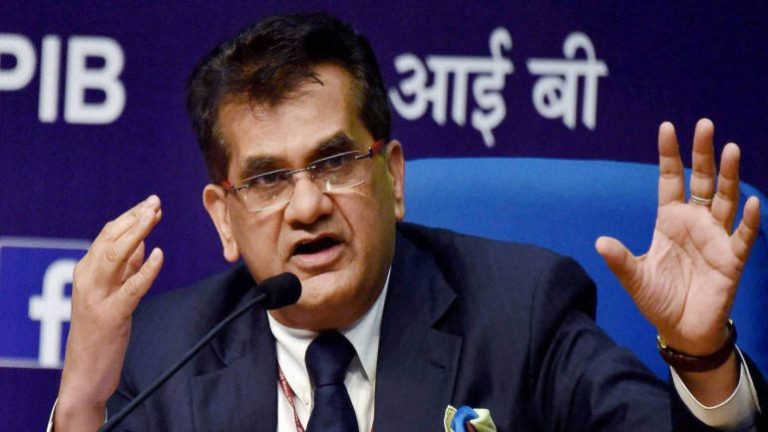
Amitabh Kant, the CEO of NITI Ayog, has stated that the recent judgement on Aadhar where the Supreme Court affirmed the constitutionality and importance of Aadhar, has validated the government’s efforts at promoting good governance and ensuring that the benefits reach the people in need. In an article written for the Economic Times, the NITI Ayog CEO has asserted that the recent Supreme Court judgement is also a validation of the magnitude of the initiative which has greatly reduced leakages and corruption in disbursements across the country.

Amitabh Kant wrote that by using AADHAR, the government of India has saved over Rs 90,000 crores every year by plugging leakages in over 500 social welfare schemes.

However, Kant is critical of the SC’s decision to limit the scope of the usage of Aadhar by the private sector, he says that the SC judgement has not gone far enough. Writing further that the SC has done a great disservice to the ‘ease of doing business’, he added that the usage of Aadhar for various services like opening of a bank account, taking loan and insurance policies or even Aadhar based payment systems have greatly reduced red tape, paper-work and time.

He writes that by scrapping the section 57 of the Aadhar Act, which allowed private companies to use the Aadhar-based authentication process, the SC judgement created a hindrance in ease of doing business and maximising technology enhanced economic efficiency. “Yes, a critical aspect of the Aadhaar is as a social welfare mobilizer, and also as a necessary form of identity for one and all. Having said that, the Aadhaar has an enormous role to play in achieving a cashless, transparent, efficient and inclusive economy and ecosystem. e-KYC and Aadhaar enabled validation has been a game changer for many sectors and boosted capability and capacity. To roll that back as per the judgment would cause irreparable paralysis to efficiency and capacity and adversely impact the productivity in the Indian economy,” Kant has written in his article.

Kant has further written that some of the major benefits of Aadhar that cut across socio-economic lines were the ease of meeting address proof requirements and easy authentication of identity irrespective of the geographical location of individuals.

Amitabh Kant asserts that the SC should have let the section 57 stand and instead should have directed the government to create a strong legal framework that set out terms of use and protect the privacy of individuals who have given their Aadhar details for authentication. He furthered that the economic outcomes of a judgement must have also been considered given the sheer number of people who have benefitted from technological efficiency brought by Aadhar enabling.

Amitabh Kant also showed concern that if due to the uncertainty created over the use of Aadhar authentication by private entities, the private entities, going forward, become wary of using biometrics and Aadhar based authentication, it would undo years of efforts spent to enhance speed, accountability and efficiency.

Praising the judgement for reposing complete faith in the Aadhar in the matters of social benefits and transparency, he has expressed concerns about its economic impacts due to the scrapping of section 57. He concludes by saying that going forward, a law that ensures privacy while removing barriers to unrelated and necessary activities will have to be the likely next step.


‘Provide quota in government jobs, educational institutions to the transgender community,’ Uttarakhand High Court directs state government

The Uttarakhand High Court on Friday has asked the state government to provide reservation for transgender people in government jobs and educational institutions. The state government has been given six months time to implement the decision. In addition to this, the government has also been directed to build separate toilets for them at public places.

The court observed that transgenders “often face severe and pervasive discrimination within the society” and said, “they (the transgender community) have an absolute right, as enshrined under Article 21 of the Constitution of India, to maintain privacy and to live with dignity.”

The order came after two petitioners from the transgender community filed a petition seeking protection of their lives and liberty. The Dehradun SSP has been directed by the bench comprising of Acting Chief Justice Rajiv Sharma and Justice Manoj Tiwari to provide security to the two petitioners. The bench has also directed the government to form a welfare board for transgenders which includes a person from the community. The high court also issued directions to the district administration to ensure registration of all transgenders, and to make sure that no discrimination happens with community members and their children

We have reported earlier today that the Uttarakhand High Court has asked the Centre to implement a strict ban on pornographic websites after taking Suo Motu cognisance of a recent gang rape of a school student in Dehradun by her fellow students.

Bhartiyata: The essence of Bharat

Sister Christine referring to Swami Vivekananda once said: “Our love for India came to birth, I think when we first heard him say the word, “India” in that marvellous voice of his. It seems incredible that so much could have been put into one small word of five letters. There was love, passion, pride, longing, adoration, tragedy, chivalry, Heimweh, and again love. Whole volumes could not have produced such a feeling in others. It had the magic power of creating love in those who heard it.”

Scores of thinkers right from ancient times have tried to figure out this wonder named India. This civilization had an enchanting effect on the world and being the oldest civilization continues to enchant people, pique curiosity and exert its influence upon this world in ways unknown. Right from the poses of Yoga to the deep diversity in each region of this nation, this nation continues to make people right from social scientists to civilizational experts flounder in their assessment.

So what is this nation we call Bharat or India?

What is Bhartiyata then?

Media had raised a storm after the recent statement of Sarsanghchalak Mohan Bhagwat Ji referring to Bhartiyata somehow making it seem that RSS had a change of stance. Needless to say, the people making this hue and cry never understood Bharat nor RSS because RSS has just reinforced its Nationalist Stand of Bharatiyata.

The cultural inclusiveness of Bharat is a fact which RSS and all Nationalist organizations always knew to be true. When Sister Nivedita exhorted the nationalist youth, who had gravitated towards Vivekananda’s message, to internalise and work for “jana-desh-dharma” she was uttering a sutra of national service inspired by an intrinsic identification with the spirit of Bharatiyata. In fact, the Jana Sangha Founder Pandit Deen Dayal Upadhyaya always used the phrase “Bhartiyata” which makes the current uproar seem needless.

So how do we understand this seemingly elusive concept called Bharatiyata?

Rabindranath Tagore put it succinctly when he suggested reading the works of Swami Vivekananda to know about India, as he felt, in Vivekananda “there is everything positive and nothing negative.”

In Bharatiyata every Hindu, Muslim, Christian, Jew and Parsi is Bhartiya first and Hindu, Muslim, Christian, Jew or Parsi second. He may practice difference philosophies, worship Gods with different names but accepts all religion as True and leading to the One Supreme Goal. That is the essence of the Bharatiyata which all Nationalist Organizations including the BJP believe in. The Slogan “India First” is a by-product of this deep-rooted ideology. Bhartiyata is the essence of Bharat on which there is no argument or debate across party lines.

The other aspect now comes around namely Hindutva which is again a confusion of an ignorant mind. Hindutva is and never was distinct from aforementioned Bhartiyata and the seemingly religious connotations attached with it. Hindutva simply the essence of Hindu Dharma is what Indianness or Bhartiyata is all about. The ignorant leftist minds do understand the deeper meaning of the word “Dharma” being righteousness just like all Indians understand it. Of the four ashrams in Hinduism, only the Vanaprasthashram stage is when Dharma is referred to as religion while Karma and Artha take preponderance in Brahmacharya and Grihastashram. However, for some political expediencies in today’s India, some political parties overlook all this because for them Ignorance is bliss.

The Sarsanghchalak statement on Bhartiyata needs to be seen in this context. As far as crediting the Congress is concerned, PM Narendra Modi himself from the ramparts of Red Fort had expressed his admiration and gratitude towards all Prime Ministers including that of Congress for their contribution to the Nation. There has been no doubt ever about the important Congress role in the Independence of the nation whether it be tallest leaders like Subhash Chandra Bose or Sardar Patel. Many of our iconic freedom fighters have undoubtedly been Congressmen.

Having said this, no first family of Indian National Congress (INC) can go around claiming accolades for the INC of Pre-independence India is definitely not the Congress of today. It would be a grave sin to even compare today’s Congress party with that of the past with its internal democracy where even the Mahatma can be challenged by Subhash Chandra Bose. Today it is merely a family fiefdom existing well past its go-by date destined to languish unless the democratic spirit in it is revived. The Congress leaders in 2019 have to make that bitter decision on whether to opt for a family run party headed by a clueless leader or a party for every Bharatiya.

Another important question which the debate on Bharatiyata brings up is on “Secularism”. The lexicon supposed to be a positive word has gained the dubious reputation of being the most misused word in India. Bharatiyata with its rich syncretic tradition of assimilating a vast repository of scriptures, philosophies and thoughts is the only land which believes in multiple ways to the same divine and hence truly secular. No other culture can lay claim to such a non-violent and inclusive philosophy much tainted in large part due to invasions across the centuries. It continues to exist despite these many challenges and continues to believe in Sarve Bhavantu Sukhina (May all be happy) & Vasudaiva Kutumbakam (The whole world as a family). The leftist continues to remain purposely unaware of the age-old Indian philosophy and continue to harp on supposed “Secularism”. No coincidence that the same man George Holyoake who coined the word Secularism also coined the term “Jingoism”

The Bharatiya Janata Party (BJP) is committed to bringing out the best of Bharat and make it the Vishwaguru again. Restoring this great motherland to its past splendor is easier said than done. India under the leadership of PM Narendra Modi ji is taking giant leaps on this front and marching ahead towards prosperity.

Bhartiyata is the only secularism that is. It is the only philosophy which encapsulates and assimilates all thoughts, ideas into one and only this philosophy can make the world rid of extremism & internal conflicts. India will lead the world in this philosophy as it has always done and ensure a strong, powerful united nation. It will be Bhartiyata i.e “India First” which will be an example of nationhood for other countries to emulate.

All this of course does not mean that BJP or RSS endorses the return to a Congress version of secularism which appeases rather than empowers minorities. We believe in empowering each Bharatiya so that Bharatiyata in them blooms like the lotus of BJP.

(Shweta Shalini is BJP Spokesperson, Advisor to Chief Minister of Maharashtra and Executive Director of Maharashtra Village Social Transformation Foundation (VSTF), an initiative by the Government of Maharashtra)

Eeny Meeny Mynie Moh: Angry Gods

0

“When I was growing up the gods were never angry,” said Eeny to her friends at a quiet cocktail party in a hidden corner of a terrace bar.

“I know,” concurred her friend, Meeny, and poured some more wine for herself. “Look what they did to poor Hanuman.”

“I adore Hanuman,” said Mynie, not to be left out, “and his cute elephant trunk.”

“That’s Ganesha, you dunce,” said Moh with some irritation. “Haven’t you seen those saffron stickers of angry Hanuman on the back of cabs?”

“Ugh!” said Mynie, disgusted as if she had found paneer instead of tofu in her salad. “Who goes in a cab?”

“The point is,” said Eeny, “that Hanuman was always a nonviolent God. Remember how he won over Lanka with love?”

“What?” asked Meeny, her face plainly indicating that this was a news to her. “Didn’t he burn the whole city down with his tail on fire?”

“No, that is what we are made to believe by these militant right-wingers,” replied Eeny, with the confidence of someone who has recently learned about some new topic by stumbling upon a WhatsApp post or a Quora answer.

“You must be kidding,” said Meeny.

“Do you know the real story?” asked Eeny, warming up to display her erudition. “When Hanuman reached Lanka, the kingdom was very dark. In order to find Sita, or was it, Gita? Anyway, he needed some light, and since there was no electricity then, he lighted the whole kingdom with so many lamps, olive oil ones at that. The city just looked like it is burning – probably some later historian mistranslated the event.”

“Who told you that?” asked Moh, unable to believe a single word of this.

Eeny looked at her, and with a triumph, said, “I read it in the book Authentic Mythology of Hindu Deities by Sanjay Dutt…I forgot his last name, some Naik.”

“Unbelievable,” exclaimed Moh.

“Duh!” retorted Eeny, mistaking Moh’s outburst as a comment on the book instead of the story. “It says authentic right in the title, so it has to be the true story.”

Moh shook her head and poured herself more wine.

Meeny, meanwhile, picked up a piece of tofu with her fork and said, “Now that you mention this, I now remember once meeting an eminent historian who said that Shiva was a nonviolent god too.”

“Absolutely,” said Eeny, for the book by Sanjay Dutt some-Naik also included stories on Shiva, and added, “one more militant right-wing narrative that he is an angry god – they have made us believe that he is the Lord of Destruction. Rubbish!”

“When Shiva opens his third eye,” said Meeny, trying to sound as erudite as her friend Eeny had tried, “rays of love will spread across the Universe.”

However hard Moh tried to ignore them by sipping more wine, she couldn’t. “What nonsense!” she hollered. “Shiva once opened his third eye and Kama, the Love God, you know, was turned to ashes – they were not rays of love, my sweetie pies, but rays of fury.”

Eeny knew what to say. “It’s a…uh…what is called an allergy, Moh.”

“What?!” yelled Moh.

“Allergy…it means, you know, a story that is really not what the story is about,” said Eeny, with some confusion.

“You mean an allegory?” asked Moh.

Meeny, who was getting impatient to add her two cents, interrupted and said, “Allergy or allegory, who cares? Do you know what I love about Shiva? The moon on his locks…I had read somewhere that it actually means peace. Such a secular symbol!”

Mynie, who was silent until then, said, “I adore Shiva and that chakkar thing that spins on his finger.” Just in case the rest did not get her abstruse reference, she lifted her index finger and went, “whirrrrrrrrrrr!”

Eeny and Meeny laughed hard at this, for despite reading books by Kudratey Schuer and the one that they called Sanjay Dutt some-Naik, they knew that Mynie was wrong about this one.

“Where did you grow up, Mynie?” asked Eeny, still laughing. “Even Shahid Siddiqui knows better than you about Hindu prophets.”

Mynie shrugged her shoulders and said with evident nonchalance, “I am a poet, and for me, poetry is more important than the story.”

Eeny and Meeny conversed about how the militant right-wing had made Durga an angry goddess in recent years.

“I didn’t know that Durga was a major goddess in Polynesian mythology,” said Eeny.

Moh had to intervene. “Whoever told you that? Durga is as Indian as Ganesha or Vishnu or any of the other gods.”

“Rowling said in one of her tweets,” said Eeny, and her eyes went dreamy remembering some obscure spell in one of her books on the boy wizard.

Meeny, looking at the incredulousness on Moh’s face, retorted saying, “She is the greatest author ever, and she cannot be wrong. She knows more about spells and stories than anyone else!”

Moh, who had never read any of Rowling’s books, wondered if there was a spell to turn her friends to ashes, and then realized that she did not need Rowling for that. Shiva had already done that some millennia before three-quarter platforms had existed.

“I adore Durga,” said Mynie, interrupting the conversation this time, “and the gold coins that fall from her palm. Clink clink clink.”

Eeny and Meeny laughed again.

Moh wanted to scream at her friends, slap them with some sense, tell them that their ignorant blabber was lower than the intelligence of politicians who had made a habit of lying every time their kurta was torn, but they had always been good to her. She looked around and the terrace bar spelt “upscale” in bold. The wine was also especially great today. She poured some more for herself.

Eeny’s iPhone vibrated on the table. She picked it up as if it was her baby, and tapped on the WhatsApp notification.

“Get the placards ladies – we need to go,” said Eeny, evidently in response to some message she had got.

Eeny, Meeny, Mynie, and Moh left the building without paying the bill.

Hindutva in the age of Social Media

With the rise of Narendra Modi, Hindutva has received a fresh ray of hope. Since his stunning victory in the 2014 General Elections, Hindutva has firmly seated itself in mainstream politics. The mainstreaming of Hindutva was further sealed when Mahant Yogi Adityanath was appointed as the Chief Minister of Uttar Pradesh after the Bharatiya Janata Party registered a thumping victory after a campaign which was very polarizing at times.

It is known that Narendra Modi used social media very effectively to emerge resoundingly on the national scene. And social media has been very critical to his victory. Thus, after more than four years in power, when Narendra Modi’s popularity remains unchallenged, we look at where Hindutva now stands in social media.

There was a particular slogan that originated sometime in the 1980s or possibly even before that, it’s difficult to be sure about these things, which went to capture the popular imagination in a definitive way. It was, however, in Lal Krishna Advani’s speeches during the Ram Janambhoomi movement that the slogan became a feature of mainstream politics and has remained ever since. The phrase that I am referring to is, of course, ‘Mandir Wahi Banayengey’.

Advani said in his speeches, ‘Saugandh Ram ki khaatey hain, Mandir Wahi Banayengey!” Since then, the slogan has become synonymous with Hindutva. There are various songs on YouTube with hundreds and thousands of views each which revolves around the theme. One such song is “Ram lalla hum aayengey, Mandir Wahi Banayengey”.
[youtube https://www.youtube.com/watch?v=_Tv74gqoMBM]

The song was shared by Subramanian Swamy himself on Youtube who recommended that the song is played every day in Jawaharlal Nehru University. It has over a million views on Youtube.

If you are under the impression a million views is a lot, here is a song called “Har Ghar Bhagva Chhayega, Ram Rajya Phir Aayega” by one Laxmi Dubey which has over 16 million views on YouTube.

If one scroll through YouTube, they will find numerous such songs revolving around the theme of Hindu assertion. Usually, the songs are dedicated to Shri Ram but occasionally, politicians like Prime Minister Modi and Yogi Adityanath also find a mention in these songs. There is this particular song by Sandeep Acharya, ‘Gunj rahey hain bas teen hi naam: Yogi, Modi, Jai Shri Ram”. It has over 2.5 million views on YouTube.
[youtube https://www.youtube.com/watch?v=zW9jHf1nYYA]

Yogi Adityanath has come to be perceived as a mascot of Hindutva in recent times. And videos on YouTube reflect that. There’s a rousing song by Piyush Mishra from the movie ‘Gulaal’ which has been used to portray Yogi Adityanath as a warrior on YouTube. The song is called ‘Aarambh hai Prachand’.
[youtube https://www.youtube.com/watch?v=j04K3_i6DGA]

It’s not only music where Hindutva has a strong presence. Hindutva has also managed to deeply penetrate the meme culture. Although it certainly can be argued that the makers of the memes themselves do not endorse most ideological positions of Hindutva or may even be critical of it, but ‘memes’ have become a subculture on their own and provide a unique insight into how the young generation thinks. As a consequence of memes, Hindutva has become ‘cool’, more accurately, has emerged as the counterculture for the youth.

There’s this page, Hindu Nationalist Anime Girls (HNAG), which adapts pictures taken from popular anime to the context of Hinduism.

Source: HNAG

Then there’s ‘Dharmic Memes for Hindu Teens’ on Twitter who we have interviewed at OpIndia.com.


And of course, there is @OGSaffron on Twitter who has acquired over 24,000 followers on Twitter with aesthetic pictures that he shares with stirring captions.


In addition to the people I have mentioned here, there are numerous others who create funny content based on Hindutva to tickle your funny bones.

Apart from songs and memes, there are also ‘Mandir Wahi Banayengey’ t-shirts available on Amazon and elsewhere.

Source: Amazon

Thus far, we have elaborated on the entertainment aspects of things. However, social media has also led to a spurt in the intellectual development of Hindutva. The manner in which social media allows everyone to have a voice and felicitates the rapid distribution of information has enabled many to share their valuable knowledge with people at large and enabled them to coordinate with others with a similar thirst for knowledge to spread their ideas better.

We are well aware of the manner in which social media destroyed the monopoly of mainstream media on truth and worked overtime to discredit the fake narratives that they would often peddle. However, social media has served a vital other purpose. It has inspired many young people to pour over historical texts to extricate tidbits of knowledge that others before them might have missed.

As a consequence of social media, we have 22-year-olds, 23-years-olds who have been provided with an opportunity to utilize resources available on the internet and made easily accessible by interaction on social media to contribute in their own way towards Hindutva. Hindus have used the ‘blogosphere’ effectively to build a solid foundation for an intellectual basis of Hindutva. In the long run, it might prove critical in reversing the effects of the tides of time.

Thus, social media has been a boon for Hindutva. And it’s no wonder that there are persistent efforts to regulate them. The vast influence of Hindutva on social media and the manner in which it used the medium to propagate itself offers us an interesting insight into a feature of religious doctrine. Unlike what rationalists would have us believe, religious doctrine is immensely resilient. Confronted with modernity and modern technology, it initially finds it difficult to cope with it but after a while, religious doctrine always manages to integrate the technology into its operations and use it to propagate itself.

Srinagar: special police officer posted in PDP MLAs residence runs off with seven AK-47s

0

A special police officer deployed with People’s Democratic Party (PDP) MLA, Aijaz Ahmad Mir, reportedly absconded with seven assault rifles of colleagues from a Police post guarding his residence at high-security Jawahar Nagar area in Srinagar.

The SPO identified as Adil Bashir Sheikh, 24, (Belt No. 488/SPO), fled with 7 AK-47 rifles and one pistol, all of which were personal licenced weapons belonging to the MLA who was currently out of the state.

The police have announced a reward of Rs 2 lakhs to capture the deserter and furthered that a case, FIR no 57/18 has been filed against him and investigation has been initiated.

A police official while speaking to Greater Kashmir said that the incident happened at 6:30 pm when the SPO had entered the J-11 quarter (official residence of MLA Mir) to “clean the rooms.”

Following the incident, the Srinagar district and the routes leading to South Kashmir has been on high alert. Amid the alert, government forces launched searches at multiple places in Srinagar and its outskirts.

Sources said that the incident came to the fore when a police officer who was on leave resumed duties and reported the incident to the MLA who later informed the police.

There have been several incidents of policemen and SPOs deserting the force along with weapons to join militant groups which have been reported in the last few years.

In March 2015, policeman Naseer Ahmad Pandit posted at the residence of former minister and legislator Altaf Bukhari fled with two rifles and joined militant group Hizbul Mujahideen. He was killed in an encounter in south Kashmir.

In January 2016, a constable Shakoor Ahmad Parray, a resident of Kundalan village of Shopian district in south Kashmir, who was posted in Bijbehara, decamped with four automatic rifles in south Kashmir, ahead of Republic day.

Earlier this month we had reported that a day after three policemen were abducted and killed in Shopian district of South Kashmir, the Hizbul Mujahideen terrorists issued threats to another 24 policemen including two officers posted in the militancy-infested South Kashmir, asking them to quit or bare the consequences.