Home Blog Page 7167

Shrikant Rathi – An achiever, a budding lawyer and a teenager with a vision

Shrikant Rathi is a typical teenager. He loves spending time with his friends, studying and has big dreams for his future. Any stranger talking to him would not even realise what hurdles this shy, smiling teenage boy has faced in his life. Shrikant is 100% visually impaired. He lost his eyesight as a toddler. Yet this young fighter has never let his lack of eyesight stop him from anything. We talked to Shrikant about his life and his dreams.

Shrikant has scored 88% marks in his 12th class board examinations from Maharashtra State Board. An enterprising student since childhood, he had scored 86% marks in 10 class board exams too. He lives in Mumbai with his uncle and aunt.

He is a 17 year old young man was has also cleared MHCET exam for further studies.

When asked about his early childhood, he said, “I lost my eyesight as a toddler. I was diagnosed with Retinoblastoma in both eyes and had lost my eyesight since I was 2 years old. I came to live with my uncle and aunt in Mumbai at age 4. I studied till class 10th in Happy Home and School For the Blind in Mumbai”.

As difficult as it was, Shrikant is extremely enterprising and attributes his success to his supportive family, teachers and friends.

“Yes it has been difficult, but my family, my teachers and my friends have supported me a lot. My friends never made me feel I am lacking something. My teachers at Happy Home School were very supportive and they always encouraged me. Up to class 10th I was in a residential school. My teachers helped me a lot. After class 10th I studied in the Arts stream in a State Board affiliated junior college. My friends helped me a lot. They used to help me with notes and even sent me to study material through WhatsApp. My uncle and Aunt would then read it aloud and explain it to me”.

Often, young boys with special needs face some amount of discrimination from their peers. When asked if he faced the same, Shrikant was all praises and said Mumbai is a friendly city and he has always found acceptance and support.

He also said the only thing that truly makes him feel bad is when someone tries to help him out of sympathy.

“Frankly, very rarely. Mumbai is a very friendly city. Even complete strangers help me get on trains and guide me. My friends have been very supportive. But the biggest support is my family. My uncle, aunt and my parents have never let me feel I am lacking anything, They are an inspiration. My dad is my hero. I only feel bad when someone tries to help me out of sympathy. I do not want sympathy. I want people to treat me like they treat everyone else”, said Shrikant.

Shrikant with his parents

Shrikant wants to become a lawyer and has cleared the MHCET and CLAT (Common Law Admission Test) too. He is hopeful of getting admission in a good college and becoming a lawyer in future.

Like any other teenager, Srikant loves cricket and books.

“I follow cricket. MS Dhoni is my favourite player. I am very interested in national politics and I actively participate in debates at my school. I love fiction. I listen to audiobooks”, he said.

A student par excellence, Srikant is also interested in current affairs. He believes Prime Minister Modi is an inspiration for youngsters like him. “I follow current affairs passionately and I can say with confidence that our country is in good hands. PM Modi is an inspiration to youngsters like me. He made me believe that any common Indian can achieve his goals if he is willing to work hard. I am willing to work hard and I am sure I will become a great lawyer someday”, he said.

He spoke about how the current government is extending all the necessary help to visually impaired sportspersons, some his friends. Srikant says, “Many of my visually impaired friends have participated in judo, Kabaddi etc. They have even gone abroad and excelled there. The government is providing them with all the opportunities and necessary training. I strongly believe that the Modi Ji is doing what is best for the country”.

His message to youngsters like him was simple. Work hard. Keep the faith and achieve the desired goal. “I want to say to everyone that hard work and faith in one’s ability makes us achieve any desired goal. I am very fortunate to have the support of my Mama Mami (Mr Anand Bagri and Mrs Puja Bagri) and also my parents. We are living in times where there are a lot of opportunities for the youngsters to explore. it is upon us to make the best of them”, he said.

Shrikant may not have eyesight, but a brief conversation with him makes clear that he has sound vision. Despite the difficulties he had faced, he has kept fighting and he does it all with a sweet smile on his face. He is an inspiration to us all.

Civilians return to their villages as India-Pakistan agree to uphold the 2003 cease-fire accord

The Line of Control between India and Pakistan has always witnessed extreme hostility with a series of violations of the cease-fire agreement between India and Pakistan. As per reports, this time again, Pakistan’s Major General Shamshad Mirza and his Indian counterpart Lieutenant General Anil Chauhan agreed to “fully implement” the 2003 ceasefire understanding in “letter and spirit.”

Both sides “agreed to undertake sincere measures to improve the existing situation, ensuring peace and avoidance of hardships to the civilians along the borders.” This came as a breather to as many as 50000 civilians who had taken shelter in schools and colleges in the Indian-ruled part of disputed Kashmir, away from the bombardment that officials say killed 12 people and wounded many more on both sides over the past few weeks.

Jammu and Kashmir Chief Minister Mehbooba Mufti, in her tweet, welcomed the ceasefire agreement.


“This brings great relief to the people residing in the vicinity,” she said on Twitter on Wednesday. “Peace on our borders is the first essential step to a larger understanding and I truly hope it sustains.”

The villagers of Jammu Kashmir are on one hand relieved with this decision as they could finally return home, but on the other hand are convinced that this decision would not last for long as they said, such agreements rarely last long.

“They agree to respect the ceasefire several times every year but then they violate it again. Every time people are killed, cattle perish and we end up in such camps,” he said. “We are in camps for the second time this year. We don’t want this uncertainty. We want permanent peace as we had 30 years ago”. as said by Bacchan Lal, the headman of Abdullian village in Jammu and Kashmir.

Tensions between both the side have forever escalated ever since. There have been innumerable such incidences where the two countries have damned each other for breaching the cease-fire contract. It was reported last year that our Indian soldiers, including an Army Major, were killed in the Rajouri district in cross-border firing. The Pakistani military used missiles to target India’s forward posts on the Line of Control (LoC). In retaliation to this, the Indian Army Jawans crossed the LoC and killed three Pakistan Army soldiers.

Almost 15 days later a cross-border operation was carried out on a day when the Indian Army was celebrating the Army Day. In this attack, seven Pakistani soldiers were killed and four others injured in by the Indian Army along the Line of Control in Jammu and Kashmir’s Poonch area. This came as a ‘retaliatory action’ as asserted by the Army Chief Bipin Rawat, who said that ‘we will take stronger steps against our enemies if we are compelled to do so.’

Pakistan has been exporting terror to India and indulging in unbridled ceasefire violations along the LoC for a long time. It remains to be seen if Pakistan honours its words this time, or as usual, goes back to its old violent ways again.

Detours : It’s time we celebrate our aboriginal or adivasi heritage and culture

A few months back I travelled to British Columbia on the invitation of Canada Tourism. I expected it to be a place filled with natural beauty and it sure did not disappoint. Falls colours were enchanting, to say the least. However, what fascinated me most was its Aboriginal Tourism – the presence of First Nations communities in public spaces and in spaces specially designed to showcase their heritage. Totem Poles could be seen almost anywhere, sculptures with folk tales sit proudly at the airport. I went museum hopping learning about the tribes like Lilawat, Squamish, Songhees, Saanich, Esquimalt. In a few days that I spent there, these names became familiar entities.

I came back, read a bit more about First Nations of British Columbia and wrote a log piece on them. As soon as it was published, my thoughts went back to all the tribal museums I have visited in India – be it Tribal Museums in the heart of Delhi or in Posh Banjara Hills of  Hyderabad, or in situ tribal museums in Araku Valley, Silvassa, and Ratnagiri. I had hardly seen a soul at any of these museums. At one place, I had to request the caretaker to open the museum for me, which he did rather reluctantly. The museums where they exist, have a series of dioramas depicting tribal lifestyles.

At one of the museums, I wanted to take pictures and I was told strictly no photographs. I asked to meet a senior official to understand why no photography is allowed. After all, all that the museum has is recreated models of tribal landscapes and lifestyles. There are some items of personal use on display, but none that would be damaged by photography like say paintings of Ajanta would.

I was told if the photographs of the museum are published online, who would come to the museum? In a state of near shock, I asked them have you seen how many people post their pictures with Taj Mahal, has it stopped people from coming to Taj Mahal or has it inspired more people to come and see it for themselves. No answer came and there was no inclination to even think about it, forget about changing the photography policy.

Imagine the lost opportunity of free publicity by visitors. Imagine the images on Instagram, Facebook, and Twitter that will, first of all, tell people that such museums and such tribal communities exist, and then hopefully encourage people to visit them.  Imagine the connect it would create for these tribal communities with the rest of the world.

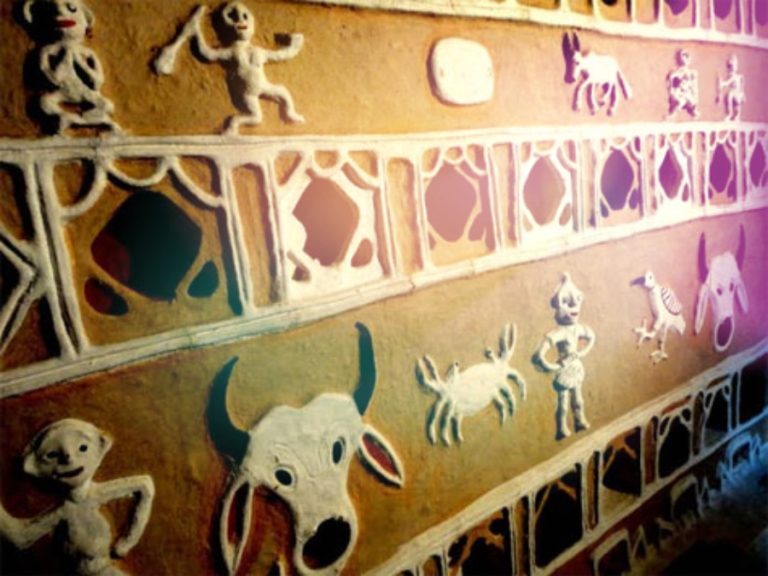
I wonder why do we not have our aboriginal art in public spaces? The only exceptions I have seen are the two railway stations across the country – Ratnagiri station with Warli art and Bolpur station with Shanti Niketan inspired art. Recently, I read about Madhubani station in Bihar being painted by local women & I thought it was a great tribute to Madhubani Artists like Ganga Devi. Why do we not have our public spaces depicting our local cultural roots? Given the diversity of our country, it would make our public spaces a riot of colour and designs while reminding us of our rich roots.

Souvenir shops in Canada were full of First Nationals inspired souvenirs. In India, it is an exception when I discover truly tribal inspired souvenirs. I think if I have to choose a tribal gift, I would have to go to Tara Books or some ethnic jewellery shops. Almost none of the tribal museums I have visited had a souvenir shop where I can buy something. They did not even have the literature about the tribes they are showcasing. At every museum, I look for books on the subjects being showcased. I am yet to find one that does not disappoint.

Guided tours can generate employment while enriching the visitor experience. Today, it is a such a dry experience to go through tribal museums of India, with almost no documentation and no reading material. It is not too difficult to publish books for children as well as adults. How lovely it would be to listen to some tribal music or instrument.

The government has already spent crores of rupees in setting up these museums, lakhs must be spent every year to maintain them. With a little thought and effort, the spaces can become our cherished cultural spaces.

Having said that there are two tribal museums that give me hope. One is Don Bosco Museum in Shillong, which presents the tribes of North East India in an elaborate and engaging manner. Second is Purkhauti Muktangan on the outskirts of Raipur in Chhattisgarh which is a vast open-air museum. Both these museums stand out because of their unique and thoughtful designs. I hope they get great storytelling guides, books and souvenirs also to complete the experience.

BBC retracts the fake news it published on Sikh police officer getting death threats for saving Muslim man

Yesterday, BBC published an article titled ‘India Police officer threatened for saving Muslim man from mob’ claiming Gagandeep Singh, the Sikh police officer who protected a Muslim guy from a mob, was facing death threats and has been sent on leave.

Fake news by BBC

The news was also picked up by other international publication, The Daily Mail.

Daily Mail too published the report.

OpIndia got in touch with Ramnagar Police Station, where Gagandeep is posted and talked to the officials who denied any such threat to Singh.

Even as ‘liberals‘ and other foreign media persons refused to believe the official version denying such threats, putting BBC report on a pedestal, BBC has silently put up a correction that they no longer believe that Singh faced death threats.

BBC correction

They even changed their story to ‘online abuse on social media’.

BBC changed the story completely.

Interestingly, BBC and Daily Mail have a huge readership in the UK which is home to over 4 lakh Sikhs.

International publications have been regularly indulging in peddling fake news and fake narratives about India. New York Times does it regularly and UK publications are no exception either. Instead of trying to invent false news in India in their attempt to create a religious divide and malign Hindus, perhaps UK based publications should focus more on the problems in their own backyard where Muslim grooming gangs have been abusing generations of little girls right under the nose of authorities.

Christian missionaries accused of assaulting an aged tribal for not converting to Christianity

A 65-year-old tribal man has filed a police case against two Christian missionaries, his daughter and her lover for forcing him to convert to Christianity, Dainik Jagran has reported. This incident has been reported from Bolba region in Jharkhand.

Promptly acting on the complaint by Somaru Manjhi, the police arrested the four accused named Sumanti Kumari, Rupesh Manjhi, Sudarshan Manjhi and Neelam Devi.

As per Ravi Shankar – the Bolba police station chief, the victim accompanied by the panchayat chief and few other individuals had filed a complaint at the police station. Under the complaint, it was alleged that Somaru was heavily pressurised by the accused to convert from Sarnaism to Christianity.

In order to achieve the goal, the accused supposedly assaulted him at his home. He was then saved by the villagers who later took him to the police station to file a complaint.

It is being reported that Rupesh Manjhi a resident of Hethma fell in love with the victim’s daughter named Sumanti Kumari. A believer in Christianity, he also convinced the daughter to convert. Later the Christian Missionaries named Sudarshan Manjhi and Neelam Devi got involved in the matter and started forcing the victim to convert.

The trouble intensified when the couple wanted to get married in a Christian religious ceremony on 30 May. The father though wanted the marriage to take place under Sarna traditions, and also insisted that he won’t convert to Christianity. Following this, the accused proceeded to beat him up.

As per a Bhaskar report, the four accused were arrested on Wednesday on charges of forced religious conversion. As per the report, this is the first time an arrest has been made in Bolba for religious conversion.

Jharkhand already has an anti-conversion bill which was put in place by the BJP government in 2017. Under this bill, one can be jailed for three to four years and pay a fine ranging between Rs 50,000 and Rs 1 lakh if they convert the religion of a minor, woman or member of the scheduled caste or scheduled tribe.

Soon after the bill’s passage, Christian groups in the state had opposed it by calling it a design to harass the church and missionaries.

Bypoll results: when ‘journalists’ turned strategists for the ‘Opposition’

Results of various bypoll elections held recently were declared today. While BJP won in Palghar, Maharashtra, Tharali, Uttarakhand and Nagaland Lok Sabha bypoll elections, the opposition won the remaining including the high stakes Kairana (Uttar Pradesh, RLD) and Noorpur (Uttar Pradesh, Samajwadi Party) and Jokihat (Bihar, RJD). Except for Rajrajeshwarinagar Assembly seat in Karnataka and Shahkot Assembly seat in Punjab, regional parties have fared better than Congress. During the high octane, Karnataka Assembly polls Congress had to form an alliance with JDS to form the government, which is already on shaky grounds. However, the ‘neutral’ journalists of India have become Opposition strategists for a day dishing out advice on what future course of action for the Opposition should be.


Can the Nehru fan-girl be far behind on nudging Congress in the ‘right’ direction?


And then she cheered for fodder scam convict Lalu Yadav’s son, Tejashwi Yadav.


AAP cheerleader and a ‘journalist’ with a fading career desperately clutching to straws, too chimed in to appear relevant.


Perhaps Congress President Rahul Gandhi’s political end is near.


Election season is upon us and the machinery is getting itself oiled. With the same people in charge of writing articles, opinions and editorials in the months during the run-up to the 2019 elections, it is time we start taking what they say with a pinch of propaganda.

CBI confirms ongoing raids on several properties of Congress leader DK Shivakumar’s ‘close associates’

Earlier today, DK Shivakumar called an emergency press conference and asserted that the Modi government was playing ‘vendetta politics’ and he suspects several properties, including that of his brothers and 11 MLAs are going to be raided by the CBI.

The Hindu tweeted that CBI raids were already ongoing in five premises including those linked to former Energy Minister and Congress leader DK Shivakumar.


This was followed by a tweet by a journalist from ABP news that CBI has confirmed no raids were being conducted at DK Shivakumar’s residence.


According to The Hindu, the raids were related to April 7, 2017, registered FIR by ACB, CBI, Bengaluru in relation to a bank fraud to the tune of ₹10 lakh at Corporation Bank, Ramanagara.

CBI had then registered an FIR against B. Prakash, chief manager of Corporation Bank, Ramanagara, alleging that he had exchanged ₹10 lakh of new ₹500 and ₹2,000 notes without any proper documentation as prescribed by RBI. He had allegedly produced 250 fabricated requisition slips for new currency notes to cover up his illegal activities.

The Hindu also confirmed that there was no search warrant against DK Shivakumar personally or his brother Suresh.

To confirm the news, we called up the CBI office in Bangalore and asked whether any CBI raids were ongoing at DK Shivakumar’s associates’ premises. We asked that DK Shivakumar had held a press conference in the morning alleging that CBI might raid premises related to him and other associates and whether this news was true.

The CBI official confirmed that the raids were ‘already ongoing’ and there is nothing new to be reported. When asked whether the raids were ongoing on DK Shivakumar or his brother Suresh’ premises, the officials said the raids were ongoing in the premises of their close associates. The official also refused to clarify further and asserted that soon the CBI will release a press note with all the relevant information.

His premises were also raided in the past when a huge cache of cash was recovered from the premises.

Reuters poll predicts India will retain the ‘fastest growing economy’ position overtaking China

0

India is expected to retain the position for the fastest-growing major economy in January-March quarter, overtaking China’s 6.8 percent. The growth in India is driven by gains in manufacturing and increased consumer spending, according to a Reuters poll, which is based on this quarters annual growth was 7.3 percent.

The number is by the far the best pace that Indian economy has seen since July-September quarter in 2016 when Demonetization was introduced by the incumbent government. The forecast for the coming January – March quarter ranged from 6.9 to 7.7 percent.

The Indian government’s GDP data is set to be released on Thursday. India’s economic affairs secretary, Subhash Chandra Garg said growth in the country is expected to be in between 7.3 – 7.5 percent.

Prime Minister Narendra Modi, in order to boost the country’s economic growth, had introduced a nationwide goods and services tax and paved way for direct foreign investment in defence and e-commerce businesses, among others.

The fiscal year 2017-2018 saw a capital investment growth of 9 percent in the last quarter in comparison it was just around 2.4 percent the year earlier, which shows that the private investments have picked up. The consumption, on the other hand, remains strong in the $2.5 trillion Economy. Consumption accounts for around 70% of the Indian economy.

This is not the first time an International forum has lauded India and the growth trajectory under Prime Minister Modi’s leadership. Recently, Moody’s had backed Modi and upgraded India’s sovereign rating for the first time in 14 years. The World Bank had also projected a solid growth trajectory under Modi’s reign. India has also jumped 30 places in Ease of Doing Business ranking and the opposition was surprisingly not happy about it. Recently, Michael Dell had spoken of how he was inspired by India and Bill Gates had lauded Modi’s Aadhaar scheme and said that he has funded the World Bank to take the Aadhaar approach to other countries. We had earlier reported how IMF (International Monetary Fund) expects India’s economic growth to reach 7.4 percent in the fiscal year of 2018-19.

Protests erupt over a staunch opponent of Christian Missionaries getting appointed as Mizoram Governor

The appointment of Kummanam Rajasekharan as the new Mizoram governor has been met with steep opposition from a political party named People’s Representation for Identity and Status of Mizoram (PRISM), the New Indian Express has reported. Rajasekharan was appointed as the state’s governor on Tuesday.

The reasons cited by the political party include Rajasekharan opposition to Christian missionaries while being a member of Hindu groups like the Vishva Hindu Parishad (VHP) and RSS in Kerala. The party is also miffed over Rajasekharan’s supposed status as a staunch Hindu and opponent of secularism. Rajasekharan also used to be BJP’s state chief in Kerala.

As per a report by Northeast Now, the newly appointed governor since 1983 has been part of RSS, VHP and Hindu Aikya Vedi’s attempt to ward off Christian missionaries from the state. The report also lists out the party’s attempt at character assassination by calling him a “bigot”.

The protesters also allege that the governor had issues with Christians in general and was one of the key accused in an attack on Christian preacher Joseph Cooper. They also attributed to him an attempt to evict 50 missionaries from the state of Kerala in 2003.

President of PRISM named Vanlalruata, was quoted as giving a statement to the media that Mizoram is a “Christian state”, while Rajasekharan is a known RSS activist actively involved with Hindu organisations. This as per Vanlalruata is an election tactic by the BJP owing to the state elections, which are due later this year.

Incidentally, Vanlalruata describing Mizoram as a “Christian state” might be ironic in the circumstances considering, one of his party’s points of attack includes Rajasekharan’s supposed anti-secularism.

PRISM incidentally doesn’t want to fight this battle on its own and has appealed to church leaders, NGOs and Mizoram citizens to join forces with them to “drive him out of the state”.

No threat to cop who saved Muslim boy from mob, officials deny making threat claims to media

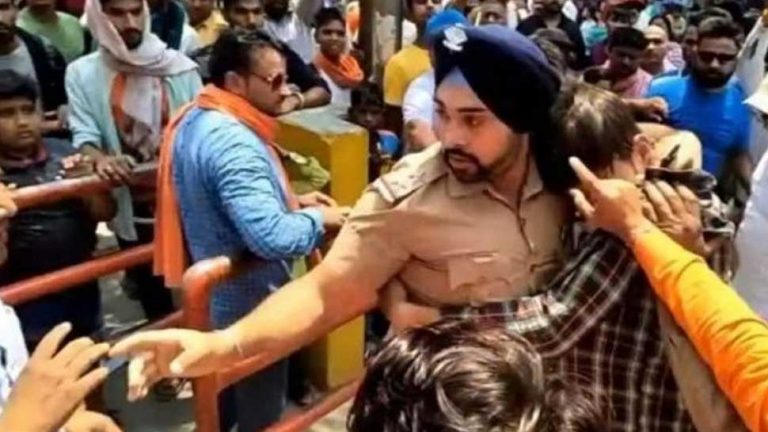
A few days ago, the picture of a Sikh police officer protecting a Muslim man from a mob went viral in the social media. The officer in the viral image, Gagandeep Singh was showered with praise. However, BBC News resorted to peddling fake news when reporting the incident.

In an article titled ‘India Police officer threatened for saving Muslim man from mob‘ BBC News claimed that Singh was criticised for his actions and has been receiving threats on his life. The article claims that the officer has been sent on leave because of the threats on his life. However, they do not quote him or name any source for the claim. They just arbitrarily state that police officials working with him have claimed so.

Not only BBC, other foreign news sites peddled the same fake news as well.

As often happens with most such fake news articles, it was soon picked up by self-proclaimed liberals and journalists. The article claimed that Hindu groups were threatening the officer.


The BBC article has been shared by thousands of people worldwide. However, The Quint, in their article, called the bluff. They reported that they have spoken to Gagandeep Singh and he has denied receiving any threats. The article quotes Gagandeep Singh as saying, ” There is no such thing. In fact, I got to know about this (that I have been receiving death threats) from other people. I have been enjoying my holiday. There is no question of me receiving death threats.”


To confirm the report, we called the police officials at Ramnagar Police station, where Gagandeep Singh is a sub-inspector and asked about any threats being received for saving the Muslim man. The officials at the station denied any such threat and also denied making any such statement to media outlets.

“Yeh galat Khabar failayi ja rahi hai, na hamein koi dhamki mili hai, aur na humne kisi media ko dhamki milne ki baat kahi hai” was their response.

Certain News corporations never miss the opportunity to malign India and the majority Hindus population. Their incessant peddling of the ‘minorities are under attack’ narrative often centres around fake news, distortions and selective outrage. This was just another attempt by BBC.

Social Media users are now slamming the BBC for reporting the fake news.


International publications have been regularly indulging in peddling fake news and fake narratives about India. New York Times does it regularly and UK publications are no exception either. Instead of trying to invent false news in India in their attempt to create a religious divide and malign Hindus, perhaps UK based publications should focus more on the problems in their own backyard where Muslim grooming gangs have been abusing generations of little girls right under the nose of authorities.

Despite their fake news being called out, BBC and Dailymail are yet to retract their fake news articles.