Home Blog Page 7345

Sunday Guardian claims a diabolical plan hatched by a former UPA minister to overthrow Modi

0

Madhav Das Nalapat, editorial director of The Sunday Guardian claimed that the ‘cabal’ loyal to the ‘first family’ in Congress was working on a ‘market meltdown’ in October. His article said that there was a systematic mechanism being worked out to engineer a crash in the market in October to tarnish the Modi government and influence the electoral results for next Lok Sabha polls.


Was the market behaviour around the budget period manipulated?

Mr Nalapat said that the market meltdown in pre-budget session was engineered by a former UPA minister and that the move had the capacity to make BJP voters in towns and cities switch sides if it were to be repeated. The report claims that the alleged market manipulation will be done by revelation of policy decisions from the former minister’s sources in the RBI and various ministries. This is an accusation of planned insider trading which is illegal. The writer cited one such plausible instance in his article.

Amazingly, the former minister is claiming credit for both the negative opening of the Singapore stock exchange on 2 February, as well as the unusual warning by Fitch rating agency that higher welfare spending in the budget just announced would impact India’s upgrade. Fitch’s comment was unexpected and the former minister has claimed to his associates that his “friends” in New York, London, Singapore and Dubai will ensure that Moody’s, Standard & Poor’s, as well as Goldman Sachs will soon issue similar warnings on India.

Alleged planned market manipulations in October can impact elections

He went on to say that if such a market crash were to happen close to the election dates, it could affect votes in urban areas where BJP is strong.

Dr Nalapat accused the unnamed former UPA minister of having hatched a plan to manipulate markets by 1st October this year in his series of tweets. As per Dr Nalapat , those assisting him in this endeavor include professionals in 31 brokerages/ financial agencies and officials in various ministries who hope that the former minister might get the ‘highest job’ if NDA were to be voted out of power in 2019.


Cabal led by former minister has deep pockets and no fear

In the article, Dr Nalapat also cited sources that accused the former minister of making Rs 39,000 crores by market manipulations, while he was in power. The cabal , according the writer is not afraid of consequences of its dubious activities. He said the ‘cabal’ headed by the former minister had planted fake stories in the past as well. He cited the case where false reports of coup by Gen VK Singh were reported in media.


His report also says that the engineered meltdown may cost about Rs 3000 crore and the former minister is ready to invest Rs 500 crores of his own in the operation. Deep pockets will come into play to achieve this goal as per Dr Madhav Nalapat. He concludes his article by saying :

Should the former minister be given an assurance by his party that he will be pitchforked into high office after the polls, the BJP may be in for an electoral ride made impossibly rough by the newly formed “October Meltdown” cabal using its deep pockets to engineer a steep and steady fall in share prices during the period preceding the Lok Sabha elections.

The scale, reach and ability of Lutyens cabal led by former minister seem to be huge. Will Modi take note of this warning and act? We will have to wait and watch.

Media reports hype a notice issued by IIT Bombay for safety and health reasons

0

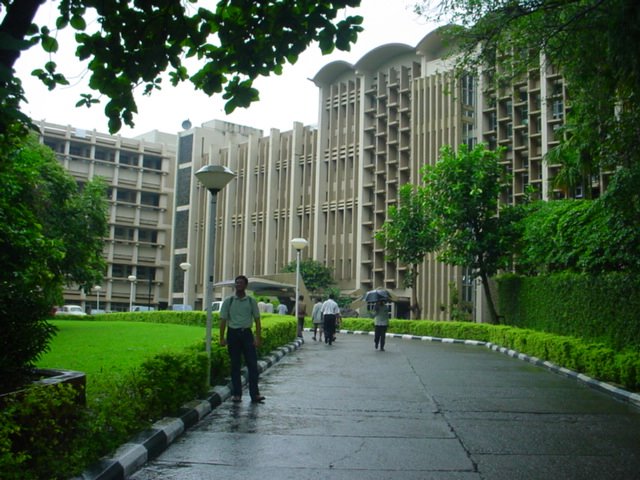
Several media houses reported about a notice issued by the IIT-Bombay civil engineering department to the contractor running a roof top cafeteria in its department. The notice issued on 20th January reportedly said that ‘non-vegetarian food is strictly banned and should not be served.’ The notice had also restricted the entry of students belonging to other departments of the institute.

Times Now ran a story with the hashtag #SanskariIITB. It also commented ‘Freedom of choice shrinking’ on its screen.

However, this turned out to be yet another case of media ‘hype’ over a trivial and routine decision that was taken by the IITB administration for valid reasons. IITB issued the following clarification regarding the incident :


The spokesperson of IITB told that the decisions were taken in the wake of Kamala Mills fire incident and health reasons. Cooking had been banned on the rooftop cafetaria of the department after the unfortunate incident of fire in a rooftop pub at Kamla Mills. The spokesperson said that some of the students had complained of food poisoning as well.

A similar controversy was raked up on social media over another notice by IIT-Bombay recent, which had asked mess staff to separate plates used for serving veg and non-veg food. Some journalists even brought ‘casteism‘ into it.

Social media reacted to such ridiculous reports after the IIT-Bombay spokesperson clarified the rationale behind the decision:

Read why BJP’s Facebook ratings have crashed to just 1.1

0

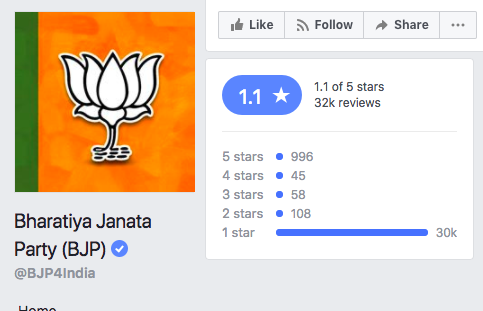
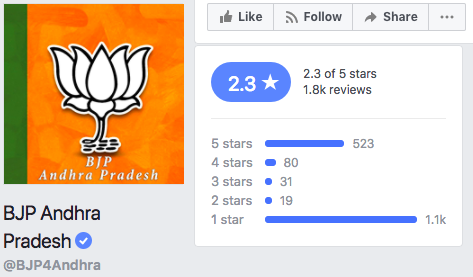
BJP’s official Facebook page ratings have come down to just 1.1 stars out of 5 stars after being downgraded by people demanding special status for Andhra Pradesh. As of now, out of total 32,000 odd votes, about 30,000 people have given it 1 star rating.

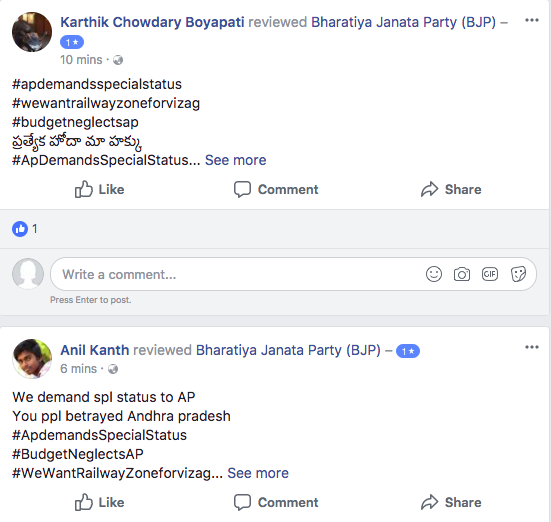
Downrating a Facebook page seems to be a new form of protest many netizens have been resorting to in recent times. The campaign to downrate the page, which earlier had an average rating of 4.5 stars, was brought down by those miffed at not Andhra Pradesh not awarded special status.

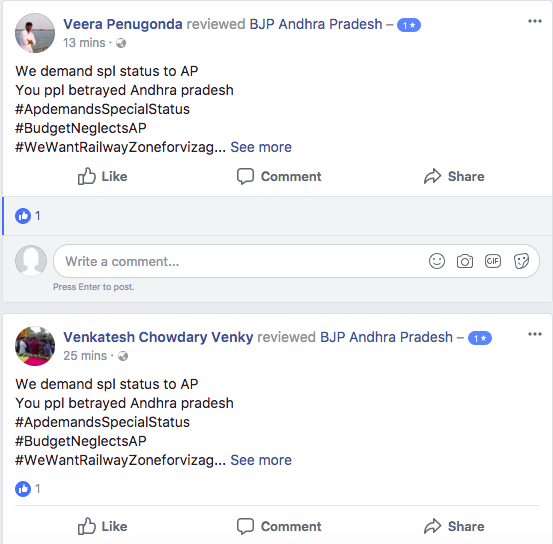
Similar trend was seen on BJP Andhra Pradesh’s official Facebook page also, where the rating was brought down to 2.3 stars. Some of the people who had downrated the page had written in their Facebook bio that they are associated with Telugu Desam Party (TDP) where many MLAs are upset with their ally BJP over the Union Budget declared earlier this month.

The page also had similar messages.

This is not the first time Internet warriors have taken to Facebook downrating to show their anger, dislike towards someone. Last year, in August, Leftists from Kerala had brought up a cyber attack on Republic TV’s Facebook page to bring down the rating and giving it negative reviews. And after they were done downrating Facebook page, they had turned their attention to the Republic TV app on Play Store.

In 2015, Snapdeal received a lot of flak from angry right wingers when Aamir Khan thought the country is intolerant. It was also accused that this piece of down voting was ‘championed’ by the BJP and was termed as bullying by some eminent media persons:


Similarly, down voting of “journalist” Barkha Dutt’s book The Unquiet Land on Amazon was called misogynist and was also referred to as “trolling” by journalists and politicians, alike:


Waiting with bated breath for the eminent intellectuals to come out in support and condemn the bullying.

To the angry middle class, read it before you press NOTA, or worse, choose Congress

The Indian middle class is Outraged. Outraged because Jaitley didn’t give any rebates in the Union Budget 2018 for the salaried class, the middle class. It seems to be the general opinion among many in the middle class that Modi has cheated them and fooled them.

The anger is real and many sarcastic and angry meme’s and jokes about the budget being shared with gusto. They are ready to vote NOTA rather than elect a “backstabber Modi” again. Their rationale being that they won’t vote Congress, they however don’t realise that they might indirectly help Congress.
That’s what I have been hearing from friends, colleagues, neighbours – everyone around. Including those who did not even vote for Modi in 2014.

Irony is – even self-declared ‘NRI intellectuals’ are complaining and shedding tears for the middle class:
So what are they angry about?

“There was nothing in the budget for middle-class/salaried-class”

Appears that middle class has confused the Budget with the recurring “Discount” “Off-Season Sale”, “Bumper Sale”, “Big India Sale” banners that they have got addicted to. Amazon does a “Great Indian Sale” in January, Arun Jaitley must do a “Great Budget sale” in February. Well, the Budget is not a discount sale.

The middle class should stop looking for rebates and discounts, reductions and benefits every year. Salaried class got some rebates this year too, apart from some over last few years. It is incorrect to simply forget that, and ask for rebates every year. Just because Subramanian Swamy talks of ‘Zero Income Tax’ or media speculated about no tax up to Rs 10 lakhs, doesn’t make them automatic entitlements to get or an obligation for the government to adhere to.

And while we are at it, as a bigger consumer of goods and services, middle class benefited most from the GST regime. Those struggling to make ends meet don’t care about restaurants and hotels. You pay 5% GST now, compared to a 18% Service Tax earlier on that dinner out. That rebate is entirely yours. And scores and scores of such other brackets where taxes reduced after GST. It would serve the middle class well if benefits are viewed with complete facts, rather than focusing just on tax rebates or buying Rahul Gandhi’s “Gabbar Singh Tax” idiocy.

“We pay all the taxes! Everyone else lives off us”

This is perhaps the biggest self-serving myth that we in middle class loves to perpetuate.

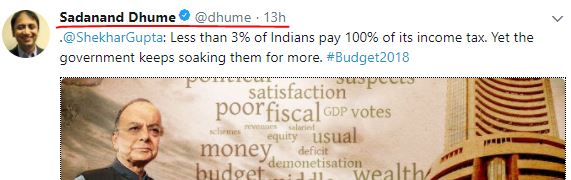
Yes, the number of direct tax assessees in India is very low. That must change, and it has changed a bit. 1.8 million new tax payers added after demonetisation strike. Still only a small 2.76% Indians pay direct income tax – that is estimated to accrue 4.31 lakh crores in FY2017-18 [pdf]. This also includes a lot of professionals/businessmen around us who earn in millions – (but since they can easily use fraud tax practices, present everything from family vacation to family dinner out as a business expense), who pay peanuts as direct taxes.

Tax compliance is a different issue altogether. But, stop deluding yourself with the notion that you are the only one paying taxes. Your 4.31 lakh crores in direct taxes is just 19% of the total 22.17 lakh crore tax revenues collected by the Govt. The bulk of taxes collected come from INDIRECT Taxes collected by the govt – GST, levies, etc. – which every Indian, from the poorest of poor to the super rich pay, of course – in proportion of their consumption as per their needs and means.

“But the Budget never benefits us! It’s always about poor, farmers and corporates. We get nothing.”

Firstly, go and delete those posts you shared on social media lamenting about poor farmers, because you didn’t mean them. Everyone wants poor to be helped, farmer to be saved – but it should be paid for by someone else. Well, there is no ‘someone else’ out there, it has to be ‘us’.

And stop grudging the industry and corporates. There would be no middle class without industry and corporates. You would be poor class in no time, if industry died. So it already indirectly benefits YOU. India need lot more industry and corporates to help more of poor to come up into the middle class.

But, wait! That is not all. Budget is all about YOU only!

  • 6 Lakh crores will be spent this year on Roads/Railways/Infrastructure. Who benefits from those? Those who don’t have a meal to eat don’t care about expressways and faster trains. You have the SUVs to use on those roads.
  • 400+ new Airports will be built across India in tier-2/3 towns. Who benefits from those? Poor don’t fly. Super rich have charters. Its middle class who will travel faster or make best of those long-weekend getaways with such a huge infrastructure impetus.
  • Hundreds of new Medical colleges will be opened via budget allocations this year. Whose kids need those? Kids of super rich could any day buy a seat – but hey, they don’t even want it, because they have business empires to run. Kids of poor barely make it to high school.
  • Who benefits most from investments in digital India infrastructure and digitization of services?
  • Rs 17000 crores to be spent for Suburban transport in Bangalore and Mumbai alone. Who benefits? Not the farmer in Dharwad or farm labourer in Akola. Not even the super rich who will never take the metro anyways!
  • Rs 22000 Gramin Markets will be setup. Hell, another farmer thing. Yeah, but guess who benefits most. YOU! because you get freedom from extreme inflation cycles.

… and scores of such capital investments being made.

Middle class has a serious Ghajini disorder! We forget the days of 10-14% inflation under UPA-2 or even when Toor daal prices being at above Rs 200/- in 2015 were a matter of middle class outrage. Where has Toor daal price been since? Did you realise the benefit of those ‘farmer friendly’ steps and meaningless E-NAM market stuff Modi’s previous budgets already accrued to YOU? If the government addresses farmers distress, YOU benefit.
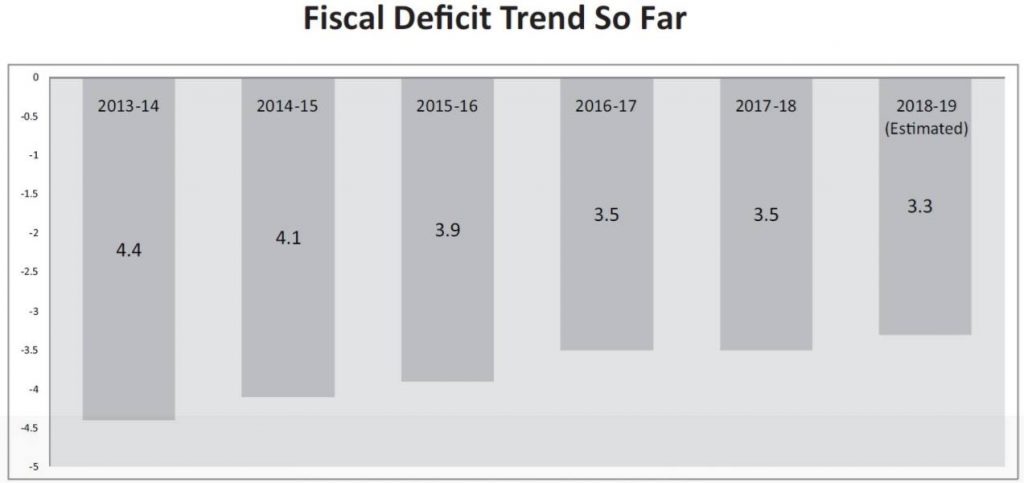
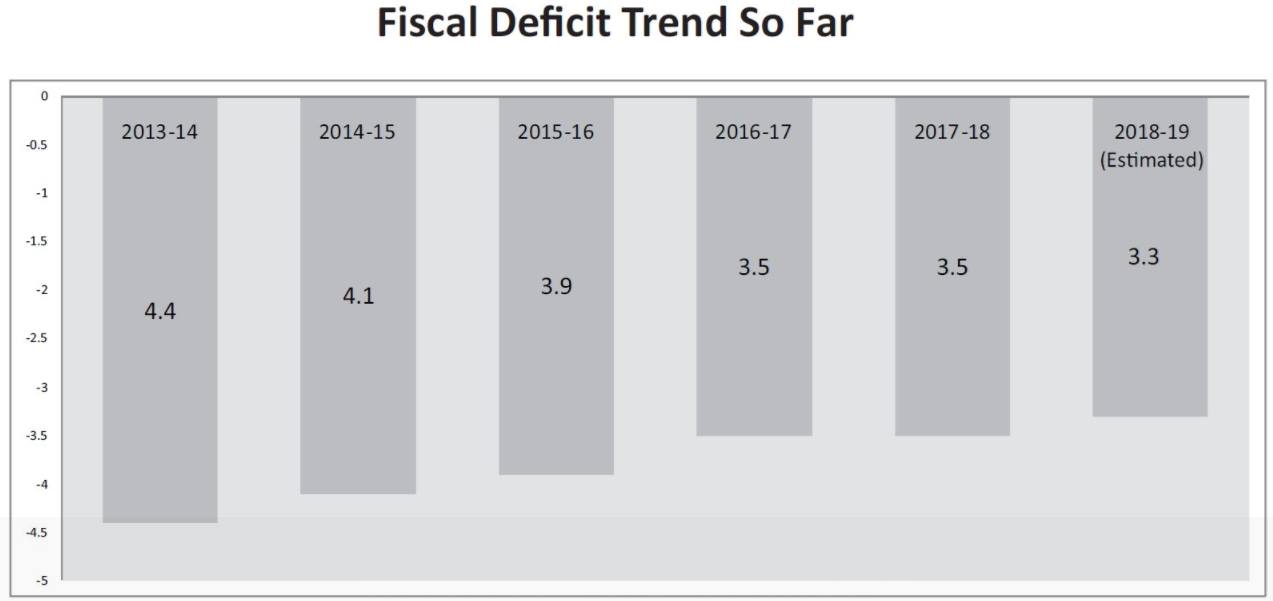
Lower deficit means safer future from a resultant stable economy. If the government keeps deficit under control as Modi has – YOU benefit from a lower risk of some future government killing you with even higher taxes.

“Modi is robbing me of my money. LTCG tax is robbing my savings”

“I am being penalised for my past investments”, “My retired fathers savings will be lost”, “Middle class is being targeted here”, and such statements were fueled by many:
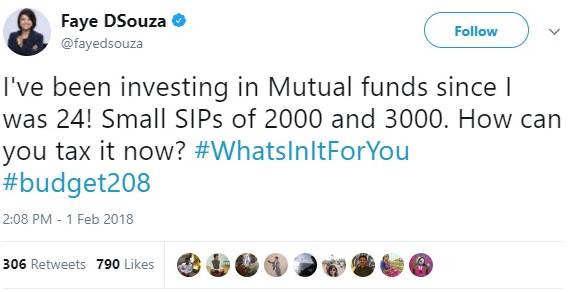
This lady – a senior editor in a news channel – is lying and misleading.

NO! Your past gains are NOT taxed. Contrary to a lot of fluff in media – Long term gains prior to Feb 1st 2018 are completely protected and not taxed. Only future Long term Capital Gains (LTCG) will be taxed. For more clarity – read this.

“But why should LTCG be taxed? This is robbing the middle-class. What incentive is there to invest in Equity long-term now?”

  • Firstly, Long term gains tax has existed on all other asset classes for ever and way more than STCG! That equity was exempt for so long and is reversed now – is a prerogative of the government today. Would I love free LTCG earning too ? Yes, why not! But then there are a lot of other taxes too I would want freedom from!
  • LTCG tax also brings in LTCL benefits, which no one is talking about.
  • LTCG is NOT Targeting the middle class. Individual equity owners number is a minority in Indian stock markets.
  • As per budget report – a whopping LTCG of Rs 3.76 lakh crore was exempt from taxes in FY17-18. And 85% of this benefit is expected to have accrued to FII/Corporates. Does that sound like middle class which is getting targeted here?
  • And finally, choosing investment options solely on tax saving criteria is patently stupid & smacks of the days middle class bought LIC policies every year for tax saving reasons. If you choose to invest in equity for long-term, do it because equity pays in long-term. Not for the tax waiver it had.

“I didn’t vote Modi for all this. I hate socialism. He spends too much on poor. Housing, toilets, gas, now healthcare… Hows it different from Congress?”

If you didn’t vote for socialism, I am sorry to inform you – you voted for the wrong campaign. Modi was out and out clear in his campaign. His speeches were full of references to “दरिद्र नारायण” “जन कल्याण” “माताओं बहनों की सेहत” “2022 तक हर भारतीय के सर पर छत” references.

Personally – I hate socialism too. But, till the economic disparity gap is narrowed and more of poor enter middle class, you and I have to live with it.

“Then how is it different from UPA?”

Good question!
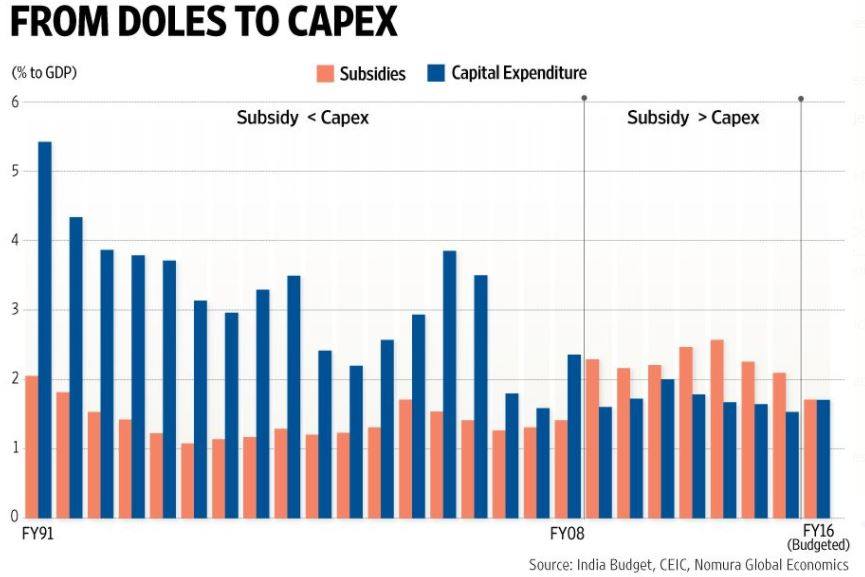
Firstly, UPA spent more on subsidy than on capital asset creation. And that huge subsidy spend was done with 60-70% leakages and bogus spends. Look at the data on ghost beneficiaries eliminated and the savings on subsidy via Aadhar and DBT in last 3 years. So, your tax money is finally being put to real use.

Some people, mostly on the economic right, did object when UPA was spending more on socialist SOPS – higher on subsidy and lower on capex all through its tenure, and that too, with a whopping 70% leakage. When UPA launched NREGA that gave money for doing nothing (and kept 70% of it in the process), we didn’t hear lout outrages. We hardly outraged against FSB and RTE, (that too based on a communally discriminatory formula) where 75% must pay for free education of 25% others because Congress messed up the government education sector over past 60+ years of its rule.

UPA became unpopular in the middle class because of corruption, not because of socialism. Basically, it was not socialism that shocked us, but leakages.

When the right prioritised objecting to corruption more than socialism during UPA, why is the same formula not being applied here where we concentrate more on lack of corruption rather than socialism, which in most cases, is unavoidable in a country like India?

There is absolutely NO party in India today which will promise to do away socialism. Not since Swatantra Party died. In fact, our constitution, amended by Indira Gandhi, now has ‘socialism’ in its preamble.

Modi never ever talked of ending socialism. Go back to his election trail and recheck his speeches. If had talked so, he would have been accused of going against constitution.

You outraged against the UPA corruption, leakages, scams, and Modi promised doing this with better effectiveness that it reaches the real needy by eliminating those siphoning from the system. Do you dispute that success today? No one is accusing of any leakages anymore. Ghost recipients have been eliminated and even the NREGA spends are directly going towards Capex/Infra development projects now.

So your choice is between paying for it with your taxes… or vote NOTA and pay for it with 70% leakage overheads.


Budget, Middle Class anger and 2019 – Should Modi be worried?

0

The 2018 budget speech was sailing along smoothly, with most ‘bhakts’ tweeting happily about the various budget announcements and singing praises of schemes like the National Health Protection Scheme. But then the moment Jaitley’s tax proposals were announced – all hell broke loose.

Supporters of the Government started showering abuses on the government for not doing anything for the middle class. This was not limited to Twitter, but seen on various social media sites including Facebook and WhatsApp. Many of these who were strong supporters of Modi were suddenly talking about using NOTA in 2019.

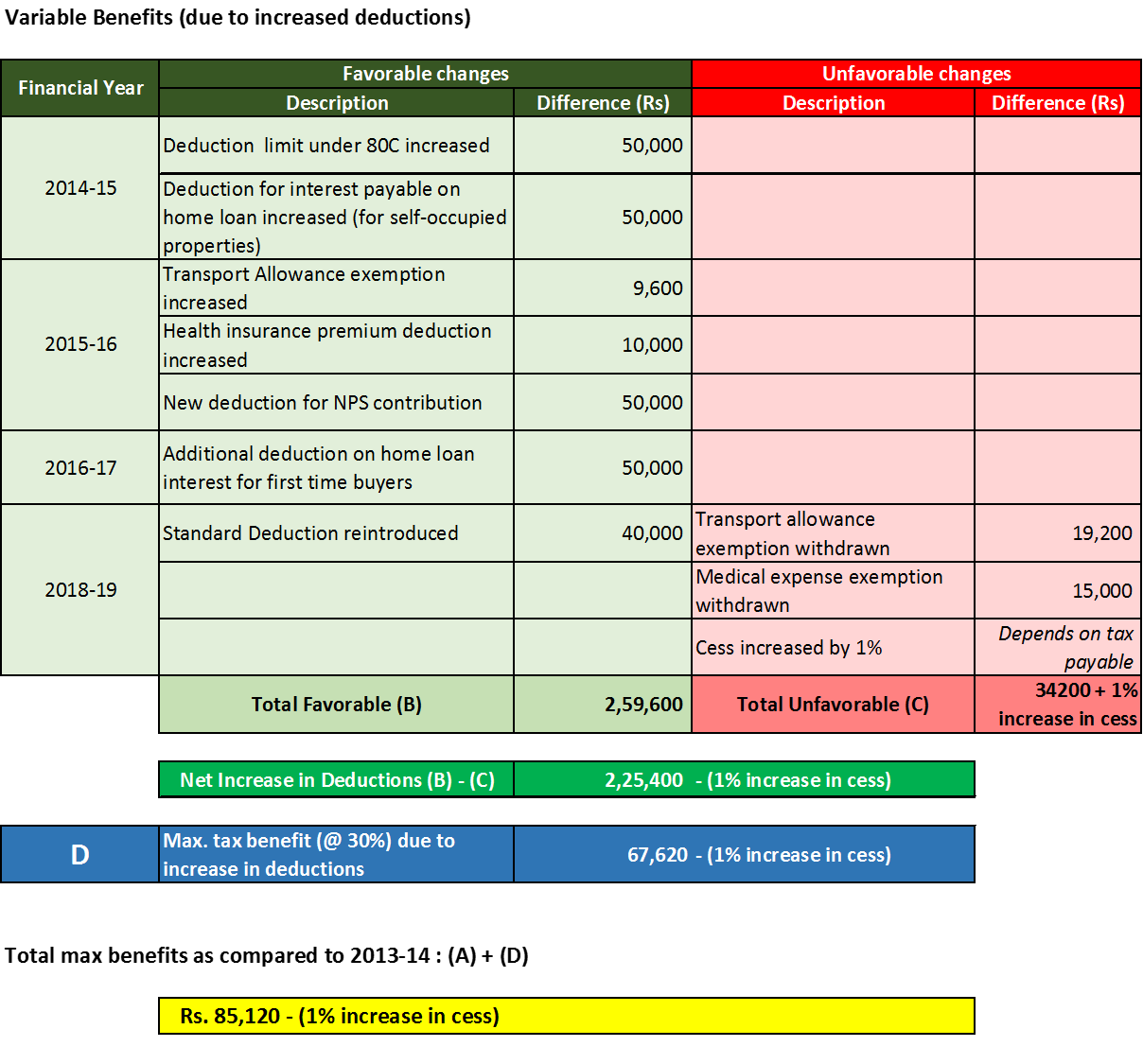
So why is the middle class angry? Didn’t they get an extra deduction of Rs 5,800? (40000 standard deduction minus 34200 deduction for transport and medical which was done away with) Did  the increase in cess by 1%, make an impact? Why are people so angry that they are even talking about a Modi defeat in 2019?

The answer lies in the attitude of this government. The budget had something for everyone – farmers, BPL, women, senior citizens; except the middle class which has been the backbone of this government. There were high expectations before the budget of IT exemption being raised to 5 lakhs, with Jaitley’s bête-noire, the maverick Dr. Swamy even demanding abolition of IT.

With such expectations, it was clear that people were upset when Jaitley didn’t deliver. But what would hurt the middle class more is the Long Term Capital Gains tax. With small savings schemes of the government not fetching sufficient returns, many flocked to the stock markets to buy shares or invest in SIPs of mutual fund. The 10% tax now will hurt their savings kitty.

The middle class strongly stood with Modi during demonetization only because they trusted his intentions, They surrendered their LPG subsidies happily for the greater cause. But then petrol prices started moving skywards, interest rates from savings were cut (even Modi’s pet Sukanya Samriddhi scheme was not spared). And to add insult to injury, salaries of judges, governors have been raised. All this has made the middle class see red and believe Modi-Shah used them to win elections and have now abandoned them.

Will this anger of the middle class hurt the government in any way? I believe the answer is yes.

2004 had a similar situation – a popular, much loved PM, booming economy and yet there was a shock of an election defeat – one reason being Yashwant and Jaswant had hit middle class hard by bringing down interest rates on savings and the Congress capitalised on this with a powerful question –‘Aam aadmi ko kya mila?’.

Can 2019 become another 2004? YES – it can.

While people love the PM, they will not vote blindly. Gujarat was almost lost, it was the middle class which helped BJP sweep urban seats, even as the party took a battering in the rural areas. Modi-Shah duo’s calculations of winning rural votes through schemes in the budget may not work so easily as it would take at least a year for the budget benefits to trickle down. Also, perceived inaction on corruption and black money is making even the strongest supporters of this government squirm.

Shah is one of the cleverest politicians in Indian history, surely he will realise that you cannot desert your core voter in anticipation of new vote bases. The Rajasthan by-poll result has delivered a shock to the BJP. In 2014, BJP won 135/145 seats in UP, Chattisgarh, Rajasthan and MP, this is their peak and they can only come down from here, winning 80-90 may not be so easy. Add to this, the Sena break-up in Maharashtra, anti-incumbency for TDP and AIADMK, we may very well end up with a situation where Modi has to become PM in 2019, with support of Pawar and Stalin, which would make him a lame duck PM.

There is still time for Modi-Shah to work on this, hope that they assuage the hurt feelings of the middle class, by making some corrections/rollbacks. Even an assurance from the PM about how he would protect the interests of the salaried-middle class, would go a long way in calming down frayed tempers. Here’s hoping that as the budget session proceeds, the government, would see sense and respond to public sentiment.

Stop demonising us merely because we want to exist : Dara hua Hindu

0

In the past few days, the news of 2 deaths have emerged which has caused a massive dent in the collective consciousness of the Hindu community. In Bangalore, a BJP worker was murdered over political rivalry while in Delhi, a Hindu boy was murdered by his girlfriend Shehzaadi’s family because they did not approve of the match. One would have expected such incidents to garner major attention of the mainstream media, but the sheer apathy of the mainstream media towards concerns of the Hindu community regarding their safety can be estimated from the fact that Swara Bhaskar’s open letter to Bhansali received more attention and coverage than these two heinous murders.

When a person from the minority community suffers a crime at the hands of a Hindu, even if not for communal reasons, the entire Hindu community is painted as intolerant and much hue and cry is raised about the radicalization among Hindus and yet when a Hindu happens to be the victim of a hate crime, the blame is pinned on the collective consciousness of the country as if other Hindus are somehow culpable for the hate that other communities harbor towards them. In the incident at Delhi, some are choosing to ignore the obvious and instead make a point about Indian society as a whole and blaming the murder of Ankit Saxena on Patriarchy.


The international media which is normally so overeager to run the narrative of intolerance of Hindus in India will conveniently choose to ignore these heinous attacks on the Hindu community as they ruin their narrative. Through extensive propaganda, a narrative has been created which shames the Hindu community for merely voicing their concerns, however valid they are. And time and again, the blame is pinned on the Hindu for his very identity.

Intellectuals in India have created a myth out of thin air that only the majority community is responsible for sustaining an environment of social harmony and consequently, should a Hindu be a victim of a hate crime, the magical wand called ‘nuance’ is waved around the subject to conjure some blame on his part. When a Hindu suffers a terrible fate, the blame is always squarely placed on the values and culture of the larger Indian society. Under such circumstances, when a Hindu voices his concerns, it is declared senseless paranoia and the community is accused of suffering from a victim-hood complex. On the other hand, we have to constantly withstand a barrage of propaganda accusing every voter of the Bharatiya Janata Party of culpability in every crime against the minority community. Hindu concerns are ridiculed, mocked and derided while the concerns of the minority communities are always exaggerated, often with fabricated evidence. The objective of such a narrative is to shame Hindus for their identity and invalidate all their concerns solely because of their identity.

Reality is often exactly the inverse of what the mainstream media professes to be. Contrary to popular claims by intellectuals, it is the Hindu, it has always been the Hindu, who upholds the principles of tolerance and coexistence in this country all the while as he is demonized by every social institution for his identity. In a recent incident, the IPS association was quick to denounce a senior IPS officer for taking a vow to ensure the construction of a Bhavya Ram Mandir at Ayodhya. It’s natural for a devout Hindu to want the Ram Mandir at Ayodhya, is the IPS Association then accusing all Hindus of being unable to perform their duty impartially?


In another incident, people mocked and condemned a journalist for touching Yogi Adityanath’s feet. Well, it is natural for a Hindu to seek blessings from a saffron clad priest. Why were they demonizing a Hindu for an act of faith? Do they want Hindus to abandon their fundamental religious beliefs before signing up for a job? It seems pretty unreasonable for people who so strongly oppose Uniform Civil Code to expect Hindus to abandon their core beliefs and all for a job. All that matters is that a journalist be efficient at his job, it is amusing then that people who are vocal cheerleaders for journalists who regularly misrepresent facts and sometimes spread lies wholesale condemn another for merely seeking the blessings of the Mahant of Gorakhnath Math.

Should a Hindu refuse to participate in the glorification of historical figures who slaughtered, pillaged and raped his ancestors, he is accused of destroying the secular fabric of the country. Should a Hindu insist that he be granted the same rights that a member of the minority community enjoys, he is accused of suffering from a victim-hood complex. When a Hindu expresses concern about the massive demographic shift that is underway in the country, he is accused of paranoia. These are all valid concerns and denial of it is not grounded in fact but in mere politics and an extremely biased view of the world. It seems that according to the intellectual elite, Hindus should just keep their head down and their mouth shut and continue to suffer whatever injustice is meted out to them because they are deserving of it by virtue of their identity.

The atrocity really crosses all limits of decency when Hindus are blamed even for the genocide they suffered in Kashmir. Intellectuals whitewash what was evidently Jihad against pagan Hindus and portray the entire series of events as a revolt by the oppressed masses against their tyrannical oppressors.


Some even allude that the migration of Kashmiri Pandits from the valley was voluntary.


It is akin to blaming Jews for the holocaust they suffered at the hands of Nazi Germany. But the only difference is, Nazis are denounced the world over while in India, the genocide of Hindus is flatly denied by large sections of the intellectual community and some even go on to blame the Kashmiri Pandits for the fate they had to endure. Only in India can the intellectual elite get away an arrogant display of genocide denial.

The death of Ankit Saxena is mere statistic while the death of Pehlu Khan, whom the police confirms was a cattle smuggler, was a national tragedy. In Kerala, RSS workers are being killed with impunity by communists but it’s the RSS which is branded as a fascist and a communal organization. The name of Shambhu Regar is forever etched in public memory yet anyone hardly knows Savan Rathod, a 17 year old boy, who was burnt to death in Pune after the suspects allegedly confirmed his Hindu identity.

We are branded bigots if we express our concerns and state that we do not approve of the direction our country is headed in. We are branded patriarchal dinosaurs for pointing out that there’s a concerted attempt at brainwashing our daughters. We are branded intolerant for calling out the hypocrisy of self appointed moral guardians of society. We are branded fascists for merely exercising our fundamental right to vote in a democracy because intellectuals do not approve of our choices. Meanwhile, our Gods are denigrated, the reputations of our heroes are sullied, our festivals are banned and our history is distorted. We are demonized because all we want is to ensure the worship of our Gods and to pass on our heritage, our traditions, to future generations. We are demonized merely for our desire to exist. We are demonized solely because we refuse to passively allow our heritage to be mere artifacts in museums. We are demonized because we wish to sustain the flames that inspired our ancestors to build one of the greatest civilizations in history. We are demonized because we refuse to forfeit our culture and traditions to the false, militant pursuit of secularism.

The entire narrative of Hindu fascism in India is a despicable charade propagated to influence democratic politics and dent the image of the country. The media wants us to remember Shambhu Regar but forget the names of Chandan Gupta and Ankit Saxena. The media desires so because it fears that the memories of Chandan Gupta and Ankit Saxena are a threat to the ‘Idea of India’ and the secular fabric of the country is only upheld when every concerned Hindu is branded as a caricature of Shambhu Regar. The intellectual elite glorifies the secular fabric of the country and the inclusive nature of our Constitution but it should remember that the foundation of their ‘Idea of India’ is built upon the carcasses of innocent Hindus.

Why it is unfair to call Modi government ‘anti middle class’

0

On 1 February, Union Finance Minister Arun Jaitley presented the Budget for the year 2018-19. Since it was the last full budget before the next Lok Sabha election, many people had expected that it would be populist. Salaried middle class had anticipated a significant relief in Income Tax. However, Jaitley did not give the expected relief to taxpayers.

Even the reintroduction of Standard Deduction failed to cheer taxpayers as its benefits got almost wiped out due to withdrawal of transport and medical allowance exemption. By the time Jaitley’s budget speech was over, social media and office corridors were rife with criticism for this “anti middle class” budget. A perception got created that Modi government had done nothing for the middle class in four years. Several people felt betrayed by the man behind whom they had rallied during 2014 election. Some even declared that they would not vote for BJP in the next election.

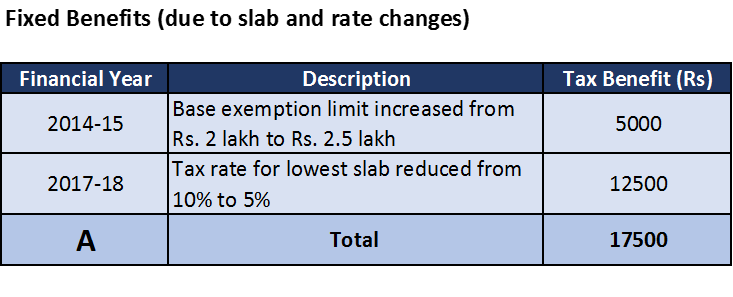
Being a middle class salaried taxpayer, I was intrigued by the severity of this criticism. Though Jaitley isn’t exactly a taxpayer-friendly FM, I never felt that honest taxpayers had suffered more under Modi government. So I decided to analyse income tax structures since 2013-14 to find out if middle class taxpayers were indeed worse off in the last four years. Below are my observations –

(Disclaimers:
1. I have assumed that middle class taxpayer = person having annual income between ₹5-50 lakh
2. I have deliberately ignored changes in IT rules which are applicable to women and/or senior citizens. The intent is to evaluate changes which are applicable to all middle class taxpayers.
3. Rebate under section 87A was increased from ₹2000 to ₹5000 in 2016-17, but was reduced to ₹2500 in 2017-18. For the sake of simplicity, I have ignored this net additional benefit of ₹500)

From the above table, it’s evident that for the same level of income, tax liability for middle class taxpayers has reduced across the board. Depending on the highest applicable tax slab and investment profile, a taxpayer can save up to ₹85,120 (minus 1% cess) as compared to 2013-14. A person having no investment and no loan is also saving ₹17,500 (minus 1% cess) in tax.

For people having home loans, the interest rates have come down by around 1.5% since 2014. This has resulted in significant saving. For instance, a person with a home loan of ₹75 lakh for a period of 30 years would be saving around ₹1 lakh per year due to reduced interest rate.

These are clear tangible benefits for middle class people. They should be looked at as a package of five years, not in isolation. Also, there are intangible benefits like more efficient use of tax money by reducing leakages through use of technology, improvements in urban infrastructure – Metro Rail, peripheral roads, improved highways, better power availability, etc. Prices of everyday use items have reduced after the introduction of GST. Government has managed to keep inflation in check.

On the issue of tax on Long Term Capital Gains, it’s a common practice around the world to tax LTCG. India had LTCG tax until 2005 when it was abolished based on Kelkar Committee report which said that the source of these gains (i.e. money invested) is already taxed, so taxing LTCG amounts to double-taxation. However it can be argued that this logic is flawed because under LTCG tax, only the gains are taxed, not the principle invested. While reintroducing LTCG tax,  Modi government has given a cushion of ₹1 lakh per year to protect small investors, and has proposed a flat rate of 10% which is reasonable. Also historical gains have been protected through grandfather clause.

In summary, it would be grossly unfair to accuse Modi government of being “anti middle class”. But perception management has never been this government’s strength, and I fear that BJP will have to pay electoral price for the wrong perception formed after the Budget. At the same time, taxpayers should realise that paying due taxes is a duty of citizens, and India’s Income Tax rates are fairly moderate for a developing, non-oil economy.

(With inputs from @muglikar_ )

Communist leader in Kerala makes taxpayers pay Rs. 50,000 for his specs

0

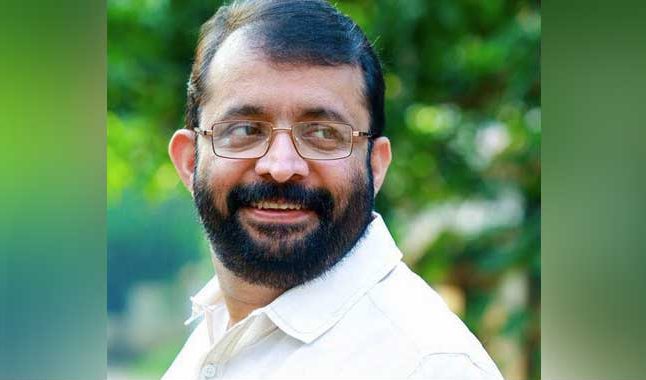
Few things scream hypocrisy as a communist’s entitlement for public fund. Kerala Speaker P Sreeramakrishnan has billed the exchequer Rs. 50,000 for a pair of glasses. According to a reply received on an RTI filed by Kochi-based RTI activist D B Binu, the Speaker had claimed Rs 4,25,594 in form of medical reimbursement from September 5, 2016 to January 19, 2018, of which, Rs. 49,900 was for buying eyeglasses (Rs. 45,000 for lens and Rs. 4,900 for frame). This, after the Assembly Speaker Vakkom Purushothaman had put a cap on reimbursement for spectacle frame at Rs. 5,000.

Defending his requirement for the expensive glasses, Sreeramakrishnan smiled and told the media persons that the spectacles are bought as per advice of his doctor. Ironically, in the state budget presented a day prior, finance minister Thomas Isaac had stressed that the government should bring down expenses in the wake of the financial crisis in the state.

This is not the first time communist leaders have made the taxpayers pay for their exorbitant expenses. Kerala health minister K K Shylaja billed the taxpayers Rs. 28,800, also, for a pair of glasses. There were also allegations that Shylaja had forged documents to claim reimbursement of medical expenses for her husband and the Vigilance and Anti-Corruption Bureau has begun a preliminary probe on a complaint from BJP state general secretary K Surendran. According to the complaint, the minister had misused her position and fabricated documents for the purpose of cheating the public exchequer and the government to extract Rs. 3,90,250.

Binu pointed out that the MLAs are spending lavishly from government funds when the government is struggling to pay pension dues to KSCTC employees and compensation to endosulfan victims.

Padmaavat has Deepika as the hero, Ranveer as the villain, and BJP as the joker

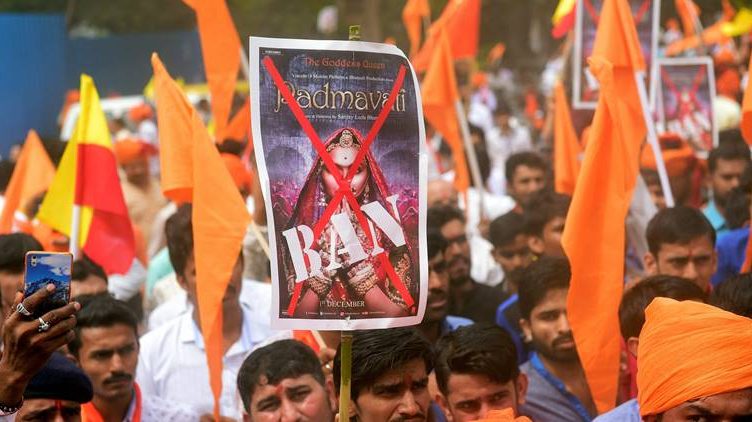
It all started with rumours that Padmaavat, then Padmavati, a movie based on Rani Padmini, was set to have a romantic dream sequence between Allaudin Khilji and Rani Padmini. The entire Hindu community, including yours truly, was up in arms against this monstrosity. Even as Bhansali’s team clarified on record, that no such dream sequence was there in the movie, Karni Sena proceeded to manhandle Bhansali and ransack his movie set, after which, followed the usual high pitched moaning about “intolerance on the rise” under Modi.

At this point, things seemed to have calmed down. Some even went to on to suggest that the confusion about dream sequence was created as a publicity stunt and the slap was a publicity stunt gone awry, because we all know outrage begets big moolah for the movie industry. But then, inexplicably, things took a rather ugly turn and the storm tore through the calm that had set upon the controversy.

Karni Sena became increasingly agitated. From threatening to alter Deepika’s pretty face, to wanting Bhansali’s head on a platter. One wondered why the asinine drone had returned, because their reasons to oppose the movie seemed quite muddled. At one point of time, it was a dream sequence that never was. Later, it became about some song where Rani Padmini was to be dancing, and all along, most people, while not wanting to outrightly offend Hindu brethren, wondered what the outrage really was about. Soon, BJP fellows started belching out ridiculous remarks, presumably, to win some sort of brownie points with the Rajput community. Some BJP Chief Ministers went a step ahead and vowed to not allow the movie to be screened in their state despite the Supreme Court asking these people to back off. Violence broke out in different parts of the country, surprisingly, only in BJP ruled states, while the BJP behaved like stoic cows standing in the rain.

While all of this was happening, BJP seemed to have forgotten that Lokendra Singh Kalvi was repeating a standard modus operandi. While his fight for his community is not something to be commented upon and is best left to the community itself to decide, in 2008, Mr. Kalvi had agitated against Jodha Akbar and IPL matches and promptly joined Congress. He even disrupted some rallies that were being held by Vasundhara Raje.

While I completely sympathise with my valorous Rajput brothers and sisters, as they have had to keep their sacred tradition from being mercilessly appropriated and twisted by vested interest for decades, why in the world could BJP not see through this political set up, is truly beyond the realm of understanding.

True to political form, after agitating against Padmaavat, Karni Sena extended support to Congress for the upcoming Rajasthan elections. Rahul Gandhi played good cop very late only after the attack on a children’s school bus, else no Congress leader spoke against Karni. Even a suave, liberal Tharoor said that Rajput sentiments should be respected. As soon as Rahul Gandhi played the good cop by blaming BJP for being regressive and tacitly endorsing attack on the school bus, lackeys like Digvijay Singh played the bad cop and extended support to Karni Sena’s agitation, so as to not alienate the Karni Sena after Rahul’s mandatory tweet. Of course, who played the good cop and who played the bad cop in this scenario depends on which side of the political spectrum one is on.

The result was for all to see. BJP lost miserably in Rajasthan by polls and that loss, was celebrated by Karni Sena.

While BJP sucked its thumb and wondered what hit them, the Karni Sena declared that “Padmaavat glorifies Rajputs” and they would be withdrawing their protest. Of course, after people mocked them and said they were behaving like Kejriwal, they did a reverse U-turn and said that it was ‘fake Karni Sena’ that withdrew the protest, and their agitation was to continue to teach BJP a lesson, because let’s face it, nobody wants to be Kejriwal, not even Karni Sena.

BJP has perhaps still not realised that the violent protests stopped after BJP managed to make a complete fool of themselves and after the Rajasthan by polls were concluded, despite Karni Sena’s loud shrieks, the movie has been screened peacefully everywhere. They haven’t realised, that while Karni Sena supported the Congress, it was the BJP that was made to look like regressive buffoons who stood firmly against the release of a mere movie (that had nothing but Rajput pride on display, apparently). They haven’t realised, while I feel safe calling them buffoons in my article, they were made to look like louts who would support violence to suppress freedom of expression.

This absolute mockery, however, can’t be attributed to BJP’s ignorance alone. This situation stemmed from their utter lack of direction, principally and ideologically.

Ideologically, if BJP wants to be a party that is for and by the Hindus, the BJP has to take a stand for the Hindus vocally and vociferously, perhaps, more pertinently, where Hindu sentiments and safety is at stake in tangible measures. Supporting hollow causes such as this, which was politically motivated from the word go, and staying silent on Hindus being turned into cattle to be butchered, defeats the seriousness of the party’s ideological cause. While BJP was willing to be painted as fascists as Karni Sena, that extended support to Congress, ran amok, in the hope that the Rajput community would believe that BJP cares about their sentiments, its highest leadership maintains silence when Hindus are killed in Kerala, when Ankit was beheaded by fundamentalists or even when Kamlesh Tiwari was languishing in jail for exercising his freedom of expression. Some BJP ‘leaders’ go a step further and play the part of Nehruvian secularists even over Ankit’s dead body. By that, I of course mean Manoj Tewari asking his murder not be ‘communalised’.

While BJP says it stands for Hindus, by not taking a definitive stand on cultural issues that effects every Hindu, it allows divisive elements like say Hardik Patel, Jignesh Mevani or even a Karni Sena to talk about cultural issues that appease a certain faction. As long as BJP keeps trying to appease factions while ignoring causes that echo with Hindus at large, it’ll keep making a fool of itself. As it has done now, it will keep ceding ground, which is good neither for the larger ideology or for electoral politics.

Principally, BJP can either be a party that claims to stand for law and order, or one that will, like Congress, shut its eyes when it is politically inconvenient. Principally, BJP can either encourage leaders like Yogi Adityanath who stopped Karni Sena violence with an iron fist, or leaders like Haryana CM Khattar, who stood by while the state burnt.

Either way, BJP, as this juncture, has to decide what its core principle and ideology is going to be. If they don’t, they will keep walking into political death traps. The opposition will continually put BJP in a fix with the multiple Hindu factions, and unless BJP makes up its mind to support larger hindu causes and opt for maintaining law and order, no matter what the political price is, it will keep writing its political and ideological obituary like it did this time.

Displeased Delhi High Court once again slams the AAP government over its governance

0

The Delhi High Court on Friday came down heavily on the AAP government and the Municipal Corporations in the National Capital region, by asking them to do their duty. This comment by the High Court was in connection with the recent dengue cases in the capital.

It seemed that during the trial, the AAP government was laying the blame on the municipal corporations, to which the High Court sternly questioned whether it (AAP government) had no responsibility.

These comments were made by the court while hearing two PILs, which sought directions for the civic bodies and the other authorities concerned, to prevent spread of diseases like dengue, chikungunya and malaria.

The bench of Acting Chief Justice Gita Mittal and Justice C Hari Shankar, further took a shot at the AAP government by observing that, “It is always you (AAP government) versus the Centre, the corporations, some statutory authority. It has to be only versus? Can’t you work together?”

These statements come after five Dengue cases have been reported in the capital in January, which is a month not associated with rainfall.

The Judges as a result sought to know why the dengue cases were being reported in January itself, and pointed out that there was a need to solve this critical problem before it reached unimaginable proportions.

Incidentally the court was also annoyed with the lack of AAP government and Municipal Corporation’s knowledge when the former told that the latter had no information about the location of these cases.

The High Court also asked the AAP government and the corporations to reduce garbage stagnation and reduce landfill, otherwise one day only landfills would remain in the capital. The court also asserted that it did not want any deaths in Delhi due to vector borne diseases.

Such criticism of the Delhi High Court against the AAP government, Municipal Corporation of Delhi (MCD) isn’t anything new.

In December the court had slammed the AAP government for not buying low floor disable friendly buses. The AAP government’s assessment in the matter was that the cost cited by the bus manufacturers for these buses was exorbitant.

In November the court was annoyed with the AAP government’s proposal to utilise Rs 400 from green cess to buy 500 electric buses. As per the court, this cess was imposed to improve the environment and mitigate pollution and that the proposal to buy these buses amounted to diversion of funds.

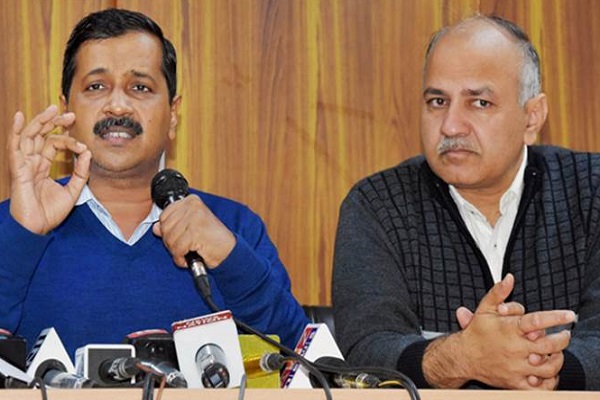
October too saw the High Court pulling up Kejriwal, this time over the pending salaries of MCD workers. During the hearing the court had interestingly commented that, “There must be somebody with whom you are not at war”.

When it comes to the MCD, it was slammed by the Delhi High Court for failing to manage stagnation and garbage in the city.