The Aam Aadmi Party is set to suffer a big jolt as the Election Commission (EC) has recommended the disqualification of 20 of its MLAs. The news came in today on 19th January. The EC has sent its recommendation to the president regarding the disqualification of the said MLAs. If the President clears it, the number of MLAs of Aam Aadmi Party will reduce to 47 from its current 67. One MLA from the original 21 “escaped” since he had already resigned, to contest elections from Punjab.
Expectedly, AAP has brought forth various arguments to defend itself, but they do not seem valid. Firstly, we need to look at the cold facts and the timeline:
March 2015: 21 AAP MLAs appointed as Parliamentary Secretaries by the 67 MLA strong AAP Government in Delhi.
19th June 2015: Advocate Prashant Patel files a petition before the President of India to disqualify the 21 MLAs on grounds that the post of “parliamentary secretaries” was an “office of profit” and the MLAs could not hold such office.
23rd June 2015: Fearing disqualification of its 21 MLAs because of the above illegality, the AAP government passed a bill to give exemption to these secretaries from disqualification with retrospective effect.
June 2016: The President rejects the above bill of the Delhi government.
From the above itself, AAP’s guilt is confirmed. The AAP Government brought in the retrospective amendment, precisely because they realised that they had been caught off guard. The amendment was brought in hurriedly, just 4 days after the case was filed.
The Excuses
Inspite of this, AAP has been brazening it out. One of the arguments put forth by AAP is that since the High Court had set aside the order appointing 21 MLAs as Parliamentary Secretaries, the posts never existed and hence there was no question of EC disqualifying the MLAs. They fail to understand that the High Court found their appointment in violation of the law, and that does not mean the appointment never happened. Sources in the EC also held that since the High Court judgment did not explicitly say that the appointments were void ab initio, the EC had to look into the matter.
Also, the grounds which the High Court went into are totally different. The court order had come after the AAP government itself conceded that since the order was passed without the approval of the LG, it went against the August 4 order of the High Court holding the LG’s approval to be mandatory. Thus the High Court had set aside the appointment because the Government had not taken the LG’s approval. This has nothing to do with the “office of profit” matter.
“Not an Office of Profit at all”
AAP has also claimed that there were no benefits accruing to these parliamentary secretaries hence it was not an “office of profit”. However, the official circular said they may use vehicles and space for official purposes. AAP on its part again claims that they had only planned to give these benefits, which were eventually not given. Again, documents from an RTI application showed that the 21 MLAs who held the posts were allotted rooms as office space by the Speaker.
Advocate Prashant Patel, the petitioner, added that generally, “profit” is interpreted to mean monetary gain but benefits other than monetary gain may also come within its meaning. He also said that by accepting the position of Parliamentary Secretary which certainly has some position, prestige or patronage attached to it, these legislators have become an inseparable and an integral part of the Executive and the dividing line between Legislature and the Government has been completely obliterated.
“Insufficient time”
Now, sources say AAP is claiming that they were not heard properly by the EC. Nothing can be further from the truth. A case which began in Mid 2015 has ended in 2018. That itself is substantial time. Plus, the facts show that AAP actually got more time than normal. The original deadline seeking response from the AAP MLAs was October 7 2016. This was extended by another 10 days as some AAP MLAs had failed to file replies. AAP MLA Alka Lamba, had said that she could not submit her reply due to “faulty pen drives” given by the EC and unavailability of lawyers on account of holidays last week.
More recently, in November 2017, the EC had given one last chance to the MLAs to submit their response. The EC had initially served a notice to the 20 AAP MLAs on September 28 seeking their written submissions, but many of their replies did not address the central issue and ended up raising other queries, hence they were given one last opportunity. Advocate Patel had called this as “delaying tactics”.
AAP to move High Court?
It appears that AAP has now decided to move High Court against this decision of the EC. This was probably inevitable since disqualification of 20 MLAs would mean a mini-election which could turn up some very interesting results. AAP’s stock is quite low recently, with its debacle in Goa and Punjab, and more recently, Kumar Vishwas’s open rebellion against AAP’s “compromised” Rajya Sabha candidates. Will Kejriwal once again roar back to abuse the EC for this decision? Only time will tell.
Even though the Supreme Court has outlawed the practice of instant triple talaq and the Lok Sabha has even passed a bill criminalising the draconian practice, its usage still seems to be continuing en masse.
It was reported by us how things were possibly brazened out when a husband gave his wife triple talaqjust a day after the Lok Sabha criminalised the act.
Now a couple of such cases have been reported from Uttar Pradesh, the first being a case where a Husband decided to give triple talaq to his wife, after she asked him to admit their four year old daughter to a school.
As per reports, the woman who hails from Bareilly was allegedly assaulted and thrown out of the house by her husband, after she asked that their four year old daughter be admitted to a school. Some days later, while she was walking on the road, her husband suddenly stopped her and proceeded to give triple talaq.
Following this, the husband openly proclaimed that PM Modi or CM Yogi won’t be able to do anything to him. The woman later along with her daughter went crying to down to her mother’s place.
Turns out that the woman named Naazreen who hailed from Katghar in Bareilly’s fort region, married Wasim in 2011, who lived in Bhud area of Premnagar. A year later she gave birth to a daughter, but soon after that, her in-laws started to harass her as they wanted a son. Even her husband allegedly started to assault her. Later when the daughter turned four year old, Nazreen naturally asked that she be admitted to a school, which was flatly refused by the husband after which the whole episode played out.
After becoming a victim of triple talaq, Nazreen has knocked on the doors of Farhat Naqvi for justice. Naqvi runs an association to help the victims of triple talaq. As per Naqvi, had a law against triple talaq been formulated, it would have created a sense of fear in the minds of the people. He claims Naazreen’s matter will be sent to the National Commission for Women.
Apart from this, another incident of Triple Talaq has also come to light from Uttar Pradesh.
As reported [1][2], a woman from Garhmukteshwar in the state’s Hapur district has alleged that her husband gave her triple talaq after which he proceeded to throw her off the first floor of their house. Following this, the woman has suffered fractures on her ribs and arms. She is now undergoing treatment in the district hospital.
As per reports, the woman named Nagris Parvir, married Shan Mohammed in February, 2013. Following this, her in-laws started harassing her for dowry. On 15th January, the husband allegedly demanded Rs 3 lakh from her and when she failed to fulfil this demand, he proceeded to give her triple talaq and threw her off the roof.
Their neighbours later informed the father of the woman reached the town and proceeded to file a complaint, but the police allegedly carried out no investigation. The father later took his daughter to a women police station in Khatauli where a case was eventually registered.
Another youth from Kerala has been killed fighting for ISIS. Kannur DySP Sadanandan has confirmed that Abdul Manaf has been killed fighting for the Islamic Terrorist Organization after his family received a message informing them of his death.
Kannur DySP Sadanandan confirms that family of 27 yr old Abdul Manaf has got a message that Manaf has been killed fighting for ISIS in Syria. #Keralapic.twitter.com/3Qr7P2VgBx
Kerala has been a hub of Islamic Radicalism in recent times with many youths joining the terrorist outfit from the Middle East. In October of 2016, it was reported that more than 30 youths from Kerala were training with the ISIS in Afghanistan. Then, in January of 2017, it was reported that the National Investigation Agency believed 22 men from Kerala who disappeared few months back were receiving training from ISIS in Afghanistan. Then later in November, the Police confirmed that 6 more youths from Kerala had joined ISIS.
The spike in radicalism among the youth of Kerala point towards a disturbing trend in the state. Hardline Islamic outfits such as the PFI have a free run in the state which may be indeed be a contributory factor to the malaise that afflicts Kerala today. Although the PFI has expressed ‘shock‘ over its former members joining ISIS, its own record is very dubious. There is a long history of its members indulging in violent crimes, including murder. However, the most infamous was the chopping off the hand of a professor in Kerala for blaspheming against Islam, by 13 of its activists.
The National Investigation Agency (NIA) further believes the PFI is running an organized conversion racket in the state. India Today in a sting operation last year exposed the nefarious intentions of the PFI in brainwashing Hindu women to convert to Islam.
The trend of youths from Kerala regularly joining ISIS reflects a larger deterioration of the Law and Order situation in the state and the utter ineptitude of the state administration to enforce the rule of law. It also is symbolic of the radical transformation of the social order of the state. With radical Islamic outfits running amok and the rampant persecution of RSS men by Leftist organizations, Kerala, despite all its claims of ‘100% Literacy’ and ‘Secularism’, indeed presents a sorry sight.
There are many allowances we can make for a false story published by a media outlet should we choose to give the benefit of the doubt, ranging from human error to acknowledging the volume of unverified or unverifiable information floating in the web with vague references that seem genuine. But when a story reappears over and over in the media, even after it has been busted as nothing but fantasy, it is pertinent to question the motive.
The vicious story of ‘breast tax’ that scroll.in published recently, is one such modern fabrication that keeps appearing in the media repeatedly – a graphic story about a supposed ‘breast tax’ in practice in 19th Century Kerala.
The story
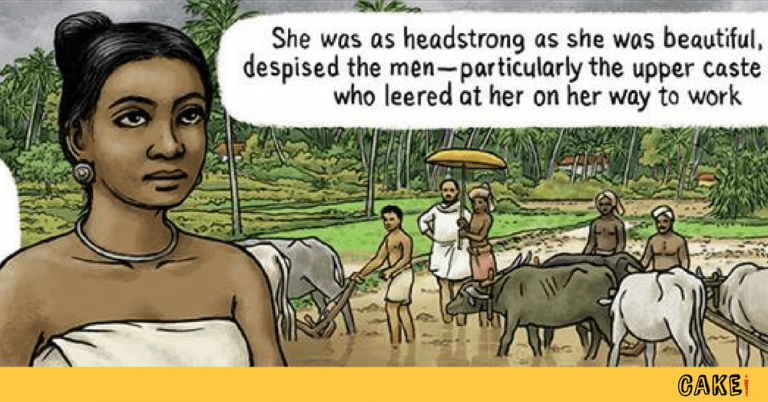
This imaginative story claims that upper caste Nairs and Nambuthiri Brahmins in Kerala did not allow women from lower castes to cover their breasts and then levied ‘breast tax’ on them. In such an exploitative society, the story goes, rose Nangeli, an Ezhava woman who protested the unfair tax system by chopping her breasts off, attaining martyrdom.
Of the many instances of atrocities in history, this may well be one of the most violent and graphic. Shaming of lower castes and what’s more, outrage of women’s modesty as a tool of oppression is surely the worst kind of exploitation one can imagine. Even as we read the story, the picture floats easily into our mind’s view: richly attired noblemen and ladies seated smugly on their ornate cushions, giving an outrageous decree, while dark and lanky, slavish people dressed in rags, bowing almost to the ground, listen but barely showing emotion. Only, we need to pause the imagination for a while to step back and ask a necessary question: just because a story is vivid and graphic in its imagery, does it become fact?
Kerala’s sartorial history
Let’s begin with a primer on the attire of women in 19th century Kerala, before we address the lack of authenticity of the story, the mindset, motives and motivations behind such a fabrication.
Kerala’s world famous tropical climate needs no introduction. Also, a widely observed pattern is that the traditional attire of a people is directly dependent on the climate of the land. Owing to the humid heat all through the year, a piece of cotton cloth draped around the middle with another (optional) hung over the shoulder as an afterthought, has largely been the traditional attire of the people of Kerala, regardless of gender or caste.
A 17th-Century Dutch visitor William Van Nieuhoff writes about the attire of Ashwathi Thirunal Umayamma Rani, then queen of Travancore, in the following manner:
“… I was introduced into her majesty’s presence. She had a guard of above 700 Nair soldiers about her, all clad after the Malabar fashion; the Queen’s attire being no more than a piece of callicoe wrapt around her middle, the upper part of her body appearing for the most part naked, with a piece of callicoe hanging carelessly round her shoulders.”
He drew a sketch of the queen and her attendants in his work (Voyages and travels to the East Indies; 1653-1670), where it is quite clear that the queen and her attendants wore little to no cloth to cover their bosoms.
Johan Nieuhoff meeting the Queen of Travancore. (Source: here)
If 17th Century seems a bit dated for our debate, let’s look at a few evidences from 19th and early 20th centuries, the very era our fable is supposed to have taken place. The story implies that nakedness was a humiliation imposed by the upper caste on the lower caste women, with the intention of depriving them of modesty and the luxury of wearing a second piece of cloth. This accusation hardly holds water when you realise that women of Nambuthiri families and affluent Nair families themselves saw no need for a breast-covering garment, either as a sign of luxury or ‘modesty’.
A Nambuthiri Brahmin woman from a 20th century Malayalam book by Kanippayyur Shankaran Namboodiripad
Nambuthiri Brahmin women , from ‘The Cochin Tribes and Castes’ by L. K. Anantha Krishna Iyer
Nair girls and men in a temple procession, from the book by L. K. Anantha Krishna IyerNair girls from the book by L. K. Anantha Krishna Iyer
‘Modesty’ (?) in Art
While the images above are photographs of upper caste women from the era, the ones that follow are paintings of women of royalty, by the celebrated painter Raja Ravi Varma.
A 19th Century painting of Junior Rani of Travancore, Bharani Thirunal Rani Parvathi Bayi by Raja Ravi Varma (Source: here)
A 19th Century painting, ‘Malabar Beauty’ by Raja Ravi Varma (Source: here)
A connoisseur of portraiture would note the elegant pose of the women, who, guided by the artist surely, took care to hold the unstitched cloth in place as a mere accessory, in a manner that the ornaments on the left hand and the neck could be highlighted, and compare it to how a modern-day woman might hold up her exquisite handbag with one hand, the other hand on the waist, accentuating her lithe form and highlighting her classy taste in accessories, while smiling at the camera.
L.K. Anantha Krishna Iyer in his book, The Cochin Tribes and Castes (pg. 100) writes the following about the clothing of upper caste Nair women during early 20th century:
The absence of any covering for the bosom in ordinary female dress has drawn much ridicule on the Nayars, and this custom has been much misunderstood by foreigners. So far from indicating immodesty, it is looked upon by the people themselves in exactly the opposite light…”A custom has in it nothing indecent when it is universal,” as one of the travellers philosophically remarks (Dall).
In the 20th century however, with the advent of modern (and Western, through colonial intervention) sensibilities of fashion and propriety, people of all backgrounds started to wear a stitched upper garment, or tuck in an unstitched cloth around the chest to form a full-bodied attire.
Ezhava girls, from the book by L. K. Anantha Krishna IyerEzhava family from an early 20th century book titled ‘Glimpses of Travancore’ by N. K. Venkateswaran
Through all these records and more, it is fairly evident that the sartorial practices in Kerala changed organically with time, a phenomenon that is observed uniformly across the world.
Who was Nangeli?
As to the specific story of Nangeli and her self-mutilation as protest, there are no historical records of any authenticity of such an event taking place.
A careful look at the references and sources of the Wikipedia article on Nangeli reveal that all of them are from the last decade and mostly from the last couple of years. None of them cites any historical records on Nangeli.
Where did the story come from?
The mysteriously new Nangeli story was recently popularized by a Malayali painter named T Murali who refers to himself as Chitrakaran. Interestingly, Chitrakaran’s blog is quite a fascinating study of his extremely bitter and hateful mindset towards Hindu deities and culture. For example, in this blogpost he ‘muses’ about Devi Saraswati in a crass manner that speaks volumes about his blind hatred rather than any intellectual authenticity.
“Since bhakti (he calls it ‘madness’) towards Gods is becoming popular in the society, thought that it is relevant to think about the breast size of Sarasvati, the brand name of bra and panties which she uses etc.”
“Let me also reveal that Chitrakaran (addressing himself) has been thinking about how many penises and vaginas the gay God Vishnu of Brahmins has.”
Making rude, incoherent allusions to genitals with an intent to vilify simply because devotion is becoming popular, by the blogger’s own admission, is an unwarranted expression of hatred towards a certain culture and an extreme example of unapologetic bigotry.
The fact, then, that a person with known hatred for Hindu culture, a propensity for vivid, graphic imagination and a tendency for irreverent sexualisation popularises a fictional story about non-existent ‘breast tax’ is quite telling.
Forget the messenger, what about the message?
Having discussed the true nature of Kerala’s cultural history, it would be naïve to take a stance that any accusation of social exploitation is false. Any astute observer of social psychology would readily admit that oppression, discrimination and exploitation have existed in all societies in one form or the other in varying degrees in every era, including the current one. Kerala, like all other regions of the world, has had its share of social inequalities and injustice as a consequence. The exemplary life and work of Sri Narayana Guru (born into an Ezhava family and faced much discrimination) in the area of social reform stand as testimony to the issues that troubled the society in the 19th Century. The study into historical evidences so far is not to deny the issue of exploitation altogether, but to explore a much deeper question: when Kerala’s history offers quite a few incidents and stories about social discrimination, why does a certain section of the media feel the need to fabricate a new story that has no basis in truth? Why can’t we talk about real issues with real basis in history, with genuine care and introspection, rather than throw outrageously wild allegations that are completely in contradiction with reality?
What purpose does Nangeli’s story serve?
Clearly, now that we have established it as fiction, Nangeli’s story is a strong concoction of all the ingredients that are accepted as most despicable in a civilised society. Humiliation of women, oppression of a community, tyranny of unfair tax – all of these hint to a cruel, oppressive regime and a society with a morally corrupt core. In short, we are presented with a black-and-white image of an oppressive rule (of the Travancore and Cochin Kings) and victimised subjects that validates intense hatred, irrational anger towards ruling-class “oppressors” and makes the present-day problems pale in comparison to the “dark past”. Interestingly, the blame of all the terror and oppression, with a story like this, is placed entirely on the upper castes within Kerala society, with hardly a glance at the destructive influence of Colonialism. A pragmatic approach, one must note, as there is not much political mileage to be achieved by hating European colonisers, and much to be gained by dividing present-day society into blaming each other for past wrongs. With a story like Nangeli’s to sufficiently horrify the modern audience, present-day Kerala with its high Human Development Index and a few inevitable snags here and there, sounds like a liberated haven that has been rescued from its horrendous tyrants.
If this is true, then the world’s sociologists must be writing paeans about this turnaround ‘success story’ in the shortest span known to history. However, a fair, unbiased study of history points us to the efforts of Sethu Lakshmi Bayi, queen of Travancore, who spent nearly a fifth of her revenue on education, contributing to Kerala’s march towards the high literacy rate which we see today. No less is the contribution of Chithira Thirunal, the last Maharaja of Travancore who ended discrimination and permitted entry of people of all castes into upper-caste-owned temples.
So, it appears, that certain sections of the media will resort to any sensationalised, vulgar hype to elicit strong reactions from the audience and impose a skewed worldview that gives strength to one faction of the political propaganda machinery. The world, as much as we want, does not render itself into a black-and-white picture. History and truth are all shades of hues.
Many people from the “Minority” Community weren’t amused when a selfie of Bollywood superstars, such as Amitabh Bachchan, Aishwarya Rai and Karan Johar, with the Prime Minister of Israel, Benjamin Netanyahu, and his wife began doing the rounds in the Media. However, Editor of the Pro Aam Aadmi Party blog, Janta ka Reporter, Rifat Jawaid, went the extra mile and sent out a bizarre tweet on the morning of the 19th contemplating the slaughter of children and calling Israeli PM ‘bloodthirsty’.
Why should children and other innocent not be mercilessly killed if such renowned personalities continue to extend their overwhelming support to brutal human rights violations by a bloodthirsty man called @netanyahupic.twitter.com/KTjyrm1UaD
Not many people from the opposite end of the Political spectrum were too keen on the blossoming friendship between the two countries but to chastise Bollywood celebrities for a selfie with the Prime Minister of Israel was a stretch too far even for our eminent journalists. Naturally, Twitter users were quick to slam the journalist for his not very sensible tweet.
#Israel is the only country in the Middle East that does not oppress women, minorities and gays. Only an anti-Semite would single out the world’s only Jewish state for this hysterical hyperbole while ignoring the hateful supremacist ideology that infests the rest of the region. https://t.co/csEfqDoflN
No Khans visited the PM of our time tested friend Israel, Mr. @netanyahu .
And here this Presstitutes which are pests in our own nation who think Religion is above Nation and not Nation First insults legends like @SrBachchan bt can’t say a word on terrorist nation Pak. https://t.co/atExrJZk2w
I will admit it. When BJP named Yogi Adityanath as the Uttar Pradesh Chief Minister, I was so excited that my hands were shaking. Like a week after sweeping the ‘seculars’ out with a 325/404 landslide, the BJP rubbed salt on their raw wounds by placing saffron clad Yogi as CM. I wondered if my heart was strong enough to take so much happiness in such a short time. Rivers of liberal tears. I wish I could have frozen that moment and lived in it forever.
But I write this post to express and put on record my growing unhappiness with the journey of Yogi Adityanath and more importantly the conduct of BJP supporters around him. Actually, it’s not like Yogi Adityanath has done something I disapprove of, it is much much more about how some BJP supporters have been behaving around him and talking about him.
Yogi has been CM of Uttar Pradesh for less than a year. He hasn’t actually done anything yet to deserve the level of adulation he is getting from a section of BJP supporters. Somebody needs to put this on a wall so that ‘right wingers’ can read this everyday.
Obviously, it’s not Yogi’s fault. Who can transform a state, that too one as large as Uttar Pradesh with misgovernance of decades, in just 10 months? But the fact remains that Yogi is unproven. That’s just a hard truth.
I know many BJP supporters see their future leader in him. And I can understand that. But please remember that he is unproven as yet and any premature adulation will only make him less likely to do the things he actually needs to do to become BJP’s next big leader.
So, if you are a true well wisher of Yogi Adityanath, for goodness sake, STOP!!!
STOP talking about him as a future Prime Minister or the next Modi. Right now there are only two similarities that I can see in Yogi and Modi — both have crazy fans and crazier haters. The haters especially will help Yogi grow in stature, but Modi grew in stature not just because of his haters, but because of his hard work too. That’s where Yogi needs to prove himself.
Remember that Modi became Modi because his path was full of thorns. Please go back down memory lane and see what Modi did, how hard he worked to emerge as No. 1.
You know, Narendra Modi made Gujarat into the first state in India with 24 hour domestic power supply. At a time when the rest of the country would pray that electricity comes at least once a day, Gujaratis had power round the clock.
You know, Narendra Modi built trauma centers in every little village in Gujarat. Ambulances in Gujarat arrive within 10-15 minutes. For nearly a decade, Gujarat saw nearly double digit growth in agricultural production despite being essentially a desert state.
Not to mention that Modi turned Gujarat into a heaven for investors and industries. For 10 continuous years from 2002 to 2012, there was no curfew for a single day in a single corner of Gujarat.
That was Modi’s Gujarat.
I remember when Modi spoke boldly at a rally in Uttar Pradesh, targetting Mulayam Singh Yadav in these words:
“Netaji, aap Gujarat nahin bana sakte. Uske liye 56 inch ka seena chahiye.”
He could say it with confidence because he knew what he had achieved for the people of Gujarat.
Modi’s Gujarat was not built in a day. It was this process of building Gujarat that molded Narendra Modi into the leader he is today.
There are at least four clear reasons for why the right-wing needs to scale down its adulation of Yogi Adityanath
(1) Your premature adulation hurts Yogi Adityanath himself. You are making the man complacent instead of hard working.
(2) You are insulting the decade long hard work of Narendra Modi in Gujarat that he did to emerge as India’s leader No. 1
(3) You are in some way embracing the worst of the same Congress culture you despise. Rahul Gandhi is a god for them simply because of his family name. Don’t let Yogi become a god for you simply because he wears saffron. If you start giving people things they don’t deserve, you are no better than a Congressi.
(4) People are ultimately very smart. They can see through artificial euphoria around a personality. Akhilesh had plenty of it going into the 2017 election. But people see work. Unnecessary euphoria without work actually pisses off the electorate.
But that’s all it is. A great start. Nothing more. Nothing less.
Let’s leave it at that.
Of course, there are valid criticisms that you can make against me here.
You can say this: But Chaiwallah, you started this article talking about how excited you were when Yogi was made CM. How dare you mock others for being excited about him?
My answer : point taken and accepted with humility. In my defense, I will say that I have tried my best to tone down my own exhilaration and tried to be objective in evaluating the man. Maybe I succeeded, maybe I didn’t. You decide and feel free to make fun of me if you want. But please, please don’t let this detract from the real issue of how the right-wing is going overboard (and hurting its own interest) through its premature adulation towards Yogi.
Pakistani Prime Minister Shahid Khaqan Abbasi created a furore a few days back when in an interview to Pakistani TV channel Geo TV, he refereed to terrorist and 26/11 attack mastermind Hafeez Saeed as “Sahab”, and claimed that no case was registered against Saeed due to which no action can be taken against him.
Abbasi took over from Nawaz Sharif in August 2017, after the latter got embroiled in the Panama Papers scandal.
Following this statement by Abbasi, the US state department has now come-up with a press statement slamming the Pakistani PM’s quip about no statement being registered against Hafiz Saeed:
#BREAKING: US @StateDept hits out at Pakistan Govt after Pakistan PM says not a single case pending against Hafiz Saeed ‘Sahab’. ‘This Guy is a Terrorist. He is mastermind of 2008 Mumbai attacks which killed many innocents including American citizens. He should be prosecuted.’ pic.twitter.com/mC6LsmituB
In the video shared by Republic TV editor Aditya Raj Kaul, the US state department’s spokesperson Heather Nauert acknowledged that her department had noticed the reports about no case being registered against Hafeez Saeed.
Nauert claimed that they regard Saeed as a terrorist, who they believe was the mastermind of 26/11 terror attack. She further asserted that the US believes that Saeed should be prosecuted to the fullest extent of the law.
Some might argue that this aggressive stance against Pakistan and its practice of harbouring terrorists comes after US President Donald Trump went on a Twitter rant against the nation by claiming that, United States has foolishly given Pakistan more than 33 billion dollars in aid over the last 15 years. He also claimed that Pakistan gives safe haven to terrorists which the US hunts for in Afghanistan.
Also as seen in the past year, certain actions by the Trump administration, might provide a faint glimmer of hope that the noose is tightening on the supporters of terror in the Pakistani establishment.
We had reported how, the US had proposed to convert Pakistan’s grant to buy military hardware, into a loan. Later it was also reported that Pakistan was to receive US defence aid only if it managed to show sufficient progress in fighting terrorism.
The Congress party seems to be unravelling as Congress spokespersons are seen losing their composure in Press conferences and debates. Another unpleasant sample was witnessed yesterday in the Zee News debate show “Taal Thok Ke”, hosted by Rubika Liyaqat and Congress spokesperson and former Rudrapur MLA Akhilesh Pratap Singh was one of the panelists.
The topic of the debate was promoted with the hashtag #SenaparNetagiribandkaro. The panellists included BJP spokesperson Dr Sambit Patra, Major General K K Sinha, Colonel Tej Tikku and Phunckok Stobdan who is a former ambassador to Kyrgyzstan, a former member of National Security Council and renowned expert on China and Central Asia.
The debate was about the recent allegations of Congress about the renewed tensions at Doklam where India and China were involved in a standoff a few months ago. Earlier this week some media houses have reported that China is rapidly expanding infrastructure in the disputed area of Doklam. Opindia.com was the only news portal to have called this bluff. Opindia.com’s counter article calling out the fake news propagated by media outlets stood vindicated when yesterday the MEA released a statement declaring that the status quo has not changed in Doklam.
However, Congress’ media cell called a press conference where Randeep Surjewala showed printouts of the satellite imagery and blamed the government for being ignorant and allowing China to expand infrastructure into the disputed territory.
Dr Sambit Patra of BJP explained in the debate that the Army and MEA are well aware and in control of the situation at India’s borders and Congress should not mislead the people with a few commonly available satellite imagery. Both Veterans Maj K K Sinha and Colonel Tikku supported this stand and asserted that the Army chief should be trusted and it is the Army who remains in dominion over India’s borders. They said that questioning their expertise based on random imagery was not only disrespectful but also unsettling.
Mr Akhilesh Pratap Singh, however, was in no mood to listen to reason, when his baseless allegations were countered with hard facts. His anger at Congress’s claims being called baseless was such, that he called everyone on the panel “cowards”, including the seasoned Army Veterans who sat with him. Both of them, having extensive experience serving the nation at the borders, tried to reason with the Congress spokesperson claiming that the entire Himalayas is extremely difficult terrain and it takes decades to build infrastructure there. Maj Gen K K Sinha also said that the Indian Army possesses all the necessary power and strategic advantage to guard our borders and the Congress or anyone else for that matter should not try to drag the Army into petty politics.
The Congress spokesperson’s repeated assertions of calling the respected army veterans ‘cowards’ were severely protested by Dr Sambit Patra. Even the anchor Ms Liyaqat’s repeated insistence to apologise to the Veterans was ignored by the Congress spokesperson. He went on to raise his voice and said that Ms Liyaqat should be ashamed of herself.
Mr Phunchok Stobdan asserted that the petty attempts to demoralise the army and constantly fuelling caste and class-based divides in the country are being watched carefully by China and questioning the army baselessly is like playing into China’s hands.
Major General K K Sinha supported the stand. He added that China is well known for its psychological warfare and Congress’ constant attempts to disregard the Army Chief and belittling the sacrifices of our soldiers in attempts to create panic among the Indian people is helping China’s and its proxy Pakistan’s cause.
Ms Rubika Liyaqat condemned the Congress spokesperson’s disrespectful words and called it the most unfortunate debate of her entire career.
Shahid Hasan Khan, the General Secretary of a student union affiliated with the Trinamool Congress Chhatra Parishad (TMCP), has been accused of molesting and assaulting a girl. The victim in question is also believed to be a member of the student union.
The girl who is a final year student at the Bidhan Chandra College in Rishra town near Kolkata, met the assistant commissioner of police in Chandannagar on Wednesday to report the incident. She in the complaint alleged that she repeatedly faced abuse from Hasan Khan, who is the son of Rishra Municipality vice-chairman Zahid Hasan Khan.
As per the victim’s statement to the media, the accused in question, mentally and physically harassed her after she refused his advances, and even allegedly threatened to kill her, by claiming that he won’t face any repercussions as he is the son of an influential person.
A Telegraph report though claims that, the harassment inside and outside the college began when she exposed Hasan Khan for submitting fake bills in the name of the student union. Hasan allegedly used to get the fake bills signed by the teacher-in-charge.
Incidentally footage form a CCTV camera emerged which showed the victim being slapped and kicked by the accused, who is also seen pushing her towards the door of the students union room.
The footage as per reports is dated as 4th December, 2017 and according to the victim, she delayed filing a complaint fearing reprisal and has alleged that when she finally decided to do so, the union’s teacher-in-charge allegedly refused to entertain it.
The girl now claims that she feels insecure and asserts that she isn’t safe either there or even outside the campus. She has even claimed that Hasan Khan threatened to let his boys loose on her.
As per the reports, no action has yet been taken against Hasan Khan till their filing and he in his defence has claimed that it is an attempt to tarnish his image. He has claimed that the incident recorded in the CCTV camera was a “light-hearted moment”.
The TMC has claimed that it would take action against Hasan Khan, who supposedly has been asked to resign from the post of General Secretary.
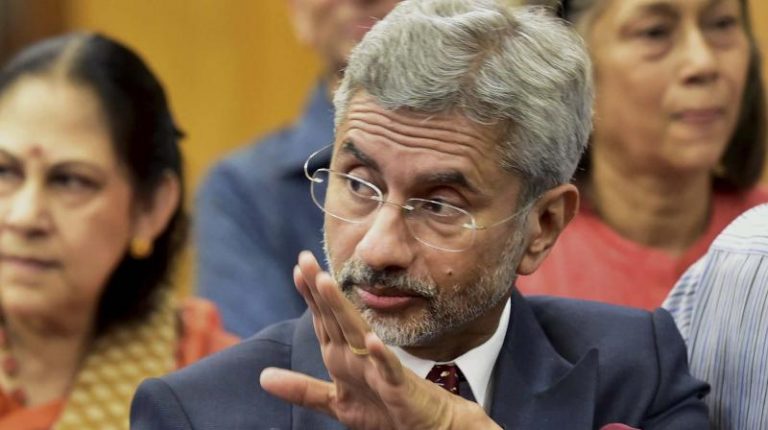
While speaking at a panel discussion at ORF(Observer Research Foundation)’s Raisana dialogue, Foreign secretary S Jaishankar remarked that Balochistan and Kulbhushan Yadav were ‘fantasies’ of others while answering a question.
This comes at a time when Pakistan has accused India of perpetrating terror in Balochistan. It has claimed that Kulbhushan Jadhav is a RAW agent. Some media houses in India like Quint have also peddled Pakistani lies.
Cheeky answer to a question on Indian terror and Kulbhushan Yadav
The lady in the audience remarked that Kulbhushan Yadav’s confessions were enough to get a flavour of India’s state sponsored terror. She said that there was little mention of Indian state sponsored terror and there was a need to respect sovereignty of Pakistan. She question Mr Jaishankar as to why he did not mention Kulbhushan Yadav or Balochistan while speaking about terror in the discussion.
While replying to the question S Jaishankar said that his brief was only to stick to facts and not dwell on other’s fantasies. He was hinting at Pakistani claims on Indian terrorism. General Petreaus also remarked that he had never heard of Indian terror from organisations like CIA.
To a question from a young lady from the audience on why he didn’t talk of #Balochistan and #KulbhushanJadhav, S Jaishankar says – my brief was to stick to “facts” and not dwell on others’ fantasies. Touche. #Raisina2018@raisinadialogue
Observations on India’s role and other big disruptions happening in the world
Mr Jaishankar also remarked that India is a solution to ensure that the rules based order stays intact. This is in sync with India’s attempts to be a more active and vocal global player under the current NDA government.
Subrahmanyam Jaishankar (@MEAIndia): The transition — how the rules based order is not limited to the Western-led world — has a solution. And the solution is called India. #Raisina2018
Mr Jaishankar also doubted whether China would be a model to other countries as a global power in future. He felt that Chinese behaviour, as it consolidates its place in the world, would be an ‘open question’. He also predicted four big disruptions that the world would see in near future. According to him, four imminent disruptions include rise of China, behaviour of the USA, terrorism and implication of non-market economics.
The four big disruptions I see: First, rise of China, Second choices, postures, behaviour of USA, Third the challenge of terrorism and fourth one is the rise and implication of Non Market Economics : Foreign Secretary S. Jaishankar at #RaisinaDialoguepic.twitter.com/yFYgoY06Jc
Mr Jaishankar was speaking at the session ‘A disruptive world : solutions for tomorrow’. Maurice Gourdault Montagne, General (Retd) David .H. Petreaus were also part of the panel discussion. The session was moderated by Samir Saran. The panel was discussing tectonic and unprecedented challenged that the year 2017 presented to the world.