Home Blog Page 7395

2G verdict: Was the man who ‘misled’ PM Manmohan Singh, a ‘Gandhi loyalist’?

0

The 2G verdict acquitted the accused, prominent among them, the then Telecom minister A Raja, but the judge in his judgement has opened up a new angle. While he trashes the case of the prosecution, a section of the judgement exclusively deals with the following:

Role of PMO: Whether Hon’ble Prime Minister was Misled, if so, by Whom?

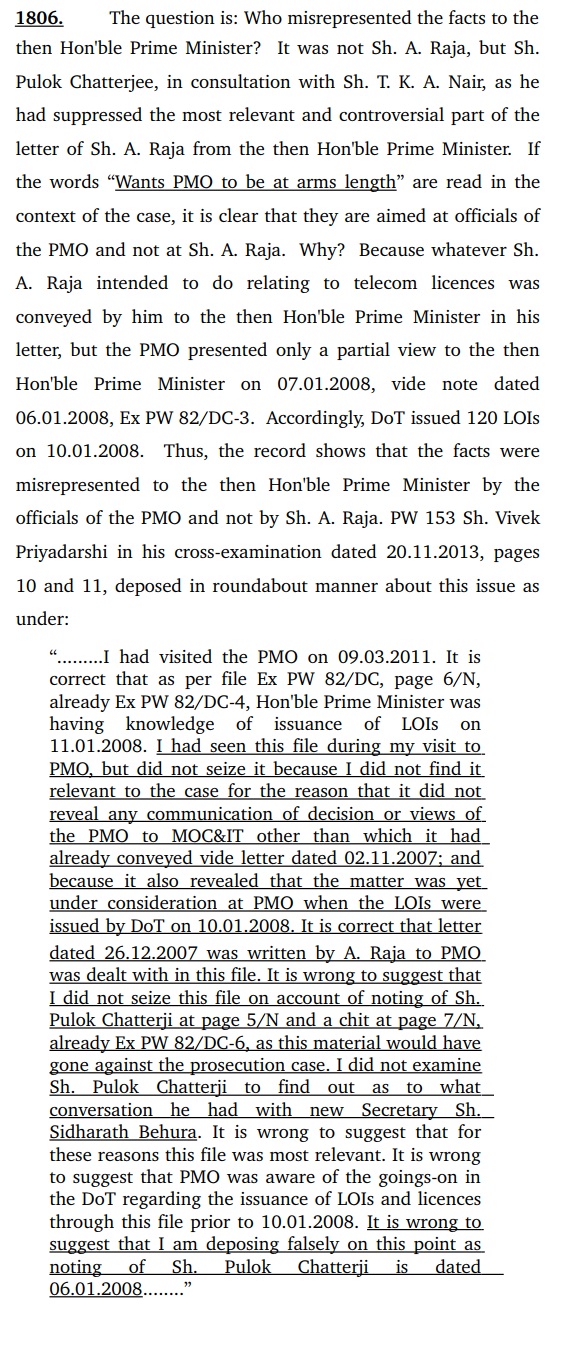
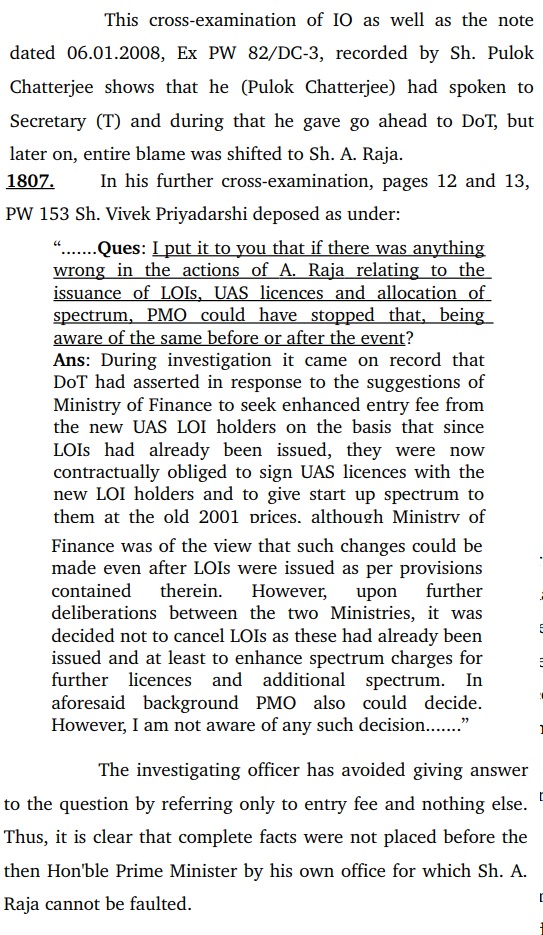
Paragraph 1795 to Paragraph 1807 of the judgement exclusively deals with this part, and the conclusion of the judge is presented as below:

From the above, one fact is clear: The CBI judge had no doubt in his mind that the then PM Manmohan Singh, had been ‘misled’ on the 2G issue. The only question was: Who misled the PM.

The judge answers this by categorically stating at the start of para 1806 that it was Pulok Chatterjee,  in consultation with T. K. A. Nair, the then Principal Secretary to the PM, as he had suppressed the most relevant and controversial part of the letter of A. Raja from the then Prime Minister.

And who exactly is Pulok Chatterjee?

In the 1980s, the then chief minister of UP, V.P. Singh, had discovered Pulok Chatterjee as a new DM for Sultanpur (under which Amethi falls), at the behest of Sanjay Gandhi. But Sanjay Gandhi expired, and Chatterjee was picked up by Sanjay’s successor Rajiv Gandhi. He is said to have become close to the Gandhi family from thereon.

After Rajiv Gandhi’s assassination, Chatterjee joined the Rajiv Gandhi Foundation for six years and subsequently worked with Sonia Gandhi as her OSD, when she became leader of opposition in the Lok Sabha. Once the UPA seized power in 2004, he was appointed as the Joint Secretary in PMO from 2004 to 2009, the period when the 2G licenses issue arose. After a brief stint with the World Bank, He was elevated to the role of Principal Secretary to PM Manmohan Singh in 2011.

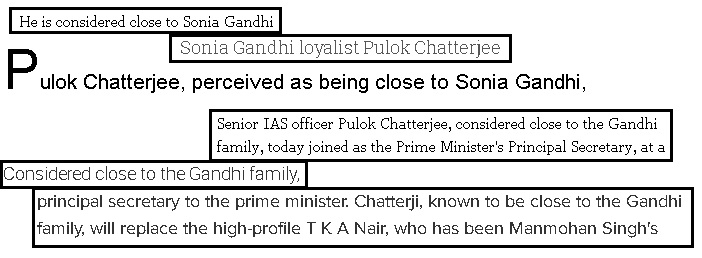
Media reports over the years have referred to Chatterjee as “close to Sonia Gandhi”, “Sonia Gandhi loyalist”, “close to Gandhi family”:

Sanjay Baru, the PM’s then Media advisor, says this about Chatterjee:

Pulok, who was inducted into the Manmohan Singh PMO at the behest of Sonia Gandhi, had regular, almost daily, meetings with Sonia at which he was said to brief her on the key policy issues of the day and seek her instructions on important files to be cleared by the PM.

Indeed, Pulok was the single most important point of regular contact between the PM and Sonia. He was also the PMO’s main point of contact with the National Advisory Council (NAC), a high-profile advisory body chaired by Sonia Gandhi, with social activists as members. It was sometimes dubbed the Shadow Cabinet.

Coming back to the 2G verdict, the judge proceeds to builds his case, and in para 1799, the judgement says

It is not clear from the record, if this note was seen by the then Hon’ble Prime Minister or not. However, it is clear that  somebody from the PMO had given a go ahead to the DoT for issue of new licences and most probably it was Sh.  Pulok Chatterjee himself, as his note records that he had spoken to Secretary (T).

A few things become clear here: The judge believes that the go ahead to give away the 2G licenses came from within the PMO, and he believes that “most probably” this came from Mr Chatterjee. The judge thus exonerates A Raja, and wonders why Mr Chatterjee would have suppressed facts, presented a partial picture, and “misled” the PM. In para 1804, the judge also says that the reason for placing such partial facts before the PM, would be best known to Mr Chatterjee himself.

While the above is clear, some questions do come up:

1. Were Chatterjee’s actions an error or a deliberate move?

2. If deliberate:

a. Did he act on his own account, as just another bureaucrat, or was he acting on someone’s behest?

b. Can it be ruled out that this entire process was orchestrated to seem like it was an “error”, when in fact it was done to first facilitate, and the cover-up, the controversial issue of licenses?

c. Who is most likely to have influenced Chatterjee to become the fall-guy for an “error”?

The judgement does not seem to deal with the above questions since the main accused was Mr A Raja, and the judge has found him not guilty. While the Congress is celebrating the judgement as a vindication of their stand, the above observation by the judge, that the PM was “misled” by “suppression of facts”, by a PMO official who happens to be a Sonia Gandhi loyalist, can be far more damaging than an A Raja conviction. The judgement essentially clears A Raja, but shines the light of suspicion on the PMO and associated characters. Will we ever have a thorough probe to explore the answers to above questions?

Man threatens to start using 2G internet to protest against acquittal of 2G scam accused

0

On Tuesday, much to the surprise of many, a special court decided acquit all the accused in the 2G spectrum scam, which as per the prosecuting agencies caused a loss of Rs 30,000 crores to the public exchequer. According to the special court judge, the prosecution failed to prove its charges as a result of which they were dropped.

A resident of Bangalore named Mr Mukesh Jiowala though seems to have taken offence at this verdict, and has announced his decision to protest against it by threatening to start using 2G internet in place of his regular high speed 100 Mbps broadband connection.

2G internet is considered one of the slowest forms of internet available to man, with download speeds on the network barely exceeding 10 kbps. Such a frustrating experience is believed to either turn the user into a mad man requiring to be admitted to a mental asylum or makes him a grand master in being patient, which immediately enables him to attend nirvana.

We sent our reporter to know more about this serious matter and Mukesh too agreed to speak to us, “Well you see, the moment I noticed that the verdict had acquitted all the accused, even though the prima facie case against them was pretty strong, I became outraged. I rapidly started dishing out very angry tweets but it failed to quell my anger. As a result I knew I had to take it to the next level”.

“Now I didn’t really want to do cliched protests like fast unto death or threatening to burn myself alive, which generally don’t bother people anymore. So I decided to use 2G against the 2G verdict and came up with this plan, which I knew would shock people. I would hence forth only use 2G internet to carry out all my internet activities until all the accused are punished. So what if I would have to view buffering 144p videos, on my 50 inch 4K Ultra HD TV, I will at least send out a strong message.”

Such a threat by Mukesh has been brought to the notice of a local political party which has sent its workers to try to dissuade him from going ahead with his protest. Its local leader named Narendra Gandhi spoke to us on a condition of anonymity.

“This is a very serious matter, it is known that using 2G internet is a far more painful than starving to death. Just last month I did a fast unto death protest for two weeks but all the while I was binge watching Netflix on a 4G connection and I only felt hungry a week into my fast, when the video buffered for a while.”

“So forget not using the internet, if Mukesh starts using it on 2G, god knows what will happen. We have urged the CBI and Modi government to rapidly file an appeal in the High Court and pursue this case as top priority, which is probably the only way Mukesh may be dissuaded”.

Author’s note: The above piece is a work of satire, obviously no human would be suicidal enough to attempt such an extreme form of protest 

Senior Congress leader justifies not letting Sachin Tendulkar speak in Parliament

0

Former cricketer Sachin Tendulkar during his cricketing days maintained an impressive 54.08 average in test cricket. But when it comes to Rajya Sabha his “average” or attendance stands at a dismal 6.6% as according to reports, he has barely managed to attend the upper house for 22 out of 348 working days since his nomination in 2012.

So it might have come as a pleasant surprise to his colleagues, when it was reported that not only was Sachin attending Rajya Sabha, he was also initiating his first debate in the upper house. The matter pertained to a lack of proper training facilities for our athletes and a lack of financial assistance for retired sportspersons.

In order to conduct this discussion, Sachin had requested time for carrying out a short discussion on this topic and was allotted a 2:00 PM slot on Thursday.

But rather than allowing Sachin to carry out a fruitful discussion regarding an issue which plagues Indian athletes, Congress’ Rajya Sabha members decided to create a ruckus in the house to disrupt proceedings ( Video via @News18Punjab):


As seen in the above video, Vice President Venkaiah Naidu is trying to calm the Congress members down, and in doing so reminded them that a honourable member who has been awarded Bharat Ratna wanted to make a submission. He is also seen urging the Congress MPs to sit down and maintain decorum. Sachin meanwhile is seen standing with a bemused expression.

The Congress almost predictably didn’t pay heed to Naidu and decided to continue their sloganeering and even didn’t stop after being reminded that the whole nation was witnessing their ruckus.

The motive behind this ruckus seemed to be that the Congress was demanding that PM Modi should clarify his remarks about former PM Manmohan Singh, which he made during the Gujarat Elections.

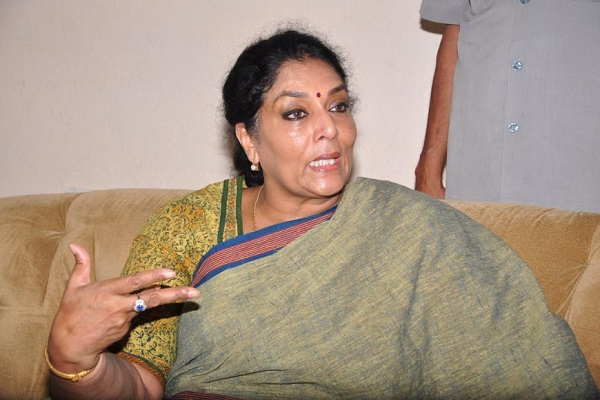
After the issue played out, the media predictably questioned the Congress and one of its senior leaders, rather than apologising for her party’s conduct decided to ‘justify’ it:


Going by the above tweet by the TOI journalist, Renuka Choudhary, is seen rhetorically questioning as to whether receiving a Bharat Ratna provides someone a “license” to speak in the Rajya Sabha.

Some might argue that such an outlook by a senior congress leader shows the party’s disregard towards not only honourable Rajya Sabha members and the upper house but also towards the nation’s highest award the Bharat Ratna. Time and again, Congress has proven its elitist mentality and this seems to be just one more incident.

This is what people who pursued the 2G scam had to say about today’s acquittal by Trial Court

0

Few people doggedly pursued the 2G scam and some of them were MP Rajeev Chandrashekhar, journalists Shalini Singh, J Gopikrishnan and Sunil Jain. Today, after the lower court acquitted D Raja and Kanimozhi owing to prosecution’s failure to prove the case against them, these people took to twitter to express not only their shock over the verdict, but also their views on how Congress was trying their best to spin this verdict.

Member of Parliament Rajeev Chandrashekhkar :

Mr. Chandrashekhar took to twitter first in anticipation of the verdict. He spoke about how he was the first and only MP back in 2007 to challenge the Congress led UPA on 2G scam and had virtually found no support.


He also tweeted about his old article, saying that the 2G scam must be investigated as a serious white collar crime and all involved must be held accountable.


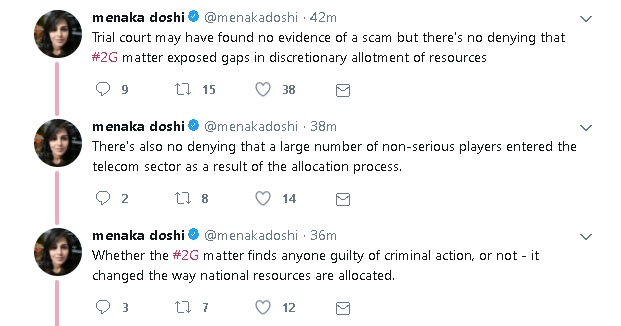
Later, once the verdict came, after widespread disappointment on Social Media, Rajeev Chandrashekhar responded again, explaining why there was no need for such disappointment. He also said that today’s judgement was only about criminal conspiracy against 4 people in the government and their money trail. While the Trial Court said the prosecution couldn’t prove these charges, the existence of the scam in itself hasn’t been contradicted since the Trial Court cannot and has not contradicted the judgement passed by the Supreme Court in 2012.


While Congress was busy patting itself on the back and asserting that this judgement meant no scam happened to begin with, Rajeev Chandrashekhar reminded them to not forget the 2012 SC verdict.


Journalist Sunil Jain (Managing editor of Financial Express) : 

Sunil Jain was one of the journalists who had pursued the 2G scam since the very beginning. Before the judgement came out, Jain took to twitter indicting Manmohan Singh, the then Prime Minister and bureaucrats of the time.


After the verdict was announced, acquitting both Raja and Kanimozhi, Jain expressed his shock and the judgement.


He then went on to question Kapil Sibal on his statements vindicating the then Congress government, Raja, and the then Prime Minister Manmohan Singh. He said while the Supreme Court understood the gravity of the scam and cancelled licenses, Kapil Sibal would rather believe a judgement passed by a trial court.


He also express hope. He said the initial verdict in the Jessica Lal murder case was an acquittal, which was later overturned. He hoped the same would happen with the 2G verdict.


Journalist Shalini Singh : 

Shalini Singh was one of the first journalists to break the 2G scam. She even blamed the Modi Government of twiddling thumbs all through in 2007 and 2012 after the SC verdict. She said she hoped they would not do the same now, and pursue this case to its logical conclusion.


Journalist J Gopikrishnan : 

Mr. Gopikrishnan also expressed his shock and anguish at the verdict.


There seems to be a consensus among people who pursued this case most doggedly, that the trial court verdict would be overturned if appealed in High Court, questioning how the Trial Court could acquit when the Supreme Court had cancelled the 2G licenses in 2012. They even indicted Kapil Sibal and the Congress party at large for considering this verdict as a declaration of innocence. Now, it for the Modi Government to take a call whether the investigative agencies would appeal this verdict in the HC or not.

It was a corrupt policy intended to promote corruption: Jaitley reacts to 2G scam verdict

0

On Thursday the nation was shocked, when the special court hearing the 2G scam case acquitted all the accused including former telecom minister A Raja and DMK MP Kanomozhi.

Soon after the verdict it was noticed that prominent Congress leaders and Journalists started spreading a “there was no scam” narrative, and even targeted former Comptroller and Auditor General of India Vinod Rai, who is credited with valuating the scam at 1.76 lakh crores.

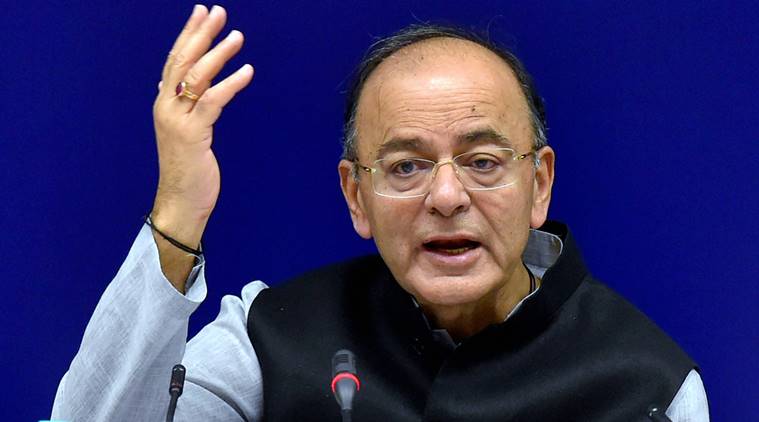
The BJP too decided to jump in the fray, and finance minister Arun Jaitey appeared before the media to react to the verdict by not holding back (Video via @CNNnews18):


As heard in the video, Jaitley says that the 2G spectrum policy was quashed by the Supreme Court which described it as arbitrary and unfair. He later described his government’s success in earning Rs 1.10 lakh crores in 2015 and Rs 65,000 crores in 2016 after a reallocation was ordered by the Supreme Court.

He thus concluded that it was clear that the UPAs policy had caused a loss as the NDA government had bagged a much higher price for the airwaves.

He described the allotment policy as arbitrary and designed to promote corruption which was implemented in an unfair manner. He thus questioned as to who was liable for this “entire scam” as according to the special court’s judge nobody is liable in a criminal case. Jaitley thus asserted that the prosecuting and the investigative agencies would look into this matter and decide what should be the future course of action.

He didn’t stop at this and described the 2G allocation exercise as a, corrupt policy intended to promote corruption and attacked the Congress party by asking it not to consider the verdict as any kind of certificate.

In a clip shared by Times Now, Jaitley was also quoted as claiming that the first come first serve policy employed during the UPA allocation was intended to serve only a select few. 

Going by such statements of Jaitley, it is amply clear that the BJP is not holding back regarding the matter and may continue to publicise the controversial aspects of the allocation to maintain the heat on the Congress party.

Apart from Jaitley, senior BJP leader Subramanian Swamy (who is one of persons credited with exposing the scam), also decided to react:


He later also suggested a possibility of some possible ‘pressure’ exerted on the special court judge:

2G Verdict aftermath: Congress and journalists claim ‘no scam’, attack Vinod Rai

0

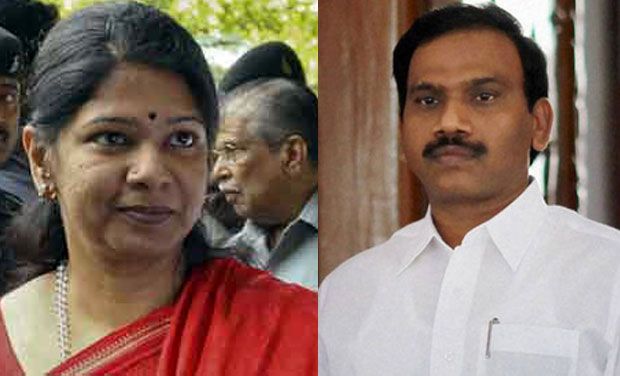
The much awaited alleged 2G scam verdict was finally out today. A special CBI court acquitted all accused, including former telecom minister A Raja and DMK MP Kanimozhi, in the 2G spectrum allocation scam cases. All of the 19 accused were acquitted of all charges in the Enforcement Directorate’s money laundering case which comes under the gamut of the 2G scam case.

Details of the judgement are yet awaited but Congress, which was at the helm of the Government when the alleged scam took place, re-iterated its “zero loss”, no scam theory. Congress leader Kapil Sibal stated:

This verdict is both a moral and legal victory for the Congress Party. I have been saying all along that this was not a scam. It was a scam by Vinod Rai.

P Chidambaram said:

Allegation of a major scam involving the highest levels of Government was never true, was not correct and that has been established today.

NDTV reporter former PM Manmohan Singh as saying:


It is pertinent to note here that although the special CBI Court has reportedly declared the above, the Supreme Court had in 2012 itself declared that the allocation of 2G spectrum by the Congress-led United Progressive Alliance (UPA) government was “illegal” and was an example of the arbitrary exercise of power. It had then cancelled all 122 telecom licences allotted on or after January 10, 2008 to 11 companies during the tenure of the former telecom minister, A. Raja.

The details of the judgement are awaited, but one lawyer on social media put forth a possible explanation:


Meanwhile, Congress was obviously expected to tow the “no scam” line and attack Vinod Rai, some “journalists” too seemed to parrot the same line:


It was quite amusing to see journalist question the existence of a scam (on which the Supreme Court had already ruled), just because a lower court had acquitted the accused. Just because a murder accused stands acquitted, does a journalist claim that the murder itself did not take place? Instead of questioning the prosecution or the courts, or in fact waiting for the full judgement, some journalists as above jumped on to the Congress line of though: attack Vinod Rai and declare that the scam never existed.

Understandably, social media users gave fitting responses to such so-called unbiased “journalists”:


The original anti-corruption crusader reminded us of history:


Journalists who had played a pivotal role in breaking the 2G scam reacted as below:


Other journalists put out a completely different perspective, compared to those who readily toed Congress’s line of thought:

Even if the CBI and ED appeal against this verdict, which is very likely, the media has chosen its narrative: Question the very existence of a scam and tarnish the messenger i.e. Vinod Rai, then then CAG. This, even before reading the verdict and understanding what went wrong: Was the prosecution’s case weak or sabotaged? Was the evidence insufficient to establish guilt beyond reasonable doubt, considering the burden of proof is higher in criminal cases? Was justice subverted by powerful politicians or businessmen? No, stupid, there was no scam!

People shocked after special court acquits all the accused in the 2G scam case

0

Many felt that 21st December 2017 would be a historic day when India via the verdict in the 2G scam case, strikes a decisive blow on the corrupt establishment which has plagued it for many a years.

As per the CBI prosecution, the irregularities in spectrum allocation resulted in a loss of about Rs 30,000 to the national exchequer. In the total three cases (2 filed by CBI and one by ED), the prominent accused included former telecom minister A Raja and Karunanidhi’s daughter Kanimozhi.

Prima facie it was reported that the Department of Telecommunications issued licenses on a first come first served basis and later the cut-off date for the applications was advanced to 1st October 2007 from 10th October 2007 which eliminated 408 out of the 575 applicants from the race. It has been alleged that A Raja was the main man behind advancing this deadline.

But today things took a shocking turn when the special court’s judge OP Saini acquitted all the accused in the matter:


As reported, the court observed that the prosecution had failed to prove its charges as a result of which they were dropped.

Such an unexpected turn of event shocked many, who as a result reacted:


Soon after the verdict, Subramanian Swamy one of the main parties to the case, came out to demand that the government immediately approach the High Court regarding this matter:


It remains to be seen what course of action the prosecuting agencies like the CBI and ED take, and if indeed they appeal against this verdict, how much longer it will take before a decisive conclusion is reached regarding the matter.

Following Modi govt’s crackdown foreign funding of Indian NGOs drops by 66%

0

As per figures released by the Modi government on Wednesday, the foreign funding of India based NGOs has sharply declined to about one-third of what they were receiving in 2015-16.

As reported, the total foreign funding of these NGOs has come down to to Rs 6,499 crore in 2016-17, from a total of Rs 17,773 crore in 2015-16.

Such a fall in foreign funding was a result of the Modi government cracking down on NGOs which violated Foreign Contribution Regulation Act (FCRA), norms.

Also in a statement to the Rajya Sabha, Minister of State (MOS) for home affairs Kiren Rijiju informed that, the government has cancelled the license of 18,868 NGOs for FCRA violations over the past six years, which includes the cancellation of 4,842 NGOs in 2017 itself.

When it comes to FCRA norms, the government has been meticulous when it comes to its compliance.

As reported recently, the Modi government had recently revoked the FCRA registration of prominent Indian institutions like the Jawaharlal Nehru University (JNU), Delhi University, Indira Gandhi National Open University (IGNOU) and IIT-Delhi, because these institutes had not filed their returns for a period of 5 consecutive years from, 2010-11 to 2014-15.

This cancellation of registration meant that these institutes were rendered unable to receive foreign funding.

The government had also directed 1,222 NGOs to validate their bank accounts where they receive the foreign funds, failing which punitive action would be taken against them. Such NGOs included prominent ones like Sri Ramakrishna Math, Ramakrishna Mission and Coimbatore Christian Charitable Trust.

We had reported in the past how a sizeable chunk of Indian NGOs were under the scanner for financial impropriety, which gave their activities a rather shady tone.

This came to light after a 2015 CBI report claimed that, out of about 31 lakh NGOs operating in the country which received their funds from the govt and/or abroad, only a paltry 10% had filed their balance sheet.

On top of it, about Rs 950 crores of the tax-payers’ money every year was being disbursed to various NGOs, as a result of which the Supreme Court noted that a law to regulate their working and funding would be a welcome step.

Can Hindutva fight the ‘poison of casteism’ that Modi talked about after Gujarat results?

0

On Monday, BJP supporters skipped a heartbeat between 9-10 AM as trends of Gujarat assembly election results started pouring in. At one point of time, Congress appeared set to get the majority and oust BJP from Prime Minister Narendra Modi’s home state. Some premature obituary for BJP was written by some anti-BJP and anti-Modi commentators and journalists.

However, it was not just the anti-BJP crowd that was writing premature obituaries, even many BJP supporters and ‘right wingers’ were doing the same in that one hour. Narendra Modi and Amit Shah were declared failures and the slogan of ‘Vikas’ was mocked mercilessly by many BJP supporters, who demanded that the party stick to Hindutva and ‘core’ issues.

Now one can discount them as ‘fake’ supporters, fickle minded, ‘living in parallel universe’, liability for the party, etc. but it is a manifestation of the ‘natural’ support base BJP enjoys, especially online. A fan or supporter becoming one of the most virulent and even vicious critic is a quintessential Indian trait. Haven’t we seen it innumerous times when cricket fans have shown their ugly side when Indian team doesn’t perform as per expectations? It was the same set of emotions at play.

I digress already. The point of writing this article is not that BJP enjoys natural support of many, but about this Hindutva vs Vikas issue, which was debated passionately in that one hour, and still continues to be debated.

Actually, it’s not Hindutva vs Vikas – they are not exactly mutually exclusive ideas as Narendra Modi has argued and tried to demonstrate – the real question is Vikas and/or Hindutva vs Casteism.

The caste plus ‘soft Hindutva’ card that Congress played in Gujarat has been argued to have worked in its favor. The acknowledgment of the same came from none less than Narendra Modi himself, who talked about “poison of casteism” coming back in Gujarat during his victory speech later in the day.

Frankly you don’t need to be an Einstein to figure out that Casteism is the undoing of Hindutva. Hindus divided on caste lines are always going to help ‘secular’ politics. The agitated supporters were pointing at this fact and demanding that BJP stays true to Hindutva and not “delude” itself that vikas (development) can defeat casteism. Everyone also pointed to the 2004 general elections defeat when BJP is supposed to have forgotten core issues in favor of development (India Shining).

But is it so simple? Can Hindutva easily trump Casteism?

Technically it can, for Hindutva and Casteism are just the opposite. But the question that needs to be asked is why do the masses appear to easily and frequently rally behind caste issues than Hindutva?

A purely Hindutva movement translating into electoral success was Ram Janmbhoomi movement spearheaded by LK Advani, but it could help BJP form a government only for 13 days. Mandal (casteism) ruled the politics in coming years and BJP could not sustain the momentum that Ram Janmbhoomi had given it. So historically, it was Casteism that trumped Hindutva, not the other way round.

Later, BJP could get to power largely on the basis of a ‘moderate’ Vajpayee’s image (that helped in winning allies and forming the NDA), with Hindutva not being the biggest USP (NDA manifesto had put the three core issues of BJP on the backburner). One can actually argue that BJP gained power (in 1999) by diluting Hindutva, and not lost power (in 2004) due to this dilution.

I would recommend reading two short articles that my troll friend Gaurav had written in 2009, here he challenge this belief that dilution of Hindutva led to BJP’s defeat, only to – in his own words – confuse everyone. He writes about ‘Mirage of assertive Hindutva’ and ‘Center right tangle’.

Or you can choose not to read his blogs (I’m Gaurav’s troll friend too), as I’d summarize and build upon his arguments here in this article. Let me start with quoting one paragraph where he explains why Hindutva alone can’t win elections. He writes:

“Hindu identity has never been as overriding as Islamic identity and unless there is a sense of impending danger or great grievance Hindus tend to focus on more materialistic pursuits. The fact that Sangh Parivar never made any sincere attempt to articulate what it hopes to achieve with Hindutva or it was never in position to implement whatever agenda it had for Hindutva just ensured that after the heady days of Ram Mandir movement Hindutva stalled electorally.”

Now the above paragraph gives an answer to the question that I had put up earlier in this article – why do the masses appear to easily and frequently rally behind caste issues than Hindutva?

In other words – there are no distinct and direct socio-economic benefits associated with Hindutva as they are associated with caste based issues.

Let’s just see the kind of socio-economic benefits a caste based leader like Hardik Patel, Jignesh Mewani, or Alpesh Thakore can convey, and convey very easily to their target audiences:

  • Reservations – direct economic benefit as you get jobs and access to better education
  • ‘Justice’ – you feel ‘secured’ that you won’t get bullied by people with muscle power
  • Power – you can actually bully others, with the bonus that you won’t get labeled as fascist

Hindutva (and Hindutva alone) fails to guarantee any one of these, except the ‘justice’ part in areas with substantive Muslim presence, say, in Western Uttar Pradesh. The ‘liberal’ media ignores the hate crimes by Muslims in such areas, but the ground reality is different. This is why a ‘controversial’ leader like Sangeet Som is an asset for BJP, no matter how much a blind NDTV pans him for ‘hate speech’ and ‘divisive politics’.

One can find fault with BJP if it doesn’t push Hindutva in such areas, as many argue that the party fails to do in parts of West Bengal. Organizations like Hindu Samhati have grown in such areas due to this ‘abdicating of responsibility’ by the BJP. However, in terms of realpolitik, BJP doesn’t have much of an incentive to push Hindutva in other areas, unless it can guarantee some other socio-economic benefits to the voters.

The third aspect of providing ‘power with respectability’ is a long-term project that requires stranglehold on narrative. It is huge task as it requires destroying the Congress-left ecosystem built and nurtured for decades. BJP has done very little on this front. It has been a personal disappointment for me.

With point number two and three ruled out, let us look at point number one. There seems to be a strategy there. Vikas (development) promises distinct economic benefits to a person, and BJP, rather Modi, hopes that it will make up for Hindutva’s weakness on other two fronts.

One has to concede that this is a rather tenuous relationship and offering. There doesn’t appear to be any direct link between Hindutva and Vikas, the way this link exists between Casteism and Reservations.

The reason it is working is because the alternatives to Modi are horrible. No one really believes that Rahul Gandhi can bring in development and it will require a massive attempt from the ecosystem to re-brand him, and the ecosystem is trying. They have around 1.5 years to achieve this feat.

Leaders associated with ‘development’ agenda (in popular perception) are Nitish Kumar, Chandrababu Naidu, and Naveen Patnaik to an extent. Two of these are with Modi and the third doesn’t have pan India appeal. The ecosystem has tried to project other development guys from time to time, including even Akhilesh Yadav, who got unusual favorable coverage from Economic Times before the Uttar Pradesh assembly elections, but Modi won (I know many of you might be itching to say ‘Yogi won’, but he was not the Chief Ministerial candidate).

Yogi Adityanath – who has Hindutva written all over him – was perhaps chosen by Modi to lead the government in Uttar Pradesh for this very reason – to make this rather tenuous relationship between Hindutva and Vikas appear a ‘natural’ relationship.

Basically, BJP is trying to make Hindutva as ‘appealing’ as caste based politics, which has some natural advantages of providing socio-economic benefits, by linking it to development. And all this is being done on macro level, at micro level, even BJP has to fall back upon some appeal of caste (Modi exploiting the ‘neech’ statement by Mani Shankar Aiyar, for example).

Is this the best strategy? No. However, this is what the strategy appears as of now and it appears to be working too. It doesn’t do a great service to the core concept of Hindutva, I grant that.

The passionate supporters want BJP to stick to Hindutva, but the problem is what Gaurav had noted in his blog after the 2009 debacle – lack of articulation about what Hindutva is and what it aims to achieve (preferably with distinct socio-political benefits to the voters, which caste based politics can seemingly offer).

All the definition of Hindutva ironically comes from the haters who caricature it as some Nazi agenda, or cleverly, a form of Casteism (for they must not allow Hindutva being perceived as antidote to Casteism). Their arguments can be destroyed – for example, they would argue if Hindutva is against Casteism why are almost all RSS chief Brahmins? Never mind that most of the communist party leaders are also from upper castes (incidentally Brahmins) and most ‘progressive’ journalists are also from upper castes. Left-leaning newspaper The Hindu had only Tamil Brahmins heading them with non-veg banned in their canteen, so let them first declare The Hindu casteist. Also, never mind that Hindutva has currently given a Dalit President and an OBC Prime Minister. Nonetheless, arguments with these elements is a waste of time. The issue here is articulation about Hindutva coming from those who espouse it.

So who articulates what is Hindutva and what is there for the common folks, especially in terms of socio-economic benefits? Ideally RSS and BJP should have done it, but perhaps they – especially Modi – found out that linking it with ‘Vikas’ was better and easier. We can find fault with the party for this, but this formula appears to be working for the party, which is why Modi gave the slogan of “jitega bhai jitega, vikas hi jitega” slogan yet again while acknowledging the challenges from Casteism.

One can hazard a guess as to why Modi – who surely is trusted by many to be a Hindutva adherent and icon – would settle for this strategy, which doesn’t have any apparent plan to push Hindutva across the country. Is the strategy just to keep Congress out of power (Congress Mukt Bharat) so that if Hindutva is not being spread, at least anti-Hindutva is also not getting stronger? I don’t know.

But outwardly, it appears that Modi will continue with his strategy of Hindutva being linked with Vikas, because an alternate ‘election winning definition’ – with distinct and direct socio-economic benefits for the supporters – of Hindutva unfortunately doesn’t appear to be available. Internally, I don’t know if the party has any plan. It should have.

But what should be that plan is the question. How do you really make Hindutva more appealing than Caste for an ordinary Hindu who might not be as invested as you in the ideology? Think beyond your social circle, especially social media circle.


Pakistan Government finally issues visas for Kulbushan Jadhav’s mother and wife to visit him

0

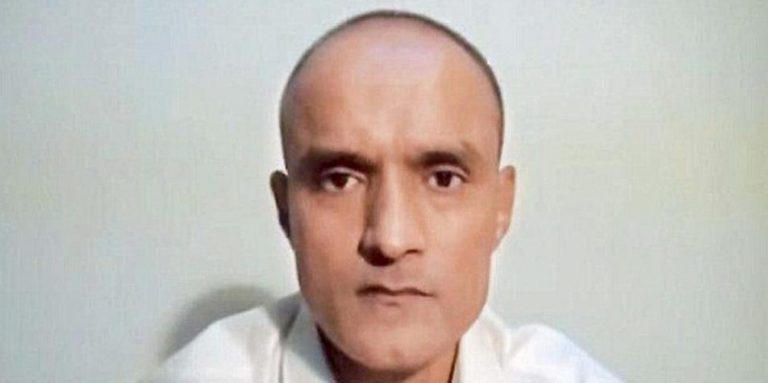
The family of Indian citizen Kulbushan Jadhav might finally be breathing a sigh of relief after it has been officially conveyed that, Pakistan has issued visas to the mother and wife of Kulbushan Jadhav so that they can visit him.

The conformation of this was provided via a tweet by Dr Mohammad Faisal, who is the spokesperson of Pakistan’s ministry of foreign affairs:


In April of this year, it was reported that Jadhav had been awarded the death penalty after being tried through the Field General Court Martial (FGCM) under Pakistan Army Act (PAA). Pakistan had alleged that, Jadhav was tasked by the RAW to plan, coordinate and organise espionage/sabotage activities aiming to destabilise and wage war against them, by impeding the efforts of Law Enforcement Agencies for restoring peace in Balochistan and Karachi. .

The Indian government though strongly denied Pakistan’s allegations, and close examination of Pakistan’s claims had revealed that they were inconsistent, and also strongly reeked of fabrication. This was cemented when a retired Pakistani Army Lt Gen too nailed Pakistan’s lies on Kulbhushan Jadhav. Pakistan had also denied consular access to Jadhav 16 times and denied visas to Jadhav’s family.

India didn’t take Pakistan’s ‘death sentence’ lying down and knocked on the doors of the International Court of Justice (ICJ). The ICJ thereby provided major relief for Jadhav by staying the hanging, but a long and arduous legal process still remained.

This visa for Jadhav’s mother and wife might also infer that Jadhav has survived captivity in Pakistan, considering that Pakistan has now ‘deemed it fit’ to allow them to visit him on 25th December. One also hopes that this family visit proves to be a breakthrough in this matter, which might finally pave the way for him to come home.