Home Blog Page 7490

PTI spreads fake news again, Rahul Gandhi uses it to score a political point

A couple of days back, Rahul Gandhi, in yet another new avatar – this time digital – ready to take on the BJP, took a jibe at the Yogi Government by quoting alleged news reports about the Uttar Pradesh government slashing the funds allocated for education in its latest financial budget:


//platform.twitter.com/widgets.jsThe report was based on a news copy circulated by the news agency Press Trust of India (PTI), which claimed that the Yogi government had drastically cut the budgetary allocation for secondary and higher education in the state.

According to the report, the Akhilesh government had allocated Rs 9,990 crore for secondary education in the 2016-17 fiscal, but this had been slashed down to just Rs 576 crore by the Yogi government in its annual 2017-18 budget.

The Higher Education too had allegedly received a cut of Rs 2,469.73, after the allocation was just Rs 272.77 crore as compared to Rs 2,742 crore in the last fiscal.

The claims made in the news report raised some serious questions about the logic behind the Yogi government’s decision as education is the pillar to support any modern society. Since the report was filed by a well known news agency PTI, it was taken as a gospel truth the media and carried on various platforms.

But as it turns out, this report was a case of a malicious fake news spread by the PTI. A website named “The True Picture” was among the first ones to fact check the PTI’s claims and found them baseless.

As it turns out, getting the numbers of budgetary allocation was quite easy, which somehow people at PTI could not find. There is an official website for Uttar Pradesh budget at budget.up.nic.in and all the information, including from previous budgets, is easily available there with a few clicks.

And that’s what some Twitter users too did and they figured out how PTI report was wrong. There was actually a sharp increase in the allocations for education budget across various sub-heads:


Now that the truth is out that PTI published a fake news report, which was used by Rahul Gandhi to take pot shots at the Yogi government, media outlets are making it appear like a political fight between BJP and Rahul Gandhi, instead of telling their readers that the news agency they subscribe to is run by incompetent journalists.

Once the truth was out, media published news reports titled – ‘Total budget for education in UP is 25.4% higher’: Adityanath government refutes Rahul Gandhi’s claim – but this is misleading in itself as Rahul Gandhi’s claim was based on news reports, not on his own imagination. Why does the media find it so tough to accept that they erred?

This isn’t the only time PTI has been caught spreading fake news. On 30th June, the PTI had come out with a news feed which claimed that the former Defence Minister Manohar Parrikar had planned the 2016 surgical strikes in the Pakistan occupied Kashmir due to an “insulting question” of a TV news anchor. The said question was posed to the Union Minister Rajyavardhan Singh Rathore and the Defence Minister saw it on TV.

This in itself was hard to believe that a Defence Minister will plan a full blown assault in an enemy controlled territory to nurse a bruised ego of a colleague. Soon enough the PTI came out with a correction (which obviously did not make the kind of headlines the original fake news did) that stated that Parrikar had actually said that he had felt insulted by a June 4, 2015 ambush on an Indian Army convoy, by the north-eastern militant group NSCN-K. The surgical strike in POK was reportedly planned after that, and not after any TV journalist’s “insulting question”.

Now it remains to be seen if the PTI comes out with a similar token correction regarding the fake news about the UP government’s budget allocation.

Muslim mob attacks police, destroys property over rumours of land grab near Mosque

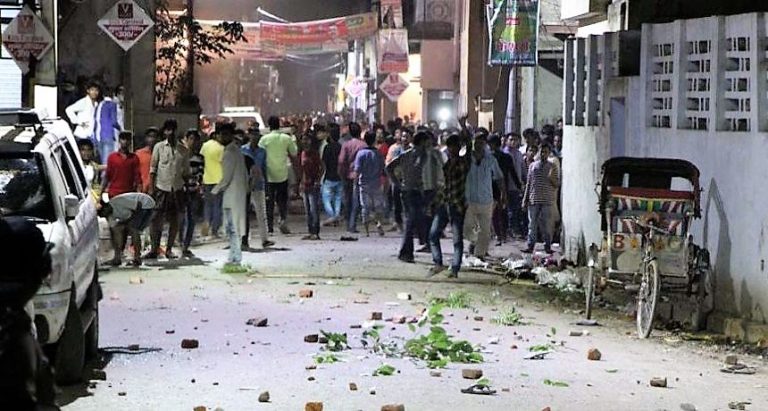
In an incident that took place near Sigra police station in Varanasi last night, a mob of angry Muslims attacked local people and the police, and damaged property after they were told that a person was trying to grab a piece of land next to a Mosque. The land is reported to be disputed with unclear ownership.

The Mosque is situated near teachers’ colony of Mahatma Gandhi Kashi Vidyapeeth and a piece of land next to it was being used by a local advocate named Mantu Singh for tying his three cows. Due to the rainy season, the land had become too muddy and Mantu is reported to have ordered fresh soil to flatten the floor of the cow shed.

When the new soil was being dumped, it was objected to by some men who came out of the Mosque. They believed that this was an attempt to grab the land and a new construction was being carried out. The argument soon turned into an alteration and the crowd assembled clashed with each other and many people, including Mantu Singh suffered injuries.

However, things didn’t end there and it is reported that men who came out of the Mosque started making phone calls to people in their locality, telling them that the Mosque land was being grabbed.

A mob of hundreds of people reportedly gathered at nearby Fatman road and started slogan shouting. The mob soon turned violent. The cow shed on the disputed land was broken and set on fire, and the mob then proceeded to attack vehicles and passersbies in the locality.

Police had to resort to lathicharge to disperse the mob, which had already inflicted injuries on many people and damages to properties. The mob attacked the police force too, after which the police fired tear gas shells to disperse the mob and control the violence.

The situation is reported to be under control now and the police are trying to identify the people who led the mob to riot.

From deaths to Award wapsi – it is happening all in Darjeeling for Gorkhaland

0

The ongoing indefinite strike in Darjeeling and Kalimpong hills, launched by Gorkha Janmukti Morcha, demanding a separate statehood for Gorkhaland has completed a month. The demand for Gorkhaland is not a new one. But this time around, it is really turning into a people’s movement.

The renewed demand for Gorkhaland was triggered by the Trinamool Congress government’s decision to make Bengali language compulsory for schools in the hills, where people predominantly speak Nepali. The Mamata Banerjee government is facing the allegations of ruthlessly crushing the movement by unleashing an undeclared Emergency in the Hills.

Even as media reports claim that three protesters have been killed, Prof Parjanya Sen, a researcher and commentator on Gorkhaland affairs in a facebook video claimed that as many as 11 protesters have been killed by the West Bengal Police and most of them were gunned down straight in their face. If true, this is an extreme form of human rights violation. But the human rights activists are conspicuous by their absence.

However, the use of force by the Mamata Banerjee government is drawing protests from some corners. For Gorkhas, it is now a do or die revolution to save their honour and pride. The chorus of ‘Jai Gorkha, Jai Gorkhaland’ is felt far and wide. There is palpable anger in the Hills and the demand for Gorkhaland is only getting louder amid vociferous support of common people.

On 13 July, Police and Paramilitary forces patrolled on the streets Darjeeling as hundreds of protesters, carrying placards demanding Gorkhaland, joined the rallies to commemorate the 203rd birth anniversary of revered Nepali poet Bhanubhakta Acharya. It could be noted that it was Acharya who translated the Sanskrit Ramayana into Nepali language. His birth anniversary is also being observed as Gorkha Ekta Dibas.

At a huge public gathering at Chowrasta in Darjeeling to mark the Bhanu Jayanti, three noted personalities from the Darjeeling hills – writer and former Inspector General of Police (IGP) of Darjeeling Krishna Singh Moktan, musician Karma Younzon and academic Prakash Pradhan have returned their awards conferred on them by the West Bengal government.

“I am a musician. But above all, I am a supporter of Gorkhaland. We do not need any awards from this Bengal government. I am sure I would get many such awards from Gorkhaland when the separate state is formed,” said noted singer Younzon while returning his Sangeet Samman, 2016 award.

Meanwhile, intellectuals from diverse fields in West Bengal – including Sahitya Academi award winning authors Sirshendu Mukhopadhyay, Dibyendu Palit, Nabanita Deb Sen, classical vocalist Pandit Ajay Chakraborty, painters Ganesh Halui and Wasim Kapoor and actor Ranjit Mallick – have written to Prime Minister Narendra Modi requesting him to take steps to “undermine” the agitation and “restore normalcy” in Darjeeling hills.

In the letter to the Prime Minister, the so-called intellectuals argue that the demand for a separate Gorkhaland state has “no historical locus standi” and “the state can’t and should not accept such a demand.”

But the fact of the matter is that Darjeeling is culturally, linguistically and geographically different from the rest of West Bengal. It is entirely wrong to claim that the demands are illegitimate or illogical.

A brief history of Darjeeling

Historically, Darjeeling was a part of the Kingdom of Sikkim in the 17th and 18th Century. In the year 1777, Nepal had appropriated the Kingdom of Sikkim. Following the Anglo-Nepal war of 1814-1816, Nepal had agreed to cede most of the Terai region – the territories between Mechi River and Teesta River – to British which the Gorkhas had annexed from the Monarch of Sikkim through the Treaty of Sugauli signed on 4 March 1816. The territories include the Darjeeling Hills.

In 1817, the British reinstated the Monach of Sikkim through the Treaty of Titalia and the territories between Mechi River and Teesta River came under Monach of Sikkim. In 1835, the Darjeeling Hill was given to the British by Sikkim. After the Anglo-British war of 1865, the British appropriated the lands that are today known as Kalimpong and Dooars. The present Darjeeling district assumed its present shape and size in 1866.

After the partition of Bengal in 1905, the administration of Darjeeling Hill was handed over to the Bihar and Orissa Province and came under its Bhagalpur division. In 1935, the British brought Darjeeling under Bengal Presidency for administrative ease as it was easy to govern the region from Calcutta (now Kolkata) than from Bhagalpur. Since then Darjeeling Hills continued to be a part of Bengal.

Gorkhaland – A longstanding demand

The demand for a separate administrative unit for Darjeeling region had started in 1907 when Hillmen’s Association of Darjeeling submitted a memorandum to Minto-Morley Reforms. In 1917, Hillmen’s Association submitted a memorandum to the then Viceroy for the creation of a separate administrative unit comprising of Darjeeling district and adjoining Jalpaiguri district. In 1929, Hillmen’s Association raised the issue before the Simon Commission. In 1930, Hillmen’s Association, Gorkha Officers Association and the Kurseong Gorkha Library submitted a joint petition for separation of Darjeeling region from the rest of Bengal presidency to the then Secretary of the State of India Samuel Hoare. In 1941, Hillmen’s Association repeated the demand for separation of Darjeeling region from the rest of Bengal Presidency before the then Secretary of State of India Lord Pethick Lawrence and urged him to make it a Chief Commissioner’s Province.

After India attained Independence, Akhil Bharatiya Gorkha League (ABGL) – the first political party of the region – was floated. In 1952, the ABGL led by NB Gurung submitted a memorandum to the first Prime Minister of India demanding economic freedom for Gorkha ethnic group and separation of Darjeeling from West Bengal.

In 1980, the Pranta Parishad of Darjeeling, led by Indra Bahadur Rai, wrote to the then Prime Minister Indira Gandhi demanding a separate state for Darjeeling. In 1986, Subhash Ghising – a poet and a former Indian Army soldier – revived the demand for a separate state under the banner of Gorkha National Liberation Front (GNLF). It was Ghising who coined the term Gorkhaland. Agitation demanding a separate state of Gorkhaland was followed in which at least 1200 people were killed. In 2007, a political party called Gorkha Janmukti Morcha (GJM) – under the leadership of Bimal Gurung – was formed to revive the Gorkhaland demand. For the last one decade GJM has been at the forefront of the Gorkhaland agitation.

Is the demand for Gorkhaland statehood illegal?

The Gorkhas are demanding a separate state under the Indian Union. This is a legitimate demand. As Indian citizens, this is well within their democratic rights to demand for a separate state as the provision for formation of new states has been enshrined in Article 3 of Indian Constitution which reads:

Formation of new States and alteration of areas, boundaries or names of existing States:- 

Parliament may by law.

(a) form a new State by separation of territory from any State or by uniting two or more States or parts of States or by uniting any territory to a part of any State;

(b) increase the area of any State;

(c) diminish the area of any State;

(d) alter the boundaries of any State;

(e) alter the name of any State;

Provided that no Bill for the purpose shall be introduced in either House of Parliament except on the recommendation of the President and unless, where the proposal contained in the Bill affects the area, boundaries or name of any of the States, the Bill has been referred by the President to the Legislature of that State for expressing its views thereon within such period as may be specified in the reference or within such further period as the President may allow and the period so specified or allowed has expired.

Bengal always indifferent towards Gorkhas?

People in the hills have long complained that Kolkata have not heeded to their concerns and problems on many occasions. Ethnic Gorkhas have been branded “foreigners” and “intruders” on occasions, and deprived of their rights in their ancestral land. It is alleged that the Late Subash Chakraborty, the then cabinet minister in Jyoti Basu-led CPM government, had once said, “Gorkhas khetey diyechi, sutey chai? (We have given the Gorkhas food to eat, now they want a space to sleep?).”

It is felt that the West Bengal government shows colonial attitude to the Darjeeling and Kalimpong hills region. Though Bengal gets huge revenue from the tea and tourism industry in Darjeeling, the infrastructure of the region is severely neglected.

The Gorkhas are fighting for their rights, identity, history, heritage and culture. The demand for separate Gorkhaland statehood is a means to that end.

Gorkhaland – The economics

Unlike the debt-ridden West Bengal, the proposed Gorkhaland state could be one of the most economically vibrant states in India as the three ‘Ts’ – tea, tourism and timber – would act as money-spinners for the region.

  • Tea: The premium quality Darjeeling tea, globally known as “champagne of teas” for its distinctive aroma, fetches about Rs 1500 crores revenue annually.
  • Tourism: Around 5 lakh domestic tourists and about 50,000 foreign tourists visit the region every year, which fetches a revenue of around Rs 500 crore annually.
  • Timber: The sale of timber and other forest products in the hills fetches an estimated revenue of Rs 100 crore.
  • Hydel power: Gorkhaland has the potential to generate thousands of megawatts of hydel power as rivers of Teesta, Mechi, Rangeet, Balasun, Relli and Sankosh flow through the region. Apart from meeting the needs of the region, the surplus power can fetch revenue for the proposed state.

The way  forward

Even though the BJP had earlier supported the demand for Gorkhaland, the party and the central government appear non-committal currently. There is immediate need to initiate talks as the stalemate has stretched for long. The center has decided to send 4 more CRPF companies to the area on directions of Calcutta High Court to maintain law and order, but it is more important to re-visit the demand for a separate state.


The selective outrage of the left and right over free speech, and how it hurts everyone

0

The assault on free speech in India is now a consistent phenomenon. We have had two attacks on freedom of expression in a matter of few days. In the 1st case, we have a 17-year-old student in Baduria, Bengal who has been arrested and jailed for some “objectionable” comments he made on Facebook. Not only was the boy imprisoned, but post that we have had reports of violence from mobs belonging to the Muslim community in some areas of Bengal.

As if this was not enough, we saw a news report where it is stated that the Mumbai Police has registered an FIR (50/2017) against a comedy group called AIB at the cyber police station in regards to an apparently “offensive” meme shared on Twitter, where they made fun of the Prime Minister of India.

And the reactions to both these cases have been predictable. The left wing has completely ignored the miseries of the 17-year-old boy being arrested in Bengal. If you go through the twitter timeline of a left winger, occasionally concerned about even a kid in Syria, there are no words for concern for this teenager. It is like it never happened or he doesn’t exist. Don’t be surprised that if you question a left winger about this, you might have reactions like “which Facebook post”, ” what 17 years old boy”, ” I don’t trust you Sanghis”.

But, the same left wingers will go on a constant diatribe about how Narendra Modi and BJP have destroyed the fabric of Indian democracy because of the FIR filed against AIB. They are all over Twitter posing as dogs since last evening, saving India from Modi. But the reality is that the Prime Minister or the BJP have nothing to do with this FIR. But, in the world of a left winger, whenever something bad happens, it is always BJP and Modi’s fault.

In Fact, the left has mastered the art of negationism/denialism. Some of you might wonder what the hell does negationism/denialism mean? In words of Koenraad Elst:

“Negationism means the denial of historical crimes against humanity. It is not a reinterpretation of known facts, but the denial of known facts. The term negationism has gained currency as the name of a movement to deny a specific crime against humanity, the Nazi genocide of the Jews in 1941-45, also known as the holocaust (Greek: fire sacrifice) or the Shoah (Hebrew: disaster). Negationism is mostly identified with the effort at re-writing history in such a way that the fact of the Holocaust is omitted.”

The Indian left has practised their unique form of negationism/denialism by completely ignoring the consistent Islamist and Marxist violence in India both, historical, and of the present times.

But the Indian left doesn’t understand one simple thing. Their consistent negationism is pushing a huge chunk of Right Wing (RW) or whom they call Internet Hindus, into a mental state of “reactionary survivalism”. The more leftist progressives practice negationism, the more Hindus go into reactionary survivalism.

When the RW Hindu enters the mode of reactionary survivalism, they start practising their form of soft negationism. The right wing has consistently been outraging about the arrest of the 17-year-old in Bengal. But, when it comes to the question of the FIR against AIB the replies one gets are fascinating. I am quoting a couple of the answers that I received on my Facebook wall verbatim over here

Answer No.1: “Well well u do that in China / PAKISTAN / Russia …Intel guys eliminate u & ur body will not be even found ..thank God they r in INDIA …its PM OF INDIA NOT SOME PETTY JOKER ….not Kejriwal or Pappu EITHER.”

Answer No. 2: “One must stay within limits. At least have respect for the high posts some people hold whether you like it or not. This poking fun at dignitaries is uncalled for and should be dealt with accordingly.”

I have to concede that some prominent RW voices on Twitter condemned the Mumbai Police’s FIR against AIB, but the RW will also have to concede that the general mood is not really of unequivocal support to AIB.

Both the sides have locked themselves up in this ideological rabbit hole and the arguments presented are more about convenience and less about principles. I believe I am seeing a trend now. Both sides are practising a form of negationism/denialism, and neither are willing to recognise that.

The blame of this cancerous atmosphere lies primarily with the Left. They started this selective outrage game. But, now we have reached a stage where everyone is outraging selectively. The left will completely ignore the excessive bullying by the Muslims and blow the violence on the Hindu side out of proportion. e.g. How the violence committed by cow thugs has been blown up as Hindu terror, which is not the case. The RW, on the other hand, will completely ignore the bullying from some Hindu groups. And I am not saying both the sides are equally guilty. There is no false equivalence here. The right has still not reached (or fallen) to the levels of the left, but the process has begun.

And, in all of this, what we have is a situation of chaos in the country. Nobody wants to talk about the real issue in India. And this is what the political class wants. They want a society that is constantly angry. Because if you are at your primary innate tribal level, you will always fight with the so called “other”.

We have a massive law and order problem in India. The reality is that we don’t have enough cops. Just read this article, and you will understand the level of the shortage we have in India. We are a highly under policed society.

We have some ridiculous laws. This is the 21st century, but, we have blasphemy laws like 295A in India. The funny part is that we are a country in which around 75% of the population follows a type of a belief system that does not even have the concept of blasphemy. But for some odd reason, we have this ancient Abrahamic relic. We are indeed a weird country. We will cling on to everything ancient. It does not matter how silly or UnHindu it is, we will keep it and then start using it and shout “garv se kaho hum hindu hai”.

I want to disclose one fact; I am one of those few people who used 295A on the Hindu side (used it again AAP supporter Vishal Dadlani for his tweets on Jain muni), but I wanted to start a movement against it by showcasing how ridiculous that law is. But it appears I showed a way to get even. The right has found that they can use the tools that were used to silence them till now, and so instead of any demand for scrapping this law, there appears more interest in using these to teach lessons to the other side.

What is going on in India is frustrating. What is AIB’S crime? Or, for that matter what is so outrageous about what that kid from Bengal did? One made a silly Twitter meme and the other made a stupid Facebook post. Now I am not a fan of what both of them did. I don’t watch the shows of AIB, and whenever I discuss/criticise Islam, I do it respectfully. My criticism does not have abuses in it. But I don’t support this kind of bullying that is happening to both of them. AIB fortunately got widespread support and they are safe, but the kid is still in jail.

I stand for their right to make fun of any idea/religion/politician. And if you don’t stand up because this time it’s about a leader/religion/idea, you like then you are part of the problem. Always remember, the party of your choice or liking won’t be in power forever. And the day the other one comes they will go after you if you hurt them. Because that is the inherent nature of the political system in India.

So if you want freedom, learn to outrage on every assault on freedom of expression. Don’t be intentionally selective in this because it is for your good. The reality today is that there is no free speech in India. And as far as I am concerned, I support everyone’s right to make fun and hurt sentiments of others unless they don’t make a direct call to violence.

The problem in India is bad policing and bad laws. But no one fixes that. Everyone keeps outraging selectively as they practice this weird form of negationism/denialism and going on with their lives as long as they are not affected personally.

Christian man arrested for desecrating Holy Crosses in Goa

In the last fortnight, 12 crosses were were found desecrated in South Goa. These incidents which began on 1st July, had led the Church of Goa to speculate that the desecration could have been carried out by vested interests, to sow communal discord in the region.

Crosses weren’t the only structures which were being desecrated. 50 gravestones were also found damaged on 9th July in the South Goan town of Curchorem. We had also reported that apart from crosses, a temple was also desecrated in the same region.

Now it seems the police has managed a breakthrough in this case by arresting a person named Francis Pereira. He was arrested on the intervening night of 14th and 15th while he was in the process of desecrating a cross.

Francis is believed to be a member of a sect which is a sub class between Catholics. He is reportedly a bachelor and lives in Kudchade.

The interrogation of Francis brought out surprising facts regarding the incident. He after confessing to the 12 cases of desecration stated that he had done so ‘casually’ and wanted to promote no enmity. Francis also claimed that he didn’t plan his endeavours and whenever he saw a cross he used to hit it.

Local reports further elaborated that point. According to one report, he used to break religious shrines in order to ‘release the souls trapped in them’. He, according to the police, believed that souls if remained trapped in shrines, graves and statues, end up becoming devils and help the politicians. He has now been sent to a 3 day police custody.

The police hopes that after Francis’s arrest, they would be able to crack over 150 cases of similar desecration which have been reported in the last 15 years. Francis might be responsible for at least some of them, as reports indicate that he has been breaking shrines for 14 years.

Even though Francis has been arrested and has also reportedly confessed his crime, it has failed to assuage various political and religious organisations in the state. The organisations are reportedly refusing to believe that it was a one man job and want the cops to find out who is the ‘mastermind’ behind the whole exercise.

Chief Minister Manohar Parrikar who had discussed the matter with the Curchorem police in person, had reportedly notified the media that the police are probing whether there was any guiding hand behind Francis.

Meanwhile the BJP MLA from Curchorem, Nilesh Cabral has given a political spin to the whole incident by claiming that Francis was an active AAP supporter. He has also generously decided to award the police team Rs 50,000 for cracking the case.

As Francis turned out to be a christian, it has prompted the Hindu group, Sanatan Sanstha to demand a public apology from those who blamed them for the desecration.

Pakistan to receive US defense aid only if it shows sufficient progress in fighting terrorism

In a case of the USA tightening the screws on Pakistan, the US house of Representatives has voted in amendments to make their defence funding to Pakistan, conditional.

The three amendments which the US legislative body has voted, would make it tougher for Pakistan to get its share of the defence fund which the US doles out. Pakistan has been sanctioned a total of $400 million in form of the defense fund for the October 2017-December 2018 fiscal.

In order to receive the funding, Pakistan would have to show sufficient progress in fighting terrorism, a tall ask considering Pakistan still continues to provide a VIP treatment to various designated terrorists including Syed Salahuddin. The conditions put forth by America are related to Pakistan’s support of terror organisation and terrorists about which US lawmakers have continually expressed concerns.

These legislative amendments were made to the $651 billion National Defense Authorization Act which is used to authorize America’s defense expenses. Before Pakistan is released this aid, the secretary of defense needs to certify that Pakistan is:

  • Maintaining security along the ground lines of communication throughout the country
  • Taking demonstrable steps in support of counter-terrorism, foiling cross border attacks and is countering the threats of improvised explosive devices
  • Committed in preventing the Haqqani network from using the North Waziristan province as a safe haven
  • Coordinating with the Afghani government in restricting the movement of terrorists along the Pak-Afghan border
  • Not using the funds, equipment provided to persecute minority groups asking for political and religious freedom

And the most significant one:

  • The funding would be withheld if the defense secretary cannot certify that Pakistan is not “providing military, financial, or logistical support to any individuals designated by the US as a terrorist operating in Pakistan or Afghanistan”. 

This isn’t the only time, the US has tried to reign in the aid provided to Pakistan. Recently we had reported how US President Donald Trump had proposed that the US grant to Pakistan for purchase of military hardware, into a loan. Pakistan was somewhat singled out in this regard as the aid would continue normally for countries like Egypt and Israel.

Why are crime reports turning into ‘communal’ headlines after a few days?

0

On Wednesday, a shocking case of robbery was reported near Farrukhabad in Uttar Pradesh. According to initial reports [1][2] dacoits decided to attack the Shikohabad passenger train and cornered a family travelling in the train. They proceeded to assault the family and stole all the jewelry and cash which the family was carrying and even misbehaved with the women members of the family. The family was reportedly returning from a wedding ceremony.

According to the GRP of Farrukhabad, a group of young men (the suspected dacoits) as well as the victim family had boarded the train at the Bhongaon station. The family got into altercation with this group after elbow of one of the guys reportedly brushed a woman member of the family. The guys then used their mobile phones to call up their ‘friends’ and over a dozen goons arrived, who collectively proceeded to rob the family. All the criminals then proceeded to disembark and flee from the train by pulling the chain near Nibkarori station.

Eight members of the family were injured in this robbery and assault, and were admitted to a hospital for treatment after the train stopped at Farrukhabad station. The injured included Mohammad Shakir, his wife Ashia Begum, their two kids and other members of their extended family. Following the ordeal, Shakir filing a police complaint about the robbery and assault.

As one could check by clicking the news articles linked back till now, they are all reported as regular crime story by the vernacular media. There is no mention of any religious angle or this being a hate crime. But this incident was then picked up by various ‘national’ media outlets, and the headlines appeared with a ‘communal’ angle:

Muslim family attacked with iron rods, robbed by 30-35 men on a train in UP [Times Now]

Muslim family attacked on train [The Hindu]

UP: Muslim family attacked on running train, assaulted using rods, jewels robbed, 9 injured [Aaj Tak]

To be fair, the Times Now and Aaj Tak reports claimed that communal slurs were also hurled at the family. The Hindu report claims that the family was ‘singled out’ due to women wearing veils (burqa). 

However, that leads us to the question that why were such claims of communal slurs being hurled by the criminals, or the communal angle not reported in initial news articles?

In fact, there are conflicting reports over what the victim family has claimed regarding the communal slurs or motives of the criminals. As per a journalist named Haider Naqvi working for Hindustan Times, the family considers it primarily a case of robbery, thus it might not be a case of targeted attack against Muslims:


Giving the benefit of doubt to the media that it has not invented quotes of the victim family, even though there are conflicting reports, maybe it could be similar to the Junaid murder case (incidentally crimes committed in trains in both the cases), where the fight had started primarily over sharing of seats, but later communal slurs were also thrown by the assailants.

However, in Junaid’s case, if you remember, some in media had claimed that the fight had started over suspicion of Junaid and his brother ‘carrying beef’ – even though neither the complainant in the written complaint nor the accused, who has confessed to his crime, talked about that being the trigger of the fatal fight.

Now that there appears to be a similar case, though fortunately no one died this time, we at OpIndia.com would like to share an email we had received earlier this week from someone claiming to have access to the work-desk at a news channel. This “whistleblower” claimed that the beef part in Junaid’s case was added by a journalist sitting in Delhi, even though the local reporter had not mentioned it in his original draft:

screenshot of the meail received
The ‘whistleblower’ claimed that once this ‘beef’ angle was inserted by this man working in a popular Hindi news channel, every other media outlet repeated the same claim

We have some reasons to believe that the claims made in the above mail could be true, because apart from police refuting this ‘fight started over suspicion of carrying beef’ theory, even Junaid’s father had refuted this theory as per an Amar Ujala report (though he did claim that communal slurs were used in a fight that started over seat sharing):

Screenshot of the report (still live on the website) that quotes Junaid's father denying any 'beef' angle
Screenshot of the report (still live on the website) that quotes Junaid’s father denying any ‘beef’ angle

One of the accused did admit that ‘beef taunts’ were made (and nobody is denying that communal slurs were thrown), but the media reports claiming that the fight had started over suspicion of Junaid carrying beef have turned out to be entirely unsubstantiated. Remember, this is how the media had reported:

tweet screenshot
Screenshot of original headline tweeted by Hindustan Times. The headline was later changed to “Muslim boy stabbed to death on train after argument turns into religious slurs”.

Media appears to be playing a very dangerous game. The same people who accuse others of communalizing an incident, appear to do so in a very determined and devious way. Not just they can twist facts, it appears that they can also invent facts by “tutoring” the victims.

Here is a journalist named Nikhil Wagle revealing that victims or survivors can be “tutored” to push a communal agenda i.e. a media person can ask a victim to claim religious or communal angle even though there was none:

Allegation or confession of media interviews being ‘tutored‘?

Wagle had made the above revelation while reacting to the news reports about local Kashmiris laughing at the plight of Hindu victims of Amarnath attack. Wagle dismissed the newspaper report and insinuated that the newspaper had “tutored” the Hindu victim to claim that Kashmiris (assumed Muslims) were laughing. If Wagle believes that Hindus can be “tutored” to claim a communal angle, why can’t Muslims be tutored to do the same?

Why should we rule out a journalist telling a Muslim victim of petty fight to claim communal angle, so that it makes spicy headlines (and possible speedy investigation of the case)? This is a possibility a senior journalist like Wagle has revealed, not something we at OpIndia.com are claiming out of nowhere.

And could these be the reasons why incidents, which are initially reported as normal crime stories, suddenly take communal angles?

The media could very well have been given the benefit of the doubt in this case, had it not been a habitual offender in this regard. They are either complicit in it by deliberately twisting facts such as in the case of a woman allegedly being beaten up to chant ‘Jai Shri Ram’, or careless to make headlines based on unsubstantiated claims as had happened in the case of a man who claimed attack by gau-rakshaks in Mumbai.

UPDATE (17 April 2018): High Court has observed that there indeed was no primary communal motive in murder of Junaid. It corroborate the fact that media inserted this communal angle to peddle its own agenda.

Despite all online buzz, this is why BJP may not do well electorally in Bengal

0

While I appreciate that BJP of late is trying to highlight the plight of Hindus under the mercy of Jihadi mobs in West Bengal, let me be blunt and say that the Bengal can not be won with Twitter friendly slogans like #SaveBengal, especially when you shout these slogans from the streets of Delhi or for that matter even in Kolkata.

Bengal can not be won with launch of online campaigns, which will be attacked by the cheerleaders of secular-liberal establishment and thus shifting the debate to a ‘representative image’ shared by a BJP guy from the riots that happened after an image was shared by a 17 years old boy, for which he is still in jail.

Bengal can not be won when you try to remain politically correct and do monkey-balancing to appear secular (we will get to this later in this article). It can not be won with Amit Shah visiting the state once in a while for inspection.

To win Bengal you need to get your hands dirty.

To win Bengal, you need a fiery ‘khati’ (core) Bangali, who is a robust fighter, an unapologetic character, and one who is not afraid to speak his/her mind out. It needs a local saviour around which the campaign to save Bengal can be launched and mobilised, not in Delhi or just in Kolkata, but in entire Bengal.

“An appeaser is the one who feeds a crocodile, hoping it will eat him last.”

“No man survives when freedom fails, the best men rot in filthy jails. And those who cry ‘appease, appease’ are hanged by those they tried to please.”

The above two quotes describe the conditions of modern India due to systematic appeasement by the elite liberal and certain section of the political class. But it particularly applies to the Bengal under Mamata Banerjee’s jaamati rule.

But is she so ignorant? Does she not know that she is feeding the crocodiles that will only get more hungry and will bite her one day? She is playing with fire and already Bengal has seen peace go up in flames multiple times. When will she realise?

I think she knows it very well. She knows that her disastrous appeasement policies will have a serious national impact. But she doesn’t care a bit. She is too intoxicated by power she is enjoying and the questions that are never asked to her as she is seen someone who is a challenger to Modi. To keep this power and status intact, she seeks the blessings of that particular community, which is around 30% of Bengal population.

In my previous articles ‘Making of a ‘New Bengal’ by Mamata in Modi’s New India‘ and ‘Steps for De-Radicalising Bengal‘, I had tried to highlight the sinister designs of ruling TMC govt, and how it gets support of the media to keep the flawed and preposterous ‘secularism’ intact. I had also stated how the central govt needs to counter it and prevent the rise Islamic fundamentalism in Bengal. This can be achieved if the BJP grows strong in the state.

But coming to BJP’s chances in the electoral politics of Bengal, I am not optimistic about it. There are various reasons for it:

  • BJP appears to ride on the anti-incumbency factor as Mamata Banerjee is in her second term. That isn’t going to happen. Bengal is historically different. Bongs are patient and willing to give chance. They let the communists rule for 34 long years and they could have ruled for another 10 years, if not for Nandigram and Singur. Rest of the people might believe that Politicians are a lot like diapers, which should be changed frequently, and for the same reasons. But bhadraloks don’t appear to think that way.
  • Lack of rural base: BJP has virtually no rural base. Large parts of rural Bengal are not aware of the existence of BJP. Yes, that’s the harsh reality. RSS is trying get a foothold, but is finding it difficult due to government control over its activities as well as populist schemes of Mamata government, such as Kanyasree which is a massive hit in the rural belt.
  • Trying too hard to remain ‘secular’. Recently in one of the debates on an English news channel regarding Basirhat riots, Rajya Sabha MP and a prominent face of Bengal BJP Roopa Ganguly’s opening remarks were about how she was secular and had many friends from the minority community and blah blah. This is the condition of entire state unit of the party. They are not bold enough to say what must be said. The political correctness will not help.
  • Lack of enthusiasm to take the initiative. One classic example of the state unit’s failure was during Amit Shah’s visit in May. Shah started his Bengal campaign from the infamous Naxalbari. He held rallies, visited homes, and had lunch at house of Raju and Geeta Mahali, a Dalit couple who ‘were’ supporters of Modi. It was a part of the Dalit outreach, which forms a considerable chunk particularly in South 24 parganas. A few days after Amit Shah left, the Mahali couple joined TMC. Yes certainly there could have been pressure on the poor couple, but wasn’t it the duty of the state unit to look after them? Such a massive PR failure hints at lack of alertness and enthusiasm in taking an initiative forward.
  • And most important factor. Absence of a strong local Bengali leader. No, not even Amit Shah’s crafty organisational skills can fill that void. As I had said in the beginning it requires a local saviour. It requires a leader who makes the Bengalis rally celebrate their lost pride and forgotten heritage and rally them like a captain in a battle. Much like Bal Thackeray and Shiv Sena revived Marathi asmita. The character of Bengal is changing fast under Islamist and Jamaati politics, and this needs to be conveyed.

There is one person who is trying that. Mamata Banerjee went to the extent of threatening to ban his organisation. It is ex-RSS man Tapan Ghosh and his organisation Hindu Samhiti. His Twitter profile says “Uncompromising Hindu activist of Bengal. Determined to fight against Islamic aggression & expansion.”

As blunt as it gets.

It is his organisation that relentlessly talked about Malda and Dhulagarh riots, which were, as usual denied by the Mamata government and its news suppressed by the mainstream media. Tapan Ghosh was also the one to highlight the issues in Tehatta where Islamist mobs had laid siege over a school and Saraswati Puja was not allowed.

Few months ago, he organised a massive rally in Kolkata, which really shook the TMC cadre. They had thought that the rally will be a flop.

As mentioned earlier, in the same debate in which Roopa Ganguly took part and started with listing her secular credentials, Tapan Ghosh minced no words. He went on to say, and I am quoting him, “When thousands from the Muslim community take part in violent activities, entire community has to come forward. If they are quiet, it means they are supporter of violence.”

BJP needs to indulge in such plain speak. It needs that firebrand leader who doesn’t care about what tags the media uses about him or her. It needs someone who cares about what is happening on the ground.

The party needs to realise that talking about ‘Sarada’ & ‘Narada’ scam will not dent Mamata’s popularity nor it can uproot her from the throne of Bengal. To snatch Bengal from Didi, it needs an uncompromising fighter, much like she had been when communists ruled.

As said before: you need to get your hands dirty.

Indian astronomers in Pune discover a supercluster of Galaxies, now named Saraswati

Astronomers associated with the India’s Inter University Centre for Astronomy and Astrophysics (IUCAA) and the Indian Institute of Science Education and Research (IISER) – institutes in Pune – have discovered a supercluster of galaxies in the direction of Pisces constellation.

This discovery made by scientists named Joydeep Bagchi, Shishir Sankhyayan, Prakash Sarkar, Somak Raychaudhury, Joe Jacob, Pratik Dabhade was submitted to the Cornell University as a concise report on 10th July. The scientists have fondly named the discovered supercluster as Saraswati after the Hindu goddess of leaning.

Supercluster of Galaxies are basically a collection of comparatively smaller galaxy clusters which are structures which contain hundred to thousand of galaxies, all of which are bound together by gravity. The Virgo supercluster is made up of about 100 galaxy clusters.

Our Milky Way falls under the Laniakea Supercluster, which was catalogued in 2014. The sheer scale of the superclusters which are millions in number, make them one of the largest structures in our cosmos. Also superclusters are not the final product of the galaxy clusters, the superclusters are also collectively identified as supercluster complexes.

Scientists believe that the Saraswati supercluster, which forms a wall like structure, has a span of about 200 megaparsec. A parsec is a unit of distance which roughly translates into 3.3 light years and when you take a million of those parsecs, it becomes a megaparsec.

Hence the Saraswati supercluster’s span turns out to be roughly about 660 million light years long. To put things into further perspective, it takes about 95,000 years just to cover one light year if you decided to travel on NASA’s Mach 9.68 X-43A hypersonic scramjet which is one of the fastest spacecrafts in the world.

This Saraswati supercluster is believed to contain about 43 massive galaxy clusters. This supercluster was observed when the universe was about 10 billion years old. The universe is currently about 13.82 billion years old, so the difference of 3.82 billion is the time light took to travel from the supercluster to the earth.

This discovery is also important as it also sheds light on the roles which the initial conditions of the cosmos and dark energy played in the supercluster formation. Dark energy is the force which is primarily responsible for the expansion of the universe.

Plus as stated in the report, discovery of such a supercluster challenges the classical cold dark matter model of Universe’s evolution.  This model states that, small structures of galaxies further congregate into larger structures like galaxy clusters and then superclusters. But the problem is, if that indeed happened, such large formations like superclusters won’t be possible within the current age of the universe.

The detailed account of this whole discovery would be published in the Astrophysical Journal which is the flagship journal of the American Astronomical Society. Interestingly this isn’t the only time one of the scientists associated with the group has made such discovery. Somak Raychaudhury, who is the director of IUCAA had discovered another such supercluster named the Shapley Concentration in 1989, while he was doing his PhD from Cambridge.