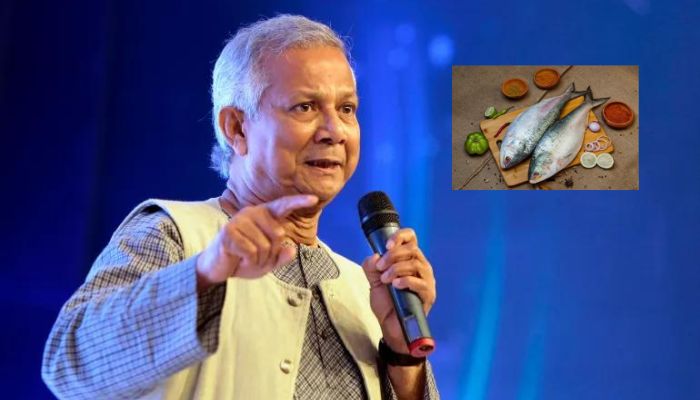
Muhammad Yunus, the controversial Nobel laureate heading the interim government of Bangladesh, is pandering to Islamists running an anti-India campaign. The recent ban on exports of Hilsa fish to India seems to be part of this nefarious agenda.
For the unversed, Bangladesh had witnessed the sinister ‘India Out’ campaign even before the ouster of Prime Minister Sheikh Hasina. Islamists belonging to Hefazat-e-Islam and Bangladesh Nationalist Party (BNP) had demanded a complete boycott of Indian products.
The anti-India frenzy had reached its zenith so much that Sheikh Hasina was forced to intervene. After the fall of Dhaka on 5th August this year, the anti-India sentiments are at an all-time high.
Hilsa export ban to pacify ‘India Out’ lobby
Muhammad Yunus, who has been given the command to sail the sinking ship of Bangladesh to safety, is now busy appeasing radical Muslim groups in the country.
This becomes evident from the decision to stop Hilsa export to India ahead of the Bengali Hindu festival of Durga Puja.
It must be mentioned that as a goodwill gesture, Sheikh Hasina would send consignments of the premium fish each year between August and October.
Muhammad Yunus has decided to make a sharp departure from this annual practice citing ‘domestic demand’.
Bangladeshi Fisheries Minister Farida Akhter had even tried rationalising the abrupt decision by claiming to make Hilsa accessible to poor families in the country. “No Hilsa will be exported to India for Durga Puja this year,” she had declared.
This single decision has increased support for Muhammad Yunus among Islamist groups, which had been spearheading the ‘India Out’ campaign.
Bangladesh cannot afford to mess with India
They are given to believe that the interim government of Bangladesh has stood up to the ‘big bully’ India.
“Even if the prices don’t soften, the news of an export ban will please people here. That’s the main reason behind the ban,” a source toldThe Telegraph.
The mindless political posturing by Muhammad Yunus comes at a time when the country owes $500 million to just one Indian conglomerate alone.
The controversial Nobel laureate is yet to account for the economic catastrophe that would be unleashed on Bangladesh if India were to retaliate similarly and cut down on onion, rice and energy exports.
The ‘India Out’ campaign wasn’t sustainable then and is not sustainable now. But this hasn’t stopped Muhammad Yunus from portraying himself as the new messiah of Bangladesh who can look the Indian government in the eye.
Muhammad Yunus and his false sense of bravado
To convince the home crowd about his false sense of bravado, Yunus was seen ‘acting tough‘ in his statements on India.
“She is there in India and at times she is talking, which is problematic. Had she been quiet, we would have forgotten it; people would have also forgotten it as she would have been in her own world. But sitting in India, she is speaking and giving instructions. No one likes it,” he has recently said about Sheikh Hasina.
The controversial ‘Nobel laureate’ further exploited the raging anti-Hasina sentiments in Bangladesh to his advantage.
Interm govt of Bangladesh panders to Islamists
Given the rising Islamism in the country, Yunus found a two-pronged way of further solidifying his space in the country’s political sphere.
He revoked the ban on the radical Islamist outfit ‘Jamaat-e-Islami’ and released the leader of the radical outfit ‘Ansarullah Bangla Team (ABT)’ Muhammad Jasimuddin Rahmani.
At the same time, Muhammad Yunus began discounting the religious angle in the targeted attacks on the Hindu community.
He has gone on record from lamenting about attacks on Hindus to saying that the claims of atrocities are ‘exaggerated‘.
The two decisions by the head of the interim government elated the Islamists in the country.
They are now led to believe that Bangladesh will witness full-scale implementation of Sharia law in the absence of Sheikh Hasina and the emergence of their new Messiah aka Muhammad Yunus.
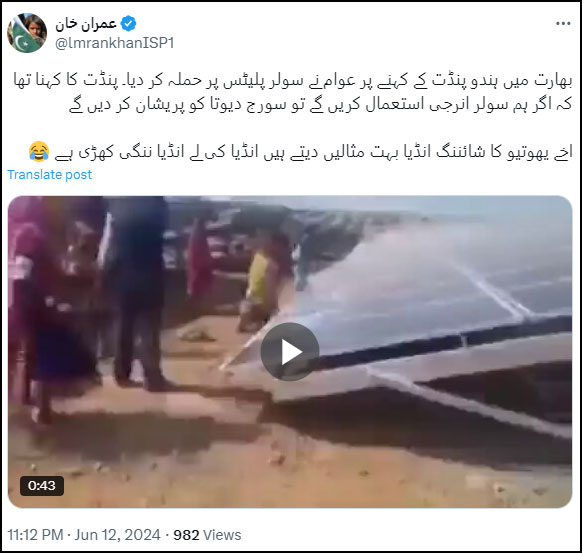
On 9th September, Türkiye-based Urdu news channel RTE Urdu spread fake news to malign Hindus and India. In a post on X in Urdu, the media house wrote, “In India, people attacked solar panels at the behest of a Hindu pandit. The pandit said that if we use solar energy, we will disturb the sun god,” while sharing a video of a few people destroying solar panels. By the time this report was published, the post had gathered over 34,000 impressions, more than 380 reposts, and over 900 likes.
Source: X
When OpIndia checked the video, it found that it was not a recent incident and had nothing to do with any Hindu priest. The video was from 2018, and the solar panels were destroyed by workers over non-payment of wages. When the video was first shared on social media, it was claimed that BJP workers had destroyed the solar panels. The video was shared on an Aam Aadmi Party Facebook group, claiming that BJP leader Ashok Saxena had said that using solar energy angers the sun god, after which BJP workers destroyed the solar panels.
Interestingly, there was no BJP MP named Ashok Saxena at that time. The video was first shared by a YouTube channel, Climate Samurai, which mentioned that the destruction took place after the workers at the solar park did not receive their wages.
The video has surfaced several times making similar claims. In June this year, some Pakistani handles shared the same video.
Source: X
Verdict: The claims by Turkish media RTE are FALSE.
Over the last few months, Elon Musk, the owner of X Corp, SpaceX and Tesla has been at loggerheads with the all powerful Brazilian judge Alexandre de Moraes after the latter banned X in Brazil. Recently, Brazil Supreme Court Judge Alexandre de Moraes ordered the freezing of Starlink’s finances and barred the company from undertaking financial operations in Brazil “to guarantee the payment of fines” imposed by the court on X. It all started in April this year when Moraes initiated an investigation into the entrepreneur after Elon Musk stated that he would reinstate accounts on the social media site X that the judge had disabled.
Musk contended that restricting the said X accounts was “unconstitutional”. As reported earlier, Moraes had said that if X failed to block the accounts of a Brazilian senator and a 16-year-old girl among others, the social media platform would be fined 100,000 reais ($19,740) every day. Since then, the tussle has intensified. It must be noted that de Moraes is said to be close to the Brazilian President and leftist leader Luiz Inácio Lula da Silva. While the Musk versus Moraes conflict is centred in Brazil, it has sparked a global debate over the judges being too powerful and judicial overreach.
The judiciary becoming more powerful than the elected legislative: what can it mean
The Musk versus Moraes dispute raises concerns in the Indian context about judicial overreach and the risks excessively powerful judges pose in a democracy. Before moving ahead, it is pertinent to understand what exactly the term “judicial overreach” means. Judicial overreach happens when the courts or individual judges transgress beyond their constitutional jurisdiction by intervening in issues generally reserved for the legislative or executive branches. Judicial overreach occurs when courts or individual judges go overboard in their judicial activism. There have been several instances when the Indian courts and judges went beyond their jurisdiction and decided on matters which should have been handled by the legislature or the executive branches of democracy.
In March this year, the Supreme Court agreed to hear a plea challenging the appointment of Sukhbir Singh Sandhu and Gyanesh Kumar as Election Commissioners in addition to the Chief Election Commissioner. The plea was moved by an NGO represented by lawyer Prashant Bhushan. The plea sought that not only the Judiciary should look at the appointment of the current Election Commissioner, but rather should also become a party to the selection of another constitutional body. It was contended in the plea that the appointment of Sandhu and Kumar countermanded the Supreme Court ruling by replacing the Chief Justice of India on the high-level selection committee with a Union Minister of the Central government’s choice. The apex court, however, refused to stay the appointments saying the general elections were about to be held.
The Supreme Court ruling on the appointment of the Chief Election Commissioner sparked an outcry from the people. The top court’s interference in the matter apparently violated the concept of separation of powers as envisaged in the Constitution. The Supreme Court, under the guise of establishing neutrality within the election commission, interfered with the jurisdiction of elected legislators.
Supreme Court on 2021 farm laws and the farmers protest
Another SC ruling that reeked of judicial overreach was that of reprimanding the Central government over the 2021 Farmers’ Protest. The Supreme Court stayed the implementation of the three farm laws, taking into account only one state’s farmer protests while ignoring other aspects of the matter. Moreover, the apex court ignored the blockade of railway tracks and tolls in Punjab as well as a national highway.
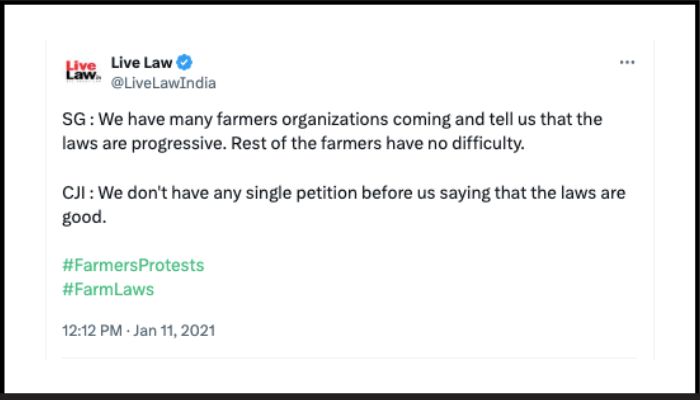
During the hearing of this matter, several observations were made by the Supreme Court bench led by the then CJI N.V. Ramana. The then CJI told the Solicitor General that they had not received any petition saying that the three farm laws were good. The CJI said this when the Solicitor General informed the court that several farmer organisations told the government that they had no difficulty and found the three farm laws progressive.
Interestingly, a year after the three farm laws were scrapped, a Supreme Court-appointed committee submitted its report which said that of 73 farmers’ unions, 61 supported the scrapped laws.
Supreme Court’s problematic observations in the Nupur Sharma case
A major outrage had erupted on social media over the observations made by the Supreme Court during a hearing in which a former BJP spokesperson requested that the FIRs against her for comments on one of the news debates in 2022 on the issue of Gyanvapi structure be clubbed.
“Her loose tongue has set the entire country on fire. She is single-handedly responsible for what is happening in the country,” Justice Suryakant said lambasting Nupur Sharma instead of criticising the jihadi mobs which raised “Sar tan se juda” slogans and carried out violence and arson across the country. The court not only pinned the entire blame on Nupur Sharma for the 2022 riots and violence unleashed by Jihadis but also ignored the derogatory remarks the other debate panellist Tasleem Rehmani made about Hindu Gods. Sadly, the oral observations made by the court, in a way granted legitimacy to the mobs who called for beheading Sharma over perceived ‘blasphemy’.
Supreme Court banned liquor shops near national highways
Back in December 2016, the Supreme Court directed that no more liquor licenses could be granted along national and state highways within 500 meters of the highway’s outside edge or service lane. The direction was issued on a plea filed by a road safety activist and did not take into account the economic repercussions. Although the intent was good, the SC ruling was an interference in the purview of the state governments.
Supreme Court verdict on Sabarimala temple
In 2018, the Supreme Court of India decreed that women of all ages should be allowed entry into the Sabarimala Temple in Kerala. CJI Deepak Mishra, reading out the verdict, stated that women are in no way inferior to men and relationship with God cannot be defined by biological and physiological factors. 4 judges of the bench had a similar opinion while, the only female judge on the bench, Justice Indu Malhotra had a dissenting opinion. By this verdict, the apex court struck down Rule 3(b) of the Kerala Hindu Places of Public Worship (Authorisation of Entry) Rules, 1965, which restricted the entry of women between the ages of 10 and 50 into the Sabarimala Temple.
This was a clear case of judicial overreach. The apex court should not have agreed to even hear the plea challenging the ban on entry of women between the 15 to 50 age group as the presiding deity of the Sabarimala Temple, Lord Ayappa is a celibate and the matter was internal issue of a Hindu place of worship based on faith. The SC verdict gave primacy to the concepts of ‘rationality’ and ‘equality’ over the essential practice of the temple being followed for centuries. CJI DY Chandrachud has even invoked patriarchy saying that the ban on women in Sabarimala Temple was an extension of the patriarchal mindset. However, as the dissenting judge, Indu Malhotra opined: “notions of rationality are impervious to religion”.
Supreme Court set 2-hour window for bursting firecrackers on Diwali
Despite the lack of a legal basis, the Supreme Court fixed timings for firing off fireworks during Diwali in 2018 and prohibited the use of non-eco-friendly fireworks. The court had set a 2-hour window for the Hindus across the country to burst firecrackers on Diwali.
In 2019, the Delhi court convicted a man for bursting firecrackers on the night of Diwali violating the prescribed time limit declared by the Supreme Court. Additional Chief Metropolitan Magistrate Jitendra Singh has convicted Old Delhi resident Mayank Singh who was bursting crackers on November 7, 2018, beyond 10 PM.
A person named Mayank was bursting crackers at Paharganj. The Delhi police had warned him to stop bursting crackers as it was in violation of the orders of the Supreme Court. However, Mayank had continued to burst crackers on the occasion of the Hindu festival Diwali. The Delhi police had booked him under Section 188 CrPC for disobeying their orders by continuing to burst crackers despite issuing a warning.
While Mayank Singh’s conviction cannot be deemed judicial overreach, the ruling raised concern over the court’s priorities. While lakhs of cases are pending, the court considered it important to penalise a common for bursting crackers on Diwali. The courts sometimes hear random PILs on priority instead of the more crucial matters. No wonder, it took three decades for the courts to punish the culprits of the 1992 Ajmer blackmail and gang rape case.
SC crossed its mandate by striking down Yogi government’s nameplate display order on the Kanwar Yatra route
In July this year, the BJP government in Uttar Pradesh ruled that vendors, hotel and shop owners will have to display the name of the proprietors on the Kanwar Yatra route to ensure that Kanwar Yatris can uphold their Satvic dietary preferences. As OpIndiareported earlier, there have been numerous incidents wherein Muslim vendors were found to be operating shops with Hindu names or those named after Hindu deities while concealing their Muslim identity thus misleading the customers, especially the Kanwar Yatris. In no time, the Islamists and their sympathisers were outraged and the matter reached the Supreme Court. While matters of religious concerns, public health, law and order, are purely a subject matter of State policy, the apex court struck down the Yogi government’s directive.
The Collegium
As if the verdict in the 1991 K Veeraswami case, which gave greater immunity to the judges of High Courts and the Supreme Court was not enough, the apex court had in 2015 struck down the National Judicial Appointments Commission (NJAC) Act. Immediately after coming to power for the first time, the Modi government passed the 99th Amendment of the Constitution and the National Judicial Appointments Commission bill in the parliament in August 2014, to set up the National Judicial Appointments Commission (NJAC). This was a proposed body which would have been responsible for the appointment and transfer of judges to the higher judiciary in India. But in October 2015 the bill was struck down by the Supreme Court of India declaring it unconstitutional. Besides, judicial overreach, the honourable courts have also done everything to protect their turf.
Back in 2019, Justice Rang Nath Pandey of Allahabad High Court’s Lucknow Bench had written to Prime Minister Narendra Modi raising concerns over the collegium system. Justice Pandey alleged that the only criteria for the appointment of judges in the Collegium system were casteism and nepotism. He alleged that merely being a member of the family of a judge ensures one’s appointment as the next judge. Justice Pandey even raised questions over the competency of judges and said that in some cases judges lack the basic knowledge of the law. He alleged that appointments under the Collegium system are made on the basis of favouritism.
Interestingly, while the politicians are required to declare their assets when they contest elections the judges or High Court or Supreme Court are not essentially required by law to make similar disclosures during their appointment, thus, leaving the citizens with a skewed idea of whether a particular judge or judges are corrupt or not. In February this year, it was reported that the Modi government was planning to make it mandatory for judges to declare assets.
Judicial supremacy over parliamentary sovereignty
India is a parliamentary democracy, with the legislature representing the will of the people. However, when judges often overturn legislatively passed laws or impose their own judgements on policy matters, Parliament’s sovereignty is undermined. The Supreme Court’s verdict in the Kesavananda Bharati case (1973) serves as a perfect example. It established the “basic structure doctrine,” which permits the judiciary to invalidate constitutional amendments that contradict the Constitution’s fundamental structure. While this was intended to protect against dictatorship or authoritarianism, it provided judges appointed through the collegium tremendous authority over the democratic will of elected parliamentarians.
From Brazil to India, judicial overreach and the many risks it poses
In a resilient democracy, such as India, there is an unambiguous distinction between the executive, legislative, and judicial branches. When judges overstep their legal authority and make decisions that influence policy or executive action, this equilibrium is disrupted. This can lead to a judiciary that functions more as a governing body than an interpreter of laws, undermining the role of elected representatives.
In many democracies, including Brazil, judges are appointed rather than elected, thus they do not answer directly to the population. When a judge gains undue power or begins to make decisions that affect significant sections of society (such as censorship or free speech restrictions), it contradicts the notion that elected officials must be accountable to voters. A lack of accountability results in unrestrained authority and possible abuse as seen in the case of the Musk versus Moraes dispute and some cases in India.
An invincible judiciary can use its power to suppress dissent by targeting people or organisations that oppose the government or the judiciary itself in some cases as seen in the Elon Musk and de Moraes case.
In numerous cases, courts have taken on a quasi-legislative role by giving extensive guidelines on issues that are generally the domain of legislators. As previously discussed, the Supreme Court has intervened in environmental policies such as prohibitions on diesel vehicles and directives on firecracker sales on Diwali etc. While judicial activism is not totally wrong since it may address gaps left by the administration, frequent interventions in policy do raise concerns about overreach.
The Supreme Court ruling in the Sabarimala case was nothing short of judicial overreach in religious practices. While even SC rulings can undergo judicial review, court rulings have far-reaching policy implications leaving little recourse for people to challenge them. As the BJD MP Sasmit Patra said last year in the context of deciding the legality of same-sex marriages, “No five-judge bench of Supreme Court can represent 140 crore Indians.”
Democracies thrive when the legislative, the executive and the judiciary function in tandem without unwarranted interference. A powerful court, untamed by democratic accountability, may subvert the core principles of India’s representative democracy, resulting in a form of governance wherein unelected persons have undue influence over elected representatives and policymaking. Thus, while judicial activism can sometimes be constructive in rectifying wrongs, it must be paired with prudence to preserve Indian democracy.
On Monday (9th September), Gaurakshak Bittu Bajrangi filed his nomination as an independent candidate from the NIT assembly segment in Faridabad. In an official statement, District Election Officer (DEO) Vikram Singh confirmed that Bittu Bajrangi has filed his nomination as an independent from NIT Faridabad seat.
Bajrangi addressed local media after filing his nomination. He said that the public has given him the ticket to contest and if elected he would continue to raise his voice for Dharma, protecting daughters from ‘Love Jihad’ among other issues.
Faridabad, Haryana: Bittu Bajrangi, an accused in the Nuh violence case, has filed as an independent candidate for Faridabad’s NIT Assembly. He criticized current leaders, pledged to address issues like ‘love jihad,’ and anticipated more legal challenges if elected pic.twitter.com/OHzlNZxCNt
Bittu Bajrangi alias Rajkumar Panchal is a Hindu activist. He is the founder of the Gau Raksha Bajrang Force. For a long time, he has been facing threats from Islamists who had once targeted his family members.
It is pertinent to note that last year, on 31st July, violence broke out in Haryana’s Nuh, Mewat district during the ‘Brij Mandal Jalabhishek Yatra’ which was organised by VHP. A planned attack was unleashed by Islamists against thousands of Hindus participating in the Shobha Yatra. However, the Islamists tried to pin the blame for the anti-Hindu violence on Bittu Bajrangi and paint a target on his back.
Since then, Bajrangi has been receiving death threats with those behind the threats asking him to “take his slippers back (Chappal lekar jao)”. Strikingly, the code ‘chappal’ was used by the perpetrators to remind the Hindu activists about the slippers Hindus had left outside the temple when the Islamist mob attacked them during Nuh violence last year.
In the meantime, he was also arrested in a case of a clash with the police. At present, Bittu Bajrangi is out of jail on bail. In this case, all Hindu organisations supported him. Initially, the rumour spread rapidly that Bittu Bajrangi was associated with the Nuh violence, but the police made it clear that action was taken against Bittu Bajrangi in a case not related to the Nuh violence, but in a different case of a clash with the police.
Voting for 90 Haryana assembly seats will be held on 5th October with the counting of votes to be undertaken on 8th October.
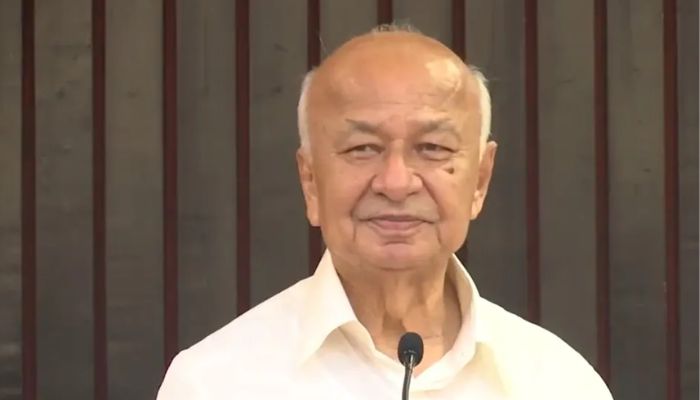
On Tuesday (10th September), former UPA Union Home Minister Sushilkumar Shinde revealed that he was “scared” when he visited Srinagar’s Lal Chowk despite being the country’s Home Minister. The senior Congress leader noted that while the public lauded the Home Minister for not being fearful, he couldn’t tell anyone that he was scared in Lal Chowk.
Notably, he made these remarks during the launch of his memoir ‘Five Decades in Politics’. Recalling his 2012 visit to the Kashmir valley, Shinde said, “Before I became the Home Minister, I visited him (educationist Vijay Dhar). I used to ask him for advice. He advised me to not roam around but to visit Lal Chowk (in Srinagar), meet people and go around Dal Lake.”
At the launch of his memoir 'Five Decades of Politics', Congress leader Sushilkumar Shinde says…
"Before I became the Home Minister, I visited educationist Vijay Dhar. I used to ask him for advice. He advised me to not roam around but to visit Lal Chowk (in Srinagar), meet… pic.twitter.com/eaw3aqdbaV
He added, “That advice gave me publicity and people thought that here is a Home Minister who goes there without any fear, lekin meri fat’ti thi wo kisko bataoon? (but who do I tell that I was scared?) I told you this just to make you laugh, but an ex-Policeman can’t speak like this.”
#WATCH | Delhi: At the launch of his memoir 'Five Decades of Politics', Congress leader Sushilkumar Shinde says, "Before I became the Home Minister, I visited him (educationist Vijay Dhar). I used to ask him for advice. He advised me to not roam around but to visit Lal Chowk (in… pic.twitter.com/MJ4QhrKbwa
While he claimed that he made the statement just to make people laugh, the Former UPA Minister Sushil Kumar Shinde inadvertently admitted that during the Congress-led UPA era, the fear of terrorism in the valley was such that even the country’s Home Minister was scared of visiting Srinagar’s Lal Chowk. Strikingly, up until recently under the Modi government, Lal Chowk was said to be the stronghold of separatist leaders like Yasin Malik and Pakistan-sponsored terrorists with open displays of Nationalist, Pro-India sentiments including waving the National flag attracting terror threats.
It is pertinent to note that Sushil Kumar Shinde was appointed as India’s Home minister by the then prime minister Manmohan Singh in 2012. He had succeeded P Chidambaram as the Union Home Minister. During his Kashmir visit, the Congress leader also did shopping at Srinagar’s Lal Chowk. Back then, he was accompanied by erstwhile J&K state’s Chief Minister Omar Abdullah.
Sharing his remarks, the Bharatiya Janata Party took a dig at the Congress party and contrasted the developments in the Kashmir valley under the UPA era vis-a-vis Modi government. According to them, while even the Union Home Minister was scared to visit Lal Chowk in the Congress era, conditions improved so much under the Modi government that Rahul Gandhi smoothly did the Bharat Jodo Yatra in Kashmir.
UPA era Home Minister Sushil Shinde admits he was scared of going to J&K
“They told me to go Kashmir and do Photo-op at Dal lake for me and UPA's Public image as Home Minister of India. But I was scared"
Several netizens also slammed the Congress party for its stance on terrorism. Some lambasted the Congress leader pointing out that he was reportedly the one who coined the saffron terror term.
When I was the Home Minister of India, I was scared of visiting Lal Chowk, J&K (he said meri fat-ti thi) – Sushilkumar Shinde
This was the condition of J&K during Congress era. Now some people including some RW mocks Modi gvt over their J&K Policy while roaming around the same… pic.twitter.com/xz7UXSfsNy
Did UPA deal with the Islamist threat in J&K from a position of fear and weakness? Was UPA hesitant to take tough calls like abrogation of Article 370 because it feared Islamist backlash? Did UPA not have confidence in Bharat's brave forces to defeat terrorism?
Walking around Lal Chowk and Dal Lake in Article 370 era Srinagar “gave me publicity and people thought that here is a Home Minister who goes there without any fear, lekin meri fat'ti thi wo kisko bataoon? (But whom could I tell that I was scared s@*&less?)”
Some of them even shared BJP leaders including Narendra Modi’s 1992 Ekta Yatra under the leadership of Dr Mulrli Manohar Joshi to unfurl the Indian flag Tricolour at the Lal Chowk despite open threats from terrorists. Back then, BJP leader Modi delivered a speech stating that the success of the Ekta Yatra had rattled the terrorists.
Rahul Gandhi is currently in the United States of America and preaching to India about respecting everyone and treating all citizens, including their different languages, equally. He even blamed the Rashtriya Swayamsevak Sangh (RSS) for the orchestrated conflict between non-Hindi vs. the Hindi language. He alleged that the organisation views India as a nation, while he boasted that his party, on the contrary, considers India a “union of states.” Interestingly, even as he advocates the value of respecting all languages, his party has been actively promoting the divisive agenda he repeatedly claims to detest.
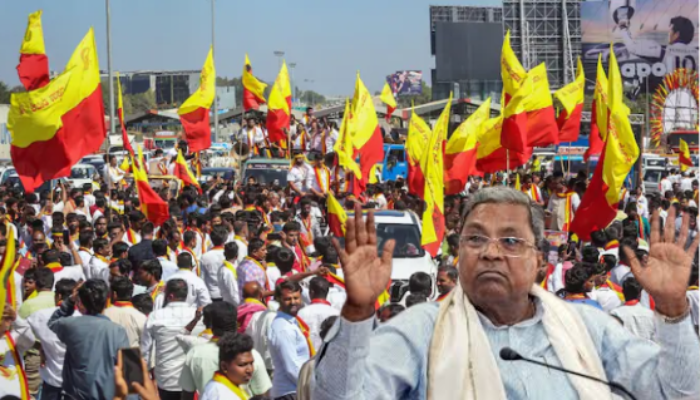
The amount of linguistic chauvinism that senior Congress leaders including Karnataka Chief Minister Siddaramaiah displayed publically manifested itself violently last year as goons wreaked havoc on the streets and targeted businesses because their signboards either did not use the required percentage of Kannada language or the words were not highlighted boldly. Notably, the attack transpired a few months after Siddaramaiah declared, “We are all Kannadigas, people speaking different languages have settled in Kannada land since the unification of Karnataka. Everyone living in Karnataka should learn to speak Kannada. Instead of Kannadigas teaching our language to others, we are learning their language first. In some parts of the state, the diaspora does not speak Kannada at all. This is happening because of the generosity of the Kannadigas.”
Incentivising criminal behaviour for ‘Kannada pride’
Owing to political support, the polarizing sentiments have grown more intense and have now resulted in defending the public assault against individuals including women. In the latest instance, a Bengaluru auto driver named Muthuraj who was arrested on the evening of 5th September for abusing and slapping a woman passenger for making him wait and then cancel the ride due to a change in plans is gaining sympathy from a section of people.
A user named Mohan Dasari posted that the accused does not deserve to bear the financial penalty and inquired as to whether any attorneys would be willing to take up his case. He claimed that the driver’s “frustration” made him react angrily and even offered Rs 1,000 as a contribution to cover the Rs 30,000 fine.
I know it’s a frustration which made him to react like that so 4 days in jail. For his helplessness of losing his earning with that duty shouldn’t be as costly as 30,000 legal cost. Any lawyer who wants to help R Muthuraj for bail?I will donate from my side ₹1000 & others too. pic.twitter.com/NmAMTIjN3E
Another netizen evoked Kannada pride to gather support for the auto-driver and also donated Rs 1,000 for the latter’s legal fees. The person, however, added, “He deserved 4 days in jail for his behaviour but should not cost 30K in high inflation period.”
An individual took a jibe at the female victim and claimed those who depend on their daily paychecks understand the worth of money more than “mall hopping passengers.” The person also pledged to give Rs 1,000 and demanded justice for him rather than the woman he insulted and assaulted.
Sir, I agree with you and I will contribute Rs.1000/- for the genuine cause. But, some one has to see that the Auto Driver gets justice. People who live on daily earnings know the value of money better than Mall hopping passengers. https://t.co/BiKHZedPyI
However, a lot of internet users also questioned how someone who was found to be abusing women could receive financial aid, pointing out the blatant hypocrisy. “So Kannada warriors are crowdfunding for a criminal who assaulted a young student,” asked a person and added that it is concerning when criminal acts are justified in the name of regional pride.
So Kannada warriors are crowdfunding for a criminal who assaulted a young student? Using regional pride to justify such criminal acts is troubling!
A person asked if customers should also start beating their cab or auto drivers if they cancel the riders. “Are you justifying a man hitting and assaulting a woman? He deserves more punishment than this,” she asserted.
Many times many drivers cancel on me in India. Do u suggest i beat them up for merely cancelling my ride?
Are u justifying a man hitting n assaulting a woman? He deserves more punishment than this.
‘You are outsiders: Speak Kannada or don’t come to Bengaluru’
The regional bigotry fostered by Congress for petty political advantage has gradually transmogrified itself into a monstrous beast as Indians from other states are already declared “outsiders” in their own country if they don’t speak the local language. A social media user who claims to live in “Karnataka Nation” announced that people who don’t speak Kannada will be treated as outsiders there because the region belongs to Kannadigas only. “Write it down, share it around. We aren’t joking,” he warned in the viral post which garnered nearly six million views to imply that no one should feel offended or victimised when exposed to regional prejudice and discrimination in Bengaluru for not being a local.
To, Everyone Coming to Bengaluru
You will be treated as OUTSIDERS in Bengaluru if you don't speak Kannada or make an effort to speak Kannada.
Another regional warrior uploaded a video of a German woman speaking Kannada and asked, “If Germans can why can’t Indians learn and speak Kannada with Kannadigas?”
German Citizen Jenifer currently staying in Karnataka learns Kannada and tries to converse in Kannada with locals.
Look at the appreciation she gets for speaking in Kannada.
The person posted another video calling the non-locals refugees because “they don’t learn Kannada” and parroted the same sentiment as he directed people to learn the language if they want to come to Karnataka and live there.
It appears that even some doctors have jumped on the “speak Kannada or leave bandwagon” according to another post which stated, “Doctors started writing their prescriptions in Kannada.” The individual remarked that the move was in response to a decree by bodies including the Kannada Development Authority which ordered doctors to write in “people’s language.”
In Karnataka, Doctors started writing their prescriptions in Kannada. Doctors have responded to the call by people & institutions like @kdabengaluru, to fulfill this basic need to write in people's language.
Kannada Development Authority Chairman Purushottama Bilimale recently directed doctors to write prescriptions in Kannada in the state.
ರಾಜ್ಯದಲ್ಲಿ ಇನ್ಮುಂದೆ ವೈದ್ಯರು ಕನ್ನಡದಲ್ಲಿ ಔಷಧಿ ಚೀಟಿಯನ್ನು ಬರೆಯಲು ಆದೇಶ ನೀಡಲಾಗುವುದು ಎಂದು ಕನ್ನಡ ಅಭಿವೃದ್ಧಿ ಪ್ರಾಧಿಕಾರದ ಅಧ್ಯಕ್ಷ ಪುರುಷೋತ್ತಮ ಬಿಳಿಮಲೆ ತಿಳಿಸಿದ್ದ ಬೆನ್ನಲ್ಲೆ
Now, does this imply that someone who doesn’t speak the language must ask that the prescription be written in Hindi, or will their request be turned down? Can a doctor, one of the most honourable professions in charge of saving lives, afford to take part in such antics?
Urdu is acceptable, Hindi is not
Notably, Purushottama Bilimale, a close aide of Chief Minister Siddaramaiah announced that the matter of teaching Kannada in Urdu-medium schools and madrassas be put on hold as the minority community is opposing it, in July.
The Congress leadership recognizes and knows when to yield and where to assert its authority in relation to issues of regional and linguistic pride as appeasement of the vote bank always reigns supreme. Urdu and English, two more non-local languages, are prominently exhibited while Hindi is gradually being removed from public signs and boards including official buildings in the state to further stoke the flames.
Who are we? We are the Karnataka Congress
What do we want? Votes in the name of Kannada Pride
How do we do it? By Abusing the Hindi language, Removing Hindi Posters & nameplates
While the thugs are storming the streets and attacking everything they perceive to be adverse to their language pride, the Congress leaders have been attending conferences like “Hindi takeover conspiracy” in an attempt to breed more division among the populace.
Meanwhile, the politicians in Karnataka are busy holding emergency meetings. Their agenda? "Hindi takeover conspiracy." One guy suggests they start a Kannada-only tech platform. "Let’s call it 'Kannoogle!'" he declares proudly. But then someone in the back mutters, "But sir, how… pic.twitter.com/eVbif9WzhS
Playing regional and language politics as government coffers run dry, the state faces a severe water and pothole crisis
The finance advisor to Karnataka Chief Minister Siddaramaiah, Basavaraj Rayareddy in July exposed how guarantee schemes have left the state’s coffers empty and prevented funding for development projects. The problem occurred when huge sums of money had to be set aside for the freebies offered by Congress. “Many MLAs are demanding funds for development works in their constituencies, however, there is no money with the government. We are spending approximately Rs 65,000 crore on guarantee schemes. Since I am the financial advisor, I somehow managed to get the grant for a lake development project,” he expressed at an event.
He further pointed out, “People want development. But believe me, there is absolutely no money. Since I am the financial advisor, I managed to get funds for the lake development project here.” Notably, in June, the Karnataka government hired Boston Consulting Group (BCG) as a consultant to cater to mounting pressure to carry out the five promises, which caused a rift within the party. The BCG was tasked to come up with strategies to boost revenue and plug leakages in revenue collections as five guarantees, promised by the Congress during assembly elections, cost the exchequer Rs 36,000 crore in 2023-24.
“If one wins elections by outsourcing core political functions to external fee-charging transactional consultants, then one also governs by outsourcing core policy functions to similar consultants,” wrote Congress leader Praveen Chakravarty on social media which led to backlash from his own party members. Afterwards, he claimed that the remark was his “personal opinion.”
The government raised petrol and diesel prices and even hinted at hiking water tariffs in Bengaluru, in June. “We are suffering huge losses. We’ve taken up new projects, and no bank is coming forward to finance the Bangalore Water Supply and Sewerage Board (BWSSB),” Deputy Chief Minister DK Shivakumar announced. In August, he reiterated that the increase is inevitable. Last year, he revealed that the government did not have funds for the development.
While the government is fighting a losing battle in the economy, the state encountered a serious water shortage over the sweltering summer. “India’s Silicon Valley” had to endure a severe water shortage pointing at the lack of management and negligence at the administration’s end as borewells across the city including the one owned by DK Shivakumar dried up due to low rainfall and forcing residents including Siddaramaiah to rely on water tankers.
Residents had to pay escalating water tanker costs as in certain areas of Bengaluru, with merchants selling water tanks demanded as much as Rs 2,000 for a 12,000-liter tanker. People who possessed upscale apartments in Bengaluru had to use mall washrooms as schools and offices ran in the virtual world, due to the crisis. The government had to impose stringent limitations on the amount of water that can be used in the home for non-drinking p.
The Congress government’s mismanagement appears to be endless as the state’s roadways have been found to be littered with potholes. However, now the government has given a fifteen-day deadline to fill the potholes to civic officials or face consequences, after multiple complaints and criticism. Bruhat Bengaluru Mahanagara Palike (BBMP) Chief Commissioner Tushar Giri Nath mentioned that as of September 9th, there were around 280 potholes on main highways and 1,663 on ward-level roads that needed to be filled. He unveiled that complaints were made by the public through the ‘Raste Gundi Gamana’ mobile app and there are more potholes in the city besides these.
According to Zonal Commissioner (east) Snehal R, although the BBMP is always patching potholes, residents are complaining about the poor quality of the work. She added that since April 2024, there have been 537 complaints regarding main highways and 494 complaints regarding ward roads in the east zone.
Conclusion
Instead of executing its mandate, the Congress party has been propelling the fires of regional and linguistic hatred while the state has been beset by a plethora of issues. The party recommended providing Kannadigas with a 100% reservation in Category C and D positions across all state-wide private sectors. Top industry leaders and state government officials, meanwhile, fiercely opposed the proposal after which Siddaramaih also removed his post. Notably, one of the proposed measures aimed to give native Kannadigas preference for 50% of management positions and 75% of non-management positions in the private sector.
The deplorable condition of affairs in Karnataka is a testament to how the party has been abdicating its responsibilities to score brownie political points, leaving the people to deal with several problems on a daily basis. The party and its leading figures including Rahul Gandhi have blatantly shown themselves to be hypocritical as they do exactly the contrary of what they preach about equal respect and opportunity for all people regardless of their religion, region, language, caste and other differences.
Bengaluru, which was regarded as India’s IT hub and a dream destination for many people has grabbed the headlines for all the wrong reasons recently as a result of such a problematic narrative. The dirty politics of Congress have allowed the nefarious elements of society to execute their plans and further pollute the atmosphere which has created a perilous situation for many Hindi-speaking individuals in the state and put their safety as well as livelihoods at risk.
Amid the Islamist onslaught against Hindus in Bangladesh, human rights activist and exiled Bangladeshi blogger Asad Noor revealed that the minority community is now being coerced into joining ‘Jamaat-e-Islami’
He made the revelations in a Facebook post on Sunday (8th September). Noor informed that on Saturday (7th September), members of the radical Islamist outfit visited Kalmati Ward No.2 in Khuniagach Union of Lalmonirhat Sadar Upazila.
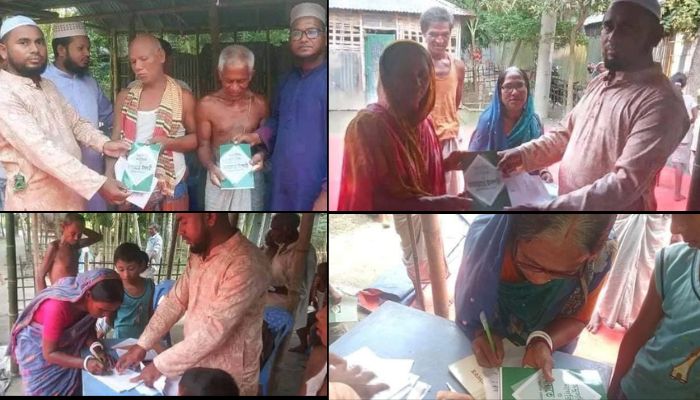
They preyed upon 27 poor, destitute Hindus and forced them to join ‘Jamaat-e-Islami.’ According to Asad Noor, the radicals threatened to kill the victims and remove them from the nation.
Forced by circumstances, the impoverished Hindus had to comply with their diktat. The Jamaat-e-Islami members coerced them into signing some forms and gave them Islamic books to brainwash them into changing their Hindu Faith.
Hafiz Mohammed Shah Alam, the Assistant Secretary of the Jamaat-e-Islami (Lalmonirhat Branch), was present during the forced induction of Hindus into the radical outfit.
The 27 victims were administered an oath of allegiance under Apexndix 11 of the Constitution.
Attacks on Hindus continue unabated in Bangladesh
The incident comes amid the lynching of a Hindu boy named Utsab Mandal by a Muslim mob on accusations of ‘blasphemy’ in the Sonadanga residential area of Khulna city.
We previously reported how Muslim students have forced as many as 60 Hindu teachers, professors and government officials to resign from their positions.
There have been at least 205 attacks on Hindu temples, shops and businesses since the ouster of Sheikha Hasina as Prime Minister of Bangladesh.
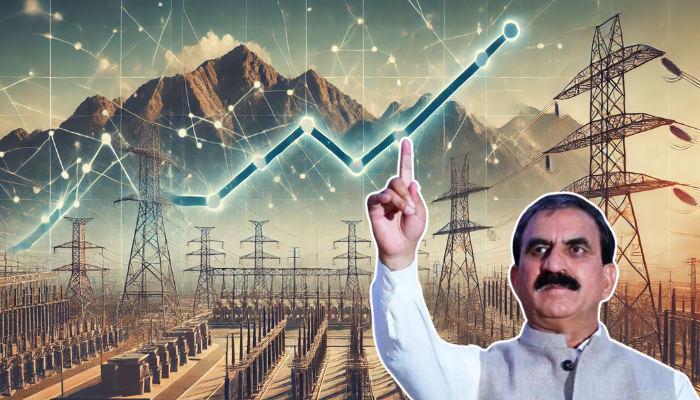
On 9th September, the Chief Minister of Himachal Pradesh, Sukhvinder Singh Sukhu, introduced the Himachal Pradesh Electricity Duty Amendment Bill, 2024, in the Assembly. The bill proposes to impose a milk cess and an environment cess on consumers. It seeks amendments to the Himachal Pradesh Electricity (Duty) Act, 2009, with the insertion of Sections 3A for the milk cess and 3B for the environment cess.
As per reports, the Congress-led HP government has planned to impose a milk cess of Rs 0.10 per unit on power consumers. Zero-bill consumers have been exempted from the cess. Furthermore, the bill includes a provision that empowers the state government to modify the milk cess by up to 50% through notification. The government plans to use the revenue collected from the cess to strengthen and uplift milk producers in the state.
The bill also proposes an environment cess for various categories of power consumers. According to the bill, Rs 0.02 per unit will be applicable for small industrial power consumers, Rs 0.04 per unit for medium industrial power consumers, and Rs 0.10 per unit for large industrial and commercial power consumers. Additionally, a charge of Rs 2 per unit will be imposed on temporary connections and stone crushers. Electric vehicle charging stations will also have to pay a higher per unit price at Rs 6 per unit.
The government claims that the aim behind imposing the environment cess is to promote power generation using solar energy and to protect the environment. The government has the authority to modify cess rates similar to the milk cess. The bill was scheduled to be discussed in the HP State Assembly on 10th September.
Notably, in March 2023, the government of Himachal Pradesh imposed a Rs 10 milk cess on every bottle of liquor in the state. However, the COVID cess imposed on liquor bottles was removed at that time. In addition, a Rs 2.5 cow cess is also imposed on liquor bottles.
Himachal Pradesh is facing a dire economic crisis. In August 2024, HP CM Sukhu announced deferring his salary, allowances, and other benefits for the next two months, citing the financial crisis. The government also planned to legalise the limited use of cannabis for medicinal purposes to improve the state’s finances.
“The CM has taken a good initiative to overcome the financial troubles we are facing in the state. We are trying to strengthen the resources in the state – be it through water resources or our excise policy and mining policy. We are also trying to legalise cannabis for limited purposes like medical use,” said Himachal Pradesh minister and Congress leader Vikramaditya Singh.
Earlier, CM Sukhvinder Singh Sukhu announced that he and his cabinet have decided to forgo two months’ salary as a symbolic measure to address the state’s fiscal challenges.
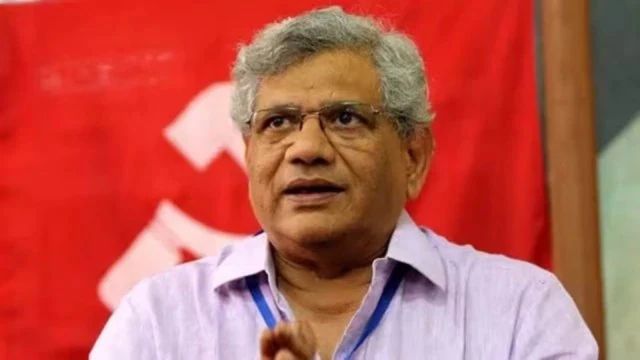
Sitaram Yechury, the general secretary of the Communist Party of India (Marxist), who was admitted to AIIMS in Delhi last month, is currently on respiratory support, according to a statement from the party. The CPI(M) also mentioned that Yechury is receiving treatment in the hospital’s intensive care unit for a severe respiratory tract infection.
“He is on respiratory support, and a team of doctors from various specialities is closely monitoring his condition, which is currently critical,” the party stated in a message on X.
Yechury was admitted to AIIMS’s emergency department on August 19 after experiencing a high fever. According to a source cited by news agency PTI, he was hospitalized due to pneumonia, and his condition was not considered serious. The CPI(M) leader had also recently undergone cataract surgery.
Earlier this year, Yechury had declined an invitation to the hallowed consecration ceremony at the Ram Mandir temple in Ayodhya, dismissing the sacred ritual as a state-sponsored event.
In 2019, Sitaram Yechury sparked controversy by stating that both the Ramayana and Mahabharata are full of violent episodes, questioning the idea that Hindus are inherently non-violent.
Speaking at an event, Yechury remarked, “The Ramayana and Mahabharata contain numerous instances of violence and warfare. How can one recite these epics as a pracharak and still claim Hindus are incapable of violence? What’s the reasoning behind saying that one religion engages in violence while Hindus do not?”
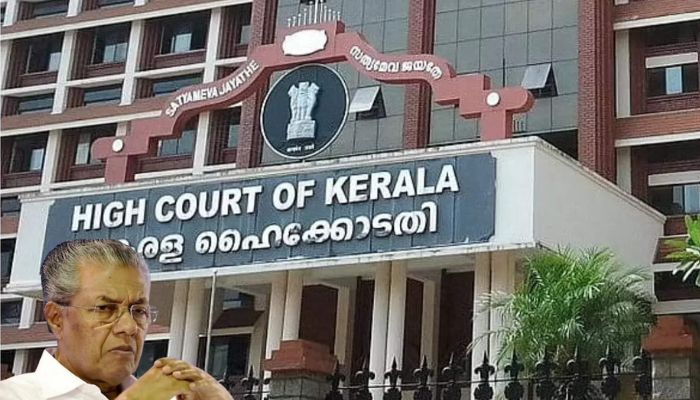
On Tuesday (10th September), the Kerala High Court came down heavily on the state government for failing to take prompt action against the sexual abuse unearthed by the Justice K Hema committee report on the working conditions of women in the Malayalam film industry.
The two-judge bench slammed the Left Front government emphasising that they are concerned with the state’s inaction, including not registering FIRs after the committee first submitted its report in 2019. The Court also reprimanded the state government saying that they had done nothing in 4 years except sitting on the report. While criticising the state government, the High Court also orally remarked that “silence is not an option”.
Notably, a special bench comprising Justices AK Jayasankaran Nambiar and C S Sudha is hearing several matters including a public interest litigation (PIL) petition seeking criminal action against those accused of sexual offences in the report.
The Special bench has directed the Kerala government to hand over the un-redacted version of the Justice Hema Committee Report to the Special Investigating Team (SIT). The Pinarayi Vijayan government had formed a seven-member SIT which is currently probing sexual crimes that have been reported in the wake of the publication of the report.
Key observations of the Kerala High Court
On Tuesday, September 10, the High Court noted that the Justice Hema Committee report was submitted to the government way back in 2019 and slammed the state government for its inaction. The court said, “We are primarily concerned with inaction of the state, including not registering FIRs… You have done nothing in 4 years except sit on the report.”
The court stressed that “silence” was not an option for the government.
The Court remarked, “When the report revealed such a malady in the system, what is the bare minimum that the State government should have done? We are taken aback by the lack of action by the State government. It is one thing to assure the confidentiality of the women who spoke to the committee and even those who have been accused may have the right to privacy. But dehors of this, when such issues are revealed in the report, shouldn’t there be some action from the government? … Why has the government done nothing till now? … It is obligatory for the State to act on this. Silence is not an option.”
The High Court also emphasised that the “bias and discrimination” against women must change.
The High Court questioned Kerala government and said, “What are you doing to address the problems faced by women in society? Not just the film industry. The situation is bad and that too in a state like ours. We have a higher population of women in our state. This is not a minority issue for us… The SIT must look into all of this.”
Furthermore, the bench has asked the SIT to submit its status report on the next date. It added that it will then decide whether to open the sealed cover containing the un-redacted version of the report or not.
The court pointed out that the Hema Committee report also mentioned instances of exploitation even before the production of a film started which doesn’t come under the ambit of the Prevention of Sexual Harassment at Workplace (POSH) Act. Consequently, the court asked the Kerala government to formulate legislation to address these problems of women.
It added, “In such situations, it may not be possible to invoke the POSH Act. If issues are not being addressed with existing legislation, the government must think of new laws.”
It also suggested arbitration and mediation proceedings for non-criminal offences. The bench remarked, “Some cases can be brought under mediation. We are not talking about criminal offences. For example, issues faced by make-up artists like if there is gender discrimination.”
The court asked the SIT not to reveal key findings of the investigation in press conferences or to the media which could lead to a “media trial”. However, the court refrained from passing a gag order on the media. But, it asked the media not to put pressure on the SIT to act in haste.
Justice Sudha said, “No press conferences from the SIT. No media trial in this case. We are not saying the investigating officers shouldn’t talk to the press but that they shouldn’t reveal any details.”
Justice Nambiar noted, “We don’t think there is any necessity to issue any gag order to the media. The media can be responsible. No gag order for the media now … It is not just courts who have to protect fundamental rights. The State also has a duty. Even the media has a duty to respect the right to privacy of individuals.”
Justice Hema Committee report
The Kerala government established the Justice Hema Committee in February 2017 after a heinous case of sexual assault of an actress came to light. Notably, a prominent Malayalam actress was kidnapped, sexually assaulted, and filmed in a moving car. The Investigations revealed that actor Dileep had allegedly orchestrated the attack to “teach her a lesson.”
Following massive furore, the Justice Hema Committee came into being and it submitted its report to the Kerala government on 31st December 2019.
However, the findings of the report were made public on Monday (19th August 2024), five years after it was submitted to the Kerala government as it was claimed that it had a lot of sensitive information which needed to be redacted before releasing it to the public. They believed that publishing the full report would harm the industry.
The 63 pages that were redacted had portions that could infringe on the privacy of the individuals mentioned in it, as directed by the State Information Commission (SIC). However, the state government is facing widespread allegations that it is trying to protect the accused and excluded more information than what was recommended.
Now the court has come down heavily on the state government highlighting the five-year delay and the LDF government’s inaction in taking prompt action in the last five years.