Home Blog Page 915

Shubh Karan Singh death case: FSL report reveals death by shotgun pellet, Punjab and Haryana HC orders further investigation. Read how it was politicised by ‘farmer leaders’

On 10th July, the Punjab and Haryana High Court observed that farmer Shubh Karan Singh, who died at the Khanuri border during farmer protests in February 2024, got shot with a shotgun, a weapon that Haryana police or the other security forces stationed at the site do not possess.

The observation came after the Forensic Science Laboratory (FSL) report was submitted in the court by the Haryana Government. Following the report, the High Court ordered further investigation into the matter to determine who fired the shot and suggested reviewing the video footage of the incident to identify the culprit.

Details of High Court orders in Shubh Karan Singh’s death

OpIndia accessed multiple orders in the matter. In a 28th May order, the Punjab and Haryana High Court noted that Shubh Karan Singh was hit by pellets when he was standing next to the electric pole situation in Village Data Singh Wala of district Jind. Hence, the investigation falls under the jurisdiction of the State of Haryana and nowhere else.

Notably, a committee was constituted by the Punjab and Haryana High Court that opined that it would be appropriate to direct the investigating agency to get a report from the Central Forensic Laboratory, Chandigarh to answer the question posed about the weapon used.

Subsequently, the court ordered the Punjab police to submit the record regarding the post-mortem report and the pellets collected from the body of Shubh Karan Singh to CFL Chandigarh.

On 10th July, Haryana police filed an affidavit as directed by the court nominating three high-ranking police officials from ADGP to the rank of Commissioner of Police for investigation into the matter. The court was also informed that the autopsy report and pellets were handed over by the Punjab police for the investigation to CFSL Laboratory, Sector 36, Chandigarh.

The FSL report dated 28th June 2024 authored by Pankaj Verma, Scientist (Ballistics) of CFSL noted that the pellets that killed Shubh Karan Singh were fired through shotgun and correspond to size “1” pellets of shotgun cartridges. The court order read, “The piece of skin and hair strands under reference have been examined chemically for the presence of firing discharge residues which were duly detected.” Furthermore, the court nominated IPS Satish Balan, Commissioner of Police, Jhajjar to investigate the matter.

Though it was not mentioned in the court order, the court observed that “Shotgun is not carried by police officers”. Addressing Senior Advocate RS Bains appearing for Kisan Union, the court said, “it shows that the pellete was shot by one of your men and you people created so much of hue and cry about it”.

Death of Shubh Karan Singh

On 21st February, Shubh Karan Singh reportedly died after he got shot in the head during a clash with the police at Khanuri border. Shubh Karan was rushed to the Government Rajindra Hospital in Patiala where doctors found out that the injury was due to a bullet wound. The protestors did not waste any time and accused Haryana police of the incident which was categorically denied by the police.

CM Bhagwant Mann announced Rs 1 crore compensation and a job for sister

Two days after the incident, Chief Minister of Punjab, Bhagwant Mann, announced Rs 1 crore compensation for the family of Shubh Karan Singh. He also promised a government job for the sister of the deceased. In a post on X, he wrote, “Financial assistance of Rs 1 crore will be given by the Punjab Government to the family of Shubhakaran Singh, who was martyred during the farmers’ protest at Khanauri border, and his younger sister will be given a government job. Appropriate legal action will be taken against the culprits. They are performing their duty.” The compensation was paid to the family by CM Mann on 10th July, the same day FSL report revealed he was shot by a shotgun and not a police gun.

Details of the autopsy report

On 29th February, an autopsy was performed on the dead body of Shubh Karan Singh by the doctors at Patiala Hospital. The medico-legal report issued by the hospital noted that metal pellets were found inside Shubh Karan’s skull. He died of a firearm injury on the back of his head. Furthermore, the report pointed out that similar metal pellets were present in the torso of many protesting farmers who were injured during the clashes.

CT scan of his body was done before sending it for post-mortem. The scans revealed that metal pellets pierced on the occipital region which is the rearmost region of the skull. The autopsy report was handed over to the police. Speaking to Hindustan Times, people aware of the development said that metal pellets recovered from the body were also handed over to the police and the same would likely be sent to ballistic experts to understand what firearm was used.

Notably, an autopsy was done only after the family allowed it following a Zero FIR registered in the matter.

FIR in Shubh Karan’s death

Following the death of Shubh Karan Singh, his family members and Kisan Union leaders did not allow an autopsy to happen. They demanded to register an FIR first in the case and said only then they would allow the doctors to perform an autopsy. The dead body of the deceased farmer was placed in the mortuary of Rajindra Medica College and Hospital in Patiala.

Eight days after the death, Punjab police registered a Zero FIR in the matter against unknown people. Inspector General of Punjab Police (Headquarters) Sukhchain Singh Gill said, “A zero FIR was registered into Shubhkaran’s death following legal advice. The Chief Minister has announced ₹1 crore compensation for his family and a police constable job for his sister as per the family’s wish. We stand by his family and will do everything to support them.”

Source: Punjab Police

The FIR was registered at the Patran Police Station in district Patiala under Sections 302 and 114 of the Indian Penal Code. It was filed on the complaint of Shubh Karan Singh’s father, Charanjeet Singh.

According to the FIR, Shubh Karan was an active participant in the farmer protests. He travelled to Khanuri border with other villagers to join the protests. On the day of his death, the protesters were met with heavy blockage and tear gas shelling by Haryana police. Charanjit Singh said that he was also present at the protest site. He said when the tear gas shelling happened, the protesting farmers ran to the nearby fields to take cover on the instructions of the union leaders. Though they moved to a safer distance, he accused Haryana police of continuing to fire tear gas shells into the fields.

Source: Punjab Police

He added that the protesters began to retreat towards their tractors and at that time, Shubh Karan Singh, who was walking a few steps ahead of his father, was stuck by a bullet at the back of his head. Following the incident, he collapsed immediately. He was picked up by fellow protesters and bystanders and transported to Khanuri Hospital where he was declared dead.

Accusations against Haryana police

Haryana police came under heavy backlash due to the action it took against protesting farmers. It has to be noted that the so-called farmers came equipped with modified tractors and machines to break the barricades. Many of them were armed with swords and other weapons.

After Zero FIR was registered in the case, Shiromani Akali Dal (SAD) leader Bikram Singh Majithia accused the Punjab government of playing in the hands of Haryana. He said, “Zero FIR means zero results. After registering a zero FIR, it has been sent to Haryana for investigation. Will the Haryana government take action against their people? Bhagwant Mann is playing into the hands of Haryana. He is working as per the directions of the Haryana Police and the Haryana government. More than 250 farmers suffered injuries and five lost eyesight…how will they ensure justice for Shubhkaran?” Majithia openly accused Haryana government and police of the injuries farmers suffered but conviniently ignored the fact that it was the farmers who came with weapons and modified machines.

In a report published by propaganda portal The Wire, family members and farmer union leaders were quoted blaming Haryana police for Shubh Karan’s death. His uncle Buta Singh told The Wire that Shubh Karan died only because Haryana police used excessive force against the protesting farmers. He said, “They were the ones who created chaos by halting farmers from marching to Delhi. Shubh would have been alive if farmers were allowed to march peacefully.”

In Shubh Karan’s village, villagers and farmer unions put up boards that read, “The Haryana government killed Shubhkaran as he was protesting at the Khanauri border to march towards Delhi demanding MSP. We will continue our struggle to get our demands fulfilled to pay tribute to him”.

Not only Haryana Police, Punjab government and police were also blamed for the death. SAD president Sukhbir Singh Badal said, “Punjab CM Bhagwant Mann’s conspiratorial double game is responsible for the loss of this young life, the only brother of two sisters. The police of another state are allowed to assault and kill Punjabis on Punjab soil, with Bhagwant Mann collaborating with Haryana against Punjab farmers. Peaceful protest is being met with bullets unheard of in a democracy. The innocent blood of Shubhkaran Singh is in Bhagwant Mann’s hands.”

Despite FSL report, new conspiracy theories are being spinned

Following the FSL report, a narrative is being constructed that Haryana Police officials were in plain clothes and anyone could have fired the shot.

Another narrative is getting traction on social media that police lie about the weapons they use. A social media user Parmjeet SIngh wrote that in 2012, a man named Jaspal Singh was shot by police allegedly using AK-47. Initially, the police denied using AK-47 but a court-ordered orensic examination eventually linked the bullet to a police-issued AK-47. The police later claimed the shot was fired in the air and ricocheted to fatally hit Jaspal Singh. Using that incident, Paramjeet asserted that it was indicative of a “prevailing implied policy of impunity in cases where police are accused of lethal use of force.”

Source: X

Farmer leader Jagjit Singh Dallewal also expressed disbelief over the report and questioned why farmers would possess weapons to harm their own. Maybe he forgot the concept of “friendly fire”. He criticised the Haryana police over the investigation and called for an inquiry led by a retired judge of the high Court to ensure impartiality and justice. He said, “Farmers had no such weapons with them. Though policemen in uniform do not carry shotguns, a number of cops in civil clothes without nameplates were present then. They were having pellet-firing weapons as police fired teargas shells. Some of them in plain clothes damaged tractors and provoked the farmers. We will release video clips of that provocation. It seems that some of them in plain clothes might have fired from the shotgun and now, the Haryana police might be trying to twist the facts in light of the FSL report. How can a shotgun be fired from the farmers’ side? It seems the Haryana govt wants to conceal its ruthless action. We will go through the report and act accordingly.”

Punjab and Haryana High Court ordered Haryana government to remove barricades

On 10th July, Punjab and Haryana High Court ordered Haryana government to remove barricades from Shambhu border considering the number of protesting farmers has come down to 400-500 from 13,000-15,000 earlier. The court said that there were no orders to remove barricades in earlier orders as the situation was tense. The orders to remove the barricades were passed in the interest of general public. The court also directed all Kisan Unions to maintain law and order. Punjab government was also ordered to ensure the protesters gathered on their side are duly controlled.

The narrative at the time about police atrocities on so-called farmers was heavily influenced by the immediate accusations from farmer unions and protestors against the Haryana police. Shubh Karan Singh’s death led to allegations of excessive force used by the police. Several political leaders asserted that the police were responsible for his fatal injury. This narrative was fueled by the initial claims that he was shot by the police, which has now been proven false by the forensic report indicating the use of a shotgun, a weapon not used by the police at the protest site.

Residential areas in North Delhi flooded after canal carrying water from Haryana collapses in Bawana

0

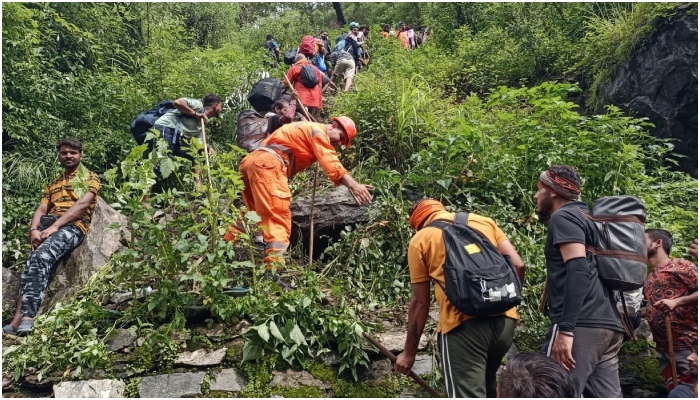
On Thursday, a sub-branch of the Munak Canal sustained a breach, in the Bawana region of North Delhi.

Munak Canal, which is a part of the Western Yamuna Canal, got its Career Lined Channel (CLC) that runs into Bawana broke, leading to floods in nearby areas.

Taking to X, Delhi’s Water Minister Atishi said, “Today early morning, there has been a breach in one of the sub-branches of Munak Canal. Delhi Jal Board is working in close coordination with the Haryana Irrigation Department, who maintain the Munak Canal. Water has been diverted to the other sub-branch of the canal. Repair work has already started and will be completed by this afternoon. The breached sub-branch of the canal will be functional from tomorrow.”

Inspecting the situation, Delhi Flood Control Minister and Aam Aadmi Party Leader Saurabh Bharadwaj said that they got the information of the embankment being broken in the night. He also asked the Chief Engineer of the Flood Department to go there to help the officials of the Delhi Jal Board.

“CLC (career lined channel) comes into Bawana that carries water from Haryana. We got this information about the embankment being broken in the night. Delhi Jal Board officials are there. I have asked the chief engineer of the Flood Department to go there and if the Flood Department can help the Jal Board in any way, we will do that,” Bharadwaj said.

Alam, a resident of the JJ Colony, said that the water had entered every block of the colony and the administration was not making much effort to maintain the flow.

“Water has entered almost every block of the JJ Colony. The barrage of the Munak canal broke at approximately midnight. The administration, especially the irrigation department, isn’t making enough effort to stop the flow… The local leader came to see, but nothing has happened so far that should have been,” he said.

Speaking on the preparedness of the Flood Department, Saurabh Bharadwaj said, “Last time, the level of Yamuna rose so much that it broke the barrage here and entered the city. The flood department is prepared well this year. New machinery is being put up, and an embankment of rocks is there that is 5 metres wide… I hope that the water of Yamuna won’t enter the city this year.”


 (This news report is published from a syndicated feed. Except for the headline, the content has not been written or edited by OpIndia staff)

Hindu persecution continues in Bangladesh: Islamists led by local Awami League leader attack Hindus in Dhaka, 60 injured

The persecution of Hindu minorities in Bangladesh has been continuing relentlessly. The latest attack on Hindus in the country transpired in the Miranjilla Colony of Dhaka. On Wednesday, 10th July, around 1.30 PM, Magistrate Muhammad Moniruzzaman visited the newly constructed Miranjilla Colony in Dhaka to rehabilitate the Hindu minorities. However, Muhammad Auwal Hossain, a local councillor, and his supporters disagreed with the decision and aggressively assaulted the Hindus.

The helpless Hindus were pelted with bricks and stones. Islamists also ransacked and vandalized numerous Hindu homes. They also targeted a temple. At least 60 Hindus suffered injuries due to the assault and were brought to the Dhaka Medical College and Hospital where they received treatment.

Notably, the Dhaka South City Corporation oversees the Miranjilla Colony region. The corporation made the decision to kick the locals out a month ago and as a result, several houses were destroyed. However, the eviction drive was stopped following the outcry across the country. The body then agreed to help the persons who were already forced out, mostly Hindus. However, the ruling Awami League leaders and multiple extremist factions in the area have been against the decision.

Attacks on Hindus have become a common occurrence in Bangladesh. Hindus were also compelled to leave their homes as they endured arson attacks after the 7th January general elections in Bangladesh. Communal attacks occurred in Faridpur, Sirajganj, Bagerhat, Jhenaidah, Pirojpur, Kushtia, Madaripur, Lalmonirhat, Daudkandi, Thakurgaon, Munshiganj and Gaibandha, among other places in Bangladesh. The minority community was attacked with sharp weapons, their houses were destroyed and their shops were looted.

‘Saifuddin takes girls to Arab countries, makes them do mujra’: Hindu woman accuses Muslim husband of forced conversion and abuse, says a Congress leader also involved in network

On 13th May a Hindu girl registered a case of violence against her Muslim husband in Lucknow, Uttar Pradesh in which six other individuals were also named along with some unidentified persons. Now, she has come forward and alleged a deep conspiracy of love jihad. She further charged that a Congress leader is also involved in this entire network.

The victim is originally from the Bahraich district of Uttar Pradesh while the accused Saifuddin is from Bidar, Karnataka. She has filed a report at the Gudamba police station in Lucknow over the issue.

The woman has now detailed her torment to the media in detail. She conveyed that the offender met her as a client while talking to ABP News. He began courting her after they talked for a few days. He used to drink alcohol by mixing pills in it and claimed that he was very upset with his family members. He claimed he has personal problems and gradually began to persuade her to marry him. One day he gave her a sedative and sexually violated her. He also recorded her explicit video and used it to blackmail her.

She added that Saifuddin’s profession is to trap girls in his net by emotionally blackmailing them. The females are from states like Mumbai, Delhi and Gujarat. Saifuddin reportedly ‘traps’ them with the allurement of jobs in beauty parlours and other benefits. Later, they are sold in the Gulf countries and are made to perform mujra. She claimed to know many girls working in different bars in Bahrain. Meanwhile, she mentioned that there is a Congress party leader in Bidar who is a relative of Saifuddin. He is also charged with assaulting and attempting to rape her.

The female earlier stated that she had spent the previous six to seven years living and working in Bahrain and Dubai. She met the culprit in Bahrain. He befriended and raped her after which she became pregnant. She submitted a case against him there, however, she was advised to embrace Islam. On 13th February, she succumbed to his family’s pressure and became a Muslim as well as married him. Saifuddin brought her to Mumbai under the guise of treatment when she was five months pregnant.

She disclosed, “One day, he sexually assaulted me in Bahrain and I lodged a rape complaint there. While the matter was under investigation, Saifuddin and his family members persuaded me to withdraw the complaint after I became five months pregnant as a result of the rape. They also pressured me to change my religion. Later, on February 13, 2024, I was married to Saifuddin according to Muslim law. In due course, Saifuddin tricked me into visiting Mumbai for a medical consultation, and I was admitted to a hospital where the doctors secretly aborted the five-month-old fetus.”

The perpetrator then took her to his home in Bidar where his brother Sabiruddin and three others, along with their sister, physically and mentally tortured the girl, as per the victim’s complaint. She also complained about his ‘girlfriend’ Monika and some other people. Afterwards, a First Information Report was registered against Saifuddin, his 4 brothers sister and Monika under 498A, 323 and 313 of the Indian Penal Code. OpIndia has a copy of the FIR.

Kerala cop framed Nambi Narayanan in ISRO espionage case in anger and vengeance after a Maldivian woman rejected his advances: CBI tells court

On the 10th of July, the Central Bureau of Investigation (CBI) told a Thiruvananthapuram court that the 1994 ISRO espionage case was fabricated by a senior Kerala cop to illegally detain a Maldivian woman after she turned down his romantic advances. The CBI said the case in which ISRO scientist Nambi Narayanan was falsely accused was fabricated by a then-special branch officer of the Kerala police.

The CBI chargesheet states that the then special branch officer, S Vijayan contrived the case after a Maldivian woman named Mariyam Rasheeda turned down his love advances. CBI alleged that S Vijayan confiscated Rasheeda’s travel documentation and airline tickets to stop Maryam Rasheeda from leaving India. Vijayan later retired as a Superintendent of Police (SP).

According to the chargesheet, Vijayan later found Rasheeda’s connection to ISRO scientist D Shasikumaran, prompting Kerala Police officers to place Rasheeda and her Maldivian friend Fauzia Hasan under surveillance.

Meanwhile, the Kerala Police alerted the Subsidiary Intelligence Bureau (SIB) about the women, but when IB officers checked the foreign nationals, they found nothing untoward, according to the CBI. Rasheeda was then arrested under the Foreigners Act for overstaying in the country sans a valid visa, with the knowledge of the then-Commissioner of Police in Thiruvananthapuram and the SIB Deputy Director.

Vijayan allegedly submitted a false report accusing Rasheeda and Hasan of violating the Official Secrets Act since her custody was coming to an end. Following this, an espionage case was filed, which was later moved to a Special Investigation Team (SIT). The SIT then arrested four ISRO scientists, including Nambi Narayanan.

The CBI chargesheet alleges that the initial wrongdoings were compounded by creating additional allegations against Narayanan and others.

The CBI, in its final report, suggested that former Director Generals of Police (DGPs) R B Sreekumar and Siby Mathews, former SPs S Vijayan and K K Joshua, and former intelligence officer P S Jayaprakash be prosecuted for their involvement in this conspiracy.

Notably, the CBI has booked these people under various the Indian Penal Code including sections 120B (criminal conspiracy), 342 (wrongful confinement), 323 (voluntarily causing hurt), 330 (voluntarily causing hurt to extract a confession), 167 (public servant framing an incorrect document), 193 (giving false evidence), 354 (outrage modesty of a woman).

Citing lack of evidence, the CBI refrained from recommending prosecution of the other 13 accused including the then IB officers and Kerala Police officers.

Reacting to the development on Wednesday, Nambi Narayanan said that his role in the matter is over since he has proved his innocence. He added that he does not wish those people to be jailed or apologise to him. However, he would have been happy if the accused officers admitted that they made a mistake.

It is pertinent to note that the CBI in its 1996 investigation report concluded that the cases against Nambi Narayanan and others were fabricated. The CBI in its report had observed that “The aforesaid IB officials comprising the team enquiring into ISRO case acted in an unprofessional manner and were privy to the arrest of six innocent persons, thereby causing them immense mental and physical agony.” The CBI had also clearly indicted Srikumar for “failing in their duty to conduct the inquiry in an objective and fair manner.”

The Supreme Court ordered a high-level investigation into the role of erring police officials in the Nambi Narayanan espionage case in 2018. On September 14, 2018, the Supreme Court appointed a three-member committee and ordered the Kerala government to pay Nambi Narayanan Rs 50 lakh in compensation for subjecting him to extreme humiliation.

Indian Cricket team unlikely to travel to Pakistan for 2025 ICC Champions Trophy, BCCI to suggest hybrid model like last year’s Asia Cup: Report

The Indian team will not travel to Pakistan for the ICC Champions Trophy 2025 and will ask the International Cricket Council to hold its matches in Sri Lanka or Dubai, a BCCI source told ANI.

The ICC Champions Trophy will be held next year from February to March 2025 in Pakistan. Since 2008’s Asia Cup, India has not played any cricket tournaments in Pakistan due to tense relationships between both nations.

A bilateral series from December 2012 to January 2013 in India also marked the final bilateral series between the two nations. Since then, both nations have only clashed at ICC tournaments and the Asia Cup.

Uncertainty has been looming over India’s participation in the upcoming event due to the relationship between the two countries.

The Pakistan Cricket Board had proposed to India to play all its matches in one city. ESPNcricinfo had reported that Lahore was chosen as the location where India would play all of their matches. However, the Indian board is not interested in the prospect of travelling to Pakistan.

While addressing India’s participation in the BCCI source, told ANI, “India will not travel to Pakistan for the Champions Trophy 2025. Will tell ICC to hold its matches in Dubai or Sri Lanka.”

BCCI Vice-President Rajeev Shukla, in May, said that the Indian team would be sent to Pakistan for the tournament only if the central government permits it.

Speaking to the ANI, Shukla said, “In the case of the Champion Trophy, we will do whatever the Government of India will tell us to do. We send our team only when the Government of India permits us. So we will go according to the decision of the Indian government.”

A similar situation unfolded during last year’s Asia Cup, which was scheduled to be hosted in Pakistan.

However, PCB was compelled to use a hybrid strategy when hosting the Asia Cup last year, with all of India’s matches–including those against Pakistan–taking place in Sri Lanka.

The tournament final, which India won, took place in Colombo. Although Pakistan had hinted at the possibility of using a hybrid approach to participate in the ODI World Cup in India the previous year, it was never given any thought.

Pakistan are the defending champions of the Champions Trophy, last held in 2017.

(This news report is published from a syndicated feed. Except for the headline, the content has not been written or edited by OpIndia staff)

Rajasthan Govt led by BJP allocates 100 crores for development of Khatu Shyamji Mandir, to renovate 600 other temples: Key takeaways from the state budget

On Wednesday, July 10, Rajasthan Deputy Chief Minister and Finance Minister Diya Kumari presented the state budget in the Assembly. She made a series of announcements, including the proposal to allocate Rs 100 crores for the re-development of Khatu Sham Ji Mandir, one of the most revered Krishna temples in the state. She also announced plans to construct the Khatushyam Corridor, modelled after the Kashi Vishwanath Corridor, to enhance the infrastructure and facilities around this Hindu pilgrimage site. 

Besides, the Rajasthan government, led by the Bharatiya Janata Party (BJP), also proposed to carry out renovation work in 600 other Temples, including Jeenmata and Shakambari temples in Sikar. A total of Rs 13 crore has been allocated for the renovation of these Temples.

Besides focusing on the re-development of Temples, the state budget also had a lot to offer to the women, youths and farmers of the state.

Initiatives for women

Aiming to financially empower women across the state, the Rajasthan government announced the “Lakhpati Didi Yojana”. Under this initiative, as many as 15 lakh women in Rajasthan will be provided interest-free loans up to Rs 5 lakh to start their businesses and improve their economic condition.

Additionally, the state government has in its budget reduced VAT on cooking gas and CNG from 14.5 per cent to 10 per cent.

In the budget, the Deputy CM also committed to providing tap water to 25 lakh rural homes this year and for this, the state govt has allocated a budget of 15000 crore.

Along with Biopink toilets for women in urban areas, 67 Pink Toilets—at a cost of Rs. 17 crore—will be built in the first phase, she said.

Initiatives taken for the youth of the state

For the youths of the state, Deputy CM Diya Kumari proposed a new ‘Youth Policy-2024’ and announced apprenticeship/internship programmes and Artificial Intelligence-based counselling for over 1.5 lakh youth.

As part of a larger plan to fight unemployment and provide the youths of the state with more possibilities, a commitment to create 4 lakh new jobs over the next five years was made.

Furthermore, arrangements have been made for Atal Udyam Yojana for the youth. Rs 25 crore has been announced for startups.

Ajmer, Bikaner, and Bharatpur engineering institutions will combine to form the Rajasthan Institute of Technology, a 300 million rupee project. At Rs 350 crore, basic amenities like restrooms and libraries would be built in schools, the Deputy Chief Minister announced.

Rajasthan Govt’s support to farmers

The state is committed to developing a Detailed Project Report (DPR) to bring Yamuna water to Rajasthan via an underground pipeline and has allocated Rs 60 crore for this project.

The State govt also spoke about expanding the Rasidpura Mandi in Sikar and setting up sprinkler irrigation facilities in 33,000 hectares of the Chaudhary Kumbharam Arya Lift Canal area, a Rs 200 crore project.

In the budget, the MSP for wheat was increased by Rs 125 and the agriculture sector received financial approval for the first phase of the ERCP.

Other key takeaways

The Rajasthan Government announced that a Rs 200 crore Amrit Global Technology and Application Center will be built in Jaipur.

Electricity connections will be provided to 2,08,000 households in the next two years, with over 25 lakh smart meters installed.

In the budget, the government announced its plans to purchase 500 roadway buses and 300 electric buses. It further said that 800 buses would operate under a service model.

A defence manufacturing hub will be established, and a new data centre policy will be introduced.

Among the solar energy projects, the government proposed the construction of a 2 MW decentralized solar plant, the creation of a Model Solar Village in each district, and the solarization of all government buildings.

Dy CM further said that Rajasthan plans to construct nine greenfield expressways covering over 2,750 km.

The health sector received a budget allocation of Rs 27,000 crore.

Under a new tourism policy, the Deputy CM proposed setting up the state tourism development board as well as a heritage conservation board to develop archaeological places and heritage sites.

Rajasthan Mandapam will be developed on the lines of the Bharat Mandapam of Delhi.

Deputy CM Kumari further said that a ‘PM Unity Mall’ will be built in Jaipur to promote ODOP (one district one product). A budget of ₹ 100 crore has been allocated for this.

Also, a Rs 200-crore corpus fund will be created as an e-vehicle Promotion Fund under the Electric Vehicle Policy, she added.

The government estimates that it will receive Rs 2.64 lakh crore in income, spend Rs 2.90 lakh crore in revenue, and have a revenue deficit of Rs 25,758 crore in the budget. The fiscal deficit is estimated at 3.93 per cent of the GSDP (Gross State Domestic Product).

ITBP seizes 108 kg of gold biscuits at Eastern Ladakh, 2 persons arrested near border

 In a significant bust, the Indo-Tibetan Border Police (ITBP) has seized 108 gold bars weighing 108.060 kgs and arrested two persons near the India-China border in Eastern Ladakh.

The seizure was made on July 9 during a Long Range Patrolling operation launched in the Southern Sub Sector, covering areas such as Chismule, Narbula top, Zakle, and Zakla. The ITBP team was deployed to check infiltration and smuggling attempts along the border.

“On 9th July, 2024 at around 01:30/02:00 PM 21st Battalion, ITBP launched a Long Range Patrolling (LRP) in the border areas in Southern Sub Sector in Eastern Ladakh of (in general area Chismule, Narbula top, Zakle and Zakla) to check infiltration as well smuggling as this is summer and activities are heightened around this season also some inputs of smuggling was received in the area near Sirigaple, Ladakh,” said the ITBP

The ITBP said its patrolling team while reaching the area of Sirigaple one km away from the International Border around at 13.20 am on July 9 came across two suspicious persons with mules.

“Patrol party chased the two persons down and took them to camping area as the suspects. Initially they told that they are collecting medicinal plants but later patrol party found huge quantity of Gold and other items. Patrol party took custody of both the suspects and seized items,” the ITBP said.

The arrested persons are Indian nationals and they have been identified as Tenzin Targy, 40, and Tsering Chamba, 69. The arrested individuals and the seized gold bars have been handed over to the customs authorities for further investigation.

Joint interrogation of the suspects will be carried out by Civil Police, Intelligence Bureau, customs and ITBP. The seizure along with the suspects have been handed over to custom department officers for further questioning and needful action as enshrined in the law. The ITBP said it has tightened vigilance along the border to prevent such illegal activities.

Besides the gold bars, two mobiles, one binocular, some Chinese food items ( one packet fragrant cake, one packet Lao Beijing, two Milk cane, two Milk Lassi, two Knives, two Ponies, one Torch-Wonder, one Hammer, and one Nose Plier was also seized from the possession of the arrested accused.

This significant seizure highlights the ITBP’s commitment to securing India’s borders and preventing smuggling attempts. The investigation is ongoing to uncover the source and intended destination of the seized gold.

The matter has been reported to higher headquarters and further investigation and action is in progress in coordination with sister organizations.

(With inputs from ANI)

NCPCR takes cognisance of complaint filed against Calvary Church Pastor for ‘cruelty’ on minor girl with kidney failure, directs police to initiate inquiry

On Wednesday, July 10, the Legal Rights Protection Forum (LRPF) took to X to inform that NCPCR had taken cognisance of the complaint it filed against Calvary Ministries in Telangana’s Bellampally region run by Christian Pastor R Praveen Kumar and Sharon. NCPCR directed the District Collector and Deputy Police Commissioner, Mancherial to initiate an inquiry into the activities carried out by the pastor in the name of ‘miracle’ healing.

@NCPCR_ directed the District Collector and Deputy Police Commissioner, Mancherial to initiate inquiry into activities of Calvary Ministries & register case against Pastor Praveen Kumar and Sister Sharon for violating provisions of JJ (C&P) Act, 2015, and other relevant laws, posted LRPF.

This comes a week after the Legal Rights Protection Forum (LRPF) filed a complaint against Calvary Ministries run by Christian Pastor R Praveen Kumar and Sharon. The complaint was filed after the Pastor was allegedly found imposing cruelty and medical negligence in the name of miracle healing towards a little girl who was suffering from kidney failure.

As per the LRPF, a video was posted on 16th May on the official YouTube channel of Pastor Praveen Kumar in which a mother of a little girl explained that her daughter was suffering from kidney damage. The mother could be seen crying in the video as she stated that her little girl had been under treatment at the Intensive Care Unit (ICU) of Niloufer Hospital, Hyderabad for the last 3 days and that she had got her to the Calvary Church’s Miracle Healing Show in Hyderabad for her life to be saved.

According to the girl’s mother, physicians advised them that the girl would not survive any longer, so they took her immediately from the ICU to the Calvary Church, despite the doctors’ warnings. She also stated that they signed an undertaking paper stating that doctors would not be responsible if anything happened to their daughter’s life. According to the mother’s statement, the girl was unable to move owing to kidney damage but can now walk.

“The act of cruelty by Pastor Praveen Kumar and Ms Sharon of Calvary Ministries towards the little girl who was suffering from serious kidney damage. Moreover, the video-graphed the minor girl child and uploaded it on their YouTube to project themselves as Miracle Healers. This is an act of causing damage to the dignity and privacy of the victim girl,” the organization added in the complaint.

It is crucial to note that the Pastor and his wife were booked in the year 2019 in a similar case. On 25th May 2019, an FIR was registered against the duo under sections 304-II, 420, and 34 of the Indian Penal Code, 1860 at Kasipet police, Bellampally after a 21-year-old person died due to negligence of the Pastor.

‘De-enroll them from school lest you want your daughter to become a pr*st*tute’: Pakistani Youtuber’s song against girl child education goes viral

In Pakistan, a music video against education for girl children is going viral on social media. The video was uploaded by a YouTuber named Hafiz Hasan Iqbal Chishti. In the music video, he asks Pakistani citizens not to send their daughters to school as they would be dancing there which is considered an ‘un-Islamic act’ or Haram. He then goes on to say that if the parents want to make their daughter a Kanjari (a derogatory word for character assassinating a woman), they could send them to school.

The song was released a few weeks ago in June. The controversial song condemning girl child education is titled, “Apni dhi Schoolo Hata Le Othy Dance Kardi Payi Ae” (De-enroll your daughter from school she was spotted dancing there). 

The controversial song is laced with misogynistic lyrics that advices Pakistanis to de-register their daughters from school and make them sit at home behind veils unless they want their daughters to become prostitutes. 

The transcripts of an excerpt from the lyrics read, “Ghar parade vich bitaale, nahi te ye te gaal jehen chipaale othey dance kardi payi ae. Endi izzat gavaani chahne, je kanjiri banane chahne phir dhi school pada le…” (Translation – Keep your daughters at home, cover them up in veils otherwise she will be spotted dancing at school. If you wish to lose respect or want your daughter to become a prostitute, then send her to school to study). 

Another reads, “Nachdi school jaake, nahi aan dhi izzat bachaake…” (She dances at school, and returns home without her honour). 

The context behind making the video also finds mention. It shows footage of a dance competition that was organized in a school in Pakistan at the request of UNESCO. In response to this, YouTuber Hasan Iqbal Chishti is seen singing the controversial lyrics. Currently, it is the most-watched video on his YouTube Channel which was uploaded on 19th June 2024. So far, it has garnered over 1 lakh 77 thousand views and over 2.9 thousand users have liked it. 

In the comment section, many educated Pakistani citizens condemned the lyrics and their intention and asked in which direction Pakistan was heading. A user took a dig at Chishti’s controversial music video. He released a video on a YouTube channel named Ex-Muslim Zafar Heretic. Condemning the song and trolling Chisti, the YouTuber said, “Let me tell the song creator that music too is Haram in Islam.”

(Video Courtesy – Ex-Muslim Zafar Heretic YouTube Channel)

However, many users appreciated Hasan Chisti for making the song. Some commented that they agreed with his observation and advice, some thanked him for uploading the song while many hailed him saying ‘Long Live Hasan Iqbal Chisti’.  

(Comments on the Video, Image Courtesy – Free press Journal)

Talibani mindset against female education

It is pertinent to note that people like Hasan Iqbal Chisti and ilk only harm society and lead it to a pitfall. Today, in every developing country, emphasis is laid on education of all children so that educated females empower society. However this is not the case in Islamic countries. They lay their focus on how to deprive females of their basic rights. In countries where pursuing basic education is a challenging task, higher education for girls seems a near impossibility. 

According to a report in Balochistan’s English-language online newspaper, Balochistan Voices, “a woman is termed to be a prostitute when she goes outside, gets an education, speaks for herself. The prostitute blame is also extended to how women dress or walk even.” 

In multiple instances, the Taliban had completely restricted female education and banned it in the Afghan-Taliban region.

In 2022, female students were stopped from appearing for University exams. They led a massive protest against this decision. Back then, Taliban’s Education Minister Nida Mohammad Nadim had defended the Taliban rule. 

He said, “Islam does not allow women to engage in adultery under the pretext of education and that banning female education is in line with the Prophet’s decree and that woman is obliged to produce children & serve her man, not to get educated.”

Taliban also claimed that female students in the universities did not follow the Taliban dress code and used to go to study dressed up as if they were going to a wedding ceremony. They also banned education arguing that men and women could meet freely in universities.

Now, the same regressive mindset of ending girl-child education has come to the fore from Pakistan which is fast marching on the Talibani path.