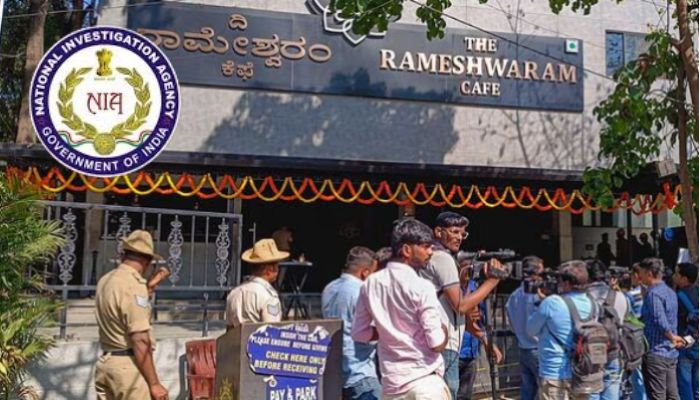
On Tuesday (21st May), the National Investigation Agency (NIA) carried out searches at 11 locations across various states in connection with the Rameshwaram cafe blast. A low-intensity IED took place on 1st March this year at the Rameshwaram cafe in Bengaluru in which 10 people suffered grievous injuries.
“Multi-state raids were underway in different locations,” a senior NIA official said, without sharing further details. According to the officials, the searches are being carried out based on specific inputs and information gathered during the questioning of Mussavir Hussain Shazib and Abdul Matheen Taha, who planned and executed the blast.
The officials added that Kumaraswamy Layout and Banshankari in Bengaluru were among the places that were raided.
According to reports, the NIA officials also raided the house of a retired headmaster, Abdul in Rayadurgam town, Andra Pradesh’s Anantapur district. They questioned retired headmaster Abdul and his son, Sohail who is a software engineer about suspicious bank deposits. Later, the Police detained Sohail who is currently being questioned by the NIA at Raydurga Police Station.
According to South First, an official confirmed to them that Sohail had been under the radar of the NIA and intelligence agencies for a while due to his suspected links with Abdul Matheen, the mastermind of the blast, as per NIA.
#Breaking: @NIA_India officials conducted search raid at the house of a retired headmaster, Abdul from Atmakur constituency in Rayadurgam town of Anantapur district.
Anantapur, Andhra Pradesh, NIA arrests Sohail from Rayadurgam town, linked to A2 suspect in Rameswaram blast. He's detained and transferred to Bangalore for investigation. Sohail's friend notified pic.twitter.com/rvmPzMXfuy
NIA took control of the blast case on 3rd March. On 12th April it arrested two main accused in this case including the mastermind Adbul Matheen Ahmed Taahaa and bomber Mussavir Hussain Shazib. Shazib is accused of placing the Improvised Explosive Device (IED) at the cafe. They were arrested from a lodge near Kolkata, where they were staying under fake identities.
It is also alleged that both of them are members of the Shivamogga-based Islamic State module. Shariq, a member of the same module, had carried out a blast in Mangaluru on 19th November 2022, the officials said.
NIA raids at 11 locations include searches on two Coimbatore-based doctors
The NIA also conducted raids at the residences of two Coimbatore-based doctors in Tamil Nadu. According to reports citing sources, two teams of NIA carried out raids at the residences of the two doctors at Periya Subbanna Gounder Street and Narayana Guru Road at Saibaba Colony.
According to sources, both the doctors hailed from Karnataka and they have been undergoing training in a private hospital at Saibaba Colony in Coimbatore for over two years. Other details are yet to emerge.
The agency started the searches early in the morning and reportedly ended by 8 AM.
On 23rd October 2022, there was a car bomb explosion in front of the Arulmigu Kottai Sanagameswar temple in Ukkadam, Coimbatore. Later, the authorities found the charred body of a 29-year-old youth, Jamesha Mubin at the blast site.
According to reports, the suicide bomber was planning to explode himself along with the car near a market on 23rd October 2022, which was Diwali eve. However, it exploded before the expected time. Since that attack, several people and organisations in the Coimbatore region have been under the radar of the Central agencies.
Meanwhile, according to Hyderabad-based Journalist Sudhakar Udumula, NIA’s Bengaluru branch apprehended a trader in Vikarabad district in these raids. The man, in his fifties, is originally from Pune but currently resides in Nanded, Maharashtra, where he runs a fruit business, the journalist added.
UPDATE: The National Investigation Agency’s (NIA) Bengaluru branch picked up a trader in Vikarabad district on Tuesday in connection with the Rameshwaram Cafe blast case. The man, in his fifties, is originally from Pune but currently resides in Nanded, Maharashtra, where he runs…
— Sudhakar Udumula (@sudhakarudumula) May 21, 2024
Sources confirmed that the trader was reportedly involved in previous cases and had been earlier convicted in a case in Karnataka, Udumula added.
It was earlier reported that agencies are trying to nab the online handler of the cafe blast accused who goes by the codename “Colonel”. According to the authorities, “Colonel” was in touch with Taha, the alleged mastermind, and Shazib, the alleged bomber, since their association with the ISIS Al-Hind module in 2019-20.
According to an NIA charge sheet, Taha and Shazib were previously part of a 20-member Al-Hind module that planned to establish an ISIS province in the jungles of South India.
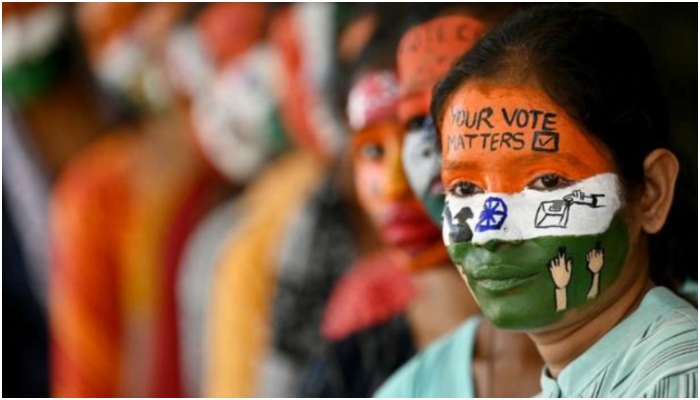
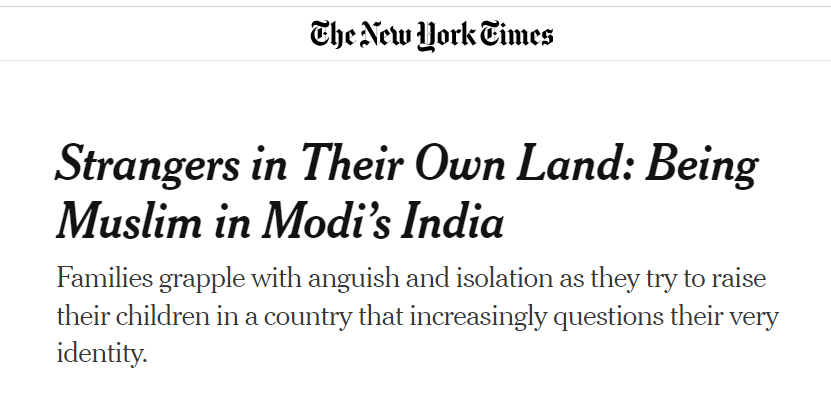
The United States media is constantly portraying the ongoing Lok Sabha elections in India as anti-Muslim. The New York Times published a report on May 19, in which it was said that Muslim families living in India have been sidelined by the ruling authorities and even their identities are being questioned.
On Monday (May 20), the US State Department clarified and praised India’s religious freedom. Foreign Ministry spokesperson Matthew Miller said that the state rejects such reports outright. “We are deeply committed to promoting and protecting universal respect for the right to freedom of religion or belief worldwide. We have engaged many countries including India on the importance of equal treatment for members of all religious communities,” Miller said in a daily press briefing.
During this time, the US State Department also rejected its International Religious Freedom Report, which stated that Muslims are being oppressed in India. Also on May 17, the White House stated that India is the world’s most thriving democracy. The ability of Indians to vote and speak out to choose the right government is commendable.
Since the commencement of the Lok Sabha elections in India, the US media has been broadcasting negative stories about the country. It describes the secular system of India as a threat. Most media outlets predict that if Prime Minister Modi is elected for the third time, violence against Muslims will escalate in the country. Also, the Indian government will isolate Muslims.
The New York Times published a report on May 18 reading “Strangers in Their Own Land: Being Muslim in Modi’s India”. The report suggested that Muslim families grapple with anguish and isolation as they try to raise their children in a country that increasingly, allegedly questions their very identity. It added that Muslims live ‘lifeless lives’ in India.
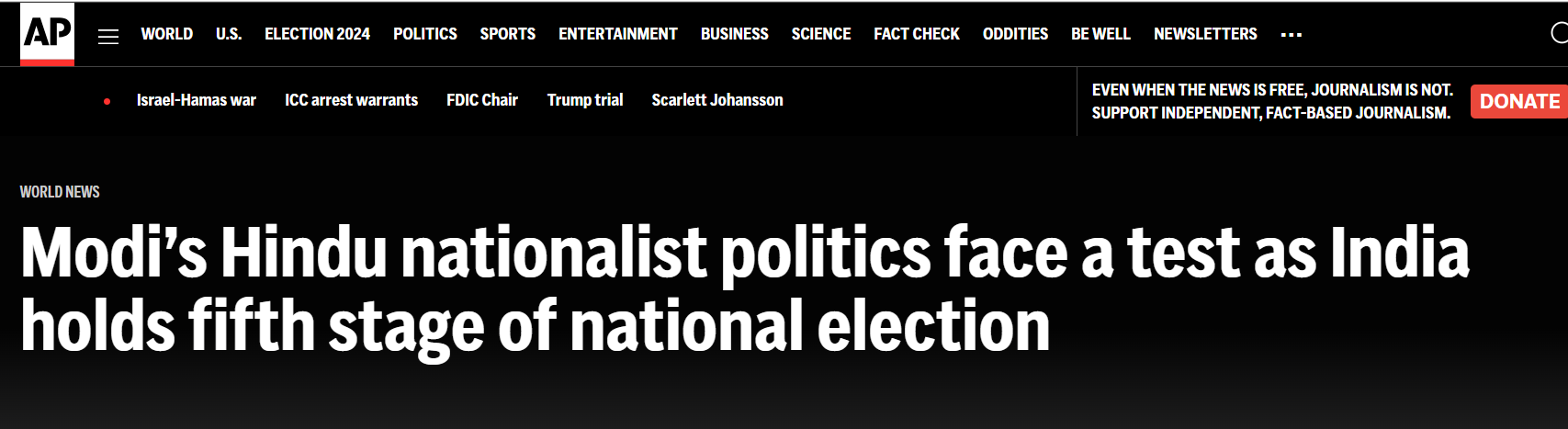
Several other US media houses like the Associated Press and Fox 59 reported that the Modi government is facing a test in the ongoing Lok Sabha elections 2024. The reports also claimed that the PM was influencing people by playing over religion.
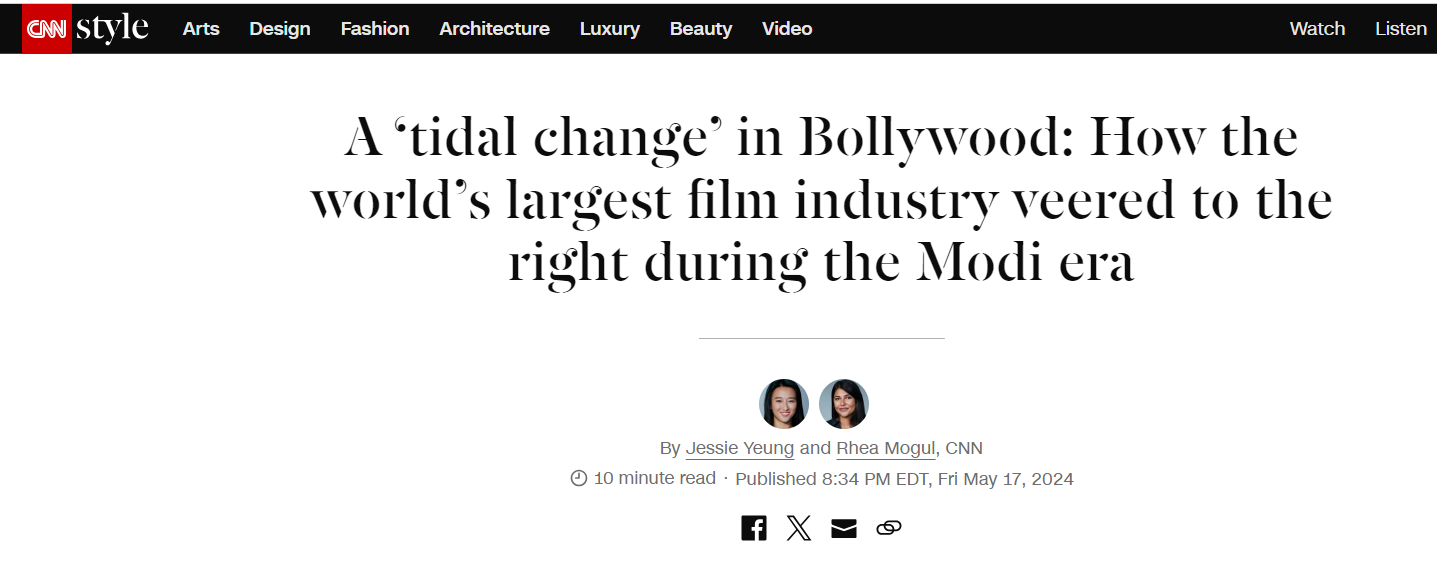
Further several reports also claimed that the Prime Minister had also influenced the people from the Hindi cinema industry. “Hindi cinema once reflected certain secular, democratic values championed by India’s founding fathers. Many critics now say the industry has veered toward the right over the past decade – coinciding with the populist rule of Prime Minister Narendra Modi and his Hindu-nationalist Bharatiya Janata Party (BJP),” the CNN report read.
Earlier in February, the British newspaper The Economist had also published a report in which it was said that there are flaws in India’s democracy. In this report which published the ranking of democracy among 167 countries, India was ranked 41st. According to the report, democracy exists in India with some flaws.
Notably, Prime Minister Narendra Modi has outrightly rejected these reports. In several interviews and election campaigns, the PM has said that no community is being oppressed in the country. He emphasized that the news of atrocities on minorities in India is absurd and the public should stay away from them.
On the other hand, the Prime Minister’s Economic Advisory Council said in a report that from 1950 to 2015, the Muslim population in India increased by 43.15%. On the contrary, a decline of 7.82% has been observed in the population of Hindus during the same period.
The research found that the Christian, Sikh, and Buddhist numbers increased, while the Jain and Parsi populations fell. Prime Minister Narendra Modi also cited the EAC-PM report, claiming that the narrative that “minority is in danger” is untrue and has been debunked. He stated that the perception that has been formed is “proving to be a mistake.”
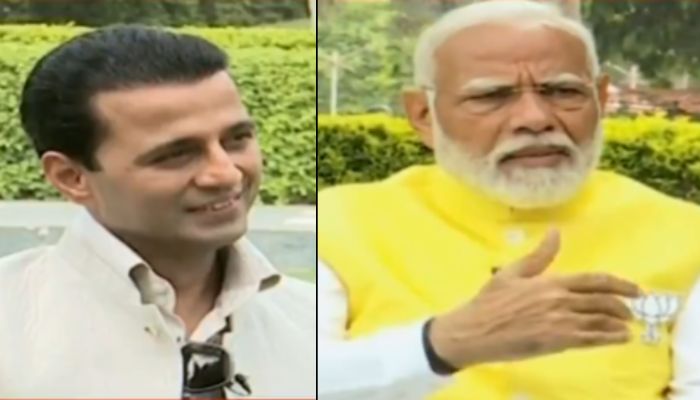
“Between 1950 and 2015, the number of Hindus in India has decreased by about 8 per cent, while that of minorities has increased by 43 per cent. The perception that has been created is proving to be a mistake. The wrong narrative is being exposed. Whatever meaning one has to take out of it, they can. I don’t want to bring out anything,” PM Modi said while speaking to Republic TV earlier this month.
“If this is factual, then the perceptions created as in that minority is being suppressed in India, there is no voice for the minority in India… all these narratives that are being created, all this allegation against India, please accept the truth and come out of this narrative,” he added.
The Economic Advisory Council to the Prime Minister (EAC-PM) is an independent council established to provide economic and related advice to the Government of India, specifically the Prime Minister.
Earlier on May 17, White House spokesperson John Kirby had said that America is closely watching the elections being held in India. He noticed that 96 crore people in India would become a part of the voting process to choose the candidates of 2,660 registered parties.
“Indians are electing 545 Members of Parliament from among thousands of candidates, with more than 10 lakh polling stations,” he added. This statement of the White House came when the global media called the elections being held in India a threat to its democracy.
Even though empirical evidence suggests every community, including the Muslims, has flourished and received central government schemes without discrimination, the Western media have run a concerted smear campaign to project the Modi government as anti-Muslim.
The Ministry of External Affairs meanwhile dismissed a report by the US Commission on International Religious Freedom accusing the ruling Bharatiya Janata Party (BJP) of “reinforcing discriminatory nationalist policies.”
The Ministry referred to the group as “biased” and indicated that it does not expect it to understand India’s diverse, pluralistic, and democratic culture.
“The United States Commission on International Religious Freedom (USCIRF) is a biased institution with a political agenda. They continue to publish their propaganda on India disguised as an annual report,” Randhir Jaiswal, an MEA official spokeswoman, stated at a news briefing.
Amid the ongoing Lok Sabha elections, Prime Minister Narendra Modi has taken potshots at Indian media for running a smear campaign against him for the past 23 years.
While speaking to News24, he sarcastically remarked, “If there was no media, then, who would have known me?”
PM Modi pointed out, “I have received a lot of abuse through the media and it has been happening for the past 23 years. People began to wonder about my ability to withstand all these abuses and still be able to work calmly.”
"अगर मीडिया न होता तो मुझे कौन जानता"
◆ PM मोदी ने News24 के साथ EXCLUSIVE इंटरव्यू के दौरान कहा
“I will say that the media has played an important role in creating public curiosity about me. It has played a catalysing effect in the process. My only challenge has been to debunk the fiction that the media plays up as ‘fact,’ he said.
PM Modi noted, “The entire media ecosystem in India runs on sources. Most of the time, the channels do not have anything concrete but they need to run news 24/7.”
“Unlike in the past, the internal affairs of the government are not leaked to the media. This is why even the gossip has a limit now. All forms of leakage have been sealed by our government,” he emphasised.
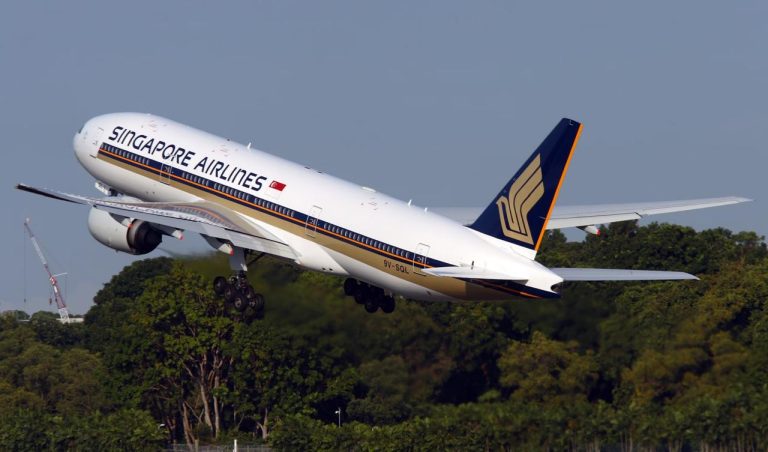
A person has died on a London-Singapore flight that experienced severe turbulence, Singapore Airlines reported on Tuesday. The plane reportedly plummeted for several minutes before being diverted to Bangkok, where emergency crews attended to injured passengers amid stormy weather conditions.
The Boeing 777-300ER, carrying 211 passengers and 18 crew members, landed in Bangkok at 3:45 p.m. (0845 GMT), according to a Facebook post by the airline.
Tracking data from FlightRadar24, analyzed by The Associated Press, showed the Singapore Airlines flight cruising at 37,000 feet (11,300 meters). Just after 0800 GMT, the Boeing 777 sharply descended to 31,000 feet (9,400 meters) over three minutes.
The plane remained at 31,000 feet for nearly 10 minutes before descending again and landing in Bangkok in under half an hour. This descent occurred over the Andaman Sea as the flight approached Myanmar.
Emergency crews from Samitivej Srinakarin Hospital, located about 20 kilometres (12 miles) from Suvarnabhumi Airport, were present to transfer injured passengers from Flight SQ321 for treatment. Videos posted on the LINE messaging platform by Suvarnabhumi Airport showed a stream of ambulances arriving at the scene.
“Singapore Airlines offers its deepest condolences to the deceased’s family,” the airline stated. “We are working with the local authorities in Thailand to provide the necessary medical assistance and are sending a team to Bangkok to offer additional support.”
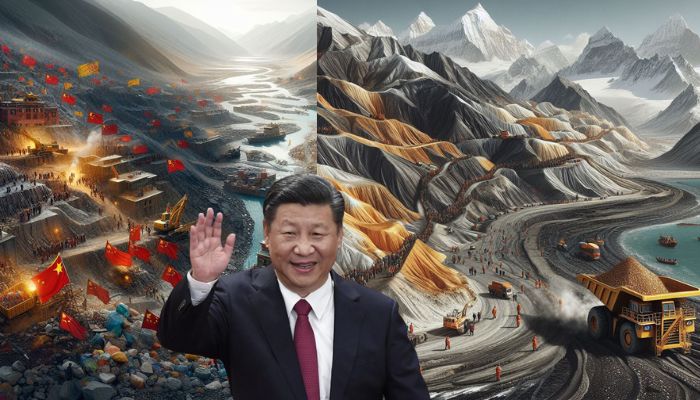
Ever since China militarily occupied Tibet in 1951, it has been notorious for exploiting the rich mineral resources of the region with impunity. However, the mineral exploitation and mining activities, which began with small projects in the Tsaidam (Chinese name – Qaidam) Basin in the late 1950s, have increased multifold. The Chinese regime has been recklessly expanding its mining activities in Tibet despite alarming warnings of social and ecological concerns by critics and renowned experts.
China rapidly expanding mineral exploitation and mining activities in occupied Tibet
According to the mouthpiece of the Chinese Communist Party, Global Times, China has increased its investment in mineral resources exploration (exploitation) during the 14th Five-Year Plan period 2021-25 to bolster reserves and production. Last year, China saw an 8% rise in exploration investment, hitting 110.5 billion yuan, leading to growth in reserves of strategic minerals like oil, natural gas, rare earth, and gold.
The report added that Qinghai Province has established 346 gold mining sites, with the largest Dachang Gold Mine located in the Yushu Tibetan Autonomous Prefecture (the Chinese name for the occupied territory of Tibet).
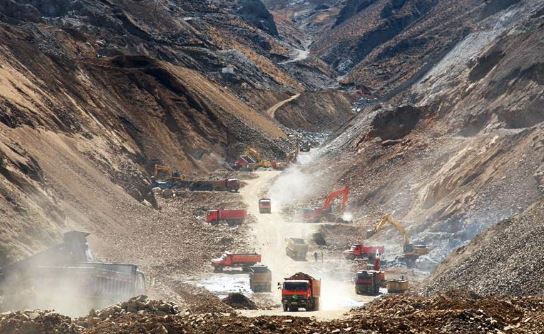
(China has been increasing the number of mines and expanding the scale of current ones to expand its mining exploration in occupied territories of Tibet despite safety concerns for the local population)
Beijing has been rapidly scaling up and establishing numerous new mines in the so-called Tibetan Autonomous Region, turning several of these mines into some of the largest mineral extraction sites in the world. This expansion overlooks all safety measures and disregards the region’s fragile ecosystem. In 2012, China’s Ministry of Land and Resources selected Gyama Mine as a “pilot of the national green mines project” and a “Model enterprise of national unity and progress”, according to Chinese authorities. They claimed that the mine had the potential to become China’s biggest copper producer within 10 years.
(China announced its intention to recklessly expand its Mineral Exploitation in Gyama Mines despite concerns of triggering disaster in the Earthquake and landslide-prone Tibetan Region, Source – Tibetan.net)
Back then, it claimed that Gyama (Chinese name – Jiama) mine would adhere to higher standards of technology-oriented and corporate responsibility-oriented laws, prioritising policies such as ‘people first’ and ‘safe production,’ while promoting ‘harmony between the mine and the community’ and shouldering the responsibility of social welfare. However, its unchecked expansion resulted in the tragic loss of 83 miners in a landslide a year later. Experts and scholars dedicated to studying the impact of Chinese policy on Tibetan climate and lives asserted that the landslide could have been a “man-made” disaster.
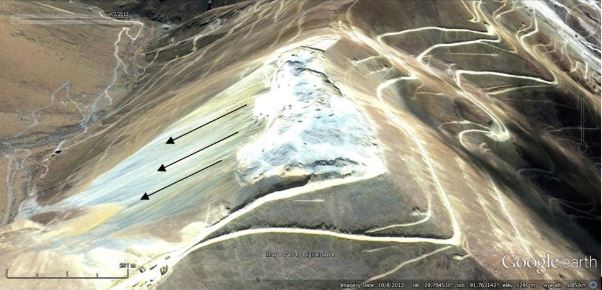
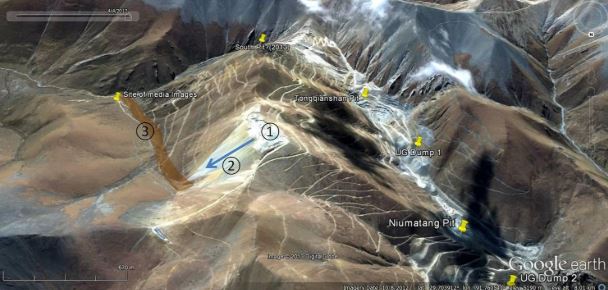
(Tibet.net graphically and geological explains why experts consider that the 2013 landslide in Gyama mine was a man-made disaster, it has used Google Earth images of before and after the incident to explain the geological event)
(Google Earth Image shows how reckless mining can trigger landslides in the region, Source – Tibet.net)
Contrary to China’s claim that the Gyama mine would be a model for “green mine” or “progress”, experts have noted that it has become the symbol of over 200 mining sites across the Tibetan plateau that face similar or even worse socio-economic and environmental problems, requiring urgent attention.
Strikingly, the Gyama Copper Polymetallic Mine, located at Maizhokunggar County in Tibet is owned and operated by Tibet Huatailong Mining Development Company Limited, a subsidiary of China National Gold Group.
China's illegal mining activities in Tibet must stop immediately. Tibet's cultural and environmental heritage is at risk as mining disrupts the delicate balance of the earth. It's time to #FreeTibet because of Tibet for Tibetans. #TibetForTibetanspic.twitter.com/D9ZN9zDcf4
Similarly, the Chinese government approved a 36-year assessment period for the ambitious expansion of its Julong (Qulong) Copper Mine into the world’s largest copper mine. It is located in Mozhugongka County, Lhasa in Tibet, and started in 2010. It is one of the largest copper mines globally. However, Zijin Mining Group, which has a majority stake in Julong Copper, plans to transform it into the world’s largest copper mine, increasing annual production to 350,000 tons by the end of 2025 and aiming for 200 million metric tons annually in the long term.
China is planning to expand the Julong mine in Tibet to make it the largest copper mine in the world. This project is led by Zijing company which has a controversial track record of dumping chemical waste into rivers, writing off worker fatalities, and environmental destruction. pic.twitter.com/AvT0aD7mpG
Furthermore, China is operating the biggest chromite mine in Tibet – the Norbusa Mine in the north of Lhuntze. In Tibetan language, Norbusa means ‘Land of Gems’ which is being plundered by the Chinese regime.
Apart from increasing the scale and number of its gold, copper, and other mineral mines, China recently expanded its mineral exploitation around lithium reserves. Till now, China, which is the world’s biggest EV market, has largely relied on other countries for lithium supply. But it recently started exploiting the vast deposits in the Tibetan plateau, which are said to be around 85% of the country’s total lithium reserves. According to a report by Turquoise Roof, a network of Tibetan researchers, this “white gold rush” has led to Chinese miners using “quick, cheap, and dirty” extraction and processing techniques. While China’s claim of using high-standard technology in the Gyama mine proved fatal for 83 miners in 2013, the reports that China is using cheap extraction processes in lithium mines should raise significant alarm.
The Chinese government has been exploiting mineral resources with impunity because it has clamped down on all modes of communication channels. However, lately commercially available satellite images have revealed the extent of danger and threat posed by China’s massive expansion in mining in Tibet.
For China, Tibet is a wasteland that can be redeemed by mining; threats and concerns
Notably, the Tibetan Plateau, which has earned the moniker of ‘Rooftop of the World’, is geologically volatile and vulnerable to earthquakes and landslides.
Critics and renowned subject matter experts have expressed concerns that in recent decades, the Xi Jinping-led CCP regime has intensified its mineral exploitation in the so-called Tibetan Autonomous Region, posing increased threats of instability. This includes heightened natural disaster risks from mining and dam projects in earthquake and landslide-prone mountainous regions. This has also led to health hazards, cultural subjugation of Tibetans, irreparable damage to land use patterns, pollution, severe environmental degradation, and disturbances to the pristine and ecologically sensitive Tibetan plateau.
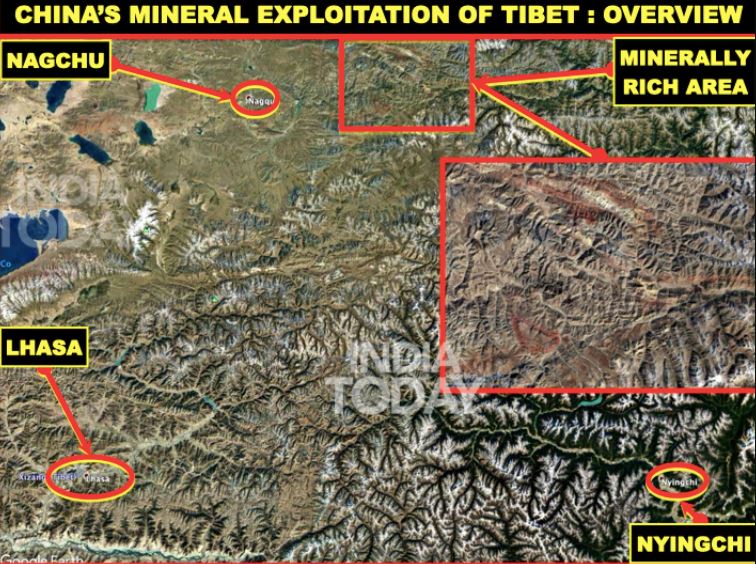
(China has intensified its mineral ‘exploration’ in the occupied territory in Tibet, a brief overview of mineral sites, Credit – India Today)
In one of his books, Australia-based authorGabriel Lafitte explained the massive, uninhibited expansion of mining activities in Tibet and the severe implications for the fragile environment and people of Tibet by highlighting China’s alarming perspective on the Tibetan plateau. Lafitte, a renowned scholar dedicated to researching the impacts of Chinese policies on the region, noted in his book “Spoiling Tibet: China and Resource Nationalism on the Roof of the World,” that “China has persistently described most of Tibet as wasteland, especially the mountains, unless redeemed by mining.”
Several experts have expressed concerns about the safety of miners, noting that China is notorious for blacking out any news that shows it in a bad light. Notably, there have been numerous protests in Tibet regarding health and safety concerns of miners, recurrent accidents, and environmental hazards, but Chinese media has deleted or blocked such news and also didn’t take adequate safety measures to averse such incidences in the future.
Accidents and issues/protests around miners’ safety and forced disappearance, torture get blacked out
On March 29, 2013, the Gyama Copper Polymetallic Mine experienced a tragic landslide that buried 83 miners alive. The incident highlighted the environmental risks of extensive mining and the lack of credibility in Chinese claims of safety and high-standard technology.
The landslide, spanning three kilometers wide and 30 meters deep, occurred while workers slept, raising concerns about the aggressive mining practices and poor environmental regulations in Tibet. The Central Tibetan Administration (CTA) suspected that the landslide was a man-made disaster due to mining activities.
(Undated image of a River polluted by mining activities in Tibet’s Maldro Gongkar county, Image Source – Radio Free Asia)
It is important to note that Gyama is also culturally significant for Tibetans, as it is home to sacred temples and traditional agriculture. However, China has been rapidly changing the landscape in the region, making it increasingly uninhabitable. The mines are accused of dumping harmful chemicals, and toxins, polluting the river, and adversely affecting the health of miners.
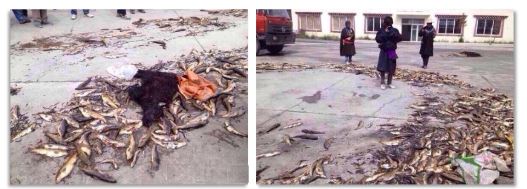
(Chemicals waste dumped by mines result in dead of aquatic life, Image – Dead fish exhibited outside Lhagang township government offices, Source – Tibet Watch report)
Another incident that came to light, despite the usual media blackout in Chinese-controlled areas, occurred in May 2023. On 14th May 2023, six workers were reported missing after an accident at the Julong Copper and Polymetallic Mine in the Tibet Autonomous Region. It was reported that contact with the miners was lost when a lift cage fell during construction.
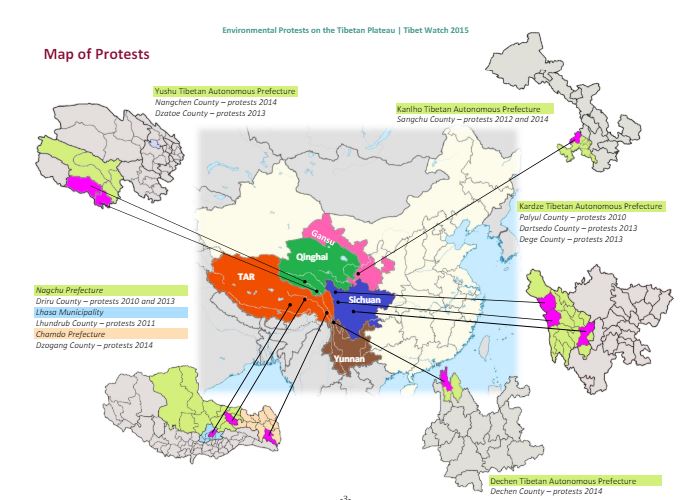
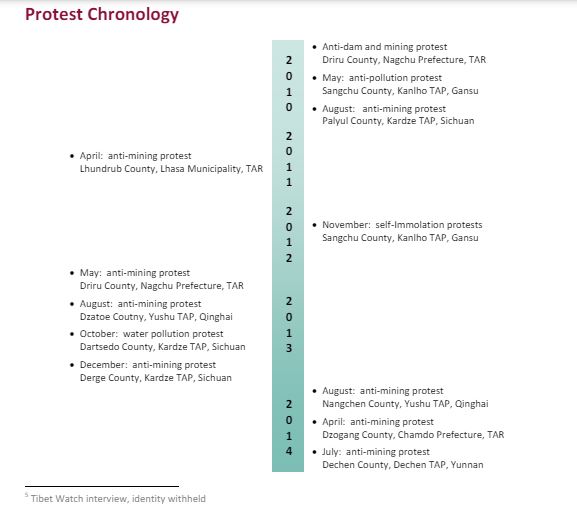
(Environmental Protests on the Tibetan Plateau, Source – Tibet Watch Thematic Report, updated till January 2015)
(Source – Tibetan Watch Report)
According to experts in the know, some of the criticisms and protests over excessive mining in Tibet had flashed in China on the internet but they were deleted or blocked in no time. These protests are often suppressed before they can begin, and despite stringent curbs, if protesters do gather, the Chinese regime cracks down heavily on them and censors any news about the events. The Tibetan Watch Thematic Report cited some of the major incidents over these concerns in the last decade.
It is pertinent to note that certification and awards for miners’ safety by the Chinese government lack any credibility and are just a farce to hide the extent of the acute crises posed by its aggressive expansion in mining activities in Tibet. Notably, the Gyama Mine, which is still one of the largest active mines in Tibet, was honoured by the local government for its work on safety, despite the 2013 disasters that resulted in the death of 83 workers in a massive landslide.
Furthermore, several experts have expressed concerns that these mines could be China’s strategic move against India apart from the reason of mineral exploitation from its occupied territory.
China’s Sinicisation Project: Cultural and Economic subjugation of Tibetans, slow population replacement
Contrary to the Chinese perspective that views the Tibetan mountains as a wasteland redeemable only through mining, the Tibetan people have a profound spiritual connection to their land. Their nomadic traditions follow the seasons, making their lifestyle sustainable by allowing the land time to replenish. Tibetans consider certain mountains and lakes as the physical homes of Buddhist deities, holding them sacred. They use remote mountains for retreat and meditation, rather than viewing them as wasteland, or cash machines.
China claims that they have spent millions on environmental conservation projects in recent years, but they have earned billions more from mining and other resource extraction activities in Tibet. Tibet literally governs for the benefit of the Chinese. #Safetibet#TibetMatterspic.twitter.com/vgIt1CIeKg
China has sought to destroy the Tibetan nomadic way of life by relocating over two million Tibetans from their ancestral lands to barrack-like urban settlements. After being forcibly displaced, nomads face poverty, unemployment, and social exclusion. Once vacated by nomads, Tibetan land and its rich natural resources become open for exploitation by Chinese companies. Many nomads, poorly educated and unable to give informed consent, are persuaded to give up their land rights through deception, threats, and bribery.
This displacement forces Tibetans into debt, making it difficult to feed their livestock or families. Nomads, lacking the skills to make a living in urban settings, are unable to compete with Chinese-literate urban Tibetans or Han Chinese immigrants. Economically marginalized, they often face social exclusion and are blamed for various social problems.
Apart from plundering mineral resources and polluting and disturbing the fragile ecosystem in Tibet, many exiled Tibetans accuse China of repression, torture, and eroding their culture. China is notorious for renaming places with Sinicised names and curbing the use of the Tibetan language, culture, and traditions—actions often referred to as part of China’s Sinicisation Project. U.N. experts have said that around a million Tibetan children have been separated from their families and put through “forced assimilation” at Chinese residential schools.
In a major step towards dismantling the pro-Khalistani terror-gangster network operating across multiple states of India, the National Investigation Agency (NIA) on Monday chargesheeted designated Canada-based terrorist Arshdeep Singh alias Arsh Dala and three of his aides, the agency said on Tuesday.
Arshdeep Singh alias Arsh Dala and his Indian agents Harjeet Singh alias Harry Maur, Ravinder Singh alias Rajvinder Singh alias Harry Rajpura, and Rajeev Kumar alias Sheela have been chargesheeted before the NIA Special Court, New Delhi.
The action marks a big leap in NIA’s efforts to destroy sleeper cells operated by Dala to unleash terrorist attacks in various parts of Punjab and Delhi.
As per NIA investigations in the case (RC- 22/2023/NIA/DLI), the three aides were running a major terror gangster syndicate in India on the directions of Khalistan Tiger Force (KTF) terrorist Dala. Accused Harry Maur and Harry Rajpura were operating as sleeper cells and were being harboured by Rajeev Kumar, and the trio had planned to carry out a series of terror attacks on Dala’s direction and with funds received from him, NIA investigations have revealed.
While Harry Maur and Harry Rajpura were the gang’s shooters and had the mandate of executing targeted killings, Rajeev Kumar alias Sheela was receiving funding from Arsh Dala for harbouring Harry Maur and Harry Rajpura.
NIA investigations have further revealed that Rajeev Kumar was also providing logistics support and arranging weapons for the other two on the instructions of Arsh Dala.
NIA had arrested Harry Maur and Harry Rajpura on November 23, 2023 and Rajeev Kumar on January 12, 2024. NIA said its investigations are continuing to destroy the entire terrorist-gangster syndicate.
(This news report is published from a syndicated feed. Except for the headline, the content has not been written or edited by OpIndia staff)
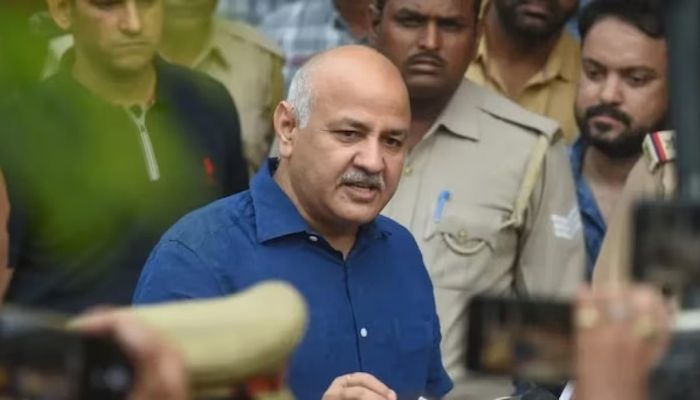
Delhi’s Rouse Avenue Court on Tuesday extended the judicial custody of former Deputy CM Manish Sisodia till May 31 in the Delhi liquor excise policy case.
The court has asked the accused persons to give an estimate of time required for inspection of documents. It has also directed the ED to file a comprehensive reply on a plea of Sameer Mahendru seeking support of CCTV footage.
The court has also directed the ED to file a detailed compliance report on how much time given to accused to inspect the documents and when they were not given time.
Sisodia has been in custody since February 26, 2023, after arrest by the CBI. Thereafter, he was arrested by the ED. Sisodia resigned from the Delhi cabinet on February 28, 2023.
On April 30, the Rouse Avenue Court dismissed the bail petitions of Sisodia for the second time in the case and said, “…This court is not inclined to admit the Applicant to Bail, either regular or interim, at this stage. The application under consideration is accordingly dismissed.”
Special Judge Kaveri Baweja also said, “It is apparent that the Applicant individually, and along with different accused have been filing one or the other application/making oral submissions frequently, some of them frivolous, that too on a piecemeal basis, apparently as a concerted effort for accomplishing the shared purpose of causing delay in the matter.”
The court also added that the period of incarceration of Benoy Babu and that of the applicant (Manish Sisodia) cannot be equated, particularly in view of the findings in the preceding paragraphs of this order that the applicant himself has attributed to the slow pace of the proceedings of the case.
The ED and the CBI had alleged that irregularities were committed while modifying the excise policy, undue favours were extended to licence holders, the licence fee was waived or reduced and the L-1 licence was extended without the competent authority’s approval.
The beneficiaries diverted “illegal” gains to the accused officials and made false entries in their books of account to evade detection, the probe agencies said. As per the allegations, the excise department had decided to refund the earnest money deposit of about Rs 30 crore to a successful tenderer against the set rules.
The Delhi government implemented the policy on November 17, 2021, but scrapped it at the end of September 2022 amid allegations of corruption.
(This news report is published from a syndicated feed. Except for the headline, the content has not been written or edited by OpIndia staff)
In Kerala’s Kollam, a local Youth Congress leader named Ashiq Badaruddin has been arrested for capturing videos of women with a camera placed in a toilet. As per reports, Ashiq Badaruddin, a local Youth Congress leader working as a toilet operator in Thenmala was arrested after women complained of his attempts to capture videos.
Accused Ashiq Badaruddin is the general secretary of Youth Congress in Punalur block. After the complaint by the women, Badaruddin was arrested and produced in court by police. Police have seized his mobile phone.
As per reports, Ashiq (30), works as a toilet operator in Thenmala Dam. He allegedly placed a camera inside the women’s washroom. On May 21, some girls women who were visiting from Thiruvananthapuram noticed the camera and complained against Ashiq Badaruddin to the police.
Ashiq was later produced in court and remanded to police custody.
On Monday (20th May), the Aligarh police arrested three people in connection to the harassment and forced conversion of a female Hindu student.
As per reports, the victim had gone to Chharra town to write a B.ED examination. While she was returning home, a miscreant and his friends began following her.
The accused had been harassing the girl for several days. The victim informed her uncle, post which family members began accompanying her to the exam centre.
अलीगढ़ – परीक्षा देकर लौट रही छात्रा से युवक ने की छेड़छाड़
➡समुदाय विशेष के नामजद युवक, साथियों पर आरोप ➡घर के बाहर हंगामा कर छात्रा को उठा ले जाने की कोशिश ➡धर्म परिवर्तन कर साथ चलने को कर रहा था मजबूर ➡आरोपी व साथियों को पब्लिक ने पकड़कर पुलिस को सौंपा ➡भाजपा की पूर्व… pic.twitter.com/qsB6EyLXqH
— भारत समाचार | Bharat Samachar (@bstvlive) May 21, 2024
The accused temporarily stopped the harassment. On Monday, they again followed the female student and created a ruckus outside her house. They even tried to pull the dupatta of the victim.
According to Bharat Samachar, they even tried to forcibly convert her to Islam. The locals got hold of the accused and thrashed them in full public glare. Thereafter, they were handed over to the police.
When the news spread, members belonging to Hindu organisations gathered outside the Quarsi Police Station and demanded strict action against the miscreants.
दि0 20.05.24 को प्राप्त तहरीर के आधार पर अभियोग पंजीकृत कर आरोपी 03 युवकों को गिरफ्तार किया गया, वैधानिक कार्यवाही प्रचलित की गई, मौके पर शांति है ।
In a tweet, the Aligarh police informed that 3 people were arrested in connection to the case. It added that the situation in the area is now under control and that a probe has been initiated into the matter.
A 37-year-old woman and six of her colleagues have been apprehended by Chennai police’s anti-vice team on charges of pushing schoolgirls, all of her daughter’s friends from middle and lower-middle-class backgrounds into prostitution. The police recovered two teens from the criminal group.
City police obtained a tip about a network of prostitutes including schoolgirls. On Saturday (18th May) night, a team led by Assistant Commissioner of Police Rajalakshmi and Inspector Selvarani searched a city lodge and recovered the two girls, aged 18 and 17.
Police said the primary culprit in the case, K Nadhiya, 37, targeted her daughter’s classmates at a local school. According to police sources, she became familiar with the girls on the idea of teaching them dance classes and beautician training, suggesting it would help them earn money part-time.
According to authorities, Nadhiya gradually picked her targets and enticed them with cash payments ranging from Rs 25,000 to 35,000. According to investigators, the accused also taught the girls to make up stories in their houses whenever they had to spend the night or go to other towns with her clients. Preliminary investigations found that some of the accused’s clients had taken the girls to Hyderabad and Delhi.
“Nadhiya’s clients had taken the girls to Hyderabad and Delhi. If some girls resisted after some time, she threatened them saying the videos of the girls with the clients would be sent to their parents. She chose the clients through social media handles, contacted them personally, and fixed the deals,” the police said.
“Some of the clients were elderly men from Hyderabad and Coimbatore who preferred schoolgirls and were ready to pay more,” they added.
Along with Nadhiya, police arrested Ramachandra, 42, Sumathi, 43, Maya Oli, 29, Jayashree, 43, and Ramandran, 70, all from different sections of Chennai, as well as Ashok Kumar, 31, of Coimbatore. Police took seven cell phones and a car from the accused.
The accused were brought before a magistrate and remanded in judicial detention. Officials from the District Child Protection Unit (south), Child Line, and the Child Welfare Committee (south) are assisting in counseling the victims.