The government of Pakistan on Wednesday confirmed that it had ordered a ban on social media platform X, formerly known as Twitter, in February owing to “national security concerns”. Islamabad informed of the ban to the Sindh High Court following which the court has demanded that the ban be revoked within one week.
The Interior Ministry of Pakistan had reportedly informed the court that the microblogging platform was banned because it “failed to adhere to the lawful directives of the government” and cited a threat to national security.
“The Sindh High Court has given the government one week to withdraw the letter, failing which, on the next date, they will pass appropriate orders,” Moiz Jaaferi, a lawyer challenging the ban reportedly said.
The Sindh HC came down heavily on the government. SHC Chief Justice Aqeel Ahmed Abbasi said, “What are you (Interior Ministry) achieving via shutting down trivial things… The world must laugh at us.
The ban on X was imposed during the Pakistan general elections during which time internet services were also banned in the Islamic country with the interior ministry citing security reasons. This unfolded after a senior Pakistani government official admitted to vote manipulation in the 8th February polls.
As per reports, users in Pakistan have reported problems using X in Pakistan since mid-February but the reason was apparently kept under wraps by Islamabad. The platform has been inaccessible reportedly since 17th February, when Imran Khan party Pakistan Tehreek-e-Insaaf (PTI) called for protests against the admission of vote manipulation.
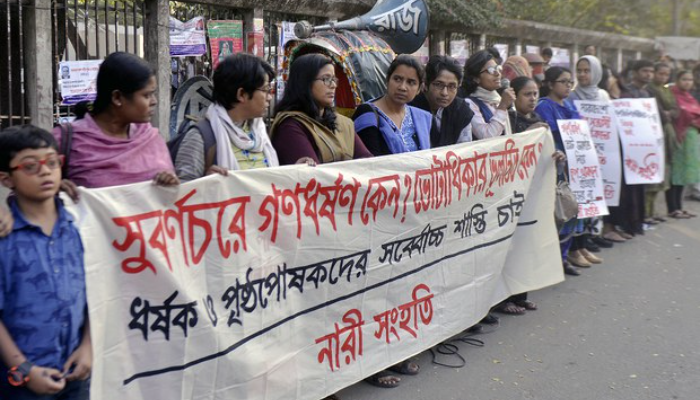
Rape is regarded as one of the most horrific crimes against women, although at times the offenders escape punishment for their transgressions. However, a reported vigilante in Bangladesh decided to take matters into his own hands and took the lives of at least three suspected rapists. The peculiar case which equally intrigued and astonished the world came to the fore in 2019.
His identity also appeared to be shrouded in mystery, reminiscent of any popular superhero movie where a ‘Dark Knight’ rises to seek retribution for the beleaguered people. He also left messages and warnings in the name of the Greek divine hero, “Hercules,” adding a further layer of secrecy to the entire thing.
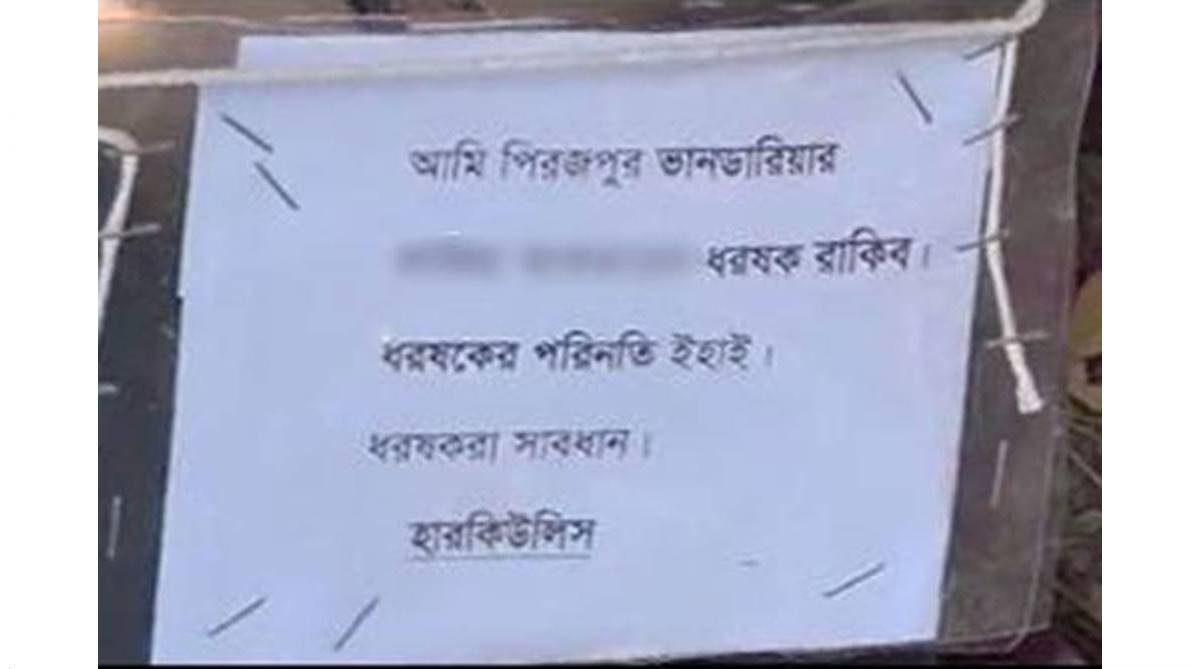
A note found hanging around the neck of one of the deceased’s bodies. (Source: The Daily Star/ANN)
The story started with a tragic occurrence on 7th January when an 18-year-old Ashulia district factory worker was found dead in her home, just hours after reporting her rape to the local authorities. According to the local police records, a textile worker individual named Ripon and three other co-workers were the identified suspects in this case. On 17th January, the vigilante found his target Ripon and exacted his revenge. He also left a note on the deceased’s neck in Savar which read “I am the prime accused in a rape case. I am a rapist. This is my punishment for the rape. Be careful. Be careful – Hercules.” This discovery signalled the beginning of the investigation into the unexplained killings.
Police then received a report of a body found in the neighbouring trash yard on 1st February in the quiet district of Rajapur, a subdistrict of Jalakathi. The deceased had been found to have gunshot wounds, which were described as significant punctures to the head. The cops observed that a message was hanging around the corpse’s neck which stated, “I am Rakib. I am the rapist of a madrassa girl (unnamed) of Bhandaria. This is the punishment for the rape. Be wary rapists – Hercules.” It was the body of a rape accused Rakib Mollah.
Notably, just one month prior, the Bangladeshi police had identified the 13-year-old girl and learned of her horrible ordeal, which led to an unusual turn in the case. She was sexually violated on 14th January by a pair of males while she was travelling to visit her grandma. The crime took place in the Pirojpur district, specifically in the Bhandaria area. Her father had reported the instance to the local police on 17th January, and they subsequently named Rakib Hossain Mollah and Sajal Jamaddar as the two possible offenders.
As fate would have it, Rakib’s body and the ominous note would be revealed within the next two weeks. With the shocking event, “Hercules” who by this point was being lauded by the townspeople as a vigilante, entered the national spotlight. The press and media throughout the world took notice of the contents of the message undersigned by Hercules. It marked the beginning of the world’s attention to the rampage that a serial murderer known only as Hercules had unleashed.
At the time, the authorities believed Hercules had struck twice and Rakib’s murder was committed after Ripon’s. They soon realized, nevertheless, that Rakib was in fact the third target and not the second, after all. A week before Rakib, Hercules had already punished Sajal, Rakib’s friend and a law student, for his misdeeds. The police recognized Sajal’s body from a different incident, remarking that his head was pierced by bullets and fractured by the blunt end of a weapon. Additionally, a message alerting potential rapists in the area was uncovered there which displayed, “I am Sajal. I am a rapist. This is a punishment for my crime. Beware, Rapists. Beware – Hercules.”
Who was Hercules
The national police force launched a nationwide search and rescue effort to find Hercules when the body count continued to rise week after week. The officer in charge of the “Hercules” case, M. Jahidul Islam, admitted that although the police have started their inquiry from the beginning, they are currently unaware of his identity. Over five years have passed there are still unanswered questions about Hercule’s identity, motivations, whereabouts and whether he acted alone.
His vigilantism was recognized and warmly applauded by the people but many criticised him for functioning outside the boundaries of the legal system. Human rights advocates around the country denounced the delivery of “divergent justification.” Sheepa Hafiz, the executive head of Ain-O-Salish, a human rights organization, cautioned against unjustified vigilantism in the area in a statement to the national press. The activists agreed that the killings and the letters would only continue, inspiring a new wave of vigilantes to oppose the status quo and social norms. Sheepa Hafiz cautioned the people and the judiciary to act cautiously. “We have to look very carefully into why such incidents are taking place.”
Assistant Police Inspector-General Shohel Rana claimed, “It is not clear to police, who are involved behind this kind of secret killings. We are trying to identify them.” The men’s families, however, claimed that they were picked up or followed by police while they looked into the rape charges. However, Shohel Rana refuted the allegations. Interestingly, after a while, the killings allegedly ended in the same year and the enigmatic tale concluded leaving the bewildered people with more questions than answers.
Ravindra Singh Bhati, an independent MLA from Sheo Assembly, Rajasthan, has been making headlines for months. He was with the Bharatiya Janata Party (BJP) before the Rajasthan Assembly Elections in 2023. However, he left the party and contested the elections as an independent candidate after the BJP denied him a ticket. Bhati won the Sheo Assembly Constituency by a substantial margin and later announced he would challenge for Lok Sabha Elections as an independent candidate from the Barmer constituency. Since 15th April, Bhati has come under fire on social media for the wrong reasons.
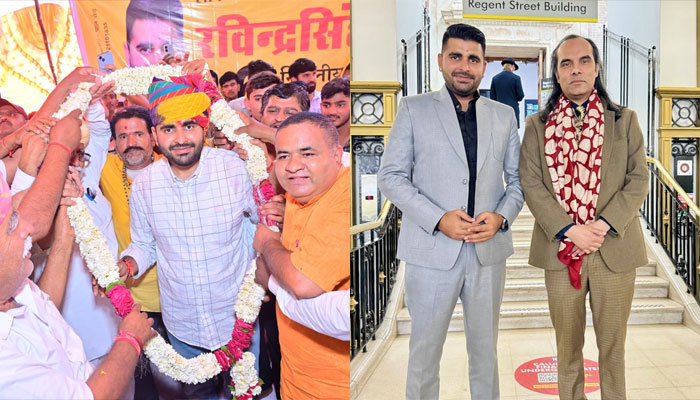
On 15th April, Sheo Constituency MLA Ravindra Singh Bhati faced criticism on social media for meeting the husband of anti-India propagandist Nitasha Kaul, Dibyesh Anand, during his trip to London in February this year. In a post on X, Bhati posted, “It was a delightful opportunity to meet Professor Dibyesh Anand, Vice-Chancellor of Global Engagement and Employability at the University of Westminster, London. During our discussion, there was an extensive and meaningful conversation about exploring new employment opportunities for youth in remote areas like Shiv. Additionally, Professor Anand assured me of his ongoing support in addressing the challenges faced by the Shiv Assembly.” Bhati trended for making a “poor choice” of meeting Anand, who is anti-India.
It was a delightful opportunity to meet Professor @dibyeshanand , Vice-Chancellor of Global Engagement and Employability at the #University_of_Westminster, London. During our discussion, there was an extensive and meaningful conversation about exploring new employment… pic.twitter.com/32vdoWJNg6
X user Rohit said, “Disappointed. He is a well-known ISI agent & supports the 1990 Kashmiri Hindu Genocide. Bigots like him brainwashed KMs to pick up arms & pelt stones. Due to such people, Kashmiri Hindus like me have been in exile for over 34 years now. Why meet such Anti-India Hinduphobes?”
Disappointed. He is a well known ISI agent & supports the 1990 Kashmiri Hindu Genocide. Bigots like him brainwashed KMs to pick up arms & pelt stones.
Due to such people, Kashmiri Hindus like me have been in exile for over 34 years now. Why meet such Anti-India Hinduphobes?
Ravindra Singh Bhati is a 26-year-old politician from Dudhoda village in the Sheo constituency of district Barmer, Rajasthan. Bhati was born into a Rajput family. His constituency is located near the India-Pakistan border. He was initially aligned with BJP and worked extensively for the party ahead of Assembly polls in 2023, hoping to get a ticket. However, the BJP gave a ticket to Swaroop Singh Khara from the Sheo constituency, leaving Bhati irked over the decision. Bhati decided to go separate ways and contested Assembly Elections as an independent candidate from the Sheo Assembly seat in Barmer, Rajasthan. Bhati is fondly called Ravsa among his peers.
जनता की अपेक्षाएं, जनता की उम्मीदें, जनता का विश्वास मेरी ताक़त है, मेरा हौसला है, मेरा जुनून है। लड़ूंगा इनके हक़ के लिए, लड़ूंगा इनके मूल अधिकारों के लिए, लड़ूंगा इनके सम्मान के लिए। आपका आशीर्वाद, स्नेह और मोहब्बत इस संघर्ष में मेरी पतवार है जो लोकसभा चुनाव की नैया को… pic.twitter.com/p3wAV0vtNl
— Ravindra Singh Bhati (@RavindraBhati__) April 16, 2024
He began his political career in 2019 through student politics. He wanted to contest the poll from ABVP but things did not work out in his favour. He became the first independent president elected in Jai Narain Vyas University (JNVU). Notably, he actively led a movement to protect University land from being sold for a convention centre, making him popular among the students and leading to his victory. Later, he led statewide protests against universities and colleges over fee issues during the COVID-19 pandemic. Rajasthan police also arrested him for violating COVID protocols. In September 2021, he led a protest against the Ashok Gehlot-led Congress government. He demanded 75% reservation in employment for the youth of Rajasthan on the lines of reservation in Haryana. Bhati has graduated in law from JNVU.
— Ravindra Singh Bhati (@RavindraBhati__) April 16, 2024
Reports suggest that Bhati’s popularity is not limited to western Rajasthan. He has been traveling to Gujarat, Maharashtra, Bengaluru, and Hyderabad to meet immigrants from his constituency to vote. His popularity is peaking on the ground and on social media. He has 2.2 million followers on Instagram.
Bhati defeated Fateh Khan, another independent candidate, Ameen Khan of Congress and Khara of BJP in the Assembly polls last year. He got almost 80,000 votes from the Sheo Assembly seats, which set a more straightforward path for his political journey. If we look at the Sheo constituency, there are around 3 lakh voters, including 1 lakh Muslim voters. Bhati was contesting against seasoned politicians, including six-time Congress MLA Ameen Khan, who has been actively contesting elections from the same seat since 1980; Fateh Khan, another independent candidate who was initially aligned with Congress but left the party after being denied a ticket and Swaroop Singh Khara of BJP.
Bhati got 79,495 votes and won the seat. Fateh Khan got 75,545 votes, Ameen Khan got 55,264, and Swaroop Singh Khara got 22,820. If the pro-Congress ballots had not been divided among Fateh Khan and Ameen Khan, it would have been difficult for Bhati to win the seat.
— Ravindra Singh Bhati (@RavindraBhati__) April 10, 2024
Soon after winning the Assembly elections, Bhati decided to try his luck with Lok Sabha Elections. He is contesting as an independent candidate from the Barmer constituency.
Who is Nitasha Kaul?
Nitasha Kaul is a controversial ‘activist’ who was recently deported to the United Kingdom after landing at Bengaluru airport. The Congress government invited her to Karnataka to speak at a ‘Constitution and National Unity’ conference.
Nitasha Kaul has justified terrorism on several occasions. She was seen making a case for radical Islamic terrorism in Kashmir by downplaying acts of terror as a ‘right to protest’ against supposed ‘repression’ by the Indian government. She also glorified Islamic terrorist Burhan Wani in a vicious article in 2016. Months after the abrogation of Article 370, Nitasha Kaul gave a written submission before the US House Foreign Affairs Committee on South Asia Human Rights in October 2019.
The anti-India propagandist exploited the opportunity to allege that the Modi government was a ‘colonial’ power and denying ‘freedom’ and the ‘right to access to the internet’ to Kashmiris.’
In December 2015, she was seen spreading falsehoods about the Rashtriya Swayamsewak Sangh (RSS) during an interview of Ram Madhav with controversial Al Jazeera host Mehdi Hasan.
In March 2017, she equated RSS to a terror organisation. Nitasha Kaul tweeted, “RSS, the right-wing paramilitary organisation in #India that breeds terrorists & of which PM #Modi is a member. #BJP is its political wing.”
She was also one of those who were behind the cancellation of PM Modi’s Wharton address in 2013. On several occasions, she endorsed Pakistan over the Kashmir matter.
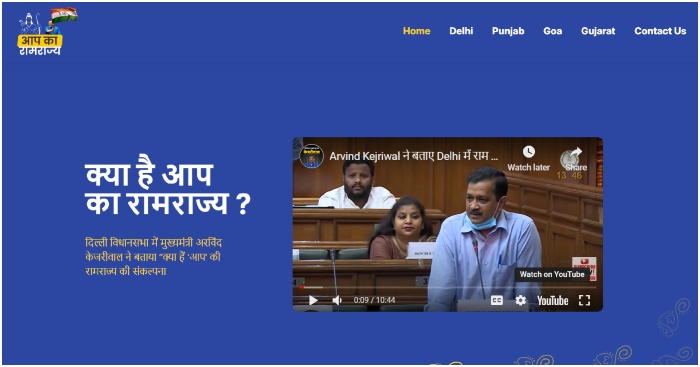
The Aam Aadmi Party (AAP) unveiled the ‘AAP ka Ram Rajya’ website on Wednesday (16th April) as a part of their Lok Sabha election 2024 campaign, claiming that Delhi Chief Minister Arvind Kejriwal attempted to achieve Lord Ram’s ideals in the national capital.
The website was inaugurated ahead of the first round of the Lok Sabha elections on 19th April, as well as the Ram Navami festival, which is being observed in numerous regions of the country.
Addressing a news conference alongside senior AAP leaders Atishi, Saurabh Bharadwaj, and Jasmine Shah, Rajya Sabha MP Sanjay Singh said, “Today, on Ram Navami’s occasion, the AAP will start a website called ‘AAP ka Ram Rajya’. What is the concept of Arvind Kejriwal’s Ram Rajya? This is the Ram Rajya that was discussed and fulfilled by Lord Shri Ram. Mahatma Gandhi wanted to implement it to bring equality. To fulfil the dreams of Ram Rajya, Kejriwal has done tremendous work in Delhi in the last ten years and has set an example for the entire country.”
Singh accused the BJP and Prime Minister Narendra Modi of harbouring animosity and vengeance towards Kejriwal, saying, “Kejriwal has demonstrated this by forming governments in two states (Delhi and Punjab) in the recent decade. He demonstrated how to grow a city by giving good schools and hospitals, free energy, and free transportation for women. Previously, people cited America as an example of good schools and hospitals, but now the entire world cites Kejriwal’s school and Mohalla clinic models.”
“Anyone who wants to examine the progress under Kejriwal’s Ram Rajya can check out this website and see the work done by the Kejriwal government in the last ten years,” he said.
Atishi meanwhile compared Lord Ram’s 14-year journey to Vanvas to Arvind Kejriwal’s ten-year struggle to fulfil his dream of Ram Rajya in Delhi, highlighting the central government’s interference, attempts to halt work and false imprisonment he faced in his quest.
screengrab of the website
Bharadwaj stated that the website contains a number of films, testimonies, and Ram Rajya plans that Kejriwal wishes to implement not only in Punjab and Delhi but across the country. He also emphasized the website’s features and urged people to vote for AAP based on the party’s activities on the ground.
It is important to note that the Aam Aadm Party has always been showcasing its hatred towards the Hindus and Sanatan Dharma and also Lord Rama at times. And now when the Delhi CM Arvind Kejriwal has been jailed because of his involvement in the Delhi Liquor Scam, the party is making use of Lord Ram’s name to its benefit.
AAP insulting Hindus, Lord Rama
In the year 2022, AAP leader Rajendra Pal Gautam who was the Minister of Social Welfare, Government of Delhi insulted Hindu Gods saying that there was no need to worship them and that he would never consider them as Gods.
According to media reports, on the day of Vijayadashami in the year 2022, AAP leader Rajendra Pal Gautam attended a program at Ambedkar Bhawan on Rani Jhansi Road in Karolbagh. People not only received Buddhist initiation but also swore an oath not to worship or regard Hindu gods and goddesses as Gods. The BJP then slammed the party and demanded an apology from the party.
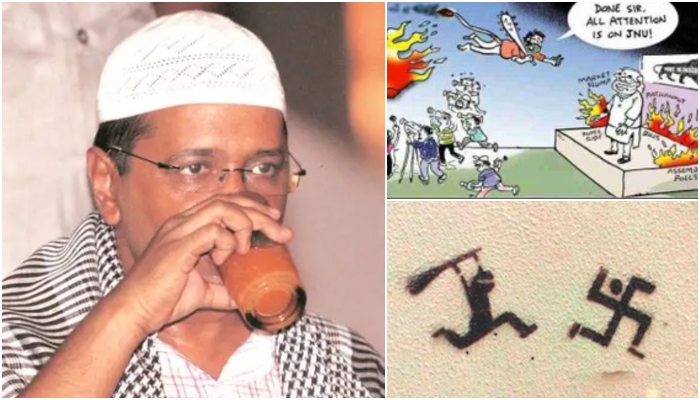
In the year 2019, Kejriwal, on the day before Holi shared an image that depicted a man running behind a ‘Swastika’ shape with a club in his hand, driving out the symbol that is considered holy in Hinduism, Buddhism, and Jainism in India.
The caption on the image read, “Hoping for a Delhi, that I actually wouldn’t mind visiting or living in.”
In 2020, Kejriwal, the chief of AAP declared himself a devotee of Lord Hanuman. He had also claimed that since Lord Hanuman is a devotee of Lord Ram, by extension, even he is so. Kejriwal had announced that after the Ram Mandir is constructed in Ayodhya, he would take the elderly people from Delhi to Ayodhya for darshan.
Interestingly, it is this ‘Ram Bhakt’ who had earlier questioned the need for a Ram Mandir. In 2014, he had shamed the Hindus for trying to build a temple at the birthplace of Lord Ram saying his Nani (grandmother) would never have approved of it.
When Ayodhya Ram Mandir was a distant reality, Kejriwal mocked the intent and repeatedly said that the government should instead build schools, colleges, and hospitals.
Not just the Delhi CM, but his colleagues have also time and again opposed the construction of Ram Mandir. AAP leader Sanjay Singh, in an attempt to gain relevancy in politics, ran a misinformation campaign alleging funds misappropriations by the BJP and Ayodhya Ram Mandir Trust in June 2021.
Further insulting Lord Hanuman, of whom he claims to be a devout devotee, Kejriwal shared a cartoon depicting the Hindu god ‘setting fire’ to JNU as a distraction. This he did after Leftist students at JNU attacked ABVP students in January 2020 over a semester form at Jawaharlal Nehru University.
— Ankur Singh (Modi Ka Parivar) (@iAnkurSingh) March 10, 2021
Kejriwal, who has always tried to portray himself as a devout Hindu, had another awkward encounter ahead of the 2020 Delhi elections when he grossly misquoted the Hindu scripture Bhagavad Gita. Taking a sly dig at their ideological opponents-BJP, he said that it is written in Gita that a true Hindu is brave and never runs away from the field. The ‘devoted’ Hindu was unaware that throughout the 700 Sanskrit verses in Bhagavad Gita, the word “Hindu” has not been used anywhere.
Arvind Kejriwal and his party have time and again insulted Hindus. In August 2020, the official Twitter handle of AAP shared pictures of Kanchenjunga in Sikkim, held sacred by both Hindus and Buddhists, Kamet Peak, and Nanda Devi hills in Uttarakhand, where lies a sacred temple of Nanda Devi, an incarnation of the Hindu Goddess Durga. It drew analogies between these sacred peaks and a humongous landfill at Ghazipur in Delhi. The contentious tweet was accompanied by the caption, “Highest Mountains of India.”
Aam Aadmi Party’s involvement in anti-Hindu protests
The Aam Aadmi Party, led by Arvind Kejriwal, has consistently provided tactical support to any sort of protest or violence against Hindus. Though Kejriwal has never officially backed such acts, he has never stopped his followers, Tahir Hussain and Amanatullah Khan, from playing a key part in the February 2020 Delhi anti-Hindu riots conspiracy.
The anti-CAA protests in 2020, which culminated in the anti-Hindu Delhi riots in February 2020, were blatant evidence of a planned genocide against Hindus in Muslim-majority areas. Arvind Kejriwal’s party’s close ties with Khalaistani separatists, who support Punjab secession with Pakistan’s support, exemplify their anti-India and anti-Hindu mindset.
OpIndia has extensively reported on how the Aam Aadmi Party, along with other opposition parties such as the Congress, supported the ‘farmers’ protest at the Singhu border against the Central government’s farm laws, which was hijacked by Khalistani elements.
Conclusion
Given all these above incidents and pieces of evidence, it is very hard to believe that AAP’s Arvind Kejriwal or the other AAP leaders are devotees of Lord Ram and Lord Hanuman as they call themselves. They have time and again applied tactics to insult Lord Ram, Hinduism, and Sanatan Dharma. And amid this using the name of Lord Ram or his kingdom to its benefit showcases the sickening mentality of the party and its leaders.
It is crucial to note that Delhi CM and AAP Chief Arvind Kejriwal has been jailed for his involvement in the liquor scam. Earlier, several other AAP leaders were arrested in the same case. The party is making all efforts to justify the acts executed by Kejriwal and is instead blaming the BJP for using the central agencies to its benefit.
The party and its leaders need to understand that it’s not the BJP that is making use of the central agencies, but it is the AAP itself who is using Lord Ram’s name for its political benefits and indirectly again causing insult to Lord Ram and Hinduism.
As hard as it is to believe, we were able to write 9 articles in a series titled How Prime Minister Modi hacks EVMs (all listed at the end of this article) without even touching upon the huge and epochal events that have unfolded in his 10 years as PM. The scale of his trail-blazing decisions is very large. Even after 9 articles on various topics ranging from health to wealth, from law-making to peace-making, we still haven’t touched upon the many other decisions that look seemingly small but are in fact big.
For example, the Modi government changed the eligible age for marriage to 21 years for both men and women. Did you know that nearly 2000 old rules and laws that were obsolete were removed by the Modi government? There are many such small things that we can spend time on (A Twitter thread here talks about 175 unique accomplishments), but we should move on to discuss the events and decisions that no one thought were possible to achieve, but that this government has accomplished!
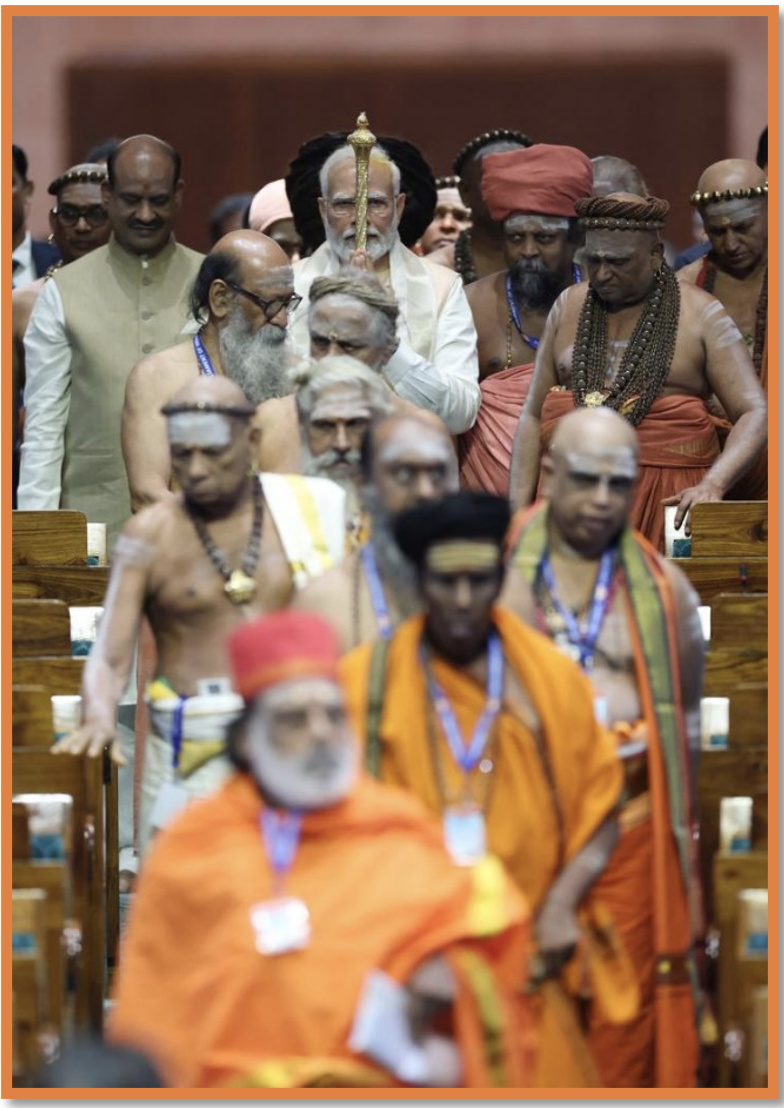
The opening of the new Parliament building, while a big event in itself, was also a witness to two huge events in Independent India. In 1947, just before the transfer of power from the British to India, Jawaharlal Nehru was presented with a Sengol from Tamil Nadu, which signifies the transfer of power. Jawaharlal Nehru sent it to a museum and it was later classified as his walking stick! It took Prime Minister Narendra Modi’s initiative to restore the Sengol to its rightful place in the Lok Sabha. This powerful image of India’s Prime Minister walking with the Sengol, accompanied by the chanting of mantras by the pandits, has left a really lasting impression in my mind.
The Women’s Reservation Bill was passed in the first session of the new Parliament building. A bill that was first mooted in 1996 could only become law in the year 2023. This was passed with an unbelievable 454-2 majority in the Lok Sabha. The scale of this achievement will be visible (literally!) once we see 33% of our parliamentarians being women, post the delimitation exercise. Both events are befitting the stature of the event of the opening of the new Parliament building.
The National Education Policy has been revised for the first time since 1985. This NEP is even more transformational than the 1985 one. The current 3-tier structure in our schools will be changed to a more meaningful 4-tier structure; there is going to be increased focus on funding research in our colleges; there are going to be changes in the way degrees are awarded; we now have the choice of making education more flexible (such as breaking up a degree into multiple slots). A single paragraph or a single article cannot do justice to discuss the monumental changes NEP will bring in once it becomes fully operational.
The Presidency of G20 was ridiculed by the opposition saying that this is just a rotating feature and nothing great about Modi. It’s phenomenal how they underestimate Modi when they ridicule him on matters so big! Nearly 200 programs related to the G20 were held in more than 60 cities or towns in India. It didn’t matter which party was ruling a particular state – all states got good preference in hosting multiple leaders from the most powerful countries of the world in their cities or towns. Celebrations were seen in the cities and towns that hosted these multiple summits.
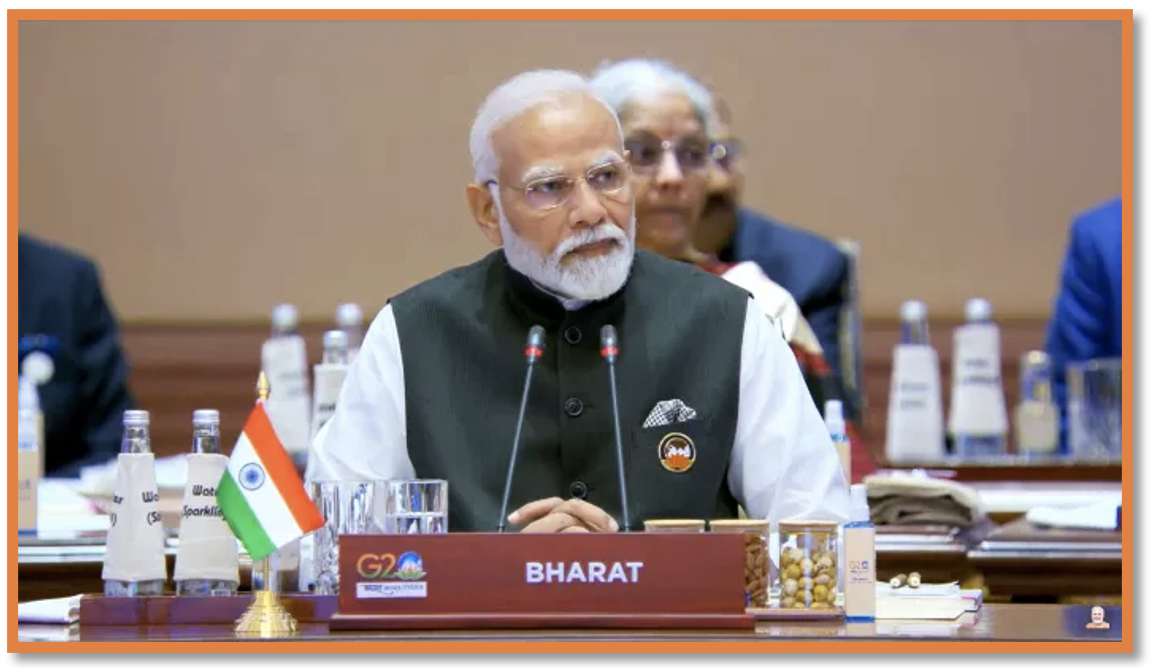
The first big pleasant surprise came when we all saw our Prime Minister PM Modi addressed the G20 Summit with a ‘Bharat’ nameplate.
The second pleasant surprise was equally very heartening. G20 was made more inclusive when the 55-member African Union joined the grouping – something that no one imagined. Just when they thought there would not be any more surprises, came two more big announcements. One is the establishment of the India-Middle East-European economic corridor. The other was the establishment of the Global Biofuels Alliance.
This OpIndia article captures very well the 10 huge accomplishments of the transformative nature of our G-20 Presidency. By involving all states of India, Modi didn’t make the G20 the elitist event they thought it was. By getting the African Union to join the G20, Modi made sure the G20 isn’t an elitist organisation they thought it was. The Presidency may have gone to another country via rotation, but the legacy of what India achieved in its presidency will stay forever!
There came a time when no one took political party manifestos seriously. That was because everyone just thought all political parties lie on their manifestos and nothing really ever comes out of it. All that changed on August 5, 2019. Words fail to describe the emotions one was undergoing while watching the political acumen with which Article 370 was abrogated on that day in the Rajya Sabha and the next day in the Lok Sabha. The ensuing peace and prosperity in Kashmir that followed the abrogation is ample proof of how people have lapped up their newfound freedom. It is baffling how people of J&K were deprived of all the opportunities available to the rest of the country and yet their misery was sold to us as a normal occurrence in J&K.
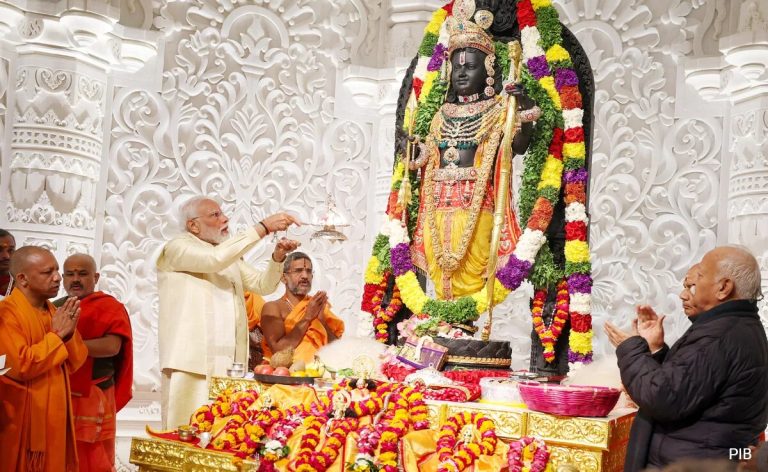
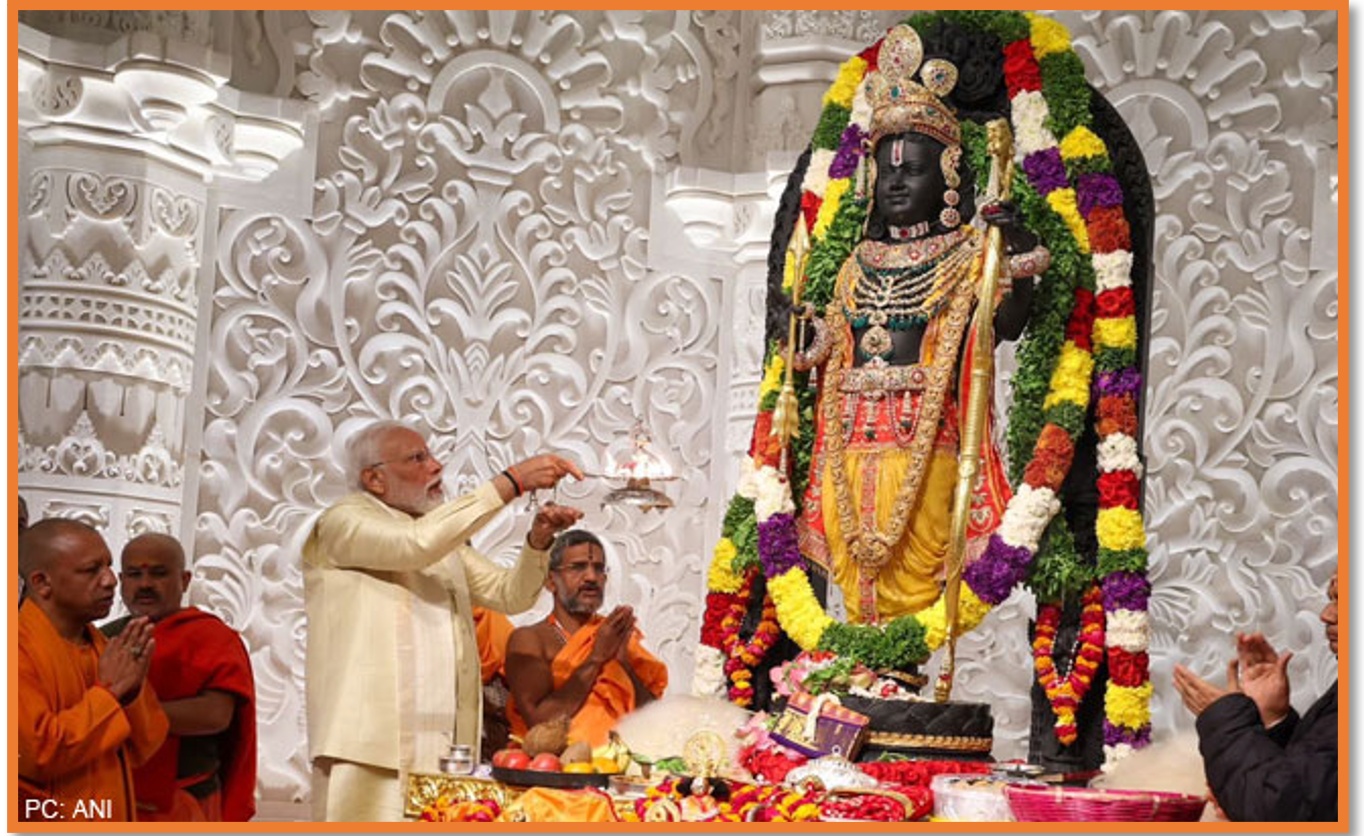
The Pran Prathista (I cannot find an English translation that will sound as beautiful as this!) of Bhagwan Ram in the magnificent Ram Mandir at his birth place in Ayodhya, is a truly epochal event. The epochal scale is evident from the fact that it took more than 500 years for this to happen.
The Prime Minister delivered a brilliant speech that befits this occasion. After most eloquently describing what Prabhu Ram stood for, Prime Minister Modi also reminded us of our duty to now lay the best possible foundation of a Bhavya Bharat for the next 1000 years. He has reminded us of the hope and aspirations that this new era brings to the crores of Indians. And he has guided us on how we must conduct ourselves to fulfil this responsibility of transforming our country. He has led by example and made us all his partners in the transformation so far. The work is far from finished though. We built a Bhavya Mandir. We will now build a Bhavya Bharat!
This brings to end the 10-article series on how Prime Minister Modi hacks EVMs. Part-1 speaks about the focus on small-scale entrepreneurs; Part-2 speaks about the revolutions in the labour/employment sector; Part-3 speaks about the focus on both prevention and cure in health; Part-4 speaks about how the lives of women were made better at home, school and work. Part-5 speaks about the Focus on financial systems, along with Big Bang Reforms and simultaneous benefits to middle-class, economically weaker sections. Part-6 speaks about law-making and peace-making efforts that made India a much safer place to live in. Two articles, not numbered in this series, but count into how he hacks EVMs are – The many highs of the 17th Lok Sabha; and the implementation of the AP Reorg Act. And of course, this particular article.
A Muslim student at a British school filed an appeal with the High Court challenging the school’s policy prohibiting prayers on school property, however, the court dismissed the petition and clarified that students must abide by school policies in order to continue their education there. The student and her parents are allowed to leave the school if they disagree with any of the guidelines.
The case pertains to Michaela Community School in Brent, north London which is a state secondary non-religious institution and one of the strictest schools in Britain that forbids religious education. The school grounds are off-limits to any form of religious activity. The institution has 700 students, more than half of whom are Muslim. 30 students spread their blazers and prayed on them in March 2023, in defiance of the school’s policy against prayers. Afterwards, the school issued stern warnings and took severe measures. The schoolgirl then filed an appeal with the High Court.
In an 83-page ruling, High Court Judge Linden stated that before admission, the school notifies the students and their parents that religion isn’t allowed on the premises. This institution is intended to be non-religious. Justice Linden pronounced, “The claimant at the very least impliedly accepted when she enrolled at the school, that she would be subject to restrictions on her ability to manifest her religion.” Judge Linden rejected the student’s claims and supported the school, which had maintained that its policy was appropriate in light of threats of bombing and death connected to its on-site religious observance.
“She (the pupil) knew that the school is secular and her own evidence is that her mother wished her to go there because it was known to be strict. She herself says that, long before the prayer ritual policy was introduced, she and her friends believed that prayer was not permitted at school and she therefore made up for missed prayers when she got home,” the judgement mentioned.
“A school should be free to do what is right for the pupils it serves. The court’s decision is, therefore, a victory for all schools,” declared founder and headteacher of the school, Katharine Birbalsingh, a former government social mobility tsar who co-founded the non-faith senior public school with former home secretary Suella Braverman.
“Schools should not be forced by one child and her mother to change their approach simply because they have decided they don’t like something at the school. Parents are under no obligation to send their children to us if they don’t like something such as Michela,” the school stated during the High Court hearing and added that allowing prayer rituals risked “undermining inclusion” among pupils.
Attorneys representing the school asserted that images of students praying outside fueled a “concerted campaign” against the school’s religious policies on social media. They additionally disclosed that Muslim children were “observed to be applying peer pressure” on their fellow Muslim students to “act certain ways.” The court was also informed that the school was the subject of “false” accusations of Islamophobia, harassment and a “bomb hoax.” Attorneys stated that lifting the “emergency” prohibition would put the school under “an unacceptable risk of threats” once more and prevent “the logistical disruption and detriments to other school activities”.
Hijab controversy in India
The Udupi Hijab conflict originated in late 2021 in Karnataka and involved Muslim female students seeking to wear hijabs as part of their school uniforms in violation of uniform dress code. The dispute resulted in significant demonstrations, court cases and even spread to other regions of the nation. The debate commenced in January 2022. A college in Udupi drove away several Muslim students who came to class wearing hijabs.
The High Court pronounced that wearing a hijab is not required by Islam. Chief Justice Rituraj Awasthi of the High Court affirmed the state government’s directive that universities and schools conform completely to the uniform policy. The matter made it to the Supreme Court which also maintained the High Court’s judgement. However, Siddaramaiah was appointed Chief Minister in 2023 when Congress won the assembly elections in Karnataka and the restriction on wearing the hijab in colleges and schools was repealed by his administration.
On Tuesday (16th April), the United Kuki National Army (UKNA) claimed responsibility for the attack on fuel tankers near Manipur’s Kaimai village on National Highway 37 (NH37). Earlier in the day, a driver suffered bullet injuries as armed men ambushed oil and gas tankers in the Tamenglong district.
According to the police, at least two fuel tankers were hit by gunfire near Keimei village on NH-37, which connects Imphal with Silchar. The police added that unknown armed men fired from hilltops to target the fuel tankers on the highway, resulting in the driver being shot in the leg. Bullets hitting the tankers caused oil spillage on the road. Additional forces were rushed to the area to ease tensions. Nevertheless, the ambush led to panic buying of petrol and diesel at petrol pumps in the valley districts of Manipur.
Hours after the attack, the insurgent Kuki outfit issued a press release to warn of more such attacks in the future.
JUST IN | United #Kuki National Army claims responsibility for attack on oil & gas tankers near #Manipur’s Kaimai village on “NH37” on April 16, warns of more such attacks on all #Imphal-bound goods vehicles, @rahconteur reports pic.twitter.com/8nxTNFtydO
In the press release as accessed by The Hindu, the UKNA issued a threat describing the 16th April attack as the “first offensive operation” against the supply of the essential commodities and “weaponry”. According to the Kuki militant group, the commodities in the truck were being sent to aid the Meitei community.
It is pertinent to note that large-scale violence erupted last year between two main ethnic communities in the state – Meitei and Kuki following a controversial court order. In February this year, the Manipur High Court removed its instruction to the Manipur Govt given last year that sparked the riots in the state which started in May 2023.
The High Court had asked the state govt to recommend the inclusion of the Meitei community in the Scheduled Tribe list, triggering massive protests and violence by the Tribal Kuki community. The court in February revised its earlier order and deleted the instructions to the state govt.
Alleging that the state government is favouring the Meitei community, the Kuki outfit levelled the state government as “communal” and conveyed that it will keep opposing it to “stop the Genocide of Kukis”. It also alleged that it would target trucks carrying essential communities to stop the “illegal transport of heavy weaponry”.
Threatening of more attacks, the press release added, “The UKNA felt sorry for injuring a driver during the operation and further it is warned that no Imphal bound goods vehicle transportation should ply on the National High Way -37 with immediate effects.”
It further stated, “That this operation is a continuing process and any transporters neglecting the order should be treated as the enemy of the Kuki’s and he or she will face the consequences of a disobedience for which he or she shall be responsible.”
It concluded by stating, “The organization understands the plight of its people at the best of the communal state government and this organisation should oppose the state government as long as it stops sponsoring the ongoing Kuki Genocide.”
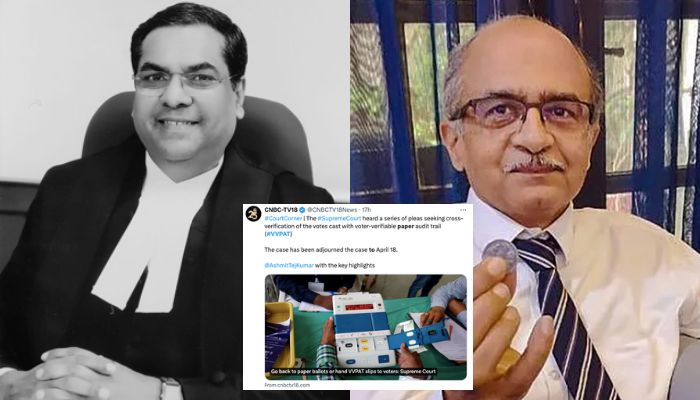
On Tuesday (16th April), the Supreme Court heard pleas seeking cross-verification of the votes cast with Voter Verifiable Paper Audit Trail (VVPAT). While the Supreme Court bench comprising Justice Sanjiv Khanna and Justice Dipankar Datta was not convinced by advocate Prashant Bhushan’s arguments to go back to election via ballot paper instead of Electronic Voting Machines (EVMs), CNBCTV18 published a misleading report claiming that the SC bench said that “we can go back to ballot paper or give VVPAT slip to the voters.
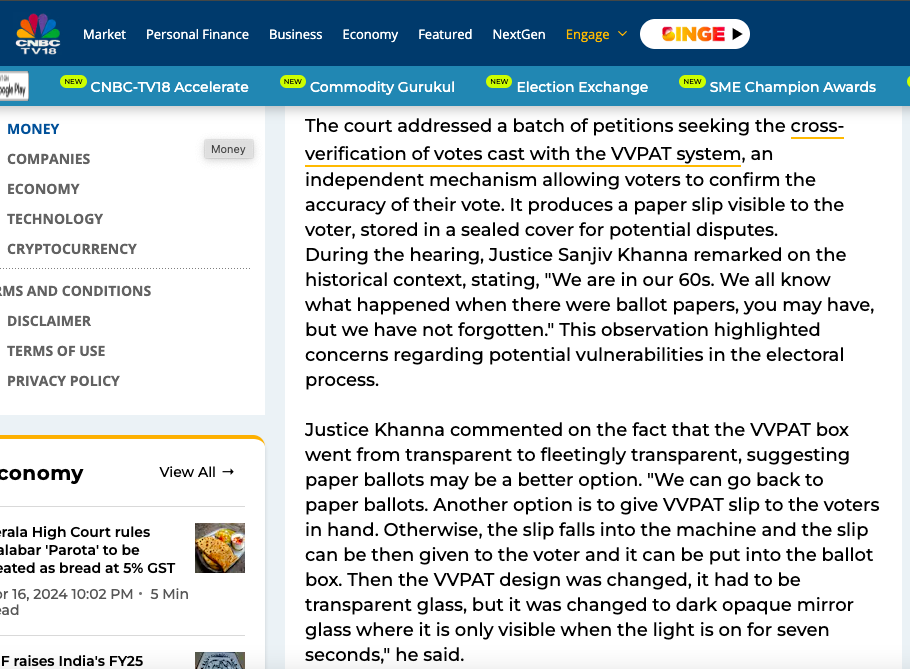
A CNBCreport (archive) claimed that Justice Sanjiv Khanna suggested during the hearing that since the “VVPAT box switched from transparent to fleetingly transparent, ballot paper may be a better option.”
The CNBC report even quoted Justice Sanjiv Khanna as saying, “We can go back to paper ballots. Another option is to give the VVPAT slip to the voters in hand. Otherwise, the slip falls into the machine and the slip can be then given to the voter and it can be put into the ballot box. Then the VVPAT design was changed, it had to be transparent glass, but it was changed to dark opaque mirror glass where it is only visible when the light is on for seven seconds.”
CNBC report
Contrary to the CNBC report’s claim, it was not Justice Khanna but advocate Prashant Bhushan who said this during the hearing. Bhushan said this when Justice Khanna asked him, “What relief are you seeking?”
To this, advocate Prashant Bhushan said, “In 2017 they designed the VVPAT machines different from what they used to be. The machine should have a transparent glass. In 2017 it was changed to dark opaque mirrored glass, where you can’t see unless a light is lit inside the box, you can’t even see the slip cut and go inside the box. suppose you put a program that if two consecutive votes are cast for the same person then the slip won’t be cut.”
In response, Justice Khanna asked: “We have understood. What do you want?”
It is in response to Justice Khanna’s question that Prashant Bhushan proposed three options before the court. He said that one option is to return to the ballot paper voting system, giving VVPAT slips to the voter or placing the transparent glass on VVPAT machines. He suggested a fourth option that if the voter doubts something is not right, he may file a complaint under 177.
“We can make the glass transparent. There are three options. Ballot paper, give VVPAT slip to voter and third is transparent glass. There is a fourth option. If the voter feels something is not right, they can file a complaint under 177,” Bhushan said.
Adv: there is a fourth option. If the voter feels something is not right, they can file a complaint under 177.
Bhushan: according to me these are the three suggestions. Most European countries have gone back to ballot paper
It is, thus, clear that it was not Justice Sanjiv Khanna who opined that paper ballot may be a better system or that VVPAT slips be given to voters but advocate Prashant Bhushan, representing the Association for Democratic Reforms (ADR) who proposed these as options to ensure fair elections.
While CNBC’s factually incorrect report claims that Justice Khanna saw ballot paper as a better option “maybe”, the Supreme Court bench was not convinced by the petitioner’s argument to return to the ballot paper.
“We are in our 60s. We all know what happened when there were ballot papers; you may have, but we have not forgotten,” Justice Khanna said.
Moreover, he also said that human intervention in the polling and counting process could lead to further problems and biases. “Normally, human interventions lead to problems and human weakness can be there which includes biases as well. Machines, normally without human intervention, will give you accurate results. Yes, the problem arises when there is human intervention or someone makes unauthorised changes when they are around the software or machine. If you have any suggestions to avert this, then you can give us that,” Justice Khanna said.
A shocking incident of forced religious conversion has come to light from Rajasthan’s Alwar where a man named Sabir is accused of raping a minor Dalit girl after he had kidnapped her. The minor victim was then forcibly converted to Islam and married to the accused, Sabir. Based on the complaint of the victim’s family, the Police have filed a case under IPC sections 363, 366A, 376(2)N and under stringent POCSO and SC/ST Acts.
The incident sparked outrage among the members of the Dalit community who have demanded the arrest of the accused. They have warned to carry out a protest if strict action is not taken in this matter.
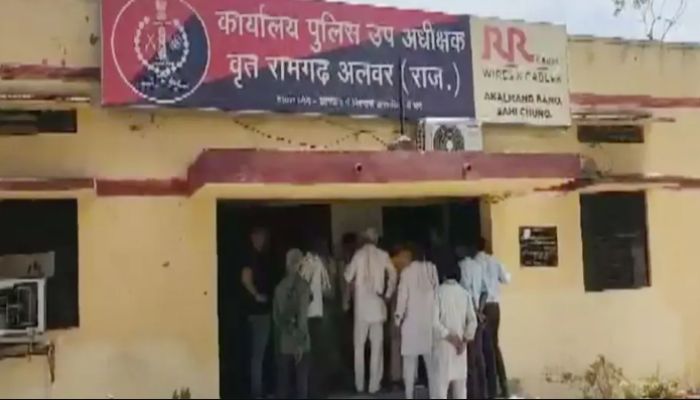
Ramgarh Deputy Superintendent of Police (DSP) Omprakash Vishnoi said that the matter is being investigated seriously.
He said that on 15th April, the family members of the Dalit minor girl had registered a case of kidnapping, rape, and forced marriage in the Bagad Tirahe police station.
The DSP assured that strictest action will be taken against the culprits involved in the case. He stated that the victim’s family told the police that their daughter had gone to the market to get her silver anklets repaired on 13th April. During this time, she disappeared somewhere on the way.
According to reports, the victim is a 17-year-old Dalit girl who resides in Bagad Tiraha, Alwar. On April 13th, she went to the market to have her anklets repaired. However, when she did not return by evening, her family members began searching for her.
They then came to know that Sabir a resident from the nearby village had abducted the minor. Subsequently, they reached Sabir’s house where his family misled the Dalit family. They told the victim’s family that they would help them in finding the girl.
However, when the victim’s family couldn’t find success in finding the victim, they reached Sabir’s house but this time they were accompanied by the Police. After reaching there, they came to know that their minor daughter had been forcefully converted to Islam and she was forcibly married to Sabir.
The victim’s family has also accused Sabir of raping their daughter. Consequently, they filed an FIR in Ramgarh police station on 15th April.
Meanwhile, BJP’s Ramgarh division general secretary Dinesh Gautam said that this is a case of Love Jihad. He added that immediate action should be taken in this case and the accused should be arrested otherwise the Dalit community will stage a protest.
Elections in West Bengal nowadays mean the use of crude bombs by political parties, mostly by Trinamool Congress workers. Often, ‘cottage industries’ making such bombs, or houses storing such bombs explode due to various accidents, which sometimes cause deaths. In the latest such incident, the intense heat of the sun caused bombs hidden in a house to burst in a massive explosion, causing panic in Murshidabad.
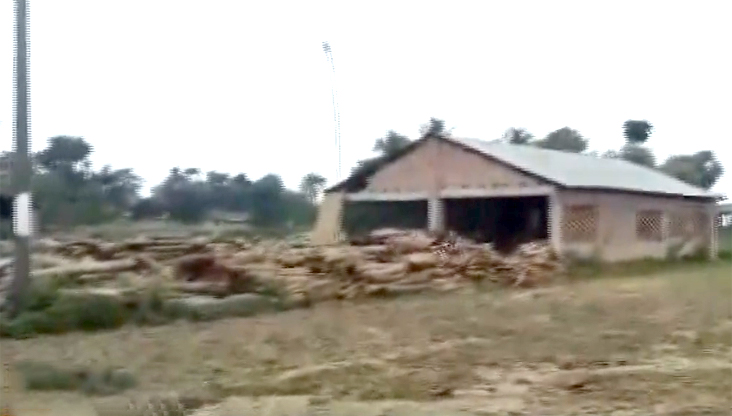
The incident took place on Tuesday in Nazirpur Paschim Para area of Rezinagar police station in Murshidabad. On 16th April afternoon, the entire area was shaken by an explosion that took place behind a wood mill in the area. While initially people thought that an electric transformer has exploded, subsequent explosions confirmed that there were bombs. The series of explosions causes massive panic in the area.
After the blasts, it was clear that bombs were hidden there, and they spontaneously exploded due to the intense heat of sunrays. There is no report of any injuries or casualties due to the explosion. Police arrived at the scene after getting the information and started an investigation. A bomb squad has also been deployed to see if there are more bombs hidden in the area.
The explosion ahead of the Lok Sabha elections have created a fight between Congress and Trinamool Congress, with both parties blaming each other. Rezinagar Block Congress President Mintu Singh alleged that the aides of local TMC MLA Rabiul Alam Chowdhury had stored bombs behind the wood mill. And that bomb exploded in the heat of the sun. He demanded that legal action should be taken after proper investigation into the case.
However, TMC leaders have denied the charges, and alleged that Congress workers are storing bombs ahead of the elections. Murshidabad district Trinamool chairman Niamat Sheikh alleged, “Congress-backed miscreants are stockpiling bombs to terrorize the area and affect law and order before the polls.”
The police said that different types of bombs are being recovered from different parts of the district ahead of the polls. Police also added that stored bombs are exploding due to overheating. The Rezinagar incident is also believed to be similar.
In a similar development, a bag-full of socket bombs were recovered in Chakraramprasad area of Sagarpara police station in Murshidabad. On the basis of information of presence of bombs, the police searched the area on Monday and recovered a bag full of fresh socket bombs from an empty field.