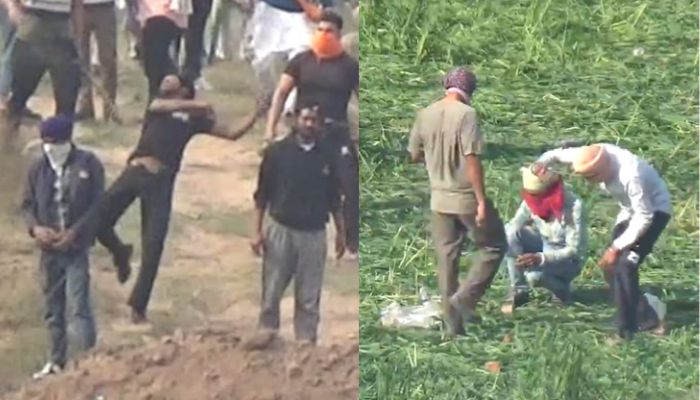
A sinister attempt is being made by anti-national elements to disrupt peace, law and order in the name of farmers protests. The Ambala Police has said that under the guise of farmers’ movement, miscreants are creating havoc at the Shambu border.
किसान आन्दोलन की आड में उपद्रवियों द्वारा शम्भू बैरियर पर मचाया जा रहा उत्पात । उपद्रवी पुलिस पर बार-बार कर रहे पत्थरबाजी पुलिस के 18 व पैरामिलट्री के 07 जवानो सहित कुल 25 जवान हुए घायल। उपद्रवियो की पहचान करने में आमजन करें सहयोग @police_haryana@DGPHaryana@AdgpAmbalaRangepic.twitter.com/rfuFb45IZN
Haryana’s Ambala Police has alleged that 25 personnel deployed at the border have been injured of which 18 are Haryana Police personnel and 7 are paramilitary forces. The police has appealed to the citizens to help them identify the miscreants.
Additional SP of Ambala Police, Pooja Dabla addressed the media in this regard.
She said, “We have released the video because a warning is being given since many days, section 144 has also been imposed. We discussed their protest call for 13th February. They were blocked with proper barricading also where our paramilitary force and police force is also deployed to stop them. Taking into account their mischief they caused in 2020, the police force has prepared beforehand. But some videos show that they are breaking stones and pelting them on our paramilitary forces and officers at the border injuring total 25 personnel including a DSP rank officer. Of the 25, 18 personnel are from Haryana police and 7 are from paramilitary forces. We have released the video in support of the police forces in order to appeal for public support to help us identify these miscreants who are disguising in the name of holding protests. We appeal to the people to identify them and inform us and your identity will be kept hidden and strict action will be taken against these miscreants.”
The Ambala Police released a number of videos from the Shambhu border which shows arsonists and vandals breaking large stones into pieces and throwing them at the security personnel deployed in the area even as they retaliated with tear gas shells.
Shortly after the police retaliated from a distance in order to disperse the crowd of attacking miscreants, a loud religious call was given by the protesters from the loudspeakers.
“Bole So Nihaal,” was chanted from the loudspeaker followed by “Sat Sri Aakal” from the crowd. Notably, an inciteful message was continously being spread through the loudspeakers from the protesters side.
Miscreants are using the Shambhu border in an attempt to enter into the national capital in the name of farmers’ protest.
This comes amidst Congress and AAP pointing fingers at the BJP-led Haryana and Central Government. In the third round of meeting between farmers representatives and the Centre, Punjab CM Bhagwant Mann equested the Centre to direct the Haryana government to ‘maintain peace’ in border areas in view of the farmers’ ‘Delhi Chalo’ agitation.
However, Mann did not address the stone pelting by miscreants at the Haryana border. While the Centre attempts to quell a repeat of the 2020-21 farmers’ protest, the AAP-led Punjab government objected to the internet suspension at the border areas citing students’ examinations and has ordered the Centre that Punjab should not have a scarcity of fuel or milk or “anything that comes from the outside”.
On Thursday (15th February), the Haryana Chief Minister hit out at the political statement made by so-called farmers leader Jagjit Singh Dallewal.
Haryana CM Manohar Lal Khattar said that the kind of tactics being used by farmers to press for their demands will only help boost the popularity of PM Modi.
Dallewal had said that they(farmers) have to bring graph of PM Modi down’ in their protest.
Meanwhile, Congress leader Navjot Singh Sidhu, recently released from jail, has been trying to hit two birds with one stone using the farmer’s protests to draw a division between states.
On Wednesday (14th February), Sidhu posted on X that the Punjab government “must protect it’s territorial sovereignty and thwart attempts by Haryana to assault /injure peacefully protesting punjabis on our soil.”
In another tweet that attempts to draw a divisive line between Punjab and India, the Congress leader asked Punjab CM Mann to “stand tall like Mamata Banerjee and Siddaramaiah, take the DGP with you and ensure that not a single ‘fire’ of the Haryana Police injures a single Punjabi on Punjab soil. Show backbone and don’t be a center doll.”
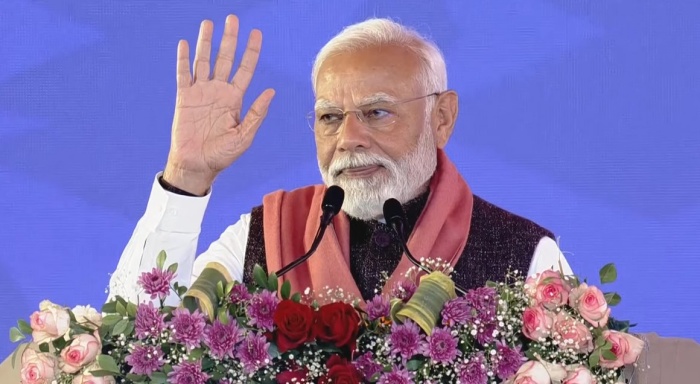
Prime Minister Narendra Modi reiterated the “400 pitch” during his address to a public event in Haryana’s Rewari on Friday while seeking their blessings for his third term to make India the third largest economy in the world.
He also highlighted the achievements of his government in the last ten years, including the historical moon landing event.
“If the G20 summit was successful, it was because of your blessings. India’s flag reached the moon where no one could; it happened with your blessings. In the last 10 years, India rose from 11th position to become the fifth largest economy in the world. In my third term, I need your blessings to make India the third-largest economy in the world in the coming years..,” PM Modi said.
“Ab Ki Baar 400 paar” for NDA,” PM Modi said.
The visit assumes significance ahead of the Lok Sabha elections due in April and May this year.
Referring to the inaugural ceremony of the Ram Mandir in Ayodhya in January, PM Modi said, “Just a short while ago, I got the opportunity to hand over development projects worth Rs 10,000 crores to Haryana, including Rewari AIIMS, a new rail line and metro line, and a museum…The blessing of Lord Ram is such that nowadays I get the opportunity to be associated with such holy work everywhere…,” PM Modi added.
Before his address, PM Modi inaugurated, dedicated to the nation, and laid the foundation stone for multiple development projects worth more than Rs 9750 crore in Haryana’s Rewari.
Haryana Chief Minister Manohar Lal Khattar felicitated PM Modi before his public address.
CM Manohar Lal Khattar said, “…This is a special occasion when PM Modi is amongst us… When you (PM Modi) were the CM in Gujarat in 2013 and people were seeing you as the PM, you started your campaign from Rewari…Today, you are fulfilling the aspiration and dream of the people of Rewari by giving AIIMS to them…”
“The Metro station project in Gurugram will not only help people from Gurugram or the country but also those foreign companies who are here to invest… In the last 10 years, the way you have guided us, especially after the Pran Pratistha (Ram Mandir), has increased trust in our leadership…,” CM Khattar added.
(This news report is published from a syndicated feed. Except for the headline, the content has not been written or edited by OpIndia staff)
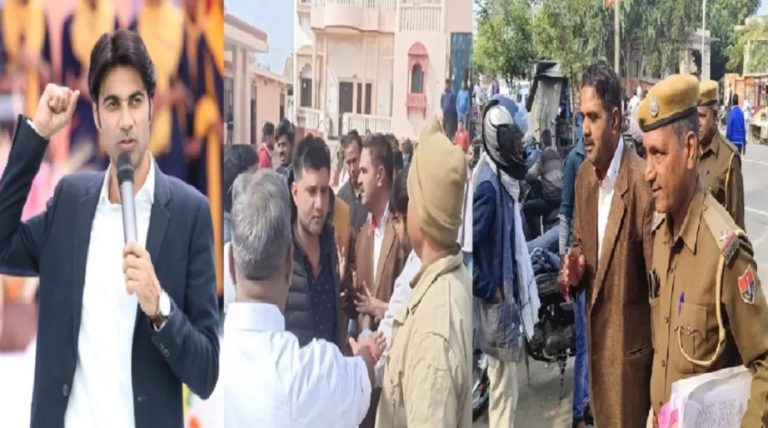
On February 11, an attempt to convert around 400 people to Christianity in a private hotel in Rajasthan’s Bharatpur came to light. Upon the complaint of Hindu organisations, the police reached the spot, stopped it and arrested two evangelists and their eight followers for converting poor people to Christianity by luring them for money.
A Special Investigation Team (SIT) has been formed to probe the alleged religious conversion cases that came to light in Bharatpur, Rajasthan.
After the conversion racket was busted, it was revealed that as many as 20,000 poor and vulnerable people of Bharatpur, Rajasthan have so far fallen prey to the trap of religious conversion laid by this gang of evangelists who promised material benefits to those who convert to Christianity. It began with the gang of evangelists organising small prayer meetings where they distributed free rations to the poor to lure them to convert to Christianity. To gain their trust these evangelists cured minor ailments of those who came there. In addition, they resolved other financial problems of these people.
Gradually, aid worth lakhs of rupees was credited to the accounts of these impoverished individuals and the conversion program that was being held on a small scale converted to large-scale programs. They were now being held in large farms, resorts, and hotels where thousands of people were invited and converted to Christianity through allurements.
Now, the investigation into the conversion racket has produced some shocking details about the entire situation, including the possibility of money laundering and funding received from foreign institutions.
In an exclusive ground report, the Hindi media outlet Bhaskar disclosed that controversial pastor ‘Prophet’ Bajinder Singh, who runs a propaganda YouTube channel, was the mastermind behind the Christian conversion trap that was exposed in Bharatpur, Rajasthan. He used to transfer funds directly into the recipient’s accounts. To oversee his conversion racket in Bharatpur, Bajinder Singh employed Ajay Singh. Originally a resident of Shrinagar a village in Rupbas, Rajasthan, Singh moved to Pipla village especially to look after Singh’s conversion business. Ajay Singh and his entire family were involved in the conversion activities.
Locals have reportedly stated that individuals received incentives ranging from Rs 2 lakh to Rs 5 lakh for religious conversion. The former Sarpanch Tuhiram claimed that he had previously alerted Ajay Singh against the illegal conversion activities he was partaking in, but Singh had refused to listen. Ajay Singh had reportedly become a Christian priest himself. The police, in fact, have even obtained a certificate from him.
Bharatpur, Rajasthan Christian conversion racket has links with an Italian organisation
The name of Labhana Ministry, an Italian organization, has emerged in the Bharatpur conversion racket. Conversion certificates issued by this particular organisation have, in fact, also been recovered by the police. The Labhana Ministry, to fulfil its goal of increasing the number of Christians in society, is reportedly funding conversion rackets operated by several Christian missionaries in India, where the impoverished and vulnerable are converted through various incentives and allurements. Besides Pipla Village, other areas where these conversion centres are operating are Kanjoli, Gundwa, Bajhera, Noh Bahamdi, Bahnera, Rupbas, Gaghina, and Bayana in Rajasthan.
Christian conversion racket in Bharatpur, Rajasthan received funds from other companies
The two people arrested in connection with the Bharatpur conversion racket were Kunwar Singh Jatav, a Bharatpur local and Shailendra Singh Jat who hails from Uttar Pradesh’s Firozabad. A large amount of propaganda material was recovered from them.
Now, it has been revealed that both these accused have links with a company named LMN, which not only funds such conversion programs but also gifts Bibles to people. Additionally, Kunwar Singh used to receive Rs 1 lakh every month from ‘Prophet’ Bajinder Singh which he, in turn, used for day-to-day expenses incurred to organise such conversion programs.
Bharatpur becoming a hotbed for religious conversion
Meanwhile, Bharatpur Superintendent of Police Mridul Kachhawa confirmed that two back-to-back incidents of religious conversion came to the fore from Bharatpur, Rajasthan. On February 11, an incident of the alleged conversion of about 400 people in a private hotel in the city came to light. Upon the complaint of Hindu organisations, the police reached the spot, stopped it and arrested two people. On February 14, a similar case came to light in Pipla village of the district, in which people had fled from the spot, but one person has been arrested.
Kachhawa added that given these incidents of the past days in the district, an SIT has been formed under the supervision of the Additional Superintendent of Police. The objective of the SIT is to investigate and stop such incidents in the district.
Is Pastor Bajinder the main accused or is there a greater conspiracy going on?
It may be recalled that on Sunday, February 11, 2024, an alleged attempt to convert hundreds of people to Christianity in a hotel came to the fore. Following a protest from Hindu organisations, some people were taken into custody and interrogated. These organisations alleged that people linked with Christian missionaries gave Rs 500-500 to the women. In addition, these people were offering to deposit Rs 40-50 thousand in the bank accounts of those converting to Christianity.
In this program, Bajinder Singh was connected live from Chandigarh and was converting people. The evangelists conducting the conversion program claimed that they could even bring a dead child back to life and could even cure deadly diseases like cancer. Kunwar Singh Jatav and Shailendra Singh Jat along with their eight followers were arrested. However, the eight followers, who were held under section 151 of the Code of Criminal Procedure, were later released on bail.
Responding to these developments, Vishva Hindu Parishad’s (VHP) Bharatpur president Lakhan Singh alleged the involvement of these persons in conversion for the last two to three years.
Both the arrested accused told the police that they were mere pawns and that the main racket was being run by the controversial ‘Prophet’ Bajinder Singh who was using live video feeds from Chandigarh to convert others. They confirmed that they have been associated with Bajinder Singh since 2020 and that Singh has converted more than 20,000 individuals in Bharatpur alone.
Notably, the conversion event that took place on February 11 came to the fore when a lawyer named Sandeep Singh reached the hotel ‘Sonar Haveli’ to book the marriage hall for a friend’s wedding. He noticed that about 400 people were present there in the banquet hall of the hotel and 15 people were present on the stage. They were being converted to Christianity after being made to swear by Jesus.
Controversies revolving around Prophet Bajinder Singh
Prophet Bajinder Singh is a controversial pastor from Punjab who has made headlines several times for his alleged ‘changai meetings’ where he claims to do miracles and healings. Singh was born into a Jat family in Haryana’s Yamunanagar. He was arrested and sent to jail for a murder case where he came in contact with a pastor and got inclined towards Christianity.
“He used to read the Bible daily and got converted,” revealed police officials privy to the investigations. Kickstarting his business in 2012, Bajinder Singh started holding Sunday prayer meetings for ‘healing’ and gradually became popular.
In 2018, he was arrested by Police in an alleged rape case in Zirakpur, Punjab. Singh was picked up by the police at the Delhi airport when the self-styled Christian Godman was about to board a flight to London. The victim had alleged that Singh lured her in 2017 on the pretext of taking her abroad.
He then sexually assaulted her at his house in Chandigarh and made a video of the same, which he then used to threaten her. Reports suggest that the victim had paid the accused pastor a sum of three lakh for promising her to be taken abroad.
Singh was accused of looting people in the name of healing. In April 2021, he was accused of looting Rs 80,000 from a family claiming to get their dead daughter back to life.
In August 2021, the National Commission for Protection of Child Rights (NCPCR) wrote a letter to Mandip Singh Brar, Deputy Commissioner of Chandigarh, seeking action against Singh for using a minor boy for forceful religious conversion activity. The action by the Commission was initiated after a video featuring a child had gone viral on social media.
In November 2021, he made it to headlines after former CM of Punjab Charanjit Singh Channi and actor Sonu Sood were scheduled to attend his meeting in Moga. Vishwa Hindu Parishad called for a protest against him, after which CM Channi decided to stay away from the event.
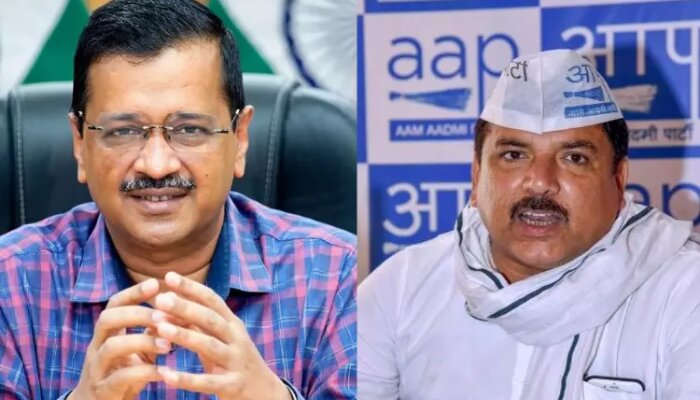
On 16th February, the Gujarat High Court dismissed the arguments put forth by Aam Aadmi Party (AAP) supremo and Delhi Chief Minister Arvind Kejriwal and the party’s Rajya Sabha MP Sanjay Singh contesting a Sessions Court order that upheld a Magistrate Court summons against them in a defamation lawsuit brought by Gujarat University regarding Prime Minister Narendra Modi’s educational background. On 2nd February, after hearing evidence from both parties, a bench of Justice Hasmukh D. Suthar reserved its decisions.
Judge H D Suthar disregarded the pleas and declared that the arguments for quashing the summons might be raised in the magistrate court during the trial. The two had filed a revision application with the Gujarati High Court in September of last year, four days after their appeal was denied by a Sessions Court in Ahmedabad. The grievance’s potential to stifle the right to free speech and expression is another point of contention raised in the appeal.
AAP representatives claimed in the High Court that the comments were not against the university and hence there was no basis for the case to be maintained at all. The varsity, however, charged that the statements made by the duo had tarnished its credibility and they should face legal proceedings.
Notably, on 1st April 2023, Arvind Kejriwal made the controversial comments at a press conference, raising doubt on the authenticity of the degree accorded to PM Modi by the Gujarat University. Sanjay Singh voiced similar sentiments at another news conference on the next day. The Gujarat University then brought a criminal defamation case against them before an Ahmedabad magistrate court. The AAP leaders have been calling PM Modi an “uneducated or less educated PM”, implying that his degree certificate is fake.
Arvind Kejriwal contended before the High Court that he delivered defamatory remarks during a press conference when he raised a significant issue regarding the qualifications of the Prime Minister of India. He claimed that it was not slanderous to express his views since he had discharged his duty to awaken the Indian people by stating that the country should have intelligent and capable persons holding constitutional positions, including the Prime Minister’s office, by bringing up the matter.
Furthermore, his petition alleged that a cursory examination of the purported remarks would not yield any element of Section 499 of the Indian Penal Code (IPC) consequently justifying the commencement and extension of the trial against him because he had uttered transparent, uncomplicated and harmless observations during a political discussion to enlighten the Indian populace.
The defence asserted that neither the act of calling the press conference nor the conduct of asking the Prime Minister of India for his degree could be deemed to be defamatory statements. It further maintained in his plea that the Gujarat University, an instrumentality of the state in this case, cannot be considered an aggrieved party and that the Court erred gravely in granting the contested summoning orders. The Court overlooked the fact that only the “aggrieved” person has the authority to file a defamation lawsuit.
It alleged that since the University is an unidentified and indeterminate body and cannot be regarded as a class under Section 499 IPC, it is not permitted for a government institution to file and maintain a criminal defamation complaint, even if it is not regarded as a state.
The appeal submitted that no appropriate investigation under section 202 of the Code of Criminal Procedure (CrPC) had been carried out in front of the court to demonstrate how the Respondent is seen to have been defamed in the eyes of others and the witnesses called in to corroborate the inquiry were Gujarat University staff members.
It conveyed, “The present Complaint is not instituted by an aggrieved person, in as much as Dr Piyush M. Patel has not claimed in the present complaint to be the aggrieved person. No specific injury or statement is stated to have been made against him, who is a Public Servant and thus Section 199(2) CrPC is not complied with in the present case. The Complaint is neither filed by the Public Prosecutor nor filed before the Court of Session.”
The motion stressed that the summons order incorrectly assumes and records Gujarat University as the petitioner’s opponent and since the complaint was lodged against the petitioner in his capacity as the Chief Minister of the National Capital Territory of Delhi, a sanction under section 197 CrPC was required.
Regarding Sanjay Singh, it was contested that the varsity’s claimed defamatory speech was not posted by him on X platform and the truth would have come to light had the magistrate court conducted its inquiry in accordance with the proper protocol in this regard. Senior advocate Rebecca John and Advocate Aum M Kotwal represented both Aam Aadmi Party leaders.
Arvind Kejriwal and Sanjay Singh’s criminal defamation charges were halted last month by the Supreme Court. The Gujarat High Court was going to revisit the issue of providing interim relief in four weeks after the Bench of Justices BR Gavai and Sandeep Mehta declined to entertain Sanjay Singh’s request to move the case out of Gujarat at the present stage. The trial court’s defamation case had been put on hold up until that point. The trial is scheduled to resume following the high court’s decision, barring another stay from the highest court. The lawyers for the AAP leaders did not ask for the high court’s ruling to be stayed.
The remarks of Arvind Kejriwal and Sanjay Singh have been cited in the criminal complaint Gujarat University filed under Section 500 of the Indian Penal Code through its Registrar Dr. Piyush M. Patel. The complaint accuses the two of making disparaging remarks about the university regarding PM Modi’s degree in press conferences and on X (formerly Twitter). A summons to appear in court was issued for them.
Background of the Controversy
The leaders of the AAP had questioned the validity of the degree that Gujarat University had awarded PM Modi. At a press conference on 2nd April 2023, Sanjay Singh charged, “All the ministers and spokesperson of the BJP have scrambled to prove that the prime minister’s degree is not fake. If an investigation takes place the prime minister’s degrees would turn out to be phoney and his (Lok Sabha) membership will be cancelled.”
Arvind Kejriwal made an identical statement while addressing the media on 1st April. He alleged, ” An uneducated or less educated PM is dangerous for India. It is either because of his ego he doesn’t feel the need to show it to anyone but this kind of behaviour is not valid in a democracy. The other question that arises is that the degree might be fake.”
“If a degree is there and it is correct then why the degree is not being given? Why Gujarat and Delhi University are not giving degrees? The degree is not being given because the degree may be fake. If the Prime Minister studied at Delhi University, Gujarat University, then Gujarat University should celebrate that our boy has become the Prime Minister of the country. It is trying to hide his degree. (Univerisity) put his all to prove a fake degree (of PM) as right,” the words have been found objectionable and declared defamatory in the criminal complaint filed by Gujarat University.
The Gujarat High Court’s March 2023 decision which stated that the Prime Minister’s Office (PMO) is not required to provide PM Modi’s degree certificates under the Right to Information Act (RTI Act) is the basis of the defamation lawsuit. The Chief Information Commission’s (CIC) directive to the PMO’s public information officer (PIO) and the PIOs of Gujarat University and Delhi University to provide information on PM Modi’s undergraduate and graduate degrees was overturned by Judge Biren Vaishnav.
Arvind Kejriwal was also ordered to pay Rs 25,000 in charges by the High Court. The Gujarat High Court ordered on 29th August that the Principal Sessions City Civil Court in Ahmedabad forward the revision plea to another court and that it make a decision on the case within ten days.
He launched an appeal with a division bench of the High Court in December 2023, contesting the single judge’s ruling. It is still pending before the High Court. Gujarat University initiated a defamation lawsuit against the two legislators shortly after the High Court ruled against the AAP leaders in the RTI case.
The High Court denied an interim stay of the proceedings in August of last year in the challenge against the issuance of a summons in the defamation action. The Supreme Court also upheld the judgement.
The additional Chief Metropolitan Magistrate Jayeshbhai Chovatiya determined in April of this year that, prima facie Arvind Kejriwal and Sanjay Singh attcaked the Gujarat University because their statements were sarcastic and intended to damage its reputation. It highlighted, “It is natural that due to the statements of the accused people who know the credit of Gujarat University and all the people who do not know Gujarat University will develop distrust towards Gujarat University.”
The Court further held that political office holders will be held personally liable for their words, which will be interpreted as a breach of the people’s trust, if they, rather than carrying out their duties to their constituents, engage in any activity that directly or indirectly furthers their enmity or selfishness, or to harm their opponents or themselves. The Court issued them summonses in that order, directing them to appear in person before the Court.
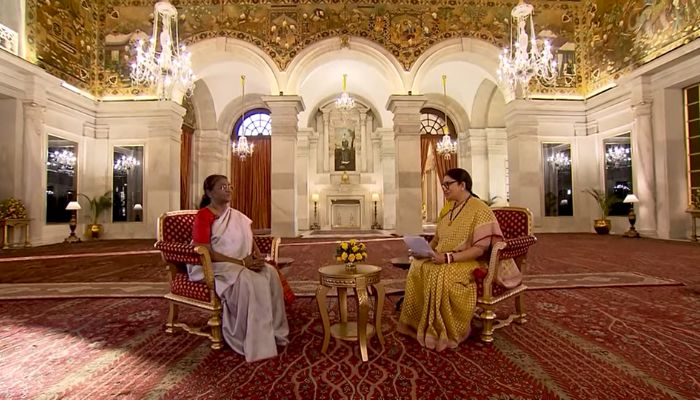
President Droupadi Murmu gave an interview to Union Minister Smriti on Monday (12th February). She shared her journey to the highest constitutional post in the country during this interview. In the interview, Murmu shed light on stories from her childhood memories to public life. The special episode was recorded at Rashtrapati Bhavan on the occasion of ‘World Radio Day’ – 13th February. The hour-long programme was broadcast by All India Radio on Tuesday (13th February).
The programme was aired under the radio series ‘Nayi Soch Nayi Kahani- A Radio Journey with Smriti Irani’. The show was hosted by Union Minister Smriti Irani. This series showcased amazing stories of women’s empowerment with the help of government initiatives. Union Minister’s show for All India Radio concluded with the President’s interview. In this report, we delve into the views shared by President Droupadi Murmu.
President Droupadi Murmu started with her recent Delhi metro journey
At the beginning of the interview, Murmu spoke about her recent journey in the Delhi Metro. She said that she wanted to experience how people feel while commuting through this public transport. She said that there are many modern-day difficulties in urban life today; so she wanted to explore the comforts and discomforts prevalent in the current metro system. She also said that after getting such experiences, she shares with the government all the good experiences as well as gives suggestions wherever necessary. She also said that interaction with students in the metro was pleasant as it was a long time since she met students. She recalled her days as a teacher in the 1990s as she talked about her interaction with students in the Delhi metro.
Humble beginnings
President Droupadi Murmu was the first female student in her village to study post-the fifth standard of the school. She said, “I was an ordinary girl. Becoming the president of India was never my dream. I was just like any other student in the village. I used to play with the other kids in the village in my childhood. We would go to school. Sometimes we would steal mangoes and guavas from somebody’s garden or farm. As a child, everything was just like most of the ordinary kids. We would swim in lakes for hours. As a young girl, I never dreamt of becoming the President of India or some big officer. It was beyond our scope of imagination. All we would think of was that ‘We should get a good education and secure some good job’.”
She added, “I developed the ambition of getting educated and securing some job because of my grandmother who lived in Jamshedpur situated at 60 to 70 kilometres from my village. She was not very educated. But she knew what difference education may bring about in the lives of people. She had closely watched it in Jamshedpur. She would thus tell me to get educated. She told me that being a girl I would be facing more struggle and therefore I needed to get an education. She told me that I should learn household chores alongside my education.”
How did President Droupadi Murmu get her name?
President Droupadi Murmu also shared an anecdote about how she got her name from a teacher. She said, “It is true that one of our teachers gave me this name. In our society, if people get a girl as their first child, they name her after her grandmother. If they get a son as their first child, they name him after his grandfather. It is because people think that the body may die but the name should be immortal. People want that the name should never die. This is why I initially got the name of my grandmother. I was named Durgi by my family.”
She further said, “One of our teachers used to travel to the school from the adjoining district. He did not like that name. Then he kept the ‘D’ from Durgi and renamed me Droupadi.”
President Droupadi Murmu has a motherly approach towards her team in the Rashtrapati Bhavan
Union Minister asked the President about her special approach towards her team in the Rashtrapati Bhavan. President Droupadi Murmu answered to this in detail during this interview. She said, “Coming to the Rashtrapati Bhavan is relatively a recent thing. But, before this, I had the same approach wherever I served. Sometimes, I was an MLA or a minister. Wherever I lived, I believed in living as a family and taking responsibility for the family. I considered everyone in my team as a family member. And it should be like that only because we work with them for a complete five years, which is not a short period. So this family includes everyone from a grade 3 or grade 4 worker to a class one officer. Sometimes we scold an erring family member strictly. At other times we impart love to them. We celebrate festivals together.”
Along with this, President Droupadi Murmu also mentioned her favourite song ‘Vande Utkal Janani’. She underlined that the cultural heritage of Odisha played an important role in her career. She recalled many inspiring Odia poems. She also said that Sengol in the new parliament building symbolises Truth, Justice, and Non-violence. She shared that it was an amazing experience to reach to the parliament for the first time as the President of India.
Early days of service
Remembering the early days of her service in the irrigation department of Odisha, President Droupadi Murmu said, “Had I been in the service, today it would have been five years post my retirement. Very few colleagues from that era are now in contact. But I came to know that when I took the oath as the President of India, sweets were distributed in the department where I used to work.”
Recalling her next job as a teacher, she said, “Life does bring many different things to you. I had to leave my job as a junior assistant in the irrigation department. We moved to a place where my husband was posted by his bank. As our kids grew, I thought about what could be an occupation I could engage myself into and help the family in multiple ways. At that time, I decided to take up the job of a teacher.”
About the teaching job, she further said, “I was ready to educate kids in the school as well as my children at home. Teaching is a very different job than my earlier job. Imparting education is seen as a great donation. It is a very important function in society. But if your mind is stable, you can mould yourself into various roles you are supposed to play. Be it a junior assistant or a teacher. I used to teach various subjects like Hindi, Odia, Mathematics, and Geography.”
President Droupadi Murmu added, “I still meet or interact with my students. My students reached new heights in their lives. Some of them are in the USA. Some others are in London. Many of them are doing high-ranked jobs. I meet them sometimes. When I see them doing these great jobs, I feel happy. My students also became very happy when I was sworn in as the President of India. They sometimes visit the Rashtrapati Bhavan to meet me. The students live in distant places. They also meet me whenever I go to their cities.”
The surprise candidature for the post of the President
President Droupadi Murmu also shared her experience about the moment she knew that she would be nominated for the top constitutional post in the country. Murmu said PM Narendra Modi could not contact her over the phone due to a poor mobile network at her home. For this reason, the PM then called Murmu’s private secretary. It was the PS who immediately told Murmu that the Prime Minister wanted to talk to her. Murmu was surprised to know this. When she was told about her idea for the presidency, for a moment she could not believe it. Then she said, “Thanks for showing this trust in me. If you are believing in this, be it so.”
She added, “As the news spread in the night, people from my village and other nearby villages started gathering near my house. It was a huge crowd. My village is very near to Jharkhand. Many people came from Jharkhand. People said that we came here to see you. Once you become President, you will become busy and we will not be able to see you this close.”
Managing the political career and family life simultaneously
President Droupadi Murmu also shed light on her experience of simultaneously managing her political career as well as her family responsibilities right from 1997 when she was contesting a councillor election as an independent candidate for the first time. She said, “I was not ready at first because my children were young. But I had some political inclination. The family was worried for sure. Because in those days, there were fewer women in politics. My husband had some weakness. Still, he supported me and I fought the election. I became a councillor and became vice-chairman of the council.”
Pondering more about the balance she achieved between her duties as a mother and as a people’s representative, she said, “Politics is not a 10 to 6 office job. It is a public service 24 hours by 365 days. One has to manage household responsibilities with that only. Especially, when your kids are young, they are not independently standing on their own, you need to pay attention to them as well. This is indeed a big responsibility. But you have a higher responsibility towards the society as well. If your family supports you at such time, you can take the responsibility. My husband gave me great support when I became the vice-chairman. I did not know how to ride a cycle, how to drive a motorcycle or a scooty. He took a bank loan and bought a four-wheeler. It was a Maruti 800 – the smallest one of that time. I learned how to drive it. I practised it. When I became a minister, even then I was willing to drive the vehicle myself. But my husband told me that I should not drive it now as I have a yet higher responsibility. You should not drive with so many thoughts in your mind, he said. This is why I stopped driving then.”
Facing the challenges as a woman minister
President Droupadi Murmu also shared her experience of working as a minister. She said, “Becoming a minister was a new thing altogether. I had faced a new situation at every milestone in my life. I was minister of transport and commerce. These subjects were alien to me. At every step, people would speculate what would I as a woman do in these portfolios. The sounds of those questions echoed into my ears. I resolved that no one should be able to raise a doubt and say that this lady could not do anything here. I decided to work in that manner. I would take a review every month. I would see for latest developments and income generation and revenue collection in our department. I worked on the steps to increase the income of my department.”
She added, “In those days, we had 18 RTO offices for 30 districts. I made it 30 RTO offices for 30 districts. There was a collection from check gates as well. I made it from 18 check gates to 23 check gates. There were many leakages in the chain. I raided collectors at midnight to address this issue. I received appreciation for my work. I gained confidence to work alongside the chief minister of the state.
President Droupadi Murmu also talked about various facets of women’s empowerment
“Seeing males and females with discriminating points of view is not fair. God has created both man and woman and he has bestowed equal mental capacities on them. Physical forms are different but their self-realisation is the same. They are equally powerful. Earlier, the society would not agree upon it. Women have mental power, they have self-realisation. If they get even a small support like in the form of a Mudra Loan, or even a word of appreciation, they feel yet more empowered. They put more energy into their work as a result. This scheme is a very good attempt to empower women in India.”
She added, “I go to universities and colleges. I see, there was a time when two or three female students would secure a first class. Now, we can see more than 70 per cent of gold medalists and scholars on the campuses are female students. Whenever I see such scenes on campuses, I feel very happy. Women also got an opportunity in the Republic Day parade and I was very happy to receive the salute as a woman supreme commander of the armed forces.”
About facing bigger challenges at every step, she said, “The first issue is to give opportunities and trust to the woman. I am thankful for the trust shown in my capacities at every time. If she can manage and handle the household responsibilities, so can she handle the responsibility of the country. And after all, time is God. You need to have a good time as well. I was very happy to sign the women’s reservation bill as the President. In current times, there is a need to give more opportunities to women. But I wish there comes a time when there is no need to make such a bill. People understand the importance of themselves and women are given equal opportunities. I have come here after a long struggle. I was feeling very proud to sign the bill. I have seen the works of very talented women in the country. When women will get an opportunity to enter the legislative assemblies and parliament in higher numbers after this reservation, at that time we can see their contribution and talk about that. But one cannot sideline them saying that ‘She is a woman, she cannot do anything’. They can work at that level. They should be given opportunities.” She also shared her experience of flying in Sukhoi of the Indian Air Force, and visit to Pokharan.
‘Yoga helped me overcome depression’: President Droupadi Murmu
President Droupadi Murmu said that there was a tough phase in her life when she lost her husband and two children. She noted that it was at this juncture that she turned towards Yoga and meditation. She underlined that practising Yoga played a great role and helped her overcome the depression. When asked about preferring national duties over grieving personal losses, she said that one should always keep his mind engaged in activities. She said, “And the activities should be positive. Thoughts should be positive. Getting trapped in overthinking and grieving is not the proper way to address it. An empty mind brings more problems to you. Negativity hollows you from inside.”
When asked about the role of a motherly attitude in the political career of a woman politician, she said, “It differs from person to person how much someone is compassionate and caring. Motherly care is important in life. Someone may give this care to her family. But someone may take herself up and see a larger family. You can do it either way. It depends on you. After all, you become what you think.”
G20, global image of India and more
President Droupadi Murmu also remarked that India’s stature in the international arena is continuously growing for the last few years. She noted that India during its presidency of the G20 summit gave the mantra of ‘One World One Family One Future’. She mentioned how India helped many other countries by providing COVID-19 vaccines. She emphasised India’s role in rescuing Indians as well as citizens from other countries from crisis-hit zones.
She also detailed her spiritual journey and told how it helped her during tough times. She also underlined that revamping the sites of civilisational and dharmik importance plays an important role in imbibing spirituality and faith in the minds of the people. She said, “Development means a wholesome development of a person and society. It has various dimensions like economic, social, cultural, civilisational, and technological too. One has to move ahead with the advancements of his time. But one cannot forget the importance of having a strong spiritual base.”
Telling about her ways to deal with criticism, she said, “Accept good things and ignore bad things. That is the way to deal with it.” The President of India concluded the interview with an appeal to the countrymen to participate in the 2024 general elections with zeal and enthusiasm as it is the largest event of democracy.
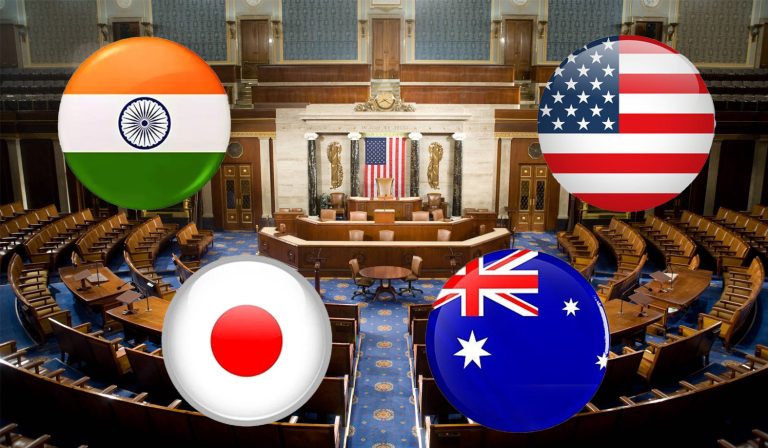
The United States House of Representatives on Thursday (local time) passed the ‘Quad Bill’ which aims to establish a working group for bolstering cooperation between the partner countries.
The Quadrilateral Security Dialogue, also known as the Quad, is a coalition comprised of the United States, Japan, Australia and India.
This bill directs the US State Department to seek to establish a working group with Japan, Australia, and India to facilitate closer cooperation on shared interests and values.
It also requires the State Department to report to Congress a strategy for bolstering engagement and cooperation with the Quad.
The strategy shall address cooperation on issues including; preparing for the next pandemic, co-developing new innovative technologies, and deepening economic engagement and integration, according to the US House of Representatives website.
Ranking Member @RepGregoryMeeks issues statement celebrating the passage of his bill — H.R. 5375, Strengthening the Quad Act — on the House floor: pic.twitter.com/dL7GSzgY4H
— House Foreign Affairs Committee Dems (@HouseForeign) February 15, 2024
US Representative Gregory Meeks, Ranking Member of the House Foreign Affairs Committee welcomed the overwhelming passage of the bill and said that Quad has been integral to promoting a free and open Indo-Pacific.
“I am proud to have advanced my legislation, the Strengthening the Quad Act, through the House of Representatives with strong bipartisan support. The Quadrilateral Security Dialogue between the United States, Japan, Australia and India has been integral to promoting a free and open Indo-Pacific, advancing US interests in the region, and bolstering our national security,” Meeks said in a statement.
“My legislation works to ensure the Quad’s success and longevity by calling on the State Department to develop a strategy on bolstering democratic coordination in the Indo-Pacific region, and establishes a Quad Intra-Parliamentary Working Group to facilitate greater engagement and cooperation among the four legislatures,” he added.
Quad is a plurilateral framework comprising India, Australia, Japan, and the USA, with a shared commitment to upholding a free, open, and inclusive Indo-Pacific, according to the Ministry of External Affairs.
Notably, the next Quad Leaders’ Summit is proposed to be held in India in 2024, but the dates are yet to be decided.
(This news report is published from a syndicated feed. Except for the headline, the content has not been written or edited by OpIndia staff)
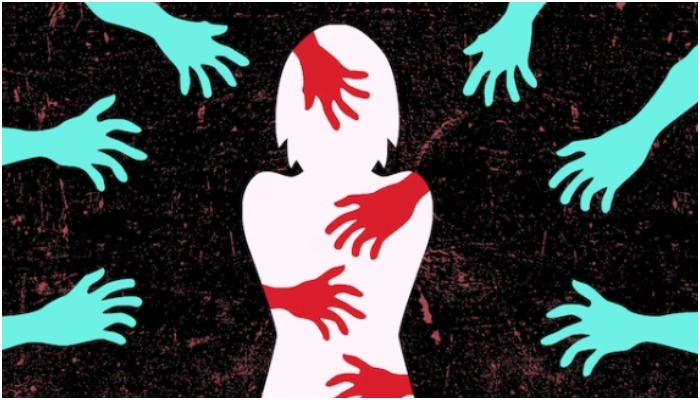
Rajasthan Police have apprehended four students taking NEET coaching in Kota for brutally raping a 16-year-old student who was also preparing to take the medical entrance exam, officials confirmed on Thursday (14th February). A charge under the POCSO Act has been registered against the accused persons.
In her police complaint, the minor stated that one of the four accused called her fraudulently to his flat, where he gang-raped her with three of his acquaintances. According to the authorities, the accused are adults, but their identities have yet to be published due to security concerns. All the accused persons are aged between 18-20.
The incident is said to have happened on 10th February, and the case was filed on 13th February. Police have confirmed that the suspects have been arrested.
In the words of authorities, the victim befriended a boy from Uttar Pradesh on social media a few days ago. During the conversation, she learned that he was preparing for NEET and lived in a leased flat in the Landmark area.
On 10th February, the boy asked the victim to meet him at his flat, where three of his friends were already present. After the girl arrived at the flat, the four of them reportedly gang-raped her.
The remaining three defendants are thought to be from West Bengal and Bihar. All of them were coaching in Kota and are currently being questioned by authorities. The police have organized a special team to investigate the case.
“The victim is a resident of UP and was preparing for NEET (National Eligibility Entrance Exam) in Kota for about a year,” said Additional Superintendent of Police, Uma Sharma.
According to the police, a day after the event, the accused allegedly intimidated the victim not to tell anyone about it. Following the incident, the victim experienced sorrow and attempted suicide. Her friends came over to support her, and she lodged a case.
An hour after claiming that the Income Tax Department froze its bank accounts, the Congress party has now said that its bank accounts are operational.
Senior Congress leader Ajay Maken took to X, formerly known as Twitter, to claim that the Income Tax Department and the Income Tax Appellate Tribunal had asked Congress to maintain Rs 115 crores in their bank accounts.
“This 115 crore is the lien marked in the Bank Accounts. We can spend an amount over and above that. This means that Rs 115 crores have been frozen. This Rs 115 crore is much more than we have in our Current Accounts,” he tweeted.
On our petition, Income Tax Department and the Income Tax Appellate Tribunal (ITAT) has said that we have to ensure that Rs 115 crores have to be kept in the Banks. This 115 crore is the lien marked in the Bank Accounts.
Earlier today, the Congress party alleged that the Income Tax department has frozen its bank accounts. The party alleged that democracy has ended in India with the freezing of bank accounts of the country’s main Opposition party.
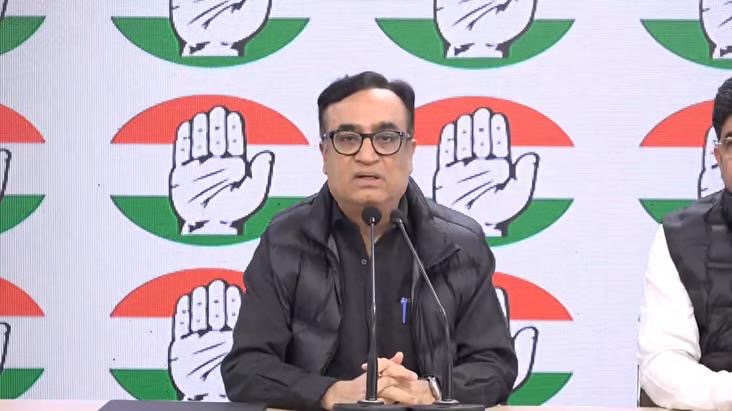
In a press briefing on Friday (16th February), Congress Treasurer Ajay Maken said that the party learnt that the banks are not honouring the cheques issued by the party.
He said that the I-T department has made a demand of Rs 210 crore on flimsy grounds over a case relating to income tax returns of 2018-19.
“It is not only the accounts of the Congress party that have been frozen, but the democracy has been frozen in our country. When the principal Opposition party’s accounts have been frozen just two weeks before the announcement of the national elections, do you think democracy is alive in this country?” Maken said.
He claimed that the money of the Congress party has not been received from the corporates, bonds nor “big money which comes from big houses”.
Maken added that the money frozen has come through crowdfunding by Congress workers. “We collected around Rs 25 crores from the crowdfunding by our workers. 95% of this, less than Rs 100, has been collected legally through UPI. This money has been collected through online funding, no cash has been taken. The Youth Congress has collected its money through membership drive,” he claimed.
Maken added, “On the other hand, more than Rs 6,500 crores which were collected through unconstitutional corporate bonds which have been pronounced unconstitutional by the Supreme Court, that account of the BJP still exists.”
This controversy comes a day after the Supreme Court struck down the electoral bonds scheme as unconstitutional and ordered the SBI to stop accepting the bonds and return such money received in the past 15 days which has not been encashed yet to the purchaser.
On 15th February, the Aam Admi Party (AAP) claimed that there was no encroachment at the Rouse Avenue court where the party’s office is located. The party claimed in the Supreme Court that it had not intruded on any land designated for the Delhi judiciary, and the plot was legally allotted to it. The AAP submitted an affidavit in the Supreme Court claiming that the stated plot was allotted to it by the Delhi Government in 2015. The affidavit was filed in response to the court’s order to vacate the encroachment by a “political party” in land intended for the Delhi judiciary.
According to the party, the Land and Development Office (L&DO) of the Government of India designated the site for the expansion of the Rouse Avenue Court complex in 2023, while the same land was allotted to it earlier. However, the attorneys for the AAP declared that the party is prepared to leave its present location if the court guarantees the selection of a different location for the construction of a new party office that complies with its national party status.
The party requested intervention in the case in its application and stated that it should be heard before the court issues any directives. The petition explained that the purpose of the allocation of office space for official party operations is to level the electoral playing field and is a crucial part of public funding for elections in India.
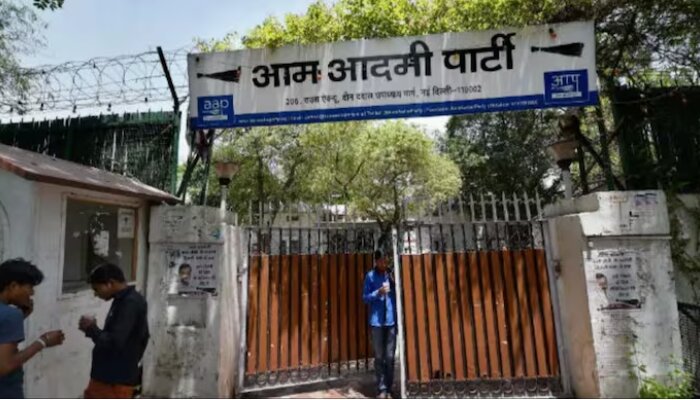
AAP has argued that as a Political Party of National Importance, it is provided with the aforementioned property, which is Bungalow No. 206, Rouse Avenue, Deen Dayal Upadhyaya Marg, New Delhi, following the Land & Development Office (L&DO) of the Government of India’s Policy Guidelines for Allotment of Land to Political Parties, dated 9.11.2012. AAP has the right to two office locations, one for its National Unit and another for its Delhi State Unit under the aforesaid standards but it has currently only been given an office area (the subject premises) for its Delhi State Unit.
The Subject Premises were formally assigned to the Applicant by the Government of National Capital Territory of Delhi (GNCTD) on 31st December 2015 for its State Unit Office, as per the Application of Intervention submitted by AAP. This was completely in line with the party’s entitlement as a State Party at the time, it claimed. Furthermore, AAP said that a notice of cancellation of the allotment was overruled by an order issued by the Delhi High Court on 23rd August 2017.
It alleged, “In view of this, there is no question of the Applicant ‘encroaching’ on a space that was duly allotted to it in 2015 and that has been in its possession since then. The Subject Premises had been in the Applicant’s occupation long before it was earmarked for extending the Rouse Avenue Court Complex.”
AAP said that as per its knowledge, on 18th September 2020, the L&DO granted 3.03 acres of land to GNCTD to construct more courtrooms for Rouse Avenue Court which is scheduled to be located next to the Rouse Avenue Court. On 12th December 2023, L&DO stated that in addition to the unoccupied property next to the Rouse Avenue Court complex, a bituminous road and the Aam Aadmi Party office that are located at the site also need to be allotted for expansion of the court. AAP claimed that the L&DO made took decision without considering the presence of its office.
The application read, “There is no explanation forthcoming for why due diligence was not exercised by the L&DO by examining the pre-existing status of the land and its vacancy.” The party maintained that despite its requests in 2017, no action was taken in response to its proposals for another location.
Although the party is willing to leave the property, it has asked the Court to make sure it is given another space because the immediate vacation would leave the AAP without any office in Delhi. This is especially important because of the upcoming General Elections and the fact that the other five national parties operate out of their designated offices in Delhi, the party claimed.
AAP noted, “Therefore, while the Applicant remains ready and willing to vacate the Subject Premises, it is submitted that this Hon’ble Court direct that such vacation be required only after at least one of the two office spaces that the Applicant is entitled to are allotted to it in the New Delhi Municipal area of a nature appropriate to the Applicant’s status as a National Party. Such a direction need not cause any further delays in the construction of courtrooms in Rouse Avenue, since the Subject Premises are not located in the portion of the land where construction is planned as per the design approved by the Hon’ble High Court of Delhi.”
The Aam Aadmi Party (AAP) came under fire from the Supreme Court on 13th February after it was notified that the party had “encroached” on territory designated for the Delhi High Court. The court expressed displeasure that the AAP political office, located at Rouse Avenue in Delhi, was built over encroached land. The Court then mandated that all intrusions be cleared from the property.
Notably, the Court became aware of the problem when it was handling a case involving the nation’s court system. The matter was being heard by a three-judge panel that included Chief Justice of India (CJI) DY Chandrachud, Justices JB Pardiwala and Manoj Misra.
The current AAP office is a government bungalow, earlier allotted to union ministers. The house at 206, Deen Dayal Upadhyaya Marg, with a huge garden was allotted to AAP in 2015, after which the party moved its office from Patel Nagar. After gaining national party status, AAP is trying to find land to construct its national headquarters but has not been successful so far. It wanted a plot on Deen Dayal Upadhyaya Marg, where the new headquarters of BJP and Congress are located, apart from the current AAP office, but the authorities told them that there is no vacant land parcel available. As per central govt rules, national parties are eligible for allotment of land at concessional rates.
The Andhra Pradesh Reorganisation Act, 2014 has not only resulted in the splitting of erstwhile Andhra Pradesh into two states – Telangana and Andhra Pradesh – but has also been the cause of two historical events in the country’s polity.
The infamous pepper spray incident in the Lok Sabha occurred when this bill was tabled in the Lok Sabha in February 2014. Desperate to not have it passed, a Congress MP, Lagadapati Rajagopal, pulled out a pepper spray from his pocket and unleashed it on hapless members of the 15th Lok Sabha. Sonia Gandhi had to suspend her own members from the Lok Sabha to enable the passage of her own government’s bill.
Everyone remembers the now famous line by Modi in 2018 while replying to the No-Confidence Motion (NCM) against his government – “I wish the opposition all the best in bringing the same motion in 2023 too”! The misgivings surrounding the implementation of the AP Reorg Act were the primary reason that led to this no-confidence motion!
The drafting of the act was so careless and shoddy that the Modi government had to redraw the boundaries of the two states, in its very first cabinet meeting in May 2014. The urgency was to ensure that there were no issues for the official bifurcation to happen on June 2nd, 2014. Over the next 10 years, it became the responsibility of the Narendra Modi government to clean up many shoddy aspects of this mess and meet the 10-year deadline that UPA put on multiple projects.
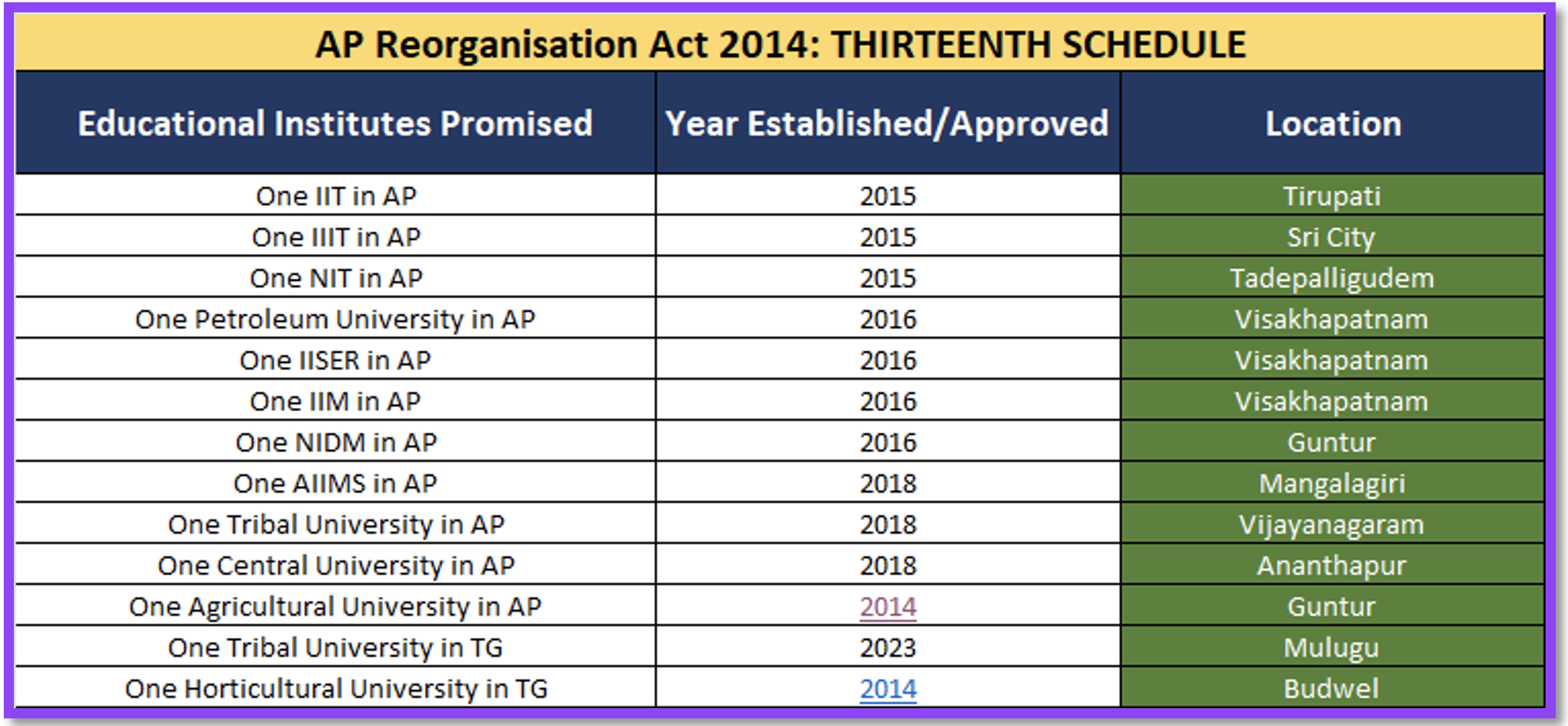
The Thirteenth Schedule of this Act promises 13 different educational institutions – 11 in Andhra Pradesh and 2 in Telangana. This was done to make up for the lack of good institutes outside of the Hyderabad region. As we can see in the table below, the Narendra Modi government has either approved or established all these institutes in these 10 years.
All institutes started imparting classes within a year of getting approvals. The last approval came for the Tribal University in Telangana in October 2023. Unfriendly media tried to make a mountain out of molehill for certain aspects of these approvals, just to make Chandrababu Naidu look good, but you can see from the table that most institutes were functioning in the first term of NDA itself (though they had 10 years of time to just approve!).
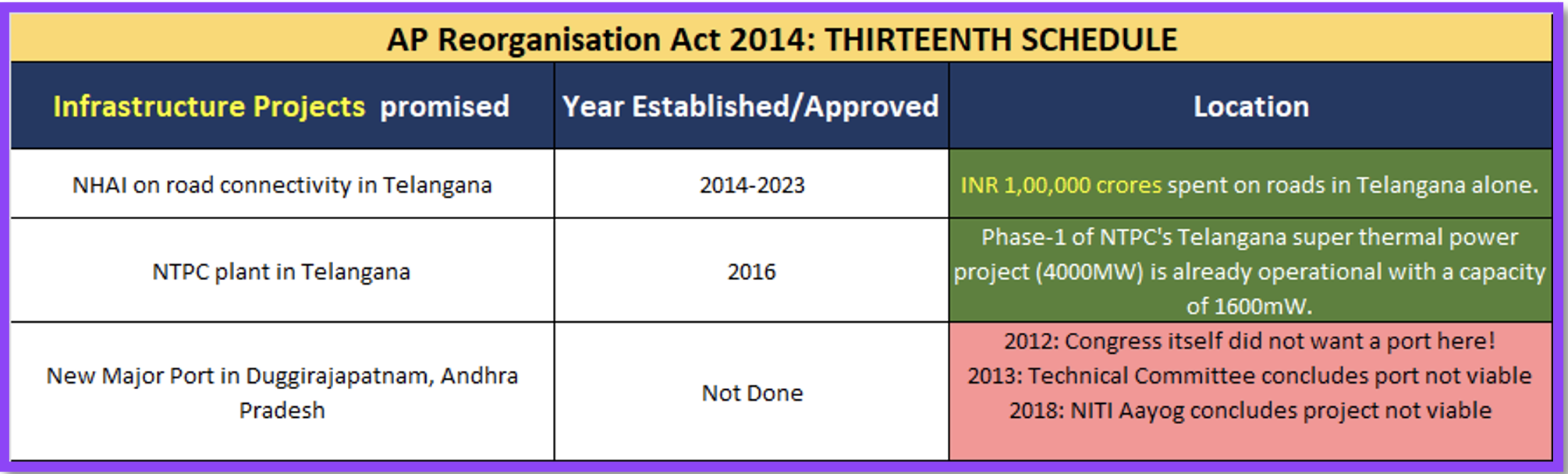
The second aspect of the Thirteenth Schedule is a shining example of how carelessly Sonia Gandhi’s government prepared the Act and left it to Modi to clean it up. The Act promised three infrastructure projects as mentioned in the table below:
A vague definition that NHAI will improve road connectivity in interior areas of Telangana was promised in the Act. Little would Sonia Gandhi have realized that Narendra Modi will simply transform the road infrastructure in the entire India, let alone Telangana. A whopping INR 1,00,000/- crores were spent on just roads for Telangana (out of which NHAI spent 75,000 crores!). The next promise is for a 4000 MW NTPC plant. Modi government approved this in 2016 and Phase-1 (with 1600MW) is already operational.
We now come to the promise that was not fulfilled – “The Government of India shall develop a new major port in Duggirajapatnam, Andhra Pradesh”. In the year 2012, Congress’s own Chief Minister recommended that a port cannot be built in Duggirajapatnam. In the year 2013, the UPA government’s technical committee concluded that a port was not viable there because of environmental issues and more importantly would be a hassle for ISRO’s launch center in Sriharikota. Yet, Sonia Gandhi decides to promise the development of a port in this very town.
NITI Aayog gives another attempt – and concludes that in addition to clearance issues, it just doesn’t make sense to have a major port so close to Chennai (80 km), Ennore (80 km), and Krishnapatnam (40 km)! The project therefore had to be shelved. The state government tried to establish another port at a town called Ramayapatnam but isn’t pursuing it any further. It’s really sad how Sonia Gandhi, knowingly promised something that she knew wasn’t recommended by anyone.
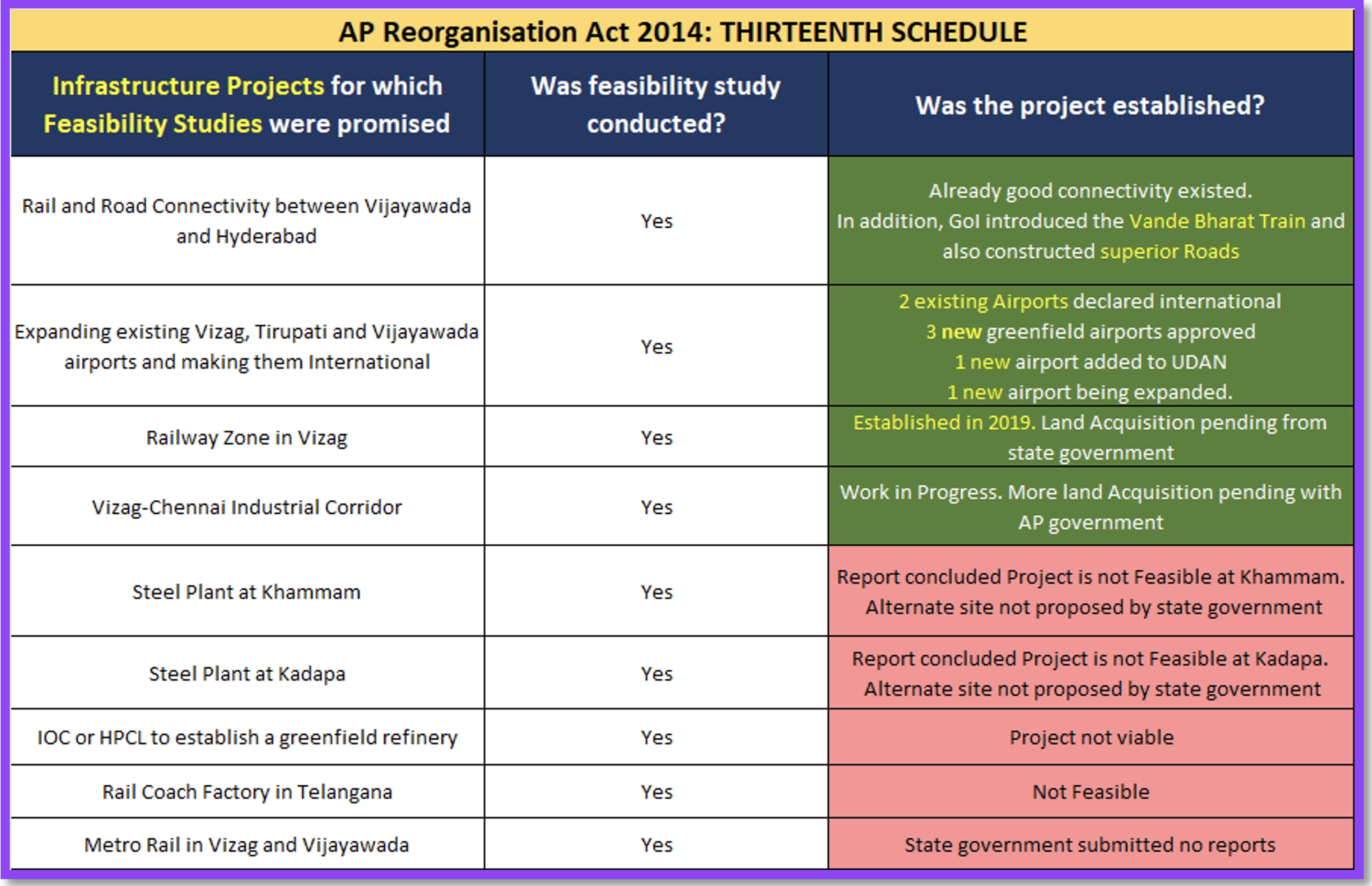
The shoddy job doesn’t end here. The Thirteenth schedule promises a lot of “feasibility studies” for multiple infrastructure projects, as listed in the table below.
Yet another vague promise of “improving rail and road connectivity between Vijayawada and Hyderabad” was made. Today, we have excellent road connectivity not just between these two cities, but across the entire two states. The investments in railways also ensured better connectivity not just between these two cities, but in the entire two states. Little did Sonia Gandhi realize at that time, that Modi would transform connectivity in India like never before!
A promise was made to merely do a “feasibility study” of expanding the existing 3 airports and making them international too (while one was already International!). Modi went multiple steps further – expanded 2 of the other airports to international; gave approvals to 3 new greenfield airports; added 1 new airport to UDAN and approved the expansion of another new airport! Little did Sonia Gandhi realize Modi would transform our transport sector like this in India, let alone Telangana!
Feasibility studies were promised, within 6 months, for 4 projects – steel plants at Khammam in Telangana and Kadapa in Andhra Pradesh; for greenfield refinery; and a rail coach factory. All feasibility reports have concluded that none of these projects are viable! Sonia Gandhi’s chicanery in portraying a mere promise of “feasibility study” as a promise of actual implementation is simply unparalleled. So technically while the Modi government fulfilled the promise of conducting feasibility studies for all projects, he has faced a lot of (unfair) flak for actually not establishing unviable projects! Even then, the Modi government wanted to work with the state governments for alternate sites for these projects, but the state governments showed no interest.
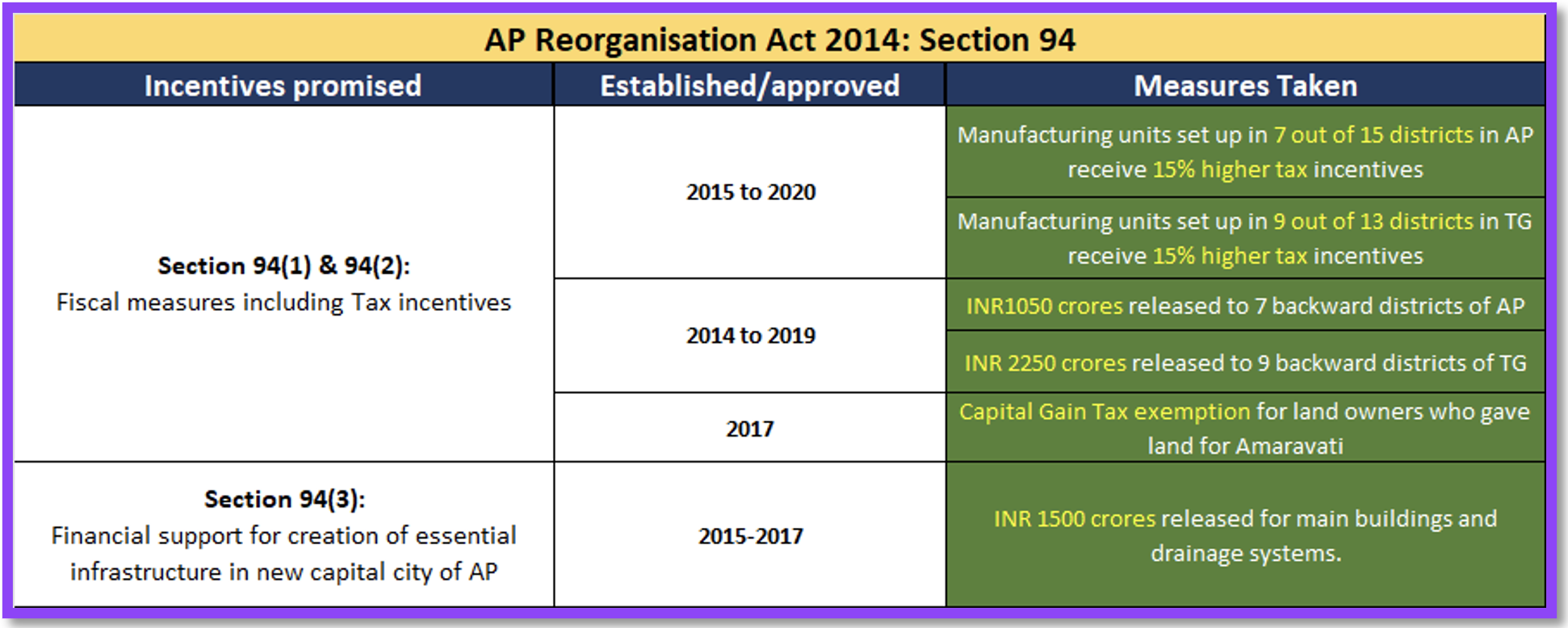
The vagueness does not extend to just Educational Institutes and Infrastructure projects. Section 94 of the Act gives a vague promise of fiscal incentives “as necessary”. This can mean anything under the sun! The Modi government has made a meaningful implementation of this vague promise by funding backward districts in both states and providing other incentives, as listed in the table below.
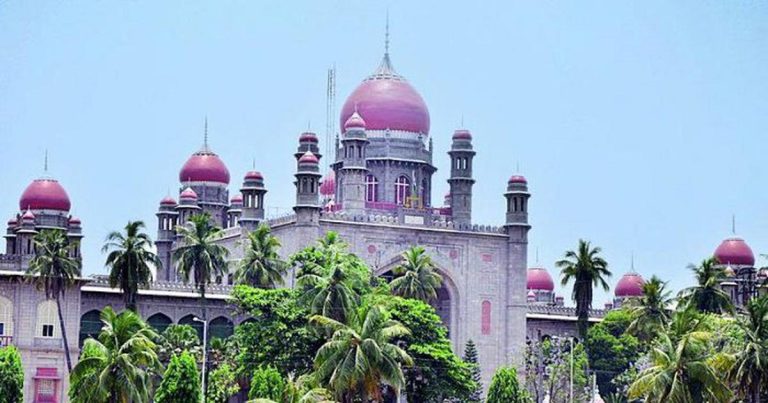
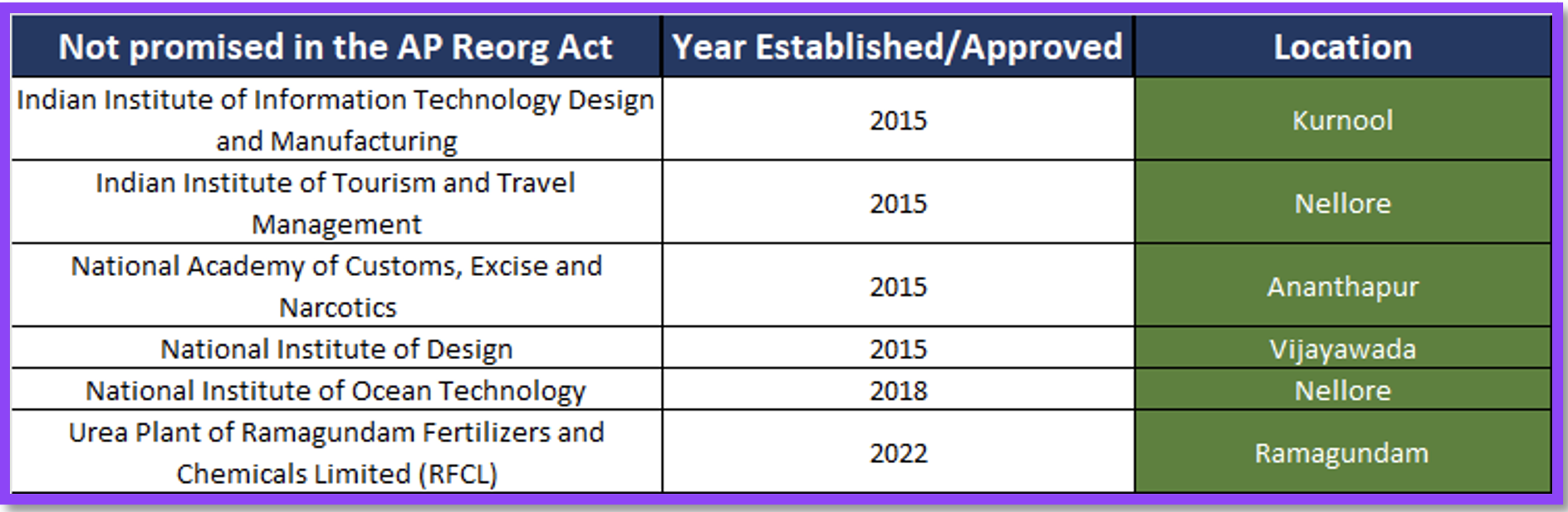
There was a vague promise of financial support for the capital city – the Modi government released INR 1500 crores for this too (the High Court, Secretariat, and Assembly were built with these funds, in addition to drainage systems). In addition to what was promised, the Modi government established institutes and projects that were not promised in the act too.
If you are not from Andhra Pradesh, you would now be wondering what exactly is the problem when the Modi government fulfilled all promises and more! The core issue was the promised Special Status to Andhra Pradesh on the floor of the Rajya Sabha by Prime Minister Manmohan Singh (but not included in the Act). He assured the special status for 5 years (2014 to 2019).
Venkaiah Naidu from the BJP told the house that when the BJP comes to power, they will extend this to 10 years. Special Status for 10 years was sold as the panacea for all ills that will befall AP when the split happens. This was sold by the BJP, TDP, and Jana Sena parties in the run-up to the 2014 elections. After the elections, because of recommendations from the 14th Finance Commission, the Modi government did not give the promised special status but instead gave a special package.
This did not go well with the people of Andhra Pradesh who were already emotionally charged. No amount of factual discourse helped create a sense of confidence among the people. It was a promise broken – no two ways about it, but the remedial measures were good. It was a double failure not to communicate them properly.
However, this broken promise should not be an excuse to forget the shoddy and perhaps dangerous way in which the state was split. We should never forget how Congress MPs had to form a ring around the country’s Home Minister in the Lok Sabha, to prevent an attack from other Congress MPs; how violence was employed by Congress MPs in the Lok Sabha; how Congress Cabinet ministers did not have access to the Act before it came to the Cabinet; how the Home Minister of India stood up and said that though he is supposed to own the Bill, he will relegate that responsibility to another minister Jairam Ramesh because he drafted the bill; and how the live telecast of Lok Sabha was cut off when the bill was put to vote! Sonia Gandhi’s lack of respect for process and norms resulted in one of the most badly prepared splits of a state.
The Act is so badly drafted that even now there are unresolved issues between the Telangana and AP state governments (For example, Jairam Ramesh failed to list 12 institutions whose assets have to be distributed between the states and now they are fighting for them!). Let’s hope that India never has such careless people at its helm again.