Home Blog Page 1562

Islamists outraged at fashion brand Zara after imagining a dead Palestinian in a wrapped mannequin, call for boycott

Spanish fashion retail giant Zara has come under fire from Islamists for its latest collection campaign called “The Jacket”. Palestinian and pro-Palestinian netizens have called for the boycott of the fashion brand alleging that it mocked the death of Palestinians in its latest collection.

On 7th December, Zara release pictures of its latest collection showing a model in black clothes against a white backdrop with props. The backdrop bears resemblance to a ravaged structure down in rubbles.

Two men in complete white uniforms can be seen merging with the background and broken mannequins have been positioned differently across these set of images.

Netizens on X, formerly Twitter, have shared some images – which now appear to have been deleted amid the backlash – alleged that the images and the props used are mocking the death of Palestinians in Gaza.

One of the deleted images shows the model hold a mannequin wrapped in a white cloth with rubble at the back. Another image shows a mannequin-like structure wrapped in plastic lying on the floor.

A third image shows the same mannequin, one wrapped in white cloth, as a standalone with another mannequin. Another image has been pointed out by social media users showing a prop like a piece of rubble which they allege resembles the Palestinian map.

Several pro-Palestinian users on X, including Islamists like Majid Freeman, have likened these Zara campaign images to the scenes emerging out of Gaza amid Israeli strikes on Hamas.

X Users have compared the Zara images with the bodies of the deceased wrapped in white in Gaza, with mothers holding their children wrapped in a white cloth, and damaged buildings.

A page called Palestine Online shared a video of a Palestinian alleging that Zara is making fun of their people and fun of their children being killed.

A video of another user is going viral where she can be heard calling for boycott of the fashion brand.

Another pro-Palestinian user said that their wardrobe is filled with Zara clothes but that they are boycotting the brand for life.

Radical, terrorism supporting Islamists like Majid Freeman have also waded in to capitalise on the boycott trend calling the Zara collection as the “Gaza genocide collection”.

According to reports, the retailers asserts that the campaign is a deliberate design choice aimed at highlighting the versatality of the garment.

Amidst the boycott, an old controversy linked to Zara’s Israeli head designer has resurfaced. In June 2021, the brand’s head women’s designer Vanessa Perilman in a private chat with a pro-Palestinian model lashed out at Hamas.

The screenshot of her message, which was made viral by the pro-Palestine model Qaher Harhash, read, “Maybe if your people were educated then they wouldn’t blow up the hospitals and schools that Israel helped to pay for in Gaza.”

Her message further read, “Israelis don’t teach children to hate or throw stones at soldiers as your people do.”

In a stark reality check to the model, she wrote, “I think it’s funny that you are a model because, in reality, that is against what the Muslim faith believes in and if you were to come out of the closet in any Muslim country, you would be stoned to death.”

The model continued to share more screenshots of Perilman’s messages even as she received death threats against her children. “I am sorry if this fight started something more than it should have but now it’s getting out of control,” her message read.

“I am literally receiving death threats against by children,” she said to Harhash. She apologised to the pro-Palestinian model and deleted her social media accounts.

Vanessa Perilman is a fashion industry veteran and obtained her current position at Zara in 2015. She works as “Head Designer for the Zara Women’s Collection” in Spain.

Perilman, an Israeli, has worked with several brands including Forever 21, Club Monaco and The Donna Karan Company. She continues to stay off of social media.

Perilman was brave enough to defend her country and did not shy away in the messages from calling out radicalism among Palestinians, many of whom have openly been supporting Hamas, as can be seen in the present day in the context of the 7th October terrorist attack.

Moreover, the global fashion industry is known to experiment beyond the limits of comprehensible creativity. Tacky and weird creativity is what often draws attention to these brands and their presentation of their collection forms a key part of their selling point. It is very much likely that Islamists read into a fashion photo shoot only to bring back the Perilman controversy from the grave and attack her and the brand once again.

After Israel launched an offensive strike in retaliation to the 7th October terrorist strikes by Hamas on Israel, pro-Palestinians and Islamists around the world have called for global boycott of Israeli brands.
Rajasthan: Hindu tailor in Alwar receives bomb threat, letter from PFI threatens him to shut shop

0

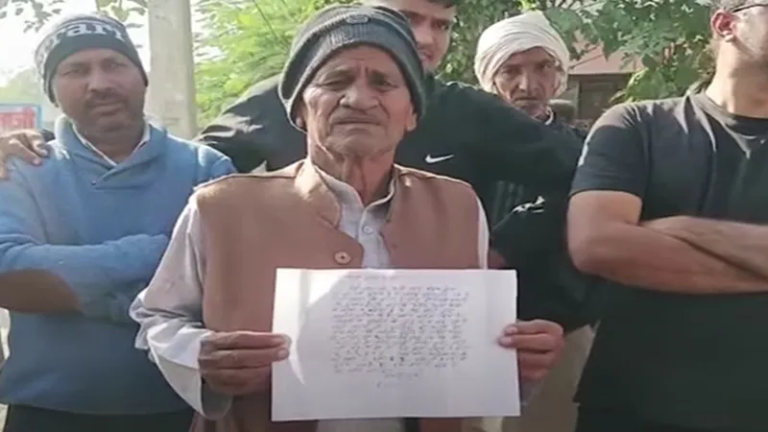
On Saturday (9th December), a Hindu tailor in Rajasthan’s Alwar district filed a complaint with the police after reportedly receiving a death threat from the banned radical Islamist outfit Popular Front of India (PFI).

The victim was identified as Sohanlal Jatav. The tailor claimed that about two weeks ago, he received a handwritten letter containing explicit threats of bombing and death.

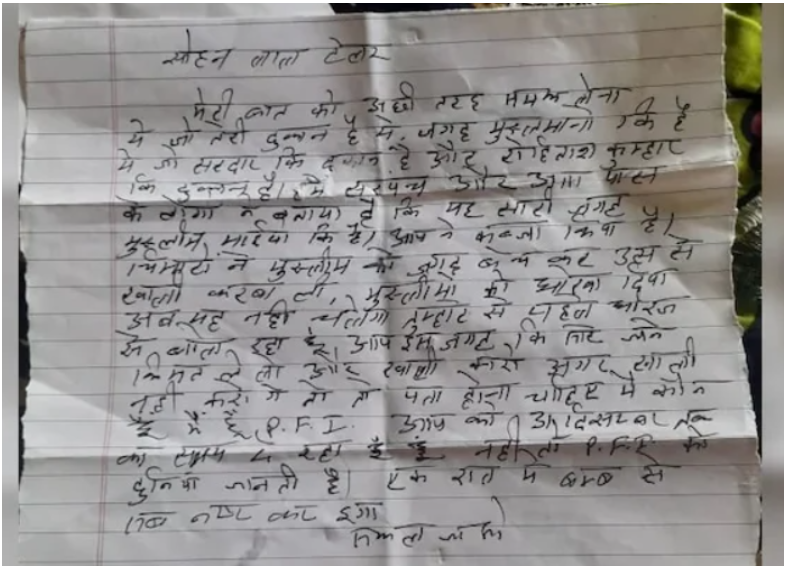
The letter, which was said to have been written by PFI, gave Jatav time until 31st December to shut down his store in the market and embrace a fair price in exchange. It stated that the three stores that Jatav owns in the market supposedly belong to the Muslim community and threatened him to shut them up. 

Threat letter received by Sohanlal jatav

However on Sunday (10th December), Jatav informed the media that he had bought the land in 1971 from the village panchayat. A few people filed a lawsuit against him after he deposited the money and obtained the lease deed. A compromise was eventually reached, allowing him to construct retail shops on the property.

“I worked as a tailor in this shop for several years. Now, for the past six months, I have rented the shop to Balaji stationers. Now, there is a threat that my possession of the shop is illegal, and I should compensate for it and vacate it,” he said.

SP Anand Sharma took cognisance of the matter and commented on the issue. He confirmed that the threat letter was sent from the Chikani post office on 13th November, but it was delivered later. He also stated the possibility that the letter was written to cause trouble during the assembly elections. “The dispute over vacating the shop was resolved 30 years ago. The investigation into the case is ongoing,” he added.

It is important to note that a Hindu tailor Kanhaiya Lal was murdered in the year 2022 by two radical Islamists named Riaz and Ghous Mohammed. The duo disguised as customers and entered the tailoring shop of the deceased. While Kanhaiya Lal was busy taking the cloth measurements, one of the accused attacked him with a long sharp knife. According to the post-mortem report, he was stabbed 26 times on his body from his neck to shoulder. Kanhaiya Lal was killed for uploading a social media post in support of ex-BJP spokesperson Nupur Sharma.

Supreme Court upholds Centre’s decision to abrogate Article 370

On 11th December, the Supreme Court of India upheld the Centre’s decision to abrogate Article 370. The National Democratic Alliance (NDA)-led government at the Centre under the leadership of Prime Minister Narendra Modi revoked Article 370, taking away the special status of the state of Jammu and Kashmir on 5th August 2019. The state was then reorganised into two Union Territories, Ladakh and Jammu and Kashmir.

Chief Justice of India, Justice DY Chandrachud, Justice Gavai and Justice Surya Kant gave a joint judgment, while Justice Khanna and Justice Kaul authored separate judgments.

In his judgment, CJI Chandrachud held that Jammu and Kashmir does not hold any internal sovereignty after accession to the Union of India.

Furthermore, CJI said that Article 370 was a temporary provision, and it was introduced to serve a transitional purpose to serve an interim process. It was introduced due to the war conditions in the state. CJI added that the textual reading showed it was a temporary provision, and thus it was placed in part 21 of the constitution.

CJI added that the effect on Presidential Power to issue a notification abrogating Article 370 subsisted. “A ruler of each Indian state had to issue a proclamation adopting the Constitution of India,” the court added.

Furthermore, CJI also held that all provisions of the Constitution of India can be applied to Jammu and Kashmir.

In conclusion, the court stated as follows.

  1. J&K does not retain any sovereignty after the instrument of accession was signed.
  2. No internal sovereignty for Jammu and Kashmir
  3. The challenge to the proclamation of the presidential rule is not valid.
  4. The exercise of the president’s power must have a reasonable nexus with the object of presidential rule.
  5. The power of parliament to legislate for the state cannot exclude law-making power.
  6. Article 370 was a temporary provision.
  7. When the constituent assembly was dissolved, only the transitory power of the assembly ceased to exist, and there was no restriction on presidential order.
  8. Paragraph 2 of co 272, by which article 370 was amended by amending article 367, was ultra vires as the interpretation clause cannot be used for amendment.
  9. The President’s use of power was not mala fide, and no concurrence was needed with the state.
  10. Para 2 of co 272 in the exercise of power under 370(1)(d) applying all provisions of the Indian constitution to Jammu and Kashmir was valid.
  11. The president’s continuous exercise of power shows the gradual integration process was ongoing. Thus, co 273 is valid.
  12. The constitution of Jammu and Kashmir is operative and has been declared redundant.
  13. Presidential use of power, not mala fide
  14. SG made a statement that statehood will be restored to Jammu and Kashmir. We uphold the decision to carve out UT of Ladakh. We direct ECI to hold polls under section 14 of the reorganisation act and statehood at the earliest.

Article 370 and effects of its abrogation

Article 370 granted special autonomy to Jammu and Kashmir. It curtailed the central government’s legislative authority over the state. The now-revoked Article 370 allowed the state to formulate its own law, with specific exemptions in areas like finance, defence, foreign affairs, and communications.

In 1954, Article 35A was introduced under Article 370, empowering the Jammu and Kashmir government to define permanent residents. The said article, which has now been revoked alongside Article 370, prohibited individuals outside the state from establishing permanent residence, buying land, or holding certain positions in government offices.

Following the abrogation of Article 370, two Union Territories named Jammu and Kashmir (with a legislative body) and Ladakh (without a legislative body) were created. As assembly elections have not taken place in either of the UTs, they are currently being administered by Centre-appointed lieutenant governors.

In May 2022, the Jammu and Kashmir Delimitation Commission redefined electoral boundaries, names and the number of assembly seats. Delimitation is a precursor to future assembly elections. Reserved seats for scheduled tribes and representation for Kashmiri migrant communities were introduced alongside the delimitation process.

Furthermore, following the abrogation of Article 370, elections in Jammu and Kashmir opened for those who settled in the region and were previously deemed as “outsiders”. This inclusive move allowed West Pakistan refugees residing in the UT for 70 years to participate actively in the local elections.

The socio-political landscape of the region has changed extensively over the past four years. Almost zero incidents of stone pelting, paced-up infrastructure, and introduction of government schemes in the region are some of the examples of changes brought to J&K following the abrogation.

Indian-origin Professors, now under scanner for endorsing anti-Semitism in US university, were behind cancellation of PM Modi’s talk in 2013

Amid the ongoing Israel-Hamas war, prominent US universities are witnessing a sharp rise in anti-Semitism and harassment of Jewish students by pro-Palestinian supporters. The case of the University of Pennsylvania in Philadelphia is no different.

On 5th December this year, two Jewish students studying at the University of Pennsylvania in the United States filed a lawsuit against the varsity for failing to stop anti-Semitism on campus and violating their civil rights.

The lawsuit stated that “(Penn) has transformed itself into incubation lab for virulent anti-Jewish hatred, harassment and discrimination.” The two Jewish students, identified as Eyal Yakoby and Jordan Davis, pointed out how some students and Professors have demonised the Jewish State of Israel.

They referred to a new group on the campus named ‘Penn Against the Occupation (PAO),’ which made anti-Semitic remarks about Israel and its right to exist as a nation. Page 28 of the lawsuit [pdf] read –

Penn Against the Occupation (“PAO”), a new anti-Israel student group, called on Penn to divest from Israeli companies, and terminate contracts with companies that “enable” Israel. PAO asserted that Israel, which has “genocidal, racist foundations,” was engaged in “ongoing ethnic cleansing” and “an ongoing project of settler colonialism that depends on the marginalization and incremental destruction of Palestinian life.” The statement was signed by twenty-nine groups and over three hundred members of the Penn community, including professors Ania Loomba, Suvir Kaul, Chi-ming Yang, David Kazanjian, Meta Mazaj, and Toorjo Ghose.

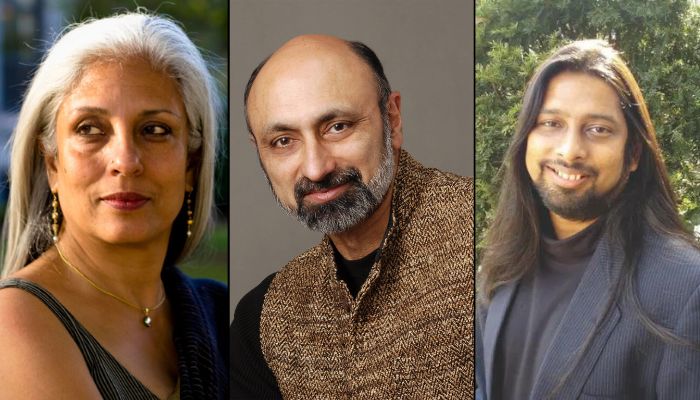
Interestingly, the Jewish students called out three Indian-origin Professors, namely, Ania Loomba, Suvir Kaul and Toorjo Ghose for endorsing the anti-Semitism fuelled by PAO at the University of Pennsylvania.

Ania Loomba (left), Suvir Kaul (centre) and Toorjo Ghose (right), images via University of Pennsylvania

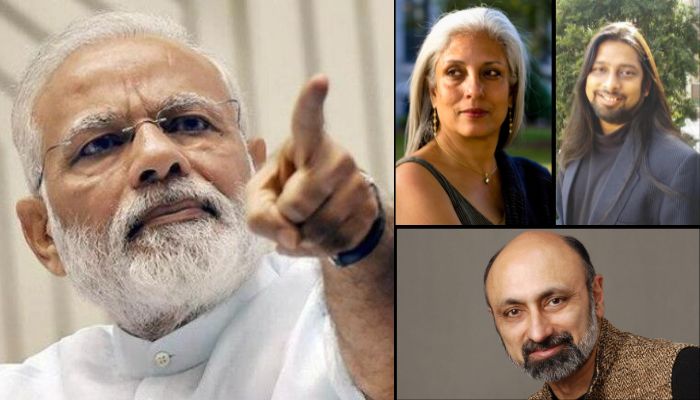
Coincidentally, the same three Professors were involved in the cancellation of Prime Minister Narendra Modi’s talk at the Wharton School of the University of Pennsylvania about a decade ago.

The year was 2013. Narendra Modi, who was then the Chief Minister of Gujarat, was invited as a Speaker at the Wharton India Economic Forum (WIEF) in Philadelphia. The event was organised primarily by the student community at Wharton.

At that time, Professors Ania Loomba, Suvir Kaul and Toorjo Ghose wrote a ‘strong letter’ against Modi to the Wharton administration.

Indian-origin Professors raked up ‘Gujarat riots case’ despite clean chit

The letter read, “This is the same politician who was refused a diplomatic visa by the United States State Department on March 18, 2005, on the ground that he, as Chief Minister, did nothing to prevent a series of orchestrated riots that targeted Muslims in Gujarat.”

The Indian-origin Professors were also able to secure the signatures of 250 people. This was despite the fact that the independent Special Investigation Team (SIT), constituted by the Supreme Court of India, gave a clean chit to Narendra Modi in the ‘2002 Gujarat riots case’ in April 2012.

Given that the event at Wharton was scheduled for March 2013, it meant that the Indian-origin Professors and the Penn University leadership were privy to the development 11 months ago.

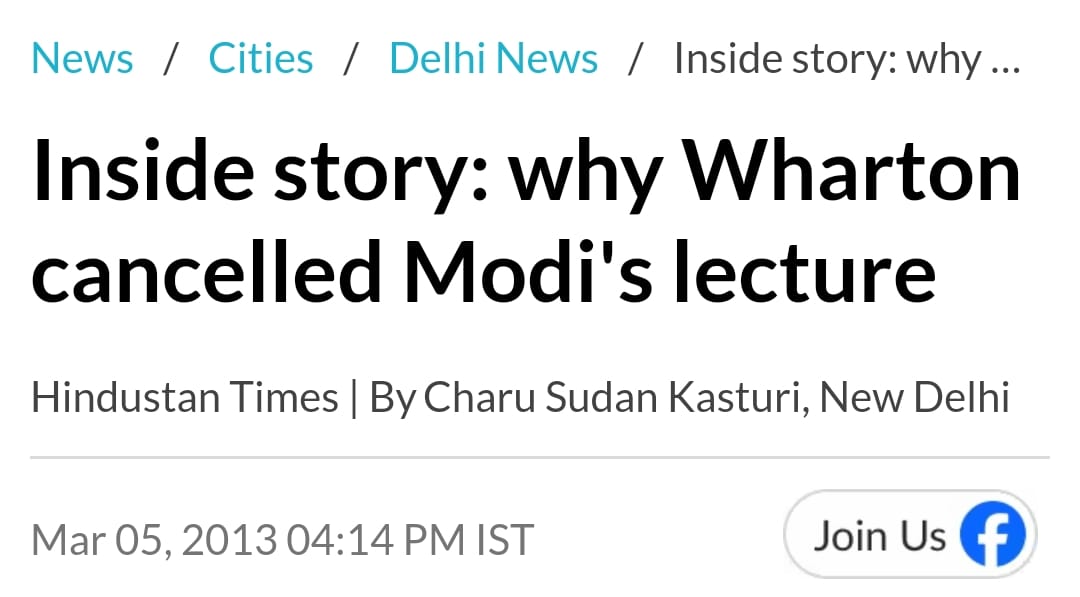
Screengrab of the news report by Hindustan Times

Nevertheless, the nefarious agenda of the three Professors succeeded and the then University President Amy Gutmann gave in to the pressure mounted by them. The invitation was eventually withdrawn

It must be mentioned that the student body at Wharton was in favour of inviting Narendra Modi and the faculty of the business school did not want to upset a potential Prime Ministerial candidate.

A senior official told Hindustan Times that not a single faculty member of Wharton School wanted the talk to be cancelled. “Make no mistake, the move to not have Modi was a result of UPenn (the workplace of the three Indian origin Professors), not Wharton,” the official emphasised.

Now, Ania Loomba, Suvir Kaul and Toorjo Ghose have been named in a lawsuit filed against the University of Pennsylvania for fuelling anti-Semitism in the campus.

University of Pennsylvania and its connection to ‘Dismantling Global Hindutva’ Conference

It must be mentioned that the University of Pennsylvania was one of the co-sponsors of the three-day Hinduphobic conference titled ‘Dismantling Global Hindutva (DGH),’ organised in September 2021.

Dismantling Global Hindutva (DGH) conference prompted Hinduphobia through fear-mongering without substantial evidence, delegitimizing Hindu critiques, and created a double standard by singling out Hindutva.

The event denied the existence of Hinduphobia and downplayed the concerns of the Hindu community. In October 2021, Hindu American Foundation wrote [pdf] to the US Department of Education’s Office of Civil Rights to investigate Penn’s treatment of Hindu and Indian-origin students.

The University of Pennsylvania was also made aware of reckless, incendiary, and unsubstantiated labels such as “supremacist,” “extremist,” “fascist,” and “Nazi” that scholar-activists associated with the event were using on both social and traditional media to disparage thousands of individual Hindus and numerous Hindu American students and community organizations expressing concerns about institutional support of a hostile, one-sided event,” the complaint said.

‘Don’t die for Yahya Sinwar, surrender now’: Netanyahu warns Hamas as IDF artillery unit enters Gaza strip

0

For the first time since Israeli forces initiated their ground offensive in Gaza, IDF (Israel Defence Forces) artillery has been deployed inside the Gaza Strip.

In the last few days, forces of the IDF’s artillery, the 282nd Fire Brigade, crossed the border and operated in the Gaza Strip in cooperation with elements of the 188th armoured brigade in the Shejaiya neighbourhood of Gaza City.

During the operation, over 20 terrorist targets were attacked, including munitions warehouses and military infrastructures of the terrorist organisation Hamas.

Until now, the men and women of the IDF artillery corps have only operated from outside the Gaza Strip, assisting the forces on the ground.

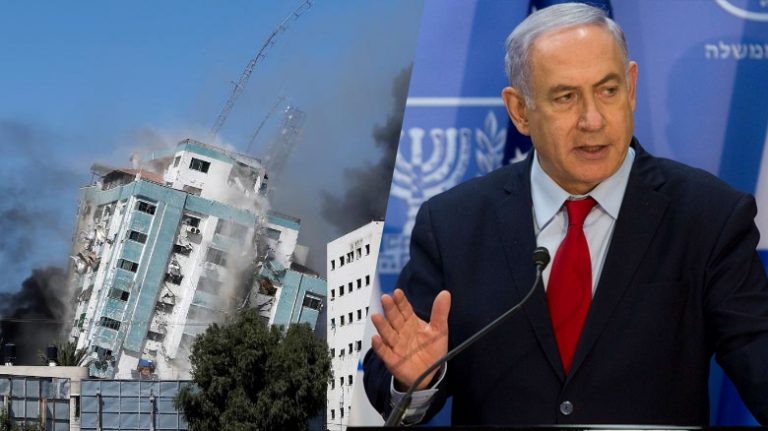
As heavy fighting continues in Gaza between Israel and Hamas, with the war entering its 66th day and Israeli forces being relentess in their pursuit of attacking Hamas, Israel Prime Minister Benjamin Netanyahu called on the terror group to ‘surrender now’ and warned that ‘it is the beginning of the end of Hamas’.

Netanyahu’s warning comes at a time when dozens of Hamas terrorists have surrendered to Israeli forces in recent days.

In a video posted by Israel PM’s Office, Netanyahu called on Hamas terrorists to not die for Hamas head in Gaza, Yahya Sinwar.

Netanyahu said, “In the past few days, dozens of Hamas terrorists have surrendered to our forces. They are laying down their weapons and turning themselves into our heroic soldiers. This will take time. The war is still ongoing but it is the beginning of the end of Hamas. I say to the Hamas terrorists: It’s over. Don’t die for Sinwar. Surrender – now!”

Meanwhile, Israel Defence Forces spokesperson Rear Admiral Daniel Hagari said the military has discovered a large tunnel network below Palestine Square in Gaza City, The Times of Israel reported.

Hagari said that troops of the 401st Armoured Brigade, the Navy’s Shayetet 13 commando unit, and the Air Force’s Shaldag unit have completed the capture of the Palestine Square area. He said that troops using “accurate intelligence” found the network of “strategic tunnels” in the area, which according to him connect to Shifa Hospital.

Hagari said, “The Palestine Square area houses Yahya Sinwar’s office, government offices, assets of senior Hamas officials, and there is a network of terror tunnels,” The Times of Israel reported.

He noted, “This is the area of the main command center, where senior Hamas members were on October 7 and during the fighting, and during the fighting, they moved to other areas.” He said the troops are continuing to probe the tunnel network in the area.

Meanwhile, the IDF announced that it has killed the new commander of Hamas’ Shejaiya battalion in an airstrike in the Gaza Strip on Saturday. Emad Qariqa replaced Wissam Farhat after the latter was killed in an Israeli airstrike on December 2. According to IDF, Qariqa previously worked as Shejaiya battalion’s deputy commander.

On Saturday, IDF also announced the death of a soldier who was injured in northern Gaza on Friday, taking the toll of slain soldiers in the ground offensive against Hamas to 98, according to The Times of Israel report.

The soldier has been identified as Lt Nethanel Menachem Eitan (22), a cadet in the Bahad 1 officers school’s Gefen Battalion, and a soldier in the Air Force’s Unit 669. In addition, the IDF said that another five soldiers were seriously injured during the fighting in Gaza on Saturday.

(This news report is published from a syndicated feed. Except for the headline, the content has not been written or edited by OpIndia staff)

‘Fake and fabricated’: India rejects Western media claims of ‘memo’ ordering crackdown against Khalistani terrorists living in US and Canada

On 10th December, India rejected reports regarding an alleged memo claiming that the Indian government ordered consulates in Northern America to launch a “crackdown scheme” against Khalistani terrorists in Western nations. Ministry of External Affairs official spokesperson Arindam Bagchi called it “fake and completely fabricated”.

Reacting to reports of “secret memo,” Arindam Bagchi stated, “We strongly assert that such reports are fake and completely fabricated. There is no such memo.” He added that the report is part of a “sustained disinformation campaign against India.” He said that the media outlet is known for propagating fake narratives peddled by Pakistani intelligence.

In the statement, Bagchi said, “This is part of a sustained disinformation campaign against India. The outlet in question is known for propagating fake narratives peddled by Pakistani intelligence. The posts of the authors confirm this linkage.”

“Those who amplify such fake news only do so at the cost of their own credibility,” he added.

US-based news outlet The Intercept claimed that the Indian Ministry of External Affairs issued a secret memo in April 2023. The news report claimed that the Indian government, in the memo, ordered its consulates in North America to launch a “sophisticated crackdown scheme” against ‘Sikh diaspora organisations’ in Western nations.

The Intercept claimed that the memo included several Sikh dissidents under investigation by India’s intelligence agencies, including Khalistani terrorist Hardeep Singh Nijjar. According to the report, the memo said, “Concrete measures shall be adopted to hold the suspects accountable.”

The report claimed that the memo issued by MEA did not order the killings of Khalistani separatists. However, it instructed Indian consular officials operating in the US and Canada to work in cooperation with India’s Research and Analysis Wing, the National Investigation Agency and the Intelligence Bureau.

Earlier, in another report, Intercept made false claims that RAW was killing India’s enemies worldwide. The basis of the report was a document provided by Pakistan. The authors of The Intercept’s report, Murtaza Hussain and Ryan Grim, claimed that “leaked” Pakistani intelligence assessments revealed a series of threats from RAW against individuals living in Pakistan. The “Pakistani intelligence” claimed the Indian agency is collaborating with local criminals and dissidents to kill and attack individuals wanted by the Indian government. The same authors also author the latest report.

Khalistani terrorist Hardeep Singh Nijjar was shot dead outside a Gurdwara in Canada’s Surrey in June this year. Nijjar was wanted in India, with the National Investigation Agency (NIA) having announced a cash reward on him. Hailing from Bharsinghpur village in Punjab’s Jalandhar, Nijjar was based in Surrey and had been declared “absconder” by the NIA.

Earlier in September, Canadian Prime Minister Justin Trudeau made allegations of Indian involvement in the murder of Khalistani terrorist Hardeep Singh Nijjar on Canadian soil.

India had rejected the allegations, calling them “absurd and motivated.” According to the Ministry of External Affairs, Canada has not been able to present any evidence to back its claims over the killing.

With inputs from ANI.

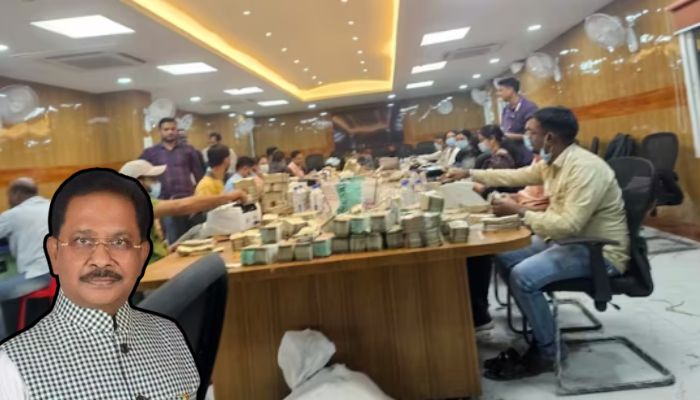
‘Highest-ever’ cash seizure in a single raid: 40 Counting Machines, 100 officers deployed to count 176 bags of cash seized from premises linked to Congress MP

The IT raid on premises linked with Congress’ Rajya Sabha MP from Jharkhand Dheeraj Sahu which started on 6th December entered its fifth day on 10th December (Sunday). As per official information, the counting is still ongoing at the time of writing this report. The Income Tax department had counted cash worth Rs.300 crore and expected the seized money to be around Rs.350 crore, as reported by Hindustan Times. 

As per reports, from the seized money and counted so far totaling Rs. 300 crore, Rs. 250 crore was recovered from several almirahs within BDPL’s Bolangir district premises, while the remaining sum was confiscated from locations across Titlagarh, Sambalpur, and Ranchi. However, no arrests have been made so far.

The IT officials have already confirmed that the current seizure of unaccounted cash from premises linked with Congress leader in Odisha, Jharkhand and Bengal is the highest-ever made by any agency in the country against a single group and its connected entities.

According to the information, initially, over 30 officers, along with bank staff, participated in counting the confiscated money. However, to expedite the process, the IT department deployed around 40 large and small machines and brought additional department and bank personnel. It is important to note that officials aim to complete the counting of the seized cash by Sunday, leading to the deployment of extra cash-counting machines and manpower on that day.

140 bags out of the 176-cash-loaded bags seized during the raids have been counted so far, officials noted. 

Evidently, on Sunday, SBI Regional Manager, Bhagat Behera from Odisha said, “We received 176 bags and 140 of them have been counted, the rest will be counted today. Officials from 3 banks are involved in the counting process, 50 of our officials are involved. About 40 (currency counting) machines were brought here, 25 are in use and 15 are kept as backup.”

Behera added that the officials are trying to finish the counting by the end of Sunday as normal banking hours will begin from Monday and the machines will also have to be returned to the banks.

As per visuals that came out on Sunday, officials were seen counting bundles of cash that was recovered from the properties of Congress MP Dheeraj Sahu. Majority of the cash was recovered from premises linked to Boudh Distillery Private Limited in Odisha.

As per the SBI Regional Manager Behera, the counting may continue on Monday as the machines are getting overheated and facing snags. He explained, “Though we have enough machines, they are heating up due to continuous counting. As bankers, we have never used machines for hours like this. Many currency notes are sticking to each other due to mildew deposits and so we are using dryers to separate the notes that have clung together.” 

Furthermore, I-T officials added that during the raids on one of the country liquor breweries in Bolangir’s Sudapada area, they found a polythene packet containing Rs.5 lakh in currency notes and the name ‘Inspector Tiwari’ mentioned on the packet. 

On the condition of unannoymity, an official said, “We think the person may either be from the excise department or local police. We would interrogate officials from the excise department.” 

According to the I-T department officials, they had suspicions over the company’s inconsistent and low net profits between 2019 and 2021 and inflated expenses towards the purchase of mahua/other articles and suspicious other payable shown in the balance sheet. 

Furthermore, a specialised 20-member IT-analysis team from Hyderabad has also joined the investigation to examine the computer hard disk and other electronic items recovered during the raid. Investigators from the Income Tax Department have also taken statements from various company officials and other individuals related to the case.

Following the seizures, BJP launched a scathing attack on Congress party asking questions from Rahul Gandhi over these developments. However, Congress has been trying to distance itself from Dheeraj Sahu, the Congress leader who is at the centre of these IT raids and demanded an explanation from him. Meanwhile, the ruling party BJD in Odisha issued a statement welcoming these tax raids. 

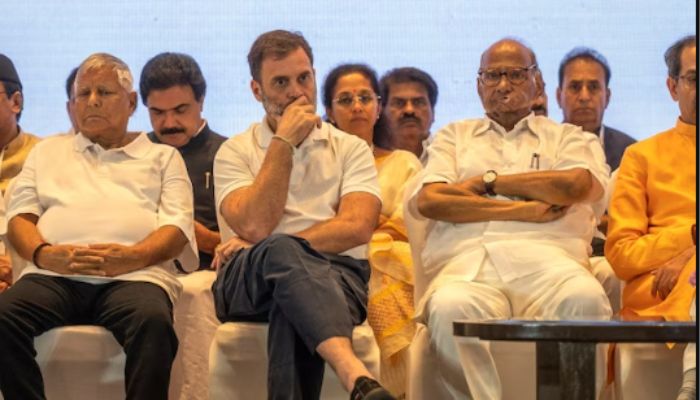
The fourth meeting of the I.N.D.I.A. bloc to be held on 19th December in Delhi, announces Congress

The fourth meeting of the Opposition I.N.D.I.A. bloc has been postponed again and it will now be held in Delhi on 19th December. Taking to X, Congress General Secretary Jairam Ramesh on Sunday (10th December) made this announcement. However, he didn’t give any reasons why the meeting was postponed from 17th December.

Notably, earlier this week, RJD Supremo Lalu Yadav had stated that the meeting of the opposition bloc would be held on 17th December.

Congress leader Jairam Ramesh shared a post stating, “Judega Bharat, jeetega INDIA,” amid reports of infighting between several alliance partners. 

The post conveying the message both in Hindi and English read, “The 4th meeting of the leaders of INDIA parties will be held on Tuesday, December 19th, 2023 in New Delhi at 3 pm.”

This will be the first meeting after Congress’s poll debacle in Chhattisgarh, Madhya Pradesh, and Rajasthan. As per a PTI report, the opposition bloc plans to work on a theme of unity ‘Main nahi, hum‘ at the meeting. 

Notably, hours into the counting of votes for four state assembly elections on 3rd December, Congress President Mallikarjun Kharge had called a meeting of the opposition bloc on 6th December. By then, trends had predicted that the BJP would form government in three states while Congress managed to attain success only in Telangana. 

However, West Bengal Chief Minister Mamata Banerjee, Bihar CM Nitish Kumar, former Uttar Pradesh CM, and Samajwadi Party leader Akhilesh Yadav opted out of the meeting indicating disappointment with the grand old party, citing different reasons for their inability to attend the 6th December meeting. Additionally, Tamil Nadu Chief Minister MK Stalin was also busy managing the Cyclone Michaung situation in the state.

As per reports, seat-sharing could likely be discussed in this fourth meeting which is one of the major bones of contention in the larger umbrella bloc of the opposition parties. Additionally, the parties could also discussion joint election campaign ahead of the 2024 Lok Sabha election. 

The Opposition bloc has met three times so far 

The most recent meeting of the 27 alliance parties took place in Mumbai and it was hosted by Shiv Sena (UBT) President Uddhav Thackeray. During the two-day discussions, discussed major electoral issues for the upcoming general elections and constituted a coordination committee. It also adopted a three-point resolution to collectively contest the 2024 Indian general elections “as far as possible.” 

Meanwhile, the name of the opposition bloc I.N.D.I.A., an acronym for the Indian National Developmental Inclusive Alliance was arrived at during the second meeting in Bengaluru. Whereas the first meeting was organised by Bihar Chief Minister Nitish Kumar in Patna, where the parties vowed to unite in the upcoming Lok Sabha polls to “dethrone the BJP.”

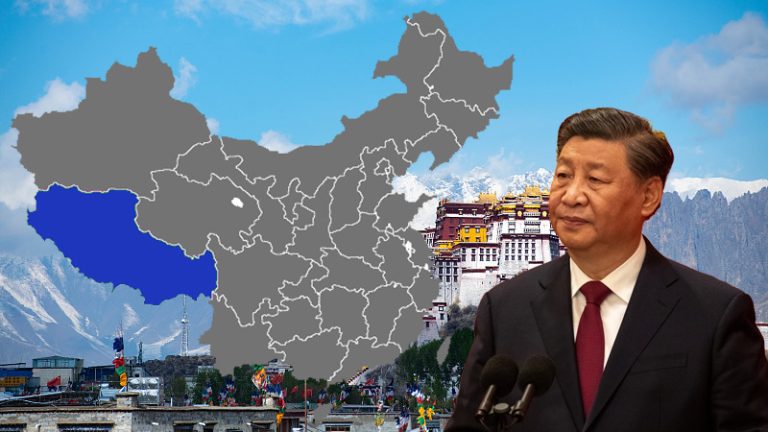
‘China destroying our identity’, says Tibetans after Chinese state media started substituting ‘Tibet’ with ‘Xizang’ in line with Beijing’s White paper

0

Chinese state-run media has drastically increased the use of the term “Xizang” to substitute “Tibet” in their English articles while referring to the autonomous region in western China. The development comes after Beijing’s cabinet, the State Council released a white paper on Tibet earlier in November, this year. 

According to a report by the South China Morning Post (SCMP), the white paper was titled “CPC Policies on the Governance of Xizang in the New Era: Approach and Achievements.” 

In the past, Beijing had released a series of white papers on Tibet to describe developments in the region since Chinese President Xi Jinping assumed power in 2012. However, this was the first time that Beijing’s white paper used “Xizang” as the English translation for the region. Previous white papers on Tibet used the term “Tibet autonomous region.”

Notably, “Xizang” is the pinyin term, or Chinese romanisation, of the Mandarin script for “Tibet”, as reported by SCMP. Pinyin is said to be the official system used in China, Singapore, and several other places. 

As per a report in the SCMP, Chinese media is using “Tibet” only in a few scenarios. These include translations of already established geographical terms and names of institutions. 

Since the release of the White Paper, Chinese Media has started to ‘drop’ the use of the term ‘Tibet’

The white paper was released on 10th November, and from then onwards till Friday (8th December), Chinese state news agency Xinhua’s English-language website has used “Xizang” in 128 articles. It used “Tibet” only five times, all of which were in reference to the Qinghai-Tibet Plateau, the geographic term covering most of the Tibet autonomous region, the SCMP report added.

In contrast to this pattern, throughout 2023 up till 10th November, search results on Xinhua’s English website yielded more than 700 results with the word “Tibet”. The recurrent use of ‘Tibet’ in earlier reports suggests that the term was used in a variety of scenarios. Those earlier references included political and economic coverage, while “Xizang” appeared only around 30 times.

Similarly, the English website of People’s Daily – CCP’s mouthpiece – used both “Xizang” and “Tibet” before 10th November. Conspicuously, the former term featured only one-fifth time as compared to ‘Tibet’. From November 10th, when Beijing released its White Paper on Tibet, until December 8th, ‘Tibet’ appeared only in one reposted article from another media outlet and in scenarios where English translations were already established, such as the Qinghai-Tibet Plateau and Tibet University. Meanwhile, ‘Xizang’ was used more than four times as often as ‘Tibet.

The SCMP report noted that similar was the case with the English-language newspaper of China Daily, another CCP mouthpiece. 

As per reports, the linguistic change aligns with Beijing’s broader efforts to reinforce national identity in ethnic minority regions by promoting “standard spoken and written Chinese,” or Mandarin. Additionally, it is in line with Beijing’s plan to foster what Xi has called a “sense of community for the Chinese nation”.

According to experts, the change reflects Beijing’s attempt to emphasise sovereignty over Tibet, however, they believe that its impact on the international community would be limited. Additionally, it is being considered part of Beijing’s efforts to exercise “discourse power”.  

Earlier in August, a group of Chinese scholars called for the official use of “Xizang” as the English name for Tibet. They claimed that it would help “reshape” the region’s image.

Furthermore, China’s United Front Work Department deals with non-party individuals and groups inside and outside China. In August, on its WeChat account, the group said 

that the term “Tibet” was misleading to the international community because it could be confused with the Dalai Lama’s term “Greater Tibet”, which encompasses areas in provinces neighbouring Tibet, including Sichuan, Yunnan, Qinghai and Gansu. 

Subsequently, in October, China’s foreign ministry used “Xizang” as the English translation for Tibet. It made this substitution while publishing a speech by Foreign Minister Wang Yi at a regional forum in Tibet whereas it had previously used “Tibet” in most English readouts.

Notably, in English, many locations in China are denoted by the pinyin of Chinese characters. However, in certain ethnic minority regions, the pronunciation in the minority language or internationally recognized names may also be employed. For example, the Inner Mongolia autonomous region is used instead of the pinyin “Nei Menggu,” and the cities in the Xinjiang Uygur autonomous region, Urumqi and Kashgar, are referred to instead of “Wulumuqi” and “Kashi” in pinyin.

The Tibetan government accuses China of exterminating Tibetan identity

On Sunday (10th December), the president of the Tibetan government-in-exile Penpa Tsering accused China of denying the most fundamental human rights to people in Tibet and vigorously carrying out the “extermination of the Tibetan identity”.

He took a strong exception to China’s white paper that refered to Tibet as ‘Xizang’. Marking Human Rights Day, Penpa Tsering, in a statement, said that the Chinese Communist Party (CCP) was “forging a strong sense of the Chinese national as one single community, promoting the Chinese language, the Sinicization of Tibetan Buddhism and developing socialist values”. 

He said, “Such infliction of suffering and oppression on the Tibetan people by the CCP authorities is unparalleled and unprecedented.” 

Tsering added that there has been a sharp increase in the appointment of Chinese officials in the Tibetan areas.

Tibet has been under the illegal occupation of China for over 60 years and it has refused to negotiate with Tibetan leaders since 2010. They describe Dalai Lamai as a “separatist” seeking independence for Tibet, a claim denied by the Dalai Lama. 

Maharashtra: 19-year-old medical student in a private college dies by suicide, 3 students named in suicide note booked

0

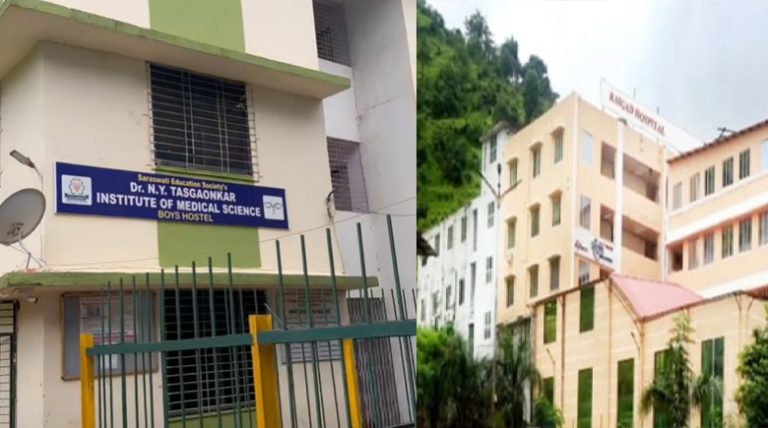
According to reports, a 19-year-old medical student named Harshal Mahale from a private institution in the Raigad district of Maharashtra killed himself. He blamed ragging and abuse from three roommates at a dormitory in Karjat.

On 1st December at around seven o’clock in the evening, the first-year MBBS student of Dr NY Tasgaonkar Institute of Medical Sciences in Karjat, Raigad, reportedly took his life by hanging himself from the ceiling of his dorm room.

A few days later, the deceased boy’s parents found his cell phone and a suicide note in the room and on 4th December they went to the cops to file a complaint. The victim claimed in his letter that his three students, including his roommate, were torturing and harassing him for two months and that he was entitled to severe punishment for them.

Karjat police have booked three students at the hostel for abetment to suicide, as they were named in the letter. Initially, an accidental death case had been registered, before the note was found.

The perpetrators are facing charges under section 306 (abetment to suicide) and other pertinent Indian Penal Code provisions by authorities in response to his father’s complaint. No one has been taken into custody as of yet and an investigation into the matter is underway.

Karjat police said the deceased, Harshal Mahale, a resident of Bhiwandi, had taken MBBS admission at the institution in October. The accused three students include his room partner and two other students from the hostel.

Other similar occurrences

In another incident, Jay Dipesh Savla, a 25-year-old resident doctor at Safdarjung Hospital reportedly killed himself in his South Delhi residence. He recently came out of depression however hanged himself from the ceiling fan in his rented home in Hauz Khas, South Delhi. He was from Maharashtra.

According to the police, his body was discovered on the 8th of December evening at his Gautam Nagar house. The authorities ruled out the likelihood that the death was the result of foul play. Chandan Chowdhary, Deputy Commissioner of Police (South) stated that around 3:55 p.m. on the fateful day, a PCR (Police Control Room) report of a person found hanging was received at the Hauz Khas police station.

He was a third-year Medicine Post Graduate student at Safdarjung Hospital. A suicide note mentioning that he had been depressed for the last two years was located at the scene. A police officer disclosed, “We were informed by his landlady that Savla had committed suicide by hanging himself. On checking, the aforesaid boy was found hanging by ceiling fan through the bed sheet.”

According to the police, the victim’s father, Dipesh Ratilal Savla received word of the death by phone. “His family members have confirmed that he was suffering from depression for the past two years,” stated another cop. He claimed that an inquest had been started and that the body had been sent to his family. An inquest has been opened by the police in this case.

On 8th December, a 47-year-old Ayurvedic doctor named Dr. G. Satish turned up dead in his automobile near Anekadu on the Bengaluru-Bantwal Highway. It is believed that he used a poison injection to put an end to his life. A resident of Pandavapura taluk in Mandya, he was operating an Ayurvedic clinic in the village of Shivalli. Furthermore, he was working as an outsourcer at the Periyapatna and Konanur government ayurvedic hospitals.

A Maruti Swift car was parked on the highway and the doctor was spotted dead in its driving seat at around 3 in the afternoon. The Rural Police Station was notified by the onlookers who observed the same. A syringe and bottle were uncovered in the car and his hand had injection marks when Police Inspector Ramesh and his team arrived at the scene immediately. His driving license (DL) and a chit discovered in his pocket helped to establish his identity. Staff members from the Government Ayurveda Hospitals in Periyapatna and Konanur were also called to the location for confirmation of the body’s identity.

Syringes and medications collected on the spot are circumstantial evidence that points to a suicide, according to the initial inquiry. Only the autopsy report, however, would be used to determine the veracity of the death. The inquiry into the mysterious death has been continued by the police.

The doctor went to the hospital in Konanur every Wednesday and Saturday while he visited Periyapatna Hospital on the other days of the week. The doctor appeared highly agitated when he arrived at Periyapatna Hospital at 10 a.m. a day before the tragedy occurred and eventually puked. According to Ashwathi, a Periyapatna Hospital employee, he left at around 11 a.m. after sipping a cup of tea that a hospital employee had brought him and maintained he would relax in the four-wheeler.

A grief-stricken Ashwathi remarked, “He was a good person and maintained a cordial relationship with all. By his appearance, he did not look dejected, but don’t know why he took the extreme step.” In an interview with journalists at Anekadu, Sandeep another friend of the deceased stated, “He was working as a doctor on an outsource basis on contract for the past 18 years. However, he was pained over his job not being regularised. His son was also suffering from ailment and even he had health issues. Hence he was dejected which may have driven him to end his life.”

A 26-year-old postgraduate student at the Thiruvananthapuram Medical College, identified as Shahana, committed suicide due to dowry demands. She worked in the surgery department of the college and was found dead at her rented apartment near the institute on 5th December morning.

Her relatives unveiled that she killed herself when her male friend who is another postgraduate doctor declined the marriage proposal. She was reportedly distressed when he asked her to marry him but insisted on a large dowry. The accused Dr E A Ruwais is in police custody. He is facing charges related to the Dowry Prohibition Act and aiding and abetting suicide. Police stated that following questioning, a decision to place him under arrest would shortly be finalised.

The victim wrote in her suicide letter how hopeless she felt and how everyone seemed to be only thinking about money. She pondered Ruwise’s request for a larger dowry, wondering if it was for his sister. His family demanded a large dowry of gold, land, and a BMW car and her family was unable to fulfil their outrageous demands. He ended the relationship as a result and then she decided to take the drastic measure.