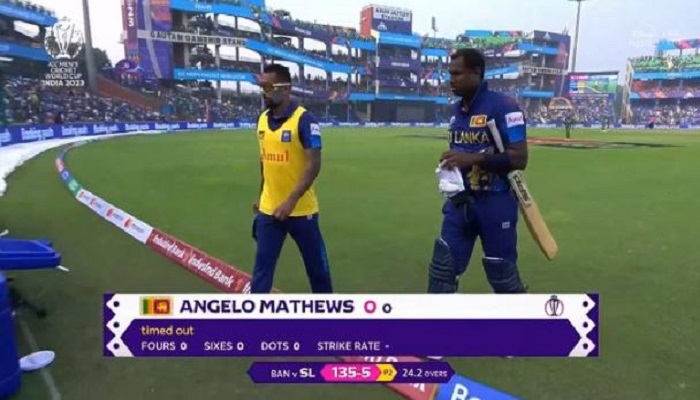
On 6th November, Sri Lankan all-rounder Angelo Mathews was given ‘Time Out’ by the on-field umpires when Bangladeshi captain Shakib Al Hasan refused to withdraw their appeal. With this, Mathews has bagged an unfavourable record to his name as he is the first cricketer in history to be ‘Timed Out’ in an International match.
HISTORY IN DELHI….!!!
Angelo Mathews becomes the first cricketer in history to be out on 'timed out'. pic.twitter.com/VRg1xmSTDf
Notably, the 38th match of the ongoing World Cup 2023 is being played between Sri Lanka and Bangladesh at the Arun Jaitley Stadium in New Delhi. After winning the toss, Bangladesh asked Sri Lanka to bat first, and Sri Lanka’s batters threw their wickets at regular intervals.
However, a new controversy erupted in the 25th over when Lankan all-rounder Angelo Mathews walked into bat. As per Sports websites, Mathews had issues with the helmet as he had picked the wrong helmet in haste.
Cricbuzz reported that Mathews leisurely walked out to the middle, which took some time, and then faced some issues with the helmet. However, by the time, the substitute ran out to bring the right helmet, three minutes had passed by. Consequently, while the umpires were having a word with Mathews, Bangladesh raised an appeal for a time-out.
Meanwhile, when Mathews didn’t reach the crease ‘in time’ and called for a replacement, Shakib and Bangladesh appealed for a time-out. Knowing the rules and adamant not to withdraw their appeal, Bangladesh gathered around as if celebrating a wicket.
But with a clear-cut ICC ruling regarding such a scenario, the umpires had to oblige and the scoreline read, “Shakib to Mathews, Timed Out!!” meaning Mathews was given timed out 0(0) without facing a delivery as he could not report to the pitch for ‘play’ within the stipulated time of three minutes.
Mathews had tried to plead his case to the umpires and Shakib, but the Bangladeshi skipper didn’t budge and fixed Mathews’ fate making him the first victim of ‘Time out’ in the International match.
Following the dismissal, Former Sri Lankan Cricketer and commentator Russel Arnold said, “This is the first time I have ever witnessed something like this.”
According to the ICC rule, a batter should be at the crease within 3 minutes of the dismissal/retirement. ICC rule on Time out states, “After the fall of a wicket or the retirement of a batter, the incoming batter must, unless Time has been called, be ready to receive the ball, or for the other batter to be ready to receive the next ball within 3 minutes of the dismissal or retirement. If this requirement is not met, the incoming batter will be out, Timed out,” as highlighted by Cricbuzz.
Even after the dismissal, Sri Lankan skipper Kusal Mendis indulged in a chat with the Bangladesh coach Chandika Hathurusingha during which the fourth umpire was also present. However, it was a futile exercise as the game progressed once the umpire gave their verdict.
However, there has been in the past no love lost between these two sides and this dismissal, record-scripting first, will add fuel to the fire of the Sri Lanka v Bangladesh rivalry and take it to the next level.
It is important to note that a similar incident took place when India faced South Africa. It transpired in 2007, during the 3rd Test between South Africa and India in Cape Town. On the fourth day, Sourav Ganguly almost became the first batsman ever to get timed out in international cricket.
Although Sourav Ganguly took 6 minutes to come out of the pavilion, he was not given time out as South African captain Graeme Smith decided not to appeal in the spirit of the game when Umpire Daryl Harper explained the situation to him.
India is gradually approaching the Lok Sabha elections and the government of Prime Minister Narendra Modi is nearing the end of its ten-year tenure. Now is the time to assess how this government has performed on various fronts over the last 9.5 years.
Since taking office in 2014, Prime Minister Narendra Modi’s government has implemented numerous flagship projects. These schemes have attempted to address fundamental problems that could not be solved from 1947 to 2014. The statistics and beneficiaries demonstrate how successful this effort has been.
The governments before 2014 were unable to provide even basic services to the people of the country, such as clean water, permanent housing, a gas cylinder, a bank account, electricity, and toilets. PM Modi after coming to power in the year 2014 decided to address these issues first. Let us understand what the impact of PM Modi’s policies has been in terms of planning.
Pradhan Mantri Awas Yojana
A home is the most important and basic need of any family. Millions of poor people in the country were forced to live under vulnerable roofs or rented houses before 2014. No government has ever been able to provide them with a permanent home. To address this issue, the Modi government launched the Pradhan Mantri Awas Yojana in June 2015.
Under this scheme, beneficiaries are given Rs 2.5 lakh in urban areas and Rs 1.2 lakh in rural areas for the construction of a house. Beneficiaries are chosen through a survey process under this scheme.
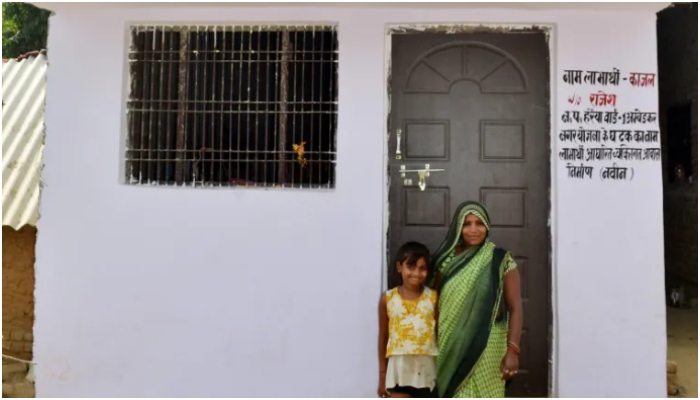
One of the beneficiaries of the scheme
According to available data, 1.18 crore houses have been approved for construction under the Pradhan Mantri Awas Yojana (Urban). 77.5 lakh of these houses have already been built. The government has allocated 1.53 lakh crore for this purpose.
In rural areas, 2.94 crore houses have been authorized under this scheme, of which 2.48 crore have been built. The Central Government, in collaboration with the State Governments, has provided a total of 2.6 lakh crore for this purpose.
In the nine years that Modi has been in power, a total of 3.25 crore houses have been built across the country. One Sunita who is a resident of Uttar Pradesh’s Lakhimpur Kheri district, is the scheme’s beneficiary. Sunita makes a living by selling flowers in front of a temple.
“Brother, we have been trying to make our permanent home for the last ten years. We tried many jobs to earn money. Today we could make our home only because of PM Modi,” Sunita says in Awadhi.
Pradhan Mantri Ujwala Yojana
Crores of households in the country had no LPG connections before 2014. As a result of this, women were forced to cook food using wood fuels and other fuels, risking their health. Not only did this have a negative impact on their health, but they also had to deal with hazards such as cutting wood for firewood and dealing with fire. Aside from that, pollution had its role to play.
To fight this problem, Ujjwala Scheme was launched on 1st May 2016. Under this, free LPG connections were given to poor families. Along with this, they were also provided with gas stoves. Before the launch of this scheme, only 62.1% of the houses in the country had LPG connections.
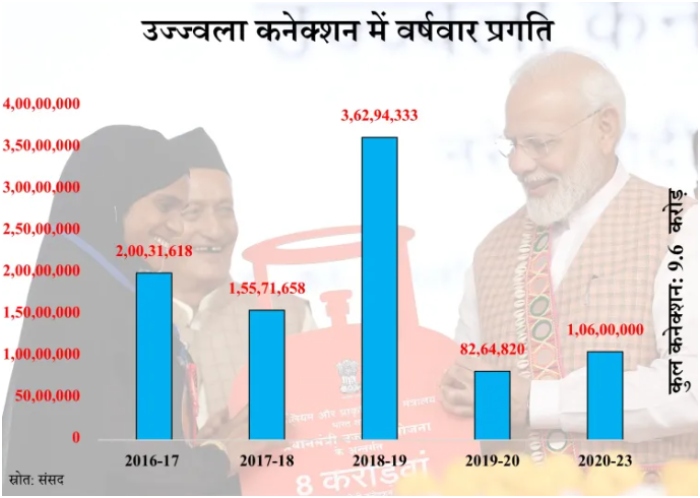
Yearly progression in the number of Ujjwala connections
Clean fuel has reached 99.8% of homes since the scheme’s inception. In the first phase of Ujjwala, 8 crore connections were distributed across the country, with an additional 1.6 crore distributed in the second phase.
Sunita, who has benefited from the Modi government’s Awas Yojana Scheme, has also benefited from the Ujjwala scheme. “Previously, one had to bring wood to cook, which was a major issue during the rainy season because the wood was wet; now, there is no problem,” she says thanking Prime Minister Modi for the positive change in her life.
Jal Jeevan Mission: Har Ghar Jal
The most difficult problem that the Modi government faced was that it had to complete work that should have been completed decades ago. The BJP government led by PM Modi had to even figure out how to get clean water to every home.
Jal Jeevan Mission was established in 2019 to address this issue. The government has established a target of providing clean water through a tap to every house in the country, whether it is in the Terai plains of Uttar Pradesh or somewhere in the Nilgiri hills of Tamil Nadu.
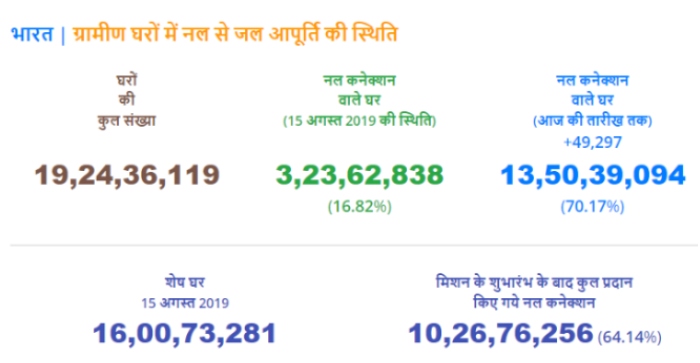
Before the launch of this scheme, only 16.82% (3.23 crore) of houses in the country had access to tap water. In states like Uttar Pradesh, only 1.9% of the houses had a tap water supply.
Tap water connection in households
It has been more than 4 years since this scheme started. This scheme has been running for over four years. Tap water is now available in 70.17% (13.5 crore) of the country’s homes. Since the scheme’s inception, the government has given the states a total of Rs 1.52 lakh crore. However, some states, such as West Bengal and Rajasthan, are still unable to properly implement this scheme.
“Previously, one had to go to the public tap of the Nagar Panchayat to get water, where supply was only available for one or two hours,” says Balram, a beneficiary of this scheme. “Even in cold weather, one had to get up at 5 a.m. to get a water vessel refilled. When there was a delay, water had to be filled using a hand pump that ran the risk of arsenic poisoning. Water has begun to flow into the house taps now,” he adds.
Pradhan Mantri Jan Dhan Yojana
Before 2014, corruption was a major issue in the country’s development. In a public speech, former Prime Minister Rajiv Gandhi admitted that if the Central Government sent Rs 1 from Delhi, only 15 paise would reach the beneficiary.
This problem could not be solved for decades. Additionally, there was a large population in the country that had no familiarity with the banking system. Neither did they have any bank account nor were they given any preference in banks. At times, the government also could not provide benefits to the beneficiaries due to no bank accounts.
To address both of these issues, the Modi government launched the Pradhan Mantri Jan Dhan Yojana on August 28, 2014, just three months after taking office. The goal was to have at least one account in every household in the country. Camps were established, and new branches were set up.
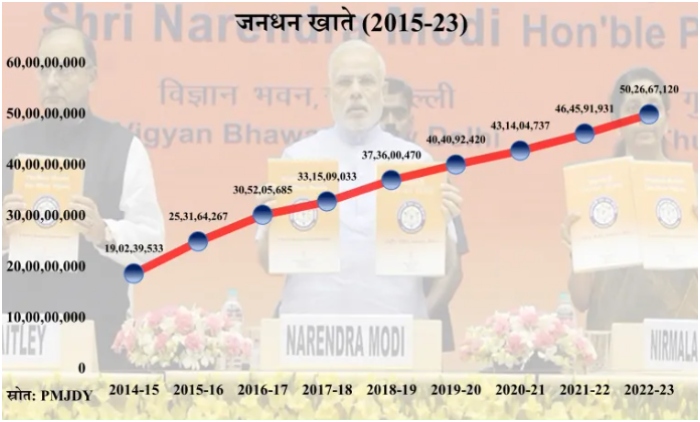
This scheme was so successful that 50.8 crore accounts were opened as a result of it. So far, the government has transferred Rs 32 lakh crore to beneficiaries via these accounts. And not a single rupee leak has been reported from these funds.
The advantages of the Jan Dhan Yojana are not limited to scheme implementation. The government has linked the Jan Jyoti public insurance scheme to this scheme. These accounts have been extremely beneficial in ensuring the success of the Pradhan Mantri Mudra Yojana, expanding Rupay cards, and accelerating the movement of Digital India.
Sunita is also a Jan Dhan Yojana beneficiary, having received Ujjwala and Awas Yojana benefits. She now puts small sums of money into her account. She saves Rs 200 or Rs 500 and deposits it into her account through the Jan Suvidha Kendra. She claims that her small savings contributed significantly to the marriage of her two daughters, Mamta and Sarita.
Pradhan Matri Mudra Yojana
Mudra Yojana was launched by the government in April 2015 to provide easy loans to small entrepreneurs. The problem was that banks did not give loans to small entrepreneurs because they sometimes did not have the documents and sometimes the banks refused them saying that they did not have any guarantee to give against the loan.
Loans ranging from Rs 50,000 to Rs 50 lakh are easily granted by resolving these issues in this scheme. This has been a huge help to small business owners all over the country. Mudra Yojana has so far provided loans totaling Rs 23.2 lakh crore to over 40 crore beneficiaries. The most important aspect of this scheme is that 70% of its beneficiaries are women.
Road and Rail revolution
The state of the country’s roads was deplorable when the Modi government took office in 2014. Railways were only used to transport laborers from one state to another. There was no new technology or strategy in place.
The biggest achievement of the Modi government in the field of railway infra is the electrification of more than 90% of the country’s railway network. Before the Modi government came to power in 2014, only 21,413 km of railway lines were electrified in the last 67 years post-independence. In just 9 years, it has more than doubled to 59,818 kilometers.
This electrification has reduced pollution while saving the railways money on diesel. Apart from that, Railways has replaced the old ICF coaches in its trains with LHB coaches, providing safety and more comfort.
Railways have started trains like Vande Bharat, the number of which is constantly increasing, to provide good facilities to Indians. While the Congress government developed only 21 Shatabdi trains in 29 years in 1988, the number of Vande Bharat trains in 2019 rose to 68.
In terms of the railway network, the country’s total railway network in 2014 was 65,808 kilometers, which has now increased to 68,043 kilometers. The rest of the existing network has been upgraded to accommodate faster trains by increasing track capacity. Apart from that, the Dedicated Freight Corridor is a significant achievement in this sector.
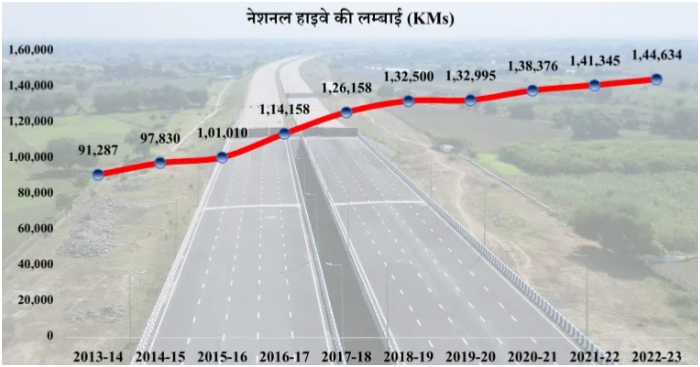
Even the opponents of Modi laud him for his success in the field of roads. The total length of the country’s National Highways in 2013-14 was 91,287 kilometers, which has now increased to more than 1.45 lakh kilometers. This is an approximate 59% increase.
Total length of National Highways
Apart from that, only 18,371 kilometers of national highways were four-lane in 2013-14, which has now increased to 45,000 kilometers. Prior to the Modi administration, an average of 10-12 kilometers of road were built per day; this has increased to 35 kilometers in 2021-22.
In addition, new motorways are being constructed across the country. Before 2014, motorways could be counted on a single hand, but now they stretch for thousands of kilometers. Many new motorways are still being built in Uttar Pradesh.
IMEEC Project
PM Modi is not only implementing Indian schemes here but also making the country a part of global projects that will benefit India immensely. One such project, IMEEC (India Middle East Economic Corridor), has begun in India.
This plan is quite ambitious, costing Rs 3.5 lakh crore. Under the India Middle East Europe Economic Corridor (IMEEC), goods will be transported by ship from Indian ports to Fujairah in the United Arab Emirates.
Following that, the containers need to be transported by train to Haifa, Israel. The containers will be shipped from Haifa to Europe, including Italy, France, the United Kingdom, and the United States. India has already begun work on connecting Indian ports with rail links under this project.
Notably, these schemes are not just on paper but are being executed on the ground. The best thing about Modi’s schemes from India to abroad is that they reach the intended recipients. If the 2024 Lok Sabha elections are fought on the basis of what the Manmohan Singh government did during its ten years in office versus what the Modi government has done, Prime Minister Modi will undoubtedly be miles ahead of them.
The next general election is expected to be held in India between April and May 2024 to elect the members of the 18th Lok Sabha.
Professor Sameena Dalwai at OP Jindal University in Haryana is not only a Hamas supporter and an anti-Hindu for opposing the Hindu chant ‘Jai Shri Ram’ but she is also anti-privacy. Sparking another shocking controversy, Dr Sameena Dalwai, who is reportedly the daughter of Congress leader Hamid Dalwai, violated the privacy of a student in the classroom.
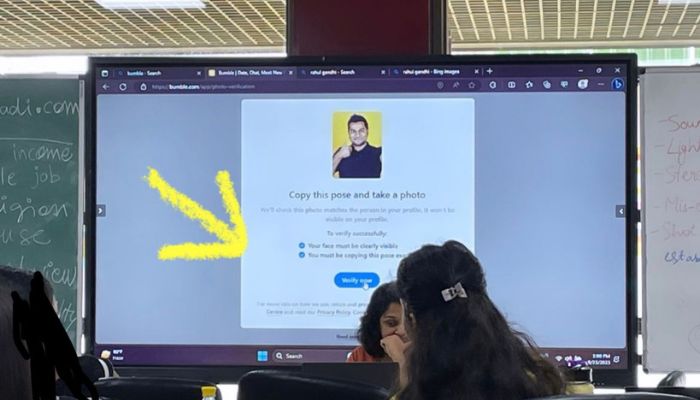
The incident dates back to September this year. Dalwai reportedly accessed a student’s account on a dating app called ‘Bumble’ on a Smart TV in a classroom full of students. A video and screenshots of some chats doing rounds on X, formerly Twitter, show the professor indulging in a detailed discussion about a dating account, which was allegedly a student’s.
A video clip shows the professor referring to a girl’s Bumble account opened on the Smart TV for the whole class to see while she delivered her lecture. The video shows the following texts written on the board “age, Mallu, location, fresher, so old, Ameti” among a few more.
Professor Sameena Dalwai of Jindal Global University, who a few days back, in an official email, had written that "Jai Shree Ram" is problematic and that Hamas is unfairly being "trolled," was allegedly seen using the dating app Bumble, and swiping people left and right in her… pic.twitter.com/w3r4iRcp9h
Another video clip shows the professor publicly displaying a boy’s Bumble account and asking, “Yes or no?” and the class replies with a no. She then can be heard asking, “Why no? Hold on hold on I have to know na why no?”
A third video clipping that lasts 4-seconds shows a different Bumble account opened. Screenshots of a few chats of students calling out Sameena’s conduct have also been doing the rounds on social media.
In one such chat, students can be seen objecting to the public display of people’s private dating app accounts. “First of all, it was wrong of her to open Bumble in class. What if we saw someone we knew personally? Also, having a dating app account is something very private that don’t share with a lot of people most of the time. How would either of us feel if our faces and profiles were plastered on a screen and 40 people were sitting in class going right swipe left swipe?” a student said.
The professor at @JindalGlobalUNI who thinks "Jai Shree Ram" is problematic & Hamas is being unfairly "trolled" by students she likes to stereotype as "Right wing" on campus is seen running "Bumble", a dating app (like Tinder), swiping people left -right in her class making… pic.twitter.com/j6uxW28osD
The Organiser claims to have accessed a complaint letter submitted by the students on 23rd September, which alleges that Professor Sameena violated the privacy of students by accessing their Bumble account during class. “This breach of privacy extended beyond her own class, affecting multiple students’ accounts within the university,” the Organiser report states.
This is not all. The professor apparently went on to ban phones in her class in response to the students capturing the image and video of the dating app incident. In an email dated 24th September, Professor Sameena wrote, “In the light of offensive use of phones in class, please keep your phones in hostels. Phones, if sighted in class, may lead to disciplinary action.” The email has been accessed by Organiser.
Furthermore, the Organiser has reported that the professor also body-shamed and used derogatory language thereby creating an atmosphere of intimidation and emotional distress in the classroom. The professor allegedly used the term “ch*****”.
The Organiser quoted a student who alleged that Dr Sameena frequently used derogatory language towards students. She allegedly even verbally abused a female student and told her to stop attending her class, promising to grant her free attendance. The student also reportedly alleged that Dr Sameena discriminates against students based on their opinions and ideology.
The students have reportedly urged the university to launch a comprehensive and impartial investigation into the incidents and have the Human Rights Commission and the Haryana State Commission for Women (HSCW) be involved in the probe.
Consequently, the HSCW has taken cognizance of the matter and its chairperson, Renu Bhatia has announced that she will visit the OP Jindal University on 7th November. Bhatia hit out at the university saying that the compromise of privacy and dignity of students by the use of dating app amounts to harassment.
It is disheartening to witness the distressing situation within @JindalGlobalUNI . The compromise of privacy and dignity of students, especially female students, by the use of a dating app and obscene material by a faculty amounts to harassment. I'm appalled by such actions.… https://t.co/VgH3vdX1Iopic.twitter.com/CJEv5waHPK
Bhatia also called out the Professor Sameena for her aversion to “Jai Shri Ram” and her support to Palestinian terrorist group Hamas.
On 1st November, a talk was organised in OP Jindal University titled ‘The History and Politics of the Palestinian Present’ by Professor Achin Vanaik, Retired Professor of International Relations and former Head of Department of Political Science at the University of Delhi, now an activist.
Several video clips of the professor’s lecture have appeared, which showed that in the name of solidarity with Palestinian civilians in Gaza, he made several antisemitic and anti-Hindu comments. He also attacked the Modi government over India’s stand on the conflict.
During his lecture, Professor Achin Vanaik said that although Zionism and Hinduism are similar, they are not same in terms of relationship with Islam. “Zionism is not anti-Muslim, it is anti-Palestinian, but it is happy to piggyback on current Islamophobia. Hindutva is fundamentally and foundationally anti-Muslim”.
In relation to his talk, a shocking was email was written by Dr. Sameena Dalwai to those who were opposed to the lecture. In the mail, professor Dalwai claimed that Hamas didn’t do any atrocities on Israeli civilians, and it was all ‘fake news by Indian troll armies’.
She wrote, “Otherwise, I hear shouts of ‘Jai Sriram’ on campus, I see right wing students and faculty doing their own events. I want to react, but I keep quiet in favour of peace.”
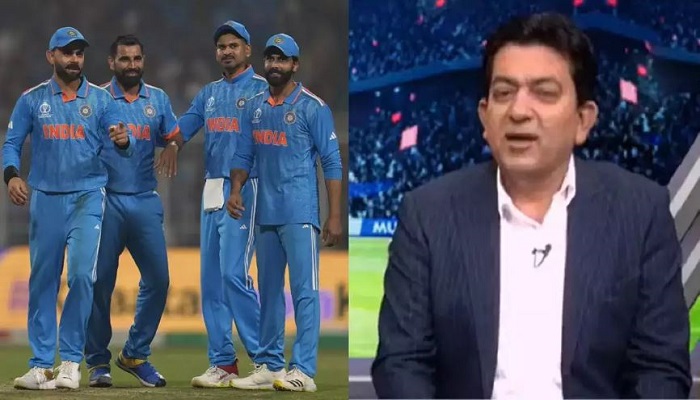
Despite facing criticism for his earlier remarks that ICC or the BCCI is giving ‘different balls’ to the Indian bowlers, former Pakistani cricketer Hasan Raza has stroked another bizarre controversy. While giving his ‘expert opinion’ on India’s triumph against South Africa, Raza claimed that India is manipulating the Decision Review System (DRS) in the ongoing ‘Home’ edition of the World Cup. Hasan Raza alleged that DRS is manipulated to favour India during their home World Cup.
Raza raised suspicion over the DRS call which was taken on Jadeja’s bowling against Rassie van der Dussen. The on-field umpire had turned down the appeal after which India asked for a review and check whether the in-form South African batsman van der Dussen was out leg before wicket or not.
On the DRS call, the replay projected that the ball would have gone on to hit the top of the middle and leg stump and the on-field umpire’s call was overturned. However, former Pakistani batsman Hasan Raza raised questions over this routine DRS call.
According to the former Pakistani cricketer, how can a ball spin from the leg stump to hit the middle stump, that’s not possible. Raza further lamented that DRS is being manipulated to favour India, which according to him should be checked.
On a Pakistani news channel, Hasan Raza said, “Jadeja picked up five wickets and finished with career-best figures. We were talking about technology where DRS was being taken. Van der Dussen was the batter and the ball was hitting the middle stump after pitching on leg stump. How is that possible?”
“The impact was in line, but the ball was headed towards the leg stump. Like everyone else, I am just sharing my opinion. I am saying that such things should be checked. DRS is being manipulated and that is clearly visible,” Hasan Raza added.
Hasan Raza Raises Questions on Indian Victory! 1 :- DRS was manipulated by BCCI with help of Broadcasters 2:- DRS was also Manipulated in 2011 when Sachin Tendulkar was playing Against Saeed Ajmal. 3:- Why Indian Team is Playing Outclass in every worldcup Event Happened in India.… pic.twitter.com/ieIJGy0cqH
Raza further complained that this was not the first issue with DRS. Earlier as well, there were two to three DRS calls that had gone in favour of India, (however), I will talk about Pakistan here, he added.
Hasan Raza then talked about the South Africa and Pakistan match at the Chepauk where Tabraiz Shamsi was given not out on Haris Rauf’s delivery when the match was hanging in the balance. Raza then went on to seek an apology from the ICC for the outcome of the DRS.
He said, “It was not the first time. The review in the match between Pakistan and South Africa and the last wicket partnership. They did not even apologise. Home conditions and home advantages come into play.”
While admitting that there was no tampering with the ball, Raza did cast aspersions on the ‘weight’ of the ball. He said that if the ball is light then it will spin, hinting that some official should check the weight of the ball after every over especially at transition. He speculated that fast bowlers could be given different balls that seam and swing a lot while spinners could be given lighter balls than spin a lot.
ICC Might Give Different Ball to Indian Bowlers thats why they are Getting Seam and Swing More Than Others.Ex Test Cricketer Hasan Raza.#CWC23#INDvSLpic.twitter.com/7KCQoaz0Qs
Earlier, on Thursday (2nd November), Raza had claimed that Indian bowlers were getting some different balls from ICC or BCCI. On a Pakistani news channel, the former Pakistani cricketer said that ICC or BCCI is providing some special balls only to Indian bowlers due to which Indian bowlers are getting ‘swing’ even on batting pitches. Hasan Raza also asserted that there should be an ‘inspection’ of balls provided by ICC.
However, he soon was at the receiving end of criticism and trolling over his bizarre claim that ICC is giving “different and suspicious” balls to Indian bowlers in World Cup 2023. Reacting to Hasan Raza’s baseless and senseless assertion, former Pakistani cricketer Wasim Akram lambasted Hasan Raza saying that he too wants to try the same stuff these people (Hasan Raza) are smoking. He further slammed Hasan Raza by saying that if Raza wants to get humiliated, he should not do the same to Pakistan in front of the entire world.
Slamming the ‘rigging’ allegation, Akram asserted that there is no device in the ball and that it cannot be swung with a device inserted in it.
Akram said, “There is no device in the ball. You can’t swing the ball with a device. For argument’s sake, if you are trying to swing the ball we can say one is a heavy side, while the other is a light side, but you can’t swing the ball with a device.”
In an upward revision, Fitch Ratings has increased India’s medium-term potential growth forecast from 5.5 per cent to a robust 6.2 per cent.
This positive development reflects the country’s growing economic resilience and potential for expansion.
This upgrade places India in the spotlight for its strong growth trajectory.
Additionally, Mexico received a substantial boost in its growth estimate, with Fitch revising it from 1.4 per cent to 2.0 per cent.
These positive changes were underpinned by a more favourable outlook for the capital-to-labour ratio.
The adjustments didn’t stop there. Fitch also revised growth forecasts for other countries. Poland’s potential growth estimate was increased to 3.0 per cent from 2.6 per cent, Turkey’s to 4.1 per cent from 3.9 per cent, Brazil’s to 1.7 per cent from 1.5 per cent, and Indonesia’s to 4.9 per cent from 4.7 per cent.
However, it wasn’t all good news. Fitch Ratings simultaneously lowered the growth estimate for China from 5.3 per cent to 4.6 per cent, reflecting a significant reduction in China’s supply-side growth potential.
Russia’s growth estimate dropped to 0.8 per cent from 1.6 per cent, Korea’s to 2.1 per cent from 2.3 per cent, and South Africa’s to 1.0 per cent from 1.2 per cent.
The overarching trend across the ten emerging markets (EM) in Fitch’s Global Economic Outlook was a drop in potential growth, with the GDP-weighted average falling to 4.0 per cent from the 4.3 per cent estimate in 2021.
The bulk of this decrease can be attributed to the substantial reduction in China’s supply-side growth potential.
Despite this, the unweighted average across the EM10 countries remained at a steady 3 per cent, thanks to upward revisions in other markets.
Fitch acknowledges that lingering pandemic effects and shifting demographic trends are responsible for the overall slowdown in potential growth across EM10 countries.
The agency also made “level shock” adjustments to historical estimates of potential GDP in 2020 and 2021 for Mexico, Indonesia, India, and South Africa, factoring in the lingering scarring effects.
In light of these adjustments and forward-looking growth forecasts, Fitch anticipates that the EM10 potential GDP will be 3.0 percentage points lower by 2027 compared to the trajectory based on pre-pandemic potential growth estimates from 2019.
This reflects the challenges that emerging markets continue to face in their pursuit of sustainable growth.
This positive revision for India’s growth potential is expected to provide a substantial boost to the nation’s economic prospects, reinforcing its position as a promising global player in the mid-term.
(This news report is published from a syndicated feed. Except for the headline, the content has not been written or edited by OpIndia staff)
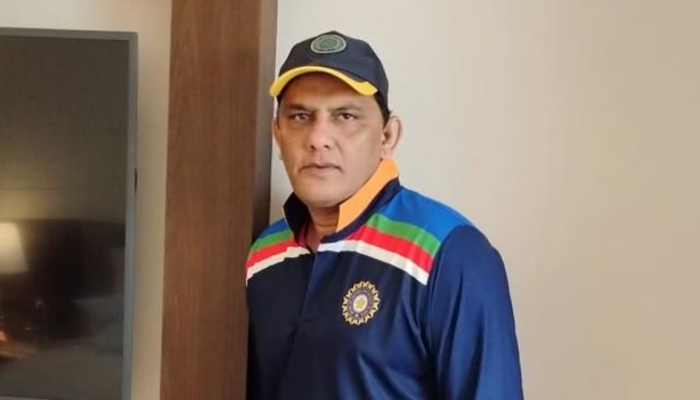
Just weeks before the Telangana assembly election, Mohammed Azharuddin, the former captain of India’s cricket team and current Congress nominee, is experiencing legal challenges, as he is been accused of corruption and embezzlement of funds. According to reports, Telangana’s Rachakonda Police on Monday, November 6, registered 4 cases of corruption against the scam-tainted former Indian skipper.
Some other office bearers and previous members of HCA have also been named in the FIR.
The former Indian cricket captain has reportedly approached the Malkajgiri Court seeking bail in all four cases registered against him.
Last month the Hyderabad Police said that criminal cases had been filed against former cricketer Mohammed Azharuddin and some other former officer bearers of the Hyderabad Cricket Association (HCA) over alleged misappropriation of funds up to Rs 3.85 crore.
Other than former HCA president Mohammed Azharuddin, those named in the FIR are former secretary R Vijay Anand and former treasurer Surender Agarwal. The case against the accused persons was registered on a complaint lodged by Association Chief Executive Officer Suneel Kante Bose.
The accused persons had been booked with criminal breach of trust, cheating, forgery, and criminal conspiracy in violation of IPC sections 406, 409, 420, 465, 467, 469, and 120-B.
They were accused of misappropriating money while procuring gym equipment, cricket balls, fire extinguishers, and bucket seats for the HCA’s premises as well as the Rajiv Gandhi International Cricket Stadium.
The alleged misappropriation of HCA funds and diversion of funds to private agencies under the guise of supplying material to the HCA, which occurred between March 2020 and February 2023, was discovered during a forensic audit conducted by a private firm at the request of the HCA.
Furthermore, police have registered three additional cases in relation to the players submitting forged age certificates to play in underage teams. An investigation has been initiated into that as well.
The former Indian cricket team captain Mohammed Azharuddin’s life has been full of controversies. In 2020, a complaint was registered against him in Aurangabad, Maharashtra for allegedly duping a travel agent off Rs 21 lakh.
Mohammed Azharuddin had a controversial cricket career
Mohammed Azharuddin was banned for life from Cricket by BCCI in 2000 after he was named by disgraced South African Captain Hansie Cronje as the man who introduced Cronje to bookies. High Court quashed the ban in 2012 but BCCI never officially lifted the ban. However, they did allow him to contest the Hyderabad Cricket Association elections.
Azharuddin had contested the 2009 general elections on a Congress ticket from the Moradabad seat and had won. In the 2014 elections, he was the Congress candidate from the Tonk-Sawai Madhopur seat but lost. Named working president of the Telangana Pradesh Congress Committee in 2018, he was disappointed in the 2019 general elections as the party denied him tickets, from both Secunderabad and Hyderabad constituencies.
This time again, for the Telangana Assembly elections, which will be held in the state on November 30, Congress has placed its bet on the scam-tainted Azharuddin and is fielding him from the Jubilee Hills constituency in Hyderabad. Though Azharuddin has not yet filed the nomination for the upcoming assembly polls, the 4 new cases of alleged corruption registered against him, will have a significant impact on his election campaign as the opposition will surely use the alleged corruption charges to target the Congress candidate.
Pro-Palestine protesters, raising chants of “Free Palestine”, staged a demonstration outside the only praying site of Jews, a synagogue, in Sweden’s Malmo city on Saturday (4th November). The protesters also gave anti-semitic calls, including chants to “bomb Israel”, while waving Palestinian flags. As per Swedish media, one of the demonstrators also burned an Israeli flag while slogans to bomb the Jewish nation were also heard during the demonstration, which was caught on camera.
Chairman of the Jewish Central Council of Sweden, Aaron Verständig captured the incident where a demonstrator could be seen burning the Israeli flag and calling to ‘bomb Israel’. He shared the video of the protest on X, which has gone viral on the internet. Condemning the incident, Verständig said, “Such acts of hatred towards the Jewish community in Malmö by extremists are utterly reprehensible.”
Det ni ser är en demonstration mot Israel vid synagogan i Malmö nyss. Vidrigt hur den judiska församlingen i Malmö ånyo attackeras av islamister. Viktigt med tydliga fördömanden @KatrinS_J mfl pic.twitter.com/0OiCbnIZyM
Footage of the incident showed the absence of any police presence at the synagogue, which has been subjected to numerous incidents of vandalism over the years.
Earlier, in 2011, Malmo City witnessed massive anti-Israel demonstrations and antisemitic rioting merely after it had plans to host Israel’s tennis team. Moreover, the city’s only synagogue has also faced arson attacks at least on two occasions, which is why several Jewish organisations have called out Police and authorities for their inaction and not providing security from violent threats from Pro-Palestinian demonstrators.
The spokesperson for the Jewish Community of Malmo, Fredrik Sieradzki, criticised police for not preventing the actions of the protesters and called their apparent failure to intervene “reprehensible.”
Calling out ‘blatant antisemitism’, the European Jewish Congress on Sunday (5th November) condemned the incident. The Jewish organisation tweeted, “We are deeply appalled by the recent Pro-Palestinian protest, which involved the burning of an Israeli flag in front of a synagogue in Malmo, Sweden. Intimidating the Jewish community and blaming them for the events in the Middle East is blatant antisemitism.”
We are deeply appalled by the recent Pro-Palestinian protest, which involved the burning of an Israeli flag in front of a synagogue in Malmo, Sweden.
Intimidating the Jewish community and blaming them for the events in the Middle East is blatant antisemitism. pic.twitter.com/W95n1Y5b3m
However, the press department of The Swedish Police Authority has not responded to the allegations that it failed to provide adequate security and take action against pro-Palestine demonstrators who gave calls to ‘bomb’ the Jewish state or burnt the Israeli flag.
On 7th October, more than 3,000 Hamas terrorists launched a surprise attack involving rocket barrages and ground assault on Southern Israel, killing more than 1,400 people, maiming some 3,000, and abducting 240 more.
Since the start of the Israel-Hamas war, the entire western world has witnessed dozens of anti-Israel and anti-semitic protests.
Evidently, the German police suspect that some unidentified assailants had tried to torch a synagogue. In Paris, police arrested a man who allegedly torched the front door of a Jewish couple. Similarly, in Lyon, a woman was stabbed in her home on Saturday (4th November), according to police officials, they suspect that the stabbing was an antisemitic assault. As per the news site 20minute.fr, the victim suffered minor injuries that required a few stitches to her abdomen.
The election chorus is echoing across Rajasthan and the Udaipur district of Mewar region reverberating the loudest. This is the same Udaipur which, in recent times, has come to be known for the brutal murder of a Hindu man Kanhaiya Lal. Kanhaiya Lal was killed by Jihadis who slit his throat in his shop where they entered on the pretext of giving measurements. His crime was that he was accused of supporting Nupur Sharma on social media, and this act was seen as ‘blasphemy’ by the Islamists.
The case had sent shockwaves across the country and sparked several demonstrations against the Jihadi mentality. The incident had stirred emotions so strong in the country that now Kanhaiya Lal’s murder case has become a major factor for political parties in the upcoming elections in Rajasthan. Political parties are leaving no stone unturned to win the elections, but ground reports say that the path for Congress is very difficult this time around.
No justice in Kanhaiya Lal’s murder case, continuous betrayal of the youth in Rajasthan and administrative failure of the Ashok Gehlot government are among the key issues for the Congress that could cost it the next term. People across Rajasthan are also unhappy that the hard work of young leaders like Sachin Pilot is being swallowed by ‘magicians’ like Ashok Gehlot.
People disappointed with Congress’s failure
Talking to News 18, local youth said that the Congress government in the state led by Ashok Gehlot has always ignored Udaipur. Rampant ‘paper leak’ incidents have made a mockery of exams and recruitment for government posts. No recruitment is being completed. Unemployment is increasing rapidly and a common man like Kanhaiya Lal is murdered in a terrorist attack in Udaipur. Is this how the administration works? Common people are also expressing displeasure over the election freebies announced by the Ashok Gehlot government.
People said that if the administrative system was good, neither scandals like paper leaks would have happened continuously nor people like Kanhaiya Lal would have lost their lives. In such a situation, Ashok Gehlot would not have needed election rallies. A Muslim youth named Iqbal said that earlier there was no communal tension in Rajasthan, but now due to the leaders, Rajasthan has also become electorally communalised.
The tragic incident in Udaipur is a vote bank opportunity for Congress: Prime Minister Modi
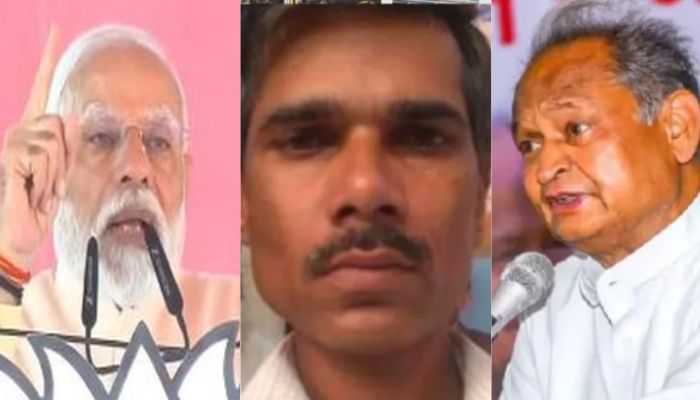
The entire Hindu community appeared united against the murder of Kanhaiya Lal in Udaipur. Raising the issue in a rally in Chittorgarh, Prime Minister Narendra Modi reminded the public about the condition of law and order under Ashok Gehlot’s rule. The PM blamed the Congress government.
Prime Minister Narendra Modi said in the rally in Chittorgarh, “Nobody had even imagined what happened in Udaipur. People come on the pretext of getting clothes stitched and without any fear or dread, they slit the tailor’s throat. Congress only saw the vote bank in this case too.”
PM Modi asked the people at the rally what the Congress-ruled Rajasthan government did in the Udaipur tailor murder case. He asked if it did vote bank politics. Kanhaiya Lal Teli was murdered for supporting suspended BJP leader Nupur Sharma. The video of the chilling murder went viral on social media.
BJP has a keen eye on Udaipur
The Bharatiya Janata Party has a special focus on the Udaipur district. There are many reasons for this, but the one reason which is affecting the entire election is the cornering of Congress due to Muslim appeasement and the Hindutva card of the BJP.
Five out of eight assembly seats of Udaipur may have been in the reserved category, but the Udaipur assembly seat, which affects the entire district, has been in the possession of the BJP for a long time. It is from here that Amit Shah started the election battle of Rajasthan while BJP National President JP Nadda has also kept Udaipur district on priority.
Congress accused of vote bank politics
Union Home Minister Amit Shah held a rally in Udaipur on 30th June 2023. Enumerating the misgovernance of Ashok Gehlot, Amit Shah said, “Ashok Gehlot’s government is number one in corruption. Today you have a chance to demand accountability as to whose two crore rupees and one kilo of gold were found inside the Rajasthan secretariat? This government has done the work of breaking all records of corruption.”
He added, “Gehlot ji broke all the promises he had made. They did not provide security to Kanhaiya Lal. Your police remained silent until he died. You did not even want to arrest the accused… NIA caught them. Rajasthan government does not form special courts otherwise Kanhaiya Lal’s culprits would have been hanged by now. They should be ashamed, they do vote bank politics.”
Kanhaiya Lal’s ashes are demanding justice
On 28th June 2022, tailor Kanhaiya Lal was brutally murdered by two Islamists in Udaipur. Kanhaiya Lal was a Hindu whose son had posted on social media in support of former BJP spokesperson Nupur Sharma. After this post, Kanhaiya Lal was receiving continuous threats. On the day of the murder, two people – Mohammad Riyaz Ansari and Mohammad Ghaus came to his shop and attacked Kanhaiya Lal with sharp weapons.
They murdered Kanhaiya Lal by slitting his throat and then posted the video of the murder on social media. In this video, both the attackers described the murder of Kanhaiya Lal as a “statement” and said that they had killed him for his support for Nupur Sharma.
The murder of Kanhaiya Lal created an atmosphere of outrage and anger in the entire country. Despite almost one and a half years having passed since the murder, the killers have not been punished yet, and Kanhaiya Lal’s ashes have also not been immersed. The court has also granted bail to an accused in this case.
In the year 2018, BJP had won 6 out of 8 seats in Udaipur
There are eight assembly seats in Udaipur. Out of these, the BJP had won six seats whereas Congress had to make do with only two seats. Gogunda, Kherwada, Jhadol, Udaipur (Rural), Salumbar, Mavli, Udaipur and Vallabhnagar assembly seats fall in the Udaipur district. Of these, the first five assembly seats were reserved for the ST category in the 2018 elections.
Out of this, Dayaram Parmar of Congress had won the Kherwada (reserved) seat. Gajendra Singh Shaktawat of Congress had won the Vallabhnagar seat. After Shaktawat’s untimely death due to Coronavirus, his wife won the by-election. The remaining six assembly seats were held by BJP.
Gulabchand Kataria has been dominating the Udaipur assembly seat for a long time and has held important positions. Udaipur district is considered the stronghold of Kataria. Last February, the Central Government relieved Kataria from the post of Leader of the Opposition and made him the Governor. He may have moved away from active politics, but his impact is visible on the politics of Udaipur.
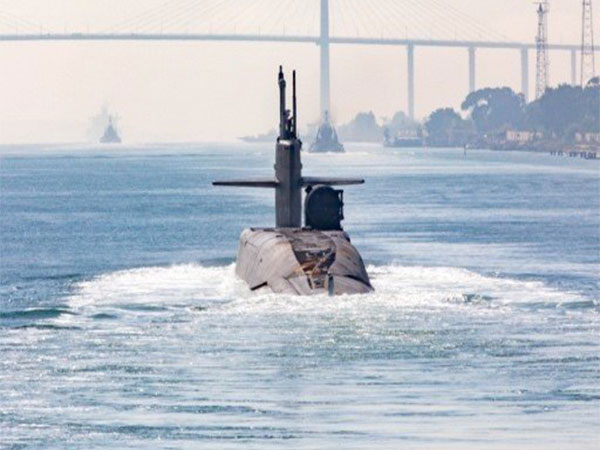
The United States military on Monday announced that a guided missile has arrived in West Asia. The US Central Command took to its social media ‘X’, and stated that an Ohio-class submarine arrived in the US Central Command area of responsibility on November 5.
According to CNN, the arrival of the missile seemed intended to display a message of deterrence clearly directed at regional adversaries like Iran and its proxies as the Biden administration tries to avoid a broader conflict amid the Israel-Hamas war.
The post was accompanied by a picture which appears to show a guided missile submarine in the Suez Canal passing under the Al Salam Bridge northeast of Cairo.
The submarine joins a number of other US Navy assets already in the area, including two carrier strike groups and an amphibious ready group, reported CNN.
However, the social media post did not mention the sub, but the US Navy has four Ohio-class guided missile submarines (SSGNs), that are former ballistic missile subs converted to fire Tomahawk cruise missiles rather than nuclear-tipped ballistic missiles.
Each SSGN can carry 154 Tomahawk cruise missiles, 50 per cent more than US guided-missile destroyers pack and almost four times what the US Navy’s newest attack subs are armed with, CNN reported. Each Tomahawk can carry up to a 1,000-pound high-explosive warhead.
According to an interview he gave to CNN in 2021, Carl Schuster, a former director of operations at the US Pacific Command’s Joint Intelligence Center said that “SSGNs can deliver a lot of firepower very rapidly.”
“One-hundred and fifty-four Tomahawks accurately deliver a lot of punch. No opponent of the US can ignore the threat,” he said as cited in CNN.
The US broadcaster noted that the first time the SSGNs were used in combat was in March 2011, when the guided missile sub USS Florida fired almost 100 Tomahawks against targets in Libya during Operation Odyssey Dawn.
The announcement of the arrival of an Ohio-class submarine comes after US Secretary of State Antony Blinken held a series of talks with US partners in West Asia.
Meanwhile, Blinken is on a visit to West Asian countries, including Turkey, Iraq, Israel, the West Bank, Jordan and Cyprus.
Earlier on Sunday, Defence Secretary Lloyd Austin spoke with his Israeli counterpart, Minister of Defense Yoav Gallant and said that the US was committed to deterring “any state or non-state actor seeking to escalate this conflict,” a clear reference to Iran and Hezbollah, the Iran-backed armed group, CNN reported.
Moreover, this month, Austin also said that the additional forces in the area were meant to “bolster regional deterrence efforts, increase force protection for US forces in the region, and assist in the defense of Israel.”
(This news report is published from a syndicated feed. Except for the headline, the content has not been written or edited by OpIndia staff)
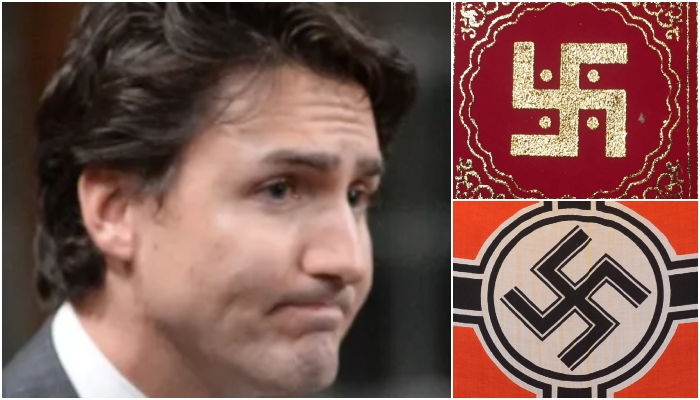
On Sunday (5th November), Canadian PM Justin Trudeau attracted controversy by mistaking the peaceful, holy Hindu Swastika for a Nazi Hakenkreuz, a symbol of hatred from the 20th century. The Canadian PM was talking about a pro-Palestinian rally that took on Parliament Hill in Ottawa on Saturday (4th November), where the hooked cross could be spotted. The Hakencreuz was used by the protesters to blatantly compare Israel to the Nazis.
The Canadian PM condemned the display of hooked cross flags displaying hatred but blatantly compared it to the Hindu Swastika committing a grave mistake. “When we see or hear hateful language and imagery, we must condemn it. The display of a swastika by an individual on Parliament Hill is unacceptable. Canadians have the right to assemble peacefully – but we cannot tolerate antisemitism, Islamophobia, or hate of any kind,” Trudeau stated on Twitter (X) after which Hindu netizens slammed the Canadian PM for equating the symbol of peace to the Nazi symbol of hatred.
When we see or hear hateful language and imagery, we must condemn it. The display of a swastika by an individual on Parliament Hill is unacceptable. Canadians have the right to assemble peacefully – but we cannot tolerate antisemitism, Islamophobia, or hate of any kind.
Vishwa Hindu Parishad spokesperson Vinod Bansal corrected the Canadian PM and tweeted that the leader should know and learn about the symbol of peace first before blindly spreading hatred against it.
“Stop equating the Hindu symbol “Swastika” with the Nazi’s symbol “Hakenkreuz” or the Hooked Cross. Your language clearly shows that by coming closer to terrorists or protecting them, you are inclined to become Hinduphobic and Indiaphobic which is not good for a country like Canada. Remember, Terrorism never escaped even its founders and supporters,” Bansal tweeted.
Dear @JustinTrudeau , Please learn #Swastik before blindly spreading hate against it. Stop equating the Hindu symbol "Swastika" with Nazi's symbol "Hakenkreuz" or the Hooked Cross. Your language clearly shows that by coming closer to Terrorists or protecting them, you are… pic.twitter.com/TC3JsJSIIC
Another netizen commented that this was the second time that the Canadian PM had compared the symbol of goodness and peace to the Nazi symbol of hatred.
Justin Trudeau doesn't know the difference between Nazi sign and Swastika:
Canadian PM Justin Trudeau again equates Hindu Swastika with Nazi Symbol, this time calls Nazi symbol of hate hakenkreuz – a Hindu Swastika. pic.twitter.com/oISAUHkYIZ
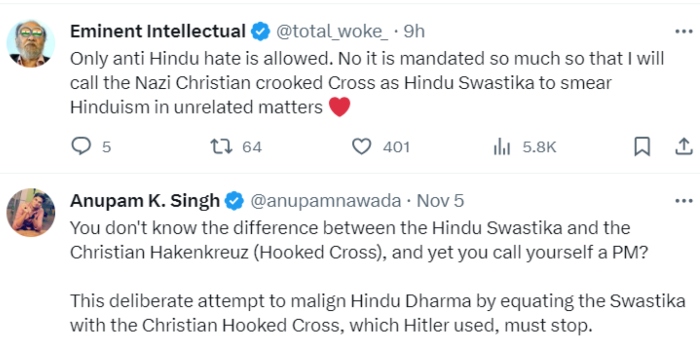
Meanwhile, many other Hindu netizens could be seen schooling the Canadian PM for making such a disgraceful comparison and hurting the sentiments of the Hindu community.
Screenshot from Twitter (X)
Swastika isn't a Hakenkreuz ! Pls use the right term for what is what… Regards from India, that is Bharat ?
Notably, this is not the first time the Canadian PM Justin Trudeau has made this weird comparison hurting the sentiments of the Hindu community. Earlier, in the year 2022, during the truck driver’s protest in Canada over the COVID-19 regulations, Trudeau and New Democratic Party (NDP) leader Jagmeet Singh had raised voices against demonstrators raising hateful flags on the streets of Canada.
“Swastikas and Confederate flags have no place in Canada,” the leaders were quoted as saying. The Canadian leaders were schooled by Hindu netizens at that time as well explaining the difference between the two symbols. However, the Canadian PM making similar comparisons again indicates his alleged deliberate intentions to demean the Hindu community and its culture.
The HinduPACT (Hindu Policy Research and Advocacy Collective), in the year 2022, had urged Trudeau and Singh not to conflate the “Swastika,” an ancient and auspicious symbol for Hindus, Buddhists, and many indigenous communities around the world, with the “Hakenkreuz,” a Nazi symbol of hatred from the 20th century.
Swastika and the Hakenkreuz explained
There is an important difference between the two symbols, which international media houses, leftists, and propagandists ridiculously use interchangeably, not only to hurt Hindu feelings but also to display their inherent Hinduphobia.
Swastika is made up of ‘su’ meaning “good” and ‘asti’ meaning “to be”. The word has been translated from the Sanskrit base. In other words, the symbol indicates well-being and attracts happiness. The symbol dates back some 6,000 years. Scholars generally agree it originated in India.
Other ancient cultures, including the Vikings and Greeks, as well as Hindus, Buddhists, and Jains, recognised Swastika as a symbol of good luck, prosperity, and all things auspicious.
A religious symbol for Hindus, the Swastika was first mentioned in the Vedas. It symbolises many things like Surya (the sun) and Brahma, the creator. It is seen as a power symbol and is also the emblem of Ganesha, the god of good luck. In both Hinduism and Jainism, the Swastika is used to mark the opening pages of account books, doors, and thresholds. It is found in a variety of temples and religious ceremonies all over the world. Further, it is used as a welcome sign in many South Asian households.
In fact, it is found that the Swastika was also used in Ancient Greece. The ancient Druids and the Celts also used the symbol. It was used by Nordic tribes and even early Christians used the Swastika as one of their symbols, including the Teutonic Knights, a German medieval military order, which became a purely religious Catholic Order.
Furthermore, the American Jewish Committee, one of the country’s oldest Jewish advocacy organisations, released a leaflet clarifying the distinction between the Swastika used for millennia by Hindu, Jain, and Buddhist cultures and the deformed Nazi version of it.
The ‘Hakenkreuz’, on the other hand, is widely recognized as a symbol of anti-Semitism, having resulted in the deaths of approximately 6 million Jews during the Holocaust. The Nazi symbol represents fascism and also it is a trauma for many people today.
Documented evidence proving the difference between the two symbols
It has been debunked several times that Hakenkreuz and Swastikas are very different symbols. Hindus and Hindu leaders worldwide are working constantly to change the perception people have created towards Swastika.
It is worth mentioning that this is the tactic used by Hindumisic propagandists who intentionally link ‘Swastika’ to the Nazi Hakenkreuz (hooked cross) in order to indicate that Hindus draw their inspiration from Nazis.
Interestingly, there is documented evidence that Adolf Hitler never used the word Swastika in his autobiography ‘Mein Kampf’ but used Hakenkreuz. However, when it was translated from German to English, the translator used Swastika, which has been propagated ever since.
Many in the West think that Hitler invented the word Swastika or that wrote it in his writings. However, the book that he wrote, ‘Mein Kampf’ never used the word Swastika. In fact he clearly used the word ‘Hakenkreuz’ to describe the hooked cross.
The book written by Hitler was translated by Irish Catholic Priest and journalist James Vincent Murphy in 1939 who purposefully mistranslated Hakenkreuz into Swastika while allowing other German words in their original form or correctly translating them into English.
The book was also translated by one Edgar Trevelyan Stratford Dugdale who correctly translated the word ‘Hakenkreuz’ to ‘hooked cross’ but his version never gained attention. He never once used the word Swastika.
Australia and California rightly recognised the difference between Swastika and Hakenkreuz
Recently, in March 2023, the Queensland government, Australia, moved legislation banning hate symbols and acknowledging the distinction between Hindu Swastika and the Nazi Hakenkreuz. Shannon Fentiman, the Attorney-General and Minister for Justice, Minister for Women, and Minister for the Prevention of Domestic and Family Violence spoke about the misappropriation of the Hindu Swastika and the need to differentiate it from a hooked cross or the Nazi Hakenkreuz.
“…when referring to Nazi symbols, it is important to note that the Nazi hooked cross is the correct terminology for the most widely known symbol. The hooked cross closely resembles the swastika, which has peaceful and profound meaning in some religions, including Hinduism, Buddhism, and Jainism. The Hindu Community of Australia helped the government in noting this important distinction,” the leader was quoted as saying.
In May 2022, California Legislative Assembly Member Rebecca Bauer-Kahan read Assembly Bill 2282 differentiating between peaceful Hindu Swastika and Nazi Hakenkreuz. In February 2022, Assembly Members Baurer-Kahan and Levine introduced Assembly Bill No 2282 to amend the Penal Code that deals with crimes. At that time, the bill did not differentiate between Nazi Hakenkreuz and Hindu Swastika and called for punishment for anyone who places or displayed signs of hate, including “Nazi Swastika”.
The California government recognised the difference after the Hindu American Foundation extensively worked on the issue and educated the general public as well as the lawmakers about the difference between the Nazi Hakenkreuz (hooked cross) and the Hindu holy symbol Swastika.
#Breaking: California Legislative Assembly Member @BauerKahan responds to education efforts of @HinduAmerican & California Dharma communities to amend #AB2282 & decriminalize the Hindu Swastika!
— Hindu American Foundation (@HinduAmerican) May 23, 2022
Hindu holy symbols are regularly defamed by the West, liberal media, and the left intelligentsia
This is not the first time that the West leader, international media, or the left intelligentsia have been caught blatantly exhibiting their Hinduphobia and purposefully linking the holy Hindu Swastika to the Nazi symbol.
Earlier in 2022, the international media outlet ‘The Guardian’ reported about an incident where a gunman had opened fire in a school in the central Russian city of Izhevsk, killing at least six people and injuring 20 before killing himself. While reporting on the horrible killings, the media outlet stated that the killer was wearing a jacket with the holy Hindu ‘Swastika’. “Gunman with a swastika on T-shirt kills 15 at Russian school,” the headline given by the media outlet read.
Likewise, many other international media houses like Global News, The Times, vice.com, Toronto Sun, South China morning post, and NBC News displayed the same Hinduphobia while reporting about the incident. The media houses failed to differentiate between two symbols which are poles apart and furthered their propaganda against the Hindu community.
Recently in June 2023, Maharashtra’s former CM Uddhav Thackeray committed the same mistake. The Shiv Sena (Uddhav camp) Chief on the occasion of the Shiv Sena foundation day backed Western propaganda and equated the Nazi Hakenkreuz to the Hindu Swastika.
Thackeray equated PM Modi to Hitler and claimed that his rule pushed the country towards dictatorship in the same way Adolf Hitler pushed Germany in the 1930s. Equating BJP to Hitler’s Nazi party, Thackeray said, “Our ruling party is acting in the same way as Hitler’s party [the Nazi party]… It is silencing all Opposition, unleashing Central agencies on them, and seizing control of the media. Remember, Hitler’s symbol too was the Swastika.” He claimed that the “authoritarian” rule of the PM and the BJP was threatening to “split the country into pieces”.
Did the Canadian PM deliberately make the unfavoured comparison?
The equation of Canadian PM Justin Trudeau with India and the Hindu community has not been so good lately. The relationship soured after he, on 19th September, accused India of killing Khalistani terrorist Hardeep Singh Nijjar on Canadian soil. Canada also expelled a senior Indian diplomat as a result of the allegations. The allegations against India opened a can of worms as the allied countries of Canada refused to issue a joint statement against India. Furthermore, India also firmly denied the allegations and expelled a Canadian diplomat in retaliation.
“We have seen and rejected the statement of the Canadian Prime Minister in their Parliament, as well as the statement by their Foreign Minister. Allegations of the Government of India’s involvement in any act of violence in Canada are absurd and motivated,” the Ministry of External Affairs has said in its statement.
Canada, led by PM Justin Trudeau, has been housing terrorists and allegedly supporting them in their anti-India activities. The Khalistani terrorists have defaced several Hindu temples and properties in Canada. Despite holding several official talks to condemn and protect the Hindu community residing in the country, the Canadian authorities seem to have hardly done anything to protect the Hindu community as the attacks on the Hindu temples continue to take place. The recent one happened on 8th September 2023.
Moreover, the Canadian PM was schooled by the Hindu community for using the Nazi symbol and the Hindu Swastika interchangeably. The HinduPACT (Hindu Policy Research and Advocacy Collective), in the year 2022, had urged Trudeau and his staffer not to conflate the “Swastika,” an ancient and auspicious symbol for Hindus, Buddhists, and many indigenous communities around the world, with the “Hakenkreuz,” the Nazi symbol of hatred from the 20th century.
However, Trudeau happened to use the two symbols interchangeably again on Sunday (5th November) while raising his voice against the crimes. This shows nothing but Trudeau’s deliberate intentions to hurt the Indian and the Hindu community by not recognising the significant difference between the two symbols and using them interchangeably.