Home Blog Page 1661

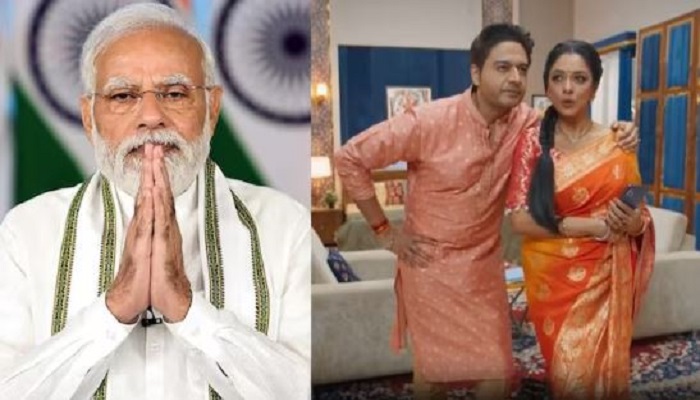
PM Modi shares ‘Anupamaa’ video promoting ‘Vocal For Local’ initiative ahead of Diwali festive season

0

Popular TV serial Anupamaa recently put its weight behind ‘Vocal For Local’ and Atmanirbhar Bharat when its main star cast was seen promoting the mass movement and spreading the message to its viewers in the festive Diwali season. Prime Minister Narendra Modi who has been unequivocally promoting the two movements to support the indigenous workforce, heaped praises on the TV serial for featuring the two schemes that are close to his heart.  

Sharing a 3-minute video, PM Modi wrote, “The #VocalForLocal movement is gaining a lot of momentum across the country.”

In this 3-minute video shared by PM Modi, Rupali Ganguly donning her popular character ‘Anupamaa’ appeals to the viewers to support the ‘Vocal for Local’ movement’ and heaps praise on the Atmanirbhar Bharat program. 

Anupamaa starts by noting that this is the era of social media where everyone is a storyteller. She adds, “Imagine if we put the story of someone close to us and his life becomes a blockbuster. So how good will it be?”

The characters then talk about the itineraries that have been procured from local vendors and truly value-for-money products which they then upload on their social media handles with the hashtags #VocalForLocal and #AtmanirbharBharat. They also promote digital payments through UPI (Unified Payment Interface) and #DigitalIndia.   

Two minutes into the video, we can hear PM Modi urging fellow Indians to be ‘Vocal for Local’ in this festive season. He also issues an appeal to work towards fulfilling our aspiration of Atmanirbhar Bharat. He encourages participation by asking Indians to upload their selfies with the artisans on the Namo App using the hashtag #VocalForLocal. He added that he would share some of these posts on social media.    

Towards the end of the video, PM Modi thanked the team of the Anupamaa serial and its broadcaster Star Plus for helping spread the message of Vocal for Local. 

Notably, Prime Minister Narendra Modi often emphasises promoting indigenous products on many occasions. He has been issuing appeals to the general public to buy goods from small shopkeepers and vendors which would help them greatly and help build an Atmanirbhar Bharat.  

It is important to note that recently, during his monthly radio program ‘Mann Ki Baat’, PM Modi laid emphasis on promoting ‘Vocal for Local’ during the festive season.

France: Dozens of Muslim travellers offering namaz at Paris airport stirs row, authorities term it ‘regrettable’ and vow to act ‘firmly’

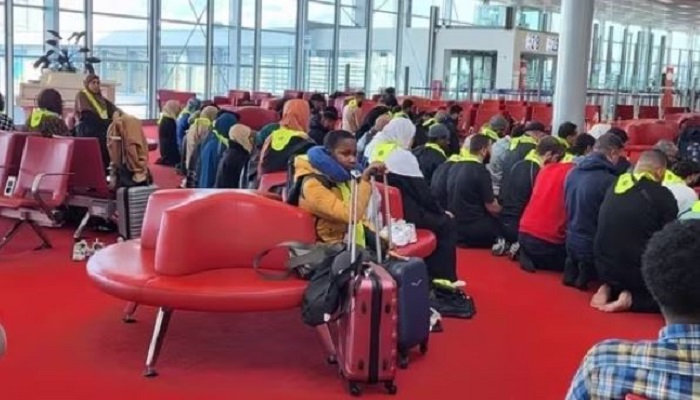
Images of dozens of Muslim travellers collectively offering Namaz at a French airport have created a social media storm. The images quickly went viral, prompting netizens and politicians to highlight that there are dedicated spaces for prayers inside airports and other such public places. When the controversy escalated, the French government on Monday (6th November) vowed that it would deal with such issues ‘firmly’. Additionally, the airport authority described the incident as ‘regrettable’ adding that they will increase vigilance. 

As per media reports, the pictures were first shared on social media by former European affairs minister, Noelle Lenoir. She asked, “What does the CEO of Aéroports de Paris do when his airport is transformed into a mosque? Is the change in status official?”

In the pictures that were shared on Sunday (5th November), several dozen travellers could be seen collectively offering Namza in the departures hall of Charles de Gaulle Airport in Paris ahead of a flight to Jordan.

Speaking with the French news agency AFP, an airport source said that the travellers were offering Namaz at terminal 2B of France’s largest airport. According to the source, there were around 30 travellers who took part in it and it lasted around 10 minutes.

Notably, France is strictly a secular country and there are limits on displays of religious belief in public spaces including schools and public buildings like airports and metros. Additionally, there are dedicated closed areas set aside for people of all faiths to pray in private in such public places including airports. 

Consequently, Transport Minister Clément Beaune stated that airport authorities were fully committed to implementing rules and vowed “firmness”.

Ruling party MP Astrid Panosyan-Bouvet noted, “There are specially dedicated places of worship at the airport.” The MP added that the authorities had to implement “the rules that prevail in France, including at the airports”.

The chief executive of operator Aéroports de Paris (ADP) Augustin de Romanet said, “This is a regrettable first.” Taking to X, de Romanet wrote, “Dedicated places of worship exist. The border police have been instructed to prohibit this and will increase their vigilance.” 

He also warned against exaggerating the incident “at this time”. It was an apparent reference to the Israel-Hamas war which has created security concerns in France including several ‘bomb threats’ on airports, museums, and other public places. 

Although virtually all of them turned out to be a hoax, they had created panic in the French public. Further, on account of violent crimes by Islamists, France has been on the highest level of security alert since 13th October when a man shouting Allahu Akbar stabbed a teacher outside a school in Arras.  

Israel asks India for 100,000 workers to replace Palestinian workers after October 7 attacks: Reports

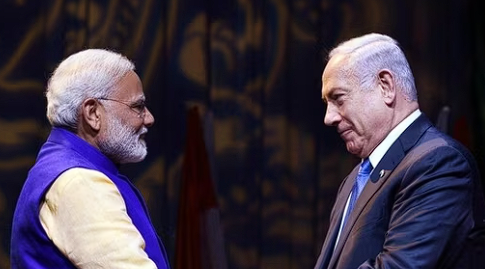
Israel has reportedly asked India for 100,000 workers to replace Palestinian workers barred from working inside Israel following the bloodcurdling events that transpired on October 7.

Journalist Aditya Raj Kaul took to X, formerly known as Twitter, to inform that Israel has formally asked India to immediately provide 100,000 workers to replace the existing Palestinian workers. In May, Israel and India forged an agreement permitting 42,000 Indian labourers to be employed within the Jewish State.

The move came in the wake of recent revocation of work permits for tens of thousands of Palestinian workers in Israel, following which the Israeli construction sector mulled over the prospect of meeting the labor shortage by considering the employment of a significant number of workers from India. This effort is aimed at filling the gap left by the absence of Palestinian workers, which has had an impact on various industries since the work permit cancellations that occurred following the Israel-Hamas conflict that began on October 7.

It has been reported that the Israeli Builders Association has requested the government’s approval to employ as many as 100,000 workers from India. This request follows the loss of work permits by around 90,000 Palestinians, particularly in the construction and other essential sectors, as a result of the recent conflict.

Haim Feiglin, the Vice President of the Israeli Builders Association, underscored the ongoing negotiations with India, awaiting the Israeli government’s approval for the employment initiative. The goal is to hire a workforce from India ranging between 50,000 to 100,000 individuals.

“We are currently in talks with India and are waiting for the Israeli government’s decision to greenlight this initiative. We aim to bring in 50,000 to 100,000 workers from India to help restore normalcy across various sectors,” he stated.

This move to recruit Indian workers is a response to the immediate challenges posed by the absence of Palestinian labor in critical sectors, while the Israel-Hamas conflict in Gaza continues. The construction industry, in particular, heavily relies on these workers, and the sudden withdrawal of work permits has created a pressing need for alternative labor sources to sustain ongoing projects and operations.

The request made by Israeli construction authorities highlights the crucial role of foreign labor in upholding vital sectors within the nation. The proposition to incorporate a significant number of Indian workers is designed to fill the workforce gap, promoting the continuity and stability of various industries affected by the sudden absence of Palestinian labourers.

Urgent need to address ‘identity theft’: Actress Rashmika Mandanna says after her deep fake videos go viral

0

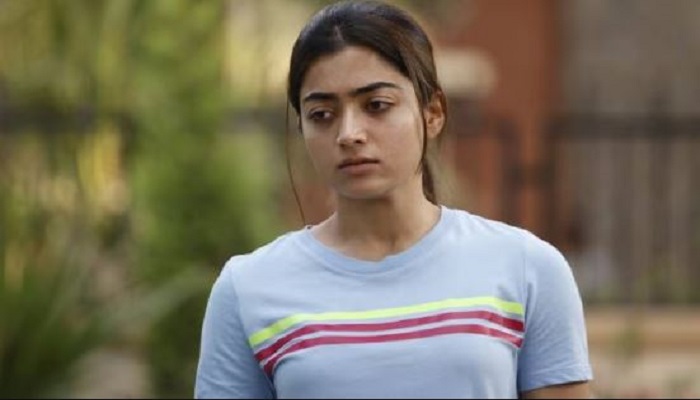
Hours after her deep fake video started making rounds on the internet, actress Rashmika Mandanna took to X (formerly Twitter) to share her ordeal and concerns over the misuse of technology, particularly regarding the deep fake video. Rashmika Mandanna said she feels really hurt to share this and has to talk about the deepfake video of her that was being spread online. The actress also stressed that the misuse of technology is extremely scary for everyone. 

Mandanna thanked her family, friends, and well-wishers for all the protection and for being her support system. However, the actress noted that she couldn’t imagine how she would have tackled this situation if this had happened when she was in school or college. 

In her post, Rashmika Mandanna emphasised that it is an urgent need for us as a community to address the misuse of technology before more people get affected by ‘identity theft’. She also tagged the Cyberabad Police, Cyber-safety and Cybersecurity awareness handles maintained by the Ministry of Home Affairs, and Maharashtra Cyber Cell unit. 

Rashmika said, “Something like this is honestly, extremely scary not only for me but also for each one of us who today is vulnerable to so much harm because of how technology is being misused.” 

“Today, as a woman and as an actor, I am thankful for my family, friends, and well-wishers who are my protection and support system. But if this happened to me when I was in school or college, I genuinely can’t imagine how could I ever tackle this. We need to address this as a community and with urgency before more of us are affected by such identity theft, “ the actress added.  

It is important to note that a video has been circulating for quite some time, especially on Instagram. In this video, a girl, whose face has been altered to resemble that of Rashmika Mandanna, is seen entering an elevator. However, the edited video was created using deep fake technology. The girl in the video is Instagram model Zara Patel, and she uploaded the original video on 9th October in which her face is clearly visible. However, through deep fake technology, the creator of the edited video superimposed actress Rashmika Mandanna’s face onto Patel’s. 

The issue was first raised by an X user with the handle Abhisheksays asserting, “There is an urgent need for a legal and regulatory framework to deal with deepfake in India.” 

When the deep fake video was flagged, Bollywood veteran Amitabh Bachchan also responded to it saying, “Yes this is a strong case for legal.”

In simple terms, deep fake technology misappropriates the identity of another person. Similar to the filters (such as puppy faces, miniatures, or age/gender fluidity) found in photo-editing apps or software, it superimposes the facial features of another person. However, unlike most unharmful filters which were used for fun or for embellishing one’s physical appearance, deep fake technology comes under cyber crime and identity theft. It poses serious risks, as with deep fake technology mischievous players could attribute inflammatory remarks that can cause serious repercussions. 

There have been a plethora of deep fake videos of several world leaders giving vile threats to their adversaries which could potentially lead to a diplomatic row between nations or even get them on the brink of war. Similarly, notable celebrities, including actors, singers, politicians etc have been prone to be used in adult or pornographic content via deep fake technology which till now has been a completely unchecked arena by legislatures throughout the world. 

DMK leader makes ‘dog eaters’ remark on Nagas, BJP and Tamil Nadu Governor slams him for insulting northeast Indians

Months after DMK leader Udhayanidhi Stalin called for the ‘annihilation’ of Sanatana Dharma, a member of his party made another controversial remark, sparking outrage from several quarters. DMK leader RS Bharathi insulted the people of Nagaland as ‘dog eaters’ while issuing a veiled threat to Tamil Nadu Governor RN Ravi.

“When the Nagaland residents, who eat dogs, displayed such dignity in their actions, driving Ravi out of their state, we must not lose sight of the self-respect of the Tamil people who season their meals with salt,” Bharathi, DMK’s organisation secretary, said at a party event held to mark the centenary of late party patriarch M Karunanidhi.

The video of Bharathi’s remarks has gone viral on the internet, triggering sharp disapproval from several quarters, including Governor RN Ravi, who condemned the derogatory comments made by DMK leader RS Bharathi towards the Naga community, where he referred to them as “dog eaters.”

The governor’s office, responding to these comments on the social media platform X, described them as “vulgar and unacceptable.”

“Nagas are brave, honest and dignified people. Thiru R S Bharathi, a senior DMK leader, publicly insulting them as ‘Dog eaters’ is scurrilous and unacceptable. I urge Mr Bharathi not to hurt a community of which the whole of India is proud,” the statement by the Tamil Nadu governor read.

The BJP too trained its guns against the DMK leader as Tamil Nadu BJP chief K Annamalai lashed out at him, saying the recent attack on the Governor is an outcome of such uncouth speeches by DMK leaders. “Reducing the pride of our North Eastern brothers & sisters to Dog eaters is highly condemnable,” said Annamalai while taking a dig at DMK’s model of ‘inclusive social justice’.

Annamalai also shared the video of Bharathi’s remarks at the event.

Reacting to the incident, BJP leader Narayanan Thirupathy said, “DMK leader RS Bharathi has insulted the people of Nagaland. Either he should apologise or he should be arrested and put behind bars.”

Apparently, Nagas are not the only section of the public targeted by the DMK, one of the key members of the opposition alliance I.N.D.I bloc. Before this, several leaders of the I.N.D.I.A. bloc had made disparaging remarks against Sanatana Dharma and threw their weight behind Udhayanidhi Stalin over his vow to ‘eradicate Sanatan Dharma’, a faith which has over 100 crore believers the world over. 

Taking a cue from Udhayanidhi Stalin, who compared Sanatan Dharma to diseases like Malaria and Corona and called for its eradication, DMK Minister A Raja claimed that his colleague’s remarks on Sanatan Dharma were soft. A Raja, who was accused in the 2G scam, argued that Sanatan Dharma should have been compared with stigmatising ailments such as HIV or leprosy.

During the current round of smear campaigns and attacks against Sanatan Dharma, several senior functionaries of Tamil Nadu Congress and its party leaders like Karti Chidambaram, son of Former Home Minister P Chidambaram and Karnataka Minister Priyank Kharge who is the son of Congress President Mallikarjun Kharge too added fuel to the fire.

Conspicuously, leaders from Congress, DMK, VCK, RJD, CPI(M), and Samajwadi Party among others have made controversial and hateful remarks against Sanatan Dharma, giving an impression that they all are on the same page as far as their opinions on Hinduism are concerned.

Amidst possibility of arrest by Enforcement Directorate, CM Arvind Kejriwal calls an all MLA meeting in Delhi

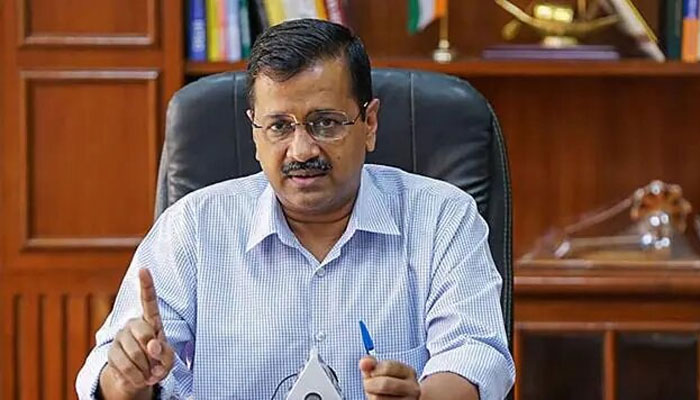
On 6th November, Chief Minister of Delhi Arvind Kejriwal called for a meeting with all the MLAs of Aam Aadmi Party in Delhi. It is speculated that the meeting was called amidst concerns over the expected action against Arvind Kejriwal by the central agencies over the Delhi Liquor Scam.

The meeting will take place in the Delhi assembly complex. However, the agenda of the meeting is unclear. There are speculations that some significant decisions will be made during the meeting regarding the AAP and AAP-led government in Delhi. Notably, the Enforcement Directorate had summoned Kejriwal on 2nd November in relation to the alleged scam, however, he failed to appear.

Arvind Kejriwal claimed there were discrepancies in the summons and decided not to appear for questioning. Instead, he joined Punjab Chief Minister Bhagwant Mann in campaigning in Madhya Pradesh for the Assembly Elections.

ED may issue fresh summons to Kejriwal soon. Several other AAP leaders and Kejriwal’s associates, including Deputy Chief Minister of Delhi Manish Sisodia, have already been arrested by the central agencies investigating the Liquor Scam. While Sisodia has been in custody since February this year, Rajya Sabha MP Sanjay Singh was recently arrested for his alleged involvement in money laundering related to the liquor scam.

Delhi Liquor Policy Scam

The Delhi liquor policy for 2021-22 was put into effect by the administration on 17th November 2021, however, it was cancelled at the end of September 2022 due to accusations of corruption. According to the agencies, the new regulation led to monopolisation, and gave economic advantages to people who weren’t eligible for liquor licenses. Central Bureau of Investigation and ED are investigating the alleged Delhi Liquor Scam. Several arrests were made in connection to the scam, including of Manish Sisodia and Sanjay Singh. Recently, the Supreme Court of India refused to grant bail to Sisodia, saying a money trail of Rs 338 crore has been tentatively established in the case.

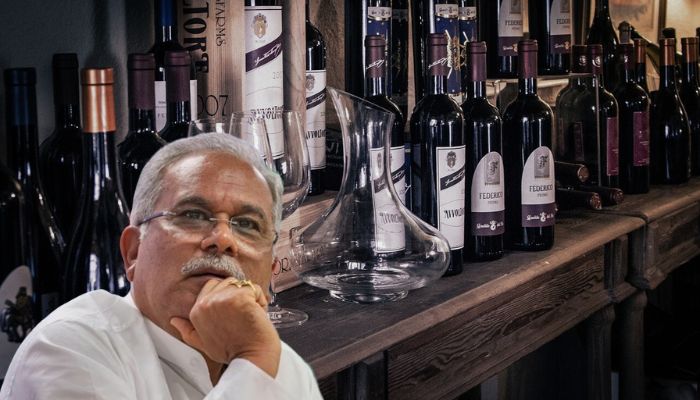
Illegal commissions, sale of illicit liquor from govt retail stores and more: How brother of Congress Mayor orchestrated ₹2161 crore liquor scam in Chhattisgarh

Ahead of the upcoming election in Chhattisgarh, the high-profile liquor scam that ran uninterrupted in the State between 2019 and 2022 has come under the spotlight again.

The scam cost the exchequer a whopping ₹2,161 crores, and was operated by high-profile bureaucrats in cahoots with political executives and distillery firms. The year was 2019. It had been less than 6 months since the Congress party formed the government in Chhattisgarh.

A businessman named Anwar Dhebar, who coincidentally happened to be the brother of Congress Mayor (Raipur) Aijaz Dhebar, came up with the idea to defraud the Excise Department of Chhattisgarh.

An IAS officer named Anil Tuteja, who was the Joint Secretary in the Department of Industry and Commerce of Chhattisgarh, also aided in running the syndicate.

The origin of the Chhattisgarh liquor scam

Historically speaking, the Department was constituted to regulate the supply and sale of alcohol in the State, generate revenues and prevent hooch tragedies caused due to the sale of illicit liquor.

During the BJP’s tenure, the excise policy of the State was amended and the Chhattisgarh State Marketing Corporation Ltd (CSMCL) was formed in February 2017. Liquor in the State was to be sold from the designated retail stores of CSMCL.

After the Congress came to power, the management of CSMCL was changed. An Indian Trade Service (ITS) officer named Arunpati Tripathi, who is said to be close to Anwar Dhebar, was given the reigns of the State-run entity in February 2019.

Three months later in May, he was made the Managing Director (MD) of the government-run entity.

Illegal commission on sale of alcohol from ‘chosen’ distillers

In March 2019, Anwar Dhebar called a meeting of the Directors of three companies ‘M/s Chhattisgarh Distilleries Limited’, ‘M/s Bhatia Wines Merchants Pvt Ltd.’ and ‘M/s Welcome Distilleries Pvt Ltd.’

ITS officer Arunpati Tripathi was also present in the meeting. According to the Enforcement Directorate (ED), the three distillers were asked to pay ₹75 commission for every case of liquor purchased from them by the Chhattisgarh State Marketing Corporation Ltd (CSMCL).

In exchange for this illegal profiteering by Anwar Dhebar, the brother of Congress leader Aijaz Dhebar, the three manufacturers of country liquor were promised ‘proportional lending rates.’ All parties present in the meeting agreed to the arrangement.

As such, liquor cases would be purchased by CSMCL from the three distillers and commissions would be collected (a majority chunk of which was kept by Anwar Dhebar). The pending dues of the country liquor manufacturers would be withheld until they paid their commission.

Sale of unaccounted, illicit liquor: A close-knitted nexus

According to the ED, ITS officer Arunpati Tripathi was tasked to ‘maximise bribe commissions.’ The liquor scam mastermind Anwar Dhebar found another way to defraud the Excise Department of Chhattisgarh.

Through his vicious network of hologram manufacturers, bottle makers, man-power management, transporters, illegal distillers, the businessman was able to sell unaccounted, bootleg alcohol from authorised CSMCL retail stores.

As such, it comes as no surprise that the sale of illicit liquor constituted 30-40% of all liquor sold in Chhatisgarh between 2019 and 2022. ITS officer Arunpati Tripathi was given the responsibility of overseeing the sale of non-duty paid liquor from CSMCL stores.

Through his firm ‘M/s Prizm Holography & Films Securities Pvt Ltd,’ Tripathi provided duplicate holograms to Anwar Dhebar. Another accused in the liquor policy scam was Vikas Agarwal, who was tasked with manpower supply through his company ‘M/s Sumeet Facilities Ltd.’

The responsibility of cash collection was given to one Siddharta Singhania, a close aide of Vikas Agarwal, through his ‘M/s Tops Securities’ firm. A man named Arvind Singh provided the logistics, ranging from transportation to supply of duplicate holograms.

As per a report by The Indian Express, about 40 lakh cases of unaccounted country-made liquor were supplied to CSMCL between April 2019 and June 2022. The cases were sold to the public (without any penny going to the State’s coffers) for ₹3,880 per case.

Anwar Dhebar set monthly targets for such unaccounted bootleg alcohol and would communicate the same to the local excise officials through ITS officer Tripathi or Arvind Singh.

Bribes from foreign liquor manufacturers

The third mechanism of the liquor policy scam was the extortion of bribes from foreign liquor manufacturers. The Chhattisgarh State Marketing Corporation Ltd (CSMCL), under the watch of Anwar Dhebar, introduced the concept of ‘Fl-10A’ licences in April 2020.

The three distillers (cartels), namely, ‘M/s Chhattisgarh Distilleries Limited’, ‘M/s Bhatia Wines Merchants Pvt Ltd.’ and ‘M/s Welcome Distilleries Pvt Ltd,’ were asked to act as ‘intermediaries’, purchase foreign liquor and sell to the Chhattisgarh government and generate a commission of 10% foreign liquor.

ED investigation and its observations

The investigation by the Enforcement Directorate in the Chhattisgarh liquor scam began in November 2022 based on a complaint by the Income Tax (IT) Department against Anil Tuteja, IAS officer who was part of the syndicate.

The central agency began its probe against him under relevant provisions of the Prevention of Money Laundering Act of 2022. The IT Department had by then seized digital devices and retrieved WhatsApp conversations, which indicated that the corruption was ‘systematic and deep-rooted’.

The ED found that the accused shared ‘daily collection’ details via WhatsApp and maintained excel sheets of the illegal cash flow. It conducted several raids, unearthed digital proofs and incriminating evidence against all accused.

The Enforcement Directorate stated in May 2023 –

“From the investigation done till date, it is clear that massive corruption has occurred in the Excise Department of Chhattisgarh since 2019. The Excise Department was historically set up to regulate the supply of liquor, ensure quality liquor to users to prevent hooch tragedies and to earn revenue for the state. But the criminal syndicate led by Anwar Dhebar turned down all these objectives as they systematically altered liquor policy as per their whims and fancies and extorted maximum personal benefit for themselves.

With the advent of new policy in the state, the CSMCL was incorporated, and it established its own stores to retail the liquor/beer/wine/country liquor after procuring country liquor directly from manufacturers. The shops were supposed to be run by outsourced staff and cash collection was to be done by private vendors/bank representatives.”

It was a travesty and irony that this unaccounted liquor was sold from state-run shops. Duplicate holograms were provided. duplicate bottles were procured in cash. Liquor was transported directly from distiller to shops by-passing state warehouses. Excise officials were involved. Manpower was trained to sell unaccounted liquor. Entire sale was done in cash. No income tax, no excise duty were paid. The entire sale was off the books. Entire sale consideration.”

With the support of the political executives, Anwar Dhebar managed to get a pliant Commissioner and MD of CSMCL and hired close associates like Vikas Agarwal alias Subbu and Arvind Singh to make the system completely subservient to him.

Arrests and aftermath in Chhattisgarh liquor scam case

In May this year, the ED attached properties worth ₹121 crores belonging to Dhebar, Anil Tuteja and Arunpati Tripathi. All of them except IAS Anil Tueteja were eventually arrested. Two others namely, liquor businessman Trilok Singh Dhillon and hotelier Nitesh Purohit, were also apprehended that month.

On July 18 this year, the Supreme Court granted interim bail to Anwar Dhebar, the brother of Congress Mayor (Raipur) Aijaz Dhebar. The apex court also stayed the investigation by the Enforcement Directorate in the Chhattisgarh liquor policy scam.

Last month, the Chhattisgarh High Court rejected the regular bail pleas of Anwar Dhebar, Trilok Singh Dhillon, Nitesh Purohit, and Arunpati Tripath.

“Once we say no coercive steps, does your action not amount to an overreach of our order? Where is the occasion for you to initiate this matter when proceedings are pending before this court,” the Supreme Court warned ED on October 19, 2023.

Similar scam in the National Capital

The Delhi Excise Policy 2021-2022 was first proposed in September 2020 but came into effect only in November 2021. It changed the manner in which alcohol was being sold in the National Capital. Introduced private players in the market and marked the exit of government-owned liquor vendors.

Delhi was divided into 32 zones and a total of 27 private vendors were to ply in each zone. Every municipal ward had 2-3 liquor vendors operating in the area. Proposals such as home delivery of liquor, allowing liquor vendors to offer unlimited discounts, opening of stores till 3 am were also tabled before the Delhi Cabinet.

The drastic policy change resulted in a 27% increase in government revenue to ₹8900 crores. At the same time, it marked the complete exit of the Delhi government from the liquor business. While the objective of Excise Policy 2021-2022 was to end black marketing and the liquor mafia, the Delhi government soon came under fire over allegations of corruption.

Chief Secretary of Delhi, Naresh Kumar, found irregularities and procedural lapses in the new liquor policy. Lieutenant Governor VK Saxena ordered a CBI probe on the recommendation of Naresh Kumar. Manish Sisodia waived off ₹144.36 crores on the license fee, to be paid by the private liquor vendors, under the garb of the Coronavirus pandemic.

Incurred loss to the Excise Department and benefitted liquor licensees by waiving the import pass fee of ₹50 per beer case. All these changes were made without the final approval of the Lieutenant Governor and thus considered illegal under the Delhi Excise Rules of 2010 and Transaction of Business Rules of 1993.

Thus, the Delhi government made a U-turn on its new excise policy in July 2022. A month later, CBI booked Manish Sisodia, ex-Only Much Louder (OML) CEO Vijay Nair and 13 others in an FIR for irregularities in the implementation of the Delhi Excise Policy 2021-2022. Sisodia was arrested in February this year.

Not until long ago, AAP supremo Arvind Kejriwal was out with all guns blazing against corruption, trying to portray himself as an anti-corruption crusader in this process.

However, when it came to one of his close aides, the Delhi CM deserted his anti-corruption stance and resorted to blaming institutions, questioning the motives of the Centre instead of cooperation with the investigating authorities in unearthing the corruption.

Arvind Kejriwal, who mouthed platitudes over the years about making India corruption free, decided to retract his own rules when it came to Manish Sisodia.


Diwali bumper offer: Modi govt slashes whole wheat flour price, know all about the ‘Bharat Atta’ scheme

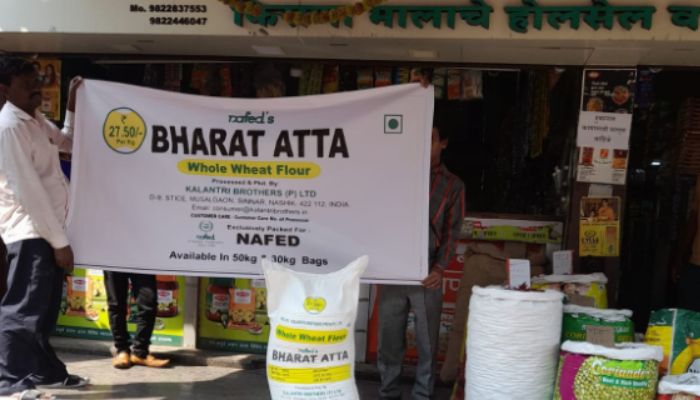
Union Minister for Consumer Affairs, Food and Public Distribution Piyush Goyal on 6th November flagged off 100 mobile vans for the sale of ‘Bharat Atta’.

The whole wheat flour will now be available to consumers in physical retail outlets and mobile vans of the National Agricultural Cooperative Marketing Federation of India (NAFED), National Cooperative Consumers’ Federation of India Limited (NCCF), Kendriya Bhandars, and other cooperative outlets at 27.5 per kg.

This comes four days after the Centre slashed the prices of Bharat Atta from Rs 29.50/kg to Rs 27.50/kg as a festive offer. The price cut comes in the backdrop of the average price of wheat flour rising 4.1 per cent in India this year to Rs 35.84/kg.

Piyush Goyal said that around 2.5 lakh tonnes of wheat has been allocated for Bharat Atta. The Centre will be providing the wheat to the above-mentioned entities for Rs 21.50/kg which is the usual offloading price. The margins of the agencies will reportedly be capped at Rs 5/kg grinding to flour and packaging.

Bharat Atta, along with Bharat Dal (Rs 60/kg,) will be available in around 2,000 outlets, the minister announced. “I trust that this scheme will establish a balance between our farmers and consumers, will keep inflation in control and will increase people’s trust in Modi hai toh mumkin hai,” Piyush Goyal said.

The flour will reportedly be available in packs of 10 kg and 30 kg. Moreover, onions, which have burnt a hole in the public’s pocket, will also be sold at a subsidised price of Rs 25/kg at the said outlets along with some lentils for Rs 60/kg.

A government official reportedly said that the initiative is one of many by the government to keep prices in check. “This is being done to send a signal to the market that if the trade does not behave in the right manner, the government is here to intervene and use its tools,” the official was quoted as saying by Mint.

Union Minister Ashwini Kumar Choubey, while flagging off 100 mobile vans for the sale of Bharat Atta, said that it is a gift from PM Modi to help the poor people.

Subsidy on flour was launched in February this year

In February, the Secretary of the Department of Food and Public Distribution of the central government, Sanjeev Chopra, reviewed the progress of the Open Market Sale Scheme (OMSS).

He particularly reviewed the progress of supply of Atta (wheat flour) at Rs. 29.50 per kg through various outlets in the country for sale to consumers with a view to check inflationary trends in the food economy, said an official statement.

It was decided that FCI, NAFED and NCCF would get wheat up to 3 LMT from FCI Depots, and after converting it into Atta, they would sell it to Consumers at Rs 29.50 per kg through various retail outlets and mobile Van etc.

While Kendriya Bhandar had already started the sale of Bharat Atta in February, NCCF and NAFED began the supply a few days later.

Earlier, on January 25, the Committee of Ministers under the chairmanship of Home Minister Amit Shah reviewed the prices of essential commodities and decided to release 30 LMT wheat from FCI stock through OMSS.

It was decided that 25 LMT be offered through the e-auction route to traders, flour mills etc as per the usual process followed by FCI. Ever since, at least 11 e-auctions have been conducted by Center for the sale of wheat and rice to various buyers across the country.

The e-auctions were organised on a weekly basis by the government in order to combat inflation and ensure the availability of rice, wheat and atta to the general public at reasonable prices.

(With input from agencies)

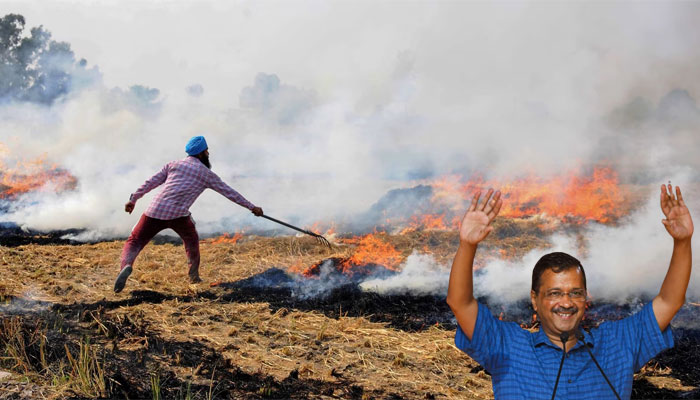
As AAP now blames Haryana for deteriorating air quality in Delhi, here’s how stubble burning in Punjab contributed massively to the pollution menace

On 6th November, Aam Aadmi Party’s Chief National Spokesperson Priyanka Kakkar accused Haryana of the alarmingly bad air quality in Delhi. In a statement during a press conference, she said that the air in Delhi got much cleaner, with a drop of 31 per cent in pollution, the best in eight years. She added that the central government also acknowledged this in its economic survey for 2022-23.

She further asserted that there has been a reduction in stubble burning in Punjab, and the stubble being burnt in Punjab is not affecting Delhi as it is 500 KM away. However, Haryana, which is close to Delhi, is burning stubble only 100 KM away. Accusing the Khattar government of not taking any steps to reduce pollution, she added that the Haryana government had not formulated the plan to buy 100 EV buses. Furthermore, the buses that enter Delhi from Haryana run on fuel banned in Delhi.

She also claimed that the Haryana government is not supporting the industries so that they can shift to cleaner fuel like Delhi. In a nutshell, she tried to throw BJP-ruled Haryana under the bus for the pollution in Delhi’s air.

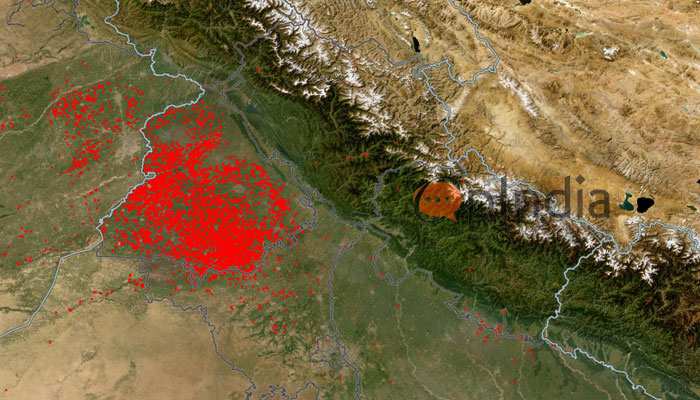
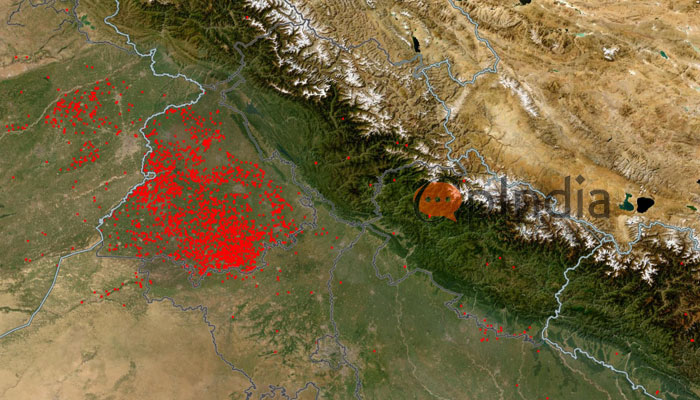
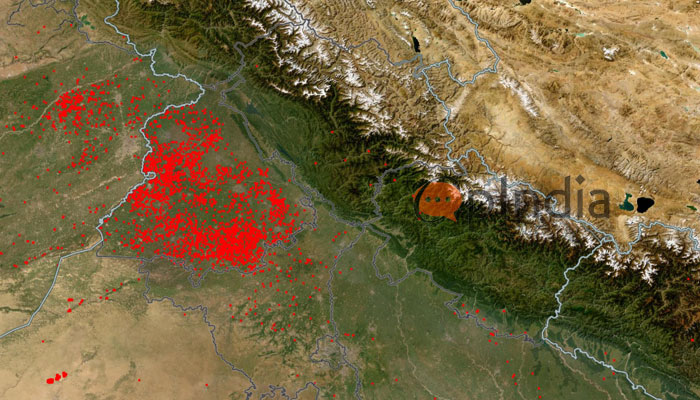
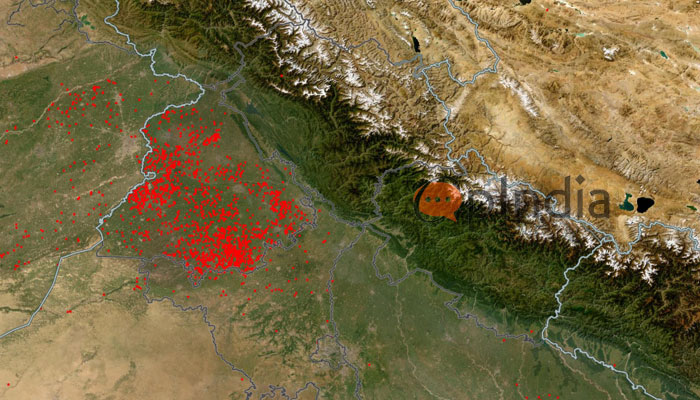
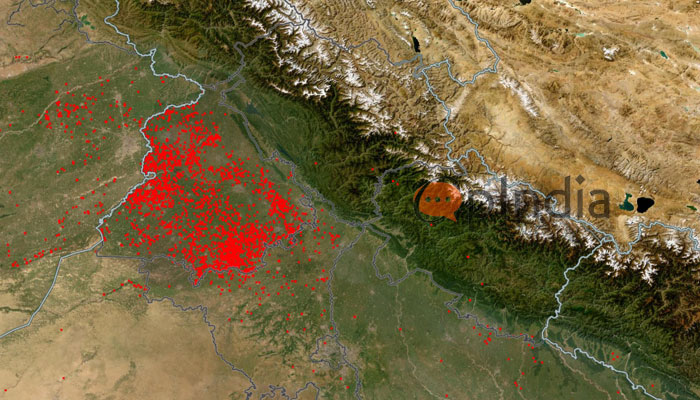
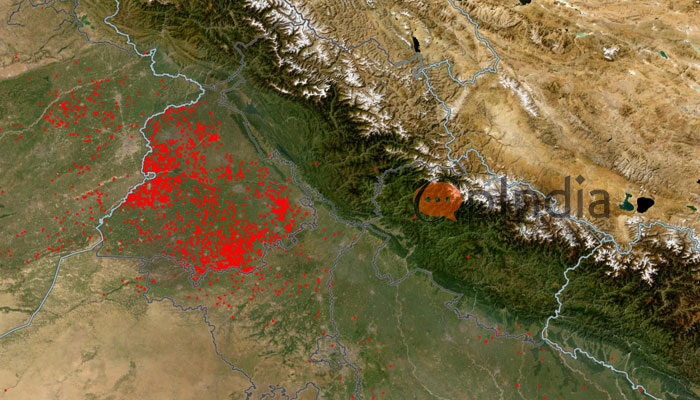
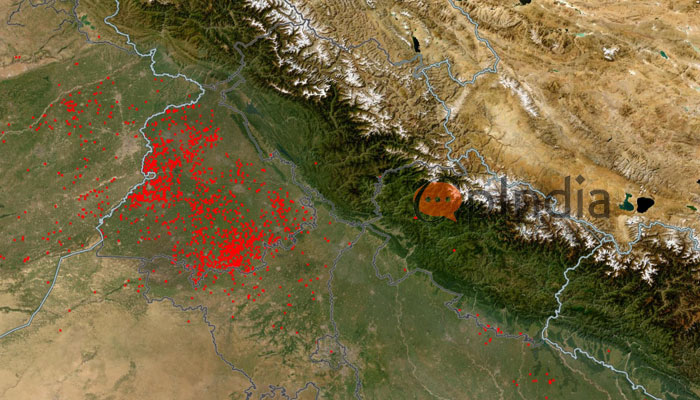
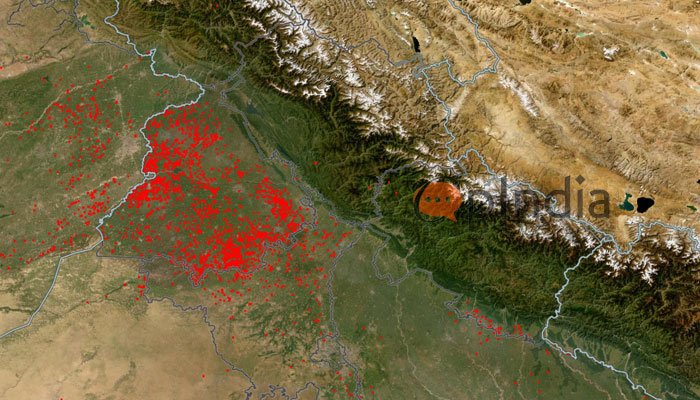
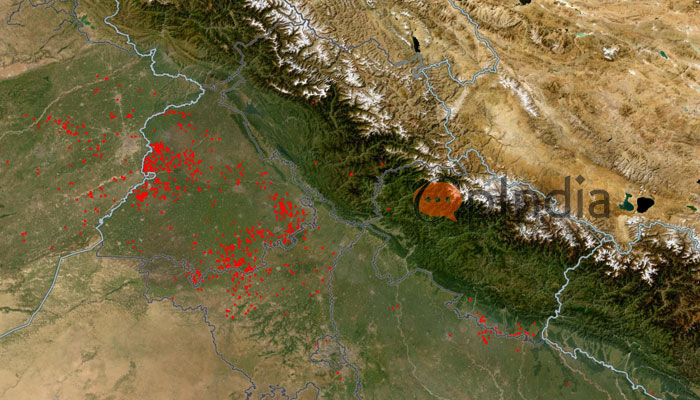
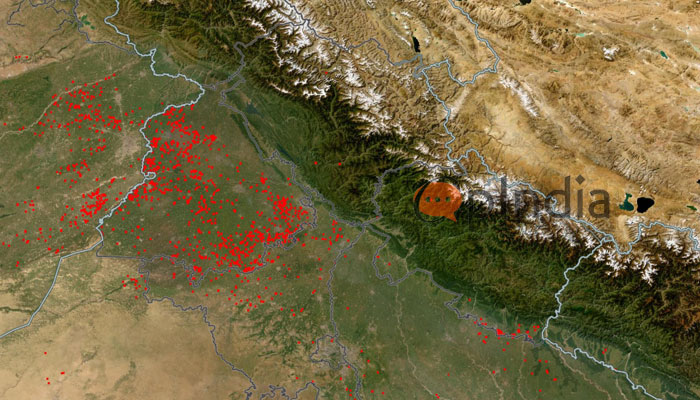
While AAP spokesperson accuses Haryana of the bad air quality in Delhi, it has to be noted that the satellite images of the last ten days tell a completely different story. Using Fire Information for the Resource Management System of NASA, OpIndia captured images of fire incidents covering Punjab, Haryana and Delhi over the past ten days. As the photos show, Haryana has very few fire incidents, while Punjab was lit up as “Christmas Lights” during the ten days. Every red dot in the images denotes one fire incident. Here are the screenshots of stubble-burning incidents from 27th October 2023 to 5th November 2023 in descending order.

Stubble-burning incidents in Punjab and Haryana on 5th November 2023. Source: FIRMS/NASA
Stubble-burning incidents in Punjab and Haryana on 4th November 2023. Source: FIRMS/NASA
Stubble-burning incidents in Punjab and Haryana on 3rd November 2023. Source: FIRMS/NASA
Stubble-burning incidents in Punjab and Haryana on 2nd November 2023. Source: FIRMS/NASA
Stubble-burning incidents in Punjab and Haryana on 1st November 2023. Source: FIRMS/NASA
Stubble-burning incidents in Punjab and Haryana on 31st October 2023. Source: FIRMS/NASA
Stubble-burning incidents in Punjab and Haryana on 30th October 2023. Source: FIRMS/NASA
Stubble-burning incidents in Punjab and Haryana on 29th October 2023. Source: FIRMS/NASA
Stubble-burning incidents in Punjab and Haryana on 28th October 2023. Source: FIRMS/NASA
Stubble-burning incidents in Punjab and Haryana on 27th October 2023. Source: FIRMS/NASA

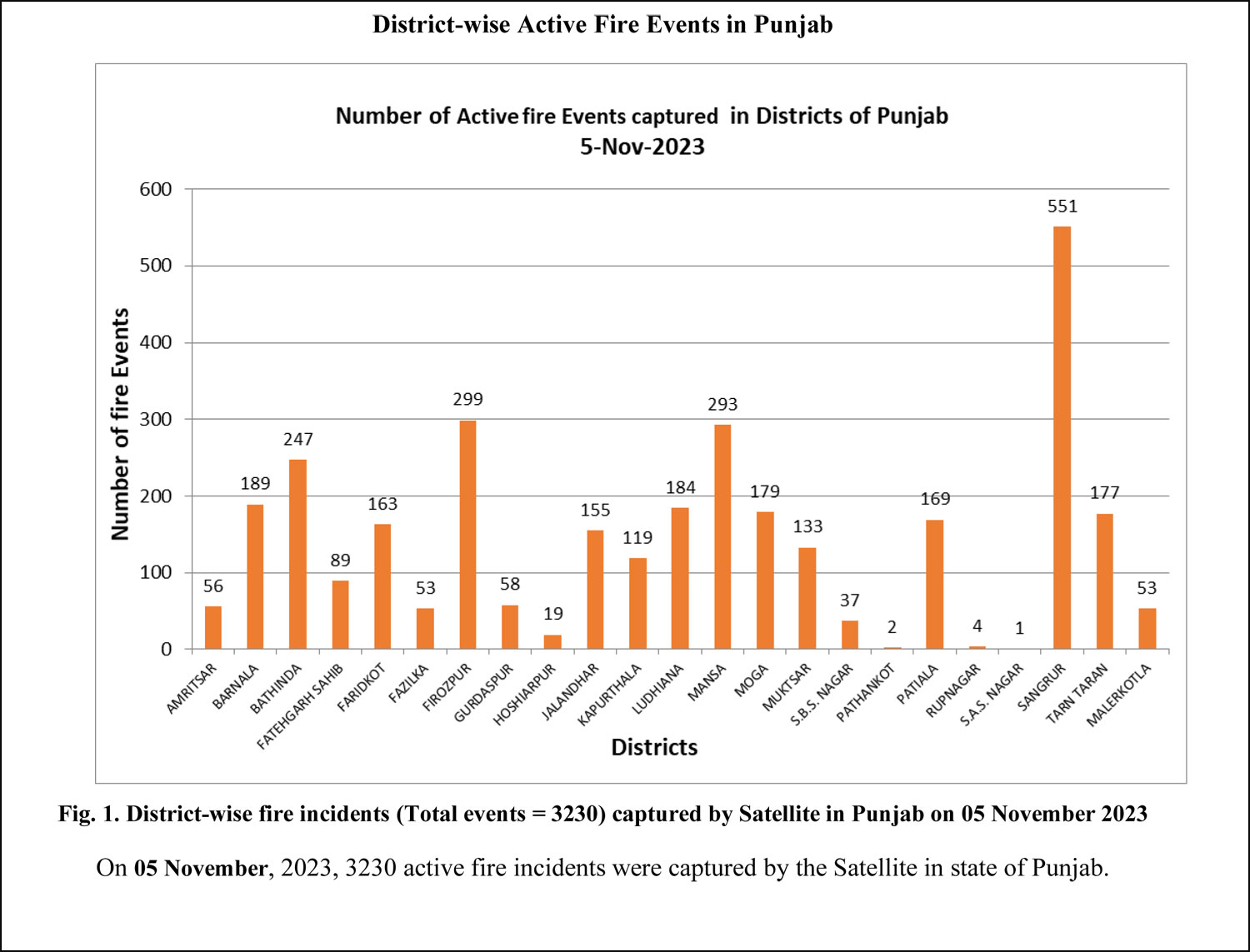
From the images above, it is clear that in the last ten days, the stubble-burning incidents have at least tripped in Punjab, while similar incidents in Haryana have been very limited. AAP’s accusations against Haryana for pollution in Delhi do not fit the data available. Furthermore, Punjab Government’s own Crop Residue Burning (CRB) Information and Management System, since 1st November 2023, over 1,300 incidents were recorded every day. On 1st November, Satellite detected 1,921 incidents in Punjab, on 2nd November, 1,668 incidents were detected, on 3rd November, 1,551 incidents were detected; and on 4th November, 1,360 incidents were detected. The number almost tripled in just one day as on 5th November, 3,230 incidents were detected. While the claims that the incidents have substantially reduced compared to subsequent days in 2022 and 2021 that does not mean that stubble burning in Punjab has no effect on Delhi’s air quality.

3,230 incidents of stubble burning were recorded in Punjab. Source: Crop Residue Burning (CRB) Information and Management System/Government of Punjab

Not to forget, in November 2022, Last year, CM Bhagwant Mann and Kejriwal held a joint press conference where CM Mann took responsibility for solving the stubble-burning problem by November 2023.

In the same month, Kejriwal categorically said that the stubble that is burnt in Punjab is responsible for pollution in “some areas of North India”. He never said it does not affect Delhi’s air quality.

Arvind Kejriwal claimed there was solution to stubble burning

Before coming to power in Punjab, Delhi’s Chief Minister and AAP’s chief, Arvind Kejriwal, claimed they had a solution for the problem of stubble burning. In November 2020, Kejriwal claimed that the Delhi government found a solution for stubble burning in association with the Indian Agriculture Research Institute (IARI) in Pusa. He claimed that the solution developed by the scientists at Pusa would convert the residual stubble into manure that would reduce the need to burn them. He repeatedly urged the Punjab and Haryana governments to use the solution. Several ads were issued, and videos were made praising the solution.

He said, “Now that we have this solution, will all state governments and central agencies adopt it to act on it and resolve the Delhi-NCR pollution menace?”

“If you spray this solution on your fields, within 20 days, the stubble will melt and turn into manure that will be beneficial for the agricultural fields. Farmers can now stop burning the stubble, which also spoils the farmlands apart from causing smoke and pollution,” Kejriwal added.

In September 2020, he claimed his government would spray the solution for free to stop stubble burning in Delhi. If he could do it, why couldn’t Bhagwant Mann replicate the “free spray” scheme in Punjab for all farmers? As Kejriwal claimed, it was a cheap solution. It could have worked, but alas.

Only ads no ‘solution’

In May 2022, OpIndia reported that the Delhi government allocated over Rs 23 crores for advertising air pollution mitigation. However, only a few lakhs were spent distributing the solution developed to tackle stubble manace. In 2020-21, the AAP-led Delhi government spent just Rs 40,000 on stubble-to-compost chemicals while investing Rs 15.8 crores on advertisements. Similarly, in 2021-22, 2.04 lakh was spent on decomposer solutions, while Rs 7.47 crore was spent on ads. In short, over Rs 23 crores, nearly 99 per cent of the budget, was spent on promotion, revealing a significant between funding for awareness and actual pollution reduction measures.

Kejriwal accused Punjab of polluting Delhi air for years

Interestingly, in November 2019, when AAP was not controlling the Punjab government, Arvind Kejriwal quoted AAP leader Jasmine Shah and accused neighbouring states of Punjab, Haryana and UP of polluting Delhi. In 2019, Punjab was blamed for Delhi’s pollution, but now, when AAP is ruling Punjab, somehow, the stubble-burning incidents do not affect Delhi’s AQI. Kejriwal said, “A very strong correlation can be seen between stubble burning and the spike in air pollution in North India. As soon as stubble burning began in the first week of Oct, the AQI started rising. Now that burning is coming to an end, air quality is also improving.”

Again in November 2019, he accused the Haryana and Punjab governments of forcing farmers to burn stubble.

In September 2021, he again praised the solution developed by Pusa scientists and urged the Punjab, Haryana and UP governments to provide the solution to the farmers in their states.

Interestingly, he and Punjab CM Bhagwant Mann accused the central government of not providing funds to give to the farmers as an incentive for not burning stubble. They wanted the Central government to pay Rs 1,500 while the Punjab and Delhi governments would pay Rs 500 each. The central government categorically refused to bear the cost. He further claimed to provide machines to the farmers. However, the stubble-burning incidents continued to happen in 2022 and 2023.

Punjab is burning 10 times more stubble than Haryana

As per Hindustan report, Punjab’s farmers are burning stubble ten times more than Haryana. Only 1,500 incidents of stubble burning were reported in Haryana across the season compared to 17,000+ incidents in Punjab. While there were 3,230 incidents reported in Punjab on 5th November, Haryana reported only 109 such incidents.

AAP becoming synonymous with scams: ED arrests Punjab AAP MLA Jaswant Singh in connection with Rs 40 crore bank scam

0

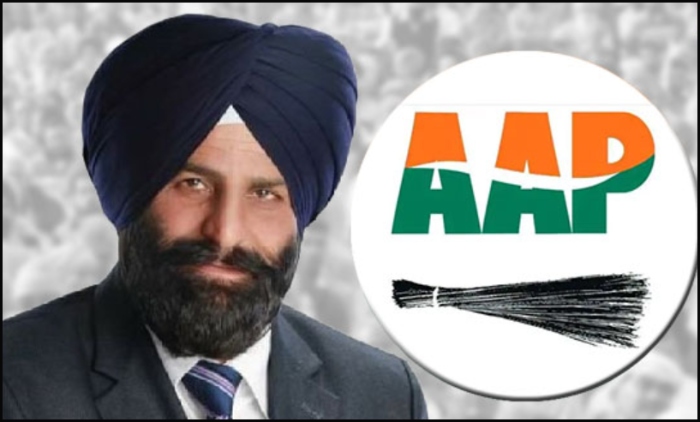
The Aam Aadmi Party (AAP) led by Delhi CM Arvind Kejriwal has been hogging headlines but for all the wrong reasons. The party has become synonymous with corruption scams. While several senior Aam Aadmi Party leaders have been implicated and various others are on the radar of the federal agencies in connection with the Delhi Liquor Policy scam case in Delhi, the ED, on Monday (November 6) arrested Punjab AAP MLA Jaswant Singh Gajjanmajra in connection with a Prevention of Money Laundering Act (PMLA) case registered against him last year related to a Rs 40 crore bank scam.

The Jalandhar ED reportedly arrested the AAP minister when he was addressing an AAP workers’ meeting at Amargarh in Malerkotla district on Monday morning.

The federal agency said that the AAP MLA was arrested as he evaded four summons for questioning in the case. He would be produced in a Mohali court on Monday evening, they said.

It may be recalled that in September last year, the Enforcement Directorate carried out simultaneous raids at multiple properties belonging to Punjab Aam Aadmi Party (AAP) MLA Jaswant Singh Gajjan Majra and his associates. The raid was carried out in connection with the Rs 40 crore bank scam.

CBI raids Aam Aadmi Party MLA Jaswant Singhrecovers 94 signed blank cheques

Prior to this, a CBI team on May 7, 2022, carried out raids at the properties linked to the ruling Aam Aadmi Party (AAP) MLA. During the searches, the CBI team recovered 94 blank cheques signed by different signatories and several Aadhar cards.

The searches were conducted in connection with the case against the Amargarh MLA over a complaint lodged by Bank of India, Ludhiana branch. 

The case was registered against Jaswant Singh, Tara Corporation Ltd (renamed as Malaudh Agro Ltd.) based at Gaunspura, Tehsil- Malerkotla, and others. The AAP MLA was a director and guarantor in the accused company. Jaswant Singh’s brothers Balwant Singh and Kulwant Singh, and nephew Tejinder Singh are also accused in the case.

Explaining the nature of the fraud, CBI spokesperson RC Joshi said, “The borrower firm was sanctioned loans at 4 intervals from 2011-2014 by the Bank. It was further alleged that the firm through its Directors had concealed hypothecated stock and diverted book debts with malafide and dishonest intention so that the same was not made available to the creditor Bank for inspection and for effecting recovery as a secured creditor. An alleged loss of Rs. 40.92 Crore (approx) was caused to the Bank.”