Home Blog Page 1665

Wind not carrying smoke from Punjab to Delhi, only Haryana and UP smoke causing pollution, claims AAP minister Gopal Rai

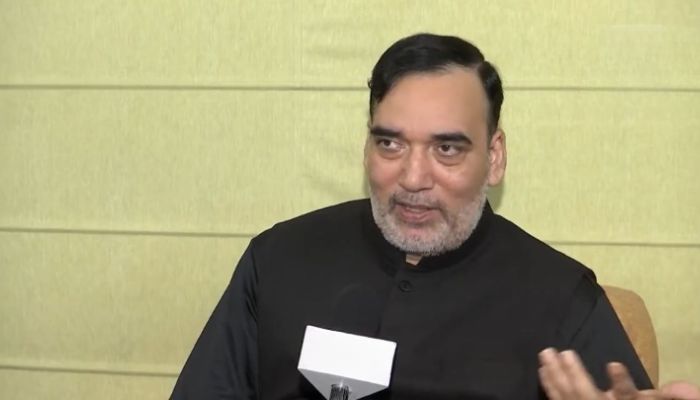
Even as air pollution in Delhi remains in severe category, AAP leaders refuse to accept that the rampant stubble burning in Punjab is partly responsible for this. On Sunday (5th November), Delhi environment minister and AAP leader Gopal Rai said that the incidents of stubble burning in Punjab are halved and the smoke from the stubble burning in Punjab has no impact on the air pollution in Delhi. The AAP minister further claimed that wind is not carrying smoke from Punjab to Delhi, but smoke from stubble burning in Haryana and Uttar Pradesh was reaching Delhi which is responsible for the poor air quality index in the national capital.

Gopal Rai said, “As far as stubble burning is concerned, it is very necessary to first understand it. Because it exposes the failure of the BJP. Delhi is surrounded by the BJP-ruled states. The meteorology department of the union government says that the wind speed is very low. If the wind speed is this low, then the air pollution in north India and Delhi primarily contains vehicular pollution, dust particles, biomass pollutants, and stubble smoke”

Gopal Rai further said, “In these four factors, the stubble burning in Punjab this year is halved as compared to the last year. But the fact is that the stubble is burning. Punjab’s stubble smoke does not have as much impact on Delhi as that of Haryana and Uttar Pradesh. This is because there is no movement in the wind. Only if the wind blows, the smoke of Punjab will reach Delhi. Right now there is smoke all around Delhi. The smoke of stubble from Haryana and Uttar Pradesh is reaching Delhi.”

On Friday (3rd November), Delhi Environment Minister Gopal Rai said that BS3 petrol and BS4 diesel vehicles coming from Uttar Pradesh have been contributing to the deterioration of the air quality index in the national capital. Now, he has added the stubble burning incidents in Haryana and Uttar Pradesh to the list of factors contributing to Delhi’s pollution according to him.

Gopal Rai’s claims are not backed by data

However, since there is an AAP government in Punjab, Gopal Rai directly gave a clean chit to the stubble-burning incidents in Punjab, claiming that the number of stubble-burning incidents in Punjab has halved in a year. He also cited the low wind speed to assert that the smoke from Pujnab does not reach Delhi.
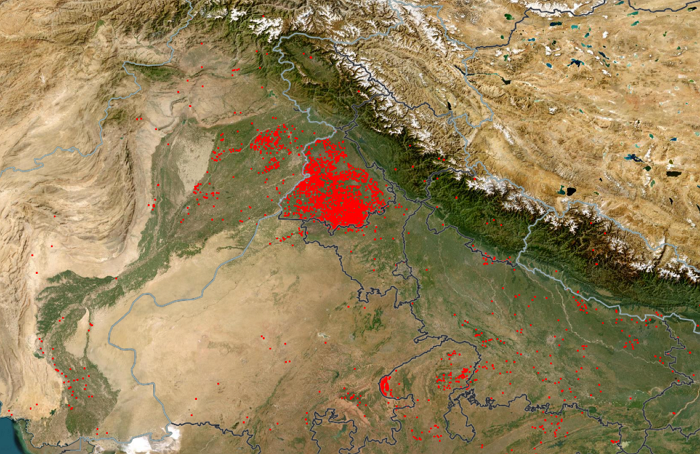
From NASA’s Fire Information for Resource Management System

AAP has been saying that stubble burning has come down heavily in Punjab, but satellite images show it is a complete lie. Fire maps released by NASA’s  Fire Information for Resource Management System show very high levels of fire incidents in Punjab, while such incidents are negligible in neighbouring Haryana and Uttar Pradesh.

While stubble incidents were seen in both Punjab and Haryana last month, it has decreased considerably in Haryana but has increased in Punjab. With the advent of the dry season, it is causing havoc in the NCR region, covering the entire region in thick fog.

In fact, Punjab has seen a sudden spike in stubble-burning incidents since October 29, while Haryana has been witnessing a downward trend largely due to strict enforcement, real-time reporting and the deployment of district and block-level enforcement teams. As many as 5,140 farm fire incidents were reported in the first three days of November.

Gopal Rai also claimed that no wind is blowing from Punjab towards Delhi, and the wind is blowing into Delhi from Haryana and Uttar Pradesh only. However, wind maps show that this is a complete lie.

The wind maps clearly show wind blowing from northwest to southeast in the north India region. So smoke from both Punjab and Haryana is reaching Delhi. But, contrary to the AAP leader’s claim, smoke from UP can’t reach Delhi at present, as the wind is blowing in the opposite direction.
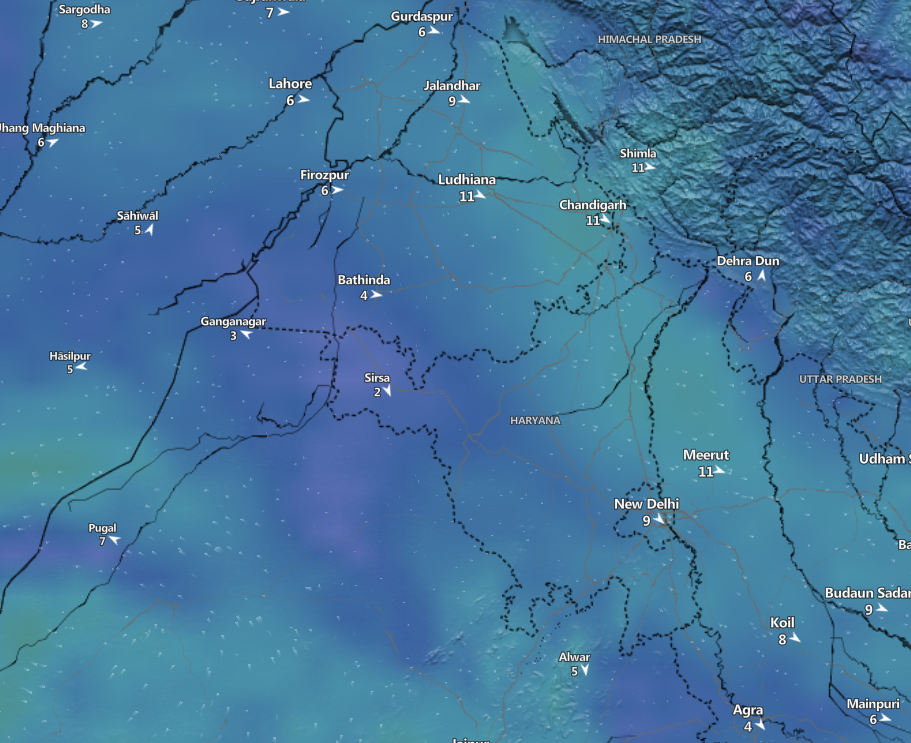
Source: windy.com

Severe air pollution in Delhi

On Sunday (5th November), Delhi’s air quality index remained above 400, signifying severe air pollution. Residents of Delhi-NCR have been breathing hazardous air for days. According to CPCB data, the air quality index (AQI) at Ayanagar was 464, in Dwarka Sector-8 it was 486, in Jahangirpuri it was 473, and around IGI Airport (T3) it was 489 lately.

All emergency measures, including a restriction on polluting trucks, commercial four-wheelers, and all sorts of construction, must be launched and enforced in the National Capital Region if the AQI exceeds 450, according to the Centre’s air pollution management plan.
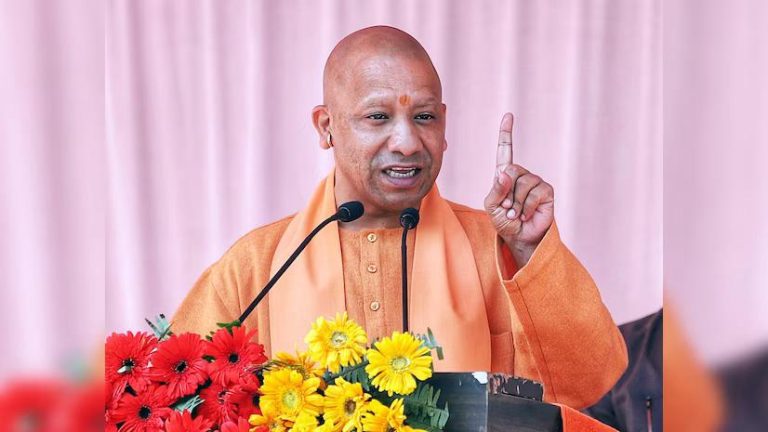
Congress did not want Ram Temple to be built in Ayodhya and it questioned the existence of Lord Ram: Yogi Adityanath in Chhattisgarh

0

Lashing out at the Congress, Uttar Pradesh Chief Minister Yogi Adityanath, on Sunday said that the grand old party did not want Ram Temple to be built in Ayodhya and that it questioned the existence of Lord Ram.

The Uttar Pradesh Chief Minister was addressing a public gathering in Sukma as part of the Bharatiya Janata Party’s campaign in the poll-bound state.

“Congress did not want the Ram temple to be built in Ayodhya. If Congress wanted, they could have built it since their government was in power for a long time. They created controversy by not allowing the Ram temple to be built. They used to beat up Ram devotees. They said that we don’t even know whether Lord Ram existed or not. These people were raising questions about the very existence of Lord Ram,” Yogi said.

During his address, the Uttar Pradesh Chief Minister said that Lord Ram’s mother, Kaushalya, was from Chhattisgarh.

“Mother Kaushalya was from Chhattisgarh. (And) that is why Lord Ram chose the land of Bastar and Dandakaranya for His 14 years of exile,” he said.

Yogi said that on January 22, 2024, the consecration ceremony of Lord Ram is scheduled.

The consecration ceremony of Lord Ram is scheduled for January 22, next year. Adityanath, Prime Minister Narendra Modi, and Rashtriya Swayamsevak Sangh (RSS) chief Mohan Bhagwat are among the other dignitaries who will attend the ceremony.

The foundation stone for the construction of the Ram Temple was laid by PM Modi on August 5, 2020.

The Uttar Pradesh Chief Minister went on to add that the construction of the Ram temple in Ayodhya marks the beginning of Ram Rajya in the country. “Ram Rajya means a government in which there will be no discrimination on the basis of caste and religion, and every poor, farmer, and tribal will get the benefits of the schemes,” he added.

Sharpening his attacks further, Adityanath said that ‘corruption’ has become a ‘culture’ of the Chief Minister Bhupesh Baghel-led government in Chhattisgarh.

“(There has been) mining scam in Chhattisgarh, coal scam, a land scam, and scams in public service commission, the scams have become the ‘Sanskar’ (culture) of Congress,” he said, adding that to end this, once again, a double-engine government is needed in Chhattisgarh.

The elections for the 90-member Chhattisgarh Assembly will be held in two phases, with the first phase of polling for 20 seats scheduled on November 7 and the remaining 70 seats to go for polling on November 17.

The counting of votes will be done on December 3.


(This news report is published from a syndicated feed. Except for the headline, the content has not been written or edited by OpIndia staff)

Uttar Pradesh: Firing at Aligarh Muslim University injures one student, dozen accused booked

0

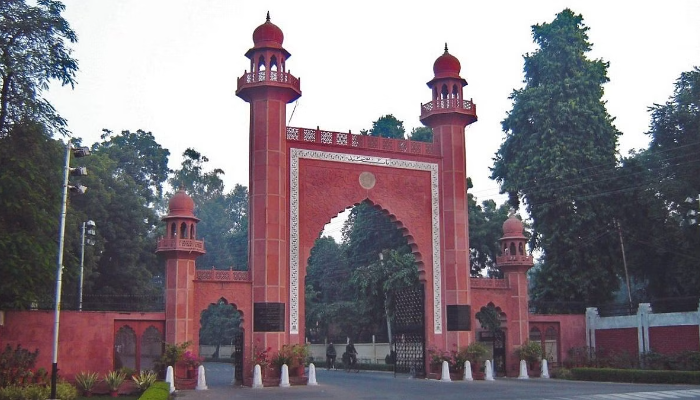
A first investigation report (FIR) was filed against twelve named individuals at the Civil Lines police station on 4th November (Saturday) following a shooting incident on the night of 3rd November (Friday) at Aligarh Muslim University (AMU) which resulted in the injury of an undergraduate student in the first year.

Rehan from Jaitwara, Moradabad who is pursuing a BA in Arabic was shot in the leg while heading to the dining hall for dinner. His condition is reported to be stable and he is currently out of immediate danger.

“A case has been registered under sections 147 (rioting), 148 (causing a riot with deadly weapons), 149 (unlawful assembly with a common intention), and 307 (attempt to murder) of the Indian Penal Code against a dozen accused, along with others who remain unidentified,” informed Vijay Singh, the in-charge of the Civil Lines police station in Aligarh which includes the university campus.

He proclaimed, “The case is currently under investigation, with authorities reviewing CCTV footage to obtain accurate details about the student involved. No arrests have been made as of yet. It is yet to be determined how many among the dozen named individuals are current or former students of AMU.”

The gunshot incident that transpired on Friday night in SS Hall North of the university was confirmed by Professor Mohd Wasim Ali, the proctor of the university. He asserted, “We are also conducting an internal investigation to determine the circumstances that led to the gunfire on the AMU campus. Initial reports suggest that some of the individuals named in the FIR have links to AMU, while the status of others as former students is yet to be verified. The injured student is safe and is currently receiving treatment for his leg injury.”

Rehan said in his complaint that at 7:40 p.m. on Friday, he came upon 12 people including Shoaib Khan alias Yahiya, Mayank Thakur and others who opened fire on him with the intention of killing him. “I sustained an injury to my leg, and the accused left, presuming me to be dead,” he alleged in the FIR which was submitted on the next day.

Divergent versions of what happened have surfaced in the interim, however, officials of the institution and law enforcement have discovered that fireworks were being let off at SS North Hall to commemorate the release of former student Shoaib Khan who had been given bail in an earlier case. Rehan sustained wounds as a consequence of gunfire from some of his supporters because he lives in the same hall.

Following reports of a shooting at the educational establishment, the local law enforcement agencies responded quickly, according to Aligarh Senior Superintendent of Police (SSP) Kala Nidhi Naithani. The circumstances surrounding the incident and the identity of the shooter continue to be investigated.

Circle Officer Rakesh Sisodia conveyed that information regarding a student’s injury had surfaced in the instance. He has been admitted to the medical college and is out of danger. The initial on-scene probe indicated that the pupil had been shot as a result of someone firing indiscriminately. A case has been launched in the Police Station Civil Line under the applicable sections. Two teams have been formed to look into the issue.

This incident has once again highlighted the ongoing problem of visitors and former students entering the AMU campus and getting involved in situations that put the management of the university in a humiliating position.

Naxals killed 27 villagers in Chhattisgarh in 2023, accusing them of being ‘police informers’: Reports

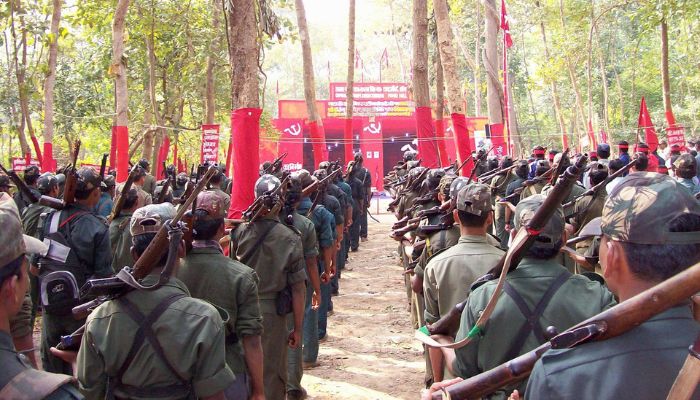
On Thursday (2nd November), a few hours before Prime Minister Narendra Modi’s rally in Kanker, Chhattisgarh’s Bastar region, Naxals murdered three villagers, labelling them as “police informers.” The brutal killing of unarmed civilians remains their most prevalent method of instilling fear.

In the past ten years, Naxals have massacred 569 villagers in Bastar. All these villagers were allegedly associated with the police providing information about the Naxals to the local law enforcement agencies.

According to a report by News18, a total of 27 killings have occurred in the past ten months. Notably, the state assembly elections will be held in Chhattisgarh in November 2023.

In addition to their targeting of security forces, politicians, and government officials, Naxals have consistently resorted to the abduction and execution of villagers as their standard operating procedure. Each year, the state police report a minimum of 50 to 60 cases of villagers being killed by Naxals, often under the accusation of being “police informers.”

Informing more about this, P Sundarraj (IG – Bastar Range), said, “The Naxals have their own units of ‘Khabri’ (informers). They often mindlessly target villagers who do not comply with their orders or who resist their actions or protest against their diktat. They abduct them, shoot or hack them dead and dump their bodies in their respective villages. This is to prove a point, ensuring their presence across villages, where government aids reach, or build critical access, roads and so on, they target those areas. This is their way of spreading fear psychosis.”

Additionally, he mentioned that the police had released statements in various instances, clarifying that the individuals targeted in these assaults, and accused of collaborating with anti-Naxal groups, had no affiliation with the police forces whatsoever.

Similar to other specialised police units, the anti-Naxal forces also employ a network of informants who operate within the region, assimilating into the local villages to gather intelligence. Nevertheless, in the majority of cases, the victims were discovered to be ordinary villagers with no ties to the forces. Naxals dumped their bodies with a poster — “Punishment for working as a police informer is death”.

The senior police officer further said, “Many times, we take the responsibility of the victim families, we rehabilitate them to safer places so that they live a secure life. These steps are being taken to ensure that the villagers have confidence in us and don’t feel deserted.”

According to the senior police officer, former Naxals who have surrendered their weapons and integrated into the security forces often serve as valuable sources of information regarding the Naxal organisation. Approximately 400 Naxals surrender annually, with 140 being enlisted and trained by the force over the last five years, while the rest undergo rehabilitation. The Chhattisgarh government has established a rehabilitation policy for both surrendered Naxals and the families of those who have fallen victim to Naxal violence.

IG P Sundarraj said, “Confidence building among the villagers is then of the crucial works we do. The Naxals generally spread false propaganda among the villagers to get their sympathy and antagonise them against the government. They tell the villagers that the government is going to sell their land and forests to private companies and that is why the roads are being built. But we are trying to bridge the gap through several community programmes inside the remote interior villages.”

He added that the Naxals are currently experiencing a decline in support from villagers, as a number of key members of their central committee (referred to as the CC) have either been eliminated or have passed away due to illness or age-related concerns.

The CC of CPI-Maoists, known as Naxals in Bastar region generally has 42 members, however, the number is now down to 22. “Around 12 members were neutralised, while the rest died (natural deaths)”, the officer said.

Detailing about how the state police is prepared and equipped to combat the Naxals, he said, “The state police force has a special unit called Bastar Fighters, which has 2,100 members. Bastar fighter is a force that consists of local villagers. We have taken 1,500 boys and 600 girls from Naxal affected villages and trained them. In 20 to 30 km, from one village to another, the language, the dialect and the terrain change. No outside force can navigate through these areas without local support. So, we have built the local forces. The central paramilitary forces have their Bastar Battalion, which has around 1,000 local youths.”

Jammu and Kashmir: Major terror plot foiled after 2 kg IED, concealed in tiffin box on National Highway, defused

0

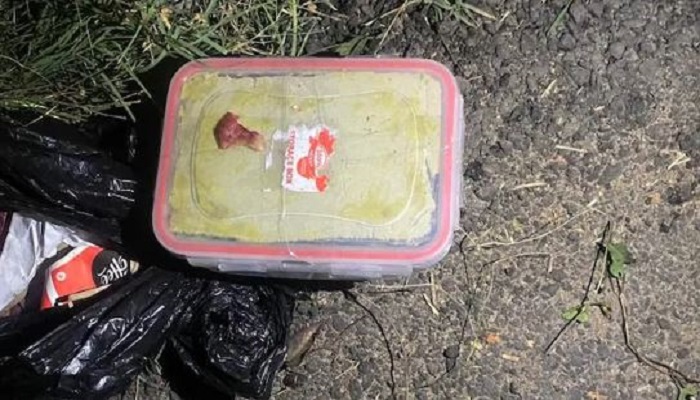
On 4th November, the security forces in Jammu and Kashmir averted a major tragedy after timely detecting and destructing a timer-based improvised explosive device (IED). The device had been concealed in a tiffin box and planted along the Sidhra-Narwal stretch of the Jammu-Srinagar National Highway near a police checkpoint.

Informing about the incident, security officials said that a tiffin box timer-based Improvised Explosive Device (IED) was found planted on Sidhra bypass on the Jammu-Srinagar National Highway in Jammu city on Saturday evening (4th November).

A senior police officer said, “Soon after the incident, a police party along with a bomb disposal squad reached the spot and stopped traffic movement. The IED was seized and defused.”

Another police officer said that the traffic movement on the Narwal-Sidrah road was suspended immediately after the detection of the IED. According to the police official, on Saturday at around 5.30 pm, Police received information that some suspicious object was lying on the Sidhra-Narwal highway stretch in Jammu near a police checkpoint.

Subsequently, a Police team along with a dog squad and bomb disposal squad rushed to the spot in search of the suspicious material. The team found a tiffin box timer-based IED, weighing around two kilograms, the official added.

The explosive device was taken into possession after a controlled detonation. Police officials added that a major tragedy was averted with the detection of the IED. 

Police said that a case under relevant sections of law has been registered and further investigation is going on. They added that efforts were underway to arrest those involved in the incident.

However, this is not an isolated case when explosives had been planted along the Jammu-Srinagar National Highway this year. Earlier, on 22nd August, police found an IED along the highway which was subsequently defused by security personnel in Panjgrain, Nagrota, on the outskirts of Jammu.

As per the media report, the terrorist organisation TRF (The Resistance Front) has taken responsibility for this ID bomb on social media. 

Meanwhile, the Special Investigation Agency (SIA) officials on Saturday (4th November) carried out searches at the house of an alleged terror suspect in Poonch in connection with a terror case, officials said.

According to the officials, the searches started around 4 a.m. at the house of suspect Mohammad Hafiz in Kanuyian village in Mendhar sub-division. Hafiz was not present at his house when it was raided.

The officials added that a joint cordon-and-search operation was launched by police and the Central Reserve Police Force. These were carried out at Copra Top, Bachian Wali, Shiendara, Thandi Kassi, and Mohalla Saedan in the Poonch district early in the morning. At the time the last reports were received, the operation was still underway.

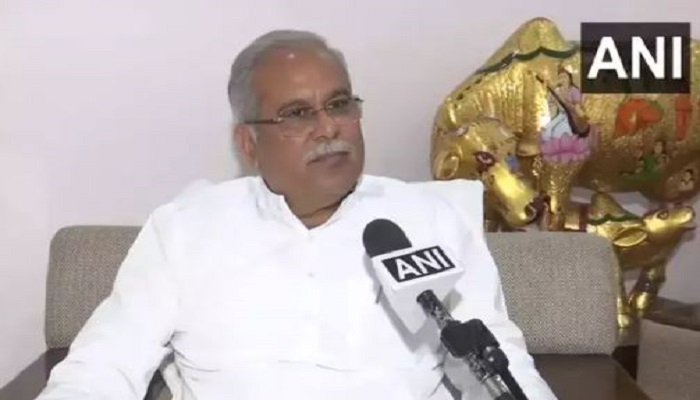
Such minor incidents are happening in some places: Chhattisgarh CM Bhupesh Baghel comments on the murder of a BJP leader by Maoists

A day after the murder of a BJP leader by Maoists, Chhattisgarh CM Bhupesh Baghel brushed it aside as a ‘minor incident’ while expressing his condolences to the bereaved family. Speaking to media persons about the killing of the BJP leader Ratan Dubey in Narayanpur, CM Baghel argued that though ‘some minor incidents’ have taken place, the situation has improved in the red corridor. 

CM Baghel added that the pressure of the security forces had pushed the Naxals back, insinuating that the recent killing of BJP leader Dubey was just a minor incident in an otherwise improving law and order situation in the Naxalite-prone area. 

Regarding the murder case by Maoists, CM Baghel said, “I express my condolence to the family members. Due to the pressure from our forces, the Naxals have moved back…Some minor incidents are happening in some places but the situation has improved…”

A day earlier, on Saturday (4th November), BJP leader Ratan Dubey was brutally murdered by Maoists in the insurgency-hit Narayanpur district of Chhattisgarh. 

Dubey was a member of the Narayanpur Zilla Panchayat. He had gone to Kaushalnar village to campaign for BJP candidate Kedar Kashyap who is contesting against Congress’s Chandan Kashyap. Dubey was first shot and then attacked with sharp weapons, including axes and daggers, in the Dhaudai region after addressing a poll rally.

After the campaign speeches, there was a cockfight that was being held near the dais, and it attracted a large crowd around it. Reportedly, the Maoist attackers, disguised as villagers, moved away from the gathering and began approaching the dais. 

BJP leader Dubey, however, soon recognised them, got off the dais, and started running. The ruckus soon diverted everyone’s attention away from the cockfight to see Dubey being pursued by several men wielding firearms, daggers, and axes. The chase continued for a few hundred metres until one of the perpetrators shot Ratan Dubey in the back. As an injured Dubey fell on the ground, the Maoist assailants attacked him with axes and daggers.

In a statement on Saturday, Sundarraj P, Inspector General of police of Bastar range said, “At around 05:30 pm, Dubey had gone to Kaushalnar village, about 5km east from Jhargati police station, for campaigning, when he was attacked and killed with a sharp weapon by unidentified Maoists. After receiving information about the incident, police and security forces were sent to the spot, and the deceased’s body is being brought to the district headquarters at Narayanpur.”

Notably, Ratan Dubey’s murder occurred just ten days after the Maoists had issued a threat to political candidates and their supporters “not to come seeking votes in Bastar.”

Before Dubey’s heinous murder, another BJP worker named Birju Taram was shot dead on 20th October by suspected Maoists in Sarkheda village, Mohla Manpur Ambagarh Chowki district. 

The murder of BJP’s district vice-president posed a serious threat as it came days ahead of the first phase of polling in the state. Narayanpur is one of the 20 Assembly seats that will hold the election on the 7th of November in the first phase of polling. The second phase of voting for the state assembly will take place on 17th November, with results to be announced on 3rd December.

Germany: Hamburg airport closed over ‘hostage situation’ after armed man drives onto Tarmac and fires shots, flights suspended

0

A horrific incident took place at the airport of Germany’s Hamburg after an armed individual broke through a gate with his car, entered the tarmac and fired two shots into the air. Police called it a “hostage situation” which forced the closure of the airport and the cancellation of all scheduled flights in the northern German port city.

The gunman drove past the entrance and onto the airport’s apron which is where planes are parked, unloaded and refuelled, on 4th November at about 8 pm (19:00 GMT). Furthermore, he flung two burning bottles out of the vehicle.

Notably, the car contained a minimum of two people, one of whom was a child. According to reports, the perpetrator’s wife has accused him of reportedly kidnapping a child. Authorities stated that they believed “a custody dispute is the background to this operation” in a statement. She had placed an emergency call alerting cops to the abduction of her baby.

“The police operation on the Hamburg flight plan continues. Flight operations will remain suspended until further notice. The police ask all passengers and those collecting them not to come to the airport. The access roads are largely blocked off,” Hamburg Airport informed in a post on social media.

Hamburg police said that the operation was underway. “Our negotiating group has contact with the person in the car. The situation remains static.”

The airport declared on its website that there would be no more arrivals or departures and that cancellations would last till 5 November. According to the local media, the airport has been cleared out in its entirety and a sizable portion has been blocked off. The police requested that the passengers postpone their trip to the airport.

A police spokeswoman, Thilo Marxsen told reporters that authorities on the ground were looking for a Turkish interpreter to speak with the 35-year-old man a few hours into the standoff. Police said that the scenario persisted in the wee hours of 5 November morning. They revealed that there were psychologists and officers specialised in negotiations present on the scene and in contact with the culprit.

German media was briefed by a police spokesperson who disclosed, “We have good contact with the perpetrator. We are relying on a negotiated solution here.” The cops declared, “That’s an absolutely good sign,” expressing their positive assessment of the length of the discussions.

According to the authorities, the occupants of the plane that was closest to the car and other aircraft were evacuated and transferred to a nearby hotel. Social media footage shows heavily armed police guiding a group of passengers to a bus by crossing the tarmac.

Alina Tuider, 32, the lady who uploaded the video, claimed that her aircraft to Vienna was ready to take off when it came to a stop shortly after 8 p.m. “We saw armed police running across the field next to our plane,” she unveiled in an interview. She added that her flight had been stopped for approximately an hour at that point. “So we knew there was something going on.” She briefly believed she heard a gunshot before discovering later on her phone that the driver was armed.

The incident caused delays for 3,200 people in all, per reports from the local press. The authorities were still investigating if the two tiny fires that were observed on the tarmac early on were started by the individual. He raced past a fence to reach the tarmac, per the police, but wouldn’t disclose if there were any security officers present.

Pir Mian Javed Ahmed converts eleven Hindus to Islam in Pakistan, multiple cases of conversion involving him surface

0

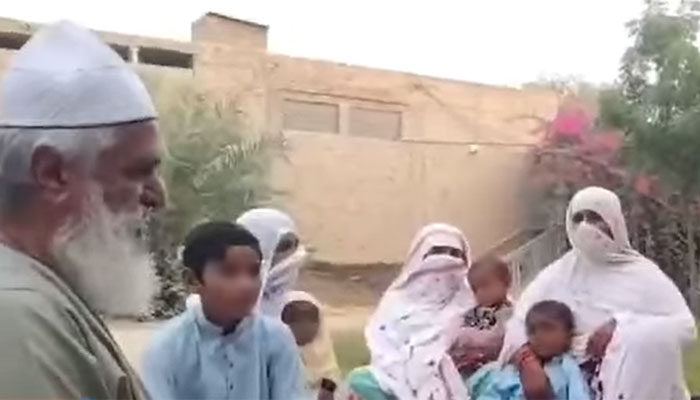
On 4th November, it came to light that eleven members of Hindu families, including men, women and children, were converted to Islam in Dargah-e-Aliya Bharchundi Shareef Dargah, located in district Ghotki of Sindh province in Pakistan. Jagrita News reported that Pir Mian Javed Ahmed read Qalma in front of the Hindus and converted them to Islam.

The report suggested that some of the family members had already converted to Islam a few years back.

This is not the first time Pir Mian Javed Ahmed’s name has surfaced for converting Hindus to Islam. Just days before 11 Hindus were converted, a 25-year-old Hindu named Shankar s/o Chetan Das Bhil from Thakrato was converted to Islam by Javed Ahmed.

In June 2023, a married Hindu woman named Pooja Kumari, a resident of Kala Bridge, Karachi, was converted to Islam by Javed Ahmed. It is unclear if she was converted before marriage or after the marriage.

In July 2023, Bharatiya Janata Party’s National Secretary Manjinder Singh Sirsa shared a video of three Hindu girls being converted to Islam by Javed Ahmed. He wrote, “Sometimes attacks on temples in Pakistan… and sometimes forced conversion and marriage of girls from minority communities! Three girls, Parmish, Roshni and Chandni, aged 16 years and below, belonging to Hindu Lehlaram Panwar of Sadiqabad, District Rahim Yar Khan, Punjab, were imprisoned and forcibly converted to Islam at the house of Pir Mian Javed Ahmad Qadri at Deharki, 60 km away. The families of these girls are repeatedly contacting me and requesting help. @MEAIindia Govt of India should come forward to help these minority families of Pakistan.”

In January 2023, a 23-year-old woman named Amar Devi, d/o Hari Chand Daherki, was converted to Islam by Javed Ahmed.

The Hindu population is declining quickly in Pakistan

When Pakistan was created in 1947, there were around 22 per cent Hindus in the country. However, as time passed, the population of Hindus declined at a fast pace, and currently, only 2.14 per cent of population is Hindus in Pakistan. Out of 4.4 million Hindus living in the country, around 4.1 million live in Sindh, while around 2 lakh live in Punjab and less than 50,000 in Balochistan.

There have been many reports of forced conversion of Hindus to Islam in Pakistan. Furthermore, several news reports have surfaced where young Hindu girls were abducted and married to Muslims after conversion.

Even the courts in Pakistan often act against Hindus. In October 2023, it was reported that a Pakistani court sent a Hindu girl, identified as Reeta Meghwar, to a shelter home after she escaped from kidnappers. She begged the court to send her to her family, but the court refused to do so.

In the same month, it was reported that a woman named Miran Kolhi was gang-raped by Shafaq Bhargari and his friends and was forced to give a false statement by a female police officer. The woman was threatened by a female police officer in Pakistan, identified as Momal Laghari, and was asked to give a false statement in favour of the accused.

Zero evidence, directions came from high level to blame India – High Commissioner Sanjay Kumar Verma slams Canada for damaging relations

On 3rd November (local time), High Commissioner of India to Canada, Sanjay Kumar Verma, slammed Canada for damaging India-Canada relations. Verma further accused Canada of naming India in Khalistani terrorist Hardeep Singh Nijjar’s murder on Canadian soil after someone from the “high level” sent directions for the same. In an interview with The Globe and Mail, Verma said India had not received any substantial evidence from Canada or its allies, such as the United States or Britain, that can substantiate Canadian claims that Indian agents were involved in Nijjar’s murder.

Sanjay Kumar Verma said that allegations laid down by Canadian Prime Minister Justin Trudeau in the Canadian Parliament on 18th September strained the bilateral relations between the two nations. Khalistani terrorist Hardeep Singh Nijjar was provided Canadian citizenship even though he entered Canada on a fake passport using a Hindu name in the 1990s. Khalistani elements like Nijjar are a threat to the sovereignty and national security of India.

According to Verma, so far, Canada has failed to provide India with any specific or relevant information that might assist in the investigation of the allegations. It has led to concerns over the integrity of the inquiry.

“There is no specific or relevant information provided in this case for us to assist them in the investigation. Where is the evidence? Where is the conclusion of the investigation? I would go a step further and say now the investigation has already been tainted. A direction has come from someone at a high level to say India or Indian agents are behind it,” he said.

Since the allegations were laid down by PM Trudeau, Canada suspended one diplomat of India, leading to diplomatic bitterness between the two countries. In retaliation, India not only fired one of the top Canadian diplomats but also asked Canada to recall 41 of the 61 diplomats from India. In October, 41 diplomats and their families left India on India’s instructions, failing which they would have lost immunity. India accused Canadian diplomats of meddling in India’s affairs. In a presser, the official spokesperson of the Ministry of External Affairs (MEA), Arindam Bagchi, told reporters, “Given the much higher presence of diplomats or diplomatic presence here…and their continued interference in our internal matters, we have sought parity in our respective diplomatic presence. Discussions are ongoing on the modalities of achieving this”.

Notably, Canadian sources claimed the Canadian Security Intelligence Service intercepted the intelligence implicating the involvement of Indian agents and information from an unnamed Five Eyes ally against an Indian diplomat. However, Verma categorically denied any involvement of Indian agents in the assassination of Khalistani terrorists on Canadian soil. He further emphasised that diplomatic conversations are protected under international law, and they cannot be used as evidence in any court of law or publicly disclosed.

The Indian High Commissioner said, “You are talking about illegal wiretaps and talking about evidence. Conversations between two diplomats are secure by all international law,” he said, “Show me how you captured these conversations. Show me that someone did not mimic the voice.”

Verma further highlighted the outstanding extradition requests of individuals over the past several years that Canada has ignored. Notably, following the allegations against India, the Ministry of External Affairs called Canada a safe haven for terrorists, gangsters and criminals. Interestingly, soon after accusing India of killing Nijjar, Canada celebrated a Nazi soldier Yaroslav Hunka in the parliament as a “war hero”, for which Trudeau faced severe criticism.

Verma also expressed concerns over his safety and security as well as for the Indian consuls general in Toronto and Vancouver. Notably, there have been several recorded instances of threats and hate speeches against Indian diplomats in Canada. Posters were raised in Canada calling for the assassination of Indian diplomats. In another poster, Prime Minister Modi and Foreign Minister Dr Jaishankar were called enemies of Canada by the pro-Khalistani elements.

Verma called for resolving the issues raised by India via professional dialogue and communication. He also urged the Canadian government to address the presence of Khalistani elements in the country.

“Don’t allow your soil to be used by a group of Canadian citizens who want to dismember India, who wants to challenge the sovereignty and territorial integrity of India,” he said.

Verma also emphasised the importance of reviving trade negotiations and welcomed Canadian businesses to India. He highlighted the need to resolve the issues between the two countries through professional dialogue.  

Primary schools in Delhi to remain closed till November 10 as air quality remains severe, stubble burning increases in Punjab

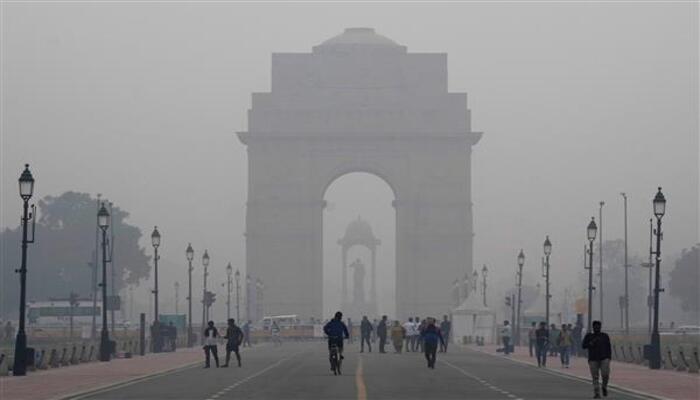
On Sunday (5th November), Delhi’s air quality index remained above 400, signifying severe air pollution. Residents of Delhi-NCR have been breathing hazardous air for days.

According to CPCB data, the air quality index (AQI) at Ayanagar was 464, in Dwarka Sector-8 it was 486, in Jahangirpuri it was 473, and around IGI Airport (T3) it was 489 lately.

All emergency measures, including a restriction on polluting trucks, commercial four-wheelers, and all sorts of construction, must be launched and enforced in the National Capital Region if the AQI exceeds 450, according to the Centre’s air pollution management plan.
In many areas throughout Delhi-NCR, the concentration of PM2.5 (particulate matter measuring 2.5), a fine particulate matter capable of penetrating deep into the respiratory system and causing health problems, exceeded the government-recommended safe limit of 60 micrograms per cubic metre by seven to eight times. It was 80 to 100 times the WHO’s recommended 5 micrograms per cubic metre.

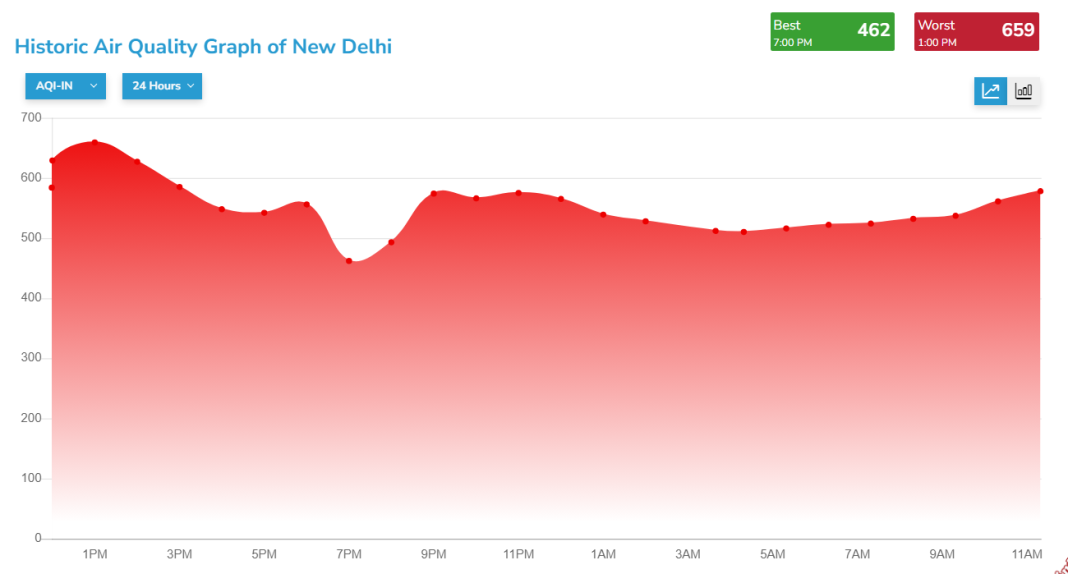
Even as you read this report the air quality of New Delhi remains hazardous. In the last 24 hours, the air quality in the national capital has fluctuated between hazardous (401-500) and severe (301-400).

Graph via aqi.in

Meanwhile, the closure of all primary schools in Delhi has been extended till 10 November. Taking to X, the Delhi Education Minister announced the closure of primary schools. She wrote, “As pollution levels continue to remain high, primary schools in Delhi will stay closed till 10th November. For Grades 6-12, schools are being given the option of shifting to online classes.”

The air quality in Delhi-NCR has deteriorated over the last week as a result of a stubble burning in Punjab and Haryana, steady drop in temperatures, calm winds that trap particles etc.

Even as the people of Delhi continue to breathe toxic air, the ruling AAP government recently blamed BS3 petrol and BS4 diesel vehicles coming from Uttar Pradesh as contributing to the deterioration of the air quality index in the national capital. Before him, Saurabh Bhardwaj also claimed on Friday (3rd November) that the severity levels in Noida, Gurugram, and Faridabad surpass those in Delhi. However, since there is an AAP government in Punjab, Saurabh Bhardwaj gave a virtual clean chit to the stubble-burning incidents in Punjab.

From NASA’s Fire Information for Resource Management System

AAP has been saying that stubble burning has come down heavily in Punjab, but satellite images show it is a complete lie. Fire maps released by NASA’s  Fire Information for Resource Management System show very high levels of fire incidents in Punjab, while such incidents are negligible in neighbouring Haryana.

While stubble incidents were seen in both Punjab and Haryana last month, it has decreased considerably in Haryana but has increased in Punjab. With the advent of the dry season, it is causing havoc in the NCR region, covering the entire region in thick fog.

In fact, Punjab has seen a sudden spike in stubble-burning incidents since October 29, while Haryana has been witnessing a downward trend largely due to strict enforcement, real-time reporting and the deployment of district and block-level enforcement teams. As many as 5,140 farm fire incidents were reported in the first three days of November.

The situation is expected to continue for a couple of weeks, as paddy is yet to be harvested on 10 lakh hectares in Punjab. Farmers in northern India burn the leftover stubble after harvesting paddy to quickly prepare the ground to sow wheat.