As the construction of the grand Ram Mandir in Ayodhya progresses, Shri Ram Janmabhoomi Teerth Kshetra’s General Secretary of Champat Rai on 12 September shared images of remains of an ancient temple discovered at the Ram Janmabhoomi during excavation. These ancient remains include several idols and pillars.
Taking to X, Rai said, “Remains of an ancient temple found during excavation at Shri Ram Janmabhoomi. It includes many statues and pillars.”
श्री रामजन्मभूमि पर खुदाई में मिले प्राचीन मंदिर के अवशेष। इसमें अनेकों मूर्तियाँ और स्तंभ शामिल हैं। pic.twitter.com/eCBPOtqE1W
Several parts of idols carved out of large stones and pillars can be seen in the picture shared by Rai who is also the international vice president of Vishwa Hindu Parishad (VHP).
However, from the tweet, it is not clear if the discovery is from any recent excavation, or if they were found earlier during excavation and Champata Rai chose to share the images now. It is notable that the construction of the Ram Janmabhoomi Mandir is almost completed, and it is unlikely that any major excavation is going on there at present. It is possible that the remains of the ancient Hindu temple seen in the image were found during the ASI survey before the disputed site was handed over to Hindus, or during excavation for laying the foundation of the grand temple.
Earlier on Tuesday (12 September), the South Korean Ambassador in India, Chang Jae-Bok highlighted the importance of the Ram Mandir in Uttar Pradesh’s Ayodhya and said that the country would like to be part of its inauguration ceremony.
He emphasised that Ayodhya is important to South Korea historically and culturally. As per Korean legends, an Indian princess from the kingdom of Ayodhya had traveled to Korea to marry their prince.
“In one history book, it was mentioned that the Princess was from Ayodhya. So, Ayodhya is of importance to South Korea as well. The central government or the state government should plan the Ram Temple inauguration on a larger scale and we would attend the event if the government issues an invitation,” the ambassador reiterated.
Regarding the inauguration ceremony, the Vedic priests from Varanasi have suggested Sri Ram Janmabhoomi Tirath Kshetra Trust to hold five-day rituals starting from 17 January for the consecration ceremony of Ram Lalla. According to them, the final installation ceremony of Ram Lalla’s idol at the temple sanctum-sanctorum in Ayodhya can be held on January 21/ 22, 2024.
Meanwhile, the preparation for the construction and subsequent consecration of Ram Lalla is going on in full swing. Earlier, on 5 September, UP CM Yogi Adityanath met PM Modi to brief him about development works in Ayodhya for the inauguration of the grand Ram Mandir.
As per media reports, during the meeting UP CM Yogi Adityanath was expected to invite PM Modi to the inauguration ceremony of the Ram Mandir.
It is pertinent to note that the tentative inaugural dates have been kept around 21-23 January and these dates have been reportedly conveyed to the Prime Minister.
Regarding the dates, the trust’s General Secretary Rai said, “The consecration ceremony of Ram Janmabhoomi will take place in the third week of January next year. Three dates, 21, 22, and 23 of January have been fixed for the consecration ceremony. We will invite Prime Minister Narendra Modi for the ceremony which will also be attended by prominent sadhus and other dignitaries.”
In the last week of January 2024, ‘Ramlalla Pran Pratishta Mahotsav‘ will take place in Ayodhya, Uttar Pradesh. Ramlalla will be placed in the temple on the ground floor, which is expected to be ready by the end of this year. Around 5 lakh devotees are expected to visit Ayodhya for the festivities.
On its part, VHP has identified over one thousand major temples in the country where live streaming will be done during the inauguration ceremony.
On 13 September, ‘communist’ China released a list of the top 500 Chinese private companies celebrating their success. In an official report, the All-China Federation of Industry and Commerce, which is a national body serving the private sector, said the top 500 private companies recorded total revenue of USD 5.46 trillion (38.83 trillion yuan), which was 3.94 per cent year-on-year growth.
E-commerce Company JD led the list with 1.05 trillion yuan in revenue, followed by Alibaba Group Holding with 864.53 billion yuan in revenue. Third on the list was the Hengli Group, which is an oil and coal enterprise. The company recorded revenue of 611.75 billion yuan.
Interestingly, the controversial Chinese tech company Huawei Technologies would have topped the 2022 list in R&D investment with over 100 billion yuan but did not participate in the ranking. Tencent Holdings, which owns WeChat, topped the list in R&D investment with 61.4 billion yuan, followed by Alibaba and Baidu Inc.
China to form a new bureau to support the private sector
While China is celebrating “private sector” success, a WSJ report from 4th September suggested that the communist government of China vowed to create a new government body to support the private sector. The new bureau under the National Development and Reform Commission would be tasked to monitor the private sector economy and establish channels for regional communication between the government and the private sector.
Reportedly, economists believe that Beijing failed to do enough to push an economic recovery and a bigger, broader package of stimulus measures was needed to restore the confidence among the general public and private sector.
Notably, the investment in the private sector saw a downfall of 0.5 per cent in the first seven months of 2023. The drop was 0.2 per cent in 2022 during the same period.
Indian communists’ love for China but hate for private sector
While communist China is celebrating its private sector and wants it to flourish, the communist parties of India have often shown a different approach. Notably, China’s progress is well celebrated among the communist circle in India.
In 2021, Communist Party of India (Marxist) leader Sitaram Yechury, Communist Party of India (CPI) leader D Raja and others attended an event organised by the Chinese Embassy to mark 100 years of the Communist Party of China. In 2015, Yechury told The Hindu during his meeting with China’s President Xi Jinping that the Communist Party of China (CPC) highly valued its relations with the CPI(M).
However, when it comes to progressive politics and supporting Indian businesses, the likes of Yechury and D Raja often attack Indian business houses like Adani Group and Reliance Industries (Mukesh Ambani-owned) to target Prime Minister Narendra Modi. It is interesting to see while communists in India work day and night against the private sector, their ideological fathers of China are working extensively to help the private sector grow in their country.
Truth of Modi govt policies – enrich the rich impoverish the poor. Unemployment surging, inflation galloping, poverty & hunger rising but Modi cronies amassing more wealth – Adani ₹360K Cr Ambani 123K Cr this year. Bonanza for BJP political funding. pic.twitter.com/1mO3vzhe0E
So much so there are hundreds, if not thousands, of Indian companies that get their products built in China. Had they tried to do the same in India, it would not be an exaggeration to expect a communist party-backed union or NGO to build a narrative against it.
For those who are unaware, back in the 1970s, China’s communist party decided to grow the private sector. In the 1980s, there was a substantial decrease in the government’s control over businesses.
According to an article in Matthews Asia, the author noted in 1984, there were hardly any private companies, and everything worked for the state. However, almost 90 per cent of the urban population is employed in small, privately owned entrepreneurial firms. While domestic private companies accounted for only 5 per cent of total exports in 2001, it rose to over 50 per cent by 2020. The private companies in China account for over 70 per cent of the technological innovations.
The government cannot provide substantial growth on its own. It required robust support from the private sector. However, communist China’s ideological children in India still live in the 1940s era of communism and want the private sector to die a slow, painful death.
On Saturday (September 9), ‘journalist’ Sohit Mishra announced his resignation from the New Delhi Television Network (NDTV) after a stint of 7 years.
“Before my experience could turn sour, I had also quit NDTV. I was not the first one to quit the news network in the past one year and certainly wont be the last,” he was heard saying.
Mishra then resorted to virtue signalling about journalistic ethics, following the footsteps of other ex-NDTV employees such as Ravish Kumar. He also insinuated that the Adani Group’s takeover of NDTV was ‘hostile’ and that there was ‘overt censorship’ on supposedly important and newsworthy stories.
Mishra heaped praise on his ex-employer Prannoy Roy, accused of stock manipulation and illicit profiteering, for supposedly allowing ‘journalism’ to thrive at NDTV. “One day, I will expose those people, who are hiding in plain sight and running their agenda via NDTV now,” he said.
“I had offers from other news channels but the creative freedom that I had in NDTV is difficult to find in other places,” the ex-NDTV scribe announced his decision to become a full-fledged Youtuber. He then sought likes and shares for his channel from his audience in the name of ‘objective journalism.’
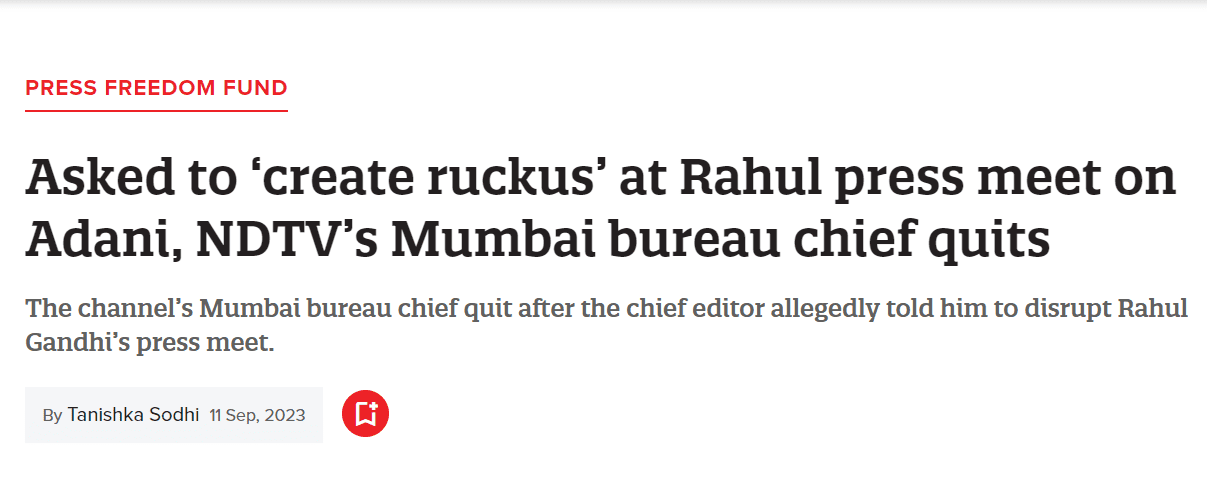
While Sohit Mishra did not explicitly mention the reason for quitting NDTV, a report by leftist propaganda outlet Newslaundry alleged that he was asked to supposedly ‘disrupt’ a press conference by Congress leader Rahul Gandhi.
Screengrab of the report by Newslaundry
“But hours before the event, Mishra had been allegedly asked by none other than the channel’s editor-in-chief Sanjay Pugalia to disrupt Gandhi’s press conference, “create a ruckus” and “change the narrative”, sources at NDTV told Newslaundry,” the report claimed.
Interestingly, the leftist propaganda outlet revealed in the very next line of its report that there was nothing disruptive about the directive by NDTV’s Editor-in-Chief Sanjay Pugalia to Sohit Mishra. In reality, the ‘journalist’ was told to ask a list of questions to the Congress scion, questioning his anti-India stance and his outlandish claims about the Rafale deal.
It must be mentioned that Rahul Gandhi had infamously coined the phrase ‘Chowkidar Chor hai’ in the run-up to the 2019 elections to insinuate a scam in the Rafale defence deal. Despite no evidence of any wrongdoing on the part of the Modi government, Gandhi and the Congress ecosystem kept on repeating the same lies.
A shocking confession by NDTV employee to Newslaundary:
During the 3rd meeting of the INDIA alliance in Mumbai, Rahul Gandhi Ji held a press conference on Adani. A report was published by OCCRP claiming that Adani invested his own money to buy his shares and… pic.twitter.com/zXrDcFZG2u
The Organised Crime and Corruption Reporting Project (OCCRP), which has ties with Chinese-financed NewsClick and George Soros-owned Open Society Foundations, conducted a hit job on the Adani Group on August 31, 2023.
On the same day, Rahul Gandhi held a press conference to target the Indian conglomerate and accuse the Modi government of supposedly indulging in crony capitalism. Sohit Mishra was asked to attend the said press conference and ask some tough questions to the Congress scion, a directive which prompted his resignation
It is interesting to note that journalists seldom ask ‘tough questions’ to Rahul Gandhi during his press conferences, which has helped him get away with peddling misinformation on an array of issues.
Sohit Mishra and his ideological inclinations
A quick glance at the Twitter profile of the ex-NDTV ‘journalist’ reveals that he is a fan of Rahul Gandhi’s Bharat Jodo Yatra (BJY).
महाराष्ट्र में होने वाली किसानों की आत्महत्या, फसल के नुकसान पर बीमा नहीं मिलना, युवाओं की बेरोजगारी, छत्रपति शिवाजी महाराज, छत्रपति शाहू महाराज, जीजाबाई.. आज इन सभी मुद्दों का जिक्र @RahulGandhi के #BharatJodoYatra की सभा में हुआ.. यह सभी महाराष्ट्र के मुद्दे हैं जो पहले गायब थे pic.twitter.com/hPYVxEGZWg
“This Bharat Jodo Yatra has brought together and awakened all those people and activists who were sleeping till now…” he claimed in one tweet. Mishra also hailed the political pilgrimage of Rahul Gandhi for highlighting issues, which he claimed were missing fromthe public discourse.
नांदेड़ में चल रहे #BharatJodaYatra में हमें यह दो महिलाएं मिलीं जो @RahulGandhi से मिलने पहुंची.. उनसे मैंने पूछा कि आप क्यों आई हैं और क्या करना है.. उनके जवाब आप सुनिए..
इस भारत जोड़ो यात्रा ने उन सभी लोगों और कार्यकर्ताओं को एक साथ लाया है और जगाया है जो अबतक सोए हुए थे… https://t.co/5UNfTDUU1A
“Interesting times in politics.. Now a Bharat Jodo concert in Indore.. To connect with the youth, you need to speak the language of the youth…One song that will definitely be played here is “Apna Time Aayega,” he said in one tweet.
Interesting times in politics.. Now a Bharat Jodo concert in Indore.. To connect with the youth, you need to speak the language of the youth..
One song that will definitely be played here is "Apna Time Aayega" ? https://t.co/wBWsneUhlW
भारत जोड़ो यात्रा में 82 वर्षीय एक ऐसे बुजुर्ग से मुलाकात हुई जिन्होंने नेहरू को देखा था, इंदिरा गांधी से वो मिले थे और बुधवार सुबह से @RahulGandhi के इंतजार में सड़क किनारे बैठे रहे.. कांग्रेस के कार्यकर्ता दोबारा एक्टिव हो रहे हैं.. @INCMaharashtra#BharatJodoYatrahttps://t.co/h9kDbn6k1J
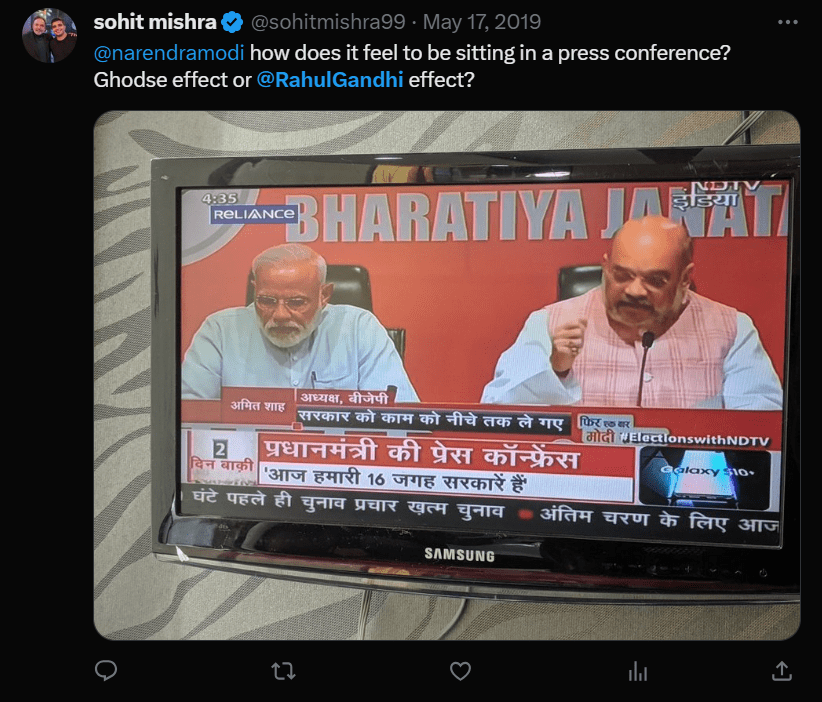
Besides his admiration for Rahul Gandhi, Mishra was also seen berating PM Narendra Modi in multiple tweets. “How does it feel to be sitting in a press conference? Ghodse effect or Rahul Gandhi effect?” he had claimed.
Screengrab of the tweet by Sohit Mihsra
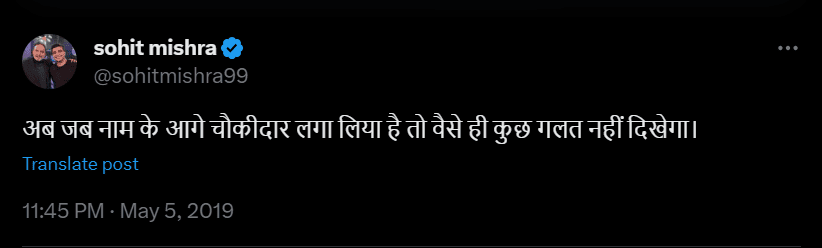
“Now, when you have added ‘Chowkidar’ to your name, it is impossible to see any wrong happening in front of you,” the ‘journalist’ took potshots at the BJP.
Screengrab of the tweet by Sohit Mishra
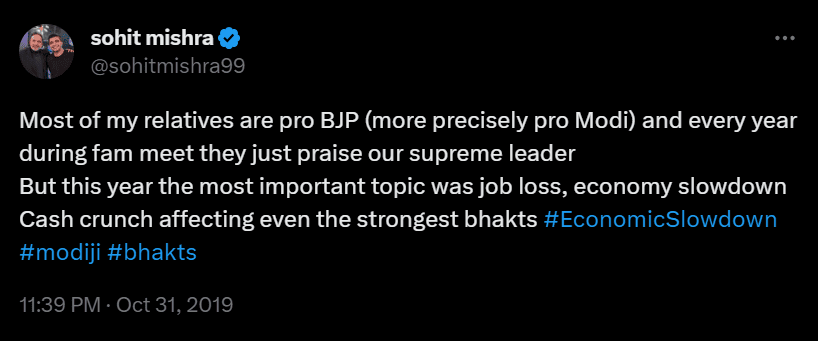
In one of his tweets, Mishra was seen speaking the language of Congress trolls by mocking BJP supporters as ‘bhakts.’
Screengrab of the tweet by Sohit Mishra
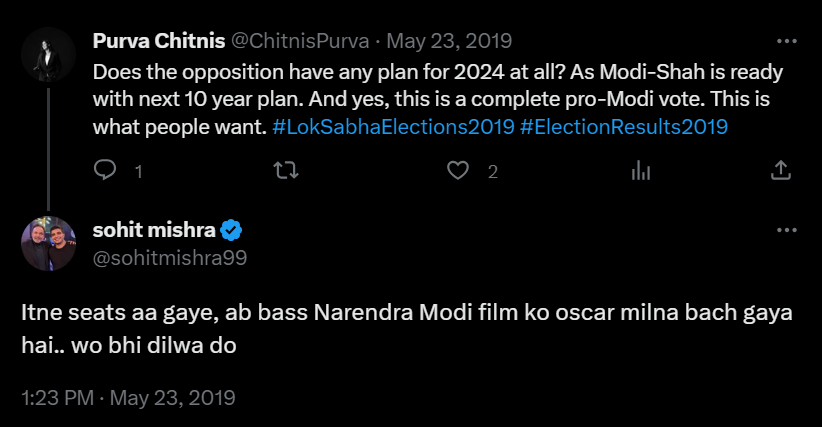
“Itne seats aa gaye, ab bass Narendra Modi film ko oscar milna bach gaya hai.. wo bhi dilwa do,” he wrote in frustration after the landslide victory of BJP in the 2019 Lok Sabha elections.
Screengrab of the tweet by Sohit Mishra
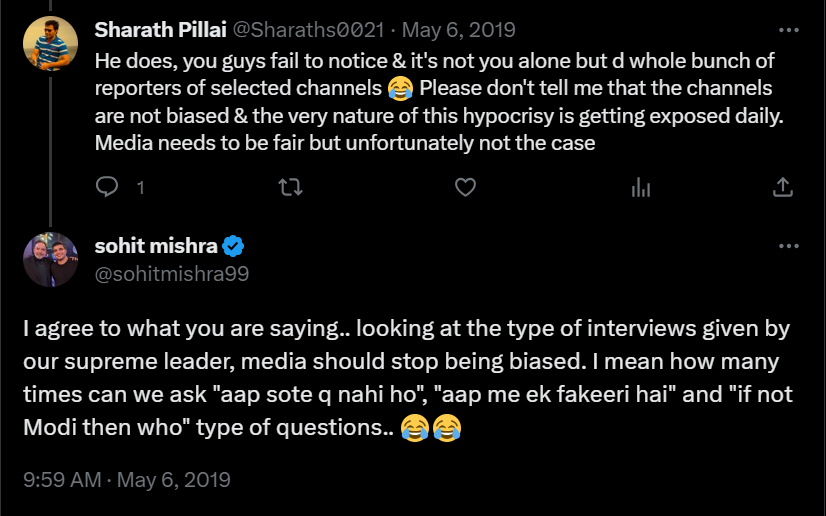
“Looking at the type of interviews given by our supreme leader, media should stop being biased. I mean how many times can we ask “aap sote q nahi ho”, “aap me ek fakeeri hai” and “if not Modi then who” type of questions…” he claimed in one tweet.
Screengrab of the tweet by Sohit Mishra
He also appeared to be in awe of propaganda artist masquerading as a ‘journalist’, Rajdeep Sardesai.
“From @sardesairajdeep How Modi won India: Rather than speaking the truth to those in power, there is a growing inclination to ‘follow the leader’ with an uncritical, unquestioning gaze, almost as if mainstream media has been co-opted into a permanent embrace with the ruling elite,” he tweeted.
From @sardesairajdeep How Modi won India: Rather than speaking the truth to those in power, there is a growing inclination to ‘follow the leader’ with an uncritical, unquestioning gaze, almost as if mainstream media has been co-opted into a permanent embrace with the ruling elite
When Adani Electricity slammed ex-NDTV journalist for misleading news
In May 2022, Adani Electricity Mumbai Board gave a befitting reply to Sohit Mishra, who claimed that the Board had sent electricity bills amounting to lakhs to the residents of Siddharth Colony area in Mumbai’s Chembur.
In his report, the then NDTV ‘journalist alleged that 3200 families living in the slums of Chembur were slapped with electricity bills amounting to lakhs.
“How much electricity bill do you pay? 5000? 10,000? The Bill of one family in Chembur is 35 lakhs!! Due to non-payment of bills, they are forced to live without electricity throughout the day. Administration, developer and electricity department have duped them”, he had tweeted.
— Adani Electricity (@Adani_Elec_Mum) May 16, 2022
Following the fraudulent report, the Adani Electricity Board on May 16 issued a statement and slammed the NDTV journalist for misleading the viewers.
“The video is highly misleading and presents a distorted view of the Truth. The fact is that these bills are of 16 years of arrears. Siddharth Colony residents stopped paying their bills on the pretext that the developers had promised to pay for their electricity”, the statement read.
The journalist however, in the series of tweets kept on arguing that the Adani Group who acquired the Mumbai electricity distribution business from Reliance Energy in 2017 had duped the consumers by issuing hefty electricity bills. He defended his video report and said that nobody from the Adani group was ready to speak on camera.
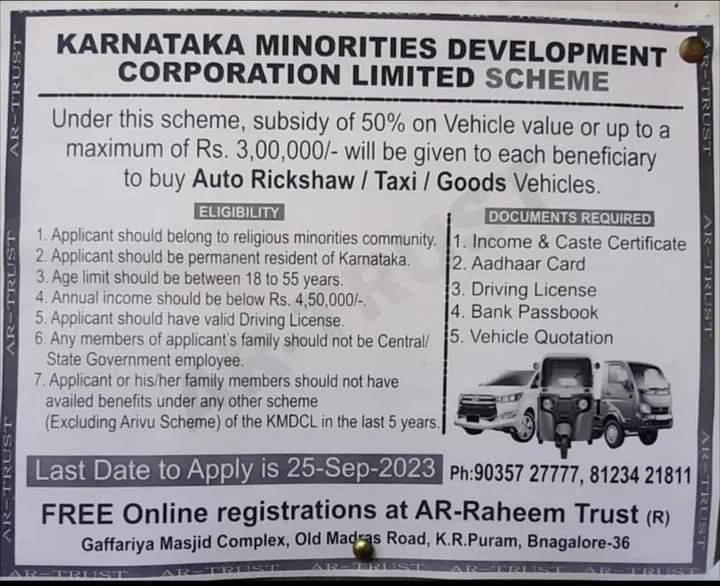
On the 8th of September 2023, a fresh controversy surrounded the Congress government in Karnataka. BJP leaders Tejasvi Surya and Minister Rajeev Chandrasekhar took to Twitter to post a screenshot of a newspaper ad which spoke about a scheme by the Karnataka government which was meant specifically for the minority communities. It appears that the advertisement was not placed by the govt but by a private organisation called AR-Raheem Trust.
The advertisement for the scheme
As per an advertisement attached by the minister in his tweet, a subsidy of 50% of the vehicle’s value with a maximum of 50% is being offered to religious minorities to purchase Auto Rikshwas, Taxis and Goods vehicles. The Swavalambi Sarathi Scheme was launched by Karnataka Housing and Minorities Welfare Minister Zameer Ahmed Khan last month.
Taking to X, Minister Chandrashekhar said that the scheme is meant exclusively for the non-Hindus keeping even the financially deprived Hindu communities out of it. The union minister said that it is a brazen discrimination and violation of Article 14 of the Constitution from a party that goes abroad and talks of Bharat’s constitution being under threat. He called it “State sponsored Conversion inducement”.
He called the scheme an ‘example of shameless, lazy, appeasement politics of bribing certain communities by Rahul Gandhi’s Congress in Karnataka.’
Rajeev Chandrashekhar said, “Shameless bribing of a community by using public resources meant for All Kannadigas. Brazen discrimination & violation of Art 14 of the constitution from a party that goes abroad and talks of Bharat’s constitution being under threat. State-sponsored Conversion inducement. This is the appeasement and corrupt politics of Dynasts of UPA/I.N.D.I alliance.”
On the 8th of September itself, the usual suspect, Mohammad Zubair, the co-founder of AltNews and dog-whistler-in-chief, attempted to “fact-check” Rajeev Chandrasekhar and Tejasvi Surya. It is pertinent to note here that AltNews and Mohammad Zubair are officially partnering with the Karnataka government to ‘fact-check’ news. This intimation was given by Priyank Kharge – Minister in the Karnataka government.
Union Minister @Rajeev_GoI and BJP MP @Tejasvi_Surya are misleading their followers by communalising the welfare schemes. This is ‘Swawalambi Sarathi Scheme’. A similar scheme was available under Karnataka BJP govt too. But both the BJP MPs don't want you to know!
Mohammad Zubair made the following claims in an attempt to fact-check Rajeev Chandrasekhar and Tejasvi Surya:
He claimed that the two leaders were communalising the scheme and that the scheme was available for SC/ST as well.
SC/ST can get 75% or a max subsidy amount upto 4 lakhs.
Minorities are eligible for 50% or a max subsidy amount upto 3 lakhs.
That under the BJP there was a similar scheme and therefore, Chandrasekhar and Surya were spreading misinformation.
AltNews’ Zubair has a penchant for spreading selective facts and misinformation to drive his agenda home. Interestingly, this is exactly what he did in this case too.
In one of his tweets, Zubair said: “• Unemployed youth from SC/ST, Minority (Muslims, Christians, Jains, Parsi, Buddhists) are qualified for this scheme. • SC/ST can get 75% or a max subsidy amount upto 4 lakhs. • Minorities are eligible for 50% or a max subsidy amount upto 3 lakhs”.
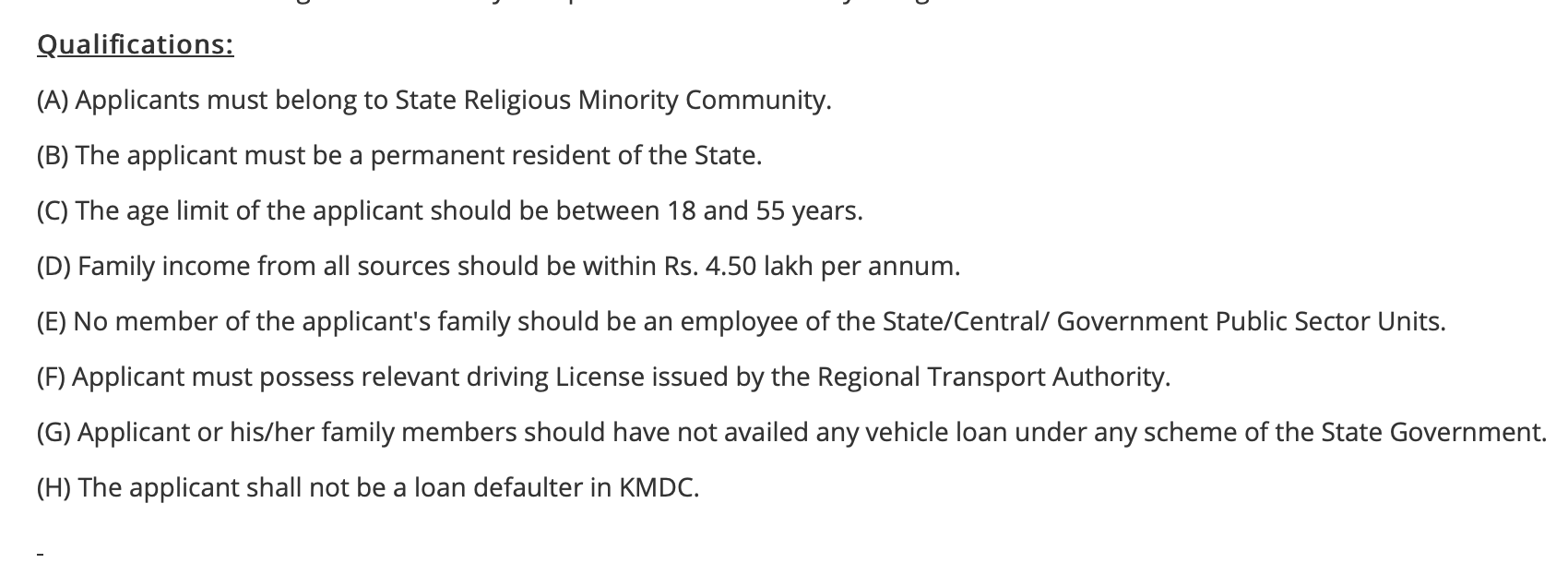
To make his point, Zubair attacked two screenshots detailing the eligibility criteria for this scheme. Zubair relied on these screenshots as if they were official intimations from the government, however, as it turns out, the website is a privately run and owned website which has nothing to do with the government at all.
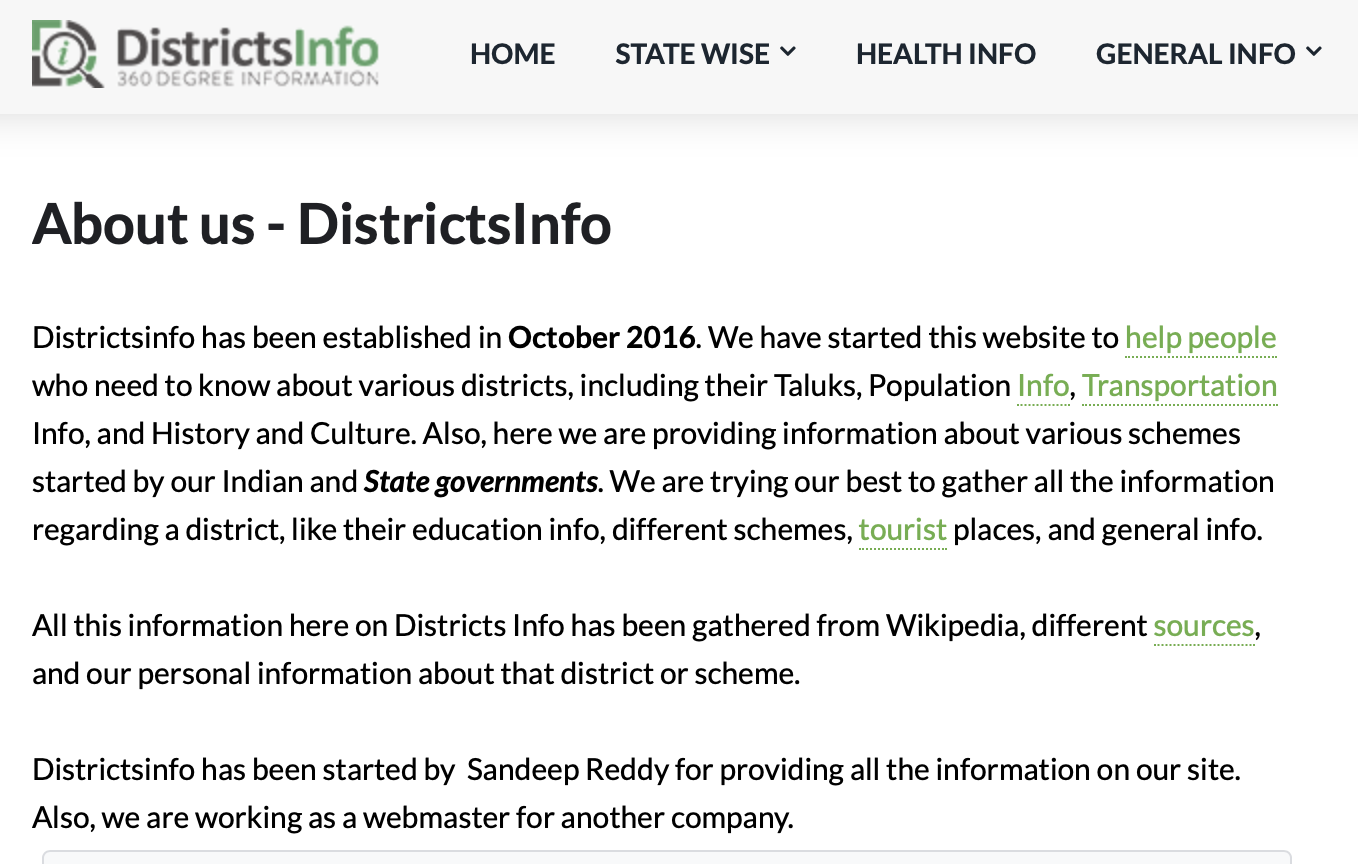
The About Us page of ‘districtsinfo’, the site from which Zubair took the screenshots, claims that it gathers information from ‘other sources’ including Wikipedia.
Districtsinfo website
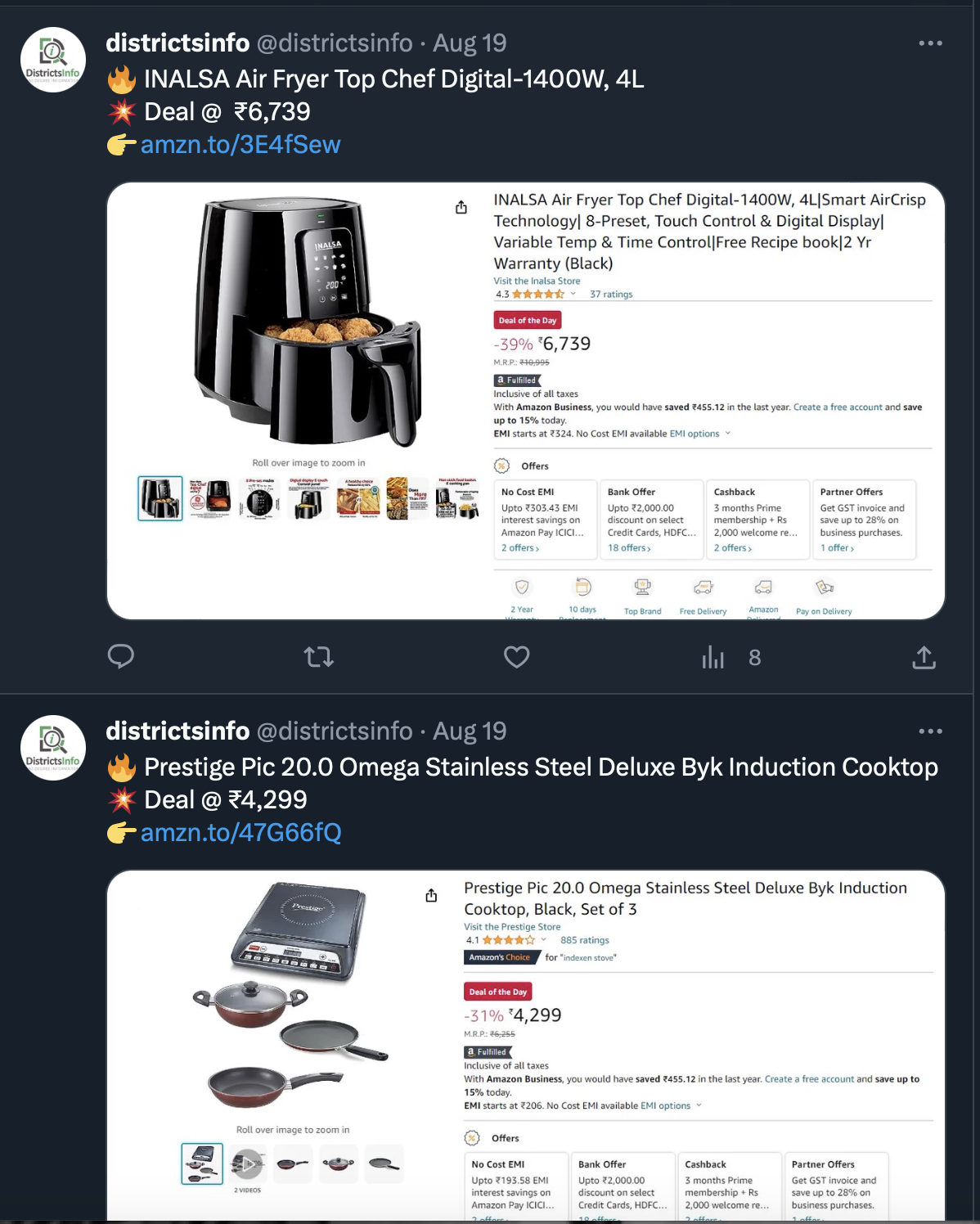
This article that Zubair is using for his fact-check was published on the 19th of August 2023 – well after the Congress govt came to power in Karnataka. On that date, this website’s Twitter handle was posting Amazon ads for air fryers and induction cooktops. They regularly and almost exclusively post Amazon ads for various products – including women’s wear and shoes.
DistrictsInfo website’s Twitter handle
It is rather evident that by no measure if the website reliable, certainly not for “fact-checking”. The information, however, is not completely wrong.
According to the Congress government budget, this indeed was the scheme which was announced by the government. However, there was vital information that not only the random website but also Zubair left out, intentionally or not, is left to the discretion of the reader.
Here is what Mohammad Zubair left out
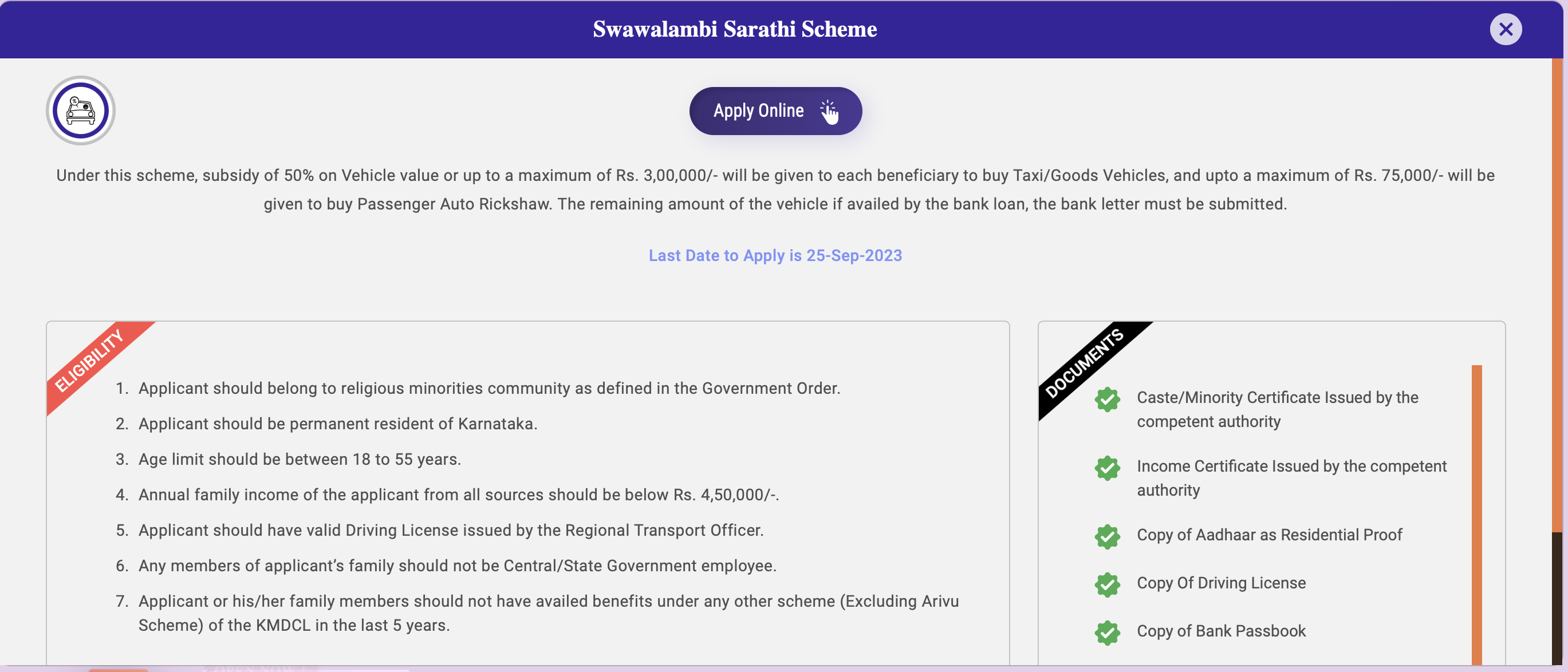
When one searches for information on the ‘Swawalambi Sarathi Scheme’, one reaches the official website of KMD – the Karnataka Minority Department.
On the website itself, there is specific information about the scheme which is to benefit minority communities.
Government website
Karnataka govt website
The website clearly says that the applicant should belong to a religious minority community to apply for this scheme. This scheme is now live from the Minority Department as evidenced by the “apply online” active button.
Now, one can argue that since this is the Minority Department website, it would reflect information only for minorities. We checked the website of the social welfare department to see if the scheme had been made active for the SC/ST category as was announced by the Karnataka government in its budget.
On that website, no scheme called ‘Swawalambi Sarathi Scheme’ has been reflected and there is no place to apply online for it either.
When OpIndia spoke to the social welfare department, we were categorically told that the scheme could be availed only by the minority community and not by the SC/ST community.
FIR against Sudhir Chaudhary for asking ‘what about Hindus’ in Karnataka scheme: What happened, Zubair’s misleading claims, Priyank Kharge’s threat and more
While it is true that the Karnataka government had announced this scheme in its budget for minorities and the SC/ST community, it would appear from the given information that the scheme has been launched so far only for minorities but has not yet been notified for the SC/ST community at all. It is evident that the SC/ST community can only avail benefits of the scheme after the scheme has been notified to them and so far, that does not seem to have happened.
Aaj Tak’s Sudhir Chaudhury did a show on the 12th of September where he confirmed that the head of Ambedkar Development Corporation, P Nagesh, also said that this scheme is not applicable to the SC/ST community yet and discussion to make it available to them is ongoing. He also confirmed that the notification to extend the scheme to SC/ST has not been issued by the government yet.
Therefore, while Mohammad Zubair relied on a random website busy advertising Amazon products, there is ample indications that while the Congress government in Karnataka announced that this scheme would be applicable for minorities and the SC/ST community, the government has started implementing the scheme for minorities but not the SC/ST community yet.
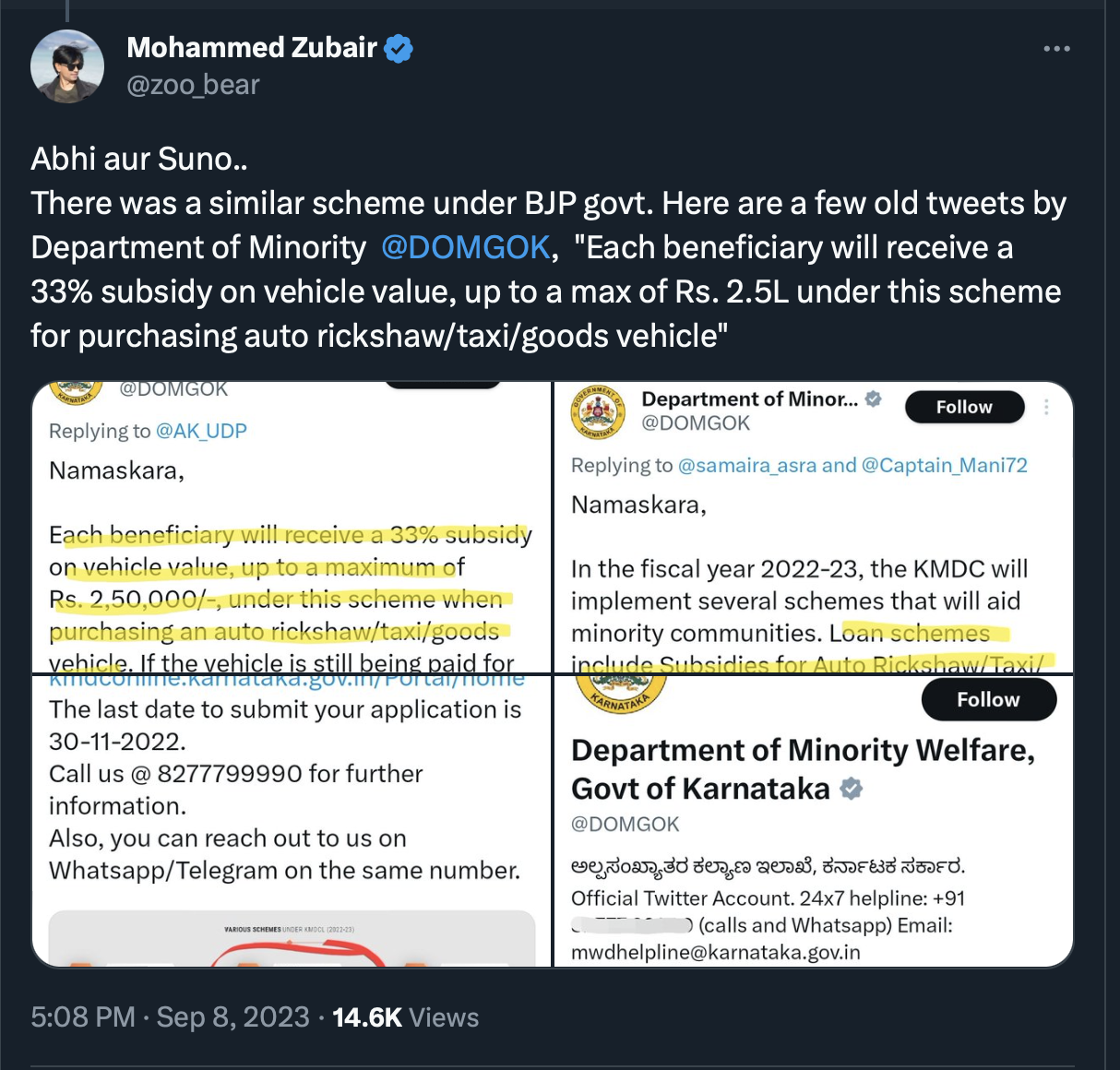
In another tweet, Mohammad Zubair made another misleading claim. Zubair tweeted, “There was a similar scheme under BJP govt. Here are a few old tweets by the Department of Minority @DOMGOK, “Each beneficiary will receive a 33% subsidy on vehicle value, up to a max of Rs. 2.5L under this scheme for purchasing auto rickshaw/taxi/goods vehicle””.
Tweets by Department of Minority Welfare of Karnataka
Zubair again smartly published selective information to ensure that the full picture was not apparent.
It is indeed accurate that a similar scheme was active under the BJP government as well. There is a 2021-2022 upload by the Minorities Department of Karnataka detailing how much subsidy was given for the purchase of vehicles up to 31st March 2022. According to the status report, there were 1,333 vehicles subsidised by the Minority Department.
Govt status report
However, the screenshots put up by Zubair were misleading because the BJP government had put this scheme on hold in 2022.
Here is what happened:
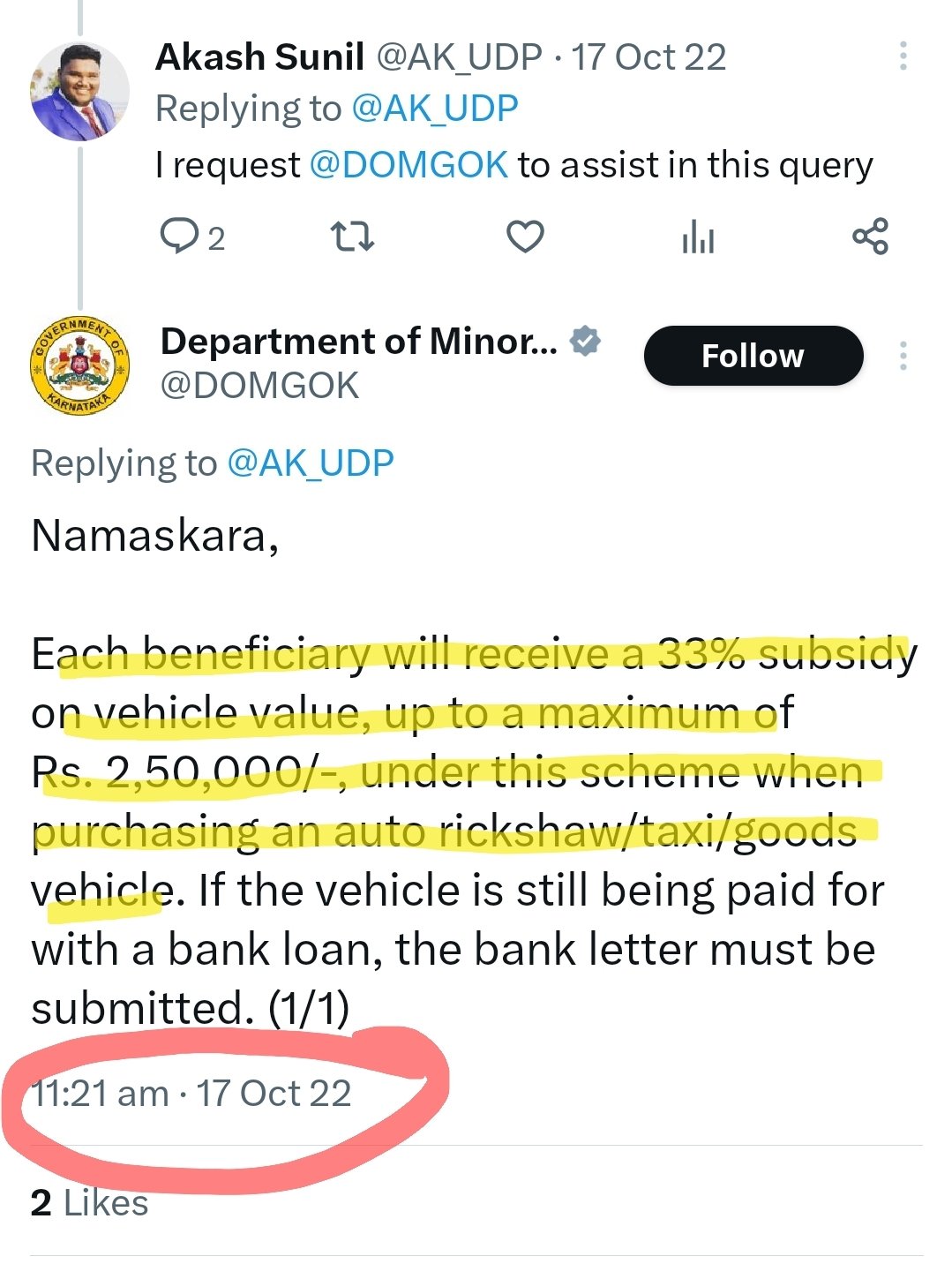
One of the screenshots that Zubair put up was a reply by the Department of Minority Affairs of Karnataka. The reply was dated 17th October 2022. In the reply, the department says, “Each beneficiary will receive a 33% subsidy on vehicle value, up to a maximum of Rs. 2,50,000/-, under this scheme when purchasing an auto rickshaw/taxi/goods vehicle. If the vehicle is still being paid for with a bank loan, the bank letter must be submitted. (1/1)”.
2022 response by DOMGOK used by Mohammad Zubair
If one notices, the response by DOMGOK is numbered 1/1. If one was a real fact-checker, one would check why the tweet was numbered and if there is a second, follow up tweet that makes the picture clearer.
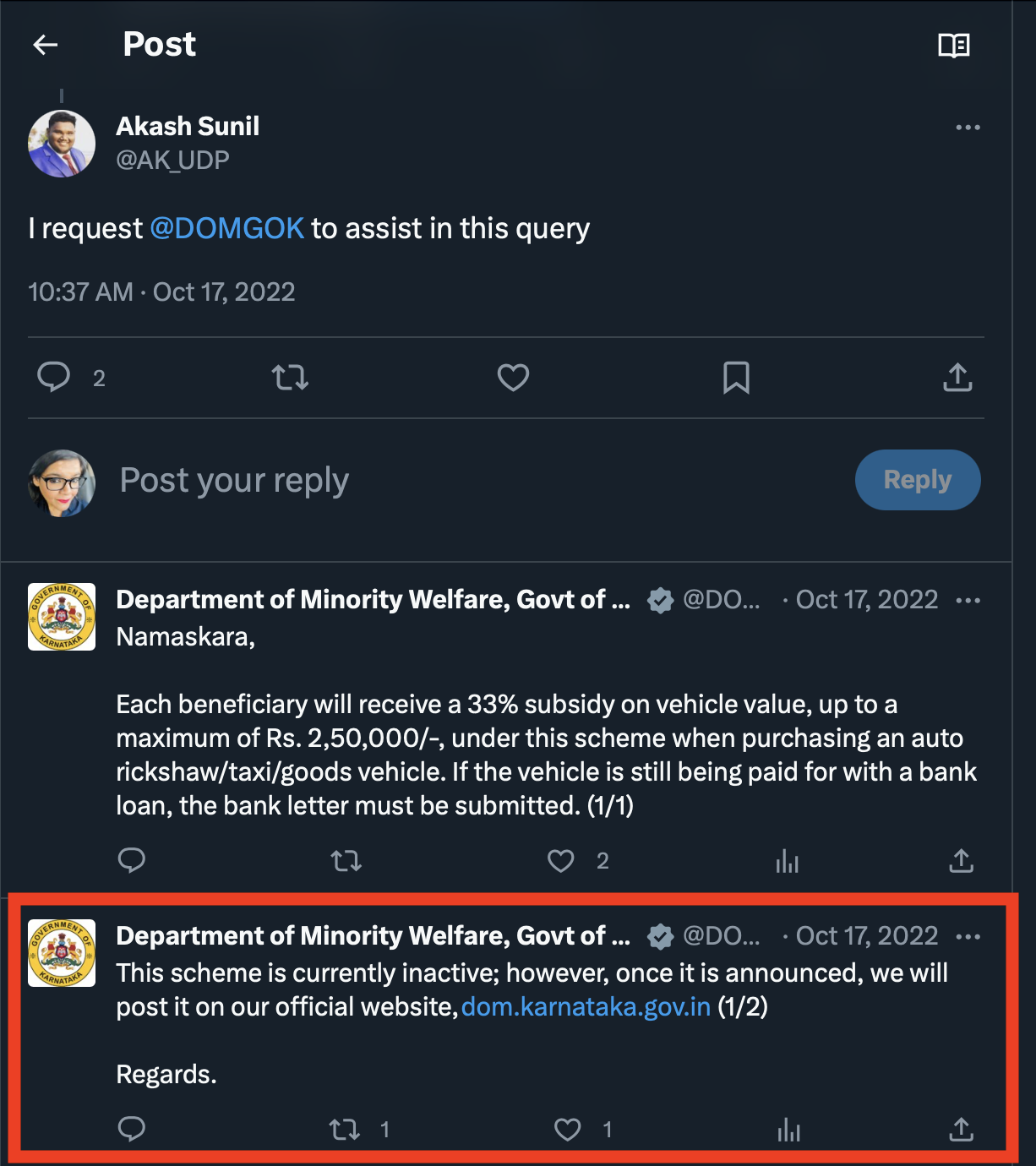
Zubair posted ONLY this screenshot and not the second tweet in the same response.
The full response by DOMGOK which Zubair refused to tweet
In the second tweet of the same response, that Mohammad Zubair seems to have deliberately left out, the Department of Minority Welfare clearly says that the scheme is “CURRENTLY INACTIVE”.
The tweets are still there on their Twitter handle.
And Direct Loans for Businesses/Enterprises. Visit https://t.co/p8TE5utXnM for more information. Tackling minorities' slums falls under 11 Municipal Corporations, which are only able to provide basic amenities. (2/2)
— Department of Minority Welfare, Govt of Karnataka (@DOMGOK) December 11, 2022
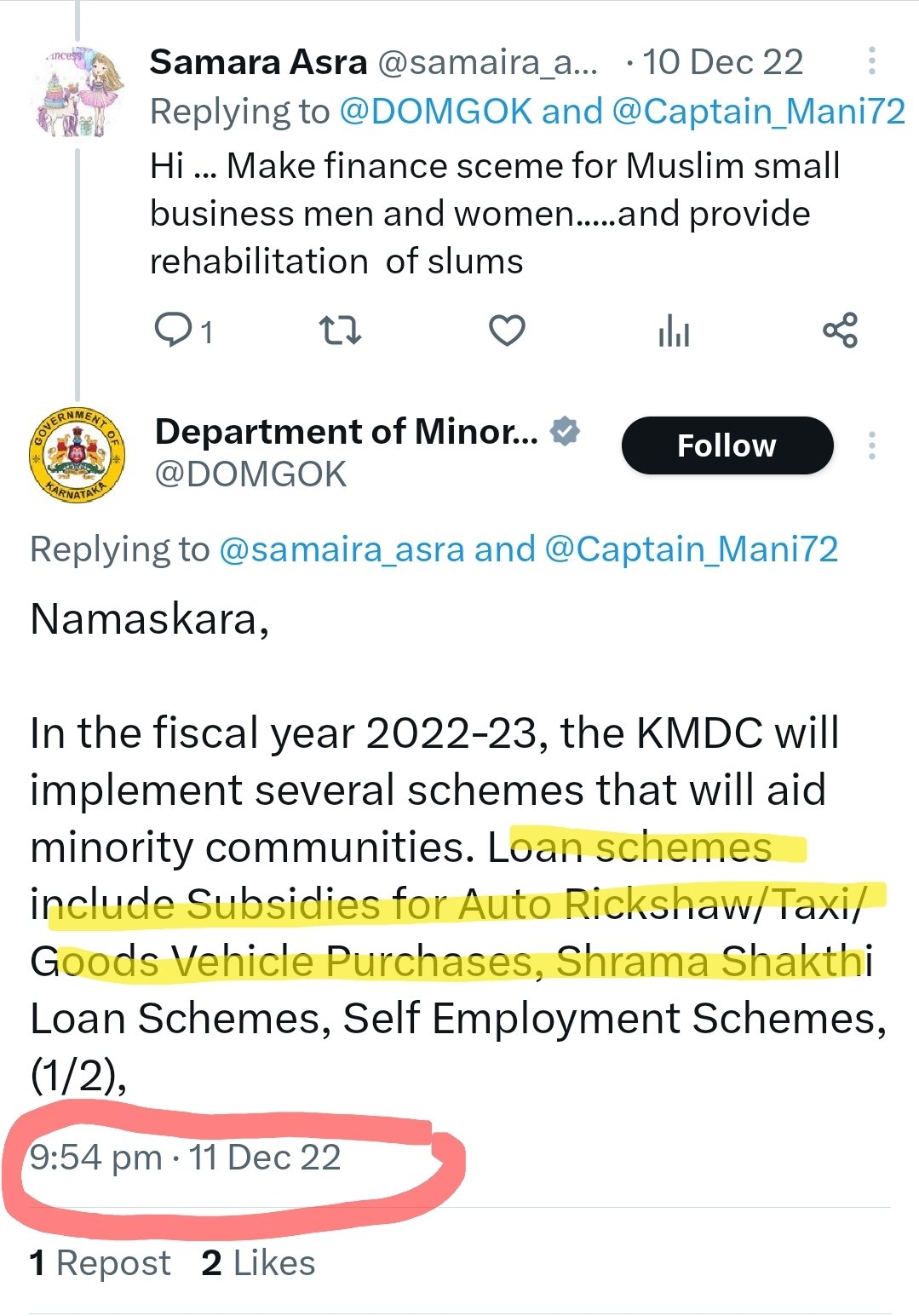
Zubair put up another screenshot from December 2022.
Another tweet used by Zubair
Given that in the October response, the Department had already said that the scheme was inactive, in the December response, the department says that the KMDC “WILL IMPLEMENT” this scheme – this only goes to show that the scheme was inactive this far till that point.
It is therefore evident that Zubair first selectively used one tweet response by the KMDC deliberately leaving out the other (which said that the scheme was inactive) and used another screenshot to mislead his readers.
It is also evident that when the Congress government came to power in Karnataka in May 2023, the scheme was still inactive and therefore, it was indeed the Congress govt in Karnataka which repackaged this scheme and introduced it again in their budget. In the budget, while they announced the scheme for minorities and SC/ST, it is, as of writing this article, only being implemented for minorities and NOT for the SC/ST community.
Now, it is entirely possible that there are other similar schemes that are extended to SC/ST and OBCs as well, however, the subject is about the Swawalambi Sarathi Scheme. This particular scheme seems to not be applicable to SC/STs as claimed – at least so far.
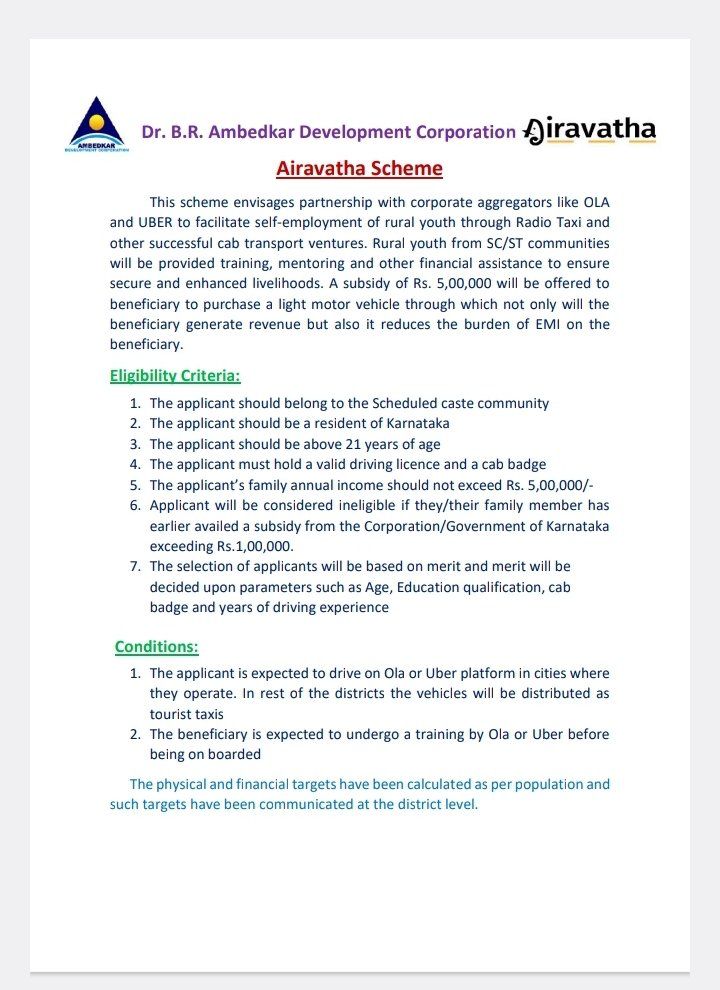
For example, there is another scheme by the Karnataka government called Airavatha Scheme which partners with OLA and Uber to facilitate rural youth from SC/ST community to get subsidized vehicles. However, it is not the same as the Swawalambi Sarathi Scheme. While this partners with Radio Taxi companies, the Swawalambi Sarathi Scheme seems to be available to all minorities. Also, the claim was never that the Karnataka govt has no schemes for SC/ST but that the Swawalambi Sarathi Scheme is meant only for minorities.
The FIR on Aaj Tak’s Sudhir Chaudhury, Priyank Kharge, fake news, lies and Mohammad Zubair
While Zubair started spreading misleading information, Priyank Kharge, who likes to call Zubair ‘Chief’ threatened Sudhir Chaudhary with legal consequences and subsequently, an FIR was filed against Aaj Tak anchor Sudhir Choudhury for merely reporting what was glaringly evident.
Sudhir Chaudhury had done a show in which he spoke about this scheme and how it was being implemented for minorities and not Hindus. As soon as the video was out, Priyank Kharge, who has recently also made anti-Hindu statements, tweeted that Sudhir was spreading misinformation and he would take legal action against the anchor.
The anchor of @aajtak is deliberately spreading misinformation on Government schemes which was first started by BJP MPs & is being amplified by sections of media.
In his defence, Sudhir Chaudhury did another show where he confirmed the following:
In the budget, Congress had indeed announced that the scheme would be available for minorities and the SC/ST communities
The ad in the newspaper and the Congress govt’s own Karnataka website proves that the eligibility requirement for the scheme is that one should belong to the minority community.
The applicability of the scheme for the SC/ST community has not been notified yet.
This was confirmed to Aaj Tak by the Managing Director of the Ambedkar Development Corporation.
Therefore, as of now, the scheme is indeed applicable ONLY for minority community.
It is pertinent to note that NONE of these facts have been tweeted by Mohammad Zubair yet.
In fact, when these facts were being articulated by Sudhir Chaudhury, this is what Zubair was tweeting:
The self-proclaimed fact-checker who Priyank Kharge calls “CHIEF” and has collaborated with in an official capacity to “fact-check” information, clearly has paltry regard for facts and the truth. In this case, it is entirely possible that the Karnataka government would make good on its announcement and notify the scheme for SC/ST as well, however, at this point, it is a fact that the scheme is only applicable to the minority community. In that respect, there was no misinformation spread by Sudhir Chaudhury or other media houses, yet, the Karnataka government has proceeded to file an FIR against the anchor instead of conceding to facts.
If indeed the scheme was applicable to SC/STs and not only the Ambedkar Development Corporation (which Aaj Tak spoke to) but also the Social Welfare Department (which OpIndia spoke to) were lying, then Kharge, instead of filing an FIR, should have made public the notification which makes the scheme applicable for SC/STs as well. Failure to do that, the facts at hand, the lies and misinformation spread by Zubair and the subsequent FIR on Sudhir Chaudhury only proves that the Congress government in Karnataka is allying with a serial fake news spreader to persecute journalists who refuse to toe their line and ask pertinent questions to the Congress government.
A Muslim man identified as Daud Ibrahim has been booked under the anti-conversion law and the SC-ST Act by the Uttar Pradesh Police for trapping a Hindu woman in an affair, marrying her, forcing her to convert to Islam, undergo ‘nikah halala’, and offer namaz.
According to a report by Subhi Vishwakarma from Organiser, Asia Bharti, a Dalit woman, submitted a complaint to the police on 9th September stating that she was trapped by her alleged husband Daud Ibrahim, who had posed as Rahul Gupta.
Tow years ago scheduled caste woman left by her husband got married to Rahul Gupta. After sometime she found he was actually Daud Ibrahim. Soon Daud & family started pressuring her to convert, undergo halala, offer namaz, remove Bindi, Alta, Mangalsutra & more.
In the FIR filed at the Akbarpur police station of the Ahmednagar district, the victim in her complaint told the police that almost two years ago, Daud Ibrahim, son of Wajid Ali alias Buddhu Kabadi, posed as Rahul Gupta lured her into a relationship.
The victim was already married when she was deceived by Ibrahim. The affair broke her marriage and Ibrahim took the victim with him, and the two began living together. The victim alleged that whenever she asked Ibrahim to marry her, he made an excuse.
Eventually, the victim found out that Rahul Gupta was actually Daud Ibrahim, and had since been pressured to convert to Islam by Ibrahim and his family. She was assaulted on 1st September for refusing to convert and was thrown out of the house.
Organiser Correspondent Subhi Vishwakarma spoke to the victim on 11 September. The victim said that she now lives with her daughter in a rented house. “My family left me long ago when I left my husband for Rahul alias Daud almost two years ago,” she said.
The victim identified her caste as ‘chamar’ which falls under the scheduled caste category. She claimed that she knew the accused as Rahul before her first marriage but her family had arranged a wedding with a main of their choice and caste.
The victim was happily married to her husband and had a daughter with him. But one day, Rahul alias Daud barged into her in-law’s house created a scene, and made allegations against her. This led to the victim’s husband abandoning her. “I had nowhere to go but to live with Rahul,” she told Organiser. The victim was also abandoned by her own family.
“Initially, he kept me with him without a marriage. Then arguments began over the same and he took me to a nearby temple in the Usarpur-Malipur area where as got married as per Hindu rituals. His friends joined on but not his family. Rahul (Daud) never stayed with me for long, he used to come on vacations and then left for work. He lived in Surat, Gujarat. I asked him to get the marriage registered but he kept on making excuses,” the victim narrated.
The victim further told Organiser that she had been pressuring the accused to get their marriage registered but he kept making excuses. “One day I created a ruckus and hence he had to shift the room. In a rush, he took me to a colony where his relatives lived, there people called him Daud Ibrahim, and mostly Muslims resided in the colony. That is when I learnt that he is a Muslim,” she said.
Asiya, the victim, said she confronted Daud after learning about his true identity and asked him why he lied about his religion. To this, according to the victim, Daud said “he was madly in love with her and if he had introduced himself with his real name, she would never have agreed to the marriage or affair for that matter.”
The victim was allegedly subjected to physical violence by Daud and his family. Daud would beat her every time she raised the matter of registering their marriage. “After I learned about his true identity, I started pressuring him even more to get the marriage registered,” she said.
“Then one day, out of nowhere, he took me to his house in Mirzapur Kodra. It was a normal house, I did not feel that they were Muslims, and no pictures or anything else was there. Daud told his family that, I was a Muslim woman. He had even brought me a burqa before taking me home,” she narrated.
After Daud’s family learnt that Asiya was a Hindu, they started forcing her to undergo ‘nikal halala’ and accept Islam in order to have a ‘nikal’ (Muslim wedding) with Daud. The family of the accused demanded that the victim stop wearing Bindi, Mangalsuta, and toe-rings, and put Alta (Mahawar, red paint).
“I used to wear them as a symbol of marriage, they asked me to live by their ways and apply mehendi instead,” the victim said adding that “the married women in the house looked like widows.
Moreover, the victim was told to do Roza-Zakat and become a “Namazi”.
“They would discuss that they could arrange a cleric who would teach me how to pray. One day, during an argument around my conversion, Daud’s sister said she knew a cleric who would do the halala and get me converted to Islam,” she said.
The victim did not know what halala was. When Organiser correspondent Subhi Vishwakarma told her about the same, the victim was shocked. The victim also narrated how Daud’s family would repeatedly berate Hindus, and say that “there is only one Lord that is Allah.”
The family of the accused also threatened to feed the victim beef. Asiya alleged that her pregnancy was terminated three times ever since she moved in with Daud. “When Daud took me to his parent’s house I was already pregnant with his baby. After his family learned of the same, they began telling me to abort. When I refused, they gave me food and water and I started to bleed,” she reportedly said.
The victim claimed that till the time she knew Daud as Rahul, he would take care of his daughter, visit temples with her, offer prayers, and wear kalawa. He was also addressed by his friends as Rahul and not Daud. But he began talking about Allah and stopped the victim from praying after they moved to his parent’s house.
Station House Officer, Malipur, Prem Chandra reportedly said that the family of the victim married her to a Hindu man but she eloped with the accused and had a marriage as per Hindu rituals. Calls made to the police by the Organiser reportedly went unanswered.
Meanwhile, the police have booked the accused Daud Ibrahim under Sections 493 (invalid marriage), 504 (intentional insult), and 506 (criminal intimidation) of the Indian Penal Code (IPC). He is also charged under Sections 3 and 5(1) of the Uttar Pradesh Freedom of Religion Act and Sections of the SC-ST Act.
On Tuesday, 12th September 2023, Ukranian politician and advisor to President Zelenskyy, Mykhailo Podolyak said that Indians and Chinese have weak intellectual potential. He said that the people from India and China do not realize the consequences of their actions.
In a new low of diplomacy, the Ukrainian advisor to the President of the war-hit country made bizarre claims about India and China in an interview that came days after the successful organization of the G20 summit in Delhi. Mykhailo Podolyak said, “What’s wrong with India, China, and so forth? The problem is that they are not analyzing the consequences of their steps, these countries have weak intellectual potential, unfortunately.”
Mykhailo Podolyak further said, “Yes, they invest in science. Yes, India has launched a lunar rover presently and is now trekking on the surface of the Moon, but that does not indicate that this country fully comprehends what the modern world is about.”
Ukranian politician and advisor to President Zelenskyy, Mykhailo Podolyak, on the intellectual capacity of the Indian and Chinese people. pic.twitter.com/bcf0IczeRy
He made these statements in response to the position of India and China on the Russia-Ukraine war. India has abstained from voting on several UN resolutions condemning Russia’s invasion of Ukraine, and continues its partnership with Russia, while extending humanitarian aid to Ukraine and calling for peace talks. China has refused to join the West in imposing sanctions on Russia and cut ties, like the West. The video clipping of the interview was making rounds on the internet.
India has made it abundantly clear that it will prioritise the needs of its own citizens and will not stop importing crude oil from Russia. India has also kept all communications and strategic partnership with Russia open. China has refused to toe Western sanctions and has improved trade ties with Russia. Both the nations, together the home to over 3 billion people, have maintained that they will not participate in the West’s war against Russia.
Ironically, Ukraine, a smaller nation that has been engaged in a long war with Russia and has avoided peace talks, getting thousands of its citizens killed and the landscape ravaged, is giving lessons on geopolitics to India and China, who have avoided getting involved in a conflict that doesn’t concern them and are focused on economic growth for their people.
This isn’t the first occurrence of Ukrainian officials making derogatory comments about Indians. In a previous incident, the Indian community was deeply offended when Ukraine’s Defence Ministry posted a controversial image of the Hindu goddess Kali. On 2nd May 2023, Ukraine’s First Deputy Minister of Foreign Affairs offered her apologies for the Hinduphobic cartoon shared by the official Defense of Ukraine Twitter account. This Twitter post was opposed by many Hindus on Twitter.
In the last month, Indian students encountered difficulties in Ukrainian universities, where they were subjected to bullying and pressure from local residents, compelling some to consider leaving the country. Now, these offensive racist remarks from this Ukrainian politician Mykhailo Podolyak have recurred, further exacerbating tensions.
Recently in an interview with the Economist, even Ukrainian President Zelenskyy himself was seen threatening Western countries to supply more weapons, insinuating they if they do not supply weapons to prolong their war with Russia, the Ukrainian refugees living in those countries might turn violent.
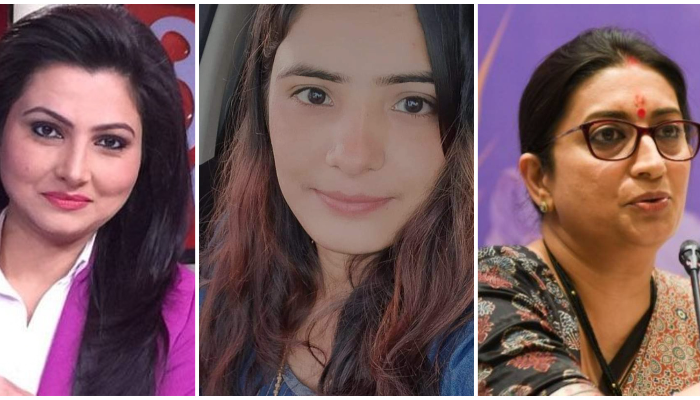
Ayushi Shukla, the state leader for the Congress party in Uttar Pradesh, has launched a sexist attack on Journalist Chitra Tripathi and Union Minister Smriti Irani in keeping with her party’s record of making crude and insulting statements about women. She is also a coordinator of UP Mahila Congress.
It is notable that she has declared “Rahul Gandhi is my superhero” and identified herself as “Nehruvian by thought” on her X (formerly known as Twitter) account.
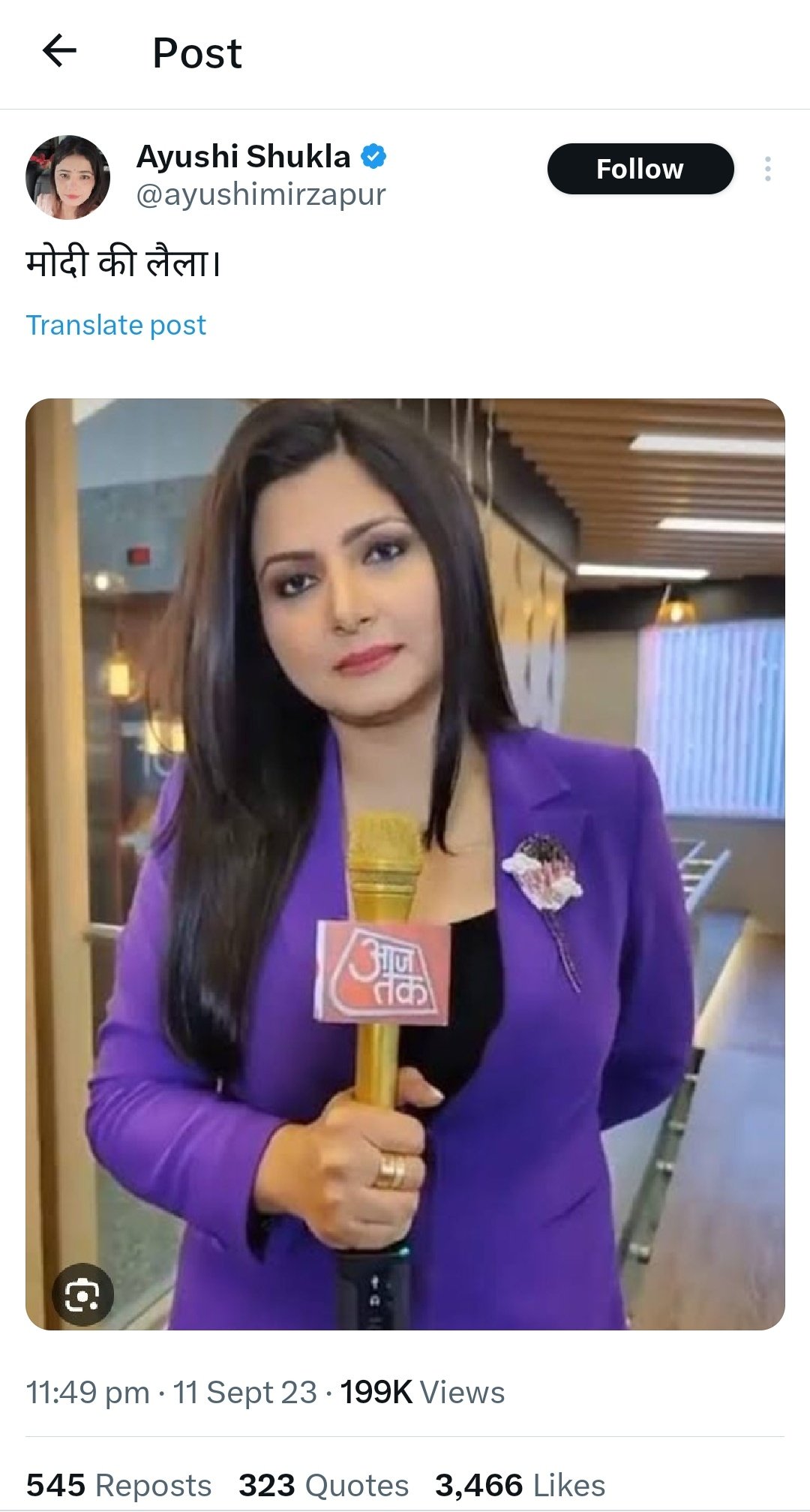
Following in the footsteps of her idol, who recently courted controversy for his flying kiss in the Parliament, she targeted multiple journalists and Bharatiya Janata Party leaders with abusive and derogatory comments. She wrote, “Modi’s Laila (lover),” with a picture of Aaj Tak anchor Chirta Tripathi. However, she deleted the tweet afterwards.
The Congress leader posted a picture of Amethi MP and Minister of Women and Child Development and Minister of Minority Affairs, Smriti Zubin Irani with the caption, “What relationship does she have with Modi,” making a veiled insinuation and added, “I will immediately follow whoever gives me the right answer.”
“How many dogs are there in this picture,” she asked in another photo which featured Prime Minister Narendra Modi with journalists, Rubika Liyaquat, Marya Shakil, Smita Prakash and Sushant Sinha.
UP BJP spokesperson Rakesh Tripathi called out Ayushi Shukla’s objectionable conduct and stated, “Shop of love! This woman is a member of the Uttar Pradesh Congress Committee and coordinator of UP Mahila Congress. Mr Rahul Gandhi is her superhero. This is the basic character of Congress.” He also asked UP Police as well as tagged prominent Congress handles including that of Priyanka Gandhi Vadra and Wayanad MP Rahul Gandhi to take cognizance of the matter.
मोहब्बत की दुकान !@ayushimirzapur ये मोहतरमा उत्तरप्रदेश कांग्रेस कमेटी की सदस्य हैं, यूपी महिला कांग्रेस की कोऑर्डिनेटर है। राहुल गांधी जी इनके सुपर हीरो हैं। यही कांग्रेस का मूल चरित्र है…..@Uppolice भी संज्ञान ले…
The Congresswoman defended herself with a bizarre excuse. “But Uttar Pradesh BJP spokesperson Mr Rakesh, I just asked what Mrs Smriti is of Mr Modi. I did not use any improper words, so why are you thinking it is wrong,” she responded.
पर उत्तर प्रदेश बीजेपी के प्रवक्ता राकेश जी मैने तो बस पूछा स्मृति जी क्या लगती है मोदी जी की, किसी गलत शब्द का प्रयोग तो किया नही, फिर आप गलत ही क्यों समझ रहे?? https://t.co/c54fFkhPJj
Notably, Congress has a history of acting in an offensive and sexist manner. The Gandhi scion was accused of blowing a flying kiss as he left the Lok Sabha on 9 August after he concluded his speech during the debate over the no-confidence motion by Union Minister Smriti Irani.
Neetu Singh, Congress MLA from the Hisua constituency in the Nawada district of Bihar engaged in a disturbing and disparaging tirade in her attempt to defend her leader and slander the Minister. She alleged, “Our leader, Rahul Gandhi, has no dearth of young females. Why would he blow a flying kiss to a 50-year-old woman and not a young girl,” she asked and further claimed, “All these allegations against Rahul Gandhi are baseless.”
Uttar Pradesh Congress leader Ajay Rai charged that the Amethi MP only came to her constituency Amethi to show “latkas” and “jhatkas” (an unflattering reference to dance moves) in December of last year. He claimed, “Most of the factories in Amethi are on the verge of closure. Half of the factories in the Jagdishpur industrial area are lying shut. Smriti Irani only comes, shows ‘latka-jhatka’, and leaves.”
A video of six-time Congress MLA KP Singh ‘Kakkaju’ from the Pichhore seat of Shivpuri district in Madhya Pradesh recently went viral on social media in which he passed an extremely controversial statement about women. He voiced, “I have observed many individuals who marry in their old age. At first, they feel pleased that a wife has come into the house, but then she feels that her husband is good for nothing.”
He added that other men start coming to their homes and the elderly husband thinks, “Because I am old and have no control over myself, I am neither able to stop my wife nor say anything.”
Congress leaders, both male and female have indulged in highly objectionable remarks against women, especially after their dismal performance in elections. They vent their frustration on the female leaders of the Bharatiya Janta Party as well as other women and expose their misogynistic mindset.
On Wednesday, September 13, India will receive its first Airbus C-295 military aircraft from Spain. The IAF will receive its first such aircraft today as part of a deal inked with Airbus for 56 such aircraft. The company will send 16 such aircraft from its plant in Spain, while the remaining 40 will be manufactured in Vadodara in collaboration with Tata Advanced Systems Limited.
According to the reports, IAF chief Air Chief Marshal (ACM) V R Chaudhari is in Seville, Spain to take delivery of the aircraft. A C-295 is a transport plane with short takeoff and landing capabilities. The plane is expected to land at Uttar Pradesh’s Hindon airbase on September 25.
The aircraft is expected to be inducted formally into the service at a ceremony in Hindan around September last week.
“The IAF chief would receive the first aircraft from Airbus at their facility in Seville, Spain on Wednesday. The aircraft would be flying to India from there after the ceremony,” defence officials told the media. The Indian Air Force chief was personally involved in the contract at important stages as the Deputy Chief of Air Staff where he was leading the contract negotiations.
In September 2021, India signed an agreement with Airbus Defence and Space to purchase 56 C-295 aircraft to replace the IAF’s antiquated Avro-748 jets. And in just two years, the first aircraft is being delivered by the European aerospace giant. This is a major improvement from earlier governments where defence deals took decades to complete, and some were even scraped after years and decades, causing major difficulties for the armed forces.
In accordance with the contract, Airbus will deliver the first 16 aircraft in a ‘fly-away’ situation from its final assembly line in Seville, Spain, within a period of four years. The following 40 aircraft will be produced and put together by Tata Advanced Systems (TASL) in India as part of an industrial partnership between the two corporations. Production of the aircraft at the Vadodara has already started.
The Main Constituent Assembly (MCA) in Hyderabad will produce several major sub-assemblies for the aircraft, which will be shipped to the Final Assembly Line (FAL) at Vadodara, where the aircraft will take its final shape. Production of sub-assemblies the Hyderabad plant has already started, and final assembly in Vadodara is expected to start by next year.
The aircraft can carry up to nine tonnes of payload or 71 personnel at a maximum cruise speed of 260 kts. Its versatility comes from its ability to be configured for air-to-air refuelling of fixed-wing aircraft and helicopters. The aircraft has a rear ramp door for quick reaction and para dropping of troops and cargo.
The aircraft has retractable landing gear and an unobstructed 12.69-meter-long pressurized cabin. The C-295 can fly at altitudes of up to 30,000 feet. It excels in short take-off and landing (STOL) from unpaved, soft, and sandy/grass airstrips.
According to Airbus, the C-295 is powered by two Pratt & Whitney Canada PW127G turbine engines, which give great flexibility, remarkable hot-and-high efficiency, and fuel consumption for a very long duration of up to 13 hours aloft.
The agreement between Airbus and TATA will see roughly 90 percent of the technology transferred. This is the first initiative of its sort in which a private business will produce a military aircraft in India. The initiative will benefit India’s aerospace ecosystem by involving various MSMEs from throughout the country in the production of airplane parts.
Once India begins production, it will be the newest member of a small group of countries capable of producing the C-295. Other members of the group include the United States, the United Kingdom, Russia, France, Italy, Spain, Ukraine, Brazil, China, and Japan.
The Income Tax department is conducting raids at the premises of Samajwadi Party leader Azam Khan in Rampur, Uttar Pradesh in relation to a tax evasion probe against the former cabinet minister. Raids are also being conducted at Regency Public School and Regency Institute of Management and Technology in Sitapur and at the residence of an advocate Mushtaq Ahmed Siddiqui in Lucknow.
VIDEO | Income Tax Department conducts raid on the premises of Samajwadi Party leader Azam Khan in UP's Rampur. More details are awaited. pic.twitter.com/DCz9VIDHcr
The raids are reportedly linked to the Al Jauhar Trust. At least 30 premises across Madhya Pradesh and Uttar Pradesh were searched including in Lucknow, Rampur, Meerut, Ghaziabad, Saharanpur, and Sitapur as part of a tax evasion probe against Azam Khan.
VIDEO | IT raids at Regency Public School and Regency Institute of Management & Technology in UP's Sitapur as part of the agency's action against Samajwadi Party leader Azam Khan. pic.twitter.com/n9QveBZcld
Source-based reports claim raids are also underway at the house of Samajwadi Party MLA Naseer Ahmad Khan, a close aide of Azam Khan. The MLA also holds office in the Al Jauhar Trust.
Azam Khan is the head of the Al Jauhar Trust. A lease for a 3.24-acre plot of the Trust was cancelled by the Uttar Pradesh government earlier this year. The plot was reportedly given to the Trust to set up a research institute and the lease was signed in 2013-14 for Rs 100 a year for over 30 years.
VIDEO | IT Dept conducts raid at the residence of an advocate Mushtaq Ahmed Siddiqui in Lucknow as part of the agency's action against Samajwadi Party leader Azam Khan. pic.twitter.com/z4Ph22kxiP
The same was cancelled by the government on charges of irregularities. The research institute was never built.
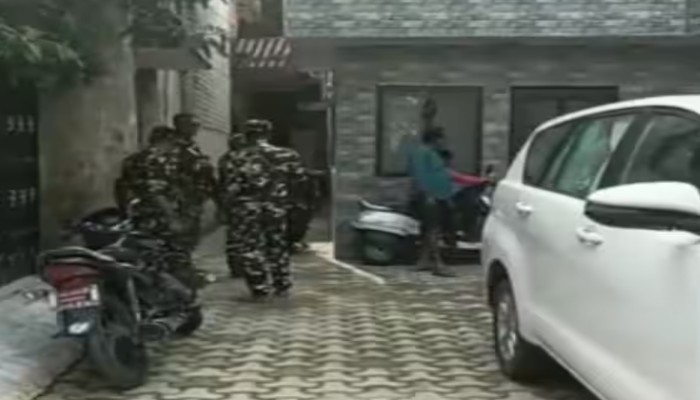
Reports claim Azam Khan and his family were present at his Rampur residence during the raids. A convoy of vehicles of the I-T department was seen parked outside the SP leader’s house which was surrounded by Central forces.
Reports citing sources claim that the raids were conducted based on several inputs. The agency has reportedly seized several documents and electronic equipment. The seized material could likely reveal details of major transactions.
As many as 81 cases have been registered against Azam Khan in Rampur on several charges including land-grabbing, cheating, and criminal trespass. His wife and son were also booked in some of these cases but all three are out on bail.
Earlier, the SP leader was charged with laundering black money during demonetisation and accused of owning assets exceeding his earnings. A case was filed in this regard in Lucknow. The Enforcement Directorate (ED) has conducted interrogations in this regard in Rampur.
On Tuesday, 12th September 2023, Congress MLA from Ferozepur Jhirka, Mamman Khan, filed a plea in the Punjab and Haryana High Court seeking the formation of an SIT (Special Investigation Team) to investigate Nuh violence. Mamman Khan sought in his petition that all FIRs related to this case be entrusted to an SIT led by an officer of rank not lower than Inspector General. Additionally, he said in his petition that the SIT should be instructed not to disclose its investigative findings to any political party representatives due to the sensitive nature of the Nuh violence that took place on 30th July 2023.
The petition, represented by Advocate Arshdeep Singh Cheema and Ishan Khetarpal, also requested protection from arrest for Khan until the investigation concludes. It argued that the state government, having failed to contain the violence, is now trying to shift responsibility onto its political rivals by unjustly involving Khan in the case.
In his petition, Mamman Khan alleged, “It is common knowledge that after the unfortunate incident of violence of Nuh, the blame game started. In order to divert the attention of the people from the failure of the government to prevent the occurrence, the high functionaries of the State, including the Chief Minister and the Home Minister started blaming the opposition. Their statements started to appear in the newspapers blaming the MLAs of the Congress party for the occurrence.”
Mamman Khan’s counsels presented a comprehensive alibi for the MLA during the timeframe of the violence, emphasising his absence from the affected regions and his presence at his Gurugram residence. The petitioner also furnished evidence of his whereabouts, including CCTV footage and receipts.
The petition by Mamman Khan argued that the government’s actions had infringed upon principles of impartial investigation. It requested instructions to establish a high-level SIT, led by senior officers, to examine the violence-related cases. Additionally, it urged that the SIT conduct an autonomous and unbiased inquiry free from political influence. The petition also called for directions to prevent any coercive actions against the Congress MLA during the investigation. The high court is anticipated to schedule a hearing in the near future.
On 1st August 2023, an FIR was registered at the Nagina Police Station in the Nuh district, citing sections 148, 149, 153-A, 379-A, 436, and 506 of the Indian Penal Code (IPC) in connection with the incidents of violence in the region during the Jalabhishek Yatra. A notice was issued to Mamman Khan under Section 160 of the CrPC and was told to join the investigation and present himself at the Nagina police station. He failed to appear on two occasions during the last fortnight. Now, he has filed a petition in the high court to constitute an SIT to probe this matter.
Notably, Mamman Khan won the 2019 elections from the Ferozepur Jhirka seat with 57.62% votes defeating BJP candidate Nadeem Ahmed. Khan had lost his first election in 2014 as an independent against Nadeem Ahmed who fought on an INLD ticket.
On 31st July, a mob of hundreds of Muslim rioters attacked Hindu devotees participating in the Brijmandal Jalabhishek Yatra in Nuh, Mewat of Haryana. At least six people were killed as a result of the riots.