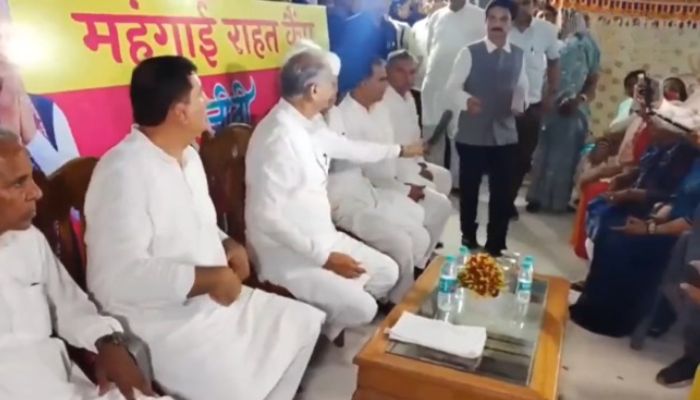
On Friday, 2nd June 2023, Rajasthan Chief Minister Ashok Gehlot, threw a microphone at the Barmer district collector during a public event. The incident reportedly occurred at the Barmer Circuit House, while he was engaging with a group of women, seeking their feedback on government schemes aimed at benefiting the public.
A video capturing this incident was widely circulating on social media. The video emerged after the public address system experienced a malfunction, seemingly causing frustration for the Chief Minister.
In the viral video, CM Gehlot was seen sitting on a chair and speaking to the assembled group of women when an apparent malfunction occurred with the wireless microphone. Displaying signs of frustration, he threw the microphone towards the Barmer district collector. Subsequently, the collector retrieved the microphone from the ground. In the meanwhile, a woman handed him another wireless microphone which was working.
Gehlot’s composure slipped again as he noticed a group of individuals positioned behind the women. In response, he demanded that they vacate the area. He said, “Where is SP (superintendent of police)? Both SP and collector seem to be similar.”
As part of his two-day visit to Barmer, Ashok Gehlot engaged in an event where women had the opportunity to share the positive impacts of government schemes and express their gratitude to the chief minister for the increased honorarium provided to Anganwadi workers. During this event, the chief minister of Rajasthan lost his temper over a minor issue like a microphone malfunction.
Later the Chief Minister’s Office attempted damage control by saying that the CM did not throw the mic towards the DC. They claimed that after the microphone stopped working, he threw it to the ground on his left.
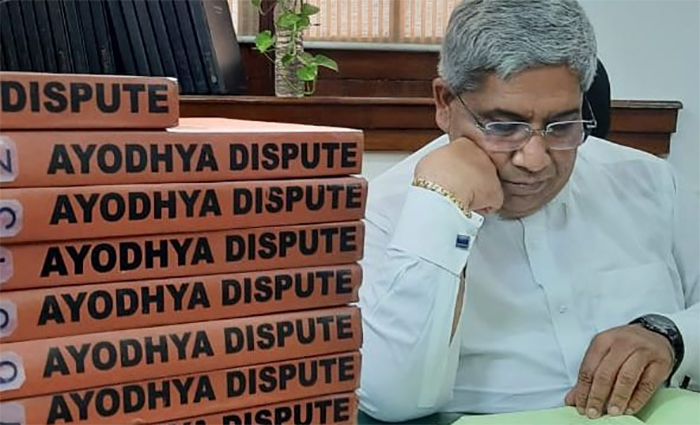
Justice (retired) Sudhir Agarwal, a member of the Allahabad High Court bench that rendered a pivotal decision in the Ram Janmabhoomi–Babri Masjidtitle suit in 2010, has stated that he was under pressure not to do so. Furthermore, he mentioned that had it not been for their ruling, there would not have been an outcome in the case for the next two centuries. Justice Agarwal retired from the high court on April 23, 2020.
“After delivering the judgment I felt blessed. There was pressure on me to postpone the judgment in the case. There was pressure from within the home and also from outside. Family members and relatives used to suggest to somehow pass time and not deliver the judgment,” he remarked while speaking with media after an event in Meerut.
He added, “Had the judgment not been delivered on September 30, 2010, in the Ram Janmabhoomi-Babri Masjid case, there would not have been any judgement in this matter for the next 200 years.”
On September 30, 2010, the Allahabad high court pronounced its judgement with a majority decision of 2:1. The verdict said that the 2.77 acres of land in Ayodhya would be divided equally among three parties, the Sunni Waqf Board, the Nirmohi Akhara, and Ram Lalla (infant) represented by the Hindu Mahasabha. Sibhghat Ullah Khan, Sudhir Agarwal, and D V Sharma served as the judges on the bench. Justice Khan had a dissenting opinion from the other two Justices.
However, on 9 November 2019, the Supreme Court in a momentous judgement pronounced that Ram Mandir (temple) would be constructed on the disputed land in Ayodhya and directed the government to provide Muslim litigants with a substitute five-acre tract in Dhannipur for a mosque putting an end to the conflict that had been festering since centuries.
Babri Masjid (Mosque) was constructed at Lord Ram’s birthplace by Mir Baqi, a general of the Mughal emperor Babur in 1528–29 on the latter’s orders after destroying the temple. The mosque was eventually demolished on 6 December 1992 by a large group of Hindu activists of the Vishva Hindu Parishad, Bajrang Dal and allied organisations.
Since the 18th century, Hindus were fighting for the right to reclaim their land and rebuild a Ram temple there. However, following the supreme court’s decision the Bhumi Pujan ritual of the temple was performed on 5 August 2020 by Prime Minister Narendra Modi after which the construction started and it will be inaugurated on January 1, 2024.
In an alarming case coming out of Maharashtra, a 16-year-old minor Hindu girl who had gone missing from Pune four years before was abducted by a 22-year-old Muslim man named Javed Sheikh. Fortunately, she was successfully rescued from Manchar. She was kidnapped in 2019 when she went to take the Staff Selection Commission (SSC) exam after completing her 10th grade.
The perpetrator is arrested and a case has been registered against him under Indian Penal Code (IPC) sections 363, 376, 324. 344 and Protection of Children from Sexual Offences (POCSO) Act. Further action will be taken against the accused but the girl is still reliving her traumatic experience.
Her family members had been looking for her ever since she disappeared but couldn’t find her anywhere. After a while, they found out about Javed Sheikh and came to know about his residence. When they reached the neighbours informed them about a girl who always lived in the house and never went outside.
They bravely walked into his home and went to the room where they discovered their scared daughter wearing a burqa. When she saw the faces of the people who had entered there, she reacted as though no one had come to meet her with affection in years. She stayed still and stared as they entered the room. She even believed that someone has come to kill her. However, she was assured not to worry. Afterwards, a woman removed the girl’s burqa and brought the latter with her.
महाराष्ट्र के पुणे में एक हिंदू लड़की 2019 से लापता थी। लड़की तब 10वीं क्लास में थी और सिर्फ 16 साल की। वह अपनी अंतिम एसएससी परीक्षा से लौट रही थी जब एक 'अज्ञात व्यक्ति' द्वारा उसका अपहरण कर लिया गया था, साल बीत गए और लड़की के परिवार के लगातार गुहार लगाने के बावजूद पुलिस लड़की को… pic.twitter.com/ygiorNCiTs
— Ach. Ankur Arya Official (@AchAnkurArya) June 2, 2023
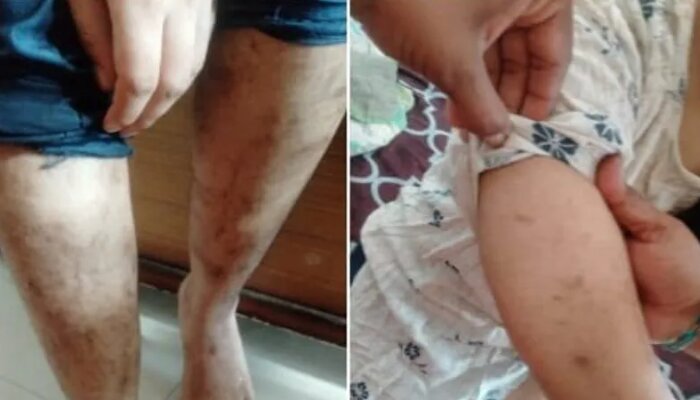
The victim, who was obviously terrified and didn’t want to speak at all, eventually described her horrific ordeal after being rescued. She reported that in addition to kidnapping and marrying her, Javed Sheikh had raped her frequently due to which she fell into depression. Furthermore, he even converted her to Islam. She had cigarette burns over her entire body. Some users on social media have also charged that the girl was forced into prostitution for six months.
Gopichand Padalkar, a Bharatiya Janata Party leader revealed that the girl’s family came to understand what had happened to their daughter after watching the movie The Kerala Story. It was also mentioned in some reports that the offender’s sister had taken the girl with her at the time of the kidnapping. Following that, the girl did not return and every attempt to find her resulted in failure.
Lately, after seeing The Kerala Story, they again appealed for help in the community and on May 16, the girl was ultimately saved. The politician demanded to check the culprit’s phone after meeting the victim. He noted that it contained images of other Hindu girls. Her brother disclosed that she was made to wear a burqa, perform namaz, and was fed mutton after the marriage. She was physically assaulted when she refused to offer namaz.
In the USA, a school district in Utah has made the decision to take the King James Bible off library shelves, following a complaint from a parent who claimed that the religious text violated a newly enacted state law that prohibits inappropriate books.
After receiving the complaint in December 2022, the Davis County school district conducted a review of the Bible to determine if it contained any objectionable content. The committee responsible for the review acknowledged that the King James Bible did include elements of “vulgarity and violence,” but concluded that it did not explicitly violate a book ban law that was enacted in 2022.
On Thursday, the school district made an announcement stating that approximately eight schools in the district would no longer provide access to the Bible for middle and elementary school students. However, high school students would still be able to borrow copies of the Bible from the library.
Towards the end of last year, a concerned parent from Davis County raised objections about the suitability of the Bible in school. According to the parent, the book contained incest, onanism, bestiality, prostitution, genital mutilation, fellatio, dildos, rape, and even infanticide. The parent said in the complaint, “You’ll no doubt find that the Bible, under Utah Code Ann. 76-10-1227, has ‘no serious values for minors’ because it’s pornographic by our new definition.”
The mentioned Utah law passed in 2022, prohibits the presence of books with “pornographic or indecent” content in Utah schools, including both libraries and classrooms. According to the law, the material is considered indecent if it contains explicit depictions of sexual arousal, stimulation, masturbation, intercourse, sodomy, or fondling. However, another parent within the district has disputed the findings of the school board’s review and is currently attempting to have the Bible reinstated in schools throughout Davis County.
This is not the first incident in which the Bible has been banned in American schools. The Bible has consistently appeared on the American Library Association’s list of most challenged books, and there have been previous instances where it was temporarily removed from shelves in school districts in Texas and Missouri last year.
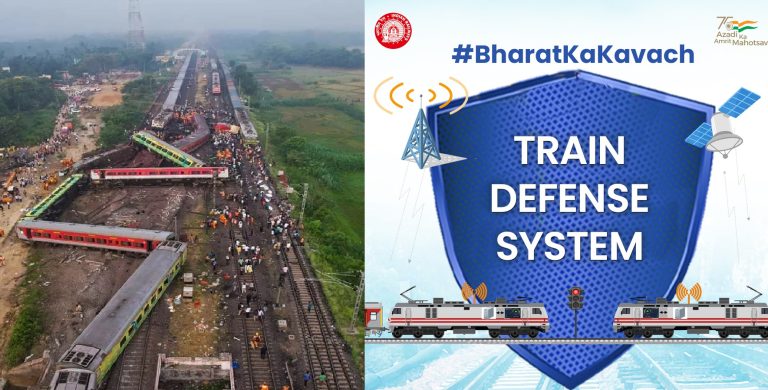
One of the worst train accidents took place in the Balasore district in Odisha on Friday (June 2) evening. The tragic incident has left 261 people dead and around 900 injured. The accident involved three trains, Howrah-Chennai Coromandel Express, Yeswanthpur-Howrah Superfast Express, and a goods train.
Since last evening, almost every media house has been giving a minute-by-minute update about the tragic incident. Earlier in the day, ANI quoted railways spokesperson Amitabh Sharma as informing that the rescue operation in the horrific train accident in Odisha’s Balasore has been completed and the restoration work has been started. Despite this, West Bengal CM Mamata Banerjee surprisingly remained completely ignorant.
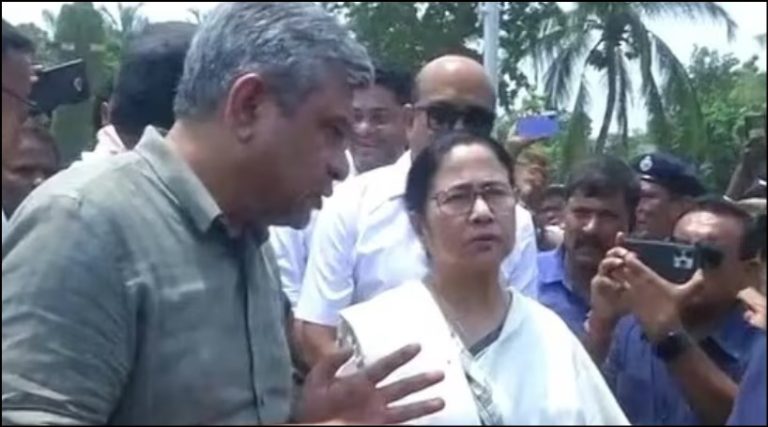
Mamata Banerjee, Saturday visited Odisha’s Balasore district where she met Union railway minister Ashwini Vaishnaw. In a video of her visit to the area, the West Bengal CM is heard insisting that the examination of three coaches of the derailed trains has still not been conducted and several more passengers may be trapped inside.
She said, “I have heard that the death toll in the train accident might go up to 500. Three coaches of the damaged train are yet to be examined and injured and deceased bodies still needed to be recovered.”
WATCH: Disagreement between West Bengal CM Mamata Banerjee and Railway Minister Ashwini Vaishnaw over death toll figures and train safety measures during a review at the site of tragic train accident at Bahanaga in Odisha's Balasore.#OdishaTrainAccident#OdishaTrainTragedypic.twitter.com/ZSCHrjOjCa
Union Railway Minister Ashwini Vaishnaw quickly intervened to inform her, “Didi, all the coaches have been thoroughly inspected, and the bodies have been recovered. The state government has confirmed a final death toll of 238.”
Despite his response, Mamata remained unpersuaded and insisted that three coaches have still not been rescued. She adamantly said that the death toll reported by the Union Minister was only as of yesterday (Friday, June 2) and not the total.
It may be noted that Union Railways Minister Ashwini Vaishnaw had reached the spot immediately after the tragedy struck at around 7 pm on Friday (June 2, 2023) and supervised the entire rescue operation that ended earlier in the day today. Mamata Banerjee, on the other hand, arrived at the train accident site only today. Despite this, she condescendingly ignored Ashwini Vaishnaw’s information and continued to declare that the rescue effort was far from complete.
It may be further noted that Union Minister Ashwini Vaishnaw not once but several times tried to apprise Mamata Banerjee that the death toll figure had been confirmed by the Odisha State Government, which we know is a non-NDA government, yet the West Bengal CM continued to completely disregard what the Union Minister what trying to tell her and continued to insist that several more passengers are trapped in the three coaches which she maintained, were not examined yet.
Not the time to play politics: Union Railway Minister responds to statements made by Mamata Banerjee
Reacting to Mamata Banerjee’s statement, Railways Minister Ashwini Vaishnaw asserted, “The CRPC lays out a proper procedure and the state government has time to time given accurate information and as of now as per the accurate information the death toll has reached 261.”
Further responding to Mamata Banerjee’s demand that the Union Railway Minister must resign over the Odisha accident, Ashwini Vaishnaw told the media, “Which is fine but this is not the time to do politics. This is time to focus on making sure that restoration happens at the earliest.”
#WATCH | Railways Minister Ashwini Vaishnaw reacts to an incident earlier today at #BalasoreTrainAccident site where WB CM Mamata Banerjee disagreed with him on the death toll, says, "…we want full transparency, this is not time to do politics, this is time to focus on making… https://t.co/4IJ5fil79Npic.twitter.com/nrXb82DuzV
Notably, speaking to ANI, the Executive Director, of the Information Publication Railway Board Amitabh Sharma said today, “The rescue operation has been completed, now we are starting the restoration work. 238 people have died and more than 600 are injured. Kawach was not available on this route”. He said that so far more than 100 people have claimed ex-gratia payments. He also said that several trains have been cancelled and diverted in the wake of the incident.
#WATCH | The rescue operation has been completed, now we are starting the restoration work. Kawach was not available on this route: Amitabh Sharma, Railways Spokesperson on #BalasoreTrainAccidentpic.twitter.com/s8Q0Kb4goE
Several coaches of the 12864 Bengaluru-Howrah Superfast Express, on the way to Howrah, derailed and fell on adjacent tracks. The 12841 Shalimar-Chennai Central Coromandel Express coming from the opposite direction on the parallel track rammed into the derailed coaches. Some 12 Coromandel Express coaches derailed and hit the stationary goods train on the third track.
Ahead of Mahakumbh 2025 which will be held in Prayagraj, Uttar Pradesh Government has proposed to beautify and develop various temples.
“There is a plan to complete more than 47 permanent and temporary works in this area in preparation for Mahakumbh. Before Mahakumbh 2025, Prayagraj will also see the development of many tourist attractions. With Rs 1542.71 lakhs, the Bhardwaj Ashram’s entrance gate, corridor development, and beautification will be completed,” the official statement said. In view of tourism development, it is proposed to spend Rs 1356.81 lakhs for Dwadash Madhav Temple, Rs 523.53 lakhs for Nagavasuki Temple, Rs 283.08 lakhs for Dashashwamedh Temple, Rs 667.57 lakhs for Mankameshwar Temple, Rs 700 lakhs for Alopshankari Temple, Rs 1000 lakhs for Padila Mahadev Temple, Rs 500 lakhs for temples coming under Panchkosi Parikrama Path, Rs 150 lakh for Koteshwar Mahadev, Rs 100 lakh for development of Kalyani Devi,” it added.
Additionally, temples coming under the Karchhana area will also be developed with Rs 460.17 lakhs. Many works including corridor development in Akshayvat/Saraswatikoop/Patalpuri temple will be done with Rs 1850 lakhs.
As per officials, prior to Mahakumbh-2025, there will be more than 10 facade-related works which are likely to cost more than Rs 18 crores. The facade lighting works are proposed at various locations including the Bade Hanuman Ji Temple located at Sangam costing Rs 1.04 crores, the Vimana Mandapam Temple costing Rs 2 crores, the Nagwasuki Temple, the Shaktipeeth Alopi Devi Temple, and the Hanuman Temple located at Civil Lines, costing Rs. 1.5-1.5 crores each.
The hanging light work from the old Naini Bridge to the DPS School in the Arail area is estimated to cost Rs. 5 crores. Additionally, there is a proposed facade lighting work costing Rs. 1.5 crores at the Science Faculty Tower of Allahabad University, at the Public Library situated in the Chandra Shekhar Azad Garden, and at the Mohall Sports Complex and Shringi Rishi Ashram in Shringaverapur Dham, each costing one crore rupees, the statement said.
(This news report is published from a syndicated feed. Except for the headline, the content has not been written or edited by OpIndia staff)
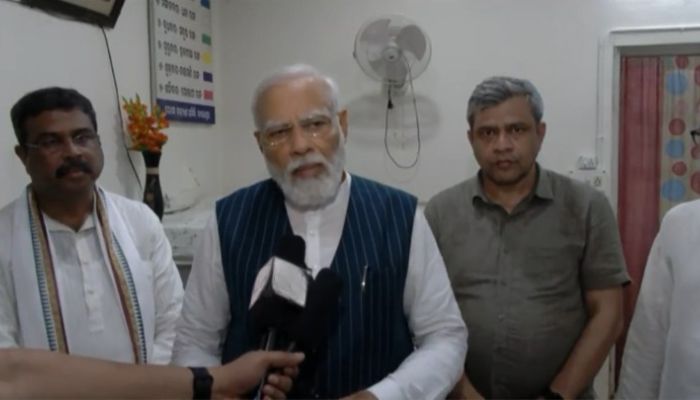
Prime Minister Narendra Modi visited the train accident site in Balasore, Odisha today. During his visit, he also met the injured individuals at hospitals in Cuttack. Accompanied by his cabinet colleagues, Union Railway Minister Ashwini Vaishnaw and Education Minister Dharmendra Pradhan, the Prime Minister inspected the site.
While speaking to DD News after the visit, Prime Minister Narendra Modi said, “Citizens of many states have lost so much in this accident. People lost their lives. This is a very painful and disheartening accident. The government will leave no stone unturned to help the families of the injured and treat the injured. Those family members who passed away cannot be brought back but the government is standing with the families in this hour of grief.”
#WATCH | "It's a painful incident. Govt will leave no stone unturned for the treatment of those injured. It's a serious incident, instructions issued for probe from every angle. Those found guilty will be punished stringently. Railway is working towards track restoration. I met… pic.twitter.com/ZhyjxXrYkw
He further said, “For the government, this is a very serious incident. Instructions are given for every type of inquiry. Those who will be found guilty will be given a severe punishment. None of them will be spared. I thank the Odisha government and the administrative officers here who put all their resources to help people. I also extend my thanks to the citizens living here because, in this dangerous situation, they helped in whatever way they could. They donated blood. they rescued people.”
PM Modi added, “I especially thank the youth here. I also bow to the people living here. It is because of their support that the operation could proceed faster. The railway has put ts all power, capabilities, and resources into the rescue operation and relief operations ahead. A well-thought effort to restore the tracks is also underway. But, in this hour of grief, I went to the spot and saw it all. I also went to the hospital and saw the injured ones. I don’t have words to express this grief. But, I pray to the almighty to give us the power to come out of this as soon as possible.”
At least 261 people were killed in a train accident in Odisha’s Balasore district that took place on 2nd June 2023. Several teams, including the Army and the Air Force, were involved in rescue operations after the accident. The injured ones are being treated.
Over 200 people have died and around 900 have been injured in one of the worst train accidents that took place in Balasore district in Odisha last evening. The accident involved three trains, Howrah-Chennai Coromandel Express, Yeswanthpur-Howrah Superfast Express, and a goods train.
As per initial reports, the Coromandel Express derailed at Bahanaga station after it entered the loop line and hit a goods train which was parked on that line. Several of the derailed coaches fell on the adjacent line, and the Yeswanthpur-Howrah Express that arrived on that line minutes later crashed into the derailed coaches. However, later some reports said that Coromandel Express derailed first and then crashed into the goods train, with no explanation of how the train derailed.
At present authorities are completely focused on rescue and restoration operations, and therefore information on how the accident took place is limited at present.
Following the accident, many people are asking why the Kavach system, designed to stop collision between two trains, didn’t stop the horrific accident. Many people are using the tragedy to blame the Modi govt, accusing it of running only PR and not actually implementing safety measures.
We were told a Make In India Train Defense System "Kavach" will prevent #RailAccident & strengthen arrangements. The #railway sector has been revolutionized. A #TrainAccident of this type belongs to another Era- (10 years ago) How did a #TrainMishap of this Magnitude take place? pic.twitter.com/cqnXjo8hH0
— Tehseen Poonawalla Official ?? (@tehseenp) June 3, 2023
Social media users are also questioning whether the Kavach system, also known as Train Collision Avoidance System actually works in preventing collision between trains.
On the other hand, some people are saying that the Kavach system works only when two trains are moving on the same track, and it does not work when a train derails, falls in an adjacent track and gets hit by another train.
The Kavach system uses high-frequency radio signals to communicate with nearby trains and tracks. It is a set of electronic devices and Radio Frequency Identification (RFID) devices installed in locomotives, in the signalling system as well as the tracks. Apart from preventing head-on and rear-end collisions between trains on the same train, it can also slow down over-speeding trains, alert and apply brakes when a train crosses the signal, automatically whistle at level crossings etc.
The devices in the system connect to each other to control the brakes of the trains and alert the drivers, based on the logic programmed into the system.
Why Kavach didn’t work
Now coming to why the system failed to avert the crash, now it has been confirmed by the Railways that the system was not installed on the tracks where the accident took place. When asked why the system didn’t work, railways spokesperson Amitabh Sharma said that Kawach was not available on this route. He said that Kavach is route-specific, and the system is currently being installed on Delhi-Mumbai and Delhi-Howrah sections. The Kharagpur-Bhadrak-Cuttack route does have this system, he added.
While under development for over a decade, the indigenously developed system has been implemented in the railway network only recently. The trial of the Kavach system took place just a year ago, where two trains, one with Railway Minister Ashwini Vaishnaw, were driven towards each other on the same track, and the system successfully applied brakes to stop the trains. After that, the railways started installing the safety system in a phased manner. According to a statement by the ministry issued in December 2022, Kavach has been deployed for 1,455 Route Kms on South Central Railway with 77 locomotives, and is in progress on around 3000 km track on Delhi-Mumbai & Delhi –Howrah corridors.
With around 70,000 km of routes which have around 1,30,000 km of tracks, and over 20,000 trains, it will take a long time to install the system on the entire railway network, even if the task is fast-tracked.
Can Kavach prevent such accidents?
Now, while it has been confirmed that the Kavach system was not available on the track where the accident took place, the question arises, could it have prevented it?
According to many, as it was not a head-on collision, it is not clear whether the system can work in such a situation when where a train hits a derailed train which was running on the adjacent track. Many are saying it would not have been prevented because it was not a head-on collision between the two trains. But the fact is, the Kavach system does much more than only preventing head-on collisions. For one, it can also stop rear-end collisions.
In this regard, it is important to know what exactly happened. According to reports, the accident started with Coromandel Express hitting a parked goods train. While later some reports said that the train derailed on its own and then hit the goods train, some media houses now have cited a preliminary report prepared by officials, which indicates that the passenger train, which was supposed to pass the station through the up main line, entered the loop line instead due to a signalling error.
According to the report, at first, the signal was given for Coromandel Express to pass through the up main line, but then it was switched off. After that, the train entered the loop line and crashed into the parked goods train. The other passenger train arrived at that time and crashed into derailed coaches of the other train which fell on the down main line.
“After careful observation, (we) came to the conclusion that the signal was given and taken off for the main line for 12841 (Coromandel Express), but this train entered the loop line and dashed with the goods train which was on the loop line and derailed,” said the report signed by four senior railway officials, who inspected the accident site on Friday night, as reported by several media houses.
However, this report has not been published officially, and media houses reported it claiming that they saw the handwritten draft.
If this report is correct, this indicates that it was most likely a human error, which caused the passenger train to enter the wrong line and crash into the parked train. As there was no scheduled halt for both the trains at the station, they were travelling at high speeds, causing massive damage. Reportedly, Coromandel Express was at a speed of 128 kmph and Bengaluru-Howrah Superfast Express was running at a speed of 116 kmph.
The Kavach system would have been possibly activated and applied brakes, as it is designed to prevent trains from entering already occupied tracks due to human and signalling errors. If the Kavach system was there, it would have tried to prevent the Coromandel Express from crashing into the goods train by applying brakes. It was essentially a head-on (or rear-end) collision between Coromandel Express and the goods train, which led to the second crash.
The Kavach system is designed to prevent Signal Passing at Danger, which is when trains not stopping at a stop signal. The Kavach systems installed at stations continuously monitor the tracks and trains on them and act to prevent any collision.
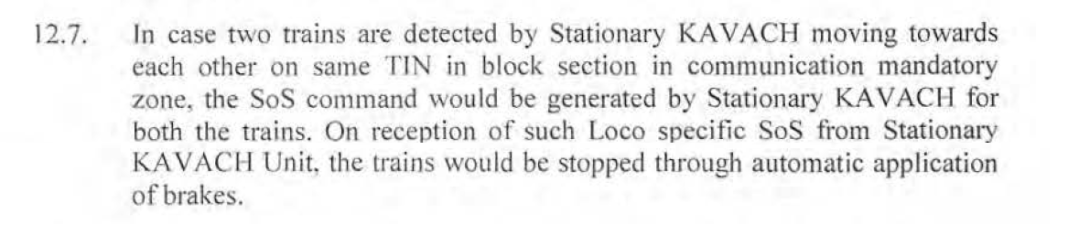
According to specifications of the Kavach system, “In case two trains are detected by Stationary Kavach moving towards each other on same TIN (Track identification Number) in block section in communication mandatory zone, the SoS command would be generated by Stationary Kavach for both the trains. On reception of such Loco specific SoS from Stationary Kavach Unit, the trains would be stopped through automatic application of brakes.” This means, if the system detects two trains on the same track at a station where Stationary Kavach is installed, it will apply brakes.
The Kavach system uses RFID tags on tracks, and the locomotives have RFID readers. Therefore, the system knows the exact location of the trains on the tracks, and if another train approaches the same track on the same location, it sends alerts and applies brakes, preventing collisions. The onboard Kavach units can also detect possible collisions by communicating with the units on other trains in an area, without using track RFIDs.
However, the important fact is that Coromandel Express was running at 128 kmph. This means, even if the Kavach was activated after it entered the loop line, the speed would be very high to effectively stop the train in time to prevent the collision. Therefore, the train would still hit the goods train.
But the Kavach system has another feature, it can prevent train collisions with the help of SPAD (Signal passed at danger) and TIN (Track Identification Number) conflict. This means, it could have possibly detected that the main line was connected to the loop line which already has a train, and could have raised alarms and activated brakes well before the passenger train entered the loop line. In that case, there could be enough time to stop the train.
Now, what if there was no collision and the first passenger train derailed on its own and fell into the adjacent line? Many people are saying the system can’t prevent such accidents.
But it has been reported that the Kavach has another feature, under which, after the system is activated, all other trains within a range of 5 km are halted to prevent any cross-track collisions.
The Kavach system detects derailments and unusual halts of running trains, which results in halting all trains within 5 km. Therefore, the system could have possibly applied brakes on the Yeswanthpur-Howrah Express even if the Coromandel Express derailed on its own, after detecting the derailment.
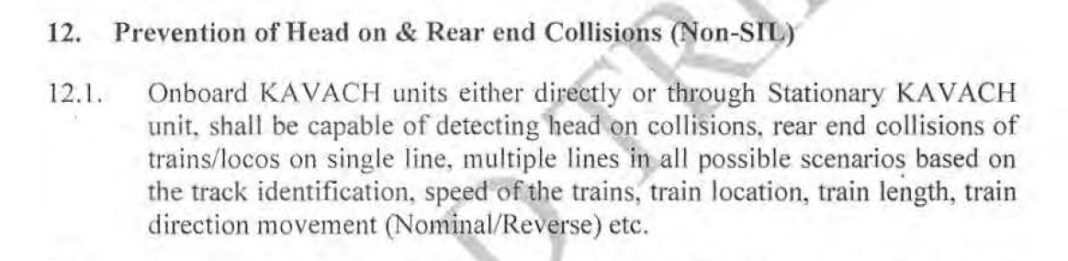
Moreover, the specifications say that “Onboard KAVACH units either directly or through Stationary KAVACH unit shall be capable of detecting head on collisions, rear end collisions of trains/locos on single line, multiple lines in all possible scenarios based on the track identification, speed of the trains, train location, train length, train direction movement (Nominal/Reverse) etc.” It says that the system can detect collisions even on multiple lines.
However, according to railway sources, the Yeswanthpur-Howrah Express reached the spot almost immediately after Coromandel Express derailed. In fact, it is also being said that the second train was already passing the station when the derailment took place and derailed coaches hit the running train. Therefore, even if the Kavach system is activated in such a scenario, it is not sure if the second train could be stopped in time.
Therefore, in conclusion, if the accident took place after Coromandel Express hit the goods train, which is most likely what happened, the Kavach system would have activated, and the accident could have been prevented. It could be prevented if the system activates after the train entered the loop line, as there would not be enough time to stop it completely by applying the brakes. But if the system is activated earlier detecting the wrong track selection, it could work. Moreover, even if the train was slowed by automatic brakes, the result could have been different. And if the train derailed on its own and then the second train reached almost immediately, the system would most possibly not work. It could have been activated, but successfully applying brakes in time in such a scenario is another matter. Most probably, there would not be enough time to prevent the second collision of the running train with the derailed train.
The Kavach system could prevent both collisions, but in this case, there were not enough times for it to act effectively.
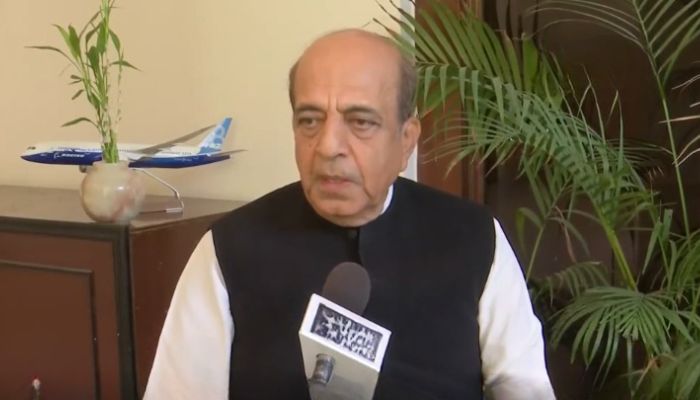
Former Railway Minister & BJP leader Dinesh Trivedi said on 3rd June 2023 that the accident of the trains at Balasore is a great tragedy and some conspiracy might be behind it which needs to be investigated properly. He also said that this is not the time to politicise this issue.
Dinesh Trivedi said, “This is a great tragedy. Our heart really goes out to the bereaved families. I think the priority has to be to save as many lives as possible. I think at this point in time, one needs a lot of doctors, and plenty of medicines and unless and until those things are there, it becomes a little difficult but it certainly is a great tragedy. Our heart really goes out to the bereaved families.”
#WATCH | Former Railway Minister & BJP leader Dinesh Trivedi speaks on #BalasoreTrainAccident; says "This is a great tragedy. Our heart really goes out to the bereaved families. I think the priority has to be to save as many lives as possible…This is not the time for politics.… pic.twitter.com/hl7IjoX2Xg
He further said, “This is not the time for politics. Nobody can do politics over dead bodies. And please understand it could be you, it could be me, it could be anybody including our relationships. At the end of the day, these are human lives. Of course, one has to ensure such things don’t happen. I can tell you being a railway minister earlier, Indian Railways is one of the best organisations in the world. It is very efficient.”
Dinesh Trivedi added, “This was also one of the freaks in the sense that derailed coaches were rammed into by another passenger train. I recall if I am not mistaken sometime in 2010, in the month of May, near Kharagpur, I think it was the Geetanjali Express that got derailed and which was rammed into by a goods train where almost above 200 people died unfortunately. And that time it was sabotage.”
He said, “In such accidents, I would not rule out any sabotage. Anything is possible. And that only the high-level commission for inquiry which has been appointed by the government and the railways safety commission can look into it. And tell us what has happened to ensure that these kinds of things don’t happen. So don’t rule out anything. When I say anything, I mean anything.”
The former railway minister said, “The scene I’m watching, it’s like there’s an earthquake. Our goal should be to not have a single death, as in Japan. New technology is emerging and it is also being incorporated into the railway system.”
At least 261 people were killed in a train accident in Odisha’s Balasore district that took place on 2nd June 2023. Several teams, including the Army and the Air Force, are involved in rescue operations after the accident.
Today, Prime Minister Narendra Modi visited the train accident site in Balasore, Odisha. During his visit, he also met the injured individuals at hospitals in Cuttack. Accompanied by his cabinet colleagues, Union Railway Minister Ashwini Vaishnaw and Education Minister Dharmendra Pradhan, the Prime Minister inspected the site.
A day after the Ministry of External Affairs (MEA) issued a statement on the Ariha Shah case assuring the return of the baby girl to India, Ariha’s mother Dhara Shah has said that the government’s efforts have given them hope that their child will soon return to India. She also expressed her trust in the Narendra Modi government.
Ariha Shah, the daughter of a Jain couple Bhavesh and Dhara Shah was 7 months old when she was separated from her parents by the authorities of the Germany Child Care Institute in 2020 after the baby was accidentally hurt by her grandmother. 20 months have passed since then but she has not been returned to her parents.
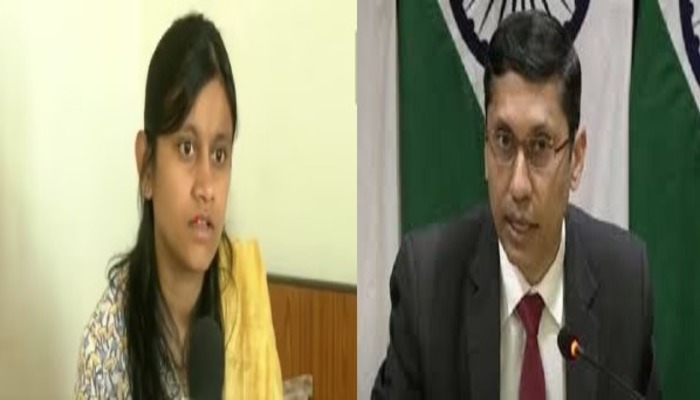
“The MEA has released a very strong statement, asking German authorities to send Ariha Shah back to India at the earliest. The Indian MEA has also shared the details of potential foster parents with the German authorities. They have said that the cultural and linguistic rights of the child should be resumed. This has given us a lot of hope that Ariha will soon be back in her country,” Ariha’s mother said on Friday.
VIDEO | "The MEA has released a very strong statement, asking German authorities to send Ariha (Shah) back to India at the earliest. This has given us a lot of hope that Ariha will soon return to her country," says Dhara Shah, mother of the Indian baby girl who has been living in… pic.twitter.com/t9I4lB5QaC
Speaking to ANI, Dhara Shah said, “I trust the Indian government and I request that once there will be PM-level intervention in the case then my daughter will return soon.”
#WATCH | "I trust the Indian government and I request that once there will be PM-level intervention in the case then my daughter will return soon," says Dhara Shah, mother of Ariha Shah, who has been in a foster care facility in Berlin, Germany pic.twitter.com/vNDpWvAkAP
India has been persistently advocating for the return of Ariha Shah to India: MEA statement
It is notable that the MEA in a Friday statement said they are continually advocating for Ariha Shah’s return to India.
MEA Spokesperson Arindam Bagchi said, “Our efforts have been guided by the best interests of the child, which we believe can be fully realised only when she is in her home country where her socio-cultural rights can be safeguarded. Accordingly, we have been requesting Germany to return the child to India. The Embassy has repeatedly requested German authorities to ensure that Ariha’s connection with her cultural, religious and linguistic background is not compromised and sought consular access to the child as well as cultural immersion at the Indian Cultural Centre in Berlin.”
The MEA Spokesperson also stated that the manner in which the baby girl Ariha Shah was shifted away from her parents to foster care is a matter of concern. He further informed that the German authorities have been apprised of India’s child protection system, and details about potential foster parents have also been shared.
“The German authorities have been made aware of India’s child protection system and the details of potential foster parents have also been shared with them. Ariha’s continued placement in German foster care and infringement of her social, cultural and linguistic rights is of deep concern to the Government of India and to the parents. We would like to reiterate that Ariha Shah is an Indian national and her nationality and socio-cultural background is the most important determinant of where her foster care is to be provided,” Bagchi said.
Moreover, the Indian authorities have urged the German authorities to allow Ariha’s return to India adding that it is her inalienable right as an Indian national.
“We urge the German authorities to do all that is necessary to send Ariha to India at the earliest, which is also her inalienable right as an Indian national. We remain committed to ensuring the return of Ariha Shah to India,” MEA’s statement added.
Indian MPs write a joint letter to German Ambassador Phillip Ackerman to bring back Ariha
Meanwhile, 59 MPs from 19 political parties have come together to ensure Ariha Shah’s repatriation to India. The MPs, both from the Lok Sabha and the Rajya Sabha wrote to Ambassador Philipp Ackerman on Friday in a joint letter, saying it was essential to return Ariha to India, “her own country, people, culture, and environment,” and that “any delay will cause irreparable harm to the baby.”
“Shifting her around from one carer to another will cause deep and damaging trauma to the child. The parents are allowed only fortnightly visits. The videos of these meetings are heart-wrenching and they reveal the deep bonds the baby has with her parents and the pain of separation,” the letter read.
The letter further stated that India can well look after her own child and that the baby girl Ariha Shah belongs to a strict vegetarian Jain family who is being raised in an alien culture.
“There is another aspect. We have our own cultural norms. The baby belongs to a Jain family who are strict vegetarians. The baby is being brought up in an alien culture, being fed non-vegetarian food. Being here in India, you can better appreciate how unacceptable this is to us,” the letter added.
Notably, Maharashtra CM Eknath Shinde on Thursday wrote a letter to External Affairs Minister S Jaishankar drawing his to the case of Baby Ariha Shah who is stranded in a foster home in Germany for the last twenty months.