Home Blog Page 3345

Gujarat: Khambhat Ram Navami violence preplanned, 3 maulvis got people from outside for the same, foreign funding suspected

Amid the ongoing investigation in the Himmatnagar Ram Navami violence, shocking reports have emerged from ongoing investigation in the Khambhat violence. Reports have emerged that at least three maulvis are involved who arranged for people from other parts of state to disrupt peace and harmony in Khambhat.

As reported by Gujarati news channel VTV, the violence was preplanned and people involved were called from outside of city by the maulvis.

The report further stated that the violence was preplanned and on the day prior to the shobha yatra, people were called in to disrupt peace and harmony in the state.

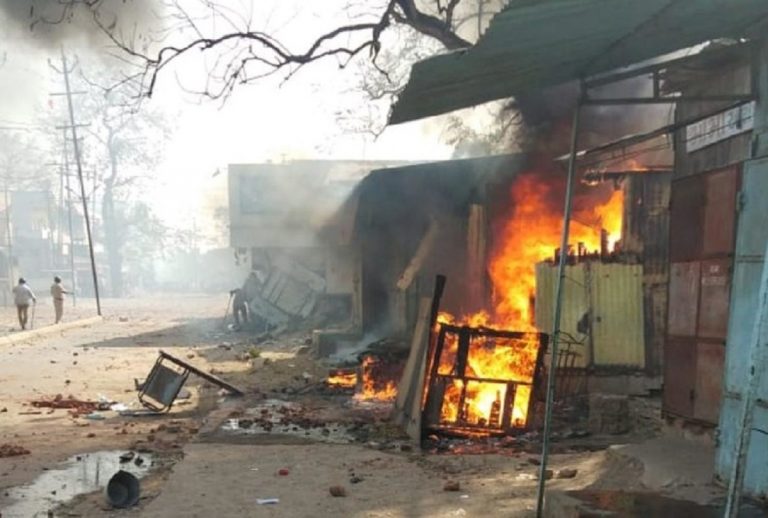
As per reports, first the stones were pelted and then the shops were set on fire.

During the course of the investigation in Khambhat violence, three maulvis were arrested. On interrogation it was revealed that the entire violence was preplanned. The maulvis arranged for people from Bharuch and Ahmedabad to come to Khambhat and indulge in violence. There are also reports that the funding for the same also came from outside of India.

As reported by News 18 Gujarati Bureau Chief Janak Dave, accused Razak Ayub, Hussain Hashmasha Diwan were involved in instigating the mob to indulge in stone-pelting.

The violence in Khambhat led to death of one person while many more were injured.

As reported by Dave, the planning for stone-pelting and violence was set in motion the day permission for shobha yatra was obtained. Since the shobha yatra was scheduled for Sunday, people from outside of Khambhat were brought in on Saturday itself. Stones and other things required to create violence were arranged for the previous day.

When the shobha yatra passed by the masjid people realised the planning of violence. As soon as the yatra reached the masjid, the stone-pelting started. Those who were called in for stone-pelting and violence were assured that nothing will happen to them and that they will be provided legal assistance.

As per reports, money had been collected in name of countering police atrocities and investigation is currently on for source of funding.

Khambhat violence

On Ram Navami procession was carried out in Anand’s Khambhat region by Hindus, celebrating the birthday of Prabhu Ram. When the shobha yatra passed by a mosque, stones were pelted on the procession and some 7-8 shops were set on fire. One person died and many others were injured in the violence. In other such incident in Himmatnagar, Gujarat, stones were pelted on the Ram Navami procession. The state administration has assured strict action will be taken against those who tried to disrupt peace and harmony in the state.

Similar such incidents of violence took place in other parts of the country like West Bengal, Jharkhand, Madhya Pradesh and even Karnataka took place on Ram Navami. The ‘liberals’ in India have tried to justify the violence by claiming that the music and slogans raised to hail Shri Ram were provocative when chanted in ‘Muslim areas’. In Islam, idol worship is considered biggest sin. Read here what the Quran says about stone-pelting.
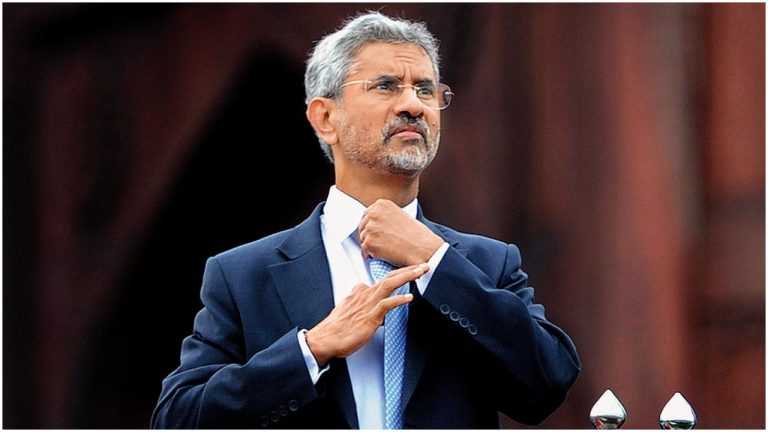
‘Americans should have a better understanding and appreciation of the civilisational state of India for ties to grow’: EAM Dr Jaishankar

External Affairs Minister Dr S Jaishankar said that the India-US relationship has undergone a “real transformation” in the last two decades, stressing that it is the human element driving this partnership.

Interacting with the students at the Howard University in the US, External Affairs Minister Dr S Jaishankar asserted that the young Americans should have a better understanding of India and the world for the ties between the two countries to grow and added that the Americans should appreciate the efforts of a civilisational state and democracy like India.

“Your appreciation of a civilisational state and a fellow democratic polity that is daily overcoming enormous odds is essential. After all, we are natural partners only when our people have a strong sense of connection,” Dr Jaishankar said to the students.

The diplomat-turned-politician said that the India-US relationship has transformed in the last two decades. He added that the strategic and security cooperation the economic or technology partnerships is making their weight increasingly felt in world affairs.

Highlighting the significance of people-to-people contact, Dr Jaishankar said that the key driver of this change has been its human element. The 4.4 million Indian diasporas have literally defined India’s image in this society and helped forge relationships that are an enormous source of strength for us in our work, he said, making a joint appearance with US Secretary of State Tony Blinken.

“At its centre (are) our students, academics, researchers, and professionals who have contributed to America’s progress even as they remain the bridge between our two societies. For our ties to grow, it is equally necessary that there is a better understanding of India and the world on the part of young Americans,” he said.

Dr Jaishankar also noted that the policymakers in both countries are sharply aware of the immense difference that educational collaboration can make.

“At the American end, we recognise the renewed focus on the STEM sector including in activities which we are both parts of in the Quad,” the minister noted.

Dr Jaishankar schools western media over the Russia-Ukraine crisis

Earlier on Monday, External Affairs Minister S Jaishankar gave a befitting reply to the western media, which was critical of India’s decision to buy a limited amount of oil from Russia.

Responding to a question on India’s decision to buy oil from Russia, which has been facing several sanctions for launching ‘special military’ operations in Ukraine, the Indian Foreign Minister said, “I noticed you referred to oil purchases. If you are looking at energy purchases from Russia, I would suggest that your attention should be focused on Europe,” he emphasised.

Dr S Jaishankar pointed out, “We do buy some energy, which is necessary for our energy security. But I suspect, looking at the figures, our total purchases for the month will be less than what Europe does in an afternoon. So, you might want to think about it.”

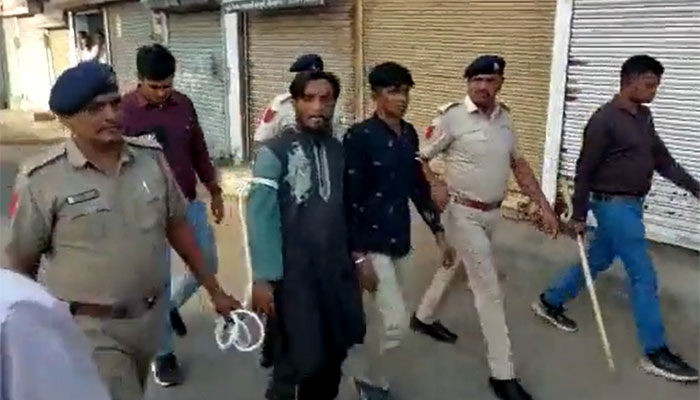
Himmatnagar violence: Accused tied with rope, paraded as taken to court for custody, ATS may investigate if required

On April 12, a Gujarat court sent eleven accused in the Ram Navami procession attack to Police custody till April 16. They were paraded by the Police while being taken to court for custody. Gujarat’s Director, General of Police Ashish Bhatiya, said in a statement that four companies of State Reserve Police (SRP), two companies of Rapid Action Force (RAF) with force from other districts had been deployed in the communal violence-hit area to maintain law and order.

Gujarat State Home Minister Harsh Sanghvi held a high-level meeting in district headquarters Himmatnagar in connection to the violence that occurred on Ram Navami and the following days. DGP, IG and other senior Police officers were present at the meeting. Sanghvi instructed the officials to carry out a strict investigation into the matter. HM Sanghvi also visited Himmatnagar and instructed the Police to create an example by ensuring strict punishment for the stone-pelters. He further instructed the officials to file a strong chargesheet against the accused.

Chief Minister Bhupendra Patel also held a high-level meeting with the senior officials, including State HM Harsh Sanghvi. He said attempts to break peace and harmony in the state would not be tolerated.

DGP Bhatiya added that the investigation is underway, and cases have been registered against the accused under various sections of the Indian Penal Code. If required, Anti Terrorist Squad (ATS) will investigate the case.

A Police point has been set up at Vanzarawas in Himmatnagar. There were reports on Tuesday that Hindu families had started leaving the Muslim dominated area as they were scared of being outnumbered in case of another incident of violence.

The Police, however, have assured them of security. They were told that there was no need to be afraid or shift to another place. Range IG Abhay Chudasama said in a statement that sufficient security arrangements had been made to ensure the safety of the locals.

Himmatnagar communal violence

On April 10, Gujarat’s Himmatnagar witnessed communal violence during Ram Navami celebrations. A Ram Navami Shobha Yatra was attacked and targeted by a group of local Muslim goons and stones were pelted at it. Reports suggest that some vehicles were also vandalized in this incident. The intention behind the attack was revealed, when the Hindu religious procession was attacked after it reached the Muslim dominated area of Chhapariya.

Several men, including police, were injured while many vehicles were burnt during the prolonged stone-pelting that the area witnessed on April 10. Another round of violence took place on Tuesday in which petrol bombs were hurled from the Muslim side. Hindu residents of the area had to take shelter in the temple and stayed up all night without food and water. Some of the Hindu families left the area fearing violence.

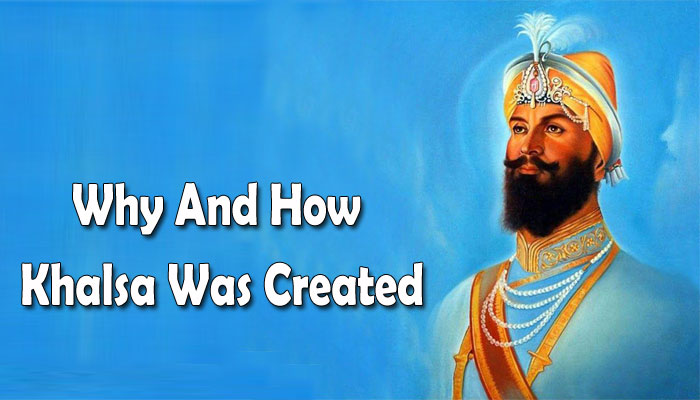
On this day, in 1699 Guru Gobind Singh, the tenth Guru of Sikhism, initiated the Khalsa. Read more

The word Khalsa means ‘pure’. It is derived from the Arabic word Khalis which literally means ‘pure’ or ‘unsullied’. Khalsa word appears only once in Shri Guru Granth Sahib Ji in Bhagat Kabir’s vani. It reads, “Kahu Kabir jab bhaye Khalsa prem bhagat jih jaani”, which means, “Kabir says those people who know the Lord’s love and devotion are the purest.”

The term was once used in one of the Hukumnamas (the written orders) of Shri Guru Hargobind Singh Ji, where he described the Sangat (group of devotees) of the eastern region as ‘Guru Ka Khalsa’ or ‘Guru’s own’. Later, it was used in a similar sense by Shri Guru Tegh Bahadur Ji in one of his letters to the Sangat of Patna.

The eternal bond between Sikhism and the term ‘Khalsa’ was established after Shri Guru Gobind Singh Ji introduced the new form of initiatory rites ‘Khande di pahul’ or ‘rites by double-edged sword’ in 1699. He brought Sikhs under the umbrella of Khalsa, the people of Waheguru or the Supreme Lord. From that day, Waheguru Ji Ka Khalsa, Waheguru Ji Ki Fateh (Hail the Khalsa belongs to the Lord God! Hail the Lord God to whom belongs the victory!!) became an integral part of Sikhism.

Death of Shri Guru Tegh Bahadur Ji

It was the death of Shri Guru Tegh Bahadur, ninth Guru of Sikhs, that led to the formation of Khalsa. Shri Guru Tegh Bahadur Ji became the ninth Guru on April 16, 1664, after the death of his grand-nephew and eight Guru of Sikhs, Shri Guru Har Kishan Ji. In 1675, Hindus of Kashmir approached Shri Guru Tegh Bahadur Ji and sought his help against the forced conversions initiated by Mughal emperor Aurangzeb.

Shri Guru Tegh Bahadur Ji went to Delhi with a delegation to meet Aurangzeb, where he challenged him that if he could convert Guru Tegh Bahadur Ji to Islam, all the Hindus in Kashmir would convert as well. Aurangzeb ordered his disciples to convert Shri Guru Tegh Bahadur Ji at any cost. They used every possible torture to force him to convert but failed. Shri Guru Tegh Bahadur Ji was tortured to death.

Three other Sikhs, Bhai Mati Das, Bhai Sati Das, and Bhai Dyal Das, who were part of his delegation, were also executed by Aurangzeb before beheading Shri Guru Tegh Bahadur Ji. Gurudwara Sis Ganj and Gurudwara Rakabganj in Delhi mark the place of beheading and cremation of Guru Tegh Bahadur in Delhi on order of Auragzeb.

The birth of Khalsa

After the execution of Shri Guru Teg Bahadur Ji, his son Shri Guru Gobind Singh Ji (formerly known as Gobind Rai) became the tenth and last Guru of Sikhs. Several months before the formation of Khalsa, Shri Guru Gobind Singh Ji had sent an invitation to all his followers to come to Anandpur Sahib on Baisakhi in 1699, which fell on March 30. Thousands of devotees gathered at Anandpur Sahib for the auspicious event.

Notably, Shri Guru Gobind Singh Ji had not detailed his intentions to formulate Khalsa in the invite but mentioned a religious congregation. Shortly before Baisakhi, Shri Guru Gobind Singh Ji abolished the institution of masands. They were basically intermediaries of Guru’s agents. Every Sangat of a different region had its own sand. In the hukumnamas of Shri Guru Gobind Singh Ji, the de-recognition of masands was mentioned. With the abolishment of the Masand system, a direct relation between the Sangats and the Guru was formed.

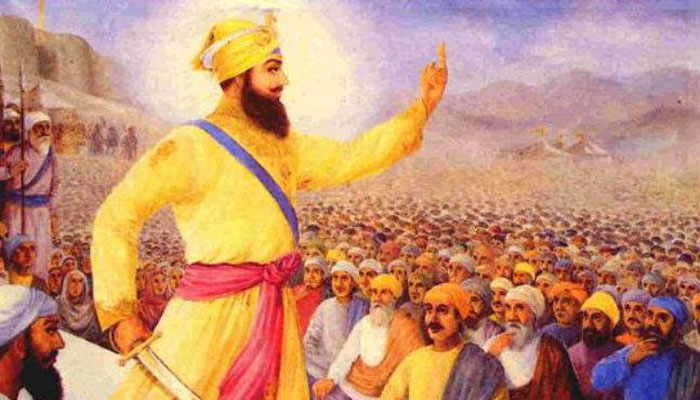
On the day of Baisakhi, many came as a sign of respect to the Guru, and the rest came out of curiosity. Shri Guru Gobind Singh Ji addressed the mass with the most memorable oration in Sikhism. He informed them about his mission to restore faith and preserve Dharma or righteousness.

After his address, he flashed his naked sword in the air and asked, “I need one head. Is there anyone among you who is ready to die for his faith?” The people present in the congregation were speechless. Some of them left the congregation, and others looked at each other in confusion and amazement. A few minutes later, Daya Ram, a Sikh who came to attend the congregation from Lahore, stood up and offered his head to the Guru. Guru Gobind Singh Ji asked him to follow him in a tent. After a short while, he came out with blood dripping sword. Everyone thought Daya Ram was sacrificed.

Source: India Today

The demand was repeated four more times by Shri Guru Gobind Singh Ji. The second Sikh who sacrificed his life was Dharam Das. The Third was Mohkam Chand, followed by two others, Sahib Chand and Himmat Rai. Everyone outside could hear the sound of ‘Thud’ from inside the tent as if their heads had fallen on the ground.

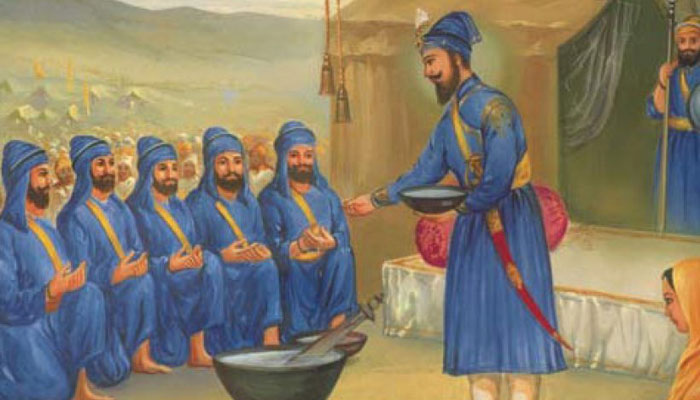
There was pin-drop silence all around. A few moments later, Shri Guru Gobind Singh Ji came out. There was no sword in his hands. Five Sikhs, who were believed to be sacrificed, came out wearing decorated robes. Guru Ji announced that they were Panj Pyare or the Five Beloved Ones. They were baptized as the first five Khalsa with the administration of Amrit. He said, “From now on, the Khalsa shall be baptized with Amrit created with water stirred with a double-edged sword – Khanda while the words of Gurbani are uttered.” Today, if someone wants to get baptized in Sikhism, he or she follows the process known as ‘Amrit Chakhna’.

Khande Di Pahul – The ceremony

The ceremony of baptization was named Khande Di Pahul, which means baptism of the double-edged sword or Amrit Sanchar. He stirred the water with the sword in an iron blow while reciting five major compositions that are Japji, Jaap, Savaiyye, Benti Chaupai and Anand Sahib. His wife, Mata Sahib Kaur, added sugar puffs to the water. It was then called ‘Khande Da Amrit’ or just ‘Amrit’.

Source: Sikh Net

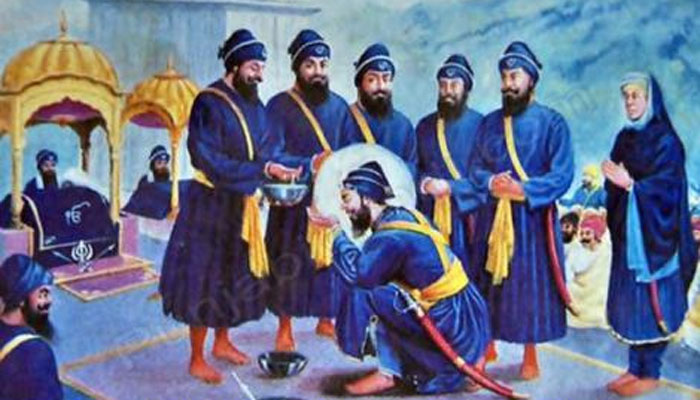
After administering Amrit to the Panj Pyare, he asked them to baptize him in the same manner. The aim was to establish equality between the Guru and his followers.

Source: Khalsa Network

Creation of the Khalsa

The creation of Khalsa is based on the training and teachings of the ten Gurus to the followers of Sikhism. Shri Guru Gobind Singh Ji wanted every Sikh to be perfect in all ways, i.e. the combination of Bhakti and Shakti or Devotion and Strength. The main principles of Sikhism include Deg or charity and Tegh or sword, which were embedded in the roots of Khalsa.

He inculcated five virtues in every Sikh that are sacrifice, cleanliness, honesty, charity and courage. He also prescribed the Sikh code of discipline. He asked every Sikh to recite the five sacred compositions or Banis every day.

Khalsa can use the sword only in times of emergency, which means the sword cannot be drawn unless all the peaceful methods have failed. It can be used only for self-defence and to protect the oppressed.

The Five Ks

Every Khalsa must follow Panj Kakka, or the Five Ks that, are Kesh, Kanga, Kaccha, Kara and Kirpan.

Kesh: A Khalsa is not allowed to cut the hair as it represents the natural appearance of sainthood.

Kanga: A small comb to maintain Kesh.

Kaccha: It does not specifically mean the undergarment, but it denoted the short trousers of the warrior. It also denotes celibacy.

Kara: The steel bangle represents the dedication toward the Guru. Shri Guru Gobind Singh Ji had said by wearing Kara, all the fears in Khalsa would disappear.

Kirpan: The sword for defence. The word comes from Kirpa, the Sanskrit word for kindness and Aan, the Persian word for self-respect. It is the symbol of power, courage and dignity.

According to the basics of Sikhism, a true Khalsa does not discriminate or see anyone as a demeaned soul. He or she will rise in defence of the oppressed and will do charity to help the needy.

Kerala: Muslim DYFI leader’s marriage with Christian woman sparks ‘love jihad’ row, CPM leader says party may take action

The Communist Party of India (Marxist) has decided to take action against a party leader in Kerala on the allegations of carrying out ‘love jihad’ by marrying a Christian woman.

According to the reports, the CPI(M) unit of Kerala’s Kozhikode is considering action against party leader and DYFI Kannoth region secretary Shejin after he married a Christian lady. The party is expected to take stern action against the Muslim leader after relatives of the woman levelled serious allegations of ‘love jihad’ against Shejin.

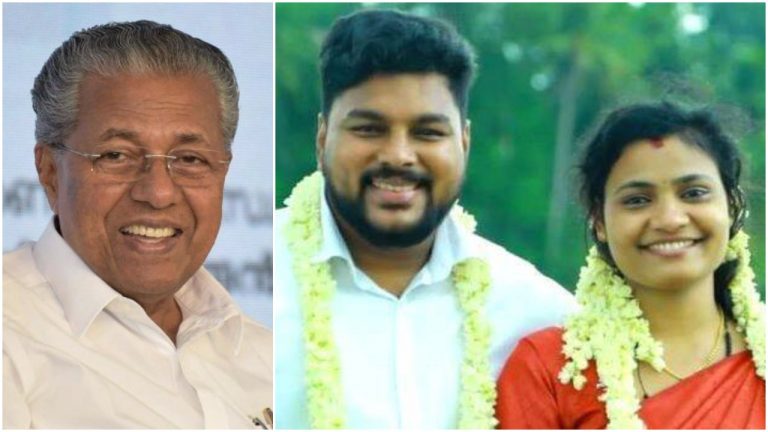
Shejin, a native of Kodancherry, had eloped with Theyyapara native Jyotsna Mary Joseph, a nurse in Saudi Arabia, and got recently married. The couple was in a relationship for seven months.

Jyotsna arrived in Kerala two weeks ahead of her engagement with another man, however, she decided to leave her home to marry Shejin.

CPI(M) leader Shejin with Jyotsna Mary Joseph/ Image Source: Manorama

Mary Joseph’s parents had lodged a complaint with the Kodancherry police, stating that their daughter was missing. As the police did not take action against the CPI(M) leader, the relatives and the locals marched to the police station.

The relatives and the locals alleged that the marriage was an act of ‘love jihad’. However, Jyotsna has said that she got married of her own will. Meanwhile, her family has alleged that Jyotsna was saying this under pressure and that the couple had the support of CPI(M) leaders.

Shejin and Jyotsna appeared in the Thamarassery court on Tuesday, which allowed them to live together.

As locals and relatives accused CPI(M) of sheltering the couple, the CPI(M) Kozhikode unit is considering taking action against Shejin for marrying a Chrisitan woman and may suspend him from the party.

CPI(M) District secretariat member George M Thomas claimed that the party took action against Shejin for causing disruption to the communal harmony between Muslims and Christians in the local area. The party claimed that the marriage had created discord between the two communities, the core voting constituencies of the Communist Party.

“If they were in love, Shejin should have informed the party. He did not speak to anyone in the party unit or organization. The allegation that the CPM had helped the two is not true,” he said.

824 out of 1,027 schools in Delhi do not have a headmaster, NCPCR seeks explanation

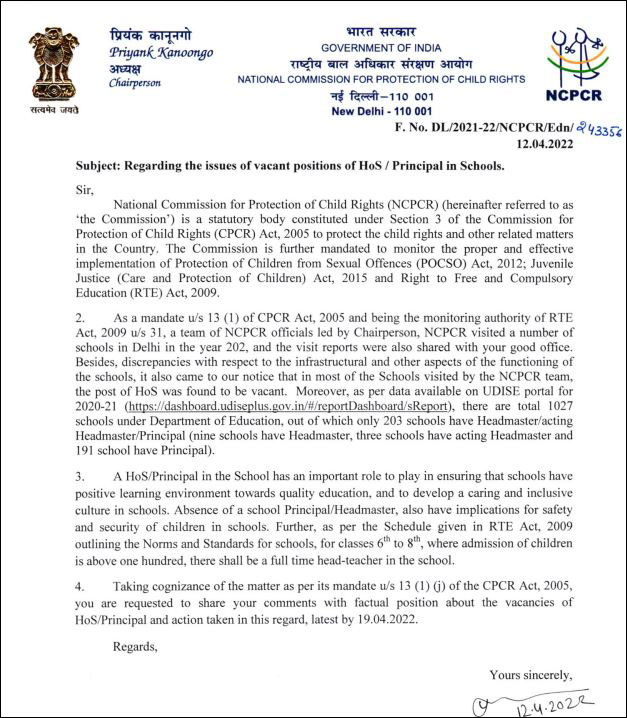
On April 12, the National Commission for Protection of Child Rights (NCPCR) sought an explanation over 824 vacant posts of principals in Delhi government schools. In a letter to Delhi Chief Secretary Vijay Dev, the apex child rights body said a team led by chairperson Priyank Kanoongo visited several schools in the national capital and found discrepancies with regard to the infrastructure and other aspects. It further added that most of the schools visited by the teams did not have a Head of School (HoS), and the post was vacant.

The NCPCR noted that there are a total of 1,027 schools under the Department of Education under the Government of NCT, out of which only 203 have a headmaster or acting headmaster. It further read, “A HoS or Principal has an important role to play in ensuring the schools have positive learning environment towards quality education, and to develop a caring, inclusive culture in schools.” It said the absence of the headmaster or principal has implications for the security and safety of the children.

The letter mentioned the Schedule given in the Right To Education Act, 2009 that states in the schools where the classes 6th to 8th number of students is above one hundred, there should be a full-time head-teacher in the school. The NCPCR has asked the chief secretary to share the factual position about the vacancies of such posts and the action taken by the Education Department by April 19.

Source: Newsroompost

NCPCR pointed out hygiene and safety issues in the Delhi school

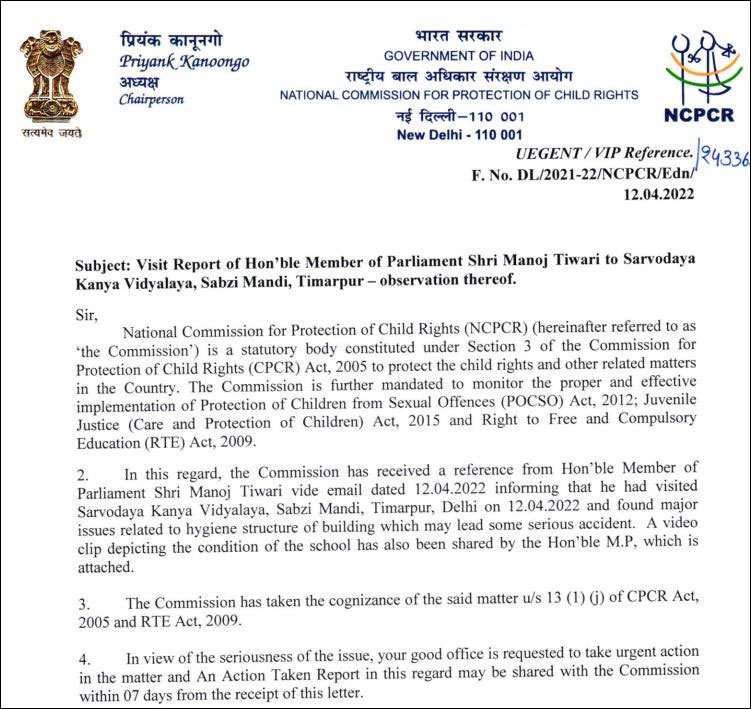
In another letter to the Chief Secretary, the NCPCR said that Bharatiya Janata Party MP Manoj Tiwari visited Sarvodaya Kanya Vidyalaya, Sabzi Mandi, Timarpur, Delhi, where he found major problems related to the hygiene in the school building. The apex body said such issues might lead to serious accidents in the school.

Source: Newsroompost

The letter added, “In view of the seriousness of the issue, your good office is requested to take urgent action in the matter, and an action taken report in this regard may be shared with the commission within seven days from the receipt of this letter.”

BJP leaders exposed discrepancies in Delhi schools

MP Tiwari is not the only BJP leader who recently exposed the discrepancies in Delhi schools. Aam Aadmi Party leaders, including deputy CM Manish Sisodia and CM Arvind Kejriwal, had targeted Gujarat schools in view of the upcoming state assembly elections. In reply to the attack by AAP leaders, BJP leaders in Delhi have visited multiple schools in recent times and published videos explaining the problems faced by the students and teachers.

‘P*ncho’: PPP supporters get into hand to hand combat with elderly PTI workers, hurl abuses at Iftar event in Islamabad, videos viral

The recent political drama that unfolded in Pakistan took a violent turn on Tuesday after videos of Pakistan Tehreek-e-Insaf (PTI) party leaders and lawmakers supporting the newly elected government clashed with each other at a private hotel in Islamabad.

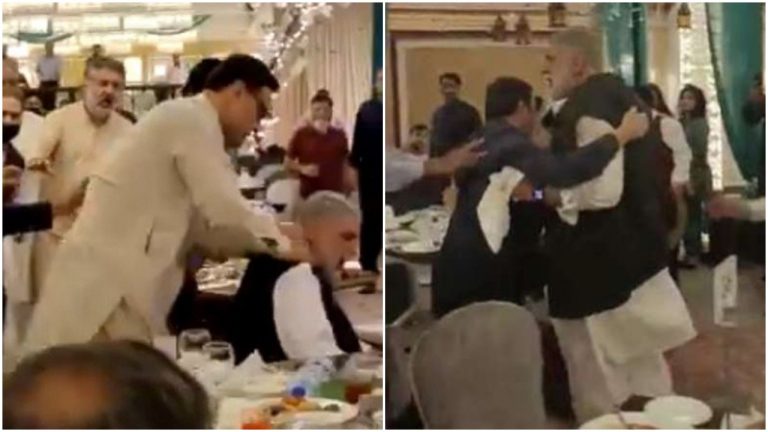
Videos have gone viral on social media platforms in which it was seen that PTI dissident lawmaker Noor Alam Khan thrashing an elderly man for calling him a “turncoat” and abused him at the Marriott hotel in Islamabad on Tuesday.

Reportedly, Noor Alam Khan, along with PPP leaders Mustafa Nawaz Khokhar, Nadeem Afzal Chan and Faisal Karim Kundi, was having an iftar dinner at the hotel where the elderly citizen, who is a PTI worker, was also present.

In the video, rebel PTI leader Noor Alam Khan and PPP leader Mustafa Khokhar can be seen hitting the elderly citizen. PPP leader Kundi was seen picking up a glass and throwing it at the elderly, who responded in kind by throwing an object back at him. As the elderly tried to retaliate, Khokhar closed in on him and punched him in the head.

The elderly man was thrown off balance and floored as Khan, and the other PPP leaders continued to beat him up before they were separated.

In another video, one can hear abuses such as ‘pen-chor’ (a variant of a popular abuse in North India as well), being hurled towards each other.

Another video of the same incident from another angle shows bystanders trying to pacify the politicians while trying to make sense of the scene unfold in front of them.

Following the incident, PTI dissident Noor Alam registered a complaint against the elderly man. In his complaint, Alam Khan claimed that he was at the hotel with his friends, including Khokhar, Chan, Kundi and Sheikh Waqas Akram, when an unidentified man began abusing him and threatened to kill him.

PTI hold demonstrations against opposition parties after Imran Khan’s ouster

Meanwhile, several thousand workers of the PTI party have held demonstrations across the country to protest against the installation of an ‘imported government’ at the centre.

Protest rallies were organised in several cities like Islamabad, Karachi, Peshawar, Malakand, Multan Khanewal, Khyber, Jhang and Quetta, with party supporters shouting slogans against the united opposition.

The demonstrations had come after Imran Khan had said the resignation marked the beginning of a “freedom struggle” and called his removal a “foreign conspiracy of regime change” in Pakistan.

In an attempt to galvanise his supporters, he had said, “it is always the people who protect their own sovereignty and democracy”.

Following Imran Khan’s ouster, Opposition leader Shehbaz Sharif took oath as the 23rd prime minister of Pakistan on Monday. Senate Chairman Sadiq Sanjrani administered the oath of office to 70-year-old Shehbaz Shehbaz in President Dr Arif Alvi’s absence, who went on ‘sick’ leave ahead of the Pakistan Muslim League-Nawaz leader’s inauguration.

Union Minister Smriti Irani schools Congress leader and Maharashtra cabinet minister Yashomati Thakur after the latter implied ‘Nagaland is not a part of India’

0

Yashomati Thakur, the Congress leader who is also the Minister of Women and Child Development in Maharashtra, was schooled by Union minister Smriti Irani after she implied that Nagaland is not a part of India.

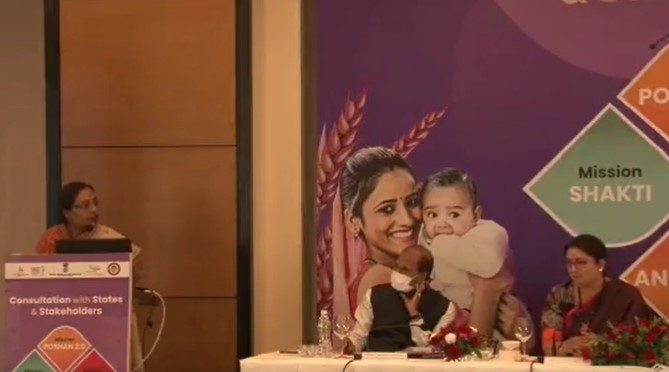
While addressing the Zonal Conference of States and Union Territories and stakeholders of the Western region in Mumbai on Tuesday (April 12), Yashomati Thakur talked about deportation to and from Nagaland, and the union minister had to interject and correct the Maharashtra cabinet Minister that Nagaland is a part of India and there is no deportation within Indian states.

The snippet of the Mumbai event where Yashomati Thakur was seen making ill-informed remarks was shared by a Twitter user Vikas Pandey (@MODIfiedvikas).

In the video, the Congress leader Yashomati Thakur is heard saying, “With some states and countries we do have an MoU but with the others, especially, children coming from Nagaland…woman coming from Nagaland…they…”, before the Congress leader completed her sentence, Union Minister Smriti Irani interjected to remind her that Nagaland is very much part of the country.

Yashomati Thakur, for a second, rectified her statement by replacing ‘Nagaland’ with ‘Thailand’, but again she quickly went on to justify her statement by saying, “It is our own country I understand, but there are children coming to the states and again ‘deported’ to the states without any notification. So Nagaland is also one of the states from where children come over here and we ‘deport’ them without any notification as we do not have an MoU within the states also”.

Here again, Union Minister Smriti Irani educated the Congress minister saying that within a country, nomenclatures like deportation are not used. The Congress leader tried to cut short the union minister to give an explanation, but Smriti Irani told her that she should be mindful that Nagaland is a part of India and secondly no one can be deported within India.

“You should be mindful of your words…this is my humble request”, said the union minister in a curt reply to Maharashtra’s Minister of Women and Child Development.

The Congress minister, sounding least embarrassed by the gross mistake she made while delivering her speech went on to say that it was a “small mistake” she had made while conveying her message.

Meanwhile, Union Minister Smriti Irani had taken to Twitter to share pictures from the event held in Mumbai. “Had fruitful deliberations on Mission Shakti, Vatsalya, and Poshan 2.0 with representatives of state governments and stakeholders at West Zone Consultation Meeting held in Mumbai today”, she tweeted.

Notably, the Ministry of Women and Child Development had initiated a series of Zonal Consultations with State Govts and Stakeholders in each region of the country to ensure the optimum impact of its recently launched 3 missions – POSHAN 2.0, Vatsalya, and Shakti. The event at which the Minister of Women and Child Development in Maharashtra spoke was part of this series of Zonal meetings with the State Govts and Stakeholders. The first such meeting was held in Chandigarh on 2nd April, the second in Bengaluru on 4th April, the third in Guwahati on 10th April, and the fourth in Mumbai on 12th April 2022. The last meeting in this series is scheduled to be held in Bhubaneswar on 13th April 2022.

Brooklyn subway shooting: Multiple people shot at, undetonated devices recovered at NYC train station

On Tuesday, April 12, at least six people were shot and wounded in a shooting that took place inside a subway station in Sunset Park, Brooklyn in New York City. The real number of casualties is still not known. According to reports, the authorities are searching for the suspect, who is said to have fled after the incident.

While some media reports suggest that the firing happened at the 36th Street station in Sunset Park around 0830 local time (1330 GMT) on Tuesday morning, some reported that it wasn’t immediately clear whether the shootings took place on the train or at the 36th Street subway station in Sunset Park or the 25th Street station in Greenwood Heights.

Reportedly, a man dressed as a Metropolitan Transportation Authority (MTA) worker with a gas mask and orange construction vest had allegedly fired shots at the people waiting for the train. At least 13 people have been injured in the attack, according to the latest reports.

Meanwhile, a spokesman for the New York City Fire Department (FDNY) also confirmed that several undetonated devices have also been found in the station.

Authorities were initially called to the 36th Street station, which serves the D, N, and R lines, due to a smoke condition. According to an FDNY spokesperson, once inside the station, first responders encountered multiple people who had been shot and numerous undetonated devices.

Social media are rife with pictures and videos showing bloodied passengers lying on the station floor.

Caution: Gory visuals, viewer discretion advised.

Clair, a passenger who witnessed the event while riding the Manhattan-bound N train, was quoted by The New York Post as saying that there were so many rounds fired off that she “lost count.”

Meanwhile, the New York Governor, Kathy Hochul tweeted that she’s been briefed about the incident. “First responders are on the scene and we will work with @MTA & @NYPDnews to provide updates as the investigation continues,” the governor Tweeted.

‘Land belongs to Lord Vishveshwar, Aurangzeb had no right over it’: Argument in Allahabad HC in Kashi Vishwanath-Gyanvapi dispute

0

In the ongoing hearing of the case related to the Kashi Vishwanath temple-Gyanvapi mosque dispute of Varanasi, the Allahabad High Court on Tuesday ordered the Uttar Pradesh Sunni Central Waqf Board to present on record all the documentary evidence pertaining to State surveys wherein allegedly the property was declared as waqf property after advocate Rastogi argued that Aurangzeb had no rights over said land and that the property belonged to Lord Vishveshwar.

Advocate Rastogi, the appointed next friend of Lord Vishweshwar noted that the required evidence to prove that the land belongs to Lord Vishweshar could be procured only through an ASI survey. He said that the property was always a Hindu property as the land belongs to ‘swayambhu’ (self-manifested) Lord Vishweshwar and Aurangzeb had no right to acquire the land.

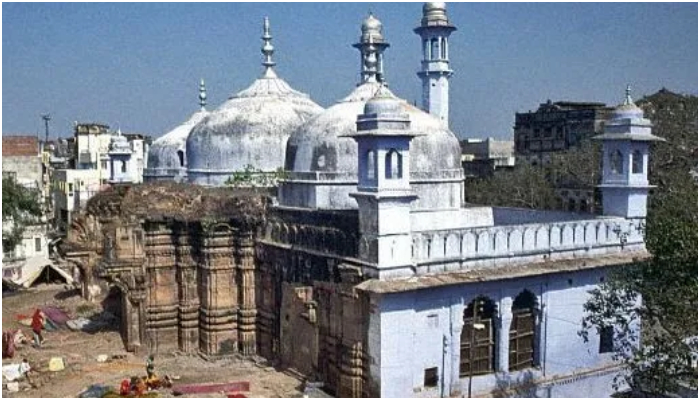
According to historical accounts, in 1669, Aurangzeb had ordered the demolition of the Vishveshwar temple and commissioned the construction of the Gyanvapi mosque.

Rastogi during the hearing pointed out that the same property was registered as waqf property on February 26, 1944, under three different laws -the Waqf Act of 1936, Waqf Act, of 1954, and the Uttar Pradesh Muslim Waqf Act, 1960. Meanwhile, Advocate Punit Kumar Gupta appearing for the UP Sunni Central Waqf Board mentioned that the old Acts were amended from time to time and the renewal of registration was done accordingly.

Before the bench of Justice Prakash Padia, Advocate Rastogi further pressed the argument that an archaeological survey of the land in question is necessary as the evidence of an ancient temple, which was razed by the Mughal ruler, lies beneath the existing mosque structure. He referred to the Ramjanmabhoomi case and said that in the instant matter too, the evidence could be recovered only from beneath the mosque structure.

The Allahabad HC on March 25 had decided to hold regular hearings in the cases related to the Kashi Vishwanath Temple-Gyanvapi mosque dispute of Varanasi starting March 29. The order was passed by the bench of Justice Prakash Padia while hearing a petition filed by the Anjuman Intazamia Masazid, Varanasi, last year seeking a stay on the proceedings. The Anjuman Intazamia Masazid had also filed applications challenging the maintainability of the civil suit pending before the lower court.

A plea was filed before the Varanasi local court in 1991 by the Ancient Idol of Swayambhu Lord Vishweshwar and 5 others seeking removal of the Gyanvapi Mosque and return of the land to the Hindus. Notably, the suit had already been stayed by the high court, including the lower court order that had directed the Archaeological Survey of India(ASI) to survey the mosque complex.

The Allahabad HC in September 2021 had also held that the lower court should wait for the verdict in the petitions before the High Court and refrain from proceeding further in the matter until the judgement is delivered. The Gyanvapi Mosque is located in the Kashi Vishwanath temple complex. Hindus believe that Vishveshwara still sits in the disputed complex. The Court has adjourned the hearing till April 29.