The Holocaust brings to one’s mind deep anguish and pain, even though not many of us lived during the times when Hitler’s army ran riot over millions of Jews across Europe. It was one of the darkest hours of humanity and the barbarism of the Nazi cruelly added another chapter to the oppression that the Judaistic faith has had to face over the centuries.
What if I were to say that there is another faith (rather a ‘way of life’) and people who have undergone as many trial and tribulations, if not more, over millennia?
Shocking, right? I speak of Hinduism, arguably the oldest extant religion today. Of Sanatan Dharma, or the ‘eternal way of life’ as it is usually called. The Vedic faith, that developed and prospered in the Indian subcontinent before having to face wave after wave of slaughter, deprivation, insult and pain. This article is a brief walk down our civilizational memory lane to look at the story of what can be called one of the most ancient and pristine renditions of spiritual humanism, and what made it so resilient and strong to withstand these relentless storms of history.
A Golden Age
Scholars have been having a long-standing debate on the origins of Hinduism. Some argue on the basis of a ‘proto-Shiva’ found on one of the tablets of the Indus Valley civilization that the ancient civilization had links to an early form of the faith, while there are others who summarily reject it [1, 2]. Dhyansky [3] argued that regardless of whether Vedic Gods were known to men there, there seems to have been a form of Yoga practised even in those times. Regardless of the veracity of these claims and arguments, I believe, nay know, that Sanatan Dharma, as I see it, did exist even then simply because the key idea and principle of this faith for me always has been the pursuit of Satya, the one absolute Truth; to try to know the workings of nature and the universe. This is why the early gods of the Hindu pantheon were modelled around nature.
For instance, one of the gods who appears often in Vedic texts is Indra. Indra is seen as the storm god who intervenes in the clouds with his thunderbolts, which then release the rains nourishing the parched land, crops and thus humanity [4]. The hymns of Rigveda declare him to be the “king that moves and moves not”, the friend of mankind who holds the different tribes on earth together. One can immediately see how the monarch was juxtaposed onto the symbol of plenty: the rain and the associated abundance, to give us Indra. Like all Vedic deities, Indra was a part of the henotheistic theology of ancient India, with the one supreme being referred to as Brahman, of which the many gods were aspects and parts [5].
This conception of trying to understand and describe nature and the universe around feeds into man’s curiosity to understand reality. The Vedic seers are said to have done so using spiritual practises, which led them to certain sparks of inspiration, certain moments of clarity about the nature of reality. It is to the underlying one-ness and unity in the Universe, as they saw it, that they attributed to Brahman [6]. Materialism may view this with skepticism if not outright ridicule but they forget that science as well looks at exploring the truths of nature. Science today has neither been able to prove nor disprove the idea of spirit. Then why the rigidity in judgement prior to extensive analysis and tests? This rigidity is definitely not seen in the Vedic seers, who ingrain the spirit of tolerance and the simple pursuit of whatever may be the truth at the heart of Santana Dharma. The humility and yet the certainty of the Vedic seers is visible in the Nasadiya Sukta, 129th hymn of the 10th Mandala of the Rig Veda, where they say:
“Who really knows? Who will here proclaim it?
Whence was it produced? Whence is this creation?
The gods came afterwards, with the creation of this universe.
Who then knows whence it has arisen?”
Some of you may argue that this seems to be a whole lot of confused gibberish. Hardly! Simply because in the duality of knowing and not-knowing, of being and not-being, of creation and non-creation, lies the fundamental conception of Brahman that has the multiplicity of realities embedded in its body. It is this core principle that made Hinduism so tolerant and yet resilient, malleable and yet steadfast. In what I see as the Golden Age of Hinduism, these ideas flowed freely and without much tension arising from the conflict of such ideas. Hinduism believed that if Brahman needs to be sought and known, that can be done using any method that the seeker may so desire.
It could be using one or more of the pramanas (methods of exploring this Truth), tools from Darsanas (schools of thoughts) or abiding by practices of one or more of the Yogas (ways of attaining a union with this Truth). Debates were often held in ancient India to discuss topics pertaining to philosophy, theology, culture and spirituality, among other areas of interest and relevance. For instance, the Brhadaranyaka Upsanisad has references to King Janaka as organizing and patronizing debates between sages and priests, besides also as participating in such debates [7]. What kept the people together, much like cement keeps the bricks together, was Dharma [8].
Dharma is that which safeguards the nature of Brahman in society, by encapsulating the spirit of oneness and harmony. It establishes certain codes of conduct and righteous behaviour. What people often forget while discussing Dharma these days as that the Dharmasastras or Manusmriti that talk of Dharma were created at a certain point in history. It is not in the details in them but rather the ideas underlying them that matter. Early human civilizations had elements of society and understanding that can raise a fair few eyebrows today, be it to do with gender roles or class structures or feudalism. Those were what human beings looked at from a certain perspective, a certain samskaar [9], informed and coloured by social and civilizational aspects of that time.
I am strongly against the verbatim citation or following of these texts today, since Sanatan Dharma has always evolved, even assimilated various ideas and cultures. Not because it had to but because it could. Simply because Brahman, the Truth, which is often referred to as existence, consciousness and bliss – Satchitananda, is a cumulative whole of all there is, has been and can be. In fact, it is my opinion that many of the more eye-brow-raising aspects of these conceptions of Dharma and Brahman were later interpolations.
For instance, the idea of gender roles and oppression of women cannot be part of a way of life that looks at a primordial Feminine as the spring from which the Universe sprung forth [10]. There are historical texts and evidence that show that women not only had a respectable position in society but also commanded clout. For instance, not many would know that some of the most revered ancient Indian scholars include Gargi, Sulabha, Vadava, Prathiteyi and Maitreyi[11].
Challenge or Accessible Reinforcement from Lumbini?
Born in Lumbini and brought up in Kapilavastu, Siddhartha Gautama was a prince of ancient India, who after seeing the misery of human life, in old age and sickness and death, withdrew from worldliness and attained enlightenment[12]. As Buddha, he alleviated the misery of droves of people, in what is today Bihar and Uttar Pradesh in India, during his lifetime. His was the Middle Path, madhyamā-pratipad, which neither followed a path of decadence and indulgences nor of self-mortification in the name of austerity[13].
Buddha took the Indian subcontinent by storm with his simple teachings and innate Buddha-hood, which shone through in his words. He was neither concerned nor interested by the reality of Brahman or of any of the gods. Being more interested in bringing people out of the cycles of dukkha (misery)[14], his prime point of difference with traditional Vedic faith was on the conception of what the Vedic seers saw as Brahman. Unlike popularly believed, he did not deny the existence of Brahman but rather did not want to engage with that problem when more earthly problems existed among his followers. His was a more anthropocentric way rather than a theocentric one [15].
Buddhism spread rather slowly till the Mauryan Emperor Ashoka adopted it as his religion after the devastating carnage he led in the kingdom of Kalinga (present-day Odisha). He not only built many Buddhist stupas and viharas (places to rest for travellers) but also sent emissaries and monks beyond the Indian subcontinent to preach the teachings of Buddha. Some of the edicts of Ashoka show that Buddhism even reached the Hellenistic world, with one edict (13th Rock Edict, S. Dhammika) saying:
The conquest by Dharma has been won here, on the borders, and even six hundred yojanas away, where the Greek king Antiochos rules, beyond there where the four kings named Ptolemy, Antigonos, Magas and Alexander rule, likewise in the south among the Cholas, the Pandyas, and as far as Tamraparni.
Strands of Mahayana Buddhism evolved and fed into the era of the Sungas, when Buddhism fell into a sharp decline, especially under Pushyamitra Sunga [16]. The Greco-Bactrian king Demetrius I and the Indo-Greek king Menander seem to have stopped the decline for a while in the northwestern parts of the Indian subcontinent in the second century BCE. It was during the first century BCE that the first anthropomorphic representations of the Buddha are found in the lands ruled by the Indo-Greeks. Not many may know that it was after seeing the rise of Buddhist temples and statues, the Vedic faith left no stone unturned to go head-to-head on this front [17].
While the Mahabhasya of Patanjali from the second century BCE extensively describes temples of Dhanapati (deity of wealth and finance, Kubera) [18], the ideas, designs and plans of ancient Vedic and Upanishad-era shrines were adopted and evolved, primarily from the competitive development of temples and arts in Jainism and Buddhism! The Kushana dynasty (30–375 CE) patronised Buddhism, and some scholars believe that it was also around this time that a significant change was made in the language of the Sarvāstivādin canon, by converting an earlier Prakrit version into Sanskrit.
This upward trend of Buddhism continued in the Gupta period with Gupta rulers such as Kumaragupta I supporting and enlarging the Nālandā university, which became the largest and most influential Buddhist university in India for centuries thereafter[19]. It was only after that that the irreversible decline of Buddhism in India started. The Chinese traveller-monk Xuanzang noted the dilapidated structures of many stupas during his visit in the 7th century CE[20]. Even then, it is noteworthy that when Muhammad Ghori attacked Delhi after the second Battle of Tarain in 1193, he demolished a number of Buddhist and Jain temples near where the Qutub Minar stands today.
So how did Hinduism survive this tussle for influence with Buddhism for around a millennium and a half?
By the power of debate and assimilation. Adi Sankara played a major role in debating with Buddhist monks and publicly defeating a few notable ones in theological debates, which were on questions of logic, phenomenology, ontology and metaphysics[21]. It was with supreme logic and methods of inference that Sankara did the job. Using advanced forms of arthapatti (a method of implication)[22], he argued that if the Buddhist conception of everything being impermanent and in flux is true, who is witnessing the flux? Against what background is the flux a flux?
Who realises that reality is impermanent if everything is part of that impermanence?
Against what permanence is the purported impermanence of reality defined?
Sankara hits out at the idea of momentariness of reality with the existence of memory. If everything is momentary, and both the perceived and the one who perceives are in a transient world, how do we have a memory of the perceived at all? Yes, much like Buddhism, Sankara believed in the impermanence of the material world but he disagreed with Buddhism on the idea that reality itself had no basis and was ever-fleeting.
Sankara’s Advaita philosophy believed in the singularity of existence while the Buddhist believed in the ultimate absence of existence.
Sankara believed that Buddha may have seen desires, attachment and bondage as key to suffering but there was a deeper level of understanding: that of ignorance of the true form of reality and existence, which escaped Buddha, according to him. He felt that everything cannot come of nothing (Sunyata, as Buddhism believed) and the deepest underlying Truth is single and whole. Sankara drives the final nail by saying that if one denies oneself, then who is it that is carrying out the act of denial? Who is it that suffers if there is actually no one who exists? The resolution of this lies not in denying existence and oneself, but rather understanding that pain and suffering come from not knowing the true nature of oneself.
In this way, Sankara carried on the work that the likes of Kumārila Bhaṭṭa and Udayanācārya did. While the Mīmāṃsā scholar Kumārila defeated disciples of Buddhapalkita, Bhavya, Dharmadasa, Dignaga and others using techniques such as Svataḥ Prāmāṇya or ‘intrinsic validity’ of an argument or thought[23], the founder of the Navya–Nyāya school of philosophy (a coming together of (Nyaya and Vaisheshika schools of logic and philosophy) Udayanācārya is said to have finally demolished the last remaining vestiges of Buddhist supremacy using methods such as Parataḥprāmāṇya (extrinsic validity of cognition) in debates, as per the Naiyâyikas[24].
These three scholars came at a time when Buddhism may well have wiped out a large section of Hinduism only a few centuries prior. In those days, debates had a very important role in society. Often the winner of a debate would lead a large populace into his/her faith or way of thinking. The victories of Sankara and the others helped in keeping the Hindus within the Vedic fold and not allow Buddhist scholars to convert them to the Buddha’s faith. Eventually, some strands of Hinduism liberally incorporated elements of Buddhist thoughts and even elevated Buddha to one of the avatars of Vishnu in some renditions of the Dashavatar (the ten incarnations of Vishnu)[25].
A Crimson Crescent?
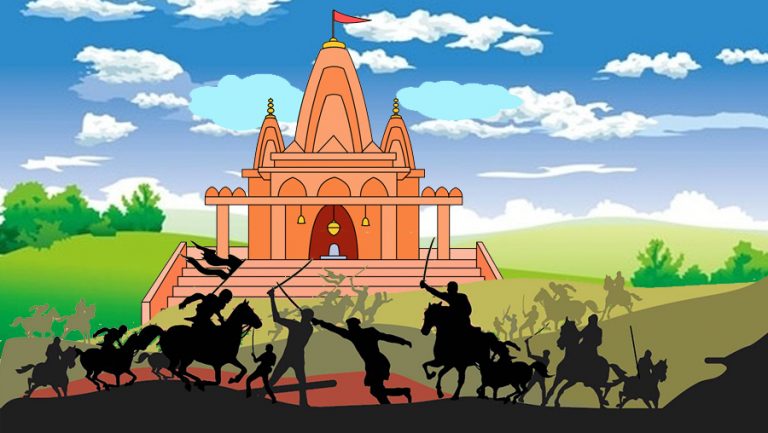
India has seen a number of waves of invasions over the millennia. Be it the Greeks, the Scythians or the Yuezhi, invaders struck the Indian subcontinent and often got assimilated into the civilizations preceding their advent. That is till the rule of Harshavardhan and the Rajput feudal lords thereafter. The Muslim conquest of the Indian subcontinent began with the conquest of Sindh by Muhammad bin Qasim and his Arabic army in 712 AD. Qasim regarded polytheists such as Hindus, Buddhists, and Jains as dhimmis (literally ‘protected person’) but also made them pay jizya (per capita yearly tax imposed on non-Muslims) for religious freedom. This would be the first of many such instances in the subsequent centuries of such an imposition. The imposition, however, was only the step after the subjugation of native people of an area; what preceded it was absolute carnage.
Historian K. S. Lal in his book Theory and Practice of Muslim State in India claims that the population of the India subcontinent went from about 200 million in 1000 AD to about 170 million in 1500 AD[26]. This was primarily due to killings, deportations, dissemination, wars, and famines. American historian, writer and philosopher Will Durant calls the Muslim conquest of India[27] PROBABLY THE BLOODIEST STORY IN HISTORY.
Interestingly, even those Hindus who converted to Islam were not immune from persecution, with them being part of a certain racial hierarchy in India as mentioned by political thinkers such as Ziauddin al-Barani in the Fatawa-i Jahandari[28], with this being something against the fundamental tenets of Islam, which knows no hierarchy in front of Allah. The destruction of temples and educational institutions led to a widespread decline in Hindu education, although Brahmanical education still received the occasional patron in the likes of Akbar (with his patronage of a Vrindavan temple). The period from the twelfth to the eighteenth centuries were dark times for Santana Dharma. Some people still persisted, still fought on.
Bukka Raya I, a founder of the Vijaynagar Empire, took steps to rehabilitate Hindu religious and cultural institutions which had suffered a setback under Muslim rule. Most of the great temples in North India were destroyed and no great temples were built under Muslim rulers. Even those that were lacked in imagery since that was not allowed in Islam. The Somnath temple was sacked and resurrected around 17 times (going on to show the grit and resilience of the Hindus who faced such violence and aggression)! This grit and resilience is further seen when one observes that though Sanskrit and research on Hindu philosophy faced a phase of struggle, with Muslim rulers often destroying well-established and well-known educational institutions, the traditional educational institutions in villages continued as before in vernacular regional languages based on Sanskrit, and a lot of Vedantic literature are said to have been translated into these languages between 12th to 15th centuries [29-31]!
The Islamic invaders in mainland India began to arrive with the arrival of Mahmud of Ghazni in the eleventh century. His campaigns across the Gangetic plains are often remembered for the amount of plundering and destruction of temples that he carried out. Al-Utbi, Mahmud’s court historian, viewed Mahmud’s expeditions as jihad to propagate Islam [32-34]. Speaking of his campaign on Mathura, from which he obtained a loot of around 3 million rupees and over 5000 slaves[35], it is written:
Orders were given that all the temples should be burnt with naphthala and fire and levelled with the ground. The city was given up to plunder for twenty days. Among the spoil are said to have been five great idols of pure gold with eyes of rubies and adornments of other precious stones, together with a vast number of smaller silver images, which, when broken up, formed a load for more than a hundred camels.
Mahmud of Ghazni sacked the second Somnath Temple in 1026 AD and destroyed the famous Shiva-lingam of the temple[36]. He organised regular raids and expeditions against members of the Rajpur confederacy he defeated between the coalition he fought on his Mathura campaign of 1018 AD to the Kachh campaign against Bhima I in 1025 AD. Alberuni, a historian who accompanied Mahmud of Ghazni, described the conquests in North-Western India[37]:
Mahmud utterly ruined the prosperity of the country, and performed there wonderful exploits, by which the Hindus became like atoms of dust scattered in all directions, and like a tale of old in the mouth of the people.
He goes on to state that the civilisation of the scattered Hindus declined and retreated from the North West [37, 38]
This is the reason, too, why Hindu sciences have retired far away from those parts of the country conquered by us, and have fled to places which our hand cannot yet reach, to Kashmir, Benares, and other places.
The subsequent raids by Muhammad Ghori were no less brutal. He is said to have destroyed 27 temples within Qila Rai Pithora, the fort of Prithviraj Chauhan, after the latter’s defeat in the Second Battle of Tarain in 1193. Ghori, along with Quṭb al-Dīn Aibak, later built the Quwwat al-Islam mosque using the remains of these temples. You can still see the remnants of these temples in the pillars of the mosque, with defaced figures and figurines of gods and goddesses and other celestial beings.
This persecution continued under the Delhi Sultanate after Aibak too. The Mamluk king Balban was said to have been as violent. In suppressing interminable revolts around Delhi he massacred so many people that some writer note that this caused rivers of blood to flow all around. Mangled dead bodies piled up in every town and the whole region emitted an unbearable stench. The Khiljis were no less. There was religious violence in India during the reign of Alauddin Khalji [39, 40]. Alauddin’s army commanders such as Malik Kafur, Nusrat Khan, Ulugh Khan and Khusro Khan attacked, killed, looted and enslaved non-Muslim people from all over India [41, 42]. The Khalji dynasty’s court historian Amir Khusrow writes in the Táríkh-i ‘Aláí [43],
The [Muslim] army left Delhi … [in] Nov. 1310 … After crossing those rivers, hills and many depths, … elephants [were sent], … in order that the inhabitants of Ma’bar might be aware that the day of resurrection had arrived amongst them; and that all the burnt Hindus would be despatched by the sword to their brothers in hell, so that fire, the improper object of their worship, might mete out proper punishment to them. The sea-resembling army moved swiftly, like a hurricane, to Ghurganw. Everywhere, … the people who were destroyed were like trunks carried along in the torrent of the Jihun, or like straw tossed up and down in a whirlwind.
When this still did not subdue the spirit of the Hindus, and riots and mutinies by the Hindus erupted in various parts of the Sultanate, from Punjab to Gujarat to Uttar Pradesh and Madhya Pradesh, these riots were crushed with mass executions, where all males above the age of 8 were seized and killed[44]. Alauddin’s general Nusrat Khan retaliated further against mutineers by seizing all children and women of the affected area and placing them in prison. In another act, he had the wives of suspects arrested, dishonoured and publicly exposed to humiliation[44].
It was not only the Muslim armies who acted as the aggressors. Even the court officials, muftis and kazis recommended violence and humiliation of the Hindu masses on religious grounds. Kazi Mughisuddin of Bayánah advised Alauddin in the following manner[45]:
keep Hindus in subjection, in abasement, as a religious duty, because they are the most inveterate enemies of the Prophet, and because the Prophet has commanded us to slay them, plunder them, and make them captive; saying—convert them to Islam or kill them, enslave them and spoil their wealth and property.
The Muslim army led by Alauddin’s famous general Malik Kafur pursued two violent campaigns in south India, between 1309 and 1311, against three Hindu kingdoms: Deogiri (in present-day Maharashtra), Warangal (in present-day Telangana) and Madurai (in present-day Tamil Nadu). Thousands of people were slaughtered. The Halebid temple was destroyed. Cities and villages were plundered. The loot from south India was so large that the historians of that era state that a thousand camels had to be deployed to carry it to Delhi[46]!
In the booty from Warangal was the Koh-i-Noor diamond that today sits atop the crown of Queen Elizabeth II[47]. In 1311, Malik Kafur entered the well-known Srirangam temple and massacred the Brahmin priests of the temple, who resisted the invasion for three days. Kafur then plundered the temple treasury, along with the storehouse, and desecrated and destroyed a number of religious icons and statues. Ulugh Khan would later invade Srirangam in 1323, and in a notorious act of brutality, have 12000 unarmed ascetics killed [48-53].
Next came the Tughlaqs. We find the systematic persecution of Hindus under the rule of the Tughlaq dynasty documented in the Tarikh-i-Firuz Shah, written during the reign of the third Tughlaq king Firoz Shah Tughlaq. It was common to capture and enslave Hindus. In fact, when Firoz Shah died, slaves in his service were killed en masse and piled up in a heap[54]! Hindus, including and particularly Hindu Brahmin priests, who refused to convert to Islam faced a terrible fate, as noted by Ziauddin Barani in his Tarikh-i-Firoz Shahi[55]:
An order was accordingly given that the Brahman, with his tablet, should be brought into the presence of the Sultan … The true faith was declared to the Brahman and the right course pointed out. but he refused to accept it … The Brahman was tied hand and foot and cast into it [a pile of brushwood]; the tablet was thrown on the top and the pile was lighted … The tablet of the Brahman was lighted in two places, at his head and at his feet … The fire first reached his feet, and drew from him a cry, but the flames quickly enveloped his head and consumed him. Behold the Sultan’s strict adherence to law and rectitude.
Under Firoz Shah’s rule, Hindus were forced to pay the Jizya tax, were recorded as infidels and their communities monitored. Hindus who tried to erect a deity, build a temple or practise their religion in public such as near a kund (water tank) were arrested, brought to the palace and executed [56, 57]. Tughlaq wrote in his autobiography Futuhat-i Firoz Shahi[58]:
Some Hindus had erected a new idol-temple in the village of Kohana, and the idolaters used to assemble there and perform their idolatrous rites. These people were seized and brought before me. I ordered that the perverse conduct of the leaders of this wickedness be publicly proclaimed and they should be put to death before the gate of the palace. I also ordered that the infidel books, the idols, and the vessels used in their worship should all be publicly burnt. The others were restrained by threats and punishments, as a warning to all men, that no zimmi could follow such wicked practices in a Musulman country.
Timur, or Tamerlane as he is famously called in many parts of the world, invaded Delhi soon after. His invasion was marked by systematic slaughter and various other atrocities on a large scale, inflicted mainly on Hindus, who were enslaved or massacred[59-63]. Apparently, he massacred Indian Muslims too, just to punish the Delhi Sultanate for being too soft on the Hindus! Sharafuddin Yazdi describes the invasion in Zafarnama[64], as follows
[Timur’s] soldiers grew more eager for plunder and destruction … On that Friday night there were about 15,000 men in the city who were engaged from early eve till morning in plundering and burning the houses. In many places the impure infidel gabrs [of Delhi] made resistance … On that Sunday, the 17th of the month, the whole place was pillaged, and several places in Jahan-panah and Siri were destroyed. On the 18th the like plundering went on. Every soldier obtained more than twenty persons as slaves, and some brought as many as fifty or a hundred men, women and children as slaves out of the city. The other plunder and spoils were immense, gems and jewels of all sorts, rubies, diamonds, stuffs and fabrics of all kinds, vases and vessels of gold and silver … On the 19th of the month Old Delhi was thought of, for many infidel Hindus had fled thither … Amir Shah Malik and Ali Sultan Tawachi, with 500 trusty men, proceeded against them, and falling upon them with the sword despatched them to hell.
After Timur left, Delhi faced a period of a political vacuum and uncertainty. Up north, in Kashmir, encouraged by Islamic theologian Muhammad Hamadani, Sikandar Butshikan of the Shah Miri dynasty quickly acquired the title of but-shikan or idol-breaker, as destroyed ancient Hindu and Buddhist temples, desecrated their premises, demolished statues, damaged Hindu and Buddhist books and banned followers of Dharmic religions from prayers, performing arts and observation of their religious festivals [65-69].
In Delhi, the Sayyids and the Lodis who came to power continued the history of oppression of Hindus. From 1414–1423, the Muslim historian Yahya bin Ahmad records that the Islamic commanders “chastised and plundered the infidels” of Gwalior, Chandawar, Ahar, Bail, Khur, Kampila, Katehr, Seori, Etawa, Sirhind and Rahtors[70]. However, what is interesting to see is that in this period the violence was not one-sided, and the Hindus retaliated by forming their own armed groups. They attacked forts that had been captured by Muslims. For instance, in 1431, Jalandhar was retaken by Hindus and all Muslims inside the fort were put in prison, with bin Ahmad remarking on the arrest of Muslims by Hindus,
the unclean ruthless infidels had no respect for the Musulman religion
Religious violence and persecution continued during the reign of Bahlul Khan Lodi and Sikandar Lodi. The Sultanate witnessed the burning and killing of Hindus for their religion, in Uttar Pradesh, Bihar and Bengal[71]. In Uttar Pradesh, a historian of Lodi dynasty times, described the state sponsored religious violence as follows,
He (Lodi) was so zealous of a Musulman that he utterly destroyed diverse places of worship of the infidels. He entirely ruined the shrines of Mathura, the minefield of heathenism. Their stone images were given to the butchers to use them as meat weights, and all the Hindus in Mathura were strictly prohibited from shaving their heads and beards, and performing ablutions. He stopped the idolatrous rites of the infidels there. Every city thus conformed as he desired to the customs of Islam.
THE MUGHALS
Even though Babur ruled in India for only four years (1526-1530 AD) before his death, he continued systematic religious oppression of Hindus and Sikhs, as noted by Guru Nanak in four hymns, when he witnessed it himself[72]. According to autobiographical historical records of Babur, the Tuzak-i Babari, Babur’s campaign in northwest India targeted pagans, both Hindu and Sikh, as well as apostates (primarily non-Sunni sects of Islam). He notes that an immense number of infidels were killed, with Muslim camps building “towers of skulls of the infidels” on hillocks [73]. Similarly, Baburnama records massacres in, and destruction of, Hindu settlements by Babur’s army[74].
His son Humayun could not rule for long before Sher Shah Suri defeated him in battle and took the throne of Delhi. In 1545, Suri led a campaign of religious violence across various provinces of the empire, both in the east and west, in India. Much like in the era of the Sultanate, Suri’s advisors counselled in favour of religious violence, with Shaikh Nizam once saying[75]:
There is nothing equal to a religious war against the infidels. If you be slain you become a martyr, if you live you become a ghazi.
Sher Shah’s army also attacked the Hindu fort of Kalinjar, captured it and killed almost all Hindus inside the fort[75]. Although Humayun’s son Akbar is taken to be a very tolerant and progressive man, he too had campaigns that very outright bloody and violent on Hindus, including those of Garha (1560 AD), Chittor (1567 AD) and Nagarkot (1582 AD).
Maulana Ahmad, a historian of that era, writes about the battle at Chittor fort in Tarikh-i Alfi[76]:
They (Hindus) committed jauhar (…). In the night, the (Muslim) assailants forced their way into the fortress in several places, and fell to slaughtering and plundering. At early dawn the Emperor went in mounted on an elephant, attended by his nobles and chiefs on foot. The order was given for a general massacre of the infidels as a punishment. The number exceeded 8,000 (Abu-l Fazl states there were 40,000 peasants with 8,000 Rajputs forming the garrison). Those who escaped the sword, men and women, were made prisoners and their property came into the hands of the Musulmans.
Nizamuddin Ahmad, another historian of that era, recorded the violence during the conquest of Nagarkot in the Tabakat-i Akbari as follows [76]:
The fortress of Bhun, which is an idol temple of Mahámáí, was taken by valor of the (Muslim) assailants. A party of Rajputs, who had resolved to die, fought till they were all cut down. A number of Brahmins, who for many years had served the temple, never gave one thought to flight, and were killed. Nearly 200 black cows belonging to the Hindus, during the struggle, had crowded together for shelter in the temple. Some savage Turks, while the arrows and bullets were falling like rain, killed these cows one by one. They then took off their boots and filled them with the blood, and cast it upon the roof and walls of the temple.
Akbar’s son Jahangir may have been a connoisseur of the arts but he was no peace-loving man either. In his reign, religious violence was targeted at Hindus, Jains and Sikhs, as seen in one of the pieces in the Intikháb-i Jahangir-Shahi[77]:
One day at Ahmedabad, it was reported that many of the infidel and superstitious sect of the Seoras (Jains) of Gujarat has made several very great and splendid temples, and having placed in them their false gods, had managed to secure a large degree of respect for themselves. Emperor Jahangir ordered them to be banished from the country, and their temples to be demolished. Their idol was thrown down on the uppermost step of the mosque, that it might be trodden upon by those who came to say their daily prayers there. By this order of the Emperor, the infidels were exceedingly disgraced, and Islam exalted.
Jahangir also gave the order to torture and execute Guru Arjun, which stirred the Sikhs to consider militancy and strong action against the Mughals. This ultimately led to the formal inauguration of khalsa (military brotherhood) in 1699 by the tenth Sikh guru, Gobind Singh. Jahangir’s son Shah Jahan was not one to be left behind, in religious violence, with his soldiers attacking seven temples, violently seizing and appropriating wealth and resources for their own use in Punjab.
It was Shah Jahan’s progeny though that probably takes the crown for being the most ruthless Muslim king that India has ever seen. His reign saw a scale of religious violence in India that is listed as 23rd in 100 deadliest episodes of atrocities in human history, in Matthew White’s Atrocitology: Humanity’s 100 Deadliest Achievements[78]. Having imprisoned his father and killed his brothers for the throne, Aurangzeb unleashed one of the strongest campaigns of religious violence in the Mughal Empire’s history. Aurangzeb re-introduced the jizya tax, led a number of campaigns against non-Muslims, destroyed Hindu temples, and arrested and executed the ninth Sikh guru Tegh Bahadur[79, 80]. Aurangzeb issued orders[79] in 1669 to all his governors of provinces to:
destroy with a willing hand the schools and temples of the infidels, and that they were strictly enjoined to put an entire stop to the teaching and practice of idolatrous forms of worship
Aurangzeb not only destroyed temples (though he made some too) but also built mosques on the foundations of destroyed temples. Idols were smashed and briefly Mathura became known as Islamabad in local official documents, while the major Hindu pilgrimage sites in Varanasi and Somnath were destroyed [81-87]. Such was the scale of the carnage that entire town and even provinces became depopulated from religious violence. Aurangzeb’s Deccan campaign alone took 4.6 million Hindu lives, almost as much as in the Holocaust! During the Mughal-Maratha wars, about 2 million civilians died in war-torn lands due to famine, drought and plague.
When the European Colonisers entered
Soon after the entry of the Portugese into India, the Goa Inquisition was established. It was an institution established by the Roman Catholic Holy Office between the 16th- and 19th-century to stop and punish heresy against Christianity in Asia. The institution particularly persecuted Hindus, Muslims and Judaizing Nasranis, among others, by the colonial era Portuguese government and Jesuit clergy in Portuguese India[88].
As part of this initiative, conversions to Catholicism occurred by force, while thousands of Goan Hindus were massacred by the Portuguese between 1561 AD and 1774 AD. The last traces of the Goa Inquisition were removed away when the British occupied the city in 1812 AD. The British and the French were not much better. Both sought to proselytise, with even some East India Company openly seeking to convert sepoys in the Indian army.
Some argue that this may have been a cause of unrest, which was further increased with the rumours of the use of animal fat on bullets used in the army. This eventually led to the Sepoy Mutiny, which, after being crushed, led to the brutal execution of 100,000 individuals (some say this could be more), many of whom were Hindus[89].
The British Raj was also very clever in employing the divide-and-rule policy that made them pit one Indian king against another, one Hindu against a Muslim, and so on. This led to minimizing harm to their personnel but significant losses to the Indians. In the riots during the Bengal partition of 1905, a number of Hindus and Muslims died in what turned out to be a prequel to the riots of 1947, when East Bengal and West Bengal became parts of different countries, based on religious lines. The Direct Action Day, called for by the Muslim League, which started on 16 August 1946, a year before India’s independence, left approximately 3000 Hindus dead and 17000 injured.
During the partition, around 14.5 million people crossed the borders. With the British government having left the Indian subcontinent, the newly formed governments were ill-equipped to deal with migrations of such staggering magnitude. Massive violence, along communal lines, occurred on both sides of the border. Estimates of the number of deaths range around roughly 500,000[90].
In post-Independent India, riots in Mumbai and Gujarat, along with the anti-Sikh riots, the exodus of Kashmiri Pandits and insurgency in various parts of the country have led to loss of lives. There have been a number of attacks on Hindus and their temples by Christian evangelists and Muslim militants. The most prominent among them are the Chamba massacre (1998), the Fidayeen attacks on Raghunath temple (2002), the Akshardham Temple attack (2002), the Godhra train burning (2002), the Marad massacre (2003) and the Varanasi bombings (2006), resulting in a number of deaths and injuries. There have also been killings of Hindu priests and saints.
In August 2000, Swami Shanti Kali, a popular Hindu priest, was shot dead inside his ashram in Tripura, with the police identifying ten members of the Christian terrorist organisation – National Liberation Front of Tripura (NLFT) as being responsible for the murder. They also raided and destroyed some of the ashrams, schools and orphanages set up by the priest in the state. Christians were also responsible for the murder of Swami Laxmananda in 2008. Riots have also affected Hindus a lot in the country, from before India attained Independence [91, 92]. One case in example is the Godhra riot of 2002. I have always condemned the killings of Muslims in the Godhra riots. What is often missed though, in this regard, is that 254 Hindus were also killed in the 2002 Gujarat riots[93-95]. A similar number of deaths were reported during the 1992 Bombay riots, with 275 Hindus having died [96].
DHARMIC RESILIENCE
A natural question you may have is: what makes the dharmic tradition so resilient. I would say a few things. Firstly, due to the element of tolerance ingrained in Sanatana Dharma, one has had a lot of schools of thoughts, sects and even cults be a part of Hinduism over the millennia. Often these groupings have been so much against each other that one probably could not call them part of the same religion at all. A Vaishnavite [97, 98] might not see eye-to-eye with a Shaivite[99, 100], while a Carvak[101] may not see eye-to-eye with a Vedantist[102], even though they all are today put under the same umbrella term: Hinduism. This flexible, albeit almost loose, and yet fairly strong association perfectly encapsulates the paradox of Brahman and is one of the key reasons for the resilience of Sanatana Dharma.
The second major reason is that politics and faith have never been as closely coupled and connected as in many of the Abrahamic religions. Therefore, we never have a pope start a war to have his king sit on the throne, in India, although we have had instances like with Chanakya when an advisor or Brahmin mentor has wielded enough influence and used his statecraft to get his favourite to the throne. It is, however, an exception and not a norm to see such a close association.
Hinduism has always had the Brahmins maintain a certain position in society, irrespective of who the kings of the times of yore were. Here, I personally do not mean or abide by the hereditary idea of who is a Brahmin but rather with the idea that anyone who has certain traits, compliant with expectations from the Brahmins, is a Brahmin. Since Hinduism is such a personal religion without any over-reliance on any figure or place of worship or even text, beyond a point, destroying any one of these or even all of these still does not break the spirit of Hinduism. That is the beauty and strength of Hinduism.
In Conclusion
I hope I have taken you down an interesting journey in this article. As we come into the modern age, I cannot help but notice the similarities between the pursuits and tendencies of Hinduism and science, both of which seek to pursue the truths of the Universe, albeit using very distinct paths. It will be interesting to see what kind of an interface may be possible between the two, with some individuals looking at topics such as the Science of Vedanta lately. Without disrespecting any religion, I would like to highlight the fact that Hinduism is the one religion that accepts all pursuits, possibilities and characteristics of the Truth, be it with Jesus or Allah or Ahura Mazda or any of the other supreme deities around the world.
Since it is henotheistic, this comes naturally to the faith. What I have lately found extremely fascinating is that Hinduism is both theocentric and anthropocentric in its establishment that the all-pervading Brahman is a part of each of us and we are made in and by the Brahman. Sanatana Dharma may have historically been documented for some thousand years but since it fundamentally relies on observations, inferences and ideas based on laws of nature and reality, it is, in effect, an ‘eternal way of life’. Given all that it has to offer, I hope this ancient order of spiritual humanism survives till the very end of days!
REFERENCES
[1] Hiltebeitel, Alf. “The Indus Valley” Proto-Śiva”, Reexamined through Reflections on the Goddess, the Buffalo, and the Symbolism of vāhanas.” Anthropos H. 5./6 (1978): 767-797.
[2] Srinivasan, Doris. “Unhinging Śiva from the Indus civilization.” Journal of the Royal Asiatic Society 116.1 (1984): 77-89.
[3] Dhyansky, Yan Y. “The Indus valley origin of a yoga practice.” Artibus Asiae 48.1/2 (1987): 89-108.
[4] Hervey De Witt Griswold (1971). The Religion of the Ṛigveda. Motilal Banarsidass. pp. 180–183 with footnotes. ISBN 978-81-208-0745-7.
[5] Friedrich Max Müller (1897). Contributions to the Science of Mythology. Longmans Green. p. 758.
[6] Gough, Archibald Edward. The philosophy of the Upanishads and ancient Indian metaphysics. Routledge, 2013.
[7] Bimal Krishna Matilal; Jonardon Ganeri; Heeraman Tiwari (1998). The Character of Logic in India. SUNY Press. p. 31. ISBN 9780791437407.
[8] Suda, J. P. “Dharma: Its nature and role in ancient India.” The Indian Journal of Political Science 31.4 (1970): 356-366.
[9] Sinha, Jai BP. “Spirituality and Materialism.” Psycho-Social Analysis of the Indian Mindset. Springer, New Delhi, 2014. 77-98.
[10] Pattanaik, Devdutt. Devi, the Mother-Goddess: An Introduction. Vakils, Feffer, and Simons Limited, 2000.
[11] Altekar, A. S. “Educational and intellectual methods in Vedic and ancient Indian cultures.” Cahiers d’Histoire Mondiale. Journal of World History. Cuadernos de Historia Mundial 5.2 (1959): 423.
[12] Thomas, Edward J. The life of Buddha. Routledge, 2013.
[13] Gowans, Christopher. Philosophy of the Buddha: An Introduction. Routledge, 2004.
[14] Wijesekera, OH de A. “The Three Signata: Anicca, Dukkha, Anattā.” (1960).
[15] Mishra, Pankaj. An end to suffering: The Buddha in the world. Macmillan, 2004.
[16] Aśoka and the Decline of the Mauryas by Romila Thapar, Oxford University Press, 1960 P200
[17] Eliot, Charles. Hinduism and Buddhism: An historical sketch. Vol. 2. Psychology Press, 1998.
[18] Kielhorn, Franz, ed. The Vyākaraṇa-Mahābhāṣya of Patañjali. No. 18-22. Government central book depot, 1906.
[19] Sankalia, Hasmukh D. University of Nalanda. BG Paul and Company, Madras, 1934.
[20] Wriggins, Sally Hovey. Xuanzang: A Buddhist Pilgrim on the Silk Road. Westview Press, 1998.
[21] Hirst, Jacqueline Suthren. “A Questioning Approach: learning from Shankara’s pedagogic techniques.” Contemporary Education Dialogue 2.2 (2005): 137-169.
[22] Simha, Prathapa G. “Arthapatti: a critical and comparative study of the views of purva mimamsa advaita vedanta and nyaya vaisesika systems.” (2014).
[23] Taber, John. “What did Kumārila Bhaṭṭa mean by svataḥ prāmāṇya?.” Journal of the American Oriental society (1992): 204-221.
[24] Shida, Taisei. “Udayana’s theory of extrinsic validity in his theistic monograph.” History of Indian Philosophy (2017).
[25] Khan, Dominique-Sila. “Reimagining the buddha.” Journal of Indian philosophy 33.3 (2005): 321-342.
[26] Lal, Kishori Saran. Theory and Practice of Muslim State in India. Aditya Prakashan, 1999.
[27] Durant, Will (1976). The Story of Civilization. Our Oriental Heritage. Simon & Schuster. pp. 458–472. ISBN 978-0671548001.
[28] Aquil, Raziuddin. “On Islam and Kufr in the Delhi Sultanate: Towards a Re-interpretation of Ziya’al-Din Barani’s Fatawa-i Jahandari.” Rethinking a Millennium: Perspectives on Indian History from the Eighth to Eighteenth Century: Essays for Harbans Mukhia (2008): 168-197.
[29] Sharma, Narindar Kumar (1976). Linguistic and educational aspirations under colonial system. Concept Publishing, Delhi. pp. 34–36.
[30] Mehta, Jaswant Lal (1980). Advanced Study in the History of Medieval India. Volume 1. p. 287. ISBN 9788120706170.
[31] Ikram, S. M. (1964). Muslim Civilization in India. Columbia University Press. pp. 123–132 – via Frances W. Pritchett.
[32] Chopra, P. N.; Puri, B. N.; Das, M. N.; Pradhan, A. C. (2003). A Comprehensive History of India, Vol. 2 — Medieval India. New Delhi: Sterling Publishers. p. 13. ISBN 978-8120725089.
[33] Bostom, Andrew G., ed. (2010). The Legacy of Jihad: Islamic Holy War and the Fate of Non-Muslims. Prometheus Books. p. 82. ISBN 9781615920174.
[34] Saunders, Kenneth James (1937). A Pageant of India. H. Milford, Oxford University Press. p. 162.
[35] Growse, F. S. (2000). Mathura-Brindaban — The Mystical Land Of Lord Krishna. New Delhi: Diamond Pocket Books. p. 51. ISBN 978-8171824434.
[36] Kakar, Sudhir (1996). The Colors of Violence: Cultural Identities, Religion, and Conflict. University of Chicago Press. p. 50. ISBN 978-0-226-42284-8.
[37] Sachau, Edward (1910). Alberuni’s India, Vol. 1. Kegan Paul, Trench, Trübner & Co. p. 22.
[38] Duiker and Spielvogel (2008). World History, Volume 1. Cengage Learning. p. 251. ISBN 9780495569022.
[39] Holt et al., The Cambridge History of Islam – The Indian sub-continent, south-east Asia, Africa and the Muslim west, ISBN 978-0521291378
[40] William Wilson Hunter, The Indian Empire: Its Peoples, History, and Products, p. 334, at Google Books, WH Allen & Co., London, pp. 334–337
[41] Irfan Habib (1978), Economic history of the Delhi Sultanate: An essay in interpretation, Indian Council of Historical Research, Vol 4, No. 2, pp. 90–98, 289–297
[42] Scott Levi (2002), Hindu beyond Hindu Kush: Indians in Central Asian Slave Trade, Journal of the Royal Asiatic Society, Vol 12, Part 3, pp. 281–283
[43] Elliot, Henry Miers; Dowson, John (1867). The History of India, as Told by Its Own Historians – The Muhammadan Period. Vol. 3. London: Trubner & Co. pp. 86–87.
[44] Elliot and Dowson, The History of India, as Told by Its Own Historians – The Muhammadan Period, Vol. 3, Trubner & Co., London, pp. 164–165, 104–107
[45] Elliot and Dowson, The History of India, as Told by Its Own Historians – The Muhammadan Period, Vol. 3, Trubner & Co., London, pp. 183–185
[46] Hermann Kulke and Dietmar Rothermund, A History of India, 3rd Edition, Routledge, 1998, ISBN 0-415-15482-0, pp. 160–161
[47] R.A. Donkin (1978), Beyond Price: Pearls and Pearl-fishing, American Philosophical Society, ISBN 978-0871692245, pp. 170–172
[48] Narasimhachary, M. (2004). Śrī Vedānta Deśika (1st ed.). New Delhi: Sahitya Academi. pp. 25–28. ISBN 978-8126018901.
[49] V.N. Hari Rao, V. M. Reddi (1976). History of the Śrīrangam Temple. Sri Venkateswara University. p. 101.
[50] L. Renganathan (26 January 2013). “Regal glorification for Lord Ranganatha at Srirangam”. The Hindu. Retrieved 27 May 2013.
[51] Prema Nandakumar (4 January 2012). “Koil Ozhugu, authentic documentation of history”. The Hindu. Retrieved 27 May 2013.
[52] “Sri Venkateswara University Oriental Journal”. 10. 1967: 48–50.
[53] Young, Katherine K. (Summer–Fall 1988). “Ramanuja on “Bhagavadgītā” 4:11: The Issue of Arcavātāra”. Journal of South Asian Literature. 23 (2): 102. JSTOR 40873968.
[54] Elliot and Dowson, The History of India, as Told by Its Own Historians – The Muhammadan Period, p. 340, at Google Books, Vol. 3, Trubner & Co., London, pp. 340–342
[55] Elliot, Henry Miers; Dowson, John (1867). The History of India, as Told by Its Own Historians – The Muhammadan Period. Vol. 3. London: Trubner & Co. p. 365.
[56] Banerjee, Jamini (1967). History of Firuz Shah Tughluq. Munshiram Manoharlal.
[57] Elliot and Dowson, The History of India, as Told by Its Own Historians – The Muhammadan Period, p. 380, at Google Books, Vol. 3, Trubner & Co., London, pp. 380–382
[58] Elliot, Henry Miers; Dowson, John (1867). The History of India, as Told by Its Own Historians – The Muhammadan Period. Vol. 3. London: Trubner & Co. p. 381.
[59] Vincent A. Smith, The Oxford History of India: From the Earliest Times to the End of 1911, Oxford University Press, Chapter 2
[60] John Keay (2011). India: A History: From the Earliest Civilisations to the Boom of the Twenty-First Century. Grove Press. ISBN 0802195504. Retrieved 27 May 2013.
[61] Khan, Iqtidar Alam (2008). Historical Dictionary of Medieval India. Scarecrow Press. p. 135. ISBN 9780810864016.
[62] Burgan, Michael (2009). Empire of the Mongols. Infobase Publishing. p. 71. ISBN 1604131632. Retrieved 27 May 2013.
[63] Elliot and Dowson, The History of India, as Told by Its Own Historians – The Muhammadan Period, p. 497, at Google Books, Vol. 3, Trubner & Co., London, pp. 497–503
[64] Elliot, Henry Miers; Dowson, John (1867). The History of India, as Told by Its Own Historians – The Muhammadan Period. Vol. 3. London: Trubner & Co. pp. 503–504.
[65] Martijn Theodoor Houtsma, E.J. Brill’s First Encyclopaedia of Islam, 1913-1936, Volume 4, Brill, Netherlands, ISBN 90-04-097902, p. 793
[66] W Haig, The Cambridge History of India, Cambridge University Press, London, pp. 279–280
[67] Elliot and Dowson, The History of India, as Told by Its Own Historians – The Muhammadan Period, p. 457, at Google Books, Vol. 6, Trubner & Co., London, pp. 457–459
[68] Walter Roper Lawrence (2005), The Valley of Kashmir, Asian Educational Services, ISBN 978-8120616301, pp. 190–191
[69] John Hutchison and Jean Philippe Vogel (1933), History of the Punjab Hill States, Volume 1, ISBN 978-8120609426, Reprinted in 1994, pp. 268–271
[70] Elliot and Dowson, The History of India, as Told by Its Own Historians – The Muhammadan Period, Vol. 4, Trubner & Co., London, pp. 47–59
[71] W Haig, The Cambridge History of India, Cambridge University Press, London, Chapter 9.
[72] John Hinnells and Richard King (2006), Religion and Violence in South Asia: Theory and Practice, ISBN 978-0415372916, pp. 101–114
[73] Tuzak-i Babari: The Autobiography of Babur, Republished in 2006 as: ISBN 978-9693518733, Translators: Elliot and Dowson
[74] Annette Susannah Beveridge, Babur-namaVolume 2, page 478-479; and Religious war and the massacres of 1526–1527 at pp. 562–578
[75] Elliot and Dowson, The History of India, as Told by Its Own Historians – The Muhammadan Period, Vol. 4, Trubner & Co., London, pp. 408–409
[76] Elliot and Dowson, The History of India, as Told by Its Own Historians – The Muhammadan Period, Vol. 5, Trubner & Co., London, pp. 173–174
[77] Elliot and Dowson, The History of India, as Told by Its Own Historians – The Muhammadan Period, Vol. 6, Trubner & Co., London, p. 451
[78] Matthew White (2011). Atrocitology: Humanity’s 100 Deadliest Achievements. Canongate Books. p. 113. ISBN 9780857861252.
[79] Vincent Smith (1919), The Oxford History of India, Oxford University Press.
[80] Peter van der Veer (1994), Religious Nationalism: Hindus and Muslims in India, University of California Press, ISBN 978-0520082564, pp. 54–55
[81] Talbot, Cynthia (October 1995). “Inscribing the other, inscribing the self: Hindu-Muslim identities in pre-colonial India”. Comparative Studies in Society and History. 37 (4): 692–722. JSTOR 179206.
[82] Thomas Albert Gilly; Yakov Gilinskiy; Vladimir Sergevnin (2009). The Ethics of Terrorism: Innovative Approaches from an International Perspective (17 Lectures). Charles C. Thomas Publisher. ISBN 9780398079956.
[83] Collier, Dirk (2016). The Great Mughals and their India. Hay House. ISBN 9789384544980.
[84] Avari, Burjor (2013). Islamic Civilization in South Asia: A history of Muslim power and presence in the Indian subcontinent. Routledge. p. 115. ISBN 978-0-415-58061-8.
[85] Ian Copland; Ian Mabbett; Asim Roy; et al. (2013). A History of State and Religion in India. Routledge. p. 119. ISBN 9781136459504.
[86] Vincent Smith (1919), The Oxford History of India, Oxford University Press, page 437
[87] Rajiv Varma Destruction of Hindu Temples by Aurangzeb
[88] Glenn Ames (2012). Ivana Elbl, ed. Portugal and its Empire, 1250-1800 (Collected Essays in Memory of Glenn J. Ames).: Portuguese Studies Review, Vol. 17, No. 1. Trent University Press. pp. 12–15 with footnotes, context: 11–32.
[89] Ramesh, Randeep (24 August 2007). “India’s secret history: ‘A holocaust, one where millions disappeared…‘“. The Guardian. Retrieved 20 August2015.
[90] “Death toll in the partition”. Users.erols.com. Retrieved 27 May 2013.
[91] “Govt releases data of riot victims identifying religion – Indian Express”. archive.indianexpress.com. Retrieved 27 May 2014.
[92] “Government releases data of riot victims identifying religion – Hindustan Times”. hindustantimes.com. Retrieved 27 May 2014.
[93]”Who killed 254 Hindus in Gujarat? – Sify.com”. sify.com. Retrieved 27 May 2014.
[94] “Riots hit all classes, all faiths – The Times of India”. timesofindia.indiatimes.com. Retrieved 27 May 2014.
[95] “India Today”. indiatoday.com. Retrieved 27 May2014.
[96] “Special: Mumbai riots a planned, perfected pogrom? – IBNLive”. ibnlive.in.com. Retrieved 27 May 2014.
[97] Welankar, Vaishali. Vaishnavism: An iconographic study. Agam Kala Prakashan, 2009.
[98] Sircar, Dines C. “Early History of Vaishnavism,’.” The Cultural Heritage of India, reprint, IV, Calcutta (1969): 137.
[99] Tyagi, Ishwar Chandra. Shaivism in Ancient India: From the Earliest Times to CAD 300. Meenakshi Prakashan, 1982.
[100] Bhatt, Niddodi Ramachandra. Shaivism in the light of epics, Purāṇas, and Āgamas. Indica Books, 2008.
[101] Prevos, Peter. “The Self in Indian Philosophy: Hindu, Buddhist and Carvaka views.” The Horizon of Reason (2002).
[102] Indich, William M. Consciousness in advaita vedanta. Motilal Banarsidass Publ., 1995.