Home Blog Page 4497

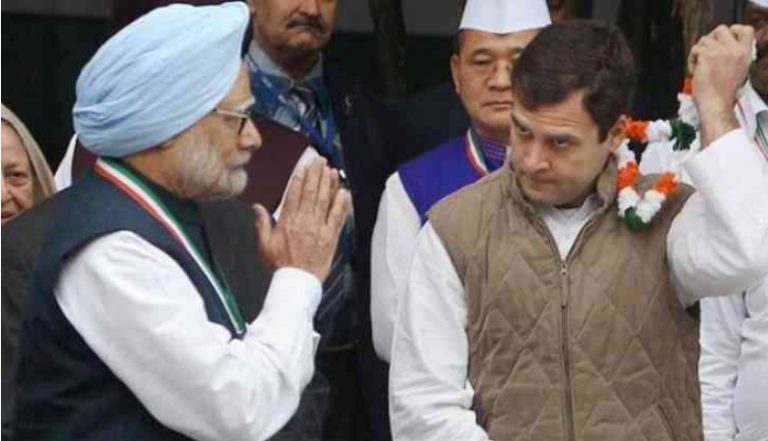
Congress announces a list of 30-star campaigners for Bengal elections, includes stoic Manmohan Singh, comical Rahul Gandhi, and scam-tainted Azharduddin: Details

Congress has released a list of 30 potential star campaigners for the upcoming assembly polls in West Bengal. The campaign includes Party’s interim chief Sonia Gandhi, ex-PM Dr Manmohan Singh & party leaders Rahul Gandhi, Priyanka Gandhi Vadra, Sachin Pilot, Navjot Singh Sidhu, Abhijit Mukherjee and Mohd Azharuddin.

Congress general secretary KC Venugopal, in his letter to the Election Commission, said that the following leaders of the Indian National Congress would be campaigning as per Section 77(1) of the Representation of People Act 1951, for the ensuing first phase of elections to the legislative assembly of West Bengal to be held on March 27.

Senior Congress leader Rahul Gandhi is among the list of star campaigners in West Bengal. Gandhi would perhaps try to lighten the intensifying political environment in Bengal with his inanities or by competing with people in push-ups on his campaign trail. He might even jump in the Hooghly river to flaunt his “six-pack” abs and commune with the local fishermen. There is an enduring doubt in some people’s mind over whether Rahul Gandhi is truly the star campaigner of the Congress party or the opposition parties.

it is also notable that after an extensive campaign against the left-front government in Kerala, Rahul Gandhi will appeal for votes for the Congress-left alliance in West Bengal. It is to to be seen whether he attacks incumbent chief minister Mamata Banerjee, as TMC is Congress ally at the national level.

Former PM Manmohan Singh, perhaps, would energise the Congress campaign by being himself, which is by being maintaining a stoic silence. Scam-tainted Mohd Azharuddin is also included in the list of the campaigners for the upcoming polls in West Bengal. As far as opinion polls go, Congress seems to be in a tricky situation in West Bengal and they might need the services of Azharduddin to ‘fix’ the issues plaguing them.

However, what is surprising is that the senior Congress leader Dr Udit Raj, who is projected by his followers as the next Congress President, has not made the cut.

Another highlight of the star campaigner list is the presence of Congress leader Navjot Singh Sidhu. It is, however, unclear how Sidhu, who fell from the grace after he visited Pakistan where he was seen posing alongside Khalistani terrorist Gopal Singh Chawla, would help revive Congress’ dying fortunes.

It is pertinent to note that though Rahul Gandhi keeps trotting out that India is no longer a democracy under the BJP rule, it seems like the Congress party has also ceased to be a democratic institution where dissenting voices are not honoured and respected. Not a single member of the G-23 leaders, who appealed for a complete overhaul and sweeping new reforms within the party, have been included in the list of 30-star campaigners.

Earlier, senior Congress leader Veerappa Moily even rubbished the existence of G-23, stating that the party is united under Sonia Gandhi’s leadership. “The Congress is one,” he said when asked about the difference of opinion within the party.

While Moily and other senior leaders have dismissed the existence of G-23, it is a loose coalition of a group of dissenters in the party who have been, time and again, calling for a complete revamp of the party. Even Ghulam Nabi Azad, one of the foremost Congress veteran, has not been included in the list of party’s star campaigners in West Bengal. Azad may have fallen out of favour with the Congress party and their feudal lords ‘The Gandhis’ after heaping effusive praises on PM Modi.

Subramanian Swamy expresses angst over SC accepting Ashwini Upadhyay’s petition challenging the Places of Worship Act but not his

The Supreme Court has today issued a notice to the Centre on a petition challenging the validity of the Places of Worship (Special Provisions) Act 1991. The petition was filed by BJP leader and lawyer Ashwini Kumar Upadhyay. While this news definitely left all Hindus gleaming with joy, considering it marks a positive step towards their long-standing efforts to reclaim their religious places of worship which were converted into mosques by Islamic invaders, it has upsetted BJP MP Subramanian Swamy, who used this opportunity to express his angst towards the supreme judicial body of India, charging it with being partial.

Taking to Twitter, the BJP leader and Rajya Sabha MP complained that the Supreme Court today took note of the plea filed by Ashwini Upadyay, but, did not bother to list his PIL on the similar matter.

Lamenting over SC’s bias, the BJP MP Subramanian Swamy said that now he would tag his PIL along with that of Ashwini Upadyay’s. “Today Noted Lawyer Ashwini Upadyaya’s WP challenging the 1991 Act barring any more temples being restored on which mosques had been built, SC issued Notice. SC Registry should have listed my WP on the same matter but erred in not doing so. I will now seek tagging with Ashwini’s”, Subramanian Swamy wrote on Twitter.

Earlier Subramanian Swamy had written to Prime Minister Narendra Modi urging him to amend the Act. He had said that the Act is offensive and ultra vires of his fundamental rights to freedom of worship. “Fundamental Rights cannot be amended or modified by the Parliament or by any law passed by the Parliament. It cannot have the overriding effect of extinguishing my fundamental right of freedom of worship under Articles 25 and 26 of the constitution. Hence, the Ministry of Law should bring an amendment to this Act,” he had written in the letter to the PM.

This Places of Worship (Special Provisions) Act 1991 was introduced on July 11, 1991, by the Narasimha Rao govt at the centre with a motive to prevent Ram Janmabhoomi-like reclamation movements for other places by Hindus in India. This Places of Worship (Special Provisions) Act 1991 placed a status quo retrospectively on the character of places of worship as existing on the date of Independence, i.e. August 15, 1947. However, the Ram Janmabhoomi was kept out of the purview of the act as the title suit for the plot in Agra was already in the court.

The act declares that the character of a place of worship freezes on 15 August 1947, meaning if a place of worship is a mosque as on 15 August 1947, its character is that of a mosque even if it was originally a temple. The act provides for punishment if any person changes or attempts to change the character of any religious place to another.

In his petition, Upadhyay argued that Act takes away rights of Hindus, Jains, Buddhists and Sikhs to reclaim their places of worship through Courts and also legalises illegal acts of Muslim invaders.

Referring to the ongoing dispute before a trial court for reclaiming the birthplace of Lord Krishna at Mathura which is directly hit by the bar under the 1991 Act, the petition, argued by senior advocate Vikas Singh, said that the 1991 law violated the principle of secularism which is an integral part of Preamble and a basic feature of Constitution.

“Hindus are fighting for restoration of birthplace of Lord Krishna from hundreds of years and peaceful public agitation continues, but while enacting the Act, the Centre has excluded the birthplace of Lord Ram at Ayodhya but not the birthplace of Lord Krishna in Mathura, though both are the incarnations of Lord Vishnu, the creator. The apex court has finally decided Ayodhya dispute on November 9, 2019 and found substance in the claim of Hindus and now a new temple is going to be constructed after more than 500 years of demolition,” read the petition filed by BJP leader and lawyer Ashwini Kumar Upadhyay, hearing which the SC sought the Central government’s reply on the matter.

This matter assumes significance in the backdrop of demands by various Hindu outfits to reclaim religious places like Mathura and Kashi, related to Lord Shiva and Lord Krishna respectively, in Uttar Pradesh, which are prohibited under the 1991 law.

The bench of Chief Justice of India (CJI) SA Bobde and Justice AS Bopanna while issuing notice to the Centre on the petition said: “The Centre has barred remedies against illegal encroachment on places of worship and pilgrimages and now Hindus, Jains, Buddhists, Sikhs cannot file a suit or approach a high court under Article 226. Therefore, they won’t be able to restore their places of worship and pilgrimage including temple endowments in spirit of Articles 25-26 and illegal barbarian act of invaders will continue in perpetuity.”

Following SC’s observations, BJP leader and lawyer Ashwini Kumar Upadhyay who took to Twitter to welcome the apex court’s decision on his petition challenging validity of Places of Worship Act.

“SC issues notice to Home, Law & Culture Ministry on PIL challenging validity of Places of Worship Act The Act not only takes away the religious rights of Hindus Jains Buddhists Sikhs to reclaim their places of worship through Court but also legalizes the illegal acts of invadors”, wrote the BJP leader on Twitter.

Google search says James Hewitt, Princess Diana’s lover, is Prince Harry’s ‘real father’: Here is how the rumour began

0

Prince Harry of the British Royal Family has been in the news recently following his Oprah Winfrey interview with wife Meghan Markle which stoked a major controversy. Now, there is a new development that could be a source for more embarrassment for the Royal Family and Prince Harry himself.

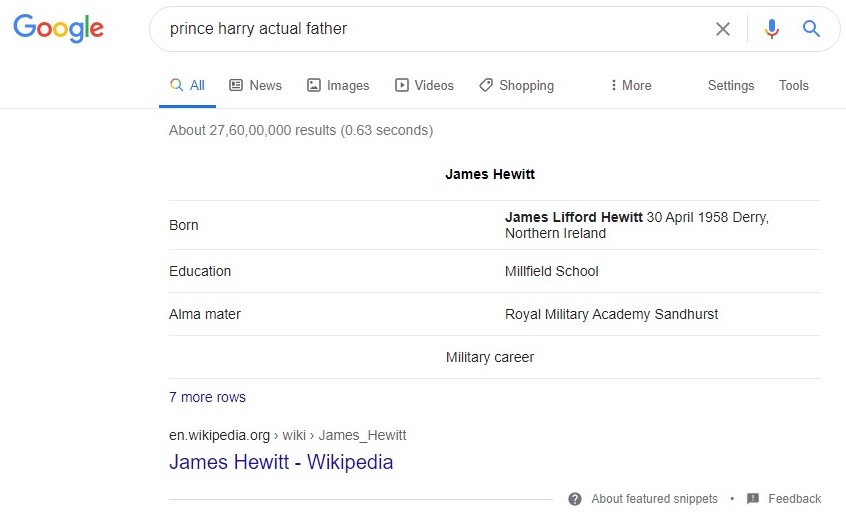
When one searches the term ‘Prince Harry Real Father’ on Google, the answer that props up is James Hewitt, a British Army officer Princess Diana was having an affair with. In reality, his father is Charles, Prince of Wales.

Prince Harry real father
Google search result

However, searching the same set of words in incognito mode throws up the correct result.

Prince Harry real father
When searched in Incognito Mode

Nevertheless, when one searches for ‘Prince Harry actual father’ in Incognito mode, it again shows James Hewitt as his father.

Incognito mode shows similar folly

There have been rumours that James Hewitt is the biological father of Prince Harry, a claim that Hewitt has himself denied. But that has not stopped the rumour mills. The superficial similarities in their appearances has certainly contributed to the rumours. Princess Diana had admitted to having an affair with him in the mid-90s.

The affair is reported to have begun when James Hewitt have been asked to give Diana riding lessons as a member of the household Cavalry. He has consistently denied the rumours and said that Prince Harry was already a toddler when the affair began.

Prince Harry was born in 1984, the affair reportedly began in the mid 1990s. He has told the Daily Mirror, “When I first met Diana, Harry was already a toddler. I can understand the interest, but Harry was already walking by the time my relationship with Diana began. Admittedly, the red hair is similar to mine, and people say we look alike.”

Google’s algorithms, however, appear to have been hoodwinked by the rumour mills into throwing up Hewitt’s name when people search for Prince Harry’s “real father”. Quite clearly, regardless of the inadvertent search results, Prince Harry’s father is Charles, Prince of Wales.

Massive furore in Pakistan Senate after the discovery of hidden Chinese spy cameras inside the hall

0

Chaos swept over the Pakistan Senate or the Upper House of the Parliament on Friday during voting for the Senate Chairman’s post after the Federal Minister for Information Shibli Faraz accused the opposition of installing spy cameras over the polling booth for the chairman and deputy chairman elections.

Before the voting process commenced, Pakistan Peoples Party (PPP) senator Mustafa Nawaz Khokhar claimed that “spy” cameras were installed right over the polling booth. It was reported that Chinese spy cams were discovered inside the Senate hall. Senator Raza Rabbani said installing spy cameras was a violation of the law.

Following the accusation, many MPs rose in uproar and the voting process was disrupted.

The Senate was holding a secret ballot today to elect its chairman and deputy chairman. Earlier, 48 newly elected members of the upper house took the oath.

On March 3, Senate elections were organised in Pakistan on the seats for which current MPs were set to retire on March 11. The Senate Secretariat had informed that the oath-taking ceremony of the newly-elected senators would be taking place in the morning, followed by the election for the chairman and deputy chairman in the afternoon or evening.

Former PM Yusuf Raza Gilani of Pakistan Peoples Party (PPP) was nominated by the Pakistan Democratic Movement(PDM), the opposition alliance of 11 parties, for the chairman’s post while Maulana Ghafoor Haidri of Jamiat Ulema-e-Islam Fazl (JUI-F) was nominated for the deputy chairman post.

On the other hand, the incumbent Tehreek-i-Insaf (PTI) of Prime Minister Imran Khan, along with its allies, selected Sadiq Sanjrani for the chairman’s post and Mirza Mohammad Afridi for deputy chairman.

A fierce competition between the two sides is expected in the House of 100. The one who will be able to get 51 votes will be the winner. The opposition claims it has the support of 51 senators. Similar claims have been made by the government.

The two sides have accused each other of using money and other tricks to lure legislators to support their candidates.

Earlier, Gilani’s win as a senator from Islamabad general seat was a bummer for Pakistan PM Imran Khan, who had campaigned for his Cabinet colleague, PTI candidate and Finance Minister Abdul Hafeez Shaikh. Though, Gilani had narrowly defeated Shaikh by racking up 169 votes as compared to his rival who got 164 votes.

The tenure of a Senator in Pakistan is for six year, with half of them retiring after three years. A new chairman and his deputy is elected after every three years to run the upper house.

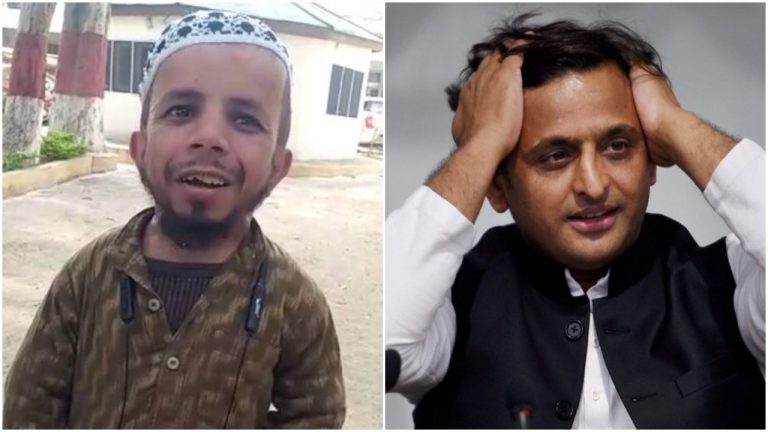
Uttar Pradesh’s ‘little man’ wants Akhilesh Yadav to come back to power to find him a bride: Watch video

A 26-year-old Muslim man in Uttar Pradesh recently approached the Shamli police, asking them to find him a bride as his family was not helping him out. Azeem Masoori stands at 3 feet 2 inches and is often referred to as ‘little man’.

Azeem Mansoori, who is just two feet in height, is frustrated as no girl wants to marry him due to his physical disability. Tired of finding a partner, Azeem has now reached the Kairana police station’s doorsteps, demanding them to find a suitable bride to get married.

Azeem Mansoori, a resident of Kairana, has pleaded with the woman police official to help him get married, saying, “Madam, how long will I remain a bachelor”.

The aggrieved person said he has failed to find a bride for himself even after searching a lot. Accusing his parents of betrayal, Azeem said that his parents did not agree to his marriage whenever he found a bride. Azeem said that his dream of marrying has remained a distant dream till now.

Speaking to the media, Azeem contended that as police are public servants, they should help him find his bride. He also said he had earlier approached the Kotwal SDM several times before but to no avail. Interestingly, Azeem said he had also met Uttar Pradesh Chief Minister Yogi Adityanath to narrate his ordeal. However, even Chief Minister Yogi Adityanath has not succeeded yet in finding a bride to Azeem.

“I have been trying for so long. Is there no one with whom I can live my life? Now I have come to ask for help from the Public Servant Police,” he said.

Reportedly, Azeem’s parents are searching for a girl for him ever since he turned 21 years old. Due to Azeem’s height, no one agrees to the marriage proposal.

Rejection has caused him a lot of stress, unable to sleep: Azeem Mansoori

Facing repeated rejections from several prospective brides, Azeem Mansoori said the rejection has caused him a lot of stress, and he cannot sleep at night. Requesting the police to help him, Azeem, who is the third of his six siblings, said he was ready to get hitched to any girl irrespective of her caste, creed, colour or religion.

But, Azeem has only one demand, i.e., his future wife must be educated. He wished to get married before Ramzan and promised that he would take her new wife to Goa, Shimla and Manali for honeymoon.

“My wish is to get married before Ramadan. No matter how the girl is, she should be educated. I’m very upset. And, now if the police will help me in getting married, I will take my wife to Goa, Shimla and Manali for the honeymoon,” Azeem Mansoori said.

Interestingly, Mansoori said that he had met former UP Chief Minister Akhilesh Yadav in 2019 in connection with his marriage. He hoped that Akhilesh Yadav would return to power in the 2022 assembly elections and find him a bride.

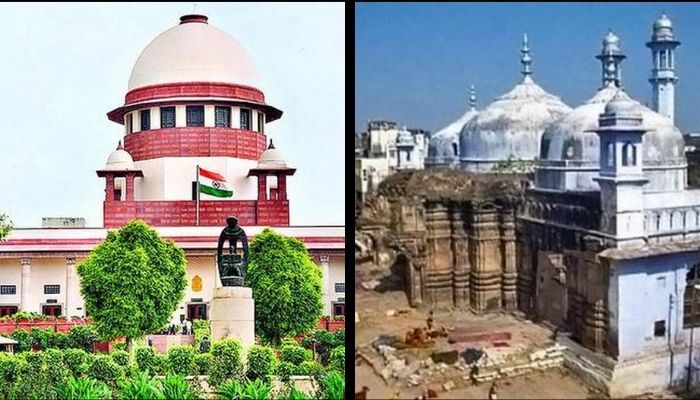
Supreme Court issues notice after petition challenges validity of 1991 Act that prevents reclamation of Kashi-Mathura temples

On Friday, the Supreme Court of India issued notice to the Centre, after a petitioner challenged the Places of Worship Act, 1991.

As per reports, the notice was issued by a Bench headed by Chief Justice of India SA Bobde and Justice AS Bopanna in response to a petition filed by BJP leader Ashwini Kumar Upadhyay. The petitioner was represented in Court by Senior advocates Vikas Singh and Gopal Sankaranarayanan.

In his petition, Upadhyay has argued that the Places of Worship Act (Special Provisions Act) prevents the reclamation of places of worship sacred to Hindus, Buddhists, Jain and Sikhs. He also pointed out that the law legitimises the illegal acts of invaders.

The petition said, “Centre has barred the remedies against illegal encroachment on the places of worship and pilgrimages and now Hindus, Jains, Buddhists, Sikhs cannot file Suit or approach High Court under Article 226. Therefore, they won’t be able to restore their places of worship and pilgrimage including temples-endowments in spirit of Articles 25-26 and illegal barbarian act of invaders will continue in perpetuity.”

It must be mentioned that the Places of Worship (Special Provisions) Act, 1991 mandates that the religious character of all places of worship must remain as it was on August 15, 1947. The law further states that no suit or legal proceeding must remain in Court challenging the character of any such place of worship. The only exception to the law was the Ayodhya Ram Mandir.

The construction for the majestic Ram temple has begun in Ayodhya, following the historic Ram Janmabhoomi verdict in 2019. Several Hindu organisations have been demanding the repeal of the Places of Worship (Special Provisions) Act, 1991 that prevents the legal reclamation of two Hindu temples of historic importance, namely, Kashi and Mathura.

In his petition, the BJP leader has emphasised that the Act gave way to an arbitrary irrational cut off date by “declaring that character of places of worship-pilgrimage shall be maintained as it was on August 15, 1947, and no suit or proceeding shall lie in Court in respect of disputes against encroachment done by fundamentalist barbaric invaders and lawbreakers and such proceeding shall stand abated.

Suit seeking restoration of worship at the ancient Hindu temple

Last month, a suit was filed before the court of civil Senior Divisional Judge, Varanasi seeking restoration of the permanence of worship rituals at the principal seat of an ancient temple which is now part of the Gyanvapi mosque complex near the Kashi Vishwanath temple. The suit was filed by Rajana Agnihotri and 9 other devotees who are also worshippers of Lord Shiva practising the Vedic Sanatan Hindu Dharma.

The suit was registered as a miscellaneous case that will come up before the concerned court for the hearing, as informed by petitioners’ counsel HS Jain. Counsel for the Committee of Management Anjuman Intazamia Masajid, who was reportedly present in the court from the respondents’ side, sought time for filing a counter-affidavit. 

Union government to enhance distribution of fortified rice to fight malnutrition, production to be doubled in the country

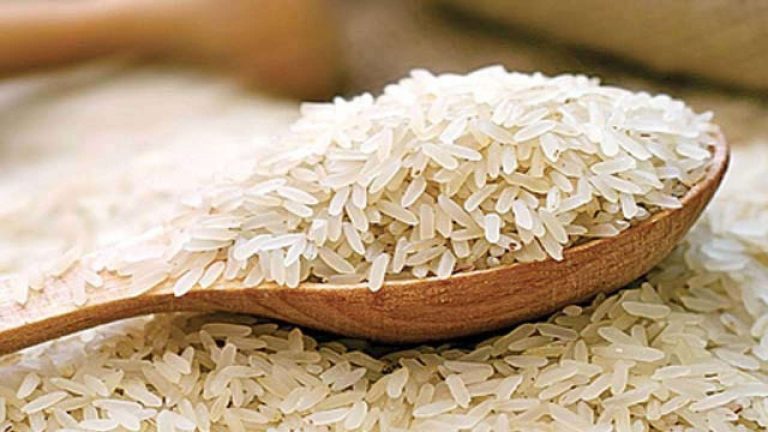
The union government has decided to enhance the distribution of fortified rice to malnutrition. Apart from the PDS system through which it is being distributed, now fortified rice will also be distributed via Integrated Child Development Services and Mid-Day Meal scheme from April this year.

At present, fortified rice is being distributed in one district each in six states, out of total 15 states identified for implementing the scheme, on a pilot project basis. The objective of the scheme is to address the problems of anaemia and micro-nutrient deficiency in the country. Fortification of rice is a cost-effective and complementary strategy to increase vitamin and mineral content in diets and a step towards nutritional security and to fight anaemia and malnutrition in the country. It is also helpful that 65% of India’s population consumes rice as staple food.

“Centrally Sponsored Pilot Scheme on Rice Fortification and its Distribution under PDS” was approved by the government of India in 2019-20 for a period of 3 years, with total outlay of Rs 174.64 crore. 15 states had consented to participate in the scheme and had identified 1 district each for implementation of the pilot scheme.

Among the 15 states, Andhra Pradesh, Gujarat, Maharashtra, Tamil Nadu, Chhattisgarh and Uttar Pradesh have already started distribution of fortified rice under the scheme in their selected districts. Till January 2021, approximately 94,574 MT of fortified rice has been distributed in these 6 States. Kerala, Odisha and Madhya Pradesh are likely to start the distribution fortified rice under the pilot scheme shortly.

Now to further enhance the distribution of fortified rice, it has been decided to distribute fortified rice under Integrated Child Development Services (ICDS) & Mid-Day Meal Scheme covering all the ICDS and MDM Centres across the country from April, 2021. Ministry of Women and Child Development and the Department of School Education and Literacy have agreed to bear the Incremental Cost at the rate of Rs 0.73 per kg for the fortification of rice under ICDS and MDM.

If required for this enhanced distribution, annual production of fortified rice will be increased accordingly. At present 15,000 MT of FRK (Fortified Rice Kernel) is being produced, it can be increased to 30,000 MT, which will be sufficient to meet the demands for ICDS and Mid-Day Meal scheme distributions.

The Department of Food and Public Distribution has also written to the MSME ministry to consider providing assistance to the rice millers for producing fortified rice. The ministry has said that a subsidy or suitable provision for providing financial assistance/package under ‘Aatma Nirbhar Bharat Abhiyaan- Corpus for MSMEs’ can be provided to the millers to encourage existing and new rice millers to equip themselves with necessary equipment to produce fortified rice to meet the demand for the same.

To produce fortified rice, broken rice is ground into powder, to which the necessary nutrients are added. This mixture is then shaped into rice-like kernels. Rice kernels can be fortified with several micronutrients, such as iron, folic acid and other B-complex vitamins, vitamin A and zinc etc.

USA, EU and UK block India and South Africa led proposal to temporarily waive intellectual property rights on vaccines to boost production

Western countries have blocked a proposal at the World Trade Organisation that would have boosted vaccine production and helped developing countries combat the Coronavirus pandemic. The proposal led by India and South Africa urged the WTO to temporarily waive off intellectual property rights for vaccines and Covid-19 related treatment.

The United States of America, the European Union, the United Kingdom, among others, objected to the proposal that would waive off provisions of the TRIPS Agreement, that governs international property rights, but only until widespread vaccination and immunity was achieved across the world.

South Africa expressed its concerns regarding the actual intent behind the decision of the developed world to block the proposal at the most recent meeting of the WTO’s Council for Trade-Related Aspects of Intellectual Property Rights.

“It is disappointing that despite the majority of the world being on the side of the TRIPS Waiver, it has been blocked by a few countries once again,” Katie Gallogly-Swan, policy coordinator at the UN Conference on Trade and Development, told Law360. “It is time to accept that we are not on track to vaccinate the world.”

Yuanqiong Hu, legal and policy adviser to Doctors Without Borders’ Campaign for Access to Essential Medicines, told Law360 “what we need today are concrete actions, not more discussions and consultations. Some countries that oppose the monopoly waiver continue to propose voluntary measures, but these governments know that this will not be sufficient and will not result in the change we need to see.”

US Senator Bernie Sanders had urged the USA to support the waiver, “It is unconscionable that amid a global health crisis, huge multibillion dollar pharmaceutical companies continue to prioritize profits by protecting their monopolies and driving up prices rather than prioritizing the lives of people everywhere, including the Global South.”

Oxfam said in a statement, “This is a massive missed opportunity to speed up and scale up the production of lifesaving vaccines worldwide by waiving the intellectual property barriers that prevent more qualified manufacturers from joining the effort.”

It said, “Rich countries are vaccinating at a rate of one person per second yet are siding with a handful of pharmaceutical corporations in protecting their monopolies against the needs of the majority of developing countries who are struggling to administer a single dose.

“It is unforgivable that while people are literally fighting for breath, rich country governments continue to block what could be a vital breakthrough in ending this pandemic for everyone in rich and poor countries alike,” added Oxfam.

Pakistan’s cash woes: UAE asks Imran Khan to return USD 1 billion by March 12 deadline

0

The United Arab Emirates (UAE) have put the Imran Khan government in a tight spot after it has reportedly asked the cash strapped country to return its one billion dollars, which the former had deposited in the central bank of Pakistan.

Actually, the United Arab Emirates (UAE) had deposited the aforementioned amount with, State Bank of Pakistan (SBP), the central bank of the country. Now, since the amount has reached its maturity, the Gulf nation has asked the Imran Khan government to return the same and has set March 12 as its deadline, as per reports.

Coming as a major jolt to a country that is already stuck neck-deep in international debt, Pakistan has begged UAE to give it some extra time as that returning such a huge amount can impact its economic situation at present.

Pakistan officials have made innumerable attempts to reach out to UAE, especially to Crown Prince Mohammad bin Zayad Al Nahyan but haven’t succeeded so far.

Pakistan took a loan from China to repay Saudi loan

Last year, the islamic country had taken a loan of 1 billion dollars from China to repay a I billion dollars loan from the kingdom of Saudi Arabia. Reports at that time had revealed that Pakistan owes China double the amount it owes to the IMF.

Pakistan aircraft seized over non repayment of leasing fees

Pakistan’s precarious state of the economy is an open secret, and now, the coronavirus pandemic has only further worsened the economic woes of cash-strapped Pakistan. Last month, Malaysian authorities seized a Pakistan International Airlines Boeing 777 plane, with passengers still on board, at Kuala Lumpur airport for not paying leasing fees worth $15 million.

The embarrassing incident had left the Pakistan government red-faced. Awkward as the incident was, the unpaid leasing fees are just the tip of the iceberg. Pakistan’s debt problem has been escalating for some years now. According to a World Bank estimate, amid the Covid pandemic, Pakistan’s real GDP growth is estimated to have declined from 1.9% in the financial year 2019 to -1.5% in FY2020.

Pakistan’s public debt went past 87% of GDP at the end of 2019-20, up from about 72% of GDP at the end of 2017-18. Moreover, the country’s total external debt and liabilities rose to $113.8 billion in the fiscal year 2020 from $106.3 billion in the fiscal year 2019.

‘FCI has optimally used state storage facilities and Adani Silos, no loss to the exchequer as suggested by the CAG,’ clarifies Ministry of Consumer Affairs

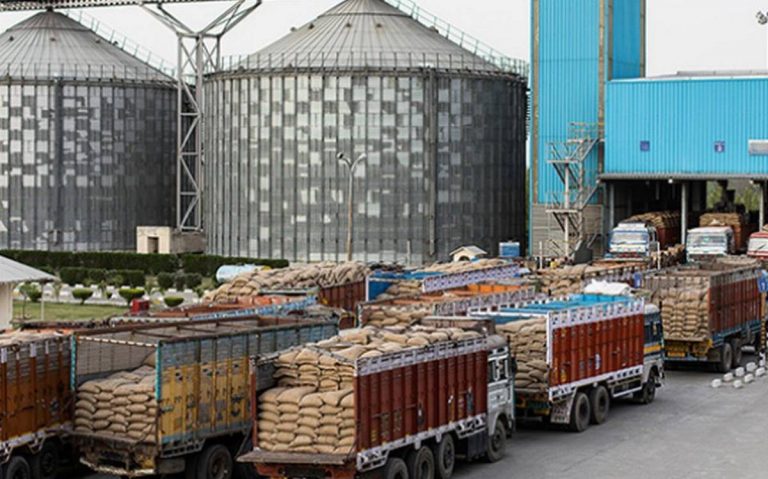
A few days after media reports had claimed the Comptroller and Auditor General of India (CAG) had accused the Union government of failing to optimally utilize storage capacity at Adani Silos at Kaithal resulting in massive losses to the public exchequer, the Ministry of Consumer Affairs, Food and Public Distribution has given a detailed clarification refuting the allegations of causing losses to Food Corporation of India.

On Wednesday, the far-left news outlet ‘The Wire’ had published a report claiming that the CAG had reprimanded the Food Corporation of India (FCI) in April 2018 for allegedly causing a loss of Rs 6.49 crore to the taxpayers due to the failure to utilise available storage capacity at Adani Silos located in Kaithal, Haryana.

The report had also claimed that the Narendra Modi government has been asking the CAG to drop these paragraphs from the CAG’s audit report. As per the Wire, the Ministry of Consumer Affairs, Food and Public Distribution, under which FCI operates, has written a letter to the CAG demanding the paragraph be stricken off the report. The Wire report tried to insinuate that the ministry wants CAG to drop the para because it is related to Adani Silos.

However, the Ministry contends that the additional expenditure has not been assessed correctly by the CAG.

CAG says FCI under-utilised Silos, causing Rs 6.49 crore loss

According to The Wire, which quotes a CAG report, between 2013-14 and 2015-16, Rs 24.28 crore was paid to Adani Agri Logistics Ltd (AALL) for storage capacity, which the FCI never utilised. During this period, storage space with a total capacity of 5.18 lakh metric tonnes (LMTs) remained unoccupied in the Adani silos for 11 months. The FCI did not use it to store wheat but kept paying the rent, the report claimed.

Reportedly, the FCI had entered into a contract with AALL in 2007 for setting up silos at Kaithal in Haryana to store two LMTs of wheat.

In February 2013, FCI signed another agreement agreeing to pay the company rent amounting to Rs 1,842 per tonne every year for wheat storage. In September 2014, it was hiked to Rs 2,033.40 per tonne per year.

The report claims that the agreement was reached based on ‘guaranteed tonnage’, which means that the FCI has to pay the rent for the entire two LMTs of wheat, irrespective of the actual amount of wheat stored.

Further, the CAG report, according to the report, pointed out that the FCI failed to transfer wheat from state-run silos to Adani silos, as a result of which not only did it have to pay the rental for vacant storage space at the latter but also had to pay carryover charges (CoCs) for storing wheat in the state godowns, incurring an additional cost of Rs 6.49 crore of the taxpayers’ money. The CAG suggested that the loss could have been avoided.

Presuming the losses, the CAG report stated that the Kaithal silo remained vacant on many occasions between 2013-14 and 2015-16. The storage capacity of 1.33 lakh tonnes, 67% of the hired storage capacity, was not used in April 2014, even though the stock was lying with state-run agencies at Pehowa, Pundri and Pai, during the same period.

According to the CAG, quoted by the Wire, it was supposedly cheaper to store wheat in silos than in state-run godowns. Hence, FCI should have transported the wheat to the silos to avoid wastage of taxpayers’ money.

However, the Ministry had soon responded to the CAG’s claim, saying it was a wrong assessment and asked them to withdraw the report.

Ministry clarifies, says CAG’s assessment is wrong

The Ministry of Consumer Affairs, Food and Public Distribution responded to the assessment stating that the CAG’s audit has based its calculation on storage charges on full payment of the guaranteed capacity of 2 LMT of the Kaithal Silo.

“However, the FCI had reduced the annual guaranteed tonnage for Kaithal silo to 1.90 LMT in 2013-14, 1.41 LMTs in 2014-15, and 1.33 LMTs in 2015-16. Thus, effectively extra payment for vacant space has been avoided,” the ministry had clarified. The ministry has said that contrary to the claim made in the CAG report, rent for the entire 2 LMT space in the silos was not paid, as the guaranteed tonnage was reduced.

Further, “Optimal utilisation of storage space does not mean whole capacity will remain utilised all the time. Some capacity will fall vacant as and when stocks are moved out. Since wheat procurement lasts for only 2 months and dispatch takes place every month, capacity utilisation will keep on decreasing till next procurement season,” the ministry said.

The ministry also apprised the CAG that their audit has not taken into account the 0.25% storage loss admissible in silos during the process of handling and storage. Hence, storing wheat in state agency go-downs indirectly leads to a saving of 0.25%, the ministry said in its first letter on October 28, 2018.

Explaining the rationale behind keeping the stock in the SGA godowns, the ministry had said, “In case of takeover of stocks from SGA before 1st July, FCI will not be entitled to 1.00% gain on the stocks taken over. Thus, there is a further 1.25% loss in a silo. Moreover, FCI would also have incurred cost on transportation and handling for shifting stock to the silo.”

CAG refutes Ministry’s clarifications, presumes losses due to storage in state-owned godowns

However, the CAG disagreed with the explanation provided by the Ministry of Consumer Affairs. It further contended that the audit had calculated the avoidable expenditure based on the actual capacity utilised at Silo, which was 2 LMT. The CAG said that the FCI’s claim that rent was paid on reduced guaranteed tonnage is not relevant as the capacity available at the silo was two LMTs of wheat, which could have been stored there.

As per CAG, the cost incurred for transporting food grains from the state godowns is Rs 11.04 to Rs 16.54 per quintal. Besides, the FCI has to pay Rs 2.11 to Rs 2.85 per quintal as debagging charges, pushing the total of Rs 13.15 to Rs 19.39 per quintal to transfer stock from godowns to silos, the CAG noted.

Since it costs Rs 20.91 to Rs 23.29 per quintal to keep the stock in the state-run godowns, storing the grain in the Adani silo at Kaithal could have saved Rs 2.7 to Rs 9.0 per quintal, the CAG presumed in its report.

Ministry responds to CAG again, says filling Silos would hinder procurement

The ministry issued another letter on February 18, 2019, reiterating its rationale behind the storing of wheat in SGAs for a short amount of time, saying it was a ‘special case’ in which storing wheat in SGA godowns instead of silos was more beneficial.

In its response to the Union government, the CAG yet again said that even though the guaranteed tonnage has been reduced, the storage capacity of the silo was two lakh tonnes. Hence, the ministry’s argument is not relevant, and the paragraph will stand.

On April 21, 2020, the ministry wrote another letter, saying if the CAG report is to be followed, that would mean that the Adani silo should remain full every month. If the FCI uses the entire space in the silos, then in the next procurement season, Adani silos cannot procure directly from the farmers because there will be no vacant storage space, the ministry said.

Read: Magsaysay Awardee NDTV India editor Ravish Kumar lies about Adani’s grain silos in Punjab amid ongoing farmer protests

“By procuring huge quantities from the farmers at the silos, the expenses incurred in the mandi on marking the bags, filling bags with grains, weighing them, sealing them, debagging, and transportation can be saved,” the letter said.

In its letter, the FCI contended that the CAG has calculated the loss based on the capacity of two LMTs in the Adani silo, while the payment was not made for this amount. The amount of guaranteed tonnage was reduced each year, the ministry reiterated.

However, the CAG responded again, saying that instead of stocking grains as per the capacity of the Adani silo, FCI stored it in the SGA godowns, thus causing additional expenditure on storing. “Therefore, the loss assessed by the CAG is based on the payment made to the SGA godowns and not the rental of the vacant storage space in the Adani silo,” the report said.

In its assessment, the CAG had stated that due to the non-transfer of stock in the Adani silo, additional expenditure of Rs 2.7 to Rs 9.0 per quintal had been incurred. The payment to SGAs to store wheat was made at the rate of Rs 20.91 to Rs 23.29 per quintal in these godowns. As per CAG, the FCI failed to act in this direction, due to which the SGA godowns had to be paid an additional amount of Rs 6.49 crore between April 2013 and October 2016, which according to them, was avoidable.

Contrary to the CAG’s assessment, the FCI, in a letter dated August 14, 2018, has said that they have earned a profit of Rs 1.59 crore in 2013-14 and Rs 42.23 lakh in 2014-15 by storing wheat in the SGA godowns.

However, the CAG has rejected the estimate provided by the FCI. In return, the CAG enquired that if storing grains in silos brings about losses, why is the government of India, allowing the construction of silos.

FCI saved Rs 20 crores by optimally using storage facilities, contends the Ministry of Consumer Affairs

Speaking to OpIndia, sources at the Ministry of Consumer Affairs, Food and Public Distribution have once again reiterated that the question of presumptive losses, as claimed by the Wire citing the CAG report, does not arise as both the storage facilities, i.e., the state-owned godowns and Adani Silos have been optimally used and stressed that no losses have been incurred as suggested by the CAG.

In a detailed response to OpIndia, the ministry officials said that the FCI had agreed to acquire an additional storage capacity of two lakh metric tonnes (MT) at Kaithal from a private company on a Built, Own and Operate (BOO) basis in 2005.

The senior officials reiterated that the optimal utilization of storage space does not mean the whole capacity will remain 100% utilized all the time. They said that CAG admitted that the Silos was 100% utilized during the period April-June, i.e. wheat procurement period. Since wheat procurement lasts for only two months and dispatch takes place every month, capacity utilization will keep on decreasing till the next procurement season as some capacity will fall vacant as and when stocks are moved out, the officer clarified over the allegations of decreasing storage in Adani Silos.

Responding to the question of Adani Silos being unutilised and vacant, sources inside the ministry said that out of the total periods of 43 months considered by CAG, the stock was less than the guaranteed capacity in only 8 months in 2013-14 and 3 months in 2014-15. Barring this period, there was optimal utilisation of storage space in the Kaithal silo for most of the period from April 2013 to October 2016.

In fact, the Ministry of Consumer Affairs said that the total four wheat procurement season is covered in the period under review. The stock position has surpassed 2 LMT every time and has even gone up to 2.15 LMT in April 2016, said the ministry.

On the question of presumed losses as suggested by the CAG, the Ministry responded by saying that the contention of financial loss based on available capacity is not tenable as the payments had to be made at reduced AGT (Annual Guarantee Tonnage). However, the CAG has made the calculation based on capacity available, but in fact, the payment of 2 LMT was never due in the first place itself, added sources in the ministry.

According to the ministry, the CAG, while making the calculations, has considered payment made to SGAs towards CoC vis-a-vis the likely cost of shifting stocks to SILO. The difference between the two has been assumed to be an avoidable loss.

However, the CoC comprises of two components, i.e. Interest and Storage charges. FCI releases the payment to SGAs at the time of taking over the stock, and it also pays interest to SGAs that is 1% higher in CoC than the rate at which funds are available to FCI, however, it offsets the major component of CoC.

The ministry sources explained, “For example, for the year 2016-17, Out of total CoC of Rs.231/MT, the amount against interest is Rs. 163.73/MT and RS.67.60/MT towards storage charges. The cost of shifting food grains from SGA godowns to Silo has been taken as Rs.163/MT for 2016-17 by the CAG”.

Considering the above, the cost of shifting the food grains to Silo is RS.163/MT should have been compared with the storage charge of Rs.67.60/MT payable to SGAs, the ministry sources pointed out.

The ministry said that the entire capacity at the Silos could not be filled as it would hinder the process of procurement during the season as the silos would have already been 100% utilized. This would lead to non-acceptance of the bulk wheat brought by farmers directly to Kaithal silo and, consequently, forgo the potential gain during procurement, the ministry said.

As per the ministry, the CAG has also not factored in the purchase of wheat in bulk from the farmers at Silos that saves Mandi Operations’ cost. As per a study conducted by RITES, there is a saving of Rs. 945/MT if wheat is purchased in bulk at Silo as compared to purchase in Mandi. This itself amounted to a saving of Rs 20 crore in the last eight years.

“Had FCI acted as per course suggested by CAG then not only the savings of approx. Rs 20 Crore would not have been there, but also the idea of encouraging farmer to bypass the normal route of procurement involving multiple handling/players and offer their stocks for direct procurement at SILO would not have picked due to capacity constraint at the SILO,” said the Ministry of Consumer Affairs, Food and Public Distribution.