Home Blog Page 486

RSS, National Education Policy, and self-serving opposition politics: TN language war, Congress’ politics and more

In his address at the annual function of RSS Delhi on December 7th, 1947, M.S. Golwalkar, the second Sarsanghchalak (Chief) of RSS, declared, “Swayamsevaks would prefer to burn themselves to ashes in the cause of their Motherland, her defence, honour and culture. To save Hindutva is the sacred mission of the Sangh. With that firm determination, we are facing our problems and no one, not even the Creator of the Universe, can stand in our way of achieving true Bharatiyatva.”

Guruji, as he was fondly called right from his days of teaching at BHU, a disciple of Swami Akhandananda, had the crux of the RSS mission imbued in that statement. While the organization that had umpteen misgivings and accusations hurled at it ever since its founding days in 1925 steps into its centenary year, it remains well entrenched in India’s heartland with around 5 – 6 million members and more than 73,000 Shakhas (branches) nationwide. Indeed, RSS’ essence remains a cultural organization, away from active power politics – though its ideology has distinctly shaped and nurtured the democratic politics of Bharat. 

How is RSS shaping the tenets of the education system in Bharat, across technological advancements and deep-rooted wisdom of Rishis and Puranas? 

How is RSS shaping the education system?

There are multiple aspects of the notion of cultural nationalism that RSS exemplifies. Education is one of them. It is to be noted that at the heart of this is an effort around ‘intellectual decolonization’, with an aim to move away from the vestiges of Eurocentrism. It also centres around ‘inclusive nationalism’, which celebrates the plurality of Indian cultures.   

Akhil Bharatiya Pratinidhi Sabha (ABPS), the apex policy-making body of RSS, in its 2016 Resolution (No. 2) at the ABPS Sabha held in Nagaur, Rajasthan, laid down clear guidelines around how the education system in contemporary India should be like. “…Every child should get value-based, nationalistic, employment-oriented and skill-based education in an atmosphere of equal opportunity. It is utmost essential to ensure proper training, appropriate salaries and strengthen the dutifulness of the teachers to enhance their standard” – should be the driving force behind India’s education system. 

RSS has been of the opinion that the purpose of education is not merely to enable the student to earn a livelihood but also to impart values of patriotism, the spirit of service, and social responsibility. The medium of education should be Bharatiya languages. Hindi as a National Link Language should be encouraged. Working knowledge of one foreign language like English, French, German, etc should also be imparted. The prime goal should be character-building education, not sex education. Focus on Sanskrit should be given. 

Ever since Guruji established the first Gita school at Kurukshetra in 1946, Saraswati Shishu Mandirs began to operate in 1951, promoted by Nana Ji Deshmukh, Deendayal Upadhyaya, and Rajju Bhaiya. This subsequently mushroomed into nearly 25,000 schools. Later, many other schools and colleges, initiated by Sangh-inspired people, got nurtured under the overarching apex body Vidya Bharati. Most of the Vidya Bharati schools are affiliated to CBSE or their local State Boards. ‘Sanskar Kendras’ (cultural schools) are also run to impart moral values to young minds. The National Education Policy (NEP) 2020 saw a copious footprint of RSS’ educational ethos.

Key themes were universal access of education at all levels, early childhood education (shape young minds in line with our cultural roots), Foundational Literacy and Numeracy, increased flexibility to choose courses, mother tongue or regional language as medium of education till Class 5 (promote regional language to train pupils), Gender Inclusion Fund and Special Education Zones for disadvantaged regions and groups, and others. As can be seen, RSS’ goal of imbibing a deep sense of cultural nationalism to young minds has been given a fillip through NEP 2020.        

‘सा विद्या या विमुक्तये’ (Sa Vidya Ya Vimuktaye) – goes the motto of Vidya Bharati. Originally present in Verse 1.19.41 within Vishnu Purana, the phrase means – ‘That is knowledge which liberates’. Indeed, the stellar service rendered by Vidya Bharati and other educational institutes under RSS’ fold have been nurturing Bharat’s young minds to liberate themselves from colonial bondage and embrace the best of what India’s priceless heritage offers.

Resistance to NEP

American author Orison Swett Marden said, “Success is not measured by what you accomplish but by the opposition you have encountered and the courage with which you have maintained the struggle against overwhelming odds.” BJP-led NDA govt at Centre has probably seen this first hand, day in and out. Karnataka and Tamil Nadu vehemently protested against NEP 2020. TN’s primary opposition is the 3 language formula, which to them is a covert attempt at imposing Hindi. In reality, it has been made amply clear that no language will be imposed on any State. 

In it’s 2018 resolution, ABPS came up with the view that ‘The languages and dialects, prevalent in the country are most essential to protect our culture, noble traditions, excellent knowledge and vast literature as well as to promote creative thinking.’ The 3 language formula is perfectly aligned to that by keeping flexibility of choice to States and individuals while ensuring that at least 2 of the 3 languages are native to India. There can’t be a more balanced approach that lays focus on both modernity and tradition! Why the Opposition from DMK and Congress then? 

The short answer is politics. TN’s opposition stems from the inflamed sentiments against Hindi imposition that shaped Dravidianist polity in mid 20th Century. Right through 1937-40, 1948, and 1965, TN had seen agitations. It is ironic that the 1968 NPE had in fact mandated Hindi, unlike NEP 2020. It stated, ‘Every effort should be made to promote the development of Hindi.’ As a consequence of the agitations, TN had seen a two-language policy (Tamil and English) being institutionalized. The ‘link language’ as a consequence was clearly missing for TN. Bharat’s root can be best understood by using common parlance across its length and breadth, its sounds and colours – and TN being such a profoundly cultural state replete with temples and heritage deserves this more so. 

More politics by TN

DMK took the misaligned resistance to NEP 2020 a step further by refusing to partake in the PM SHRI initiative. PM Schools for Rising India (PM SHRI) was approved by the Cabinet in 2022 and it aims to set up more than 14,500 schools that enshrine the tenets of NEP 2020. The schools aim at being exemplary schools for children, and by linking a noble cause as this to petty regional politics, DMK only did a disservice to deserving pupils of the State!

Curious case of Congress’ opposition to NEP 2020

The most bizarre, and downright ludicrous, instance of opposition to NEP 2020 has been from INC. The first National Education Policy of 1968 was introduced by the then PM Smt Indira Gandhi, on the recommendations of the Kothari Commission18 (1964-66). Of the various recommendations therein, a section was devoted to the 3-language formula. Hindi was clearly called out as the ‘link language’, an idea that RSS also holds. It further mentioned, ‘In developing Hindi as the link language, due care should be taken to ensure that it will serve, as provided for in Article 351 of the Constitution, as a medium of expression for all the elements of the composite culture of India.’ 

The same Congress is now holding placards against Hindi imposition when NEP 2020 mentions nothing of that kind. 

The shortcomings of NPE 1968 were highlighted by Ramamurti Review Committee (1990) and Janardhan Reddy Committee (1992), findings from which were incorporated into the new NEP 2020 drafted by K. Kasturirangan Committee. Naturally, not only is NEP 2020 a more flexible set of guidelines as relates to the 3-language formula, but it is an improved version of the earlier NPE too. Hence, the party that should worry and oppose the least around NEP 2020 or ‘Hindi imposition’ is Congress! 

Best of past and present 

In a letter as a reply to Maharaja of Khetri, dated 04.03. 1895, Swamiji wrote, “…It is out of this past that the future has to be moulded; this past will become the future. The more, therefore, the Hindus study the past, the more glorious will be their future, and whoever tries to bring the past to the door of everyone, is a great benefactor to his nation.” NEP 2020 is moulded in a similar frame, with the best of our ancient wisdom and modern advancements playing their part in tandem. It remains to be seen though if the new education policy gets to shape new India and its brilliant minds in ways more glorious than we could possibly imagine, or it gets sacrificed at the altar of self-serving politics! 
UP: IAS officer involved in multiple corruption cases bought houses, bungalows and 700 Bighas land – How Abhishek Prakash amassed huge personal wealth

0

From corruption accused Pooja Singhal to former IAS probationer Puja Khedkar accused of wrongfully claiming caste and quota benefits in civil services examination to now Invest UP CEO Abhishek Prakash allegedly amassing wealth illegally, the IAS officers are making headlines for wrong reasons lately.

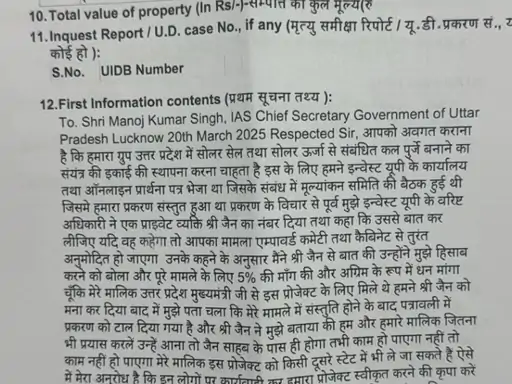
On 20th March 2025, the Uttar Pradesh government suspended Invest UP’s CEO IAS Abhishek Prakash for allegedly seeking bribe through a now-arrested middleman Nikant Jain to approve a solar power plant project. At the behest of Abhishek Prakash, Jain was allegedly demanding 5% of the said project’s total cost as commission for approval.

The Lucknow Police have registered a case against Nikant Jain at the Gomti Nagar Police Station under BNS Section 308 (5) (extortion) and Sections 7, 12, and 13 of the Prevention of Corruption Act. Originally from Meerut, Jain is a resident of Gomti Nagar’s Viram Khand.

Meanwhile, the state government said in a statement that IAS Abhishek Prakash has violated the All India Services (conduct) rules -1968 section -3 and that he has been suspended with immediate effect.  Prima facie, the allegations levelled against IAS Abhishek Prakash have been found to be true after investigation, the state government said.

“Malicious intent of Invest UP CEO Abhishek Prakash, vested interest and unfair financial gain could be the reason for this…In the case, prima facie Abhishek Prakash has been found responsible. This is a violation of the All India Services (conduct) rules -1968 section -3. Abhishek Prakash is being suspended with immediate effect. Further disciplinary action will be taken against him as per IAS ( RR-2006),” the government said.

The All India Services (conduct) rules -1968 section -3 pertains to the ethical standards and code of conduct laid for IAS officers.

Notably, the Uttar Pradesh government’s action came just hours after Chief Minister Yogi Adityanath while addressing a public meeting in Gonda said that “no one will be spared if found guilty.”  

On 20th March, Vishwajeet Dutta of the SAEL Solar P6 Private Limited filed a complaint alleging that despite a positive recommendation from the review committee, the company’s file was stopped as they did not pay 5% commission that Abhishek Prakash sought through middleman Nikant Jain.

SAEL Solar P6 Private Limited had applied through both online and offline mediums for making parts for solar cells, solar panels, and equipment used for solar energy. The project is reported to be of immense strategic importance.

The complainant alleges that after a review committee gave a favourable recommendation to the project, IAS Abhishek Prakash allegedly asked Vishwajeet Dutta to meet Nikant Jain. Dutta was allegedly told that if he met Jain and paid 5% of the project’s cost in advance, he would approve the project, however, upon failing to comply, the project would not get approved no matter how hard Dutta tried.

FIR against IAS Abhishek Prakash (Source: Dainik Bhaskar)

Who is IAS officer Abhishek Prakash

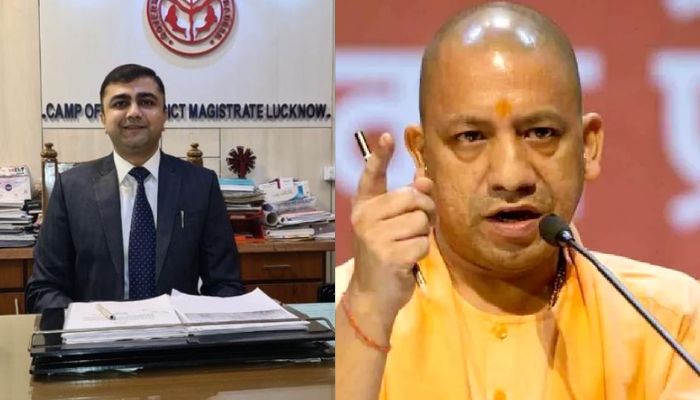
Born in 1982, Abhishek Prakash is a 2006-batch IAS officer. At present, Prakash was holding charge of Secretary, Uttar Pradesh Government, Infrastructure and Industrial Department and CEO Invest UP, which is the State’s investment promotion agency. Abhishek Prakash has earlier been the DM of Lucknow for a long time. Prakash has also previously served as the DM of Lakhimpur Kheri, Aligarh and Hamirpur districts. 

Defence Corridor Land Acquisition Case and the “corrupt” role of Abhishek Prakash

Amidst the ongoing investigation around allegations of demanding 5% commission to approve a solar project, IAS Abhishek Prakash’s troubles are mounting further as the Defence Corridor file sent by the Revenue Council to the government might get a nod from CM Yogi Adityanath. In the Defence Corridor Land Acquisition Case, 18 officers, including Abhishek Prakash who was the then Lucknow DM, have been accused of corruption.

In this case, the former Chairman of Revenue Board Dr Rajneesh Dubey had submitted the report to the government after investigation. After that, some officials have also been charge-sheeted. It is being said that after getting the green signal from the CM, the file of Defence Corridor can be opened. With this, Abhishek Prakash’s troubles can increase further.

Bhatgaon Gram Panchayat in Sarojini Nagar Tehsil of Lucknow was picked for the Defence Corridor. Apart from the manufacturing facility for Brahmos missile, many companies related to the defence sector were looking for land. This resulted in the land rates in Bhatgaon skyrocketing.  As the prices went up dramatically, the land mafia became active and in connivance with the tehsil officers, the land that was to be acquired for the corridor was bought from the local farmers at a cheap rate. After that, a huge amount was extorted as compensation. Many of these officers also took land in the name of their servants and relatives. The then ADM and his subordinate employees allegedly played a key role in this fraud.

In the investigation report sent to the government, evidence has also been found of the names of allottees being added by manipulating the documents in the acquisition process in a fraudulent manner. Rules have been ignored in buying and selling. The non-transferable category of leased land could not be sold as per the rules, it was first made transferable and then sold. Compensation was paid by showing outsiders as the owners of the land. The officers who distributed the compensation have also been negligent in investigating the ownership rights.

The report also mentions that Rs 45.18 crore was sanctioned for about 35 hectares of land in Bhatgaon, in this, however, irregularities of around Rs 20 crore were uncovered. In this case, the role of the then DM Abhishek Prakash and his special employees of Sarojini Nagar tehsil came under scanner. After being suspended, one of these employees threatened the officers to expose the fraud.

In the preliminary investigation of the Revenue Board, many officers including the then DM Abhishek Prakash, ADM, SDM and Tehsildar were found guilty. In addition, four employees were suspended.  

Notably, as the chairman of the land acquisition committee, Abhishek Prakash fixed the land rates arbitrarily in connivance with the tehsil administration.

Abhishek Prakash’s controversial tenure as Lucknow Development Authority’s Vice-chairman

Besides, the allegations of corruption in the Defence Corridor Case and the recent ‘bribe for approval’ case, Abhishek Prakash has also been accused of benefiting several builders and arbitrarily issuing sealing and licenses while posted as the vice-chairman of the Lucknow Development Authority (LDA).

Reports say that during his tenure as LDA VC, he got many illegal constructions demolished, but benefited builders close to him. He is also accused of issuing licenses to builders he favoured in many areas including Aashiyana. There are also allegations of arbitrarily withholding the files of builders in connivance with LDA officials.

Abhishek Prakash colluded with mining mafias and rigged land purchases during his multiple postings as DM

During his time as the District Magistrate of Kheri, Hamirpur, and Aligarh over the years, Abhishek Prakash was accused of rigging in land purchase and sale in Aligarh. Several complaints were filed against Prakash accusing him of manipulation in government tenders in Lakhimpur and collusion with mining mafia in Hamirpur.

IAS Abhishek Prakash bought 700 Bighas of land in his family’s name during his tenure as DM of two districts

The corruption-accused IAS officer had allegedly purchased 700 Bighas of land while being DM of Lakhimpur Kheri and Bareilly in the name of his family. Abhishek Prakash had bought land in the name of his family members—mother, father and brother—as well as by forming some fake companies. Similarly, he is also accused of buying 400 bighas of land in Bareilly. There are also allegations of stamp duty evasion at both the places. In this matter, the DOPT had written to the UP government to launch an investigation.

Abhishek Prakash amassed huge wealth and properties during his tenure as district magistrate

It has been reported that during his tenure as the District Magistrate of Lucknow, IAS Abhishek Prakash allegedly amassed lavish properties including a house in Ansal housing society, a bungalow in Aashiyana, as well as a villa in the city. Prakash had close ties with middlemen Nikant Jain and Lucky Jafri, who used to do liaisoning for IAS officers. The duo used to make commission deals to get the files of important projects cleared by Prakash.

UP CM Yogi Adityanath’s zero-tolerance policy against corruption, 11 IAS officers suspended

While IAS Abhishek Prakash’s alleged corrupt practices have shocked the country, Uttar Pradesh Chief Minister Yogi Adityanath has been getting appreciation for his zero-tolerance for corruption within bureaucracy. It is pertinent to mention that Abhishek Prakash is not the only IAS officer the Yogi government has suspended so far, 11 IAS Officers have been suspended over corruption allegations.

In November 2024, IAS Ghanshyam Singh was suspended in the case of delaying the measurement of fields in Lakhimpur Kheri.

In July 2024, IAS Devisharan Upadhyay was suspended as during his posting as Member Judicial Revenue Council, he was accused of arbitrarily restoring the leases of 35 plots in Aligarh.

In 2022, IAS TK Sheebu was suspended after he was accused of corruption in mining-related matters.

In 2022, IAS Sunil Kumar Verma was suspended from the post of DM of Auraiya on charges of misuse of power and corruption.

Similarly, IAS Devendra Pandey was suspended while he was DM in Unnao after he was accused of financial irregularities in purchases made in the Basic Education Department.

IAS Amarnath Upadhyay was suspended while DM Maharajganj. He faced the accusation of irregularities in the budget of cow protection centres.

Another IAS officer Kumar Prashant was suspended in June 2018 while he was DM Fatehpur. He was accused of rigging in government wheat procurement. Alongside Prashant, IAS Jitendra Bahadur Singh was also suspended while serving as DM Gonda after he was accused of embezzling government grains.  

Kedarnath Singh was suspended while he was in the tourism department.  IAS Sharda Singh was suspended while he was the Uttar Pradesh’s Chakbandi Commissioner. He was suspended after allegations of not recruiting on OBC quota in recruitment emerged.

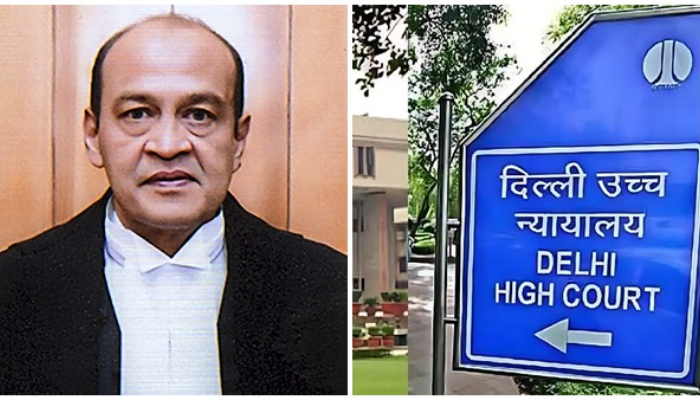
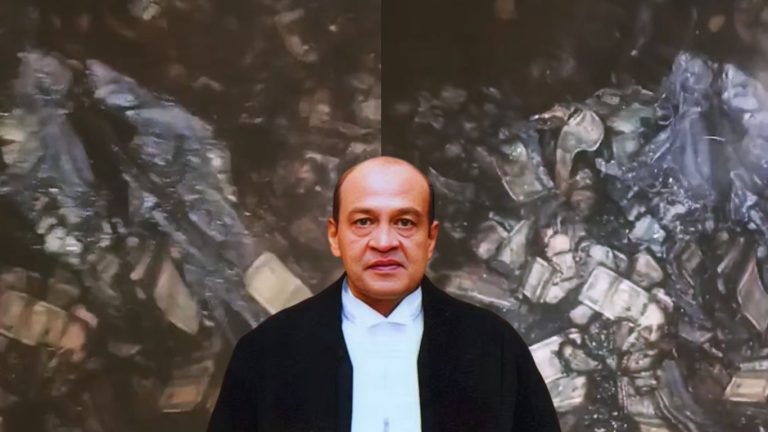
Justice Yashwant Varma’s name appears on Delhi HC cause list despite CJI order to deroster him, transfer to Allahabad HC under consideration

The Justice Yashwant Varma controversy has taken a new turn as a fresh 24th March Delhi High Court cause list (calendar of pending court cases) shows him leading the bench. Notably, the judicial work that was previously under his purview was withdrawn following the discovery of unaccounted cash at his residence on 14th March following a fire incident, reported India Today. Some cases are reportedly still listed under him, despite the order to deroster him.

According to media reports, this could be an administrative issue as such schedules are sometimes set at least a week in advance and it could be the reason behind Justice Varma’s name on the list. Meanwhile, the proposal of transferring him to the Allahabad High Court is still under consideration.

On the other hand, Chief Justice of India Sanjiv Khanna instructed Delhi High Court Chief Justice D K Upadhyaya to refrain from giving Justice Varma any judicial work and formed an internal committee to carry out an investigation. The three-member panel comprises of Justices Sheel Nagu (Chief Justice of the Punjab and Haryana High Court), G S Sandhawalia (Chief Justice of the Himachal Pradesh High Court) and Karnataka High Court judge Anu Sivaraman.

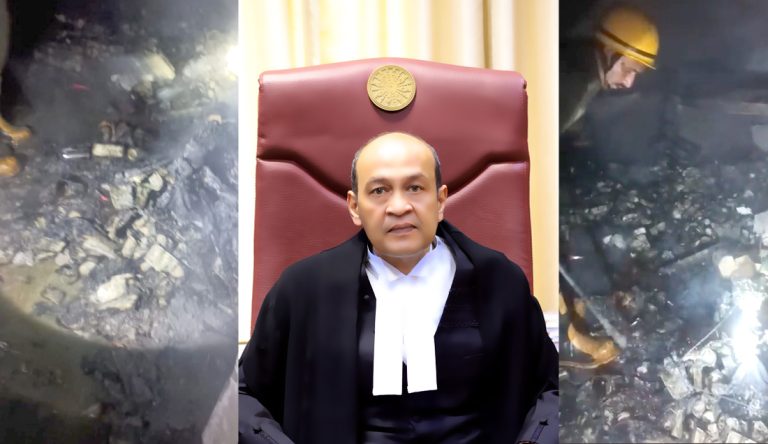
The Supreme Court of India released several documents related to the case, along with a few photographs and a video clip showing burnt and half-burnt currency notes. Notably, the videos of the burnt cash, which formed a crucial piece of evidence, were initially shared with senior officials. Later on, after the videos reached all the stakeholders, instructions were issued from within the police department to delete all the videos keeping an original copy and to prevent them from circulating. Multiple agencies were present at the scene during the fire incident like the fire department, police, NDMC, CPWD etc, and several personnel made videos. However, when the videos were sent to higher officials, they were instructed to delete them.

Furthermore, Justice Varma was named in an FIR filed by the Central Bureau of Investigation (CBI) under the Prevention of Corruption Act and an ECIR filled by the Enforcement Directorate under the Prevention of Money Laundering Act in an alleged fraud committed by Simbhaoli Sugars Ltd. Before his elevation as a judge to the Allahabad High Court in October 2013, Justice Varma was a non-executive director of the company whose accounts were reported as a non-performing asset (NPA) in 2012. By 2015, the Sambhaoli Sugars case was declared a ‘suspected fraud’ case and was reported to the Reserve Bank of India (RBI).

An investigation was launched by the CBI in February 2018 against Sambhaoli Sugars based on a complaint filed by the Oriental Bank of Commerce. The bank had accused the company of misappropriating ₹97.85 crore of loan amount which was supposed to go to farmers. The company allegedly diverted the funds for other purposes. The CBI FIR mentioned the names of 12 accused including the name of Justice Varma as a non-executive director of the company.

However, the investigation in the case stalled and no significant action was taken in the case for a long time. In February 2024, the case was reignited after a court ordered the CBI to resume the investigation. However, the court order was overturned by the Supreme Court leading to the closure of the CBI’s preliminary inquiry (PE) in the case.

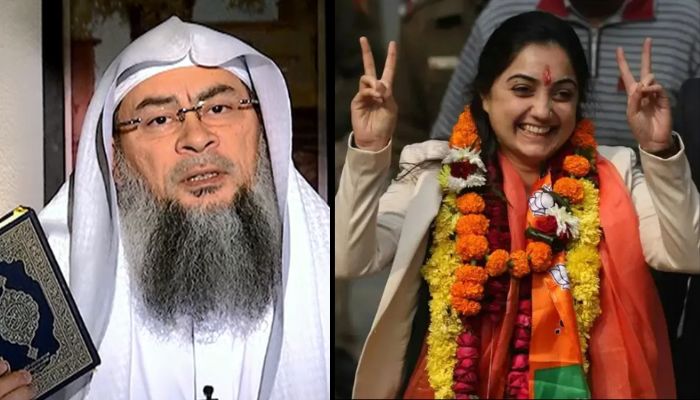
Saudi cleric reinforces what Nupur Sharma said in 2022, labels apologetic Muslims as ‘kafir’ for doubting marriage of Prophet Muhammad

A Saudi Arabia-based Islamic cleric, Assim al-Hakeem, has reiterated what former BJP spokesperson Nupur Sharma said during the course of a debate in 2022.

In an undated video that was shared on social media, the cleric was heard saying, “The biggest problem we have with the Westerners from America, Canada and Europe is that they don’t have their Islam on cemented area. They are so easy to flip to the other side and that is why you find many of them…have doubts. Why? The Prophet married Aisha when she was 9.”

Assim al-Hakeem appeared furious at ‘Westernised Muslims’ for doubting the fact and questioning the marriage of Prophet Muhammad.

“You are a kafir. If you doubt the Prophet and he thought of her for a second, you are a full-fledged kafir. Get the heck out of my house,” he mocked Muslims for casting aspersions on the marriage of Prophet Muhammad.

Later in the viral clip, Assim al-Hakeem pointed out, “You say, I don’t know why the Prophet married Aisha when she was nine and he was 50 years of age. It doesn’t sound good, but I accept it.“

“Do you think bad of the Prophet of Islam? Is he a paedophile? Astaghfirullah. I would be a kafir thinking this,” the Saudi cleric emphasised.

In an earlier tweet made in 2016, Assim reiterated that Aisha was nine years of age when she came with the Prophet. He denied all other investigations and references quoting that Aisha was around 17 when she came with the Prophet.

It is worth noting that Assim’s citation to Sahih al-Bukhari also states that Aisha was nine years old when Prophet Muhammad consummated the marriage.

As per sunnah.com, the Sahih al-Bukhari says, “Narrated Aisha: that the Prophet (ﷺ) married her when she was six years old and he consummated his marriage when she was nine years old. Hisham said: I have been informed that Aisha remained with the Prophet (ﷺ) for nine years (i.e. till his death).”

Sahih al-Bukhari quoted at sunnah.com

Sahih al-Bukhari, according to sunnah.com, is a compilation of hadith compiled by Imam Muhammad al-Bukhari. It is a compilation of Prophet Muhammad’s sayings and acts, commonly known as the Sunnah.

It has around 7563 hadith (with repetitions) in 98 books. The collection is considered by the vast majority of Muslims to be one of the most genuine collections of the Prophet’s Sunnah.

The controversy surrounding Nupur Sharma

In May 2022, Nupur Sharma was one of the panellists on the Time Now show along with Taslim Ahmed Rehmani on the Shivlinga found at the Gyanvapi disputed structure site. During the debate, Rehmani used derogatory language against Bhagwan Shiv that irked then-BJP spokesperson Nupur Sharma.

Sharma countered her and questioned how would he react if she used the same language for Islam and the Prophet. Though it was a counter statement, Alt News’ co-founder Mohammed Zubair found it to be the perfect opportunity to ruin Sharma’s life.

He cunningly trimmed Rehmani’s remarks that came before Sharma’s counter remarks and presented as if Sharma was insulting Prophet Mohammed. The propaganda against Sharma worked and it sparked an international outrage.

Regardless of the fact that what Sharma said about the Prophet’s marriage to the 9-year-old Ayesha, which is mentioned in multiple Islamic hadiths, Nupur Sharma was branded as a ‘blasphemer’, with Islamic organisations openly declaring that she should be murdered.

Following the witch-hunt against Sharma, there were protests and riots across the country. People who supported Sharma were threatened by Islamists online and offline.

FIRs were filed not only against Sharma but also against those who supported her. Notably, Kanhaiya Lal, a Hindu tailor from Udaipur, Rajasthan, and Umesh Kolhe, a businessman from Maharashtra’s Amravati, were brutally murdered by Islamists for supporting Sharma.

When Nupur Sharma approached the Supreme Court seeking clubbing of FIRs against her, the two-judge bench that heard the matter seemed to have already formed an opinion against her based on the disinformation and misleading propaganda running in media and on social media. Justice Surya Kant, in his oral observations, blamed Nupur Sharma for what was happening in the country.

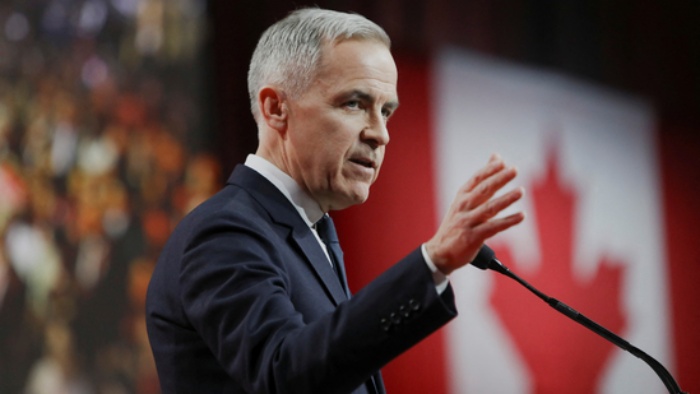
Canada’s new PM Mark Carney calls for snap elections on April 28

0

Canada’s new Prime Minister, Mark Carney, has moved to dissolve the Parliament and called a snap election for April 28, Al Jazeera reported on Sunday.

The move comes less than two weeks after Carney took office, succeeding former Canada PM Justin Trudeau.

Carney cited the need for a strong mandate to deal with the ongoing trade tensions with the United States, sparked by President Donald Trump’s trade actions, as per Al Jazeera.

Following his meeting with the Governor-General Mary Simon, the Liberal Party leader told reporters in Ottawa that “Canada facing the most significant crisis of the lifetimes because of President [Donald] Trump’s unjustified trade actions and his threats to our sovereignty” and requested parliament’s dissolution.

“I’m asking Canadians for a strong, positive mandate to deal with President Trump and to build a new Canadian economy that works for everyone because I know we need change – big change, positive change,” he added.

According to Al Jazeera, the election was initially scheduled to take place by October 20, but experts believe Carney’s Liberal Party hopes to capitalize on its current momentum. Recent polls show the Liberals in a tight race with the opposition Conservatives.

The party, which has been in government since 2015, has seen a surge in support since Trudeau’s January announcement that he planned to step down amid repeated threats from Trump.

The US president’s tariffs and calls to annex Canada have fuelled anger and uncertainty, and many Canadians have been supportive of the Liberal government’s firm — and unified — response to Washington.

According to recent polls, after years of criticism for their handling of soaring housing costs and an affordability crisis, the Liberals are now locked in a neck-and-neck fight with the opposition Conservatives.

Menawhile, the Trump has repeatedly said he wants to make Canada into the “51st state.” He also has imposed steep tariffs on Canadian goods that economists say could plunge the country into a recession.

Carney, a former central banker and economist, has the highest approval ratings among federal party leaders, according to a recent Ipsos poll.

Canadians view him as the best leader to handle Trump’s tariffs and their impact. Carney has pledged to continue the firm response to US trade policies, including reciprocal countermeasures

He has also rejected Trump’s proposal to annex Canada, calling it “crazy” and said that Canadian sovereignty must be respected before he will hold talks with Washington.

Bangladesh: BNP extremists pelt stones and vandalise house of Hindu family, issue death threats in hopes of encroaching property

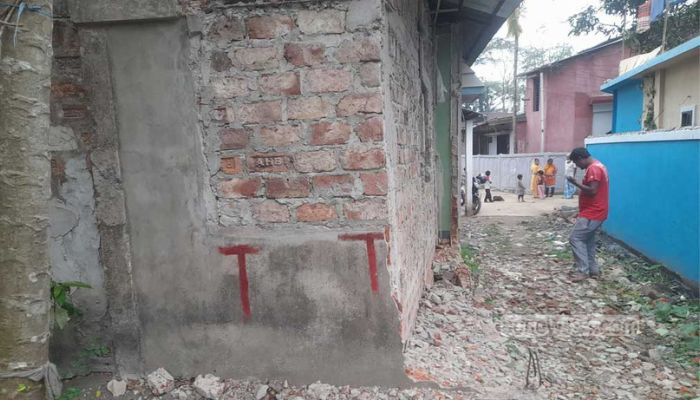
On Tuesday (18th March), extremists belonging to the Bangladesh Nationalist Party (BNP) vandalised the house of a Hindu family and issued death threats to them in Sylhet city of Bangladesh.

According to reports, the victim was identified as a differently-abled Asim Kumar Das. On Tuesday, local BNP leader Jasmine Begum, and her brothers Raihan Mia, Kawasar and Kamal Ahmed pelted stones and bricks at his house.

They also broke the glass panes. When the victim’s parents attempted to stop the extremists, the latter assaulted them with sticks and pipes. The BNP leader and her aides also entered the premises of Asim Kumar Das’ house and carried out vandalism.

They also threatened to kill his parents. The Hindu family thereafter filed a complaint with the local police. OC Syed Anisur Rahman claimed that the dispute was over ‘road space’ and that the situation was under control.

On learning about the incident, the leaders of the local Sylhet Metropolitan Puja Udjavan Parishad and the Bangladesh Hindu-Buddhist-Christian Unity Council visited the residence of the Hindu family.

It has come to light that the BNP leader Jasmine Begum had previously attacked the residence of Asim Kumar Das not once but 3 different times. Attempts were being made to encroach his house in the guise of clearing space for the road.

First, the extremists were successful in encroaching 2 feet of space and later demanded an additional 5 feet of space from the helpless Hindu family. When the demands were not met, they carried out vandalism and issued threats.

In January this year, OpIndia reported how 4 radicals associated with Chatra Dal (the student wing of the Islamist political party BNP) abducted three Hindus from Chittagong and demanded ransom from their families.

Curfew lifted in Nagpur, CM Fadnavis says situation is completely peaceful days after violence by Muslim mob

0

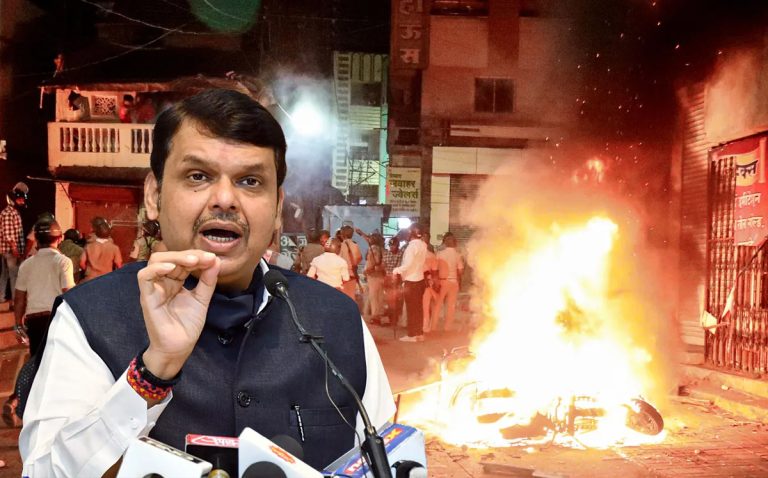
After curfew restrictions were lifted across Nagpur following recent violence, Maharashtra Chief Minister Devendra Fadnavis on Sunday assured that the situation in the city is completely peaceful and that there is no need for a curfew.

“The situation is completely peaceful. There is no tension anywhere, and people of all religions are living together in harmony. There is no need for a curfew anymore, and hence, it has been lifted,” CM Fadnavis told reporters.

Meanwhile, Nagpur Police conducted a flag march in the Mahal market area on Sunday as a precautionary measure to maintain peace and stability after the curfew was lifted across the city.

Police Commissioner Ravinder Singal issued a stern warning against the misuse of social media, urging people to think “a thousand times” before posting anything related to the recent Nagpur violence.

“Things are normal here. There is no issue right now, and life is normal everywhere. So far, 13 FIRs have been filed, more than 115 people are in custody, and further action is ongoing,” Singal said while speaking to ANI.

He urged the public to maintain harmony and refrain from spreading misinformation.

“Everyone should respect each other and avoid violence. If you have any information, report it to the authorities so we can take appropriate action. Those who upload or forward misleading content will face strict action. So before posting anything, think a thousand times about its consequences,” he added.

The flag march was conducted after the curfew was lifted across Nagpur, with restrictions eased in the last four affected areas on Sunday.

As per officials, restrictions have been relaxed in Kotwali, Tehsil, Ganeshpeth, and Yashodhara Nagar. The decision was made after law enforcement agencies reviewed the situation.

Earlier on Saturday, authorities had lifted the curfew in Pachpaoli, Shantinagar, Lakadganj, Sakkardara, and Imamwada. Besides, restrictions were temporarily relaxed in Kotwali, Tehsil, and Ganeshpeth between 7 PM and 10 PM.

The clashes in Nagpur on March 17 erupted over demands for the removal of Aurangzeb’s grave. Tensions escalated further when rumours circulated that a holy book of a particular community had been burnt during the agitation. However, the situation has now returned to normal, and the curfew imposed in several areas has been lifted.


(This news report is published from a syndicated feed. Except for the headline, the content has not been written or edited by OpIndia staff)

Burnt Cash at Judge’s House: Major contradictions in Justice Yashwant Varma’s response vs. police & Delhi HC reports

In the case of unaccounted cash found at Delhi High Court Justice Yashwant Varma’s residence after a fire incident, the Supreme Court of India has taken the unprecedented step of releasing several documents related to the case, along with a few photographs and a video clip showing burnt and half-burn currency notes. The apex court has released the report of Delhi High Court chief justice, reports by police and Delhi HC’s registrar and the response by Justice Varma.

In his response, Justice Yashwant Varma has denied keeping at the store room which caught fire on 14th March. However, a perusal by reports by various officials and the Varma’s response show that there are several contradictions in them. Moreover, the photos and videos released by Supreme Court show that cash was indeed burnt during the fire incident.

Here are some of the contradictions:

Who reported the fire

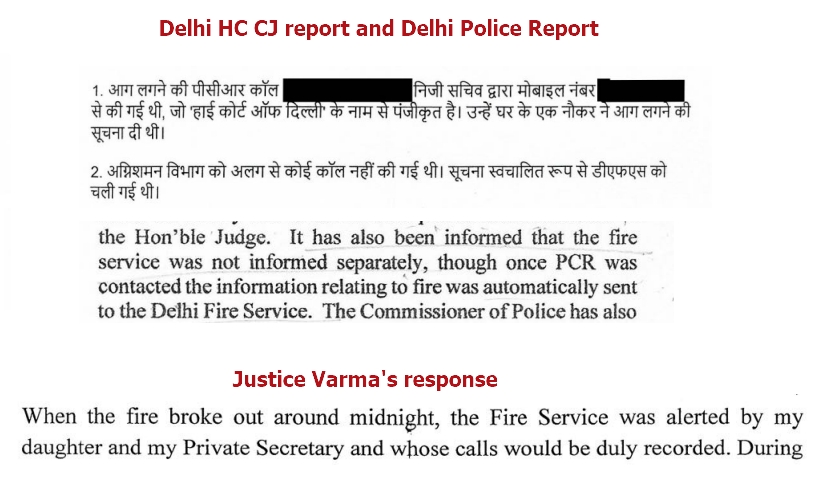
In his response submitted to Delhi HC’s Chief Justice Devendra Kumar Upadhyaya, justice Yashwant Varma said that he along with his wife was in Madhya Pradesh when the store room at his residence caught fire, and only his mother and daughter were present at the spot. He said that when the fire broke out around midnight, the fire service was alerted by his daughter and his private secretary. He claimed that calls of the same would be duly recorded.

But the Delhi Police report contradicts this claim. The police has told the court that nobody called the fire service about the fire, and only a PCR call was made by the Justice Varma’s private secretary. As per police, the intimation of the fire was automatically forwarded to the fire service, and that is how firefighters reached the house and doused the fire.

The store room is locked or unlocked

Justice Varma in his response claimed that the store room, which is separate from his main residence, is kept unlocked, and that the room is “generally utilised by all and sundry to store articles such as unused furniture, bottles, crockery, mattresses, used carpets, old speakers, garden implements as well as CPWD material.”

He added, “This room is unlocked and accessible both from the official front gate as well as the backdoor of the staff quarters.” The judged further said, “The very idea or suggestion that this cash was kept or stored by us is totally preposterous. The suggestion that one would store cash in an open, freely accessible and commonly used storeroom near the staff quarters or in an outhouse verges on the incredible and incredulous.”

However, again this claim contradicts with the police version. The Commissioner of Police has stated that the store room used to be kept locked. Notably, the store room is adjacent to the Guard Room where Central Reserve Police Force (Battalion 70F) is posted.

What happened to the cash

Justice Yashwant Varma has categorically denied the presence of any cash in the store room. He says his daughter and others in the house were not shown any sacks of cash after the fire was douse. He adds no cash was found when he reached the house, which matches with report of Delhi HC’s registrar who visited the house on 15th March evening. The registrar said that when he visited the house at around 9.10 pm, he found no cash in the dark room.

However, the police version and the statements of the guards confirm that there were cash that got burnt in the fire, and the remains of the cash were removed the next morning. In his report, the police commissioner told the Delhi HC CJ that 4-5 half-burnt sacks were found after dousing the fire, and remains of burnt Indian currency notes were found inside the sacks.

Moreover, the police confirmed that debris and half-burnt items were removed from the room the next morning. This confirms that along with other items, the burnt currency notes were also removed in the morning of 15.3.2025.

The report by Chief Justice Devendra Kumar Upadhyaya states that the probe so far does not reveal possibility of entry or access to the room by any person other than those residing in the bungalow, the servants, the gardeners and CPWD personnels, if any. He added in the report, “, I am of the prima faice opinion that the entire matter warrants a deeper probe.”

The reports by the police, and fire service, and visuals released by the Supreme Court confirms that cash was found after the fire was doused in the store room, and it was removed the next morning.

Notably, while fire service had first reported the cash, Delhi Fire Services chief Atul Garg on Friday said that firefighters did not find any cash during the operation. However, a day later he denied making any such statement, clarifying that he never said that no cash was found.

The fire incident took place on 14th March, and the courts stepped into action immediately after that, but the matter was made public only on 20th March, a week later. The hushed manner in which the matter has been dealt with by the authorities also raises serious questions on the accountability and transparency of the judiciary as well as the administration.

There are also allegations that police and fire service personnel who recorded videos of the cash were ordered to delete the videos and not circulate them, keeping only one original copy. Reports claim multiple videos were made, while Supreme Court has released only one. Notably, the Supreme Court has now formed a 3-member committee to probe the matter.

Bangladesh: Govt officials, student ‘activists’ hoard millions in cryptocurrencies, propaganda arm of Yunus regime tries to disprove it as ‘fake news’

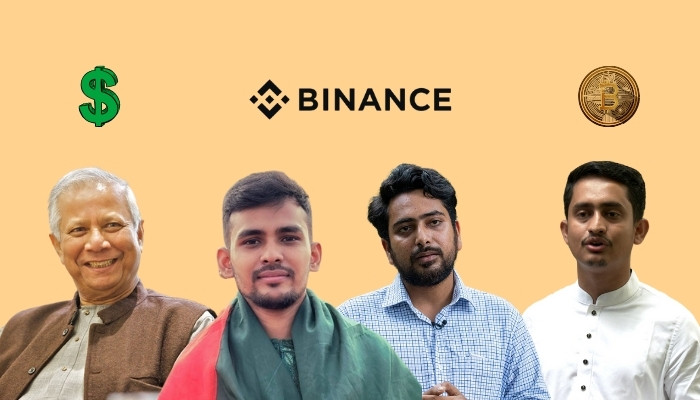
‘Student activists’ and advisers to the interim government of Bangladesh, led by controversial Nobel laureate Muhammad Yunus, are hoarding large sums of unaccounted money in the form of cryptocurrencies. The revelations were first made by ‘The AsiaPost News’ in a report published on 25th February this year.

The development came days after the Elon Musk-led Department of Government Efficiency (DOGE) cancelled a $29 million USAID project to strengthen the ‘political landscape in Bangladesh.’

‘The AsiaPost News’ shared screenshots, obtained from their sources, which show people close to the Yunus regime amassing millions of dollars in wealth. The unaccounted money is being stored in the online cryptocurrency exchange, Binance.

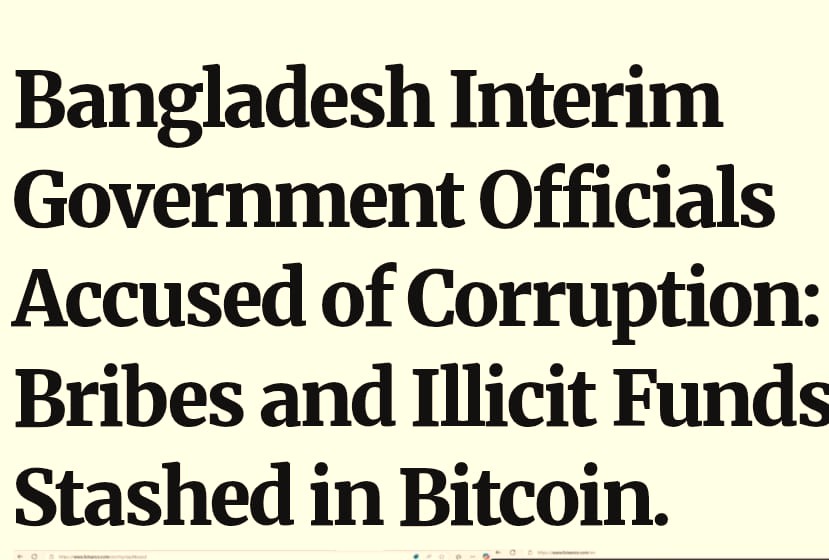
Screengrab of the report by ‘The AsiaPost News’

The interim government in Bangladesh came to power only 7 months ago and yet the ‘student activists’ and ‘advisors’ have been able to enrich themselves in such a short span of time.

“These revelations further fuel concerns that the very individuals who once claimed to stand for justice and democracy may now be engaging in unchecked corruption, all while Bangladesh faces one of the most challenging periods in its history.These evidences could expose one of the most significant corruption scandals in Bangladesh’s history,” stated The AsiaPost News.

It further inquired, “As the nation struggles for survival, the question remains: will justice prevail, or will those in power continue to exploit the people they once vowed to protect?“

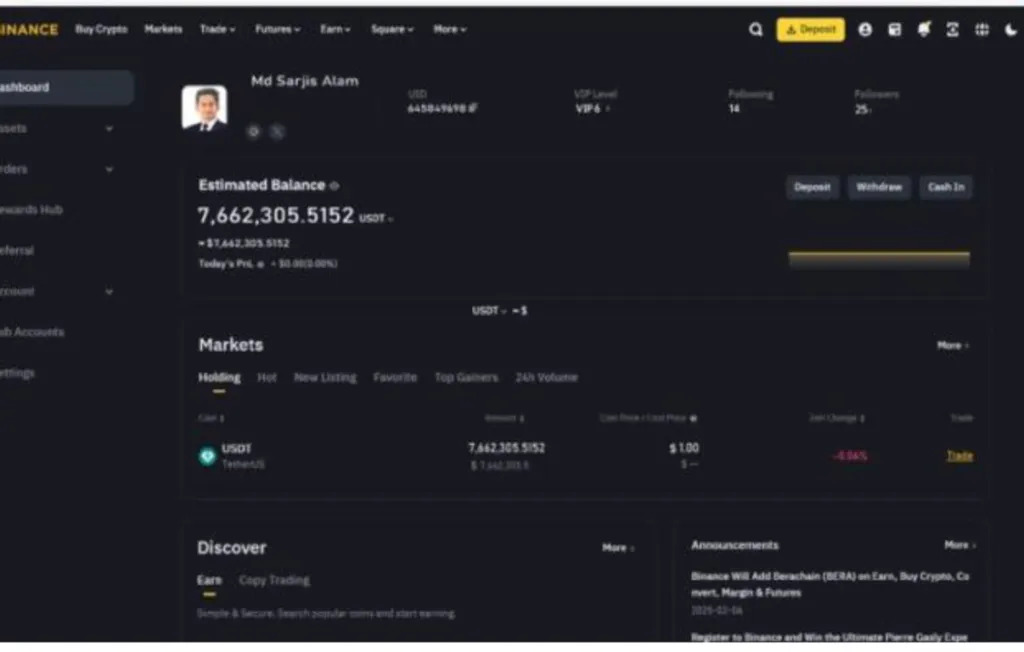
Binance account of Sarjis Alam

During its investigation, The AsiaPost News found that ‘student activist’ Sarjis Alam has accumulated a massive $7.76 million. This is despite no known source of income or a position with the interim government of Bangladesh.

Alam had repeatedly threatened India and demanded the handover of former Prime Minister Sheikh Hasina. Owing to his anti-Indian rhetoric, the Islamist was made the chief organiser of the Jatiyo Nagorik Committee. He issued veiled threats to PM Modi on Vijay Diwas (16th December 2024).

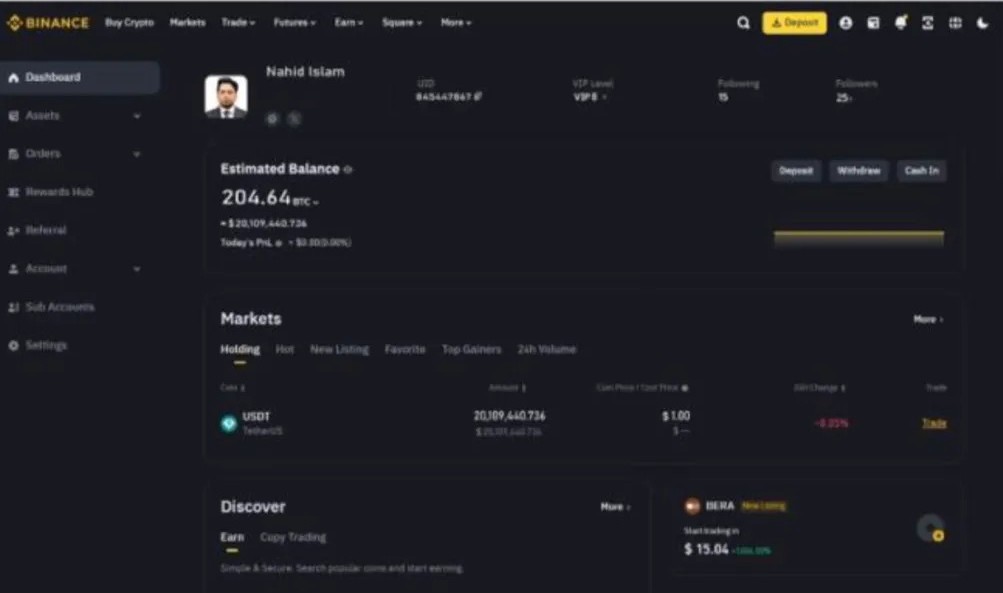
According to ‘The AsiaPost News’, Nahid Islam (who previously served as the information adviser to the interim government of Bangladesh) also had 204.64 Bitcoin in his Binance account. It roughly translates to $19 million.

Binance account of Nahid Islam

Coincidentally, Nahid Islam tendered his resignation around the time of publication of the report and later joined the newly formed ‘Jatiya Nagorik Party (National Citizen Party).

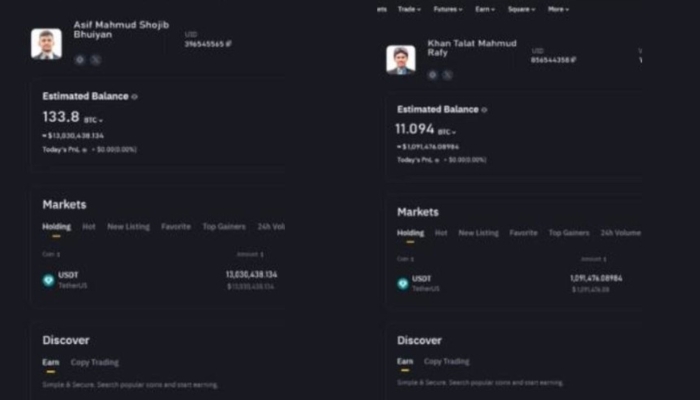
Asif Mahmud Sajib Bhuiyan, the Youth and Sports Adviser to the interim government of Bangladesh, had also amassed 113 Bitcoin which is equivalent to $12 million.

According to ‘The AsiaPost News’, the Binance account of ‘student activist’ Khan Talat Mahmud Rafy shows that he has 11.09 Bitcoins. Despite having no position in the interim government, he enjoys full state protocol.

Binance accounts of Asif Mahmud Bhuiyan and Khan Talat Mahmud Rafy

Even the press Secretary to the interim government of Bangladesh, Shafiqul Alam has accumulated $10 million worth of cryptocurrencies in his Binance account.

With no known sources of income that could justify such wealth, it becomes increasingly clear that the funds have been received through illegal means from external sources.

While the regime of Muhammad Yunus came to serve the people, it quickly filled the coffers of its officials and ‘student activists’ who orchestrated the undemocratic ouster of former Prime Minister Sheikh Hasina.

When Muhammad Yunus was convicted of violating labour laws

The track record of Yunus is not bright either. In January 2024, a labour court in Dhaka found him guilty of violating the labour laws of Bangladesh. He was convicted, sentenced to 6 months of simple imprisonment and fined Tk 30000 (~$260).

Yunus and three other directors at ‘Grameen Telecom’ violated labour laws by failing to create a welfare fund for the workers in the company. 

The labour court Judge, Sheikh Merina Sultana, noted that 67 Grameen Telecom employees were supposed to be made permanent in the company which did not happen.

As per the company’s stated policy, it is supposed to share 5% of the dividends with the staff, which failed to materialise. Muhammad Yunus is currently facing 100 other charges for graft and labour law violations in Bangladesh. 

The 2006 Nobel Peace Prize winner founded Grameen Bank in 1983 to lend small loans to the poor. He was earlier fired as Managing Director of his bank for violating retirement regulations of the Bangladeshi government.

Yunus was also on trial for receiving money in 2013 for receiving money without government permission. He was infamously called a ‘bloodsucker’ by Sheikh Hasina for giving out loans to the poor at extremely high interest rates.

Attempts to discredit report by ‘The AsiaPost News’ as fake

Two days after the publication of the exclusive investigative report, a propaganda portal masquerading as ‘fact-checking’ website called ‘Rumour Scanner’ wrote an article decrying the revelations made against the govt officials and ‘student activists’ close to the Yunus regime.

It alleged that the screenshots are ‘manipulated using digital editing techniques’ and are being disseminated ‘based on an unreliable source’.

OpIndia spoke to renowned Bangladeshi journalist Salahuddin Shoaib Choudhury, who promptly pointed out that the ‘Rumour Scanner’ is being run from the Office of the Press Secretary to the interim government of Bangladesh.

The same Press Secretary Shafiqul Alam has been exposed by ‘The Asia Post News.’ As such, Rumour Scanner did not spare any time to brand its report as ‘fake news.’

Salah Uddin Shoaib Choudhury further directed us to 2 of his articles (here and here) where Shafiqul Alam had resorted to Joseph Goebbels-like propaganda to label news stories, critical of Yunus regime, as ‘fake.’

It has been a month since the ‘The Asia Post News’ published its critical story, exposing the corruption at the top level of the interim government. Despite this, no investigation has been initiated into the matter. Instead, an all-out effort has been made to bury the story.

Justice Yashwant Varma cash controversy: Instructions were issued to officials present on the spot to delete videos of burnt cash, claims report

In the latest revelation in the Justice Yashwant Varma cash controversy, it is being reported that the junior Delhi Police officials who recorded the videos of the burning cash at the judge’s residence were instructed to delete the videos and not to make copies of them.

According to the Republic, the videos of the burnt cash which formed a crucial piece of evidence were initially shared with senior officials. Later on, after the videos reached all the stakeholders, instructions were issued from within the police department to delete all the videos keeping an original copy and to prevent them from circulating.

As per Republic, multiple agencies were present at the scene during the fire incident like the fire department, police, NDMC, CPWD etc, and several personnel made videos. However, when the videos were sent to higher officials, they were instructed to delete them and not share them.

Multiple videos of the burnt cash were reportedly recorded by the officials present at the spot. One of the videos showing burnt cash was released by the Supreme Court last night.

Documents released by the apex court state that the burnt debris was removed a day after the fire incident, on 15th March morning. “On examining the incident reported, the material available and the response of Justice Yashwant Varma, what I find is that the Commissioner of Police in his report dated 16.3.2025 has reported that as per the guard posted at the residence of Justice Yashwant Varma, the debris and other partially burnt articles were removed from the room where the fire had broken out in the morning of 15.3.2025,” stated Delhi High Court chief justice Devendra Kumar Upadhyaya in his report submitted to CJI of India.

This is why the Registrar-cum-Secretary sent by the Delhi High Court Chief Justice Devendra Kumar Upadhyaya didn’t find any cash when he went there to inspect the site after the fire incident. The Registrar-cum-Secretary was accompanied by Justice Varma and his private secretary during the inspection and he said that there was no currency at the spot. Justice Varma also denied having any knowledge about the cash.

The fire incident occurred at Justice Varma’s official bungalow at 30 Tughlak Crescent, New Delhi late in the night on 14th March. The next day, i.e., 15th March, Justice Devendra Kumar Upadhyaya, Chief Justice of the Delhi High Court, received a call from the Commissioner of Police, Delhi, Sanjay Arora, at around 4:50 PM. He informed Justice Upadhyaya about the fire incident and the burnt cash at Justice Varma’s residence. Justice Upadhyaya informed CJI Khanna. The same day, Justice Upadhyaya sent the Registrar-cum-Secretary for inspection of the site of the incident. By that time, Justice Varma has also returned from Bhopal.

This raises an important question as to who removed the burnt cash from the site of the fire incident and on whose instructions. The removal of the burnt cash from the site of the incident amounts to destruction with evidence which is a criminal offence. Besides, why the instructions were issued to remove the videos of the burnt cash also remains a question to be answered.

Ever since the news of the fire accident at Justice Varama’s residence boke out, new twists and turns have been emerging in the matter every day. The hushed manner in which the matter has been dealt with by the authorities also raises serious questions on the accountability and transparency of the judiciary as well as the administration.

Interestingly, the fire incident occurred on 14th March but the news about the incident broke out on 20th March, a week later. Moreover, the Delhi Fire Services chief Atul Garg initially denied reports of finding piles of cash at the judge’s residence but later on, he denied having given any such statement to any media outlet and dismissed his earlier quoted by the media as fake news.

In the meantime, a transfer order was also issued by the Supreme Court transferring Justice Varma to Allahabad High Court. However, the Supreme Court yesterday denied any link between Collegium’s proposal to transfer the judge to Allahabad High Court, saying that it was a routine transfer proposal that has not been finalized yet.

On Saturday (22nd March), the Supreme Court publicly released a report on its website including three images and a video of the incident. The same day, a three-member committee was formed by the Supreme Court to conduct a probe into the matter. The committee is chaired by Justice Sheel Nagu, Chief Justice of the Punjab and Haryana High Court, alongside Justice GS Sandhawalia of the Himachal Pradesh High Court and Justice Anu Sivaraman of the Karnataka High Court. The committee will investigate the allegations and submit a report to the Chief Justice of India, Sanjiv Khanna. The CJI also asked the Chief Justice of Delhi High Court to not assign any case to Justice Varma.