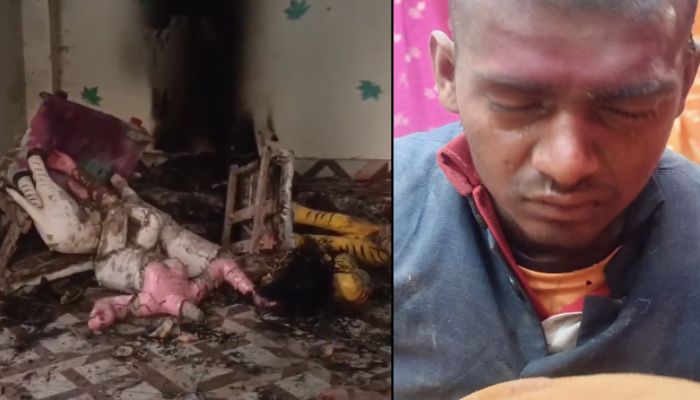
A fake Peer Baba called Abul Rzzak has been arrested in Baramulla, Jammu and Kashmir for cheating people, especially deceiving Muslim women by promising them ‘Jannat Ka Rasta’ (road to heaven). As per reports, Abdul Razzak had built a black structure designed like the Kaaba in Saudi Arabia on his land and was claiming to be a ‘Paigambar'( messenger of God) to the locals.
Locals have reported that the fake Peer Abdul Razzak used to smoke charas and ganja inside the black structure and promise all sorts of spiritual insight to deceive women, who used to seek his ‘advise’ in large numbers.
Abdul Razzak had reportedly claimed to locals that he is a reincarnation of Sufi saint Noordin Noorani, and he has divine powers. Deceived ny his claims, a large number of Muslim women in the area had started following him.
From his curious black hut that he had designed like an Islamic religious structure, Razzak used to distribute ‘Tabeez’ (amulets) to locals, with promises of healing powers. The local people who reported him added that he is a cannabis addict and his wife had left him.
Abdul Razzak had claimed before locals that Allah has ordered him to build a replica of the Kaaba in Mecca in Baramulla. He had added that the duplicate Kaaba would be for poor Muslims who are unable to travel to Mecca. He had already started the construction of the duplicate Kaaba. However, following complaints, some jounalists were alerted to his plans. The journalists met Razzak pretending to be his followers and sought information on the duplicate Kaaba.
Following a social media video where the plans of Razzak were exposed by the journalists, local villagers gathered and attacked his fake masjid. The police were alerted to arrest Abdul Razzak while locals set the fake mosque on fire. Razzak has been described as ‘mentally ill’ by some persons too.
Maulanas in Kashmir have announced that the fake mosque built by Razzak is un-Islamic and cannot be allowed under Islamic law.
In 2018, Elon Musk commented, “Betting that science is wrong and oil companies are right is the dumbest experiment in history by far.” He was referring to the oil lobby, and how a move to renewables, that will aid a greener planet, has been witnessing resistance. Indeed, renewable energy sources like solar, wind, and hydropower produce fewer pollutants and greenhouse gases than fossil fuels, with concomitant social, sustainability, and cost benefits.
Developed economies have already been witnessing good progress in this space. Ex-US President Biden signed the Inflation Reduction Act (IRA) in 2022, reducing GHG emissions and lowering energy costs. EU, to phase out Russian fossil fuel imports implemented REPower1 EU in May 2022, which will promote clean energy.
State of Renewable Energy in India
India has been committed in this space too, with its enhanced Nationally Determined Contributions (NDCs) under the Paris Agreement, aligning with principles of equity and Common but Differentiated Responsibilities and Respective Capabilities (CBDR-RC). Aided by the LIFE (Lifestyle for Environment) movement, India has pledged to achieve 50%2 of cumulative electric power capacity from non-fossil fuels by 2030.
As of October 2024, out of a total of 452.69 GW3 electric generation capacity, renewable energy stands at 201.45 GW, which is around 46.3% of total installed capacity. Solar leads the segment, with 90.76 GW, followed by wind (47.36 GW).
Renewable energy capacity in India: Buildup from previous budgets around renewable energy
The green energy commitment of the present-day government has been evident in the last few budgets.
Union Budget 2022: INR 3365 CR4 for solar power, comprising both grid-interactive and off-grid projects, was allocated. An outlay of INR 19,500 CR was made for PLIs in solar photovoltaic cell manufacture. The focus on solar power bore fruit – By Dec 2024, an installed solar module manufacturing capacity of ~63 GW5 and solar cell manufacturing capacity of ~ 5.8 GW had been achieved. The PM had made a telling statement back in July 2020, while inaugurating the 750 MW Rewa Solar Project in MP6 – “Solar energy is Sure, Pure, and Secure.” That spirit saw its reflection in the budget. Sovereign green bonds for green infrastructure were also proposed.
Union Budget 2023: Focus was laid on the Battery Energy Storage System (BESS), with Viability Gap Funding. Research shows that in the least Cost Optimized (LCO) pathway for India’s power sector, solar will dominate the growth of electricity generation, however, cost-effective storage solutions are crucial to sustain this post-solar crosses 25%7 of energy mix.
The cost decline for BESS was crucial as a consequence.
An outlay of INR 19,744 CR was also earmarked for the National Green Hydrogen Mission.
Union Budget 2024: Focus was shifted to diversify non-fossil fuel capacity beyond grid-scale solar and on-shore wind. A tender announcement for a 500 MW8 offshore wind project on the coastlines of Gujarat was also made. Thrust on PM Surya Ghar Muft Bijli Yojana for 10 MN households was also given, which led to the growth of rooftop solar to 15.7 GW as of Dec 2024. 100% exemption of Basic Customs Duty (BCD) for 25 critical minerals9 was also announced.
Union Budget 2025: FM Sitharaman, building on the momentum from previous budgets, has focused on long-term energy security this time. A major focus has also been on expanding Nuclear capacity to 100 GW by 2047. Key features around Renewables in this budget can be thought through across a few areas:
Clean-tech manufacturing: Recognizing that MSMEs are key growth drivers, a budgetary allocation of INR 100 CR has been made to boost the manufacturing of solar PV cells, wind turbines, batteries, and electrolysers.
Focus on Solar power: INR 241 BN has been allocated to Solar, including INR 1.5 BN for the solar power grid, and INR 2.6 BN for PM KUSUM (Pradhan Mantri Kisan Urja Suraksha evam Utthan Mahabhiyan), a scheme10 supporting farmers by subsidizing standalone solar pumps and solarizing existing grid-connected pumps to reduce diesel dependence. PM Surya Ghar Muft Bijli Yojana has witnessed an 81% increase in allocation, from INR 110 BN last year to INR 200 BN this year.
Green Energy Corridors (GECs): Modernization of grid infrastructure is pivotal for RE integration. To support the integration of RE into this grid, INR 60 BN has been allocated from GECs. States have been allowed to borrow an additional 0.5% of their GSDP to strengthen the financial health of distribution companies.
Green Hydrogen: The National Green Hydrogen Mission has received a budgetary outlay of INR 6 BN, up from 3 BN last year.
Strengthening EV value chain: To further fortify the EV value chain, Basic Customs Duty on key materials like Cobalt, Lithium-ion battery scrap, lead, etc has been removed. National Critical Minerals Mission11 has been allocated INR 41 BN, to build a resilient value chain for Green Technologies. Budgetary allocation for the PLI scheme for the National Program on Advanced Chemistry Cell Battery Storage has been substantially increased from INR 1.54 BN to INR 15.58 BN.
Focus on Nuclear Power: The Nuclear Energy Mission for Viksit Bharat12 has been introduced, which aims to promote domestic nuclear capabilities and promote private participation. Allocation of INR 20,000 CR has been made to develop at least 5 indigenously designed Small Modular Reactors (SMRs) by 2033. Amendments to the Atomic Energy Act and Civil Liability for Nuclear Damage Act will be taken up by Parliament. While as of Jan 30, 2025, India’s installed nuclear capacity is 8180 MW, plan is to grow that to 100 GW by 2047. The Focus of GoI will be to partner with private firms to set up Bharat Small Reactors and enhance R&D across Bharat Small Modular Reactors, and newer technologies.
Renewable energy is the path forward
The Matsya Purana13, one of Hinduism’s 18 major Puranas (Mahapuranas), mentions in Chapter 68:
Health ought to be sought from the Sun, wealth from Agni,
knowledge from Isvara, and emancipation from Janardana.
The Sun has been bestowed a special place of reverence in Puranas and ancient scriptures, and Bharat’s special focus on Solar power and other renewable energy sources is a continuance of that, both from a philosophical and scientific paradigm. Budget 2025 has further reinforced that spirit and laid out a clear path for ushering in renewables within the buzzing energy sector in India – that will be one of many levers to hand-hold India in its path towards Viksit Bharat 2047.
After the overthrow of the Sheikh Hasina government in Bangladesh last year in August, the country has been facing market instability and high inflation. As per reports, grocery stores across the country are facing a shortage of cooking oil including branded bottled oil and non-branded loose soybean oil. The shortage has resulted in hiked prices further adding to the problem.
The interim government that took over after the ouster of the Awami League government reportedly waived the Value Added Tax (VAT) to stabilise the prices of cooking oil after prices were hiked to facilitate supply chains. The VAT on cooking oil was reduced by 5 per cent and the VAT at the production and business levels was fully removed in October last year. According to retailers and wholesalers in major cities including Dhaka, Chattogram and Barishal, the supply chain was impacted after the government refused to raise prices last month. The local refiners were seeking a hike in prices citing increased import costs.
According to reports, strategic pricing tactics adopted by producers and marketers ahead of Ramadan have increased soybean oil prices. Reduced commissions and stringent credit policies by dealers at the retail level have led to a considerable decline in bottled oil availability in local shops of Bangladesh, which relies on imports to meet its annual oil requirement of 24 lakh tonnes.
Bottled soybean oil is selling at Tk 175 to 176 per litre in the country marking a one per cent increase over the last month. As per data compiled by the Trading Corporation of Bangladesh (TCB), the prices of loose soybean oil increased by 4 per cent in the last week going from Tk 180 to Tk 182 per litre.
Bangladesh facing financial crisis
Bangladesh has been facing financial troubles following the overthrow of its elected government last year by a violent revolution. The country is engulfed by political and financial instability. In a recent financial setback, Switzerland and the US discontinued their financial aid to Bangladesh.
Soon after assuming office last month, US President Donald Trump stopped all the US funding coming into Bangladesh. Trump passed an executive order directing the USAID to suspend all its operations in Bangladesh. This was followed by Switzerland’s decision to discontinue its financial aid to Bangladesh. The Swiss Agency for Development and Cooperation (SDC) decided to end its bilateral development programmes with three countries including Bangladesh by the end of 2028.
On Thursday, February 6th, the Punjab and Haryana court observed that the Punjab government does not want to comply with the judicial directions seeking disclosure of state expenses incurred on advertisements, renovation of houses of Ministers, etc. The court also said that the state does not want to disclose the money spent on litigation at the Delhi High Court and Supreme Court from December 2021 to September 2024.
This is after the court found that the state had no explanation for not clearing the dues of over ₹500 crores to hospitals under the Ayushman Bharat scheme. The court revealed that the state received a share of funds from the government of India but failed to pay the hospital’s dues. “The reasons, which have been mentioned in the affidavit (submitted by the Punjab Government) reflect that the State of Punjab does not intend to comply with the directions,” Justice Kuldeep Tiwari stated.
He said that the state was given 4 months to furnish the details of where the money was spent, but the state had no intentions to provide such details.
The observation came as several hospitals from Punjab sought the release of funds from the state government under the Ayushman Bharat Yojana. It was noted that the state only released ₹26 crore against bills amounting to ₹500 crore.
In September last year, the court asked the state to provide details of expenses to examine whether the funds provided by the Center to the state had been misutilized. Recently, the court had asked the State Principal Secretary of Finance to comply with the judicial directions, but to no avail.
Ever since its launch in the state of Punjab, the scheme of Ayushman Bharat has always been a matter of concern as private hospitals complain that they never get reimbursements from the state on time. As per the scheme, the cost of treatments to the hospitals should be reimbursed within 14 days of submitting the bills. There is a provision of 1% per annum interest payments to hospitals in case of delay in payments.
Private hospitals have been complaining that these payments have never been made on time. In 2021, private hospitals in Punjab stopped treatment citing undue checking by the insurance company hired by the government to make payments on its behalf. In 2022, private hospitals further denied treatment to patients under the scheme, citing pending payments of Rs 130 crore.
Earlier the Indian Medical Association (IMA) in Haryana also stated that around 600 private hospitals in the state had decided to stop treating patients under the Ayushman Bharat scheme from February 3rd. The IMA’s Haryana unit said that the patients at the private hospital relying on the slated government health scheme would hardly benefit from the scheme as the doctors would not treat them under the said scheme. As per the unit, the government had not yet cleared the reimbursement of the hospitals worth ₹400 crores.
As per the reports, there are around 1300 hospitals eligible for the Ayushman Bharat scheme, of which 600 are private facilities. The Ayushman Bharat scheme launched by the BJP government in 2018 aims to provide free access to health insurance coverage for low-income earners in the country. In the state of Haryana, there are around 1.2 crore people who are registered under the scheme.
The association opined that the private hospitals were not able to manage their expenses while treating the patients under the Ayushman Bharat scheme, given no reimbursement from the government.
However, now the court has observed that the Government of India had provided funds to the state which were further not transferred to the hospitals running the Ayushman Bharat Yojana. “The information shall be provided to this Court regarding the intent of the State of Punjab whether they are ready and willing to make compliance of order (supra) positively by the next date of hearing,” the court said adjourning the case.
Registration under the Uniform Civil Code (UCC), which was recently implemented in Uttarakhand, does not require state residents to have a domicile or permanent residence certificate. The UCC applies to all persons living in the state for at least one year. Professor Surekha Dangwal, the Vice-Chancellor of the Doon University and a member of the Expert Committee that drafted the Uttarakhand UCC, issued a statement clarifying the residence status required under the UCC on Monday (3rd February).
Professor Dangwal said that the registration under the UCC is for the sole purpose of preserving the demography of the state and enriching the government database. “The provision to include all individuals who have lived in Uttarakhand for at least one year is intended to safeguard the state’s demographic composition,” she said.
Permanent Residence is to be decided as per the previous laws
Professor Dangwal said that the permanent residence will be decided as per previous conditions and the issue has not been dealt with in the UCC. She said the UCC governs matters relating to marriage, divorce, live-in, will and so on. “Apart from this, there are no additional benefits from UCC registration. Permanent residence in Uttarakhand will be decided as per the previous conditions, this subject was not even before the Uniform Civil Code Committee,” Professor Dangwal stated.
“The criteria for permanent residency in Uttarakhand remains unchanged. The aim is to regulate personal laws to ensure that Uttarakhand’s society and culture are preserved, thus securing the demographic structure of the state. Moreover, it will help keep criminal elements in check,” she added.
People who come to Uttarakhand from other states and do not have a permanent residence cannot avail of the benefits of the state government schemes without being registered under the UCC. “Such people will now be able to take advantage of government schemes only after getting registered. If this was applicable only to permanent residents, then many people coming from other states would have been left put its scope, while they would have continued to take advantage of all the government schemes here,” the Professor said.
She said that a person registered under the UCC can have a voter card even if he has a normal residence in any other place.”The registration under the UCC allows a person to make his voter card if he has a normal residence anywhere. Through this, personal laws have been regulated. So that the society and the culture of Uttarakhand can be protected, this will ensure the protection of the demography of Uttarakhand,” Professor Dangwal added.
Details of live-in couples will be protected
Regarding the registration of live-in relationships under the UCC, Professor Dangwal said that the documents submitted for the registration of a live-in relationship under the UCC would be verified only at the registrar’s level. On receiving an application for the registration of a live-in relationship, the registrar will provide an electronic record to the local police station in charge through the District Superintendent of Police (DSP). “Access to this record, including for the local police station officer, will be strictly under the supervision of the District Superintendent of Police,” she said. She added that according to the rules while sharing any information relating to a live-in relationship with the police, the registrar must expressly mention that the information is being provided only for record-keeping purposes.
Online portal for registration under the UCC
The registration portal (ucc.uk.gov.in) for the Uniform Civil Code launched by the Uttarakhand government allows residents to register in both online and offline modes. The online portal provides for registration under nine categories of services including registration of marriage, divorce, termination of live-in relationships, and filing appeals and complaints regarding grievances and issues related to the processing of documents or disputes. For online registration, an Aadhar verification through an OTP will be conducted while the offline registration can be done through an OTP verification of phone number.
The illegal encroachment and arbitrary claiming of properties of common people alongside government land by Waqf Boards has been a significant menace across various states in India. Thousands of properties, from sprawling acres across various districts of Uttar Pradesh to entire villages in Tamil Nadu are illegally occupied or have been claimed by Waqf Boards as its properties.
In a report prepared by the Joint Parliamentary Committee (JPC) on district-wise data on Waqf properties in Uttar Pradesh, it has been stated that Ayodhya, Shahjahanpur, Rampur, Jaunpur and Bareilly districts have the maximum number of illegal Waqf properties on encroached government land, reported Amar Ujala. In each of these districts, Waqf boards are claiming two thousand or more properties. In the revenue records, these lands are in the category of public use. The JPC has submitted its report to Lok Sabha speaker Om Birla.
There are 2589 properties registered in Shahjahanpur in the records of the Waqf Board, out of which 2371 are government properties. 2363 out of 3365 Waqf properties in Rampur, 2116 out of 3652 in Ayodhya, 2096 out of 4167 in Jaunpur and 2000 out of 3499 Waqf properties in Bareilly are located on government land.
As per the Amar Ujala report, there are a total of 57792 government properties in the state, which are registered as Waqf properties in the records of the Waqf Board. Waqf’s claim on government properties has also been found in the top 21 districts of Uttar Pradesh. The JPC report says that there are 1792 properties in Lakhimpur Kheri, 1778 in Bulandshahr, 1610 in Fatehpur, 1581 in Sitapur, 1575 in Azamgarh, 1497 in Saharanpur, 1471 in Moradabad, 1331 in Pratapgarh, 1293 in Agra, 1216 in Aligarh, 1251 in Ghazipur, 1154 in Meerut, 1150 in Sambhal, 1045 in Amroha, 1027 in Deoria and 1005 in Bijnor that are claimed as ‘Waqf property’, but are actually on government land.
Waqf board says ‘our property’, but no documents to show transfer on tehsil records
The report says that there are 40 such districts in the state where hundreds of Waqf properties are registered in the records of the Waqf boards, but there is not a single document on transfer of property in the tehsil records. These districts are Firozabad, Mainpuri, Mathura, Aligarh, Etah, Kasganj, Ayodhya, Azamgarh, Ballia, Badaun, Shahjahanpur, Siddharthnagar, Bahraich, Balrampur, Gonda, Shravasti, Deoria, Kushinagar, Maharajganj, Jalaun, Lalitpur, Auraiya, Farrukhabad, Kannauj, Kanpur Dehat, Hardoi, Rae Bareli, Bulandshahr, Ghaziabad, Hapur, Bhadohi, Mirzapur, Sonbhadra, Bijnor, Kaushambi, Prayagraj, Chandauli, Jaunpur, Varanasi, Mahoba.
Notably, in Mahoba, the Waqf Board have no record of any Waqf property in Mahoba and just one in Sonabhadra. However, the district-level gazette shows 245 properties in Mahoba and 171 properties in Sonbhadra as waqf.
Last month, a government-ordered survey in Uttar Pradesh’s Kanpur revealed that there are 1670 Waqf properties in the district. Of these, 548 are built on government land. As per the survey report, there are 914 properties under the Sunni Waqf Board and 34 under the Shia Waqf Board in the Sadar tehsil. In Ghatampur 189, 388 in Bilhaur, and 144 in Narwal. Most of the illegal waqf properties on government land are mosques, graveyards, shrines and mausoleums. The report said that 80% of these illegal waqf properties are used for Islamic religious purposes.
The governments of various states have been conducting surveys to identify waqf properties. Recently, it was revealed in a survey that in Rajasthan, the ownership of land of 69 temples most of which are ancient, is with the Waqf Board in government records. Most of these properties are in Bharatpur, Jhalawar, and Alwar. It was reported that these temples stand on 59 ‘Waqf properties’ across 20 districts in the state.
In December 2024, the Central government said that there are 8.72 lakh Waqf immovable properties across the country. Out of these, 994 properties have been transferred to Waqf in an illegal manner. Out of these 994 properties, 734 are in Tamil Nadu only. There are 63 such properties in Rajasthan. The government said that the Parliament that out of 8.72 lakh Waqf properties across the country, only 3.3 lakh have been digitized. That means only 37% of the country’s Waqf properties have been digitized.
There is no end to bizarre claims by the woke community regarding genders. In the latest such incident of woke insanity, the Science Museum in London has claimed that the Legos, the popular plastic construction toys, are anti-LGBT. The reason for this claim is that Legos have ‘male’ and ‘female’ parts, and therefore reinforces the idea that heterosexuality is the norm.
According to an exclusive report by the Times, this has been included in the description of Lego bricks displayed at the museum in a self-guided museum tour on “stories of queer communities, experiences and identities”. The tour has been conceptualised by a Gender and Sexuality Network at the museum.
The “Seeing Things Queerly” guide in the tour states that Lego bricks are anti-LGBT because they reinforce the idea that heterosexuality is the norm because they have male or female parts that are made to “mate” with each other. It states that this is “heteronormative”, which is the idea that “heterosexuality and the male/female gender binary are the norm and everything that falls outside is unusual”.
The Lego section in the “Seeing Things Queerly” page on the museum’s website states, “Lego bricks are often described in a gendered way. The top of the brick with sticking out pins is male, the bottom of the brick with holes to receive the pins is female, and the process of the two sides being put together is called mating.”
It further adds, “This is an example of applying heteronormative language to topics unrelated to gender, sex and reproduction. It illustrates how heteronormativity (the idea that heterosexuality and the male/female gender binary are the norm and everything that falls outside is unusual) shapes the way we speak about science, technology, and the world in general.”
Lego is a line of plastic construction toys made by the Lego company consisting of interlocking bricks that can be assembled and reassembled in countless ways. The pieces connect through a stud-and-tube design, making them easy to stack and separate. Legos are used for play, education, and even engineering prototypes.
Notably, in most mechanical and electrical connections where a pin of a component is inserted into a hole of another component, the pin is called the male part and the hole is called the female part. In such cases, male part means that it is a pin or similar structure that goes into the female part which is a hole with same shape and size of the pin, so that it forms a perfect fit.
Such use of male-female does not refer to gender, it just identifies the two parts of a connection.
Speaking in the Rajya Sabha during the Motion of Thanks on the President’s address, Prime Minister Modi launched a scathing attack on the economic policies of the previous Congress governments on Thursday (6th February). Taking a dig at the Gandhi family, PM Modi held it responsible for the economic mismanagement in the country. “Because of economic mismanagement and bad policies of the Royal Family, the entire society was defamed and declared guilty,” said the Prime Minister.
दिल्ली: प्रधानमंत्री नरेंद्र मोदी ने कहा, "शाही परिवार के आर्थिक कुप्रबंधन और गलत नीतियों के कारण पूरे समाज को दुनिया भर में दोषी ठहराया गया और बदनाम किया गया…"
He said that in India, there was no ‘Licenseraj’ or ‘permit culture’ and free trade was always encouraged. “If we look at Indian history, there was no license raj or permit culture in India. For centuries, the people of India believed in free trade. We were among the first communities in the world to believe in free trade in the world”, he said. “Centuries ago, Indian traders travelled across countries for trade. There were no restrictions on cross-border trade. This was our nature and culture but we destroyed it,” he added.
Why PM Modi held Congress responsible for the poor economy of the country
PM Modi blamed the previous Congress governments for the poor economy of the country during the crucial years after independence. It was the Congress that formed government after independence with Jawaharlal Nehru becoming the first Prime Minister of the country. Nehru, a socialist to the core, made such flawed policies that the country remained on the edge of a food crisis. Nehru and the subsequent Congress governments did not encourage entrepreneurship and kept everything, from hotels to banks, under government control which hindered the economic progress of the country leading to red-tapism.
To justify the crawling economic growth of the country during the 1950s and 1980s which was a result of the poor economic policies of the government, the term ‘Hindu rate of growth’ was coined by Marxist economist Raj Krishna blaming the Hindu community for the poor economic growth rate. During this period, the Indian economy grew by just 3.5% on average. For some reason, this rate was named after Hindus.
This is an intrinsically flawed notion because the entire Indian history of the last thousand years bears testimony to the wealth and prosperity of this country. Prior to the Islamic and British invasions, when Indian society was predominantly Hindu, trade and commerce flourished on this land. The country was the hub of global trade. The wealth and prosperity of the country were the reason that greedy invaders attacked this land. India’s economy declined after the repeated attacks and loot by Muslim invaders and then British colonisation.
PM Modi implied that by coining the term ‘Hindu rate of growth’ for India’s slow GDP growth, the Congress maligned the name of the entire Hindu community. He stated that while the slow growth rate was the result of mismanagement of the ruling by the Nehru-Gandhi family, the entire Hindu community was held responsible and maligned in the entire world.
The PM said that the slow growth of the Indian economy after independence was the result of the licence-permit raj during Congress governments, but the Congress party blamed an entire community by naming the slow growth rate after Hindus.
Many argue that the ‘Hindu Rate of Growth’ should actually be called the ‘Nehru Rate of Growth’, because the slow growth was essentially the result of his policies. Nehru wanted that govt should run every business, and private industry was stalled by putting limit on their production through licence and permit system.
Nehruvian policies were also carried forward by his daughter Indira Gandhi. Indira Gandhi nationalised sectors like banking, textiles, coal, steel, copper etc. Due to this, the country had to bear the brunt of this ‘Nehru growth rate’ for many decades.
Therefore, PM Modi said that the royal family brought disrepute to India and to the Hindus on the global stage.
Netflix has recently released a web series titled ‘Apple Cider Vinegar’ starring Kaitlyn Dever as Belle Gibson, the woman who faked having cancer to become an Instagram influencer. The film is inspired by real events around how an Australian woman Belle Gibson claimed in 2013 that she was diagnosed with an inoperable brain cancer with only four months to live and how she cured herself using natural therapies and diet. It, however, turned out eventually that Gibson was telling a compelling lie.
Belle Gibson launched her Instagram account with the username @healing_belle in 2013. She claimed to have been diagnosed with inoperable cancer and how she overcame the same through a healthy diet etc. She began sharing those healthy recipes on her account and amassed thousands of followers. Belle Gibson used to share updates on how she was coping with her health condition which she claimed was due to a negative reaction to the Gardasil HPV vaccine, taking her followers for a ride. Belle Gibson also claimed that she nearly died during a medical procedure and that her cancer spread to her spleen, liver uterus and blood.
In no time, Gibson’s story became an inspiration, she solidified her position as a wellness expert, landed a book deal and even launched her own wellness application The Whole Pantry. Back in 2014, she was awarded Cosmopolitan’s Fun Fearless Female title. Similarly, Elle Australia called Gibson the ‘most inspiring woman you’ve met this year’.
While her cookbook was to be launched in US and UK bookstores in 2015, some Australian journalists began digging into Gibson and found that her inspiring and emotional story was nothing but a bunch of lies convincingly told and foolishly believed by the people. Meanwhile, several charities to whom Gibson pledged thousands of dollars revealed that they never received a single penny from the wellness influencer.
Soon after, Belle Gibson appeared in an interview with an Australian news outlet and admitted to having concocted a fake story. “None of it is true,” she said back then. This, unsurprisingly triggered severe backlash from people who believed her lies and followed her.
Later, Gibson appeared in 60 Minutes Australia and said, “I didn’t trade in on my story or in other people’s lives. I’m not trying to get away with anything.”
As her lies were getting exposed, Apple withdrew Gibson’s wellness app from the Apple Play Store and Apple Watch. Her book was pulled back and her business was shut. Gibson had multiple lawsuits against her making false claims of donating money to charities. She was further fined by a federal court judge for deliberately deceiving cancer patients. Till 2019, she claimed to not be in a position to pay the fines and in 2020 she reportedly joined an Ethiopian community and called South Africa her “home”. As of now, her whereabouts are unknown.
Describing the premise of the six-episode series based on Belle Gibson’s fake story, Netflix said, “Set during the early days of Instagram, Apple Cider Vinegar follows two young women who set out to cure their life-threatening illnesses through health and wellness, influencing their global online communities along the way. All of which would be incredibly inspiring if it were all true. As we’ve since learned, it’s often impossible to tell what’s real and what isn’t on social media, even when it comes to the most serious subjects.”
Netflix stated that the series is inspired by the 2017 book The Woman Who Fooled the World by journalists Beau Donelly and Nick Toscano.
The controversial United States Agency for International Development (USAID) is facing the blunt end of the Trump administration’s ire. The agency has its senior officials sent on leave, contractors fired and foreign funding activities restricted. One after the other, it has been revealed how the US government’s ‘wallet with a mission’ squanders US taxpayer’s money on dubious entities even terrorist organisations in a direct or indirect fashion all to promote ‘democracy’ and ‘freedom’. USAID was also funding at least major left-leaning media, outlets all of whom claimed to be ‘independent’ actually took money from the US govt.
Politico, a left-leaning media which back in 2023 defended the Trudeau administration in Canada for honouring a Nazi in its parliament, received a whopping $8.2 million from USAID via 237 transactions over the years. The top US government agencies that awarded funds to Politico were the Department of Health and Human Services, the Department of the Interior, the Department of Energy, the Department of Agriculture, Department of Commerce (DOC).
In the year 2016, the funding to Politico LLC skyrocketed from 1 new award to 80 in 2024 and 4 in the fiscal year 2025 until the USAID came under the scanner and the Trump administration announced a halt on government funding to the left-leaning media outlet. Notably, the rapid increase in funding to Politico was recorded when the Biden administration held the reins of power in the United States.
To no surprise, two former Politico writers recently accused the publication of suppressing negative news about Joe Biden and his family, particularly in the context of the Hunter Biden laptop scandal.
On 5th February, White House spokeswoman Karoline Leavitt confirmed that Politico and several other media houses received funding from USAID to subsidise subscriptions using American taxpayers’ money, however, she said that this practice will stop now. Leavitt added that the Department of Government Efficiency (DOGE) is working towards cancelling those payments.
“I was made aware that USAID has funded media outlets like Politico who I know have a seat in this room. I can confirm that the more than $8 million taxpayer dollars that have gone to essentially subsidizing subscriptions to Politico on the American taxpayers’ dime will no longer be happening. The DOGE team is working on cancelling those payments now,” the White House spokeswoman said.
Press Secretary Leavitt calls out Politico to their face.
“I was made aware of funding from USAID to Media Outlets…including Politico…who I know has a seat in this room. The $8M you receive ends today. The DOGE Team is cancelling those payments now…” pic.twitter.com/s3xiy2h87F
New York Times, Associated Press and other left-leaning media outlets received funds from USAID
Besides Politico, The New York Times, a major left-leaning media outlet that a record of batting for Democrats, romanticising Khalistani terrorists, downplaying Islamist violence against Hindus in Bangladesh and eulogising anti-Hindu violence accused Islamists like Umar Khalid in India, received more than $350,000 per year since 2022 and millions since the year 2008.
Some social media users including one Ian Miles Cheong claimed that the U.S. Department of Health and Human Services was the largest contributor to the NYT, granting $26.9 million, while the National Science Foundation followed with $19.15 million. They further claimed that in August 2024 alone, the US government provided $4.1 million to The New York Times under the Biden administration.
The US Government gave the New York Times tens of millions of dollars over just the past 5 years despite paying relatively little money to the NYT in the years preceding 2021. For instance, in August 2024, the US government awarded $4.1 million to the NYT.
As OpIndia checked the official data for all fiscal years for New York Times Co, it received $2.5 million from 266 transactions. The Department of Defense with obligations of $567,082 was the top awarding agency followed by the Treasury Department with obligations to the tune of $5,41,483.
In the trailing 12 months, the media outlet received about $378,266 from 18 transactions. The New York Times received its highest funding under the Biden administration. The Department of Defense with obligations to the tune of $201198 followed by the Treasury Department with obligations of $75,012 were the top contributors to New York Times Co.
Not to forget, NYT has persistently been pushing a pro-Ukraine, anti-Trump narrative while also villainising Elon Musk. Amusingly, NYT had also endorsed democrat candidate Kamala Harris in the last presidential elections in the US wherein Harris suffered a crushing defeat at the hands of Donald Trump.
Interestingly, the former owner of The Washington Post, Graham Holdings Company received over $968.1 million in government funding since 2008 with the Department of Education being its top contributor. It must be noted that Graham Holdings Company owns several television local news stations in the United States and the left leaning Foreign Policy magazine which platforms Islamists to peddle Muslim victimhood propaganda in India. Unsurprisingly, Foreign Policy is one of the prominent news outlets seething over Trump administration’s crackdown on USAID.
Another ‘independent’ news outlet that received federal funding is The Associated Press. The left leaning news outlet received $619,968 from 13 transactions in the trailing 12 months with the Department of State (DOS) being the top contributor making up to 87.45% of the funds awarded.
The total amount awarded to The Associated Press since 2008 stood at $37.5 million.
Among the other major media houses that received federal funding over the years was Thomson Reuters. Thomson Reuters Special Services LLC which is the parent recipient, was awarded a whopping $120.3 million from 239 transactions. The Department of Defense with obligations of $60.21 million was the top awarding federal agency followed by Department of Homeland Security.
Meanwhile, in the trailing 12 months Thomson Reuters Special Services LLC received $13.6 million from 28 transactions.
Meanwhile, Bloomberg is also among the top recipients of federal funding. According to the official data, Bloomberg LP received $208,418 from 12 transactions in the trailing 12 months while it has since 2008 received $6.4 million with the Department of the Treasury, Pension Benefit Guaranty Corporation (PBGC), Securities and Exchange Commission (SEC), Commodity Futures Trading Commission (CFTC), and Department of State (DOS) being top five awarding agencies.
During our search, we came across the recipient profile of Bloomberg LP (parent recipient) and found that the company received $233.9 million from 4,281 transactions since 2008.
In addition to this, Bloomberg’s subsidiary Bloomberg Finance LP received federal funding of $20 million in the trailing 12 months and $156.1 million in all fiscal years since 2008 with numbers being the highest under the Biden administration. Besides, Bloomberg Industry Group, INC received $15.8 million from 173 transactions in the trailing 12 months.
Other than Bloomberg, Dow Jones & Company which owns The Wall Street Journal and is a subsidiary of News Corp is also among the major recipients of the US federal funding. The company has continuously been receiving significant funding since 2008, the highest transactions were recorded in the years 2022, 2023 and 2024. In the trailing 12 months alone, Dow Jones & Company received $969,872 from 25 transactions.
Meanwhile, Comcast Corporation (parent recipient) which owns NBC News, received $573.7 million from 31,297 transactions. The transactions peaked in the year 2022 with obligations standing at $233.5 million and 2231 new awards.
National Public Broadcaster (NPR) has also received federal funding, however, the amounts are way too less compared to other left-leaning legacy media outlets.
Interestingly, the US government had also been interested in funding entities with links to media houses in foreign countries. The USAID previously funded BBC Media Action, a British Broadcasting Corporation-linked charity. The charitable arm of BBC which claims to support journalism and communication projects in underdeveloped regions is reported to have received £2.6 million from USAID in 2023-24.
Upon checking official data, OpIndia found that in the trailing 12 months, BBC Media Action received $2.8 million from 7 transactions with USAID being its top awarding agency in the United States followed by the Department of State. Overall, since 2008, BBC Media Action has received $17.3 million from 49 transactions of which the highest were made during the years 2013, 2016, 2021, 2023 and 2024.
While it is true that BBC Media Action and BBC News are not the same, a British charity affiliated to the United Kingdom’s public service broadcaster receiving massive funding from a US agency using US taxpayers’ money making it one of the top donors is in itself quite problematic. While Trump supporters view this as a wastage of government funds, the left liberals who dub USAID as the country’s ‘soft power’ continue to defend it. However, the editorial independence of those media trained by BBC Media Action remains questionable since it is not too unlikely that the US government funded the charity keeping its own policy interests and objectives in consideration.
Interestingly, USAID also funded a Pakistani “policy research and advocacy” initiative Media Matters for Democracy. The MMFD Trust received $603,686 from 14 transactions in all fiscal years since 2008 with the US Department of State being its top awarding agency.
With USAID coming under scanner, a pandora’s box opened and the veneer of ‘independent’ media that the USA’s leftist news outlets donned for so long has finally fallen off. While they may put forth arguments like those funds were for subsidised subscriptions, research and so on it is apparent that the self-proclaimed ‘independents’ too have overlords. Taking into account the kind of coverage NYT, Associated Press and other media outlets funded by US federal agencies including USAID did during the recent US Presidential elections behaving like the propaganda machinery of the Democratic Party with pathological limerence for Kamala Harris and disdain towards Donald Trump, it is not surprising that some of these outlets received highest federal funding under Biden administration.
In fact, when media outlets receive federal funding their editorial independence is compromised and as seen in the case of Politico wherein its former journalist said that several stories about Hunter Biden were killed, self-censorship also comes into play. A truly independent media cannot be both, a government watchdog and its financial benefactor. Apparently, this is why the American people are outraged, and rightly so.
The legacy media in the US has in the recent past been receiving flak from the American people for its sheer bias against the right wing, especially Trump and his supporters while functioning as coolies of the Democrat Party and the propaganda machinery for the liberal-woke cabal. The recent revelations of the so-called ‘independent’ and ‘unbiased’ media outlets being funded by federal agencies make one wonder if the media is actually independent.
USAID and its anti-India propaganda
OpIndia has time and again highlighted how the USAID has been attempting to interfere in India’s internal matters. It had attempted to bring about a ‘colour revolution’ in India through its affiliates. We recently published a deep dive on USAID’s 96-page propaganda guide meant to help the USAID team peddle influence in foreign countries, co-opt the media ecosystem and civil society and bring about ‘regime change’ in the host nation. All of this was shrewdly framed as an effort to combat ‘information disorder.’ It is a common trait of the left-liberals across the world to hide behind high-sounding terms like democracy, diversity, freedom, combating disinformation and whatnot while the real intent is to topple governments not ideology aligned with them.
Notably, the USAID backed fake news peddlers and known Modi/BJP detractors like Rana Ayyub, it promoted Atlantic Council that attacked Modi government and also collaborated with far-left billionaire George Soros during the Obama administration to promote its ‘radical agendas’ in several countries including India.
Despite not being a go-to source of information and news US-based media outlets funded by USAID or who have been recipients of federal funding in the recent past. The coverage of the NYT, Associated Press, Bloomberg and other such outlets on events like the protests against the CAA-NRC or the Ayodhya Ram Janmabhoomi verdict, India’s attempts to deport illegal immigrants, or its strict stand against Khalistani secessionism, Islamic terrorism and villainization of Prime Minister Narendra Modi labelling him as Hindu ‘fascist dictator’ and whatnot, reflects their ideological bias. The US federal agencies financially backing such biased media houses reflects its support to the way these media outlets function or rather has been using its media as tools for narrative shaping on foreign soil.