Home Blog Page 520

Police permission not required for construction of buildings: Delhi Government issues circular after Amit Shah’s direction

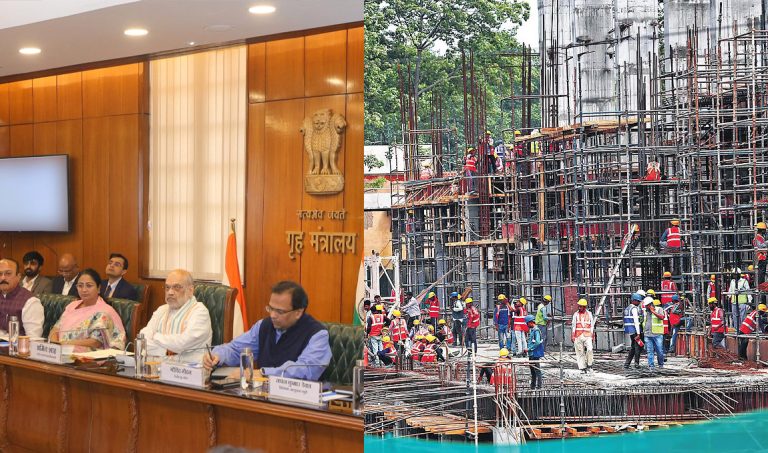
A day after Home Minister Amit Shah gave directions that permission of Delhi Police will not be required in matters related to construction in the national capital, the Delhi Government issued a circular asking the police to sensitise its field officials to remove the misconception that police permission is required for carrying out any building construction.

The circular said that building construction activity is regulated by the MCD and other local bodies in their respective jurisdictions.

It said Section 312 / 313 of the DMC Act (Delhi Municipal Corporation Act), 1957 provides finalising of layout plan, Section 336 of the Act provides for sanction of building plan and Section 346 for occupancy or completion certificate.

The circular said there is no provision under DMC Act, 1957 by which a person is required to seek the permission from police for carrying out the construction.

It said there are, however, certain provisions in the DMC Act related to police giving information to the MCD with respect to an offence or for probe of such offence.

The circular said “there is a misconception” that a person needs to obtain permission from the police for carrying out construction of a building and there is sometimes misuse of the provisions “for the purpose of rent seeking”.

It asked Delhi Police to sensitise its field officials “to prevent the misuse of the provisions” and to remove the misconception that there is any need for permission from the Police for carrying out any construction of buildings.

Police authorities will continue to assist and provide full support to all municipal officers and other municipal employees in the exercise of their lawful authority, the circular said.

Senior Delhi Police officials met at the police headquarters here earlier in the day following yesterday’s meeting on law and order chaired by Amit Shah and discussed follow-up measures, including ways to mount greater vigil against street crime, improve the security of senior citizens and women, and take steps against gangsters.

The sources said that senior officials also discussed ways to prevent the entry of drugs in the national capital.

Measures will be intensified to identify and deport illegal immigrants from Bangladesh as part of drive against those staying illegally in the country, they said, adding that a plan will be prepared to effectively tackle street crime.

The sources said police have been asked not to get involved in matters relating to construction and underground boring in unauthorized colonies.

To check threats received by businessmen, action will be intensified against gangsters operating from abroad, as well as their local accomplices in Delhi.

Sources said that Deputy Commissioners of Police (DCPs) have been told to personally listen to the complaints of people.

The meeting chaired by Amit Shah yesterday was attended by Delhi Chief Minister Rekha Gupta, Home Minister of Delhi government Ashish Sood, Union Home Secretary Govind Mohan and senior officials.

Several measures and suggestions to strengthen safety of women, children and senior citizens and improve law and order in the national capital and controlling crime were discussed in detail in the review meeting held on Friday.

The Home Minister expressed hope that the double-engine government will work with double speed for a developed and safe Delhi, as per the expectations of Prime Minister Narendra Modi.

Amit Shah directed the Delhi Police that strict action should be taken against the entire network that helps Bangladeshi and Rohingya intruders enter the country, get their documents made and facilitate their stay here.

He said that the issue of illegal intruders is also related to national security and it should be dealt with strictly and they should be identified and deported.

Amit Shah emphasized that strict action should be taken against police stations and sub-divisions which fail to perform.

The Home Minister said that there is a need to work with a ‘top to bottom’ and ‘bottom to top’ approach in dealing with narcotics cases and dismantle its entire network. He directed that permission of Delhi Police will not be required in matters related to construction in Delhi. He directed that 25 security committees should be formed, on a pilot basis, in JJ clusters and after seeing their results and efficacy the initiative may then be taken forward.

Amit Shah said that it should be the priority of the Delhi Police to eliminate interstate gangs in Delhi with a ruthless approach. The Home Minister said that DCP-level officers should go to police stations and organize public hearing camps and solve the people’s problems.


(This news report is published from a syndicated feed. Except for the headline, the content has not been written or edited by OpIndia staff)
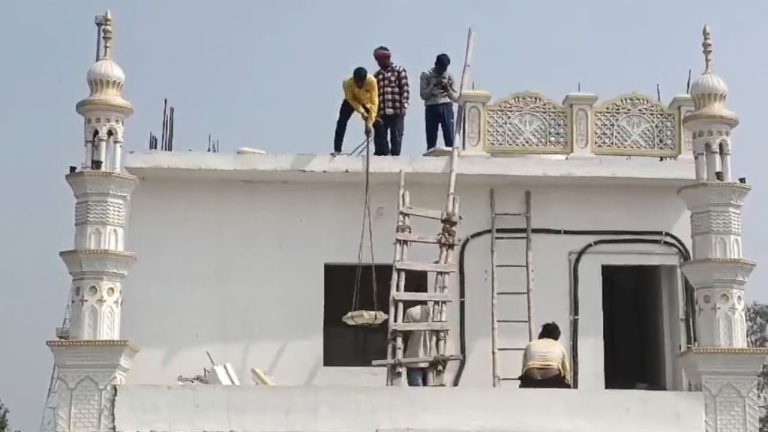
Gorakhpur: Mosque committee voluntarily demolish illegal structure after being served an ultimatum to dismantle unlawful construction

In Uttar Pradesh’s Gorakhpur, the mosque committee voluntarily demolished the Abu Huraila Mosque, located at Ghosh Company Chowk. The Gorakhpur Development Authority (GDA) issued a notice 15 days ago regarding the illegal construction of the mosque. On Saturday, the mosque committee itself began dismantling the structure, as the notice period had ended the previous day.

Illegal Four-Story Mosque Built on Municipal Land

A four-story mosque had been constructed illegally on municipal land near Ghosh Company Chowk in Gorakhpur. The municipal corporation had issued multiple notices to remove the unauthorized construction. A few months ago, a bulldozer was used to clear the illegal encroachment, but a four-story mosque was rebuilt on the same land. Reports indicate that the mosque was constructed without obtaining approval for its design. Subsequently, the Gorakhpur Development Authority issued a notice to the mosque committee, ordering them to vacate the premises within 15 days.

Mosque Committee Acted Before the Notice Expired

It is reported that on February 15, a notice was issued to Shoaib Ahmed, the son of the late caretaker of the mosque, instructing the removal of the illegal structure. With the deadline ending yesterday, the mosque committee members began demolishing the building themselves on Saturday. A multi-level commercial complex will now be constructed on the same land.

Notably, in recent days, the Madni Mosque in Kushinagar, a neighbouring district of Gorakhpur, was demolished using a bulldozer. Similarly, the 85-year-old Jahangir Khan Mosque in Meerut was also taken down.

Gorakhpur Development Authority issues 15-day ultimatum

Earlier last month, Gorakhpur Development Authority issued a 15-day ultimatum to demolish a three-storey mosque which was rebuilt recently after a previous demolition. As per the GDA, the mosque was built ‘illegally’ on municipal land near Ghosh Company Square.

In a notice issued on February 15 to Shoaib Ahmed, son of the mosque’s trustee, he has been asked to demolish the mosque within 15 days saying it was built without getting the map approved within the stipulated time limit. The notice adds that if this is not done, the GDA will demolish the structure with bulldozers and recover the cost incurred by the builder. GDA also pasted a copy of the demolition order on the mosque. 

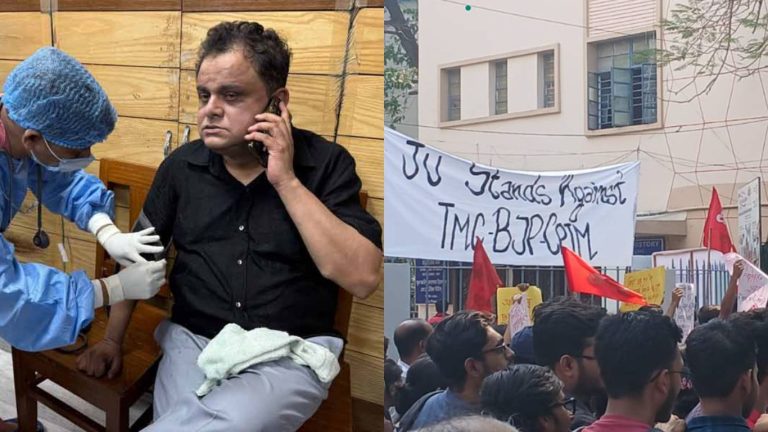
West Bengal Education Minister Bratya Basu and several professors injured in attack by SFI protestors in Jadavpur University, vehicles vandalised

West Bengal Education Minister Bratya Basu was physically attacked by a group of left-wing students at Jadavpur University on Saturday (1st March) when he was there to attend an event of the West Bengal College & University Professors Association (WBCUPA), an organisation of pro-Trinamool professors. Minister Basu was injured in the attack, and his vehicle was vandalised. Several professors of the university were also attacked, and some students were also injured in the clash.

According to reports, when Basu was leaving the university campus after attending the event, he was stopped by the protesters belonging to the Students’ Federation of India (SFI), the student wing of the CPI(M), who were demanding immediate student body elections. The protestors deflated the tyres of his car and climbed on its bonnet.

The Education Minister came out of his car and tried to talk to the protestors, but the protestors did not listen to him and vandalised his car and two other accompanying pilot cars. He sustained injuries due to bricks thrown by protestors at his car. He was taken to the SSKM Hospital, Kolkata. His guard also sustained injuries.

The protestors reportedly attacked the WBCUPA professors as well. Professor Omprakash Mishra was chased by protestors carrying sticks. He was rescued by the university guards. Two professors are said to have been injured in the attack, while one student received head injuries. Some students reportedly tore the saree of a female professor. Before this, some SFI protestors heckled Basu when he was delivering a speech during the WBCUPA event. They threw chairs and vandalised the venue.

Basu, who is the president of the WBCUPA, condemned the violent protests and said that action would be taken against those responsible. “This hooliganism cannot continue. I can talk to some representatives of the students. But it is difficult if everyone creates chaos. However, I will not give in to any provocation. The Vice-Chancellor will take action against those who are doing this,” said Basu.

“If this had happened in Uttar Pradesh, could any student organisation have done this? During today’s incident, we could have called the police. But I forbid even a single policeman from entering the academic premises, “he added. Basu accused the protestors of selectively targeting the TMC and not questioning the BJP. “Those who are attacking professors today, how many steps have they taken against militarisation in the education sector? They want to attack Trinamool professors, but they remain silent about the BJP,” Basu alleged.

Trinamool state general secretary Kunal Ghosh condemned the incident and the attack on professors, terming the SFI ‘uncivilised’ in a Facebook post. He said the generosity of the TMC should not be mistaken for weakness.

“Those who committed this incivility with Professor Dr Pradeep Mukherjee in Jadavpur and those organisations need to be identified. Pradeep is a clean gentleman. Appropriate action needs to be taken against the few uncivilised people. Trinamool’s courtesy does not mean weakness. Why should they be beaten? As a ruler, one should definitely be restrained. But if the chauvinism crosses the line, one should give a befitting reply,” he wrote.

Delhi’s Patiala House Court allows police to withdraw 2019 sedition case against Shehla Rashid over her tweets on army

The Patiala House Court has allowed an application moved by Delhi Police seeking direction to withdraw a 2019 sedition case against former Jawaharlal Nehru University Students’ Union (JNUSU) leader Shehla Rashid Shora concerning her tweets about the Indian Army.

Chief Metropolitan Magistrate Anuj Kumar Singh allowed the application on February 27. The application stated that Delhi Lieutenant Governor V K Saxena, who had previously granted sanction to prosecute Rashid, has now withdrawn the sanction. A senior official also confirmed the development in the matter.

The Special Cell of Delhi has recently moved the court and filed an application under section 321 CrPC, stating that “The case was examined by the Screening Committee, which recommended for withdrawal from prosecution of the said case. The same was placed before the Government of NCT of Delhi for consideration.

“Hon’ble Lt Governor. Delhi has approved the recommendation of the Screening Committee for withdrawal from prosecution under section 196 of CrPC. It is, therefore, requested to take appropriate action in the matter, under intimation to this Government,” Delhi Police said in the application.

Shehla Rashid was booked by Delhi Police in 2019 under the sedition law for her tweets in which she had claimed that the armed forces were “entering houses” in Jammu and Kashmir and “picking up boys”.

The case was filed on the complaint of a Supreme Court lawyer, Alakh Alok Srivastava. In the complaint, it was mentioned that Rashid, in her series of tweets, mentioned alleged human rights violations by the Indian Army. However, the Army has officially denied the allegations levelled by Rashid and called them baseless and unverified.


(This news report is published from a syndicated feed. Except for the headline, the content has not been written or edited by OpIndia staff)

Muslim mob hounds Hindu boy in Bangladesh, accuses him of ‘insulting Islam’: List of Hindus attacked in the name of ‘blasphemy’ in recent times

On Friday (28th February), a Muslim mob comprising of members of the radical ‘Hefazat-e-Islam Bangladesh’ and ‘Tawhidi Janata‘ hounded a Hindu man named Supta Saha Anik after accusing him of making ‘objectionable remarks’ about Islam.

The mob organised a protest rally in Kalmakanda upazila in the Netrakona district of Bangladesh after Jumma Namaz. They also demanded the immediate arrest of the Hindu man for supposedly insulting Prophet Muhammad and gave an ultimatum of 48 hours.

As expected, the violent Muslim mob raised genocidal slogans and vowed to make ‘ultimate sacrifie’ in order to avenge the supposed dishonour to Islam.

According to reports, the victim Supta Saha Anik is a student of Rajshahi University. He is also a member of the Chhatra League, the banned student wing of the Sheikh Hasina-led Awami League.

Anik is a resident of Mantal village in Kalmakanda upazila in the Netrakona district.

As per screenshots that have surfaced on social media, the Hindu man seemed to have engaged in a heated confrontation with a Muslim man and criticised Islam in response to his provocation.

In a video that surfaced on social media, a violent Muslim mob could be seen at the residence of Supta Saha Anik, intimidating his father.

Muslims attack Hindu minorities in Bangladesh under pretext of blasphemy

In January this year, a Hindu man named Pranta Talukder was abducted and tortured by a Muslim mob in the Chittagong city of Bangladesh. He was thrashed mercilessly and left severely injured over allegations of committing blasphemy.

In December 2024, Muslims carried out arson attack on 130 Hindu houses and 20 temples after accusing a young boy named Akash Das of making blasphemous comments on Facebook.

In October 2024, a frenzied Muslim mob laid siege to the Kadirdi Degree College in Boalmari in the Faridpur district of Bangladesh after accusing a Hindu boy named Hridoy Pal of ‘insulting’ Prophet Muhammad.

In September last year, a Hindu boy named Utsab Mandal was almost lynched by a Muslim mob on accusations of ‘blasphemy’ in the Sonadanga residential area of Khulna city.

Later that month, another frenzied Muslim mob laid siege to the Patiya police station in Chittagong district of Bangladesh, demanding that the cops hand over a Hindu boy accused of ‘insulting’ Prophet Muhammad.

The mob, comprising mostly local madrassa students, also attacked an army vehicle after seeing a young boy in civilian clothes and mistaking him for the Hindu victim. A 22-year-old Hindu youth named Partha Biswas Pintu was arrested on charges of committing ‘blasphemy’.

In May 2024, a Hindu student named Utsab Kumar Gian, studying at the Bangabandhu Sheikh Mujibur Rahman Science and Technology University in Bangladesh, was thrashed by a Muslim mob on accusations of blasphemy.

When Bangladesh High Court recommended death penalty for blasphemy

In November 2024, OpIndia reported how the High Court of Bangladesh recommended strengthening the Cyber Security Act to make ‘blasphemy’ punishable by life imprisonment and death penalty in the country.

“There should be a provision of punishment like death penalty or life imprisonment for such unnecessary, unconscionable, obstinate and provocative speech and conduct against the Quran and Muhammad (Pbuh), which the parliament may consider,” a 2-Judge Bench of Justices MR Hassan and Fahmida Quader stated.

They further declared, “To discourage any such inflammatory speech or act which is likely to offend the minds of people of any religion, or to cause fear, terror, discomfort or apprehension in any of them, enhancing the punishment for such offences and to make them non-bailable must be considered.“

The Bangladesh High Court added, “If the offenders who are involved in the respective links of the charge sheet are not brought under the law, in every case the main culprit or the main conspirator or the main source will remain out of touch. Hence, there needs to be an appropriate order in this regard.“

Currently, the maximum punishment imposed by the blasphemy law in Bangladesh is 2 years imprisonment and a fine of 5 lakh Taka. The country’s High Court now recommends increasing the maximum punishment to non-bailable charge, life imprisonment and death penalty.

CAG on health report exposes delay in disbursement of COVID-19 vaccination funds by the AAP government

The Comptroller and Auditor General (CAG) has exposed severe lapses in the healthcare system in Delhi under the previous Aam Aadmi Party (AAP) government. The report, focusing on healthcare under AAP, pointed out that although the central government released funds to the Delhi government specifically for COVID-19 vaccination efforts, the AAP-led government failed to disburse the funds in a timely manner. Serious healthcare system lapses include a shortage of staff in hospitals, non-functional operation theatres, shortages of medicines, and other issues.

Delay in disbursing central funds for vaccination

The CAG report suggests that funds allocated by the Union Ministry of Health and Family Welfare were meant to be transferred to the Delhi State Health Society (DSHS) for further distribution. However, the Delhi administration, under the leadership of former Chief Minister Arvind Kejriwal, withheld the money for months, effectively delaying crucial immunisation efforts.

According to the report, the central government allocated Rs 9.60 crore in two instalments. The first instalment of Rs 3.46 crore was released in January 2021, and the second instalment of Rs 6.14 crore was released in March 2021. Instead of immediately transferring the money to DSHS, the Delhi government delayed the process and released the funds in April 2021 and May 2021, respectively, when the second wave of COVID-19 was wreaking havoc in the national capital.

Unspent funds despite urgent need

The CAG report also revealed that despite the urgency of the pandemic, a significant portion of the vaccination funds remained unspent. By March 2022, only Rs 7.92 crore out of the allocated Rs 9.60 crore was utilised, raising serious concerns about the efficiency of fund management during a public health crisis.

Delhi was one of the most affected cities during the COVID-19 pandemic, and thousands of lives were lost. The vaccination drive played a crucial role in curbing the spread of the deadly virus nationwide. However, the delay in fund allocation and mismanagement in the utilisation of funds by the then Kejriwal-led government might have severely compromised the pace and effectiveness of the immunisation programme in Delhi.

Earlier OpIndia reported that out of a total of Rs 787.91 crore allotted for COVID fund, AAP government used only Rs 584.84 crore. Also, Rs 30.52 crore meant for healthcare workers and Rs 83.14 crore for essential drugs and PPE kits were not used by the then-Delhi government.

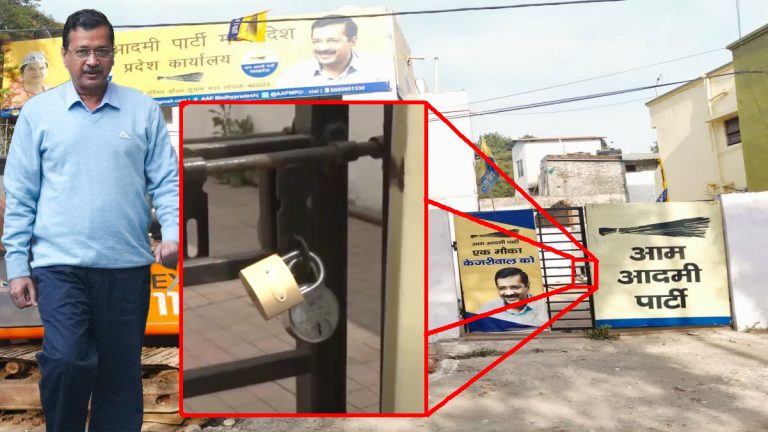
Aam Aadmi Party Office in Bhopal sealed by landlord due to non-payment of rent and electricity bill for months

An Aam Aadmi Party office in the Subhash Nagar area of Bhopal in Madhya Pradesh has reportedly been sealed due to non-payment of the rent. As per reports, the landlord of the building housing the party office alleged that three months’ rent and electricity bills have been pending. Landlord Dileep Mangalani reportedly alleged that party members have been giving false assurances of payment of the rent and the bill. He said that they took away stuff from the office stealthily without informing him.

As per the landlord, rent of ₹60,000 for 3 months has not been paid. Additionally, the electricity bill of around ₹13,000 for 6 months remains unpaid by the party.

AAP members issued death threats, alleges landlord

“Aam Aam Party occupied my house on lease about 4-5 months ago. And ever since they paid about 2 months’ rent with difficulty. They did not pay any rent for three months at all. When I call they say they are coming. They came at night like thieves and took away all their belongings without asking me,” said Mangalani. He alleged that whenever he calls the party members for rent, they threaten him. “I am legally sound. I have done nothing wrong. Whenever I call them for rent they threaten me and dare me to get the building evacuated. They use Kejriwal’s (Arvind Kejriwal) name and threaten me saying that governments can get anyone killed without anyone finding out about it,” alleged the landlord.

“If you want to vacate the building then clear the dues and take your stuff. They took away their stuff like thieves and did not come to pay the money. They have not paid three months’ rent worth ₹ 60,000 and electricity bills worth ₹13,000 that’s, why I sealed the building,” he added. Manglani said that he would file a complaint with the police.

AAP Mayor says there was some misunderstanding

Commenting on the allegations of the landlord, AAP state president and Singrauli Mayor Rani Aggarwal said that he was having some misunderstanding. Aggarwal said that the person in charge of the office had gone somewhere. She said that a state-level meeting of the party will be held in the office on 5th February in which she would address the media.

Notably, the party had shifted their state office from Subhash Nagar Colony to Arera Colony before the 2023 State Assembly elections. A 40-member team was reportedly posted at the office six months before the assembly elections. However, after AAP lost the assembly elections, its Arera Colony office building was evacuated and the staff was also removed.

Vehicles older than 15 years old will not be allowed to get fuel in Delhi after March 31, announces Minister Manjinder Singh Sirsa

To curb pollution in the national capital, vehicles older than 15 years old will not be allowed to get fuel after March 31, Delhi Minister Manjinder Singh Sirsa announced after holding a meeting with officials here on the issue of pollution.

The Minister for Environment, Forest and Wild Life, Sirsa, also announced that a team would be formed to identify the vehicles and bar their entry and exit into the city. He added that Delhi Airport, multi-story structures and other big offices must install anti-smog guns to control pollution at their respective places.

“After 31st March, fuel will not be given to 15-year-old vehicles…There are some big hotels, some big office complexes, Delhi airport, big construction sites in Delhi. We are going to make it mandatory for all of them to immediately install anti-smog guns to control pollution at their places. We are going to make it mandatory for all the high-rise buildings in Delhi to install smog guns. We are going to make it mandatory for all the hotels in Delhi to install smog guns,” he told reporters.

Sirsa further said that the government would make efforts to create artificial rain through cloud seeding to tackle pollution further.

He added, “Similarly, we are going to make it mandatory for all the commercial complexes…We have decided today that we will take whatever permission we need for cloud seeding and we will ensure that when there is severe pollution in Delhi, rain can be caused through cloud seeding and pollution can be controlled.”

The quality of air deteriorates with the onset of winter in the National Capital and adjoining areas.

Earlier this week, the Delhi Minister launched a scathing attack on the Aam Aadmi Party and alleged that the previous Delhi government “looted the public”.

Speaking to reporters, Sirsa said, “This (AAP) government has looted the public with both hands. Liquor scam, school scam, bus scam and now camera (CCTV) scam are also coming to light.”

“They used to say that cameras will catch theft but the thieves themselves took away the cameras… they have left no scam unturned… I think CAG report will have to be called on cameras too”, he added.


(This news report is published from a syndicated feed. Except for the headline, the content has not been written or edited by OpIndia staff)

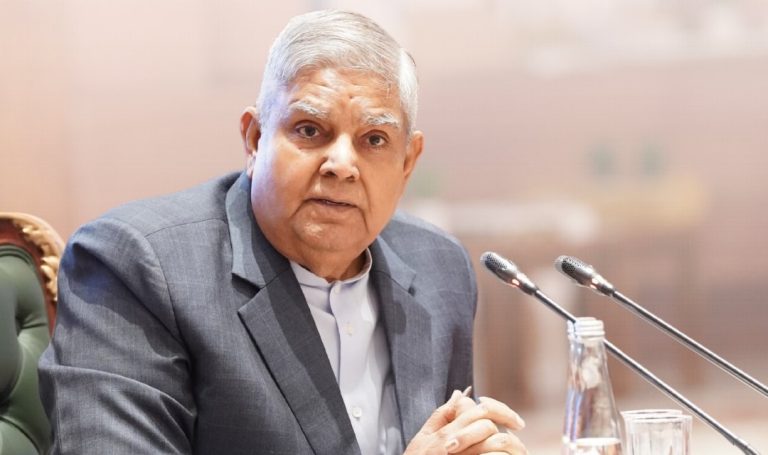
A segment has absolute tight fist control on arbitral process, domain experts should be made arbitrators, not just retired judges: Vice President Dhankhar

0

Addressing the Colloquium organised by the India International Arbitration Centre (IIAC) at Bharat Mandapam on Saturday, Vice-President Jagdeep Dhankhar said that the arbitral process in India is “just an additional burden to the normal hierarchical mechanism of adjudication.”

“Arbitrators play as much critical role as members of the bar associated with the arbiter process. Surprisingly, there is, I’m saying it with utmost restraint, absolute tight-fist control of a segment of a category that is involved with arbiter process determination. This tight-fist control emanates out of judicial feats. And if we examine it on an objective platform, it is excruciatingly painful,” he stated.

Highlighting India’s vast expertise across sectors, Dhankhar noted, “This country has rich human resources in every facet–oceanography, maritime, aviation, infrastructure and what not. The disputes are relatable to the experience, which is sectoral. Unfortunately, we have taken in this country a very myopic view of arbitration as if it is adjudication. It is much beyond adjudication. It is not conventional adjudication as historically evaluated globally.”

Highlighting the importance of involving domain experts in arbitration, Dhankhar stressed, “A former Chief Justice of this country……did make an observation, “Process has become an old boys club”. He was referring to retired judges’ participation in the arbitral process. I should not be misunderstood even for a moment. Retired judges of this country are assets to the arbitral process. They lend credibility to us. I know some of the former chief justices and judges being absolutely appreciated globally for international commercial arbitration……But there are areas where the arbitral tribunal needs to be supplemented by experts in the field of oceanography, in aviation, in infrastructure”.

Emphasizing the significance of Article 136 and its effects on the arbitration process, Dhankhar remarked, “The Attorney General of the country can really reflect and make a big change. Which country in the world, Attorney tell me, has suo moto cognisance by the highest court? I’m sure I can’t look around. And Article 136 intervention was supposed to be a narrow-slit. The wall has been demolished with anything and everything under the sun, including what a magistrate has to do, what a Session Judge has to do, what a District Judge has to do, and what a High Court Judge has to do. That wall demolition is also hurting the arbitral process. All I am suggesting, in all humility and as a concerned citizen of this country, is that the issue you are debating is critical to micro and small industries. They want facile, easy arbitral process”.

Expressing his concern over the progress of the arbitration ecosystem in the country, Dhankhar said, “Now is the time when India is emerging in every field globally. Why shouldn’t India emerge as a global dispute resolution centre? If I reflect to myself……what do they have which we don’t? Their infrastructure is hardly comparable to what we have. And look at cultural centres where arbitrators can really engage. Go to Kolkata, Jaipur, Bangalore, Hyderabad, Chennai, any part, get away from the metro then you’ll have. I have seen in ten years the growth of arbitral centres with credibility in Dubai and Singapore. On self-assessment without fear of contradiction, I can say we are nowhere. We are not in the mind of people with commercial relationships with us if it is international commercial arbitration.”

Underlining the need to move towards a different settlement, the VP stated, ” Let us navigate, because it is time for us to navigate, step by step, from alternative resolution to amicable resolution. Why should it be an alternative? It must be the first option. Why should it be a substitute for litigation? So amicable resolution, from dispute resolution to difference resolution. Why do we label it a dispute? These are differences. These are differences because a new person has taken to a particular enterprise in making India; he has engaged in a startup. There are some differences. He wants to iron out this difference because he is not all in all. He cannot have a way with all the various departments. Therefore, let us convert it from dispute resolution to difference resolution and then why resolution? Why not make it from resolution to settlement? And why look for a judicially unforeseeable package of awards? Let us get into consensual convergence. All these, in my modest assessment, will secure commercial partnerships. They will not break partnerships. They will nurture partnerships in commerce, business trade and industry. They will ensure their blossoming”.

“Every economic activity will have differences, disputes, requiring quick solutions. Sometimes, disputes and differences arise on account of perception variations, inadequate support or helplessness. In this situation, it is very significant that we focus on adjudication”, he added.


(This news report is published from a syndicated feed. Except for the headline, the content has not been written or edited by OpIndia staff)

West Bengal’s Cheif Electoral Officer rubbishes CM Mamata Banerjee’s claims of election manipulation

West Bengal’s Chief Electoral Officer (CEO) has rejected CM Mamata Banerjee’s claims of electoral fraud, asserting that the voter roll update process adheres to established legal guidelines.

Slamming the West Bengal Chief Minister over claims of fraud during elections, the West Bengal CEO responded on its official account on X, detailing the procedures for updating electoral rolls, citing the Representation of the People Act, 1950, the Registration of Electors Rules, 1960, and the Manual on Electoral Rolls.

“The process involves BLOs, AEROs, EROs, DEOs, and CEOs across all States and UTs,” the post stated. “Political parties actively participate through Booth Level Agents, and any objections must first be raised with the designated 80,633 BLOs, 3,049 AEROs, and 294 EROs in West Bengal.”

The Chief Electoral Officer’s response came in the wake of the announcement made by Ms Banerjee about the formation of a committee to investigate alleged voter list irregularities in the state.

On Thursday, Chief Minister Mamata Banerjee accused the BJP of manipulating voter lists, comparing the situation in West Bengal to alleged electoral irregularities in Maharashtra and Delhi. She claimed the BJP had used similar tactics in other states and was now attempting to replicate them in West Bengal.

“From the Election Commissioner’s office, they have fabricated a fake voter list online, adding fraudulent voters in every district of West Bengal,” Ms Banerjee alleged. “This strategy helped them win elections in Delhi and Maharashtra, where the opposition was unaware of such manipulations. Most of these fake voters come from Haryana and Gujarat. With the Election Commission’s backing, the BJP is altering the voter list, undermining Bengal’s legacy of independence.”