Home Blog Page 5887

Delhi: Alertness of cops prevented 150 criminals from escaping during the clash between police and lawyers in Tis Hazari court

A huge disaster has been saved by the Delhi policemen despite being roughed up by the lawyers at the Tis Hazari court complex on Saturday as the alertness of Delhi police officials made sure that nearly 150 dangerous criminals did not escape from their custody.

Reportedly, the violent clashes which erupted between police and lawyers at Tis Hazari Courts complex on Saturday could have turned into a disaster as more than 150 hardened criminals could have been out on the streets.

The police who were outnumbered and cornered by the lawyers but with their presence of mind, fastened the gates of the lock-up at the court with handcuffs and stationed a table there so that the lawyers could not force their way inside.

Reportedly, the CCTV footage and mobile videos revealed the unfolding of events during the clashes between cops and lawyers at Tis Hazari court complex on Saturday noon. The lawyers kicked and threw tables and chairs to break the lock-up gate. The handcuffs and the table helped reduce the impact of the pounding.

Read- Watch: Delhi lawyers spat with journalists, push and shove a woman journalist when questioned about scuffle with Delhi Police

In the meantime, the police got alerted and moved the inmates into a room at the far end of the lock-up to prevent them from escaping. A few policemen even formed a human chain at the entrance of the corridor to block their view.

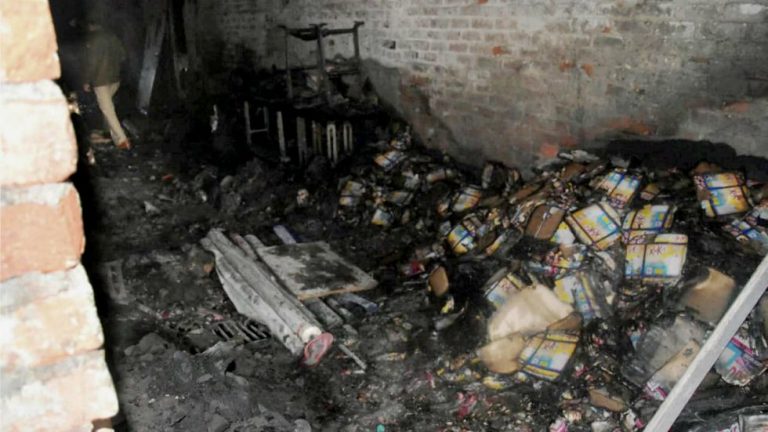
However, just when the policemen thought that they had succeeded in their plan, dramatically a bike at the gate went up in flames. As the situation turned dangerous, the policemen continued their duty taking a risk of falling unconscious due to the smoke. Also, petrol had spilt on the ground and there was a chance that the tank could have exploded.

However, the policemen brought the situation under control by throwing water from their camper to douse the fire. Another cop broke open the window panes behind the lock-up to allow the smoke to go out.

As the stand-off didn’t end for 15 minutes, the policemen decided to take a calculated risk. They divided themselves into two teams. One team took the responsibility of stopping the advocates from entering the lock-up and the other group was to secure the criminals in a corner until reinforcements arrived.

To the respite of the policemen, reinforcements arrived and the inmates were packed into vans and taken back to jail.

Read: Here is why Delhi policemen chanted ‘Humara CP kaisa ho? Kiran Bedi jaisa ho’ at the protests at Police headquarters

This alarming episode has now prompted the Special Branch of Delhi Police to issue instructions regarding the handling of inmates until the situation returned to normal. In a message released to the special commissioner (law and order) on Saturday, the special branch asked for providing security at all police posts and lockups with extra focus on those located in court premises.

“Undertrial prisoners may not be allowed to be transported to courts until the situation turns normal. The arrangement is made for video conferencing in urgent and important cases. The judges may be requested to hold courts in jail concerned,” the circular read. It was also advised not to take undertrials outside jails for medical examination.

Tis Hazari incident:

A fight started over the issue of parking at Tis Hazari court flared into a battle between lawyers and policemen on Saturday afternoon.

The incident began around 3 pm on Saturday when a policeman of the Delhi Police got into a fight with a lawyer over parking his car outside the jail lockup, a space reserved for jail vans. However, the argument turned violent when a group of lawyers who were campaigning for the bar council elections got into a heated exchange with the police.

The cops allegedly dragged a few of them and took them to the lockup. While this was happening, some lawyers reportedly set a few bikes parked outside the lockup on fire.  Lawyers even attacked journalists, covering the incident.

Later, the police lathi-charged the lawyers and reportedly damaged their cars and chambers on the court premises. The Delhi Police claimed 20 police officers and 12 lawyers were injured in the clash.

During the clash, an advocate named Vijay Verma was allegedly shot, leading to lawyers setting up fire on police vans. The lawyer was admitted to St. Stephen’s hospital and is under observation.

However, the lawyers did not stop at Tis Hazari court. They continued their vandalism after they went on a violent rampage and indulged in yet another scuffle with a policeman near the Saket district court in Delhi.

The lawyers were seen unleashing crude hooliganism against a police official by slapping him and later throwing a helmet on him. The unfortunate policeman, in a bid to save himself from further beating at the hands of the lawyers, takes a u-turn on his bike and escapes away.

On Monday, lawyers at Delhi’s Karkardooma court reportedly beat up a policeman and have misbehaved with a woman journalist. Social media posts also say that common men, including litigants and some court staff members, have been attacked by the lawyers too.

Nehru Memorial ‘Modi-fied’ as Congress leaders Mallikarjun Kharge, Jairam Ramesh, Karan Singh removed from panel

The Central government on Tuesday reconstituted the Nehru Memorial Museum and Library (NMML) and removed senior Congress leaders Mallikarjun Kharge, Jairam Ramesh and Karan Singh from the panel. Senior journalist Rajat Sharma and poet, lyricist and adman Prasoon Joshi were inducted in the society.

Prime Minister Modi is the president of the society and Defence Minister Rajnath Singh is the vice-president. Along with them, union ministers Amit Shah, Nirmala Sitharaman, Ramesh Pokhriyal, Prakash Javadekar, V Muraleedharan and Prahlad Singh Patel, ICCR chairman Vinay Sahsrabudhhe, Prasar Bharti chairman A Surya Prakash, secretaries of Expenditure, Culture and Housing and Urban Affairs, are its members.

Read: Modi government to change Nehru Memorial to Museum for all Prime Ministers of India

The members are appointed for a period of five years or until next order, whichever comes first. Last year in November, journalist Arnab Goswami had replaced Pratap Bhanu Mehta at NMML. 3 other members, economist Nitin Desai, professor Udayan Mishra and former bureaucrat BP Singh, were also replaced along with Mehta who had opposed the Centre’s proposal of honouring all past prime ministers at the Teen Murti Estate.

In September 2018, the Sonia Gandhi led Jawaharlal Nehru Memorial Fund was asked to vacate the Teen Murti Complex. The ministry of housing and urban affairs had stated in its letter that the JNMF is occupying the premises without any authority of law and the NMML needs the space.

Will Ram Lalla finally come home: The culmination of a people’s movement spanning over 491 years

The Supreme Court is set to deliver its verdict on the vexatious issue of whether Sri Ramlalla Virajman is the legitimate owner of the Ram Janmabhumi temple site in Ayodhya, before Chief Justice of India, Justice Ranjan Gogoi, retires on November 17, 2019. Alternately, the court will decide whether the land belongs to the Sunni Muslim Wakf Board because Emperor Babur conquered the region and erected a mosque in 1528 AD. Hindus have doggedly fought to reclaim this particular spot for 491 years, and now await the judgment with bated breath.

Many who led the struggle to reclaim the site in the twentieth century are no more: Paramhans Ramchandra Das (allegedly behind in the “arrival” of the Ramlalla murtis in the disputed structure in 1949), Mahant Avaidyanath, Gopal Singh Visharad, Ashok Singhal, Acharya Giriraj Kishore, Deoki Nandan Aggarwal, and so many others. However, leaders like Lal Krishna Advani, Murli Manohar Joshi, Uma Bharati and Vinay Katiyar will witness this historical moment. So will Sadhvi Rithambara, then a noted firebrand.

Read: Road to Ram Janmabhoomi, Ayodhya: How Hindus fought for Shri Ram

As a political correspondent at the time, I recall a conversation with Congress leader P. Shiv Shankar wherein he said that the history of India would henceforth be written in terms of pre- and post-December 6, 1992. Like many Congressmen of the time, he was unhappy with the way Prime Minister P.V. Narasimha Rao had handled the matter. Though the political discourse on “communalism” got much fodder with the demolition of the disputed structure, History is more complex and has so far eluded such simplistic prescriptions.

The Supreme Court had dodged the Ram temple bullet when President Shankar Dayal Sharma, on January 7, 1993, under Article 143 of the Constitution, sought its opinion on the question of whether there was a temple at the site before 1528 AD. Coming hot on the heels of the demolition, the court should perhaps have laid out some objective parameters for resolving this long-simmering dispute. However, a five-judge bench headed by Chief Justice M.N. Venkatachelaiah and comprising Justices J.S. Verma, A.M. Ahmadi, S.P. Bharucha and Y.D. Ray returned the Presidential reference on October 24, 1994, expressing an inability to answer the question. In the process, a judicially sponsored opportunity to resolve the vexed issue was lost.

Now, the appeal against the judgment of the Allahabad High Court, which heard the matter as a trial court (unprecedented in the annals of the Indian judiciary), has reached the Supreme Court as the first court of appeal. But there is no higher court of appeal. It may be emphasised here that the Supreme Court has clarified that though five judges are hearing the appeal, the Bench is not a Constitution Bench.

Read: The absurdity of the ‘solution’ to build a Hospital at Ram Janmabhoomi

Looking back, Sri Ramlalla has gone through many vicissitudes to arrive at this crossroad after murtis of Ramlalla “mysteriously” emerged inside the central dome of the structure on December 22-23, 1949. As chief minister Gobind Ballabh Pant refused to remove the murtis despite pressure from Prime Minister Jawaharlal Nehru, the site was declared a disputed property on December 29, 1949. Muslims were barred from entering the mosque and Hindus were permitted to have darshan from a side gate. Both sides filed cases in court. The Nirmohi Akhara suit of December 17, 1959, sought possession and custodianship of the land. The Sunni Central Board of Waqf suit of December 18, 1961, claimed ownership of the site.

The case hung fire for several decades until the Vishwa Hindu Parishad (VHP) took it to the people in 1984. The campaign got an unexpected boost when, on February 1, 1986, the Faizabad district magistrate ordered the gates of the mosque to be opened so that Hindus could worship there. As this was not expected in the regime of Rajiv Gandhi, the shocked Muslim community set up the Babri Masjid Action Committee at the instance of Ali Miyan, president of the All India Muslim Personal Law Board.

Read: Hindus have been demanding restitution since 1528 for the Ram Temple destroyed by Islamist barbarians, Rajeev Dhavan

The stagnant wheels of the Ram chariot began to move and in 1989, the campaign to build a grand temple for Sri Ram gathered heft with the Bharatiya Janata Party endorsing the Ram Janmabhumi movement at Palampur (HP). Briefly, the VHP performed shilanyas (foundation laying ceremony) on land adjacent to the Babri structure on November 9, 1989, with permission from the Rajiv Gandhi government, and BJP president Lal Krishna Advani launched his famous Somnath-to-Ayodhya rath yatra on September 25, 1990. The yatra galvanised the country and seemed invincible until Bihar chief minister Lalu Prasad Yadav ordered Advani’s arrest at Samastipur the same month.

After a two-year stalemate, during which Uttar Pradesh chief minister Mulayam Singh Yadav ordered firing upon Ram bhakts in Ayodhya in 1991, killing an untold number (the bodies were allegedly thrown in the Saryu river), frenzied kar sevaks razed the disputed structure to the ground on December 6, 1992. This apocalyptic event was the most powerful Hindu assertion in northern India since the creation of the Sikh kingdom by Maharaja Ranjit Singh. It sent shock waves through the country, even the world, and led to a new stalemate at the site itself, though prayers and darshan by devotees continued.

The Ram temple now took off from the point at which the Supreme Court returned the President’s reference in 1994. At that time, Justice A.M. Ahmadi had asked the purpose of the reference, to which Solicitor General Dipankar Gupta had responded that if there is a temple the government will act according to the wishes of the Hindus, and if not it will respect Muslim wishes.

In April 2002, a three-judge Bench of the Allahabad high court began hearings and sought to know the truth about the ownership of the land. Accordingly, in 2003, the Canadian firm, Tojo Vikas International, entered the picture with its technology for ground-penetrating radar. It took pictures up to a depth of 1650 feet and reported to the High Court that a huge Bhavan (building) was visible under the ground where the mosque stood. To verify this finding, the court ordered the Archaeological Survey of India (ASI) to excavate the site.

Read: Origins of Hindutva: Re-arming Hinduism in an era of nation-states

Amidst stringent conditions and restrictions, the excavation was conducted under the supervision of Dr B.R. Mani. A two-volume report submitted to the court stated that a “north Indian temple” was found under the disputed masjid; in other words, the masjid was not built on empty land. This let the cat among the pigeons and Muslim organisations and secular intellectuals went into overdrive to dispute and discredit the findings.

It is pertinent that the Allahabad High Court accepted the fact that the central dome of the demolished structure was the birthplace of Sri Ram. On the question of whether a “non-Islamic structure” was destroyed to build the mosque, two judges concurred while one merely agreed that malba (debris) was used in the construction of the mosque. It is reasonable to ask where this debris came from; it would hardly have been transported from outside the area, but it could have belonged to a previous human habitation on the site. But the excavation did not reveal any debris suggesting human habitation at the site; only artefacts relating to the presence of a grand temple were revealed along with the presence of an older and smaller temple below it.

Oddly, proponents of the Babri mosque offered their arguments and “pieces of evidence” outside the courtroom. In the court itself, they conducted themselves quite poorly, unable to substantiate any of their loud claims. Ultimately, on September 30, 2010, the High Court awarded the disputed land to three parties, one-third to Ram Lalla Virajman, represented by the Akhil Bharatiya Hindu Mahasabha; one-third to the Sunni Waqf Board; and the remaining to the Nirmohi Akhara. Aggrieved, all parties approached the Supreme Court in December 2010 and secured a stay order in May 2011.

After a considerable lull, the Supreme Court returned to the matter on March 21, 2017, and observed that as the matter is sensitive, an out-of-court solution should be attempted. This failed, predictably, and on December 5, 2017, the Court said it would hear the 13 appeals in the title dispute on February 8, 2018. In October 2018, the apex court ruled that the dispute would be treated as a title suit (ownership dispute) and would be listed before an “appropriate Bench” in January 2019 and this Bench would fix the schedule of hearings in the case. Ultimately, a five-judge Bench was set up on January 8, 2019, and the first hearing held on January 10, 2019.

During the premiership of Rajiv Gandhi, Congress leaders Buta Singh and Sheila Dikshit tried to open a debate on the very existence of Sri Ram, whether he was born in Ayodhya and where this city was located. In fact, this question was raised even in the tenure of Prime Minister Chandra Shekhar, but the VHP said that if the existence of Sri Ram is questioned, it (VHP) would withdraw from the dialogue. So the Muslim side dropped this question in 1991.

Sri Ramlalla Virajman’s case to recover His birthplace and temple fought via “next best friend” Deoki Nandan Aggarwal, ran for 15 years (1995 to 2010) before the Lucknow Bench of the Allahabad High Court. During the course of the hearing, Justice Rafat Alam asked Zafaryab Jilani (lawyer for BMAC), “do you want to solve the case or to leave it to the next generation?” Jilani replied, “I want it to end” and withdrew the question of the existence of Sri Ram. Justice Alam insisted that he give it in writing that Sri Ram was born in Ayodhya, and accordingly, Jilani submitted in writing: “Now the question ends”.

Read: Rajeev Dhavan’s effusive praise for Aurangzeb captures brilliantly the essential position in favour of Babri Masjid

Nevertheless, once the question is raised, doubts will linger in the minds of citizens, so some points can be made. The most obvious answer is that Sri Ram is the hero of the Valmiki Ramayana, but scholars are undecided about the age of this epic, though they agree that it is thousands of years old. However, the Skanda Purana is generally accepted to be one thousand years old, and in the Vaishnav Khand, Ayodhya Mahatm, chapter 10, there is a description about the location of Ayodhya in relation to the temples surrounding it. This matches the map created by the Government of India in 1950 with the sole difference that the measurements were given in dhanus (one dhanus is a little less than 5 feet).

The Skanda Purana also explains why the Ram Janmasthan is worshipped: its darshan gives moksha (release from the cycle of birth and rebirth). The darshan gives Punya (merit) equal to the donation of one thousand cows. For Hindus, the Janmasthan is itself a deity, a swayambhu, self-manifested expression of divinity.

An interesting aspect of the case in the Allahabad High Court was that the suits of the Nirmohi Akhara (1959) and Sunni Muslim Wakf Board (1961) were dismissed and “no relief granted”; their appeals are now before the Supreme Court. Both parties got one-third share of the disputed plot during “moulding of relief” (vaikalpik rahat), which the court is entitled to grant under Article 142 of the Constitution, in the case where God is plaintiff (filed by Deoki Nandan Aggarwal as “next friend” of deity; after Aggarwal’s death, the Supreme Court-appointed advocate Triloki Nath Pandey to represent the deity).

The most pertinent point in the Ayodhya struggle pertains to the issue of adverse possession. That Muslims have broadly been in possession of the Janmasthan since 1528 is undisputed. But for this to give them legitimate ownership rights requires them to fulfil certain legal conditions, as argued by advocate Parmeshwar Nath Mishra of Kolkata, namely, they must be in continuous possession of the site, the possession must be uninterrupted, and peaceful. None of these conditions apply to Ayodhya. Briefly, Hindus and even Sikh Nihangs have waged armed struggle to reclaim the site from 1528 onwards; Muslims stopped offering namaz in 1936; Muslims were officially barred from the site in 1949 and since; and Hindus are in effective possession of site since December 6, 1992.

The Muslim side invoked the concept of Res Judicata under which if a civil suit is filed and decided, a similar suit cannot be filed in the same matter. Hindus lost a legal battle in 1885. However, the Hindu side responded that the God is a legal entity, a juristic person, and a living entity due to the ritual of pran prathistha (breathing life into the murti); the deity can hold property and the deity is always minor in Law and the property of a minor cannot be taken by anyone. Hence, the claim of adverse possession and Res Judicata does not hold. Further, the Janmasthan is itself a swayambhu deity and the deity cannot be divided.

Interestingly, under Muslim law, the land must be purchased legally from the owner for the mosque to be considered legal (wajib), and this was how Prophet Mohammad built the first mosque in Medina. Namaz on the seized property is not acceptable to Allah. This was why Syed Shahabuddin, a leading personality of the BMAC, had said that if the existence of the temple is proved, Muslims will withdraw their claims. This was brought on record in the White Paper published by the Narasimha Rao government, but pressure from certain historians made the BMAC renege on its promise.

Read: Babri Masjid demolition: Pride or shame lies in the eyes of the beholder. Here is why people can be proud of it

The Supreme Court hearings have now concluded, including failed attempts at mediation. Zafar Farooqi, chairman of the UP Sunni Muslim Wakf Board is reported to have said that Muslims should give up claims to Ayodhya, but he did not make any presentation before the court. So now, Ramlalla Virajman waits for his day in court.

Leading Hindu and Muslim organisations have appealed for calm ahead of D-day and it seems that both sides are prepared to conduct themselves with maturity and goodwill. For the Janmabhumi side, however, there is also the issue of charges against leaders like L.K. Advani, M.M. Joshi, Uma Bharati, Vinay Katiyar and others, who were charged with criminal conspiracy in the demolition case. The verdict could determine whether these charges will be dropped, or will persist. But whatever the verdict, it would be in the fitness of things to drop the charges because this was not a petty crime and involved larger civilisational issues.

Pakistan’s official song on Kartarpur Corridor features Bhindranwale and other Khalistani terrorists

In what seems to be an act to provoke India ahead of the opening of Kartarpur Corridor, Pakistan has featured Khalistani terrorists and anti-Indian elements including Jarnail Singh Bhindranwale in its official song to welcome Sikh pilgrims to Kartarpur Sahib. Kartarpur Sahib is believed to be built where Guru Nanak had died.

On Monday, Pakistan’s Ministry of Information and Broadcasting had released a video of the official Punjabi song welcoming Sikh pilgrims to Pakistan for the Kartarpur Corridor, which displays posters of Khalistani separatist leaders Jarnail Singh Bhindranwale, Maj Gen Shabeg Singh and Amrik Singh Khalsa in the background.


At around 38 seconds in the video, a poster with Bhindranwale’s image with ‘Referendum 2020’ can be spotted. Bhindranwale was a Khalistani separatist who killed by Indian Armed forces in Operation Bluestar in June 1984 ordered by then Prime Minister Indira Gandhi. Maj Gen Shabeg Singh and Amrik Singh Khalsa were also killed in Operation Bluestar. The posters of pro-Khalistani movement “Referendum 2020” sponsored by the Pakistani establishment can also be seen in the background of the video.


The song has been released ahead of 550th birth anniversary of Sikhism founder Guru Nanak Dev. The song welcomes Sikh pilgrims at Gurdwara Darbar Sahib on the occasion of the opening of Kartarpur corridor and 550th anniversary of Guru Nanak Dev.

With the terrorist state of Pakistan releasing such videos ahead of the opening of Kartarpur corridor, concerns will be raised against the opening of Kartarpur corridor as Indian Intelligence agencies had accessed information that terrorists being trained near the border district of Narowal in Pakistan’s Punjab province, the same district where Kartarpur Sahib Gurdwara is situated.

The Indian intelligence agencies are very much apprehensive about Pakistan’s over-eagerness to open Kartarpur corridor as it provides an opportunity for the terror state to “exploit Sikh sentiments to support Khalistan agenda” in India.

Read: Navjot Singh Sidhu invited by his ‘friend’ and ‘angel’ Imran Khan for the opening ceremony of the Kartarpur Corridor on November 9

The reports of terror camps near the Indian border comes months after a Pakistani spy, part of a larger espionage network, was caught by the military intelligence from Gurdaspur in Punjab. The accused Pakistani spy was sending photographs and information related to the construction of Kartarpur corridor to his handlers in Pakistan through his WhatsApp number raising doubts about Pakistan’s intention to build the corridor.

Earlier, the Chief Minister of Punjab, Captain Amarinder Singh had also warned the country about Pakistan’s treacherous plans to use the Kartarpur corridor to inflict terror on India, especially by reviving Khalistani terror. Captain Amarinder Singh had reiterated his position on the opening of the Kartarpur Corridor by Pakistan. He claimed that it is an ISI ploy to strengthen anti-India forces, including the Sikhs For Justice (SFJ).

Read: Former Indian diplomat says Referendum 2020 movement backed by Pakistan’s ISI lacks mass support

Meanwhile, supporters of Navjot Singh Sidhu has put up hoardings calling him and Imran Khan the real heroes of Kartarpur. The hoardings were put up by Amritsar Municipal Councillor Harpal Singh Verka who is known to be close to Sidhu.

The hoarding with pictures of Pakistan Pakistan Prime Minister Imran Khan and Congress leader Navjot Singh Sidhu called them the real heroes who made the opening of Kartarpur corridor a reality. However, the hoardings, which appeared on Tuesday afternoon, were quickly taken down within hours.

Navjot Singh Sidhu was the first Indian politician who received the first invitation card to the opening ceremony bearing number 001 from Imran Khan two days ago. The Punjab government has already permitted him to visit Pakistan on November 9 when the Kartarpur corridor will be formally inaugurated.

Here is why Delhi policemen chanted ‘Humara CP kaisa ho? Kiran Bedi jaisa ho’ at the protests at Police headquarters

During the protests at Delhi Police headquarters at ITO, the protesting personnel were chanting ‘Humara CP (commissioner of police) kaisa ho? Kiran Bedi jaisa ho (How should our CP Be? Like Kiran Bedi)’.


The police personnel were protesting after some cops were brutally thrashed by lawyers at Delhi’s Tis Hazari Court on November 2. Some police personnel were also seen holding placard that read ‘We need you’ with a picture of former Delhi Special Commissioner Kiran Bedi.

In fact, Delhi Police Commissioner Amulya Patnaik was also booed at as Delhi Police personnel raised slogans of ‘we want justice’ outside the Police HQ.


The reason police personnel reminisced about Kiran Bedi was the 1988 incident which also took place at Tis Hazari Court. In January 1988, Delhi lawyer Rajesh Agnihotri, was accused of stealing from a ladies common room from St Stephen’s College. On 16th January, he was handcuffed and produced at Tis Hazari court. Lawyers said it was illegal. The metropolitan judge discharged the lawyer same day and directed police to take action against the ‘guilty police officials’.

On 18th January, the lawyers went on a strike demanding action against the police officials. Kiran Bedi, the first woman IPS, on 20th January held a press conference and justified the police action and criticised the magistrate order for discharging Agnihotri.

Read: Watch: Lawyers at Delhi’s Tis Hazari court take law into their own hands, beat up Delhi Policemen

Next day, some lawyers went to office of Kiran Bedi which was located in the same Tis Hazari complex to express their concern. Lathi charge was ordered on the lawyers and many were injured. For the next two months, lawyers stopped courts from functioning in Delhi and in neighbouring states and demanded Bedi’s resignation.

Later, Delhi High Court constituted a two-judge committee to look into the matter, following which the strike was called off. The committee reported that handcuffing of Agnihotri was illegal and recommended that Bedi be transferred.

Last week, Delhi Police officials were assaulted by Delhi lawyers over a parking spot dispute which turned violent. Later on Monday, an on-duty policeman was also assaulted by a lawyer at the Saket Court in Delhi. Several chapters of the IPS Association have also condemned the attack on the men in Khakhi.

Mysuru: 37 Catholic Priests accuse Bishop of sexual misconduct, corruption and more, write letter to Pope Francis

0

Thirty-seven Catholic priests from different parishes in Mysuru have written to Pope Francis to remove the Bishop of Mysore KA William over his alleged involvement in criminal offences, misappropriation of funds and sexual misconduct.

According to the reports, the letter to Pope Francis, who is the Vicar of the Catholic faith at the Vatican, written by the parishes accuses Bishop William of marrying a woman, who works as a staff in ODP, Mysuru. The Bishop has also been accused of practising factionalism and favouritism. The letter also accuses Bishop William over parenthood, sexual liaisons and corruption.

Read: Meet the controversial anti-Hindu evangelist, Bishop Ezra Sargunam, who wanted to punch Hindus in the face

According to the priests, Bishop married a woman, who was previously married and had a daughter from her first marriage, the second child, who is a boy, is borne out of the marital relationship with Bishop William. The woman’s husband had allegedly left her because of the illicit affair with the Bishop. The woman now lives with her children and the Bishop allegedly meets with her frequently and also looks after her family.

The priests released a press note stating, “This is an issue involving crimes of moral turpitude by Bishop William of Mysuru, involving financial irregularities, sexual misconduct, kidnapping and suspected murders.”

In their letter, the priests also highlight the numerous cases of sexual exploitation and corruption against Bishop William during his career in the clergy. In the Hinkal Parish, priests alleged that Bishop William had a sexual relationship with an Anglo-Indian woman and had made her a pregnant. The lady and child have now been shifted abroad.

Read: Sexual abuse by Clergy: Savio Rodrigues and Joseph Kennedy petition PM Modi to take action against sexual crimes in the Catholic Church

In another instance, as described in the letter, the priests allege Bishop William was also once caught in bed with a woman clerk-accountant in a room at the Bishop House by his workers.

“It is naked truth that the ladies who were working under him and cooperated sexually to him, have been given luxuries of the life by providing all amenities including multi-storied-buildings and job opportunities in the diocesan institutions,” the priests expressed in their letter.

The letter stated that Bishop William even preyed on the women and girls who cleaned the campus and narrated two cases involving the sexual liaisons of the senior clergy leader from Mysuru. The priests also threw some light on the criminal cases against the Bishop under various Sections of IPC 406, 420, 504, 506, 323

The letter to the Pope also highlighted the illegal land dealings carried out by Bishop William allegedly for kickbacks. These properties are currently under litigation.

Read: The Jacobite Syrian Church should focus on the rape culture in Churches instead of Sabarimala

A case was registered by a man named Alex who was fatally beaten up by Bishop KA William when he was a parish priest. After William became a Bishop, he paid a huge sum of money to Alex to drop the case last year.

Meanwhile, Bishop William has denied any wrongdoings and said the allegations against him are far from the truth and the accusers did not even contact or discuss the matter with him. He further claimed that the allegations against him have not only damaged his reputation but also the Archdiocese of Mysuru and the Christian community.

Netizens outrage after radical Islamic literature on Ghazwa-e-Hind found on Google Play Store

Radical Islamic literature on Ghazwa-e-Hind has been shockingly made available on the Google play store. Various social media users who took notice of this have been outraging and questioning how Google could openly give a platform to an ideology of terrorism, violence and radicalisation.

Major Surender Punia on Twitter, taking note of this serious infraction, asked the government of India to immediately put a ban on this and urged other users to report this to Google.


Google store, an official application store for the Android operating system, allowing users to browse and download applications developed with the Android software development kit and published through Google, after making ‘Ghazwa E Hind’ available on its app store has received more than 5000 downloads for this app which has irked Netizens who have firmly demanded that it must be made unavailable on the google store with immediate effect.

The description for the app says “has been designed for everyone who wants to know about war of Hind. This app contains a book named “Ghazva e Hind” that is full of historical knowledge.”

Social media activist Anshul Saxena took to Facebook to share the google store links from where this book, which is widely used by radical organisations to indoctrinate Muslim youth into terrorism, can be bought. Condemning this endeavour, Saxena too sought an immediate ban on it.

Social media activist Anshul Saxena’s Facebook post

The term Ghazwa-e-Hind or a holy raid of India has been used by the Pakistani terrorists against India for decades. The concept of Ghazwa-e-hind roots from several works of Islamic literature named Hadiths. The doctrine predicts onslaught upon citizens of India by Islamist forces and its take over by them. The doctrines are widely used by radical organisations to indoctrinate Muslim youth into terrorism by asserting that conquering the lands of ‘non-believers’ is their holy duty.

In March 2019, Intelligence reports had revealed that terrorist organization Jaish-e-Mohammed had in a meeting decided that the group will resolve to execute the ‘Ghazwa-e-Hind, a doctrine aimed at the conquest of India. Jaish-e-Mohammed is the same terrorist organisation which executed the horrifying Pulwama attack, in February 2019, which left 40 CRPF jawans dead. Following this Indian government in the wee hours of 26th February, launched airstrikes on terror camps of JeM based in Pakistan-occupied-Kashmir and Pakistan. It also killed many operatives of JeM, delivering a big blow.

Ahead of Ayodhya judgement by Supreme Court, Muslim clerics urge everyone to accept verdict and maintain calm

0

With the verdict in the Ram Janambhoomi case imminent, the Muslim clerics have urged people to respect the apex court’s decision on the long-drawn row and asked people to maintain peace and calm. The Muslim clerics met Union Minister Mukhtar Abbas Naqvi at his residence ahead of the Supreme Court’s much-awaited verdict on the Ayodhya dispute.

The Chairman of All India Sufi Sajjadanashin Council, Syed Naseruddin Chisty advised people of all religion to accept the court order. He also claimed that the council will issue guidelines to all dargahs and make an appeal to people to not believe in rumours and fake news.


Another Shia cleric, Maulana Syed Kalbe Jawad echoed similar sentiments saying that everyone should respect the honourable court’s decision and exhorted people to maintain peace and calm as the country primes itself for a resolution in one of the oldest legal disputes.

Yesterday, Ayodhya Police had issued notification calling out the rumour-mongers and cautioning them that strict action will be taken against those who will be found inciting unrest through sharing fake news, communally sensitive videos/messages on Facebook, Whatsapp and other social media platforms. The UP Police has assured that they are completely and absolutely ready for the verdict.

The district magistrate has instructed people to not make any defamatory comments against any religion, community, deities, eminent personalities on social media platforms. People have also been prohibited from organising any event regarding the Ram Janmabhoomi-Babri Masjid dispute. Section 144 has been imposed in Ayodhya till December 28. Those violating the orders will be booked under Section 188(disobedience of an order promulgated by public servant) of the IPC.

A five-judge Supreme Court bench headed by CJI Ranjan Gogoi heard the Ayodhya case on a day-to-day basis for 40 days and reserved its verdict on October 16. The court is expected to deliver its verdict on a dispute over the possession of 2.77 acres of land in Ayodhya district in Uttar Pradesh before November 17, when CJI Gogoi retires.

The Hindu parties have laid claim to the entire 2.77 acres of land claiming that it is Lord Ram’s “janm sthan” and the Muslims came here only after 1528 when a mosque was forcibly built on the ruins of the erstwhile Ram temple.

Ahead of Kartarpur Corridor opening, India alleges Pakistan has not made arrangements, MoU not amended to waive passport as per Imran Khan’s tweet

0

The Kartarpur corridor will be inaugurated on November 9 in Pakistan to mark the 550th birth anniversary of Guru Nanak Dev. Merely four days ahead of this significant day, Pakistan is up to playing its dirty tricks.

According to the government of India sources, no arrangements have been made from the Pakistani side as far as the pilgrims to the holy site are concerned. India has alleged that Pakistan has not sent any confirmation over the list of 575 Indian pilgrims scheduled to visit the opening ‘jatha’ to Gurudwara Kartarpur Sahib, which India shared with Pakistan. India has also claimed that critical information such as availability of medical facilities and security arrangements for the pilgrims have also not been shared with India.

India further alleged that Pakistan has not allowed any advance team from India to visit the shrine to review the arrangements.

“Several prominent dignitaries are travelling as part of inaugural ‘Jatha’. However, Pakistan has not allowed any advance team from India to visit Kartarpur Sahib to confirm the arrangements made,” the sources within government sources were quoted as saying by news agency ANI.

“A list of prominent Sikh leaders and other dignitaries who are part of the inaugural ‘jatha’ to undertake the pilgrimage on 9th November has been sent to the Pakistani side. However, India is yet to receive a confirmation from Pakistan on the list,” they added.


Sources who are of the belief that Pakistan has ruined the spirit of the pilgrimage as they have been unwilling to extend full cooperation, also felt that Pakistan Prime Minister Imran Khan’s Tweet, stating that no passports would be required to undertake the pilgrim, has created an absolute confusion amongst the pilgrims.

Read- Terror camps and terrorist training facilities setup near Kartarpur Sahib Gurdwara in Pakistan: Intelligence Reports

India has said that this requirement is however mentioned in the MOU signed. There has been no offer from Pakistan to amend the MOU in light of Imran Khan’s tweet. Pilgrims are therefore are unclear on the documents they need to carry.


Pakistan Prime Minister Imran Khan had announced on Friday through Twitter that Sikh pilgrims visiting the gurdwara at Kartarpur Sahib will not require passports to enter Pakistan and also would not have to register their purpose of visit 10 days in advance. His tweet was, however, devoid of an explanation as to how these measures would be implemented.

“Also, no fee will be charged on the day of inauguration & on Guruji’s 550th birthday,” he wrote.


Pakistan Prime Minister Imran Khan will open the Kartarpur Corridor ahead of the 550th birth anniversary of Guru Nanak on November 12.

India and Pakistan last week signed the agreement on the Kartarpur Corridor that will allow Indian pilgrims to undertake a visa-free visit to Gurdwara Darbar Sahib in Pakistan. The agreement will allow 5,000 Indian pilgrims daily to visit the shrine.

The two countries had signed the agreement after three rounds of tough negotiations. Despite Indian relentless efforts to get the fee waivered, each Indian pilgrim will require to pay a fee of USD 20 to use the corridor which connects the Dera Baba Nanak shrine in India’s Punjab with Darbar Sahib at Kartarpur, just 4 kilometres from the International Border, located at Narowal district of Pakistan’s Punjab province.

When Muslims become 50 % of the population, we will hunt you down: Man threatens after being confronted for sending d*ck pic to woman

One Mohammad Absar, a resident of Delhi, resorted to bigotry and abuses when confronted for sharing a vulgar image of male genitals with a lady. When a Facebook user accosted Absar for sharing an obscene picture with one of his friends, Absar threatened him saying that with his community (Muslims) being just 18 per cent of the population, folks like him are terrified of them, imagine what will happen when they will be 50 per cent of the population.


The Facebook user, who goes by the name Abhishek Anand on Twitter claimed that he confronted Mohammad Absar for allegedly sending picture of his genitals to one of his female friends. Anand was himself abusive in accosting Absar for sending lewd pictures to his friend. However, Absar gave it a religious flavour by responding that Anand and his community (Hindu) members are afraid of his community (Muslim) which is currently just 18 per cent of the total population. Making sacrilegious remarks against Lord Ram and Sita, who are deeply respected and revered by millions of Hindus, Absar asserted that even they will not be able to help people like Anand when Muslim population in the country would touch 50 per cent mark.

Absar used derogatory language for Lord Ram and Sita to insinuate that Hindus will have nowhere to hide when his community (Muslim) population will reach 50 per cent of the total population. In addition, odious racial comments replete with invectives were made by Absar against Anand as well as Lord Ram and Sita.

Absar continued threatening Anand by admitting that he indeed sent the d**k picture to the lady and dared the Facebook user to do whatever he could. Absar also provided his residential address and mobile phone number challenging Anand to have any action initiated against him before sharing the same obscene d**k image with the Facebook user.