Home Blog Page 5933

JNU admin declares Students Union ‘illegal’, demands evacuation of JNUSU office by today 5 PM

0

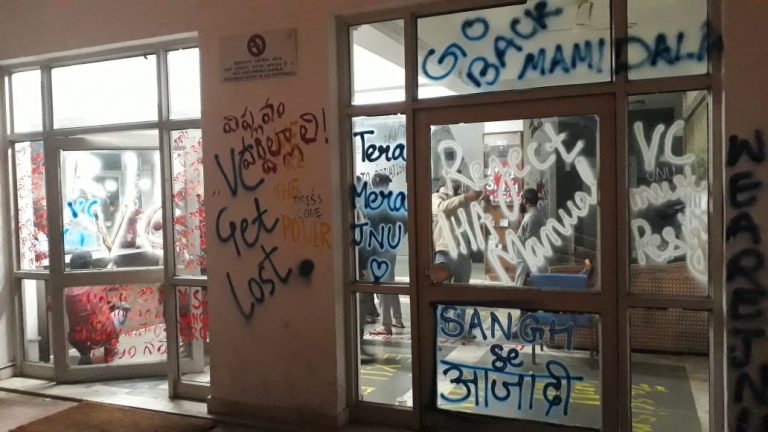
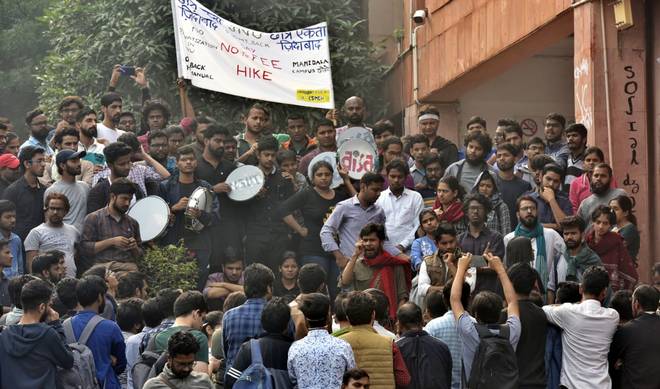
The Jawaharlal Nehru University (JNU) administration has today denounced the Jawaharlal Nehru University Students’ Union (JNUSU) as ‘illegal’ and ordered them to vacate the unlawfully squatted JNUSU office by today 5 PM, failing which they have warned the Student Union of double locking the room.

The administration stated that they had issued a notice informing about the proceedings to both last year and this year’s JNUSU because of the non-compliance with the Lyngdoh Committee Recommendations.

The notice which was signed by Umesh Ashok Kadam, the Dean of Students said, “To prevent misuse of property, it is decided by the Competent Authority of the University that the said room shall be locked immediately and the same may be handed over to the JNUSU after notification of the same.”

On the expected lines, the decision to evict them has not sit well with the JNUSU which called for a protest outside their Union office at 3.30 pm on Wednesday. They publicly burned the notice order issued to them by the JNU admin. The Union has termed the eviction order as an ‘onslaught’ to muzzle students’ voice. They have asserted that they will physically oppose any attempt to expel them. In addition, JNUSU basic secretary Satish Chandra Yadav claimed that the college didn’t inform the Union in advance with regards to the violations.

Also Read: Democracy died a painful death in JNU

Critiquing admin’s decision, the JNUSU issued a statement saying that they would like to ‘remind the administration that the JNUSU office is not the personal property of the Dean to allot’. It is a symbol of the JNU Student Community’s Right to Representation and Unionise, that is entrusted to the JNUSU,” the Union said. They also contended that the JNUSU was recognised and legitimised by the Delhi High Court.

Furthermore, the Students Union contended that it was not invited to the current Tutorial Council assembly. JNUSU president for the last 12 months, N. Sai Balaji reasoned that had the union been illegal, Delhi High Court would have already deemed it null and void.

Earlier this year, JNUSU elections were embroiled in controversy after two candidates approached the Delhi High Court to get a stay on the elections. The High Court said in an order that they didn’t see any relevant reason to put a stay on the election results.

In its judgment, the Delhi HC had asked the JNU to notify the election results as long as they were in accordance with the Lyngdoh Committee guidelines and with approval from the Grievance Redressal Committee.

India must change its modus operandi towards Balochistan to have an upper hand over Pakistan and China

0

On August 6th India constitutionally abrogated the conservative and absolutist Article 370 from the state of Jammu and Kashmir. The move – which proved to be a stumper for Pakistan’s diplomacy wing – triggered a fission of frustration catalysed with enigmas in Pakistan’s entire establishment. Pakistan’s frustration found many ways to carve itself out open on the world canvas, the darkest of it was their military and ISI’s sweating attempt at maligning India at the world stage. Every brush of the box was used to paint a case for liberation of Kashmir from Indian state and longing for the merger with Pakistan.

Pakistan ever since its creation – which was a result of instalment of intense religious hatred, fundamentalism and extremism along with clever populistic political play – has used every trick to annex Kashmir from India. It partly, due to negligence of Indian state, succeeded in annexing a third of J&K in 1947. Bound by its ideology of Gazwa-e-hind, Pakistan has injected the mission to destroy India into its veins. Though, by abrogation of article 370, India has further knotted the vindictive mission for Pakistan, it is also equally unambiguous that Pakistan will try every possible pernicious trick to return its way in the quest for the annexation of Kashmir. The state of Pakistan, deeply enmeshed in and fuelled by terrorism and religious extremism, will eventually return to turf with new challenges for India.

Balochistan and other regions of Pakistan
Map showing Balochistan and other regions of Pakistan

For years we have been burned by our house fire lit by neighbour Pakistan. And for years we tried extinguishing the fire. Every time we extinguished it, the neighbour came with a new idea to again lit fire in our house, repeatedly burning us. Despite our strength, might and nationalism, Pakistan didn’t stop perfidiously harming us. And it won’t stop, until we completely quash its malevolent establishment, break its backbone. The best way to foil and counter Pakistan’s mission of destroying India is by dismantling the entire state of Pakistan. This is the time India shifts its gear from being defensive counter aggression to hardcore lethality. We can start by changing our modus operandi towards Pakistan’s most vulnerable part – Balochistan.

Balochistan, apart from being the largest province of Pakistan making 40% of the total area, is also the least inhabited province with only 5.94% of the total population. The province is also the most marginalised province with only 20% of population having access to safe drinking water, only 25% villages electrified, a whopping infant mortality rate of 108, highest poverty rate, lowest literacy rate and share of GDP in Pakistan’s economy witnessing a steady drop from 4.9% in mid 1970s to 3.7% now. Despite being carved on soil which possesses one of the region’s richest mineral reserves, the state of Balochistan has singled out and charred to backwardness by Pakistan.

Also Read: India’s strategic conundrum and Balochistan

The Balochs have locked themselves in an intense fight with the state of Pakistan for occupying their land, illicitly and unjustly, since 27th March 1948. The land has witnessed 5 major conflicts by the Balochs against Pakistan, each fiercer than earlier. Even at complete lack of any visible external support, Baloch sarmachars (freedom fighters) once succeeded in regaining their independence for a short while. The current and the fifth conflict – which started after the assassination of one of greatest Baloch leader Nawab Akbar Khan Bugti in 2006 by Pakistan military – is the biggest conflict till date.

Despite Pakistan’s unremitting interruptions in Kashmir, India has completely refrained itself from espousing and promulgating the Baloch issue. Lack of which has given Pakistan an upper hand over us. ‘Lack of unity’ in Baloch tribes – a reason often cited behind India’s blasé and disengagement in Balochistan – is, though concurring with reality, a fallacy on many points. The Baloch tribal lack of unity is no different from the diversity of opinions in India or Europe, given for the fact that all of the Baloch tribes are unanimously united for the ultimate cause of attaining freedom. Shunning of Baloch issue on the basis of ‘lack of Baloch tribal unity’ fallacy, as it often happens, is a ludicrous mistake. Another possible reason behind India refraining indulgence in Balochistan was the fear of prompting a counteract by Pakistan. The fear was a parrying inclination. India, as a state, has a proclivity of non-indulgence in others’ internal matters, which, however banal in this case, spawned the initial blasé. All of the reasons are unworthy of countering the geopolitical advantages we have on our table if we free Balochistan.

The most prudent advantage of a free Balochistan for India is countered and diminished Pakistan. Espousing the Baloch issue will give India an upper hand over Pakistan. Decluttering the Baloch issue to make it compatible for India will automatically make it more labyrinthine for Pakistan. Pakistan’s Kashmir card – which it loves to use at every international gathering and diplomatic engagements – will have a legitimate counterpart from the Indian side. India utilising the Baloch issue conscientiously coupled with PoK and Gilgit-Baltistan case can provide an incredible advantage, completely dismantling Pakistan’s paradigm and steering a tectonic shift in geopolitics towards India. Balochistan’s rise aided by India will also spawn mentality for replication in the vicinal province of Sindh and Khyber Pakhtunkhwa also. India can utilise Baloch land to further disintegrate Pakistan and can morph into the beginning of the end for Pakistan.

Also Read: China Pakistan Economic Corridor (CPEC) is a death and destruction project, Baloch people won’t let it be completed

Pakistan’s growth is heavily dependent on the province of Balochist. Understanding the significance of Baloch land along with the consciousness of its meagre non-economic value, Pakistan is aiding Chinese capture of the province in exchange of exchequers. Pakistan’s growth in Punjab is modelled on poverty in Balochistan. And China, in all understanding of this, has been capitalising on this Pakistani need by acquiring access to, or gradually annexing, Balochistan. Chinese BRI’s flagship infrastructure and CPEC project run through Balochistan ending at the port of Gwadar. Which, undoubtedly, makes Gwadar and Balochistan one of the most important strategic points for China. India supporting the Baloch movement will provide an impeccable uppercut to India over China. Establishing a permanent and powerful influence in Balochistan can provide India with tremendous strategic advantages.

The geopolitical strategics at the helm of the region of Balochistan is of paramount significance and prudence, especially to India. For an aspiring global power like India, ensuring economic security is undoubtedly the top priority. Balochistan is a key to that locker where we can secure our assets for future economic requirements. The region is home to rich mineral resources and possesses a vast reservoir of oil and natural gas. India can utilise the region’s economic prowess through exploration, extraction and development of reservoirs by Indian technologies. The vast energy resource of Balochistan can suffice great part of India’s rich energy demands, significantly easing the energy crisis. Balochistan also sits on an extremely critical strategic point. Balochistan is the passage from the Arabian Sea to energy and resource rich Central Asia – Afghanistan, Turkmenistan and Kyrgyzstan – which makes it a tremendously significant strategic region. India can capitalise on the region’s situation and can establish direct, devoid of Pakistan, connection with Central Asia and Russia.

Also Read: Pakistan plundering Balochistan, we appeal PM Modi to support freedom struggle: Dr Allah Nazar Baloch of BLF speaks exclusively to OpIndia

The 771 km long coastline of Balochistan oversees the busiest and richest passages of the world’s oil coming from the Middle East. Strait of Hormuz – the critical chokepoint passage of world’s 20% oil trade – lies in a close approximation of Balochistan’s Gwadar port. In the 21st century, ports play an extremely important geopolitical and strategic part in a country’s muscle power, sometimes vital to countries’ significance. Pakistan without Balochistan and Sindh will be just a landlocked country like the Central Asian nations. Having Balochistan as an ally will enable its long coastline which can add in the enhancement of India’s defence and economic prowess.

When Prime Minister Narendra Modi in 2016 spoke of Balochistan from the Red Fort, he triggered a chain of intellectual thinking. PM Modi torched a beam of light on the dark realms of Balochistan through his address. Now since the issue has captured the limelight, it is important for India to carry onto it. This is the time India not only extinguish but also counter the fire caused in our backyard for years by our neighbour. This is the perfect time for India to change its modus operandi towards Balochistan.

Indian Railways opens new revenue source, watch Housefull 4 movie promotion pictures

The Indian Railways has launched a new way of earning revenues under the leadership of Union Minister Piyush Goyal. The Minister for Railways announced in a tweet that a special train will travel from Mumbai to Delhi on 16th-17th October to promote the movie Housefull 4. He also urged more filmmakers to use the service to reach out to more audiences.


Under the scheme ‘Promotion on Wheels’, special trains will be made available for booking for the promotion of art, culture, cinema, television, sports and others. The Akshay Kumar starrer Housefull 4 is the first movie to be promoted under this scheme. The train will carry celebrities and media persons and travel through several important districts. It will have eight coaches.

Hpusefull 4 promotion

“Under this initiative, the railways has approached many major production houses with upcoming films to use these FTR (Full Tariff Rates) trains to facilitate pan-India publicity and promotions of films across the length and breadth of the country. The Indian Railway Catering and Tourism Corporation (IRCTC) shall be the nodal agency for handling such trains,” the Western Railway said in a press release.


Here are some of the interesting artwork on the train that promotes Housefull 4:

Promotion pictures of Housefull 4 painted on train coaches
Akshay Kumar for Housefull 4 promotions
Promotion pictures of Housefull 4 painted on train coaches

Earlier, Shahrukh Khan had also undertaken promotional activity using the Railways, however, it had led to a commotion. This time, the promotion seems far more official and organised.

Read: SRK booked for vandalism, it was ‘gareeb’ vendor’s complaint against ‘Raees’ superstar

As Minister, Piyush Goyal has introduced various reforms and pursued numerous other ventures to increase the efficiency of the Indian Railways. Ventures such as the Bullet Train and the Vande Bharat Express witnessed immense progress and the latter entered service during his tenure as Minister.

Piyush Goyal also announced that loudspeakers along railway tracks between Haridwar and Dehradun will play the buzzing sound of bees to dissuade elephants from venturing into the tracks thus endangering their safety.

It is also being speculated for some time that the long-delayed Vistadome trains will finally run in Kashmir after the abrogation of Article 370. If it does to come to pass, it will be another feather in the cap for Piyush Goyal during his service as the Union Minister for Railways.

Earlier, trains have carried advertisements to generate revenue for Railways, however, this is the first time an elaborate movie promotion has taken place.

Celebrate O’ Ye Hindus for The Return of the King appears imminent and inevitable

The arguments in the Ayodhya dispute have concluded today. And judging from the conduct of Senior Advocate Rajeev Dhavan representing one of the Muslim parties in the matter, Hindus have reasonable cause to be optimistic about the verdict. He had what we would call a complete meltdown that involved tearing documents and maps.

Predictably, people from expected quarters are busy spreading negativity on social media and are sermonizing that Hindus should not be in a celebratory mood. Although it is legitimate to say that people should not engage in demonizing other communities, the impression that is being conveyed is that even expressing jubilation at the turn of events is equivalent to preaching bigotry.

Needless to say, celebrating in anticipation of The Return of The King to His sacred abode in Ayodhya is not bigotry nor does it breach communal harmony. Since the fall of the Maratha Confederacy, Hindus have had pitifully little to truly jubilant about and the restoration of the Ram Mandir at Ayodhya is one such thing. We have every right to celebrate what appears inevitable.

The Ram Janambhoomi Movement was a glorious chapter in the history of Independent India and in the context of the great Hindu Civilization, it marked the rekindling of the ancient fire that inspired our ancestors to greatness. The sacred fire that was rekindled during the course of the movement has inspired the decimation of the secular establishment in the years to come.

It was the Ram Janambhoomi movement that gave rise to the Bharatiya Janata Party and its stellar electoral victories in 2014, which was repeated with an even bigger margin in 2019, is evidence of the success of Hindu Consolidation that the RJB Movement first inspired. That Hindu Consolidation has resulted in the abrogation of Article 370 as well. And we should remember where it all began.

A matter of discussion that often comes up between friends is when was the last times Hindus as a community felt this jubilant about their civilizational prospects. And the answer is always the same. It was during the rule of the Maratha Confederacy that Hindus were so exuberant and after its fall, the great Hindu Civilization hasn’t had too much to celebrate about. Therefore, it’s completely reasonable that Hindus are expressing unbridled joy at the much-anticipated restoration of the Ram Mandir at Rama Janambhoomi. And it has been a long time coming.

After centuries, the expansionist spirit that inspired our civilization to unprecedented glory has taken root again in the hearts and minds of the Hindus. The confidence with which Defense Minister Rajnath Singh threatens Pakistan with war if they continue sponsoring terrorism against India and indulge in human rights violation within the Indian territory they occupy is evidence of the exuberance that every pious Hindu feels in their heart.

The Surgical Strikes and the Balakot Airstrikes that stirred a wave of Nationalism across the entire country is a testament to the change in the mood of the nation since the time when atrocities against Indians were allowed to be perpetrated without inflicting any consequences. Before the Surgical Strikes as well as Balakot Airstrikes, there was fervent anticipation in the air, that a tectonic shift in India’s policy against Pakistan was imminent.

When the strikes eventually happened, nobody expected Prime Minister Narendra Modi to take things that far. But he did, and great credit goes to him for the statement of intent he made. In stark contrast to earlier times, after the deplorable Pulwama Terror Attack, people knew something big was going to happen. The air was thick with anticipating and one could feel it with every breath they took. The country mourned for the irreparable loss that was inflicted by terrorists but at the same time, they wanted and expected Narendra Modi to make Pakistan pay for its transgression. The nation demanded vengeance and the Prime Minister did not disappoint.

After a long time, the Hindu Civilization feels confident enough to aspire for greater things. The Shastra Puja that was conducted by Defense Minister Rajnath Singh while receiving the Rafale jet in France demonstrated that we shall no longer shy away from our identity. We feel comfortable in our skin now. And it is on the foundation of our civilizational identity that India will stand with the rest of the world.

On a similar tone is the Citizenship Amendment Bill (CAB) that seeks to provide citizenship to persecuted minorities from neighbouring countries, who are discriminated against and persecuted with the approval of the state. The CAB again is motivated by our identity as a civilization and is a step in the direction of taking upon the mantle of responsibility and duties that were handed over to the Indian state by the sacrifices of our ancestors. It hasn’t been passed yet but one expects it to be passed soon enough.

The abrogation of Article 370, too, was consistent with our civilizational identity. The existence of a virtual Islamic state with its own constitution within the secular state of India was unpalatable to most of the country. And yet, it was a Hindutva government that showed the ideological fortitude that was necessary to take this step. Here, too, credit must go to Home Minister Amit Shah for the manner in which he has brilliantly managed the state thus far.

All of this was made possible by the Ram Janambhoomi movement. The edifice of the current ruling disposition was built upon that foundation. Devout individuals would also be inclined to believe that the ideological victories that the Hindu Civilization has scored in a very short span of time are a consequence of the favour of the Gods that was earned through the sacrifices made during the Ram Janambhoomi movement and one cannot really fault them for that.

It begs the question at this point. If all these victories were earned through the Ram Janambhoomi Movement, what other victories would we reap as a consequence of the restoration of the Ram Mandir at Ayodhya? Therefore, keeping such sentiments in mind, it is not difficult to understand why Hindus are jubilant today.

It is important to remember that the overwhelming majority of Hindus are celebrating in anticipation of the restoration of the Ram Mandir at Ram Janambhoomi, they are not indulging in any communal hatred. We have every right to celebrate in anticipation of The Return of The King for the love that every pious Hindu that bears towards Rama. It broke every Hindu’s heart to see Rama in a tent. Hindus treat their Gods as their own family. And no one would want their family to continue to live in a tent for decades.

The restoration of the Temple is also important for our civilizational identity and the future of our country. It is only when the King is restored to His rightful place that the nation could aspire to greatness. Today is a great day and Hindus should not be made to feel bad merely for celebrating a rightful victory.

Ram Janmabhoomi case: NBSA issues advisory to media houses, asks news channels to not broadcast demolition videos

0

On the last day of Supreme Court hearing in the in the Ram Janmabhoomi – Babri Masjid land title case, the News Broadcasting Standards Authority (NBSA) has issued an advisory to all media houses asking them to restrain themselves while covering Ayodhya case hearing.

On Ram Janmabhoomi case, the NBSA said, “do not speculate on court proceedings; ascertain facts of hearing; do not use mosque demolition footage; do not broadcast any celebrations; and ensure no extreme views are aired in debates.”

Read: NBSA threatens to shut down Republic TV if Arnab Goswami doesn’t apologise for calling Jignesh Mevani’s goon a ‘goon’ for misbehaving with journalist

When Republic journalist Shivani Gupta was harassed by goons at Gujarat MLA Jignesh Mevani’s ‘hunkar rally’, NBSA hid behind the veil of broadcasting ethics to silence a victim. In fact, instead of standing in solidarity with a journalist who was heckled in the most grotesque manner on national television, the NBSA has taken it upon themselves to question Shivani. The NBSA, in all its wisdom, decided that the issue wasn’t that the reporter was harassed. In fact, in spite of being given a CD that captured the horror, the NBSA decided that they couldn’t conclusively tell if Shivani was harassed.

The Supreme Court today concluded hearing the arguments in Ram Janmabhoomi case and the verdict of the same is expected on or before November 17. The marathon hearing concluded after forty days, making the Ayodhya hearing as the second-longest in the history of the Supreme court after the landmark hearing in Keshavananda Bharati case which lasted for 68 days.

Read: Shia Waqf board chief calls ‘Babri Masjid a blot to India’, says it is a ‘crime to call it a mosque’

Senior advocate Rajeev Dhavan, representing the Muslim parties in the Ram Janmabhoomi – Babri Masjid land dispute case, suffered a meltdown and tore up a pictorial map showing the exact birthplace of Lord Ram during the hearings in the Supreme Court on Wednesday. The Senior advocate Vikas Singh sought to place on record the book ‘Ayodhya Revisited’ by former IPS Kishore Kunal. Senior advocate Singh is representing the Hindu Mahasabha and the book ‘Ayodhya Revisited’ talks about pre-existence of Ram Temple in Ayodhya. This was when Dhawan had a complete meltdown and it the frenzy he started tearing off papers and maps handed over to him by the Hindu Mahasabha as he strongly opposed the party in the Supreme Court.

Ayodhya case: Twitter erupts with jokes after Rajeev Dhavan, advocate representing Muslim side has a dramatic meltdown in Court

Senior Advocate Rajeev Dhavan representing the Muslim parties in the Supreme Court in the Ram Janmabhoomi case had a complete meltdown in the courtroom today where he shredded papers and maps handed over to him by the Hindu Mahasabha.

Dhavan’s actions have caused a flood of memes and jokes on Twitter.

The social media platform has been flooded with hilarious memes and hashtags like #rajivdhawan, #rajivdhavan, #Ayodhyahearing etc have been trending.

Twitter users seem to be quite miffed as well as inquisitive as to what caused the senior advocate to behave in such a manner.


There were some who accorded Dhavan with the title of the best-overrated actor.


The famous song ‘Tel Laga Lo Dabur ka’ made an entry in the form of a Sunny Deol video too.


Meanwhile, responding to a The Wire journalist Arfa Khanum Sherwani who claimed that the dirty display of communalism in the name of Ayodhya is pushing the country into a pit, another user posted a hilarious video which left Twitterati in splits.


Senior advocate Rajeev Dhavan, following his epic meltdown in Supreme Court on the last day of the hearing on Ram Janmabhoomi case, justified his behaviour by claiming that he was permitted by the CJI to do so.

The 5-judge Constitution bench has finished the hearing in the case at 4 pm today and has reserved the order.

Ram Mandir Construction will start on 6th December, will be completed in 6 months: BJP MP Sakshi Maharaj

0

As the Supreme Court concluded the hearing in the Ram Janambhoomi case today, BJP MP Sakshi Maharaj has said that the construction of the Ram Mandir will start on 6th December. The member of Parliament from Unnao in UP has said that it is logical that the construction of the temple should begin on the date when the structure was demolished.

On 6th December in 1992, the disputed structure of Babri Masjid was demolished by Kar Sevaks, which stood at the site of the Lord Ram’s birthplace.

[youtube https://www.youtube.com/watch?v=nYCpmK0Kv0s]

“This dream is being realised due to the efforts of Prime Minister Narendra Modi, Home Minister Amit Shah and Uttar Pradesh Chief Minister Yogi Adityanath,” Sakshi Maharaj said while talking to reporters in Unnao today. He said that Hindus and Muslims should come together to build the temple. “The Sunni Waqf Board should accept the fact that Babar was an invader and not their ancestor,” he added.

The Parliamentarian said that the verdict that the Supreme Court will deliver after four weeks will be in the favour of Hindus only. He said that not only entire India and the whole world, even the Gods and Goddesses, including Lord Ram, are looking at the Supreme Court proceedings.

Also Read: Hindus have been demanding restitution since 1528 for the Ram Temple destroyed by Islamist barbarians, Rajeev Dhavan

He said there will be two Diwalis, once during Diwali, and then after the verdict comes. He added that work on the Ram Mandir is going on since the Silanyas was done, and the grand temple will be ready in six months.

The Supreme Court today concluded the hearing the appeals filed by Hindu and Muslim parties against the Allahabad High Court which had split the disputed site into three parts and had allotted each part to two Hindu parties and one Muslim Party. The verdict in the case is expected before November 17, the date when the chief justice of India Ranjan Gogoi retires.

Shiv Sena MP Omraje Nimbalkar attacked with a knife while campaigning for party candidate by unidentified man

Shiv Sena MP Omraje Nimbalkar was stabbed by an unidentified man during a poll rally in Maharashtra’s Osmanabad district on Wednesday, police said. The incident took place in Naigaon Padoli in Kalamb taluka where the MP was campaigning for his party candidate Kailash Patil.


During the rally, a man along with a group came close to Nimbalkar on the pretext of shaking hands with him. “While greeting the MP, the man attacked him with a knife and immediately fled. Nimbalkar got hurt on his hand but escaped a major injury because of his wrist-watch,” said a police official.

The unidentified assailant fled after the failed attack, police said, adding that an investigation into the incident has begun. Police are reviewing the footage from CCTV camera’ installed in the vicinity to identify the assailant.

Omraje Nimbalkar’s father, Pawanraje Nimbalkar, who was a Congress leader was shot dead in his car near Kalamboli on the Mumbai-Pune Expressway on June 3, 2006. Senior Nationalist Congress Party (NCP) leader and former Lok Sabha MP Padamsinh Patil is the key accused in that case.

Maharashtra will go to polls in a single phase on October 21. The counting will take place on October 24.

Just like poor get subsidised ration, will subsidise Whiskey and Beer: Independent candidate’s bizarre promises Maharashtra constituency

An Independent candidate Vanita Raut from Chimur village in Chandrapur district of Maharashtra has announced a bizarre set of promises, assuring the locals of the village that if she is elected to power, she would grant licenses and permits to the unemployed youth to open beer bars in the village.

(Source: Twitter)

The election letter distributed by Vanita Raut has gone viral as she asserts that she would put an end to the liquor ban in the region after being elected. She claimed in her letter that she is extremely aggrieved to see people in her constituency employ devious means to obtain alcohol. Raut says that despite the ban, the liquor sale continues to proliferate, although in an illegal manner. She assured that if she is elected to power, she would strive to get the liquor ban removed.

Raut has centered her campaign around the ban on liquor in Chandrapur district from the last 4 years. Slamming the alcohol ban, she said, “If I am elected, I will grant permission to build beer bars across the village. I will grant licenses of beer bar to unemployed youth for starting up bars and liquor shops if I secure majority in the elections.”

[youtube https://www.youtube.com/watch?v=lWJ2fSs1kbI]

She further continued, “Just like people below the poverty line (BPL) get ration at a subsidised rate, similarly, If I am elected to power, I will sell whiskey and beer at a subsidised rate. A pint of beer which usually costs Rs 80 will come at Rs 20. Therefore, people will not drink it with their friends which invariably ends up in a brawl. They will bring the alcohol bottle home, along with 3-4 eggs for their children and drink with their family. This way, they would drink in limit, their children will get scrumptious meal and their family will be happy.”

Ram Janmabhoomi case: Supreme Court concludes hearing of all parties, reserves judgement

0

The Supreme Court on Wednesday reserved its judgement in the Ram Janmabhoomi-Babri Masjid title dispute case after hearing arguments from all the concerned parties.

The marathon hearing concluded after forty days, making the Ayodhya hearing as the second-longest in the history of the Supreme court after the landmark hearing in Keshavananda Bharati case which lasted for 68 days.

Reportedly, the Supreme Court has finished hearing all arguments in the Ayodhya case one hour before the set deadline. The Supreme Court has allowed the parties to submit their written notes over the next three days.

Senior advocate Rajeev Dhavan, representing the Muslim parties in the Ram Janmabhoomi – Babri Masjid land dispute case, suffered a meltdown and tore up a pictorial map showing the exact birthplace of Lord Ram during the hearings in the Supreme Court on Wednesday.

Read: Shia Waqf Board wants Ram Temple built, Sunni Waqf Board lawyer says ‘Hindu Taliban destroyed Babri’

The Senior advocate Vikas Singh sought to place on record the book ‘Ayodhya Revisited’ by former IPS Kishore Kunal. Senior advocate Singh is representing the Hindu Mahasabha and the book ‘Ayodhya Revisited’ talks about pre-existence of Ram Temple in Ayodhya. This was when Dhawan had a complete meltdown and it the frenzy he started tearing off papers and maps handed over to him by the Hindu Mahasabha as he strongly opposed the party in the Supreme Court.

Earlier in the afternoon, the Supreme Court witnessed a high drama on the last day of hearing after the CJI fixed 5 pm as the deadline for concluding arguments in the protracted legal battle. “Enough is enough”, had said the bench, which revised the deadline for the case from October 17 to a day earlier.

The Supreme Court is hearing a total of fourteen appeals filed against the 2010 judgment of Allahabad High Court which ordered that the 2.77-acre land in Ayodhya be partitioned equally among three parties – the Sunni Waqf Board, the Nirmohi Akhara and Ram Lalla.

Read: Shia Waqf board chief calls ‘Babri Masjid a blot to India’, says it is a ‘crime to call it a mosque’

A five-judge Constitution Bench headed by Chief Justice of India (CJI) Ranjan Gogoi had earlier asked for parties to conclude their arguments in the land dispute case to be concluded by October 17. The bench also comprises of Justices S A Bobde, D Y Chandrachud, Ashok Bhushan and S Abdul Nazeer, who are hearing appeals against the September 30, 2010, verdict of the Allahabad High Court.

The Supreme Court has been carrying out day-to-day hearing of the case and the arguments were to be concluded by 18th October but then, October 17 was given the last date for arguments. The Supreme Court had earlier warned that the parties will not be given any extra day. It is speculated that the Supreme Court will deliver the judgement on or before November 17, the day CJI Ranjan Gogoi retires.