The youth wing of the Indian National Congress is up to its usual tricks again. Amidst the JNU protests and the decision to revoke the SPG cover of the Gandhi family, the Youth Congress decided to use the two issues together in order to corner the BJP government.
In its efforts to target the BJP government, the Youth Congress made quite a few errors of judgment. For one, the two issues are completely unrelated, it makes no sense to draw a false sense of equivalence between the two. The only similarity between the two is that in both these cases, the youth wing of the Congress party is supporting the wrong party.
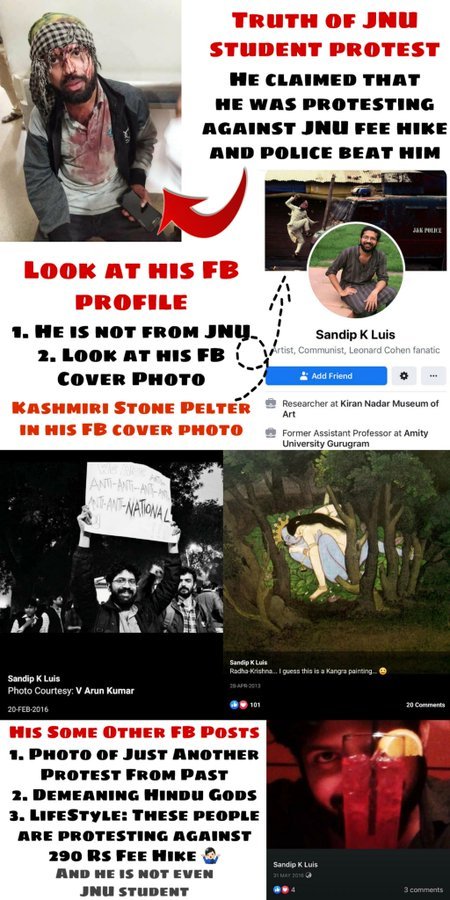
Furthermore, as has been pointed out by Twitter user @Gujju_Er, the photo of the man Youth Congress has used to peddle its agenda is not a student of the JNU. According to his profile on Facebook, he is a researcher at the Kiran Nadar Museum of Art and a former Assistant Professor at the Amity University. The cover picture of his profile also reveals his political inclinations quite clearly.
Source: @Gujju_Er/Twitter
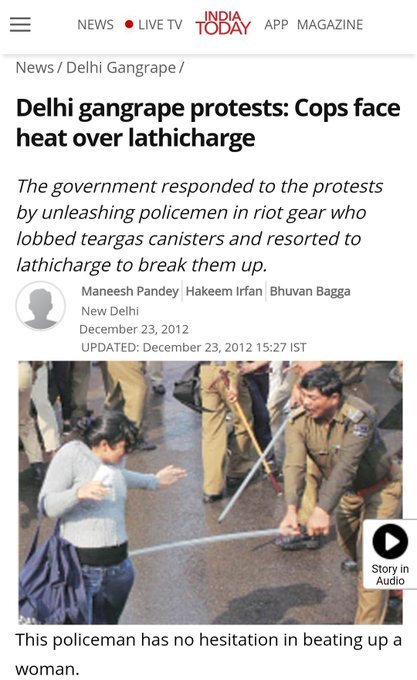
Furthermore, the image they have used where a girl can be seen being beaten by the Police is actually from the Nirbhaya protests which occurred during the UPA regime. Thus, the Youth Congress is using an instance where a girl was thrashed by the Police which was under the control of the Congress-led UPA government in order to target the NDA government at the Center.
Source: @Gujju_Er/Twitter
The Youth Congress has decided to side with the students of JNU on an issue which cannot be justified in any manner. The quality and the quantity of output produced by the JNU does not justify the exorbitant subsidies it receives from the government. The administration, meanwhile, has approached the Delhi High Court seeking contempt action against its “students” and the Delhi Police for violating a court order against holding a protest within 100 metres of the varsity’s administrative block.
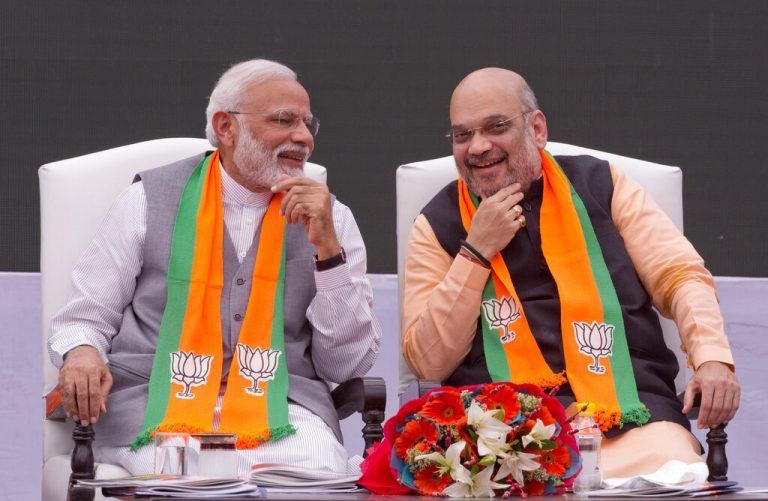
Like its former president Rahul Gandhi who landed in JNU to defend the indefensible when anti-national slogans were raised in the campus, the Youth Congress has decided to tread a similar path. Earlier, the Youth Congress had protested the removal of SPG cover of the Gandhi family by burning effigies of Prime Minister Narendra Modi and Home Minister Amit Shah.
Students of Banaras Hindu University (BHU) have been protesting over the appointment of a Muslim professor, Dr Firoz Khan, at the Sanskrit Vidya Dharma Vigyan. The students have been called Adharmik bigots, giving it a colour of communal bigotry.
The controversy surrounding this appointment and the protest is worth exploring, trying to understand each side’s point of view, without labelling them, bigots. Nevertheless, it seems those who are opposing the BHU students have only argument available – label all believers as bigots. No reasoning, no logic, no discussion, just call them Hindutvawadis.
I am a graduate from BHU. I prefer people indulging in this debate to first understand BHU, about its conceptualization, about its principal objective, and also about the people behind this sacred institution that blends ancient Indian traditions with modern education.
Bharat Ratna Pandit Madan Mohan Malaviya, who became president of the Indian National Congress as many as four times and also founded the Hindu Mahasabha, stands as a colossal figure in the history of the nation. He observed that while students of other sects knew much about their religion, the Hindus knew very little about their rich cultural legacy. He was grieved to learn that the number of Indian youths, who went abroad for higher studies, returned home with distorted attitudes towards their own country and culture. The only solution to his mind was to lay in creating a university in which a correct approach towards Indian cultural values.
Same time, as part of the Aligarh movement, in 1875, the Muhammadan Anglo-Oriental College was set up by Sir Syed Ahmad Khan to help Muslims in India overcome their educational backwardness and prepare themselves for government services. MOA provided western education, but the focus remained on Islamic theology. In 1920, it was granted university status and called the Aligarh Muslim University.
In the year 1904, Mahamana formally moved the resolution for establishing a Hindu University. The Hindu University was not established merely to grant degrees and diplomas to young men of India. Its primary purpose was to enable the students to feel grateful to be true Hindus and patriots.
The resolution for the establishment of a HINDU UNIVERSITY was announced on 1 January 1906. The resolution was reiterated at an assembly of Hindu religious leaders and scholars held at Prayag during Kumbh under the President-ship of Jagadguru Swami Shankaracharyaji.
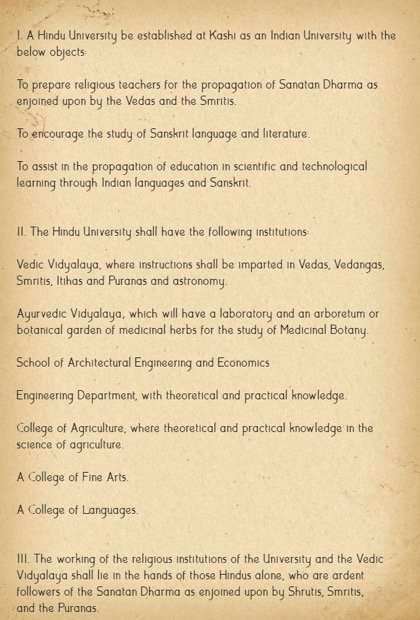
The resolution reads as follows:
The resolution
Notice the first laid out objective of the university and the first institution of learning that was resolved to be created. It was a Vedic Vidyalaya that later turned out to be Sanskrit Vidya Dharma Vigyan Sansthan.
Since Malviya Ji hailed from Prayag, many influential citizens pressed him to shift the venue of the University to Prayag, but Malaviyaji did not budge an inch. He chose Kashi as the site because of the centuries-old tradition of learning, wisdom, and spirituality inherent to the place.
After initial hiccups, Malviya Ji got the clue of how to persuade people to donate. He propagated it as a noble Hindu cause. With the overwhelming support of the Hindus, the foundation-stone of the BHU was laid by Lord Hardinge, the then Viceroy, on the Vasant Panchami day in 1916.
It was a unique experiment where the study of Dharma Shastras was promoted by the most potent functionary of the colonial government in Gandhi Ji’s presence. It established that the genuine pursuit of Hindu Dharma Shastras is not a gateway to some chauvinism, the way today’s liberals make us believe.
The vision of this Hindu University, in the beginning, was to study Dharma Shastras and other such literature. However, Malviya Ji was a true sage who represented a unique amalgamation of the ancient and the modern.
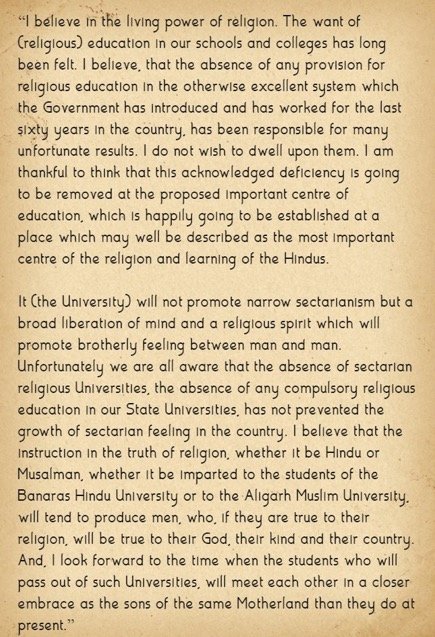
BHU has the word ‘Hindu’ in it and a grand Viswanath temple inside the campus that echoes Hinduism in its institutional thinking. However, the word ‘Hindu’ in BHU does not carry any communal and sectarian connotation. In a speech delivered at the time when BHU Bill was introduced in the Legislative Assembly, Malaviyaji explained its real purport.
His words:
Malaviyaji explained its real purport
BHU is essentially a national and cultural University whose character is an extension of the sacred geography of Banaras. Please do not try to paint it as another bigoted institution because of its name. There are plenty of obvious ones. BHU teaches us how to be culture-specific and yet cosmopolitan. Its excellence does come from not moving away from its Hindu character, but because of it.
The BHU Act of 1915 clearly states that the university will be open to people cutting across gender, race, caste, creed, and class, something which makes it truly inclusive. The ONLY EXCEPTION being the Sanskrit Vidya Dharma Vigyan Sansthan that follows a specific rule as per BHU’s constitution.
The establishment of the SVDV stream is dedicated to establishing scientific value to the Hindu beliefs, unearthing the minefield of Indian texts. The other objective is also to reverse the colonial thrust of contemporary knowledge about India, that mocks and demeans Hindu traditions and faith. It is the responsibility of this faculty to clarify and put forth the scientific basis for each matter of tradition and faith.
BHU has 14 faculties, more than 120 departments dealing with ould an array of subjects across all branches of the humanities, social sciences, sciences, engineering, and medicine. It boasts of more than 20,000 students from more than 34 nations and nearly 2,000 faculty members who come from all castes and religions.
With that background, now look at the roots for this controversy over the protest.
The students allege serious corruption in the recruitment process. The allegation is also that the recruitment of Dr Khan is done through OBC quota. It could be true or false, and there is no arm investigating the matter.
The appointment is against the established rules of the department. The BHU rule clearly says that a non-Hindu can neither study nor teach in SVDV stream. The appointment of a Muslim as an assistant professor could be a part of a conspiracy.
First and foremost, this protest is NOT about a Muslim scholar teaching Sanskrit. The students are NOT seeking exclusive claim over Sanskrit. Sanskrit is just another Indian language, and any person following any religion can teach it. BHU has a Department of Sanskrit in the Faculty of Arts.
But the usual suspects in media are running the story as if the students are opposing the appointment of Muslim professors in BHU. That would have been ugly bigotry if that was the case.
There are two aspects to this debate — first, the rules, then the logic.
The rules as per BHU’s constitution are loud and clear, and it does not allow a non-Hindu to study and teach ONLY in this department. Debate on it. Present solid arguments and get the rules changed. Until that is achieved, the rules must adhere.
Now, let us talk about logic. For once, give a try to understand and respect a believer’s perspective. It is not a “Sanskrit course.” It is Dharma Vigyan. There is a vast difference.
This one department out of 120 other departments teaches Hindu Theology – Vedic and Dharmic Studies. The protesting students are followers of Sanatan Hindu traditions. Their objection is not – how can someone who does not practice, who does not have faith in the literature, teach Hindu Dharma? Their objection is – how can they have the trust and faith in what that person is teaching? It is not about his ability or eligibility; it is about the believer’s faith.
For believers who are pursuing a career in Dharma Vigyan, the expectation from their Guru to embody respect for the sacredness of the literature he is going to teach is obvious. How is it considered misplaced by any measure? What is the debate?
Those who are opposing the believers have deeply internalized the idea that since Hindus are a majority in India, they must cease to own any exclusivity. How can they ask to build a Rama Temple in India at his birthplace? How can they have an exclusionary rule in a tiny department of a large University that was conceptualized primarily for the studies of Hindu Dharma Shastra?
Prof Khan chose Sanskrit as his career, which is excellent. There is no taking away from the professor’s scholarship. These students have also not chosen a lucrative career either. The opted Vedas, Vedang, Karmakand, Jyotish in which they have full faith and have dedicated their lives to them.
Faith matters when the topic taught is about faith. In Dharma Vigyan, the literature has to be decoupled from the point of view of Dharma. It requires embodying specific values, practices, and rituals. Obfuscating from this and focusing on the language only, is misleading.
While laying the foundation-stone of BHU, Lord Hardinge who echoed these Indian sentiments:
Quote:
“The whole Indian idea of education is wrapped up in the conception of a group of pupils surroundings their Guru in loving reverence and not only imbibing the words of wisdom that fall from his lips but also looking up to him for guidance in religion and moulding their character in accordance with their precept and example.”
Unquote.
One may still disagree with the student’s point of view, but calling it bigotry as the only presentable argument, going in every tangent to abuse the believers, is ugly bigotry.
In order to reduce the number of child marriages happening in Assam, state Minister for P.W.D, Health and Finance, Himanta Biswa Sarma, has announced that the Assam government in the state will spend Rs 800 crores per year under Arundhati scheme. Through this scheme, the brides belonging to Economically Weaker Section (EWS) will be given 1 tola(10gms) of gold free, provided they register their marriage.
Assam Min HB Sarma: Assam govt is planning to spend Rs 800Cr per year under Arundhati scheme in which every bride of Assam to be given 1 Tola gold free.The aim of the scheme is to reduce child marriage as it’ll require the marriage to be registered to avail benefits of the scheme pic.twitter.com/oyURjquo2k
Assam Arundhati Gold Scheme was announced by the state Finance Minister Himanta Biswa Sarma on February 6, 2019, while presenting State Budget 2019. Under the Assam Arundhati Gold Scheme state government will provide One Tola (10 Gm) Gold worth Rs 38000 to new marriages brides of economic weaker section (EWS), whose parents’ annual income from all sources is up to 5 lakh Rupees.
With the stated aim of discouraging cold marriages, the Assam government approved the Arundhati scheme that incentivises marriage registration. Child marriage is prescribed under the Prohibition of Child Marriage Act which states that a girl in India cant get married before the age of 18, and a boy cant get married before 21 years of age. Brides belonging to EVS can avail the scheme by formal registration of the marriage under the Special Marriage (Assam) Rules, 1954 at the time of marriage.
The claimant of Arundhati scheme will have to apply one month in advance from the date of marriage. However, if the claimant applies post-marriage, then the benefits can only be availed when he/she applies within one year from the date of their wedding. Those applying after one year of their marriage would not be granted benefits of the scheme.
Besides reducing child marriage, the scheme also aims to economically empower newly married couples and provide them with a prospect of bettering their future.
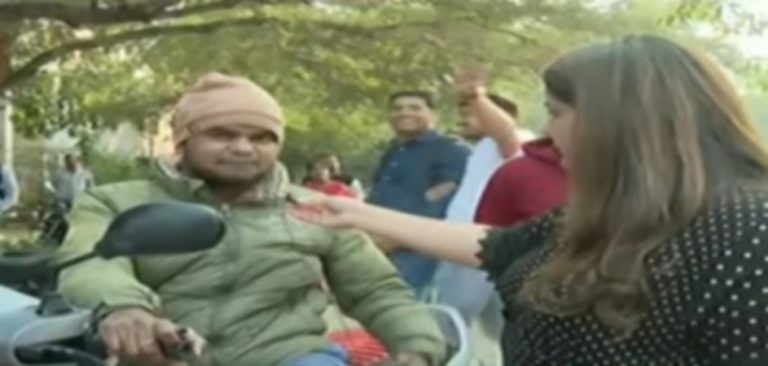
In a shocking video, one of the protesting students of the Jawaharlal Nehru University (JNU), who have taken to violence while protesting against the ‘unaffordable’ hostel fee hike, was seen threatening a media person that he had all the means to purchase an AK-47 rifle to shoot the police and journalists if he wants to.
On November 19, the Republic TV’s Legal Editor, Rhythm Bharadwaj, was interviewing a JNU student on the University campus when he, in his attempt, to justify the violence being resorted to, by the JNU students, in their ensuing battle against the administration was heard threatening the media person.
The students had reportedly blocked ambulances, stalled traffic on the arterial roads of Delhi yesterday, after the protests that have been going on for about 3 weeks spiralled out of the University onto the roads of Delhi after the JNUSU called for a protest-march from college to Parliament to demand the rollback of the increased fees, along with multiple other restrictions imposed.
In the video, the student is heard threatening the journalist, as he justifies picking up lathis and guns in retaliation to the alleged police action. “Lathi aur bandook humein bhi uthana aata hain, kal humlog ki baari thi, aaj police aur media ki bhi baari aa sakti hain..”, (roughly translated as, even we know how to pick up sticks and guns. Yesterday it was us, today it might be the police or the media’s turn) said the student.
When the reporter cross-questioned the student on his warning of picking up lathis against the authorities by asking “aap ab lathi-charge karenge?” (You will now resort to lathi-charge?), the student said, “Bilkul karenge, kyun nahi karenge…hum kisi se darte nahi hain (why not, of course, we will lathi-charge, we are not scared of anyone)”.
When the media person questioned him on the unlawful protest, the JNU student remarked, “Mein physically handicapped hoon, mujhe janwaro ki tarah maara gaya, kya mein nahi khareed sakta AK-47, meri itni aukaat nahi hain kya? (I was beaten yesterday. A physically handicapped person was beaten yesterday. I am saying that can’t I purchase an AK-47? Don’t I have the status to buy an AK-47? We will open fire using guns. We will kill the journalists one by one.)”
Yesterday, Republic TV had claimed that the JNUSU avoided answering questions asked by their crew and their crew were heckled by the students gathered there.
The JNU students have been protesting for the last few weeks about the new hostel manual which advocated a hike in hostel fees, dress code regulations, and curfew timings. Yesterday the JNUSU called for a protest-march from college to Parliament to demand the rollback of the increased fees, along with multiple other restrictions imposed. A few days back, a soon-to-be inaugurated Swami Vivekananda’s bust in the campus was vandalised by the JNU hoodlums opposing the new fees hike and other restrictions.
Home Minister Amit Shah has formally announced in Rajya Sabha today that the National Register of Citizens (NRC) will be implemented all across the country. The Citizenship Amendment Bill (CAB) is also slated to be taken up by Parliament in this session. Last time, the bill lapsed because it was not passed by the Rajya Sabha.
It goes without saying that the CAB is the most crucial safety measure required to ensure that the NRC is a success. Without the CAB, genuine Hindu (and Sikh, etc) refugees in the country would feel harassed by the NRC process, causing additional misery to an already marginalized and vulnerable people.
At the same time, we also need to understand that the global anti-Hindu ecosystem is waiting to pounce upon the CAB and use it to misrepresent and demonize India and its elected government. We cannot underestimate the power of this ecosystem. Following the abrogation of Article 370, there was systematic vilification of India on the roads, in universities, in newspapers, in diplomatic circles and in legislatures of foreign countries. We have to do all we can to nip this in the bud.
There are two practicalities to be acknowledged here. First, we may bristle at foreign countries getting involved in purely internal matters of India, such as NRC, CAB or Kashmir. But the fact remains that as a $3 trillion economy, we cannot avoid global attention in our domestic affairs. We simply have to adapt to this. Think about how everyone everywhere has something to say about the US Presidential race.
Second, a good deal of this vilification campaign is due to reasons that are beyond our control. The global liberal subservience to Islamism, for instance. If the New York Times refuses to blame radical jihadis for the 9/11 attacks and blames the airplanes instead, we cannot expect them to understand our pain in Kashmir. Again, we cannot stop British MPs who must answer to huge Pakistani populations in their constituencies. Not much we can do there. But where we can pull strings, we have to do our best.
Therefore, we have to adapt, be proactive and make sure that India is not demonized over the Citizenship Amendment Bill.
The accusations are already flying thick and fast, with India being accused of trying to deprive Muslims of citizenship.
How might we counter this? We have to explain that the proposed CAB is not something that is exclusionary in nature. Rather it is a measure that protects a vulnerable group of refugees by giving them citizenship.
How can India deport a Hindu refugee to Pakistan or Bangladesh to face religious persecution, perhaps even death?
This is not discrimination against anybody. Civilized countries all over the world have policies that prevent people from being deported to places where they would be persecuted for their identity.
Let me quote to you the UN Convention of 1951 which defines a refugee as:
“someone who is unable or unwilling to return to their country of origin owing to a well-founded fear of being persecuted for reasons of race, religion, nationality, membership of a particular social group, or political opinion”
This definition has been incorporated into the laws of many countries, including the 1980 Refugee Act in the United States. This act amended the Immigration and Nationality Law in the US and established a clear distinction between “immigrants” and “refugees.”
India is merely doing the same here. We are establishing a legal distinction between immigrants and refugees.
Most Western countries, for instance, would not deport a gay person to Iran, where they would face the death penalty. Is this discrimination against straight people?
It is similarly dishonest to say that India protecting Hindus from getting deported to Pakistan is somehow against secular principles. The Indian government is not discriminating here; the Indian government is merely acknowledging the fact that other countries in our neighbourhood discriminate against Hindus.
As the Citizenship Amendment Bill makes its way through Parliament, we need an aggressive strategy to tell the world that we are merely enforcing a globally accepted principle of justice.
One concrete suggestion that I would make in this regard is to change the bureaucratic sounding name of the Bill. The Bill amends Citizenship law in India and therefore it’s been called the ‘Citizenship Amendment Bill.’ As such, the name of the bill doesn’t immediately tell us what its purpose is. Whose citizenship? What amendment? This means that any mention of the bill must come with an additional explanation. And global liberals speaking to foreign audiences get a chance to twist their explanation to fit their propaganda.
We can short circuit this propaganda rather easily by changing the name of the bill. Why not rename it to something like “Protection of vulnerable religious minorities bill”? Let’s put it upfront that the bill is supposed to protect a group of particularly vulnerable people and not to exclude anyone. Make the job of our enemies that much harder. Leave them to explain why they are against protection for vulnerable religious minorities.
We saw the power of names quite recently. Even though OCI is not more than a visa, global liberals pounced upon the C-word in OCI to claim that India had stripped someone of citizenship! As opposed to just denying a visa. This was a small instance, but it shows why we need to be careful in choosing names.
As a nation primarily made up of Hindus, the deck is already stacked against us in foreign capitals. We don’t enjoy the benefit of the doubt like a Western country would. As a prominent world power, we cannot expect our domestic affairs to fly under the global radar. We have to aggressively engage with the world and explain our side. Because nobody else will.
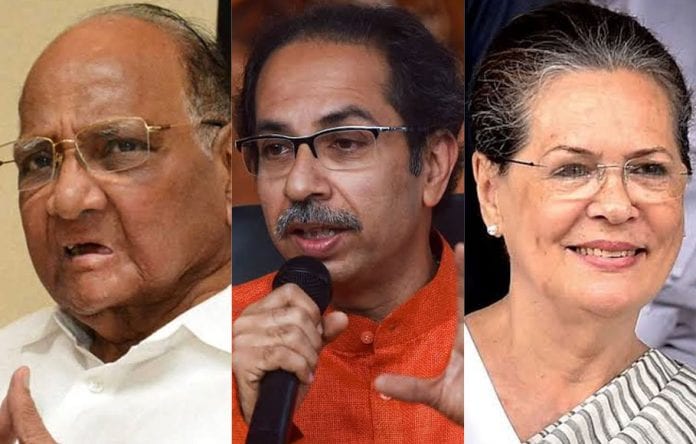
The Universe itself appears to be conspiring to make Shiv Sena the butt of a great many jokes. To add insult to its many injuries, Maharashtra Congress is advising Sonia Gandhi to not enter into an alliance with the party, Republic TV has reported.
SCOOP: Maharashtra Congress urges Sonia Gandhi to not ally with Shiv Sena https://t.co/XVcD8NF2Oe
This comes after Sharad Pawar met Prime Minister Modi in the Parliament. He also wrote a letter where he appealed to Narendra Modi to take measures for the welfare of farmers. In the letter, the NCP supremo wrote, “I have collected data on crop damage from two districts, but damage because of excessive rains extends to rest of Maharashtra, including Marathwada and Vidarbha. I am collecting details and information regarding the same, which should be sent to you at the earliest.”
Delhi: Nationalist Congress Party Chief Sharad Pawar meets Prime Minister Narendra Modi in Parliament. (file pics) pic.twitter.com/HRkIjEgffa
As it so happens, the meeting between Sharad Pawar and Narendra Modi has ruffled many feathers. The Congress is upset because ‘timing of the meeting was wrong’ given the crisis in Maharashtra over government formation. The Shiv Sena is deeply troubled as well and is now saying no formal announcement was made regarding its exit from NDA. Funnily, the declaration was made by Sanjay Raut, a person who reminded people every twenty-four hours that the next Chief Minister will be from Shiv Sena. This declaration by Raut was despite the fact that they did not attend the NDA meet ahead of the Winter session of the parliament. Shiv Sena MP Arvind Sawant also resigned as Union Minister after the alliance broke up. In short, the Shiv Sena did a Kejriwal right there, in other words, a U-Turn.
It must be very difficult to be a Congress sympathizer right now. The ‘intellectual’ class was urging the Congress quite openly to ally with the Shiv Sena in order to keep BJP out of power. Attempts were also being made to secularize Balasaheb Thackeray’s party. But as it so happened, the Congress party believes that an alliance with Shiv Sena will dampen its electoral prospects significantly.
If it were difficult to be an ‘intellectual’ Congress sympathizer, it is an even worse time to be a Shiv Sainik. The party first dumped its traditional alliance partner over a silly demand for the Chief Ministerial position when it has only 56 seats in the Assembly while the BJP has over a hundred. Then, it was willing to sacrifice its core ideology in order to ally with the NCP and Congress. Despite making so many sacrifices, both the opposition parties still remain non-committal on an alliance with Shiv Sena. It appears that Uddhav Thakeray dug a giant hole for the BJP and then proceeded to jump straight into it himself.
Thus, we are at a situation where the Congress doesn’t wish to ally with the Shiv Sena. The Shiv Sena is desperate for an alliance with NCP and the Congress but both of them remain non-committal. Now, Sharad Pawar meets Prime Minister Modi and the Congress is upset about it as well. In short, the Dance of Democracy is truly underway and the Maharashtra Tragicomedy has intensified manifold.
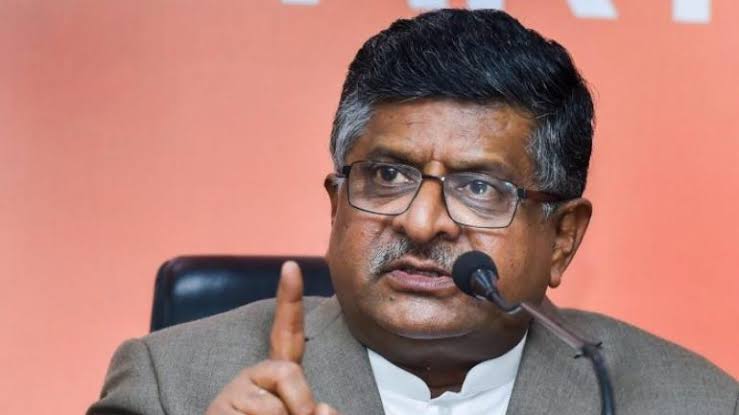
The Union Minister of Law and Justice, Communications and Information Technology, Ravi Shankar Prasad, in a written reply on Wednesday asserted that the central government has no plans to link Aadhaar with an individual’s social media accounts. He also reiterated that Aadhaar data is completely secure and it is audited from time to time. Prasad was responding to a question raised in the Lok Sabha.
Prasad added that under Section 69A of the Information Technology Act, 2000, the government has the right to block websites social media accounts in the country in matters of public interest. The government has so far blocked 633 URLs in 2016, 1,385 in 2017, 2,799 in 2018, and 3,433 in 2019.
Regarding the question asked by AIMIM chief Asaduddin Owaisi about the threat posed by the Israeli spyware on Whatsapp targeting Indian journalists and social activists, Prasad responded that the government had taken cognisance of the fact that the Israeli spyware tried to snoop on 121 individuals in India.
Prasad responded that Cert-In had issued an alert on vulnerability in WhatsApp after which the instant messaging service had responded saying that such loopholes can’t be used to launch an attack.
Prasad further added that the government has sought an explanation from WhatsApp about the Israeli spyware Pegasus attack on its users using its platform. WhatsApp then reportedly updated Cert-In, claiming that the full impact of the attack is difficult to gauge. “We are committed to uphold the Right to Privacy of citizens of India and have asked WhatsApp to provide a detailed explanation about the issue. We are bringing a bill for the private data security of citizens,” Prasad added.
Earlier too, when it was revealed that some Indian journalists and activists have been target of surveillance by the Israeli spyware Pegasus, Prasad had then assured people saying that the government is committed to preserving and safeguarding the privacy of Indians and that the government had asked WhatsApp to explain the kind of breach and what it is doing to safeguard the privacy of millions of Indian citizens.
In response to the allegations that the government was behind the snooping of Indian journalists and activists, Prasad had then said, “Government agencies have a well-established protocol for the interception, which includes sanction and supervision from highly ranked officials in central and state governments, for clearly stated reasons in the national interest.”
For a warrior, nothing is higher than a war against evil. The warrior confronted with such a war should be pleased, Arjuna, for it comes as an open gate to heaven. But if you do not participate in this battle against evil, you will incur sin, violating your dharma and your honour – Swami Vivekananda
‘Dharma’, which is at the soul of the Sanatan, is perhaps the most complex and liberating concept of Hinduism. Dharma has no equivalent term in any other language. Religion and Theology, the modern terms used are mostly anglicised, biblical and Abrahamic. It is a fact that ‘Dharma’ has been used in different religious texts of Hinduism in different forms. And it is in this fact, that the BHU controversy is rooted.
The crux of the BHU issue and the basic problem of students with the Muslim professor
BHU students have been protesting against the appointment of a Muslim professor in the Dharma Vigyan department. The students say, that in their course, they study mantra, shloka, yagna, vaidik rituals, Purohit Karm, recitation, Bhagwat recitation, jyotish, karmakand, etc. They are not only involved in studies but it is also the source of their livelihood. most of them spend their lives performing Purohit Karm. Essentially, the Dharma Vigyan department of BHU educates the future gatekeepers of Sanatan. The BHU students have repeatedly said that they are not against Muslims. They are not even against the Muslim professor teaching Sanskrit, however, they don’t want a non-Hindu, teaching them about their religion.
The facts of the case have been twisted beyond measure. One needs to understand at the very onset of this discussion that the students of Dharma Vigyan don’t learn Sanskrit as a linguistic endeavour.
The first fact to understand is that BHU has a separate Arts department that teaches Sanskrit as a linguistic endeavour. Just as one would perhaps learn French or English or even Hindi.
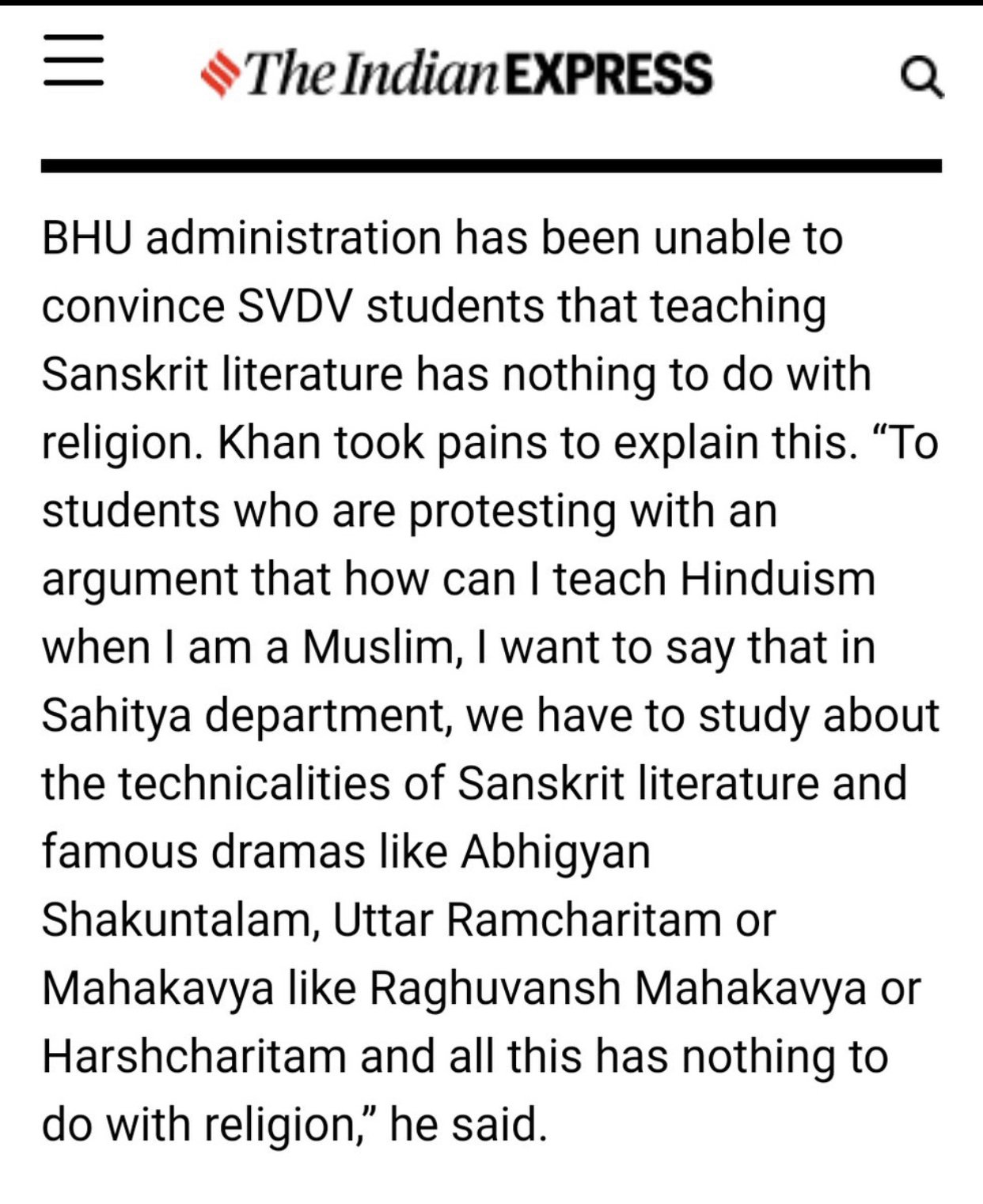
The Sanskrit being taught at the Dharma Vigyan department has deep religious significance. For this, I quote Professor Feroze Khan himself:
Excerpt of Indian Express article
He says that in the Sanskrit department of Dharma Vigyan, one has to not only learn the technicalities of Sanskrit as a language but also “famous dramas” like Abhigyan Shakuntalam, Uttar Ramcharitam or Mahakavya like Raghuvansh Mahakavya or Harshcharitam. He further says that these have nothing to do with religion.
With all due respect to Professor Khan, this statement itself shows that Professor Khan is looking at Sanatan with Abrahamic lenses. For Islam or Christianity, their religious text, so to speak, is limited to the Quran or the Bible. That is the final word of God for co-religionists. In Sanatan, however, there is no final word of God and no codified text that defines Hinduism.
Follow is what Professor Khan calls “dramas that have nothing to do with religion”:
Uttar Ramcharitam: The Uttararamacarita is a Sanskrit play in 7 acts in the Nataka style by Bhavabhuti. It covers the events of the Uttara Kanda of the Valmiki Ramayana, the final years of Rama on Earth up to his ascension. Abhigyan Shakuntalam: A Sanskrit play by the ancient Indian poet Kālidāsa, dramatizing the story of Shakuntala told in Mahabharata. Or even Raghuvansh Mahakvya which is a Sanskrit Mahakavya by the most celebrated Sanskrit poet Kalidasa from the 5th century CE. It narrates, in 19 Sargas, the stories related to the Raghu dynasty, namely the family of Dilipa and his descendants up to Agnivarna, who include Raghu, Dasharatha and Rama.
Essentially, when one looks at what Professor Khan calls ‘just dramas that have nothing to do with religion’, one sees that the scriptures he talks of are deeply rooted in Sanatan Dharma. They are about our Gods and God-Kings who we, till date, revere. The fact that Professor Khan thinks these epics have ‘nothing to do with religion’, should in itself be a problem with his appointment to the Dharma Vigyan department because the students of the department do not view these epics as “dramas that have nothing to do with religion”.
I personally worship a Sati Goddess. There is a ‘paath’ that details her life that we call ‘Mangal paath’. It is in the form of poetry. Now for someone who doesn’t worship the Sati Goddess, it is just poetry that has ‘nothing to do with religion’. But for me, it is one of the most sacred texts. Similarly, the Bhagawat Gita in its original form is written in Sanskrit. However, there is another form of it called the Hari Gita, which is in Hindi poetic couplets. For a Sanatani, does Hari Gita become a ‘drama that has nothing to do with religion’, or is it as revered?
It must be mentioned here that I don’t have the knowledge or the expertise to question Professor Khan’s scholarship and in no capacity, am I trying to do so. I am simply trying to infer, from his own words, whether his scholarship is in tune with ‘faith’ that is the central focus of the Dharma Vigyan department. And hence, it becomes necessary to clarify that I come from a place of faith, and not scholarship, which is the crux of the BHU controversy, to begin with.
Are BHU students enrolled in the Dharma Vigyan department ‘bigots’?
One has to ask a very important question in this context – why would a student enrol himself in the Dharma Vigyan department of BHU? If a student enrols for an MBA, one can safely assume that he intends to work in the corporate sector in tune with his specialisation, which could be Marketing, Finance, Supply Chain Management, so on and so forth. When a student enrols for Mass Communication, one might safely assume that the student’s interests lie with fields like Journalism, for example. Now, when these students enrol in the Dharma Vigyan department, are they doing so to learn literature, or are they doing so to understand, learn about and pursue religious endeavours. If they had enrolled to merely learn literature, why would they enrol in Dharma Vigyan and not the Arts department?
Extrapolating from the above argument, it is thus safe to assume that the students of Dharma Vigyan enrolled there with the specific purpose of pursuing religious endeavours. While I love my faith and hold it very very dear, would not take it up as an academic exercise because my vocation lies elsewhere. But for these students, their faith is their vocation.
Do these students deserve to be called ‘bigots’ simply because they want the sanctity of their vocation to be preserved? Should they necessarily submit to secular ethos when their vocation itself is rooted is faith? Would we call a student of Physics a ‘bigot’ if he doesn’t want to learn about his subject from a Historian who might not understand the nuances of the subject? On the other side of the debate, is it alright for a man studying his faith as a vocation to be called a bigot if he doesn’t want a man, who calls parts of his faith as ‘dramas that have nothing to do with religion’ teaching him? The manner in which these Dharmics have been vilified is patently grotesque.
The Swarajya article
That brings me to the article published in Swarajya Magazine by Arihant Pawariya. Arihant is a friend whose journalism I deeply respect, however, in this matter, I daresay, he has been grossly off the mark.
The first argument that Arihant makes is that the family of Professor Khan is rooted in Indian culture and hence, protesting against him is counterproductive. My respect for Professor Khan increases manifold when I hear how his family has been rooted in Sanskrit and that his father would sing Bhajans and take care of Gaushalas. However, his family history has nothing do with the fact that he is in fact by all standards, someone who the students of Dharma Vigyan might not want to learn from.
Further, Arihant, in essence, says that a qualified Muslim professor is far better than a Hindu professor who is not as qualified as him. While on the face of it, this argument holds utmost merit, one needs to understand that this course itself is rooted in faith. And hence, his personal faith is as much a part of his ‘qualification’ as his Sanskrit scholarship. That he believes that certain epics are ‘dramas with nothing to do with religion’ vindicates that point further.
Arihant says, “Dr Khan will be joining the most secular of these departments. He will be teaching literature. Of course, it would be Sanskrit literature and many scriptures would be a part of the curriculum but it’s not theology per se”. I find this statement deeply problematic as well. Sanskrit as a language, firstly, cannot be secularised completely. It is a gateway to our Vedic wisdom. Secondly, if ‘many scriptures would be a part of the curriculum’, how can one assume that it is not related to theology since the students themselves are not learning it as a linguistic or literary effort but as a part of their faith, their scriptures?
Next, the article in Swarajya lists people like Dayanand Saraswati who wrote on Islam or Dr Ambedkar who wrote on Islam but was not an Islamic scholar. The central point being missed here is that none of them was employed to teach students of Islam. Professor Khan, just like anyone else is free to write about Sanatan or Sanskrit, the contention here is not whether a Muslim can write about Sanatan but whether a non-Hindu can teach students of Dharma Vigyan who are taking up faith as a vocation. The right question to ask here is that can a Hindu teach a future Maulvi? The Islamic community would resist and rightly so. A person who has no faith in the scripture he teaches has no business to teach the scripture to students of faith.
Further, he says, “Islam has already too many mullahs to issue a fatwa against apostates. Hindu nationalists would do better to side with heretics rather than mullahs. If Muslims, no matter how small a section, want to de-Arabise and Indianise, how can any Hindu nationalist find fault with this? It’s a no brainer”.
Here, I completely agree with him. Any Sanatani would welcome Muslims learning about Hinduism. Just like it was the Hindus who stood up for Triple Talaq petitioner Ishrat who got death threats for participating in Hanuman Chalisa recital. It was Hindus who stood up for Dilsher Khan who was thrashed for reading Ramayana and Mahabharata.
The “liberals” have drawn on this argument and fallaciously turned this into a “Hindu bigots uniting against Muslims” argument. For the sake of argument, even if we do accept this theory, one has to ask why these “liberals” did not stand up for Ishrat or Dilshad? Where was the outrage when Muslims were uniting against these Muslims?
Essentially, in the Swarajya article says that the BHU protestors are ‘entitled juveniles’ and them, including the ones supporting them, are ‘bigots’. A “bigot” essentially is a person who is intolerant towards those holding different opinions. One has to wonder – who is the real bigot here? The BHU students who want to assert their right of learning Dharma from someone who holds the same faith, unequivocally, or those who are calling them bigots for holding a different opinion and not conforming to the touted ‘secular ethos’?
Tertiary allegations – casteism and ‘inclusivity of Hinduism’
The one argument that I repeatedly came across from various quarters that BHU students not wanting to learn Dharma from a non-Hindu is the same as Brahmins not wanting to the lower-castes to learn the scriptures. Here, I would like the shed the veil of subtlety and be categoric. Firstly, it is patently sinister to bring in the caste argument when the discussion is about Hindus vs non-Hindus. There is something extremely baleful since this argument aims to equate non-Hindus to “lower caste Hindus” and Hindus to Brahmins thereby insinuating that those who are not Brahmins are not Hindus. Nobody can deny that caste discrimination is real and a termite that has only weakened Hinduism. But in the context of BHU and the current controversy, the Hindu students of Dharma don’t wish to learn about their faith from a non-Hindu, there is no assertion that they do not wish to learn from castes other than Brahmins. This argument can only be considered a Leftist-Islamist agenda to drive a wedge in the Hindu community.
The other extremely misplaced, if not sinister argument is that Hinduism is “inclusive” and hence, the focus should not be on the religion of the Guru but his knowledge. As already established, his knowledge of Sanskrit is not a contention, his faith is. Secondly, it becomes important here to draw a comparison between ‘Pluralism’ and ‘Secularism’. Hinduism is Plural. It takes everyone along and even under Hindu supremacy, non-Hindus are not discriminated against, unlike Islamic nations. However, pluralism cannot mean that Hindus need to give up claim on all things Hindus. The problem is that the expectation from the Hindu community is that they should not claim exclusive rights even on faith. When a Ram Mandir is being spoken about, Hindus are ‘bigots’ if they don’t agree to a Masjid being made on Ram Janmabhoomi. When it is about theology, Hindus are ‘bigots’ if they don’t allow a Muslim man to teach them their own faith. The problem is that the starting assumption is that a Hindu is a ‘bigot’ unless he is willing to give up his claim on his own culture and his own religion.
The BHU students are being called ‘bigots’ because they refuse to give their claim on their own faith. The BHU students are being called ‘bigots’ because they are not willing to sacrifice their faith to prove that they are not ‘bigots’.
The BHU students are being called ‘bigots’ because they are Hindus. If the AMU students studying Islamic theology would have said they do not wish to learn about Islam from a Hindu or a Sikh, their demand would have been considered a reasonable demand coming from a place of faith. A reasonable demand of the devout and rightly so. But the BHU students, in the same situation, are bigots. Because a Hindu is always assumed to be one unless he is willing to give up his entire existence to conform to misplaced ideas of secularism.
The Importance of Boundaries
There are some fundamental truths about human society cannot be denied. Boundaries are important, borders are generally good. Society shouldn’t have to abolish boundaries and borders to prove that they are inclusive. Of course, overtime, the boundaries and the borders have to be redefined to include a particular section of society and exclude some others but the abolition of the boundaries themselves must occur after great introspection.
What we are essentially witnessing in BHU is abolition of boundaries not redefining them. The appointment of Dr Firoz Khan in the Dharma Vigyan department of the BHU erases the boundaries between Hindus and Non-Hindus in the teaching of Hindu theology itself. It’s a huge boundary and it’s being abolished without sufficient thought. This could have perilous consequences for the future. Thus, under such circumstances, when we have sufficient reason to believe that the consequences could be grave and not much evidence to suggest for the alternative, preserving the status-quo is the only way forward. The boundaries between Hindus and Non-Hindus ought to be preserved in the current context.
Furthermore, attempts have been made to paint the decision with the brush of caste. Such attempts are worthy of condemnation. Those who wish to bring Jaativad in this argument ought to remember Hindu society has reached a point where it seeks consolidation of Hindus under one banner. Greater unity is sought to be achieved although Jaativad does exist in current society.
However, it is pertinent to mention that Hindu society has redefined certain boundaries over time to open numerous doors to all castes and creed without discrimination but, at the same time, Hindu society does not wish to accord the same privileges to someone who is not a Hindu. Thus, essentially, what has occurred over the years is the redefinition of boundaries, not the abolition of it. Thus, the issue of BHU does not have an ounce of casteism in it.
Inclusiveness without boundaries is one gigantic mess. Not everyone belongs everywhere. All of us know it. We won’t allow everyone into our homes or our country even, that is why we oppose illegal immigration. That is the whole premise for the preservation of the traditions of Sabarimala Temple as well. “Not all exclusion is discrimination,” as J Sai Deepak is fond of saying. And it is the same argument that is being made for the support towards the students of BHU. Dr Firoz Khan may be a scholar of Sanskrit but he is not eligible for teaching Dharma Vigyan to Hindus by virtue of his faith. Only a person who has faith in Hindu theology could ever do justice to that role, and that could only ever be a Hindu.
The media-political establishment of the United States of America suffers from remarkable hubris. Despite the atrocious conduct of the USA in recent times, the liberal media and the Democrat party continues to feign moral superiority over the rest of the world, especially India. As the USA continues to struggle through an era of the great divide, CNN has become the embodiment of the rot that has taken over the country. In an article published by CNN on the 20th of November titled “In secular India, it’s getting tougher to be Muslim”, the author expects India to tolerate a state of affairs that the USA will never tolerate within its own territory.
The author uses the abrogation of Article 370, the Supreme Court verdict on the Ram Janmabhoomi case and the NRC to paint a picture of Muslims in India living as second-class citizens.
The author of the CNN article about India says about the Ayodhya verdict, “The ruling on the Ayodhya site was seen as a blow to Muslims. It also came at a time when Muslims increasingly see themselves as second-class citizens in the predominantly Hindu country.” The author states further, “In August, the Indian government stripped the majority-Muslim state of Jammu and Kashmir of its autonomous status, essentially giving New Delhi more control over the region’s affairs.”
She adds, “That same month, nearly two million people in India’s northeast Assam state were left off a controversial new National Register of Citizens, which critics feared could be used to justify religious discrimination against Muslims in the state. All of this comes under the shadow of the country’s Prime Minister Narendra Modi, a self-proclaimed Hindu nationalist who has spoken out repeatedly against India’s secularism.”
This is a deliberate attempt to slander India at the international scene. We can only be grateful for the fact that CNN is not taken seriously even in the USA, let alone in India. And it is precisely this adamant refusal of the alleged news network to ignore facts at the altar of a preferred narrative that has destroyed CNN’s credibility.
The Ayodhya verdict was delivered by the Supreme Court of India, the conclusion wasn’t decided by the Narendra Modi led government. Will liberals now say the Supreme Court has fallen victim to Hindu Nationalism as well? Of course they will, it’s because they respect institutions only when they peddle the liberal agenda. Regarding the abrogation of Article 370, will the USA tolerate a law that provides for an Islamic state within its territory? All of us know the answer to that question and yet, India is expected to tolerate the same. Why?
With regards to the NRC, it is the duty of every country to ensure that illegal immigrants do not leech off the limited resources that are available to it. And the exercise is designed to suit that purpose. The political establishment of the USA may have different ideas but it is the moral imperative of every government to prioritize its own citizens over illegal immigrants. The political establishment of both parties in the USA do not believe it to be so. That is why Donald Trump got elected in the first place.
One of the reasons why the USA is so divided today is because of immigration. The Democrats support it because it increases their vote-bank. The Republican establishment supports it because it benefits businesses. But the average American is sick of it and does not want such a thing. That is why they voted Donald Trump to power, someone who promised to fix it but has been unable to due to resolute resistance from the political establishment.
India has different priorities than the United States and we still live in a country where Democracy at least functions the way it is supposed to. Narendra Modi promised to abrogate Article 370, he promised to enforce the NRC in Assam, his rise to power is defined by the Ram Janmabhoomi Movement and he has never shied away from it. Indians elected Narendra Modi to power on the basis of these promises and he delivered on these fronts. This is how a Democracy is supposed to work, not like the USA where an overwhelming majority of Americans do not want illegal immigration but the political establishment of both parties conspire to force it upon them.
Then, the author of the CNN article argues that the future looked bleak for India because of the looming prospect of a Uniform Civil Code. She says, “Currently, India has separate marriage, property and adoption rules for people from different religions — but code would wipe those out. That particularly worries the Muslim community, as it could mean that Sharia law no longer governs their marriage, inheritance and succession rights.” And adds, “Analysts worry that India’s attempt at marrying a pluralist society with a secularist system of governance will continue to be chipped away at as the ideas proposed by Hindu nationalists gain mainstream credence and support from citizens and public institutions.”
It is a ridiculous assertion that could only find credence in the minds of Western liberals. Does Sharia have any place in American society? Would their favourite president Barack Obama propose Sharia law in America? Did Muslims live in great fear in the USA during Barack Obama’s tenure as President? They did not have Sharia law governing United States jurisprudence back then and they do not have it now either. If any party or politician would propose Sharia law in the United States, they would be hammered by everyone. Why is it then that Western liberals expect India to tolerate Sharia law in our country? Is the USA a less pluralistic country because it doesn’t have Sharia in its society?
Amusingly enough, the enforcement of a Uniform Civil Code is a pretty liberal idea and every liberal ought to celebrate the abolition of Sharia law. And yet, we see continuously that its liberals who explicitly support Sharia. It only goes on to show that liberals love Islam more than liberalism and liberalism ends where Muslim feelings begin.
The article also uses Asaduddin Owaisi, a rabid hatemonger whose own brother wanted the Police to be lifted for 15 minutes so that Muslims could show Hindus who were the boss, to further its own charade. It also uses various other ’eminent intellectuals’ to further the notion that India is headed towards dark times.
Apparently, in order to uphold Secularism and liberal values, CNN believes India has to tolerate an Islamic state within its territory, it has to tolerate Shariah law and it has to tolerate illegal immigration as well. Does this look anything like Secularism or Liberalism? If it does, India wants none of it and it voted for a party that wants none of it either. And the political party is respecting the voters’ wishes. That is how Democracy is supposed to function.
Hindu Mahasabha has suggested that chanting slogans like ‘Jai Shri Ram’, ‘Bharat Mata Ki Jai’ or ‘Vande Mataram’ should be a precondition to avail a ‘discount’ on the fee at the Jawaharlal Nehru University (JNU). Over past few days, JNU students have been protesting against hostel fee hike, and have resorted to vandalism and violence.
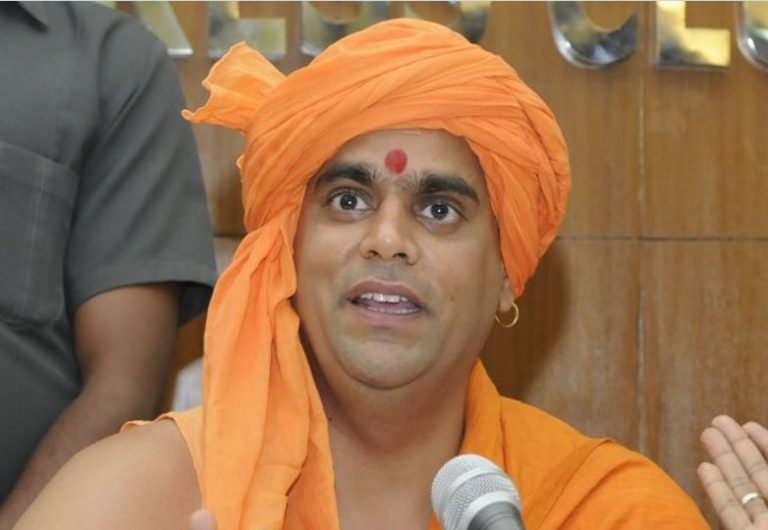
On being asked about the ‘Jai Shri Ram’ being a religious slogan, Swami Chakrapani of Hindu Mahasabha said, “Jo Bhagwan Shri Ram ka naam lega wo maryadit rahega (Whoever will take Lord Ram’s name will be regarded)”. Then he added, “If you don’t want to take his name, you must chant ‘Vande Mataram’ or ‘Bharat Mata Ki Jai’. Ye to bol sakte ho (at least, you can say this much). It is patriotic to do so.”
Calling the students at JNU, “pizza-burger wale”, he claimed they lack “sanskar” (culture) and the majority of them are ‘anti-India’, said Swami Chakrapani. “Look, parents feed their children. But does it mean they can’t discipline them if they go astray? These students who have gone astray also need to be disciplined”, he furthered.
Earlier in the day, the Delhi Police had registered two FIRs in connection with Monday’s protest march. Reportedly, the Delhi Police had registered FIR against unknown protestors for allegedly violating prohibitory orders, obstructing police officers from discharging duties, and causing hurt.
The violent protests had erupted in JNU after the university administration had introduced fees for utility services like water and electricity on an actual basis, and a fixed charge of Rs 1700 per month for services like sanitation, maintenance, cook etc.
The room rent was also increased from ₹20 to ₹600 for single-seater and from Rs 10 to Rs 300 for double seater. One time security which is refundable had gone up from Rs 5,500 to Rs 12,000 and the students have been protesting against it.
Following the violent protests, the JNU administration had announced a ‘major rollback’ in the hostel fee hike. Despite the rollback, the JNU goons had resorted to shocking vandalism during the protest and had desecrated the soon-to-be inaugurated statue of Swami Vivekananda on campus shocking citizens across the country.