Home Blog Page 6191

The Quint uses Khalistanis, Urban Naxals and Leftists to show that ‘Punjab and Sikhs are upset over injustice in Kashmir’

The Modi government recently took a bold decision, revoking the special status accorded to Jammu and Kashmir. While abrogating the provisions of Article 370 and scrapping Article 35A, it also bifurcated Jammu and Kashmir into two Union Territories – J&K and Ladakh.

As soon as the Home Minister Amit Shah made the announcement in Parliament, it was as if a dam had been broken. The country rejoiced in one voice, after all, this was nothing short of true independence. After decades of tyranny and Pakistan using the special status to fan discord and terrorism, Jammu and Kashmir had finally been fully integrated with the rest of India without any conditions or riders.

However, not everyone was in a celebratory mood. The ones who had created a cottage industry around the Kashmir conundrum and had profited massively from the conflict started yelping. Congress, the parents of this decades-long conflict were not happy. Rahul Gandhi has not said much apart from one strange tweet with tons of platitudes. Adhir Ranjan Chowdhury stood on the floor of the parliament and toed the Pakistan line by internationalising the issue and asking the government, in effect, whether it should have consulted the UN and Pakistan before altering the nature of Jammu and Kashmir. Digvijay Singh etc also chimed in with a host of ridiculous comments and Congress eventually passed a resolution in CWC against the decision of the government. The incitement came from various other political quarters like Mehbooba Mufti, Farooq Abdullah, Omar Abdullah, Mamata Banerjee etc.

While the politicians were understandably hurt that a simmering issue that has helped most political parties over the decades could be potentially resolved over time with this move, the media was equally hurt. There were several op-eds written about how this is an assault on democracy, the Kashmiri people are being hurt and the list if endless.

While all this happened, the UN and most other countries, even UAE, that Pakistan claims to have an Islamic bond with, supported India. Almost in unison, the statements said that this was an internal matter of India. The statements were significant because Pakistan was then completely removed as a stakeholder in Jammu and Kashmir per the international community.

However, though the international community conceded and the people of Jammu, Kashmir and Ladakh were rejoicing the move, the media was busy peddling a dangerous narrative. One such report that stood out was that from The Quint. The Quint headline read, “‘This is Like 1984’: Punjab Upset Over ‘Injustice’ in Kashmir”.

The insinuation of the headline was simple. Punjab hates the idea of Jammu and Kashmir being an integral part. Subliminal messaging is even more dangerous. What the headline indicated to the average reader was the following:

  1. Punjab sympathises with the separatist sentiments of a section of the South Kashmir population as it resonates with the Khalistanis.
  2. The Indian government was committing genocide in Kashmir.

While the second one is mere platitude that is being peddled by Leftists, the second insinuation that links Khalistan with J&K decision is far more worrying.

Now, since The Quint had published this report, it became imperative to analyse what data points they had used. It was also imperative to understand whose statements were they basing their sweeping generalisation on.

The Quint article first quoted Chief Minister of Punjab Captain Amrinder Singh. Amarinder Singh had said that he thought the move was unconstitutional. However, it is not surprising that he would say that considering his party stand has been on those lines.

Next, The Quint quotes Kanwar Sandhu, who is an AAP MLA. AAP supported the decision of the Modi government’s decisions in Jammu and Kashmir in the parliament. However, the AAP in Punjab had a diametrically opposite stand. However, any journalistic endeavour that makes such a tall statement would require the report to present all sides of the picture. The Quint fails to mention that AAP in Punjab has thrived by playing on Khalistani sentiments. During the Punjab elections, AAP had openly and shamelessly pandered to Khalistani elements. This little piece of information is given a miss by The Quint.

Further, The Quint quotes certain organisations that have raised an objection to the effective abrogation of Article 370. Interestingly, Quint mentions all of them almost as if they are all independent organisation comprising of average, everyday Sikhs. That is not the case.

Firstly, under the subheading, “Widespread Protests”, The Quint writes the following:

“However, opposition to the Modi government’s move wasn’t restricted to the corridors of power. There were protests in different parts of Punjab, mostly by Left-wing and Panthic outfits”. 
It is intriguing how The Quint took the opinion of the Left and juxtaposed it to the entire state of Punjab.

Coming back to the outfits mentioned by Quint. The Quint writes:

“For instance, outfits like Lok Sangram Manch, Kirti Kisan Union, Punjab Students’ Union, Inqlabi Lok Morcha, Inqlabi Kendar and Association for Democratic Rights carried out protests in Bathinda, Moga and other cities. Dal Khalsa also held demonstrations expressing solidarity the people of Kashmir”. 

While mentioning these outfits, The Quint does not even inform their readers of what these outfits are or what their political inclinations are making it seem like they are merely organisations by independent Sikhs.

Lok Sangram Manch, for example, is an outfit that comes under the aegis of CPI-ML New Democracy. In fact, at a conference in Punjab held by Lok Sangram Manch, ‘comrade’ Varavara Rao was also an ’eminent’ speaker.
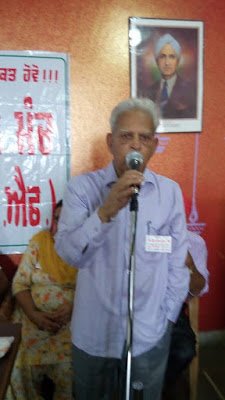
The website says, “After the session, Comrade Varvara Rao lectured the comrades, sister organizations and general public on the national and international situation and challenges. He referred to the legacy of Punjab and encouraged the people to take part in revolutionary struggles. He attacked Modi government for its communal Hindu fascist and economic onslaught against poor people of India”.

While the word ‘Khalistan’ has not been mentioned in the report itself, the nexus between Khalistani elements and Urban Naxals is rather evident. Next, The Quint mentions Kirti Kisan Union which is also an arm of CPI-ML New Democracy. The Inqlabi Lok Morcha, too, is a Far-Left organization.

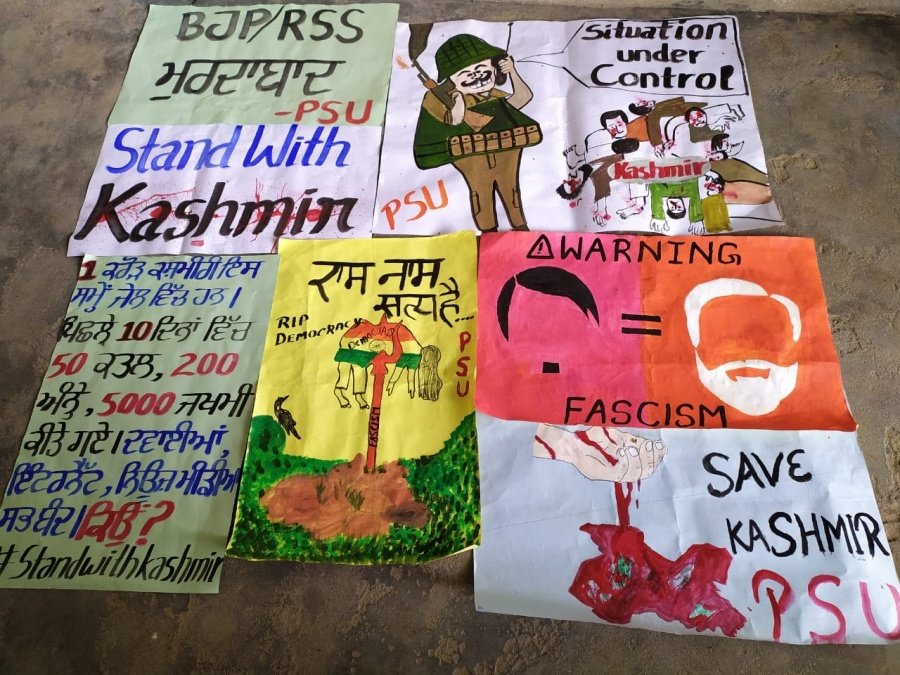
The Punjab Students’ Union too is far-left. They project deep hatred for Hindus with the mention of ‘Ram’ in their so-called protest against the abrogation of Article 370. It also insults the Indian Army by portraying them as killers and the Indian flag in one of their posters. The PSU has also been accused of having intimate links with Naxalites. The claim was made by a student leader from Punjab, Darshan Baghi, in his memoir. He claims that he abandoned the union due to its sectarian politics.
Then, there is the Association for Democratic Rights (AFDR). The AFDR is a coordinating organisation of the CDRO, an organization that we have reported on extensively for their links to the Urban Naxals for their alleged involvement in the violence at Koregaon Bhima and an alleged plot to assassinate Prime Minister Modi. In earlier articles, we have also covered their intimate links to Kashmiri separatists and separatists in Manipur.

It is rather evident that all the organisations mentioned by The Quint are Far-Left organisations that have often indulged in disruptive politics.

The Quint doesn’t stop there. In order to paint a picture of entire Punjab dissenting against the Modi govt’s move in Jammu and Kashmir, Quint shamelessly quotes Khalistan supporters and extremists.

One of the organisations that The Quint quotes is Dal Khalsa.

Quoting from an August 2018 Tribune report:

On the occasion of its foundation day, the Dal Khalsa on Monday said it would strive for a peaceful, political and democratic struggle for a separate Sikh homeland. At the same time, the radical Sikh organisation paid homage to “militant” leaders, acknowledged the “contribution” of Pakistan-based Sikh leaders and boasted of support of Kashmiri separatist leader Syed Ali Shah Geelani.

In a recent sting operation, some shocking facts came to the forefront which goes on to reveal that from attacking political leaders with the support of the ISI, openly extending support to terrorists like Hafiz Saeed, to carrying out anti-India campaigns in the UK and USA, Khalistani supporters who have lately become active have made ‘break India’ their core impulse.

Gurcharan Singh, member of the once-banned Dal Khalsa said, “The enemy of your enemy is your friend. That is the simple thing. And secondly, when the union is smashed into small parts we will need a coalition of such groups.” He, in a shocking revelation, mentioned that they have links in every single state of India and that they are funding every terror activity in India.

Gurcharan Singh, amongst the several other sensational claims he made also alleged that the Dal Khalsa had backed the Aam Aadmi Party in the Punjab Assembly Elections 2017.

Another individual that The Quint mentions is one Gurdarshan Singh Dhillon. While The Quint introduces him in their article as “a renowned scholar of Sikh history”, when one researches a little further, one realises that while he might be a history scholar, he is also a staunch Khalistani radical.

There are several videos of Dhillon where he has openly espoused and advocated for Khalistan and fanned separatist, radical sentiments.

[youtube https://www.youtube.com/watch?v=A7rQm6VjSJI]

[youtube https://www.youtube.com/watch?v=qSxBUdUHsbc]

The Quint goes on to mention a retired IAS officer called Gurtej Singh. Interestingly, what they do not mention is that Gurtej Singh too is Pro Khalistan and in fact, had started a political party along with Gurdarshan Singh Dhillon called Lok Leher Party. Even Indian Express brands Gurtej Singh as having pro-Khalistan sentiments.

The Quint then quotes one man, a journalist from the UK, to broad-brush the sentiments of Punjabi diaspora.


The argument posed by Sunny Hundal didn’t make sense, to begin with. The Indian Government has not asked anyone to stop praying in Kashmir. It was merely a statement of grand-standing that sounds intellectually soothing, according to where a person’s political bias lies but is not founded on facts or logic.

Sunny Hundal is also the Social Media Editor at openDemocracy. It is a globalist institution that receives significant donations from the Ford Foundation, George Soros’ Open Society Foundation, the Rockefeller Brothers Fund, the Heinrich Boll Foundation and numerous others. At OpIndia.com, we have earlier reported on organizations funded by George Soros who are involved in undermining the sovereignty of nations around the world. Heinrich Boll Foundation also contributes to CSSS, whose member Ram Puniyani was involved with drafting the Communal Violence Bill as part of an advisory council of Sonia Gandhi’s NAC.

The Quint then speaks the language of Khalistan in conclusion of its report. It says:

Clearly, the revocation of Jammu and Kashmir’s special status and the ongoing lockdown in the erstwhile state has sparked fear and anger among Punjab’s Sikh community as well as the Sikh diaspora. There are fears that what has happened in Kashmir might happen in Punjab and that the Hindutva march could eventually harm the Sikhs as well.

The lockdown in Kashmir has also brought back memories of the ghastly violence against the Sikhs in the 1980s and 1990s and the attack on Harmander Sahib in Amritsar, a yet unhealed wound for many in the community.

Another concern in the community is that the worsening of ties between India and Pakistan can put the Kartarpur Sahib corridor project in jeopardy.

The Quint here quite openly fans Khalistan sentiments. The Sikhs as a community have always stood by not only the Hindus but also the sovereignty and integrity of India. For the Quint to draw a parallel between the situation in Kashmir, which is largely fanned and funded by Pakistan to the sentiments of the average Sikh in Punjab, based on the statements of Urban Naxals and Khalistanis is worrisome, to say the least.

It is further interesting that Quint, on its own accord has branded the effective abrogation of Article 370 as a ‘Hindutva march’. Essentially, the move has nothing to do with religion and is an exercise in the full and complete integration of Jammu and Kashmir with the rest of India without any conditions and riders. In saying this, Quint not only panders to Khalistan separatists but also Pakistan as it is their preferred narrative to pin this on ‘Hindutva’. If the jubilation of Kashmiri Hindus finding justice after decades of genocide can be branded as a Hindutva March, then this article by The Quint could very well be branded as a March of the Khalistani and Islamic Extremists.
National Film Awards: Andhadhun by Sriram Raghvan gets Best Hindi film award, Vicky Kaushal and Ayushmann Khurana grab best actor awards

The 66th annual National Film Awards for 2018 were announced today. Andhadhun by Sriram Raghvan starring Ayushmann Khurana won the best Hindi film award. Keerthy Suresh won the Best Actress award for Mahanati (Telugu and Tamil). Vicky Kaushal (Uri) and Ayushmann Khurana (Badhaai Ho) both won the Best Actor awards.

Award for Best Popular Film Providing Wholesome Entertainment went to Badhaai Ho starring Neena Gupta and also Ayushmann Khurana. Award for Best Feature Film went to Hellaro (Gujarati).

Sanjay Leela Bhansali’s Padmaavat got best choreography (Ghoomar) and best playback singer (male), Arijit Singh. Surekha Sikri won the Best Supporting Actress Award for Badhaai Ho (Hindi) and Swananda Kirkire won the Best Supporting Actor for Chumbak (Marathi).

Nargis Dutt Awared for Best Feature Film on National Integration went to the Kannada film Ondalla Eradalla.

Uttarakhand won the Most Film Friendly State award.

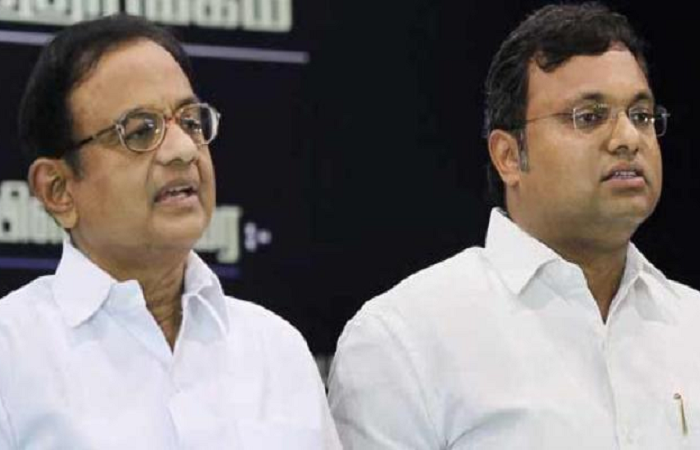
Since March 2018, Court extended interim protection from arrest to accused P Chidambaram and Karti 22 times. Read details

On Friday, Former Union Minister P Chidambaram and his son Karti got interim protection for the 22nd time from a Delhi special CBI court in connection with the Aircel-Maxis cases filed by the Central Bureau of Investigation and the Enforcement Directorate.

What is the Aircel-Maxis deal?

The Aircel-Maxis controversy, a case which has been carrying on since 2011, has its roots in the 2G spectrum ‘scam.

A Malaysian firm named Maxis had acquired Aircel by buying a 74 per cent stake in it in March 2006. The company also allegedly invested Rs.742 crores in Sun Direct, a company chaired by former Telecom Minister Dayanidhi Maran’s brother, Kalanithi Maran in 2009.

In October 2011, the CBI filed a case against Dayanidhi Maran on the basis of Aircel founder Sivasankaran’s complaint. The FIR also stated that a company owned by Kalanithi had received an amount of Rs.549 crore for facilitating the Aircel-Maxis deal.

In December 2014, the CBI examined that the former Union Finance Minister P Chidambaram had a connection with the case, questioning whether he was competent for giving Foreign Investment Promotion Board (FIPB) sanction for the foreign investment in Aircel since he could only sanction investment up to Rs 600 crore. The Aircel-Maxis deal was worth Rs 3,500 crore, which, they argued, needed the approval of the Cabinet Committee on Economic Affairs (CCEA)

The CBI alleged that after the approval was received, Aircel Televentures Limited paid a sum of 26 lakh to a company linked to Karti Chidambaram.

In April 2017, the CBI informed the Supreme Court that it is investigating P Chidambaram’s role in the alleged irregularities in grant of FIPB approval in the Aircel-Maxis case, and alleged payments to Karti.

In July 2018, senior Congress leader Chidambaram and his son Karti along with 16 others were charged by the Central Bureau of Investigation in the probe into suspected criminal misconduct related to approvals of investment deals. The CBI had also accused him as ‘willful lawbreaker’ in its charge sheet filed in July.

Interim Protection for 20th time:

Since March 2018, both P Chidamabaram and Karti Chidambaram have been continuously granted interim protection from arrest by the special CBI court in Delhi for their alleged involvement in the Aircel-Maxis scam.

Here is a list of interim protections provided by the special CBI court headed by Justice OP Saini to accused P Chidambaram and Karti Chidambaram. Interestingly, in some of those cases, both ED and the CBI have themselves asked for an adjournment in the case further providing relief to the accused.

  1. March 20, 2018: The special CBI court granted protection to Karti Chidambaram from arrest till April 16, 2018, in Aircel-Maxis matter arising out of the 2G spectrum cases lodged by the CBI and the Enforcement Directorate (ED).
    Special Judge OP Saini gave the agencies three weeks to file a detailed reply on the anticipatory bail plea of Karti.
  2. April 16, 2018: A Delhi court yet again granted Karti Chidambaram interim protection from arrest till May 2, 2018, in two cases filed by the Central Bureau of Investigation and the Enforcement Directorate in the Aircel-Maxis matter.
    Special Judge OP Saini once again granted relief to the son of senior Congress leader P Chidambaram after the Enforcement Directorate’s counsel asked for time to argue against Karti Chidambaram’s anticipatory bail application.
  3. May 2, 2018: The Delhi court granted Karti Chidambaram interim protection from arrest till June 4, 2018, in two cases filed by the CBI and ED in the Aircel-Maxis matter arising out of 2G spectrum cases.
    Special Judge OP Saini granted relief to the son of senior Congress leader P Chidambaram after the Enforcement Directorate (ED) sought time to argue on Karti’s application seeking anticipatory bail.
  4. June 5, 2018: A special court here extended interim protection to former Union Minister P Chidambaram from arrest till July 10, 2018, in the Aircel-Maxis deal case.
    Special Judge OP Saini announced the order and directed him to join the investigation whenever required.
  5. July 10, 2018: The Delhi court ordered that former Union Minister P Chidambaram and his son Karti would not be arrested in the Aircel-Maxis deal related money laundering case till August 7, 2018.
    The ED had opposed the bail application before special judge OP Saini in its written submission and sought time to argue the matter.
  6. August 7, 2018: A Delhi court today extended till October 8, 2018, the interim protection from arrest granted to former Union minister P Chidambaram and his son Karti in Aircel-Maxis cases filed by the CBI and the ED.
    Special CBI Judge O P Saini put up the matter for October 8 after the counsel appearing for the agencies told the court that the main counsel was not well and requested time.
  7. October 8, 2018: A Delhi Court further extended the interim protection from arrest till November 1, 2018, granted to former Union Minister P Chidambaram and his son Karti in the Aircel-Maxis case filed by the CBI and the ED.
    Special CBI Judge O P Saini adjourned the matter till November 1 after the lawyers appearing for agencies sought an adjournment in the matter.
  8. November 1, 2018:  Former Union minister P Chidambaram and his son Karti got relief after a Delhi court extended their interim protection from arrest till November 26, 2018, protection in the Aircel-Maxis money laundering case filed by the CBI and the ED.
    Senior advocates Kapil Sibal and AM Singhvi, appearing for Chidambaram had submitted on behalf of P Chidambaram. Taking note of Chidambaram’s submission, Special Judge OP Saini extended till November 26 the protection from arrest granted to him.
  9. November 27, 2018: The CBI this time sought more time before special CBI judge OP Saini to procure sanction to prosecute the remaining five public servants.
    The court meanwhile also extended the period of interim protection from arrest for Chidambaram and his son, Karti to December 18, 2018.
  10. December 19, 2018:  The Delhi court again extended till January 11, 2019, the protection granted to former Union minister P Chidambaram and his son from arrest in the Aircel-Maxis scam.
    Special Judge OP Saini extended the relief granted to Chidambaram and his son Karti after the CBI and the ED submitted that new material has been recovered which needs to be collated. It also granted time till January 11 to the CBI to get sanction to prosecute some of the people accused in the case.
  11. January 11, 2019: The Delhi court on that day extended the interim protection from arrest to former Union Minister P Chidambaram and his son Kartitill February 1, 2019.
    Special CBI Judge OP Saini put up the matter for February 1 after Solicitor General Tushar Mehta, appearing for the CBI, told the court that the ongoing probe was about to be completed.
  12. February 1, 2019: Union minister P Chidambaram and his son Karti got further protection after the Delhi court extended their protection till February 18, 2019, in the Aircel-Maxis scam.
    Special CBI Judge OP Saini extended the relief to Chidambaram noting that he would not be available on February 1 for which the matter was earlier listed.
  13. February 18, 2019: The Delhi court extended till March 8, 2019, the interim protection from arrest granted to former Union minister P Chidambaram and his son Karti in the Aircel-Maxis scam cases filed by the CBI and the ED.
    “Requesting both parties to expedite the matter but the date is not fixed yet. Put up the matter for March 8,” the judge OP Saini had said.
  14. March 8, 2019: Karti and his father P Chidambaram yet again got an extension from the Delhi court with interim protection from arrest till March 25, 2019.
    Special Judge OP Saini had adjourned the hearing after senior advocate Sonia Mathur, appearing for the CBI, sought time to argue on their anticipatory bail pleas.
  15. March 25, 2019: The Delhi court again extended till April 26, 2019, the interim protection from arrest granted to former Union minister P Chidambaram and his son Karti in the Aircel-Maxis case filed by the CBI and the ED.
    P Chidambaram appeared before Special Judge OP Saini, who extended the interim relief granted to them.
  16. April 26, 2019: Former Union Minister P Chidambaram and his son Karti got an extension from Delhi court till May 6, 2019. The father-son duo got interim protection from arrests in the Aircel-Maxis case.
    Special Judge OP Saini extended the interim relief to Chidambaram and his son and posted the matter on May 6 after ED sought more time to gather evidence.
  17. May 6, 2019: The Delhi court extended the interim protection from arrest granted to former Union Minister P Chidambaram and his son Karti in Aircel-Maxis cases by CBI and ED till May 30, 2019.
    Special Judge OP Saini extended the protection after senior advocate A M Singhvi, appearing for the Chidambarams, made a request in this regard.
  18. May 31, 2019: A Delhi court on May 30 extended the interim protection from arrest granted to former Union Minister P. Chidambaram and his son Karti Chidambaram in the Aircel-Maxis cases by the CBI and the Enforcement Directorate (ED) till August 1, 2019.
    Special Judge OP Saini extended the protection after the ED sought three-weeks’ time to argue on their anticipatory bail pleas.
  19. August 1, 2019: The Delhi court on August 1 extended the interim protection from arrest to former Union minister P Chidambaram and his son Karti in Aircel-Maxis cases filed by the CBI and the ED till August 9, 2019.
    Special Judge OP Saini extended the relief after the argument on anticipatory bail plea of the father-son duo remained inconclusive as both the agencies sought time to argue the matter further.
  20. August 9, 2019: A Delhi court today once again extended till August 23, 2019, the interim protection from arrest granted to former Union minister P Chidambaram and his son Karti in Aircel-Maxis cases filed by the CBI and the ED.
    Special Judge OP Saini extended the relief, which was to end today, saying the court was not available for arguments.
  21. August 23, 2019: A Delhi court refused to adjourn the Aircel-Maxis case hearing against Chidambaram and his son Karti on the pleas filed by CBI and ED seeking adjournment as another case was pending before the SC with regard to the INX Media scam. While Special Judge OP Saini took strong objection to agencies seeking repeated adjournments, he reserved the order for September 3, 2019, extending their interim protection till then
  22. September 5, 2019: According to the reports, special Judge OP Saini again granted relief to the father-son duo and directed them to join the probe in the cases. “In event of arrest, they should be released on a personal bond of Rs 1 lakh and one surety of like amount. The accused are directed to join the investigation,” the court said.

Justice OP Saini acquited 2G scam accused A Raja, Kanimozhi:

Interestingly, OP Saini was the same judge who acquited Former telecom minister A Raja, DMK member Kanimozhi and several others in the 2G spectrum allocation scam cases in 2017. The scam related to the 2G spectrum licence allocations in 2007-08 which caused, according to a report by the Comptroller and Auditor General of India, a loss of Rs 1.76 lakh crore to the exchequer.

Note: The article has been updated with latest information and more interim protection granted by CBI Special Court Judge OP Saini.

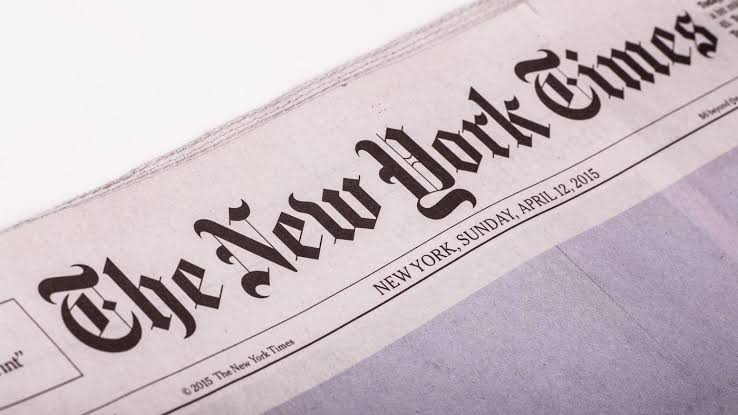
New York Times asks America and China to come together to stop “India’s Folly” on Jammu and Kashmir

The editorial desk of the New York Times seems to be inordinately perturbed by the Indian government’s move to abrogate Article 370 and bifurcate the state of Jammu and Kashmir into two Union Territories. After the Indian government took the momentous decision, the NYT published an editorial imploring the US government and China to join hands in stopping what they described as “India’s Folly”.

In an editorial slamming India for repealing Article 370, the New York Times cited the close ties between the United States and China saying, “The United States and China shouldn’t let Kashmir become a puppet in their ceaseless disputes.” Casting gloom over India’s decision, the newspaper claimed that India’s move to do away with “semi-autonomous” state will result in imminent bloodshed and escalate into an unpredictable regional crisis.

Invoking erstwhile US president Bill Clinton’s characterisation about Kashmir- “The most dangerous place on Earth”, the NYT editorial quoted Pakistani Foreign Ministry saying it will exercise all possible options to counter India’s illegal move. The editorial also stated that India’s move may invite Pakistani action and result in an intractable conflict between the two nuclear countries.

The NYT asked the two countries-United States and China to take urgent action to set right India’s folly and stop the region from plunging into a catastrophic abyss.

While asking the US and China to intervene, the editorial highlighted the shift in USA’s preference from Pakistan to India. “The fray is not without global implications. Under President Trump, the United States has shifted its favours from Pakistan, a longtime recipient of American aid, to India, which the administration perceives as a bulwark against China. China, meanwhile, has become an ally and financial patron of Pakistan.”

The New York Times, who couldn’t dissuade American retailer giant Wallmart from selling the guns even after two recent gruesome shooting incidents that rocked the States, believes that the two nations who are in a perennial tariff war will shun their differences and come together to violate India’s sovereignty by intervening in its internal matter. Historically Americans consider communists to be their biggest enemy, but now the NYT wants the world’s oldest democracy to ally with Communist China against the world’s largest democracy.

NYT’s wish of UN intervention in Kashmir has already been rejected after the UN chief had today snubbed Pakistan claiming that the UN has no locus-standi over the Kashmir issue as it is a bilateral issue as per Shimla Agreement.

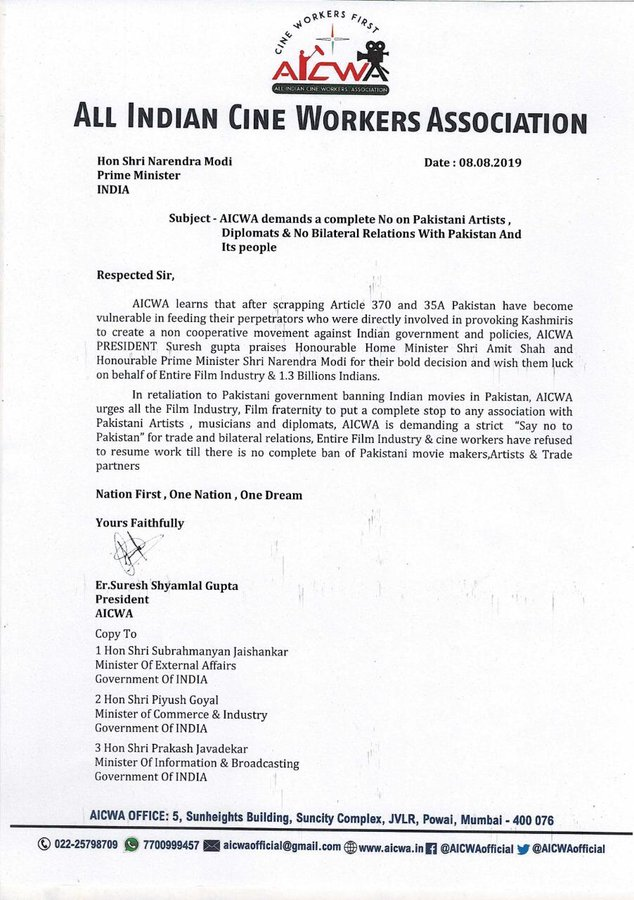
All India Cine Workers Association writes to PM Modi demanding ban on Pakistan artists, diplomats and bilateral relations

The All India Cine Workers Association (AICWA) has written to Prime Minister Modi demanding a complete ban on Pakistani artists, diplomats and bilateral relations with Pakistan and its people. In a strongly worded letter AICWA says that they have learnt that following the abrogation of Article 370, Pakistan has started encouraging unrest in Kashmir and provoking Kashmiris to create a non-cooperation movement against Indian government and its policies.

All India Cine Workers Association writes to PM Modi (image: ANI)

The film body adds that in retaliation to the Pakistan government’s decision to ban Indian films in Pakistan, the AICWA has urged the entire film fraternity to completely stop association with Pakistani artists, musicians and diplomats. AICWA has also demanded a strict ‘Say No To Pakistan’ for trade and bilateral relations. The film body says that the film fraternity refuses to resume work till there is no complete ban on Pakistani movie makers, artists and trade partners.

The AICWA President also praised PM Modi and HM Amit Shah for their bold decision and wish them luck on behalf of entire film fraternity and 1.3 billion Indians.

“Nation First, One Nation, One Dream,” the AICWA President Suresh Shyamlal Gupta writes in his letter.

On Wednesday, Pakistan had snapped off its trade ties with India and downgraded diplomatic ties with India.

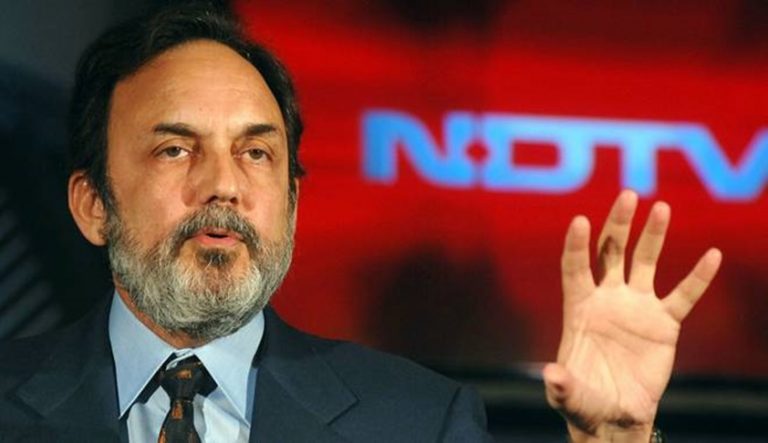
Caught being Pakistan’s mouthpiece, NDTV lies again, claims Pakistan is doing what NDTV does with news

Earlier today, NDTV was called out in the social media for being Pakistan’s mouthpiece. Pakistan’s ruling party PTI had used a video clip from NDTV to peddle their anti-India propaganda.


Imran Khan’s PTI had used a clip from Sreenivasan Jain’s show on NDTV where an NDTV journalist reporting from Srinagar had claimed that he had met an old, blind man in Srinagar who was allegedly told him, “New Delhi is saying everybody in Kashmir is happy about making Jammu and Kashmir a UT. Let them lift the curfew and they will know how happy we are”. The show had not shown the so-called old man.

NDTV’s anti-India stand has been known to everyone for a while and the channel was slammed on social media for acting as Pakistan’s mouthpiece after the PTI tweet was shared widely.

Pakistan’s love for NDTV is not new and many NDTV anchors, present and former, have found praises from our enemy nation in the past.

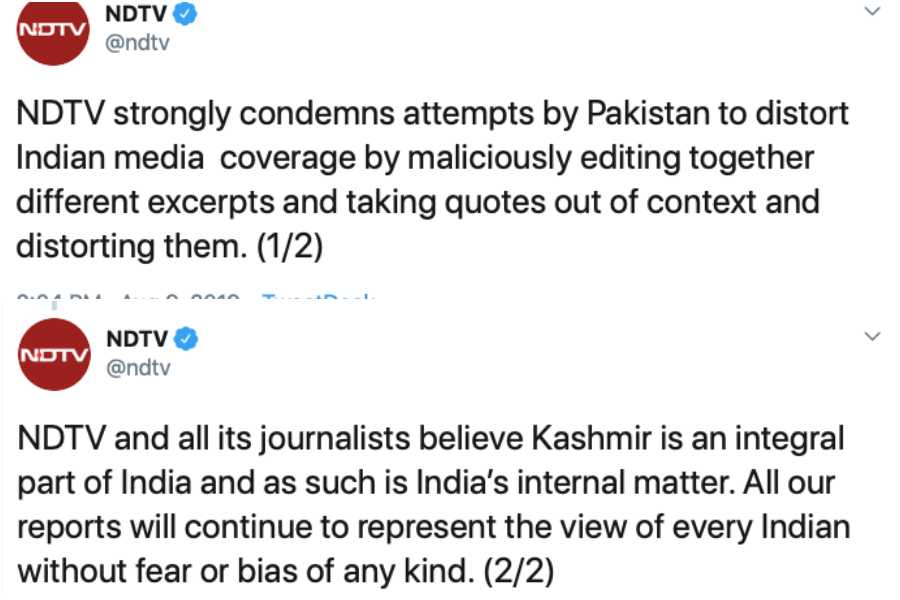
After wide social media outrage, NDTV decided to come up with a clarification statement. They claimed that Pakistan has done something that NDTV does usually, taken quotes and statements out of context, and distorted its meaning.

They also claimed that Pakistan has ‘distorted Indian media coverage’ by ‘maliciously editing together different excerpts’ and ‘taking quotes out of context.

via Twitter

However, even in their clarification, NDTV managed to tell lies. The video clip that Pakistan’s PTI had shared was not edited by ‘piecing together different excerpts’. It was a continuous section taken from the show titled ‘Reality Check’ that was aired by NDTV and uploaded by them on YouTube yesterday.

The clip shared bt Pakistan’s PTI appears at 5.00 minutes in the 25-minute video on NDTV’s YouTube channel. The clip shared by Imran Khan’s party is a continuous section 28 seconds long and there is no ‘editing together different excerpts’. PTI’s tweet quotes the alleged statement by this nameless old man exactly as the NDTV reporter says it. So it is not clear what exactly is NDTV calling a ‘distortion’ and quoting out of context.

Actually, NDTV has basically blamed Imran Khan’s PTI for doing things they themselves have been doing with news. NDTV has been caught several times spreading blatant fake news and misleading people with quotes taken out of context and distortion of facts.

It is notable here that despite being endorsed by Imran Khan’s party. NDTV did not muster the courage to name PTI in their clarification tweet. Neither did they say that Khan’s party has misused one of their reports. Instead, they went with generalisations like ‘Indian media coverage’.

It is also interesting that after airing show after show where they are trying desperately hard to peddle the narrative that Pakistan has been peddling, despite the fact that the state has been converted into a Union Territory and its people given all the rights that every other citizen of India enjoys, NDTV ironically adds the platitude that it believes ‘Kashmir is an integral part of India and India’s internal matter’.

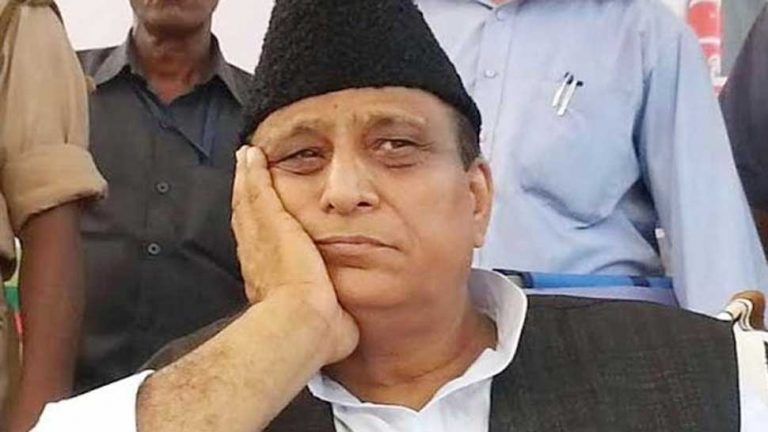
As AMU Student Union secretary, SP MP Azam Khan was rusticated for a year in 1975 for forcibly trying to enter female ward in hospital

If reports are to be believed, the Samajwadi Party MP Azam Khan, infamous for making sexist and misogynist comments on his colleagues, was once expelled from Aligarh Muslim University (AMU) for a year when he was a student leader for allegedly entering the female ward of a hospital forcibly.

A well-known Shia cleric, Maulana Kalbe Jawwad said Azam Khan was punished by the AMU administration for misbehaving with a woman in 1975. He was pursuing Master of Laws (LLM) at the university then.

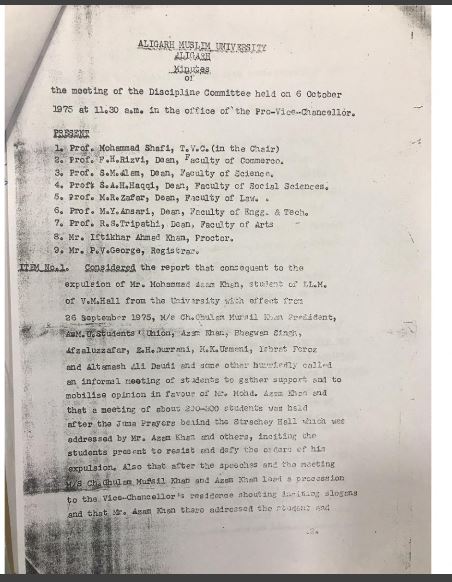
The cleric recounted that Azam Khan, who was also secretary of the Aligarh Muslim University Student Union then, had tried to forcibly enter a female ward of a hospital. The cleric furthered that the authorities of the Aligarh Muslim University had then set up an inquiry committee which found Azam Khan guilty following which he was expelled on October 6, 1975.

Minutes of the meeting conducted an inquiry committee which found Azam Khan guilty following which he was expelled on October 6, 1975. Photo: IANS

Maulana Kalbe Jawwad had earlier also in 2014, produced documentary evidence in support of his similar allegations against the SP MP Azam Khan.

Azam Khan had then refused to recognise Jawwad as a religious head and called him an agent of the BJP. The cleric, in response, had alleged that the SP leader was trying to create a Shia-Sunni divide for his political gains.

Azam Khan is in neck-deep trouble. Recently he was reprimanded and made to apologise by Lok Sabha Speaker Om Birla for his creepy and sexist remark against BJP MP Rama Devi. Moreover, the Samajwadi Party is facing charges of using derogatory remarks against BJP leader Jaya Prada.

Apart from this, the founder member of the Samajwadi Party, Azam Khan, is also facing charges of land grabbing and theft of books in Rampur.

The SP MP has more than 30 cases in his name. Majority of these cases relate to grabbing of land belonging either to the government or to poor farmers. Considering this long history of involvement in land grabbing cases Senior Samajwadi Party (SP) leader Azam Khan might soon be listed as a land mafia on the Anti-Bhoo Mafia (anti-land mafia) portal of the Uttar Pradesh government.

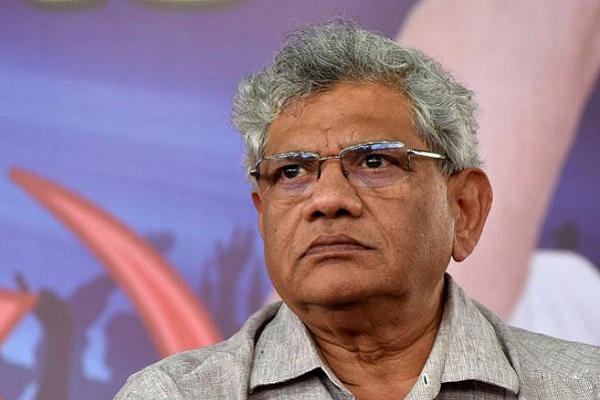
Sitaram Yechury stopped at Srinagar Airport, sent back to Delhi

General Secretary of the CPI(M), Sitaram Yechury, who had gone to Srinagar to visit the members of his party there is being sent back to Delhi. Yesterday, Congress leaders Ghulam Nabi Azad and Gulam Ahmed Mir were detained at the Srinagar airport before they were sent back to Delhi as well.


Yechury had said yesterday that he would go to Srinagar to meet CPI(M) workers and the lone MLA the party had in the erstwhile state assembly.

Politicians from opposition parties have been engaging in extremely disturbing rhetoric which could imperil a sensitive situation as Jammu & Kashmir slowly returns to normalcy. Despite the narrative that is being peddled on social media and in newsrooms, the newly formed union territory is making peace with recent developments.

However, amidst clear provocation from Pakistan, it’s understandable that the Indian government is exercising caution. It’s also reasonable for the government to not allow the union territory to become a new battleground for petty politics.

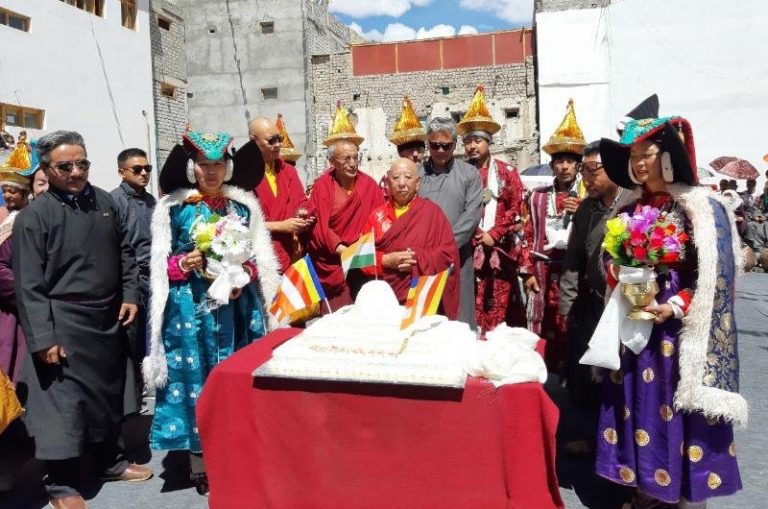
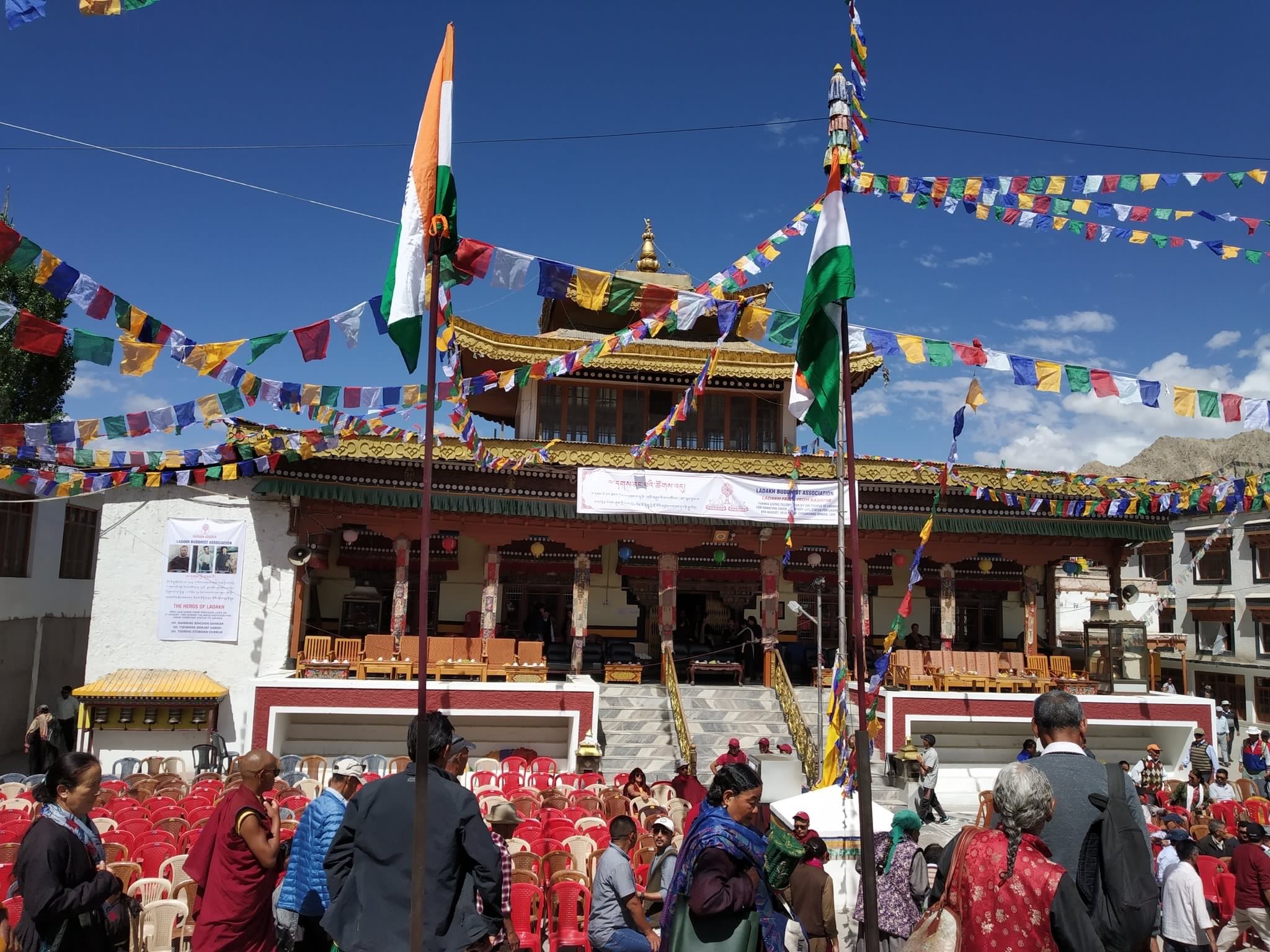
Meanwhile, people in Ladakh have wholeheartedly embraced the decision with open arms. A “thanksgiving” ceremony was organized by the Ladakh Buddhist Association (LBA) in Leh on Thursday in celebration of their newly granted Union Territory status.

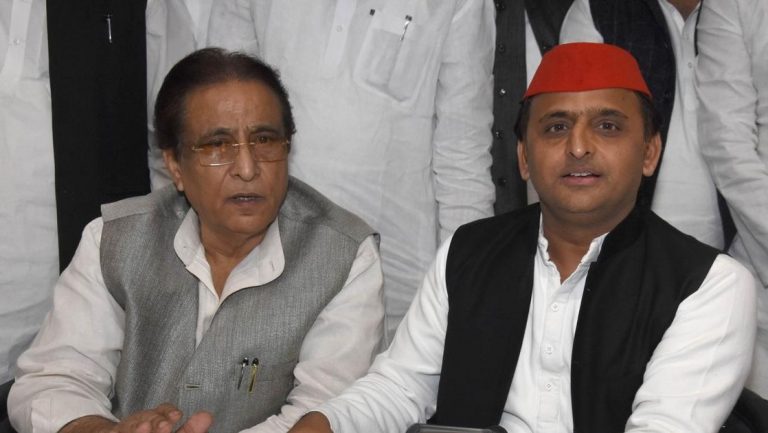
Akhilesh Yadav directs SP workers to block roads, hold massive protest in support of Azam Khan across Uttar Pradesh

On the direction of Samajwadi Party chief Akhilesh Yadav, the party workers across Uttar Pradesh have organised massive protests at their respective districts today in support of Azam Khan.

The Samajwadi supremo had announced a state-wide protest on August 9 in support of Rampur MP Azam Khan and his son Abdullah Azam, the Suar MLA. During the protest, SP workers are demanding that ‘fake cases’ against Azam Khan be withdrawn and harassment of Abdullah should be stopped.

A group of Samajwadi workers were stopped by the Uttar Pradesh police as they blocked roads and disrupted traffic in Uttar Pradesh today.


Samajwadi Party claims that the charges of land grabbing filed against Azam Khan are fake. The SP leader has been declared as a land mafia by the UP government, and several FIRs have been registered against him on the complaints of as many as 26 farmers. The farmers allege that Azam Khan had forcefully grabbed their land for his university. Khan has denied all the charges, and the party has stood firmly behind him.

Akhilesh Yadav seems to be sharing a very special bond with Azam Khan. This affinity probably compelled Akhilesh to extend his support to Azam Khan’s sexist and creepy remark against the BJP female MP. While under normal circumstances this could amount to harassment and sexual abuse, Samajwadi Party supremo Akhilesh Yadav, however, found nothing wrong with it. He said that Khan’s remarks were nothing but ‘poetry’.

Nevertheless, the Samajwadi Party also said that the protest will highlight the deteriorating law and order situation in Uttar Pradesh. The list of demand also included the setting up of a fast track court for the trial of the accused in the Sonebhadra massacre case, shifting of Unnao rape accused, MLA Kuldeep Singh Sengar to a jail outside Uttar Pradesh, allocation of land to tribals of Umbha village in Sonebhadra district and entering their names in revenue records.

On August 4, Uttar Pradesh police had booked 16 Samajwadi workers including district president Firoz Khan in Sambhal for burning effigies and blocking a key road. The police had stopped them from going to Rampur in support of MP Azam Khan and his son Abdullah. Since the police prevented them, the workers led by Sambhal president, Firoz Khan started burning effigies in front of sub-divisional magistrate (SDM) court. This had led to the blocking of Sambhal-Moradabad road.

The Samajwadi Party had also organised a huge rally in Rampur on August 1 as a show of strength to protest against the raids against Azam Khan and the detention of his son Abdullah Azam Khan.

Abdullah was detained as he was found violating Section 144, imposed by the police on the account of the ‘Save Azam’ rally staged by Samajwadi Party in Rampur on August 1. As per reports, UP Police had blocked all roads leading to the Mohammad Ali Jauhar University and imposed section 144 in the area. Despite this, Abdullah and his supporters tried to storm the university, leading to clashes with the police.

Earlier, the police had carried out raids at the university and recovered many valuable old books stolen from a centuries-old Madarsa in Rampur. Abdullah Khan later held a candlelight vigil to protest the raids outside the University. Azam Khan, the father of the SP MLA from Suar is the founder and chancellor of the university. The police conducted search operations at ‘Mumtaz Central Library’ of Mohammad Ali Jauhar University following a complaint by the principal of Madrasa Aliya, wherein he stated that 9000 books and rare manuscripts from the Madrasa have been stolen.

Ladakh residents organise thanksgiving ceremony to celebrate their region becoming a Union Territory

0

A “Thanksgiving” program was organised by the Ladakh Buddhist Association(LBA) in Leh yesterday to celebrate Ladakh becoming a Union Territory after the central government obtained a presidential decree to abrogate Article 370 and bifurcate the state into two Union Territories- Jammu and Kashmir with legislature and Ladakh without legislature.


A legion of people from different villages participated in the celebration. Political leaders, religious leaders, monks and Sarpanchs were present at the event to rejoice the government’s decision to reorganise the region as a union territory and preserving Ladakh’s distinct identity.

People celebrating Thanksgiving in Leh

People in Ladakh have been demanding the union territory status for several decades. As the Ladakh MP Jamyang Tsering told the Lok Sabha on 6th August, people in Ladakh felt that the Jammu and Kashmir government was discriminating against the region. He had accused that due to the policies of Congress government and Article 370, the development, political aspiration, identity, language of Ladakh have become extinct under Kashmir.

Therefore, people in Ladakh are elated with the prospect of development of the region as a union territory. Even the Muslim residents in Ladakh expressed their elation at the government’s decision by hoisting the Indian flag at the top of the centuries-old mosque in the main market region of Leh.


One of the Muslim residents said, “From Leh to Kanyakumari, we are all Indians and India is one. We have full faith in PM Modi and we are happy with Modi government’s move of declaring Ladakh a UT and expect that this decision will kickstart development of the Ladakh region.”

Yesterday, PM Modi addressed the nation talking about his government’s decision to abrogate Article 370 and bifurcation of the state into two union territories. PM Modi defended his government’s move saying the decision will herald increased development of the regions. PM Modi also said that farmers in Ladakh will have unfettered access to markets across India for selling their produces and will bring prosperity to the region.