Home Blog Page 6568

West Bengal: Mamata government to face fresh challenges as more than 300 TMC workers join BJP

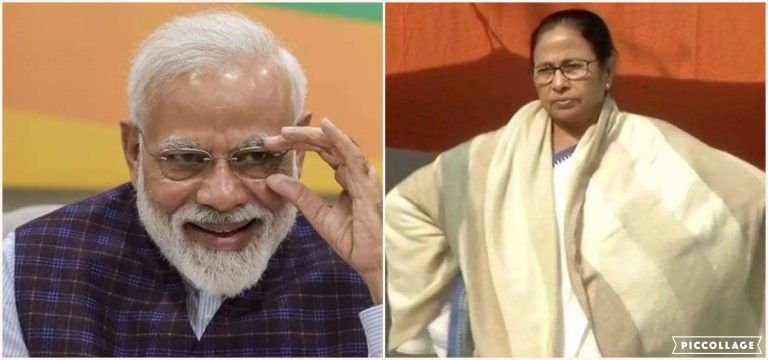
A fresh challenge has been thrown in front of the TMC government led by Mamata Banerjee in West Bengal, as The Sunday Guardian reports that more than 300 Trinamool Congress (TMC) workers from Cooch Behar in West Bengal, along with senior TMC Yuva Morcha leader, Nishith Paramanik and a former CISF commandant and Arjuna awardee, Chhaya Adak, joined the Bharatiya Janata Party at their national headquarters in Delhi on Thursday.

Amongst over 300 workers, there are elected sarpanches from various villages of Cooch Behar district. Meanwhile, more than 150 of them are members of the Panchayat Samiti from several villages across the district.

BJP leader, Mukul Roy, who is also an ex TMC leader, told The Sunday Guardian, “All of these people who have joined the BJP today were active members of the TMC in Cooch Behar and most of them are elected members of the gram panchayat. They have joined the party today under the leadership of Nishith Paramanik (TMC’s leader of the youth wing). They will all work for the BJP in the Lok Sabha elections and help the party secure the Cooch Behar seat,” Roy confirmed.

As per reports, all the 300 workers have joined the BJP under the leadership of Nishith Pramanik, the rebel youth wing leader of TMC who is believed to be close to Abhishek Banerjee, the nephew of Mamata Banerjee, who is also the national president of the TMC’s youth wing.

Nisith Paramanik while speaking to The Sunday Guardian confirmed, “Around 350 people from Cooch Behar joined the BJP today and these are people who won the panchayat elections on a TMC ticket. However, we have all decided to quit the TMC and join the BJP because of the lack of democracy in Bengal. The government and the TMC are being run on the whims and fancies of ‘pisi’ and ‘bhaipo’ (aunt, as in Mamta Banerjee and nephew, as in Abhishek Banerjee). TMC has become like a private limited company. We all believe that if anybody can help West Bengal and the country, it is Prime Minister Narendra Modi and we are certain that the BJP will win the Cooch Behar seat in the Lok Sabha elections.”

According to a senior BJP functionary of Bengal, several sitting MPs of TMC are also waiting to join BJP, “We are in talks with several TMC leaders who are willing to join the BJP ahead of the Lok Sabha elections, but they are just waiting for the right time. Some were scheduled to join on Thursday along with these people from Cooch Behar, but now they will join after the elections are declared. Even some Congress leaders are waiting to join the BJP in Bengal. They are afraid to go public now, because of the present situation in Bengal. Let the elections are declared and you will see how many join the BJP in Bengal.”

This can be seen as a repetition of the past, when last year, the Mamata government lost around 600 of its workers to the BJP.

Besides this incident, there have been various other instances of people choosing to quit the TMC and in most cases heading over to the BJP.

One of the biggest high profile exits from the TMC, former union minister Mukul Roy joined the BJP in November 2017, after quitting his former party in September of that year. Former captain of India’s football team Baichung Bhutia too quit the TMC in February but did not associate with any other political party.

The beginning of this year was also marked with similar embarrassment for TMC as Saumitra Khan, Member of Parliament from the Trinamool Congress, had formally joined the Bharatiya Janata Party on January 9, 2019.

Such defections raise the question of whether political workers at the grassroots level are losing faith in the TMC and whether they are starting to see the BJP as an alternative political force in the state.

Preach ‘say no to terror’, for India’s ‘war’ is a consequence of Pakistan’s terror

On February 27, 2019 – the fateful day when Wing Commander Abhinandan Varthman was captured by Pakistan army, I was in for a cruel shock on social media. #SayNoToWar was trending for hours on social media, with support from the ‘liberal’ fraternity, while no one bothered to say ‘Say No to Terrorism’.

It is well documented that India has never instigated violence, but always responded to one. Yet, we, the enfranchised citizens of this motherland are of the belief that the responsibility to alleviate potential unrest in the subcontinent lies with India. It is high time we acknowledge that only after all possible options to address the concerns are exhausted, that India has resorted to warfare. For a septuagenarian Nation that has fought five full-fledged wars, we very well understand the cost of conflict and its long-term implications.

The political leadership of this Nation has never depended on warfare for its adrenaline rush. Moreover, no leader has used war to create an international or domestic upset. Also, even the common citizens have never lauded violence or penalized the political leadership for not taking a ‘hard-line’ against Pakistan. And yet, there are those who want to preach us with #SayNoToWar and demotivate our men in uniform, who stand at the front, to protect us, not indulge in warfare.

It is hilarious, how Indian peaceniks have never gathered the gumption to tell Pakistan, globally known for its tacit support to terrorists and terrorism, to mend its ways. As opinion makers who have the power to influence minds across borders, I am not sure, why they never wrote books or organized festivals that discussed how terror bred and thrived in the dark yet protected lanes of Pakistan. I fail to decode why and how does Pakistan manage to enjoy the sympathy of the liberals, despite causing mayhem in India for decades.

As social media got flooded with the blood-stained face of brave heart Abhinandan, perky posts and chirpy pictures of journalists who crossed the border to cover the swearing-in ceremony of Prime Minister Imran Khan haunt me. The numerous times, they have debated on retarded issues like ‘things India should learn from Pakistan’, come back to remind me, that India has failed to tackle Pakistan with might and measure, because of the enemies within. It is our own that have failed us and continue to fail every soldier who dares to wear the uniform.

  • Congress MLA, Navjot Singh Sidhu, an acclaimed cricketer was introduced to politics by Bharat Ratna Atal Bihari Vajpayee. After doing India proud on multiple occasions, he has been on a mission to embarrass the Nation on every possible issue related to Pakistan. Not only has he flouted all norms of diplomacy with the terror State, but he is also yet to call out Pakistan and hold the failed State accountable for the terror attack on CRPF Jawans at Pulwama.
  • Congress spokesperson, Randeep Singh Surjewala addressed the Indian press minutes after the media announced that CRPF Jawans had been killed at Pulwama in an attack by the Jaish e Mohammad. In the 18-minute press conference, the leader did not condemn Pakistan even once. Moreover, in a yet another press briefing, the spokesperson called the Adil Ahmad Dar, the man behind Pulwama terror attack, a ‘homegrown so-called terrorist’. It puzzles me, why is Adil being called a ‘so-called terrorist’ and not just a terrorist. How is he homegrown? India is not home to Jaish e Mohammad – Pakistan is.
  • Mehbooba Mufti made a seditious statement when she said, “If there is an attack (on Article 35A), then I do not know which flag, other than the tricolour, would the people of Kashmir bear in hand. And if they do so, then do not tell us that we had not warned you (Centre). Do not push the people of JK to the wall”. It was unacceptable to observe that the opposition to such a reprehensible statement was limited to just one side of the spectrum. Jammu and Kashmir is an integral part of India and irrespective of our political allegiances we need to unequivocally condemn such inflammable statements.
  • Just today, Congress leader Digvijay Singh too joined the bandwagon. He demanded proof of India’s airstrikes and that argument was promptly picked up by Pakistan.

At a critical juncture, when India has the international community’s back and Pakistan stands isolated, it is regrettable that we don’t have the unconditional support of our fellow citizens. Glossy media faces are scrambling for video bytes that present India as a Nation eager to hit the war field, when the fact is, India has been fighting and not waging a war for more than seven decades now. As Indian peaceniks went on an overdrive to sell Imran Khan’s statesmanship, they insulted Indian soldiers, who have been in the line of Pakistan’s duplicity and chicanery.

We have strived to balance dialogue and militancy, only to fail every time. This is the harsh truth, we need to start from. India cannot win any war, be it with poverty, illiteracy, unemployment or terrorism, till we are infested by those who are working to unsettle every move of the Government of India, only to please their paymasters. I am unable to comprehend professional, political or personal compulsions faced by these Indians, so much so that they are forced to conduct themselves like modern-day ‘Jaichands’.

NDTV’s Ravish Kumar says Media should not report on Indo-Pak conflict as it may help BJP in elections, Pakistan uses it to target India

During the heightened tension between India and Pakistan following the Pulwama terror attack, several cases of Pakistan using Indian media reports to further its agenda had emerged. The government of Pakistan had quoted Indian media to claim that Pulwama attack was staged by India. When Indian Air Force bombed the terror camps in Pakistan, the government of Pakistan had denied that any camp was hit in the operation. Section of Indian media had chosen to believe Pakistan government more than the Indian government in this regard.

Now, NDTV India journalist has gone a step ahead and claimed that the Indian government is putting pressure on Indian media to build a narrative against Pakistan. In an interview given to German media house Deutsche Welle (DW), Ravish Kumar has said that Indian TV channels are not reporting the conflict, but using the conflict to increase the prospect of the ruling party in the upcoming elections. And the Pakistani media has started to use this as a proof that India is pushing for a war with Pakistan.

Ravish Kumar says that Indian media should concentrate on issues like unemployment, and not on Pakistan sponsored terrorism, because that may help BJP in general elections. Indian media often act as activists, taking a side in various issues instead of plain reporting, but media should not take anti‑terror position as it may benefit BJP, he says.

According to Ravish Kumar, Indian media is being pressurised to report anti-Pakistan narrative because the general mood has turned towards warmongering. He also says that it has become a big challenge as Indian Air Force has not provided the exact number of causalities in the Indian air strike on terror camps in Pakistan. He wants to imply that the version of Indian Air Force can’t be relied upon as they have not published complete detail of the operation, ignoring the fact that it is very difficult to obtain a reliable ground report from a terror base in Pakistan where even Pakistani citizens are not allowed to go.

Ravish Kumar is so worried about Indian TV channels reporting on Pakistan sponsored terrorism benefiting BJP in Lok Sabha elections that, he has appealed to Indian public should not watch news channels for next one and half months. Moreover, he is very much worried that Indian public mood at present supports the offensive against Pakistan, and laments that journalists are having to report on that line else nobody will watch their channels.

The controversial NDTV journalist accused the TV channels of turning into “graphic war rooms”, referring to use of animations and file footage of fighter planes used in the reporting. It can be noted that when channels have used such visuals, they have mentioned that they are simulated images or file footage. Moreover, it is not unusual for the media to use such visuals in the absence of actual imagery from an incidence being reported. But Ravish Kumar has a problem with such visuals because he fears that it adds to the public mood of ‘warmongering’ against Pakistan.

As expected, Pakistani is already using the interview of Ravish Kumar in their propaganda.


Pakistan based Ary News has reported that Indian media is being pressurised conform to the official narrative, quoting the interview given to DW News. Several other media houses in Pakistan have also covered the same.


Pakistan is trying to imply that India is trying to escalate the situation and pushing for a war, while Pakistan wants to maintain peace, and such statements from India journalists are being used by Pakistani media to prove the same.

India is facing a huge threat of terrorism from terror groups harboured by Pakistan. We are losing our security personnel to Islamic terrorists in the valley on an almost daily basis. While some of the terrorists are Indian citizens, there is no doubt that all of them are radicalised, trained and armed by Pakistan based groups. In such a scenario, strong action from India to destroy the terror infrastructure is very much needed, and almost every nation in the world has supported India’s right to defend itself. But for a section of India media, their hatred for Modi is bigger than the terrorism faced by India, and they are openly saying that media should not focus on anti-terror operations as that may help BJP in elections, which is reflected in the comments of Ravish Kumar.

Pakistan wants ‘peacenik’ Priyanka Chopra removed as UNICEF ambassador because she said ‘Jai Hind’

Priyanka Chopra, who once lived in India and often performs the role of a ‘peacenik’, is now facing strong denunciation from similar ‘peace-loving’ Pakistani citizens after she came out in support of the Indian Air Force and tweeted, “Jai Hind”. The peace-loving, intelligent Pakistanis have now expressed their anguish over Priyanka Chopra’s support to Indian armed forces and have demanded the removal of the actress as a goodwill ambassador of UNICEF.

“War between two nuclear powers can only lead to destruction & death. As goodwill ambassador of UNICEF, Priyanka Chopra was supposed to stay neutral and peaceful but her tweet in favour of Indian arm forces after they invaded Pakistan airspace shows otherwise. She doesn’t deserve this title anymore,” the petition read.

Priyanka Chopra, whose parents were both doctors in the Indian Army, had incidentally supported the Indian Armed Forces after it had carried out air strikes to target the Jaish terrorist camps inside Pakistan. Interestingly, soon after Pulwama terrorist attacks that had killed more than 40 security personnel, Priyanka had turned to be a peacenik to claim hate was never an answer. Priyanka could not get herself to outright condemn Pakistan for sending terrorists to bleed India with a thousand cuts.

Despite Indian ‘peaceniks’ trying hard to project Pakistani establishment as a messiah of peace, the true nature of Pakistanis manifests itself as they attack individuals for merely expressing their love for the country. Interestingly, such intolerance towards Indians also indicates that despite the fact that ‘peacemaking’ is a good business venture, which has also been India’s policy towards Pakistan for so long, it has failed to achieve everlasting peace between two countries.

Priyanka Chopra, like other fellow peaceniks in the country, deliberately ignores the fact that the peace movements with Pakistan like ‘Aman Ki Asha’ has no influence in making the terrorist state of Pakistan to give up its terror policy of ‘bleeding India with a thousand cuts’. In fact, Pakistani establishment and its citizens have no respect for this Indian ‘peace’ non-sense and have often targetted us under the garb of restoring ‘peace’.

The ‘peaceniking’ is post-modernism hypocrisy which no one comprehends. The ‘pacifist’ movements across the world have turned out to be short-sighted, with a focus on achieving ‘negative peace’ of merely preventing large scale violence rather than propagating for long term ‘positive peace’ of achieving peace through ‘human justice’. The irony of peacemaking industry is it has only thrived because of the conflicts and wars, which not only gives them a platform to scream for peace but also fills their coffers with huge monetary grants to act as a ‘safety valve’ of the victims.

The hypocrisy of these ‘celebrity-peaceniks’ like Priyanka Chopra is not unknown in the age of social media. Priyanka Chopra was part of a huge controversy for being a part of an American TV show which had demonized Hindus with ‘Hindu terror’ bogey.

Netizens had also exposed Priyanka Chopra over her “double standards” on burning of crackers. Priyanka had urged people to not burst crackers on Diwali claiming that it could lead to ‘Asthma’ by emotionally stating that she had diagnosed with asthma at the age of five. However, netizens had asked what happened to her asthma and concern for the environment and animals when she lit fireworks to celebrate her own wedding with Nick.

Congress leader Digvijay Singh asks for ‘proof’ of India’s airstrikes, Pakistan uses it to target India

Geo News, a Pakistani media outlet published a report on March 3, in which Senior Congress leader, Digvijay Singh’s disgraceful remark, calling ‘Modi a liar’ and asking the government to provide proof of the Balakot strike gets a mention.

Senior Congress leader, Digvijay Singh’s comments against the Modi government and in turn the mistrust by him in the Indian Armed forces, has provided enough substance to the Pakistani media to build fictional narratives to attack India with.

Digvijay Singh, who is best known for his controversial remarks and for releasing a book called “26/11, RSS Ki Saazish”, has this time, displayed his insensitivity by urging the Modi government to provide proof of the Balakot airstrike. He also praised Pakistan PM Imran Khan for the release of IAF Wing Commander Abhinandan Varthaman, something that Khan was bound to do under the Geneva Convention rules.

While speaking to reporters in Indore, former Chief Minister of Madhya Pradesh, also refuted Prime Minister Narendra Modi’s claim that after the 26/11 Mumbai terror attack, the Indian Air Force (IAF) wanted to conduct a surgical strike against Pakistan, but the Congress-led UPA government rejected the idea.”I can only say that we have not seen a bigger liar than Narendra Modi,” he said.

In fact, TMC supremo and West Bengal chief minister, Mamta Banerjee, had displayed a similar disregard for the government by demanding proof of the February 26 air strikes carried out by the Indian Air Force (IAF) in Pakistan’s Balakot.

Accusing the BJP of playing politics over the sacrifice of soldiers, the CM also questioned the timing of anti-terror operations carried out by the Indian defence forces and sought to link it with the upcoming general elections.

At the time when India is standing together showing tremendous trust in our armed forces and the government, there are few members of the opposition parties and leftist media thralls who have been providing enough meat to Pakistan media by displaying their seditiousness towards the Nation.

The blatant lie and hullabaloo created by the opposition parties over an all-party meeting at the time when India is engaged in an intense diplomatic and military strategising to secure India’s best interests against a terrorist supporting Pakistan had also given Pakistan’s official radio channel a fighting chance to scoff India’s dynamism.

Major General Asif Ghafoor, Director General (DG) of the Inter-Services Public Relations (ISPR), the media wing of the Pakistan Armed Forces, in a press conference had claimed that the Pulwama Terror Attack was “staged” by India.

Ghafoor also remarked that certain Indian political analysts on social media have opined that Narendra Modi may attempt to escalate matters with Pakistan to help with his re-election bid.

Intriguingly, Ghafoor also made a passing comment that appeared to be a repetition of the claims made in the incendiary caste analysis report of the martyrs by Ajaz Ashraf of The Caravan.

Not only that, but Ghafoor also cited the video of the terrorist’s parents, which was widely reported by the Indian media, where it was insinuated that Adil Dar turned terrorist because of maltreatment by the Army. Ghafoor picked up the “minorities under threat” bogey as well.

Sadly, at the time when the entire Nation stands together, resolute, supporting the government and the Indian armed forces who are determined to give a befitting reply to Pakistan, who has been long breeding terrorism on its soil, India too is sheltering few traitors who are hellbent on portraying India in a bad light.

Uttar Pradesh: Unqualified teachers found teaching in Madrassas in Meerut

0

According to a report of Amar Ujala, a case of fraud has come to light in madrassas in Meerut Uttar Pradesh where teachers were found to be teaching subjects other than those they were qualified to teach. Several madrassas were examined four months ago on the order of District Magistrate (DM) Anil Dhingra. However, no action was taken by the concerned department on the inquiry report.

It was found during the investigation that the teachers in the madrassas were teaching subjects other than those in which they held qualification and the madrassas have been receiving salaries from the government for these unqualified teachers. Under the Madrassa Modernisation Scheme, madrassa teachers holding a graduate degree is entitled to Rs 8,000 and those holding a post-graduate degree is entitled to Rs 15,000 per month as salary.

The DM had ordered the investigation of six madrassas in Meerut out of which one was closed down by the madrassa operator during the investigation. In Madrassa Irfan-ul-Uloon Amrauli, the appointment of two teachers was shown. Out of the two teachers, one who held a B.A. in Economics, Political Science and Hindi was found to be teaching Mathematics and the other one who held an M.A. in Urdu was found to be teaching English. In Madrasaa Faiz-e-Aam Nangla Harelu, the teacher who was found to be teaching Science had Bachelor’s degree in Hindi, English and Political Science and the teacher who taught Mathematics was a graduate in English, Sociology and Education.

In Madrassa Faiz-ul-Islam Mawana Khurd, the Hindi teacher held Masters’ degree in History and the English teacher held a B.A. in Political Science, Urdu and Sociology. In Madrassa Hussainia Nangla a teacher holding an M.A. in Political Science was appointed to teach Hindi and the teachers teaching Social Studies and English held M.A. in Urdu and in Hindi respectively. A similar arrangement was found in other Madrassas.

War and Peace: This is isn’t a hot-headed call to war, this is a call to ensure long-lasting peace

Pakistan has painted itself into a corner today. It’s continued employment of terrorists as ‘strategic assets’ in waging a proxy war against India stands exposed before the world. It is, therefore, posing as a “peace-loving nation”, ready for talks with India. The statements of Pakistani Prime Minister Imran Khan urging for talks, accompanied by the release of Wing Commander Abhinandan Varthman (a matter in which they had very little choice, considering the Geneva Convention norms) have been seized upon by the usual suspects in India. They have joined in unison with Pakistani voices “to give peace a chance”. Before taking any decision, we need to zoom out and look at the bigger picture to put the correct perspective on these placatory moves by Pakistan.

Kashmir’s accession to India in 1947 was a big blow to the ‘two nation theory’, on the basis of which Pakistan itself was created. It tried to remedy that by force, sending in ‘Kabailis’ mixed with regular Pakistani army personnel in civvies, to seize Kashmir and present a fait accompli. Rapid action by Indian Army saved the day, and for the next one year, we systematically pushed back Pakistani forces from a large part of Kashmir. In a highly questionable decision, the then Prime Minister Jawahar Lal Nehru took the matter to the United Nations and accepted a ceasefire brokered by them before all of Kashmir could be liberated. This resulted in the creation of Pakistan Occupied Kashmir. It also resulted in the entire state of Jammu and Kashmir acquiring the status of a ’disputed area’.

In 1965 Pakistan Army once again tried to seize Kashmir by force, following a template similar to 1947 – infiltrating irregulars accompanied by Pakistan Army regulars into the Kashmir Valley. They thought that the Indian Army, having recently suffered a major setback in the war against China in 1962, was too weak and demoralised to fight back strongly. We proved them wrong when, under the leadership of a new Prime Minister Lal Bahadur Shastri, Indian Armed Forces not only threw out the raiders from Kashmir but also launched an offensive into Pakistani heartland in Punjab. In the next fortnight, we made major territorial gains in Jammu and Kashmir as well as Punjab. Once again, before a decisive blow could be struck, we succumbed to international pressure and agreed for a ceasefire. Both sides agreed to return captured territory and go back to the status quo. Kashmir remained unresolved.

In 1971 the focus shifted from the North to the East, when Pakistani atrocities in Bangladesh (then East Pakistan) led to an influx of millions of refugees into India. The humanitarian crisis thus caused compelled India to resort to war once again. This time Pakistani forces were decisively defeated and signed an instrument of surrender. Indian Army took approximately 92,000 Pakistani personnel as prisoners of war. Once again, the political leadership turned the victory on the battlefield into a defeat on the negotiating table. We released the prisoners unconditionally while failing to seek a decisive resolution of the Kashmir issue.

The defeat of 1971 rankled deeply with Pakistan. It set off a chain of events which led them to formulate a strategy of inflicting ‘death by a thousand cuts’ to India, which is still in operation. Simply put, it meant Pakistan realized that India was far too strong for Pakistan to take on militarily. So Gen Zia Ul Haq came up with a strategy to use terrorism as a tool to target India in Kashmir and other parts of India. The Russian withdrawal from Afghanistan had left a large surplus of weapons and trained guerrillas which could be used in this proxy war. This war has been playing out ever since, with occasional flare-ups like the Kargil episode and Operation Parakram after the attack on India parliament.

Pakistan’s strategy has been to keep the pot boiling, just enough, but to avoid it simmering over. Engage Indian Army in Low-Intensity Conflict without allowing escalation into a full-fledged war. That’s why the moment it realises it has gone too far – like in Kargil, after the Parliament attack, or now after Pulwama – it immediately backtracks and starts making placatory noises. But every time, terrorist attacks resume after a short interval. The unfortunate part is that successive Indian governments have been obliging enough to go along with this playbook of Pakistan.

One of the key election planks that Narendra Modi came to power on was a tough posture on Pakistan. Yet, to be fair, he began his term with earnest efforts to give peace a real chance. The invitation to Nawaz Sharif to attend his swearing-in ceremony, the subsequent bonhomie including the unexpected stopover in Pakistan, were all aimed at this. Pakistan responded with a terrorist attack in Pathankot. Like after all major attacks, Pakistan feigned innocence and promised to act against ‘non-state actors’ provided they were given proof. In the past, comprehensive dossiers of evidence (including the statements of Ajmal Kasab, the Pakistani terrorist caught alive after the 26/11 Mumbai attacks) had been provided to Pakistan, but without any concrete action. After Pathankot, the government went a step further and agreed to allow a Pakistani team to physically visit the attack site – with a predictable outcome – nought.

Shortly afterwards came the Uri attack. This time significant retributory action was authorised by the government. Special Forces teams carried out attacks on terrorist launch pads inside PoK. Unlike similar actions in the past, the government this time took full ownership of having ordered the army to cross the Line of Control (LoC) and strike at terrorist targets. This was escalation phase 1. A clear signal was sent out that the manner in which we will deal with terror attacks on our soil had changed. But the point wasn’t apparently driven home hard enough – and the Pulwama attack followed.

Now India has undertaken an unprecedented retaliatory action by carrying out air strikes, not only on terrorist camps in Pakistan Occupied Kashmir (PoK) but also in Pakistan itself. This was escalation phase 2. The subsequent foiled Pakistani air strike on Indian military targets in Jammu and Kashmir, the downing of Pakistani F-16 and Indian MiG 21, the capture and subsequent return of Wing Commander Abhinandan Varthman – that’s where we are now.  As per the time tested script, Pakistan is now trying to cool things down by making placatory noises. Like a broken record, it has once again promised to act against terror, provided India ‘gives them proof’. They are urging us to come to the dialogue table and resume talks. The usual suspects within our country have been quick to seize upon this as evidence of Pakistan’s desire for peace, and voices for India to ‘give peace a chance’ are coming from expected quarters.

It is now for the government to decide whether it will press home the advantage it currently has, or succumb to Pakistan’s promises of dealing with terrorists and de-escalate militarily. Lessons from the past tell us that we should get Pakistan to deliver BEFORE we ease the pressure this time. The minimum we must demand before pulling back is unconditional handing over of Masood Azhar, Hafiz Sayeed and Dawood Ibrahim, and complete dismantling of terror infrastructures in Pakistan.

This is not a hot-headed call to war, as no one knows the price paid for active hostilities than a soldier. This is a call to ensure long-lasting peace – one in which we don’t have to constantly look over our shoulders fearing the next terrorist attack. In which soldiers and paramilitary men aren’t killed every other day. Days of thousand cuts are over. The time is ripe, and if the advantage isn’t pressed home now, 2019 might be just another lost opportunity like 1948, 1965 and 1971.

China will declare Masood Azhar a terrorist if they get something in return from India: Former Ambassador to China

While delivering an annual lecture to the Indian Association of Foreign Affairs Correspondents, Former Ambassador to China and Bhutan Gautam Bambawale suggested that if India needs to designate Masood Azhar, the head of terrorist organization Jaish-e-Mohammed, as a terrorist, it needs to have a transactional approach with China.

Bambawale said that China can stop using its veto every time India moves to ban Masood Azhar a terrorist if does or give China something it needs.

“If there is a bargain can indeed be struck. I am confident that our diplomats are already working on such a scenario” Bambawale was quoted by DNA. Bambawale, who is considered an expert on issues related to China, suggested that barter can work in the case of China, as both countries mutually agree on a variety of issues.

India has been persistent in its approach to declare Masood Azhar as a global terrorist. In 2009, India had moved a proposal to ban Azhar. In 2016 again, India moved a similar proposal with the P3 (the United States, the United Kingdom, and France) in the UN’s 1267 Sanctions Committee to ban Masood Azhar, in the wake of the 2016 attack on India’s Pathankot by JeM terrorists.

The P3 nations had moved a similar proposal again in 2017. However, on all occasions, the proposal was blocked by China, a veto-wielding member of the UNSC.

Even after the ghastly terrorist attack in Pulwama, last month, China has shown indifference to the matter, by refusing to label Azhar as a terrorist. On February 15th, spokesmen of the Chinese Foreign Ministry, Geng Shuang had expressed sympathy for the victims of the attack and also had asked the regional countries to come together to fight the menace of terrorism.

But, along with this, he had added, “as for the issue of listing, I could tell you that the 1267 Committee of Security Council has a clear stipulation on the listing and procedure of the terrorist organisations. JeM has been included in the Security Council terrorism sanctions list. China will continue to handle the relevant sanctions issue in a constructive and responsible manner.”

On the boundary issues between India and China, Former Diplomat Bambawale said that is a difficult issue due to the nature of borders in Himalayan regions.

“Elaborate and fairly successful Standard Operating Procedures have been put into place to ensure that our Armed Forces do not get into situations which will raise temperatures in the relatively cool climes of the India – China boundary,” Bambawale said. He said in the present decade, Indian and Chinese army have come directly face to face on three occasion: Depsang in 2013, Chumar in 2014 and most recently Doklam in 2017.

The former diplomat said this is because India now has a better border than 20 or 25 years ago, which is giving both Indian and Chinese forces more chances of confrontation.

“In each case, the Chinese PLA attempted to change the status quo on our frontier and in each case the Indian Army blocked such an attempt. Once the status quo was resumed, the situation went back to normal, although it may be a new normal,” He added. The former Ambassador, further remarked that his experience shows that Chinese has changed owing to its fast-paced economic growth, and its proclivity to new ideas.

Five security personnel martyred, one civilian dead as Handwara, Kashmir encounter enters third day

The encounter between terrorists and security forces in Babagund, Handwara area enters the third day. Five security personnel, three from CRPF and two state policemen have been martyred and a civilian has lost his life during the encounter, reported ANI.

Reportedly, the encounter began on Friday morning when security forces launched a search operation in the area in north Kashmir, following information about the presence of terrorists near Handwara. However, the police were not aware of the number of terrorists hiding in the residential houses at Babagund village.

On Friday the army had said that two terrorists who were hiding in the village have been killed. The terrorists hiding inside the house started to fire against the security forces when they advanced towards the house where terrorists were hiding.

Shockingly, a group of youngsters clashed with security agencies near the encounter site on Friday in which several protesters were injured in security forces’ action.

Three Central Reserve Police Force personnel, including one CRPF personnel who succumbed to injuries on Sunday and two state policemen, lost their lives during the encounter and eight others including a commandant were injured in the 60-hour encounter. One civilian was also killed in the firing and several others were injured following clashes near the encounter site on Friday.

The Union government’s hardline policy against Pakistani backed Islamic terror in Kashmir seems to have yielded results as the terrorism in Kashmir is believed to have entered its final stages. The terrorists in the valley facing huge failures have become desperate and indiscriminately attacking civilians and security personnel across the valley. In a massive crackdown, the NIA had recently conducted raids on Pakistani backed Hurriyat and other separatists in relation with the terror-funding case.

The NIA has raided seven locations including, the residences of Moderate Hurriyat Conference chairman Mirwaiz Umar Farooq and JKLF chairman Mohammad Yasin Malik, in Srinagar. Apart from these, houses of Muhammad Ashraf Sehrai, Zafar Akbar Bhat, Naseem Geelani, Masrat Alam, and Shabir Ahmed Shah were also raided.

On February 28, the Government of India had banned Jamaat-e-Islami following the ghastly terror attack in Pulwama. The banned outfit is suspected to be funding the terror organisation Hizbul Mujahideen. Nearly 350 leaders of the organization have been detained by the government, 70-Srinagar based bank accounts have been seized, and assets worth Rs 52 crore have been confiscated and action have been initiated under the Unlawful Activities (Prevention) Act.

Never forgive or forget this ‘Deep State’ which echoes Pakistan

India commanded attention from its citizens in the last two weeks. In an uninterrupted stretch, Pulwama terrorist attack was followed by a counter-attack on JeM in the Kashmir Valley, diplomatic and economic measures, airstrikes deep inside Pakistan territory, the Abhinandan saga and renewed shelling from across the border. A real war loomed.

Since the early 90s, Pakistan had followed a very successful yet predictable pattern. Bleed India endlessly through its terrorists. Next, ensure India doesn’t resort to a deterrent action. Follow it up with more bloodshed. More and more soldiers are killed. The morale of Indian armed forces dissolve; its alienation with its political class grows. Kashmiris are displayed on world forums as victims of Indian state’s brutality. Turn 185 million Indian Muslims into a hostile force against majority Hindus and Indian state.

So why didn’t India take any deterrent measure? Why was Pakistan always allowed a free goal? Who made India complicit in designs of Pakistan? And why did India follow Pakistan’s agenda? These are important questions. Its’ awareness could save or break our country.

In the three decades of terrorism in India, out of the 10 worst terrorist attacks on Indian soil, but for one on Parliament in 2001, the rest were all under Congress (UPA) rule (the one in Uri and Pulwama have been successfully avenged). Here is the chronological order, in terms of casualties and damage:

  • 26/11 Mumbai attacks: Hafiz Saeed’s Lashkar-e-Taiba (LeT) caused mayhem in Mumbai for four days, targeting Nariman House, Hotel Taj, Hotel Oberoi, Trident, Chhatrapati Shivaji Terminus, Leopold Café, Metro Cinema, Cama Hospital etc, killing 166 and injuring 293 innocent citizens;
  • 1993 Mumbai serial bomb blast:  On March 12, 1993, a series of bombs shook Mumbai. 257 dead 713 injured;
  • 2006 Mumbai train blast: On July 11, 2006, a series of seven bombs exploded in seven local trains. 210 people dead. 715 injured;
  • 2016 Uri attack: On September 18, 2016, Pakistani militants killed 17 soldiers, most of whom were burnt alive;
  • 2001 Parliament Attack: On December 13, 2001, terrorists breached security but couldn’t reach the main buildings. Six policemen and three staff were killed;
  • 2008 Ahmedabad serial blast: On July 26, 2008, series of blasts hit Ahmedabad. 21 bombs exploded within 70 minutes. 56 killed; 200 injured;
  • 2008 Jaipur serial bomb blast: On May 13, 2008, 8 synchronize bomb blasts killed 63 persons. 216 were injured;
  • 2008 Bangalore serial bomb blasts: On July 25, 2008, nine bombs went off; killing 2 and injuring 22 persons;
  • 2008 Delhi serial bomb blasts: On September 23, 2013, series of bomb blasts took lives of 30, injuring over 100 persons;
  • 2007 Samjhauta Express bomb blasts: On February 18, 2007, bombs set off in two carriages of Delhi-Lahore Samjhauta Express. 68 dead, dozens injured.

All these attacks were done with impunity. The first step thereafter is to soften the outrage (in wake of Pulwama, it was the fake narrative of how Kashmiris across the country are fleeing!). Lutyens Media are the first movers which stick to Mahatma Gandhi and his “an-eye-for-an-eye-would-leave-the-world-blind” morality. Its Indian readers are told that an escalating war between two nuclear-armed nations would cause mayhem; newspapers are splashed with stories of state brutality in Kashmir Valley; the famous “never-say-die spirit” of Mumbai is evoked; “Aman ki Asha” is propped up in narrative; Bollywood starts singing  “terrorism-has-no-religion” etc – all are aimed to assuage the anger. So that the next round of violence could begin. (See the above list of terror attacks: no less than 4 major ones took place in 2008 and what did UPA-1 do: Nothing).

This orchestrated narrative couldn’t have happened without a nexus between the political class and media/academia. One could assume that newspaper barons don’t have the sanctity of news as their uppermost goal. Tangible and intangible benefits could be a priority. Why bite the hands which feed? But what about political powers. Why did they sing in harmony to Pakistan’s tune?

Viewed from this prism, the pattern becomes clear. This ‘Deep State’ in India echoes Pakistan. It doesn’t matter if India goes to pieces. Its’ brave soldiers lose live by thousands. Innocent citizens go up in smoke. Widows and orphaned children bewail.  The country is scarred and brought to its knees. These are the forces which manufacture scare about Hindu extremism (imagine, even 26/11 was nearly plastered on this narrative!!!).

The last two weeks have been truly amazing. Balakot has meant that India could strike deep within Pakistan; that nobody in the international forum—not even China—comes out in their support; that Pakistan won’t play the nuclear-bomb card. The paradigm has shifted. “Aman ki Aasha” narrative is flushed down the drain forever.

You and I are happy by the turn of events of the last two weeks. There is a general, all-around respect for PM Narendra Modi. But did you ever hear this gang say so? Why are they unhappy when the nation is happy? In India’s moment of triumph, they have a sense of despair.  Let us hang them out to dry. No point in naming these politicians and journalists/academicians. But we all know them. Never forget or forgive. If they thrive, terrorism would too.