Australian Foreign Minister Marise Payne has issued a statement responding to India’s air strike on Jaish‑e‑Mohammed terror camps in Pakistan in the early hours of 26th February.
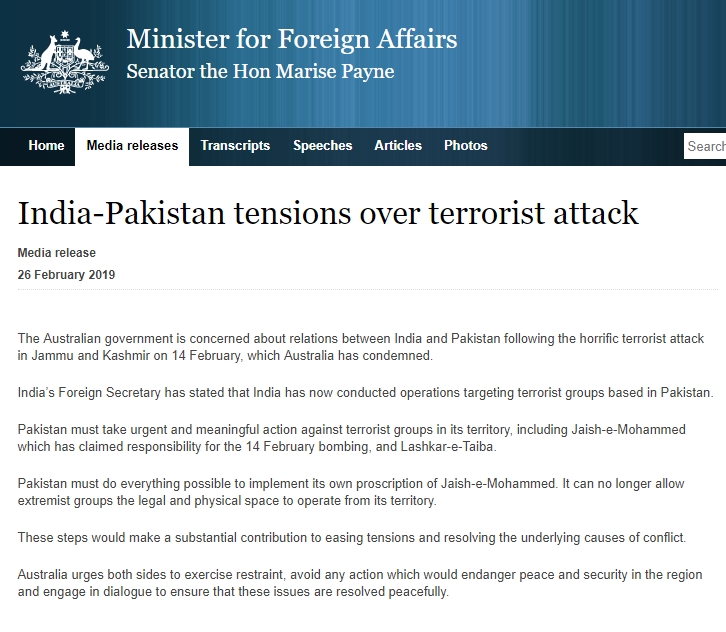
The media release issued by the Ministry for Foreign Affairs of Australia states that the Australian government is concerned about relations between India and Pakistan following the horrific terrorist attack in Jammu and Kashmir on 14 February, which Australia has condemned.
India’s Foreign Secretary has stated that India has conducted operations targeting terrorist groups based in Pakistan, the statement notes.
Australia has said that Pakistan must take urgent and meaningful action against terrorist groups in its territory, including Jaish-e-Mohammed and Lashkar-e-Taiba. The statement stressed that Pakistan must do everything possible to implement its own banning of Jaish-e-Mohammed, and it can no longer allow the terror organisations to operate from its territory.
Australia also urged both the countries to exercise restraint, to avoid any action which can endanger peace and security in the region, and asked India and Pakistan to resolve the issues peacefully through dialogue.
The full statement issued by Australia can be seen below.
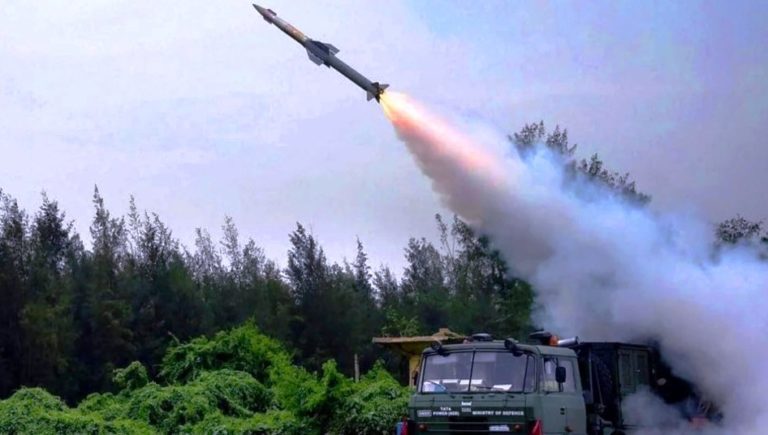
India has successfully test-fired the quick reaction surface to air missile (QRSAM) off the coast of Odisha on Tuesday.
India successfully test fires quick reaction surface to air missile off the coast of Odisha. Two missiles were tested by the DRDO for the missile being developed for the Army. pic.twitter.com/5W9Hjmj45L
The missile was developed by the Defence Research and Development Organisation (DRDO) in cooperation with Bharat Electronics Limited and Bharat Dynamics Limited for the Indian Armed Forces.
Unnamed sources were quoted by Odisha Sun Times as saying that the indigenously developed sleek and highly mobile air defence system was fired from a canister mounted on a rotatable truck-based launch unit from Integrated Test Range (ITR) at Chandipur in Balasore district.
The all-weather weapon system has a strike range of 25 to 30 km and is capable of tracking and firing. The QRSAM was developed as a replacement for the ‘Akash’ missile defence system. It is also equipped with electronic countermeasures against jamming by aircraft radars.
As per reports, the missile has 360-degree coverage, lightweight, high mobility and shorter second reaction time as compared to ‘Akash’. It also uses solid fuel propellant and is capable of hitting multiple targets and low flying objects.
The successful test firing of the missiles comes on a day when the entire country is euphoric after the Indian Air Force crossed the International Border into Pakistani territory to conduct strikes against JeM terror camps.
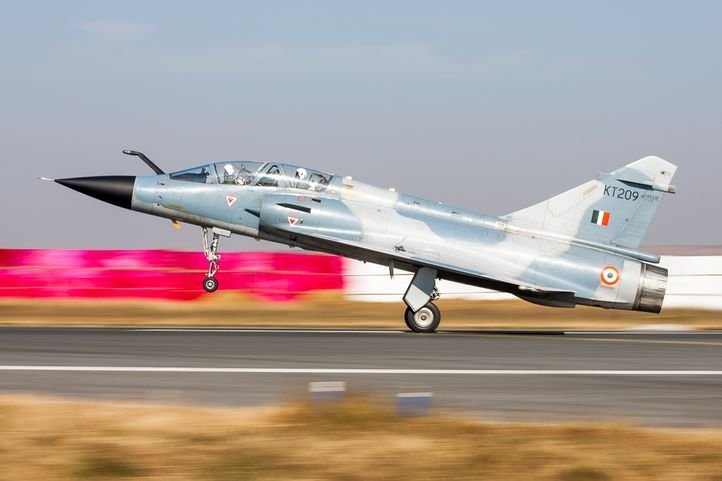
In the early hours of 26th February, Indian Air force destroyed training camps of Jaish‑e‑Mohammed in Balakot in Pakistan, avenging the Pulwana terror attack. According to reports, 12 Mirage 2000 fighter jets were using this decisive strike against terror camps deep inside Pakistan.
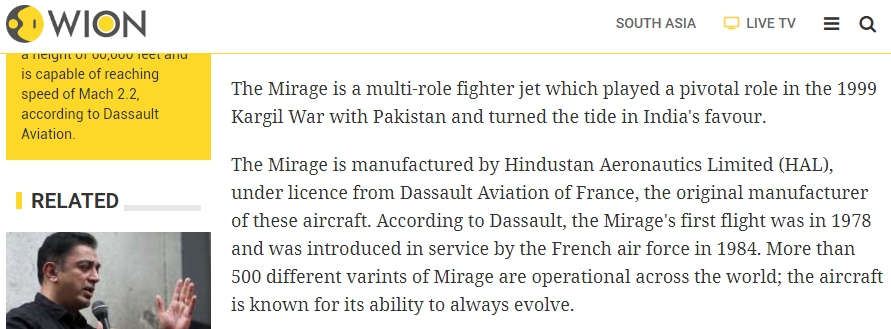
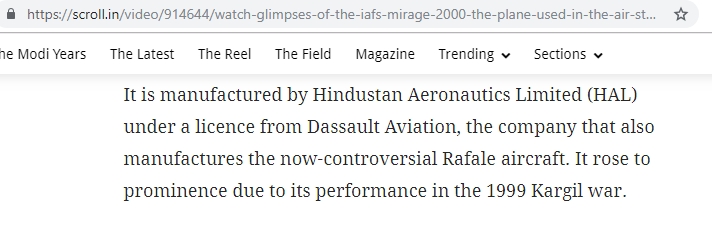
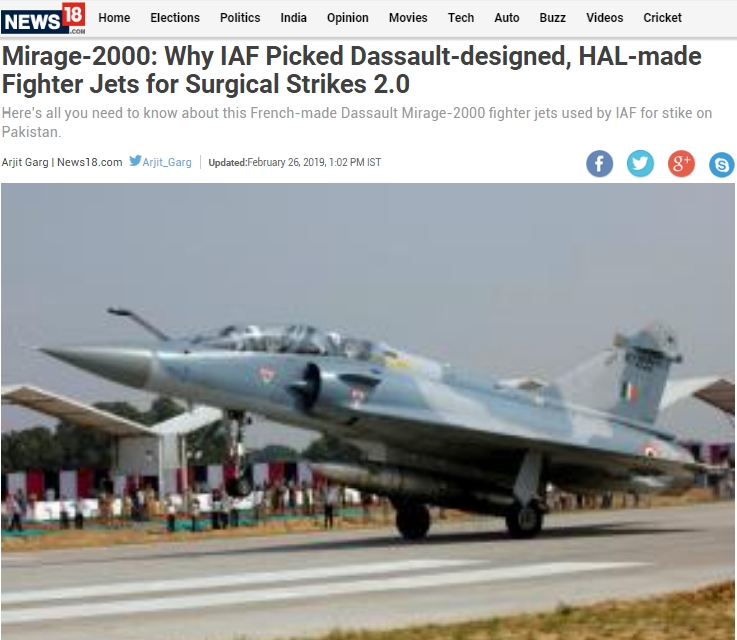
While reporting about the strike, several media outlets claimed that the Mirage 2000 jets of IAF are manufactured by Hindustan Aeronautics Limited under licence from Dassault Aviation. Several media outlets like CNN News 18, Wion News, Scroll, India Times etc made the same claim.
Screenshot from Wion
Screenshot from Scroll
The article by Wion was titled ‘All you need to know about Mirage-2000 fighter jets which destroyed terror camps across LoC’, and India Times article was ‘Here Is All About Mirage-2000, IAF’s Key Fighter Which Has Been Kicking Pakistan For 20 Years’. The Scroll article was titled ‘Watch: Glimpses of the IAF’s Mirage 2000, the plane used in the air strike on terror camps’.
Screenshot from India Times
The articles were claiming to provide comprehensive information about the fighter jets used by India in the operation, but all of them provided one wrong information, that the jets are made in India by Hindustan Aeronautics Limited under licence from Dassault in France.
But the fact is, although HAL manufactures some fighter jets under licence from the original manufacturers, the Mirage 2000 is not one of them. India has 3 squadrons of Mirage 2000, which means 54 aircraft, and all of them were made by Dassault in France. When India first bought 40 Mirage 2000 planes, 36 single seater fighter jets and 4 twin-seat trainer jets, there was a plan to buy 110 more jets, and they were to be made by HAL under licence. But that plan never materialised, and therefore HAL never made the Mirage 2000. After that, India ordered 10 more Mirage 2000 jets from Dassault.
Although HAL does not make the Mirage 2000, they are upgrading the jet for Indian Air Force, and the aircraft that had crashed earlier this month in Bengaluru was a Mirage 2000 recently upgraded by HAL. The plane had crashed just before take-off during an acceptance trial by two IAF trainer pilots, killing both of them.
At present, HAL manufactures Sukhoi Su-30 MKI fighter plane under licence from Russia, although the jets made by HAL cost about ₹150 crore more than what is charged by the Russian manufacturer. HAL also makes the Hawk trainer under licence from BAE Systems in UK.
Screenshot from CNN News 18
The CNN News 18 report has corrected now, saying Mirage 2000 is made by Dassault, but screenshots above show how the report looked earlier. Other media houses are still carrying the wrong information about HAL making the jets.
The claim that HAL makes the jets used in today’s strike in Pakistan is not just an error by media houses, it is also part of the anti-Rafale deal narrative propagated by Rahul Gandhi.
So now pseudo-nationalists are attacking HAL so that the Ambanis get all future defence contracts instead of the Indian public sector company which has played a crucial role in India’s defence over the years .
For those claiming that HAL has nothing to do with #Mirage2000pic.twitter.com/TcGblI6ex1
The Congress president has been claiming that the Rafale deal was snatched from HAL and given to Anil Ambani and trying to prove that HAL is fully capable of making the jet, despite the poor record of HAL in delivering jets in time. Some journalists even used this false claim to drive home the point being made by Rahul Gandhi.
The Indian Air Force has today carried out rapid action air strikes over terror camps in PoK and Pakistan early in the morning.
As the Indian media and social media space get flooded with reactions and celebratory responses praising the armed forces, there are also some die-hard self-proclaimed ‘liberals’ who can never hide their hatred for PM Modi, even for a moment when the entire nation gets together to celebrate the valor of our armed forces.
As more and more details of the Indian air strike over terror camps in Pakistan and PoK have been emerging, so are the opinions of Modi haters whose hatred for one man trumps everything else.
An extremely critical time for South Asia’s 2 billion people. This is the time for Imran Khan to be a true leader and not be as irresponsible as Modi. Prioritize people over politics.
Another of these geniuses pounced upon the words used by the foreign secretary, that it was a non-military pre-emptive strike against JeM. Somehow he has deduced that a government which has just authorised its air-force to take 12 fighter jets and blow a terror camp inside Pakistani territory to smithereens was using certain words because it is afraid of Pakistan. Irony must have been dumped somewhere with the payload too.
MEA secretary clearly pointing out that it was a ‘non-military pre-emptive strike against Jaish’.
Former Samajwadi spokesperson Pankhuri Pathak took the occasion to pay homage to HAL for building the Mirage jets that carried out the strike. Only there was a tiny technical problem. HAL does not build the Mirage jets, Dassault Aviation does.
Then there were some who started to claim that the air strikes mean nothing as they cannot end terrorism and it is election posturing by the current government. Following the logic of their arguments, one is bound to think, do these people have an exact time frame after which they advise a government must cease to function before every election? Because no matter what and when it does something, naysayers like them are going to draw the conclusion that it was done for political benefits, be it the surgical strikes of 2016, or today’s air strikes.
Have the ‘air strikes’ rendered Pakistan and its proxies incapable of hurting India? Will cross border terrorism atop or is this a political strike that the Modi Govt could not have gone to the elections without? The publicised strikes after Uri beg this question
Leftist propaganda website The Wire too came quickly with an article. Its promoter tweeted saying why would terrorists be present at a well-known place after the Pulwama attack. However, It is certainly not clear how well-known was the JeM camp in Balakot was to him.
If India’s claim of massive damage is correct, it’s not clear why large number of terrorists would be at a well known place whose existence Indian intelligence had publicly acknowledged–when it was clear India was likely to hit back in the wake of Pulwama. https://t.co/Eswip6uOij
There are reactions still coming. In the coming days, when Pakistan’s reaction and statements will also emerge, it will be fun to watch how much it will match the tones and content of the arguments made by Indian left-liberals.
Earlier in the wee hours of the day, Indian Air Force Mirage 2000 fighters destroyed multiple terrorist camps deep inside Pakistan to avenge the death of soldiers in the Pulwama terror attack. The Indian Air Force had carried out the pre-emptive attack to destroy the terror camps operated by the proscribed terror outfit Jaish-e-Muhammad. It was reported that the IAF jets had pulverised terror camps in Balakot (Pakistan), Muzaffarabad (PoK) and Chakoti (PoK) in the well-planned strike involving a fleet of IAF jets and other military jets.
The reports are now pouring in corroborating the claims of air strikes at Balakot in Pakistan. According to a report by the BBC, one of the residents in Balakot has confirmed the attack that took place at around 3 am in the morning. “I heard the sounds of explosions around 3 am, there were simultaneous 4-5 big explosions preceded by the noise of jets flying above. However, after 10 mins they had gone,” one of the residents of Balakot claimed. He further added that later when they went to one of the sites where the bomb was dropped, 4-5 buildings were damaged and people injured.
First confirmation from Pakistan of Strike by Indian Air Force. BBC Urdu video from Jaba Post, Balakot, KPK where a local says that there were 5 big blasts after 3am at night followed by Jets leaving within 10 minutes. Many casualties and several injured. How can Pakistan deny? pic.twitter.com/izac7IGFsR
However, Pakistan spokesperson for Pakistan Armed Forces Maj Gen Asif Ghafoor had downplayed the air strikes, claiming that Indian aircrafts’ intrusion happened across the LOC in Muzaffarabad Sector within Pakistan occupied Kashmir. He also tried to hide his country’s defence failure by alleging that the ‘payload’ that was dropped by the IAF Mirage-2000 had fallen on the open area, with no damage to infrastructure, neither any casualties. This is not much different from Pakistan’s reaction after Surgical Strikes.
Indian aircrafts’ intrusion across LOC in Muzafarabad Sector within AJ&K was 3-4 miles.Under forced hasty withdrawal aircrafts released payload which had free fall in open area. No infrastructure got hit, no casualties. Technical details and other important information to follow.
But the latest admission by the residents of Balakot in Khyber Pakhtunwa debunks the tenuous defence mounted by the Pakistan armed forces spokesperson in the wake of another surgical strike in their country. The corroboration from locals also means that the Indian Air Force had crossed the International border for the first time in decades to strike terror targets deep inside Pakistan.
The terror camp annihilated in Balakot was an Alpha-3 terror camp of the Jaish-e-Muhammad. It was headed by Maulana Yusuf Azhar, brother-in-law of the JeM chief Masood Azhar. It is believed that Maulana Yusuf Azhar has been killed in the attacks along with the fatalities count somewhere between 200-300.
Earlier in the day, the Indian Air Force conducted a ‘non-military pre-emptive strikes’ against the biggest Jaish-e-Mohammad terrorist camp in Balakot to counter multiple potential fidayeen attacks.
The operation conducted by the Indian Air Force was based on credible intelligence that Jaish-e-Mohammed was attempting another suicide terror attack in various parts of the country and Fidayeen jihadis were being trained for this purpose. Reportedly, nearly 250 terrorists belonging to Jaish-e-Mohammad, trainers, senior commander and Jihadis have been eliminated.
The Indian Air Force had employed its best aircraft and equipment to successfully carry out these deep air strikes at Balakot terror camps in Pakistan. Reports from Shiv Aroor, a defence expert suggests that India had employed seven equipment to pound 1000 kilograms of bombs in a 21-minute operation inside the Pakistan territory.
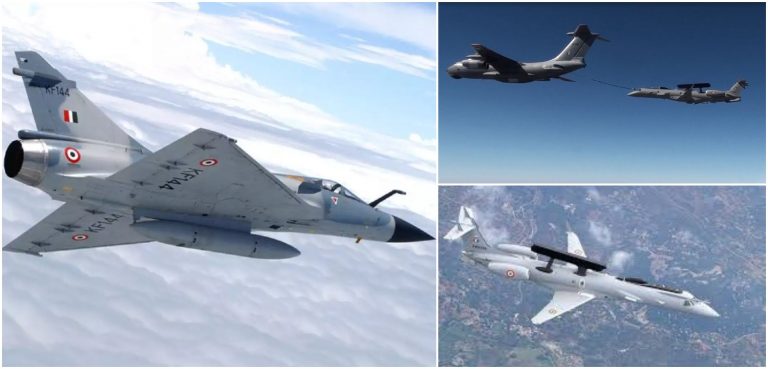
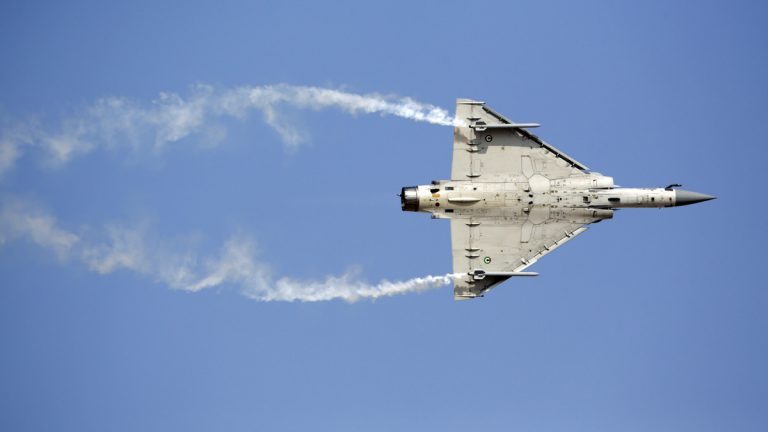
Dassault Mirage-2000: The Indian Air Force had chosen its best and battle-tested twelve French Mirage-2000 aircraft based out of Gwalior Air Force base of Central Air Command. Mirage-2000, a French multirole, single-engine fourth-generation jet fighter manufactured by Dassault Aviation, is the predecessor to the Dassault Rafale. Mirage-2000 was acquired by the Indian Air Force in 1982 and had performed exceptionally well during the whole conflict in the high Himalayas.
DRDO NETRA Airborne Early Warning and Control System (AEW&CS): An airborne early warning and control system or ‘Eye in the Sky‘ of the Indian Air Force, operated on Embraer ERJ 145 aircraft platform. The DRDO AEWACS aircraft provided the command and control to the Mirage-2000 aircraft. The Active Electronically Scanned Array (AESA) radars mounted on the aircraft provided Mirage-2000 with the primary target information. The NETRA AEW&C aircraft is based out of Bathinda Air Force base of Western Command.
Ilyushin Il-78: An aerial refuelling tanker of the Indian Air Force stationed at Agra Air Force Station of Central Air Command. It was deployed for refuelling of Mirage-2000 for long endurance missions.
IAI Heron: It is a medium-altitude long-endurance unmanned aerial vehicle (UAV) developed by the Malat (UAV) division of Israel Aerospace Industries. The IAF had deployed it in the operation to conduct real-time aerial surveillance along the Line of Control.
GBU-12 Paveway Laser Guided Bombs: Guided Bomb Units is an American aerial precision laser-guided bomb mounted on Dassault Mirage-2000 to target the terror camps with high precision. The Mirage jets were armed 500/1000lb laser-guided bombs.
Lighting Pods: The Mirage-2000 jets were fitted with Israeli lightening targetting pods. The pods assist in acquiring the target and guiding the laser-guided bombs to target precise locations.
MATRA Magic Close Combat Missile: MATRA is a French medium to short-range air-to-air missile deployed at the Mirage-2000, to be used if they encounter Pakistani jets during the airstrikes. The air-to-air missiles would have given the Indian Air Force pilots an option to engage with the Pakistani Air Force if at all they had responded to airstrikes.
In an operation in the early hours of the day at 3.30 a.m, the IAF jets had pounded terror camps Balakot, Muzaffarabad and Chakoti in the well-planned strike involving a fleet of IAF jets and other military jets. Nearly 200-300 casualties on the side of Pakistan have been reported.
The MEA in its press briefing confirmed that India indeed crossed the International Border into Pakistani territory to conduct air strikes against terror camps. There was a concerted attempt by the Pakistani establishment to peddle the narrative that the Indian Air Force did not enter Pakistani territory which now stands dispelled.
As we have reported earlier, the air strikes were conducted at Balakot which is located in the Khyber-Pakhtunkhwa province of Pakistan. Balakot is 50 km from the Line of Control. More worryingly for Pakistan, Balakot is less than 200 km via road from Islamabad and less than 70 km from Abbottabad.
Abbottabad, as readers may be aware, is the same place where Osama bin Laden was found to be hiding by the United States of America. It was at his residence there, near to a Pakistani military base, that Bin Laden met his end. That India was able to reach so close to such a significant base within Pakistani territory ought to concern the Pakistani establishment.
As we have said before, for Pakistan, there are two possible scenarios. Either it was not aware that Indian aircraft had penetrated their defences into their territory or they were aware but could not do much about it. From the Pakistani perspective, it is difficult to say which is worse.
The bigger concern for Pakistan will be the fact that India’s Mirage 2000 aircraft are nuclear capable. That an Indian nuclear-capable aircraft was able to penetrate into Pakistani territory without any bother and was able to return without any consequences will give the Pakistani establishment nightmares for days to come.
Remember, the Mirage 2000 jets are also rigged for nuclear strikes. Imagine what the Pakistani air force would have gone through realizing they have broken through.
The Pakistani people have turned against their government and Army as well. Therefore, there is considerable pressure within their establishment to retaliate. In such circumstances, it’s unclear the extent to which Pakistan will risk retaliation.
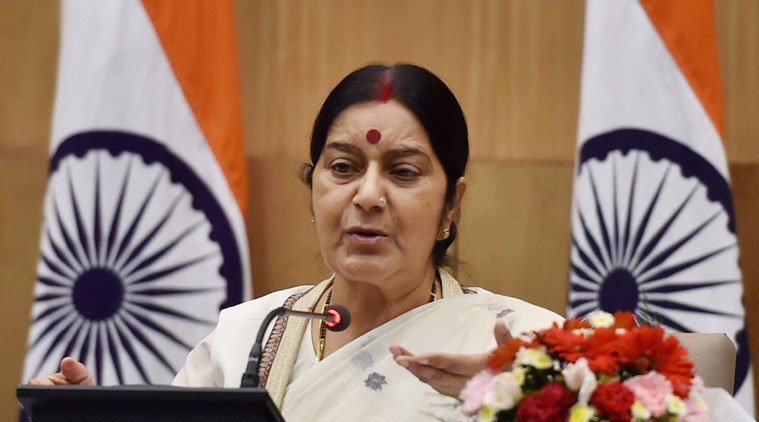
Earlier today, in the pre-dawn air strikes carried out by the Indian Air Force, that targeted and destroyed Jaish-e-Muhammad terror camps across the border in Balakot, the Externals Affairs Minister Sushma Swaraj has called an all-party meet today at 5 PM to brief them about the details of the precision attack on the terror camps. EAM Sushma Swaraj had earlier this morning attended the CCS meeting, after which she called for an all-party meet later in the evening.
According to the reports, 12 Mirage-2000 took part in the Operation and bombs weighing 1000Kg each was dropped on the terror camps, rendering them completely and wholly demolished. The IAF jets pounded terror camps Balakot, Muzaffarabad and Chakoti in the well-planned strike involving a fleet of IAF jets and other military jets. Prime Minister Narendra Modi has briefed both President Kovid and Vice-President Venkaih Naidu about the operation undertaken by the Air Force destroying terror camps in Pakistan.
Affirming that the Indian Air Force carried out early morning surgical strikes in Pakistan, Foreign Secretary Vijay Gokhale said, “In an intelligence-led operation, India struck the biggest Jaish facility in Balakot on early hours of Tuesday. India calls it non-military pre-preemptive action to counter multiple potential fidayeen attacks.”
As per reports, the terror camp in Balakot, which was attacked by the IAF was headed by Maulana Yusuf Azhar, brother-in-law of JeM chief Masood Azhar. It is believed that he has been killed in the attack. 200-300 terrorists residing at the terror camp, primed to orchestrate attacks in India are assumed to be eliminated in the attack.
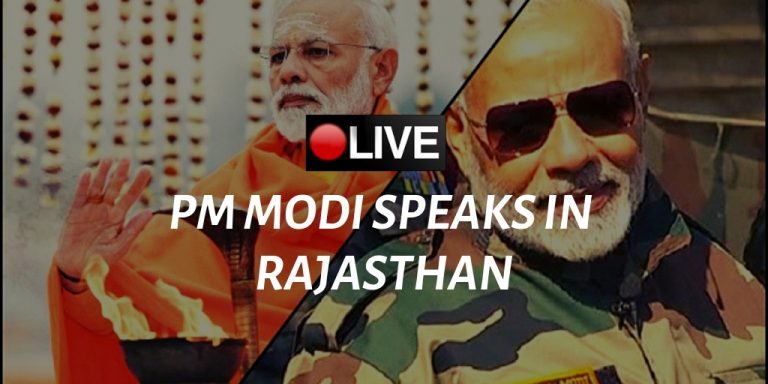
India is in safe hands, is the message Prime Minister gave while addressing a rally in Churu, Rajasthan, just hours after India carried out airstrikes in Pakistan, this time deep inside their territory in Balkot, Khyber Pakhtunkhwa.
Prime Minister Modi gave a clear message that the country will now bow down. He thanked the people to have voted for a strong government in Centre in 2014 and urged them to vote for a strong government in the upcoming elections as well.
You can also watch the rally video on this page (click on the play button of the YouTube link below), while a live blog will load below the YouTube link:
After MEA’s press briefing, it can be stated with certainty, as has been clear for quite some time now, that the Indian Air Force did penetrate deep into Pakistani territory.
We have also reported that the Pakistani media has accepted the fact that India entered Pakistan. The Pakistani government, however, still appears to be in denial.
We realise it’s election year, and a desperation across the border. Fact of the matter is, Indian jets were forced to retreat in haste by Pakistan army patrols and dumped fuel, which in their scramble they thought was a bomb.#Pakistan
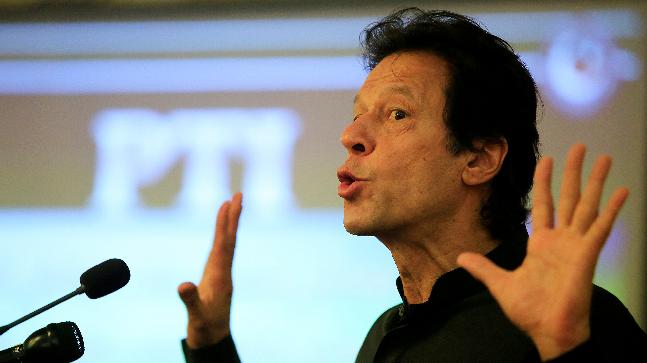
It appears, however, that Imran Khan and his party aren’t fooling anyone. Even their people have turned against them. Pakistanis have resorted to abusing the political party that won the elections and formed the government.
I regret supporting PTI.
This is your response?
They came into Pakistan and bombed us and this is Imran Khan’s response?
They’ve breached your country and this is all you have to say yikes. Whether they did or did not drop bombs you need to retaliate because words will do nothing for you but more for them. https://t.co/D96H4ETT6H
Another handle tweeted, “They can find us even in Quetta, Parachinar and even Thar dessert for a tweet but here, an entire aircraft entered our territory and they had no idea about it?”
Humein tu Quetta , Parachinar aur Thar mein bhi dhoond letay hein ke tweet kyoun kiyaay, yahan poora jahaz humaray soobay KP mein ghuss gaya aur khabar tak na huee?
As we had reported earlier, the Pakistani Army has claimed that the Indian Air Force had entered Pakistani territory and reached as far as Balakot, a town in Mansehra District in the Khyber-Pakhtunkhwa province of Pakistan.
Reportedly, 12 Mirage jets took part in the Operation and 1000 Kg of bombs were dropped on terror camps across the Line of Control, destroying them utterly.