Home Blog Page 7231

5 Delhi super cops who nabbed 500 criminals just in 2017

0

A report published in the Hindustan Times today talks about the five famous assistant sub-inspectors (ASI) of Delhi police who pursued and caught almost 500 proclaimed offenders in 2017, more than one-fourth of what the entire force managed that year. Amongst the five dauntless officers namely, assistant sub-inspectors Bhagwan Singh, Krishan Kumar Yadav, Naresh Rana, Rajesh Kumar and Jagat Singh of Delhi police posted in different locations, ASI Rajesh Kumar Pahal of Punjabi Bagh police station topped the list with 129. All these fearless officers have their own stories to tell.

ASI Rajesh Kumar Pahal, joined the force in 1993 and worked as a driver in police stations till 2007. Since 2008, the year he became part of a team assigned to catch fugitive criminals he claims to have nabbed around 1,500 proclaimed offenders. As a driver, he drove for many of his senior officials, including the squad leader, now-retired inspector Joginder Singh, who caught more than 3,500 proclaimed offenders in 39 years.

Pahal recalls that the “The working style and dedication of those officers made them favourites of their seniors. This impressed and inspired me and I decided to be like them,” he said.

The opportunity came in 2008 when inspector Singh put him on the trail of a fugitive named Virender Singh from Haryana’s Bahadurgarh, a bus driver hiding for almost 25 years after he ran over a man in old Delhi in 1983 and fled. The man died and a court declared Virender a proclaimed offender. Pahal worked his intelligence network and learned that Virender had returned to his village after many years and was looking for a job desperately. Pahal disguised as a transporter, went to his home offering a job to Singh. Lured by the offer Singh called two days later confirming to meet Pahal at a bus stop on Jhajjar road. As he reached the police team was waiting for him. “Virender was the first proclaimed offender I caught. He was carrying a reward of Rs 5,000,” Pahal said.

ASI Bhagwan Singh of Jamia Nagar police station caught 107 fugitives last year, followed by 100 by ASI Naresh Rana of Alipur police station, and 86 and 76 each by ASI Krishan Kumar Yadav of Sangam Vihar and Jagat Singh Jatav of Palam Village police station. All these Five ASIs are a storehouse of enthralling stories of fortitude.

Rana, the eldest and most experienced among the five, recalls an incident, where he caught 98-year-old Rajrani this New Year’s Day. She was declared a proclaimed offender 15 years ago after she jumped bail in a bootlegging case. “She was 81 when she was arrested by Uttam Nagar police for allegedly selling illicit liquor. She got bail and never went to court for the trial. The Tis Hazari courts declared her a proclaimed offender in 2003,” he said.

ASI Jakhar narrates that he posed as a farmer to arrest a suspected rapist, Zafaryab, who was declared a proclaimed offender in 2013.

ASI Bhagwan Singh recalled the frustration of at least 15 failed attempts to arrest a man wanted for allegedly raping his married cousin, and the joy of success after digging in for almost four months.

During difficult times, ASI Yadav said they go back to their mentors and discuss problems. “Their advice keeps us going.”

It was guidance from seniors that inspired and turned five constables into ASIs with a unique knack for prizing out criminals from their hiding holes. Delhi police have over 80,000 personnel, but only a few are selected for the task that these ASIs are capable of accomplishing. Their skills and intelligence apart, the motivation to chase down a fugitive comes from three incentives that, according to Yadav, are — an out-of-turn promotion by arresting over 80 proclaimed offenders, including 40 involved in heinous crimes, in a year; reward money and the acknowledgement and appreciation with each success.

These missions of going after a fugitive involve its own set of risks and challenges. Many times these brave officers have found themselves surrounded by supporters of suspects, got attacked by villagers, and were wounded on several occasions, but these do not refrain them from taking up challenges. On other occasions, they are assigned regular duties such as maintaining law and order, visiting courts, securing streets and night patrol.
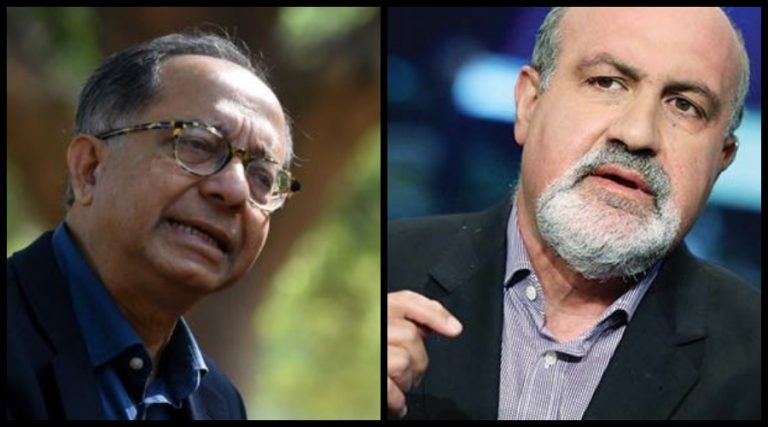
Economists bullshit for a living : NN Taleb gives Kaushik Basu a lesson on ‘Skin in the Game’

0

Nassim Nicholas Taleb is one of the deepest, and more importantly, most independent thinkers of our time. His writings are among the clearest expositions on varied topics such as rationality, religion and minority populations, and these constitute arguably the best debunkings of simplistic but grandiose and judgmental liberal takes on these topics.

Ever sensed something wrong with the “Terrorism kills far fewer people than road accidents or falls from ladders” argument, but struggled to articulate your objection? Many smart people struggle with that too, but here is Taleb demolishing it like kniving through butter. Many of us have pointed out Bollywood’s hypocrisy, selectivity and sanctimony, but to understand the structural mechanics of how that comes about, one has to read Taleb [twitter thread], [article]. One of the few well-known thinkers to emphasize the tolerance of pagan religions, he is also among the rare few that put into practice the idea of distinguishing virtue from virtue-signalling, distinguishing true humility from fake humility/humility-signalling.

In contrast, Kaushik Basu is what Taleb terms Intellectual Yet Idiot (IYI). You may remember him as the economist who did not merely stop at criticizing demonetization (as many economists did) but actually asked that it be rolled back, echoing similar and suspicious demands from Mamata Banerjee. From December 2009 to July 2012, Basu was the Chief Economic Adviser to the Government of India. During that and the immediately following period, Indian economy fell to its worst crisis in over a decade, and the political class was voted out in the 2014 elections. Yet, IYIs like Basu remained unquestioned: they have no accountability, no skin in the game (please read this Taleb article in its original, since it is easy to misinterpret it, e.g., by confusing it with incentives). The main point is that there is no mechanism to punish economists for coming up with disastrous policies: as Taleb notes, from pilots to plumbers, those with a real job can get fired if they do not know their job well or execute it poorly, but the same never happens to tenured economics professors. Basu is a Professor of Economics at Cornell University and occupies a named chair. His PhD was guided by another IYI, Amartya Sen.

Unsurprisingly, IYI professors leave no stone unturned in using their position to claim expertise (a form of rent-seeking), to lay claim to power without accountability at the expense of those outside their ecosystem. This attitude is reflected in the following tweet of Basu:


It was of course left to Taleb to show Basu his place, by highlighting the crucial missing ingredient, Skin In The Game:


In fact, Basu wasn’t even being original. The very same analogy earlier figured in a condescending and elitist New Yorker cartoon that mocked American citizens’ exercise of the franchise:


Many smart people fell for the too-clever-by-half cartoon, and it was Taleb who injected clarity then:


To familiarize with Basu’s IYI thought patterns, let us take this occasion to visit a few of his previous “gems” on Twitter. Here is an unbelievable one:


Of course, no one in the world ever doubts that a mathematical proof doesn’t further need to be enhanced by data. It is outside the world of mathematics (to which Basu certainly doesn’t belong), where deductive reasoning doesn’t suffice to get us started, that data and facts are needed. One wonders what potent mix of muddle-headedness and arrogance it takes to mix the two worlds like this.

Another tweet showcases his contempt for the average human:


Note the use of the word “high office”, suggesting an attitude at odds thinking of the state as an employee or sevak of the people, and the use of the word “philistinism”, which is a comment on manners, habits and cultural tastes rather than any majoritarianism; the tweet is a naked chauvinistic assertion of cultural superiority.

A third “gem” is a window into the povertarian nature of his mind. He routinely tweets beautiful images from various countries, but when it came to his own home city, Kolkata, here is what he tweeted as an “impressionist’s dream”:


Like many racists from a bygone era, and like many povertarian IYIs, Profesor Basu too has internalized an aesthetic convention wherein western countries are to be represented by beautiful imagery from them (no offense with that per se), but not only in India to be represented by images of its heart-wrenching poverty, but that humiliating poverty, rather than evoking pity, is to be enjoyed as a great work of art. Is it any surprise that his economics is what it is?

How Opposition’s ‘judiciary is in danger’ crusade is a farce

0

Vice President Venkaiah Naidu today rejected the impeachment motion against Chief Justice of India (CJI) Deepak Misra saying there is no merit in the charges against the CJI. On Friday, 64 members of Parliament belonging to Congress, NCP, Muslim League, CPM, CPI, Samajwadi Party and BSP, signed the impeachment motion against CJI Deepak Mishra. According to the section 124(4) of the constitution, impeachment motion can be brought against the CJI on the grounds of misbehaviour or incapacity.

However, the full frontal assault by Congress against judiciary just because the verdict was not favouring their interest, has not been received well. The move was labelled as “a horrible black day in the history of Supreme Court” by senior jurist Fali Nariman. As per Indian Express, Nariman pointed out that the charges brought by the Congress-led Opposition are not in line with what the four senior judges, Justices Jasti Chelameswar, Ranjan Gogoi, Kurian Joseph and Madan Lokur, had stated in their press conference held in January this year. This move of senior judges had disappointed former Attorney Journal Soli Sorabjee and former SC Justice Santosh Hegde. Speaking on the discrepancies between the judges’ grievances and Opposition’s motion, Fali Nariman pointed out that one of the charges by the Opposition is a forgery. But the four judges did not subscribe to this charge. To level such a serious charge against the CJI one should have cogent evidence.

He further added that it was imperative to have ‘extraordinarily important grounds’ to impeach the CJI because ‘the final interpreters of the Constitution is the judiciary and not Parliament. The persons who finally and irrevocable interpret the Constitution are the highest court. Parliament can (only) pass a Constitutional amendment.’ He added that bringing forward such charges would amount to ‘destroying the Constitution’. He pointed out that former Prime Minister Dr Manmohan Singh hasn’t signed the impeachment motion, especially since if he also believes the charges put by Congress are valid.

He pointed out how this will put up a precedent that the government can move an impeachment motion against any judge they don’t like, or who gives a verdict which does not favour them.

It is indeed tough being in the Opposition when you have been conditioned to be in power. The opposition wants us to believe that Modi is just so powerful that in four years that he has been the Prime Minister, every independent body from CBI to Supreme Court to educational institutes, has turned into a ‘caged parrot’. There were no award-wapasis before 2014, even when the country faced riots, hate crimes, many of which were perpetrated by people belonging to their own political party. The hypocrisy is mind-boggling. Suddenly intolerance was on a rise in India and now even judiciary is in danger. Retired civil servants are writing letters, saying we have failed as a nation. Earlier, similar such letter was written by some of the same former bureaucrats, during the run-up to Uttar Pradesh elections, which was swept clean by the BJP. Clearly, no such incidents happened prior to May 2014.

The Opposition’s well coordinated, synchronised efforts to create an environment of fear, danger deserves a huge round of applause. If only they had put in so much efforts to build the nation and its wealth, instead of their own personal agendas, things would have been different, perhaps.

No one is gonna perform a Sati due to a movie: Court slam petition seeking to ban Padmaavat’s last scene

0

Today, The Supreme Court dismissed a petition calling for a ban on the last scene of the Deepika Padukone starrer Padmaavat. According to reports, the petition, which was filed by Swami Agnivesh, called for a ban on the last scenes of the movie alleging that it promotes the ‘Sati’ system.


According to reports, the petition filed by Agnivesh also sought for an FIR to be lodged against the producers and director of the movie on charges of promoting a social evil.

The Supreme Court bench headed by CJI Deepak Mishra, which also included justices AM Khanwaliker and Justice DY Chandrachud reportedly observed that deletion of scenes cannot be directed in a movie after it has been cleared by the CBFC. CJI Mishra also asked the petitioners if they think it is possible anyone can perform the Sati by merely watching a movie.


Previously several states had banned the movie but the SC had on January 18 restrained the ban and prevented other states from banning the movie. The movie was released all over India on January 25. There are conflicting reports as to whether the Swami Agnivesh petition mentioned Sati or Jauhar in its allegation. If the petition stated Sati, it was factually wrong because the movie does not feature any such act. Also if the petition states the movie was promoting Jauhar, the idea is equally wrong considering Jauhar was committed to escape enslavement and rape by Islamic invaders.

Swami Agnivesh himself is a controversial character and has met with severe criticism by Hindu priests and Hindu groups. Many have even called him anti-Hindu. There were widespread protests in 2005 when Agnivesh had demanded that the Puri Jagannath Temple be opened to non-Hindus. In May 2011, hundreds of Hindu priests protested against Agnivesh’s claim that ice stalagmite that they believe resembles Lord Shiva is just a piece of ice;

There were widespread protests and criticism both before and after the release of the movie. Before the movie release, Congress backed Rajpur Karni Sena carried out many protests and had issued violent statements. Cities like Ahmedabad and Gurgaon even witnessed violence during the movie’s release. Many eminent intellectuals had also gone forward to allege that the movie promotes patriarchy.

The movie was based on Malik Mohammad Jayasi’s Padmaavat and after the censor board’s direction, its name was changed to ‘Padmaavat’ from the earlier title of ‘Padmavati’ to reassert that it is based on the literary work and not history. The movie was highly successful and reportedly went ahead to collect Rs 500 crores worldwide.

Singapore PM leads 40,000 devotees in a Puja at newly renovated 164 year old Hindu temple

0

The Singapore Prime Minister Lee Hsein Loong on Sunday led a Puja for the re-consecration of a 164 year Hindu temple, which was recently renovated at a cost of about SGD 4.5 million. Also present at the puja were four ministers of in his government and about 40,000 devotees. This was the first time PM Loong had taken part in such a ceremony after becoming the Prime Minister in 2004.

As per a Facebook post by PM Loong, the renovation of the Sri Srinivasa Perumal temple took about 1.5 years and was possible thanks to the generous donations by various devotees. He also informed the public of the same via a tweet:


The renovation was carried out in the build-up to the re-consecration ceremony also known as Maha Samprokshanam, which takes place every 12 years. The Maha Samprokshanam would now be followed by a 45 day long cultural celebrations termed as Mandalabishegam.

As per reports, the ceremony at one of the oldest temples in the island nation comprised of sprinkling holy water from sacred vessels known as Gadams on the main statue of Sri Srinivasa Perumal and the temple’s nine pinnacles.

Historically this temple was built in 1854 and was declared a national monument in 1978. This was the fourth such renovation which took place in the temple since 1978 and has seen the expansion of the worship and eating space. Besides this the temple was rid of pests, weeds and saw its paintings and murals getting repainted. Its structures like the tower entrance, temple roof and pillars were reconditioned.

In order to carry out the restoration, a 20 member team of highly skilled artisans was brought in from India. Maintaining the original colour scheme was one of the conditions during the restoration, hence a 14 colour palette comprising of oil and enamel paints was used to ensure the same. The renovation also saw the use of lime mortar instead of regular cement.

Modi Government cracks down on scamsters: Promulgates Fugitive Economic Offenders Ordinance

0

In its endeavour to crack down on economic fugitives and attach their properties, the Union Cabinet on Saturday approved a proposal to annunciate Fugitive Economic Offenders Ordinance 2018, sources said. The ordinance seeks to confiscate properties of economic offenders, like Nirav Modi, who flee the country to avoid facing criminal prosecution.

The need for the Ordinance has arisen as there have been instances of economic offenders fleeing the jurisdiction of Indian courts, anticipating the commencement, or during the pendency, of criminal proceedings. The law is aimed at quickly recovering losses to exchequer or public sector banks in cases of frauds like the alleged USD 2 billion fraud by fugitive jeweller Nirav Modi.

With this Ordinance, corporate fugitives would be forced to return to India to face trial for scheduled offences. This would also help the banks and other financial institutions to achieve higher recovery from financial defaults committed by such offenders, improving the financial health of such institutions.

The provisions made under the Fugitive Economic Offenders Ordinance are:

1. Making an application before the Special Court for a declaration that an individual is a fugitive economic offender.

2. Attachment of the property of a fugitive economic offender and proceeds of crime.

3. The issue of a notice by the Special Court to the individual alleged to be a fugitive economic offender.

4. Confiscation of the property of an individual declared as a fugitive economic offender or even the proceeds of crime.

5. Disentitlement of the fugitive economic offender from defending any civil claim.

6. Appointment of an administrator to manage and dispose of the confiscated.

The Fugitive Economic Offenders Bill, 2018 was introduced in the Lok Sabha on March 12 but couldn’t be taken up due to the logjam in Parliament over different issues. With Parliament being adjourned sine die, an ordinance was proposed. The Union Cabinet yesterday approved the ordinance and the President today gave his assent to the promulgation of the same.

The statements reveal that “A Fugitive Economic Offender is a person against whom an arrest warrant has been issued in respect of a scheduled offence and who has left India so as to avoid criminal prosecution, or being abroad, refuses to return to India to face criminal prosecution.” However, only cases of frauds, cheque dishonour or loan default of over Rs 200 crore would come under this Ordinance.

This initiative taken by the government to curb economic offenders like bank fraudsters or loan defaulters comes as a revolutionary step aimed at deterring offenders from evading the process of law.

Letter to the disempowered Hindu : Use your energy fruitfully

0

Recently, a tweet came to my attention:

Person cancelling Ola cab because driver was Muslim
Partial screenshot from a post put on social media

I have blacked out the name of this person because the ecosystem is out to destroy his life over this. And they will most likely succeed, given the amount of power they have.

Predictably, those on the “liberal” side of social media were smacking their lips, getting ready to chew him up. I found the reaction from the “Hindu right” on social media much more interesting and it is to them that I address this letter.

In particular, many on the Hindu right were asking: What about similar posts that have been all over social media recently, where “liberals” proudly show off their hatred for Hindu drivers of Uber and Ola, especially those who chose to wear markers of their religion, such as a Hanuman sticker on the back of the car or on the dashboard? Why didn’t the ecosystem condemn that?

First of all, everybody knows the answer to that question. Because, in India, the pain caused to a Communist or to a Muslim is considered more important than the pain caused to a Hindu. India is an apartheid state. You really should know that much by now.

So forget that. I want to address the sense of disempowerment that would lead an ordinary Hindu to lash out with the kind of behaviour described in this tweet. The ordinary Hindu gets sick and tired of constant humiliation, of the endless double standards … and finally decides to lash out. How? By taking out the frustration on a completely innocent Ola Cab driver.

DON’T DO THIS.

First of all, because it is wrong.

Second, because it is a complete waste of your energy.

Third, because it is counterproductive.

So what should the disempowered Hindu do with his helpless sense of anger?

We live in a democracy. Well, more or less. Which means that the large majority of Hindus can still make a difference.

Your anger is an asset. It gives you the energy to bring about change. Use this energy wisely.

Are you angry about how the ruling class, the academic, intellectual and media narrative consistently demonizes Hindus? So am I. So are a lot of us. Let’s pool this energy together and get something done on the ground. How are they able to push the anti-Hindu narrative down the throats of a nation that is still almost 80% Hindu? Let’s work on organizing for change.

Don’t take the easy and completely useless way out by discriminating against a completely innocent person from another community.

And the change I am talking about is not just about voting. Again, that’s an easy “solution.” How much effort does it take to press a button, honestly? Don’t expect a big change that easily.

Let me give you some real challenges to use that energy towards. Have you noticed that the anti-Hindu brigade rules this country by taking advantage of divisions among Hindus? Well, do something about that. Get out there, reach out to other Hindus, inside and outside your caste/linguistic group. Make them aware of the threat. Tell them that if we don’t hang together, we will all hang separately.

Some of the people you talk to will certainly mock you or heap scorn on you. Can you take the hit to your ego and still keep working?

The real challenge is to get out there and organize. For example, are your children’s textbooks anti-Hindu? Is your school punishing children for celebrating a Hindu festival? Well, do you have the courage to get out there and call the school management and demand justice? It may be hard for you alone. Do you have the time, patience and sheer grit to reach out to parents of other kids and get together to pressurize the school?

There’s more. Do you suspect that the “scholars” got together and edited out the sufferings of Hindus from official history? Well, get out there and get informed about what has been scrubbed out. Luckily, we live in an age of social media and information has never been easier to obtain. It is all out there if you go looking for it.  Find out about the Goa Inquisition, for instance, something I heard about from Shefali Vaidya’s lectures on the subject. Once you find out, tell others. Build opinions and influence others in your community.

When Hindus reach out to each other, cutting across lines of caste and language, they find out each other’s stories. We and our ancestors have all suffered under the jackboot of Communism and Islamism. Unfortunately, most of us think that this suffering was localized to our region and/or caste because we don’t talk to each other enough. But when we start talking to each other, we realize the problem in its entirety. We realize that we Hindus have been at the receiving end of a single unified assault. It’s called Breaking India.

So, let us use our energy wisely. The ecosystem is counting on each one of us to stay in our own bubbles, not reaching out to our fellow Hindus nor hearing the stories of their suffering. So, let’s talk.

Mainstream media appears desperate to link any rape with Hindu temple, here is one example

0

In recent days, a section of the mainstream media and “celebrity activists” seem to have set a trend to link the heinous act of rape with Hindu temples after the Kathua rape-and-murder case. The outrage over Kathua by these set of celebrities itself had highlighted the temple part more than the heinous crime itself, as if by design. Now it appears that there is indeed a design to the whole ‘movement’.

As seen today, the media seems desperate to continue this “rape in temple” trend, by willing to overlook facts to force fit a case into the said narrative.

On Monday morning, some media houses reported that a minor girl was kidnapped and raped in a “temple complex” in Haryana’s Yamunanagar:


Aaj Tak even proceeded to openly liken the crime to the Kathua rape case by headlining the story as, “Haryana witnesses Kathua type crime, attempt to kill a minor after raping her“.

Glancing at local news reports though reveals that the true facts of the matter are different from the “angle” being provided by the aforementioned media houses.

As reported by Dainik Jagran, the crime actually didn’t take place inside any temple or its premises. As claimed by the victim, she was taken by the four assailants to a “Dharamshala’s porch” near a Shiv temple, where they proceeded to rape her. The report also quotes SP Rajesh Kalia as asserting that the Dharamshala isn’t part of any temple.

The fact that the crime was committed in a Dharamshala (guest houses run by local communities, usually for pilgrims) and not a temple was also confirmed in an Amar Ujala report. Plus the report has hinted at the non-functional nature of the religious complex by claiming that the said temple didn’t have any priests and that the Dharamshala (which earlier used to remain under lock and key) was long being used as a meeting place by anti-social elements.

Another angle which might negate the communal angle insinuated by the mainstream media (by linking the crime to the temple and likening it with Kathua incident), is the inter-religious nature of the accused, with reports claiming that two of the accused in question are Muslims, who too was present when the others named Meharlal and Vikas allegedly committed the crime. The other two accused have been named in reports as Danish and Bhura.

The police have asserted that they will nab the culprits at the earliest.

Clearly based on the information provided by local reports, the aforementioned media houses seemingly jumped the gun to sensationalise their reports, when the police itself has denied the venue of the crime being linked to any temple, and the temple itself not being under use.

This incidentally isn’t the only time the media has painted crimes with a selective communal colour. This was prominently witnessed in the case of a robbery being spun as “Muslim family attacked”, and a youth Junaid’s murder getting portrayed as “murder over beef”, while it has now been confirmed that the motive of the crime was seat sharing.

Read Naidu’s scathing rejection of impeachment motion : Allegations not admissible, Parliamentary customs disregarded

0

Vice President Venkaiah Naidu today rejected the impeachment motion against CJI Deepak Mishra tabled by the 64 MPs of seven opposition parties. The VP has stated legal, moral and constitutional reasons as the ground for the rejection of the motion.

The order of rejection which runs 10 pages, lists out the background of the charges and the Vice Presidents base for rejection. At the beginning of the order, the VP acknowledges the relevant sections of the constitution and the relevant laws (The Judges Inquiry Act, 1968) that lays rules for the grounds on which an impeachment motion can be initiated against a sitting judge. He acknowledges that since 64 MPs have signed it, the motion meets the requirement of a minimum of 50 MPs signing the order. He has also added that the same Act also provides for the chairman of the council, after consulting, to either reject or accept the motion.

The VP mentions that he took guidance from a previous Supreme Court order in the case of N Krishna Swami vs Union of India (AIR 1993 SC 1407).

courtesy: Livelaw

The VP mentions that since the case is against the CJI himself he has not consulted him on the matter and has consulted with legal luminaries, constitutional experts, former secretary generals of both houses of Parliament and several jurists. He adds that after going through comments and consultations of all the above, he is of the opinion that the impeachment motion is not fit to be a case for removal of a judge.

The VP added that the article 124(4) explicitly states the ground for impeachment to be ‘proved misbehaviour or incapacity’. He added that the word ‘proved’ places an obligation that the allegations of misbehaviours must be proved before the parliamentary process of removal can be initiated, which is not the case in this motion.

courtesy: Livelaw

Venkaiah Naidu goes ahead to add that the MPs who have presented the motion are unsure of their own case since the page 1 of the motion has phrases like ‘may have been involved’ and ‘he too was likely’ etc and it shows that the MPs are merely stating their suspicion or a conjecture or assumption which cannot be called ‘proved beyond reasonable doubt’. He adds that conversations between the third parties, with dubious credentials, which have been extensively relied upon, cannot themselves constitute any material evidence against the Chief Justice of India.

The VP further adds that it is affirmed by a constitution bench of judges of Supreme Court ( Kamini Jaiswal vs Union of India , 14 Nov, 2017 ) that the CJI is master of roasters and that it is his prerogative alone to constitute benches of judges and there cannot be any direction to the CJI as to who will sit on a bench and who shall take up the matter.

courtesy; Livelaw

The order further mentions that in para 15 of the same Supreme Court order, it is mentioned that the CJI is well within his powers to construct administrative benches too.

Courtesy: Livelaw

Mr Naidu adds further that the five allegations mentioned by the MPs are neither admissable or tenable. He states that the allegations in the motion have a serious tendency of undermining the judiciary and hence it is neither legal nor proper to admit the notice of motion. He states that the provisions in the constitution are to nurture and strengthen the judiciary and there are safeguards to prevent interference in its independence by Legislature and Executive powers.

He adds further that the section 124(4) and the Judges Act both have laid down very stringent conditions necessary for initiation of such proceedings and they are aimed at protecting and safeguarding the independence of the judiciary and keep the judges safe from external pressure.

courtesy: Livelaw

The Vice President further adds that there is virtually no verifiable concrete imputation in the motion and it would be inappropriate and irresponsible to accept statements which have little empirical basis. He asserts that he has examined the relevant provisions in the constitution and also has pursued the annexures provided in the motion, consulted with experts he is certain that the motion is not admissible. He also added that the parliamentary customs and conventions have been disregarded in case of the impeachment notion.

He goes ahead to add that it is prohibited for the members to publicize any notice submitted to the Chairman till it is admitted and circulated to the said members. He condemned the MPs conducting press conferences immediately after submitting the notice and asserted that is against the propriety and decorum of the parliament and also denigrates the institution of the CJI.

Watch: Kapil Sibal’s flip flop on impeachment process of Judges exposes his hypocrisy

0

The opposition has been going hammer and tongs against the Chief Justice of India, Deepak Misra. They had forwarded an impeachment motion signed by 63 members of parliament in a bid to start the process of impeaching the CJI. However, the Vice President of India, Venkaiah Naidu, has rejected the opposition’s motion.

To this, the Congress party and its allies expressed shock and dismay. They wondered how the Vice President could reject the impeachment motion when they had the requisite number of signatures signifying the number of MPs who support the impeachment motion.

This entire campaign has also been spearheaded by Kapil Sibal, senior Congress leader and lawyer. Kapil Sibal has also proclaimed that he will not appear in front of the CJI till the process is over. He reportedly told The Indian Express, “I will not appear in the Chief Justice’s court from tomorrow onwards… till he retires, because that is consistent with the highest standards of my profession.”

He has reportedly also said, “He (Naidu) has no jurisdiction. He cannot decide on the merits of the motion. He can only decide on the procedure. So the provision in the Judges (Inquiry) Act for him to either dismiss or admit, relates to only whether 50 members have signed, their signatures are there and motion is in order. He is to refer that matter to the Judges (Inquiry) Committee for a decision on the merits. He has no role to play as far as the merits are concerned… He can’t dismiss it. It’s not permissible under the Constitution. He can dismiss it provided 50 members are not there, provided the charges are inconsistent with the provisions of the Constitution. But otherwise, he cannot. He cannot say this is not enough. He is not a quasi-judicial authority to decide on the motion. That’s for the Judges (Inquiry) Act,”

Interestingly, a 2010 video has surfaced, where Kapil Sibal in an interview to NDTV is heard saying exactly the opposite.

[youtube https://www.youtube.com/watch?v=7x_zVCGdM9o]

In the video, Kapil Sibal is seen disagreeing the with the impeachment motion of judges in India. He termed it improper. He had said that politicians should not be involved at all in a Judge’s impeachment. In the show, Mahesh Jethmalani asked Kapil a question. He asked that once, Kapil Sibal had defended Justice Ramaswamy in the floor of the house. He asked whether Sibal had examined the case of Justice Dinkaran and whether he thinks that Justice Dinkaran prima facie has a defensible case at all.

Sibal said, that he has a big problem with the process of impeachment since political parties issue whips. He said that the entire process goes against principles of fairness. He says he doesn’t agree with the procedure for impeachment at all and that politicians should in no way be involved in such proceedings. He says there needs to be a national debate on whether the parliament should be involved at all.

Interestingly, he vehemently disagreed with political parties in opposition “getting x number of signatures’ and proclaiming the “guy guilty”. He said he disagrees with opposition parties saying that just since 50 MPs have signed the motion, the Judge to be impeached is guilty.

He says that in this case, all the parties that have signed the motion will issue whips. So whether others agree with the motion or not, they will have to vote for the motion.

This hypocrisy was noticed by scientist and commentator, Anand Ranganathan as well who had commented on the change of stand using this video.


In it indeed ironic that Kapil Sibal, his party and his party’s allies are now doing exactly the same thing that Sibal stood against. It is interesting to note, that in the Justice Ramaswami impeachment proceedings of 1993, the Congress party had actually saved a corrupt judge. Today, the Congress seems to be going after an honest one, who has no case of misconduct proven against him, probably because he is hearing certain cases that are likely to go against the party and the dynasty.

At the end of the interview, Kapil Sibal asked, “what sort of a system is this”.

Perhaps it is time for the people of this country to ask the Congress party, “what sort of a system is this?”