Pakistan’s trade with Afghanistan has fallen sharply by more than 50% from $ 2.7 billion in the financial year 2015-16 to $ 1.2 Billion in the financial year 2016-17. This was revealed by Zubair Motiwala the Chairman of Pakistan-Afghanistan Joint Chamber of Commerce and Industry on Friday.
As per Motiwala, India and China’s penetration has resulted in Pakistan struggling to retain its market share and is even losing out in its traditional markets like red meat, flour and clothing. India is triumphing Pakistan via subsidising its exports and is even selling air tickets with a 75% rebate.
It is also noted that the Indian goods are replacing their Pakistani counterparts in Afghanistan’s capital Kabul with the help of cheaper products and in the process are damaging Pakistan’s already troubled economy.
India’s focus to capture Afghan market has also resulted in the Afghan nationals preferring to travel to India for medical treatment. Earlier their preferred medical destination used to be Peshawar and Hyderabad in Pakistan which now wear a deserted look.
Peshawar has also been hit in the form of its 100 flour mills closing due to a drastic fall in Afghan demand. The magnitude in the fall of trade can be gauged by the fact that container traffic between the two countries has dropped to just 7,000 from a previous figure of 70,000.
It though isn’t clear what is the total contribution of India and China each when it comes to the reduction in Pakistan’s share. The possible prospect of China hurting Pakistan’s economy is also ironic considering the both keep boasting about being all weather friends.
Such a development comes after reports have been emerging about Pakistan being worried about India’s influence in Afghanistan, the fears which have also been acknowledged by the United States.
India and Afghanistan’s rising trade cooperation can also be gauged by the reports of India flagging off its first wheat shipment to Afghanistan via Iran’s Chabahar port. This had meant that both the countries established a trade route which didn’t involve Pakistan as an intermediary. Earlier trade between India and Afghanistan was a major hassle as Afghanistan being a landlocked country, was totally dependent on Pakistan for sea access.
Sunil Gavaskar the, the legend of Indian cricket became the first batsman to cross 10,000 runs in test cricket on this day in 1987. India was playing against Pakistan at Ahmedabad. The match ended in a draw, but Gavaskar made history by becoming the first Mr 10,000.
First in History!#OnThisDay in 1987 Sunil Gavaskar became the First Player in Cricket History to reach 10,000 Test Runs (v Pakistan at Ahmedabad)
This was his 212th inngs, in his 124th Test. Play was stopped for more than 20 mins as the crowd went mad because of the milestone pic.twitter.com/atvcVatwgS
Gavaskar made a total of 63 runs in the match. His feat was an inspiration for future batsmen and helped India to gain respect and self-confidence in world cricket. Unfortunately, the tapes of the historic moment have been lost as per reports. In a reply to a query under RTI filed by Indian express, Doordarshan, which was the sole broadcaster at that time had replied ‘not available’
An article in India Today captured this moment as below :
Talk about small steps and giant leaps. On March 7, 1987, a quick single nudged through the slips to a Pakistani bowler named Ejaz Fakih took Sunil Manohar Gavaskar from his innings score of 57 to 58 at the Sardar Patel Stadium in rural Motera outside Ahmedabad. That run also took Gavaskar to a territory which, never mind the batsman, even cricket itself had never seen.
Several accounts of the match recall how the crowd rushed into the field to congratulate Sunil Gavaskar and disrupted the game for some time. Arnabha Sengupta, a cricket historian and a writer at Cricket County described the moment as below.
That was the Test that saw the scaling of the Everest of batsmanship. After 16 years of splendid service to the game, on the third afternoon of the Ahmedabad Test match, Sunil Gavaskar late cut Ijaz Faqih and ran down the pitch with his bat raised high. For someone who did not watch the scoreboard while batting, Gavaskar was well aware of the runs against his name. He was edgy as well. He had every right to be. He was about to become the first man whose collection of Test runs ran into five figures. That brace he got with the fine deflection got him his 10,000th Test run.
In spite of the lack of a video record of this huge moment, we can still be proud that an Indian managed to reach this milestone in cricket.
On a day when it was reported that the online streaming music app Gaana was raising $115 million (about ₹750 crores) from Chinese Internet investment company Tencent Holdings Ltd and Times Internet Ltd (Gaana to raise $115 million from Tencent, Times Internet – Livemint), came the news that online retailer Amazon had launched its PrimeMusic streaming music service in India.
According to Amazon, “Prime Music provides unlimited, ad-free access to on-demand streaming of curated playlists and stations, plus millions of songs and albums at no additional cost for eligible Amazon Prime members.”
The Amazon Prime service in India costs ₹999 annually and provides “free One-Day, Two-Day and Standard Delivery on eligible items”, PrimeVideo – Amazon’s video streaming service, and now PrimeMusic. According to Midis Research, Amazon had become the third-largest music subscription service globally, behind Spotify (40%) and Apple Music (19%).
I gave the PrimeMusic service a spin, and after two days of trying it out, I came away reasonably impressed. If you are already a subscriber to Amazon’s Prime service, you don’t need to do anything more than downloading the PrimeMusic app (available on most mobile operating systems, including iOS and Android). The service is also available on web browsers. The selection is impressive, and the curated lists are fairly comprehensive. For someone like me who has a preference for older Hindi soundtracks and likes listening to Mohd Rafi, I was pleasantly surprised to find a broad array of choices at my disposal. I can create my own playlists, listen to curated playlists, or listen all day long to stations. I spent all Sunday streaming songs from the service to my speakers. The service restricts streaming on only one device at a time, however. For morning listening, there is an acceptable, though not comprehensive, selection of devotional songs. The price too is right. Where that leaves other services like Gaana, Saavn, Wynk, Hungama, and others remains to be seen. The future does not look very promising, to be frank. But more on this later.
From a first look, the Amazon PrimeMusic service seems to have hit the ground running.
Flipkart First and Flyte
It is worth noting that it was in May 2014 that Flipkart had launched Flipkart First, a membership program patterned on Amazon Prime, which cost ₹500 a year, and which promised “Free shipping on your orders*“, “in a day” delivery for most products, and “Discounted same day delivery*“. In the more than three years since its launch, Flipkart has not added any new benefits to its First program. It was more than two years after Flipkart First’s launch that Amazon launched its Prime service in India (see my article). At the time, I had remarked on the lack of focus on Flipkart’s part to promote its FlipkartFirst service.
“But for reasons best known to Flipkart, after an initial flurry of promotion and advertising, including a three-month giveaway to 75000 customers, Flipkart did not seem to pursue it with any sort of vigor. Customers complained of many products being excluded from Flipkart First, and in the absence of any sustained campaign to make customers aware of the programme, it has slowly faded from memory. … Worse, there was a news story on July 20th about Flipkart planning to launch a programme called “F-Assured”, as a replacement to Flipkart Advantage. The story suggested that the launch of F-Assured was also meant to “preempts the launch of Amazon Prime” — something that did not come to pass.”
It, therefore, came as no surprise when there were news reports in late 2017 of Flipkart looking to “relaunch” its Flipkart First program in collaboration with other e-commerce vendors and startups like MakeMyTrip, Ola, and BookMyShow (article in Mint and Economic Times). The article also mentioned that Flipkart “lost focus in making it work. Customers didn’t take to it and the service fizzled out.”
Contrast this with Amazon’s focus on making its Prime program a success. So much so that this is what Amazon founder and CEO Jeff Bezos had to say in his annual letter to shareholders in 2015:
“AWS, Marketplace and Prime are all examples of bold bets at Amazon that worked, and we’re fortunate to have those three big pillars.”
It is not as if Flipkart had not ventured into the music business. In Feb 2012, it had launched its online music store, Flyte, and in June 2013 shuttered it. I wrote about it in my article in DNA in 2015. According to one website, the reasons for Flyte being shut down were several, from poor marketing support, digital piracy, low revenues, and more.
“Flyte, with low revenues and low growth, remained a low priority business, and it never got the marketing support needed to push for an increase in sales. A couple of people we spoke with repeatedly emphasized the lack of marketing support as a key reason for Flyte’s lack of success – Flyte built traction almost entirely on word of mouth, while the physical goods business got all the marketing spends.”
Second, the financial reasons for which Flipkart shut down Flyte, even if true, defy belief. For a company that had raised thousands of crores of rupees (billions of dollars) in funding, persisting with a new and promising line of business that would burn a hole of a few million dollars a year should have been a no-brainer. Except, that it wasn’t.
Flyte Music had struck deals for India based music downloads on web and app by paying music labels an aggregate minimum guarantee (MG) of around $1 million (Rs 5.5-6 crores) for the year, multiple sources told MediaNama. … Revenues from song downloads were fairly low – not even 50% of the minimum guarantee amount (only around Rs 2-3 crore is what we heard), and the ARPU was around Rs 9-12 per user, which made it difficult to justify the minimum guarantee, and any significant customer acquisition costs.
One can only speculate what Flipkart’s competitive response would have been had it not prematurely abandoned its foray into digital music.
The Battle-lines and the Battleground
More pertinently, what seems to be clear is that Amazon is betting heavily on India. Having lost the race in China, it has pulled out all stops to turn its India operations into the market leader in the country. According to this article, Alibaba had a 51% market share, while Amazon had less than 1%. Clearly, India is a market Amazon can ill-afford to lose.
The battle for space on the consumer’s smartphone screen is also one of numbers. On this dimension, Flipkart has but one app in its arsenal – its shopping app. The second app is the “Flipkart Seller Hub”.
Flikart apps on Android
On the other hand, Amazon has a formidable presence that allows it to land-and-expand: its shopping app, Music, Prime Video, Now (for hyperlocal grocery shopping), Kindle, Drive, Assistant, Photos, Fire TV, Go, Alexa, and more. In all but the shopping space, Flipkart is more of an out-of-sight-out-of-mind case.
Amazon apps on Android
People may remember that it was in November 2015 that Flipkart had launched, on an experimental basis, its hyperlocal grocery delivery app, Flipkart Nearby. It was a smart and timely competitive, pre-emptive move against Amazon. Unfortunately, even that was shut down a short few months later in 2016 as Flipkart doubled down on clamping down on its bleeding bottom-line.
But this is only one half of the picture. To understand the other half, it is important to look at the entities that have been funding Flipkart in recent times. According to website Crunchbase, Flipkart saw investments from eBay, Microsoft, Tencent, and Softbank to the tune of $2.5 billion in its last funding round. According to online news site Recode, Flipkart is the largest e-commerce investment Softbank has made from its $100 billion fund. Furthermore, there have been persistent rumours that brick-and-mortal behemoth Walmart has been looking to invest in Flipkart. As recently as January 2018, there wereseveralnewsstories that talked about the possibility of Walmart acquiring a 20% stake in Flipkart at valuations that could touch $20 billion. To put that in perspective, Walmart’s biggest acquisition to date was its purchase of online e-commerce site Jet.com in August 2016 for $3 billion in cash and $300 million in Walmart shares. Jet.com had been founded by Marc Lore, who had earlier been a co-founder of Quidsi, the company behind the website Diapers.com, and which had a very bruising battle with Amazon a decade back. This is another fascinating story that I mentioned in my article here.
All this points to one inescapable conclusion – the battle in India for e-commerce market leadership is no longer between just Amazon and Flipkart. On one side you have Amazon with its relentless focus on execution and remarkable track record of having won many more battles than it has lost. On the other side, you have Flipkart that is now backed not only by billions of dollars in fresh funding, but also a diverse array of interests like Tencent, Alibaba, Microsoft, eBay, Softbank, and possibly even Walmart. These entities seem to be bound by their unanimous need to put all their wood behind the arrow that is Flipkart. This is no longer about investing in the Indian e-commerce market to get a hefty multiple on their investments. It is now looking more and more like the OK Corral where the final shootout will take place. Place your bets on who will come out of this scrap as Wyatt Earp.
In October 1965, young Communist leader V S Achuthanandan, who later rose to become the Chief Minister of Kerala, found himself facing an internal probe within his own Communist Party. The probe found him “guilty” and the Communist Party decided that he must face punishment for his “anti-party activities.”
His crime? Trying to organize a blood donation campaign to help Indian jawans at the border in the 1962 war with China.
The Communist Party had refused to declare support to India during the 1962 war. As a result, donating blood to the Indian Army came to be seen as an “anti-party activity.” Instead, the Communist Party chose to support the Chinese, that too the Chinese under Mao Zedong, the brutal dictator who oversaw the massacre of some 300 lakh people.
Today we see the same party and its leaders on Indian TV channels, their faces flush with anger, as they complain about the fall of a statue.
As recently as 2017, when the Chinese tried to change the status quo in Doklam and India stood up valiantly for Bhutan, the CPI(M)’s official mouthpiece People’s Democracy had this to say:
“India should let Bhutan take the lead in negotiating with China on the disputed Doklam Plateau and other disputed territories instead of getting involved itself. “
Yes, leave Doklam to be settled between Bhutan and China, so that the dragon can squish the tiny Himalayan kingdom with one finger. Meet the Communist Party: the face of high treason right since 1947.
Despite this, why is the party of treason on every news channel, complaining with a straight face about damage to some statue? Because they have complete and total confidence in our opinion makers, our intellectuals, our academics, our writers and artists. This ecosystem is so poisoned by Communist infiltration that they will successfully make statue demolition a bigger issue than high treason.
This ecosystem is both the steel frame that protects the Congress Dynasty and the charmed armour of the Communist Party. No crime committed by them is so big that it cannot be whitewashed by the ecosystem.
So what if a BJP booth president by the name of Madhu Deb was found murdered, his dead body hanging from a tree in Tripura’s Barjala merely days before the election? The ecosystem will act as a water tight and air tight seal so that word doesn’t get around so that the stench of murder does not reach the clothes of the godly Comrades who strut around like royalty on news channels.
So what if this is the face of Kavita Kaloi, beaten and raped in March 2016 for daring to leave the CPIM in Tripura?
The first reference to this incident in “national media” that I could find is from Feb 2018, almost 2 years after the incident. In between, the media was running more important errands, such as finding out which Hindu right-wing Twitter trolls are the most intolerant.
Which would you rather see? Sitaram Yechury’s face as he describes the Communist Party’s unwavering commitment to tolerance or Kavita Kaloi’s face that bears the imprint of that “tolerance”?
Exactly. So that’s what the ecosystem showed us all. For the Communists, everything was forgiven. Cries of “Azaadi” at JNU are like a rock concert. Much more telegenic than Kavita Kaloi.
The mass murder by the Communists at Marichjhapi in Bengal 1979? Forgiven.
Mass murder of Ananda Margis in Kolkata in 1982? Forgiven.
The Sainbari killings: that fateful day in 1970 when Communists slaughtered two brothers and made their mother eat rice soaked in the blood of her sons?
Forgiven. Forgiven. Forgiven.
In 1997, Buddhadeb Bhattacharjee, replying to a question in West Bengal Assembly, admitted that 28,000 political murders had been committed in Bengal between 1977 (when the Communists came to power) and 1996.
What is the verdict of the ecosystem on 28,000 murders? Forgotten a thousand times over!
Let’s cry for a statue instead.
Only a few days ago, a Kerala Congress MLA was pelted with stones for a Facebook post reminding the Communists of the time their veteran leader A K Gopalan, at the age of 38, began a “relationship” with a 12-year-old girl.
Comrade A K Gopalan was the first leader of the Communists in the Lok Sabha. Even the CPI(M) Headquarters in Delhi is named after him.
Not content with the Congress MLA getting pelted with stones, the ecosystem swung into action to protect the reputation of Comrade A K Gopalan. In a bizarre defence, the Deccan Chronicle explained:
“Being attracted to a 12-year-old doesn’t make you a paedophile.”
Paedophilia. Check.
Mass murder. Check.
Treason. Check.
That’s all to be forgiven and forgotten. The ecosystem will whitewash them all. Now, how about that statue, right?
The Bombay High Court on Tuesday ruled that a Hindu doesn’t lose the right to inherit his/her parents’ property after converting to another religion. This ruling by Justice Mridula Bhatkar was in the form of the High court upholding a lower court’s order which favoured Nazneen Qureshi, who had laid claim to the property of her deceased Hindu father.
As per Justice Bhatkar, the right to inheritance by birth or in some cases is via marriage and isn’t a choice. Thus renouncing a particular religion for the purpose of conversion cannot cease relationships which are established by birth, ruled the judge. As per detailed reports, the Judge observed that a Hindu convert is eligible to his/her father’s property if he dies without making a will.
In the given case, Nazneen Qureshi was born to Hindu parents who had married a Muslim and had converted to Islam in 1979. Since her father’s death, she laid equal claim to a flat and a shoe store along with her five sisters and a brother. The brother, as a result, contested her claim by arguing that since she had converted to Islam, she should be disqualified under the Hindu Succession Act.
He also later sold off the shoe store and didn’t share the earnings with Nazneen. As a result, she filed a civil suit in a lower court to restrain her brother from “selling or creating any third party rights” for their family flat. The court passed an interim order in her favour. This was challenged by the brother Balchand Lalwant in the Bombay High Court, which has resulted in the current ruling.
Incidentally, this isn’t the first time such a ruling has been passed by the Indian courts. In September 2017 it was reported that the Gujarat High Court had ruled that a Hindu daughter could inherit her father’s properties even after converting to Islam. Here the judge had interpreted the Section 2 of Hindu Succession Act to rule that, “if the parents are Hindus then, the child is also governed by the Hindu Law or is a Hindu”.
Six male and one female student have been arrested by Kolkata Police for trying to deface the statue of Dr Syama Prasad Mookerjee and legal action has been initiated.
6 male and one female ( age 22-29) who tried to deface the bust of dr shyama prasad mukherjee have been arrested from the spot by Kolkata Police and strong legal action initiated. No vandalism would be tolerated.
The bust of Jana Sangha leader was damaged and blackened in South Kolkata earlier today. Members of an ultra-Left group ‘RADICAL’, have been arrested in this connection. As per reports, the accused used a hammer and a chisel to damage parts of the statue and then blackened it, while raising slogans against the razing of Lenin’s statue in Tripura.
Prime Minister Narendra Modi has expressed concern over such incidents of vandalism and the Home Ministry has assured that necessary steps will be taken to prevent such incidents.
Earlier, miscreants had hurled petrol bombs at the BJP office in Coimbatore, Tamil Nadu.
At least ten Bramhin men were attacked in Chennai on Wednesday morning and their Janeu or ‘sacred threads’ were cut off. This incident is reported to have happened in Triplicane area in Chennai today. A group of eight men are believed to be behind the attacks.
Most of the people attacked were either bare-chested or they were returning from a nearby temple. As per a report in the Indian Express, the incident happened around 7 am within the limits of the Ice House police station. Police are now searching for the gang which carried out these attacks.
The bike-borne men also reportedly raised pro-Periyar slogans while cutting the sacred threads.
Chennai Police on a massive search for the eight member gang that cut off sacred threads of around 10 people today morning near Triplicane. Below is the pic of Two accused in the gang. @IndianExpresspic.twitter.com/wsu3v7BOcz
A report in DT Next also claims that Police have already collected the CCTV footage from the neighbourhood and also identified the people involved in the act.
The incident comes after BJP leader H Raja‘s facebook post stirred a controversy in Tamil Nadu. Raja has posted about the Lenin statue being brought down in Tripura and said that tomorrow it might be the statues of EV Ramaswamy (Periyar).
Several Tamil politicians issued threats of outrage after the post and even petrol bombs were hurled at the BJP office in Coimbatore after the incident. A statue of Periyar was vandalised in Vellore yesterday.
Later, H Raja reportedly deleted his post saying it was done by an admin.
“Since I was travelling to Delhi, as soon as I landed, I instructed to remove the post and also I removed the admin. We have ideological differences with Periyar but we don’t believe in the desecration of statues. I don’t approve the violent incidents that happened on both the sides. And also I have no intention of insulting anyone’s feelings” he said according to a report in DT Next.
There have been several incidents of vandalising the statues across the country. Prime Minister Modi has reportedly spoken to the Home Minister and strongly condemned these incidents. BJP President Amit Shah has also issued a warning to his party workers to not be involved in any such incidents.
I have spoken to the party units in both Tamil Nadu and Tripura. Any person associated with the BJP found to be involved with destroying any statue will face severe action from the party.
The police in Triplicane area are currently trying to nab the men who cut off the sacred threads. Such incidents have also happened in Tamil Nadu earlier when in a series of incidents, sacred threads of three temple priests were cut off.
Ram Guha has goofed up on Twitter again in an attempt to show that media is subservient to Amit Shah and BJP. He wrote that the article published by Times of India was an ‘astonishing piece of fake news’. He also claimed that Sushma Swaraj and Arvind Kejriwal had more followers than Shah. When Twitter follower count alone is considered, Sushma Swaraj (11.1M) and Arvind Kejriwal (13.5M) have more followers than Shah(10.1M). But the article had taken into account Instagram and Facebook as well in their assessment.
Ram Guha’s propaganda tweet
Twitter users criticised Guha for his propaganda.
Mr @Ram_Guha it is a normal practice to count followers of celebrities/politicians considering FB, Insta &Twitter. This report clearly mentions that
Shah : 11M + 10M + 0.67M = 21.67M
Kejriwal: 13M +7M + 0.01M = 20.01M
Meanwhile, the number of followers that Arvind Kejriwal, Sushma Swaraj and Amit Shah can be seen from the below screenshots. Follower count of leaders in question on social media can be summarised as below
Amit Shah: Facebook 11.76 million. Twitter 10.1 million followers. Total: 21.86 million.
Arvind Kejriwal: Facebook 7.04 million following. Twitter 13.5 million followers. Total: 20.54 million.
Sushma Swaraj: Facebook 2.94 million following. Twitter 11.1 million followers. Total: 14.04 million.
Amit Shah on FacebookAmit Shah on TwitterKejriwal on facebookKejrwal on TwitterSushma Swaraj on facebookSushma Swaraj on Twitter
Clearly, Amit Shah leads other two politicians on social media in terms of followers. The numbers are not on Guha’s side. However, propaganda of his ilk does not rely on facts.
When we talk about politics, we talk about political parties, and not as much about ideologies or policies. In principle, politics is about forming or influencing policies that control or affect a society’s functioning. Party politics or electoral politics is an organized way of achieving this objective by forming political organizations that will contest elections.
But there are politics by other means, and the most well known among these means is “activism”. Activism, advocacy, social work, and even journalism are means of indulging in this politics, which should not be confused with party politics. Although more often than not, such means of politics either end up aligning with or being subsumed within party politics, that’s a different issue.
In essence, activism and politics cannot be seen in isolation. Hence, when someone who is into some sort of activism and claims to be apolitical or politically neutral, take my word for it that either the person is lying or is too immature or maybe even delusional.
When one’s activism (or journalism) is influenced by an ideology, one can be reasonably sure that with time, he or she will align himself/herself to a political party or politician who best aligns to either their ideology or their personal aspirations, financially or otherwise. Or in other cases, the person could start a new political party itself such as Arvind Kejriwal, or try to be in electoral politics as ‘independent’ such as Irom Sharmila.
With social media, activism has taken a new turn. Everyone armed with an internet connection believes themselves to be a revolutionist. The millennials are suddenly ‘woke’ (a term used by millennials to describe themselves when they wake up to their privileges and want to start a revolution to destroy the privileges) and are trending hashtags, creating YouTube videos all in false sense of importance and entitlement, while aligning themselves, subconsciously, towards political ideologies of their liking, mostly Left. Their attempts get support from the old left, which controls the media and narrative with an iron hand – the ‘ecosystem’ everyone talks about.
Some of these new age activists make their political alignment very clear. For example, a lady named Shehla Rashid, a freelance protestor who doubles up as a student at JNU, has made it clear that she is aligned to the Left. However, not everyone is as clear, or should I say, honest, in their alignment as Rashid.
In April 2016, few weeks after the ‘Bharat Ke Tukde’ slogans were raised at JNU (Jawaharlal Nehru University) in New Delhi, Indian liberal media woke up to the newest nationalist face. A daughter of a martyr was appealing for peace. “Pakistan didn’t kill my father, war did”, was what she said. Keeping aside the fact that she sort of lied about her father’s martyrdom, who was killed in Operation Rakshak in August 1999, trying to neutralise Pakistani terrorists, and not in Kargil War, as claimed by her, the fact that she was hailed as a paragon of peace between two nations, was misplaced, to put it mildly.
Recently, she posted a picture on Instagram where she seems to have ‘gifted’ a copy of her ‘book’ (sub 25 people publishing their memoirs and here I am, still trying to figure out which metro to take to go to Lajpat Nagar) to a woman she considers her ‘favourite human’:
The Instagram post of Gurmehar Kaur
At first glance I thought, wow, her mother looks very familiar, but then it struck me her favourite human is actually Priyanka Gandhi.
Gurmehar looks up to Gandhi, whose only achievement in her life is to be born in The Family and marry Robert Vadra, fashionista masquerading as a businessman. Gurmehar says Gandhi understands her the best because just as how her mother had to struggle to raise her as a single mother, Sonia Gandhi, too, struggled to raise her already grown up adult children.
Wonder what Arvind Kejriwal, who was once proud of Gurmehar, has to say to this development. Also surprising is to find Priyanka Gandhi being her favourite human, since Gurmehar, being such a vocal ‘activist’ has never talked about Priyanka Gandhi earlier. At least I hadn’t read or heard her speak of her. What changed suddenly?
I don’t have any problem with whoever Gurmehar wants to look up to in her life as a favourite human. It is her life, her choice. But she has got some millennials look up to her as a favourite human, thanks to the support of the ‘ecosystem’, and this is where she needs to be called out. That her activism is not something so pure that millennials may believe.
The same millennials were making jokes on Rahul Gandhi. The funny memes in the process were hurting the old aura of the Nehru-Gandhi family, so the ecosystem needed new heroes who could provide this love and respectability that Rahul Gandhi and internet singlehandedly took away. Dynasty’s old politics was not working, so politics by new means was needed.
Nothing wrong in that, it’s all fair and legitimate. However, it is also fair that people, especially the millennials, should know that politics is not necessarily electoral politics. While they can continue making jokes on Rahul Gandhi or Narendra Modi or whoever they want, they should realise that politics and politicians come in all shapes and sizes. Your heroes have another face, a real face. Know the Bruce Waynes.
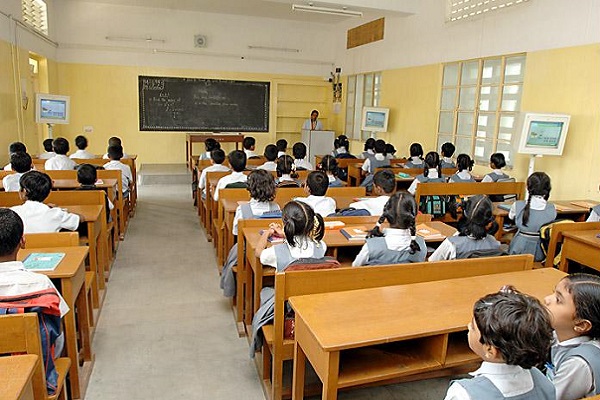
The Indian education system has since long been a subject of criticism for a variety of reasons. On one hand, it is accused of being a fiefdom of left-wing academicians who are highly intolerant towards contrarian views, and on the other, it is accused of severely lacking innovation. Another form of criticism includes the education system’s disconnect with the changing times, rendering the students incompatible with the industry’s needs.
Now the Prakash Javadekar led Human Resource Development (HRD) ministry has decided to conduct a novel experiment in order to possibly give education back to the masses by seeking suggestions regarding how to rationalise school curriculum from class I to XII.
Promoted under the Department of School Education and Literacy, the Ministry is inviting suggestions on rationalising curriculum, syllabus and subject contents for “all-round development of students”.
As per the release, in order to develop a more egalitarian society, besides cognitive and analytical skills, attention also needs to be paid on “life skills, experiential learning, health and physical education, sports, visual and performing arts, literary & creative skills, work-based education”. But as per the department, the workload on cognitive and analytical regions renders a student unable to focus on the latter areas.
Hence in order to solve this, the ministry is inviting suggestions from ” teachers, academics, students, parents and other stakeholders associated with school education”, to ensure that a balance is maintained between the aforementioned points for students following NCERT/CBSE syllabuses from classes I to XII.
The suggestions which will be accepted till 6th April are expected to be precise and can be sent via clicking at this link.
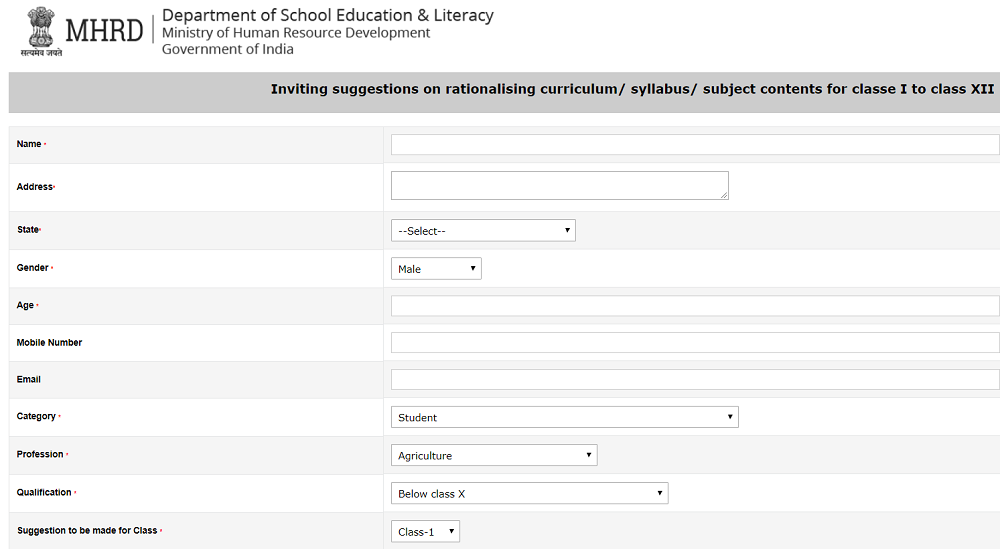
In the form provided by the ministry, one compulsorily needs to fill the details like one’s name, address, state, gender, age, occupation, category, qualifications and the class, subjects for which one wants to make the suggestions.
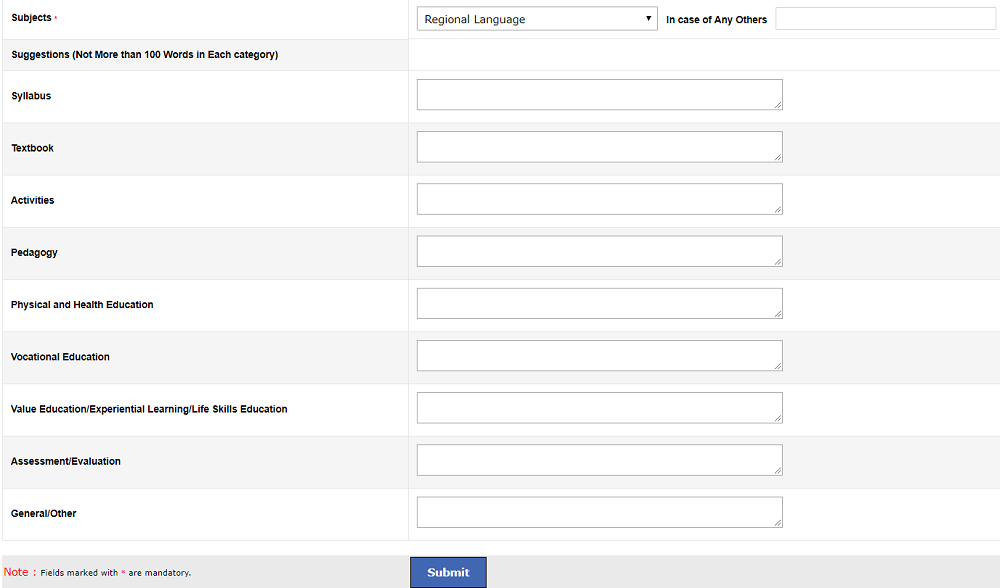
The area in which one can make the suggestions within a 100 words are:
Syllabus
Textbook
Activities
Pedagogy
Physical and Health Education
Vocational Education
Value Education/Experiential Learning/Life Skills Education
Assessment/Evaluation
General/Other
This is a sample screenshot of an unfilled form:
Sample form part-1Sample form part-2
It is certainly heartening to note that the HRD ministry has decided to take the opinion of the informed public regarding the designing of a rationalised curriculum. But it remains to be seen whether the effort translates into a genuine implementation of novel suggestions sent by the public which also importantly is bereft of interference by the leftist establishment and its “eminent thinkers”.