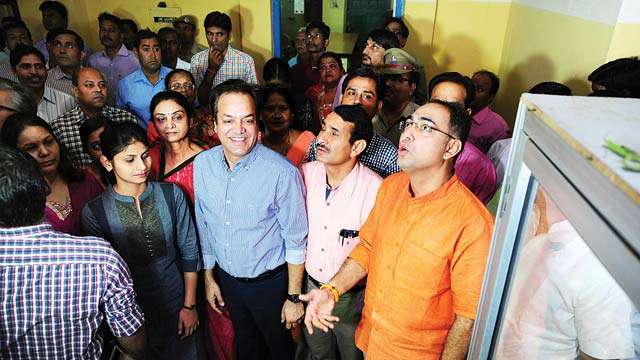
Ashok Lahoti, the mayor of Jaipur has caused a bit of a flutter in the media after making it compulsory for the Jaipur Municipal Corporation (JMC) to play the National Anthem at the start of the day and play the national song in the evening.
This practice began at the headquarters of the JMC on Tuesday and as per mayor Ashok Lahoti, it will be extended to all zonal offices and fire stations by the end of November. Lahoti says, this would bring a positive work culture at the offices. The timing for playing the national anthem and national song is 9.50 AM and 5.55 PM respectively.
All the staff members have been instructed to stand and pay respect while the anthem and song are played. The staff members have also been asked to be present in the offices during this time period. This according to Lahoti will ensure that people reach the office on time and also stay the full working hours.
As per other reports, Lahoti has since then upped the ante by mentioning to reporters that there was no opposition to this move and if anyone is opposed to it, they should go to Pakistan. He further stated that people were not being asked to raise religious slogans. This statement as a result drew a sharp reaction from the Congress party.
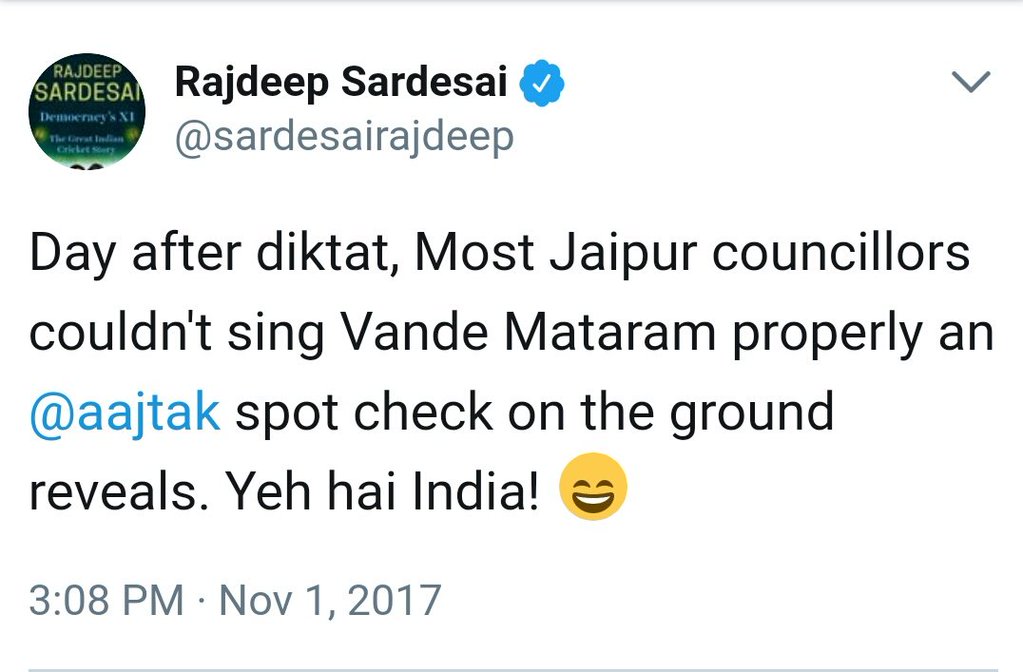
Soon after this whole incident, a controversial journalist also took to twitter to start making “expert comments” on this subject:
One wonders why Mr. Sardesai would seem so gleeful about his claims.
This isn’t the first time such a large scale experimentation (apart from playing it in cinema halls) regarding the National Anthem has taken place.
We had recently reported how a small Telangana town named Jammikunta comes to a standstill at 8:00 AM when the national anthem is played. This practice was started from this year’s independence day and in order to make it far reaching, the police officers have set up 16 loudspeakers around town. This move was welcomed by the local residents who look forward to singing it everyday.
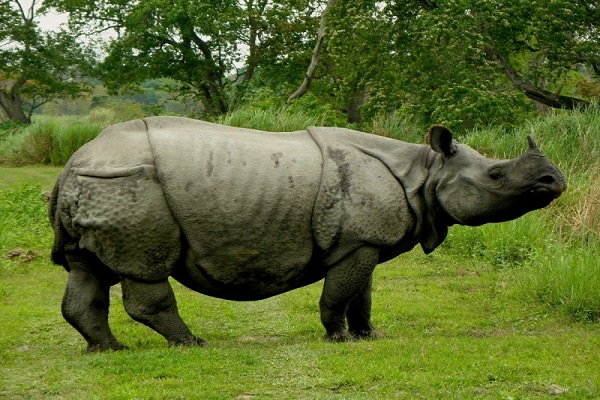
The Kaziranga National Park in Assam is home to the iconic one horned rhino whose numbers are estimated to be about 2401 as per a 2015 census.
The biggest problem which has plagued these rhinos for all these years is rampant poaching, mainly to acquire the animal’s horn, which has a huge demand in the global ivory black market.
As per official figures the hunters have killed a total of 143 rhinos in the last 12 years and about 70% of those deaths have taken place from 2012. This predictably resulted in appeals by animal conservationists for finding a solution to the problem.
As a result the rangers of Kaziranga started using sophisticated techniques like using night vision cameras, drones and erecting eight 90 foot towers fitted with cameras for live security stream. They also used combat techniques like stealth, stakeout and sustained surveillance to catch poachers, especially at night. The antiquated service rifles of the park guards were replaced by modern AK series rifles and a coordinated network with governmental agencies like the state police, was created for better security of the park.
All this seem to have borne fruit and as reported, only two rhinos have been killed this year which is the lowest figure since 2001. As per another report, poachers made 10 attempts to enter Kaziranga in the last 6 months out of which 8 were foiled. In the 2 instances where they managed to enter, the authorities arrested them before they (poachers) could carry out their hunting.
Thanks to the security efforts, a total of 48 hunters have been arrested by the authorities and one was killed. Some of the equipment used by these hunters include poisonous liquid which is applied on darts, inflatable rubber boat, tranquilliser and motorbikes.
The magnitude of the poaching problem in Kaziranga can be gauged by the fact that the team of Deben Borah, officer in-charge of Jakhalabandha police station has caught 260 poachers in 3 years.
The authorities’ efforts haven’t been limited to security measures but have also included providing alternative livelihood options to nearby villagers who earlier used to provide logistic support to these hunters.
This victory over poaching hasn’t meant that the authorities have let their guard down. They are aware that the hunters might also be upping their game. The price tag of about Rs 1 crore for rhino’s horns in the international market means that they won’t be giving up anytime soon.
A columnist associated with the Left leaning website Newslaundry, has displayed his bigotry in all its glory today, by trying to pass off a 2016 video of Prime Minister Narendra Modi meeting Sayed Fakhar Kazmi Chisty of Ajmer Sharif, as a recent video. Not only that, he said this was Modi’s attempt to appease the Muslim minority in poll bound Gujarat.
Modi is so scared to lose Gujarat, he’s started to appease Muslim minority. You can see him bowing in front of & kissing the Islamic text. pic.twitter.com/vwfrVBcnbE
In the video, Modi could be seen greeting Muslim religious leaders and showing respect to the gift offered by the head. He is seen bowing to what looks like a book of religious scriptures. To any viewer, it would seem more like Prime Minister Modi being respectful to sacred books of religions other than his own, something any civilised person would do.
What is outrageous is that this video is not from recent times, but from May 2016, when the religious heads had visited the Prime Minister, as pointed out by this Twitter user.
On Social Media, such misrepresentations and lies have a tendency of taking a life of their own. That is exactly what happened. Soon after Jas Oberoi had tweeted, Aam Aadmi Party leader Sanjay Singh, too quoted the tweet and spread it further saying how Modi wore the turban of Muslim religious leaders, but that too in closed rooms.
मोदी जी को धन्यवाद उन्होंने मुस्लिम धर्म गुरुओं से पगड़ी पहनी, लेकिन छुपकर बंद कमरे में। https://t.co/0Y6gcRWNZF
This is not a one off instance where Oberoi has spread out of context, mischievously edited videos to spread misinformation. Today he spread a 30 second video clip of PM Modi speaking on climate change where it seemed like PM Modi was denying the phenomenon of climate change.
Student: Sir, what do you have to say about global warming & climate change?
Indian PM: Climate hasn’t changed, we humans have.
Actually, this video is a part of longer video of Prime Minister Modi explaining climate change to school children.
Watch hw a dialogue with kids as simple as it can come frm the heart of PM Modi to explain Climate change is taken out of context by AIB. pic.twitter.com/A33rPmZcke
Earlier, too, Oberoi had made an extremely Hinduphobic remark when he asked BJP spokesperson Tajinder Bagga, a Sikh supporting Hindu festival, to give up Sikhism.
Can you at-least give up Sikhism before promoting idol-worship & superstitions? What a disgrace for the community, this @TajinderBagga. https://t.co/7lFW64kmmG
He had also referred to a VHP meet for temple as “Hindu terrorist recruitment drive”.
Hindu terrorist recruitment drive, loud chants of killing those opposing Ram Mandir & much more. Organized by VHP in Goregaon #DigitalIndiapic.twitter.com/bizsjTKQqD
NewsLaundry, when asking for funds, appeals to people to come forth and help them “keep news free”. Perhaps it is time people appeal to NewsLaundry and their columnists to try and “keep news real” and “free from bigotry”.
On 30 October, the focus of CNN News 18 prime time show ‘Viewpoint’ was a man named Deepak Talwar. CNN News 18 claimed to have accessed Income Tax Department chargesheet against Talwar, a self-proclaimed corporate consultant (a fancy name for lobbyist), accusing him of receiving massive kickbacks worth Rs. 1000 crore between 2008 and 2011 for influencing aviation policies of the UPA government to favour his ‘clients’. According to CNN News 18 report, the charges against Talwar are –
Received kickback of $9.8 million from Air Arabia for helping the airline secure more destinations
Received kickback of $9 million from Qatar Airways
Helped Dubai based airline Emirates to get bilateral agreements amended to enable larger passenger access in Indian market
Helped Air Asia in obtaining operating permits
However, Deepak Talwar’s lobbying exploits are not limited to aviation policy. In fact, he had his fingers in multiple UPA scam pies. Let’s look at Talwar’s career –
According to Outlook report, Deepak Talwar is the son of a former bureaucrat. Termed as “the king of the tribe” among lobbyists, he gained prominence during 1990s, using his proximity to the then top bureaucrat A.N. Varma to facilitate FDI approvals for multinational companies during economic liberalisation.
In 2009, Talwar formed a 26:74 joint venture with US based Telcordia Technologies (now part of Ericsson) to win Mobile Number Portability (MNP) license for southern and eastern zones. However, MHA had red flagged this deal because Telcordia had already signed a similar deal with Pakistan. MHA said, “Since Deepak Talwar Consultants didn’t have any expertise in telecom, this would give Telcordia full control over the firm both administratively and technically, even though day-to-day operations may be entrusted to Indian nationals. The foreign partner may be in a position to exploit for their country’s interest as well their commercial interest”. Despite MHA’s objections, the company received clearance from the UPA government to implement MNP.
Delhi Police investigations in the MNP deal revealed that Talwar had roped in a senior IAS officer – Ravi Inder Singh, former director with MHA, through a businessman named Vineet Kumar for obtaining information on ministry’s file noting as well as guidance on obtaining security clearance for MNP implementation. Both Kumar and Singh were arrested.
Talwar’s alleged proximity to the then Civil Aviation minister Praful Patel helped him become a major player in the aviation sector. Talwar won two major contracts from Delhi International Airport Limited (DIAL) during Patel’s tenure for which DIAL drew flak from the CAG. According to an internal investigation by Air India, Talwar’s company supplied DVDs for the airline’s in-flight entertainment system at ten times the market rate.
Deepak Talwar’s name also figured in the infamous Radia tapes. Niira Radia in a telephone conversation with a Times of India reporter had claimed that Talwar and Praful Patel had made $300-400 million in selling bilaterals (air service agreements between Air India and foreign airlines) on the Gulf routes. CAG report said that Civil Aviation ministry under Patel approved additional rights to Emirates despite UAE’s failure to give reciprocal rights to Air India. According to Radia, Deepak Talwar was instrumental in the “Emirates deal”.
Revelations in Radia Tapes resulted in Supreme Court directing CBI to start a preliminary enquiry (PE) against Deepak Talwar. The extent of Talwar’s influence can be gauged from the fact that during the period when CBI was conducting this enquiry, Deepak Talwar visited the then CBI Director Ranjit Sinha more than fifty times at his residence! The PE against Talwar was subsequently closed by the CBI.
Talwar’s fortunes started turning for the worse after Modi government came to power. In June 2016, more than hundred Income Tax officials raided a dozen premises owned by Deepak Talwar. His name also came up in connection to another lobbyist named Sanjay Bhandari who was found to be in possession of sensitive documents of Defense Ministry
Congress leader Digvijaya Singh’s name emerged in the files recovered by IT department from the raids on Talwar’s premises. The recovered data allegedly show that Singh and his family members were frequently upgraded on international flights, mostly on Emirates
In May 2017, MHA sent a notice to a NGO setup by Deepak Talwar for violating FCRA norms. The NGO received donations worth crores of rupees from aviation and defense companies like Airbus and MBDA – the European missile manufacturer which is a supplier to Rafale and Scorpene. According to MHA, Talwar’s NGO flouted several provisions of the FCRA, including “false statements, false accounts, claimed bogus expenses, furnished concocted vouchers, purchased three luxury cars over ₹84 lakh, payment made by NGO for foreign visits of Mr. Talwar, funds used for making payment related to business activities of the founder of the Trust.”
According to CNN News 18, Deepak Talwar lobbied for a company called Dnata (part of Emirates group) to get ticketing contracts from Air India. Dnata was considered as a security risk by the Intelligence Bureaufor its apparent links to Pakistan and was denied security clearance by the Vajpayee government to provide services at four Indian airports. Interestingly, the name of Dnata also came up in the investigation of another lobbyist Moin Qureshi who helped the company win another service bid for IGI Airport during UPA tenure. The bid was cancelled in 2014 over concerns raised by IB.
Above information makes it clear that Deepak Talwar was as influential as Niira Radia, if not more, during the UPA government. Through his alleged proximity to UPA ministers and top ranking bureaucrats, Talwar not only unduly influenced policies to benefit himself and his corporate clients, but he also made sure that the law never caught up with him. Until Modi government came to power.
Yesterday was a red letter day for India, no matter how you look at it. For the last 8 years, India was languishing in the 130s in the Ease of Doing Business (EODB) rankings released annually by the World Bank. This mediocre performance, was even more disappointing in 2016. This was because of the fact that, on most other rankings, India had soared up. The Government had also pushed for reforms at various levels, even starting a state-wise ranking system within India to make states more competitive. Now in 2017, the work of the past couple of years has borne fruit.
But this was not enough for some. The same people who are medical experts when there is Dengue in Delhi, and are banking experts when it comes to NPAs, had now become Business experts, trying to pick holes in this phenomenal rise in India’s EODB rank.
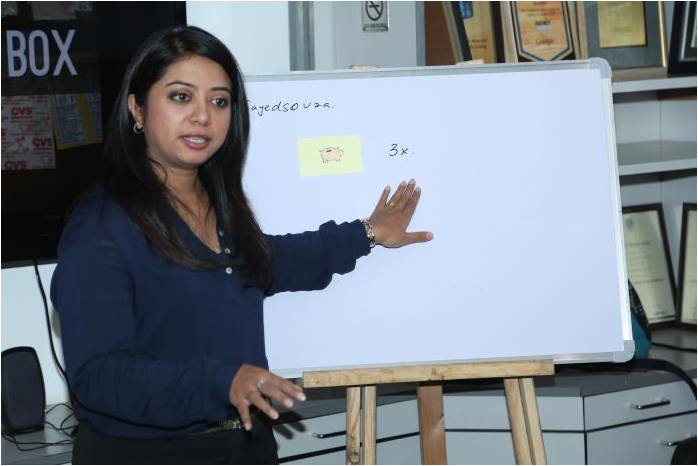
One such upcoming starlet is Mirror Now’s anchor Faye DSouza, who has recently become the favourite of left liberals in India. Her rise can be attributed to her aggressive stance on issues, but with a tilt to the left and lot of virtue signalling, unlike most other aggressive TV anchors who are firmly on the right and have started speaking politically incorrect or inconvenient truths.
DSouza tweeted, and also stated on her show discussing Ease of Doing Business, that the ranks do not include GST and also measure ONLY Mumbai and Delhi, thus alluding that they are not truly representative of India. This view was also echoed by one of her panelists, and was gladly accepted by her:
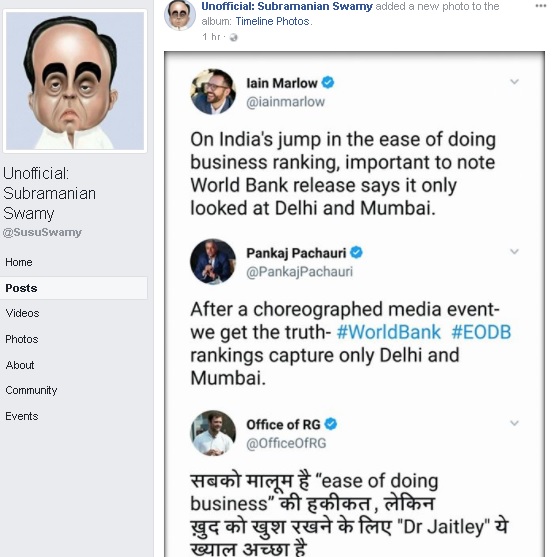
On social media, we had the co-founder of a left leaning “fact-checking” site, who runs the parody Facebook page “Unofficial: Subramanian Swamy”. Assuming he had checked his facts, he posted a picture making a similar argument, that the rankings had covered only Mumbai and Delhi:
Firstly, yes: GST is not covered in these rankings. But this is not because Modi made them skip GST, but because the rankings for all economies are benchmarked to June 2017. GST will come up in the rankings for next year, and surely Faye D’Souza would do very well to bring it up then, but talking about GST (which was introduced in July) in context of a ranking system which evaluated data till June, is foolish.
Secondly, yes, “only” 2 cities i.e. Mumbai and Delhi are tested by the rankings. But, in what could be a big shock for the likes of D’Souza, the World Bank tested ONLY 1 city in the entire country for 179 out of 190 countries!
By the logic alluded to above, these rankings must be trashed at source, since the data of only 1 city is being extrapolated to the entire country! The World Bank has it’s own logic for this, but perhaps if people actually read the report [pdf], they would have known better:
click on the image for original (larger) size
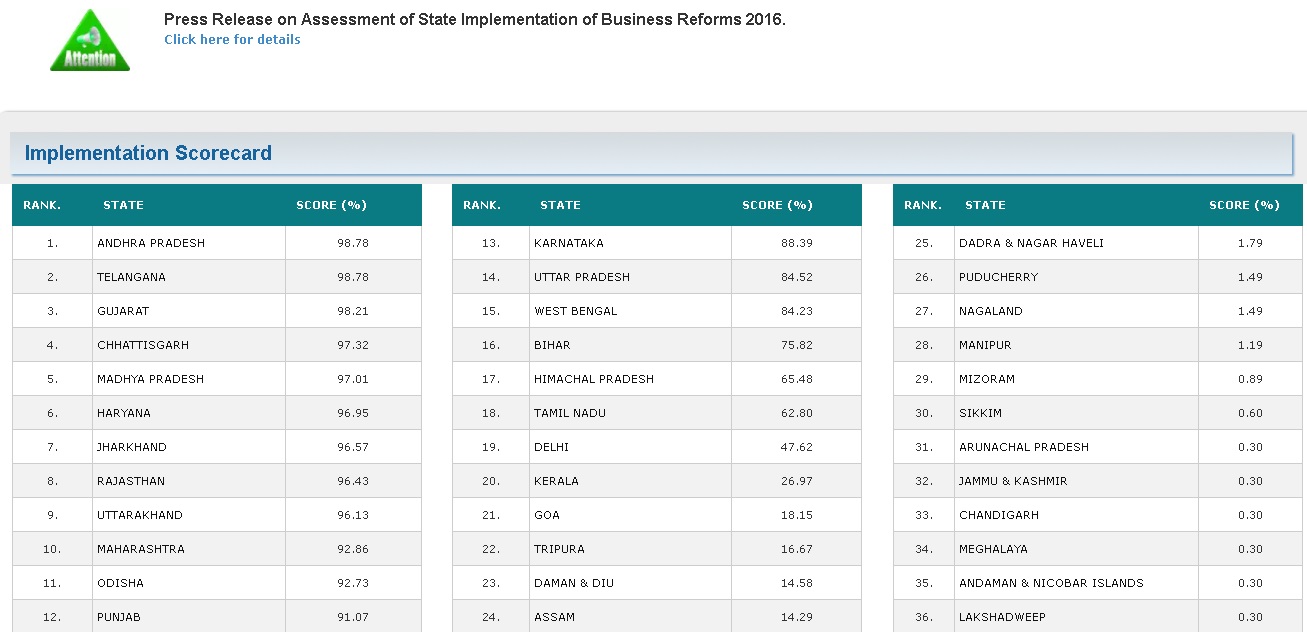
But all is not wrong with the logic extended by so-called “experts” above. For such a diverse country like India, just 2 cities may not do justice. In fact, if we see India’s state-wise EODB report for 2016 (the report for 2017 is not out as of date), which is prepared by the Department of Information Policy and Promotion, Maharashtra and Delhi, are ranked at 10th and 19th place respectively!
click on the image for original (larger) size
In short, entire India, is being judged based on the performance of only 2 cities, and the respective states of these 2 cities, are not doing very well, with Delhi being a poor 19th on the list. This very concern was in fact raised by India itself, when it saw that in spite of work being done, the rankings were stagnant.
India had requested World Bank to go for a wider assessment to get a better rank for India. So while commentators may be saying that India’s good rank is because of it not being representative of other states, it could well be true that if certain other states were chosen, the rank could have been much better.
More disturbing that Delhi’s 2016 rank, is Delhi’s score for 2016, which is a dismal 47.62%. Maharashtra is ranked tenth, but it has a very decent score of 92.86%, indicating that it has a relatively low rank, only because there are some other states which are even better, albeit by a small margin.
The World Bank too gives out similar scores called “Distance to Frontier” (DTF). DTF shows the distance of each economy to the “frontier,” which represents the best performance observed on each of the indicators across all economies. An economy’s distance to frontier is reflected on a scale from 0 to 100, where 0 represents the lowest performance and 100 represents the frontier.
India’s DTF for 2017 was 60.76. The data from 2009 (the earliest year for which DTF is available) clearly shows that till 2014 i.e. for almost 6 years, India’s DTF score grew by only 4.10 points. It actually dipped, between 2012 and 2013! In the subsequent 3 years, from 2015 to 2017, the DTF score has jumped 7.89 points.
India’s Distance To Frontier scores over years
Absolute measures, such as DTF, are important because rankings can get skewed for various reasons. Rankings depend on how the other countries are performing. Further, if new countries are added to a data set, the ranking may drop even though the score has improved, only because there are more participants in the ranks. This happened to India recently, in respect of the Global Hunger Index where it was initially reported that India’s rank had fallen. It was later revealed that the “fall” was due to the reason that 44 new countries were added to the rankings.
India reaching the 100th Rank in EODB, while being commendable, is still not enough. We need to move much further ahead if we are to truly become a paradise for business. This point is not lost on anyone. But prime-time anchors and alleged “fact-checkers” need to ensure that their criticism of this commendable improvement, is not based on empty rhetoric and half-truths.
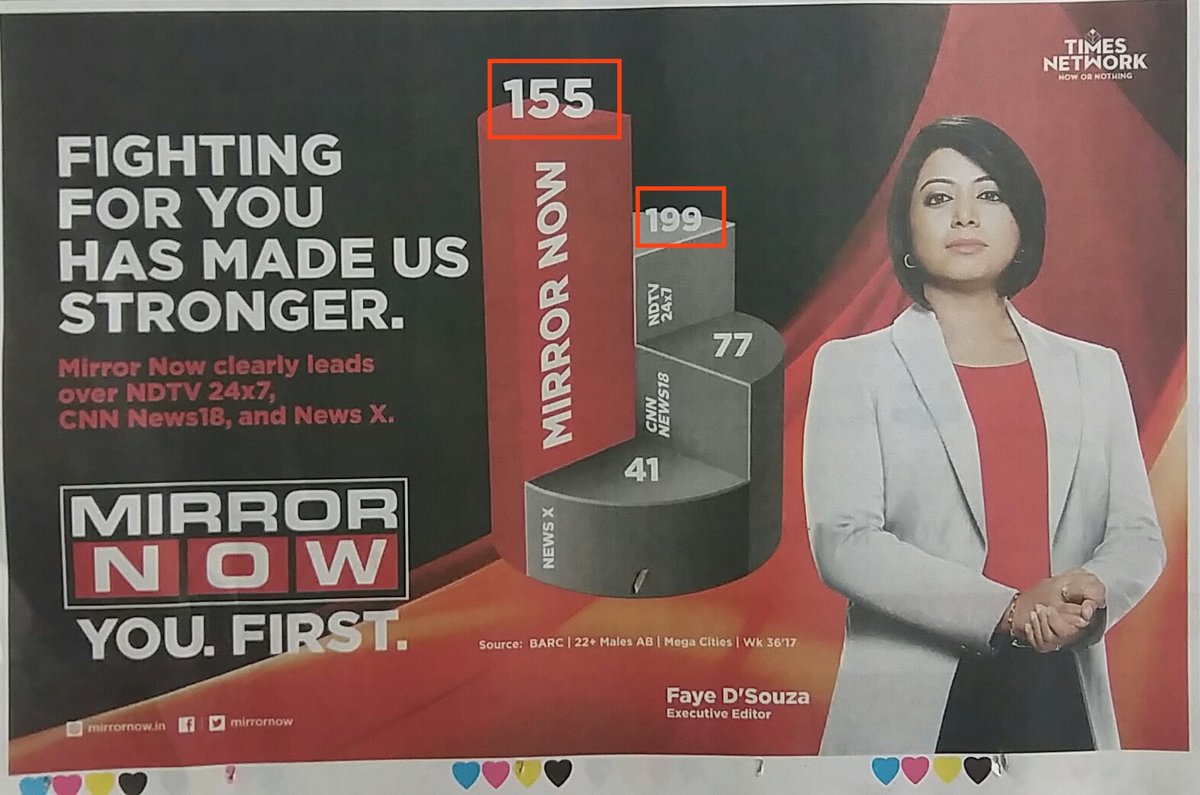
And Faye, before you crunch the numbers of the EODB rankings, you may want to look at Mirror Now’s advertisement, which shows 155 to be greater than 199, by a considerable margin.
Enforcement Directorate (ED) today arrested Gagan Dhawan, alleged to be Ahmed Patel’s close aid, under the Prevention of Money Laundering Act (PMLA) in a case involving bank fraud of over Rs. 5,000 crore.
ED arrests Gagan Dhawan under PMLA in a case involving bank fraud of over Rs 5000 Crore by Sandesara group.
Dhawan is said to be a close aide of Congress leader Ahmed Patel and advisor to Congress President Sonia Gandhi. Earlier, in September, an FIR filed by CBI named Irfan Siddiqui, son in law of Ahmed Patel, for allegedly bribing top Income Tax officials for hushing up the raids and huge money trail data seized from Sterling BioTech and Sandesara Group of companies.
Earlier, in August, ED had carried out raids in 12 places of former Congress leader Shaukeen and Gagan Dhawan under the Foreign Exchange Management Act (FEMA). The premises raided included a flat in south Delhi’s upscale East of Kailash area, five flats in Vasant Kunj including the office of Aaina Marble Pvt Ltd, a farmhouse in Bijwasan, a flat in Inraprakash building in the Barakhamba area of central Delhi, a flat in Chanakyapuri and a flat in Chawla area of the national capital. ED officials said they had received initial information that black money of politicians and bureaucrats was being converted into white.
According to CBI, the company had taken loans of over Rs 5,000 crore from a consortium led by Andhra Bank which have turned into non-performing assets. The FIR mentioned that the total pending dues of the group companies were Rs 5,383 crore as on December 31, 2016. The ED had taken cognizance of this FIR to file a money laundering case against them.
Last week, Gujarat ATS had arrested two suspected ISIS operatives from Gujarat who were allegedly plotting an attack on a Jewish synagogue in Ahmedabad. A day later, in a press conference, Gujarat Chief Minister Vijay Rupani had claimed that the two men were employed in a hospital of which Congress leader Ahmed Patel was a patron. However, Ahmed Patel has dismissed this allegation.
The mainstream media these days is not tired of praising how Congress is witnessing a “resurgence” on social media, especially on Twitter. However, this resurgence appears to be based on manipulations and lies. Last month it was reported that bots could be behind the sudden increase in popularity of Rahul Gandhi on Twitter, while today, it became apparent, how Congress is using lies and defamatory content to push their propaganda.
The person helping in spreading this propaganda was no other than party’s spokesperson Sanjay Jha, better known as the person who was regularly bashed by Arnab Goswami on TV debates in run up to the 2014 general elections.
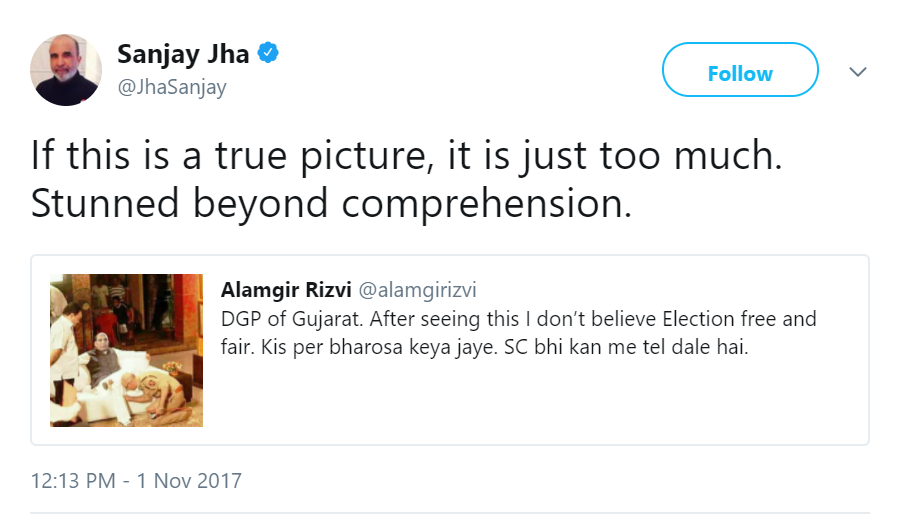
Earlier today, Jha circulated a picture on Twitter, which showed someone purported to be the DGP of Gujarat Police, kneeling down to senior BJP leader and Union Home Minister Rajnath Singh.
Sanjay Jha spreading lies on Twitter
The original picture was posted by a Congress supporting troll named Alamgir Rizvi and was further spread by Sanjay Jha with “is this true” type disclaimer, which was made popular by Delhi Chief Minister Arvind Kejriwal as a potent tool to spread lies and propaganda.
The motive behind spreading the picture was to show that Gujarat police was compromised, and thus the upcoming assembly elections in the state might not be free and fair.
However, alert Twitter users pointed out that Jha was spreading a fake picture. In reality, Congress trolls had morphed Rajnath Singh’s face on a still image from a movie that showed a police officer kneeling down to a politician.
In fact, this particular morphed picture has not been spread by Congress supporters on social media for the first time. Last month too, a Congress troll named Farida Patel had shared the same morphed picture. The troll was exposed by social media users last month itself.
So essentially, Congress spokesperson Sanjay Jha spread a known lie, perhaps in a proverbial bid to repeat a lie thousand times till it becomes a truth. Jha deleted the tweet after over half an hour of bashing by various social media users for spreading lies, but despite knowing the truth, the other Congress troll had not deleted the tweet by the time this report was published.
Funnily, not only the lies of Sanjay Jha were exposed, his low intellect and awareness was also exposed by social media users, for the DGP of Gujarat is a woman while the morphed picture had a male police officer kneeling down, who Jha thought was the DGP of Gujarat.
National Spokesperson of Congress does not know that DGP of Gujarat looks nothing like that person in pic because its a woman, Geetha Johri, https://t.co/Zn0r7Iv0mg
Apart from the lies and propaganda that Congress is indulging on a widespread level on social media – known as its “resurgence” in the mainstream media – this incident also betrays that perhaps Congress deep inside knows that they are going to lose the Gujarat elections. Because the original intent behind sharing this message was to pre-empt the loss by claiming that elections were not free and fair owing to a compromised police force.
The World Bank’s Ease of Doing Business ranking showed a massive jump for India from being ranked #130 in the world to #100 in the world. Now, liberal friends sometimes have difficulty reading the writing on the wall and so I made this simple chart to help them:
Ranked #142 in the year 2014. It’s almost like Dr. Singh’s shiny degrees were of no worth to the nation because all he did was work his way up through the ranks of the corrupt system under the thumb of the Dynasty. From Adviser to Foreign Trade Ministry (1971-72) to Adviser to Finance Ministry (1972-76) to Director of Reserve Bank (1976-80) to RBI Governor (1982-85) to Deputy Chairman of Planning Commission (1985-87).
It was not until 1991, when the Government of India had money left for less than three weeks, that Dr. Manmohan Singh finally decided to take a stand against Nehruvian socialism of the previous four decades. At that time, Dr. Singh was a couple of months away from reaching the age of 60 years. Always a good time for a young man to finally start speaking his mind.
The news of the massive improvement in Ease of Business rankings came accompanied with the data of core sector growth reaching a six month high of 5.2% in September. This, after a really strong August number of 4.4% that led to an IIP number well above expectations.
Meanwhile, SBI research also put out a report saying that the GDP growth for the year may well be above 7%.
And let’s not forget that GDP growth for the Fiscal 2015-16 was at a five year high of 7.6%.
So, let’s back up here and take a look. First Modi government put India on a path of quick recovery that led us to a five year high in GDP growth in Fiscal 2015-16.
Then, massive reforms were unleashed in Fiscal 2016-17 to convert India into a rule based, formalized economy. This led to a slight dip in growth in FY 2016-17, but still at 7.1% … a dream for most countries around the globe (as the President of the European Commission pointed out).
And now, after the massive structural reforms, India is scheduled to beat 7% again this year. This is roughly the same as the reasoning of the IMF, as NDTV reporter Namrata Brar, who was clearly fishing for an anti-Modi headline, found out to her bitter disappointment.
So, what’s the explanation for this, short of accusing the IMF, the World Bank and the President of the European Commission being Gau-rakshaks?
It’s almost like massive structural reforms carry with them short term risks and then lead to long term benefits. If structural reforms were easy to implement in the short term, everybody would do them.
Dear liberals, this is your country too. Instead of reaching for Burnol and Eno, you are most welcome to celebrate with us. If you can open your eyes and see the light …
The Opposition would do well to go back to basics and restart its campaign of church attacks, intolerance and Award Wapsi. Everyone loves a good joke. Rahul Gandhi must do what he is best suited for.
Of course, we cannot forget here the pathetic fact that India is celebrating a ranking of #100 among the nations of the world. We want our country to be a superpower, to be No.1, not #100.
Ten years from now, I hope we look back with a mixture of pity and amusement at this moment when we had to celebrate coming in at 100th position in the world. But this can only happen if we remember who benefited the most from keeping India poor for 70 years.
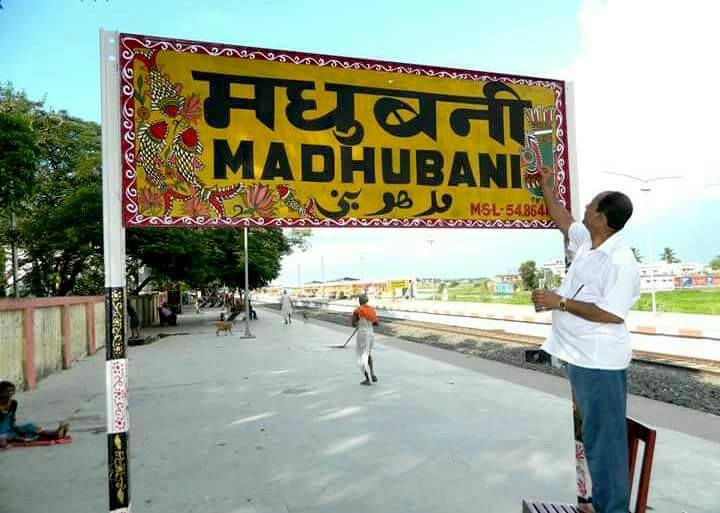
The world renowned traditional art form from Bihar, Madhubani, is now adorning the walls of Madhubani railway station. As part of the Swachhata mission on 2nd October, the East Central Railway (ECR) division took it upon themselves to transform the walls into beautiful piece of art as a way to not only showcase the talent of the artists, but to also make the newer generation aware of the tradition. As many as 200 Mithila painting artists took part for about fifteen days to make this possible. It has been well appreciated by many people who were pleasantly surprised to see the lovely walls.
Madhubani Railway Station turned into an amazing space of art with “Mithila/Madhubani Painting”
150+ local artists created this free of cost pic.twitter.com/zpP5tItiLJ
This is Madhubani Railway station which has been beautifully decorated by the world famous #Madhubani Paintings made by local artists. pic.twitter.com/nei1W8D8mz
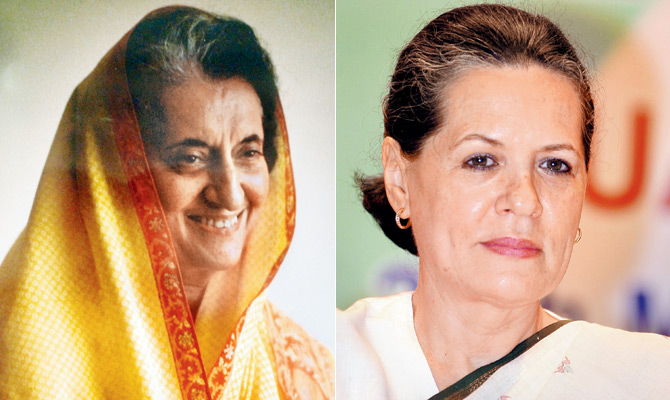
Some of the events in present political arena, when viewed from Indian National Congress’ side, look like a poor quality repeat telecast of events that occurred in the 1970s.
When Indira Gandhi was the Prime Minister, people of India were angered and frustrated with the rampant corruption. Just like 2014, when people were fed up with the news of corruption of Sonia Gandhi led union government. Technically Dr. Manmohan Singh was the Prime Minister, but we all know who had his reigns.
In 1974, Jai Prakash Narain, popularly known as JP, started a campaign against the misrule & corruption of Bihar Government. It later turned out to be against misrule and corruption of Indira Gandhi. During this political and social turmoil, India saw a lot of changes and many new things happened. Not only numerous leaders like Lalu Prasad Yadav, Mulayam Singh etc were born because of this campaign but seeds of many political parties were sown. The biggest change was, age-old Congress rule in India was overthrown. For the first time a non-Congress political party got elected – Janta Party formed the government in Delhi.
Similar things happened in 2014 too. Anna Hazare tried to become JP part deux. Several new leaders like Arvind Kejriwal, Manish Sisodia etc were born. And though they couldn’t form the Union Government, they got elected to govern Delhi.
One can say these similarities are very far-fetched. But moving forward, in 2014 Lok Sabha polls, due to various reasons and not because of Anna’s movement, people overthrew the invincible UPA Government and gave mandate to BJP.
Now here comes the striking similarity; after general elections of 1977 Indira was rendered powerless and everybody thought her political career was almost over. And she too, as at first it seemed, had accepted it. She had disappeared from the political arena of India, or to be more precise, she was not occupying the central stage.
After the political defeat of 2014, Sonia Gandhi too is seen nowhere. Rahul is leading the pack but Sonia Gandhi is missing. Just like Indira Gandhi of 1977-78.
Gradually things started taking a turn. Indira Gandhi was arrested – handcuffed. On Oct 3rd 1977, CBI officials entered her home and arrested Indira when Sonia was preparing evening tea for her. This arrest and the subsequent quick release gave her dying political career some much needed oxygen. This arrest gave her the opportunity to gain public sympathy. People of India have seen a lot, but someone from the Nehru-Gandhi family being handcuffed was still unimaginable. She made people believe that Janta Party Government had launched a campaign of political vendetta against her.
In National Herald case, when the court ordered Sonia Gandhi and Rahul Gandhi to be present in the court, it was no less shocking for Indian people. It was that time when Sonia responded with: “I am the daughter-in-law of Indira Gandhi. I am not scared of anyone.”
It was in the reference to 1977-78 saga. Sonia tried her best to get public sympathy and make people believe that she was being made a victim of political vendetta. She wanted an action-replay of history. If INC people and INC sympathizers are to be believed, so far the strategy is working well. And they hope that in 2019 Sonia will come back to power as Indira did.
One most important thing not yet mentioned is; people were showing sympathy towards Indira but that wave was not strong enough to elect her back. What really made her come back to power? What was the event which really ignited her almost dead career? Well, it was murder of 14 dalits in Belchhi village of Jehanabad district of Bihar.
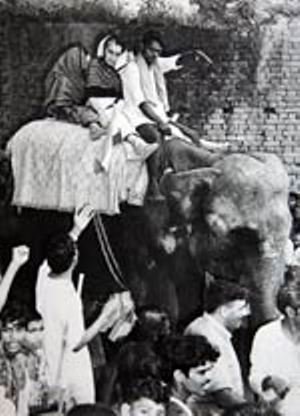
In an age-old caste war, 14 dalits were murdered there. Indira, who was searching for an agenda, took no time to grab this ‘opportunity’. She immediately rushed to Belchhi riding an elephant. Indira had captivated the nation and the whole nation was looking towards her for help. The result was evident in the next elections when Indira regained power handsomely.
Indira, whose political career was about to hit the rock bottom, found the ladder made of these 14 dalit lives and made a strong comeback.
At a time, when Sonia is also busy looking for a ray of hope considering she is at her career worst, can it be said that she is 14 dead bodies away from power? Hope not. However, with the caste cauldron heating up in various states, we can only hope that history doesn’t repeat itself.