Tuesday, March 31, 2026
Home Blog Page 7483

NDTV stops Sagarmala project – from making losses for shareholders to making losses for India

0

Ministry of Home Affairs under Modi Government has issued Notices to 10,300+ NGOs. We have seen earlier how these NGOs obtain foreign funding and are actively involved in scuttling developmental projects at the behest of their foreign masters. Till date all opposition to any infrastructure or other projects was from NGOs. The media’s role was limited to reporting these cases. Apparently now Modi Govt has to fight even non-NGOs if they are to execute ambitious projects. Here is the story how an alleged media company “NDTV” is acting like an NGO.

History of Sagarmala Project:

We know that India enjoys enviable coastline of 7500 kms which touches upon 13 states and union territories and some islands. With India’s strategic location in the Asian Continent, there indeed is no doubt that a string of “pearls” or “sagarmala” would help India play a pivotal role in international trade. Every developed Country has ports which can handle huge capacities. Somehow India lags behind in port facilities in comparison to China or other nations.

Keeping this in mind Modi Government undertook the ambitious Sagarmala Project to deliver impact through over 150 projects which shall lead to an estimated annual logistics cost saving of 35,000 Crores! These projects are estimated to boost India’s merchandise exports to $110 Billion by 2025. It is further estimated that 1 crore new jobs out of which 40 lakhs will be direct employment shall be created from these projects.

The Cabinet approval for the project was given in March 2015. The Shipping Ministry is the nodal ministry which is implementing this ambitious project. Shipping Ministry also released the project reports which can be accessed here and a notice inviting comments from the stakeholders was also released with last date of submissions as 31st August 2016. The Ministry also formed a “Special Purpose Vehicle”  under the name and style of Sagarmala Development Company Limited which was incorporated on 31st August 2016.

NDTV Approaches NGT

Curiously, NDTV, a media company, filed a petition before the National Green Tribunal (NGT) making a “Direct Attack” on the Modi Government’s Sagar Mala plans. An Analysis of the proceedings together with news items throws some interesting details. NDTV in its petition has prayed for:

  • “stopping of work” on all new ports as an interim measure,
  • “civil and criminal action” be taken against authorities, governments and private companies
  • formulation of a “national coastal policy”
  • creation of a restoration fund
  • cumulative environmental, economic and social impact assessment

A few quick questions:

  1. How does a media company become an expert on environmental issues?
  2. On what basis did NDTV conclude that Governments deserve civil and criminal action for their “neglect, over-sight, and complicit actions”?
  3. Did NDTV submit any “reports” from “experts” to back their claims?
  4. Has NDTV challenged the Environmental impact assessment” as done by ministries?
  5. Is NGT empowered to direct formulation of “coastal policies”?
  6. Is NDTV’s demand for a blanket scrapping of the Sagarmala projects justified? Or does it reek of some obstructionist tactic?
  7. How is NDTV “empowered” under its Memorandum and Articles of Association” to take up “environmental issues”? A quick analysis of the Memorandum of Association of NDTV shows they have a vague power under Clause 3 (B) (32) to investigate value of any “asset” but it is still not clear if they can file a case or not.
  8. Are all the shareholders of the company aware of these antics of NDTV, which is clearly drifting away from its stated goals of being a media house?
  9. Any spend on legal and other fees on an activity which NDTV is basically not supposed to indulge in, is justified?
  10. Does NDTV itself being embroiled in numerous tax scandals, have the moral right to be pontificating on other issues?

The only tenuous link of a media company like NDTV to this NGO-esque action can be their 2011 “Save The Coast” campaign which “highlighted” how developmental activities are hazardous to India’s coastline. But most of the above questions, still remain unanswered and valid.

Proceedings Before NGT

A quick glance at the proceedings before the National Green Tribunal show the following:

NDTV filed its petition in 2015 against the Ministry of Shipping, MoEF, and 11 States as well as Union Territories. Initially in an order dated 20th January 2016 the Bench ordered a bailable warrant against the Resident Commissioner of Daman and Diu at New Delhi which was subsequently cancelled. It imposed costs of INR 50,000 each on Maharashtra state and Gujarat State for non filing of replies. Maharashtra later complied with the order. The case, as per the orders, has not been taken up on “merits” as yet. In fact as per the latest order some respondent state has also challenged the time limit of filing this petition before NGT (6 months as per NGT Act,2010) which is pending. All in all the orders show that a flurry of activities is happening in this petition.

What is intriguing is that hardly any news channels or for that matter even NDTV published any articles on this until recently. In fact this is probably the first case where a media Company has taken up an “environmental issue” with the Courts. In this era of micro news, an action as this didn’t attract ANY attention?

Counter Views to NDTV Claims

It is pertinent to note that any project undertaken by the Government together with the assistance and partnership of State governments and private entities will not be implemented without proper studies. Amongst other things the government appoints independent experts to study environmental impact of projects. This EIA forms a very important part of the “project feasibility”. It is still not clear how NDTV has come to a conclusion that these projects are not feasible. It is clear that a single TV campaign will not give deep insights which government/private agencies undertake while deciding project feasibility. So did they carry out their own independent analysis? Which is that agency? Who paid for these reports? Why should report by NDTV be given weightage and not that by other agencies? Did NDTV provide its suggestions to the Ministry of Shipping on the draft plans they put forth for pubic comments?

“Stop Work” and its ill effects

Here is a small anecdote: while constructing an expressway between two cities, a group of environmentalists (pre NGT era) approached the High Court stating that the mountains which are to be cut are homes to a certain variety of “rats”. This delayed the project by 6 months causing monetary losses etc but nevertheless it was built. Today in 2016 these same “environmentalists” use the same highway to commute and the “rats” be dammed. None of these guys care for them anymore.

There indeed is no doubt that development should be sustainable and that both development and preservation of nature should be balanced. However going to Courts and challenging every power project, every mine, road port dam has become a quick and fast route to achieve fame.

It is clear that many “protests” are done at the behest of foreign hands/money and guidance. This not only hampers the economic activity it also leads to huge monetary losses. Take for example this Sagarmala project. While the Government has clearly put the  project reports in public domain the Petitioner NDTV has not clearly and specifically mentioned why and exactly how these projects are dangerous for the coast line. They haven’t even spelt out how NDTV as a media company is concerned with this issue in first place.

Now that we have a brand new NGO like NDTV out in open waging a war on a project which is ensuring capital flow, cost savings and 1 crore jobs, it is time for us citizens, for whom the projects are being executed, to rise up and ask them, what is your problem.

The implosion of AAP – churn or crash and burn?

0

Arvind Kejriwal’s Aam Aadmi Party is still in stages of infancy if we are to compare it with the other political parties in the fray. Less than 4 years into the game, AAP has racked up considerable successes in its repertoire. The biggest success of course is its unprecedented landslide victory in Delhi. In other places across the country, it hasn’t tasted much electoral success, but has been trying to position itself as the go-to party for someone who doesn’t want to vote for the BJP or the Congress.

Being Delhi centric, and owing to the friendly disposition of many top journalists towards Arvind Kejriwal, AAP has got more than its fair share of limelight. We have seen occasions where even PTA meetings have been glorified by “journalists” as a landmark moment in governance. Given the over-the-top positive acclaim received, AAP has also faced a higher level of barbs and attacks from its critics as well as opponents. Countless U-Turns, allegations of corruptions, frauds, donations scams, all have hit AAP. But all said and done, AAP has braved the fire from outside well.

Now, AAP is facing a different challenge. This time the enemy is within. We had last seen this when the founding fathers of AAP like Prashant Bhushan, Shanti Bhushan and Yogendra Yadav were unceremoniously booted out of the party. At that time, they claimed they were unhappy with Kejriwal’s dictatorial attitude, while Kejriwal’s coterie suggested they had other grudges. It was in the end painted as an ego battle.

This time though, things are much worse. AAP has faced one of its toughest weeks in its short political existence. Their own leaders have been the reason for much of the discomfort and this time, one cannot dismiss it as mere ego wars.

It started in Punjab, where AAP’s state convenor Sucha Singh Chhotepur was allegedly caught in a sting operation, accepting some sort of bribe. If some rumours are to be believed, it was an inside job from within the AAP. This eventually led to Chhotepur being sacked. Chhotepur episode had a ripple effect in Punjab, the full impact of which is yet to be seen, but till now these are the scalps it has claimed:

Firstly Siddhu’s much touted entry into AAP did not materialise, partly because his demands were rejected, and also possibly because of the mess that AAP Punjab was in.

Secondly, AAP’s credibility was obviously damaged, since their top leader in Punjab was caught in a sting

Thirdly, Chhotepur caused many splits in AAP Punjab. Factions loyal to him have threatened to leave AAP, and already, 80% of AAP office bearers of Amritsar zone have quit citing “dictatorial behaviour” by party observers from outside Punjab.

As mentioned, the full extent of the damage is yet to be seen.

If Punjab was one big pile of mess, Delhi has been worse. Yet another AAP cabinet minister had to be sacked and this time for extremely embarrassing reasons. Women and Child Development Minister Sandeep Kumar was sacked after his sex videos with 3 different women emerged. It was also reported that he misused his official position to secure a US citizenship for his newly born son.

Although Kejriwal tried to limit the damage of Sandeep Kumar by sacking him before the news broke out, the aftermath has been more damaging. AAP leader Ashutosh brazenly defended Sandeep Kumar’s sexcapades by trying to pull down national icons like Nehru, Gandhi and Lohia among others. A former colonel and AAP MLA from Delhi, Sehrawat opened another can of worms by writing a scathing letter to Kejriwal claiming that women are being used duped and exploited in Punjab too. He even went on to name leaders like Sanjay Singh, Dilip Pandey and Durgesh Pathak. Singh now is considering filing a defamation case.

The other state where AAP was trying to grab a foothold was Goa. Even here it has been been weakened. A few months back 9  members of the Vasco Unit of AAP left the party alleging that the party had fallen prey to the real estate lobby. Just yesterday, 2 more AAP leaders and former activists quit Goa’s AAP unit, making very similar allegations. Local developments coupled with the national developments have resulted in a loss of momentum here too with AAP supporters openly lamenting their party’s downfall.

To top all of this, now Arvind Kejriwal’s mentor has come down hard on AAP and Kejriwal. He has said he is very angry and very disappointed at AAP and Arvind Kejriwal, because of all the scandals it has been embroiled in. Anna further said that he had warned Kejriwal about a dilution in quality thanks to his ultra-ambitious moves. This in fact the same as what Prashant Bhushan was saying when he too was on the verge of quitting.

In all of the above, there is no Modi hand. There is no Modi controlled LG or Modi controlled ACB, which is tormenting AAP and Kejriwal using fake allegations. This is no external element to this who can be called “Sanghi” or “paid media” or “bhakt”. There is no escaping this. And hence this is AAP’s most testing time.

If an analogy can be drawn, we can look at numerous tech start-ups in India who are now facing rough times. They started off with promise, innovative techniques which threatened to disrupt existing market forces. Valuations soared as a select few players backed them. The race for revenues began as all these startups tried to expand aggressively, scaling up operations. But the internal systems, practices, goals of many were not mature enough to handle such massive growth plans, resulting in an implosion. Many of these start-ups have now begun their way downhill, sacking many employees, and boasting of much lower valuations.

AAP too has gone wrong in the same way. It tried to expand its foot-print beyond Delhi too soon. Systems were not in place, and in order to expand, they had to compromise severely on the quality of its inductees. Traditional parties have undertaken years of struggle to reach their current status. They have toiled from the bottom-up, creating a strong cadre, making their stand on issues clear, winning local elections, then state elections and finally heading for the central level. AAP on the other hand is more interested in the flash-bang method which demands quick results. And it has gone very bad for them. The chickens are now coming to roost.

The question now facing us is this. Will this be the 2nd round churning from within the AAP, when all the unwanted elements will desert AAP, and AAP will continue its march ahead? Or will AAP this time lose its absolute core, and with it, its charm and charisma? Only time will tell, but this time, AAP only has it’s own self to blame.

Women’s Maternity Bill – Boon or Curse in the Career Ladder?

0

Recently the Rajya Sabha passed the Women’s Maternity Bill in the Indian Parliament.  The bill mandates that any private establishment with more than 10 employees will need to give six months maternity leave to women and every company with more than 50 employees must establish crèche facilities for children. Companies such as Microsoft and Flipkart have already begun providing such facilities for women to be able to retain talent for the long-term. While the Bill is seen as a welcome move by feminists groups it didn’t bring a smile to all the entrepreneurs including the incoming President of Confederation of Indian Industry (CII) and Executive Vice President of Apollo Hospitals, Ms. Shobhana Kamineni.

The Bill text is of six pages with very little information on why or how should this Act is expected be implemented by companies. The Bill in the current form may appear to be empowering women, and the Government hopes to increase women participation in work force with this Bill, but the reality may be far from it. Women employment is intrinsically linked to multiple gender issues. Following are some scenarios that can occur due to this Bill-

1. Small and Medium scale enterprises typically have 10-50+ employees with each employee doing specific important tasks. If an employee is to remain absent for 26 weeks the work would need to be allotted to someone who already is handling a responsibility. If the woman is in mid-managerial position there is a likelihood that a small enterprise doesn’t employ more than one or two managers of her skill sets. Absence for such a long period of time will impact the productivity of the company since seamless takeover and handover of responsibilities in such a small team doesn’t happen. During performance appraisal, long absence will definitely reflect on the percentage of pay raise. Already, many companies give a minimal 1% pay raise for absence due to pregnancy. In the same firm, if the lady is in the lower pool of talent and if there are larger number of women in the group, multiple people going on such long leaves will again impact the company’s salary budgets. Fresh graduate women may get hired with no pay disparity with their male counterpart but with progress of time pay disparity will develop due to large duration of absences.

2. Long maternity leave and transfer of responsibilities to other team members can create friction between members. Male employees may feel burdened with extra load of work while a female team member is away and still being paid. Gender sensitivity trainings cannot necessarily handle every type of hostility that can occur in such scenarios. Young female employees may be kept away from critical missions to avoid any delays or team friction impacts. There have been cases where women are kept on the bench in IT companies as they approach their maternity leave or are kept on it when they come back from the leave so that termination laws can be applied easily to fire them.

3. Long maternity leave may be the best answer to hold talent for large IT companies and multi-national companies which spend a good part of their budget on employee training programs. For these companies loss of talent due to personal issues is a high risk. But what happens to companies that require low skill or abundantly available skillsets in large numbers e.g. shopping mall attendants, large chain-store shop floor employees, security guards, customer service representatives, medical nurses and related personnel, data-entry operators? Large numbers of women are employed in these sectors. With such laws being placed, manpower servicing companies will shy away from hiring women as permanent employees. Permanent employees enjoy far better benefits like medical insurance, EPF and gratuity etc which a temporary employee may not get. A good example of companies using such tactics in the West is Walmart which is well known for lower number of permanent employees compared to its temporary hires. Larger number of temporary or part-time hires helps the company keep its employee benefits costs down and thereby lower their sale prices.

The below graph developed by Pew Research Center shows that more parental leave is linked to higher gender pay gap.  European countries with liberal parental leave policies have higher pay gaps between men and women in ages 30 to 34.

Leave-Wage gap link
Leave-Wage gap link

In earlier paragraphs I listed a few economic impacts of the law for companies and thereby salary of the female work force. The economic impact will affect social and cultural aspects of the Indian society too. Well educated women in order to rise in their career paths will tend to push the decision to have children further or have only one child. While one may feel such a forced decision will reduce the population growth in the long run such decisions will impact future generations and their social well-being.  To understand the situation one can look at Japan or some of the other ageing European countries with lower total fertility rates (TFR).  India has been a vibrant country and one main reason for it is the abundance of young generation through every decade.

The answer obviously does not lie in abolishing of maternity leave for women but in adopting a middle path. The decision to have children should not be a burden on the hiring agency or a trade-off for women. Parenting and baby rearing is not necessarily meant only for women. Men should and need to play a significant role in it. For this article, I tried to find out the status of paternity leave given by Multi-National Corporates to small scale companies- the answer varied from 2 days to two weeks post birth of the child. No amount of gender sensitivity workshops can bring in change in men’s perception of the work involved in child rearing unless they are also involved in it personally. It would be prudent to keep maternity leave to the current 14-16 weeks status and increase paternity leave for men. This would reduce the burden of career challenges due to child birth being faced by women and be shared by the working couple. If men are allowed to take a month or two from work when the baby is four months or above it will help the woman get back to work early. Any drawbacks a woman suffers in terms of reduced pay rise due to leave of absence will be reduced or shared equally by both.

Women empowerment does not mean you give more leave so that she can continue to deal with child rearing. It has to mean shared load.  As mentioned by Sheryl Sandeberg in her book “Lean In”,  women aren’t “maternal gatekeepers”. Child rearing has to become a shared responsibility and such laws do not help towards the goal. As the discussion on enhanced paternity leave is gaining prominence, Maneka Gandhi apparently has said such a legislation will have little impact in India, where men do not even avail their existing leave entitlements to share the responsibility of child care. Paternity leave can be considered only if, once the woman goes back to work after her 26 weeks of leave, we find that men are availing their sick leave for a month to take care of the child. Let me see how many men do that. I will be happy to give it but for a man, it will be just a holiday, he won’t do anything.”

Such denigration of males will not help in development of society on humanist principles. Firstly, it is wrong to casually pass off all males as being uninterested in child rearing. With rising awareness there are many men who would be keenly interested in child rearing activities.  Secondly,  sick leave rules in companies aren’t as straight forward as mentioned by the minister. Few companies will give sick leave if demanded in advance and nor will it be approved for a full one month unless a serious illness is involved. If a company has a defined paternity leave of five days there is every likelihood that the company will deny one month’s sick leave in advance for the new Father.

In the 1965 Daneil Patrick Moynihan published a report titled “ The Negro Family: The Case for National Action”. In this report he argued that the high rate of families headed by single mothers would greatly hinder progress of blacks toward economic and political equality. Based on this conclusion President Lyondon Johnson signed the War on Poverty Act which gave considerable economic package to single mothers.  Since then, the percentage of Black single mothers has gone up from 23% in 1965 to staggering 70% in 2016 while the poverty numbers have not reduced at the same rate.  There has been a significant breakdown in the social structure of the Black community in the past fifty years. While there may be several reasons for this breakdown the key take away for the Indian context is the aspect of effect of a law -that while being well meaning when one tries to alter the social structure with economic gains thrown in as a carrot it can affect the family fabric considerably.

Based on news reports of past weeks it seems Maneka Gandhi’s thought process in tabling the Women’s Maternity Bill has been- women participation in work force is low–> because they have children–> men are lousy selfish fathers–> ergo increase maternity leave. The conclusions are being poorly supported by a study conducted by NCW with very little industry input.

The social and economic structure of every country is different. While European countries and the USA have high percentage of women employment USA does not have strict laws for maternity leave. Most US Universities and private industry do not provide paid maternity leave. India has a large number of small to medium scale industries which employ more than 80 million people and contributes about 8% to GDP. Women are typically employed in the IT, Banking, Retail and Tourism sector in India which contribute about 70% of GDP.  It is essential to have a dialogue with these industries and work towards a favourable solution. A long paid maternity leave will increase the salary budget of a company and the only way for it to recover cost will be through increased sales price. In order to survive any company will want to sell its product at lower costs and can do so only if it reduces its internal costs. The first blow in such scenarios will obviously be women employees who might be potentially requiring paid leaves.

While it is true that “It takes a whole village to raise a child” the current Women’s Maternity Bill attempts to put the onus of social and psychological upbringing on the Mother and the financial responsibility on business enterprises . The decision of a couple to have a child should not necessarily burden the business entity or only the woman. A Legislative Bill should consider the impact of the rules on the complete society during the formation of the Bill even while favouring one section of the society.  It is necessary to learn from the debacles of those countries which already have liberal paid maternity leaves versus those that don’t and develop laws that will not create more problems for the women employee.

Why Are Delhi’s Roads Flooded? – Some Solutions

0

For a government that has spent crores in advertising the apparent appreciation of its Mohalla Clinics, by a few news agencies from the United States (US), this remark by the visiting US Secretary of State, on the state of Delhi’s water-logged roads, should ring a bell:

 “You guys deserve an award for being able to get here today. I don’t know if you came in boats or amphibious vehicles of some kind. But I salute you.”

Mr. Kerry was speaking at the Indian Institute of Technology (IIT). His motorcade was stuck in traffic for over two hours on Tuesday, and then again for over an hour, on Wednesday. Others- who happen to be our own citizens, did not have the luxury of outraging in front of a packed audience. Nearly all major, and minor roads of the city were severely flooded, leading to the break-down of vehicles, at various places. This has become a common occurrence during the ongoing monsoon season.

One would think that the rainfall must have been unprecedented, for such a situation to arise. But nothing can be farther from truth; for as of now, Delhi is still rain-deficit. So far in the season, from June 1 till August 30, the city has recorded 451 mm of rain, as against the normal average rainfall of 522.8 mm.[1] Torrential downpour like the one experienced yesterday is all but common in this season of shifting monsoon troughs. Handling this much of rain is a challenge that Indian cities are well aware of, given that Mumbai gets almost four times the average rainfall in Delhi, at 2,409 mm.

Who manages Delhi’s roads?

There are around 17 government agencies in Delhi, which are  involved in road, and drainage.[2] The five national highways in the city, for instance, fall under the National Highways Authority of India (NHAI). All roads more than 60 feet wide, are the responsibility of  the Public Works Department (PWD). In the unauthorised colonies and slums, the Delhi Urban Shelter Improvement Board (DUSIB) is responsible. This leads to a case of overlapping jurisdiction. For example, a 20 km- long drain may fall under the jurisdiction of multiple agencies. This makes the task of fixing responsibility, difficult.

Solution: There is a need to transfer the management, and maintenance to a single authority, so that accountability can be fixed. The Delhi Chief Minister has done little to this end. While he fights everyone from the Lieutenant Governor to the Prime Minister on issues that politically matter to him, these kinds of issues are mostly absent from the discourse.

The difference between sewerage, and storm-water drains

While the sewerage system is used to carry liquid waste in closed pipelines (to treatment plants), the drainage system’s function is to carry rainwater in open drains, to Yamuna. According to Delhi Jal Board’s submission to the National Green Tribunal (NGT), only 55% of the city has a sewer connection. This means that the sewerage waste from the other 45 percent is dumped wherever possible, including the storm-water drains. Thus, sewer waste, and construction debris regularly enters the storm-water drains, further reducing their capacity to hold rainwater, which then leads to water-logging.

Solution: Around 1,750 unauthorised colonies lack a sewerage system. The promise of constructing sewers, is made before every election, by all political parties, but is soon forgotten. There is a need to escalate the construction. There is a further need to ensure that sewage is not dumped into the drains. A regular check of all sewers should be ensured, so that any such occurrence can be noted. The monitoring status should be clearly reflected online. A web-based application should be started, to ensure that citizens can blow the whistle, if need be.

Lack of funding by Government of Delhi

No specific mention was made in Delhi’s Budget, to the problem of water-logging, or drainage system. Only related mention was that of constructing sewerage in unauthorised colonies. No surprises there, for the politics of unauthorised colonies is an old ploy. A sum total of 300 crores was allotted for the same. Further, the budget of the entire Public Works Department is a mere 0.9%. And this includes all public works, including construction of new roads, flyovers, etc. Very little of this will be spent on maintenance, and redesign of storm-water drains. The NGT expert committee on the issue, argues that a massive funding of Rs 19,500 crore will be required, in order to fix the sewerage system itself, let alone the sum required for the drainage system. The IIT Delhi Professor who heads the panel argues that even if the government allocates Rs. 1,000 crore every year, the problem will end only in 20 years. Even so, by that time, there would be further cost escalation, and greater pressure, due to population growth. [3]

Solution: It will be a foolish mistake to believe that Delhi has sound public infrastructure. There is a need to augment the financial resources of the Public Works Department, or to transfer them to a new body that may be created, as proposed above. As for the sewerage system, clearly 300 crores is not enough. There is a need to raise money from the market, if government resources are limited. But first and foremost, there is a need to rationalise subsidies, and give up the policy of making Delhi a so-called ‘zero-tax’ city. The government needs to raise, and direct its resources, in a rational manner.

Government of Delhi’s neglect of the drainage system

A master plan for drainage, was to be prepared under the Delhi Master Plan of 2001. This has not been revised since 1981. Delhi’s population has grown tremendously. Weather patterns have changed too. Without a new plan, no improvement in policy is possible. A committee was setup for this purpose in 2005, but it did nothing until 2012. Work was then handed over to IIT Delhi. The committee is facing a data crunch. Delhi Government has provided only 80 percent of the data, and the work is hence, delayed.

Furthermore, Delhi’s drains are designed to cater to a maximum of only 25mm rain in an hour, whereas experts have suggested that the city needs drains, that can cater to a minimum of 62.5mm rain, during a 30-minute duration. [4]That Delhi’s sewerage system has not been designed for heavy rains is a fact that PWD Minister Satyendra Jain openly accepts, and yet does little to invest in their expansion. As per the report of the Comptroller and Auditor General (2014), Delhi’s Flood Control Department has not conducted any topographical survey of Yamuna, since 2005. Without this data, dimensions for these drains cannot be planned. [5]

Solution: It is high time, the AAP government makes improving the drainage system, a priority. Most citizens will agree that traffic, and water-logging are one of Delhi’s biggest problems. Little has been done by our lawmakers to address the same. Believing that the Odd/Even rule was a policy in the direction, will be a mistake; for pollution was the driving factor, reduction in traffic was the unexpected outcome that they started boasting about. Chief Minister Arvind Kejriwal has all the time in the world for ‘Modiji’, and drug abuse in Punjab, but none whatsoever for Delhi’s unique problems. Maybe this is because unlike the caste of Nitin Patel in Gujarat/religion of beef-eaters, etc., these issues are not a concern for him? Is it because considering the issues of ‘middle-class’, does not suit his politics? This has to change.

The blame game over de-siltation

The turf war is primarily between BJP’s Municipal Corporation of Delhi (MCD), and AAP-led Delhi Government. Recent media reports suggest that many large drains in the city including Najafgarh drain, Wazirpur Industrial Area-Azadpur Nallah, and Anand Parbat-Shastri Nagar-Sadar Bazar Nallah, are choked with garbage and silt. While MCD makes tall claims of having conducted de-siltation, what is also regularly seen is that the silt is often dumped in adjacent areas. It then makes its way back, during the next downpour. Besides, officials of Delhi Government have argued that a lot of silt has entered into the PWD drains, from the MCD ones- which are mostly low-stream.

Solution: Once again, the need of a unified authority to administer, and maintain drainage systems can be felt. The idea of better coordination between agencies is a farce. Till the time there are different agencies to look after maintenance, nothing will be change. The government can also look into the prospect of privatising the maintenance responsibility, and restricting its job to ensuring a strict vigil.

Reviving Delhi’s natural drains

Last year, a committee formed by NGT, surveyed the city using Delhi’s drainage map of 1976, and found 44 of its 201 natural drains, ‘missing’. Delhi had a network of storm-water drains, originating mainly from the Ridge, and feeding the Yamuna. Over time most of these have been turned into sewage drains. At many places, these natural drains have been filled up, to build shops, and parking lots. During the Commonwealth Games, for instance, portions of the South Delhi drain—called Kushak Nullah near Jawaharlal Nehru Stadium and Sunehri Nullah near the CGO Complex—were covered to make parking lots for buses. [6]

Solution: There is a need to develop a detailed plan, to clear the unauthorised construction on these natural drains, and revitalize the area around them. These areas can be developed as tourism, and recreation points, in order to ensure that they are not ‘lost’ again. Such a step will go a long way in improving the drainage system.

[1] http://www.skymetweather.com/content/weather-news-and-analysis/monsoon-rains-drench-delhi-again-weather-goes-pleasant/

[2] http://www.hindustantimes.com/delhi/crores-go-down-the-drain-as-delhi-fails-to-fix-its-monsoon-mess/story-r0p7dN8D7I2eGs51hyOJ3N.html

[3] http://www.hindustantimes.com/delhi/almost-half-of-delhi-lacks-proper-drainage-system/story-gJEh13vpVQWQT8ZJbNCG2J.html

[4] http://timesofindia.indiatimes.com/city/delhi/Delhis-drainage-desilting-and-flood-control-a-big-fraud-CAG/articleshow/37664866.cms

[5] http://www.outlookindia.com/newswire/story/no-topographical-survey-of-yamuna-from-2005-to-2011-cag/852751

[6] http://www.dailymail.co.uk/indiahome/indianews/article-3142441/Delhi-faces-widespread-waterlogging-construction-debris-block-vital-drains.html#ixzz4Ix3L4nJ3

PM’s photo in Jio ad – is Reliance guilty of unauthorized use of PM’s pic?

0

This morning saw full page ads by Reliance where they dedicated their Jio 4G offering to Prime Minister Narendra Modi’s Digital India dream. Full page ads were expected today as RIL chairman Mukesh Ambani had announced the launch of Jio digital services – an ambitious project by Reliance that they have been talking about for some years now – in an annual general meeting of the company yesterday, but the photo of Prime Minister raised curiosity and some eyebrows.

Quite unexpectedly, it was Delhi Chief Minister Arvind Kejriwal, who was among the first one to raise the issue. He got a chance to attack both Modi and Ambani, and he sent a series of tweets and retweets attacking them:


This was soon picked up by AAP followers and supporters, which included people working as journalists, who expressed outrage that the Prime Minister was “endorsing” product of a private company.


Questions were raised if the Prime Minister Modi had given permission to use his photograph in an ad by a private company. If yes, why was a private company favoured? If not, was it an unauthorized use of PM’s photo by a private company?

OpIndia.com got in touch with the Prime Minister’s Office (PMO) to get a reaction, but the authorities refused to give an official statement claiming the issue was a contrived controversy created by some people and it did not merit an official response.

However, PMO officials confirmed that there was no question of Prime Minister endorsing a particular private company’s products or offering. “It is ridiculous to even think that,” an official said, who didn’t want to be quoted.

“Digital India, Swachch Bharat, Startup India, etc. all are pet dreams of the PM, and all government or private parties are welcome to take the message forward without misleading anyone,” the official added.

So it was a case of someone riding on popularity of another person to push one’s own brand. The same was earlier argued by many others on Twitter too, who tried to reason with the group claiming ‘PM endorses Reliance’ theory.


But is it legal? Can any action be taken against Reliance for using photograph of the Prime Minister in a private ad? Experts believe that Reliance could be safe from any legal action as their deeds may not be in contravention of any copyright laws or advertising guidelines.

“If you see clearly, the ad is not talking about any mobile product or plan, but it says it is a dedication to Prime Minister’s dream. There is no claim of PM endorsing the product. They haven’t even used the Digital India logo in the ad,” Ajita Patki, a Pune based lawyer specializing in Intellectual Property Rights said.

“It is similar to some health drink brand putting up huge poster of an Olympic medal winner congratulating them or dedicating their product to them. If you remember, many companies had used Sachin Tendulkar’s image under garb of giving him a farewell when he announced retirement from test cricket. Tendulkar was not brand ambassador of each of those companies, and I don’t think Tendulkar sued anyone for ‘unauthorized’ use of his image,” she explained.

So it appears that Reliance is practically safe in the latest case. And it’s good news for them given that only a couple of weeks back the government of India had slapped additional penalty of Rs. 2500 crore on them.

Why does AAP not follow the Constitution of India?

0

Four days ago, while addressing the annual convocation of National Law school of India University of Bangalore, President Shri Pranab Mukherjee advised the student community to carefully study the Indian Constitution and understand the political system that we have adopted. He also emphasized that democratic institutions and procedures established under the supreme law of the land also need to be understood in proper perspective.

What was in the back of President’s mind when he said so? Was it only the student community he was addressing? Presumably not that community alone but also perhaps the Aam Admi Party whose leaders erroneously believe that Delhi-ites have given them massive mandate to govern the national capital the way they like. If they so believe, their notions are grossly misplaced. No doubt they have been chosen by the people with landslide majority but chosen for what purpose? Is it to rule and govern Delhi just as the ruling parties do in other States? No. They have not been chosen to replace the Central Government- appointee Administrator of the Union Territory but to assist, aid and advice him on behalf of the people. By winning election they do not become “hukamraans”. Rather they become the chosen few who are to aid and advice the Lt. Governors in Union Territories like Delhi and Pondicherry where people’s representation are associated with the administration of the Union Territories.

India is a federation consisting of two kinds of federating units viz. UTs and States. But there is a crystal clear difference between the governance system of States and those of Union Territories. In States, periodic elections are held and the leader of the majority party in the State Assembly becomes the Chief Minister or the Chief executive and its is he who actually governs and exercise all state powers.

On the other hand in the territories of the Union, as per the Constitution which “We the people of India…..have adopted, enacted and given to ourselves” it is the President (who is bound to act on the aid and advice of the Union Cabinet) who administers such territories. This job is performed by Rashtrapati Ji through an Administrator called the Lt. Governor.

Today, we have 7 Union Territories in all, Out of these, in 5 such territories there is no elected setup worth the name and the L.G. has the unbridled authority. It is only in 2 of such Territories viz. Pondicherry and Delhi that we have an elected Assembly. The people who thus get elected, do not govern but render aid and advice to the Administrator in administering the said territory.

In the backdrop of the observations made by the President at the Law University in Bangalore, Kejriwal- Sisodia & Co. must understand and appreciate in proper perspective their powers and limitations in a Union Territory set-up.

Kejriwal- Sisodia would recall that immediately after their swearing- in ceremony when they jointly made a courtesy call in Rashtrapati Bhawan, the President had presented to them a copy of the Indian Constitution which they proudly flaunted before the media. What was there to be proud of? Actually, as the defender and protector of the Indian Constitution, Rashtrapati Ji by presenting a copy of the Constitution gave them a dignified rebuff befitting his stature.The unread Constitution copy must be adorning the shelf of the Leaders who must read it. While Mr. Sisodia’s predicament being a non-graduate may be understandable, Mr. Kejriwal, being an Ex-IRS officer looking for future at National level must brush up his knowledge of the Indian Constitution.

Since its coming into power, the AAP Govt. and its functionaries have repeatedly mocked at the Constitution and its architect and brazenly flouted the Laws, rules and conventions. To quote only a few instances:

1. Constitutionally Delhi is a territory of the Union of India and hence only the Central Govt. has the authority to govern it. But AAP netas who have been elected to assist, aid and advice the administrator (LG) erroneously feel that they are “State Govt.”, which they are not.

2. Dr. Ambedkar had declared that there shall be only one Govt. in Delhi having exclusive power over India’s Capital. And there could however be a city administration at local level to function under the President (Centre). But AAP claims they are a parallel Govt. with equal powers vis-s-vis the centre.

3. Constitution makers made Delhi a UT and placed it as chapter 8 in the Constitution and states put in chapter 6. AAP disagrees and applies provisions of chapter 6(viz. States) and not of UTs (Chapter 8) leading to constant conflicts.

4. Constitution provides that India has 29 States and 7 UTs. As per AAP’s interpretation, India has 30 States and 6 UTs. Are they not making mockery of Constitution.

5. Dr. Ambedkar was a staunch opponent of statehood for Delhi. AAP insults founding father and Dalit icon by repeatedly demanding statehood- a demand rejected umpteen times.

6. Constitution says that Delhi being the Capital and Head Quarter of federal Govt., all proposed laws shall be passed by 4 stake holders viz. Delhi Govt., LG, Central Govt. and Assembly. But AAP sidelines the two and straightway passes Bills as done in other States thereby vitiating lawmaking and reducing it to a nullity. That precisely is the reason that 14 of their Bills are yet to receive the Presidential nod.

7. Constitution provides for 3 State organs each independent and supreme in its allotted sphere. kejriwal Govt. has obliterated the dividing line between Govt. and Assembly by wresting Legislature’s control through a pliable Caretaker and planting 21 Trozen horses in Assembly premises reducing it to a merely rubber stamp legitimizer of executive actions.

8. Constitution provides for 3 regular Assembly sessions in a year and special session in case of emergency. But Delhi Govt. summons special session, to hurl abuses at high functionaries and criticize other institutions.

9. Constitution lays down that disciplinary authority for All India Service Officers ( IAS, DANICS etc.) is the Union Govt. But Delhi Govt. suspends and punishes such officers at their whims by issuing invalid “farmaans” without bringing the matter to LG’s notice.

10. Constitution provides that any Constitutional amendment, even removing or inserting comma or full stop, can be done by parliament by a special majority of 2/3rd members which neither UPA had nor NDA has. Caring two hoots for Constitution CM often demands control over Police or Statehood from PM as if asking for his car key or pen.

11. Delhi Govt. has so much disrespect for Constitution that Assembly Committee takes decision to summon LG who constitutionally administers Delhi on behalf of President. The moot point is that if President advises LG to ignore summons and not to appear, will the Committee or Assembly proceed against Rashtrapati Ji?

S.K.Sharma

(Writer is Constitutional expert and Former Secretary to Delhi Vidhan Sabha & Loksabha)

His Honesty Kejriwal flying around while Delhi crying for Basics!

0

Hello Dilli,

I hope that you guys are enjoying the cheaper power and the power cuts for 2 to 6 hours a day. Kudos to you for seeing the change in politics by bearing all the pain for two summers tight-lipped. But there is more to come, and I am sure you will have the power and courage to see them through as well.

Ultimately, what matters is an ‘Honest Government’ after all. So what if there are some additional difficulties, pains, and tortures to the ‘Aam Aadmi?’

Earlier, in DESU days, the power failures, power cuts, and arbitrary billings were routine in Delhi, and you would know it better that Sheila Dixit made them a thing of past. Then ‘Honesty‘ happened to Delhi. Before the elections, His Honesty showed some 380 pages report and promised to send Sheila Dixit to jail. Somehow, that report seems to have got lost somewhere.

20 May 2013: “Delhi’s water being stolen by water tanker mafia. Both parties (Congress and BJP) have interest in Delhi’s illicit water business.” – His Honesty.

djb1

28 July 2015: Four months in the Government , the AAP Government, that runs and ruins the Delhi Jal Board while the water Mafia settles with the new dispensation. Black marketing of water scales to a new high.

djb2

There was “tanker-corruption” earlier, but at least the regularized colonies of Delhi used to get water in summers. But the Honest Government. exceeded all limits. The water situation in Delhi has gone from bad to worse. But Honesty demands a price to be paid, and Delhi friends are paying by living without water for a few weeks. Kudos!

Hilariously, while on one side, the Supreme Court slammed the Honest Government over acute water crisis saying that the water mafia was ruling Delhi for every drop, our National Chief Minister was advertising to send water to Latur, Maharashtra. Can’t believe? Watch HERE.

Those who wish to know more about the detailed nexus of the ‘Water Tanker Scam,’ may refer to this Detailed Report to know what.

But like the famous #OddEven, at least His Honesty is doing something. Let us see, what?

When the AAP Government came to power, in June 2015, they constituted a ‘Fact-finding Committee‘ to probe the irregularities in hiring some 385 stainless steel water tankers by the Delhi Jal Board in 2012, during Sheila Dikshit’s rule. The five-member committee was formed by Delhi Water Minister Kapil Mishra.

The report, submitted to His Honesty Shri Kejriwal in August 2015, indicted former Delhi chief minister Sheila Dikshit of causing a loss of Rs 400 crore to the national exchequer in the process of awarding tenders for hiring water tankers. The documents showed murky details in the water tanker contracts and recommended a FIR against Congress leader Dikshit by the CBI and the ACB.

However, the ‘Honest AAP Government ‘ sat on the report for one full year. When news reports suggested that Sheila Dikshit could be Congress party’s poll in-charge in Punjab or its chief ministerial candidate in Uttar Pradesh,  AAP Government sent the report to the Prime Minister (only Kejriwal Sir or the God knows why) and Delhi’s lieutenant governor.

Next was a series of tweets and TV bytes in which Delhi’s water minister suggested: “the former Delhi chief minister should be behind bars.” They also claimed that the BJP was not keen to punish the guilty. Now you know, why the report was sent to the Prime Minister.

Reacting to the fact-finding report, BJP MLA, Vijendra Gupta said, “It is highly suspicious that why Arvind Kejriwal sat on the files for almost a year. We suspect some secret understanding between Sheila Dikshit and Kejriwal.”

The LG Najeeb Jung also forwarded the complaint filed with him by BJP leader Vijender Gupta to the ACB accusing Shri Kejriwal of “suppressing” the committee’s report into the tanker scam for 11 months. ACB filed an FIR on Delhi CM also along with former CM Sheila Dixit.

This is exactly what was His Honesty waiting for. He cried foul on top of the voice and blamed Mr. Modi. How Cute!!

Naturally, Sheila Dikshit questioned the timing of the probe saying, “The allegations are politically motivated. The AAP Government is raising the issue for their political interests. I would like to ask Delhi Chief Minister if he was so interested in weeding out corruption then why he was quiet for a year? He should have immediately terminated the contracts. Who stopped him from doing so? It was not my decision to procure the water tankers. It was a collective decision by a board comprising DJB CEO, engineers, municipal councilors and experts.”

While this blame-game tamasha is on, Delhi continues to suffer. AAP followers are consistently fed by the crooks who are hand in glove with these Mafias to keep them confused. Let them be informed that the MCD (under BJP) is only responsible for solid waste; the responsibility to manage drainage and sewerage belongs Delhi Jal Board, under the chairmanship of Kapil Mishra Sir of AAP.

Did you notice how just half an hour of rain brought Delhi to a complete halt? Will His Honesty tell us, which Modi, which LG, which MCD is stopping him from running the DJB and PWD efficiently and why has it utterly failed?

djb4

djb7

You can live in a fancy sounding location in Delhi, but cannot prevent stinking sewage water seeping into your water supply. Imagine the plight! An epidemic is in the waiting. I hope before it reaches to that stage, better sense prevails. While the Dengue and the Chikungunya have reached almost on an epidemic scale, sewage flows out of the taps in Delhi, and His Honesty is busy abusing the center, eyeing other state elections at the cost of poor Delhi residents. A second reminder, Delhi Jal Board and Health Dept, both come under the AAP run Delhi Government, NOT not under Municipality.

This is the crux! You MUST verify yourself, who is “the authority responsible for planning, designing, and execution of water supply and wastewater management facilities within its jurisdiction in the National Capital Territory of Delhi. Check Here!

Finally, on public pressure, the Dwarka MLA, Adarsh Sashtri confesses that the DJB has made Delhiites’ life hell. The bigger news is that he has not yet been sacked by His Honesty.

djb8

I do understand, what were people thinking while voting for AAP and my sympathies for them. One is, of course, free to choose between ‘cheap’ and ‘reliable’ power! But when some of them tell the solid logic behind their choices, I feel like crying for them.

Can someone tell me how one can agree to pay Rs 15/unit for diesel generator power (generating fumes on both odd and even days) during the time of power cut, instead of a much lesser rate even without subsidies, all this in the lure of cheaper power? Here is one of such species of humans, and trust me, she is not the only.

djb3

Then comes mood swings. Slow realization perhaps.

djb13

And now finally, for those who are under the impression that, Delhi Domestic Electricity Tariff is a gift from Almighty, here is a quick comparative reference [rate before subsidy]. For complete Tariff details, check here: Domestic Electricity LT Tariff Slabs and Rates for all states in India in 2016. So, if Mr. A’s average consumption is 800 Units, and Mr. B’s average consumption is 2000 units, their electricity bills (calculated in the second table) in the three states would be:

djb10

djb20
Electricity Bills in different states

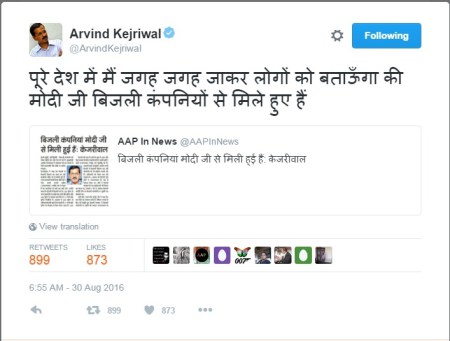
Now look at the above numbers and also the never ending rant below and decide for self, ‘कौन हैं जो बिजली कंपनियों से मिले हुए हैं?’ (who after all is hand in glove with the Electricity supply companies?).

djb10a

Sometimes I laugh and cry at the same time. While I laugh at the irony of the situation, I cry because I laughed too much. The irony of the situation is, that while His Honesty is coughing and faffing on odd-even days, people in Delhi are crying for BASICS every day!

Credit: I thank Prakash Sharma for his insight that he shared through his tweets on the subject. He tweets at @India_Policy

Has the fight for Uttar Pradesh begun within BJP?

0

Uttar Pradesh, the “Hindi heartland”, the “cow-belt”, was once upon a time BJP’s bastion. Of late though, BJP had lost its foothold there, with the emergence of caste based parties like SP and BSP. This changed in 2014 when BJP racked up an unprecedented 70+ seats in Uttar Pradesh in the Lok Sabha elections, which powered NDA to a stunning majority. Hence, early surveys in Uttar Pradesh indicate that the 2017 state elections maybe the ticket for BJP’s revival.

The question of course is, who will line up to be the CM candidate in Uttar Pradesh. Two names which get commonly thrown around are Smriti Irani and Varun Gandhi. Irani has been the HRD minister and was “demoted” to the Textile Ministry, which could possibly be a blessing in disguise. She has adopted Amethi as her constituency, where she contested against Rahul Gandhi. She has always remained mum on her political ambitions in UP.

Varun Gandhi on the other hand is out of the news for some time now. Reports say he has been deliberately sidelined, yet some posters of “supporters” often portray him as the CM candidate for Uttar Pradesh. Compensating for his absence from news cycles in his mother Maneka, who is the Women and Child Development minister. Her ministry is fast becoming controversy’s favourite child.

The main issue dogging Maneka Gandhi’s ministry currently is her quixotic and draconian idea of policing social media for “trolling”. Further, her ministry’s dealings on social media aspects themselves seem very problematic.

Yesterday, Minister Maneka Gandhi tweeted from her official handle, an undated clarification on the social media handling of her ministry. The crux was: A selection committee had shortlisted an agency, but when the file reached her, she rejected the idea of hiring people from outside:


The puzzling part is, a letter dated 22nd September 2015, almost a year before, was already making the rounds on the internet, which clearly showed the WCD ministry hiring a social media agency for precisely this work!

Deleted letter

The letter completely contradicted the minister’s stance on the hiring of the agency, and within minutes of Maneka’s tweet, the letter was deleted from the official site.

As if that wasn’t enough, we go back to the idea of social media patrolling. It was revealed via RTI that the ministry had in fact hired 2 consultants for regulating social media trolling. Is it the job of this ministry to act as a cop on social media?

But the next bit of news is perhaps the most startling. We already revealed how the Textile Minister Irani was subjected to a farcical hit-job last week. The hit-job claimed that Irani had purchased items worth Rs 8 lacs from the Cottage Industry Corporation and had made her secretary charge the bill to the Government. This apparently led to a souring of relationship between the two. Luckily the truth was revealed when the Cottage Industry Corporation revealed that no such purchase had every taken place, hence the entire story was fabricated. HRD Ministry too issued swift clarifications.

In all this, the role of a few individuals is key:

Rajdeep Sardesai, first tweeted about this news (time-stamps suggest he tweeted this even before the media house published their story), without naming Irani. He later deleted it, but before he could delete it, self-declared “image-guru” Dilip Cherian quoted the same tweet attempting to fan the fire. This tweet was then quoted by an abusive and lying journalist, Swati Chaturvedi, where she claimed that “secretary in the ministry has asked for another posting”. Readers may note that this is the same journalist whom we had recently exposed for her lies, and who had then in revenge, attacked our co-founder and had demanded he be sacked by his employer.

How do these events have a relation? Rajdeep Sardesai has been often thrashed by Smriti Irani online, for his lies. Dilip Cherian is the co-founder of the social media agency “Perfect Relations” which, as per one letter was hired by Maneka Gandhi’s ministry, and as per another, was not hired. Chaturvedi is rumoured to be close to Maneka Gandhi and she has defended the ludicrous social media policing proposal vehemently.

What makes matters worse is a tweet series by Twitter User  which claims two things:

A. In May 2016, the Textile Ministry (then not under Smriti Irani) had signed an MoU with NDTV, which was “cancelled” after social media outrage.  claims this was never cancelled. The textile secretary is said to have sent a false compliance report to the PMO, and this was apparently noticed by the new minister Irani, who has now reported this to the PMO, which is livid.

B. Within days of the above report going to the PMO, the fake Rs 8 lakhs hit-job on Smriti Irani was published, and this was done, according to , at the behest of “a PR firm hired by another ministry”. As we mentioned above, the fake story claimed relations between the secretary and the minister had soured because of the Irani’s fault. This was further perpetuated by the likes of Chaturvedi.

Is there a thread emerging here? Individuals close to Women and Child Minister, from a PR firm which was hired by the ministry, allegedly spreading a fake story against another minister, which is completely untrue? And in all this, a secretary also gets a defence.

What could be the reason you ask? Read the introduction again. Smriti Irani and Varun Gandhi are two of the contenders for UP form BJP. Make of it what you want but this matter is just hotting up.

Two consultants hired by WCD Ministry to regulate online “trolling”. Is this their job?

0

Online harassment is taking a centre-stage due to Union minister Maneka Gandhi coming out with a hashtag #ImTrolledHelp to help (?) women being harassed online.

If somebody is being harassed online there are many ways to tackle it – if it is Facebook there are enough safeguards to report such harassment to Facebook and if it is Twitter there too exists lot of safeguards – to report abuse and action is taken within maximum of 7 days – both Facebook and Twitter deactivate the accounts and in both Facebook and Twitter there is also a option of blocking the said person.

The only time when some serious help maybe needed is when real crimes happen on social media. A threat to a person in real life counts as a crime. Logically this should extend to social media as well. But here the system fails. Social media platforms like Twitter and Facebook have no mechanisms to take action against people who threaten with a crime. They could suspend the account, but they can do nothing to ensure a crime doesn’t take place. Obviously, they are not expected to do so and here the law enforcement agencies step in. Unfortunately, the local police station also may not be of much help. Cops are often misogynistic, and to add to this, technologically illiterate. Explaining and convincing them about a threat on social media to a woman could be a herculean task.

THIS is exactly where WCD Ministry should have stepped in. Credible threats of violence, especially against women, need to be addressed as soon as possible. Any ministry is well within its rights to act against a crime or the possibility of occurrence of a crime. Instead, we see the WCD Minister going after something as vague as “trolling” which can cover an innocuous “ROFL” comment, to even the vilest of abuses.

The number of instances where action has been taken on online harassment of women are many – but  what union minister Maneka Gandhi did by introducing #ImTolledHelp is totally unwarranted – there are many issues on which she can concentrate instead of job of regulating online harassment of women .


The motive clearly seems to help her media friends who provoke all Right-Wing people and then cry victim . If Maneka Gandhi was serious, by this time many journalists should have faced the heat for their endless trolling and abusing Smriti Irani and @UnSubtleDesi. Till date no action has been taken against them.


The number of times Smriti Irani has been trolled is endless and till date we have not seen Maneka Gandhi take action on them:


The very fact that the minister’s initiative is welcomed by all journalists means it was done for them and intentions not seem to be genuine .

So I filed an RTI to find out how she proposes to keep a track of complaints and how many ministry officials are deputed for it and if there is a segregation of complaints – like Facebook / Twitter etc – this is the reply given –

RTI reply
RTI reply

Based on the reply I have filed an appeal to know the following facts –

  1. What are the names / address of these 2 consultants ?
  2. What is the basis of selection of these 2 consultants ?
  3. Was there a proper tender process followed to shortlist these consultants .

Once I get a reply will update it – I am sure it will be interesting and have also further filed a RTI to know the following facts –

“Since announcement of the special cell for dealing of online stalking and abuse of women, I wish to know totally how many complaints have been received as on date and I wish to know the breakup of the locations from where complaints were received and breakup of the medium from which it was received: like how many were from Facebook , how many from twitter and if any other online source. Also would like to know how many of these cases have been fit for further action. Also please let me know the actions taken on the cases you found fit for further pursuance.”

Once a reply comes for the subsequent query I have raised, I am sure many questions will be answered, whether #imTrolledHelp is a genuine effort on minister’s part or just an exercise to satisfy her friends in media.

If it is proven that this is just to help her friends in the media,  hope PM takes action against her not only for this nonsense but also on her stand on many other issues like opposing #Jallikattu in the name of animal rights

The sooner the better for country .

(This post was originally published here)

Twitter users come out in support of OpIndia co-founder as trolls target his personal life

It is well known that those who call themselves “liberals” are the most intolerant bunch in India, but not only are they intolerant, they are vicious and they believe in total annihilation of people who dare to disagree with them, or worse, challenge their narrative.

They indulge in character assassination (physical assassination is usually outsourced to the left wing terrorists, who are not yet operative in urban India) and they try to hurt your personal life. They want to make lives of people hell, so that no one ever dares to disagree with them again.

This is what they tried to do earlier with Rahul Raj, one of the co-founders of OpIndia.com and who also runs a popular Facebook page called “Bhak Sala”.

The attack on Rahul was initiated and championed by an abusive Twitter user Swati Chaturvedi, who claims to be a journalist.


//platform.twitter.com/widgets.js

We had earlier published a report how one of her journalistic reports was devoid of any facts and bordered on cheap rumor mongering.

Perhaps that fact-checking of her claims by us infuriated her. Since she didn’t have facts on her side, she decided to use slander and abuse as tools. In a series of tweets, which were nothing but targeted harassment, she claimed Rahul Raj of stalking her and being abusive.

If keeping track of her articles to do fact-checking is “stalking”, we at OpIndia.com will continue doing this not only to her, but to every journalist who wants to get away after claiming imaginary things. So far as being “abusive” is concerned, it’s ironical that it comes from Swati, who herself is abusive.

However, that doesn’t give anyone a license to abuse her. But the fact here was that she failed to produce a single tweet where Rahul Raj had used abusive language against her.

But as always, facts didn’t matter to Swati. She continued her tirade against Rahul Raj, and was later joined by a few journalists and trolls belonging to a couple of political parties, towards whom she is friendly.

Apart from slandering Rahul Raj’s character for being a stalker and abusive (without giving any proof), she tried to hurt Rahul’s professional life by complaining to the company with which Rahul is employed.

Her fanatical and senseless behavior was soon noticed by many Twitter users who decided to speak against this targeted harassment of Rahul Raj. Soon after hashtag #Support_Bhak_Sala was trending on Twitter. Following are some of the selected tweets people came up with to support Rahul Raj: