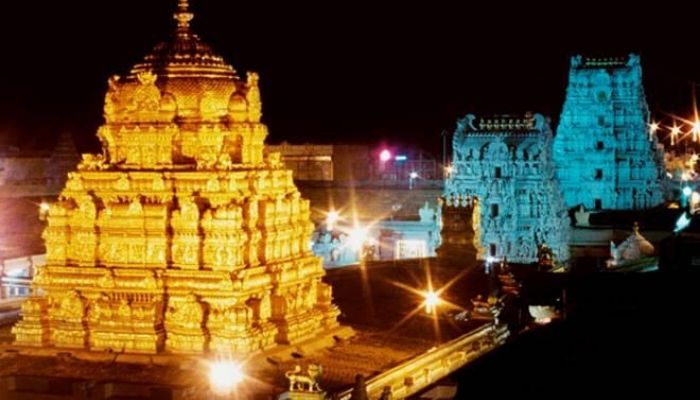
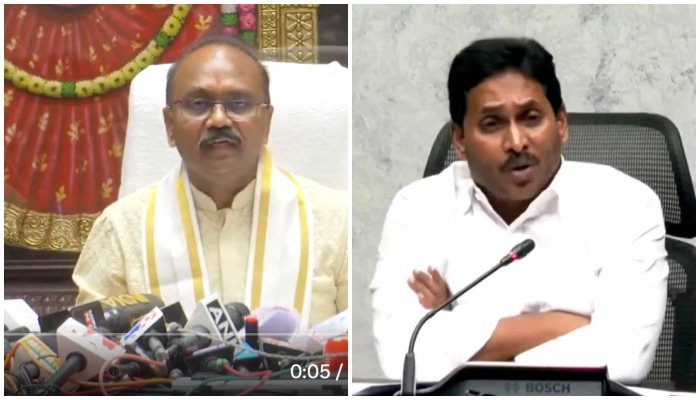
Telugu Desam Party (TDP) leader Gandi Babji hits out at YSR Congress Party (YSRCP) over alleged use of animal fat in consecrated sweets–‘Tirupati Prasadam’ at Sri Venkateswara Temple and said that the party did ‘illegal activities’ for ‘greed of money’.
Speaking to ANI on Friday, he said, “The previous YSRCP government did all illegal activities for greed of money. They did not consider people’s lives and sentiments.”
He further said that the government will investigate the matter and find out the persons involved in it.
“After we came into power, Chief Minister Chandrababu Naidu enquired about the issue, so they found it, it was a polluted ghee. The government’s duty is to find out who is responsible for it,” he added.
The remarks came after Andhra Pradesh Chief Minister Chandrababu Naidu claimed that substandard ingredients, including animal fat, were used in the preparation of Tirupati laddus, a sweet offered at the Sri Venkateswara temple in Tirupati, during the previous Yuvajana Sramika Rythu Congress Party (YSRCP) government.
Earlier, Andhra Pradesh Deputy Chief Minister Pawan Kalyan said that he was “hurt and shocked” by the controversy over the alleged use of animal fat in Tirupati Laddu Prasadam given at Tirumala Temple in Tirupati and called to set up a ‘Sanatana Dharma Rakshana Board’ to protect the sanctity of temples.
“We are hurt and shocked…When people of no commitment, no value and no respect for the sanctity of the temple, if they take charge this is what happens…It is not just about prasad, maybe liquor and non-veg was supplied, people were having parties there,” Pawan Kalyan told ANI.
Reacting to the allegations, the YSRCP chief Jagan Mohan Reddy told reporters, “Ultimately, at the end of the day, I myself am writing a letter to the Prime Minister. I am also writing a letter to the Chief Justice of India. I am explaining to them as to how Chandrababu Naidu twisted the facts and why action should be taken against him for having done so.”
(This news report is published from a syndicated feed. Except for the headline, the content has not been written or edited by OpIndia staff)
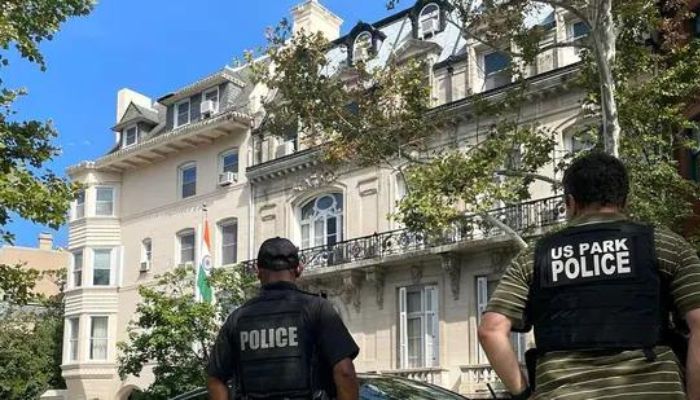
An official of the Indian Embassy in Washington was found dead under mysterious circumstances within the premises of the mission on Wednesday (18th September).
The embassy confirmed the development in a statement on Friday (20th September). The case is now being investigated by the Secret Service and the local law enforcement authorities in the United States.
According to a report by PTI, the investigation officials are probing all possible angles including suicide. Further details are awaited in the case.
⚡️ BREAKING: ?? Indian Embassy official found dead at ?? Washington DC office
Local police and the Secret Service are investigating the incident that took place two days ago pic.twitter.com/FSTfDvYIcD
In a statement, the Indian embassy in Washington stated, “With deep regret, we wish to confirm that a member of the Embassy of India passed away in the evening of 18th September 2024.”
“We are in touch with all relevant agencies and members of the family to ensure the swift transfer of the mortal remains to India,” it added.
“Additional details regarding the deceased are not being released out of concern for the family’s privacy. Our thoughts and prayers are with the family in this time of grief. We thank you for your understanding,” the Indian embassy concluded.
Amid the ongoing violence against minorities including Hindus in Bangladesh after the fall of the Sheikh Hasina government, the Bangladesh National Hindu Alliance placed four key demands with the interim government ahead of the upcoming Durga Puja. As the most important festival for Bengalis, the Hindus in Bangladesh also celebrate the religious festival with great enthusiasm.
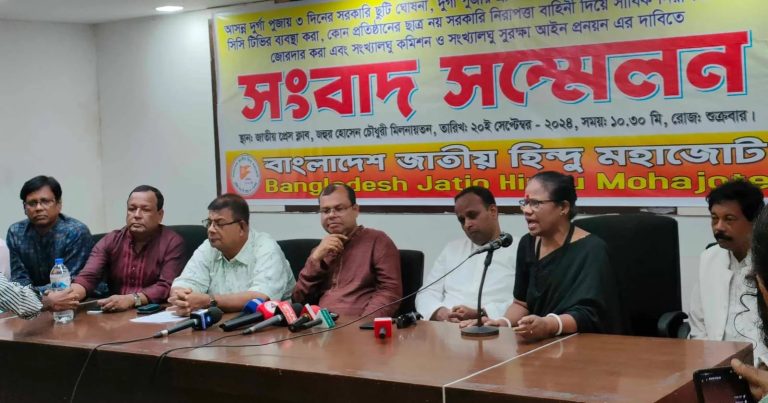
But with the rise of fundamental Islamists in the country, attacks on Durga Puja pandals including vandalization of idols have become common in recent years. With large-scale violence against Hindus and Hindu temples under the current regime, the Bangladesh National Hindu Alliance held a press conference at the Jatiya Press Club in Dhaka, today, where they made the demands.
Leaders of the National Hindu Alliance said that the Hindu community often faces discrimination during Durga Puja, including only one day govt holiday during their most important festival. They demanded a three-day government holiday for Durga Puja, saying that the current only one-day holiday is not enough to fully participate in the festivities and rituals.
Durga Puna is a five-day festival, and only one-day govt holiday is not adequate, they argued. The Hindu group has urged chief advisor Mohammad Yunus to declare official holidays on Ashtami, Navami, and Dashami.
Anticipating large-scale attacks and vandalisation of Durga Puja mandaps during the festival starting on 9 October, Bangladesh National Hindu Alliance demanded increased security measures, including the installation of CCTV cameras at all permanent and temporary puja mandaps and the provision of security by government forces before and during the festival.
They also demanded the deployment of military personnel at all puja mandaps during Durga Puja. The members of the organisation said that given the past incidents, the Hindu community is increasingly concerned about the security of puja pandals this year.
The Hindu organisation also demanded the establishment of a minority protection law and a minority commission.
The leaders of the organisation said that Durga Puja represents unity and celebration for the entire Bengali nation. They added that the festival requires significant commitment and adherence to religious customs.
Notably, the Bangladesh Home Ministry has already announced several restrictions on Hindus during Durga Puja. The ministry has directed Puja committees to turn off Durga Puja rituals and sound systems five minutes before Azan and Namaz. As per the ministry, a total of 32, 666 puja mandaps will be erected across the country this year.
Bangladesh National Hindu Alliance also welcomed the interim government’s decision to give magistracy powers to the army, saying this will help in maintaining law and order. On 17 September, the Bangladesh govt gave magistracy power to commissioned army officers with immediate effect for 60 days in order to improve law and order.
The officers will act as executive magistrates across the country, and an officer with magistracy power can arrest people and put them in custody. In self-defence and extreme need, the officer can open fire.
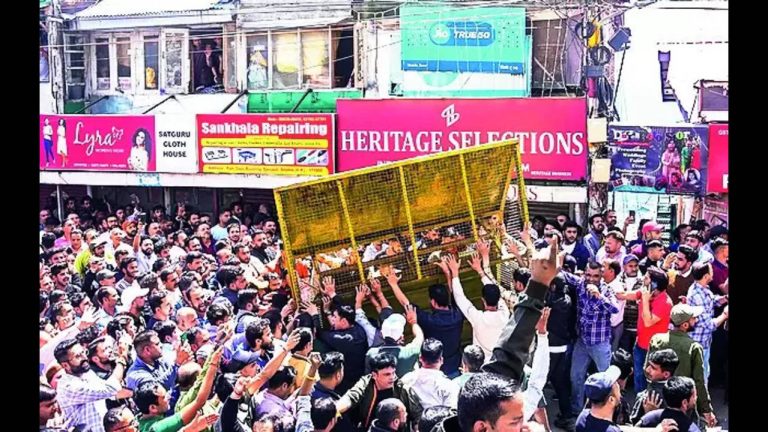
Himachal Pradesh is in the throes of protests as thousands of Hindus have taken to the streets against what they assert to be a deliberate attempt to effect demographic change and fuel chaos in an overwhelmingly Hindu state.
A peculiar incident provides a background into why Hindus in Himachal Pradesh have decided to take the matter into their own hands and protest against what appears to be a sinister plan to surreptitiously Islamise the society and change the demographic composition of the society.
Curiously, at least 46 Muslim vendors in Shimla were caught using the Aadhaar Card with the same date of birth. Unsurprisingly, all of them were outsiders. Most of those vendors had recently come to Himachal Pradesh under the pretext of starting a business.
Big news from Shimla : 35 MusIim vendors had the same Aadhar card details and all of them are outsiders. They came to HP recently in the name of doing business.
First illegal Mosques & now this, it's a big conspiracy to change the demography of Devbhoomi Himachal Pradesh… pic.twitter.com/U0QdjYLFjf
A report published in Jagran said 46 out of 88 Muslim vendors in Shimla had the same date of birth. This led to protests from the traders and locals, who filed a complaint with the police, demanding them to authenticate their identities. Thousands thronged the streets of Shimla to oppose what they call a conscious attempt at altering the demography of a predominantly Hindu state. In addition, security concerns also prompted a raft of people to come out in protest against vendors who had reportedly forged their identities to operate their businesses in the state.
However, this is not the first time that the state has been rocked by public demonstrations.
For the last few weeks, large-scale protests have been a mainstay of Himachal Pradesh, also known as ‘Devabhoomi’ because of its strong association with Hindu mythology and religion. But this ‘Devabhoomi’ appears to be facing imminent threats from irreversible demographic alteration, cultural decay, and illegal encroachment and construction.
While the issue has been a flashpoint for decades, it gained prominence with the protests against the unauthorised structure raised at what locals claim as an illegal mosque. The issue is more than 14 years old but it took a violent turn when some Muslim youths launched a deadly assault with rods and sticks on Hindu traders in the Malyana region on 30th August. 37-year-old businessman Vikram Singh endured critical injuries while four other businessmen were also hurt. The incident further escalated the tensions as the local Hindu community took to the streets to protest against the attack as well as the illegal mosque.
Waqf Board recently gave a submission to a Shimla court that it owns the mosque and the argument was only about its further development. The Shimla Municipal Corporation Commissioner’s court heard both parties in the mosque case and fixed the next hearing for 5th October.
On the other hand, the matter was also raised in the state assembly which sparked disagreements among the leaders of the ruling Congress party. According to MLA Harish Janartha, the mosque was built on land owned by the Waqf Board before 1960. He did, however, add that three stories were erected unlawfully in 2010 and asserted that they were taken down. He claimed that both outsiders and local Muslims were using the mosque and alleged that some elements were exacerbating the problem.
The attack and the ensuing protests, however, rippled through the state, prompting people elsewhere to come out and express their disapproval against illegal construction and structures built on usurped lands. Following Sanjauli, a large number of locals in Himachal’s Mandi district came out on the streets protesting against an unauthorised structure built at a mosque.
After the cases of illegal mosques came to light from Shimla’s Sanjauli, a massive protest erupted in Kullu against an illegal Jama Masjid built in the town’s Shriram Street. Hindus, in large numbers, staged a protest against the illegal mosque.
In Himachal Pradesh’s Kullu, the illegal mosque that triggered outrage among the Hindu community is located on Shriram Street of Akhara Bazaar. It goes by the name of Jama Masjid. According to Hindu organisations, the Jama Masjid has been illegally built on land that belongs to the Khadi and Village Industries Board.
Demanding administrative action against the illegal construction of this mosque, the protesters took out a march from Ramshila’s Hanuman Temple to Dhalpur Chowk. Members of Hindu Jagran Manch and other Hindu organisations began Hanuman Chalisa recitals nearly 10 meters away from the site of the illegal mosque.
According to Hindu organisations, in correspondence that has been going on since 2017, the Kullu Municipal Council has accepted that this mosque was built illegally on land that belongs to Khadi and Village Industries.
It is claimed that the Jama Masjid was built in Akhara Bazaar in 1990-1991. Back then, the structure had only one floor. Later, it underwent reconstruction in 2017 and now it has four floors. Back then, the Hindu organisations had raised objections against construction work in this illegal mosque which had halted its work. According to them, the structure of this building doesn’t adhere to the map passed for this place.
The Hindu organisations added that nuisance creators are coming from other states to Himachal Pradesh. Their number runs in hundreds daily and they enter Himachal without any registration. They commit anti-social activities and are thus posing a threat to the culture and security of this place.
For those protesting against the illegal mosques and unauthorised structures, the fight is not only about the brazen violation of law and order in the name of religious freedom but also about the existential threat they face from a proselytising faith that poses a grave threat to their religious and cultural identity.
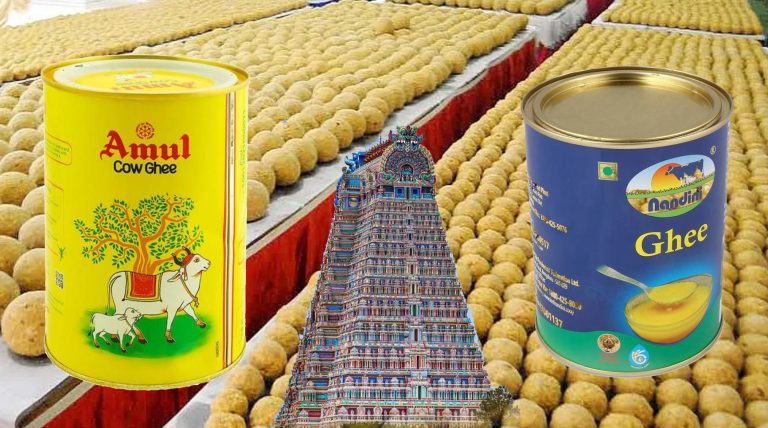
Amid the controversy over the presence of animal fat like beef fat, pig fat and fish oil in ghee used to make the famous laddus of Tirupati temple, dairy giant Amul has clarified it never supplied ghee to the temple. The clarification came after several social media users claimed that after the temple stopped buying Nandini ghee from Karnataka over increased price, they started to buy Amul Ghee, and the adulteration was found in the ghee supplied by Amul.
Notably, Tirumala Tirupati Devasthanams in Tirumala has been using Nandini ghee to make its prasadam for decades. But after the Karnataka Congress government increased the prices of Nandini Milk marketed by the Karnataka Milk Federation, the ghee price also increased, and it was no longer the lowest bidder in twice-a-year tenders floated by the temple. As a result, the temple committee selected a different ghee supplier to make the laddus.
Now, it has been revealed that the cheaper ghee selected by the temple was not pure dairy ghee, but it was adulterated with plant and animal fats. As per a test report by According to a report by the National Dairy Development Board’s “Centre of Analysis and Learning in Livestock and Food” (CALF) laboratory in Gujarat, apart from several vegetable oils, the ghee used by the temple also had Fish Oil, Beef tallow which is a form of fat, and Lard which is a form of fart obtained from pigs.
The laddus also used vegetarian ingredients like Soybean, Sunflower, Olive, Rapseed, Linseed, Wheat germ, Maize germ, Cotton Seed, Coconut, Palm kernel fat, and Palm Oil.
After this revelation, some supporters of opposition parties started to claim that this adulterated ghee was supplied by Amul.
So they changed the ghee from Karnataka's Nandini to Gujarat's Amul because it was "cheaper". Such a farce.https://t.co/cbc5HlI6qD
Social media users also cited an India Today report from August last year, which claimed that Amul ghee was selected instead of Nandini ghee after the price hike by Karnataka Milk Federation products. However, strangely, the Amul ghee words were put in brackets in the quote by KMF president K Bheema Naik. The India Today report quoted him lamenting about losing the contract to supply to the temple as saying, “We proposed a higher price due to the upcoming hike in milk costs from August 1, but the TTD chose a different company (Amul brand) that made the lowest bid on the e-procurement site.”
It is not sure whether Naik mentioned Amul, or it was inserted by India Today, as the term is in brackets. The report also raised the question whether the quality of the laddu will be same after it is made using Amul ghee.
Pro-Congress Twitter account Spirit of Congress also shared the report, claiming that Nandini was removed and Amul was given the contract to supply ghee to TTD in 2023.
Nandini used to supply pure quality Ghee till 2023 for Tirumal Tirupati Devasthanam.(TTD)
Then.. Nandini was removed and Amul was given the contract to supply ghee to TTD.
Mumbai Congress social media general secretary also made the same claim, that Amul had replaced Nandini to supply ghee.
So Nandini Ghee from Karnataka was replaced, and Amul Ghee from Gujarat was awarded the contract for Tirupati Prasad. Something seems suspicious ever since the news broke yesterday. Tirupati is one of those revered temples where such mistakes are unimaginable. #TirumalaLaddu… pic.twitter.com/J1dcG07fyS
Now, Amul has clarified that it never supplied ghee to TTD, and the claims made social media users are wrong. In a statement, the company said, “This is in reference to some social media posts mentioning that Amul Ghee was being supplied to Tirumala Tirupati Devasthanam (TTD). We wish to inform that we have never supplied Amul Ghee to TTD.”
The further added, “We also wish to clarify Amul Ghee is made from Milk at our state-of-the-art production facilities which are ISO certified. Amul Ghee is made from high quality pure milk fat. The milk received at our dairies passes through stringent quality checks including adulteration detection as specified by FSSAI.”
The leading dairy brand said, “This post is being issued to stop this misinformation campaign against Amul.”
Amid the rising crimes in European nations including the UK, it has come to the fore that in London, a rape case is reported every hour. On average, 24 such incidents were reported in a day to the Metropolitan Police with a total of 8,800 cases in 2023. According to the Met Police, the charges of sexual abuse have doubled since 2022, as reported by BBC.
As per the official data, 20,000 sexual crimes were reported in London alone last year while the exact figures stood at 8,852 rape cases and 10,991 other sexual violence. While these numbers are alarming the actual number of cases is obviously much higher than documented. This is better understood from a Rape Crisis report, which states that only one in every six women who are raped reports the crime, compared to one in every five male victims, and only one in every four report other forms of sexual assault. 40% of the survivors don’t approach the police due to “embarrassment”, 38% don’t tell the police since they opine the police will not be able to help them and 34% think that seeking police help would be “humiliating”. Another disturbing aspect is that 1 in 2 adult rape survivors have been raped more than once.
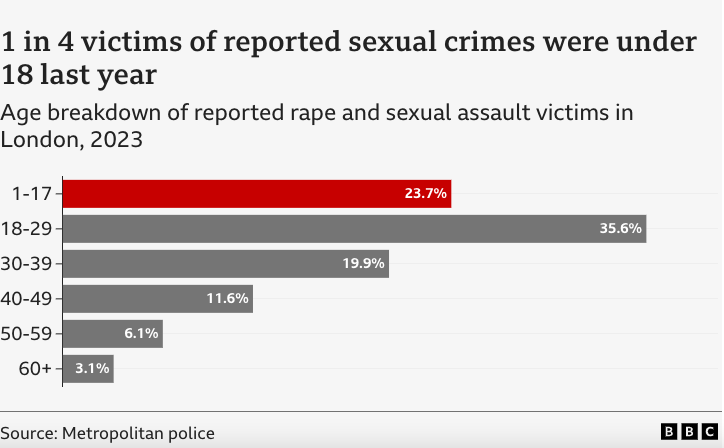
Last year, the police received 11,000 reports of various sexual crimes, with over a quarter coming from youngsters under the age of 18. The BBC report says that the figures represent the number of reports issued from 2018 to 2023, “but do not necessarily mean all the crimes happened within that time period.”
One dataset focused solely on reported cases of rape, while the other included cases of sexual assault, assault by penetration, and attempted rape. From 2018 to 2023, the overall number of reported offences surged by 14%, reaching nearly 20,000. Precisely, the Metropolitan Police received a report of sexual violence or rape every 26 and a half minutes.
The alarming numbers revealed in the official data warrant discussing the existence of Muslim grooming gangs in the United Kingdom. Grooming gangs, particularly in towns and cities such as Telford, Rotherham and Rochdale, have gone unchecked for many years. Much later it was revealed that organised grooming gangs systematically sexually abused young girls. These crimes were sometimes overlooked or downplayed by authorities. The media also contributed to its downplaying by often presenting Muslim grooming gangs mostly involving Pakistani and Afghan origin, targeting white non-Muslim girls “Asian gangs”.
While the perpetrators in the Telford, Rotherham and Rochdale grooming cases were mostly Muslims, a section of the media covered up the religious and racial motivation behind the crime. Notably, drugs and alcohol were commonly used to render victims unconscious or entrap them in a cycle of abuse which went on as threats and blackmailing continued.
Rape and sexual abuse offences in the United Kingdom have frequently gone unchecked or underreported, owing to a mix of systemic failures, societal stigmas, and law enforcement challenges. The above discussion and the UK media reports suggest that victim blaming and fear of stigmatisation, Lack of Trust in Authorities coupled with the fears of being labelled “racist” or “Islamophobic” has been major reasons for the sexual abuse cases being underreported. The incidents of grooming gangs exploiting women, particularly the Telford case, demonstrated how police inaction emboldened the offenders and allowed the abuse of thousands of vulnerable girls and women to continue for years. It took three major grooming gang scandals for the Grooming Gang Taskforce leading to hundreds of arrests, the UK authorities
The union territory of Jammu Kashmir is currently undergoing its first assembly election after the abrogation of Article 370 on 5th August 2019. Prime Minister Narendra Modi referred to the historic voter turnout in the first phase of the poll as proof of a “Naya (new) Kashmir” in his first rally at the She-i-Kashmir Cricket Stadium in Srinagar. He stated, “J&K is witnessing a festival of democracy. The first phase of voting was held peacefully and not under the shade of terrorism. Voters, including young, old and women, voted freely and in huge numbers. Kishtwar saw 80%, Doda and Ramban 70% and Kulgam 62% voting. Compared to the previous turnout, new records have been set. People have written a new chapter of history. It shows the aspirations of people are touching new heights in J&K. The world is witnessing how the people of J&K are strengthening the Indian democracy of the country. I congratulate people for that.”
श्रीनगर की रैली में मेरे भाई-बहनों का जज्बा जम्हूरियत के जश्न में नया जोश भरने वाला है। pic.twitter.com/nJlLx0YNfC
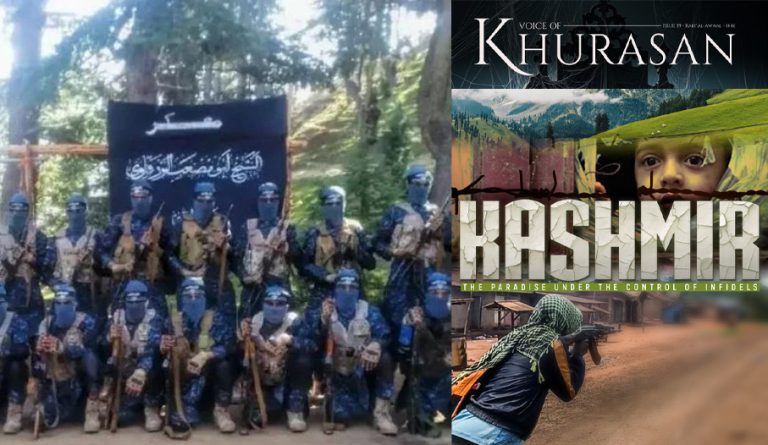
While the people are enthusiastically participating in the assembly election and exhibiting their faith in India’s robust democracy, the jihadi elements have once again conspired to use the opportunity to stoke anti-national sentiment and create trouble, in the name of Islam. Islamic State Khorasan Province (ISKP), which is a regional branch of the Islamic State of Iraq and Syria (ISIS) also known as Islamic State (IS), in the latest issue of its propaganda magazine “Voice of Khurasana” has referred to Kashmir as “The Paradise Under the Control of Infidels,” and urged the Muslims in Kashmir to wage jihad against India.
It has featured dramatic pictures of pro-separatist elements holding black flags with JKIS or ISJK (Islamic State in Jammu and Kashmir), a group loyal to the IS operating in the valley, written on them along with images of alleged atrocities inflicted on the locals by the security forces. Notably, a few serene and stunning photographs of the valley are also included to showcase its beauty and imply how it is being ruined by the ‘evil infidel.’ The article is ridden with outrageous claims and outright lies intended to stir up violence in the valley, with nary a shred of supporting proof.
The article titled Kashmir: The Paradise under the Control of Infidels, the first article in the magazine, began by lamenting how Muslims have abandoned jihad and replaced the Quran with Western laws which caused a steady decline of the Ummah (Muslim community) at the hands of non-Muslims. It further read, “After the division of the Islamic Ummah, every part of its existence is filled with pain, and one part of it cannot heal the pain of any other part. Now, the infidels are standing in one rank to attack the existence of the Islamic Ummah, and all of them are shooting arrows at it from the same bow.”
“You see that the Jews, Crusaders, atheists, communists, Hindus, Magians, and other pagan nations in the world each have their separate states they defend with their persons and wealth. The United Nations, the Security Council, the international community, and other oppressive groups have also allowed this, calling it the economic right of these infidels. On the other hand, Muslims do not have the right to have an independent Islamic state under which they can gather beneath the shade of one flag and obey one Imam,” the article alleged while conveniently forgetting that there are at least fifty-seven Muslim countries in the world and they are part of all these international bodies.
Furthermore, no non-Islamic nation has established an alliance solely based on religion like the Organization of Islamic Cooperation (OIC), which is exclusive to the Muslim states. Contrary to the claim, there is no Hindu country in the world, and just one Jewish nation which is always attacked by Islamist groups and countries. Similarly, while the Magians had a nation in distant past, now that land is a Shia Muslim country, Iran.
“Those Muslims who even attempt to establish an Islamic state are called extremists, terrorists, kharijites, takfiris, and many other names,” it further bemoaned the fact that the world opposes and fights against the horrific crimes committed against non-Muslims by jihadi groups like IS, including rape, murder and slavery as infidels are considered lesser humans by these Muslim fanatics.
The article then commenced its discussion on Kashmir by claiming, “One of the segments of this fragmented existence of the Islamic Ummah is Kashmir, this heavenly land that has been oppressed for decades by infidel Hindus, nationalistic militias, and so-called jihadist organisations working for the interests of intelligence agencies.” The inflammatory piece went straight to the point, condemning Hindus for retaining Kashmir, a traditionally Hindu territory that even derived its name from Sanskrit and was once known as Kasmira.
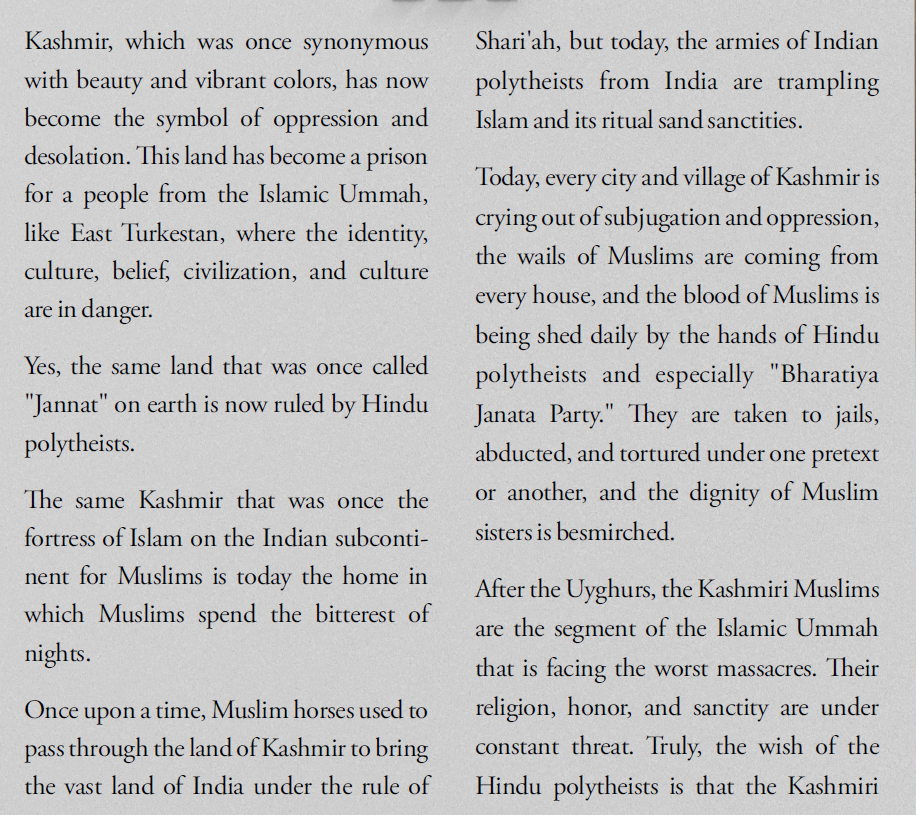
It then adopted the same worn-out rhetoric as every anti-India and anti-Hindu outfit and stated, “Kashmir, which was once synonymous with beauty and vibrant colours, has now become the symbol of oppression and desolation. This land has become a prison for a people from the Islamic Ummah, like East Turkestan, where the identity, culture, belief, civilization, and culture are in danger. Yes, the same land that was once called “Jannat” on earth is now ruled by Hindu polytheists. The same Kashmir that was once the fortress of Islam on the Indian subcontinent for Muslims is today the home in which Muslims spend the bitterest of nights.” The narrative that this terrorist organization is attempting to spread is drastically different from the reality of the prosperous valley where people are living through exciting developments and experiences that were inconceivable before 2019.
“Once upon a time, Muslim horses used to pass through the land of Kashmir to bring the vast land of India under the rule of Sharia, but today, the armies of Indian polytheists from India are trampling Islam and its ritual sand sanctities. Today, every city and village of Kashmir is crying out of subjugation and oppression, the wails of Muslims are coming from every house, and the blood of Muslims is being shed daily by the hands of Hindu polytheists and especially the Bharatiya Janata Party. They are taken to jails, abducted, and tortured under one pretext or another, and the dignity of Muslim sisters is besmirched. After the Uyghurs, the Kashmiri Muslims are the segment of the Islamic Ummah that is facing the worst massacres. Their religion, honour, and sanctity are under constant threat. Truly, the wish of the Hindu polytheists is that the Kashmiri Muslims should worship Allah as they do, chanting “Ram Ram and Bhagwan Bhagwan” instead (Nawjubillah),” the article levelled those allegations without citing any concrete incidence of the oppression committed by the ‘notorious polytheists alias Hindus’ in Kashmir.
Image via Kashmir: The Paradise Under the Control of Infidels
Unsurprisingly, the ISKP is just another Islamist outfit that has its natural nemesis in the ‘Hindu nationalist’ BJP which dissolved Article 370. The argument’s merit, not that it had any, was eroded when the article compared Kashmiri Muslims to Uyghurs who have been imprisoned in detention camps, forced to eat pork, unable to observe Ramadan and spent their life in utter misery under the Communist Party of China. On the other hand, Kashmiri Muslims, like all Indians, are entitled to the same rights and privileges under the country’s constitution.
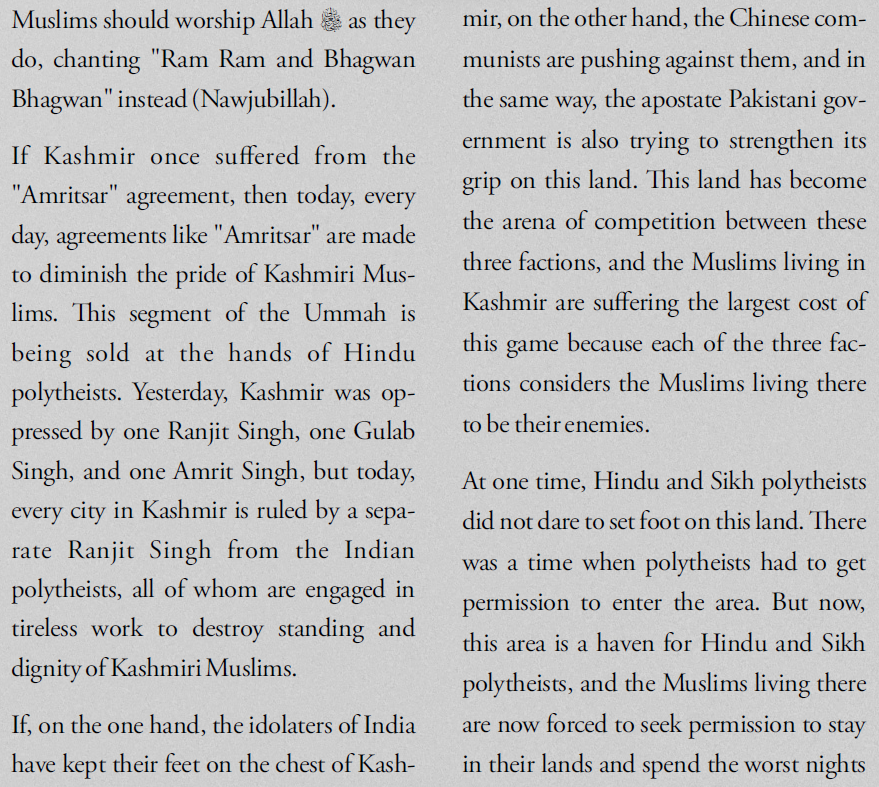
The article then brought up the “Treaty of Amritsar” and accused, “If Kashmir once suffered from the ‘Amritsar’ agreement, then today, every day, agreements like ‘Amritsar’ are made to diminish the pride of Kashmiri Muslims. This segment of the Ummah is being sold at the hands of Hindu polytheists. Yesterday, Kashmir was oppressed by one Ranjit Singh, one Gulab Singh, and one Amrit Singh, but today, every city in Kashmir is ruled by a separate Ranjit Singh from the Indian polytheists, all of whom are engaged in tireless work to destroy standing and dignity of Kashmiri Muslims.”
It then added, “If, on the one hand, the idolaters of India have kept their feet on the chest of Kashmir, on the other hand, the Chinese communists are pushing against them, and in the same way, the apostate Pakistani government is also trying to strengthen its grip on this land. This land has become the arena of competition between these three factions, and the Muslims living in Kashmir are suffering the largest cost of this game because each of the three factions considers the Muslims living there to be their enemies.”
“At one time, Hindu and Sikh polytheists did not dare to set foot on this land. There was a time when polytheists had to get permission to enter the area. But now, this area is a haven for Hindu and Sikh polytheists, and the Muslims living there are now forced to seek permission to stay in their lands and spend the worst nights of life with the permission of the polytheists,” the article consisted yet another preposterous assertion that demonstrated its nefarious objective. Notably, the land of Kashmir has traditionally belonged to the Hindu and other Dharmic faiths until the Islamic invaders devastated the majestic valley for conversion, rape, loot and oppression.
Image via Kashmir: The Paradise Under the Control of Infidels
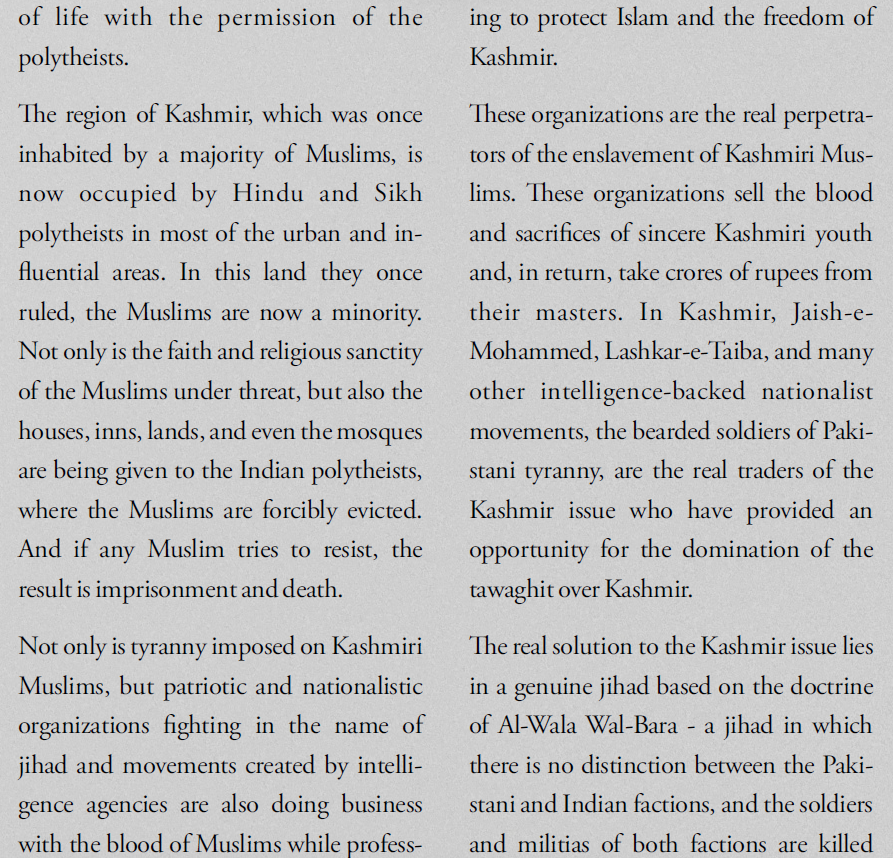
“The region of Kashmir, which was once inhabited by a majority of Muslims, is now occupied by Hindu and Sikh polytheists in most of the urban and influential areas. In this land they once ruled, the Muslims are now a minority. Not only is the faith and religious sanctity of the Muslims under threat, but also the houses, inns, lands, and even the mosques are being given to the Indian polytheists, where the Muslims are forcibly evicted. And if any Muslim tries to resist, the result is imprisonment and death,” claimed the piece littered with glaring falsehoods and abject misinformation. The truth is that it was minority Kashmir Hindus who were slaughtered, raped and forced to flee their homes by people who shared similar ideology and then later captured their flourishing businesses, houses and properties.
It further added, “Not only is tyranny imposed on Kashmiri Muslims, but patriotic and nationalistic organizations fighting in the name of jihad and movements created by intelligence agencies are also doing business with the blood of Muslims while professing to protect Islam and the freedom of Kashmir. These organizations are the real perpetrators of the enslavement of Kashmiri Muslims. These organizations sell the blood and sacrifices of sincere Kashmiri youth and, in return, take crores of rupees from their masters.”
The article then targeted Pakistan and its terrorist organisations including Jaish-e-Mohammed and Lashkar-e-Taiba for having a nationalist view which is considered a sin according to Islam. It declared, “In Kashmir, Jaish-e-Mohammed, Lashkar-e-Taiba, and many other intelligence-backed nationalist movements, the bearded soldiers of Pakistani tyranny, are the real traders of the Kashmir issue who have provided an opportunity for the domination of the tawaghit (a focus of worship other than God) over Kashmir. The real solution to the Kashmir issue lies in a genuine jihad based on the doctrine of Al-Wala Wal-Bara (loyalty and disavowal which signifies loving and hating for the sake of Allah), a jihad in which there is no distinction between the Pakistani and Indian factions, and the soldiers and militias of both factions are killed with the same sword.”
Image via Kashmir: The Paradise Under the Control of Infidels
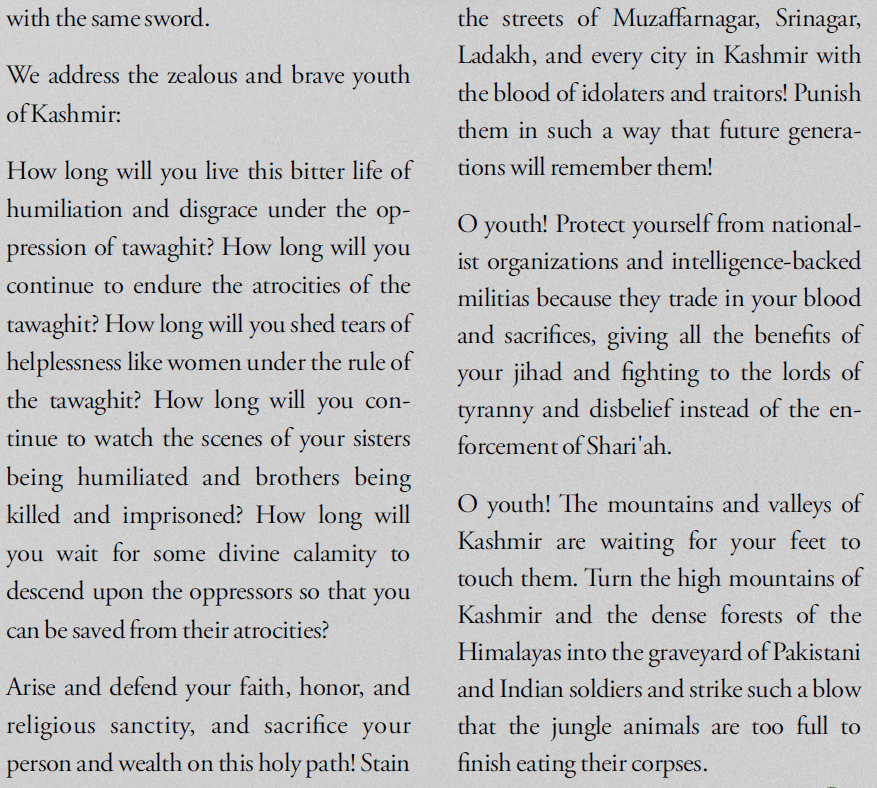
The article then turns its attention to the “zealous and brave youth of Kashmir” and embraces the route of emotional manipulation combined with religious fervour. “How long will you live this bitter life of humiliation and disgrace under the oppression of tawaghit? How long will you continue to endure the atrocities of the tawaghit? How long will you shed tears of helplessness like women under the rule of the tawaghit? How long will you continue to watch the scenes of your sisters being humiliated and brothers being killed and imprisoned? How long will you wait for some divine calamity to descend upon the oppressors so that you can be saved from their atrocities? Arise and defend your faith, honour and religious sanctity, and sacrifice your person and wealth on this holy path,” it provoked.
The article incited young Kashmiri Muslims to take up arms and engage in bloodshed. It maliciously urged, “Stain the streets of Muzaffarnagar, Srinagar, Ladakh, and every city in Kashmir with the blood of idolaters and traitors! Punish them in such a way that future generations will remember them! O youth! Protect yourself from nationalist organizations and intelligence-backed militias because they trade in your blood and sacrifices, giving all the benefits of your jihad and fighting to the lords of tyranny and disbelief instead of the enforcement of Sharia. O youth! The mountains and valleys of Kashmir are waiting for your feet to touch them. Turn the high mountains of Kashmir and the dense forests of the Himalayas into the graveyard of Pakistani and Indian soldiers and strike such a blow that the jungle animals are too full to finish eating their corpses.”
Image via Kashmir: The Paradise Under the Control of Infidels
It even invoked the name of Shaykh Abu Hafs al-Hashimi al-Qurashi, the fifth and current caliph of the Islamic State to encourage Kashmiris to adhere to the same path. “O proud youth! Raise the flag of tawhid (monotheism/belief in Allah), provide as many means and tools as possible for war, and open the front of jihad and fighting against the infidels. No one should bargain over your efforts, sacrifices, blood, and jihad. Choose the holy ranks of Dawlatul Islamiya and the shade of the black flag of tawhid under the leadership of Shaykh Abu Hafs al-Hashimi al-Qurashi, start jihad and fight accordingly.”
The article asked Kashmiri Muslims to transform the region into Jannat (heaven) where non-believers are forbidden entry which refers to the Islamic doctrine that Muslims alone are entitled to paradise and non-Muslims will spend all of eternity in hell. It implored, “O zealous believers living in Kashmir! The ongoing humiliation, crisis, and lack of security in this subjugated and oppressed land can end only when you start an armed jihad against all the tawaghit. Arise and try once again to bring the rule of Islam to this land of Muslims and enforce the Sharia that was revealed to the Prophet. Just as this land is called the Jannat on earth, turn it into the Jannat in which the polytheists do not have a place to step, and the believers live in peace, honour, and dignity.
The article subsequently addressed the promise of invading and conquering India, known to Pakistanis as Ghazwa-e-Hind and how the country’s rulers will be bound in chains and presented before Allah to plead for forgiveness. It stated, “Finally, we give the ghazis (Muslim warriors) who are doing jihad to make the kalimah (declaration of faith in Islam) of tawhid in Kashmir reign supreme the good news of the Messenger of Allah in which he said about Ghazwatul-Hind (invasion of India).”
It then proceeded to point out religious quotes to assert the point and stressed, “Abu Hurairah (one of the companions of the Prophet Muhammad) reported that the Messenger of Allah said, ‘Some people of my Ummah will invade India and Allah will enable them to conquer it, until they bring the kings of India in chains, and Allah will forgive them their sins. Then they will return to ash-Sham, and there they will find Issa ibn Maryam.’ On the authority of Thawban (one of the companions of the Prophet Muhammad), the Messenger of Allah said, ‘There will be two groups in my Ummah whom Allah has protected from the fire. One group will invade India and the other group will follow Issa Ibn Maryam.”
Image via Kashmir: The Paradise Under the Control of Infidels
The article further added, “And Abu Huraira reported, ‘The Messenger of Allah promised us the invasion of India. If I get the opportunity to participate in it, I will spend my life and wealth in it; if I am killed, I will be counted among the best martyrs; and if I return, I will be free (from the Hellfire),” to justify why the Kashmiris must take up weapons and assist in the invasion of India.
“So, O oppressed Muslims living in Kashmir! Arise for the best battle, the best martyrdom, and the best victory. Get up! Save yourselves from the burning fire of Hell. Advance one another in attaining the greatest happiness of the best ghazis and the best martyrs. Do not waste this opportunity. Wage jihad against the polytheists and idolaters to make the kalimah of tawhid reign supreme. Do the greatest jihad! Soon, victory will kiss your feet, and you will have a free and independent land steeped in tawhid, jihad, and Sharia. Allah is mightier than all, but most of the people do not know,” the article concluded with yet another sincere appeal to butcher non-Muslims for the sake of Islam.
Image via Kashmir: The Paradise Under the Control of Infidels
The propaganda piece might be full of deception and inaccuracies but it doesn’t take away from the malevolent intent behind its release at a crucial time when assembly polls are going on in Jammu and Kashmir. Its goal is clearly to destabilise the valley which has joined the Indian mainstream and democracy is thriving in even the most isolated areas as proven by the unprecedented voting. The election was scheduled on 18th September, 25th September and 1st October while the result will be announced on 8th October.
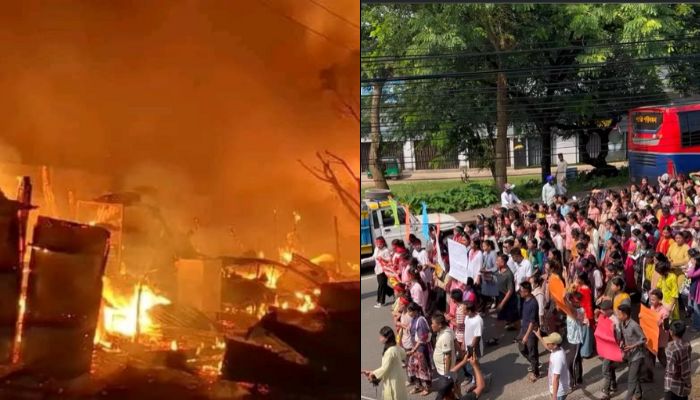
On Thursday (19th September), violent Muslim mobs attacked the Buddhist Chakma and Hindu Tripuri communities in Dighinala and Khagrachhari Sadar in the Chittagong Division of Bangladesh.
According to reports, the accused set fire to more than 200 shops and homes belonging to the minority groups. The Muslim mob also attacked a Buddhist temple and carried out an arson attack.
The official death toll is 3 although our sources in Chittagong confirmed that the actual death toll is much higher.
The deceased were identified as 20-year-old Junan Chakma, 60-year-old Dhananjoy Chakma and 30-year-old Rubel Tripura. All of them belonged to the minority communities.
The targeted attack on Buddhist Chakmas and Hindu Tripuris came a day after a criminal named Mohammed Mamun was killed in Khagrachari on Wednesday (18th September) while trying to steal a motorcycle. Mamun had 17 criminal cases registered against him, including theft.
An organisation named ‘Bengali Chhatra Parishad’ took out a procession in the city a 4:30 pm on Thursday (19th September) to protest the death of Mamun and then carried out violence against Buddhist Chakmas and Hindu Tripuris.
The carnage continued till 8:30 pm on Thursday before the situation could be brought under control. However, fresh violence was carried out by Muslim mobs yet again on Friday (20th September) morning.
A victim named Insta Chakma told The Daily Star that the local masjid made a false announcement that the tribals were attacking the Bengalis. This emboldened the violent Muslim mob to attack Chakmas and Tripuris and set fire to their businesses.
“Then like many, we fled from that area and had no shelter in the forest. Fire and smoke could be seen from the forest,” the victim added.
The onslaught against Hindu Tripuris and Buddhist Chakmas, which started in Khagrachari, also spread to the adjoining Rangamati district.
To make matters worse, a mosque in Rangamati further incited Muslims to attack the minority groups. A man could be heard directing the Chakmas and Tripuris to retreat or face consequences.
The development took place soon after Hindus and Buddhists alike took to the streets to protest against the attack on them. Reportedly, 40000 Chakmas and Tripuris participated in “March for Identity” rally in Khagrachari.
Suhas Chakma, Director of the Rights & Risks Analysis Group (RRAG) informed, “…Bangladesh Army supported the burning down of the Chakma shops and houses at Dighinala Sadar today. Consequently, there is no Chakma left in the Dighinala sadar area.”
He added, “Such act of violence underscores the growing insecurity faced by indigenous communities in the CHTs. The issue of lack of safety and security for the Chakmas will be raised before international bodies, including the United Nations Human Rights Council”
The affected areas of Khagrachari and Rangamati are part of the Chittagong Hill Tracts, which is home to the indigenous Chakma, Marma, Tripuri, Chak, Bom, Lushei, Khumi and other tribal groups.
The local administration has imposed a curfew in Rangamati from 1:30 pm onwards on Friday to prevent any untoward situation.
The situation on the ground
OpIndia reached out to a female Hindu activist from Chittagong, whose house was attacked by Muslim mobs after the fall of Dhaka on 5th August 2024. She informed us that the conflict between Muslims and the tribal community is not new.
“There have been repeated attempts to convert Chakmas, Tripuris and other tribes to Islam. Given that there is a shortage of employment opportunities in the hill tracts, many of them live in abject poverty. Islamic groups reach out to them for Dawah and make lucrative offers.”
“If they refuse, then, they are intimidated and threatened.” She insisted that the current incident should not be looked at from a ‘Bengali Vs tribal’ perspective, given that only one community was behind the onslaught.
OpIndia is in touch with a victim, who had to flee his hometown in Dighinala and is currently in hiding. Due to safety and security reasons, he only communicates to us via messages through an interlocutor in Bangladesh.
Another source, familiar with the development, informed us that a nefarious attempt is underway to brand Chakmas and Tripuris and part of the ‘Christian-Kuki’ alliance eyeing to create their separate State.
The source added that they would use it as a pretext to ‘justify’ carrying out military action against the vulnerable minority groups and blame India at the same time.
Bangladeshi media pass off violence as ‘ethnic clash’
In the meantime, prominent Bangladeshi media began discounting the religious motivation behind the attack by presenting it as a conflict between ‘Bengalis and tribals.’
This is despite the fact that only Muslims participated in the onslaught against Chakmas and Tripuris, who predominantly belong to the Buddhist and Hindu communities. At the same time, it must be remembered that a Buddhist temple was also set ablaze by the Muslim mob.
It’s evident that the Bangladeshi media is yet again trying to shield radical Muslims involved in the religious targeting of minorities.
We have previously reported about the nefarious attempt to downplay violence against Hindus (post the undemocratic ouster of Sheikh Hasina as Bangladesh’s Prime Minister) as ‘fake‘, ‘exaggerated‘ or ‘politically motivated‘.
Attack on Hindus in Bangladesh
There have been at least 205 attacks on Hindu temples, shops and businesses since the ouster of Sheikha Hasina as Prime Minister of Bangladesh.
OpIndia had reported how a Hindu boy named Utsab Mandal was almost lynched by a Muslim mob on accusations of ‘blasphemy’ in the Sonadanga residential area of Khulna city.
We previously exposed how Muslim students have forced as many as 60 Hindu teachers, professors and government officials to resign from their positions.
Human rights activist and exiled Bangladeshi blogger, Asad Noor, has recently revealed that the minority community is now being coerced into joining ‘Jamaat-e-Islami’.
On 6th September, a procession of Hindu devotees carrying the idol of Lord Ganesha came under attack in the Kadam Mubarak area in Chittagong city of Bangladesh.
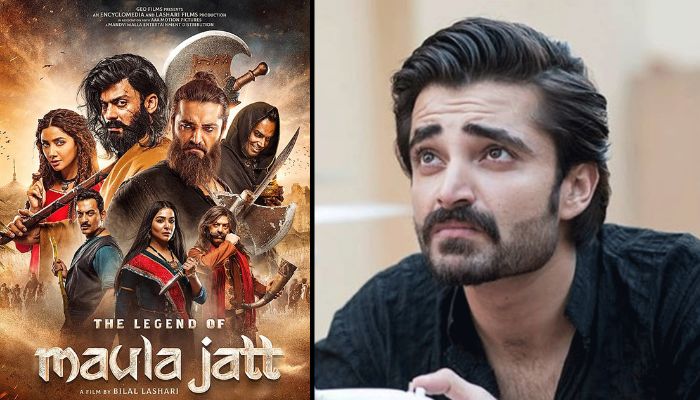
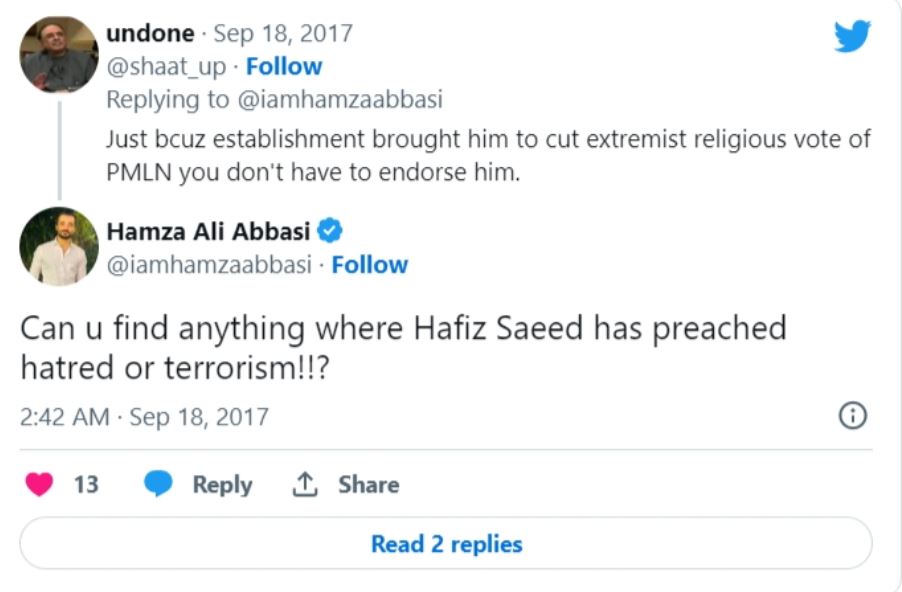
While the release of many Indian films is banned in Pakistan, a controversial Pakistani film featuring a notorious sympathiser of terrorist Hafiz Saeed, is all set to be released in India. Notably, Pakistan’s only Rs 100 crore grossing film, ‘The Legend of Maula Jatt’ will be released in India on 2nd October. The film has been in controversy for several years as it features Pakistani actor Hamza Ali Abbasi, a notorious sympathiser of 26/11 Mumbai terrorist attack mastermind Hafiz Saeed.
Initially, the makers of the film had scheduled its release in December 2022 but after facing massive backlash in India, its release in India was postponed “indefinitely”.
Recently, the filmmakers shared a poster of the film from the official Instagram account of ‘Maula Jatt’ to inform about its release date. The caption read, “Two years on, The Legend of Maula Jatt is still unstoppable! Witness the epic saga on the big screen in India from 2nd October 2024. Cinema listing to be shared soon.”
Several netizens have expressed disappointment and registered their protest over the release of a Pakistani film in India when the country continues to carry out terrorism against India. They have also cited Hamza Abbasi’s praise for a terrorist who killed scores of innocent people in India and carried out one of the worst terrorist attacks on Indian soil, 26/11 Mumbai terror attack.
Pak movie of actor who supported terrorist Hafiz Saeed who has killed 100s of Indians is getting released in India.
While nationalist Kangana Ranaut's 'Emergency' is not getting certificate from censorboard. pic.twitter.com/Xfp5XvaBNu
Expressing disappointment, the Head of BJP Maharashtra social media team, Ashutosh Dubey wrote, “It raises concerns about how @ZeeStudios_ can proceed with the release of this Pakistani film, considering that the funds generated from Indian audiences may potentially be utilized for activities that threaten India’s security.”
It raises concerns about how @ZeeStudios_ can proceed with the release of this Pakistani film, considering that the funds generated from Indian audiences may potentially be utilized for activities that threaten India’s security.#BoycottZeeStudiospic.twitter.com/eZwZyIvIZI
Another X user wrote, “How can Pakistani films be cleared for screening in India? Pakistan is sponsoring terror in India & we are allowing them to make money from India?”
The film is based on a 1979 Pakistani cult classic titled, ‘Maula Jatt.’ The remake features actor Fawad Khan as the hero ‘Maula Jatt’ who fights his nemesis and finest warrior in Punjab by the name of Noori Natt (played by Hamza Ali Abbassi).
Zee Studios had bought the Indian rights for this all-time high-grosser Pakistani film. In December 2022, the makers had planned to release the film in Punjab and Delhi to target Punjabi speakers. However, the announcement of the film’s release had triggered a massive outrage in the country. Netizens registered their outrage stating that Pakistani films should not be released in India especially when the Islamic Republic continues to sponsor terrorism in India. Netizens had also demanded a ban on the film’s release in India.
Moreover, the movie had also courted controversy for starting actor Hamza Ali Abbassi, known for his admiration of 26/11 terror mastermind Hafiz Saeed.
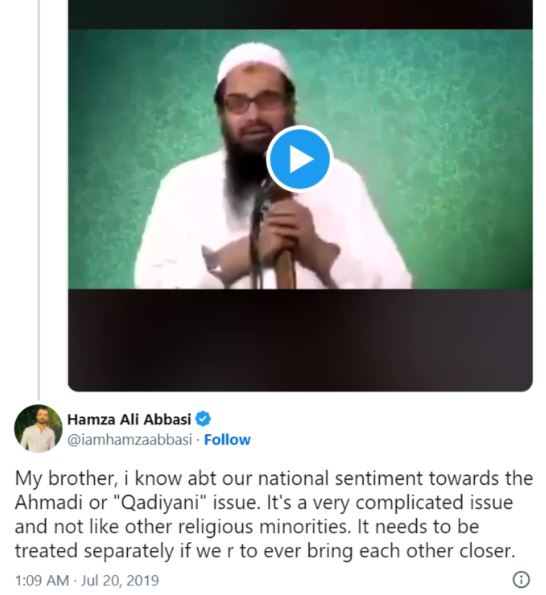
Hamza Ali Abbasi and his support for Hafiz Saeed, 2-Nation Theory
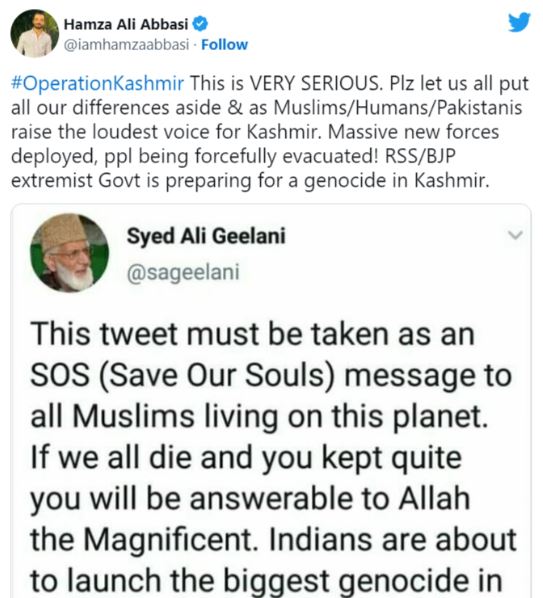
OpIndia had reported on in December 2022 that Pakistani actor Hamza Ali Abbasi, who plays a crucial role in the movie, has been unabashed in his vocal support for the 2008 Mumbai attack mastermind, Hafiz Saeed.
The movie features actor Fawad Khan as the hero ‘Maula Jatt’ who fights his nemesis and finest warrior in Punjab by the name of Noori Natt. This character of Noori Natt is played by Hamza Ali Abbasi, who is known for being a terrorist sympathiser and an active proponent of the divisive ‘Two Nation theory.’
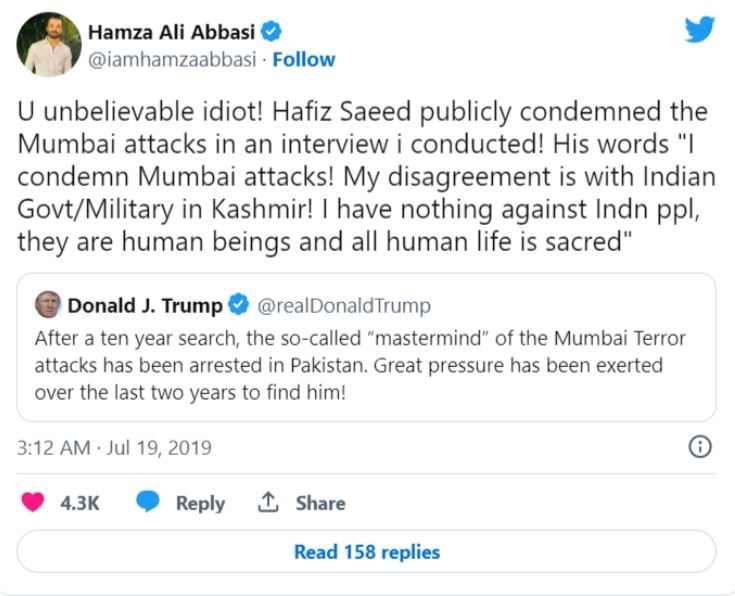
While responding to a tweet by Donald Trump in 2019, the actor claimed, “You unbelievable idiot! Hafiz Saeed publicly condemned the Mumbai attacks in an interview I conducted.”
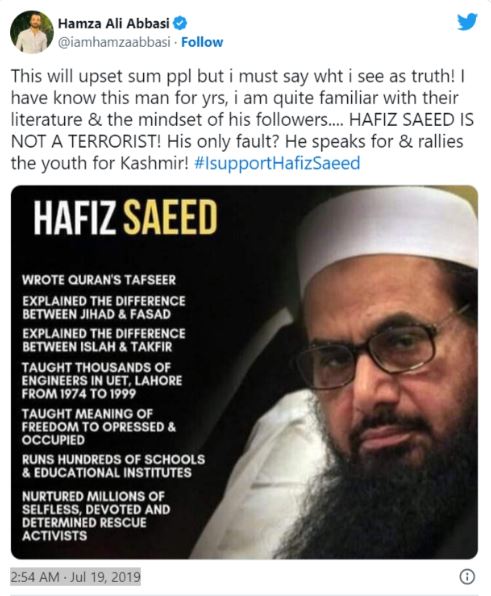
Following the arrest of Hafiz Saeed by Pakistani law enforcement authorities in July 2019, Hamza Ali Abbasi extended his support to the terrorist and absolved him of any wrongdoing. He also applauded the extremists who came out in support of the 26/11 mastermind.
“Hafiz Saeed is not a terrorist! His only fault? He speaks for & rallies the youth for Kashmir!” the Pakistani actor claimed in a 2019 tweet, despite being sanctioned by the United Nations a decade earlier.
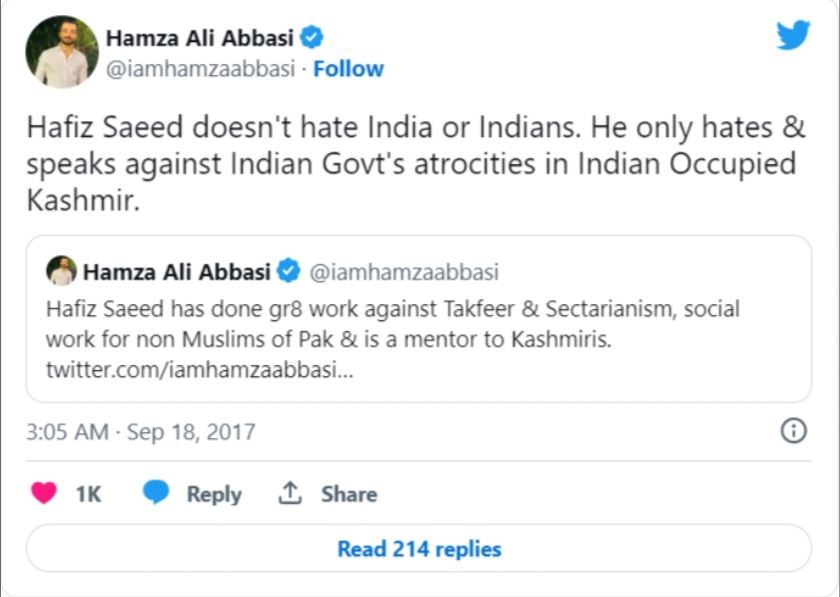
In one instance, the Pakistani actor went on to claim that Hafiz Saeed had done great work for non-Muslims of Pakistan and that he bore no ill will against India or Indians.
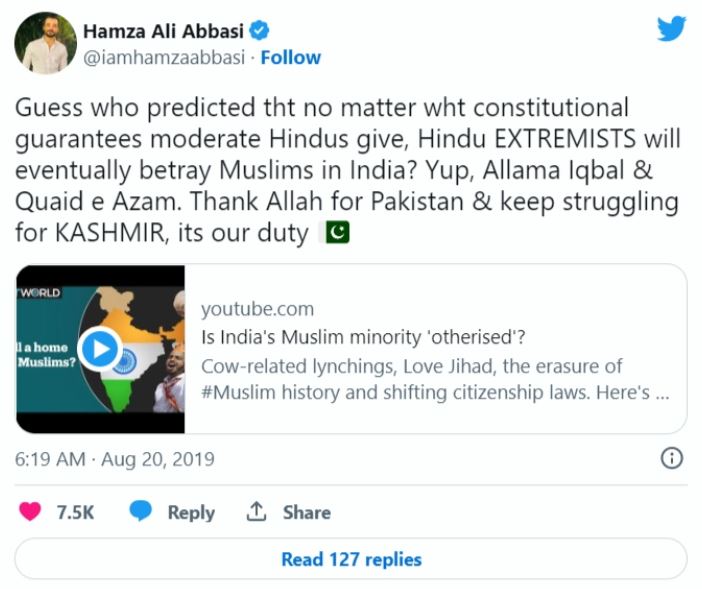
The brainwashed Pakistani actor has been a long-proponent of the divisive ‘Two Nation Theory’, which claims that ‘Hindus’ and ‘Muslims’ are not just two religious communities but nations in themselves (and cannot coexist).
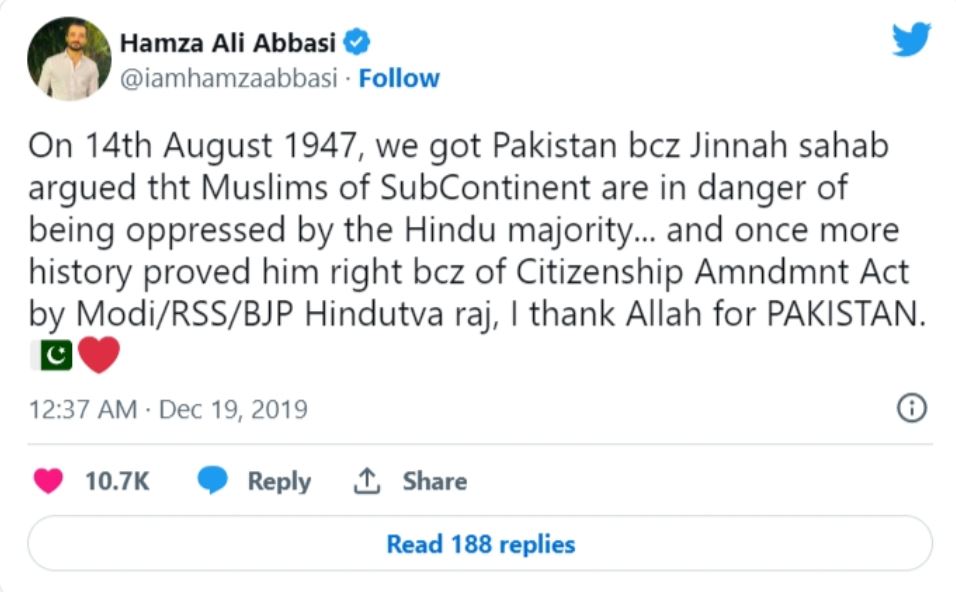
Under the pretext of criticising the Citizenship Amendment Act (CAA), he unleashed his bigotry on Twitter. “On 14th August 1947, we got Pakistan because Jinnah Sahab argued that Muslims of the sub-continent are in danger of being oppressed by the Hindu majority,” he had claimed.
“…And once more history proved him right because of Citizenship Amendment Act by Modi/RSS/BJP Hindutva raj, I thank Allah for PAKISTAN,” Hamza Ali Abbasi had remarked.
Reacting to the allegations of usage of animal fat in the making of the Tirupati Laddu Prasadam, former Andhra Pradesh Chief Minister YS Jagan Mohan Reddy said on Friday that the Telegu Desam Party (TDP) is “politicising religious matters.”
Chandrababu Naidu had alleged that the previous YSR Congress-led government used animal fat in Laddus at Sri Venkateswara temple in Tirupati. A lab test report also showed the presence of pig fat and beef fat in the samples from the Tirupati temple.
“The tender process occurs every six months, and the qualification criteria has not changed for decades. Suppliers must provide an NABL certificate and a product quality certificate. TTD collects samples from the ghee, and only products that pass certification are used. TDP is politicizing religious matters. We have rejected the products in our regime 18 times,” Jaganmohan Reddy said.
Tirupati Laddu Prasadam row | Amaravati: YSRCP chief and former Andhra Pradesh CM, YS Jagan Mohan Reddy says, "The tender process occurs every six months, and the qualification criteria has not changed for decades. Suppliers must provide an NABL certificate and a product quality… pic.twitter.com/ln3Bl1OMvo
Former TDP Chairman and YSRCP leader YV Subbareddy had earlier denied all allegations of animal fat adulteration in ghee used to make the Laddu prasadam. He claimed that only organic ingredients were used in the preparation of Prasadam.
“All the ingredients used for Swami’s offerings from the last three years are all organic ingredients, including ghee. This is a very vile allegation that our government and our party, which have done so many programs while protecting the sanctity of Swami, are doing so many programs to mislead the people,” he said.
We got samples tested and confirmed beef fat and pig fat adulteration, says TTD Executive Officer Shamala Rao
Meanwhile, executive officer of Tirumala Tirupathi Devastanam (TTD) Shamala Rao said that there had been apprehensions about the quality of the Prasadam and under CM Naidu’s instructions a lab test of the same was ordered.
“When I took over as executive officer TTD, the CM expressed concern on the ghee procured and the quality of the laddu which is considered to be very sacred and offered as ‘Prasadam’ to Lord Venkateswara Swamy. Any deviation in the quality will cause doing ‘apavithram’ (doing something which is not sacred). He wanted me to take steps to ensure that the sanctity of this temple is restored including getting pure cow milk ghee. We started working on that… We found that we don’t have any internal lab to test adulteration in the ghee. There is no system to check the quality of ghee in outside labs also… The rates quoted by tenderers are unviable, they are so low that anyone can say that pure cow ghee cannot cost so less… We warned all suppliers, that they will be blacklisted if the ghee supplied doesn’t pass the lab test… We collected all samples and sent it to the best lab, it is government-controlled, and the reports have come and are shocking,” he said.
Rao further added, “The report says the ghee sample is adulterated with vegetable fat and also animal fat. Animal fat adulteration includes lard (pig fat), palm oil, beef tallow, and fish oil including grape seed and linseed. The ghee sample was a concoction of all this and the result was abnormally low. Pure milk fat should have a reading between 95.68 to 104.32, but all our ghee samples had values around 20, which means the ghee supplied is highly adulterated… We started the procedure for blacklisting and also penalising the supplier. We formed an expert committee to improve ghee supplies and also to strengthen our internal system so that we don’t face this problem again… We have found suppliers who have passed the tests… We have been asked by the expert committee to set up our own lab… This problem will be solved in the future.”
Rao added that the TTD is in the process of setting up an in-house lab. For the time being the TTD is working with NABL accredited labs and regularly sending samples to ensure the quality of ingredients. The process of blacklisting of the former suppliers who sent adulterated ghee is already started and the new suppliers have been found and their samples have passed the tests.
#WATCH | Tirupati Laddu Prasadam row | Executive officer of Tirumala Tirupathi Devastanam (TTD) Shamala Rao says, "The report says the ghee sample is adulterated with vegetable fat and also animal fat. Animal fat adulteration includes lard (pig fat), palm oil, beef tallow, and… pic.twitter.com/LPdyuCCvA3
Earlier on Thursday, Andhra Pradesh Minister Nara Lokesh shared a video clip in which Andhra Pradesh Chief Minister N Chandrababu Naidu was seen saying that previously animal fat was used in consecrated sweets–‘Tirupati Prasadam’ instead of ‘Ghee’ at Sri Venkateswara temple in Tirupati.
In a post on X, Andhra Minister Nara Lokesh said that he was shocked by the findings and added, “The Lord Venkateswara Swamy Temple at Tirumala is our most sacred temple. I am shocked to learn that the YS Jagan administration used animal fat instead of ghee in the Tirupati Prasadam.”
“Shame on YS Jagan and the YSR party government that couldn’t respect the religious sentiments of crores of devotees,” he added.
The charges of the AP CM have been denied by former TDP Chairman and YSRCP leader YV Subbareddy, who claimed that only organic ingredients were used in the preparation of Prasadam.