

In August 2024, a task force at Rutgers University released a “Caste Report,” which they wanted to push forward to include “caste” as a new protected category under the university’s discrimination policy. The Rutgers Caste Report was co-chaired by Audrey Truschke – a leading anti-Hindu propagandist masquerading as a professor of history at this very university. Truschke has a long history of whitewashing heinous crimes committed by the Mughals against Indians, especially Aurangzeb.
The task force said that discrimination based on caste is widespread on campus. It recommended a number of educational and policy measures that, presumably, would resolve the issue. However, the report supported these conclusions with a limited set of anecdotal testimonies. It has had no substantial evidence and has raised serious concerns over the objectivity and motivations behind the recommendations.
Its claims were based on the principle of caste-based discrimination on campus. “The Task Force Report claimed that the so-called caste discrimination is a significant problem at Rutgers and it is impacting students, faculty and staff.” The discrimination is preventing good students, faculty members, and staff from contributing to it and availing opportunities because of its hostile environment says the report by the task force.
Prevalence of Caste-Based Discrimination
It said that the report was of the view that discrimination based on caste is a pervasive issue at Rutgers. It maintained that such discrimination has devastating consequences for people coming from caste-oppressed backgrounds. Various testimonies were cited, such as a student mentioning his identity as Brahmin during a class, a housing situation in which the Dalit student faced discrimination because of caste. However, these testimonies were anecdotal and did not make up a representative sample from the campus population. The report itself acknowledged that an undue lack of systematic data on caste-based discrimination existed. It said, however, “that these personal stories do justify comprehensive policy changes.”
Recommendations for Policy Changes
With less-than-substantial evidence of caste-based discrimination at Rutgers to go on, the task force urged that caste be added to the university’s non-discrimination policy. Rutgers Caste Report further recommended that the university spread awareness on caste-related issues and conduct large-scale data collection of incidents related to caste discrimination. The report contended that these recommendations of the task force will help in maintaining inclusiveness at the campus and looking into issues that any form of caste-based discrimination does not get unnoticed on the campus of the University.
Absence of Evidence and Systematic Data
It should be stressed that even the report has admitted that there is an absence of systematic data on its claims of caste-based discrimination at Rutgers University’s campus. According to the report, the Office of Employment Equity reviewed no complaints on specific caste discrimination at the campus.
The fact that the Task Force has to confess that there is a lack of documented evidence of any type of caste-based discrimination at any level on the campus itself is indicative of the fact. However, the report still insisted that caste-based discrimination is a “problem” at the campus and recommended further data collection. It essentially called for policy changes based on unverifiable and limited anecdotes. By pushing for policy changes without substantial evidence has raised concerns if the issue of caste is being manufactured or exaggerated to serve specific ideological ends.
The report read, “At Rutgers, the Office of Employment Equity (OEE) enforces the Policy Prohibiting Discrimination and Harassment, 60.1.12, which this Task Force recommends be expanded to include caste as a protected category. A review of OEE’s records showed no complaints that pertained to caste specifically. This absence of data is inconsistent with the “Testimonies about Casteism and Caste-Based Discrimination at Rutgers.” This underscores the report’s recommendations to enhance Rutgers policies against caste-based discrimination and provide education to all members of the Rutgers community on the harms of casteism.”
Questionable Testimonies and Examples
For any study to become substantial and trustworthy, the data should be verifiable and if there are testimonies they should be clear enough with proof to support the claims. However, in this case, the anecdotes used in the report are questionable and often unrelated to the institutional discrimination
For example, one of the stories mentioned in the report involved a student discussing his family’s caste-based marriage preferences. It is unclear how it affects the students or anyone on the campus as it is just a discussion and every family or individual has his or her own preferences. Claiming that this leads to caste-based discrimination on the campus is overstretching and exaggerating the matter for vested interests.
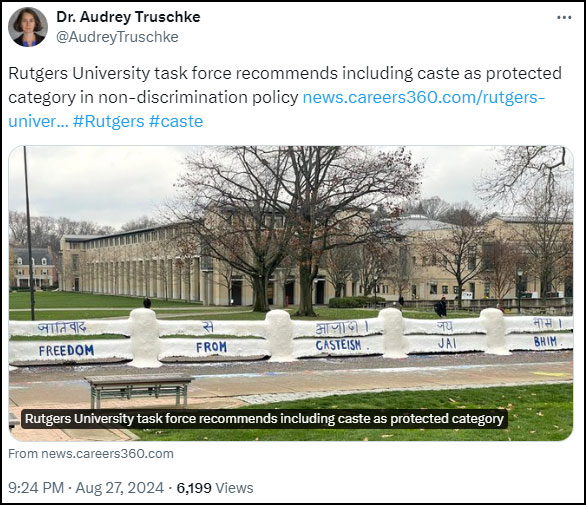
We predicted after the #Sb403 veto – the “caste” warriors would be back… And, as expected our favorite serial prevaricator, “Prof” Audrey Truschke is at it- pushing out her latest salvo to her echo chamber of devotees. Currently she is pretending that she had nothing to do… pic.twitter.com/1qgDS1cDLu
— CoHNA (Coalition of Hindus of North America) (@CoHNAOfficial) August 27, 2024
Another story involved a Dalit student being advised by her family not to reveal her caste to anyone on the campus. This is an unnecessary fear being rooted by elders of the family into the children. The student in question here was going to study at a university in the US where caste-based discrimination is mostly not heard of until recently when the CISCO Caste Case made the headlines and it became the baseline to import the caste system to the US from India and create a non-existence fear of it.
These examples in no way demonstrated systematic discrimination at the campus or provided a basis for altering the policies at the university. The testimonies reflect individual social tensions rather than institutional biases.
Potential Ideological Bias
The Rutgers Caste Report was co-chaired by Audrey Truschke who has a history of anti-Hindu sentiments. It raised questions about the objectivity of the findings. Truschke has a history of portraying Hindu culture and texts negatively and aligning herself with groups that have been accused of propagating Hinduphobia. Her involvement in the task force suggests that there is a potential bias in framing the issue of caste discrimination at the campus.
Notably, Truschke has frequently distorted facts to fit her ideological narratives. She often positions Hinduism in a negative light. Her role in the task force and the continued push for caste to be a protected category despite the lack of data raises questions about the motivation behind the report. It appears that she will use this report as a vehicle to promote a specific narrative that aligns with her previously documented biases against the Hindu community.
SB403: A failed precursor to the Rutgers Report
For the unaware, the Rutgers Caste Report by the task force closely follows the narrative of California’s SB403 legislation that sought to add caste as a protected category under state civil rights laws. SB403 was introduced in early 2023 and gained support from several activist groups. However, it faced severe criticism due to a weak evidentiary basis, which was the Cisco Caste case.
The Cisco Caste case was a lawsuit where two engineers were accused of caste discrimination against a Dalit colleague. However, this case was later withdrawn because of lack of evidence. In effect, serious criticism walloped the Californian Department of Fair Employment and Housing for filing a case without concrete evidence. The outcome of the case exposed the lack of credible evidence supporting the claim that caste-based discrimination is widespread in the US companies where Indians are employed.
Notably, California Governor Gavin Newsom vetoed SB403. He stated that the existing laws were enough to cover all forms of discrimination including caste under broader categories like race, religion and national origin. The failure of SB403, however, did not deter the activists and it appears that they continued to find ways to set the narrative that caste discrimination is widespread in the US. This time, they used the Rutgers campus to propagate the agenda and to set a base for the policy change at university campuses.


