Wednesday, April 1, 2026
Home Blog Page 867

Telecom industry seeks reduction in license fees, duties on equipment, exemption from GST for payments made to DoT and others in union budget

Ahead of the first Modi 3.0 budget, the Cellular Operators Association of India (COAI), an industry body, on Wednesday listed several recommendations addressed to the Union Ministry of Finance.

The industry body sought exemptions on custom duties on telecom equipment, sexemption from GST under Reverse Charge Mechanism on payments made to DoT for license fees, spectrum usage charges, and spectrum acquired in auctions among other recommendations.

COAI also recommended that the license fee be reduced from 3 per cent to 1 per cent, relieving the telecom service providers from additional financial burden.

The much-awaited full Budget for 2024-25 is scheduled to be tabled on July 23 – the first Budget under Modi 3.0. The budget session of Parliament is scheduled to commence on July 22 and conclude on August 12.

Considering the huge capital that Telecom Service Providers (TSPs) have to invest in the current scenario, especially for the deployment of 5G, the industry body has recommended abolition of Universal Service Obligation Fund (USOF) levy.

Alternatively, it suggested that the government may consider suspension of the USO contribution of 5 per cent of Adjusted Gross Revenue till the existing USO corpus of approximately Rs 80,000 crore is exhausted.

COAI stated that it is also concerned over the definition of gross revenue (GR). According to the industry body, under the present definition revenue from all telecom activities is covered.

This, it argued, has created ambiguity because the term telecom activity is not defined clearly, so it may include revenue from activities believed to be incidental to telecom activity.

COAI thus recommended that the definition of gross revenue be made precise, stipulating that the revenue from activities for which no license is required should not be a part of gross revenue.

“We hope the government will consider these recommendations in the upcoming budget and help the industry navigate through these prolonged challenges,” said Lt. Gen (retd), Dr SP Kochhar, Director General, COAI.

Owing to the intense price competition in the market, the telecom industry in India has consolidated from over 10 companies in 2017 to three private and one public sector company.

Coming to customs duty, over the past 5 to 6 years, the government has gradually increased the customs duty on telecom equipment to 20 per cent, which the industry says significantly impacted the rollout of 5G services in India.

COAI has requested exemptions on customs duties for certain telecom equipment to alleviate the cost challenges associated with deploying this critical infrastructure.

“The industry body recommends that the customs duty be reduced to zero and then gradually increased depending on creation of ecosystem for manufacturing of telecom gear in India. Until high-quality equipment is available domestically at competitive prices, COAI urges the government to reduce customs duties for 4G and 5G network products, as well as other related items, to nil,” COAI said.

Faced with tight market dynamics, the telecom operators, Jio, Airtel, and Vodafone Idea, raised prepaid tariffs in a range of 10-25 per cent, invariably, a few days ago.


 (This news report is published from a syndicated feed. Except for the headline, the content has not been written or edited by OpIndia staff)

‘Kingpin’ Arvind Kejriwal’s close associate directly involved in handling Rs 25 crore bribe money for AAP: ED chargesheet

In a major development in the Delhi Excise Policy case, the Enforcement Directorate’s latest chargesheet alleges that Delhi Chief Minister Arvind Kejriwal was aware of and complicit in the use of bribe money in the Goa elections. The ED’s chargesheet included details about Arvind Kejriwal’s WhatsApp discussion with accused Vinod Chauhan.

The chargesheet also adds that K Kavitha’s PA had sent more than Rs 25 crore to the Aam Aadmi Party through Vinod during the Goa elections. The WhatsApp chat indicates that Chauhan had cordial relations with the AAP supremo.

ED has alleged that “accused number 37” Arvind Kejriwal colluded with members of the ‘South Group’ and others, including Vijay Nair, to get kickbacks of Rs 100 crore for “providing undue benefits to private entities by formulating and putting in use a tailor-made liquor policy.” According to the ED, Nair acted on behalf of Kejriwal and AAP’s other top leaders

According to the chargesheet, the AAP received Rs 45 crore of the Rs100 crore payment, which was funnelled through hawala routes for campaigning in the Goa Assembly polls. Vinod Chauhan, Kejriwal’s close aide, dealt directly with the hawala dealers and was responsible for sending Rs 25 crore for the Goa elections,  the chargesheet adds.

“Relationship of Sh Vinod Chauhan with the accused Sh Arvind Kejriwal: Sh Vinod Chauhan as depicted in the flow Chart above and in the paras above handled was responsible for the transfer of Rs. 25.5 Cr from Delhi to Goa which was received from Sh Abhishek Boinpally e a representative of the South Group who also handled cash transfer in the quid pro quo arrangement. It is pertinent to note that Sh Vinod Chaughn is not an unrelated person unknown or unassociated with the AAP leaders but is very much a close associate of the accused Sh Arvind Kejriwal The examination of the digital device of SH Vinod Chauhan has revealed the chats revealing a close relationship between Sh Vinod Chauhan and Sh Arvind Kejriwal, the chargesheet accessed by IndiaTV reads.

Source: IndiaTV

The ED chargesheet also attached screenshots of the WhatsApp chats between Kejriwal and Vinod Chauhan. In one such chat, Chauhan said that a Patna High Court judge Rajan Gupta wanted to meet Kejriwal and sought time for the meeting. In response, Kejriwal replied, “Sure”. In another screenshot, Chauhan sent birthday wishes to Kejriwal.

“In this manner, Arvind Kejriwal is directly, knowingly and involved in the generation, acquisition and possession of the proceeds of crime of Rs 100 crore…Arvind Kejriwal has concealed the proceeds of crime by way of using cash transfers/Hawala transfers from the point of generation till the use. Hence, the accused Arvind Kejriwal, is actually and knowingly involved in the different processes and activities connected with the offence of money laundering, i.e. generation, acquisition, possession, concealment, transfer, use and claiming it to be untainted as defined u/s 3 of PMLA, 2002,” the chargesheet adds.

According to the ED chargesheet, Chanpreet Singh, a Chariot Productions employee, managed the money that reached Goa via hawala. Singh, who worked on the AAP’s Goa campaign as a freelancer, was paid by the party with Rs 1 lakh, IndiaToday reported.

ED also mentioned chats between Arvind Kejriwal and C Arvind, former secretary of AAP leader Manish Sisodia, to demonstrate how the CM Kejriwal allegedly attempted to mislead the probe. The probe agency also stated that a large amount of evidence was destroyed.

Right to freedom of religion doesn’t encompass the right to convert others: Allahabad HC

The Allahabad High Court recently announced that the freedom of Indians to freely practice and spread their faith does not entail a collective right to convert others. The court upheld the same constitutional right to religious freedom for both the person deciding to convert and the one being converted. Judge Rohit Ranjan Agarwal’s bench further stated that every person has the freedom to choose, practice and express their religious beliefs owing to the constitution’s guarantee of individual freedom of conscience, however, this right does not apply to the collective right to proselytize, which is the act of trying to convert others to one’s religion.

He conveyed, “The Constitution confers on each individual the fundamental right to profess, practice and propagate his religion. However, the individual right to freedom of conscience and religion cannot be extended to construe a collective right to proselytize; the right to religious freedom belongs equally to the person converting and the individual seeking to be converted.”

The court further emphasized that the purpose of the Uttar Pradesh Prohibition of Unlawful Conversion of Religion Act, 2021 was to protect the constitutional prohibition against unauthorised religious conversions. The court was considering a bail request submitted by a person named Shriniwas Rav Nayak in connection with a case that was filed at the Nichlaul police station in the Maharajganj district under Sections 3/5 (1) of the Uttar Pradesh Prohibition of Unlawful Conversion of Religion Act, 2021.

The informant was invited to co-accused Vishwanath’s home on 15th February, where a large number of villagers mostly from Scheduled Castes were present, according to the First Information Report. Ravindra, Vishwanath, his brother Brijlal (the applicant) and Shriniwas Rav Nayak persuaded him to abandon Hinduism and become a Christian by luring him with the promise of a better life and an end to his problems. A few locals had already embraced Christianity and begun to pray. After making an excuse, the informant called the police to report the occurrence.

Legal representation for the bail applicant contended that his client from Andhra Pradesh was not involved in the purported conversion and was only providing domestic assistance to one of the co-accused. The attorney added that there was no undue influence and the witness statements could not be believed because the official complaint did not name any converter per the 2021 Act. Furthermore, no one who became a Christian has complained.

Additional government advocate mentioned that the applicant arrived at the location, Maharajganj, where the conversion was happening, and was actively involved in the illegal act of converting from one religion to another. The court highlighted, “The Constitution clearly envisages and permits its citizens right to freedom of religion in respect to their professing, practising and propagating its religion. It does not allow or permit any citizen to convert any citizen from one religion to another religion.”

The court pointed out that Section 3 of the 2021 Act expressly forbids conversion to another religion on the grounds of deception, compulsion, fraud, undue influence and seduction. It stated that the Act forbids aiding, abetting or collaborating to such conversion and stipulates penalties for violating the section’s prohibitions. The court further declared that the Act was passed with consideration for Article 25 of the Indian Constitution, which prohibits any citizen from converting another citizen to their own religion.

Considering the accusations levelled against the accused, the court observed that the informant had been coerced into converting to a different religion. This alone was sufficient grounds for denying the applicant bail, as it demonstrated that a conversion program was underway, including several Scheduled Castes villagers being converted from Hinduism to Christianity. The court ruled that in this instance, the state’s counter-affidavit, which was supported by the police’s recordings of comments from unaffiliated witnesses, proved that a conversion event had transpired.

It pronounced, “In the instant case, the informant was persuaded to convert to another religion, which is prima facie sufficient to decline bail to the applicant as it establishes that a conversion programme was going on where many villagers belonging to Scheduled Castes community were being converted from Hindu religion to Christianity. There arises no occasion as to why the informant would rope in the applicant, who is a resident of Andhra Pradesh, falsely in a case of unlawful religious conversion. Neither in the bail application nor during the argument, it has been submitted that there stood any enmity between the informant and the applicant.”

As a result, the court decided that there was sufficient evidence to establish an illicit religious conversion under the Act of 2021 and denied bail to the applicant-accused.

Supreme Court stays Gujarat High Court order directing state government to reclaim 108 hectares of land allotted to Adani Ports in 2005

On Wednesday (10th July), the Supreme Court stayed a Gujarat High Court order that directed the state government to reclaim grazing land given to an Adani Group entity in 2005. Notably, the 108 hectares (266 acres) of land is located near Mundra port in Gujarat’s Kutch district. 

The bench of Justices B R Gavai and K V Viswanathan was hearing the petition filed by Adani Ports and Special Economic Zone Ltd (SEZ). The petition argued that the impugned order was required to be stayed in the interest of justice. 

During today’s hearing, the bench said, “Issue notice. Stay of impugned order.” The apex court has now sought a reply from the Gujarat government on this issue. 

Earlier this week, on 5th July, the Gujarat government informed the High Court that it would take back nearly 108 hectares of ‘gauchar’ (grazing) land which was allocated to an entity of the Adani Group in 2005. 

Following the submission of the state government, the High Court had ordered, “Taking note of the affidavit of the Additional Chief Secretary, Department of Revenue, State of Gujarat, we require the concerned authority/officers to complete the process of resumption in accordance with the law.” The court had then posted the matter for 26th July. 

It all started after locals from Navinal village of Kutch district approached the High Court and filed a Public Interest Litigation (PIL) in this matter. In their PIL, they challenged the administration’s decision to allot 231 acres of ‘gauchar’ land to the Adani Ports and SEZ Ltd. 

According to the villagers, while the land was allotted to the Adani Ports and SEZ in 2005, they only learned about the decision in 2010 when APSEZ began fencing the land. In their plea, the villagers contended that it had left them with just 45 acres of grazing land. 

However, in 2014, the High Court dismissed the PIL after getting an assurance from the state government that they would grant an additional 387 hectares of government land for grazing. 

A year later, in 2015, the state government filed a review petition before the High Court and submitted that the available land for allocation to the panchayat was only 17 hectares.

It then submitted a proposal to allocate the remaining land at an alternate site which was nearly seven kilometres away. However, the villagers rejected the proposal stating that cattle couldn’t travel such a long distance.

Consequently, in April 2024, a division bench issued an order directing the Additional Chief Secretary of the Revenue Department to find a solution to this matter. 

This week, on 5th July, the Additional Chief Secretary submitted an affidavit apprising the court that the state government has decided to reclaim nearly 108 hectares (266 acres) of ‘gauchar’ land, which was earlier allotted to Adani Ports and SEZ, which prompted the High Court to issue an order to that effect. 

However, in a major relief to the Adani group, the apex Court has now stayed the High Court’s 5th July order and has sought a reply from the state government in this matter. 

‘NGO’ publishes report peddling Muslim victimhood, claiming Muslims were lynched after 2024 elections: Here is the truth about some cases mentioned

On 2nd July, the Association for Protection of Civil Rights (APCR) released a report claiming that incidents of anti-Muslim crimes have increased in India following Lok Sabha Election results. The report was used by several media houses including Free Press Journal, Clarion, Muslim Mirror and others to make similar claims.

There are two infographics based on APCR’s report available. The following infographic was released on 2nd June and shared by Kafila.

Source: APCR/Kafila

The second infographic was released by APCR and is available on their Facebook page.

Source: APCR

The truth behind Aurangzeb’s death

In the infographics shared by APCR and other portals, the Aligarh incident of the death of Aurangzeb alias Farid was mentioned. The report read, “Aurangzeb alias Farid was beaten to death by a group of Hindu men in Aligarh leading to communal tension. 10 days after the lynching, he and eight others were booked by the police for dacoity.”

On 18th June, Mohammad Farid alias Aurangzeb died in district Aligarh of Uttar Pradesh. Several Hindu traders and businessmen were accused of the murder. The family members of Farid filed a case against ten identified as the accused claiming it was a murder. Several of the accused were arrested by the police. However, there was much more to explore in the case. As per OpIndia’s ground report, the families of the Hindu accused in the matter stated that Aurangzeb was a thief who invaded their homes with the intention to steal.

On 20th June, several businessmen submitted a memorandum to the local BJP MP, claiming themselves to be victims of the thefts. In the given case, they have alleged that the Hindu members are unnecessarily being targeted under the wrong sections for raising their voices against Halal products.

It was reported that Aurangzeb was caught while stealing. Following this, people got angry and beat him up. The accused say that Aurangzeb was turned over to the police alive. If Aurangzeb dies later, a case should be made for culpable homicide, which is not murder and does not fall under Section 302 of the Indian Penal Code.

According to the memorandum handed to the BJP MP by local traders in Aligarh, the goal of disseminating such propaganda is to ensure that if theft or other problems occur at their location in the future, they will not report out of fear. All of them agreed that numerous robbers had previously been apprehended here, the majority of whom belonged to a specific community (the Muslim population).

In another ground report by OpIndia, it was revealed that Aurangzeb and his three accomplices barged into the house of a Hindu businessman with the intention of stealing. They molested the women in the house and took the family members hostage. In a written complaint, the wife of one of the accused stated that on the day of the incident, her husband noticed a noise from the roof. At the same time, 4-5 armed men barged into their house through the stairs. The armed intruders took the victim and her family hostage in a room, threatening to shoot and kill everyone if they called for help. When the intruders demanded cash and jewellery, the terrified victim took them out of the safe and handed them over.

It is said that the robbers looted Rs 2,50,000 to 3,00,000 from their house. They handed this money to some of their accomplices on the roof. One of these accomplices is identified as Jameel, also known as Alfa Tailor. After giving the looted money and jewellery to Jameel, two suspects re-entered the victim’s house. They then grabbed the victim and another woman in the house with malicious intentions. Both the accused tore the clothes of the victims and attempted to rape them.

When the family members cried for help, people from the locality gathered. The thieves tried to escape and one of them fired shots at the neighbours creating a chaotic situation. During this commotion, one of the fleeing robbers fell on the stairs and got injured, while his accomplices managed to escape. The injured person turned out to be Aurangzeb, alias Mohammad Farid. The neighbours caught hold of him and during questioning, he revealed the names of his accomplices as Salman, Tufail, Asif, and Jameel alias Alfa Tailor. Aurangzeb further said that he and his gang conduct reconnaissance in Hindu-populated areas to identify wealthy families. They had done a recce of the victim’s house for four days.

Despite clarification from the police, several Islamists and propagandists painted the matter as “lynching of a Muslim by Hindutva mob”.

Death of Salman Wohra

Another incident mentioned in the report was the death of Salman Muhammad Hanif Whora. The report read, “Salman Vohra, who had gone to watch a cricket tournament match in Chikhodra, Gujarat was mercilessly beaten to death by a group of men.” Notably, there was no communal angle to the matter as shown by the report and other news portals and propagandists. Portals like Makhtoob Media claimed that the incident happened because Hindu spectators were not happy that Muslim players were performing well. On 1st July, OpIndia published a ground report explaining what happened on the fateful day of 22nd June. On the day of the incident, 23-year-old Salman went to watch a cricket tournament that was being played at Chikhodara, late in the evening.

A person named Imroz Abdul Rahim got into an argument with the accused in the case over the issue of bike parking. Soon it turned into a fistfight between them. Salman intervened to defend Imroz. It was alleged that the accused assaulted them with a bat and other sharp weapons. Afterwards, both of them were shifted to a hospital for treatment. However, 23-year-old Salman died during treatment. Nine accused were arrested by the police in the matter and a case under Sections 143, 147, 148, 149, 302, 324, 323, 504, and 506(2) of the IPC and Section 135 of the Gujarat Police Act.

It was evident that there was no case of communal tension between the accused and the victims but the fight was about a bike parking. However,  leftist media including The Wire, The Quint, Maktoob Media, The Kashmiriyat, and some other portals tried to paint this whole incident in a communal colour. They claimed that Hindutva supporters were angry at Muslims who were playing well and they killed a Muslim man. They further claimed that Hindus gathered in the crowd and were chanting ‘Jai Shri Ram’ slogans during the match. They went further to claim that at the time of the incident, Hindus in the crowd were inciting the killers.

The claims made by these media houses were categorically dismissed by DSP Jayesh Panchal. Speaking to OpIndia, he said, ” “The kind of communal angle that the media is talking about is completely wrong. Police are continuously investigating after the incident. We have interrogated the arrested accused, they also did not say any such thing, the statements of the people present in the field during the incident have also been taken. Even the eyewitnesses have not recorded anything like this in the statement.”

During the conversation, he further stated, “Not only this, the person who is the complainant in the incident has also not mentioned any such incident in his complaint.” When OpIndia asked him about the slogans of “Jai Shri Ram” and the claims about the Hindu crowd during the cricket match, he outrightly denied it. He said, “In the investigation so far, no incident of this kind has come to our notice, either in the statement of the complainant, the witness, or the accused. ” He noted that there was a clash over a motorcycle and added that the claims made in the media were false.

Not only the police officer but local Muslim leader Ismailbhai also denied the claims of communal angle. Speaking to OpIndia, he said, “The slogans raised during the match have nothing to do with the murder. There is no communal angle in this whole incident. What has happened is very wrong. The deceased was recently married. The assailants hit him in the kidney and seriously injured him. All we want is that those who are responsible should be severely punished.” When OpIndia asked him about the religious angle in the murder, he said, “Look, the incident is very bad and serious. But let’s not be wrong, there is no communal element in this. The angle does not appear.”

Missing information from death of Christian woman in Chhattisgarh

The report further talked about the murder of a Christian woman in Toylanka village in the district Dantewada of Chhattisgarh. The report read, “A Christian woman was murdered in Toylanka village in Chhattisgarh’s Dantewada after she and some of her family members had converted to Christianity.”

A crucial piece of information was missing from the report as the murder was committed by the family members (Hindu) of the woman. The report left a scope of misrepresenting the information as the murderers in the matter could interpreted as non-family members or locals.

As per Dainik Bhaskar’s report, the murder of the Christian woman happened after she converted to Christianity. Her family members were not allowing her to farm on their ancestral land. The victim, identified as Bindu Sodhi was working on the farm when some of her family members along with villagers reached there and asked her to stop which led to an argument between the two sides. The matter escalated and Bindu was attacked with axe and other sharp weapons. She was seriously injured and rushed to hospital by the police.

Bindu died while receiving treatment at the hospital. Furthermore, the family members and villagers did not allow her body to be buried inside the village. The matter reached court after which an order was passed allowing the body to be buried in the village as per Christian rituals. Forced conversion is a serious matter in Chhattisgarh and reports of disowning and communal boycotts of converted families are common.

While APCR report tried to portray it as if the incident was linked to Lok Sabha Elections, it has nothing to do with BJP coming back to power.

Death of Irshad Alam

Another case that has been mentioned in the list was the death of Irshad Alam in West Bengal. The report read, “A 37-year-old Irshad Alam, who worked in a television repair shop, was forced inside a student’s hostel in Bowbazar, Kolkata, and beaten up with a cricket bat and hockey sticks. He was rescued by police and taken to a hospital, where he died.”

Interestingly, there was no mention of the reason behind the assault which left a loophole of it being considered a hate crime against Muslims. However, in another graphic that was shared by Kafila, there was a mention of “phone theft”. This particular graphic, which was shared by Kafila, is not available on the website or any social media platform linked to APCR. The graphic shared by APCR has no mention of phone theft.

On 28th June, a 47-year-old man (age wrongly mentioned by APCR) identified as Irshad Alam was detained by students of state-run Udayan Hostel in Kolkata over suspicion of mobile phone theft. Irshad, who was a resident of Belgachia, used to work as a mechanic at an electronics shop in Chandni Chowk of Kolkata. Police rushed to the hostel after learning about the incident and rescued Irshad. He was shifted to the hospital where he died while receiving treatment.

BJP criticised the West Bengal government over the incident and accused it of letting unauthorised persons live in the state-run SC/ST hostel. Union MoS and state BJP president Sukanta Majumdar said in a statement, “There are reports that some people residing in the north Kolkata hostel were not students but unauthorised outsiders staying there for years. This issue is further complicated as some boarders of the SC/ST hostel were also implicated in the case… Security concerns arise when there is no CCTV footage available of the alleged incident.” 16 people were arrested in connection to Irshad’s death. The details of the case revealed that there was no communal angle to the matter. However, the incident was projected as a lynching of Muslims by several portals. For example, Siasat wrote, “A Muslim man named Irshad Alam was tied up and beaten to death,” without giving the background of the story.

Interestingly, the matter was mentioned twice in the inforgraphic made by APCR which shows how serious they are about their research work.

Death of Maulana Sahabuddin in Jharkhand

Another matter listed in the report is the death of Maulana Sahabuddin in Koderma Jharkhand. The report read, “Mob Lynching in Jharkhand’s Koderma Maulana Sahabuddin, a resident of Raghuniyadih in Koderma district and an Imam at Basramo Turkabad, Barkatha area, was lynched by a mob. He was returning home on his bike when a mob brutally beat him to death. No action has been taken so far by the Police.”

The lies about Shahabuddin’s death were spread by several media outlets and journalists including The Observer Post, Naseer Giyas, Waris Masih, Rana Ayyub and others. It was claimed that Shahabuddin was beaten to death by a mob on 30th June when he was returning to his house on his bike near Ghuthari Kariya. The report claims that Shahabuddin was attacked after his bike hit an auto in which a Kathuri Kar resident, Anita Devi was seated along with her husband and brother-in-law. In the accident, the Hindu woman sustained injuries to her nose and hand.

The report further adds that Anita’s husband and brother-in-law gathered some residents and boys playing cricket nearby, who then assaulted the Imam with sticks and batons. The report claimed that the deceased person’s son Mohammed Parvez Alam and Suraj Das, a local leader of All India Majlis-e-Ittehadul Muslimeen (AIMIM) alleged that it was a mob lynching and not an accident.

While the Islamists online are giving a communal colour to the incident, Jharkhand Police has denied the claims and said that there is no communal angle. The police confirmed that the Maulana, who was rushed to the hospital after the accident, succumbed to his injuries on the way.

“The Imam received injuries due to the accident. There is no communal angle here. He was transported to the hospital in a police vehicle but succumbed to his injuries on the way. His body has been sent for a postmortem,” the police said.

Death of Firoz Qureshi in Shamli, Uttar Pradesh

Yet another false propaganda spread by the APCR report was about the death of a Muslim man in Shamli, Uttar Pradesh. The report read, “In Uttar Pradesh’s Shamli, a Muslim man was beaten to death by a mob on Thursday. The victim was identified as Firoz Qureshi from Jalalabad. His brother filed a complaint against Pinki, Pankaj, and his partners. FIR registered but no arrest made.”

Several journalists and Islamists were peddling a narrative that Firoz Qureshi’s death is the latest incident of targeted mob lynching of Muslims, especially after the election, Shamli Police issued a statement bursting this sinister narrative. In its statement, the police said that on 4th July, Firoz broke into Rajendra’s house in an inebriated state triggering a scuffle between the two parties. However, Firoz’s family took him to their home soon after where he died. The police said that there were no serious injury mark marks on the body of the deceased.

Later, Firoz’s family member complained, based on which an FIR was registered and Rajendra was booked under Bharitya Nyay Sanhita (BNS) 105—culpable homicide. In addition, the deceased’s body was sent for post-mortem examination. The police said that the postmortem report stated that the cause of Firoz’s death was not assault. Firoz had entered Rajendra’s home on the night of 4th July in an intoxicated state resulting in a scuffle. Notably, even in his complaint, Firoz’s brother Afzal stated that Firoz used to consume intoxicants sometimes. The police said that despite this, the incident was given a communal colour and passed off as a case of mob lynching.

“It was also informed earlier that it is clear from the post-mortem report that the cause of death was not assault. The deceased had entered the accused’s house drunk. Despite this, the incident was deliberately given a communal colour and it was posted on social media as mob lynching to spread ill will. Action will be taken in the FIR registered as per the post-mortem report. An appropriate FIR has also been registered against the malicious post. The accusations are irrational and hence refuted,” Shamli Police said.

The police stated that since the cause of death is unknown, the deceased’s viscera has been preserved and the report is awaited. Meanwhile, the inspector in charge of the Thana Bhawan police station has been directed to take strict action against the five individuals accused of posting fake news. A case against Zakir Ali, Wasim Akram Tyagi, Asif Rana, Saif Allahbadi and Ahmed Raza Khan was registered for spreading fake news on social media.

Shop of Javed vandalised in Himachal Pradesh

The case of Javed’s shop being vandalised has been reported by APCR with misleading information. The report read, “A mob looted and vandalized a textile shop belonging to a Muslim man named Javed in Himachal Pradesh’s Nahan after he had reportedly shared a picture of animal sacrifice on his WhatsApp status. A week Shamli police arrested the shop owner Javed for promoting enmity.”

The shop was indeed vandelised by agitated Hindus but APCR skipped the information on which animal’s sacrifice was shown in the status. Javed, who was a resident of Uttar Pradesh, was running a cloth shop in Himachal for several years. On Bakrid, he published photos of a sacrificed animal, which appeared to be a cow, on his WhatsApp status. The locals came to know about it and some of them got agitated. There was no need to publish images of the dead body of the animal with its head on WhatsApp status and it was seen as a provocation.

The incident took place in district Simaur of Himachal Pradesh. On 17th June, Javed uploaded images of an animal slaughter, which appeared to be a cow, on the event of Bakrid. Javed, originally from Saharanpur in Uttar Pradesh, has been operating a ready-made garments shop in Nahan, Himachal Pradesh, for the past 1.5 years. Hindu groups protested and called for action when they arrived at Javed’s garments shop in Nahan.

Furthermore, they stated that Javed should never again be permitted to work in Nahan. There were rumours that some participants in this rally turned violent. In Nahan, a rally has also been planned by Hindu organisations. Since the incident, Javed has absconded from Nahan. Later, on 23rd June, he was arrested by Shamli police. Notably, police stated that it was buffalo, not cow in the images. However, the images were still intolerable.

Communal tension over Eidgah gate in Jodhpur

In another reported incident, APCR claimed that communal tension erupted in Jodhpur over the construction of a gate near Eidgah. The report read, “Communal violence reportedly took place in Jodhpur’s Soor Sagar area. The violence took place concerning the construction of a gate near an Eidgah at Rajaram Circle of the city.” Interestingly, there was no mention of why the tension erupted as opening the Eidgah gate should not agitate anyone. The reality is that the proposed gate was in close proximity of a Hanuman Mandir and Hindus were against opening the gate. The matter was shown as if it happened after Lok Sabha Election results but in reality, it is a 15-year-old case. Section 144 was imposed in the region after the communal clash.

The violence erupted from a longstanding dispute between Hindu and Muslim communities over a gate being constructed at Eidgah near Rajaram Circle in Sursagar. The new gate is being opposed by the Hindu community as it’s in proximity to the Hanuman Temple. The construction of the gate sparked similar controversy 15 years ago and the project was halted.

On the evening of 21st June, one faction broke the previous agreement and resumed construction of the gate. When Hindus learned about it they gathered and staged protests. The two communities sat together and concluded that the gate would not be constructed. However, radicals in the Muslim community insisted that they would open the gate at any cost.

The arguments between the two communities led to the instances of clashing late at night. Stones were pelted for over two hours during the violence. One shop and tractor were burnt. A jeep was damaged. The authorities are monitoring the situation closely and have ensured that the law and order situation is under control. A Hindu woman, who tried to save her grandson got injured during stone pelting and lost vision in one eye. APCR conviniently skipped that detail as well.

Court-ordered demolition drive in Akbar Nagar of Lucknow reported as anti-Muslim

APCR simply mentioned it as “A large-scale demolition was carried out in Akbarnagar in Uttar Pradesh’s Lucknow.” No background was mentioned. No mention of a court order behind the demolition drive and no mention of the fact that the residents were properly compensated by the state government.

After a massive demolition drive undertaken by the Lucknow Development Authority (LDA) and Municipal Corporation, all the illegal encroachments in Akbar Nagar were cleared on the 18th of June. Over 1,169 unlawful residential properties and over 100 commercial structures were demolished with heavy machinery, including bulldozers. Late at night, action was initiated to demolish an illegally erected mosque and madrasa in Akbarnagar. Previously, action has been taken against a temple.

In the visuals, an illegally constructed four-storey mosque can be seen being razed to the ground in late-night action. The last leg of the demolition drive was started on 10th June and completed on Tuesday. The delay was caused due to Bakrid. The entire area was closed, and traffic was diverted to allow for the demolition drive on Tuesday. The demolition drive to remove an illegal encroachment on 24.5 acres of land began in December of last year. Over 1,320 illegal buildings including religious sites of Hindus and Muslims have been removed in the area.

It is pertinent to note that families in Akbarnagar who have lost their homes have been provided with alternate housing in other parts of the city through the PM Awas Yojna. Nearly 1,800 affected families have received accommodation. The LDA in the year 2023 had asked the residents to vacate their homes to carry out the anti-encroachment drive by sending notices and letters. The residents of Akbar Nagar in Lucknow then knocked on the doors of the High Court getting a breather ahead of the demolition drive in the area. As per the court orders, the demolition drive was initiated after marrying out rehabilitation efforts for the affected individuals. It is evident that all sort of religious, commercial and residential structures irrespective of religion were demolished in the drive. However, it was projected as if it was anti-Muslim and happened because the BJP came back to power.

Attacks on Hindus between 4th June and 10 July

As it has been proven that APCR used selective information to project several incidents as anti-Muslim which was far from reality, it is important to assess the situation on a broader scale. APCR projected as if only Muslims or Christians were victims of violence since Lok Sabha Election result were announced. However, Hindus also become targets of violence.

On 7th June, at around 9:15 PM when the victim Vipin was walking outside after having dinner, Shahbaz and Karim who are residents of Bhavi Chhidwa village reached there. Looking at Vipin, both of them started abusing him and said, “Bwa* keep chanting BJP-BJP. Modi-Yogi Kya ukhaad lenge? BJP ki M** k* B*.” After hurling abuses they launched an attack on Vipin. Iron rods and sticks were used in the attack. Due to a head injury, Vipin began to lose consciousness. Seeing his relative being assaulted, Aman raised an alarm. At that moment, Mobin, Jameel, Sagir, Farukh, and Afsar, also joined the attackers. They also launched an attack on the family members of the victim who were sleeping. During the attack, they also hurled casteist slurs and abuses at the victims. Vinod, Santosh, Pawan, Suraj, Bhola, and Manju Devi sustained serious injuries during the assault.

On 25th June, Mausam, Shahid and Arfat attacked a Hindu family allegedly for voting BJP in Lok Sabha Elections.

On 25th June, a disturbing video surfaced on social media platforms from Muzaffarpur, Bihar. In the video, a 15-year-old boy was forcibly detained, brutally beaten, and humiliated. The incident took place in Batraul village of Motipur town. The shocking video showed that the teen was forced to chant “Miyan Saheb Zindabad” and “Allah-Hu-Akbar”. Furthermore, the teen was forced to lick spit off the feet of the attacker. Police have filed a case and arrested Munna, Sahil, and one other person.

On 29th June, a Hindu family was attacked in Hardoi, Uttar Pradesh by a mob of 10-15 Muslims. They barged into their house and attacked them using firearms and sticks. One of the victims, Aman Rajput died while several others were injured. The attack happened over a transaction matter. Around 10 months ago, Aman had lent Rs 1 lakh to Abrar, one of the attacker’s son Rizwan. Aman was demanding his money back but Rizwan was not returning it. On 15th June, there was a dispute between the two parties and police intervened. However, on 29th June, Abrar, Rizwan, Ishtiyak and Rehman attacked them.

The list of attacks on Hindus is just the tip of the iceberg. There are several cases of Love Jihad, forced conversion and more that must be included in such incidents. Selective reporting by APCR is a clear indication that the organisation is playing its part in creating a communal rift in the country and projecting a bad image of India on international platforms.

As CPIM and Congress oppose UCC, Muslims in Kerala opt for Special Marriage Act to bypass regressive personal law

Muslims in Kerala are now increasingly marrying under the Special Marriage Act (SMA) to avoid regressive inheritance laws under the Muslim Personal Law (Shariat) Application Act of 1937.

As per a report by The New Indian Express, a total of 277 such marriages were registered in the districts of Thrissur (144) and Kasaragod (133) in the past year. The largest number of registrations (80), under the Special Marriage Act, were made in Anthikad village of Thrissur.

It must be mentioned that under the Muslim personal law in India, a daughter is only entitled [pdf] to a share in property which is half of that of the son. In the event of ‘no son’, only 2/3rd of the property goes to the daughter and the remaining to the Muslim man’s brothers.

The glaring inequality first came to light when actor Shukkur and his wife Sheema remarried in March last year under the Special Marriage Act so that their daughters could inherit the full share of their property.

Since their marriage under SMA, many Muslim couples have followed suit in Thrissur and Kasaragod.

While speaking about the matter to The New Indian Express, Shukkur said, “I sought details of SMA marriages in the state from January 1, 2020, to June 2024, under RTI. On verifying the details received from these two districts, it is clear that a large number of marriages were registered under SMA post March 2023, after the registration of our marriage.”

Shukkur and his family

He emphasised, “Details from other districts are yet to be received. As per the feedback I receive daily, more families with only daughters are now taking the legal route to avert a situation where their daughters fail to get their property after their death.”

“I have been receiving enquiries from within the state and from the USA and the Gulf countries. In fact from wherever Malayalis are living. Many wanted to know about the legal issues,” Shukkur further informed.

Relevance of Special Marriage Act in Equal Inheritance

When a Muslim couple marries under the Special Marriage Act of 1954, they cease to be Muslims for the purpose of inheritance. Thereafter, their property is no longer governed by the Muslim Personal Law (Shariat) Application Act of 1937.

The inheritance for such a couple is then considered under the Indian Succession Act of 1925 [pdf], which ensures inheritance in property for a man’s widow and children (male and female) equally.

According to The New Indian Express, the number of marriages under SMA stands at – Pazhayannoor (13), Erumapetti (7), Annamanada (7), Andathodu (12), Anthikad (80), Kunnamkulam (18), Mullassery (1), Katoor (6), Uduma (6), Nileshwar (10), Thrikkaripur (44), Rajapuram (8), Kasaragod (19), Mancheswaram (17), Hosdurg (15), and Badiyadka (14).

The cascading effect of Shukkur’s initiative is now being witnessed on the ground. A Malabar-based Islamic scholar told The New Indian Express, “It’s true that such a trend is there in the community. However, being a sensitive issue, it wouldn’t be appropriate for us to comment. We need to hold further studies into this matter.”

Politics in Kerala over Uniform Civil Code

The implementation of the Uniform Civil Code (UCC) would eradicate contradictions in personal laws and ensure social justice in 4 key spheres, including, marriage, divorce, inheritance and succession.

UCC was a key component of BJP’s manifesto for the 2024 Lok Sabha elections. However, the two leading political parties in Kerala, namely, the Communist Party of India (Marxist) and the Congress are opposed to uniformity in personal laws.

In July last year, the Congress party opposed the Uniform Civil Code. “We are clear that there can be nothing uniform about all laws. How can the country have the same civil laws for North East, South India, Muslims and Hindus? However, some angularity of individual laws can be looked at,” a party leader was quoted as saying by the Hindustan Times.

Former Leader of Opposition, V.D. Satheesan, went on record to claim, “The Congress has no ambiguity regarding the UCC. Senior leader Jairam Ramesh had clearly stated the party’s stand as soon as this issue came back to the limelight.”

“The Law Commission had said in 2018 that the UCC should not be implemented under any circumstances. The Congress also has the same position. The UCC is not practical as there are several tribes and communities within each religion, including Hinduism, with their own cultural background and traditions,” he made his party’s stance clear.

The Communist Party of India (Marxist), which portrays itself as the champion of social justice in India, also opposed the Uniform Civil Code. In fact, the party organised seminars against UCC in Kozhikode in North Kerala.

CPIM chief Sitaram Yechury alleged that the Centre was eyeing to implement UCC to “convert the secular, democratic Republic of India” into “a rabidly intolerant fascist Hindutva Rashtra”.

Conclusion

With no respite in sight against the regressive Muslim personal law and bleak chances of enactment of the Uniform Civil Code, Muslim couples in Kerala are increasingly opting for marriage under SMA to ensure fair and equal inheritance.

Western ‘experts’ continue to cope and seethe over India-Russia bilateral ties, trying to shame India while surviving on Russian gas

PM Modi’s 2-day visit to Moscow at the invitation of Russian President Putin to attend the 22nd India-Russia Annual Summit has been drawing a lot of “concerns” and statements from Western nations who have been claiming for over 2 years that Russia has been ‘isolated’ and everyone in the world should shun anything Russian.

India has steadfastly refused to bow down to Western demand and has continued its time-tested bilateral ties with Russia, expertly navigating the tight geopolitical rope of diplomacy in a multipolar world. However, the Western nations and their ‘experts’, including politicians and commentators, used to the centuries of the colonial mindset that expects the Global South to follow their orders, are still reeling from the invisible blow.

That a country can have its own independent foreign policy and foreign policy is not about just obeying orders from NATO or the White House, is apparently still news to many.

British broadcaster Piers Morgan reacted to the news of PM Modi receiving the Order of St Andrew, Russia’s highest civilian honour, saying, “Shame on you, Narendra Modi”, followed by thumbs-down signs. Notably, the award was bestowed on PM Modi in the year 2019, but he received it physically during the recent visit.

The British broadcaster, curiously, does not feel ashamed at his own country still importing billions of dollars worth of natural gas from Russia while pretending to impose sanctions on it.

A recent article in Skynews revealed that Europe has paid Russia over 10 billion dollars so far for Liquefied Natural Gas or LNG. Though the Nordstream pipelines somehow mysteriously blew up, minimising the flow of pipeline gas from Russia to Europe, the LNG tankers cruising from Russian ports to European terminals never stopped. Not just that, one of the largest LNG tankers that carry the Russian gas, the Yakov Gakkel, is even owned by a British company.

So basically, while shaming and whining and coping when any world leader talks to Putin, the Western nations have themselves preserved their self-interests quite smoothly, and have been paying billions to the same “war machine” they claim India should break ties with.

Morgan here is not alone in sharing the hollow virtue signaling. The cope is apparently widespread among US intellectuals.

posts by Sergey Radchenko

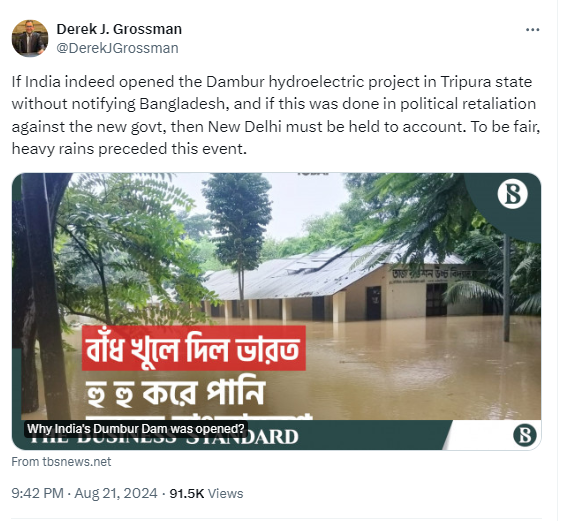
US-based foreign affairs columnist and professor Derek Grossman hasn’t stopped expressing his sadness and profound disappointment at the Indian PM meeting the leader of one of India’s most trusted allies. For some strange reason, he has been expecting India to abandon its own national interests, jeopardise its energy security and military needs, and join the Western bandwagon of blind sanctions against Russia.

Posts by Derek Grossman

The US government has also acknowledged that they have ‘concerns’ with India’s ties with Russia but added that they continue to regard India as a strategic partner. The US and the West in general, through unofficial voices, their media narrative, and statements, have been trying a lot to nudge India away from Russia, at least join in symbolically in the form of condemning statements and criticism against Russia. But the Indian government channels have been avoiding this trap. Indian ministers, EAM Jaishankar, FM Sitharaman, and Petroleum minister Puri have time and again reminded Western media that India won’t do hollow virtue signaling at the cost of its national and strategic interests.

In December 2023, EAM Jaishankar stated, “India-Russia relations are the only constant in global politics. There is a high degree of trust.”

The world has been multipolar for a long time now, it is only the colonial mindset of the Western powers that refuse to see it. A cartoon in the Chinese government mouthpiece Global Times on PM Modi’s Russia visit captured the essence of the American, rather the West’s myopic expectations and behaviour.

Global Times cartoon on Modi’s Russia visit and the US’ reaction

The hypocrisy of the West’s virtue signaling to India over ties with Russia

Throughout their blame games and attempts to shame, European nations had continued to pay Russia billions of dollars for energy imports. While expecting Asian powers like India, Saudi Arabia, and China to cut down their ties with Russia, they have been keen on saving their own energy interests. They have also been supplying weapons to Ukraine, basically fuelling the war from both sides. The age of Western hegemony over nations is over. The multipolar world is here to stay and no matter how much shaming and condemning the Western ‘experts’ do, rising global powers will pursue their foreign policy independently, not as per orders from the White House.

Complaint filed against Karnataka CM Siddaramaiah and nine others in the alleged MUDA scam: Details of alleged wrongdoings in compensation against land

The Congress government in Karnataka has been embroiled in a major controversy over the issue of land acquisition cost and alleged irregularities. Incidentally, on Wednesday (10th July), a complaint was filed against Karnataka Chief Minister Siddaramaiah and nine others for allegedly forging documents to claim compensation from the Mysuru Urban Development Authority (MUDA). Social activist Snehamayi Krishna has filed the complaint. It has accused Siddaramaiah, his wife Parvathy, his brother-in-law Mallikarjuna Swamy Devaraj, who claimed to be a landowner, and his family of ‘wrongdoings’. 

The complaint was lodged at Vijayanagar Police Station in Mysuru. The letter has also been written to the governor, the state chief secretary, and the principal secretary of the revenue department. It alleged that MUDA cheated by creating fake documents and obtaining plots worth crores of rupees. 

It is pertinent to note that earlier, CM Siddaramaiah rejected the BJP’s demand for a CBI probe in this matter. In his defence, he demanded Rs 62 from MUDA claiming that it “usurped” his family’s 3.16-acre land for a development project. However, the Chief Minister’s demand soon sparked an outrage among the Bengaluru farmers. They accused the administration of following separate rules for the Chief Minister and state farmers. Additionally, they have also started to demand higher compensation from MUDA for acquiring their land for key development projects.

Major developments in the alleged MUDA scam and the ongoing controversy explained

Evidently, a major controversy over the reported allotment of 14 pricey plots to CM Siddaramaiah’s family in Mysuru has rocked the state politics of Karnataka. The Bharatiya Janata Party has been demanding a CBI probe in this matter. It has alleged irregularities and a scam in the land acquisition and allotment of an alternate site. 

According to the allegations, MUDA generally follows a 60:40 ratio in development projects meaning that it gives 40% of land back to the farmers in the same developed project. However, it is alleged that MUDA not only followed a 50:50 ratio in CM Siddaramaiah’s case but also allocated pricy plots at a different location.  

BJP has alleged that Siddaramaiah helped himself with the allotment of 14 plots in the upscale Vijayanagar locality in Mysuru in exchange for giving up 3 acres 16 guntas of land on the city outskirts to Mysore Urban Development Authority (MUDA). It has charged CM’s family with accepting Rs 35 crore worth of plots in place of earlier decided compensation of Rs 3 lakh.

Speaking with the media, the Leader of the Opposition in the Karnataka Assembly, R Ashoka said, “It is like taking compensatory plots on MG road for the land surrendered at Dasarahalli (outskirts) in Bengaluru.” 

Earlier this week, Ashoka said, “The CM has resorted to indiscriminate looting to secure his son’s future (Dr Yathindra Siddaramaiah) after being convinced that his days as CM were numbered. The Rs 4000 crore scam in the allotments of MUDA plots was the biggest one…He (the CM) seems to have decided to make wealth for the next 10 generations.”

He added that the allotment has caused financial losses to MUDA as its officials allotted the plot on a 50:50 ratio basis soon after CM’s wife made an application. The BJP leader further added that the MUDA had carved plots out of denotified land owned by the CM’s family, but he was not getting access to records. There was a big racket behind these allotments. 

Ashoka added, “Though 86,000 people applied for MUDA plots, only Congress leaders have got allotments.” 

On Saturday (6th July), Union Minister Pralhad Joshi demanded an impartial investigation into the alleged MUDA scam and appealed to the state government to transfer it to the CBI. 

He said, “It is alleged that it is a more than Rs 3,800 crores scam and plots duly authorised by MUDA have been transferred in the name of the wife of Chief Minister Siddaramaiah. There was a huge scam and the then DC who has now been transferred to cover up the same, had written more than 15 letters to the state government to look into the matter and show proper directions to MUDA. In spite of that, they did not act and Siddaramaiah got very valuable land.”

Siddaramaiah demands Rs 62 crore compensation for 3.16 acre land

Following mounting pressure from the BJP, CM Siddaramaiah claimed that he got a lesser acre of land as compensation. He rejected BJP’s allegations that the 14 pricey plots allotted to his family were done “illegally”. Regarding the allotment of land in a different location, he claimed that it was MUDA’s mistake. Subsequently, he demanded Rs 62 crore as compensation for the 3.16 acres of his family land which was acquired for a development project.  

Siddaramaiah said, “Our land measuring 3.16 acres was encroached, made into sites, and sold. So, let them compensate us with Rs 62 crore, which is the market price of the land.” 

He argued, “Our land was taken away. Should I let go of 3.16 acres just because I’m the chief minister? Actually, we should have got another 3.16 acres in a land-to-land deal.” 

According to reports, in lieu of the 3.16 acres of land that MUDA used to form a layout, Siddaramaiah’s wife was compensated in a 50:50 ratio. This means that she got half the land in the form of developed plots. Incidentally, the Chief Minister seemingly admitted that his wife was given developed plots in a better location.  

Siddaramaiah said, “What could I have done if they (MUDA) gave me a site in some other place because there was no space on the land that was ours? I didn’t ask for any specific locality. It was MUDA that made the mistake.” 

He added, “We didn’t ask for sites to be given in Vijayanagar 3rd or 4th Stage. We simply agreed for a 50:50 ratio.” He stated that his government had scrapped the 50:50 rule in October last year. 

“Notwithstanding that, let the authorities give me Rs 62 crore. I got 14 sites in lieu of 3.16 acres. While one acre has 44,000 sqft, what I got was 38,264 sqft. So, I’ve got less,” CM Siddaramaiah had said

Officials responsible for land acquisition admit CM’s demand started to cause them concern as Farmers demanding higher compensation

Strikingly, his demand has led to a major concern for the development authority as farmers have started to demand higher compensation for their acquired land citing CM Siddaramaiah’s Rs 62 crore formula for 3.16 acre of lands in Mysuru. 

Notably, the state govt is in the process of acquiring land for multiple projects in several parts of Karnataka. Among them, farmer groups from Bengaluru Rural, Chikkaballapur, and Kolar districts have started to cite the CM’s example to demand higher compensation. 

The farmers’ groups have argued that if the CM can publicly demand Rs 62 crore compensation for his three acres of land, then the land parcels that have been notified for acquisition for various infrastructure projects around Bengaluru should be paid Rs 25 crore per acre as compensation. 

According to media reports, officials involved in the land acquisition process have admitted that CM Siddaramaiah’s Rs 62 crore demand has started troubling them.  

A farmer leader from the Kolar district emphasised, “The land prices around Bengaluru are higher than in Mysuru. If the CM is demanding such huge compensation for a residential project where there is a provision for allotment of alternative sites, then farmers in and around Bengaluru who have been losing land for roads, industries and other projects should be paid compensation according to the formula laid down by none other than the CM. There cannot be one rule for CM and another for farmers.” 

A farmer leader from Chikkaballapur, Anjaneya Reddy said, “The quantum of compensation demanded by the CM is double or triple the guidance value of land prevailing in Mysuru. Compensation for farmers in Bengaluru Rural and Chikkaballapura, where agricultural fields have been notified for acquisition for the special economic zone (SEZ), aerospace park, ring road, and housing projects, should be paid on a similar yardstick. If the govt refuses to pay the farmers on similar grounds, then the CM has no moral right to demand such huge compensation overlooking farmers elsewhere.”

Representative of distressed farmers losing their land for the Peripheral Ring Road (PRR) project, Eshwar Reddy said, “We do not know how the CM has arrived at such a huge figure. Given the fact that he is CM, he must have calculated it as per the rules. By the same rules, farmers around Bengaluru should be paid Rs 25 crore for each acre acquired either by the Karnataka Industrial Areas Development Board (KIADB) or the Bengaluru Development Authority (BDA). This price should be the model for all other acquisitions.”

He also raised questions over the Congress government’s stance. He noted, “Whenever the government in the state takes land for development projects, it develops it and gives it back in a 60:40 ratio. The government keeps 60% of the developed land, including corner plots, commercial spaces, and other important places, and the farmers get only 40%.” 

Highlighting the same, he asked how did MUDA agreed to a 50:50 compensation ratio in Siddaramaiah’s case. He further asked whether the government would offer farmers 60% of developed land.

Mumbai BMW hit-and-run case: Illegal section of Juhu bar where accused Mihir Shah partied demolished, father Rajesh Shah sacked from party post

After the Excise Department officials sealed the property 24 hours earlier, sections of the bar in Mumbai’s Juhu that provided alcohol to 24-year-old Mihir Shah were demolished by city officials on the 10th of July morning. The Vice-Global Tapas Bar sold liquor to the 24-year-old who is below the legal age for drinking, ahead of a collision between late 6th and early 7th July in which a BMW driven by him rammed a two-wheeler, killing a 45-year-old woman Kaveri Nakhwa and injuring her 50-year-old husband Pradeep Nakhawa. The pub was shut down for supplying alcohol to minors, supplying alcohol without a valid license and unlawful construction. These unauthorized portions were demolished.

The action was taken under relevant provisions of the Bombay Foreign Liquor Rules. The K/West (KW) ward officials of the Brihanmumbai Municipal Corporation (BMC) stated that on the evening of 9th July, the property was inspected by the authorities to determine whether any illegal alterations had been carried out to the property. The pub also received a letter from the excise department on the same day alleging that among other violations, the place was selling and distributing alcohol to unlicensed customers in an area designated for non-licensed restaurants.

An official stated, “During our inspection, we found out that a portion of the kitchen and the loft located at the front of the entrance were illegally built. We have initiated a demolition drive against these structures.” They mentioned that the bar has been open since 2022. A bulldozer and a group of officials were sent by the BMC to execute the demolition.

The perpetrator’s father who was part of Maharashtra Chief Minister Eknath Shinde’s Shiv Sena was removed from the position of the party’s deputy leader. According to the police, the Palghar Shiv Sena leader actively assisted in his son’s escape and intended to tow the offending vehicle away. According to an official, the investigation into the case has shown that the deceased was run over by driver Rajrishi Singh Bidawat shortly before the Bandra Worli Sea Link after being dragged there by the main accused Mihir Shah as the pair absconded.

Rajesh Shah and Rajrishi Bidawat were produced in the court of Chief Metropolitan Magistrate (Sewree) SP Bhosale on July 8 and remanded in 14-day judicial and one-day police custody, respectively. Rajesh Shah was, however, later granted bail by the court on payment of Rs 15,000 on 8th July. The Mumbai Police revealed in their submission to the court that Rajesh Shah had contacted his son numerous times after the accident, instructing him to take Rajrishi Bidawat’s seat on the passenger side. He intended to blame the driver for the accident and protect his son. He arrived at the spot in a Mercedes, spoke to his son and asked him to flee. 

Sections 105 (culpable homicide not amounting to murder), 281 (rash and negligent driving endangering human life), 125-B (endangering life and personal safety), 238, 324(4) (committing mischief amounting to cause loss and damage) of the Bharatiya Nyaya Sahita have been invoked against Mihir Shah. Moreover, he faces charges under the Motor Vehicles Act’s Sections 184, 134A, 134B, and 187. On 9th July, he was taken into custody along with his mother and two sisters from an apartment in Virar, 65 kilometres away from Mumbai. The mother and sisters were nabbed from Shahpur. His friend Avdeep is also being questioned by the police. The police suspect they aided in hiding him.

Mihir Shah successfully evaded the authorities from 7th July and was arrested from Virar near Mumbai. The police unveiled that he left his car and driver behind in the Kala Nagar region and departed the scene in an auto-rickshaw. He then arrived at his female friend’s suburban Goregaon home. She got in touch with his sister, who came to Goregaon, picked them up and brought the two to her Borivali house. The Shah family then decided to escape, driving an Audi to a resort in Shahapur in the Thane district. The resort also hosted his two friends along with his sisters Kinjal and Pooja Shah and mother Meena Shah.

Mumbai Police tracked the number of one of the people who were with him after finding out the identity, however, the friend had also turned off his cell phone. After leaving the Shahapur resort late on 8th July evening, Mihir Shah and his friend arrived in Virar, whereupon his friend turned on his cell phone for fifteen minutes and police apprehended the two individuals as soon as they discovered the mobile tower location. According to witnesses, Mihir Shah had a beard when he departed a Juhu bar on the fateful night. He was clean-shaven when he was taken into prison, though authorities believe he might have changed this detail to hide his identity.

The accused reportedly admitted driving the BMW that struck with a scooter and killed a woman. According to police sources, he described his actions before and after the fatal accident during interrogation. Police sources conveyed that he started his evening with companions at the Tapas pub in Juhu. After giving his pals a ride home in a Mercedes, he took the BMW for a “joy ride” down Marine Drive. He took the wheel and switched seats with his driver near Haji Ali. He acknowledged driving the opulent vehicle when it crashed with the two-wheeler, hauling Kaveri Nakhwa for about 1.5 kilometres before abandoning her corpse on the road.

After the accident, Mihir Shah was terrified. He left the scene before his father could get to Bandra out of fear of facing consequences from his family. He took sanctuary in his girlfriend’s Goregaon home rather than going back to his own house. His statement supports the chronology of events that the police assembled using eyewitness reports and CCTV evidence. He is scheduled to appear in court when the cops intend to request his custody to conduct an additional investigation.

On camera, Mihir Shah and Rajrishi Bidawat were seen removing the woman from the bonnet, putting her on the road, and then mowing her down once more as they reversed the fancy car. “After she was dragged from Worli, Mihir and Bidawat stopped the car just before BWSL and removed the woman who had got entangled in the vehicle’s tyre. Bidawat then took the driver’s seat and ran the car over the victim while reversing. They then fled. They sped towards Kala Nagar where the vehicle’s engine stalled,” conveyed an officer.

Drinking garlic juice after a dogbite will cure rabies? ‘Herbal influencer’ makes wild claims, doctors horrified

Stray dog menace has become a major concern in India with frequent reports of stray dogs mauling down people. Dog bites are the leading cause of rabies-related deaths in humans. While Rabies is a preventable viral disease, and there are appropriate scientific treatments for the same, once the infection sets in, it is 100% fatal and there is no cure for it.

Amid multiple reports of children and elderly being attacked and mauled by stray dogs across the country, a Herbal ‘influencer’ has stirred a debate on social media after claiming that garlic juice can cure rabies.

Responding to an X post featuring a video of three stray dogs attacking a young boy on the street, a herbal influencer who goes by the name “ChiefHerbalist” ‘advised’ netizens on 4th July that if they are bitten by a dog and need to treat themselves for rabies, they should drink garlic juice every morning and evening two weeks. The influencer with over 1 lakh 86 thousand followers on X, claimed that it would cure rabies.

“In case you get bitten by a stray dog and you want to treat yourself of rabies; Grind garlic and press juice into water. Drink the juice every morning and evening for two weeks. You will be okay. Nature heals,” Chief Herbalist posted.

The herbalist’s absurd claim about curing rabies with garlic juice alarmed the doctors. One Dr Krishnamurthy asked the herbalist if he would become the subject of an experiment wherein he would be bitten by a rabid dog and then would treat himself with garlic juice. The doctor added that if herbalist’s garlic juice cures rabies, everyone will bow down to him.

“Let’s do a simple experiment. We will arrange you to get bitten by a rabid dog. Treat yourself without getting rabies with garlic juice. We will all bow down to you,” Dr Krishnamurthy, the head of department of interventinal cardiology at Kauveri Hospital said.

In response, the herbalist expressed eagerness to be a part of such an experiment. When the doctor said that had conducting such an experiment not been illegal, he would have done it immediately, the herbal influencer asserted that the doctor is “running away” from his challenge.

Quoting the first post by the “Chief Herbalist”, Dr Krishnamurthy said, “Such people giving advice which endangers lives should be put behind bars immediately without provision for bail.”

An X user claimed that an acquaintance of his lost his life during the covid pandemic days after doing exercises shown on Instagram reels. The X user asserted that if someone follows the garlic juice ‘treatment’ to cure rabies and ends up losing their life, the herbal influencer would be to blame.

To this, the herbalist brazened out, “I also lost someone who took Covid vaccine recommended by a Doctor. Lol.”

In response to the herbal influencer’s garlic juice recommendation, another doctor advised people to visit a hospital and take necessary vaccines to prevent rabies. “Please visit the nearest hospital in case of dogbite and take the vaccine and immunoglobulin if needed to PREVENT rabies. Don’t wait to get rabies. Once you get it, you won’t have much appetite for Garlic lemonade,” the doctor said.

Can garlic really cure rabies? No, it can’t.

Rabies is a preventable viral disease most often transmitted through the bite of a rabid animal. The RABV virus infection is the root of the ailment. The virus infects the central nervous system of mammals which ultimately results in brain disease and death. It causes encephalitis (inflammation of the brain) in humans and other mammals. Rabies spread from the saliva of infected animals. The majority of rabies in the United States are linked to skunks, raccoons, bats and foxes. However, dogs continue to carry the rabies virus in many other nations, including India, and dog bites are the leading cause of rabies-related deaths in humans worldwide.

A detailed OpIndia explainer on Rabies, its causes, symptoms, prevention and medical treatment can be read here.

Notably, India continues to be the country with the world’s largest number of rabies deaths annually. Thousands of people in the country die of rabies after suffering days of excruciating pain and horrific symptoms of hydrophobia.

The number of human deaths globally due to dog-mediated rabies is estimated to be 59,000 annually. India is responsible for 36% of rabies-related deaths worldwide, according to the statistics of the World Health Organisation. 

Notably, some health and wellness websites do suggest applying garlic paste on the dog bite wound since garlic contains antiviral properties. However, it is not a proven rabies remedy. It is claimed that ancient Greek philosopher and polymath Aristotle also recommended garlic for Rabies treatment, however, blindly following any ancient remedy or a modern-day ‘herbalist’ can prove detrimental for the affected person.

Applying garlic juice or any other home remedy to a dog bite wound is not an effective or scientifically supported treatment for preventing rabies. Rabies is a viral infection that is almost 100% fatal, and immediate medical intervention is crucial.

The appropriate response to a dog bite is to thoroughly wash the wound with soap and water and seek medical attention immediately. A healthcare professional will determine if post-exposure prophylaxis (PEP) for rabies is necessary, which includes a series of rabies vaccinations. Using unproven methods like garlic juice can delay proper treatment and increase the risk of infection and can even result in death.