Home Blog Page 890

‘Republics are always saved on the street, not inside parliaments’: Yogendra Yadav says his hopes are on ‘resistance movements’ to “save the Republic”

Andolanjeevi Yogendra Yadav recently delivered a controversial address where he instigated people to hit the streets to ‘Save the Republic”. Yadav argued that the Republic was in danger and it could only be saved by hitting the streets and launching ‘resistance movements’. For Yadav, the Republic could never be saved from Inside parliaments. 

Around 52 minutes into the video shared by leftist propaganda portal The Wire, Yogendra Yadav could be heard saying, “I reside my hopes in… My hopes are one in the opposition. The opposition has found its voice as was evident in the last parliamentary session. Second, in resistance movements, just watch the streets carefully.. if democracy..you know.. Republics are saved never inside parliaments. Republics are always saved on the street so watch the streets carefully, the next few years. I expect resistance, and protest movements to gather courage because in many ways politics is like the stock market it’s all driven by sentiments.” 

Yadav, who has been a perennial protester against the Modi government, added that the message today to anyone who wants to stand up to this government, is they’re going down, inko to dekh lenge

Yadav made these remarks while delivering a lecture on ‘Are we back to democratic politics? Reading the implications of verdict 2024’ at the Asian College of Journalism in Chennai on Thursday (18th July). 

Strikingly, leftists around the world have used the ‘resistance movement’ as a colloquial term to justify violence, chaos, and acts of hooliganism, arson, and anarchy. It earned notoriety as pro-Palestine groups around the world justified the 7th October Hamas terror attacks on Israeli soil as a “resistance movement”. Around the world, leftists have been the proponents of street violence, street veto, and creating anarchy to subjugate a democratic government and usurp power in an anarchic vacuum.

Furthermore, leftist cabal in India has also used it to defend accused Urban naxals and Naxalities who wage war against the Indian state or indulge in anarchist acts directed against the Indian state. They falsely paint the accused Urban naxals, criminals, and naxalities as victims of so-called oppression by the state and claim that they were forced to pick up arms to fight and reclaim their rights.

During his address, Yogendra Yadav also launched smear campaigns against the judiciary and the media. 

He further said, “I have mild hopes from the media and Judiciary, very limited hopes with media… my limited hope is while they would continue to be the spokespersons of the ruling party they may stop hounding the opposition which is what they specialized in the last 5 seven years… if they were to stop just this little bit I would see that as an important course correction and Judiciary occasionally we can find slightly better judgment on a few things just minor course correction I don’t expect any major change from Judiciary either where do.”  

During the event, he also alleged that the country was fast sliding towards becoming a Hindu Rashtra. He said, “We were rapidly sliding towards becoming a fully blown de facto Hindu Rashtra.”

He added, “We are poised at a very critical moment in the history of our country. We are in the no man’s land between the First and the Second Republic of India which makes the situation so critical and fraught with danger.”

“The battle to reclaim the Constitution and democracy should be combined with a social radical agenda. This moment in history offers one of the rare opportunities to combine the social and political agenda. The way to take on the BJP would be a social coalition at the bottom of the pyramid – a moment of sharp class politics in the country,” he added.

The Chairman of the Asian College of Journalism, Sashi Kumar, N. Ram and N. Murali, Directors, The Hindu Group; G. Ramakrishnan, CPI(M) Politburo member, a few senior journalists and scholars from various fields were also present at the event. 

India will contribute 1 million dollars to UNESCO World Heritage Centre, announces PM Modi at 46th session of World Heritage Committee in Delhi

Prime Minister Narendra Modi on Sunday announced that India will contribute one million dollars to the UNESCO World Heritage Centre to provide support for heritage conservation in countries, especially of the Global South.

Speaking at the inauguration of the 46th session of the World Heritage Committee at Bharat Mandapam in New Delhi today, PM Modi said that India considers the preservation of global heritage as its responsibility, and hence, is providing support for heritage conservation not only in India but also in countries of the Global South.

“India considers the preservation of global heritage as its responsibility, and hence, we are providing support for heritage conservation not only in India but also in countries of the Global South. India is assisting in the conservation of many heritages like Angkor Wat in Cambodia, Cham Temples in Vietnam, and Bagan Stupa in Myanmar. In this direction, I am making an announcement. India will contribute one million dollars to the UNESCO World Heritage Centre. This grant will be used for capacity building, technical assistance, and the conservation of world heritage sites,” PM Modi said.

“A certificate programme in world heritage management has also started in India for young professionals,” he added.

The Prime Minister also appealed everyone to come together to advance each other’s heritage.

“Today, through the 46th session of the World Heritage Committee, India’s appeal is to come together to advance each other’s heritage. Let us unite for the expansion of human welfare sentiments. The world has also seen a time when heritage was ignored in the race for development, but today’s era is much more aware,” PM Modi said.

He also asserted that India’s vision is both development and heritage.

“In the past 10 years, India has touched new dimensions of modern development and has also pledged to take pride in its heritage. Be it the Vishwanath Corridor in Kashi, the construction of Ram Temple in Ayodhya, or the modern campus of the ancient Nalanda University. Numerous such works are happening across the country. Today, the benefits of Ayurveda are reaching the entire world, but it is India’s scientific heritage,” he added.

PM Modi also pointed out that India’s heritage is not just history; it is also science.

“In India’s heritage, one can witness a glorious journey of top-notch engineering. Just a few hundred kilometers from Delhi, at an altitude of 3500 meters, is the Kedarnath Temple. Even today, that place is so geographically challenging that people have to walk a lot or go by helicopter. It is astonishing that the construction of the Kedarnath Temple was done in the 8th century. Its engineering took into account the harsh environment and glaciers,” he said.

“There are various centers of heritage in the world, but India is so ancient that every point of the present narrates a story of a glorious past. The world knows Delhi as the capital of India, but this city is also a center of thousand-year-old heritage. Here, at every step, you will witness historical heritage. About 15 kilometers from here, there is an iron pillar weighing several tons. A pillar that has been standing in the open for 2000 years, yet it is rust-resistant to date. This shows how advanced India’s metallurgy was even at that time. It is clear that India’s heritage is not only history, but it is also science,” PM Modi added.

The Prime Minister also informed that a historic place in north-east India has been proposed to be included in the UNESCO World Heritage list.

“The World Heritage Committee’s program is a proud achievement for India. I have been informed that the historic “Maidam” of North East India is proposed to be included in the UNESCO World Heritage List. This will be India’s 43rd World Heritage site and the first heritage site in North East India to receive the status of a cultural world heritage,” PM Modi informed.


(This news report is published from a syndicated feed. Except for the headline, the content has not been written or edited by OpIndia staff)

West Bengal CM Mamata Banerjee, who opposed CAA, says her govt will offer shelter to ‘helpless people’ suffering in ongoing violence in Bangladesh, cites UN resolution for refugees

On Sunday (21st July), West Bengal Chief Minister Mamata Banerjee responded to the ongoing violent protests over job quotas and potential humanitarian crises in Bangladesh. The TMC Supremo said that the state will surely keep its door open for ‘helpless people’ who have been affected by violence in the neighbouring country and offer them shelter. Banerjee, who had earlier opposed the Citizenship Amendment Act, cited the UN resolution on refugees for assuring assistance and shelter to Bangladeshis

Addressing her party’s ‘Martyrs Day’ rally in Kolkata, Mamata Banerjee, speaking in Bengali, said, “I cannot speak anything about Bangladesh as it is another country. The Indian government will speak about that. Jodi asohai manush banglar dorja thokthokai, amra tader asroy debo (But if helpless people knock on the door of Bengal, we will shelter them).” 

The specific remarks could be heard around 3 hours and 16 minutes into the video shared by the official handle of the All India Trinamool Congress (AITC). 

She added, “That’s because there is a United Nations Resolution to accommodate refugees in regions adjacent to those under turmoil.”

Bengal CM Banerjee assured all cooperation to Bengal residents whose relatives may have remained stuck on account of the escalating violence in Bangladesh. She added that assistance will also be extended to Bangladeshis who came to West Bengal and are facing difficulty in returning home. 

Meanwhile, she also issued an appeal to the Bengalis not to get provoked by matters concerning the current situation in Bangladesh. She said, “I will ask everyone not to comment on Bangladesh, not to fall prey to instigations. We have compassion and sympathy for anyone whose blood is shed. We are sad for those people.”

Strikingly, CM Banerjee who has assured assistance to ‘helpless people’ including Bangladeshis in the aftermath of violent protests in Bangladesh, had vehemently opposed the implementation of the Citizenship Amendment Act (CAA) which was passed by the Indian Parliament. 

Since 2020, she repeatedly led anti-CAA protests and coined slogans like ‘Caa Caa chi chi (CAA Shame Shame’, (a reference to CAA shorthand of Citizenship Amendment act). Additionally, in January 2020, the Mamata Banerjee-led TMC government passed a resolution against CAA in the state assembly. She was accused of fearmongering and provocating a large section of the society, particularly the Muslims, and spreading falsehoods against CAA. 

On many occasions, she lied about CAA alleging that it would grant refugee status to citizens, strip them of their voting rights, and govt scheme benefits. “We are ready to shed blood for the country but will not tolerate torture for the country. A uniform civil code is not acceptable. I want harmony among all religions. Your safety. Your life. No NRC, no CAA,” the West Bengal CM had said while addressing a gathering in Kolkata on the occasion of Eid-ul-Fitr in April 2024. 

Mamata Banerjee again makes ‘Kafir’ jibe during ‘Martyrs Day’ rally

Meanwhile, while addressing the Martyr’s Day rally on Sunday (21st July), she again made the Kafir jibe while attacking his political rivals. She reportedly stated that she is not a Kafir and went on to equate Kafirs with cowards. 

Around 3 hours and 7 minutes into the video shared by TMC, Mamata Banerjee said, “Jo darte hai wo marte hai, Jo ladte hai wo Kamyab hote hai, hum darpok nhi hai, hum kafir nhi hai, hum gaddar nhi hai.” (Translation – Those who get scared ends up losing, while those who put up fight achieve victory, we are not coward, we are not kafir or traitor.) 

Earlier, she allegedly made kafir jibe on the day when Prime Minister Narendra Modi consecrated Ram Lalla’s idol in Ram Mandir.

Addressing the gathering at Park Circus Maidan, she issued a stern warning to those who support or vote for BJP. She said, “Ek bat yaad rakhna, BJP ko madad mat karna, BJP ko agar tum log madad karoge koi to Allah ki kasam aap logo ko koi mafi nhi karega hum to mafi nhi karenge.” (Translated – Do remember one thing, don’t support/assist/vote for BJP. I am swearing on Allah if you help/assist BJP, nobody would forgive you, let alone me.) 

In her address at Circus Maidan during the ‘Sarv Dharm Sambhav’ rally, she also reportedly said, “Jo Kafir hain, woh darte hain, Jo ladte hain, woh jeet te hain.”

Kafir is a pejorative jibe used by Islamists to refer to anyone who doesn’t believe in Islam, polytheists, and idol worshippers even calling for direct harm (annihilation of their existence). 

However, this is not the first time that West Bengal CM Mamata Banerjee has used the pejorative term. In May 2022, a video of West Bengal Chief Minister Mamata Banerjee went viral on social media where she was addressing the crowd on the occasion of Eid. During her address, she said something that sounded like ‘Kafir’. She said, “Let them do what they want. We are not scared. We are not cowards. We are not ‘Kafir’ [possibly]. We fight. We know how to fight. We will fight against them. We will finish them.”

Bangladesh: Students to continue protests over other demands even after Supreme Court scraped almost all quota in govt jobs

Demonstrators in Bangladesh claimed they would not halt their agitation even after the contentious job quota law was significantly restricted by a verdict from the country’s Supreme Court. The decision reduced the percentage of reserved jobs from 56% of all posts to 7%, but it did not satisfy the demands of the demonstrators. The percentage of government positions earmarked for the children of “freedom fighters” from Bangladesh’s 1971 liberation war against Pakistan was reduced from thirty per cent to five per cent by the Supreme Court.

According to law, one per cent was set aside for tribal communities and another one per cent for individuals who identify as third gender or have impairments. The court declared that the remaining 93% of posts would be filled based only on merit. Student leaders, meanwhile, continue to insist that their opinions have not been heard. The ruling has calmed down the streets, but student leaders promise to continue their agitation until important demands including the release of those who are in jail are fulfilled and officers accountable for the violence step down.

“We applaud the Supreme Court’s decision. However, we won’t stop protesting until the government provides an order that reflects our requests,” remarked a representative for Students Against Discrimination, the primary organization in charge of planning the demonstrations. There have been some arrests of protest leaders while justice for those killed in the conflict is demanded by the protestors. The student groups are also demanding the restoration of internet services and the resignation of ministers.

Law Minister Anisul Huq said the government would implement the ruling within days. He also blamed opposition forces for joining the protests and destroying “the symbols of Bangladesh’s development”.

Bangladesh was placed under a stringent curfew with a “shoot-on-sight” order by the police following 133 fatalities from widespread public unrest. The country’s top court is scheduled to rule on the future of civil service hiring standards on 21st July which ignited the fatal skirmishes between police and university students.

On 20th July after the protests turned into one of the bloodiest under Prime Minister Sheikh Hasina’s leadership, soldiers patrolled several parts of Dhaka. In addition to students, other individuals have joined the call for the administration to quit. The turmoil began as a protest against admission quotas for highly sought-after government posts. The riot police were unable to put an end to the chaos after which the military took over.

Since the 18th of July, Bangladesh has also seen a severe restriction on the flow of information to the outside world due to an internet blackout. The system for allocating civil service jobs, which reserves over half of the positions for particular groups, such as the offsprings of veterans of the nation’s 1971 liberation war against Pakistan is the root cause of the dissatisfaction. Opponents have repeatedly argued that individuals who support Hasina, who has ruled the nation since 2009, stand to gain from these quotas.

The protests started after the High Court on 5 June reinstated the 30% quota in govt jobs for children and grandchildren of independence war veterans, which was abolished by the govt in 2018. The HC had said that the circular abolishing reservation for the descendants of freedom fighters in class 1 and 2 jobs was illegal. This meant that along with other reservations for disabled individuals (1%), indigenous communities (5%), women (10%), and people from underdeveloped districts (10%), the total quota went up to 56%, leaving only 44% govt jobs to filled on merit basis. Now the Supreme Court has ordered that only 7% of the jobs will be reserved.

Swami Govindananda Saraswati says Swami Avimukteshwaranand Saraswati is fake baba and a Congress toy, slams Priyanka Vadra for calling him Shankaracharya despite SC stay order

On Sunday (21st July), Swami Govindananda Saraswati Ji Maharaj came down heavily on the Congress party and its leader Priyanka Gandhi Vadra. He accused her of trying to interfere in religious matters by supporting and projecting Swami Avimukteshwaranand Saraswati as the Shankaracharya of Jyotish Peeth in Uttarakhand. Govindananda Maharaj stated that after their Guruji departed heavenly abode, Priyanka Gandhi Vadra wrote a letter in which she referred to Avimukteshwaranand as Shankaracharya even though the Supreme Court had stayed his coronation as the revered top seer of Jyotish Peeth. 

Govindananda Maharaj demanded a public apology from Priyanka Gandhi for referring to Avimukteshwaranand as a Shankaracharya or else they would file a contempt petition against her in the Supreme Court. 

Speaking with news agencies ANI and PTI, Govindananda Maharaj claimed that Avimukteshwaranand is a fake baba and a toy for the Congress party which is playing games by supporting him and projecting him as a Shankaracharya. He further claimed that Avimukteshwaranand stands against PM Narendra Modi. But he stands with Rahul Gandhi whenever he makes anti-Hindu remarks because he is backed by the Congress party. 

Speaking with ANI, Govindananda Maharaj said, “… This is for everyone, Congress, BJP, all CMs and the PM, HM and everyone who is supporting Avimukteshwaranand… The Congress party is giving complete support to Avimukteshwaranand… When our Guruji became ‘Brahmleen’, these people asked for a letter to Congress… The Congress issued a letter and Avimukteshwaranand reached the Supreme Court. Priyanka Gandhi Vadra wrote a letter on September 13, 2022, addressing him as revered Sankharachayra Avimukteshwaranand Saraswati Ji. How did Priyanka Gandhi Vadra write a letter addressing Avimukteshwaranand as the Shankaracharya when the Supreme Court had issued a stay?…”

He came down heavily on the Congress party for trying to interfere in religious matters. He added, “Will Congress decide who the Shankaracharya is? He is standing against Narendra Modi and who is backing him? Priyanka Gandhi Vadra. Avimukteshwaranand will stand with Rahul Gandhi when he makes anti-Hindu remarks. Why? This letter is the reason… The Congress is playing a game and Avimukteshwaranand is the toy… I want to ask Priyanka Gandhi Vadra that she should either issue a public apology for writing this letter or we will file a contempt in the Supreme Court against her…” 

Speaking with PTI, he alleged that Avimukteshwaranand is a fake baba and he should not be referred to as a Sadhu or a Sanyasi lest be called a Shankaracharya. 

“One fake baba called Mukteshwaranand is getting popular these days. PM Modi has touched his feet and a big businessman like Anil Ambani welcomed him to his home. Some people on TV are giving him the tag of ‘Shankaracharya’. I want to give this message to all the citizens of the country that Mukteshwaranand is fake number one, he is not even deserving of adding sadhu, sant or sanyasi to his name so forget about Shankaracharya,” Swami Sri Govindananda Saraswati Maharaj said.

Govindananda Maharaj reportedly showed a Varanasi Court’s order. “A non-bailable arrest warrant was issued against him, and he (Avimukteshwaranand) was declared absconder. We want to tell all of this to the Supreme Court but they keep giving next dates and we want justice. He is causing harm to the country,” Govindananda Maharaj was quoted saying by Business Today.  

He further went on to make serious allegations against Swami Avimukteshwaranand. As per Business Today, he further stated, “We are putting all of these documents forward for the sake of the country. Avimukteshwaranand is killing and kidnapping people, raising questions against the Pran Pratishtha of Lord Ram, he is attending weddings pretending to be a ‘Sanyasi’. He is saying that 228 kg of gold in Kedarnath is missing, does he even know the difference between gold and brass?”

Supreme Court stopped the coronation of next Shankaracharya of Jyotish Peeth

It is pertinent to note that in October 2022, the Supreme Court stopped the coronation of Avimukteshwaranand Saraswati as the new Shankaracharya of the Jyotish Peeth in Uttarakhand. The order came after Solicitor General Tushar Mehta submitted before the court that the Shankaracharya of Puri’s Govardhan Math had filed an affidavit that his appointment as Jyotish Peeth’s Shankaracharya had not been endorsed

The court was hearing a plea that alleged that Swami Avimukteshwaranand Saraswati falsely claimed that the deceased Shankaracharya Swami Swaroopanand Saraswati appointed him as a successor Shankaracharya of Jyotish Peeth. 

Karnataka government mulling new plans to make 14 hours workday and 70 hours workweek, faces stiff opposition from employees and IT unions

In Karnataka, the IT firms have submitted a proposal to the Congress-led state government demanding that the laws should be amended to extend employee working hours to 14 hours a day, as per media reports. The proposal was reportedly presented in a meeting called by the Labour Department of various stakeholders. As per reports, the state government is mulling the proposal to extend the working period of techies to 14 hours per day and 70 hours a week. However, the new proposal is facing stiff opposition from employees and IT unions who have described it as “inhuman”.  

According to reports, the Congress government is planning to amend the Karnataka Shops and Commercial Establishments Act, 1961 and the IT firms want their proposal to be included in the amendment. They want the state government to legally extend work hours to 14 hours (12 hours + 2 hours of overtime). 

Currently, the labour laws permit 9 hours of working day, while an additional hour is allowed as overtime.

The new proposal submitted by the IT firms states, “employees in the IT/ITeS/BPO sector may be required or allowed to work more than 12 hours a day and not exceeding 125 hours in three continuous months”. 

As per reports citing sources, the Siddaramaiah government has held an initial meeting on this matter and further decisions will be taken soon. Additionally, the Cabinet is likely to discuss the proposal. 

The proposal faces strong opposition

However, employees and IT firms have strongly come out against the proposal claiming that it is “inhuman”. Citing health issues and concerns of mass layoff, they have urged the Siddaramaiah government to turn down the proposal. 

The Karnataka State IT/ITeS Employees Union (KITU) has vehemently opposed the move as they think this is “an attempt to impose slavery“. It has called upon all the IT/ITeS sector employees to come in resistance against the Karnataka Government’s move to increase the working hours in the IT/ITES/BPO sector to 14 hours a day. 

In a statement, the Union said, “The proposed new bill ‘Karnataka Shops and Commercial Establishments (Amendment) Bill 2024’ attempts to normalize a 14-hour work day. The existing act only allows a maximum of 10 hours of work per day including overtime, which has been completely lifted in the current amendment. It will facilitate the IT/ITES companies to extend the daily hours of work indefinitely.” 

According to KITU, this is the biggest-ever attack on the working class in this era as it has warned that the proposal could lead to a layoff of nearly one-third of the workforce. The Union argued that it would allow companies to move towards a two-shift system from the present three-shift system, thus taking away nearly one-third of jobs.  

The statement added, “This amendment will allow the companies to go for a two-shift system instead of the currently existing three-shift system and one-third of the workforce will be thrown out of their employment.” 

The union also cited studies that point out that extended working hours adversely impact health of the employees. 

It said, “As per the report of KCCI, 45% of employees in the IT sector are facing mental health issues such as depression and 55% facing physical health impacts. Increasing working hours will further aggravate this situation.” 

It also slammed the state government for treating them as ‘mere machines’ rather than as human beings. 

The statement further read, “This amendment shows that the government of Karnataka is not ready to consider workers as human beings who need personal and social life to survive. Instead, it considers them as only a machinery to increase the profit of the corporates whom it serves.”

They have urged CM Siddaramaiah to ‘rethink’ and not implement the demand put forth by IT firms. They have warned that this will be an “open challenge” to the 20 lakh employees working in the IT/ITeS sector in Karnataka and called upon them to unite and oppose this move. 

Meanwhile, speaking to The Hindu, Labour Minister Santosh Lad said that the proposal is still in the discussion stage. 

He said, “A proposal of extending the work hours to 14 hours has come in. Discussions are still going on the same.”

If the proposal is implemented, it could adversely impact the state capital Bengaluru, which is the IT hub of the country.

The IT firms’ move to extend working hours for techies comes months after Infosys co-founder Narayana Murthy proposed that young professionals should work up to 70 hours a week. Back then, his remarks had stirred a hornet’s nest and initiated a fierce debate regarding work-life balance.  

Delhi HC tells petitioners to seek relief through IT Rules on PIL against derogatory YouTube videos and comments: Read how videos of women and minor girls taking holy dip in rivers are being spread

On 18th July, a writ petition filed in the public interest by Advocate Amita Sachdeva, Advocate Ajay Gulati and Mrs Sandeep Munjal was withdrawn from the Delhi High Court after the court asked the petitioners to seek relief through the established procedures under the IT Rules. The petition was filed against the derogatory videos being posted on YouTube of women and minor girls taking holy dip at Rivers in Haridwar, Rishikesh and other places.

The comments posted on these videos were not only derogatory in nature but raised serious questions on the integrity of platforms like YouTube that allow such videos to be posted without any consequences. Though the petition was withdrawn, the court emphasised on the importance of the subject matter acknowledged the serious nature of the content in question.

OpIndia accessed the PIL documents and did independent research on the subject to understand how deeply rooted the problem is. While some videos have been deleted, the channels that uploaded are still active and uploading similar videos almost daily.

Notably, all the petitioners are associated with Hindu Janajagruti Samiti, which is a grassroot-level non-profit organisation dedicated to upholding Dharma. The organisation has raised voice for Hindu causes and causes that have impact on the society in general on several occasions. In the petition, substantial evidence was provided with screenshots of the videos, links and screenshots of the derogatory comments uploaded by the vloggers on YouTube.

The unauthorised videography and photography on the sacred Ghats of the Ganga capturing women and minor girls without their consent raise serious questions about the security arrangements, implementation of the IT Rules and procedural delays that let these vloggers scout free without having any fear of the consequences.

It has to be noted that before approaching the Delhi High Court, the petitioners approached several authorities including the Women Commission of Uttarakhand and the National Commission for Women (NCW) with complaints against multiple vloggers. OpIndia noted that there was a list of 50 odd channels uploading such videos consistently on YouTube. During discussion about the matter, Adv Amita Sachdeva pointed out that the channels mentioned in the PIL were just the tip of the iceberg and there must be several other channels that upload similar content on YouTube. Despite the efforts of the petitioners, firm action on the vloggers was not taken leading to PIL in the Delhi High Court.

Petitioners also followed-up on the complaints filed at Women Commission of Uttarakhand and NCW. Following the complaints, NCW sought some additional details that were promptly provided by the petitioners. It was also acknowledged by the Department of Reforms and Public Grievances and the forwarded complaint carried a note from then-Union Minister Smriti Irani highlighting the seriousness of the issue. The matter was raised with the National Commission for Protection of Child Rights (NCPCR) as well.

Unfortunately, the complaints were closed due to attachment problems with a request to upload the documents again. Meanwhile, acting on the repeated complaints, Circle Office in Haridwar installed “warning boards” on the Haridwar Ghats of Ganga River prohibiting videography, reels and photography. However, the vloggers did not stop and continued uploading similar videos. Petitioners also approached YouTube requesting the removal of the explicit videos but no concrete action was taken.

Later, the petitioners sought judicial intervention in the case and the Delhi High Court listed the matter on 18th July 2024 in the court of Chief Justice. OpIndia accessed the order of the court. Speaking to OpIndia, Adv Sachdeva said that the court recognised the genuine intent behind the petition but asked the petitioners to adhere to the existing IT Rules. The court acknowledged the serious nature of the content in question and appreciated the motive behind the petition while advising the petitioners to seek relief through the established procedure under the IT Rules.

Adv Sachdeva said, “Although I was aware of the IT Rules, I believed the sheer volume of problematic videos—numbering in the millions—justified immediate court intervention. Nonetheless, the court stressed the need to exhaust the remedies provided by the IT Rules first. Should these regulatory channels fail to provide satisfactory relief, we have the option to approach the court again.”

OpIndia investigation

OpIndia investigated the matter and scrolled through the channels and comments mentioned in the PIL. It was found that some of the videos mentioned in the PIL have already been deleted by YouTube but there is a plethora of such videos available on YouTube.

The first channel we came across was “Adbhutvlogs”. It was mentioned in the PIL as well. The channel has 4.88 subscribers and 76 videos. All of the videos on the channel are of women and girls taking holy dip at Ganga Ghat. On one of the videos the comment read, “Thank you for sharing your family bath video. Really enjoyed.” Another comment read, “Maine sexcribe kya es video ko, buht maja aya,” to which the owner of the channel wrote “thanks”.

Video screenshot has been blurred by OpIndia. Source: YouTube

Here is a screenshot of the channel.

The video thumbnails in the screenshot have been blurred by OpIndia. Source: YouTube

Another channel that we found is named “Hero City Blog”. It has 1600 subscribers and 263 videos. The most popular video on the channel has 24,000 videos. Most of the videos on the channel were of women and girls taking dip in Ganga. It was evident from the videos that the person recording the video used the zoom feature to record the videos from a distance.

The video thumbnails in the screenshot have been blurred by OpIndia. Source: YouTube

The third channel we noticed is the Govind UK vlog. It has 17,200 subscribers and 285 videos. The most popular video on the channel has over 8.4 lakh views which was uploaded 10 months ago.

The video thumbnails in the screenshot have been blurred by OpIndia. Source: YouTube

On a video that was uploaded 10 months ago, there was a comment in Hindi that loosely translated to “Whenever I want to masturbate, I watch Ganga Snan videos”. The level of filth in the comments and the way these videos have gained traction on YouTube is shocking.

The video thumbnails in the screenshot have been blurred by OpIndia. Source: YouTube

We also found a channel “Mohit Saini Technical” where some of the videos were visibly of minor girls.

The video thumbnails in the screenshot have been blurred by OpIndia. Source: YouTube

The channel has over 6,000 subscrivers and 1,400 videos. Some of the comments included by the petitioners in the PIL can be seen in the screenshots below.

The video thumbnails in the screenshot have been blurred by OpIndia. Source: YouTube

The videos and comments show that there is a need for immediate action by the authorities in the matter. The persistent posting of derogatory videos, despite complaints and warnings, underscores a significant failure of the authorities to control such elements at sacred ghats of Ganga. The serious and sensitive nature of the content, which exploits women and minor girls, demands swift and decisive action. Authorities must enforce stricter regulations, ensure robust monitoring of platforms like YouTube, and take immediate action against the uploaders to prevent such exploitation in the future.

Unconstitutional, blatant overreach, and dividing Indian citizens: Kerala government’s appointment of ‘Foreign Secretary’ is against Indian constitution itself

The Bharatiya Janata Party (BJP) and several constitutional as well as domain experts have lambasted the Kerala government after it passed an order to appoint IAS K Vasuki as the ‘foreign secretary’ in the state. Strikingly, the Left Democratic Front (LDF) government in Kerala has claimed that IAS Vasuki only has the additional charge of “External Cooperation” and she will liaise with the Ministry of External Affairs (MEA). According to them, the LDF government’s order dated 15th July didn’t appoint a ‘Foreign Secretary’ as it comes under the purview of the Union government.  

However, the appointment of an IAS officer as Secretary for “External Cooperation” in foreign matters by a state government doesn’t sit well with the Indian constitution and well-established rules of business and norms. The order not only violates the seventh schedule of the Indian constitution which categorises Foreign Affairs under the Union List but is also at odds with the Indian constitution. It could set a dangerous precedent for Indian democracy as well as harm national integrity both in the country as well as abroad.    

‘Blatant overreach’ and violation of Union List: BJP slam Communist government over the appointment order

BJP State President K Surendran came down heavily on the LDF government and Kerala Chief Minister Pinarayi Vijayan. He described the appointment of a ‘foreign secretary’ as a “blatant overreach” and a violation of the Union list of the Indian Constitution. Pointing out that the LDF government has no mandate in foreign affairs, he asked CM Vijayan if he was “trying to establish Keralam as a separate nation?”

K Surendran also warned that the LDF government’s move to interfere with External affairs could have serious repercussions. He stressed that the Communist government has been embroiled in several alleged scams and is under the scanner of probing agencies. 

Highlighting scam allegations against the Vijayan government, the state BJP President said, “The Kerala Chief Minister has already been accused of smuggling gold through the UAE consulate and collecting funds abroad. Violations of the protocol by the Chief Minister, Ministers, and Speaker are still being investigated by agencies.” 

He added, “Former Finance Minister (in the first Pinarayi government) Thomas Isaac is under ED’s lens for violating the FCRA Act under the guise of KIIFB (Kerala Infrastructure Investment Fund Board). All dollar smuggling and currency smuggling related to this government are under investigation. Vadakancherry LIFE Mission Scam will also find a place in the list.” 

Surendran argued whether the appointment of Foreign Secretary was being done to safeguard the financial dealings and interests of CM Pinarayi Vijayan in the Gulf countries.

Additionally, Former Minister of State (MoS) in MEA, V Muraleedharan said that the appointment order blatantly challenges federal principles. He asked, “Is this a misguided governance attempt or another step in CM’s history of dubious foreign consulate ties?”

According to him, the move looked like a “tactical ploy” by CM Vijayan for securing support for their frequent foreign trips. Given their history of shady relations and smuggling, the true motives behind this decision are deeply concerning, the BJP leader added. 

He also requested the Kerala Governor to revoke CM Vijayan’s ‘unconstitutional’ order which undermines the constitution and federal integrity. 

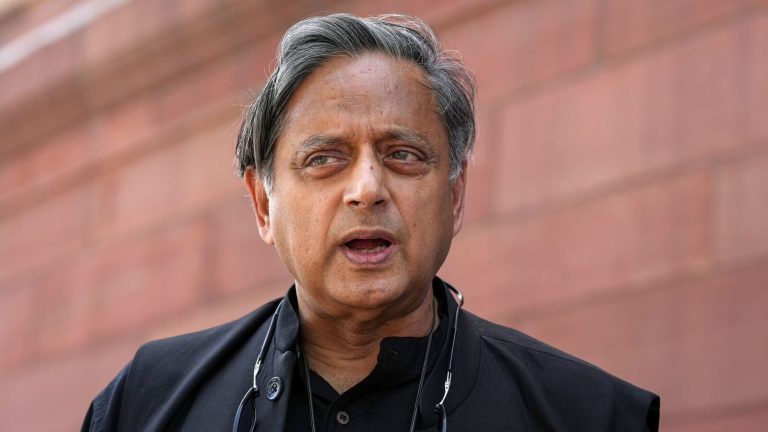
Congress leader, Shashi Tharoor, who has previously served as a diplomat and as MoS MEA, described it as a “fairly unusual” move, however, he refrained from criticising his I.N.D.I. alliance partner, CPI(M). Defending the move, he claimed that it was done for better ‘coordination’ and a move meant for the betterment of Keralites abroad. 

Kerala government defends the move, claims that they have not appointed a ‘Foreign Secretary’

Defending the move, the LDF government has claimed that they have given IAS K Vasuki additional charge of “external co-operation” and it should not be read as an appointment of “foreign secretary”.

Following massive backlash, Kerala Chief Secretary Venu V issued a clarification. He claimed that an officer for External Cooperation was in existence for some time and was created for better coordination with delegates coming to the state from other nations.

In a Facebook post, he claimed that the state government had not issued an order appointing a foreign secretary as it was not ignorant of the fact that foreign affairs were the domain of the Centre. 

However, speaking to NewsX, Former Foreign Secretary, Harsh Vardhan Singhla rejected the LDF government’s claim that appointing a Secretary for ‘External Cooperation’ was not the same as appointing a foreign Secretary’. Pointing out that the order violates the Indian constitution, he urged the state government to either amend the order or revoke it. 

(Video Courtesy – NewsX YouTube channel)

Regarding the phrasing and LDF government’s defense of ‘External co-operation’, Harsh Vardhan Singhla pointed out that the formal name of the Union Ministry is ‘Ministry of External Affairs’ and not Foreign Ministry as colloquially referred to as in media. He added, “So external cooperation really refers to foreign policy or foreign-related cooperation and from that perspective, I don’t think there is any ambiguity in that order.” 

He added that this is a case of over-reach, the state has to either amend the order or take it back. Responding to the query that the matter could reach the courts, Singhla said there is no case made out here as it is clearly in violation of the Union list. He added that states can’t start conducting their own foreign policy. 

Meanwhile, he also pointed out that when officers/ governments deal outside India, they deal with entities not based on states but rather on a country basis, that is they see them as Indian citizens, not as residents of Kerala, UP, or any other state.

Grave ramifications of the appointment order

Meanwhile, apart from the BJP, several journalists, X users, and experts have pointed out that the order by a state government to appoint a ‘foreign secretary’ is unconstitutional as it violates the seventh schedule.

In simple terms, under the seventh schedule, the constitution has categorised subjects into three lists, namely Union, Concurrent, and state lists to divide areas of responsibility and avoid turf war or delegation of responsibility/accountability on others. Only the Union government can make rules and laws on subject matters mentioned in the Union List. Similarly, states have the authority to make laws on matters mentioned in the state list. On subject matters mentioned in the concurrent list, both state and Union governments can make laws with the Union government’s law overriding state laws in case of overlap. 

Notably, Foreign Affairs comes in the Union list. Simply put, only the Union government can make decisions, frame rules, or make appointments concerning the External affairs department and Foreign policy. That is, states can’t start conducting their foreign policy or make appointments to that effect. This is why the recent appointment of IAS K Vasuki as the Secretary for ‘External Co-operation’ (in other words ‘Foreign Secretary’) is seen as an overreach by the state government of Kerala and a violation of the Indian constitution.

Kerala government’s decision threatens Federalism enshrined in the constitution and furthering divisions

The move by Kerala government is also seen as an attempt to usurp the powers of the Union government, posing a serious threat to federalism and the democratic process in the country. 

Over the years, states ruled by the parties that are part of the I.N.D.I.A. bloc have made several decisions against the federal structure enshrined in the Indian constitution. This includes Kerala and West Bengal governments insisting on appointing Vice-Chancellors for Universities which have been junked by the courts, states revoking NOC for probing agencies like ED, and CBI to investigate fresh cases in their states, and presenting the Union government as an outsider, alien to the state.

Further, the recent appointment order of a ‘Foreign Secretary’ could embolden sentiments of regional chauvinism, and foment further division of the country on lines of political ideology. Following the incident, more states could feel inclined to appoint officers, in violation of the constitution, as facilitators to other CMs in the guise of assisting their labourers in that state, or even in the judiciary to speed up matters concerning their state residents. 

The appointment of a ‘foreign Secretary’ by a state government could lead to the creation of more unconstitutional posts that undermine democracy, federalism, and the Indian constitution. 

On several occasions, several political parties and leaders including the incumbent Leader of the Opposition (LoP) in the Lok Sabha, Rahul Gandhi have furthered falsehoods that India is a “Union of States”, alleging that the Union government can’t bulldoze itself on state governments. In line with the Union of States assertion and allegations of the so-called North-South divide, they have also peddled divisive propaganda around tax devolution to states and their states’ particular concerns about collection of GST. If the current trend of appointment continues, it could lead to states, especially ruled by I.N.D.I. alliance parties, to appoint their ‘Secretary’ to the Finance Department and other Ministries.   

Nonetheless, such appointments by the state government in the guise of the betterment of their state residents abroad not only further divisive sentiments, harming national integrity and national brotherhood, it also have the potential to divide Indians living abroad on a linguistic and regional basis. It could lead to segregation of Indian citizens abroad on such divisive lines and blurring sentiments of national interest and brotherhood in them, instilling in them the sentiment to bypass Indian government over ideological, linguistic, or regional bais.

Neglected regions: The socio-economic struggles of Pakistan-Occupied Jammu & Kashmir and Gilgit-Baltistan

Pakistan Occupied Jammu and Kashmir (POJK) and Gilgit-Baltistan (GB) are regions in Pakistan that have long been neglected in various domains such as education, youth unemployment, poverty, infrastructure, healthcare, and food security. This neglect has led to significant socio-economic challenges for the residents of these areas. Highlighting the extent of neglect and its impact on the people of POJK and GB is the most crucial step that society demands at present.

Since Pakistan’s independence, GB has lacked political representation in the national parliament. Despite its historical struggle to end this inequality with other regions, GB does not have seats in either of the two houses of the Pakistan Assembly.

Education is a fundamental right and a crucial factor for socio-economic development. However, the education sector in POJK and GB has been severely neglected. According to the Pakistan Education Statistics 2021-22 report, there are significant disparities in the availability of essential facilities such as toilets, potable water, and boundary walls in schools across different regions of Pakistan. POJK and GB are among the regions with the lowest access to these basic facilities. The lack of infrastructure in schools is a major barrier to education in these regions.

Many schools operate without proper buildings, and students often have to study in makeshift classrooms or under open skies. This not only affects the quality of education but also discourages parents from sending their children to school, especially girls. As a result, the literacy rate in these regions remains low compared to the national average.

Moreover, there is a significant shortage of qualified teachers in POJK and GB. The existing teachers are often underpaid and lack proper training, which affects their ability to deliver quality education. The government has made some efforts to address these issues, such as the establishment of Daanish schools in POJK and GB, but these initiatives are not enough to meet the growing educational needs of the population.

Youth unemployment is another major issue in POJK and GB. The unemployment rate in POJK is double that of Pakistan’s other provinces. The lack of job opportunities forces many young people to migrate to other parts of the country or abroad in search of better prospects. This brain drain further hampers the development of these regions. The situation is particularly dire for women and young people. The female labour force participation rate in POJK is only 7.9%, compared to the national average of 23%. Similarly, the youth unemployment rate in POJK is 27%, indicating systemic inequities within the labour market.

The lack of employment opportunities not only affects the economic well-being of individuals but also contributes to social issues such as crime and drug abuse. In GB, the situation is slightly better due to the presence of a highly educated workforce in the Information and Communications Technology (ICT) industry. However, many young people still struggle to find decent jobs and are forced to settle for low-paying, dead-end jobs. The government needs to create more job opportunities and provide vocational training to equip young people with the skills needed for the job market.

Poverty is a pervasive issue in POJK and GB. According to the Pakistan Poverty Alleviation Fund, the proportion of the population living below the poverty line in these regions is significantly higher than the national average. The multidimensional poverty index, which takes into account factors such as education, health, and living standards, also indicates high levels of poverty in these regions. The high poverty rates are a result of various factors, including the lack of economic opportunities, poor infrastructure, and limited access to basic services.

Many households in POJK and GB rely on subsistence farming and face challenges such as low agricultural productivity and limited access to markets. The government has implemented some poverty alleviation programs, such as the Interest-Free Loan Programme, but these initiatives have not been sufficient to address the root causes of poverty.

The lack of basic infrastructure is a major barrier to development in POJK and GB. The regions suffer from poor road networks, inadequate water supply, and limited access to electricity. The mountainous terrain and harsh weather conditions further exacerbate these challenges. The government has announced several infrastructure development projects such as the construction of the Shounter tunnel and the establishment of a bus service between POJK and GB.

However, these projects have faced delays and funding issues along with giving contracts to outside contractors which suppresses local marginal contractors, and their impact on the ground has been limited. The lack of infrastructure not only affects the quality of life of the residents but also hinders economic activities and access to essential services.

Healthcare services in POJK and GB are inadequate and fail to meet the needs of the population. The regions have a limited number of healthcare facilities, and those that exist are often poorly equipped and understaffed. Overall healthcare infrastructure remains insufficient. The lack of healthcare services has serious implications for the health and well-being of the residents. Many people have to travel long distances to access medical care, and the cost of treatment is often prohibitive. The government needs to invest in healthcare infrastructure and ensure that quality healthcare services are accessible to all residents of POJK and GB.

Food security is a major concern in POJK and GB. The regions are heavily dependent on government subsidies for basic necessities such as wheat which started in 1970. The recent reduction in wheat subsidies, declared by the GB Chief Minister due to pressure from the federal government, has led to widespread protests and increased food insecurity. The rugged terrain and limited agricultural land make it difficult for the regions to achieve self-sufficiency in food production.

Once upon a time, wheat was a budget hero at 20 PKR per kilo (that’s a mere 7 cents in USD). But then—plot twist!—the government cranked up the price to 36 PKR (13 cents). An 80% leap! The government needs to address the food crisis by restoring subsidies and promoting local agricultural production. This can be achieved through initiatives such as providing farmers with access to modern farming techniques and improving access to markets. Ensuring food security is essential for the overall development and well-being of the residents of POJK and GB.

The neglect of POJK and GB in various domains such as education, youth unemployment, poverty, infrastructure, healthcare, and food security has had serious implications for the socio-economic development of these regions. The government needs to take urgent and comprehensive measures to address these issues and ensure that the residents of POJK and GB have access to basic services and opportunities for a better quality of life. By investing in these regions and addressing their unique challenges, Pakistan can promote inclusive and sustainable development for all its citizens.

“Judges are also humans”: Karnataka High Court recalls order which stated only watching child pornography not a violation under IT Act

On Friday, 19th July, the Karnataka High Court rescinded its 10th July ruling which stated that the Information Technology Act does not criminalise merely viewing child pornography. Judge M. Nagaprasanna’s division bench withdrew the order and said that on 18th July the bench had “misread” Section 67B (b) while pronouncing the initial judgment.

“We are also human beings and mistakes do happen on our side. There is always an opportunity for corrections. An inquiry will be done in this regard and a new order will be delivered. This order is cancelled,” the bench conveyed.

It also noted that the order was passed under Section 67B (a) of the IT Act, following a petition filed in this regard by the state government. According to the IT Act’s Section 67B (b), creating text or digital pictures, collecting, searching, browsing, downloading, making advertisements, circulating, exchanging, or picturising children in an obscene, indecent manner is open for investigation under the section.

The court’s reconsideration came after a previous ruling that had granted relief to a person who had been charged with spending fifty minutes viewing child porn on the internet. A complaint was filed against the petitioner for distributing or sending content that included children in violation of Section 67B of the IT Act. The petitioner’s attorney contended that since his client only visited the website and did not disseminate anything, the section was not applicable in the case.

Judge Nagaprasanna dismissed the charges against N Inayatullah and stated that one doesn’t turn into an accused by only watching pornographic content online. He added that the material must be published or distributed for prosecution under Section 67B of the Information Technology Act. The court’s ruling drew heavy criticism. A recall application was filed with the court by the state administration following which the bench discovered that it had not considered Section 67B (b) of the Information Technology Act as it rendered the decision.

According to the Karnataka High Court, Section 67B (b) is pertinent to the matter at hand. It further clarified that the original decision’s omission to take this section into account was an error. The proceedings have been quashed as a result. Judge M Prasanna of the High Court then cancelled the earlier directive.

The petitioner, Inayatullah, had looked at pornographic pictures of kids on his phone on 23rd March 2023, between 3:30 and 4:40 pm and a complaint was filed to the Bangalore Cyber Crime Station of the Bangalore City CID unit by the National Crime Records Bureau (NCRB). NCRB obtained information via the portal established by the national government to combat sexual abuse against women and children.

A case was filed against the perpetrator under Section 67B(b) of the Information Technology Act on 3rd May 2023, at the Bangalore Cyber Crime Police Station, following verification of the information. Inayatulla was identified as the individual who checked the obscene video of children. The petitioner filed a request before the High Court to have the lawsuit dismissed.

A case of a similar nature had previously reached the Supreme Court. During the hearing in April of this year, the apex court declared that visiting child pornographic websites was not illegal but the use of kids in such videos is a crime. The observation was made while reserving the order on a plea challenging the Madras High Court judgment that stated that downloading child pornography was not an offence under the Protection of Children from Sexual Offences (POCSO) Act.

Judge N Anand Venkatesh of the Madras High Court during a hearing on 11th January 2024, pronounced that downloading and viewing child porn in private is not unlawful under the IT (Information Technology) Act and POCSO (Protection of Children from Sexual Offenses) Act. A case under POCSO will only be brought if a minor is used for pornography.