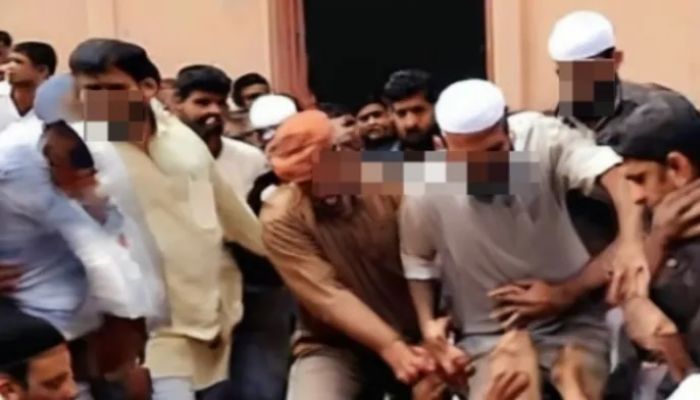
In Saharanpur district of Uttar Pradesh, people from the Dalit community have accused a Muslim mob of attacking them with weapons and brutally assaulting them. It is also alleged that the accused hurled casteist abuses at them and threatened to kill them. During the attack, the accused also targeted a woman. 3 people have suffered serious injuries in the attack and they have been admitted to the hospital.
Based on the complaints of the victims, the Police have registered a case against 5 accused including Ishaq, Sahil and Asghar. The incident took place on Friday (9th August 2024) in the home district of Bhim Army chief and MP Chandrashekhar ‘Ravan’.
प्रकरण के संबंध में वादी की तहरीर पर थाना नकुड़ पर सुसंगत धाराओं में मुकदमा पंजीकृत किया गया है। साक्ष्य संकलन एंव विवेचनात्मक कार्यवाही प्रचलित है।
The incident pertains to a village Khera Afghan in the Nakur police station area of Saharanpur. On Friday (9th August), Rajesh Kumar, who belongs to the Scheduled Caste Jatav community, lodged a complaint with the police in this matter.
In the complaint, he stated that recently one of his inverters was stolen. On 9th August, his brother Dayaram asked questions in this regard from Asghar’s son Ajju, Ayyub’s son Shibbu, Ishaq, Sahil and Asghar. This infuriated the accused and all of them started hurling abuses at Dayaram.
When he asked them to stop abusing him, they brought sticks and shovels from their houses and started brutally assaulting Dayaram. During this time, a villager named Rishipal who was passing by, tried to intervene and briefly stopped the accused from assaulting Dayaram.
It is alleged that sometime later, Ajju, Shibbu, Sahil, Asghar and Ishaq reached Rishipal’s house and they had weapons in their hands. The accused started hurling abuses at Rishipal and when he tried to stop them, they hurled casteist slurs and said, “S**e, C**m*r, you will stop us?” and brutally assaulted him. Rishipal’s brother Karthik and his aunt Anita attempted to save him from the attackers. But the attackers also launched an attack on them and assaulted them mercilessly. After hearing the commotion and the cries of the victims, villagers started gathering there which forced the accused to run away. However, before fleeing the crime scene, they gave death threats to the victims. All the three injured victims have been admitted to the hospital for treatment.
In his complaint, Rajesh Kumar has demanded strict action against the five accused – Ajju, Shibbu, Ishaq, Asghar and Sahil.
Based on his complaint, the police have registered an FIR against the five accused under sections 191 (2), 115 (2), 352, 333 and 351 (2) of the Bharatiya Nyay Sanhita (BNS) along with SC/ST Act. OpIndia has accessed a copy of the FIR.
It is pertinent to note that the the place where the incident unfolded is the native district of Bhim Army chief and MP Chandrashekhar Ravan.
The Securities and Exchange Board of India (SEBI) has urged investors to remain calm and conduct thorough research before reacting to the Hindenburg Research report.
“Investors should remain calm and exercise due diligence before reacting to such reports. Investors may also like to take note of the disclaimer in the report that states that readers should assume that Hindenburg Research may have short positions in the securities covered in the report,” the SEBI said in a statement.
The late evening release of SEBI refutes the charges made by the US-based short seller and says “the allegations made by Hindenburg Research, against the Adani Group, have been duly investigated by SEBI.”
It further adds that even the apex court in its order has noted that SEBI has completed the investigations in 22 out of 24 cases.
“Hon’ble Supreme Court in its Order of January 3, 2024, noted that SEBI had completed twenty-two out of twenty-four investigations into the Adani group. Subsequently, one more investigation was completed in March 2024, and one remaining investigation is close to completion.”
SEBI statement says the ongoing investigation in the last case is also about to complete.
“…in this matter, more than 100 summons, around 1,100 letters and emails have been issued to seek information. Further, more than 100 communications have been made seeking assistance from domestic/foreign regulators and external agencies. Also, more than 300 documents containing around 12,000 pages have been examined.”
SEBI says as per the rule on the completion of investigations, before initiating enforcement proceedings, show cause notices are issued and an opportunity is given for a hearing to the parties.
“Pursuant to the completion of investigations, SEBI initiates enforcement proceedings which are quasi-judicial in nature. This comprises issuing of show cause notice and giving of opportunity of hearing which culminates in the passing of a speaking order. Such order is then made available in the public domain. Where investigations have been completed, enforcement proceedings initiated are ongoing and appropriate actions are being taken in accordance with the applicable securities laws.”
As a policy measure, SEBI refrains from commenting on any investigation or ongoing enforcement matter.
SEBI says the show cause notice issued to Hindenburg Research on June 27, 2024, was issued following the due process of law for violation of securities laws
“It is noted that Hindenburg Research has itself made the show cause notice issued to it available on its website. The show cause notice contains the reasons for its issuance. The proceedings in this matter are ongoing and the same is being dealt with in accordance with the established procedure and in compliance with the principles of natural justice.”
On charges of SEBI’s (REIT) regulations had benefitted large multinational financial conglomerate SEBI says, REIT regulations were amended from time to time and implemented after a robust consultation process from the stakeholders.
“As with all cases involving introduction of a new regulation or amendment to an existing regulation, a robust consultation process for seeking inputs and feedback of the industry, investors, intermediaries, relevant Advisory Committee and the public at large is in place. Only after consultation, a proposal for introduction of a new regulation or change in the existing regulation is placed for the consideration of and deliberation of the SEBI Board. Regulations are notified after approval of the SEBI Board. As a measure of transparency, the agenda papers for Board meetings and outcomes of Board discussions are also published on SEBI website.”
Hence, claims that such regulations, or circulars issued related to REITs were to favor one large multinational financial conglomerate, are inappropriate.
The market regulator further adds that for the development of the Indian securities market, SEBI has underscored the potential of REITs, SM REITs, InvITs and municipal bonds amongst other assets and they are highlighted in the latest SEBIs Annual Report
Therefore, the claim that promoting REITs and SM REITs among various other asset classes by SEBI was only for benefitting one large multinational financial conglomerate, is inappropriate.
The release also said that SEBI chairperson has recused herself in matters involving conflicts of rule.
“it is emphasized that SEBI has adequate internal mechanisms for addressing issues relating to conflict of interest, which include disclosure framework and provision for recusal. It is noted that relevant disclosures required in terms of holdings of securities and their transfers have been made by the Chairperson from time to time. Chairperson has also recused herself in matters involving potential conflicts of interest.”
The market regulator has over the years built a robust regulatory framework that aligns with best global practices and also ensures protection of investors.
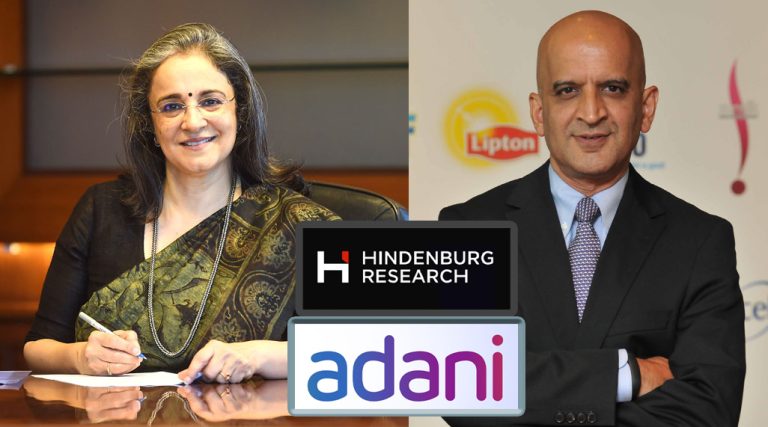
A day after US-based short seller Hindenburg Research alleged that SEBI Chairperson Madhabi Puri Buch and her husband Dhaval Buch had stakes in “both the obscure offshore entities used in the Adani money siphoning scandal,” the SEBI Chairperson and her husband in their personal capacity issued a detailed statement rejecting the allegations.
This followed a brief statement issued by them earlier on Sunday where they had accused Hindenburg of tarnishing their reputation.
Earlier on Saturday, the US-based firm Hindenburg Research alleged that SEBI’s Chairperson Madhabi Buch and her husband had a stake in “both the obscure offshore entities used in the Adani money siphoning scandal.”
In January 2023, Hindenburg published a report accusing the Adani Group of financial irregularities, leading to a significant drop in the company’s stock price. The group at the time had rubbished these claims.
In January 2024, the Supreme Court refused to transfer the probe into the allegations of stock price manipulation by the Adani group to an SIT and directed market regulator SEBI to complete its probe into two pending cases within three months.
Earlier this year the SC also dismissed a plea seeking to review the verdict that had sought investigation by the market watchdog SEBI in the Adani-Hindenburg case.
(This news report is published from a syndicated feed. Except for the headline, the content has not been written or edited by OpIndia staff)
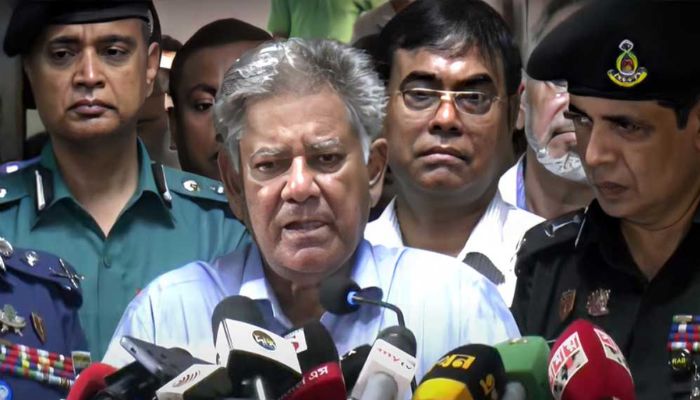
On Sunday (11th August), the Interim Government of Bangladesh issued a stern warning to media organisations and threatened a complete shutdown if it indulges in sycophancy. Notably, Home Affairs Adviser to the Interim government, Brigadier General (retd) M Sakhawat Hossain warned that the media outlets would face closure if they indulged in flattery/sycophancy or provided misleading news. This serves as a chilling effect as he also blamed local media for not reporting the truth and flattering the Sheikh Hasina government during ‘student’ protests.
On Sunday, Hossain briefed the media after visiting injured police personnel at the Rajarbagh Police Hospital at 12:30 PM. He claimed that during the recent protests, the Bangladeshi media repeatedly said, ‘nothing happened, nothing happened’. “I saw everything from the BBC but not our media. Shame on you. Shame on the Media Owners,” he said.
The Home Affairs Adviser criticised the Bangladeshi media for not presenting the truth. He said, “A country deteriorates when the media fails to report honestly.” He argued that had the media accurately reported events, the current situation involving the police might have been avoided.
He added, “The media often ignores the truth…There is a lack of substantive discussion on talk shows, and the media fails to provide accurate information.”
The Home Affairs Adviser added, ‘Whatever happened before, no one will be allowed to indulge in flattery again. Media will work independently. Even then, those media who will be indulging in sycophancy/flattery will be closed. I repeat, I will shut down the media hall of flattery.”
He further stated, “The politics of Bangladesh has been turned into the politics of flattery. It has damaged the country. You don’t make politicians, you make flatterers/sycophants. Made such flattery that – people are dying, but they say, ‘No, everything is fine’. Politics cannot be done with such sycophants. Those who are doing politics, they cannot leave politics. Avoid flattery.”
Additionally, the Interim government’s adviser for Posts, Telecommunications, and Information Technology, Nahid Islam said that officials who were involved in the internet shutdown during the recent student protests will face consequences, the Daily Star newspaper reported.
He made these remarks while speaking with reporters on the first day of joining his office at the Secretariat on Sunday. He said that access to the internet is a right and disrupting or shutting it down is a violation of human rights. He claimed that the indiscriminate internet shutdowns will no longer be tolerated.
Meanwhile, according to the newly-appointed Inspector General of Police (IGP) Md Mainul Islam, at least 42 members of the police force were killed and scores were injured in clashes during the recent protests that resulted in Sheikh Hasina’s ouster. According to the Daily Star newspaper, he said that over 500 police personnel were injured and took treatment at the hospital. Islam added that more than two dozen police personnel are still undergoing treatment.
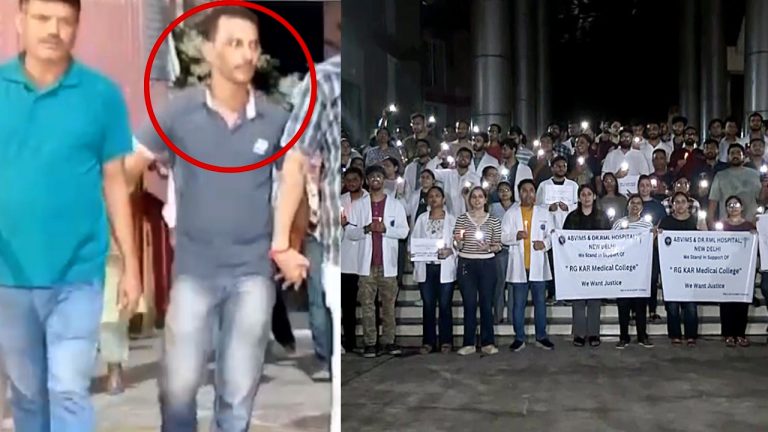
The accused in the brutal rape and murder of a post-graduate trainee doctor at RG Kar Medical College in Kolkata was arrested by the police on 10th August. Reportedly, the accused identified as Sanjoy Roy has confessed to the crime. He was an outsider who was frequent visitor at the premises of the hospital. He was sent to police remand for 14 days. Kolkata Police Commissioner Vineet Goyal said, “This is a heinous crime, and the arrested person is allegedly involved based on circumstantial evidence, including accounts of the other doctors present during night-duty hours.”
Police found porn videos on the accused’s phone. He was identified as a civic volunteer, member of a group that was formed in West Bengal to support the police. It was also part of the Police Welfare Board. This was the reason he got easy access to the hospital premises. During the investigation, he was seen entering the hospital at around 4 AM.
According to reports, when the accused entered the hospital on the day of the incident, he was wearing earphones. However, while leaving the hospital, the earphones were missing and were seized by the police. The earphones helped the police to trace the culprit. The accused has been booked under Sections 64 and 103 of BNS.
Mamata government vows to seek the death penalty for the accused
Speaking on the matter, Chief Minister of West Bengal, Mamata Banerjee vowed she would seek the death penalty for the accused. TMC national general secretary Abhishek Banerjee had called for “capital punishment or encounter” of the accused of such crimes.
Man threatens doctor of the same fate as Kolkata Rape and Murder victim
On 10th August, a man in the Purba Bardhaman district of West Bengal was arrested by the police for allegedly threatening a woman medic of a similar fate as the rape and murder of a trainee doctor at RG Kar Medical College of Kolkata. The man was arrested after doctors and nurses of the state-run Bhatar State General Hospital staged a protest and demanded the arrest of the accused.
A district health official said in a statement that the patient, Susanta Roy, allegedly threatened the attending doctor that if the medic did not treat him properly, “he would ensure the same treatment as the woman doctor of R G Kar Hospital in Kolkata witnessed.”
The official added, “The doctor, as part of her duty and medical ethics, did not stop the treatment, and she discussed the matter with other staffers. Today, they came in a group to the CMOH office and demanded punishment of the man and security for the health personnel.”
Police officials in a statement to India Today said, “We have learnt the accused went to Bhatar state-run hospital for treatment and threatened the lady doctor for being late to start his treatment. The lady accused the civic volunteer of threatening her, saying, ‘Did you see what happened at RG Kar Medical College Hospital? It can happen to you too.”
Kolkata Rape and Murder Case
On 9th August, a woman doctor was found dead in a government college under mysterious circumstances. The incident is said to have happened on the third floor of the emergency building of RG Kar Medical College in West Bengal’s Kolkata on Friday morning. The victim who was a second-year postgraduate student of RG Kar Medical College, was found dead inside the Seminar Hall on the 3rd floor of the campus.As per the police, the woman had gone to the third-floor seminar hall to have dinner.
A day after the incident, the preliminary post-mortem report confirmed that she was raped before the murder. The four-page autopsy report revealed that the woman had bleeding from her private parts. Additionally, she also had injury marks on other parts of her body. The Police stated that the autopsy report has also ruled out suicide. Subsequently, they have registered a case at the Tala Police Station. A police officer told PTI, “This is definitely not a case of suicide; the woman was murdered following sexual assault.”
A day after US-based short seller Hindenburg Research alleged that SEBI Chairperson Madhabi Puri Buch and her husband Dhaval Buch had stakes in “both the obscure offshore entities used in the Adani money siphoning scandal,” the SEBI Chairperson and her husband issued a detailed statement rejecting the allegations.
This followed a brief statement issued by them earlier on Sunday where they had accused Hindenburg of tarnishing their reputation.
The statement says that Madhabi Buch is an alumnus of IIM Ahmedabad and has had a corporate career of over two decades in banking and financial services, largely in the ICICI Group. From 2011 to March 2017, Madhabi lived and worked from Singapore, initially as an employee of a Private Equity firm and subsequently as a consultant.
Dhaval Buch is an alumnus of IIT Delhi and has had a corporate career of 35 years in Hindustan Unilever Limited in India and then in Unilever globally as part of its senior management team. From 2010 to 2019, Dhaval lived and worked in London and in Singapore – both with Unilever.
“During this long period, Madhabi and Dhaval have accrued their savings through their salaries, bonuses and stock options. Insinuations about their net worth and investments referencing Madhabi’s current government salary is malicious and motivated,” the statement reads
The statement says “The investment in the fund referred to in the Hindenburg report was made in 2015 when they were both private citizens living in Singapore and almost 2 years before Madhabi joined SEBI, even as a Whole Time Member. “
“The decision to invest in this fund was because the Chief Investment Officer, Anil Ahuja, is Dhaval’s childhood friend from school and IIT Delhi and, being an ex-employee of Citibank, J.P. Morgan and 3i Group plc, had many decades of a strong investing career. The fact that these were the drivers of the investment decision is borne out by the fact that when, in 2018, Ahuja, left his position as CIO of the fund, we redeemed the investment in that fund,” the statement further reads.
“As confirmed by Anil Ahuja, at no point in time did the fund invest in any bond, equity, or derivative of any Adani group company,” the statement adds.
The joint statement also addresses the issue of the SEBI chairperson’s husband’s appointment with Blackstone Equity.
“Dhaval’s appointment, in 2019, as Senior Advisor to Blackstone Private Equity was on account of his deep expertise in Supply Chain management. Thus, his appointment pre-dates Madhabi’s appointment as SEBI Chairperson. This appointment has been in the public domain ever since. At no time has Dhaval been associated with the Real Estate side of Blackstone. On his appointment, the Blackstone Group was immediately added to Madhabi’s recusal list maintained with SEBI,” the statement reads.
“Over the last two years, SEBI has issued more than 300 circulars (including “Ease of Doing Business” initiatives in line with the developmental mandate of SEBI) across the entire market eco-system. All regulations of SEBI are approved by its Board (and not by its Chairperson) after extensive public consultation. Insinuations that a handful of these matters related to the REIT industry were favours to any specific party are malicious and motivated,” the statement adds.
The joint statement also addresses the issue of consulting companies that were set up by the SEBI Chairperson before she assumed office.
“The two consulting companies set up by Madhabi during her stay in Singapore, one in India and one in Singapore, became immediately dormant on her appointment with SEBI. These companies (and her shareholding in them) were explicitly part of her disclosures to SEBI” the statement said.
“After Dhaval retired from Unilever in 2019, he started his consultancy practice through these companies. Dhaval’s deep expertise in Supply Chain allowed him to work with prominent clients in the Indian industry. Thus, linking accruals in these companies to Madhabi’s current government salary is malicious. When the shareholding of the Singapore entity moved to Dhaval, this was once again disclosed, not just to SEBI, but also to the Singapore authorities and the Indian tax authorities,” the statement adds.
The joint statement also claimed that the Buch couple had disclosed all this to the required agencies.
“SEBI has strong institutional mechanisms of disclosure and recusal norms as per the code of conduct applicable to its officers. Accordingly, all disclosures and recusals have been diligently followed, including disclosures of all securities held or subsequently transferred,” the statement said.
“Hindenburg has been served a show cause notice for a variety of violations in India. It is unfortunate that instead of replying to the Show Cause Notice, they have chosen to attack the credibility of the SEBI and attempt character assassination of the SEBI Chairperson,” it added.
Earlier on Saturday, the US-based firm Hindenburg Research alleged that SEBI’s Chairperson Madhabi Buch and her husband had a stake in “both the obscure offshore entities used in the Adani money siphoning scandal.”
Hindenburg’s research claimed in its analysis, “We had previously noted Adani’s total confidence in continuing to operate without the risk of serious regulatory intervention, suggesting that this may be explained through Adani’s relationship with SEBI Chairperson, Madhabi Buch.”
“What we hadn’t realized: the current SEBI Chairperson and her husband, Dhaval Buch, had hidden stakes in the exact same obscure offshore Bermuda and Mauritius funds, found in the same complex nested structure, used by Vinod Adani,” the report by the US hedge firm said.
In January 2023, Hindenburg published a report accusing the Adani Group of financial irregularities, leading to a significant drop in the company’s stock price. The group at the time had rubbished these claims.
In January 2024, the Supreme Court refused to transfer the probe into the allegations of stock price manipulation by the Adani group to an SIT and directed market regulator SEBI to complete its probe into two pending cases within three months.
Earlier this year the SC also dismissed a plea seeking to review the verdict that had sought investigation by the market watchdog SEBI in the Adani-Hindenburg case.
(This news report is published from a syndicated feed. Except for the headline, the content has not been written or edited by OpIndia staff)
The Jharkhand High Court recently directed the state government to utilise its ‘Special Branch’ for identifying infiltrators/illegal immigrants in the Santhal Pargana region. The Court also noted that the issue of infiltration has been considered as an external aggression by the Supreme Court.
Notably, a petitioner named Danyaal Danish, a resident of Jamshedpur, has filed a PIL before the court. The PIL highlight that there has been wide-scale infiltration of foreigners who are “mainly coming” from Bangladesh, especially in six districts – Godda, Jamtara, Pakur, Dumka, Sahibganj and Deoghar.
A division bench of Acting Chief Justice Sujit Narayan Prasad and Justice Arun Kumar Rai is hearing the matter. In its order dated 8th August, the bench took note of a document submitted by the petitioner on the changing demographic composition in the state, particularly the Santhal Pargana region (as per Census data 1951-2011).
The Counsel, representing the petitioner, submitted that the percentage of tribal population in the Santhal Pargana region had “decreased drastically”. From 44.67% in 1951, it has come down to 28.11% in 2011. In contrast, the Muslim population had “increased manifold” and it had jumped from 9.44% in 1951 to 22.73 % in 2011.
The counsel further stressed that due to infiltration, illegal immigration etc., the demographic set up of Jharkhand in particular Santhal Pargana Region is changing rapidly. It is pertinent to note that Santhal Pargana is only 15 kilometers away from Bangladesh and it borders West Bengal.
The petitioner’s counsel highlighted that if the population of the Scheduled tribe decreases in the Santhal Pargana region then it would jeopardise the interest of the State of Jharkhand in particular the tribal community.
The petitioner also submitted before the court that Bangladeshi infiltrators in Santhal Pargana are converting native women by marrying them and grabbing their lands through gift deeds. According to the petitioner, after marrying tribal girls, the infiltrators are indirectly running the reserve posts. In his petition, he has also submitted that infiltrators have established a large number of mosques and madrassas in districts bordering Bengal.
The court noted that the matter appears to be very serious. It stated that in addition to the issue of illegal immigrants, it was also the question of the extinguishment of the tribal community from the State for which the State of Jharkhand was created to protect their interest and also for securing their rights.
Responding to the petition, the state argued that the local authorities including the police administrations have been facing difficulty in identifying infiltrators.
To which, the bench replied that it failed to understand why services of the “Special Branch” were not being utilised for this purpose which is supposed to give such information.
Criticising the district administrations, the bench said that this also revealed the “lackadaisical approach” of the district administration. The court noted that ration cards, voter cards and Aadhar cards were reportedly being prepared based on documents that “cannot be said to be genuine”. Based on such documents the “infiltrators are utilising the beneficial schemes” of the state which are meant for the welfare of the local people, the court noted.
The bench directed, “Therefore, the State is directed to utilise the Special Branch for the purpose of identification of infiltrators/illegal immigrants. The Deputy Commissioner of the concerned districts since have already been directed to file an affidavit, hence, let such exercise of identification of the infiltrators having Ration card, the Voter card and the Aadhar Card be conducted on the basis of the ‘record of rights’.”
It is pertinent to note that a record of right is a document which have details of land and its ownership.
The bench also directed the Deputy Commissioner of the concerned districts to ensure that documents like Ration card, Voter card, Aadhar Card or B.P.L. Cards etc. are issued only after verifying the ‘record of rights’, directing them to issue orders to that effect.
Additionally, the Court also made the Director of the Intelligence Bureau, the Director General of the Border Security Force (BSF), the Chief Election Commissioner of India, and the Director General of the Unique Identification Authority of India parties to the case. Subsequently, the court issued notices to them and asked them to file a response in the matter. The next date of hearing in this matter is 22nd August.
The High Court also noted that the issue of infiltration has been considered as an external aggression by the Supreme Court. Thus the high court said that the services of the Intelligence Bureau would be “effective” in dealing with the issue and directed it to submit a report on the issue in a sealed cover.
Nishikant Dubey had raised the matter in Parliament
Earlier, on 25th July 2024, Godda MP Nishikant Dubey had raised this matter in the Parliament. He had demanded implementation of NRC in the Santhal Pargana region.
The BJP leader said that everywhere the voters increase only by 15-17% but in this region, it has increased by 123%. He added that in the assembly constituency falling in his Lok Sabha constituency, about 267 booths saw the Muslim population increase by 117%.
Dubey said, “There are 25 such assembly seats in Jharkhand where the population has increased by 123 percent, this is a matter of concern. He said that there was a riot in Taranagar area in Pakur district. The reason for this riot is that the Bengal Police and people coming from Malda, Murshidabad are driving away our people. The Hindu villages are getting deserted.”
Speaking in the Lok Sabha, BJP MP Dubey said that when Jharkhand was carved out from Bihar, the Santhal Pargana region had 36% forest dwelling population in 2000, which has now reduced to 26%. He asked the House where this 10% population disappeared. But no one talks about this in the Parliament.
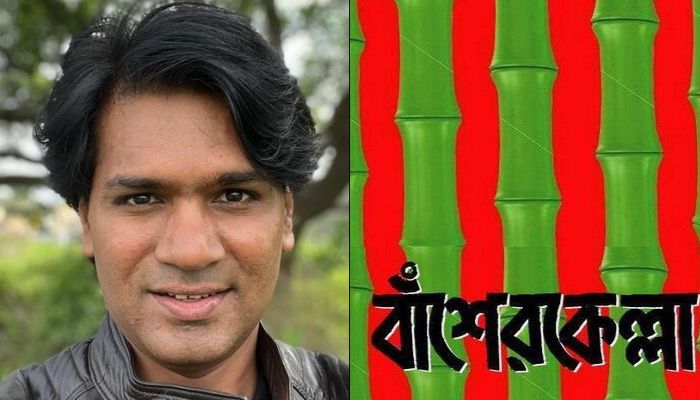
Amid reports of 205 attacks on Hindus in Bangladesh, an X (formerly Twitter) handle named ‘Basherkella’ has been at the forefront of downplaying atrocities committed by Islamists against the minority community.
‘Basherkella’, with over 3,20,000 followers, has been the ‘go-to-source’ for radical Muslims in the Indian subcontinent ever since the ouster of Sheikh Hasina and the onset of violence against the Hindu community.
With ties to both the Bangladesh Nationalist Party (BNP) and Jamaat-e-Islami (JeI), it has left no stone unturned to give a clean chit to Islamists involved in the anti-Hindu carnage.
On Sunday (11th August), Basherkella shared a misleading video by Akash Banerjee to falsely claim that Hindus are not under attack in Bangladesh (despite overwhelming evidence to the contrary).
OpIndia had reported how the YouTuber shrewdly cast doubts on the extent of attacks on the Hindu community and suggested that it could be the result of political violence and not religious targeting.
For the unversed, Basherkella came to the fore after the start of the trial by the International Crimes Tribunal (ICT) in Bangladesh. ICT was formed to investigate atrocities committed by the Pakistani Army and their supporters, Razakars, Al-Badr, and Al-Shams, on civilians during the 1971 Liberation War.
It has infamously supported war criminals, propagated Islamic extremism and endorsed attacks on minority communities (particularly the Hindus).
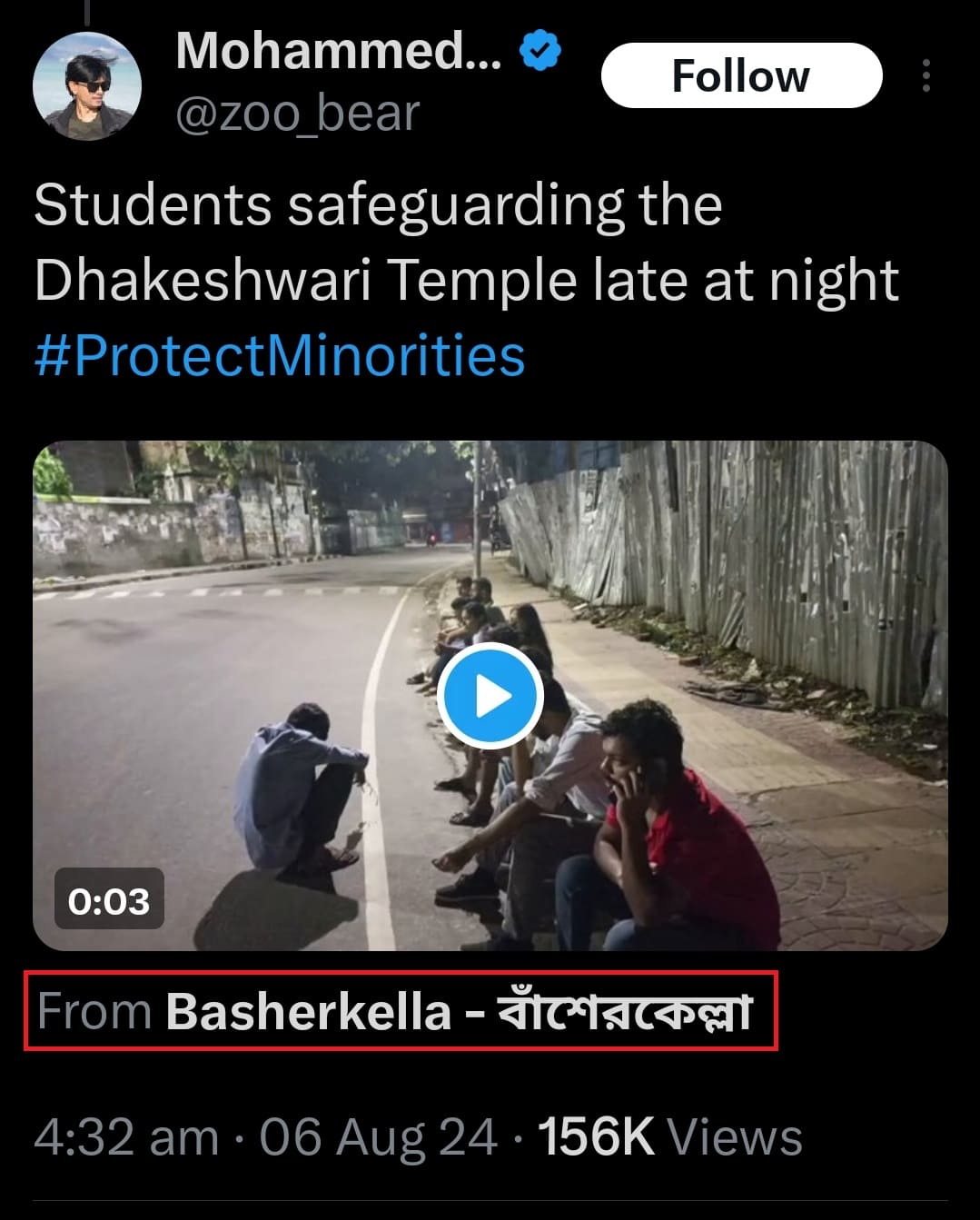
Given its notorious reputation, Mohammed Zubair of Alt News reuploaded a video published by Basherkella on Tuesday (6th August).
He claimed that Muslims were protecting the famous Dhakeshwari temple without mentioning the ‘religion’ of those endangering the safety of the Hindu site. The video shared by the dubious fact-checker and Basherkella was meant to negate the Islamist role in the anti-Hindu attacks.
Basherkalla, cited by Zubair to whitewash the pogroms against Hindus, is putting a target on the back of Bangladeshi Hindus by accusing them of spreading 'Bhagwa Love Trap' and importing 'Hindutva' and 'India' agenda.
As pointed out by popular Twitter user ‘Year of the Kraken’, Basherkella was seen lying about Hindus ‘attacking’ the armed forces of Bangladesh alongside Awami League members.
Basherkella has been the frontrunner in dehumanising, instigating attacks and shrewdly whitewashing them when caught red-handed.
Anti-Hindu diatribe, attacks and downplaying of violence
According to a report published by Asia Times in 2013, BNP and Jamaat-e-Islami carried out attacks on 319 temples, houses and shops of the Hindu community after the International Crimes Tribunal (ICT) sentenced war criminal Delwar Hossain Sayeedi to death.
At that time, ‘Basherkella’ dehumanised Bengali Hindus with slurs such as ‘malaun’ and called for their murder. It announced, “We will kill all the Malauns and Bangladesh will be ‘Banglastan’ like Pakistan.”
A report by The Daily Star quoted the extremist account as saying, “In this subcontinent, if we and Pakistan unite, we won’t have to care about Malaun, atheist and Nasara. We will name this Islamic country as Islamic Republic of Banglastan or join with Pakistan where only Muslims will live.”
Basherkella accused Hindus of burning their own houses. Source: Twitter
During the Islamist onslaught on Bangladeshi Hindus in October 2021, Basherkella resorted to vicious victim-blaming. It openly peddled fake news to give a clean chit to Muslim mobs, which set fire to Hindu houses in Rangpur.
OpIndia had reported the incident at that time. In a tweet, Basherkella had alleged, “Some #Hindu of Pirganj Upazila of Rangpur ignite their own houses to malign about the non-sectarian image of #Bangladesh: locals say.” After being exposed on social media, the Jamaat mouthpiece quietly deleted the tweet.
At that time, The New Indian Express had reported, “The UK-based IT cell of the JeI, Basherkella (bamboo fortress), has been spewing anti-Hindu and anti-India propaganda for some time, giving traction to the view that the violence was planned in advance.”
— Basherkella – বাঁশেরকেল্লা (@basherkella) April 5, 2022
A year later, Basherkella dehumanised Hindu women by posting a picture of a smiling dog with a ‘bindi (red dot)’.
In a vicious Hinduphobic tweet, Basherkella wrote, “Tip ader sanskriti, Musalman der not (Bindi is their culture and not that of Muslims).” It indicated that ‘bindi’ belonged to Hindu women, who were represented by the picture of a smirking dog.
‘Basherkella’ encouraged violence, economic boycott of Ahmadiyas in Bangladesh
In March 2023, ‘Basherkella’ was actively involved in provoking Muslims to attack the Ahmadiya community in Ahmednagar village in the Panchagarh district of Bangladesh.
The Jamaat mouthpiece had posted a series of tweets after violent Muslim mobs targeted Ahmadiyas, killing 2 and injuring three dozen others. An estimated 50 shops and 189 houses were set on fire.
‘Basherkella’ not only encouraged Muslims to continue violent demonstrations against Ahmadiyas but urged them to boycott businesses belonging to the minority community.
— Basherkella – বাঁশেরকেল্লা (@basherkella) March 3, 2023
“A series of tweets from Basherkella has left the minority community shocked and bewildered…One of the tweets from the verified Basherkella account lists some renowned local brands, calling them “Qadiani owned” and asks all to boycott their products,” a report by Dhaka Tribune noted.
It also accused law enforcement authorities of taking the side of Ahmadiyas and attacking ‘anti-Qadiani protestors’ at the behest of the Sheikh Hasina-led-Awami League government, thereby fuelling more unrest.
At that time, the role of ‘Basherkella’ in inciting violence was confirmed by the then Information and Broadcasting Minister Dr Hasan Mahmud.
— Basherkella – বাঁশেরকেল্লা (@basherkella) March 3, 2023
Muslims had attacked Ahmadiyas after the latter announced plans to hold a 3-day religious program (Jalsa Salana) in Panchgarh.
Support for Al Qaeda
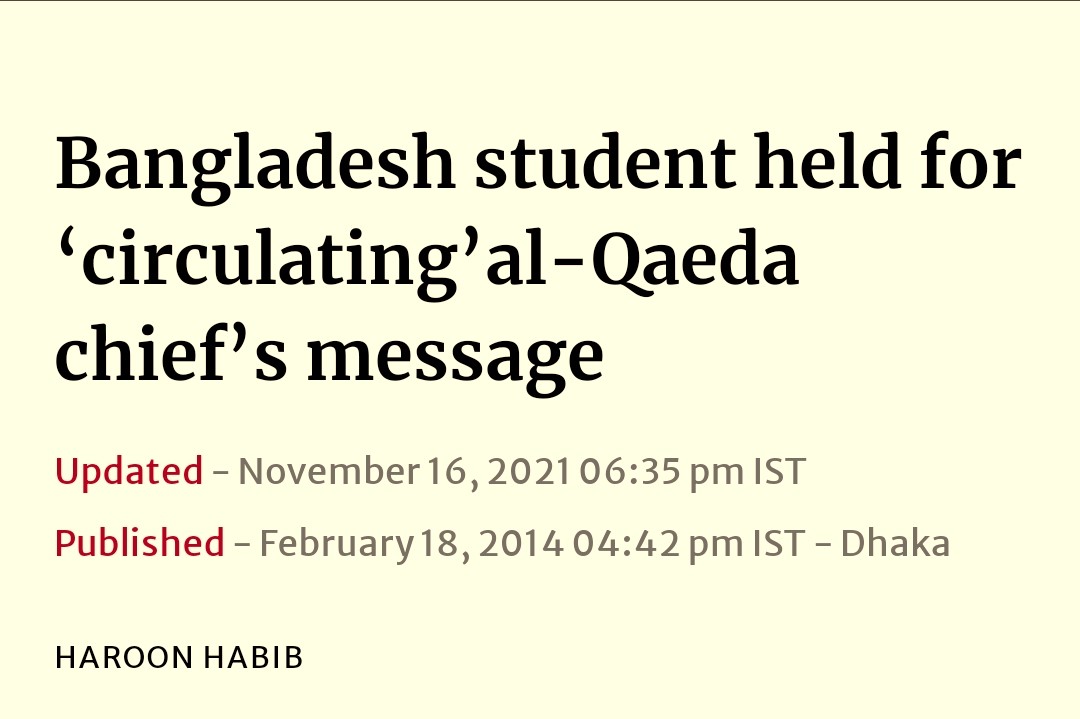
In November 2021, the Rapid Action Battalion (RAB) of Bangladesh police arrested a 21-year-old Muslim youth for amplifying the terror message of slain Al-Qaeda supremo Ayman Al-Zawahiri.
The accused was identified as Rasel Bin Sattar Khan. He had called for an Islamic uprising (intifada) in Bangladesh. Rasel was the admin of the Facebook page of ‘Basherkella’ and possessed jihadi books.
Despite being a third-year student, he had strong connections with Al Qaeda. Rasel was found circulating the audio message of Zawahiri, wherein he was heard calling for a mass uprising against ‘enemies of Islam.’
Screengrab of the news report about the arrest of Basherkella’s admin
The message also made references to the governmental crackdown on violence unleashed by Hefazat-e-Islam in Dhaka in 2020.
Pro-US interference and growing control
In October 2023, the ‘Bangladesh Hindu Buddhist Christian Unity Council’ pointed out how Basherkella was endorsing the visa restrictions imposed on media personnel by the US government.
It raised alarms over the Jamaat mouthpiece hailing US Ambassador to Bangladesh, Peter Haas’ as a ‘true friend.’
OpIndia had reported in November about the overt interference of Hass in the internal politics of Bangladesh. He had visited the house of a BNP leader named Sajedul Islam Sumon and even directed the Awami League to engage with the Opposition BNP.
Ambassador Haas is a true friend of the people of BD! His efforts in rescuing them from dictatorship are highly appreciated. Let's hope he continues to play a role in establishing democracy and ending dictatorship in the country. pic.twitter.com/1vwaJnfuSc
Reportedly, Basherkellah has been an ally of Tarique Rehman, the son of BNP supremo Khalida Zia. Rehman has been living in self-exile in the United Kingdom since 2008.
After Sheikh Hasina was ousted as PM of Bangladesh and replaced with a US asset, we highlighted overwhelming evidence to show that the country was heading towards becoming an Islamist state.
With the increasing control of Jamaat-e-Islami and BNP in the political discourse of Bangladesh, extremist handles such as ‘Basherkella’ are going to gain more ground on social media in the coming days.
The main opposition party of Maldives, the Maldivian Democratic Party (MDP) has welcomed the sudden change in Indian policy of President Mohammad Muizzu-led government. The party asserted that the policy change has reaffirmed that India is the Maldives’ most reliable partner in times of crisis.
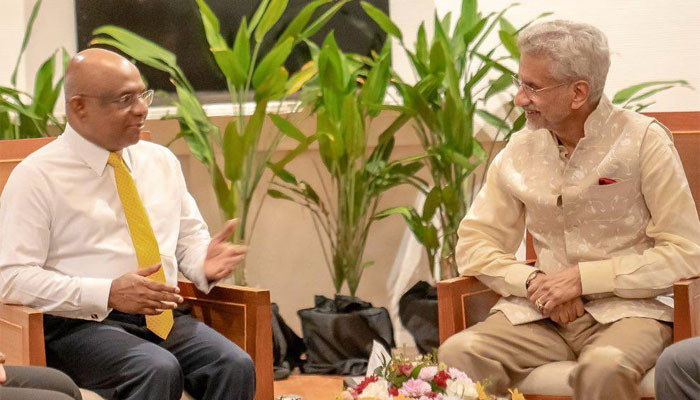
MDP chief Abdulla Shahid urged the Muizzu administration to issue a public apology “for the actions, lies and irresponsible comments from its officials which have resulted in significant damage to the Maldives’ foreign and economic outlook.” Shahid has served as the foreign minister of Maldives in the past.”
Great pleasure to warmly welcome and meet Indian External Affairs Minister @DrSJaishankar to the Maldives with my colleagues from @MDPSecretariat .
The Maldives has always been confident that India will always be the first responder any time the Maldives “dials an… pic.twitter.com/a2ckdHHaEa
In a post on X, Shahid said, “The Maldives has always been confident that India will always be the first responder any time the Maldives “dials an international 911”. The current government’s initial stoking of anti-India sentiments through aggressive slogans, mockery and the branding of a time-tested friend and development partner as a regional bully, has caused a decline in Maldives international standing, economic loss, and many other unnecessary difficulties, and challenges.”
Shahid added, “With this in mind, the MDP welcomes the sudden recalibration of the Maldives-India policy of President Muizzu’s government, from its previous India Out policy. The Maldivian Democratic Party hopes that this shift will not be temporary or superficial, but consistent and meaningful in the best interests of the people of the Maldives. Further, the MDP calls on the Government of President Muizzu to issue a public apology for the actions, lies and irresponsible comments from its officials which have resulted in significant damage to the Maldives foreign and economic outlook.”
In an official press release issued by the Maldivian Democratic Party Secretariat, the party thanked Indian External Affairs Minister Dr S Jaishankar for India’s steadfast support to the people of Maldives. Furthermore, they welcomed the initiative to train 1000 civil service officers which was a key program during previous President Solih’s tenure.
The press note read, “During the past five years, India has assisted the Maldives in a variety of areas, including the funding of the largest infrastructure project in the country the Greater Male Connectivity Project. Other large-scale projects include the National College of Policing and Law Enforcement (NCPLE) in Addu City, the Coast Guard Building in Male’, the development of Maldives National Defence Force Harbour and dockyard in Uthuru Thila Falhu, the Addu Roads and Sewerage Development Project, the Development of Water and Sewerage projects in 36 Islands, the Koodoo and Felivaru Fisheries Expansion Project, Hanimaadhoo International Airport, IGMH Hospital.”
It added, “The Government of India has also extended grant assistance through the High Impact Community Development Projects scheme, for 47 projects in over 60 islands across the Maldives, amounting to over 250 million Rufiyaa. India also provided extensive support to the Maldives to tackle and overcome the COVID-19 pandemic, including through vaccines, medical consumables, financial assistance, and humanitarian assistance.”
Maldives-India relationship
With President Muizzu taking power in Maldives last year, the ties between India and Maldives went south quickly. Muizzu’s election campaign, including the “India Out” campaign, where his party promised the withdrawal of Indian military personnel from the Island nation led to tensions between the two countries. Furthermore, Muizzu’s pro-China stance was no help to repair the relations. After several talks, the military personnel were replaced by civilians.
In January this year, Prime Minister Narendra Modi went to Lakshadweep Islands and promoted tourism. Though he did not take any names, some social media users urged Indian tourists to choose Lakshadweep over Maldives. The campaign initiated by Indian users on X irked some ministers of Maldives leading to some derogatory comments from them for India and PM Modi.
The incident spiralled into a diplomatic event and three of Maldivian ministers were suspended by the government. Furthermore, several Indians who had either booked tickets for Maldives or were planning to go there for holidays cancelled the tickets. Maldives is dependent a lot on tourists from India and such cancellations resulted in a fall in revenue for the country.
Muizzu, however, kept his anti-India stance intact for months. However, on 10th August, out of the blue Muizzu, called India “one of the closest allies” of Maldives and thanked PM Modi and the Government of India for its continued support.
Notably, Maldives holds importance in the Indian Ocean region as it is India’s key maritime neighbour. During the previous government under President Ibrahim Mohamed Solih, the relationship between the two countries in overall bilateral ties, defence and security saw a lot of progress which changed drastically after Muizzu took over. However, India decided to keep supporting the Island nation and did not cut diplomatic ties.
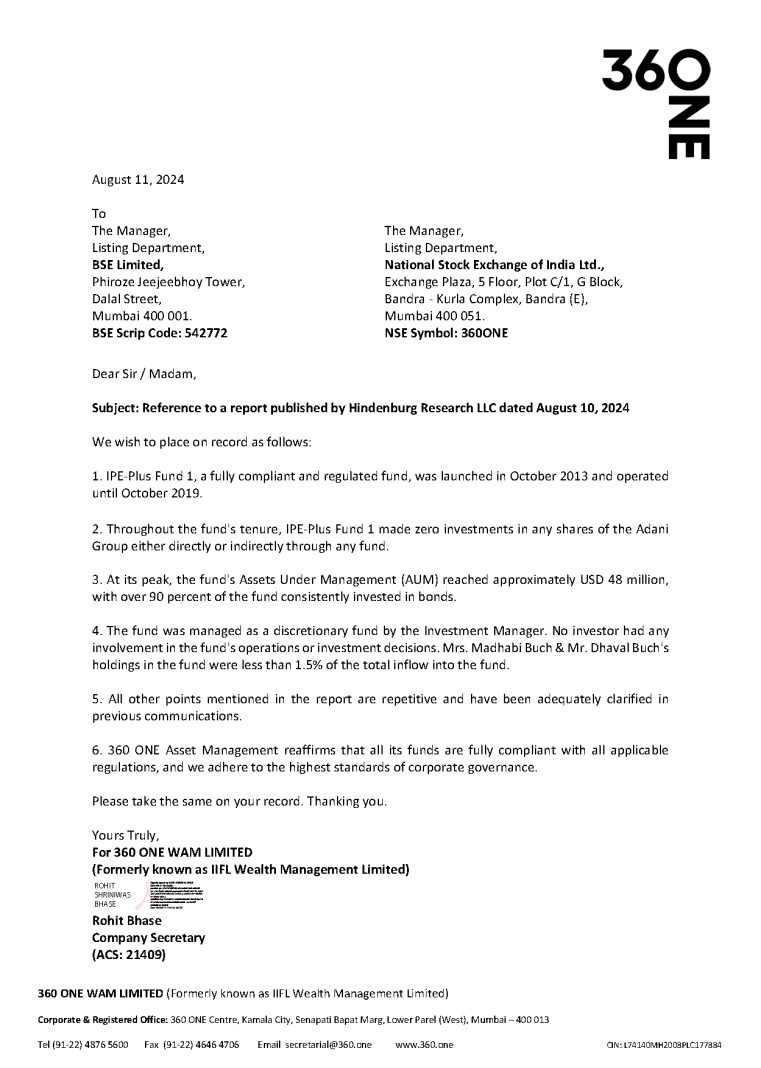
In a stock exchange filing on Sunday, 360 One Wam Limited, formerly known as IIFL Wealth Management Limited, said its IPE-Plus Fund 1 had made zero investments in any shares of the Adani Group — either directly or indirectly.
This clarification from the publicly-listed financial services company comes after US-based short seller Hindenburg Research in a report levelled fresh allegations against Adani Group. This time the short seller also raised questions about investments made by SEBI Chairperson Madhabi Puri Buch, and her husband Dhaval Buch.
IPE-Plus Fund 1 is a fully compliant and regulated fund that was launched in October 2013 and operated until October 2019, 360 One Wam informed stock exchanges.
“Throughout the fund’s tenure, IPE-Plus Fund 1 made zero investments in any shares of the Adani Group either directly or indirectly through any fund.”
The fund also said that 90 per cent of its investments were in bonds and only 10 per cent in shares
“At its peak, the fund’s Assets Under Management (AUM) reached approximately USD 48 million, with over 90 percent of the fund consistently invested in bonds.”
The exchange filing also said that the fund was managed as a discretionary fund by the Investment Manager and that investors have no role in making investment decisions.
“No investor had any involvement in the fund’s operations or investment decisions. Mrs. Madhabi Buch and Mr. Dhaval Buch’s holdings in the fund were less than 1.5 per cent of the total inflow into the fund,” said the financial advisory services firm in the stock filing.
It reaffirmed that all its funds are fully compliant with all applicable regulations, and “we adhere to the highest standards of corporate governance.”
Earlier on Saturday, US short seller Hindenburg had alleged, “We had previously noted Adani’s total confidence in continuing to operate without the risk of serious regulatory intervention, suggesting that this may be explained through Adani’s relationship with SEBI Chairperson, Madhabi Buch.”
“What we hadn’t realized: the current SEBI Chairperson and her husband, Dhaval Buch, had hidden stakes in the exact same obscure offshore Bermuda and Mauritius funds, found in the same complex nested structure, used by Vinod Adani,” the report by the US hedge firm said.
Hindenburg Research said it has made the new allegations based on documents provided by a whistleblower and investigations carried out by other entities.
Earlier in the day, hours after US-based short seller Hindenburg Research allegations SEBI Chairperson Madhabi Buch and her husband issued a joint statement rejecting the allegations. Madhabi Puri Buch and her husband accused Hindenburg Research, against whom SEBI has taken enforcement action, of character assassination.
In the joint statement released to the media, they said, “Our life and finances are an open book. All disclosures as required have already been furnished to SEBI over the years. We have no hesitation in disclosing any and all financial documents, including those that relate to the period when we were strictly private citizens, to any and every authority that may seek them. It is unfortunate that Hindenburg Research against whom SEBI has taken an Enforcement action and issued a show cause notice has chosen to attempt character assassination in response to the same.”
In January 2023, Hindenburg published a report accusing the Adani Group of financial irregularities, leading to a significant drop in the company’s stock price. The group at the time had rubbished these claims.
The Hindenburg report alleged stock manipulation and fraud by the conglomerate. The case is related to the allegations (part of a report by Hindenburg Research) that Adani had inflated its share prices.
After these allegations were published, there was a sharp fall in the shares of various Adani group companies’ stocks.
In January 2024, the Supreme Court refused to transfer the probe into the allegations of stock price manipulation by the Adani group to an SIT and had directed market regulator SEBI to complete its probe into two pending cases within three months.
Earlier this year the SC also dismissed a plea seeking to review the verdict that had sought investigation by the market watchdog SEBI in the Adani-Hindenburg case.
(This news report is published from a syndicated feed. Except for the headline, the content has not been written or edited by OpIndia staff)
Even days after the ouster of the country’s elected leader, Sheikh Hasina, social unrest, chaos and anarchy continues to prevail in Bangladesh as Islamist mobs have so far forced several top officials in judiciary, finance, and educational sector to step down. Several key officials, including the country’s Chief Justice, central bank governor and Vice-Chancellor of Dhaka University have been forced to resign as rioters accuse them of being Sheikh Hasina loyalists.
Facing violent protests, Bangladesh Bank governor Abdur Rouf Talukder has resigned from his post. However, as per reports, his resignation has not yet been accepted. According to Reuters, the Vice-Chancellor of Dhaka University, ASM Maksud Kamal was also forced to step down from his post. Notably, the so-called student protests initially started from Dhaka University.
Earlier in the day, on Saturday (10th August), the rioters directed their attacks on the country’s highest court and its judges. The protesting ‘students’ and the Interim government alleged that judges of the Supreme Court were involved in a “conspiracy”. Demanding en-mass resignation of judges, thousands of rioters gheraoed the Supreme Court. While they demanded the resignation of all judges of the apex court, the rioters gave Chief Justice 2 hour ultimatum to tender his resignation or face “dire consequences”.
The situation escalated, with reports indicating that the Chief Justice may have fled the premises and later resigned from his post. Chief Justice Obaidul Hassan, appointed last year, was accused of being a Hasina loyalist.
The rioters directed their attack against the Supreme Court after the Chief Justice convened a full-court meeting allegedly without consulting the newly formed interim government. Following the development, the ‘student’ protesters alleged that the judges were involved in a conspiracy.
They also received support from Asif Mahmud, the adviser to the Youth and Sports Ministry of the Interim Government. Taking to Facebook, Mahmud had demanded the unconditional resignation of Chief Justice Obaidul Hassan and the cancellation of the full-court meeting.
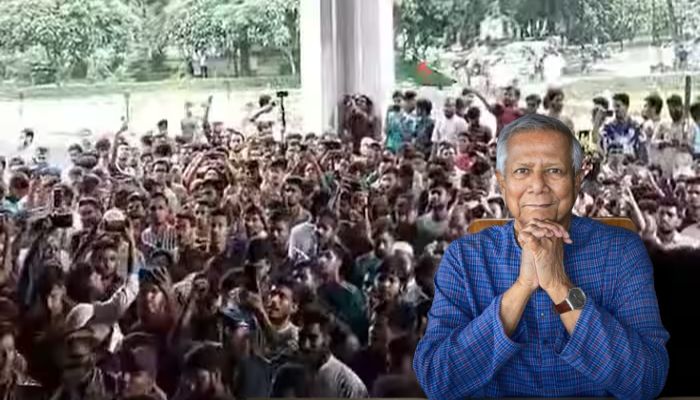
Interim leader Muhammad Yunus calls targeted attacks on minorities as “heinous”
Meanwhile, on Saturday, Interim leader Muhammad Yunus condemned the attacks on minorities and urged the Bangladeshi youth to protect them. He described the targeted attacks as “heinous” and asserted that restoring law and order remained the top priority of the Interim government.
He said, “Are they not the people of this country? You have been able to save the country; can’t you save some families?… You must say – no one can harm them. They are my brothers; we fought together, and we will stay together.”
It is pertinent to note that following the ouster of Sheikh Hasina, Hindus and other minority groups have been facing targeted persecution at the hands of Islamist mobs. Strikingly, more than 205 incidents of attacks on Hindus and other Minorities have been reported across 52 districts of Bangladesh since 5th August when Sheikh Hasina resigned and was forced to flee to India to save her life. Scores of Hindus have been severely injured in the attacks on their homes, temples, and businesses.
Numerous reports of kidnapping, sexual assault, and other heinous crimes against woman have also rocked Bangladesh. Additionally, Bangladeshi Hindus, in thousands, have also attempted to cross over to India to seek refuge and avoid religious persecution in the country that is fast becoming an Islamic fundamentalist state under the interim government.
Following days of unhinged attacks, thousands of Hindus started raising voice against targeted attacks and religious persecution and continued staging protests in various parts of the country.
Bangladeshi Hindus unite to raise voice against ongoing religious persecution and targeted attacks
Hindus in Bangladesh have come out in large numbers in various cities of Bangladesh protesting against the attack on Hindus and temples by Islamists after the fall of Sheikh Hasina government. Large protests erupted in Shahbag in Dhaka, Shariatpur, Chittagong, Barishal, Dinajpur, Mymensingh and other places, demanding protection of religious minorities.
More than 7 lakh Hindus took to the streets in Chittagong city and raised slogans, this country does not belong to anyone's father.
Jai Maa Kali
Now the Hindus of Bangladesh are also ready to take up arms.
In Chittagong, there was a massive gathering of Hindus, with some media reports claiming that over 7 lakh Hindus assembled at Cheragi Pahar Square, the cultural centre of the port city. They held placards saying ‘why we are not independent’, ‘why attack on our temples’, ‘why threat to leave the country, nation wants answer’ etc.
Apart from Bangladesh, Hindus also came out in large numbers in India, UK, US and member nations of European Union to raise voices against persecution of Hindus and other religious minorities in Bangladesh.
The Hindu community in Bangladesh have raised the following specific demands –
Establishment of a ministry of minorities.
Formation of a minority protection commission.
Enactment and Implementation of strict laws to prevent attacks against minorities.
Allocation of 10% of parliamentary seats for minorities.
Investigation on attack on minorities, arrest and appropriate punishment of culprits.
Compensation to the Hindu minorities who have faced vandalism, loot and torture.
Transform ‘Hindu Kalyan Trust’ as an autonomous body, free from Govt’s influence and interference.
Bring back minorities who have fled villages in the border areas and protect them against threats.
Ensure and arrange security for the Hindu homes, businesses, temples.
Increase representation of the Hindu minorities in different Govt. entities.