Home Blog Page 894

Haryana: Sonepat Congress MLA Surender Panwar arrested by ED in illegal mining case

On Saturday, July 20, Enforcement Directorate (ED) arrested Congress MLA Surender Panwar in an illegal mining case. Panwar is the MLA from Sonepat seat in the state of Haryana. Earlier in January this year, ED had searched premises linked to Surender Panwar and his aides.

The arrest of the Congress MLA is in connection with a money-laundering case linked to illegal mining in Yamunanagar in Haryana and some other areas of the state. The money laundering case investigation came following several FIRs of the Haryana Police to probe alleged illegal mining of boulders, gravel and sand in the past in Yamunanagar and nearby districts even after the lease expiry period and court’s order.

Along with investigating potential fraud in illegal mining, ED is also looking into the ‘e-ravan’ system, an online site introduced by the Haryana government in 2020 with the goal of streamlining tax and royalties collection and preventing tax evasion in mining regions, as per a PTI report.

Notably, Surender Panwar resigned from his position and sent it to Haryana assembly speaker in July 2022, claiming personal reasons such as dangers to his family’s safety and well-being. However, later he withdrew the resignation.

Bollywood actor Sonu Sood justifies spitting in people’s food, says it is Humanity; equates spitting on food with Lord Ram eating Shabri’s ber

Bollywood actor Sonu Sood landed himself in a fresh controversy on Saturday (20th July) as he came out in defence of a miscreant who was seen on camera spitting on rotis he was preparing for his customers. In a post on X, Sonu Sood equated the miscreant’s act of spitting on rotis to that of Ramayana’s Shabri who had tasted berries before giving them to Lord Ram. The Bollywood actor claimed that if Lord Ram could eat Shabri’s berries, why can’t he eat rotis that have been spat upon? He defended the act of spitting by describing it as an act of “Humanity”. 

Sonu Sood wrote, “Our Shri Ram Ji ate the tasted berries of Shabri, so why can’t I eat them (rotis spat upon)? Violence can be defeated by non-violence, my brother. Humanity must remain intact. Jai Shri Ram”

However, his social media post soon triggered outrage from X users who called him out for defending the act of spitting on the customer’s food. Several X users pointed out that the intention behind Mata Shabri tasting berries was to give only sweet berries to Shri Ram, out of devotion to her Lord while the miscreant’s act was driven out of religious hatred.

An X user, Rosy, requested Sonu Sood to visit the said dhaba and make a video of himself eating the spit-soiled rotis.

Several users also objected to his analogy where he equated the miscreant with Shabri and by extension likened himself with Lord Shri Ram. 

Political analyst Abhishek Tiwari responded to his post saying, “The miscreant roti-maker is not Mata Shabri and you aren’t Ram.” Mata Shabri is the symbol of love, this person is spitting in hatred, he added. 

Another user wrote, “Shame on you for this Bizarre comparison of Prem of Shabri vs Thuk J!;had just to prove your one-sided secular ideology. U don’t have respect for those Kanwariya who follow Satvik food, their tapasya worship of many days is nothing for you. Disgusting” 

It is pertinent to note that Sonu Sood made the post in the wake of recent order passed by the Uttar Pradesh government where it has asked eatery owners and operators, falling on the route of Kanwar Yatra, to display their names. Earlier, it was alleged that several miscreants were running their eateries/carts under false Hindu names which at times created a law and order situation. Reacting to it earlier, Sonu Sood argued that eateries should have nameplates displaying ‘Humanity‘ as their identity. He made the recent controversial post while reacting to a user who highlighted that the UP government’s order asking food vendors to display names is important as some miscreants had been accused of spitting in customers’ food.

Drones, videography of Brij Mandal Jalabhishek Yatra, and more: Nuh administration heightens security measures following last year’s Islamist violence

Following last year’s violence when Islamists launched a planned attack on thousands of Hindus participating in the ‘Brij Mandal Jalabhishek Yatra,’ the Nuh administration is implementing heightened security measures for this year’s Shobha Yatra. This year, the yatra will take place on 22nd July amidst a large police deployment. The Police will maintain a strict vigil as drones will be deployed to videograph the entire yatra. Special teams have been formed to monitor social media platforms. Additionally, Police personnel will be deployed in the mountains near the Nalhar Mahadev temple.

Administration officials said permission has been granted for the procession. However, they have prohibited arms, lathis, DJs, and loudspeakers during the Shobha Yatra. Vehicles entering the district from all routes including Kundli–Manesar–Palwal Expressway (KMP) will be thoroughly checked. 

The Police have also formed a dedicated social media wing to flag incendiary posts and constituted a committee of both Hindu and Muslim members, authorities said on Friday (19th July).

On 22nd July, the Jalabhishek Yatra will commence from Nuh’s Nalhar temple and it will culminate at Singar via Jhirka’s Jhir mandir in Ferozepur amid heavy deployment of Police. 

Nuh Deputy Commissioner Dhirendra Khadgata stated that three drones have also been deployed. He said, “Around 1,600 police officers will be deployed on the day of the yatra and one company of RAF (Rapid Action Force) and IRB (Indian Reserve Battalion) are also in place in case of an exigency.”  

Gurugram South DCP Sidhant Jain said that a social media cell comprising four officers has specifically been asked to monitor content posted online to flag any incendiary posts and take necessary action. 

He added, “We have also appealed to the people in the area not to participate in the procession and to pray at their local temples. However, no restriction has been placed on any community in Gurugram.” 

DC Khadgata said, “We have 100 volunteers who will help police with the coordination of the movement along the yatra. Thorough checking will be in place to crack down on contraband or any weapon.”

Ahead of the Yatra, the police had filed an FIR against two persons, a minor and a lawyer, earlier this month. 

Brij Mandal Jalabhishek Yatra committee convenor Surender Singh said, “Around 8,000 devotees from Haryana and its neighbouring districts are expected to take part in the day-long procession, which will begin with the ritual bathing of the Shiva idol at Nalhar temple and culminate at the Radha Krishan temple in Singar village in Punhana. It will also halt at a Shiva temple in Ferozepur Jhirka on the way.” 

He added, “Besides the devotees from outside Nuh, 2,000 local devotees will also be expected to turn up at each of the three temples. Around 50 prominent saints will also join the procession.” 

Nuh Shobha Yatra violence

On 31st July 2023, violence broke out in Haryana’s Nuh, Mewat district during the ‘Brij Mandal Jalabhishek Yatra,’ where Islamists launched a planned attack against thousands of Hindus participating in the Shobha Yatra. Islamists torched several vehicles, pelted stones, and opened indiscriminate fire on Hindu devotees part of the Shobha Yatra, leading to clashes and communal tensions in Haryana’s Nuh, a Muslim-majority region. 

Islamists have claimed the riots happened because of Bajrang Dal activist and Gau Rakshak Monu Manesar. Old videos of Monu were circulated to instigate Muslims saying he was going to Nuh on that day. The video that was mostly circulated was from October 2022. Detailed reports can be checked here. Furthermore, a cyber crime police station was attacked in Nuh and Police officials were injured

During the investigation into the riots, OpIndia accessed over 25 FIRs and complaints that provided a clearer picture of what happened during the violence. Based on information available via FIRs, complaints, and witnesses, it appeared that the attack was pre-planned. According to the Police, children from a Madarsa were also involved in the attack. The Police also arrested Congress MLA Mamman Khan who was later released on bail.

Bangladesh: Death toll rises to 105 as students clash with law enforcement authorities over quota politics

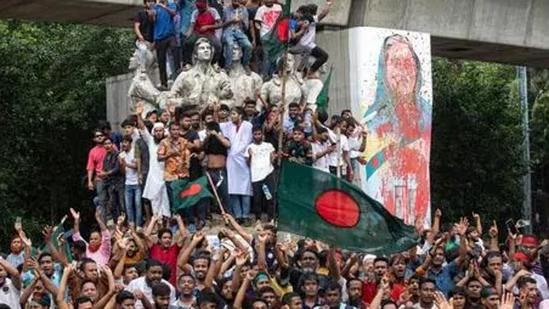
The violent protests between students and law enforcement authorities in Bangladesh over ‘quota politics’ have led to over 105 deaths and 2500 injuries so far.

As per reports, more than 52 people were killed on Friday (19th July). The agitation over the reinstatement of the 30% quota to the families of the freedom fighters of the 1971 Bangladesh Liberation War has been ongoing for over a month.

On Friday, the protestors freed 100s of prisoners from a jail in the Narsingdi district of Bangladesh and then set the facility on fire. The police had banned all public gatherings, rallies and processions to bring the law and order situation under control.

A day earlier, anti-quota protesters set fire to the headquarters of the state broadcaster Bangladesh Television (BTV) in Dhaka.

The Background of the Controversy

Bangladesh had 56% reservations until 2018 for certain groups in government jobs, which are considered lucrative in Bangladesh.

These groups include disabled individuals (1%), indigenous communities (5%), women (10%), people from underdeveloped districts (10%) and families of the freedom fighters of the 1971 Bangladesh Liberation War (30%).

This left only 44% of seats for selection based on merit. There were large-scale protests in 2018 by student groups, which forced the then-Sheikh Hasina government to abolish the quota altogether.

In June 2024, the High Court in Bangladesh overturned the decision of the government and held the scrapping of 30% reservation for families of freedom fighters as illegal. This sparked fresh protests from student groups.

The Appellate Division of the Supreme Court upheld the decision of the High Court on 4th July 2024, leading to widespread demonstrations. Following appeals by the Sheikh Hasina government, the court asked all petitioners to maintain the status quo until 7th August 2024.

However, the protesting students are steadfast in their demands and are willing to even endanger their lives to prevent the implementation of the 30% quota yet again.

Uttar Pradesh Govt notifies State Capital Region in the line of Delhi-NCR, six districts including Lucknow to be included for planned development

The Yogi Adityanath government in Uttar Pradesh has issued a notification forming the State Capital Region in the line of Delhi-NCR. Undre this plan, a state capital region will be created around Lucknow. The notification has been issued to include six districts under this SCR after a cabinet meeting.

The Uttar Pradesh State Capital Region will be created by combining Lucknow, Unnao, Rae Bareli, Barabanki, Sitapur and Hardoi districts. A total area of ​​27,860 square kilometers will be included in the state capital region of Uttar Pradesh.

The notification also formed an authority named ‘Uttar Pradesh State Capital Region Development Authority’, which will act as the umbrella body to coordinate with other agencies and departments to push for rapid urbanisation within Lucknow and its neighbouring districts.

The Chief Minister will be the Chairman of the Authority. The Chief Secretary will serve as the vice-chairman, and the Principal Secretary of the Housing and Urban Planning Department will be the convening member. Divisional Secretaries, Additional Chief Secretaries and Secretaries of several important departments will be members. DMs of all the 6 districts and vice-chairmen of development authorities will also be members.

Officers nominated by the Government of India and the Ministry of Defence will also be its members. Major city and village planning officials will also be ex-officio members. Divisional Commissioner Lucknow will be the Secretary of the SCR Authority.

After the formation of SCR, connectivity infrastructure like expressways, metro, trains etc covering the entire area will be developed. These projects are expected to bring big real estate development in the region. It is expected the area will grow and transform like Noida-Ghaziabad in NCR.

While Lucknow would act as the key driving force, the authority would integrate Barabanki, Rae Bareli, Unnao, Hardoi and Sitapur as part of the SCR by planning new road corridors, mass rapid transport system and other interlinkages to integrate the six districts as a holistic urban area.

The initiative will create massive employment opportunities in infrastructure projects like building roads, bridges, railways and metro etc. This will lessen the increasing burden on capital Lucknow.

After the formation of the SCR, new bylaws will be implemented in the 6 districts. The practice of haphazardly building houses, societies and encroachments will be curbed. The districts surrounding Lucknow will have metro connectivity, enabling people to live there instead of settling in Lucknow. The state capital region will also have a fleet of electric buses for connectivity.  

The entire traffic system in the SCR will be connected to an Integrated Traffic Management System, and CCTV surveillance will increase.

It is also proposed that Lucknow and Kanpur metro can be connected via Unnao in future. The infrastructure of Kanpur and Lucknow airports will also be developed.

Bangladesh: 39 dead in violent clashes over quota system dispute, Sheikh Hasina’s govt to probe Pakistan’s ISI role in unrest

On 19th July, violent student agitation against government job quotas forced television news networks in Bangladesh off the air and severely hampered telecommunications. The country has been rocked by huge protests as clashes between students, pro-government supporters and armed police intensified over reservations for the children of freedom fighters. The death toll has already reached 39 and more than 2,500 individuals have been injured as 18th July turned out to be the deadliest day in the conflict. Bangladesh has suspended internet services to try to quell the unrest.

Police and protesters armed with sticks and rocks clashed across the country, including in the capital, Dhaka, as the students tried to shut down transportation across Bangladesh. As demonstrators set fire to cars, police stations and other enterprises, authorities used tear gas and rubber bullets to disperse the crowd, resulting in hundreds of injuries. On the evening of 18th July, the Sheikh Hasina administration summoned the Army as protestors supported by pro-Pakistan Jamaat-e-Islami battled with police and paramilitary forces.

Prime Minister Sheikh Hasina reportedly has to look towards India for political backing. India maintains continuous communication with Bangladesh’s security apparatus and key decision-makers to analyze the situation, which is rapidly escalating into a serious crisis. Experts suggested that India might attempt to overhaul the governance structure while assisting Bangladesh’s government which is also probing the role of Pakistan’s ISI in igniting the violence via the banned Jamaat-e-Islami.

Protesters are being led by leaders of the Bangladesh Nationalist Party (BNP) with foreign support. Jamaat, which is currently an illegal outfit, derives its strength from its student branch, which has participated in protests and acts of street violence for many years. In 1971, Jamaat officials were charged with war crimes and have since mingled with Lashkar-e-Taiba (LeT) and other terror organizations.

International phone calls and internet traffic were severely disrupted, while multiple Bangladeshi newspapers’ websites remained un-updated and social media accounts were offline. A few phone calls were successful but mobile data wasn’t available and messages were unable to be sent. While entertainment stations continued as usual, news television channels and state broadcaster BTV were taken off the air. A message citing technical difficulties and promising a quick return to programming was shown on several news programs. Schools and universities are also closed while authorities have banned rallies in the capital Dhaka.

A gang identifying itself as “THE R3SISTANC3” appeared to have hacked the prime minister’s office, the central bank and the police official websites. The same statements were splattered across the websites, “Operation HuntDown, Stop Killing Students,” with the addition of red text that declared, “It’s not a protest anymore, it’s a war now.” The page also had a message that read, “The government has shut down the internet to silence us and hide their actions.”

Meanwhile, 202 Indian nationals, mostly students stuck in Bangladesh have entered India at the Dawki integrated checkpoint in Meghalaya. “Until today 18th July evening at 6:45 pm, 202 Indians stranded due to violence have crossed from Dawki (81.5 km from the capital Shillong). All possible measures have been taken for the safety of the students. The situation is under control but the government is maintaining a watch,” informed an official.

According to the official, 198 of the 202 are students and 67 are from Meghalaya. “Other students who crossed over include students from Nepal (101) and Bhutan (seven), the remaining 23 are from other states of the country and four are tourists.” According to the official, the state administration was in communication with the Land Port Authority and the Bangladesh High Commission to enable the safe repatriation of Indian nationals. There is now a helpline available at 1800 345 3644. To aid in the evacuation and rescue of individuals from Meghalaya, additional police superintendent Hiwot Rymbai (91 96157 16153) and land port executive Thomas (91 84150 60802) have been designated as nodal officers.

The Indian High Commission in Dhaka recently released a critical alert advising Indian nationals and students studying in Bangladesh to minimize their travel and stay indoors as much as possible in light of the growing instability in the nation. The demonstrations stem from grievances over a government policy that reserves 30 per cent of public sector jobs for the families of individuals who fought in the 1971 War of Independence from Pakistan. Protesters claim that the new order is discriminatory and favours supporters of the ruling Awami League headed by Prime Minister Sheikh Hasina who is the daughter of Sheikh Mujibur Rahman, the founding father and first president of Bangladesh.

Sangam Dhaba becomes Salim Bhojanalaya, Chai Lover Point renamed as Ahmed Tea Stall: Eateries display real owner names in Uttar Pradesh after official directive

The hotel owners and vendors in Muzaffarnagar have been ordered to display the real identities of their owners prior to the “Kanwar Yatra” in Uttar Pradesh. Furthermore, a directive has been issued to write down the names of the employees at the hotels and stores. The state government has passed an ordinance stating that customers should be aware of whose business they are purchasing from and there should not be any confusion about it. Meanwhile, Chief Minister Yogi Adityanath has also asked for the implementation of the same system in the entire state after which the hotel and shop owners have started following the instructions.

The Delhi-Dehradun National Highway-58, which passes through Muzaffarnagar, underwent significant changes the day after the order was pronounced. Till now, a tea stall on the highway was known as “Chai Lover Point,” however, it is now renamed as “Wakil Ahmed Tea Stall.” Its owner Faheem claimed that the authorities approached him and told him to change the name, which he did but complained that he would suffer losses during the “Kanwar Yatra” because the devotees would not come to his shop after reading the new name.

Image via Aaj Tak

In another instance, the name of a dhaba which was running as “Sangam Shuddha Bhojanalaya” for more than two decades has now been altered to “Salim Shuddha Shakahari  Bhojanalaya” after the govt order. It is situated in the Muzaffarnagar district by the side of the road and its proprietor Salim alleged that the name of the place was “Sangam Shuddha Bhojanalaya” for the last twenty-five years but now it has been changed on the orders of the administration.

Meanwhile, Lokesh Bharti, owner of Sakshi Hotel on the Delhi-Dehradun Highway also informed, “We were contacted by two police personnel yesterday and they demanded that the name be written in front of the establishment. along with the names of the people working at the hotel after which four Muslim staff members have been temporarily removed.”

Beed: Hindu youth arrested for posting WhatsApp story against Vishalgadh illegal encroachment after Islamists threaten violence

On Friday (19th July), a Hindu youth identified as Ganesh Narvade, a resident of Pimpalner village of Maharashtra’s Beed district was arrested by the state police for allegedly posting a WhatsApp story against the illegal encroachment on the Vishalgadh fort. The video allegedly posted by Ganesh indicated that no illegal encroachment on the fort of Chhatrapati Shivaji Maharaj would be tolerated.

The video that led to the arrest was posted by Legal Rights Observatory (LRO) on social media. “Muslim mob threatened the police to torch police station after which Dhimmi SP surrendered to wild jihadi violence threat and arrested Hindu youth,” LRO posted on X.

OpIndia spoke to SP Beed Nandakumar Thakur who confirmed the arrest of the Hindu youth but refused to share any further details. On asking about the arrest, he claimed that people complained about him so we had to arrest him. However, now it has come to the fore that the accused has been granted bail.

Massive controversy erupted at the Vishalgadh fort near Kolhapur after a group of protestors led by a descendant of Chhatrapati Shivaji Maharaj, Sambhajiraje demanded the removal of alleged illegal encroachment from the fort, the maximum of which is by the Muslim community. The state CM also on 15th July then ordered the district administration to remove the illegal encroachment after alleged violence was reported on 14th July on site.

However, the Bombay High Court on 19th July asked the state to halt the demolition drive at Vishalgadh. The Court criticized the government for demolishing over 70 houses at the Fort and said strong action would be taken against the officials.

Earlier detailed reports covered by OpIndia on this issue can be read here and here.

‘How can you raze structures during the rainy season? Will not hesitate to put officers in jail,’ Bombay HC halts demolition of illegal structures at Vishalgadh

On Friday (19th July), the Bombay High Court criticized the Maharashtra government for demolishing over 70 houses in the Vishalgadh Fort area in Kolhapur, where alleged communal violence erupted between two factions on July 14th. The state CM on July 15th ordered the removal of illegal encroachments from the fort, most of which are by the Muslim community.

The State’s Public Works Department (PWD) began the demolition process in the disturbed area, tearing down houses, stores, and so on on 15th July, the court heard. While the Maharashtra government maintained that it was only razing commercial structures that were not protected by a court order, the division bench of Justices Burgess Colabawalla and Firdosh Pooniwalla directed the State not to demolish any structure, whether commercial or residential. The bench further chastised the State for starting the demolition operation during the rainy season.

“How can you raze structures during the rainy season? We make it very clear that no structure, we repeat no structure, be it a commercial one or a household, should be demolished till further orders,” the bench ordered.

State Chief Government Pleader Priyabhushan Kakade informed the court that the State was simply demolishing commercial structures that were not protected by any kind of stay order issued by a court of law.

The judges stated that they would record the statement and that if there was a violation, the officers involved would be held accountable. “We will record your statement, and if there is a breach, we will take strong action against your officials. We will not hesitate to send the officers to jail,” Justice Colabawalla stated orally.

Furthermore, Advocate Satish Talekar, appearing for the encroachers, showed the judges a video of the alleged violence, which he claimed was allegedly caused by a call from former Member of Parliament (MP) Sambhaji Raje Chhatrapati, who allegedly asked his followers to free the Vishalgadh fort area from illegal encroachments. He claimed that individuals armed with sticks and hammers identified themselves as “Shiv Bhakts” and attempted to demolish the Raza Sunil Jama Masjid in Gazapur within the fort region. He claimed that the police stood there as mute bystanders.

After viewing the video, the bench inquired with Kakade about the actions taken in response to the violence. “What is this? Who are these men?” Justice Colabwalla addressed Kakade, who stated that he had no idea what the petitioner was telling the justices because Talekar had not served anything to the State.

“They are clearly not your officers. However, as a state, you are responsible for maintaining law and order. Where’s the law and order here? We want to know if a FIR was filed or if any action was taken,” the bench stated.

As a result, it directed the Senior Police Inspector of the Shahuwadi Police Station in Vishalgadh to personally appear in court on July 29th and explain what action was taken against the alleged attackers. The next hearing will be on July 9th. 

What happened at Vishalgadh?

The Kolhapur district administration on the 15th of July evening began removing illegal encroachments from Vishalgadh Fort in Kolhapur, amidst heavy police presence. This is after the state CM ordered the removal of illegal encroachments from the fort, most of which are by the Muslim community.

The administration notably responded to protests organized by Sambhajiraje Chhatrapati, a former Rajya Sabha MP and descendant of Chhatrapati Shivaji Maharaj. The former MP had organized a massive protest on 14th July after the state administration failed to take action against the illegal encroachments. The enraged protesters reached the foothills of the fort on Sunday, 14th July, and created a ruckus in the Gajapur area, allegedly vandalizing properties and a local Masjid. Several videos of the same have been going viral over the internet. 

Earlier, similar protests were organized by Sakal Hindu Samaj on 7th July where hundreds of Hindu activists and Maratha loyalists reached the foothills of the fort and demanded action against illegal encroachment. However, it was after the massive protest and alleged violence on 14th July that the state CM responded and ordered the district administration to take down all the illegal encroachments, by both the Hindus and the Muslims.

It is believed that the population located on the fort of Vishalgadh, most of which is Muslim, has been involved in carrying out alleged illegal encroachments, construction, or expansion of the Masjid. The population there has also for years constructed illegal sheds, further expanding the businesses of chicken and cattle slaughters.

Following the alleged violence on 14th July, Sambhajiraje personally arrived at the location and declared that he would not leave until the encroachments were removed. He said there were 158 encroachments in total, just six of which were being litigated in court. “Why is no action being taken against the rest?” he inquired.

However, Sambhajiraje and his followers have time and again stated that the issue of illegal encroachments on Vishalgadh is not at all communal and that they are demanding the removal of encroachments by both, the Hindus and the Muslims living on the fort. “We want to remove all encroachments, including those by Hindus and Muslims. I know what secularism is and nobody needs to teach me that,” Sambhajiraje said.

Earlier detailed reports covered by OpIndia can be read here and here.

If Rahul Gandhi becomes brand ambassador of population control, it will show fatafat results if not khatakhat, says Himanta Biswa Sarma, claims Assam will be Muslim majority by 2041

Assam chief minister Himanta Biswa Sarma on Friday said that if leaders who get votes from the Muslim community campaign for population control, it will show better results. Addressing a press conference on the upcoming Amrit Brikshya Andolan 2.0 in Assam, the CM said that if Rahul Gandhi becomes the brand ambassador for the population control campaign, it will show fatafat results, if not khatakhat results.

Himanta Biswa Sarma said that people who are not adopting birth control measures will listen to Rahul Gandhi, and they will not listen to him or PM Modi. He said, ‘go to a Muslim village and ask whom they will listen, Rahul Gandhi or me, or Rahul Gandhi or PM Narendra Modi, obviously they will say Rahul Gandhi.

The Assam CM said this while talking about the rising Muslim population in the state. He said that while Muslim leaders themselves adopt birth control measures, they don’t encourage the same in the Muslim community. He said that people who are considered friends by Muslims should come forward to increase birth control among Muslims, adding that they will not listen to people considered enemies by them.

Himanta Biswa Sarma also said that at the present rate of population growth in Assam, the state will become Muslim majority by 1941. He said that Muslims are growing at around 29% per decade, while the Hindus are growing at around 16%. “By 2041, Assam will become a Muslim-majority state. It’s a reality and nobody can stop it,” he said.

Citing statistical sample analysis, he said that the share of Muslims in the Assam population has reached 40%. The CM said that anyone can derive this by looking at population data from past censuses. By using the past growth rates, the future population shares can be projected, he said. Sarma added that the data shows that the Muslim population grows by around 22 lakh every decade, and accordingly the community will become majority by 1941.

When asked whether the rising population shows the failure of population control awareness campaigns, CM said that awareness campaigns don’t work in sandbars, inhabited by Bangladesh-origin Muslims. He said that awareness programs don’t work if leaders closer to the Muslim community don’t endorse it. The CM said that instead of awareness campaigns, the requirement is to educate Muslim girls, ban child marriage in the community etc, highlighting his government’s initiatives towards these efforts.

He added that had the previous governments focused on these aspects, the situation would have been better now. Himanta Biswa Sarma added that such initiatives will take time to show results, it is not like PWD road which can show results immediately.

He said that not everyone likes to have 8-9 children, but there are some enabling factors and political angles, that result in population growth. “If you consider them to be only votes, and if the political leaders don’t get involved in the population control movement, how can we achieve results,” he asked.

He said that Muslims will not listen to his advice on birth control because they consider him to be an enemy, therefore this has to be said by those leaders who are considered friends by the Muslims. If people who seek votes from them don’t get involved in this, we can’t achieve much, he added.

The Assam CM said that the Congress party must take a leading role in the control of population growth because Muslims listen to them. He said, “The Congress should lead in controlling the birth rate of suspicious citizens. Rahul Gandhi, known for securing votes with false claims, should take responsibility as a brand ambassador. Congress is the party that those opposing Indian culture listen to.”

He added that if Rahul Gandhi becomes a population control brand ambassador from tomorrow, it will show results fatafat (fast) if not khatakhat, referring to the phrase used by Rahul Gandhi while promising money to women ahead of Lok Sabha elections.

When a reporter asked how an unmarried person can be a population control brand ambassador, he said that it is not needed to marry and have 12 children for this. People (who don’t use birth control) listen to him, not me, that’s why it will be effective, the Assam CM said.