Home Blog Page 910

Uttar Pradesh: Maulvi Azizul Rehman rapes a minor student inside a madrassa in Rampur, arrested

A shocking case of rape of a minor student inside a Madrassa has come to light in Rampur district of Uttar Pradesh. The accused has been identified as Azizul Rehman. He is the Maulana of Jamia Arabia Sirajul Uloom Madrassa and used to impart religious teachings to students. After committing the heinous act, he threatened the victim that he would kill him if he told anyone about his acts. The accused also used to try to take the minor to his home.

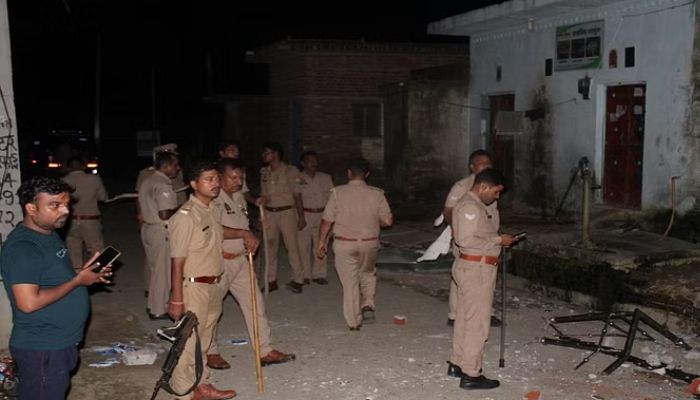
Based on the complaint filed by the victim’s father, the police registered an FIR on Tuesday (25th June 2024). The Police then arrested Maulana Azizul. This incident took place in the Azimnagar police station area of Rampur district. In Nanglia Ankil village, there is a madrasa named Jamia Arabia Sirajul Uloom. A 15-year-old student from the Milak Khanam area of Rampur also studies in this madrasa.

In the complaint, the father stated that his son was taking religious education at the madrasa where Maulana Azizul Rehman teaches students. He is a resident of the same village where the madrassa is located. According to the complaint, on several occasions during the last one year, the accused Maulana used to remove the victim’s pajama and raped the minor victim by indulging in unnatural sex.  

It is alleged that the Maulana sometimes used to entice the minor while at other times he used to threaten him. After sexually assaulting the minor, Azizul would threaten the victim, saying he would kill him if he told anyone about his acts. On Monday, (24th June), the Maulana started pressuring the victim to come to his house. Somehow, the student managed to escape and reach his home.

After reaching home, he narrated his ordeal to his family. The next day, the victim’s father filed a complaint with the police. Subsequently, the police registered an FIR against Maulana Azizul under Sections 377 and 506 of the Indian Penal Code (IPC) and Sections 3/4 of the POCSO Act.

Police teams were formed, and they immediately initiated a search for the Maulana. Just a few hours later, on Tuesday, the accused Maulana was arrested. Investigation and other legal actions are being carried out in the case. OpIndia has a copy of the complaint related to this case.

Rajasthan: MBBS student undergoes dialysis 4 times after suffering kidney damage in ragging, 7 senior students booked for forcing 1st year students to do 300 sit-ups in sweltering heat

A shocking case of ragging has come to light in a medical college in Dungarpur, Rajasthan. A first-year MBBS student had to undergo dialysis four times after allegedly being brutally ragged by some senior students last month, which caused an infection in his kidney, police said. After the anti-ragging committee found the allegations against senior students to be true, the college suspended the students and the college principal lodged an FIR against seven students. 

It is alleged that the seniors summoned over 50 first-year students to a hill where they were forced to do over 300 sit-ups in sweltering heat on 15th May. The temperature had reached 48° C on that day. As a result, one student’s health deteriorated, and he was rushed to a hospital in Dungarpur. But there was no improvement in his health, after which his family took him to a private hospital in Gujarat. The doctors there revealed that his kidney and liver suffered damage, causing kidney infection. 

4-5 other students also needed treatment after the brutal ragging, but they recovered after primary medical care.

According to the SHO of Dungarpur Sadar police station, Girdhari Singh, seven second-year students made the victim do more than 300 sit-ups at a place near the college on 15th May. This exerted severe pressure on his kidney, leading to a malfunction and an infection, he said.

The Police officer added that the victim was hospitalised in Ahmedabad for a week during which dialysis was done four times. As per the Police, the student is now stable and he rejoined college in June. The student had enrolled in the college in September of last year.

The SHO stated that the college principal lodged an FIR against seven accused students on Tuesday (25th June) after they were found guilty in an inquiry by the anti-ragging committee of the institute. 

The police officer further stated, “He had faced ragging earlier too but did not complain. The latest incident came to light after the college authority received a complaint through the online portal on June 20 following which an inquiry was conducted.”

An FIR was filed against seven students. They have been booked under IPC sections 323 (voluntarily causing hurt), 143 (unlawful assembly), 147 (rioting), 149 (offence committed in prosecution of common object), 341 (wrongful restraint), and 352 ( assault or criminal force otherwise than on grave provocation). The matter is being investigated, the SHO said.

Speaking with ETV Bharat, the father of the victim claimed that along with his son, there were more than 50 other first-year students, who were ragged on 15th May. He claimed, “As many as 40 second-year students harassed the freshers. They were tortured so badly that one had to be hospitalised.” 

He also said that his son’s muscle snapped as a result of intense physical exertion, which caused kidney and liver infections. He said that his son was shifted to the hospital after calling an ambulance via 108 service, and later the student was admitted to Zydus hospital in Ahmedabad.

A first-year student named Harshit Khanna also confirmed that students of his class were ragged by the senior students. He said that 3-4 students suffered deterioration of health as a result, and one of them had to be hospitalised.

A Deccan Herald report identified the seven students as Devendra Meena, Ankit Yadav, Ravindra Kulriya, Surjit Dabriya, Vishwavendra Dhayal, Siddharath Parihar, and Aman Ragera. Meanwhile, there is ambiguity about the identity of the victim. While news agency PTI has not revealed the identity of the victim or the accused students, some media reports claimed that the victim’s name is Pratham Vyas, while others identify him as Vikas.

Meanwhile, a separate incident of ragging emerged from the Bordumsa sub-division in Arunachal Pradesh’s Changlang district. The incident occured at a boarding school on 25th June at around 2 PM. As per reports, around two dozen class 8 students were injured following an attack by Class 11 students at Jawahar Navodaya Vidyalaya in Bordumsa. The boarding school has around 530 students and 18 teachers. Following the incident, the school’s principal, Rajiv Ranjan, stated that a disciplinary committee met promptly and decided to suspend five students involved in the ragging.

Sam Pitroda, who resigned over his racist remarks about Indians during Lok Sabha elections, re-appointed as chairman of the Indian Overseas Congress

Congress ideologue Sam Pitroda, who resigned following outrage over his racist remarks against Indians during the 2024 Lok Sabha elections, was re-appointed as the chairman of the Indian Overseas Congress.

The All India Congress Committee shared a notification on June 26, 2024, announcing that the Congress President has reappointed Sam Pitroda as the chairman of the Indian Overseas Congress.

On 8 May 2024, the Indian Overseas Congress President Sam Pitroda resigned from his post after his racist remarks about Indians from various regions, and the backlash that followed it. The resignation was accepted by Congress president Mallikarjun Kharge.

Pitroda had claimed that Indians native to the Eastern side of the country resemble Chinese people, those living in the West appear Middle Eastern while North Indians look like ‘white people’ and the ones in the South are similar in appearance to the people of ‘Africa’.

Sam Pitroda stated, “We could hold a country together as diverse as India where people on the East look like Chinese, people on the West look like Arab, people on the North look like maybe White and people in the South look like Africa. Doesn’t matter. We are all brothers and sisters. We all respect different languages. We all respect different religions, different looks, different customs. different food and as a Gujarati, I love dosa, I love idli. That’s my food. That’s no longer South Indian food. Okay, that’s the India I believe in where everybody has a place and everybody compromises a little bit.”

Pitroda’s earlier comment on inheritance tax

Sam Pitroda was in the news last month for doubling down on ‘inheritance tax’. Amidst outrage over the Congress party’s ‘wealth redistribution’ poll promise, Chairman of Indian Overseas Congress and Rahul Gandhi’s advisor Sam Pitroda has suggested that a US-like inheritance tax should be brought in India. Pitroda while explaining the inheritance tax claimed that in the US, 55% of the wealth is grabbed by the government when a person dies and the rest goes to the family, suggesting that Congress can bring a similar policy under its wealth redistribution promise.

Sam Pitroda’s ‘Hua toh Hua’ comment to shrug off the 1984 Sikh genocide

Sam Pitroda is best known for his callous comment shrugging off the 1984 anti-Sikh riots in a bid to attack Prime Minister Narendra Modi. This is not the first time when Pitroda has shrugged off a serious topic on a casual note. Earlier, he had insulted the Pulwama martyrs by trivialising the attack and towing Pakistan line by demanding proof of the Balakot airstrikes.

“Ab kya hai ’84 ka? Aapne kya kiya 5 saal mein, uski baat kariye. ’84 mein hua to hua. Aapne kya kiya? (now what about ’84? What did you do in 5 years, talk about that. What happened in ’84 had happened. What did you do?) You were voted to create jobs. You were voted to create 200 smart cities. Aapne wo bhi nahi kiya. Aapne kuch nahi kiya isliye aap yahan wahan gup lagate hain (you didn’t do that also. You didn’t do anything hence you are talking here and there)”, he said.

Chhattisgarh: NSUI president Surykant Verma nabbed in relation to Balodabazar violence, stolen phone recovered; religious symbol of Satnami community was desecrated

On the 26th of June, the 25-year-old state president of the Congress party student wing National Students’ Union of India (NSUI) in Chhattisgarh was taken into custody along with six others by the police in connection with the intense violence and arson that occurred in Balodabazar of the Balodabazar-Bhatapara district in the state. He also allegedly stole a mobile during the unrest.

The authorities are continuously taking action in the matter. The accused has been identified as Surykant Verma who is charged with vandalism and theft of a phone. The cops have apprehended one hundred and forty-five people till now and put them behind bars. The case is still under investigation.

The controversy that erupted on the intervening night of 15th and 16th May is related to the Satnami community of the area. A holy symbol known as “jaitkham” or “victory pillar” worshipped by the community which was near the Amar Gufa at Giroudpuri Dham in Balodabazar was damaged which infuriated the locals and later led to the arrest of three individuals. Three labourers from Bihar were alleged to have defiled the sacred symbol out of aggravation over not receiving payment. They were reportedly intoxicated.

However, the action did not placate the people who accused the issue was being suppressed and the real culprits were not captured. The community members then met with the administration and demanded an inquiry. They also declared a one-day protest. The scheduled date of this demonstration was 10th June. The agitation started peacefully but quickly turned violent which deteriorated the situation. The national flag was also disrespected in the SP (Superintendent of Police) and Collector’s office and a white flag was hoisted there.

Many vehicles were damaged and incidents of arson also transpired. Chief Minister Vishnu Deo Sai removed the Collector and SP because of the declining state of law and order. Meanwhile, measures were taken to deal with the miscreants. After the chaos, two days later, more than 100 rioters were nabbed. Now, 145 accused persons including members of an outfit named Bhim Regiment have been caught and 13 First Information Reports have been registered in the case.

On 10th June a mob set fire to a complex housing government offices, including those of the district collector and the Superintendent of Police. They also torched more than 150 vehicles, including two and four-wheelers, in Balodabazar city during the agitation. The district administration enforced section 144 of the Code of Criminal Procedure, which forbids gatherings of four or more people in the region in response to the unrest that resulted in arson and stone-pelting.

Police were using CCTV footage, recordings and technical evidence to identify and apprehend the people responsible for the chaos. The Satnami community is the largest Scheduled Castes group in Chhattisgarh. It was formed by the social reformer Baba Guru Ghasidas in the medieval era.

Inhumane, disgusting: Italian PM Giorgia Meloni pays homage to Indian worker who died after being dumped by employers after his hand was chopped by machinery

On Wednesday, June 26th, Italian PM Giorgia Meloni paid homage to Satnam Singh, who was dumped by his employers after his hand was chopped off in an accident while working at a farm in Italy. She spoke of the horrible and inhumane death condemning a disgusting attitude from his employer. “This is the worst Italy that profits from desperation,” she said after which all the deputies present in the Chamber stood up and applauded her in honor.

“These are inhumane acts that do not belong to the Italian people, and I hope that this barbarity will be punished harshly,” she added.

Earlier this week, 31-year-old Satnam Singh of Punjab died tragically after his employer abandoned him on the road without medical attention after his arm was cut by heavy farm gear. Singh was hurt by heavy machinery while working in a vegetable field in Lazio, close to Rome. The Embassy of India in Rome announced on Wednesday via X that it was aware of the tragic death of an Indian national in Latina, Italy.

“He was thrown out like a dog. There is exploitation every day, we suffer it every day, and it must end now. We come here to work, not to die,” Gurmukh Singh, head of the Indian community in the Lazio region of central Italy told media.

Meanwhile, Muktesh Pardeshi, Secretary (CPV and OIA), Ministry of External Affairs, expressed India’s grave concern to Luigi Vignali, Director General for Italian Citizens Abroad and Migration Policies, about Satnam Singh’s killing and demanded immediate action against those involved. The Indian embassy is currently contacting the victim’s family for diplomatic assistance and transportation of mortal remains.

As per the reports, Singh was left outside his home after sustaining injuries to his arm and legs, with his amputated limb placed in a fruit crate. The farm’s owner, Renzo Lovato, expressed his grief over the disaster but said Singh had been warned not to approach the machine that would hurt him. “The worker did it his own way. It was carelessness, unfortunately,” Lovato said.

Thousands of Indian farm laborers meanwhile in Italy protested after the incident and called for an end to “slavery.”

An inquiry into Lovato’s son, who allegedly abandoned Singh outside his home, has been launched, with potential accusations of manslaughter and failing to aid a person in danger.

‘Aspiring to build a career beyond Tamil Nadu, learn conversational Hindi’: Cricketer Ravichandran Ashwin slams Dravidian anti-Hindi campaign ‘Hindi Theriyadu Poda’

Ace Indian off-spinner Ravichandran Ashwin recently slammed DMK’s anti-Hindi campaign slogan, ‘Hindi Theriyadu Poda’ (Translation – I Don’t Know Hindi, Get Lost!)”,  and advocated for learning the Hindi language. Notably, Ashwin has been interacting with several media channels regarding his recently released book, “I Have the Streets: A Kutty Cricket Story.” During an interaction, he shared anecdotal stories to emphasise the need to learn other languages if one wants to make a career beyond their native state. He noted that learning the language could go a long way to earning acceptance from others and contributing to conversations.

While interacting with Chennai Super Kings’ Content Head, Radhakrishnan, Ashwin shared his thoughts on the challenges of not being able to converse in Hindi. He argued that there can be two mindsets. A non-Hindi speaker could take pride in saying, ‘Hindi Theriyadu Poda,’ or he could learn basic conversation in Hindi or communicate properly to Hindi speakers that he faces language barrier issues and seek assistance. He stressed the need to have a mindset that leads to personal growth. 

“Not knowing Hindi can be proudly expressed as ‘Hindi Theriyadu Poda‘. Alternatively, it can be viewed as ‘If we don’t learn it, it could be difficult‘, a mindset that can lead to significant personal growth,” Ashwin was quoted saying in The Commune. 

He also emphasized the importance of learning conversational Hindi for anyone who aspires to build a career beyond Tamil Nadu. At the same time, the Indian cricketer also seemingly urged native Hindi speakers to empathize with those learning the language and to foster inclusivity beyond linguistic barriers. 

He added that he wrote the book to drill down the point that learning the language would go a long way to earn acceptance from others and also be a part/contribute to conversations.

(DMK leaders are notorious for anti-Hindi remarks and campaigns, Udayanidhi Stalin, Minister and son of Tamil Nadu CM, MK Stalin wearing T-shirt that has anti-Hindi slogan, Image Source – FB page–Udhayanidhi Stalin Welfare Association Tharamangalam)

It is pertinent to note that Dravidian parties including the ruling party in Tamil Nadu, DMK have been peddling the trope of so-called “Hindi imposition”. As part of anti-Hindi rhetoric in the state, it has been fanning anti-Hindi sentiments among the state residents with campaigns like ‘Hindi Theriyadu Poda’ (Translation – I Don’t Know Hindi, Get Lost!)”. Dravidian leaders and its supportive ecosystem have been notorious for making derogatory remarks about North Indians, particularly in the Hindi speaking belt, referring to them as “vadakkans“ (the term being used as a slur for North Indians), “panipuri sellers”, Toilet cleaners, etc. 

In December 2023, DMK MP Dayanidhi Maran said “Hindi speakers clean toilets.” Former DMK MP Senthilkumar, inside the parliament, referred to Hindi heartland states as “gaumutra” states.

Meanwhile, after R Ashwin batted for learning Hindi, several X users lauded him for his remarks while some started targeting him for his views and hurled labels at him to cast aspersions on his character. Some X users made anti-Hindi remarks. It is pertinent to note that Ashwin hails from the Tamil Brahmin community. The Dravidian parties have been deriding and vilifying the community.    

In his book, R Ashwin states, “I can read and write Hindi, but the Hindi spoken in the world outside Tamil Nadu is nowhere close to what we are taught in textbooks.” He also elaborated on how he faced the issue of a language barrier during the initial days of his cricketing career. 

Nonetheless, R Ashwin launched his book, ‘I Have the Streets: A Kutty Cricket Story’ on 10th June. It is published by Penguin Random House India and it highlights Ashwin’s journey from playing gully cricket to striving for excellence in the sport. For his book, he has collaborated with Siddharth Monga, a cricket writer from ESPN Cricinfo, who helped him transcribe his voice notes and shape the narrative.

Delhi Court remands CM Arvind Kejriwal to CBI custody for three days in liquor policy scam

A Delhi Court has sent CM Arvind Kejriwal to CBI custody for three days following his arrest by the federal agency in connection with the alleged liquor policy case.

The agency had initially requested a five-day custody. Kejriwal was apprehended by the CBI at Delhi’s Rouse Avenue Court and, within an hour, withdrew a Supreme Court petition challenging the stay on his bail grant after his March arrest by the Enforcement Directorate in the same case.

The petition was withdrawn without objection from the ED, with plans to file a more substantial appeal against the High Court’s decision to stay the Rouse Avenue Court’s bail order.

The Central Bureau of Investigation on Tuesday (25th June) moved to arrest Arvind Kejriwal from Tihar Jail in the Delhi liquor policy case. This happened on the eve of the Supreme Court hearing his petition appealing the Delhi High Court ruling delaying the trial court’s order to give him bail.

As per the reports, the CBI also questioned Kejriwal in this case and granted permission to bring the Delhi Chief Minister before the relevant trial court on Wednesday (June 26), where he is expected to request his custody.

Notably, Kejriwal will appear before the CBI court on Wednesday morning, where he will be detained for further custodial interrogation. 

The ED arrested Kejriwal on March 21, stating that the Delhi chief minister diverted money from liquor vendors to support party activities. The Aam Aadmi Party and other opposition parties have said that this case is part of the Narendra Modi regime’s habit of employing central agencies to target opposition figures.

UP: Azim Ali forces Hindu girl to convert to Islam, perform Nikah, family assaults her for not following Islamic customs, FIR registered

In a case of grooming Jihad in Uttar Pradesh’s Badaun district, a Muslim youth named Azim Ali allegedly forced a Hindu girl to convert to Islam and perform Nikah with him. The accused force-fed meat to the victim along with forcibly taking her to Dargahs and reading Islamic texts. As the Hindu victim refused to do so, Azim Ali thrashed her.

On 25th June, the victim lodged a complaint at the Kotwali Nagar police station against accused Azim Ali. In her complaint, the victim stated that when she was 17, a 24-year-old Azim Ali, who resided in her neighbourhood, lured her into his love trap. Azim blackmailed the girl with obscene pictures and videos, and he raped her multiple times.

Azim took the victim around a year ago, threatening to kill her and make her obscene video viral. When the girl’s father filed a police report, Azim and his father Shakir Ali pressured her and convinced her to give a statement in their favour. Among the five accused in the case, accused Shakir Ali is a chemist by profession.

Once the victim’s statement was recorded in court, Azim Ali took her to his house, where Azim Ali, his father Shakir Ali, mother Reshma, brother Nadeem Ali, and sister Saima started pressing the victim to renounce Hinduism and convert to Islam. The accused Muslim family coerced the victim who is a strict vegetarian, to cook and eat meat.

The woman also alleged in her complaint that she was forced to wear Islamic attire and read Islamic books. She was taken to the tombs against her will. When the girl objected, she was held captive in a room and brutally assaulted. In addition, the victim was left famished for a very long time. 

A few days later, the accused Azim forcibly converted the Hindu girl to Islam and performed Nikah with her. After the nikah, the girl was given the name Mayra. On Monday, the 24th of June, Azim, his mother, father, and brothers began assaulting the victim. They were outraged because the victim did not observe Islamic norms.

The victim managed to escape the accused’s captivity and reached the police station late at night. She informed the police about her ordeal and sought stern punishment against the perpetrators. The police have registered an FIR based on the victim’s complaint against Azim and his family members.

The accused persons have been booked under Sections 323, 504, and 506 of the Indian Penal Code (IPC) and Section 3/5(1) of the Uttar Pradesh Prohibition of Unlawful Conversion of Religion Act 2021. OpIndia has obtained a copy of the complaint. Meanwhile, Badaun police stated the case is being investigated, and further necessary action is underway.

PMO official during UPA govt and others spread fake news that NTA is a private society not under RTI: Here is the truth

Even as controversies around the National Testing Agency and the cancellation of exams continue, fake news regarding the agency continues to emerge. In the latest incident, several netizens have started to claim that NTA is a private organisation and it does not come under the Right to Information Act. Using the fact that NTA was registered under the Societies Registration Act, 1860, several people are claiming that it is a private society. However, this is a false and baseless claim, and NTA is not a private body.

One prominent name making the claim is Pankaj Pachauri, journalist and former Communications Adviser to the PMO during the Manmohan Singh-led UPA-1 govt. Posting the certificate of registration of NTA on 26 June, Pachauri claimed that he is shocked to know that “NTA is a private society deciding the future of the students to publicly funded government institutions.”

The former NDTV journalist also claimed that NTA is not under RTI, which means no information about it can be obtained. He added that there is no public oversight, which means no accountability for NTA. He claimed that it has been done so that the “govt and the ministry can wash their hands off the scam.”

The same claim was made by a Congress worker named Harmeet Kaur K on X on 22 June. She claimed that NTA is “just a society, not set up by an Act of Parliament, or a PSU, or a public sector commission or board, or a registered company”. She claimed that as NTA is registered under the Societies Act, “it is just a Governing  Body with no general body to speak of, and is not subject to the rules that govern the conduct and honesty of government employees.”

While it is true that the National Testing Agency was registered as a Society under the  Societies (Registration) Act, 1860, the claim that it is a private society and does not come under laws such as RTI are completely false.

The NTA was formed by the Department of Higher Education under the Ministry of Human Resource Development (now called the Ministry of Education) and is a government body. Just because NTA is registered under the Societies Act, it does make it a ‘Private Society”. When it was formed in 2018, HRD secretary R Subrahmanyam was the chairman of the agency, and the members included other govt officials from various ministries and one member each from CBSE and IIT Kanpur.

The NTA website states that it is an autonomous organization under the Department of Higher Education, Ministry of Education, Government of India. Therefore, the claim that NTA is a private society is false, and it is a full-fledged government body directly under the control of the Union Education Ministry.

Just because NTA is registered under the Societies Registration Act, it does not mean it is a private body. There are a large number of govt bodies registered under the Societies Registration Act. For example, the Sports Authority of India is registered under the Act. Some other notable govt bodies registered as societies include the Indian Council of Agricultural Research, Kendriya Vidyalaya Sangathan, Navodya Vidyalaya Samiti, Film and Television Institute of India in Pune, National Rural Roads  Development Agency, National Horticulture Board, National Institute of Health and Family Welfare and many others.

Many of these institutions are decades old, which means the practice of registering govt bodies as societies has been going on for a long time, it is not something started by the Modi government. It is concerning that a person who worked in the PMO during the UPA govt is not aware of the fact that a large number of govt organisations are under Societies Registration Act, 1860 under various ministries and departments.

Similarly, the claim that NTA does not come under RTI is also completely false. The NTA website has a dedicated section on filing RTIs. It states that RIT queries can be raised with NTA using the standard for seeking information under the RTI.

NTA has also made several suo moto disclosers on its website, where it as uploaded several manuals, appraisal reports, replies in the parliament, and responses to RTI queries. This means, a lot of information about the agency can be obtained from the website without filing a request under the act.

The other claim by Pankaj Pachauri, that NTA does not have public oversight and therefore it has no accountability is also completely false. Just like hundreds of govt bodies registered under the Societies Registration Act, NTA also has public oversight through the ministry and ultimately through the parliament.

As a govt body under the education ministry, NTA is subject to audits and other oversights applicable to all government agencies.

Goa CM asks centre for Rs 8,700 crores to roll out big projects, including Rs 300 crores for the decennial exposition of St Francis Xavier’s relics

On 22nd June, Union Finance Minister Nirmala Sitharaman was urged by Chief Minister Dr Pramod Sawant to allocate a budget of Rs 8,700 crore for four major projects in Goa, including displaying the relics of Saint Francis Xavier, enhancing inter-city connectivity, building small dams and establishing a smart water utility. He asked the centre for grants totalling Rs 300 crore for the decennial exhibition of Saint Francis Xavier’s relics later this year and Rs 700 crore for water augmentation projects at a pre-Union budget meeting presided over by Nirmala Sitharaman.

Expounding on the necessity for funding, he stated that over 60 lakh pilgrims from all across India and abroad attended the previous exposition in 2014 and this year’s attendance is anticipated to be higher. He declared, “The state government has to make all the preparations for infrastructure creation for the smooth conduct of this global event.” Saint Francis Xavier’s relics are kept in the Basilica of Bom Jesus in Old Goa which is close to Panaji, the state capital. The dates of the exposition are set between 21st November 2024 and 5th January 2025. Millions of people from all over the world attend the event, which takes place once every ten years. According to a statement from the chief minister’s office, Pramod Sawant emphasized the necessity of an economic package of Rs 300 crore for the occasion.

Meanwhile, the chief minister who holds charge of the state finance department also asked for assistance with the Konkan Railway (KR) route double-tracking. He asserted that it is the main rail link for ports along the western coast, running from Mangaluru to Mumbai, but double-tracking had been completed on a small section of the line while the remaining is still pending because of financial constraints.

He mentioned, “With this double-tracking, Goa will also be able to use this rail network for inter-city connectivity. Currently, land is a scarce entity in Goa, and in the future, the widening of roads will be difficult. Hence, I request you to provide Rs 5,000 crore to Konkan Railway for this inter-city connectivity project in Goa.” The chief minister further stated that Goa was to receive Rs 200 crore for tourism development and Rs 500 crore for the development of renewable energy to mitigate climate change, as recommended by the 15th Finance Commission.

He stressed, “We need much-improved rail connectivity from Goa to major cities like Bengaluru, Hyderabad, and Pune. Vande Bharat or express trains to these destinations will help the passengers, especially Goans,” and requested that the state receive these grants as soon as possible. Furthermore, he pointed out that Goa performs exceptionally well under the “scheme for special assistance to states for capital investment” and the initiative should be awarded an additional Rs 1,000 crore because it is considerably assisting Goa in accomplishing its infrastructure developments.

He highlighted that the state’s swift growth efforts have led to a quantum leap in water demand. The state government intends to develop and harvest water resources by establishing new water retention structures and enhancing current storage facilities to guarantee an adequate supply of water. Therefore, he sought Rs 700 crore to be provided to Goa for the construction of small dams, the augmentation of the water-holding capacity of already-existing dams, the strengthening and upgrading of irrigation projects and the implementation of anti-sea erosion and flood control measures.

According to Pramod Sawant, the state is working toward achieving “smart water utility” and replacing outdated pipelines gradually is one of the key components of this effort. He added, “For the implementation of this project, we seek special assistance of Rs 1,000 crore.” He noted that the state government has Rs 431 crore in the Reserve Bank of India (RBI)-maintained guarantee redemption fund. He maintained that the state has significantly lowered the outstanding loan amount of Rs 297 crore against the given guarantees by prepayment over the years.

He clarified that this corpus should be 5% of the extended guarantees by RBI norms, and withdrawals are only permitted if guarantees are invoked. He conveyed, “As the contribution in the fund is more than the loan amount, a policy decision needs to be taken to allow withdrawal of this excess amount or to transfer this excess amount to the consolidated sinking fund maintained by RBI.”

His office informed, “The chief minister said these initiatives are essential for Goa’s development, and he expressed certainty that they will be included in the upcoming Union Budget 2024-2025.” Goa Chief Minister Pramod Sawant was in Delhi to take part in the pre-budget meeting led by the Union finance minister and the Goods and Services Tax (GST) Council meeting.

Who was ‘Saint’ Francis Xavier?

Saint Francis Xavier who thought of the dark-skinned natives as “devils”, entered India on 6th May 1542 with a single aim to spread Christianity. Xavier established the idea of the Inquisition, an organization inside the Catholic Church designed to identify and punish anti-Christian behaviour defined by orthodox Christianity, to spread Christianity throughout India and strengthen its foundations. The inquisitions were nothing more than concentration camps from the 16th century, as European colonial rulers forced the politics and teachings of the Catholic Church upon indigenous populations.

Among his projects in India was providing patronage for the construction of churches throughout Malabar, which were completed at the volunteer hands of local neo-converts. The new churches were constructed with money pilfered from the Hindu temples. The Brahmins were his soft targets since they frequently served as centrifuges in his conversion efforts. The so-called lower populace was prevented from adopting the foreign faith by the influence of Brahmins, who topped the caste hierarchy.

He expressed, “(Indians) being black themselves, consider their colour the best, they believe that their gods are black, the great majority of their idols are as black as black can be and seem to be as dirty as they are ugly and horrible to look at.” Eminent Indian historian Anant Kakba Priolka referred to the period of inquisition led by Francis Xavier as the age of “callousness and cruelty, tyranny and injustice, espionage and blackmail, avarice and corruption, repression of thought and culture and promotion of obscurantism.”