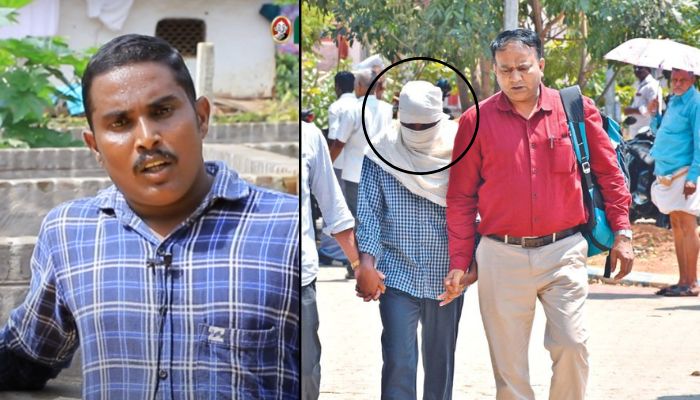
On Tuesday (18th June), one Aurangzeb, also known as Mohammad Farid, died in strange circumstances in Uttar Pradesh’s Aligarh district after which several Hindu traders and businessmen have been accused of his murder. The deceased’s family members have filed a case against the ten identified as the accused, alleging murder. So far, six accused have been arrested. At the same time, the Hindu accused’s family members have stated that Aurangzeb was a thief who invaded their homes intending to steal.
The Udyog Yuva Vyapar Mandal in the Mamu-Bhanja area of Aligarh has formed a support group for the accused Hindus. On 20th June, several businessmen submitted a memorandum to the local BJP MP, claiming themselves to be victims of the thieves. In the given case, they have alleged that the Hindu members are unnecessarily being targeted under the wrong sections for raising their voices against Halal products.
The Gandhi Park police station covers the Mamu-Bhanja area in Aligarh. The area includes Radio Market, which is home to hundreds of traders. The majority of the traders here are Hindus. Approximately half a dozen of the accused in the murder of Farid alias Aurangzeb are local businesspeople who operate in a variety of industries here.
Satish Gautam, the BJP MP from Aligarh, visited this market on Thursday, June 20. Dozens of businessmen gathered here and presented him with a memorandum. The memorandum states that in the incident in which action was to be taken under Section 304 (culpable homicide that does not amount to murder) of the IPC, Section 302 (murder) of the Indian Penal Code has been imposed due to pressure from Muslims.
Sections of culpable homicide imposed
Many businessmen, including Rajesh Garg, Rahul Garg, Sunil Rajni, Pankaj Aggarwal, and Kishan Arora, claim that they had no prior enmity with the deceased Aurangzeb. The businessmen accused in this case have no criminal background. As a result, this incident was not intentional.
It is reported that Aurangzeb was caught while stealing. Following this, people got angry and beat him up. The accused say that Aurangzeb was turned over to the police alive. If Aurangzeb dies later, a case should be made for culpable homicide, which is not murder and does not fall under Section 302 of the Indian Penal Code.
Targeted after supporting action on Halal products
In the memorandum handed to the BJP MP, the traders stated that they are the target of conspirators both domestically and internationally. According to Vyapar Yuva Mandal, the major reason for the conspiracy against them is a boycott of Halal items. According to dealers, the market fully supported the Uttar Pradesh government’s action against Halal items in February 2024.
All market traders were prohibited from purchasing or selling halal goods. Traders claim that the boycott is being used to express anger by labeling them murderers and imposing other charges. They also say that tweets from outside and the actions of some local suspects back up his assertions.
The traders have also expressed apprehension in their memorandum that in the coming future, the traders of the Mamu-Bhanja area may be made victims of some conspiracy or the other. All of them have collectively demanded protection from the government. He also accused him of spreading propaganda to defame businessmen.
It is all propaganda so that thieves and dacoits can easily rob us
According to the memorandum handed to the BJP MP by local traders in Aligarh, the goal of disseminating such propaganda is also to ensure that if theft or other problems occur at their location in the future, they will not report out of fear. All of them agreed that numerous robbers had previously been apprehended here, the majority of whom belonged to a specific community (the Muslim population).
Traders claim that such shared angles are being circulated as part of a conspiracy, resulting in massive losses for their businesses. Traders have also alleged that the controversy over the incident is being generated so that traders will continue to tolerate theft and other instances without taking action.
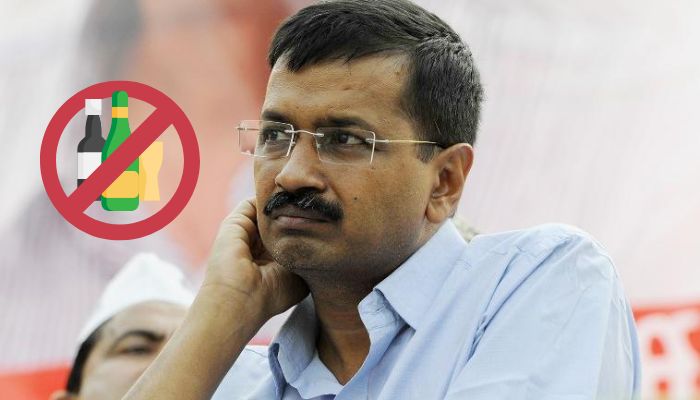
On Friday, June 21, the Delhi High Court temporarily suspended the order that granted bail to Delhi Chief Minister Arvind Kejriwal in the money laundering case linked to the liquor policy issue.
The court put a hold on the bail order’s implementation until a final decision is made on the stay application submitted by the Directorate of Enforcement (ED).
“Arguments have been heard. I am reserving this order for two to three days. Order reserved. Until the decision is pronounced, the implementation of the challenged order will remain stayed,” the Court ruled.
Justice Sudhir Kumar Jain, presiding over the vacation bench, issued this order while serving notice on the ED’s petition, which contested the trial court’s decision from the previous day that granted bail to Kejriwal.
The matter was addressed today following an urgent request made by the ED’s counsel earlier this morning before the Court.
Sunita Kejriwal, the wife of Mr Kejriwal, and leaders of the Aam Aadmi Party (AAP) planned to visit Tihar Jail at 4 pm today to meet the Delhi Chief Minister.
Delhi court granted bail without reading documents: ED
The Enforcement Directorate moved the High Court against the bail order today, and now it has been revealed that the lower court called ED’s arrest of Kejriwal ‘mala fide’ and granted bail without reading documents submitted by both parties.
In the judgement, the judge said that it is not possible to go through thousands of pages of documents at this juncture. But the court still decided that ED’s action was mala fide and granted bail to Arvind Kejriwal. The court also refused to hear ED’s arguments against the bail and asked ED’s counsel to present his arguments very briefly. The bail order was issued hurriedly at around 8 pm yesterday, and the order was not uploaded due to lack of time.
Arguing against the bail order, Additional Solicitor General SV Raju said that the trial court didn’t hear ED’s arguments, and didn’t look at documents given by ED saying it is voluminous. “Court says bulky documents have been filed. There can’t be any more perverse order than this,” the ASG said. He said that the court must go through the submitted documents.
“Without going through documents filed by both sides, without giving us the opportunity the matter is decided. The court must pass an order by law. Without going to documents how can you say it’s relevant or not relevant?” the ED counsel said.
Yesterday, a Delhi court granted Mr Kejriwal’s release on a personal bond of ₹1 lakh with certain conditions, including that he would not interfere with the investigation or influence witnesses. The court accepted Mr Kejriwal’s argument that the investigation agency had not provided sufficient evidence since his arrest on March 21.
This bail came after multiple attempts in trial courts where Mr Kejriwal was repeatedly denied bail. He has remained in his position as Delhi Chief Minister despite calls for his resignation from the ruling Bharatiya Janata Party.
In May, the Supreme Court granted Mr Kejriwal interim bail for election campaigning, but he returned to prison two days before the results were announced.
The Enforcement Directorate (ED) arrested Mr Kejriwal on money laundering charges related to the 2021-22 Delhi liquor policy, which was later revoked after objections from the Lieutenant Governor. The ED alleges that funds received from liquor vendors were used to finance the AAP’s campaign in Goa, where Mr Kejriwal serves as the party’s convenor.
The Bombay High Court on Friday acknowledged that the families of two IT professionals who died in the Porsche accident in Pune’s Kalyani Nagar last month are undoubtedly traumatized, but also noted that the accused teen involved in the accident was likely in “shock” as well. This observation was made during the hearing of a plea filed by the accused’s aunt, who is seeking his immediate release.
In her petition, the minor accused’s paternal aunt asserted that the Pune police had been unlawfully detaining the minor in a remand home and demanded his prompt release. She argued that the police were guilty of “abuse of process and blatant disregard for the rule of law.”
The 17-year-old, whom the police allege was intoxicated while driving the luxury Porsche that fatally struck two bike-riding techies, Aneesh Awadhiya and Ashwini Koshta, in the early hours of May 19, is currently held at an observation home in the city.
“There is no denying the unfortunate nature of the accident. The families of those who lost their lives are understandably in shock. However, the minor responsible for the accident, who was intoxicated at the time, is also traumatized. It is reasonable to assume that his mental state has been negatively impacted,” observed a division bench of Justices Bharati Dangre and Manjusha Deshpande during the hearing of the plea.
The bench questioned the procedure of remanding the minor to an observation home despite being granted bail. “What kind of remand is this? What is the authority behind this remand? How can someone be granted bail and then taken into custody? He is now confined to an observation home despite being granted bail. Is this not a form of confinement? We need to know the basis of your authority,” the High Court stated. The court reserved its order on the plea, which will be issued on June 25.
Last week, the Juvenile Justice Board (JJB) extended the minor’s remand at the observation home until June 25. The boy’s parents are in police custody for allegedly swapping his blood samples at Sassoon General Hospital, with two doctors and a hospital employee also arrested for manipulating the samples. The boy’s grandfather, Surendra Agarwal, was arrested for allegedly kidnapping the family’s driver and pressuring him to take the blame for the accident.
The police have submitted their final report to the JJB, presenting all evidence against the minor. “We have provided comprehensive evidence to the JJB proving he was driving the Porsche from his house on the evening of May 19 until the accident occurred,” a crime branch officer said, adding that the report supports their plea to try the juvenile as an adult.
“The report includes corroborative statements from eyewitnesses, CCTV footage, and evidence of him consuming alcohol at Cosie Restaurant and Blak Club. It conclusively demonstrates that the juvenile, in an intoxicated state, was driving the car and caused the deaths of two riders,” he explained.
The Karnataka government’s decision to hire “The Boston Consulting Group” (BCG) as a consultant appears to have divided the Congress party as Praveen Chakravarty (Chairman – Professionals’ Congress & Data Analytics) joined voices with the Bharatiya Janata Party BJP to criticise Chief Minister Siddaramaiah administration’s move to recruit the consulting giant in an attempt to increase revenue to fulfil its five election guarantees. The company will take a hefty Rs 9.5 crore for a six-month period. The finance department turns to BCG as a consultant to help “unlock” budgetary potential.
The Congress leader took to X (formerly Twitter) and expressed his opposition and stated that if one outsources essential political duties to outside, for-profit transactional consultants to win elections, then they must similarly outsource essential policy operations to the such consultants to govern.
If one wins elections by outsourcing core political functions to external fee charging transactional consultants, then one also governs by outsourcing core policy functions to similar consultants!https://t.co/O7xgk3T1mZ
However, later Praveen Chakravarty attempted to downplay his outspoken disapproval of the Karnataka government’s and referred to it as his “personal opinion”. Chakravarty also apologised for his comments after other Congress leaders slammed him. He claimed, “In retrospect, I should have been much more sensitive about the context. It was absolutely not intended as a personal criticism of any, let alone my own party’s. I have spoken with and expressed my apologies for causing inadvertent harm to the leadership in Karnataka.”
I posted my pvt opinion on the broader culture of outsourcing core political & policy functions to outside consultants with no ‘skin in the game’. It’s an issue that is debated widely in research circles & my comment was purely academic.
“What is the need of the BCG when a self-proclaimed economist like Siddaramaiah is the chief minister,” Leader of the Opposition of the Karnataka Legislative Assembly questioned and highlighted, “Not sure whether it will boost the revenues of the state government, but it will definitely boost the revenues of a private consultancy firm (sic) at the cost of Karnataka’s taxpayers.”
The Congress administration was also criticised by BJP state unit president BY Vijayendra for their “outrageous” decision to employ a “foreign” consultant. He declared, “This is akin to handing over the reins to the East India Company.” The politician further charged, “When the state government operates under the directions of an external agency, the welfare of the people takes a backseat, and innocent citizens are the ones who suffer.”
There is pressure on the Congress government to raise Rs 50,000-60,000 crore annually to fund development projects and carry out the five guarantees which would benefit 5.10 crore individuals in Karnataka at the cost of Rs 36,000 crore from the state’s coffers in 2023–2024. The five promises are Anna Bhagya (10 kg of rice per month to every member of BPL families), Yuva Nidhi (Rs 3,000 dole to unemployed graduates and Rs 1,500 to unemployed diploma holders for two years in the 18 to 25 age group), Shakthi (free travel for women across Karnataka in state buses), Gruha Lakshmi (Rs 2,000 to every woman head of a family) and Gruha Jyoti (200 units electricity free to every household).
This fiscal year, Chief Minister Siddaramaiah has allotted Rs 52,009 crore for the programmes. According to reports, the BCG recommended in its draft report that the government concentrate on finding new revenue streams in industries like mining and asset monetisation. One proposal, for instance, is to commercialize around 25,000 acres of property close to Bengaluru. The Karnataka government is reportedly considering creating planned satellite cities in and around Bengaluru as well as in Bidadi, Anekal, Hoskote, Devanahalli and Doddaballapur.
“When we create infrastructure, housing, industrial layouts, and IT corridors, then it will increase the value of land and some amount of land can be monetised to raise funds for development,” a source unveiled. He added that efforts are being explored to enhance expenditure management in departments including public works, electricity, irrigation, rural development and Panchayati Raj.
Additionally, the state administration is looking for creative ways to raise money. The state administration hopes to raise an extra Rs 5,000 crore every fiscal year if these recommendations are put into practice. More GST and property tax compliance, according to Additional Chief Secretary (Finance), LK Ateeq, would also assist in increasing revenue.
The consultant’s responsibilities encompassed devising strategies to augment tax and non-tax earnings, reducing expenditures, investigating inventive funding avenues, cultivating public-private partnerships (PPPs), using technologies to seal gaps and capitalizing on assets. Targeted interventions are going to focus on four main departments: public works, energy, rural development and irrigation. New revenue streams within departments, such as mining and forests will also be sought out.
A few days ago, the state government announced an increase in the fuel cess on petrol and diesel which caused fuel prices to rise. Karnataka Sales Tax (KST) on gasoline was increased by the government from 25.92 per cent to 29.84 per cent, and on diesel from 14.3 per cent to 18.4 per cent with effect from 15th June. According to the Petroleum Dealers Association, this will likely result in an increase in gas and diesel prices in the state of about Rs 3 and Rs 3.05, respectively. “We need money for Guarantees and development, hence there has been an increase in fuel price,” said State Minister for Commerce and Industries MB Patil.
“The water tariff has not been increased in Bengaluru in the last 10 years. There has been a great loss. We have to take on new projects. No bank is coming forward to finance the Bangalore Water Supply and Sewerage Board (BWSSB). Every year we are suffering a big loss,” claimed Karnataka Deputy CM DK Shivakumar while addressing the media recently, insinuating a possible hike in water tariffs in the state.
On the 20th of June 2024, the Patna High Court overturned the 65% reservation quota for backward classes, extremely backward classes (EBC), scheduled castes (SCs), and scheduled tribes (STs) in Bihar. The Court stated that the Bihar Reservation of Vacancies in Posts and Services (Amendment) Act, 2023, and the Bihar (In Admission in Educational Institutions) Reservation (Amendment) Act, 2023, were unconstitutional and violated the equality clause of Articles 14, 15, and 16 of the Indian Constitution.
#BREAKING Patna High Court observes that the #Bihar Govt did not do any in-dept study before increasing SC/ST/OBC reservation to 65%.
"State proceeded on the mere proportion of population of different categories as against their numerical representation in govt services and… pic.twitter.com/dDgFuAG1CX
In March, the high court reserved judgment on writ petitions challenging the constitutional validity of increasing reservation quotas for backward, extremely backward classes, scheduled castes, and scheduled tribes from 50% to 65% in government jobs and higher education institutions in Bihar. A division bench comprising Chief Justice K Vinod Chandran and Justice Harish Kumar reserved judgment after hearing 10 writ petitions filed by Gaurav Kumar and others.
“The State attempted no in-depth study or analysis before providing for enhancement of the reservation percentage established from the records. The State proceeded on the mere proportion of the population of different categories as against their numerical representation in govt services and educational institutions…,” the High Court said.
HC strikes down the Bihar Reservation of Vacancies in Posts and Services (for Scheduled Caste, Scheduled Tribes and Other Backward Classes) Amendment Act, 2023 and the Bihar Reservation (in Admission to Educational Institutions) Amendment Act, 2023 for breaching the 50%… pic.twitter.com/wqUsyHATbF
“We, hence, set aside the Bihar Reservation of Vacancies in Posts and Services (for Scheduled Caste, Scheduled Tribes and Other Backward Classes) Amendment Act, 2023 and the Bihar Reservation (in Admission to Educational Institutions) Amendment Act, 2023 as ultra vires the Constitution and violative of the equality clause under Articles 14, 15 and 16. The Writ Petitions are allowed leaving the parties to suffer their respective costs,” the Patna High Court ruled.
Notably, the PIL had argued that these amendments violated the 50% cap on reservations established by the Supreme Court in the Indira Sawhney case (also known as the Mandal Commission case). The petitioners contended that the state’s decision to exceed this cap without demonstrating exceptional circumstances was unconstitutional. They also asserted that the reservation percentages should be based on adequate representation rather than proportional representation of these classes within the state.
It is pertinent to mention that the RJD-JDU-led Bihar government’s amendments in November last year, based on a state-wide caste census, increased reservations to 20% for Scheduled Castes, 2% for Scheduled Tribes, 18% for Other Backward Classes, and 25% for Extremely Backward Classes, with an additional 10% for the Economically Weaker Sections, bringing the total to 75%.
The Patna High Court’s decision underscores the ongoing legal and political complexities surrounding caste-based reservations in India, emphasising the need for adherence to constitutional limits and judicial precedents when implementing such policies.
Meanwhile, Rashtriya Janata Dal (RJD) leader and former deputy CM of Bihar, Tejashwi Yadav has blamed the Bharatiya Janata Party (BJP) for the striking down of 65% reservation cap. He also accused the BJP-led Central government of deliberately delaying the inclusion of the now-scrapped laws in the Ninth Schedule of the Indian Constitution.
बीजेपी के लोग घोर आरक्षण विरोधी है। हमें तो पहले से संदेह ही नहीं बल्कि पूर्ण विश्वास था कि ये लोग दलितों, आदिवासियों, पिछड़ों और अतिपिछड़ों के आरक्षण को बढ़ने से रोकने एवं समाप्त करने का प्रयास करेंगे। हमारी सरकार के जाति आधारित सर्वे को भी इन लोगों ने हर स्तर पर रुकवाने की… pic.twitter.com/MgRF3TIACl
How the courts scrapped similar laws in other states in the past
Increasing caste reservations beyond the 50% cap by political parties in India is often seen as a populist strategy aimed at securing votes from specific communities. While it appears to address social inequities, this approach undermines the principle of meritocracy and violates constitutional guidelines. Other than Bihar, governments in other states have also attempted to increase reservations beyond the 50% cap.
Supreme Court scraps Maratha reservation
In 2018, Maharashtra passed the Socially and Educationally Backward Classes (SEBC) Act, providing a 16% reservation for the Maratha community. This led to the total reservations in the state exceeding 50%, which was contested in the Bombay High Court. In 2019, the Bombay High Court upheld the Maratha reservation but reduced it to 12-13%. The case eventually reached the Supreme Court, which in 2021 struck down the SEBC Act, citing that the law violated the 50% cap established by the 1992 Indra Sawhney judgment and that there were no extraordinary circumstances to justify exceeding this limit.
Gujjar reservation in Rajasthan
The Gujjar community in Rajasthan has long demanded inclusion in the reservation system to address their socio-economic backwardness and has also led agitations for the same. The state governments led by BJP’s Vasundhara Raje and Congress’s Ashok Gehlot have made multiple attempts to accommodate these demands, leading to significant legal and political challenges. In 2019, the Rajasthan government granted a 5% reservation to the Gujjar community and other groups under the Special Backward Classes (SBC) category through the Rajasthan Backward Classes Amendment Act, 2015. As of now, the Rajasthan government provides a 5% reservation for the Gujjar community under the category of Special Backward Classes (SBC). This is part of the broader reservation structure in the state, which totals approximately 64%. Notably, in Rajasthan, SCs get 16%, STs 12%, OBCs 21%, MBCs [Gujjar, Raika-Rebari, Gadia Luhar, Banjara and Gadarias 5% and EWS get 10% reservation.
The Rajasthan High Court struck down this provision, citing that it exceeded the 50% reservation limit and lacked sufficient data to justify the classification of these communities as backward. Eventually, the matter reached the Supreme Court, however, refused to interfere and rejected a plea seeking a stay on the 5% quota to Gujjars and the other four MBCs.
75% reservation for locals in private sector in Haryana
In Haryana, the caste reservation status involves a blend of quotas across various categories, including SCs getting 20%, Backward Classes (A) 16%, Backward Classes (B) 11%, and EWS getting 10% reservations, taking the total to 57%. Last month, the Punjab and Haryana High Court issued a notice seeking a response from the state government on why the caste reservation has exceeded the 50% cap in Haryana.
Other than this, the Haryana government passed the controversial Haryana State Employment of Local Candidates Act, 2020, which mandated 75% reservation for local candidates in private sector jobs offering a monthly salary of less than Rs 30,000. However, this law was struck down by the Punjab and Haryana High Court in February 2023. The court ruled that such a reservation was unconstitutional, as it interfered with the fundamental rights of private employers to hire freely and contravened the principles of equality enshrined in the Indian Constitution.
Hemant Soren-led Jharkhand government passed the OBC reservation bill taking reservations up to 77%
In November 2022, the then Jharkhand CM Hemant Soren brought a bill known as the OBC reservation bill, which would increase the OBC quota to 27%, SC quota to 12%, ST quota to 28% and include the 10% EWS quota. This bill was passed in a one-day special session in 2022. However, Governor CP Radhakrishnan returned the bill saying that it crossed the 50% cap imposed by the Supreme Court.
Tamil Nadu has 69% caste reservation, DMK govt refused to implement a 10% EWS quota
Tamil Nadu has the highest percentage of caste-based reservations in the country at 69%. This includes reservations for Backward Classes (26.5%), Backward Class Muslims (3.5%), Most Backward Classes / Denotified Communities (20%), Scheduled Castes (18%), and Scheduled Tribes (1%).
Source: bcmbcmw.tn.gov.in)
While the courts have intervened in the matters of state governments making laws transcending the 50% cap to grant reservation to certain caste groups, Tamil Nadu has for long maintained a 69% cap nearly unchallenged. This is because the Tamil Nadu Reservation Act, 1994, which provided for these reservations, is included in the Ninth Schedule of the Constitution.
Notably, the Ninth Schedule contains a list of central and state laws which cannot be challenged in courts and was added by the Constitution (First Amendment) Act, 1951. Thus, the Tamil Nadu Reservation Act, 1994 is protected from judicial review.
However, in the 2007 I.R. Coelho vs. State of Tamil Nadu case, the Supreme Court ruled that laws placed in the Ninth Schedule after 1973 could be subject to judicial review if they violated the basic structure of the Constitution.
Back in 1969, the Dravida Munetra Kazhagam (DMK) government, led by Chief Minister C.N. Annadurai, introduced a 31% reservation for Backward Classes (BCs). In 1971, under the leadership of M. Karunanidhi, the reservation quota was further increased based on AN Sattanathan Commission’s report taking the total reservation to 49%. In 1980, the AIDMK government led by MG Ramachandran (MGR) reversed the economic criteria he earlier implemented for reservation eligibility after vehement opposition by the political parties and defeat in state assembly elections. MGR raised the reservation for BCs from 31% to 50%, thus taking the total reservation to 68%. In 1990, the Karunanidhi-led DMK government brought a 1% ST quota. With this, the total caste reservation in Tamil Nadu stood at 69%.
In the 1992, Indra Sawhney vs. Union of India case, the Supreme Court ruled that reservations should not exceed 50% of available seats and jobs, except in extraordinary circumstances. The court also established the concept of a “creamy layer” to exclude the more affluent members of OBCs from availing of reservation benefits.
After this, the Tamil Nadu government led by AIADMK’s Jayalalitha successfully lobbied for the inclusion of the Tamil Nadu Reservation Act in the Ninth Schedule of the Indian Constitution in 1993. The then CM Jayalalitha led a delegation of state parties to PM Narasimha Rao and urged him to refer the bill to President Shankar Dayal Sharma for his assent which was given a month later.
While the DMK government introduced Muslim reservations in 2006, when the Central government introduced reservations for Economically Weaker Sections (EWS) in 2019, it vehemently opposed it saying that it granted a significant section of the upper caste population “easy exclusive luxurious” reservations. The DMK government has also passed an act giving an internal 10.5% reservation to Vanniyars under the Most Backward Classes quota. However, the Supreme Court struck it down since it was implemented without any quantifiable data to support its move.
Conclusion
Various political parties frequently promise increased reservations to certain caste or ‘minority’ groups to win their support during elections. These promises are presented as a way to address historical injustices and provide opportunities for underrepresented communities. However, such moves are often more about electoral calculus than genuine social reform. It is pertinent to understand that increasing reservations might yield short-term political and electoral gains, but it risks long-term societal harm by exacerbating divisions and hatred and failing to foster genuine socio-economic development.
Delhi Chief Minister Arvind Kejriwal was granted bail by Special Judge Niyay Bindu of Rouse Avenue Courts yesterday evening, the detailed order of which was uploaded today. The Enforcement Directorate moved the High Court against the bail order today, and now it has been revealed that the lower court called ED’s arrest of Kejriwal ‘mala fide’ and granted bail without reading documents submitted by both parties.
In the judgement, the judge said that it is not possible to go through thousands of pages of documents at this juncture. But the court still decided that ED’s action was mala fide and granted bail to Arvind Kejriwal. The court also refused to hear ED’s arguments against the bail, and had asked ED’s counsel to present his arguments very briefly. The bail order was issued hurriedly at around 8 pm yesterday, and the order was not uploaded due to lack of time.
Rouse Avenue Court Judge doesn't have time to go through the documents and wants to give the judgement without going through the documents.
Arguing against the bail order, Additional Solicitor General SV Raju said that the trial court didn’t hear ED’s arguments, didn’t look at documents given by ED saying it is voluminous. “Court says bulky documents have been filed. There can’t be any more perverse order than this,” the ASG said. He said that it is the duty of the court to go through the submitted documents.
“Without going through documents filed by both sides, without giving us opportunity the matter is decided. It is the duty of court to pass order in accordance with law. Without going to documents how can you say it’s relevant or not relevant?” the ED counsel said.
The ASG also said that Kejriwal’s side made a wrong statement and the court accepted it. He said that trial court order mentions that ECIR is from 22 August 2022 but the ECIR was registered in July 2022. “If you’d gone to documents you would have known that the ECIR was registered in August. So there was no question of material being available in July,” SV Raju argued. He added, “On Wrong facts, wrong dates, you come to a conclusion that mala fide.”
The ED also argued in the High Court that the lower court disregarded the earlier High Court order in this matter, which had found merits in the arrest and remanded the Delhi CM to ED custody and then jail. The ASG also pointed out that the SC didn’t stay the HC order, and therefore the lower court can’t decide in Arvind Kejriwal’s favour.
The ASG said, “Compare the judgment with the findings. This court says no mala fide. She gives a finding on mala fide on same facts. SC has not said that you decide uninfluenced by that judgment.” He argued that bail can be cancelled on two grounds, if relevant facts are not considered and irrelevant facts considered.
He said that HC had justified Kejriwal’s arrest after he had ignored 9 summons by ED, and now the lower court gave a opposite verdict, and said it is a “totally perverse order”.
ASG: There are two ways on which bail order can be set aside. I am saying it is a perverse order as irrelevant material was considered. This is totally perverse order.
The High Court expressed surprise that the lower court didn’t consider its judgement in the case while issuing the bail order. “You are saying all these points were not considered? You are saying the points which were elaborately dealt with by the HC have not been considered?” the bench asked.
The High Court vacation bench of Justices Sudhir Kumar Jain and Ravinder Dudeja will resume hearing arguments after the lunch break.
The bench earlier stopped release of Kejriwal from jail, and agreed to hear ED’s plea against the bail on an urgent basis. The ED says that the court granted bail to Kejriwal without hearing it and without reading documents submitted by the agency.
Yuvajana Sramika Rythu (YSR) Congress Party chief and former Chief Minister Yeduguri Sandinti Jagan Mohan Reddy is under fire after images of his luxurious sea-facing abode in Visakhapatnam (Vizag) surfaced on social media recently. However, his party defended the construction, emphasising that these buildings are government assets rather than private properties of Jagan Mohan Reddy. However, the controversy has been further escalating as the Telugu Desam Party (TDP) has levelled charges of corruption against him, especially in light of the state’s financial condition. The lavish estate, according to the TDP, was meant to serve as Jagan Reddy’s camp office as he proclaimed Vizag as the capital of Andhra Pradesh.
#WATCH | Andhra Pradesh: Drone visuals of the buildings constructed atop Rushikonda in Visakhapatnam.
Rushikonda Palace controversy erupted when Bheemili MLA Ganta Srinivasa Rao visited the buildings constructed atop Rushikonda by the previous YSRC regime. Terming the buildings… pic.twitter.com/XcjVQ68kAo
The Rushikonda palace which is spread over a 9.88-acre sea-facing site and possesses twelve bedrooms with a total built-up area of 1,41,433 square meters has turned out to be an extravagant symbol of grandeur. The Jagan government reportedly spent Rs 407 crore of the anticipated Rs 452 crore on the project, which involved cutting the idyllic Rushikonda hills to create the three mansions. Some washrooms are even 480 square feet large and meeting halls measure 7,266 square meters.
Expensive imported marble and chandeliers costing Rs 2 lakh grace the vast corridors leading to the first-floor conference area in Kalinga block. A home theatre with a wall-to-wall screen is another highlight of the block. The facilities in the Gajapathi and Vengi blocks are the same. The government invested Rs 50 crore in landscaping and Rs 33 crore on interior décor. There is central air conditioning throughout the entire complex, including the restrooms. A dining hall with a view of the sea, each bedroom with twelve beds, and baths with spa services are among the special features.
The TDP pounced on the Jagan government and highlighted that the new buildings are a testament to its “misgovernance.” After TDP stormed into power, Bheemili MLA Ganta Srinivasa Rao and members of the ruling party visited the location to acquire information regarding the project before Chief Minister Chandrababu Naidu’s scheduled visit to Visakhapatnam. They also posted images on social media and slammed the YSR Congress government for tearing down Praja Vedika, which was constructed under the previous TDP administration.
Ganta Srinivasa Rao declared, “Jagan was voted out of power before enjoying the opulence of the palace he constructed. It was constructed in an impractical manner, and a decision regarding its use will be made after Naidu’s visit.” The new Chief Minister Chandrababu Naidu and even his deputy Pawan Kalyan were unaware of what was happening behind the barricades. He added, “Divine intervention prevented Jagan from using the palace,” referring to the former chief minister’s oust from office. When the proposal was contested, a High Court expert committee discovered multiple infractions, but construction went forward, he asserted.
According to Ganta Srinivasa Rao, the opulence of the palace was reminiscent of the palaces constructed by Saddam Hussein, the dictator of Iraq and Karnataka mining baron Gali Janardhan Reddy. He contended that it had a large conference space intended for reviews and gatherings, which isn’t a feature of tourist homes. The TDP maintained that the building costs were kept “highly confidential” and that contracts were given toYSR Congress Party’s supporters.
The TDP leader pointed out, that Rushikonda’s green tourist resorts, which brought in up to Rs 8 crore a year, were razed to make way for the palace. He emphasised that the state government had deceived the judges. He mentioned that the state government referred to it as a “star hotel” at first, then as a “Chief Minister camp office” and finally as a tourism project. With a timeframe of 15 months and a budget of Rs 91 crore, the project was initiated as a five-star hotel, however, according to the TDP, Rs 21 crore was spent on landscaping and Rs 95 crore was used to level the land. Twenty-foot barricades were installed to keep the building activity concealed.
TDP’s official social media handle also denounced the former chief minister in a series of tweets and accused him of building the palace discreetly and shielded by extensive barricades. It wrote, “Rushikonda Palace incident alone is enough to know how much good people have done to the state by defeating Jagan. Look at how much effort he had to occupy a hill in Visakha and build a palace with Rs.500 crores of public money.”
జగన్ ని ఓడించి ప్రజలు రాష్ట్రానికి ఎంత మేలు చేసారో తెలుసుకోడానికి ఒక్క రుషికొండ ప్యాలెస్ ఉదంతం చాలు. విశాఖలో ఒక కొండని ఆక్రమించి, అందులో రూ.500 కోట్ల ప్రజాధనంతో ప్యాలెస్ ని కట్టుకున్నాడంటే ఎంత బరి తెగింపో చూడండి!#FurnitureDongaJagan#AndhraPradeshpic.twitter.com/KCOrZdb9TZ
The party further accused, “For his (Jagan Mohan Reddy) wife’s wish, a palace worth Rs. 500 crores, with a view of the beach and the sea in the north-east. The bathtub alone is Rs.26 lakhs. Again he made a mockery of the poor and beggars and deprived the impoverished of their homes.”
భార్య కోరిక కోసం, కొండని కొట్టి మరీ, ఈశాన్యంలో సముద్రం ఉండేలా, బీచ్ వ్యూ తో రూ.500 కోట్లతో ప్యాలెస్. బాత్ టబ్ ఒక్కటే రూ.26 లక్షలు.
“The Italian marble and tiles used in Rushikonda Palace are mind-blowing. For the cost per foot of this Italian marble, a middle-class person can afford a small-sized apartment. This is the beach view palace built by Jagan Reddy in Rushikonda with the materials used for royal prasadas built by heads of state,” the party stated in another tweet.
రుషికొండ ప్యాలెస్ లో వాడిన ఇటాలియన్ మార్బుల్, టైల్స్ చూస్తే దిమ్మ తిరుగుతుంది. ఈ ఇటాలియన్ మార్బుల్స్ కోసం ఒక్కో అడుగుకి పెట్టిన ఖర్చుతో, మధ్య తరగతి ప్రజలు, ఒక చిన్న సైజ్ అపార్ట్ మెంట్ కొనేయొచ్చు.
దేశాధినేతలు కట్టుకునే రాజప్రాసాదాలకు వాడే మెటీరియల్తో, జగన్ రెడ్డి రుషికొండలో… pic.twitter.com/UcniQawJ1d
“The luxuries and comforts provided to Jagan Mohan Reddy at the Rushikonda Palace have left people in shock,” highlighted TDP Spokesperson Pattabhi Ram Kommareddy Pattabhi. He drew attention to the lavish spending on a range of amenities, asserting that these indulgences had cost close to Rs 500 crore. A tub that was estimated to be worth Rs 40 lakh and a wheelchair that was estimated to be worth Rs 10 to Rs 12 lakh were two of the most prominent expenses. The palace also includes an abundance of exquisite furnishings, including a spa area with an expensive massage table. He added, “I was surprised to see a massage table inside the Chief Minister’s bedroom.”
The TDP leader also brought on the timing and nature of these expenditures, expressing that considering the state’s acute financial situation (Andhra Pradesh is in debt for Rs. 12 lakh crore) such spending was improper. Furthermore, he flagged a conflict of interest by affirming that Devi Reddy Srinath Reddy, a relative of Jagan Mohan Reddy, was awarded the contract for these constructions.
Environmentalists and bureaucrats raise concerns
Environmentalists and campaigners have criticized the construction, noting that it goes beyond the rules governing the Coastal Regulation Zone (CRZ). Numerous court cases, including one before the National Green Tribunal (NGT), have been brought against the building. EAS Sarma, a retired bureaucrat, wrote to the Ministry of Environment, Forests and Climate Change (MEFCC) stating that the buildings are meant to house the chief minister’s office rather than be utilized for tourism, as part of the administrative capital relocation to Visakhapatnam. He asked the MEFCC to bring charges against APTDC personnel for breaking the law and to withdraw the CRZ clearance.
Following social media posts about the reckless excavation of hills for the construction of the multi-story tourism resort, L V Subrahmanyam in 2021 approached Raj Bhavan. He was the chief secretary of the government led by Y S Jagan Mohan Reddy from June to November 2019. He pointed out, “How can this (destruction) be allowed to go on? Are we having any concern for conservation? Wish the Governor questions this action. We cannot be silent spectators. An innocent tribal is not allowed this liberty in his habitat where options are few. But here with all options for alternative this marauding of ecology is simply unpardonable. We must halt this at once (sic),” in a letter.
According to former Union energy secretary and retired IAS officer E A Sarma, the state government received environmental clearance from the centre for the construction on Rushikonda hill by claiming that the project only involved remodelling the existing resort and would not cause any harm to the hill or surrounding vegetation. However, he charged, the exact opposite is happening there. “The construction activity has extensively damaged the otherwise scenic Rushikonda hill terrain, leaving ugly scars and causing extensive denudation of the vegetation there.”
YSR Congress Party defends itself
The party has claimed that the goal of the renovation project was to increase Visakhapatnam tourism. “They are not private property. They do not belong to anyone. These buildings were constructed keeping in mind the priority given to Visakhapatnam by the previous government. It is up to the government how to use them. People are noticing the motives behind going into such government buildings and taking pictures and trying to smear them with distortions. Even since 1995, Chandrababu has been boasting that Visakhapatnam is the financial capital. He has become the chief minister four times so far. Realize that even if a Prime Minister comes to Visakhapatnam, a President comes, a Chief Minister goes, or people like the Governor go, there is no proper building to host them. Going inside the buildings of Rushikonda Resorts and taking pictures and displaying bile may give you emotional satisfaction, but the people of Visakhapatnam are not doing so,” it alleged on X (formerly Twitter).
According to the party, the structures were built to accommodate dignitaries including the president and prime minister when they come to the city. TDP MLAs and certain ministers, per former minister Gudivada Amarnath, are attempting to deceive the people by portraying the buildings as private properties for Jagan Mohan Reddy’s disposal. He recounted that the Andhra Pradesh Tourism Development Corporation (APTDC) resort was constructed while NT Rama Rao was the chief minister and it still controls the land. He disputed the TDP’s allegations of exploitation of funds by stressing that the current administration could decide how to use the buildings for public purposes.
The Andhra Pradesh Tourism Development Corporation was in charge of the Haritha resort on Rushikonda Hill, and the YSR Congress Party government had been revealing plans to turn it into a popular tourist attraction since late 2021. A 9.88-acre portion of the resort has been off-limits ever since, and the government claimed that it was undergoing development work. The land was divided into blocks, according to official records and structures were built at an estimated cost of Rs 356.4 crore. RK Roja, former minister of tourism, launched the redevelopment initiative in February.
Now, following the shift in state administration following the assembly elections, the future of the new building atop Rushikonda Hill is now uncertain. There is considerable ambiguity and limited access to its neighbouring areas.
Amid the escalating row between Delhi and Haryana over the water crisis in the national capital, Delhi Water Minister Atishi said on Friday, that she will step on the path of ‘Satyagraha’ and start an ‘indefinite fast’ from today.
She said despite every possible effort, the Haryana government is not providing full water to Delhi, resulting in 28 lakh people not getting water.
The Aam Aadmi Party (AAP) leader said she will go to Raj Ghat to pay tributes to Mahatma Gandhi, following which she will start an indefinite fast at Bhogal, Jangpura at noon.
Taking to X, Atishi stated, “Water shortage continues in Delhi. Even today 28 lakh Delhiites are not getting water. Despite every possible effort, the Haryana government is not providing full water to Delhi. Mahatma Gandhi has taught that if one has to fight against injustice, one must adopt the path of Satyagraha.”
दिल्ली में पानी की कमी बरकरार है। आज भी 28 लाख दिल्ली वालों को पानी नहीं मिल रहा। हर संभव प्रयास के बाद भी हरियाणा सरकार दिल्ली को पूरा पानी नहीं दे रही।
महात्मा गांधी ने सिखाया है कि अगर अन्याय के ख़िलाफ़ संघर्ष करना हो, तो सत्याग्रह का रास्ता अपनाना होगा। आज से ‘पानी…
“I will start ‘Water Satyagraha’ from today. I will go to Raj Ghat at 11 am and pay tribute to Gandhiji. I will start an indefinite fast at Bhogal, Jangpura from 12 o’clock. I will remain on fast until the people of Delhi get their rightful share of water from Haryana,” she added.
Atishi had announced on Wednesday, that if Delhi does not get its “rightful” share of water by June 21, she will be forced to do a ‘Satyagraha’.
The Bharatiya Janata Party has continued to attack the Delhi government over the water crisis.
BJP MP Bansuri Swaraj alleged the crisis has been “orchestrated” by the AAP government to “encourage corruption.”
“It almost seems that this crisis, which is not a natural crisis, has been orchestrated by the Kejriwal government to encourage their own corruption as well as to encourage the illegal tanker mafia,” Bansuri Swaraj told ANI.
“Delhi is in a dire state. The entire city is parched and the Kejriwal government is indulging only in theatrics. Delhi minister Atishi instead of working on the ground and instead of taking any adequate steps is now indulging in mere theatrics and is now threatening Delhiites with anshan (fast),” she added.
Delhi has been reeling under a water crisis amid scorching heat for close to a month now. People in multiple parts of the city are forced to queue up to collect water from the tankers. They have expressed their frustration with the situation, demanding an end to their problems.
The political row over the water crisis has continued to intensify with BJP and AAP at loggerheads.
Congress, which contested the Lok Sabha elections in alliance with AAP, has also attacked the Delhi government on the issue, with Congress’ Delhi president Devender Yadav terming it a “deceit” with the people.
(This news report is published from a syndicated feed. Except for the headline, the content has not been written or edited by OpIndia staff)
In an alarming event meant to hurt Hindu beliefs, over 53 carcasses of cattle were discovered in three separate locations including Seoni in Madhya Pradesh on June 20th. These corpses were not only carelessly discarded but also flung into the sacred waters of the Wainganga River, adding to the community’s distress.
Receiving complaints, the local police swiftly summoned a veterinary doctor to check the remains. Following the examination, the carcasses and remains were buried, and an immediate inquiry was launched.
As per the exclusive report by Organiser, the remains of around 19 cows had been thrown into the river, and apart from this, more than 32 cows had been slaughtered in other nearby areas. Several of the cows had been mutilated, with portions of their bodies left all over the forest and their heads hacked off.
Over 54 Gau Matas have been found dead, some with their heads severed, others with their limbs chopped off in three different places in Seoni district of Madhya Pradesh.
Local residents supported the police in recovering and burying the bodies. They stated that such an incidence was rare in the region and thought that the remains may have been carried by the river. Some believe that the recent slaughterhouse crackdown caused cow remains to be disposed of in numerous locations in order to avoid police intervention. However, the exact cause is still being investigated.
Superintendent of Police Rakesh Sinha told the people that the police are stepping up their efforts against cow smugglers. “All eyes are on them, and those who are illegally smuggling have been caught,” he said. Outraged locals have called for immediate action to identify and prosecute those guilty.
A local Hindu activist accorded the incident’s timing to the minority population’s recent Bakrid celebrations, implying that the Muslim community attempted to upset Hindus. He urged for a CBI investigation and harsh penalties against the perpetrators, including bulldozer action. He warned of widespread protests if the demands were not satisfied.
“We are examining the issue from all angles and will soon identify those behind it and arrest them,” SP Sinha said.
Despite the problems caused by recent rains, efforts to remove all remains from the river continue. Seoni Collector Kshitij Singhal acknowledged that the administration is thoroughly probing the issue and has promised strong punishment against anyone involved.
Alok Dubey, the BJP district president, described the incident as “cruel and highly condemnable.” He guaranteed that senior party leaders had been notified and that negotiations with officials were ongoing.
Dubey emphasized the enormous anguish caused to the Hindu community and claimed that the incident was an attempt by anti-social groups to undermine district harmony.
A day after Delhi CM Arvind Kejriwal was granted bail by a Delhi court in the Excise Police Scam case, the Delhi High Court stayed his release from jail while agreeing to hear ED’s plea against the bail order on an urgent basis. Notably, Special Judge Niyay Bindu of Rouse Avenue Courts had issued the bail order at around 8 PM yesterday, and the detailed judgement was not uploaded due to lack of time.
The Enforcement Directorate moved the High Court against the bail order today, saying that it was not allowed to argue opposing the bail plea by the court. Additional Solicitor General SV Raju argued on behalf of ED, moving an urgent stay of the bail order. He said, “I am moving for an urgent stay. The order was pronounced yesterday at 8. The order is not uploaded. We were not given a clear opportunity to oppose bail.”
The ASG argued that he was asked to complete his argument quickly, and his arguments were curtailed. He said that ED’s prayer for a stay on the bail order wasn’t even considered by the court. “I am demanding that the order be stayed and the matter be heard as soon as possible. We were denied the full opportunity to argue the case. I am making allegations with full seriousness,” the ASG said.
SV Raju quoted Bar and Bench saying that his arguments were curtailed. Kejriwal’s counsel Abhishek Manu Singhvi opposed the ED’s plea, saying there are several Supreme Court judgements saying that cancellation of bail is radically different from grant of bail.
Court: The bail order will not be given effect. We have not passed the final order. You may argue for as much as you can.
However, the Delhi High Court’s vacation bench of Justices Sudhir Kumar Jain and Ravinder Dudeja allowed ED’s plea to list the matter urgently for today itself. The court ordered that the lower court’s order granting bail to Arvind Kejriwal will not be given effect before it hears the ED plea. The bench said that it will take up the matter after the files reach the court, and listed the matter for today, 21 June.
Special Judge Niyay Bindu of the Rouse Avenue Court yesterday granted bail to Kejriwal for a bond of ₹1 lakh. The ED had sought 48 hours to appeal against the order, requesting a stay, but the court refused the plea.
As the bail order was granted late in the evening, Arvind Kejriwal was expected to be released today from Tihar jail. But with High Court accepting ED’s request to hear its plea challenging the bail order and staying his release, he will now remain in jail till the High Court issues an order.