The traditional methods of exploiting a One-time password (OTP) and making fraudulent phone calls to take someone’s hard-earned money have given way to new forms of cyber fraud. A person’s account was defrauded in a cyber-fraud case that surfaced in the Purnia district of Bihar without the use of an OTP, a phone call or any other conventional tactics that the public and police are aware of.
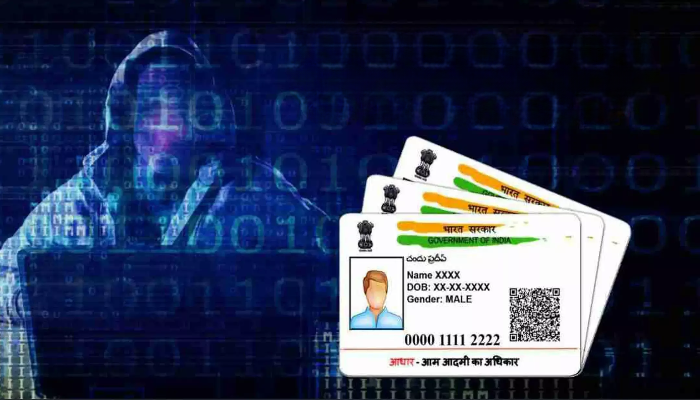
In this case, the cybercriminals used the Aadhaar biometrics data of the victim obtained from govt land records to make transactions using the Aadhaar Enabled Payment System. Bihar police revealed the unique scam in a press conference, the video of which was shared by Haryana IPS officer Pankaj Jain on X (Twitter).
Explaining the modus operanding of the scam, the Bihar Police said that the victim’s land documents, dated 25th June 2024, were obtained by the cybercrime gang by hacking into the government database. The criminals then breached the victim’s Aadhaar details and fingerprint from the land documents.
Subsequently, the perpetrator reportedly impersonated the victim by cloning the thumb impression taken from the land records. They then took money out of the victim’s bank account through the Aadhaar Enabled Payment System using the cloned thumb impression and the victim’s Aadhaar details. As AePS enables payment without any OTP, the criminals were able to steal money using the illegally obtained Aadhaar details and fingerprints.
Eight persons have been arrested by the Bihar Police in connection with the case. The group has been defrauding people of their money on a regular basis without using OTP or fraudulent phone calls. Further investigation is underway and the authorities are looking for the rest of the culprits.
Aadhaar cardholders can make transactions using their Aadhaar credentials by using the Aadhaar-enabled Payment System (AePS). Although this is a ground-breaking method of handling payments in places with poor or no Internet connectivity, the fact that the cardholder’s fingerprint is used to confirm their identification poses a risk because it can be taken unlawfully and replicated by fraudsters.
The Aadhaar number should be concealed to prevent AePS fraud. A virtual ID should be used for online transactions rather than Aadhaar. The virtual ID can be generated on the UIDAI website. People should make sure their phone number and email address are connected to their Aadhaar so the person can receive alerts when their Aadhaar is utilized in any suspicious way. If one has fallen victim to AePS cyber fraud, it should be reported on the National Cybercrime Reporting Portal.
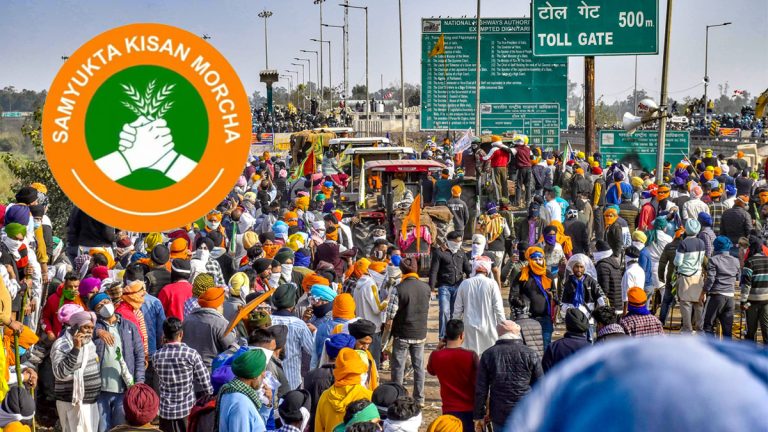
The Samyukta Kisan Morcha (SKM) on 11th July announced that it will resume its agitation over its pending demands, including a legal guarantee to Minimum Support Price (MSP), a loan waiver, pensions for farmers and farmworkers and stop the privatisation of the power sector. The organisation had presided over the 2020-21 farmers protests. The farmers’ body mentioned that it would also seek appointments to meet Prime Minister Narendra Modi and the Leader of Opposition in Lok Sabha Rahul Gandhi to present their charter on unfulfilled requests from farmers.
It declared, “The general body has decided to resume the agitation demanding implementation of the agreement, dated December 9, 2021, that the union government has with the SKM, signed by the secretary of the Department of Agriculture, Government of India and other key demands affecting the livelihood of farmers.” A legally guaranteed Minimum Support Price (MSP) for all crops, an end to the privatization of the power industry and prepaid smart meters, compensation for the families of all farmers who lost their lives in the farmers’ struggle, the withdrawal of all cases pertaining to the farmers’ agitation and the amendment of the pollution control act to exempt farmers from criminal liability due to stubble burning are all covered by the agreement.
The SKM intends to redouble its efforts by presenting an updated demand charter to every member of the Rajya Sabha and Lok Sabha. Delegations from their leadership will personally meet with the members of parliament from 16th and 18th July to apply pressure on the Bharatiya Janata Party (BJP)-led National Democratic Alliance (NDA) government and demand that the farmers’ demands be addressed immediately. The decision was made during the SKM’s general assembly meeting on 10th July in New Delhi.
“Memorandums will be submitted to the newly elected members of the Lok Sabha and the Rajya Sabha on July 16, 17, and 18. The state units of the SKM will be meeting the MPs of their respective states. In addition, the SKM will be seeking time from the PM as well as the LoP to hand them over the memorandums,” informed Dr Darshan Pal, a member of the National Coordination Committee.
“On July 17, a three-hour-long protest will be carried out outside the houses of the Punjab Chief Minister Bhagwant Mann and all Aam Aadmi Party ministers to press upon the demands related to the state, including the water crisis, debt burden, and opening of the India-Pakistan road trade corridor, among others,” stated Ruldu Singh Mansa, president of the Punjab Kisan Union and another National Coordination Committee member of the SKM.
Leaders of SKM conveyed that they will hold seminars on the same day in every state to illustrate how the water issue and climate change are impacting agriculture. Furthermore, it will commemorate “Quit India Day” as “Corporates Quit India Day” to pressure India to leave the World Trade Organization and stage protests nationwide in favour of its demands charter. Members of SKM asserted that the “Expose, Oppose and Punish BJP” campaign cost the saffron party 63 seats in the Lok Sabha. They claimed that the campaign was responsible for the party’s defeat in 38 rural seats in Punjab, Haryana, Uttar Pradesh, Rajasthan and Maharashtra.
The farmers’ outfit pledged to persist with their anti-BJP campaign and hold Mahapanchayats in the next assembly elections in Jammu and Kashmir, Maharashtra, Haryana and Jharkhand. Notably, from 20th November 2020 to 9th December 2021, the SKM protested against the three farm regulations that the Modi government had proposed and then revoked, at the borders of Singhu and Tikri, close to Delhi.
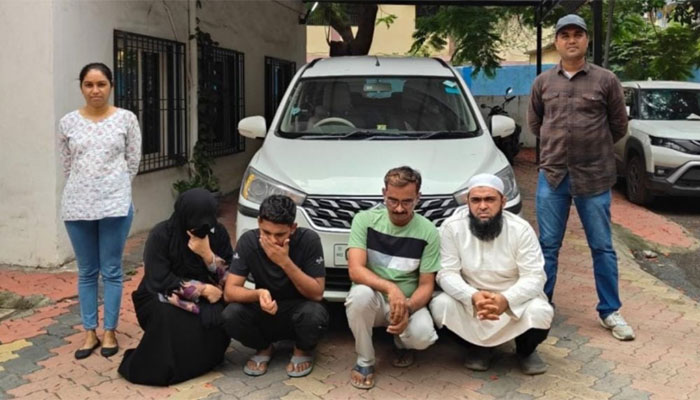
On Monday, 8th July, Surat Police’s Special Operation Group (SOG) busted a gang that smuggled gold worth Rs 7 crores from Dubai to India in 25 trips. The gang was being run by a Maulvi identified as Abdul Bemaat who has been arrested by the police. His three accomplices identified as Umaima Saleh, Naeem Salej and Feroz Ibrahim Noor, have also been arrested in the matter. During interrogation, Bemaat admitted that his gang smuggled 10 KG gold worth Rs 7 crores to Vadodara in 25 trips. The gold was delivered to to a jeweler named Faizal Memon in Vadodara.
The news of the Surat police SOG arresting a Molvi and a couple with 65 lakh rupees worth of gold from Dubai is concerning.
The revelation that they were adulterating the gold by adding chemicals and converting it into paste form for smuggling. pic.twitter.com/ykwgFznFuV
Reports suggest that Maulvi Bemaat was the mastermind of the gold smuggling gang. To save himself from authorities, he used a South African number to communicate with others via WhatsApp. The police examined his mobile phone and found out that he frequently contacted his contacts in Dubai and South Africa via calls and chats. The Gujarat ATS, Income Tax Department, and ED, have joined the investigation against the Maulvi. Police also recovered 30 passenger passports copied on his mobile. He traveled to Sharjah and Dubai ten times from Surat. Investigation revealed he smuggled gold from Sharjah.
Maulvi Bemaat is a migrant from Maharashtra. He had been smuggling gold for the past 2.5 years. Bemaat secured his passport in 2016. From 2003 to 2017, he worked in Jamiyar Islamia Madarsa in Akkalkuva in Maharashtra. After 2019, he worked at Chhatrapati Sambhajinagar-based Markaze Islami Madarsa. After the COVID-19 pandemic, he moved to Mosali with his wife and daughter.
As per the report, PI Ashok Chaudhary of Surat SOG received information about Bemaat’s operations. As per the information, his gang would sneak gold into India in travelling bags. The smugglers boarded the Dubai-Surat flight late on Saturday night and were supposed to deliver it to Shivam Hotel near Jahangirpura. Police set up a trap near the hotel and apprehended two of the accused in an Ertiga car and a couple from a Maruti Tours taxi. A rubbery layer was found between the resin and the bottom plastic of the bag made with gold paste.
Among the arrested accused in the case, Umaima and Naeem are husband and wife. Their job was to function as carriers. The police recovered gold worth Rs 64.89 lakh from them. The gang converted the gold into a paste and layered it in trolley bags. They used the special chemical Acorizia to prevent the detection of gold at the airport. Despite their efforts, Surat SOG managed to crack down on the gang.
— NewsCapital Gujarat (@NewsCapitalGJ) July 8, 2024
Upon testing with the help of experts, the gold was extracted and it was found to be 927 grams worth Rs 64.89 lakhs. The four accused were arrested on the spot. All the accused are natives of Mangrol, rural Surat. Maulvi, who is the mastermind of the gang, works in a madrasa on a monthly salary of Rs 6,500.
Maulvi was the sender as well as an investor in the smuggling of the gold. Feroz worked as a driver for the gang. All four accused were sent to four-day police custody. The Vadodara-based jeweller Faizal Memon who bought gold from the gang has been declared wanted in the matter. Additionally, the police have declared Maulvi’s relatives Sokhat and Shehzad who are residents of Johannesburg and Dubai as wanted in the case. The police believe that these two helped in smuggling gold from foreign countries to India. Further investigation into the matter is underway.
Meer Faisal, the self-proclaimed Muslim rights activist and supposed ‘journalist’ who regularly spreads fake news against Hindus, whose account had been previously withheld in India and who was quoted by ISIS to target Hindus, sent OpIndia a legal notice on the 2nd of July. The legal notice was against this article published by OpIndia where we wrote about the fake news peddled by Meer Faisal and the subsequent demonisation of Hindus. As soon as the legal notice was emailed, it found its way to media portals which zealously covered the contents of the legal notice. Since Meer Faisal has decided to go to the media with his legal notice, we believe it is only fair that our response is also published for the benefit of our readers.
Following is our response. The content of the legal notice is in italics, followed by our response to the accusations.
At the very outset of your notice, you have claimed that your client is a law-abiding and respectable citizen of India. We would like to reject that assertion basis the fact that the Government of India had withheld the X account of Meer Faisal because of the repeated sharing of fake news and supposedly disturbing the law and order situation with his fake news.
Following is the point-wise response to your legal notice.
1. That you the Noticee, have on various occasions published articles concerning my Client which are not only false, malicious, fabricated and far from truth but are also extremely defamatory in nature wherein such articles have portrayed him as a radical Islamist and anti-national having links with illegal and banned organizations. It was because of such articles being peddled by you the Noticee that the previous Twitter handle of my Client has been withheld in India.
We would like to place on record that our reports are factual and that we have not “linked him” with illegal and banned organizations. The illegal and banned organization – ISIS – associated itself with Meer Faisal because of his ‘stellar’ work as a ‘journalist’. We merely reported it. You should take this issue up with ISIS – not us.
2. The said article revolves around the story of a man who had shared a disturbing photo of an animal being allegedly slaughtered in a slaughterhouse on his WhatsApp status. After the said photo became viral on the internet, the man received immediate backlash and legal action as an FIR was registered against him. The said man, who ran a garment shop in Nahan, Himachal Pradesh was soon hounded by certain right-wing organizations and his shop was vandalized and looted by the public in full view of the police. It was later confirmed by the police that the animal in the said photo was a buffalo (permitted animal for slaughter) and not a cow (not a permitted animal for slaughter). You the Noticee have in your article alleged that my Client has skipped a material fact in his reporting that the animal was cow and the religious sentiments of hindus were offended by the image. It is worth mentioning that the police investigation has revealed that the image posted by the man was indeed that of a buffalo and not cow which proves that my Client had not misreported or omitted any material act while sharing the video but had in fact made a correct factual reporting of the situation. However, it is you the Noticee which seem to have been after my Client and want to weaken his credibility as a journalist for reasons best known to you. It is reiterated at the cost of repetition that my CIient has done correct reporting and the post on his Twitter Account where a video with the caption “ln Himachal, Hindutva mob attacked the Muslim man’s shop in front of the police, looting and vandalizing it after he shared a picture of an animal sacrifice on his WhatsApp status” was uploaded by my Client has been confirmed by Mr Abhishek, Superintendent of Police, Shamli District Uttar Pradesh
We thank you for confirming our report. In your notice, you mentioned that Meer Faisal in his reportage tweeted that a picture of “animal sacrifice” was uploaded on the accused’s WhatsApp status, leading to the “Hindutva mob” attacking the Muslim man’s shop.
In his tweet, Meer Faisal mentioned that the accused had shared an image of “Animal sacrifice” on his WhatsApp, because of which, a “Hindutva mob” attacked his shop. In this tweet itself, Meer Faisal purposely did not disclose that the Hindus believed the animal being slaughtered was a cow, because of which they vandalized his shop. Cow slaughter is banned in the state and the cow itself holds great religious significance to Hindus.
By terming it merely an image of “animal sacrifice” and the Hindus protesting as a “Hindutva mob”, Meer Faisal hid the material fact to give the impression that the Hindus who were protesting as purposefully and needlessly violent. He seems to have wanted to project that the outraged community was driven purely by their hatred for the accused, owing to his Muslim religious identity, instead of informing readers that the Hindus were outraged specifically because they believed the animal being sacrificed to be a cow.
Meer Faisal should have used a picture of the ‘alleged cow slaughter’. It is also noteworthy that animal slaughter is literally intrinsic to Bakrid and no Muslim has been beaten up for that, so the use of ‘animal slaughter’ instead of ‘alleged cow slaughter’ was meant to suggest that a Muslim was beaten up for practicing his religion rather than indulging in a banned act that Hindus deem provocative.
We, therefore, stand by our assertion that Meer Faisal withheld material facts of the case when he reported the incident with the intention of painting Hindus in a negative light, which is the essence of his entire “journalistic” career.
3. This clearly shows that you the Noticees have a personal vendetta with my Client because of which the above-mentioned article has been published and the contents of the article being absolutely false, fabricated, baseless, libellous and malicious and made deliberately to malign the reputation of my Client which my Client enjoys. Additionally, the article is a classic example of reckless and unethical journalism practiced bringing disrepute and ignominy on respectable persons be sensationalizing unverified reports. It appears that the same has been done with an intention to increase popularity of the website and other media presence of Oplndia.
As I said before, we reject the claim that Meer Faisal is a respectable person and/or has any credibility. Our intention was to talk about the manner in which material facts are hidden by Islamists to tarnish Hindus. We stand by it.
If you could have bothered to go into the niceties of the issue and had delved into the facts before publishing the Articles, it would have been amply clear that my Client has not done any false reporting or has been spreading any news that could be called radical Islamist in nature but is nothing more than responsible journalism. The contents of the article are in no manner a reflection of the true and correct facts of the situation as neither my Client has done any misleading reporting nor is he trying to spread hatred amongst religious communities.
I am not very sure what you mean by “bothered to go into the niceties of the issue”, however, we have already demonstrated how our assertions were correct. We stand by them.
As for Meer Faisal being an Islamist and attempting to spread religious hatred between communities I would like to submit the following:
Meer Faisal repeatedly spreads verifiably fake news against Hindus, in one of the incidents, calling a Hindu a ‘terrorist’ based on fake news. We stand by our assertion that he spreads religious hatred, especially when he terms all non-Muslims as Kafir. Further, an Islamist is someone who advocates increasing the influence of Islamic law in politics and society and supports Islamic fundamentalism. The fact that Meer Faisal has asserted that all non-Muslims are Kafirs is proof of the fact that he supports fundamentalism. Further, Meer Faisal should publicly declare that he does not believe in increasing the influence of Islamic law in politics and society, if he has a problem with the epithet.
4. Amongst the people who have visited the website and read the article, many have believed the contents of the article and have even shared it, causing immense hardships to my Client and has caused a threat to his life because of the careless journalism. The unfortunate and brazen part is that you have allowed/ did not restrict people from viewing and sharing the Articles and helping in reiterating the false, fabricated, baseless, libellous, and malicious content and tried to reinforce the idea being disseminated by the Articles.
We have published reports busting the religiously motivated fake news by your client. If he wishes to not be branded as a fake news peddling Islamist, he should stop peddling fake news and spreading religious hate against Hindus. We stand by our articles. Further, it is a rather unlettered expectation that we would STOP people from reading the articles that we have published on our portal. We will obviously not stop people from reading our articles and reinforce the facts we have published – that is how journalism works.
5. On account of your articles, my Client is being perceived as a fake journalist or anti-national having connection with illegal groups in the eyes of the general public and therefore, the articles need to be urgently taken off and at least a clarification in the shape of apology is warranted in the circumstances to salvage the reputation of my Client.
We stand by our articles and will not be issuing an apology. About your client being “perceived” as a fake journalist and anti-national – we would like to place on record that we believe that ‘perception’ is a result of his own actions and we believe that perception to be true.
We, therefore, reject the accusations leveled in the notice and believe we acted in good faith, presenting the truth in our reports.
Last week, several notorious Islamists and Muslim ‘journalists’ claimed that a Maulana in the Koderma district of Jharkhand was lynched by a Hindu mob as a retaliation for hitting a woman on the road. The deceased Shahabuddin was an Imam at Basramo Turkabad in the Barkatha area. Now it has been confirmed by the police investigation and the post-mortem report that Shahabuddin died due to a road accident, and there was no mob attack involved.
A report published in The Observer Postclaimed that Shahabuddin was beaten to death by a mob on 30th June when he was returning to his house on his bike near Ghuthari Kariya. The report claimed that Shahabuddin was attacked after his bike hit an auto in which a woman named Anita Devi was seated along with her husband and brother-in-law.
The report by Meer Faisal claimed that after the incident in which the woman was injured, her husband and brother-in-law gathered some residents and boys playing cricket nearby, who then assaulted the Imam with sticks and batons. It was soon claimed on social media that a Hindu mob lynched the Maulana due to his Muslim identity.
However, the Jharkhand Police had denied the claims, saying that the Maulana died due to a road accident. The police confirmed that the Maulana, who was rushed to the hospital after the accident, succumbed to his injuries on the way.
“The Imam received injuries due to the accident. There is no communal angle here. He was transported to the hospital in a police vehicle but succumbed to his injuries on the way. His body has been sent for a postmortem,” the police said.
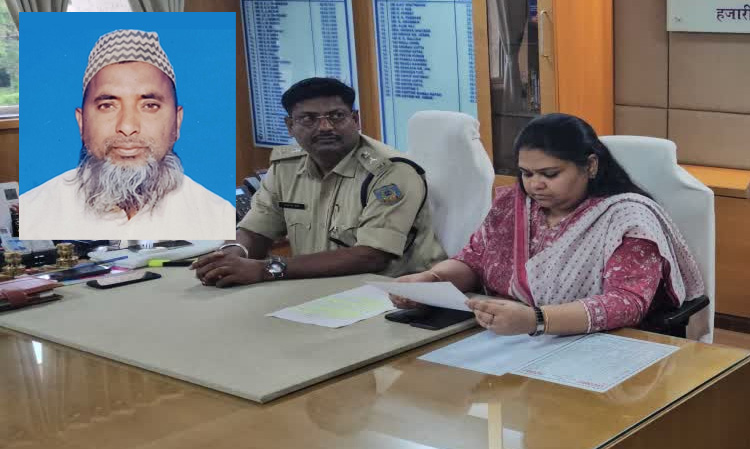
Now the postmortem report has confirmed the police version, that Shahabuddin was injured in a road accident, and he was not assaulted by any mob. Hazaribagh DC Nancy Sahay and SP Arvind Kumar Singh revealed the details of the report in a joint press conference on Wednesday.
They said that after the police investigation and post-mortem report, it became clear that Shahabuddin died in a road accident. DC Nancy Sahay said that on June 30, Sahabuddin was going from Basramon village of Barkattha to his home in Raghuniadih village of Koderma on his motorcycle. During this journey, he lost balance of the two-wheeler near Chutharikatiya road of Barkattha police station area at around 08:10 am.
Sahabuddin fell down and was severely injured, including suffering serious head injury. A woman named Anita Devi was also injured in this accident. He was taken to Barkattha Community Health Center for treatment by the police, but the doctors declared Sahabuddin dead.
The police wanted to take the woman also to the hospital for treatment, but she declined saying her injuries were minor and she will get treatment at home.
Notably, after the incident, the wife of deceased Sahabuddin had filed a complaint with the police claiming that there are video footage of the ‘mob attack’. But after police investigated the case, they didn’t receive any evidence to support the allegations.
Both the police investigation and the postmortem report have confirmed that Sahabuddin died due to road accident, and there is no evidence that he was lynched, the police said.
Notably, Meer Faisal who wrote the fake report is a known fake news peddler and he was quoted by ISIS in its magazine. In July 2023, ISIS had used several tweets posted by Faisal in its magazine Voice of Khurasan. For a long time, Meer Faisal has been spreading the propaganda of alleged attacks on Muslims by Hindus.
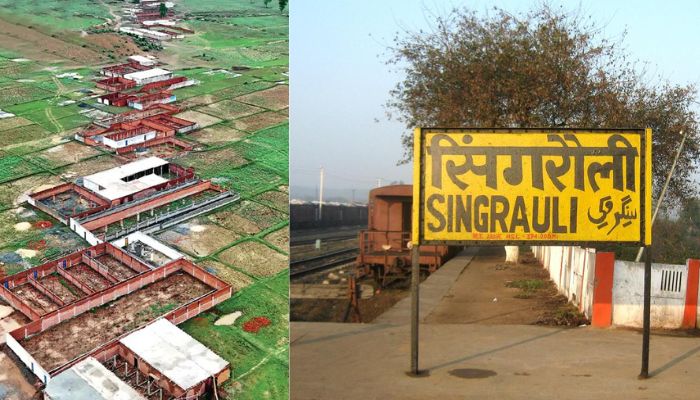
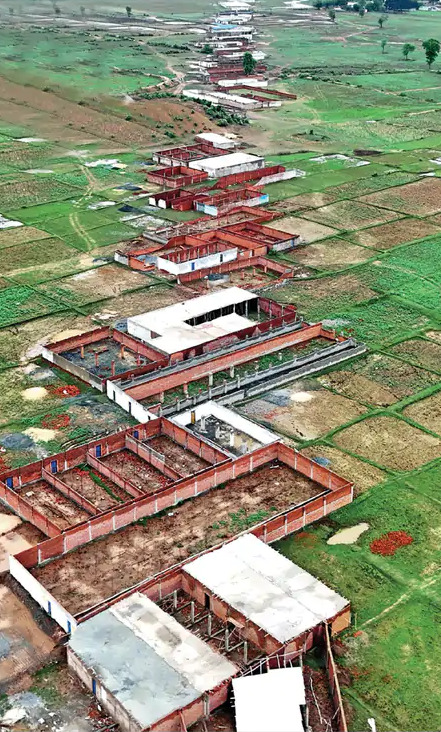
“India is not for beginners”, this is commonly said to boast the sometimes unique and otherwise absurd things Indians do. In one such incident in Madhya Pradesh, in just two months, nearly 3000 houses were constructed along the land area marked for acquisition for the construction of the Singrauli-Prayagraj Highway. These houses were allegedly constructed near the highway route by individuals aiming to siphon off compensation payouts when the government acquired the land for the project. This ‘fraud’ was orchestrated by land brokers in collusion with local officials.
Who built these houses on land where the highway project will pass?
While there are 2000 to 3000 houses constructed within a short span of time, these houses have been built by people from Uttar Pradesh, Chhattisgarh and Jharkhand. A Bhaskar report says that these non-MP residents have constructed 32 houses each with one sole motive—Muavza [compensation].
Source: Bhaskar
These “compensation houses” have 4-foot high brick boundary walls and tin sheds appearing to be “pucca” houses, however, no one resides here. The sole purpose of these houses is to satisfy the avaricious financial desires of the fraudsters involved. It is essential to note here that these plots are not owned by outsiders but by local poor farmers.
In March this year, a notification was issued by the authorities for land acquisition to construct 70 70-kilometre highway in Madhya Pradesh. Subsequently, the sale and purchase of land in the affected 33 villages of Chitrangi and Dudhmaniya tehsils in Singrauli was prohibited.
Notably, when a highway project is approved, the sale and purchase of land in the affected area are often prohibited to prevent speculation and inflated compensation claims. This process is governed by the Right to Fair Compensation and Transparency in Land Acquisition, Rehabilitation and Resettlement Act, 2013 (LARR Act, 2013). The Act ensures fair compensation and rehabilitation for those whose land is acquired for public purposes, including infrastructure projects like highways.
Under the LARR Act, once a notification for land acquisition is issued, the transfer of land in the affected area is restricted to prevent people from constructing buildings or making other improvements solely to increase the compensation amount. This measure is crucial to ensure that the compensation process remains fair and that government funds are not unduly exploited.
The 80:20 formula to grab compensation
Since there was a prohibition imposed on the transfer and registry of land in the landmarked during the survey, the land brokers made the local poor farmers who own these plots to sign a stamp paper which stated that if compensation is provided by the National Highway Authority of India (NHAI), then its 80% amount will go to the builder, while the remaining 20% will go to the land owner. The land brokers identified people from UP, Chhattisgarh and other states to become part of this ‘deal’.
In Badkudu village, locals told Bhaskar that the patwari has constructed houses by getting them in the name of his brother and other relatives. Interestingly, entering into the 80-20 formula-based agreement is beneficial for farmers in two ways. If the land plot is acquired by NHAI then the farmer will get compensation Meanwhile, when the stamp paper signatory constructs rooms on the farmer’s land then in that also the farmer will also get 20% money while the lion’s share will go to the builder. In simple words, this means that the farmer will get compensation for the acquired land and a separate compensation for the construction on it.
How land is acquired for highway construction projects
The National Highways Act, of 1956 allows the government to acquire land for the construction, development, and maintenance of national highways. Under this Act, compensation is determined based on the value of the land at the time of notification, and it includes any improvements made to the land.
For the purpose of land acquisition for any highway project, a notification is issued as per section 3a [Power to acquire land, etc] of the National Highway Act. “Where the Central Government is satisfied that for a public purpose any land is required for the building, maintenance, management or operation of a national highway or part thereof, it may, by notification in the Official Gazette, declare its intention to acquire such land,” it states.
Under section 3b [Power to enter for survey etc] of the NHA (1956), a competent official is appointed to conduct a survey of the land area in question. For this usually, the District Collector or SDM is appointed as the Competent Authority of Land Acquisition (CALA).
Under section 3c [Hearing of objections] of this Act, the findings of the SIA are discussed in a public hearing, allowing affected individuals to voice their concerns/objections.
Under section 3d, the Central government makes an official declaration regarding the land acquisition Section 3e of this Act allows the Central government to take possession of the land in question for the designated purpose. Section 3g lays rules for the determination of the compensation amount the Central government will pay to the owners of the acquired land.
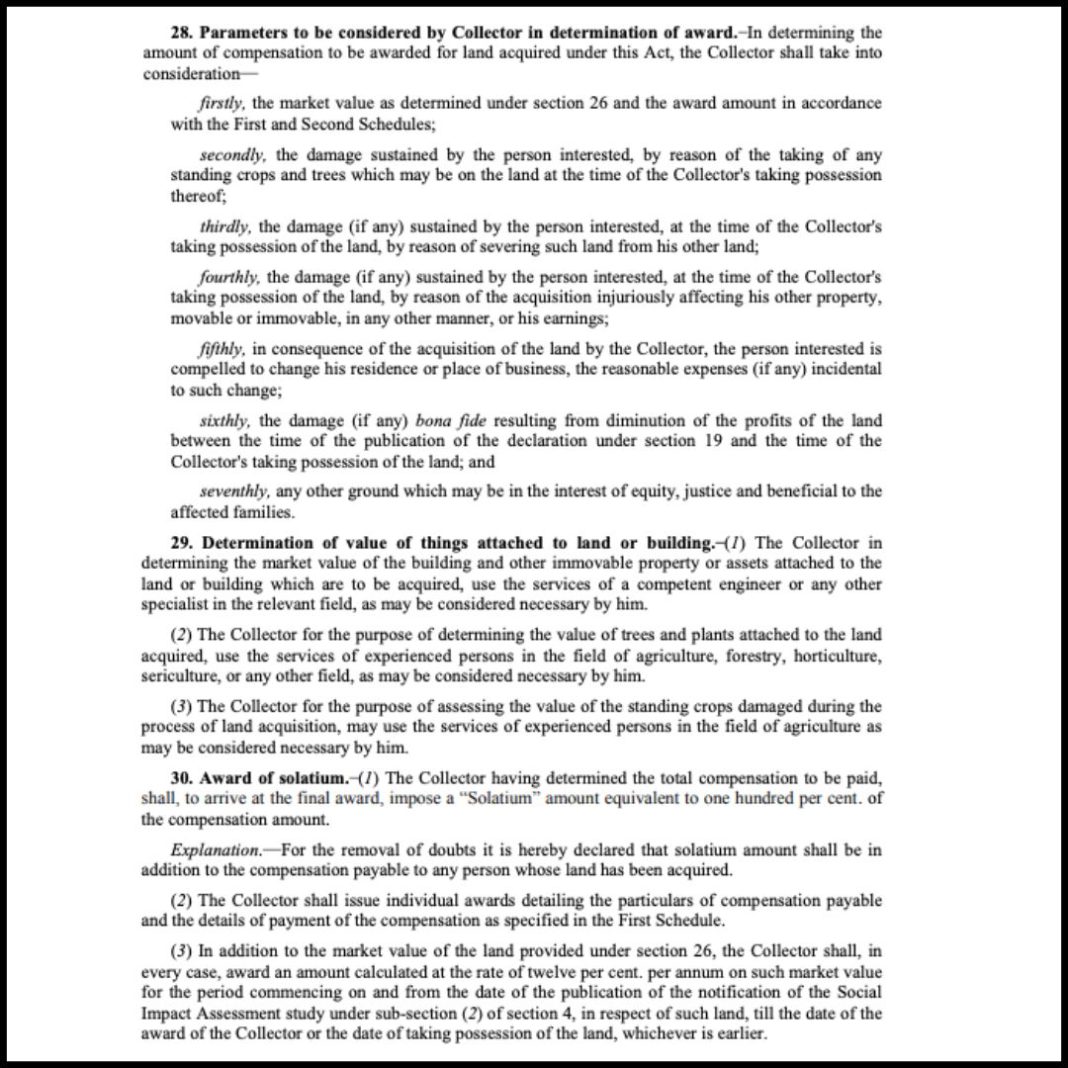
As stated by Union Road and Transport Minister Nitin Gadkari in August last year, while land acquisition for highway projects is done under NHA 1956, the compensation of land is decided as per the provisions of the Right to Fair Compensation and Transparency in Land Acquisition, Rehabilitation and Resettlement Act, 2013 or simply LARR Act 2013, which is 2 to 4 times of the determined market value of the land.
Notably, the compensation is calculated based on market value, including a solatium (an additional amount) of 100% of the market value for rural areas and 50% for urban areas. This compensation amount is usually paid directly to the landowners through bank transfers to ensure transparency and prevent fraud.
Parameters to be considered by the Collector while determining compensation as per LARR Act 2013
Compensation racket operating in collusion with Revenue officials
Since there was a ban on the sale and purchase of land in the affected area after NHAI’s survey, if houses were suddenly constructed in one to two months, it is clear that some government officials are involved in this fraud. If houses have been built after the land survey, then it is not possible without the connivance of the revenue department officials since compensation is decided on the basis of the report submitted by the SDM.
Notably, while houses may be constructed recently, if the village patwari has mentioned in the official record that the house was built a few years ago, then the NHAI will be bound to give compensation to the land owner as per the rules. It is pertinent to note that once the land acquisition notification is issued under NHA section 3A, the land use in the affected area cannot be changed. This means that if a land patch was farmland before the 3A notification, then it cannot be used for residential or commercial purposes.
The NHAI has received several complaints regarding this alleged fraud. PWD’s Executive Engineer Shankar Lal has confirmed this and said that necessary action will be taken. Meanwhile, Chitrangi SDM Suresh Jadhav has said that only those houses which were built before the 3A notification will get compensation. He added that the authorities will investigate as to which houses were constructed after the issuance of land acquisition notification and for this, satellite map will also be checked.
Sidhi Singrauli Railway Land Scam
It is interesting to note that a similar fraud was uncovered by the Ministry of Railways last year in the 541-kilometre Lalitpur–Singrauli railway track construction project worth Rs 6672 crore. In this case, several fake landowners siphoned off heavy compensation for the land acquired by the Railways. Investigations reveal that inflated compensation amounts were granted based on fabricated land records. Much like it is emerging in the above-discussed highway case, in this case as well, some revenue officials worked in collusion with the fraudsters. Similar frauds have been reported in Singrauli for NHAI’s road construction and widening projects as well.
People deliberately constructing houses near the Singrauli-Prayagraj highway project to exploit compensation payouts, is both alarming and deeply troubling. This brazen act of fraud, allegedly carried out by individuals in collusion with corrupt government officials raises eyebrows. Such acts of deceit exploit the very mechanisms designed to ensure fair compensation and rehabilitation for those genuinely affected by land acquisition projects. It diverts crucial resources away from their intended purpose and slows down the progress of essential infrastructure developments. The fraudulent actions erode the trust between the government and its citizens, making it more difficult to implement future projects effectively.
Two days after three paramilitary Frontier Corps personnel in Pakistan’s Tank district in Khyber Pakhtunkhwa province were kidnapped by unidentified militants, the dead bodies of two of them have been recovered. On 9th July, it was reported that three Pakistani military and police personnel were abducted by suspected Tehreek-e-Taliban Pakistan (TTP) militants from a checkpoint in the Tank district.
Now, two bodies have been recovered from Shaheed Murid Akbar area of Kadi Hyder in Tank. The two victims are identified as Constable Habib Khan, a resident of Tank district, and Frontier Corps employee Inamullah from Benti in Kadi Marwati, Tank.
These soldiers were driving from the Sor Qamar FC post to Tank Bazar when militants stopped them at a checkpoint between Kot Azam and Kot Qila. The militants abducted the three personnel and turned over their ATM and identification documents to the civilian driver, whose car they had hired.
In a shocking turn of events, around ten military personnel including a captain and two police personnel including an inspector CTD have reportedly been killed in the last 48 hours.
Dead bodies of military and police personnel who were abducted by terrorists from a checkpoint in Tank district have been recovered. 10 military personnel including a captain and 2 police personnel including an inspector CTD have been killed in 48 hours. Alarming attrition.… https://t.co/GHXQyh9906
On Wednesday, the Pakistan Army and counterterrorism police killed three militants in a joint operation in Khyber Pakhtunkhwa.
The clashes broke out during an intelligence-based operation in the Hassan Khel area of Peshawar. During the exchange of fire, two Pakistan Army personnel, including a captain, as well as several officers from the Counter Terrorism Department were killed. In a statement, Pakistan’s Inter Service Public Relations (ISPR) said that four security personnel were slain during the conflict.
So far this month, 14 Pakistani security personnel, nine militants, and eight civilians have been killed.
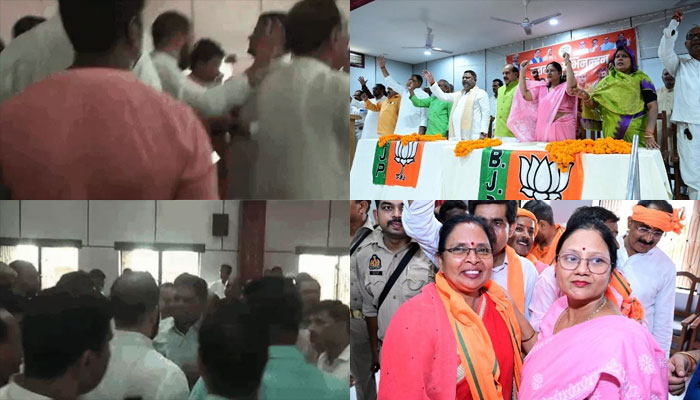
On Tuesday, 9th July, Bharatiya Janata Party (BJP) workers disrupted a party event in Deoria and accused State Minister for Rural Development, Vijay Lakshmi Gautam, of favouring the Samajwadi Party. The workers accused Minister Gautam of being an agent of the Samajwadi Party.
The events unfolded at the event organised by the party at Rainath Brahma College in Salempur, Uttar Pradesh, to honour the local party workers. Gautam was invited as the chief guest to celebrate the party workers. However, she faced significant opposition from the workers themselves who refused to accept honours from her.
Accusing Gautam of undermining BJP’s efforts in the recent elections, party workers shouted slogans against her. District Party President Bhupendra Singh and senior party workers tried to calm the workers down but to no avail. Several party workers boycotted the event and some of them threw away the ceremonial scarves presented to them.
The incident brought forward the deeper dissatisfaction within the BJP ranks that stemmed from a review of the performance of the BJP in the Lok Sabha Elections 2024. Notably, Uttar Pradesh fell short of the expectations of the supporters in terms of seats. Following the elections, BJP leadership planned to honour workers who worked tirelessly in their respective constituencies to boost morale. However, the event in Deoria backfired as workers did not hold back while expressing their grievances and blamed Gautam for the setbacks the party faced during the elections.
Following the event, senior BJP leaders expressed their dismay over the organisation of the event. Arun Kumar Singh criticised the event and called it a provocation rather than an honour ceremony. He said that when the party suffered losses, what was the logic of celebrating.
There were around 200 workers who attended the event and around 60 of them led the protests. The absence of key figures such as District Panchayat President Girish Tiwari, former MP Ravinder Kushwaha, and MLC Dr Ratan Pal Singh further fueled the discontent and speculations.
Despite the chaos, district president Bhupendra Singh assured that efforts were underway to address the grievances of the workers. He assured that in the upcoming membership drive in July, the party will identify and address disruptive elements within the party.
Notably, though Gautam started her career with the BJP, she shifted to the Samajwadi Party in 2017 when the BJP did not give her a ticket and contested Assembly Elections on an SP ticket. However, she was defeated by BJP’s Kali Prasad. In 2022, she again joined the BJP and contested the election from Salempur. Gautam won the Assembly Elections in 2022 as Yogi Adityanath returned to power for the second time.
During the Lok Sabha elections, an audio of Vijay Lakshmi Gautam criticising Uttar Pradesh CM Yogi Adityanath had also gone viral. In the audio, she was blaming the CM of ignoring her and concentrating only on Gorakhpur. However, later, she claimed that the audio is generated using Artificial Intelligence.
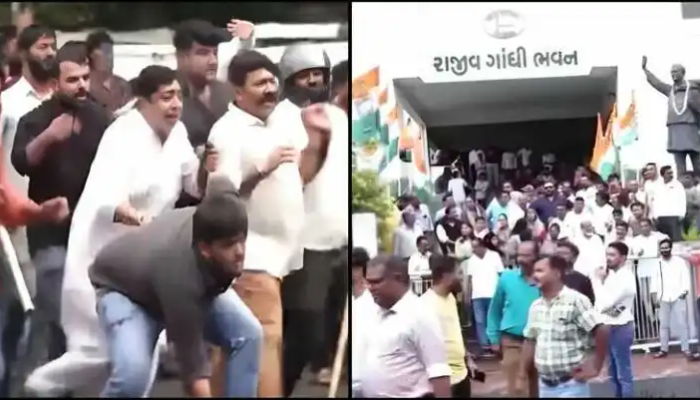
Five Congress workers who were charged with stone-pelting and rioting on 2nd July were denied bail on 11th July by an Ahmedabad city court. The attack followed altercations between Congressmen and members of the Bharatiya Janata Party (BJP) over “anti-Hindu remarks” made by the Leader of the Opposition in the Lok Sabha, Rahul Gandhi during a speech in Parliament.
Two First Information Reports (FIRs) were filed against the accused in Ahmedabad city based on two complaints, one from the chief of the Bharatiya Janata Yuva Morcha (BJYM) and the other from a policeman.
The authorities apprehended Harsh Ishwarbhai Parmar (23), Vimalbhai Pansara (50), Manish Thakor (47), Sanjay Barot (57) and Mukeshbhai Datania (68) after Karmaraj Bhagvatsinh, constable of Paldi Police Station who had endured injuries in the assault submitted a complaint and an FIR was launched. Karmaraj Bhagvatsinh filed a formal complaint charging that Congress leaders Shehzadkhan Pathan, who holds the position of Leader of Opposition in Ahmedabad Municipal Corporation and Pragatiben Nandaniya, along with “around 200-250 Congress workers” and “a mob of 150-200 BJP persons” were involved in rioting and stone-pelting, among other offences under the Bharatiya Nyaya Sanhita (BNS).
After reviewing the photos and CCTV footage of the event, Sessions Judge Jayeshkumar Ishvarlal Patel noted that it was a “clear case of assault on a public servant” and a “clear case of attack on police machinery” while denying bail to the five defendants. The court further observed that the wounded person received at least eight sutures in his skull. A few “accused may be associated with a party but they cannot be permitted to take law and order into their hands and neither is there such a provision in law,” Sessions Judge Patel added in the judgment.
The Gandhi scion claimed “Hindus are violent” in parliament which led to a massive row in the country. Ahmedabad BJP also organised a protest following a large-scale agitation by Bajrang Dal activists near the Gujarat Congress headquarters in Ahmedabad on 1st July. An altercation transpired between the two sides and Congress workers reportedly started stone-pelting at them when they were 300–400 meters away from the party’s office. They unveiled that some of the BJP workers were taken to LG Hospital, Ahmedabad for medical care after suffering injuries. Acid and alcohol bottles, sticks and stones were thrown at them from the Congress office.
OpIndia had talked to Ahmedabad Bhartiya Janta Yuva Morcha (BJYM) president Vinay Desai following the incident who disclosed, “BJP Yuva Morcha workers staged a protest a short distance from the Congress office with placards, in response to Rahul Gandhi’s anti-Hindu comments. However, our people were attacked. Congress leaders, workers and goons called by them attacked our workers with stones, glass bottles, sticks and sharp weapons when our workers were standing. They came in a crowd, smashed the police-erected barricades and attacked the group wounding several of our workers. Five of them had to be transported to a hospital for treatment due to their critical condition. The cops who were present on the spot were also injured. BJYM workers were demonstrating in a peaceful and democratic manner. We have submitted a complaint against Shaileshbhai Parmar, Shahzad Pathan and others.”
“Workers from the BJP Yuva Morcha had gone to the Congress office to peacefully protest Rahul Gandhi’s remarks that were disparaging to Hindus. All they had with them were placards. However, Congress officials and workers threw stones, liquor bottles and acid bottles at them. Five of our workers were seriously injured in this attack and were immediately admitted to Sardar Vallabhbhai Patel Institute of Medical Sciences and Research (SVP) Hospital for treatment,” revealed Ahmedabad City BJP president Amit Shah.
The main accused in the Worli hit-and-run case, Mihir Shah had consumed an excessive amount of alcohol at two different places on the night of the incident, said Mumbai police sources on Thursday.
According to the Mumbai police, “During the investigation, it was found that the arrested accused Mihir Shah consumed alcohol before the incident. He consumed alcohol at two different places on the night of the incident.”
“The probe revealed that after drinking alcohol at Vice Global Tapas Bar located in the Juhu area, accused Mihir Shah drank alcohol at another place between Malad and Borivali,” the police said.
“The interrogation with Rajrishi Rajendra Singh Bidawat, accused driver, also revealed that these people had come to visit Marine Drive since the day of the incident fell on a Sunday,” said police.
Police said that the accused driver Rajrishi Rajendra Singh had taken the car from Borivali to Marine Drive, but once they reached there, Mihir had forcefully taken the car keys from the driver to drive the car near Girgaon Chowpatty.
Meanwhile, earlier in the day both accused in the Worli hit-and-run case reportedly confessed to their roles in the crime and are in the custody of the Mumbai police.
According to Police sources, the main accused, Mihir Shah and his driver Rajrishi Bidawat, were both confronted by the police during interrogation.
“Both accused confessed their roles in the crime and the police did a scene recreation from the night of the accident. With a similar sequence to the actual accident night, the scene was recreated from CJ House Worli to Sea Link Worli,” said police.
Earlier on Wednesday, a Mumbai court sent Mihir Shah to police custody until July 16.
Mihir Shah was arrested in Virar on Tuesday. He was brought to Sewri court in Mumbai on Wednesday. Shah had been absconding after the car he was allegedly driving hit a scooter on Dr Annie Besant Road in Worli on Sunday, July 7.
Fourteen teams were formed by Mumbai police to nab him. Police arrested Rajrishi Singh Bidawat and Mihir’s father, Rajesh Shah, for their alleged involvement in the case.
Following the tragic incident, the deceased woman’s husband, Pradeep Nakhwa, questioned the delay in the arrest of the accused and alleged that he dragged his wife from Ceejay House to Sea Link Road.
“It was due to ‘politics’ and the accused would not be arrested until the Vidhan Sabha session ends,” Nakhwa had claimed. He also alleged that the delay in the arrest was because the accused was the son of a political leader.
According to Mumbai police, the 45-year-old victim was a resident of Worli Koliwada. Her husband was riding the scooter while she was riding the pillion. The husband also sustained injuries in the incident.
“The couple was returning home after buying fish when the scooter they were riding on was hit by the luxury car. Both of them sustained injuries, and the woman died during treatment,” police added. Police also said that the luxury car belonged to a leader of a political party based in Maharashtra’s Palghar.
The incident in Worli follows less than two months after the Pune case in which a luxury car allegedly driven by a 17-year-old youth, who was allegedly under the influence of alcohol, rammed into a motorcycle, resulting in the deaths of two software engineers in Pune’s Kalyani Nagar area in the early hours of May 19.
Maharashtra Chief Minister Eknath Shinde expressed his “alarm” at the “rise in hit-and-run incidents” in the state and said that he has directed the police to take strict action against such cases, adding that the “guilty will not be spared.”
The Shiv Sena also removed Rajesh Shah, the father of the accused, from the party following his arrest.
(This news report is published from a syndicated feed. Except for the headline, the content has not been written or edited by OpIndia staff)