

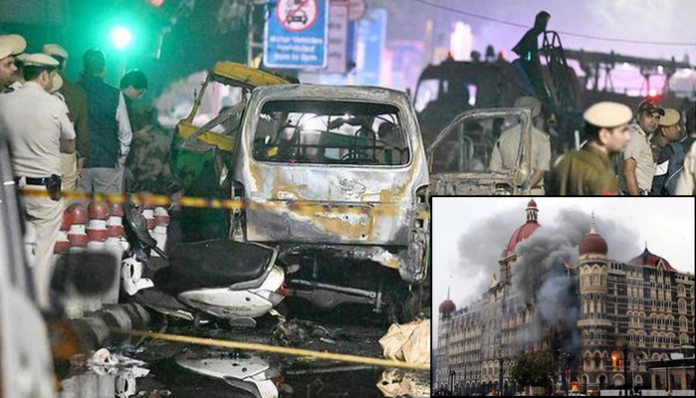
Investigation into the Red Fort terrorist attack in Delhi on 10th November, which left 13 dead and several injured, has revealed that the terrorists were planning to carry out a series of attacks similar to the 26/11 terrorist attacks in Mumbai. As per reports, the terrorists had planned to target top landmarks in the national capital, including Red Fort, India Gate, Constitution Club, and the Gauri Shankar Temple. Railway stations and shopping malls were also on the hit list of the terrorists.
The conspiracy to carry out terrorist attacks in the heart of Delhi has reportedly been underway since January this year. The Jaish-e-Mohammed and Ansar Ghazwat-ul-Hind (AGH)-linked terror module behind the Red Fort blast had been conspiring to plant 200 highly potent Improvised Explosive Devices (IEDs) in high-profile and busy places in Delhi, Gurugram and Faridabad. It is reported that terrorists also wanted to stir communal tensions by attacking religious sites.
An examination of the data retrieved from the mobile phone of Dr Muzammil Ganaie, one of the accused in the terror module, reportedly revealed that he conducted multiple recce of the Red Fort area in January this year. He conducted the recces with Dr Umar Nabi, an assistant professor at Al-Falah University, who was driving the car that exploded at the Red Fort. Their visits to the area were confirmed through their location data and CCTV footage of nearby areas. Authorities believe that the recces were part of a larger conspiracy to attack the Red Fort on Republic Day, but the plan could not be executed due to intensified security.
In an investigation initiated by the J&K Police, eight terror suspects, including three doctors, have been arrested. The accused were linked to an inter-state terror module, which was being controlled from across the border. The police seized a huge cache of arms, ammunition and around 2900 kg of explosives from different locations during the investigation into the terror module. The handlers of the terror module reportedly chose ‘doctors’ to execute the attacks to give a “white collar” cover to their malicious plans. The terror module was busted by the J&K police, in a joint operation with the Haryana Police, hours before the explosion at the Red Fort.
The 26/11 Mumbai terrorist attacks
On November 26, 2008, Mumbai was shaken by a series of terrorist attacks which broke out at 12 locations simultaneously, including the iconic Taj Mahal Hotel, the Oberoi Trident Hotel, the Chhatrapati Shivaji Maharaj Terminus, and Leopold Hospital. The attacks carried out by Pakistani terrorists linked to Pakistan-backed Lashkar-e-Taiba, brought the entire city to a halt by holding hostages, many of them foreign nationals, as the ghastly scenes were telecast live in our living rooms. 175 people (including 9 terrorists) died in the terror attack and over 300 people were left injured.
