Aditya Dhar’s spy thrillers, Dhurandhar 1 and 2, inspired by the actual gangs of Karachi’s oldest neighbourhood, Lyari, and the story of an Indian agent who infiltrated these syndicates to tear down terror networks in Pakistan, captured the imagination of the Indian audiences. The series turned out to be an unexpected blockbuster as the characters were immortalised on the silver screen.
A few weeks later, National Investigation Agency (NIA) teams executing raids at various sites across West Bengal and Kolkata arrived at Gulshan Colony, the state’s very own Lyari, which, unbeknownst to many, has established itself as a hotspot for crime, Bangladeshi and Rohingya infiltrators, violent occurrences and similarly notorious developments.
Holy moly: NIA Team reaches infamous Gulshan Colony. https://t.co/Zbi9NRNgW0
— Sougat Chakraborty (@sougat18) April 28, 2026
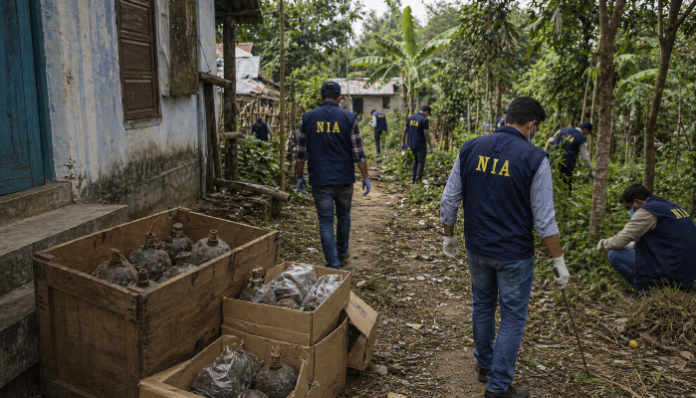
The anti-terror agency dispatched numerous personnel prior to the second phase of voting as a preventive step to ensure a peaceful electoral process and a swift response to any potential challenges in Bengal. The teams have been stationed in districts such as Purba Bardhaman, South 24 Parganas, Hooghly, Nadia, Howrah and Kolkata. According to officials, they are decisively looking into the matters pertaining to the confiscation of crude bombs, illicit weapons and ammunition.
They informed, “The agency has intensified its presence as part of precautionary measures to ensure a peaceful electoral process. The NIA teams are stationed on the ground to enable swift response to any untoward situation that may arise before, during, or after polling.” They stated that the move is intended to uphold law and order and avert any possible disruption associated with the capture of explosives or illicit firearms in sensitive regions.
NIA took over the case involving the recovery of crude bombs on 26th April and began its inquiry with a terror angle, following the registration of a fresh First Information Report (FIR) after directives from the Ministry of Home Affairs (MHA), owing to the severity of the incident, the probable impact on national security and the need to unearth a larger conspiracy.
The Kolkata police discovered 79 homemade explosives and other incriminating materials that were being stockpiled at a place, posing a threat to property and human life, along with the intent to instil fear and panic among the people. The matter was first reported on 25th April at the Uttar Kashipur Police Station of Kolkata’s Bhangar division.
The official complaint was submitted in compliance with the applicable sections of the Explosive Substances Act of 1908 and the Bharatiya Nyaya Sanhita (BNS) after reliable details regarding the storage of crude explosives and the components used to prepare them were received.
The authorities responded to the tip-off and recovered 9 spherical objects that seemed to be homemade bombs, tied with jute ropes alongside other evidence. These were stored by unidentified individuals in an abandoned home near a burial ground in Majherhat (Poilepara) hamlet, Uttar Kashipur police station in South 24 Parganas, which is an All-India Trinamool Congress stronghold.
The incident has, yet again, drawn attention to the Muslim-dominated Gulshan Colony, under ward number 10 of Panchannagram, is already known for its alarming activities and anti-social elements.
SIR highlighted a massive voter discrepancy in Gulshan Colony
Last November, the colony made headlines during the Special Intensive Revision (SIR) in the state. The Booth Level Officers (BLOs) who went there were surprised to find that they could not identify eligible voters among a population of about 200,000. According to reports, nearly 90% of the inhabitants were outsiders and stayed in the vicinity for many years.
They were not registered voters and were originally from Bangladesh, but asserted to hold Voter ID cards. The overall count of authorised voters at the booth was just 2,500 to 3,000. It was also outlined by Bharatiya Janata Party (BJP) leader Amit Malviya.
The mystery of Kolkata’s Gulshan colony!
— Amit Malviya (@amitmalviya) November 10, 2025
A colony that mushroomed overnight claims to have nearly 2 lakh residents, but when BLOs went for verification, they could trace only 20,000 voters. Where are the rest?
Mamata Banerjee and the TMC fear the Statewide Integrated Revision… pic.twitter.com/GHkR5JAlgz
The formation and expansion of the colony commenced with the rise of the TMC to power in 2011, and hundreds of buildings were constructed within a few months. There are allegations that the Kolkata Municipal Corporation does not possess any official records of the locality. Locals, who lived there before it was created, charged that Bangladeshis were settled in the area with the support of leaders from the ruling party.
Senior BJP leader Suvendu Adhikari also accused that intruders had been staying there for an extended period and only evacuated due to the execution of the SIR initiative. “If they are Indians, then why are their names not there in the voter list. If a fake identity card is created, then can anyone be called Indian? How was Gulshan Colony created? Who provided electrification there? Who provided water there,” questioned Samik Bhattacharya, president of the party’s state unit.
Union Minister Dr Sukanta Majumdar flagged the “noticeable demographic change in 13 years” in 2024, posting, “This area has become a hub for illegal Bangladeshi infiltrators and Rohingyas, fostering crime and lawlessness.”
Gulshan Colony in Kasba has undergone noticeable demographic changes over the last 13 years. This area has become a hub for illegal Bangladeshi infiltrators and Rohingyas, fostering crime and lawlessness.
— Dr. Sukanta Majumdar (@DrSukantaBJP) November 22, 2024
As Kolkata Mayor Firhad Hakim once remarked about a "mini Pakistan" in… pic.twitter.com/TaAn0zIRZw
“As Kolkata Mayor Firhad Hakim once remarked about a mini-Pakistan in Kolkata, it seems a mini-Bangladesh has now emerged,” Majumdar added, accusing TMC councillors of offering fictitious Aadhaar cards and voter IDs. “Is the Trinamool government truly unaware of the illegal constructions, encroachments and rising criminal activities here,” he asked and demanded answers.
It is evident that Bangladeshi and Rohingya infiltrators have systematically occupied the colony, despite the contrary arguments of the TMC.
Gulshan Colony: The growing trouble zone
The colony has been described as a haven for offenders, and many terrorists have even been nabbed from there. Bar fights, shootings, stabbings in broad daylight, Bangladeshi hideouts and such events are persistent features of the colony.
An official of Kolkata police expressed, “Over the years, Gulshan Colony has become a den of criminal activities and a safe haven for criminals, several of whom come from outside the state as well as from outside the country. The dingy lanes and bylanes and closely connected buildings also allow criminals to flee and hide even during surprise raids. We have built a dedicated strong network in the area, but we have to admit, even then, it becomes difficult to prevent crimes at times,” reported The Times of India.
The illustrations of gang wars, which are more appropriate for the fictional world of Cinema rather than real life, often manifest on its streets. The same unfolded in September of 2025 after which Mohammad Nafis, Mohammad Sajid, Ahmed Hossain alias Mohammad Madhu, Raja Khan and Mohammad Firoz alias Mini Firoz were arrested as they were seen “vandalising bikes, assaulting shop owners and hurling crude country-made bombs,” adjacent to the EM Bypass of the Ananadpur police station area.
Gulshan Colony—Kolkata’s most notorious hotspot of lawlessness. Bike borne criminals open fire as terrified residents flee in fear. We heard of this from 90s Bihar. Worry much how SIR would happen here, police themselves avoid this area, sending ECI officials would be deadly https://t.co/jJWd2owM5L pic.twitter.com/HIoqhcvmO4
— Sudhanidhi Bandyopadhyay (@SudhanidhiB) September 13, 2025
A confrontation between two local syndicates had led to the unrest, which “aimed to establish Firoz’s dominance in the area” and terrified the locals. He also enjoyed political clout and was eventually caught in Delhi after a 10-day search. Police suspected collaboration from groups within the Trinamool Congress. Locals conveyed that disagreement over ownership of a factory was the trigger, and a retaliation took place when a gang tried to threaten the proprietor.
A few months before this, a building material supplier was brutally killed with a chopper on a busy road near his house in the colony. The assailant lived in the same neighbourhood as well. Furthermore, Kasba councillor Sushanta Kumar Ghosh mentioned, “It’s a difficult place to manage. Since the Left regime, the place has been a hub of illegal construction. Multiple water bodies have been filled up, and illegal buildings have been constructed here. I have tried to stop them, but it’s a big racket, and thus I think I was attacked,” while talking to the media house.
His home is also in Gulshan Colony, and he was targeted after a plan was hatched by Mohammad Afroz (Gulzar Khan per other reports), who confessed to the murder attempt, which stemmed from a land conflict there. Severe altercations involving properties occur frequently, and violent instances transpire almost every week. People in the surrounding territories face similar dread, avoid parking their vehicles outdoors and abstain from strolling on the road late at night.
Conclusion
Gulshan Colony has been in the spotlight for all the wrong reasons, and although it may closely resemble Luyari, the gang members are illegal immigrants, unlike those in Pakistan. Additionally, the SIR exercise raised another critical inquiry: if there are barely any legitimate voters in the colony, then were Bangladeshis and Rohingyas participating in the democratic process to choose a government for the citizens of the state?
With TMC’s track record and the dismissal of 9.1 million bogus voters during the drive, this is much more plausible than improbable. On the other hand, the authorities do not intervene strongly due to the political influence and the daunting network of these criminals, which is apparently supported by the party in power in the state.
The situation is so bleak that even people from nearby areas are scared for their lives and safety, as guns and weapons are brandished, and shootouts are carried out with impunity, leaving vulnerable citizens in shock. Thus, it is hardly astonishing that the latest NIA investigation is also concentrated on the area, as these dreaded intruders and perpetrators can jeopardise national peace and security, much like they did to the state.