

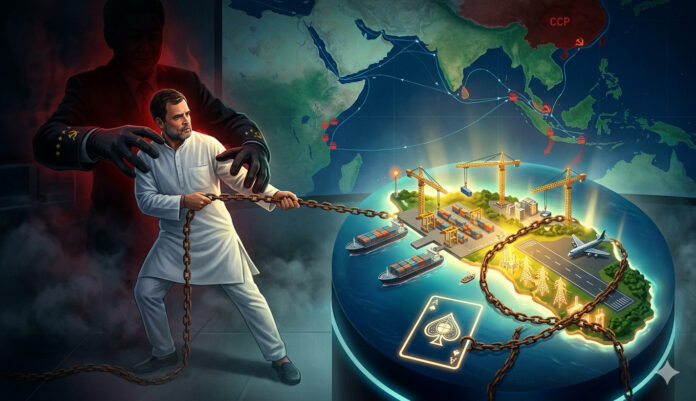
A 2003 internal speech by then-President Hu Jintao warned his leadership of what he called the ‘Malacca Dilemma‘, China’s existential reliance on a waterway it does not control and cannot easily avoid, somewhere in the Chinese Communist Party archives.
That problem has continued to grow worse over the past 20 years. As of 2025, more than 80% of China’s oil imports, which are valued at about $312 billion a year, come through the Strait of Malacca, which is only 2.8 km wide at its narrowest point. Approximately $3.5 trillion in global business, or two-thirds of all Chinese marine traffic, travels through these waterways annually. Every day, China uses more than 15 million barrels of oil. Just 3.7 million are transported by its overland pipelines. The maths is harsh. Beijing’s economic engine is based on a bottleneck that it fears and cannot fix.
Now think about India’s position. Geostrategically speaking, the Andaman and Nicobar Islands, a 700+ kilometre stretch that spans the entrance to the Malacca Strait, are a natural aircraft carrier that India was gifted by geography. Great Nicobar, the southernmost island in this series, is nearly equidistant from Singapore, Port Klang, and Colombo. One of the main routes used by ships to enter and exit the strait is the Six Degree Channel, which it overlooks. The waterways around these islands are used for 60% of China’s entire trade. Control of the route is a strategic trump card in any significant battle with China, rather than a negotiation chip. India is finally realising it and moving ahead to use its geographical blessing. And a segment of its own political class is attempting to prevent this.
What the great Nicobar project actually is
The Great Nicobar Island Development Project, devised by NITI Aayog and approved by the Union Cabinet in 2021, aims to make the island one of India’s most important commercial and strategic hubs. There are four main parts to the project, which are expected to cost around ₹81,000 crore (almost $10 billion).
Built on a naturally occurring deep harbour of 18 to 20 meters, the transhipment port in Galathea Bay aims to have a capacity of 4 million TEUs by 2028 and 16 million TEUs by 2058. This would challenge Singapore’s capacity close to the mouth of the strait, which China is most afraid of. An international greenfield airport that can accommodate wide-body aircraft and has a 3,300-meter runway. A 450 MW solar and gas-powered power plant. The Andaman and Nicobar tri-service command will be upgraded into a frontline strategic arm with these dual-use military and civil facilities.
Economic security is national security. Currently, ~75% of India’s transshipped cargo is handled by foreign ports like Colombo and Singapore. The Galathea Bay ICTP aims to internalize this trade, securing supply chains and reclaiming strategic economic leverage.
— Netram Defence Review (@NetramDefence) April 29, 2026
5/9 pic.twitter.com/OnMixAo1yK
A crucial economic problem is addressed by the port alone. Around 40% of India’s transhipment business is handled by Colombo, and 25% of the country’s cargo is currently transshipped through foreign ports. Every container that travels through Colombo rather than an Indian port costs India money and geopolitical advantage. Galathea Bay would put an end to such reliance and secure India’s place at one of the busiest maritime crossroads in the world. This is India’s counter to China’s ‘String of Pearls’ not through confrontation, but by creating hubs of connectivity and commerce,” stated maritime historian Nick Collins.
The string of pearls and India’s answer
Defence strategists refer to the network of military and commercial port facilities that China has meticulously constructed over the past 20 years as the ‘String of Pearls,’ which stretches from the South China Sea to the Indian Ocean to the Horn of Africa. Although the phrase was originally used in a Booz Allen Hamilton report for the US Department of Defence in 2005, the strategy it refers to has only become more complex since then.
The pearls are well known. Gwadar Port in Pakistan, which is located close to the Strait of Hormuz and serves as China’s western anchor for energy security; Hambantota in Sri Lanka, which was leased to China for 99 years after Colombo was unable to pay its debts, Kyaukphyu in Myanmar, which has pipelines that go straight into Yunnan, and Coco Islands in Myanmar, which is strategically placed to monitor India’s Andaman naval installations. Additionally, China has established military structures in the Maldives and has a permanent military base in Djibouti. Containment is the ring’s obvious purpose. China wants to be able to keep an eye on Indian naval activities, project strength into the Indian Ocean, and, most importantly, safeguard its own supply lines that depend on Malacca by gaining influence around every chokepoint before India does.
India has responded with what observers now refer to as the ‘Necklace of Diamonds‘ strategy, which consists of a series of strategic port access agreements, naval collaborations, and infrastructure investments aimed at encircling China. In addition to strengthening naval cooperation through the Quad (India, US, Japan, Australia), India has gained port access in Oman’s Duqm, Indonesia’s Sabang (a deep-sea port right on the entrance to Malacca), and the Seychelles. A ₹5,650 crore military infrastructure upgrade was given to the Andaman and Nicobar Command in 2019. The command now houses INS Utkrosh at Port Blair, INS Baaz in Great Nicobar, and INS Kohassa in North Andaman.
The centrepiece of this whole architectural design is Great Nicobar. A full-fledged military and commercial base at Galathea Bay, located at the entrance to the Strait of Malacca, would enable India to monitor and, if necessary, intercept shipping through one of the world’s most important waterways. That is not adventurism. That is the reasonable application of geography.
The Iran lesson
If anyone requires a practical demonstration of what it means to sit beside a critical strait and have the power to threaten, facilitate and weaponise global trade, Iran has been providing it since February 2026.
When the United States and Israel launched strikes on Iran, Tehran used a weapon it had been keeping in reserve for decades, the Strait of Hormuz. Iran successfully blocked one of the busiest energy routes in the world by using threats, drone attacks, naval mines, and anti-ship missiles. During peacetime, the Strait of Hormuz transports nearly 20% of the world’s seaborne oil and LNG. That flow is now only a trickle.
The effects have been quick and widespread. The price of a barrel of oil has risen past $100. Shipping companies have stopped doing business. Insurance firms withdrew their coverage for war risks. Energy shocks have affected nations ranging from Germany to Japan, which receives 93% of its crude oil from Hormuz. Iran hasn’t had to literally sink every ship as part of the de facto blockade; all it has needed is enough genuine threat to force insurers, captains, and shipping firms to reevaluate the risk.
According to the Atlantic Council in March 2026, Iran has proved that ‘mass-produced drones, limited firepower, and credible threats may be enough for any country positioned along a critical maritime chokepoint to shut down major shipping lanes.’
Even more startling is the fact that Iran has used this location as a bargaining chip. Tehran has made the Strait of Hormuz the currency of a peace deal by offering to reopen it in exchange for the US lifting its naval blockade and ending the conflict. Iran has demonstrated its ability to impose costs on international energy markets through minimal interruption, and the CSIS noted that this ability will continue long after the current war is resolved. Once utilised, geography turns into a long term strategic asset.
Apply this lesson to the Malacca Strait now. 20% of the world’s oil is transported via a strait that Iran controls just one side of. If Great Nicobar is developed, India will be at the mouth of a strait that transports more than 80% of China’s oil imports and two-thirds of its overall trade. By all measures, India has significantly more leverage. And, unlike Iran, India’s posture is defensive, not a threat to close anything, but the ability to ensure freedom of travel or, in a conflict situation, to deny it to an adversary whose entire economic model is based on those waters. The Great Nicobar Project is more than just infrastructure because of this.
Opposition demand, strategic consequences
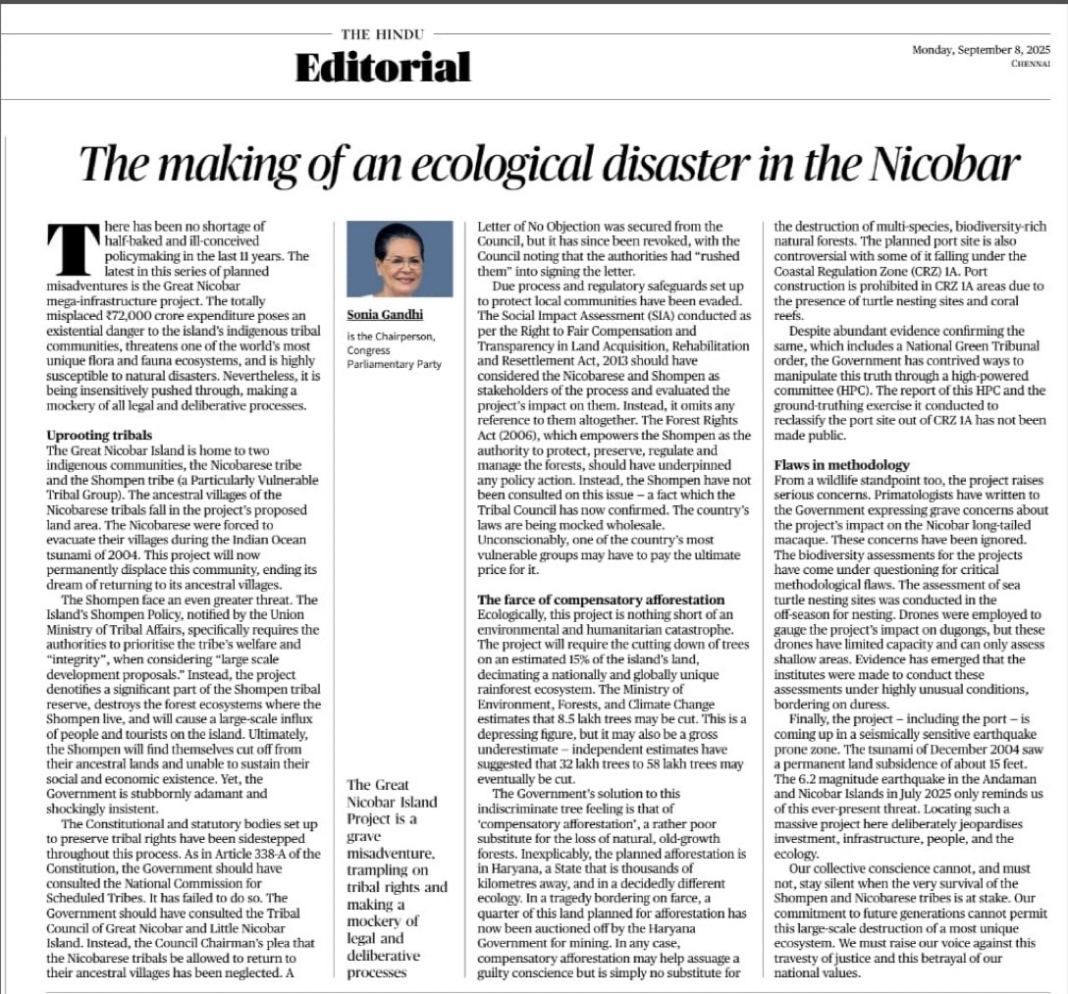
During his visit to the Andaman and Nicobar Islands, Rahul Gandhi called the Great Nicobar Project ‘one of the biggest scams and gravest crimes against this country’s natural and tribal heritage.’ He referred to it as ‘destruction dressed in development’s language.’ In a September 2025 editorial, Congress Parliamentary Chairperson Sonia Gandhi described it as an existential danger to the islands’ indigenous population, the Shompen tribe, and a threat to their distinctive ecosystem. The party has met with tribal elders who have complained about lack of transparency and displacement.
However, it is important to note what the project’s opponents do not address. Rahul Gandhi has not proposed a revised development plan that respects tribal concerns while maintaining vital infrastructure. He hasn’t offered a rehabilitation timeline. He hasn’t even touched on the military aspect. In its current form, the opposition calls for stopping rather than improving.
The National Centre for Sustainable Coastal Management, the Environment Ministry’s High Powered Committee, and the National Green Tribunal have all approved the proposal. The government claims, with substantial evidence, that the port covers roughly 10% of the island’s total area, and that the strategic imperatives are inextricably linked to the economic imperatives, 25% of India’s cargo passing through foreign ports is both a national vulnerability and a logistics inefficiency.
It is hyperbolic and biased to say that the Nicobar project automatically puts the Shompen people in danger. The 2015 Shompen Policy, geofencing, surveillance towers, and a monitoring committee for tribal welfare are just a few of the safeguards the government has put in place to ensure that the project won’t disrupt Shompen communities. Additionally, it has been stated that the project’s clearances include protections, and the administration as a whole continues to help tribal communities with basic infrastructure, health care, education, and other social services.
Who else wants India to stand down
The most obvious form of opposition to the Great Nicobar Project is the political opposition in Parliament. Beneath it is a larger ecosystem of global advocacy, which merits examination because of what it regularly chooses to highlight, what it routinely ignores, and whose interests its findings just so happen to serve. Survival International, a London-based advocacy group that released its annual report mentioning how India plans to sacrifice one of the world’s most isolated tribes to create ‘the new Hong Kong’ in 2025, has been the most vocal global voice opposing the project.
The report, which has received widespread coverage in Western media, declares the initiative genocidal and asks for its immediate abandonment. Additionally, 39 worldwide ‘genocide experts’ wrote an open letter on behalf of Survival International, characterising the project as a death sentence for the Shompen. The language used is remarkable.
However, it is worthwhile to pose a straightforward query: where are the comparable Survival International campaigns opposing China’s infrastructure projects in Tibet, Xinjiang, or along its Belt and Road corridor? These projects have uprooted much larger indigenous populations with minimal tribal consultation and regulatory oversight. The response is that those campaigns are hardly non existent. The largest state directed displacement of indigenous populations in the twenty-first century is taking place next door, and a London based organization with the means to launch a persistent international pressure campaign against democratic India’s nationally approved, officially authorised infrastructure project seems to have found no comparable bandwidth.
This trend was first noted by India’s Intelligence Bureau in 2014, when an official report that was leaked revealed that a number of foreign-funded NGOs consistently opposed infrastructure, mining, and nuclear projects, slowing an estimated $2.8 trillion in GDP growth. The structural observation remains true regardless of the accuracy of every aspect of that report that a nation that is democratic, accessible, and whose courts and regulators react to civil society pressure is, by definition, more vulnerable to globally coordinated opposition campaigns than one that is not. China isn’t. India is.
By definition, people who have become accustomed to the status quo will find it inconvenient when a country asserts itself in the global world order. The Indo-Pacific power dynamics would be altered in ways that go far beyond any bilateral rivalry between China and India if India were to establish a significant naval and economic presence near the Strait of Malacca entry point. Beijing’s maritime calculations, established transshipment hubs that profit from India’s current reliance on foreign ports, and an international NGO ecosystem that has more experience managing developing world governments than taking into account their strategic interests are all disrupted by a more powerful India, and this observation is not paranoid.
Conclusion
China has spent hundreds of billions of dollars and twenty years trying to resolve the Malacca Dilemma. It has constructed ports across the Indian Ocean rim, pipelines through Myanmar, and corridors into Pakistan. It has invested in alternate routes precisely because the Strait of Malacca provides an acute, structural weakness, one that an India with strong Nicobar infrastructure could, in extreme cases, leverage. The single development that would most intensify China’s concerns about Malacca is a fully functional Great Nicobar, complete with a significant transhipment port, a military airport that can accommodate strike and surveillance equipment, and enhanced tri-service command capability. It would imply that India, located at the strait’s entrance, is no longer merely a passive geographical beneficiary. The presence would be strategically active.
The present opposition to this project, which calls for stopping it rather than reforming it or strengthening its tribal protections, coincidentally aligns with Beijing’s preferred conclusion. It might just be a coincidence. It might represent a true, principled, and wholly domestic environmental perspective. It is possible for both to be true. However, in a world where Iran’s geographic location near a strait is worth negotiating a ceasefire, and China’s most acute strategic fear is the waterway outside India’s front door, India’s political leaders owe the country a conversation that is proportionate to the risks.


