

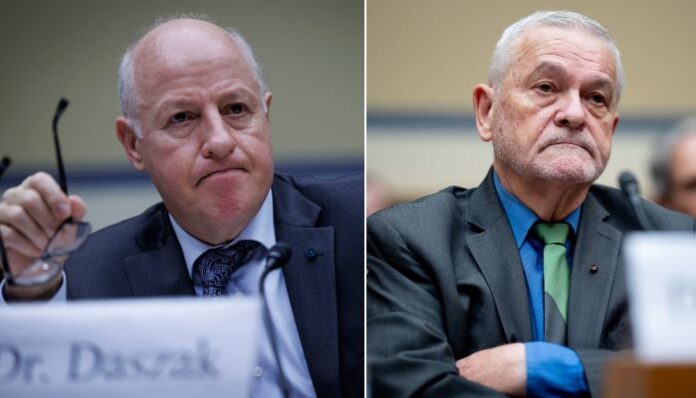
A British zoologist who worked on bat coronavirus research linked to China’s Wuhan is at the centre of fresh questions after US court documents revealed private exchanges between him and a former senior US health official. Dr Peter Daszak, the former president of EcoHealth Alliance, is named as “co-conspirator 1” in a criminal case involving David Morens, a former employee of the National Institute of Allergy and Infectious Diseases (NIAID) and an adviser to Dr Anthony Fauci.
Morens, 78, pleaded guilty this week to conspiring to evade public records laws and hide government documents related to research funding and the COVID-19 pandemic. He could face up to five years in prison. No criminal charges have been filed against Daszak.
Private emails and hidden communications
According to Morens’s signed plea agreement, he communicated with Daszak through his private Gmail account so that their messages could not be accessed through Freedom of Information Act requests.
Court documents also state that Morens and his co-conspirators worked to “counter the narrative that COVID-19 leaked from a lab”. They reportedly concealed some of their communications while publishing papers and articles in a way that could create the appearance of an independent scientific consensus.
In June 2020, emails showed that Morens agreed to write a “scientific commentary” supporting the importance of Daszak’s research. Daszak’s name was to be kept out of the article, making it appear that the piece was fully independent.
Morens wrote to Daszak: “Let’s win this anti-science battle, get you refunded, then settle the scores and kick some ass.” In another message, he said he was working “behind the scenes” to help Daszak and added: “My boxing gloves are on and laced up.”
Wine gifts and support for research funding
Court papers show that Daszak later sent Morens two bottles of The Prisoner Red Napa Valley wine. In his message, Daszak thanked him for his advice, support and “behind the scenes shenanigans” during his battle with officials above him, including a reference to then-US President Donald Trump.
Daszak also promised further expressions of gratitude, including dinners at Michelin-starred restaurants.
Morens had also promised to help Daszak regain funding for bat coronavirus research in China. The funding had been suspended in April 2020 amid concerns over whether the research could have played a role in the pandemic.
The following month, Morens published an article titled The Origin of Covid-19 and Why It Matters. In it, he supported the view that Covid-19 had emerged through a “natural” spillover from animals and argued that research such as Daszak’s should continue to help prevent future pandemics.
Wuhan research under scrutiny
Covid-19 first emerged in Wuhan, around eight miles from the Wuhan Institute of Virology (WIV), where Daszak and EcoHealth Alliance had worked with scientists studying bat coronaviruses. Their work involved collecting and genetically modifying viruses to examine how they could mutate and potentially infect humans.
Prof Richard Ebright, a molecular biologist at Rutgers University, said Morens’s guilty plea was an important step towards holding US officials accountable for funding what he described as reckless research in Wuhan.
Last year, the US Department of Health and Human Services debarred Daszak and EcoHealth Alliance, blocking them from receiving federal funds for five years. The move followed an eight-month investigation that concluded taxpayer money had been used to support dangerous gain-of-function research in China aimed at making viruses more lethal.
WHO probe and questions over COVID origins
Daszak was part of a World Health Organisation (WHO) team that visited the Wuhan Institute of Virology in 2021 to investigate the origins of Covid-19. The visit came as China faced criticism for delays in providing information about where SARS-CoV-2 emerged and how it spread.
The WHO report, which Daszak helped prepare, said a lab leak was possible but unlikely. The report was later widely criticised as a “whitewash”.
Daszak later stepped aside from further Covid origin investigations after failing to disclose his close working relationship with scientists at the Wuhan Institute of Virology.
Viscount Ridley, co-author of Viral: The Search for the Origin of Covid-19, said the record showed that Daszak had supported and funded dangerous gain-of-function experiments involving SARS-like viruses in Wuhan. He also pointed to claims that important details of a 2018 plan involving changes to such viruses had not been made public.
Ridley said Daszak later tried to shut down investigations into whether a laboratory accident could have caused the pandemic, while also supporting a misleading letter published in The Lancet and working to discredit scientists raising questions about the lab-leak possibility.
The case against Morens has brought fresh attention to the private communications between US officials and researchers involved in Wuhan coronavirus work, as well as the efforts made to shape the public debate over the origins of Covid-19.
