

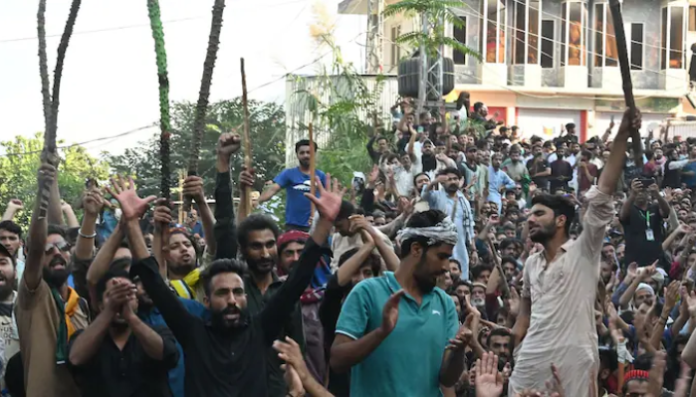
Protesting leaders in Pakistan-occupied Jammu and Kashmir (PoK) where government forces have fired on civilians and killed at least 12 while wounded over 200, have accused authorities of employing force against peaceful demonstrators during ongoing unrest.
On 3rd October, protests in PoK entered their sixth day in a row and spread throughout the area following the deaths of three young men at the hands of Pakistani authorities. Thousands Pakistani people attended their final prayers in Muzaffarabad and displayed their outrage towards Islamabad.
JKJAAC leader Shaukat Nawaz Mir stated, “This was a peaceful lockdown call by the Jammu Kashmir Joint Public Action Committee. All the citizens of Muzaffarabad were peacefully recording their protest on Neelum Bridge when a few people, some facilitators, facilitators of institutions, arrived with institutional weapons in the presence of the administration and police, and opened direct fire on our venue. We have evidence of this. As a result, one of our youth was martyred and more than 20 were injured by the direct fire. We will not forgive this murder under any circumstances.”
#WATCH | Muzaffarabad, PoJK: Leader of Jammu Kashmir Joint Awami Action Committee, Shaukar Nawaz Mir says, "This was a peaceful lockdown call by the Jammu Kashmir Joint Public Action Committee. All the citizens of Muzaffarabad were peacefully recording their protest on Neelum… https://t.co/sd3m4AAp7x pic.twitter.com/z4UfqMbbGL
— ANI (@ANI) October 3, 2025
According to Faisal Jamil Kashmiri, another JKJAAC leader, economic problems and long-standing grievances are the main causes of the demonstrations. “These protests are growing because these promises have not been fully implemented. The issue of the 25 per cent quota which has been in place since 1947, is also a key reason. With an unemployment rate of 64 per cent, our youth are protesting to demand that this quota system be completely abolished,” he pointed out.
Pakistan: A rogue state, a sinking ship
President of the Foreign Affairs Committee of the United Kashmir People’s National Party (UKPNP), Jamil Maqsood, charged Pakistan with repressing its own people and asserted that the people of PoJK now want to rejoin the state of Jammu and Kashmir. “Pakistan is a rogue state. It has a history of oppressing people,” he lashed out.
“It is rampant corruption, liking and disliking, nepotism and the fashion they have imposed on us. The constitutional restraints have actually ignited the local population.POJK is one of the major markets for fake and fabricated food items and everything else which is produced in Pakistan. So, people are deprived of health, education, development, and job opportunities and everything else,” he outlined.
Jamil further declared, “The youth has stood up that we want a united Jammu and Kashmir, we would not allow you to merge or to destroy or to diminish our local identity into Pakistan. Pakistan is sinking the Titanic, and we are not ready to ride on it.”
Jamil pointed out that the people “are not ready to live with Pakistan and the major aspiration and vision of the people in all these regions is to reunite with the erstwhile state of Jammu and Kashmir.” He emphasized that “people are not ready to be silenced,” despite Islamabad’s efforts to use force to quiet these voices.
Jamil conveyed, “The blood and human rights violations and refusing their fundamental human rights in Balochistan, in Sindh, in Khyber Pakhtunkhwa, in other areas, as well as in Gilgit-Baltistan and the Pakistan-occupied part of Jammu and Kashmir reflected a pattern of suppression.”
Attack on journalists
The disturbances also reached Islamabad where police broke into the National Press Club, wounding multiple reporters and destroying equipment. Officers entered the building to arrest Kashmiri reporters who were reporting the protests organised by the Azad Jammu and Kashmir Joint Awami Action Committee (JAAC), according to Pakistani media agencies.
Images from the location showed police beating journalists with batons and trashing media equipment. The crackdown occurred during a nonviolent agitation by a group of attorneys from the Jammu Kashmir Joint Awami Action Committee (JKJAAC), which is spearheading the protests in the valley.
Journalist unions called the raid an attack on press freedom and declared a “Black Day” in response to the widespread indignation it sparked. Police officers using batons were seen hauling protesters outside the eatery in videos.
Notably, authorities have also reportedly directed local media not to cover the daily protests and they have blocked internet and cell phone services in the valley.
New Delhi calls out Islamabad
Meanwhile, the violence committed by Pakistani forces on demonstrators in the region was also denounced by the ministry of external affairs. “We have seen reports on protests in several areas of Pakistan occupied Jammu & Kashmir, including brutalities by Pakistani forces on innocent civilians. We believe that it is a natural consequence of Pakistan’s oppressive approach and its systemic plundering of resources from these territories, which remain under its forcible and illegal occupation,” expressed MEA spokesperson Randhir Jaiswal. He stressed that Pakistan must be held responsible for its “horrible human rights violations.”
The extent of the violence was illustrated by the blood-stained streets which were also covered in expended gunshot casings, broken glass and strewn stones, reported AFP. Police and security personnel swarmed the streets, employing tear gas to quell crowds that peaked at about 6,000.
The protests that started after the administration failed to meet 38 key demands have sparked a broader movement against the military’s transgressions in the region. The movement’s main demand is to remove the 12 assembly seats in PoK reserved for Kashmiri refugees living in Pakistan. The completion of development projects, bread and electricity subsidies, and tax breaks are also at the heart of the anger.
