

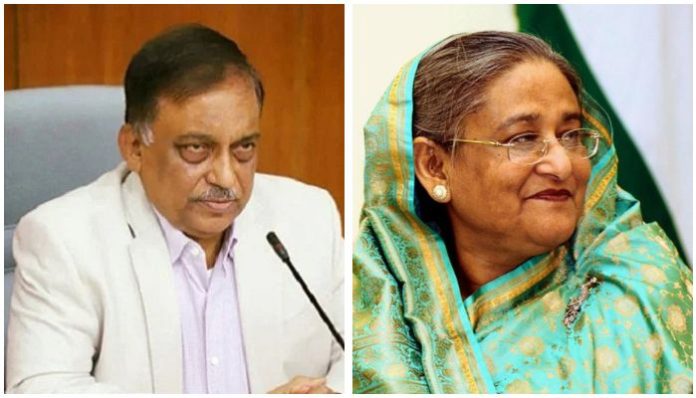
Bangladesh’s political scene has been set on fire with rumours of an army coup and claims of betrayal at the very top. A soon-to-be-released book has made shocking claims about how former prime minister Sheikh Hasina was overthrown through a major international conspiracy.
Hasina’s former home minister, Asaduzzaman Khan Kamal, has accused the country’s current army chief, General Waker-Uz-Zaman, of being part of what he describes as a CIA-backed plan to remove Hasina from power. The book, titled Inshallah Bangladesh: The Story of an Unfinished Revolution, is written by Deep Halder, Jaideep Mazumdar, and Sahidul Hasan Khokon, and will be published by Juggernaut.

“A perfect CIA plot,” says Hasina’s former Home Minister
According to the book, Khan Kamal shared the details during a conversation with the authors at a hotel Delhi on a June morning. He called the power shift in Bangladesh “a perfect CIA(Central Intelligence Agency) plot” that was planned carefully over time.
“We didn’t know that the CIA had Waker in its pocket,” he is quoted as saying. Kamal said that even the country’s main intelligence agencies, the Directorate General of Forces Intelligence and the National Security Intelligence, failed to inform the prime minister of the plot. He suggested that senior members of both agencies might also have been involved, given that the army chief himself was one of the main conspirators.
The U.S. motive: Weakening strong regional leaders
When asked why the US would want to involve itself in the regime change in Bangladesh, Kamal gave two reasons. First, he said, Washington doesn’t want too many powerful leaders in South Asia at the same time, referring to Indian Prime Minister Narendra Modi, China’s Xi Jinping, and Hasina. Strong regional leaders, he argued, make it difficult for the US to push its interests.
The second reason, he claimed, was the strategically located St Martin’s Island in the Bay of Bengal. The island sits just a few kilometres off the coast of Myanmar and has gained importance in recent years due to China’s growing influence in the Indian Ocean region.
Hasina’s warning about US pressure over St Martin’s Island
Hasina herself, before losing power, had told journalists that she was under pressure from Washington to hand over control of St Martin’s Island. In a press conference before her ouster, she had claimed that she was told she could remain in power if she agreed to give the US access to the island. She refused, calling such a move a direct compromise of Bangladesh’s sovereignty.
Even after leaving office, during a Facebook Live session on 11th June, she repeated her accusation that the new government, led by economist Muhammad Yunus, was acting under US influence. “The Indian press is reporting this now, but the prime minister had warned us long before our government fell that the US wants her out to gain control of St Martin’s Island,” Kamal was quoted saying in the book.
The book’s release comes at a time when Bangladesh’s army, which remains under General Waker-Uz-Zaman, is again in the political spotlight. On 11th October, the army admitted in an unprecedented statement that 15 of its officers were being detained for their roles in the enforced disappearances of Hasina’s political opponents during her rule. The development has raised fears of tension and division within the military. Waker, who was supposed to travel to Saudi Arabia soon after, cancelled his visit amid growing internal unease.
“This will deeply unsettle Bangladesh,” says author Deep Halder
According to a report by News18, Lead author Deep Halder said that these revelations will deeply unsettle Bangladesh’s politics. He explained that General Waker had been appointed army chief by Hasina herself, just before she was removed. “Two people in top positions, General Waker and President Md Sahabuddin, were central to many rumours and theories about the power shift,” Halder said. He pointed out that the president has failed to keep the military out of politics, as seen during riots in Gopalganj and the arrests of army officers. Over the past year, rumours circulated that General Waker was acting as “India’s agent.” But this new claim, that he was aligned with the CIA, completely changes that narrative and raises questions about which side he is really on.
In one of the most dramatic parts of the book, Asaduzzaman Khan Kamal compared Hasina’s fate to a famous moment from the Mahabharata. “Like Abhimanyu was trapped and killed by those he trusted, Waker tied up with fundamentalist forces in Bangladesh to bring Hasina down,” he reportedly told the authors.
He said that radical groups like Jamaat-e-Islami Bangladesh, which had long been divided and hostile to each other, came together for the first time with the shared goal of removing Hasina. According to Khan, this alliance of Islamist parties was coordinated under Jamaat’s leadership and backed by external intelligence networks.
How the betrayal unfolded
During their conversation, which the authors describe in detail, two Awami League MPs silently listened as Kamal spoke about how events unfolded. He said that Waker took over as army chief in June 2024 and within weeks, on 5th August 2024, he forced Hasina to leave the country. Kamal believed that removing her was Waker’s “first secret mission”, one that required him to betray the very leader who had promoted him to the top post.
Kamal further said that Pakistan’s Inter-Services Intelligence (ISI) had been working closely with Jamaat. According to him, ISI-trained men had quietly joined Jamaat and played a central role in inciting violence in late June, including attacks on policemen. When he was home minister, Kamal said, senior police officials warned him that foreign-trained militants were mixing with the so called protesters. Concerned, he rushed to inform Sheikh Hasina. But she told him that the army chief had already assured her that the military would control the situation.
Kamal said that even after being told about ISI’s involvement, Waker continued to insist that the army could manage the crowd without involving the police. A day before Hasina was forced to leave, a meeting was held at her residence, Gonobhaban, to assess the situation. Senior officials from the government and security agencies attended the meeting. Kamal said he had proposed that police should secure all entry points into Dhaka to stop agitators from flooding the capital. But Waker disagreed, saying that the public no longer trusted the police and that the army should take charge instead.
Kamal recalled that he even offered to have the police guard the prime minister’s residence. But Waker dismissed the suggestion, assuring both Kamal and Hasina that the army would not allow anyone near Gonobhaban. “She trusted him that evening,” Kamal said, adding bitterly, “and we all know what happened the next day.”
What followed, he implied, was the final act of betrayal. On the morning of 5th August, 2024, Sheikh Hasina’s government fell. She was forced to leave the country under military pressure, marking the end of her long rule. Kamal’s version of events paints Waker as the central figure who set the plan in motion, coordinating with Islamist groups and international agencies to unseat her.
