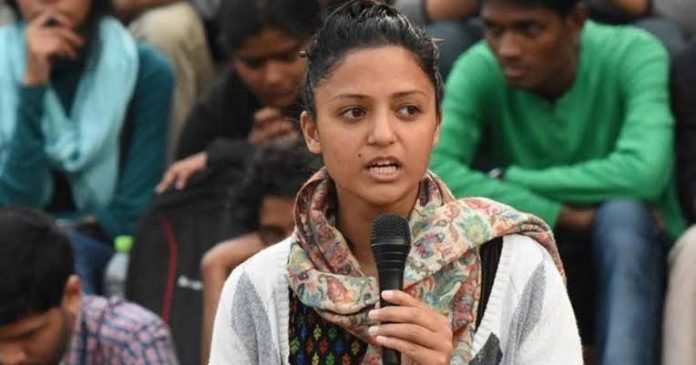
In a series of tweets posted by career-protestor-turned-politician Shehla Rashid today, the former JNUSU vice president brazenly defended Kashmiris embracing the path of terrorism while pinning the blame on India for the same. Shehla, who seemed despondent after UNSC’s refusal to intervene in the Kashmir issue, contended that “Armed insurgency” in Kashmir is a “direct result of violent policies of India since 1953”.
2) … violent policies by the Indian govt since 1953. The Indian govt has always undermined and overthrown the authentic leadership of Kashmiris, and rigged elections, installed puppet regimes. THAT is what pushed Kashmiris to shun the system and take up arms. If anything …
— Shehla Rashid شہلا رشید (@Shehla_Rashid) August 17, 2019
Furthermore, she said that the Indian government is indulging in state terrorism by apparently trampling upon the social, civil and political rights of the Kashmiris. It is noteworthy to mention that Shehla describes the decision to abrogate Article 370 as “terrorism” while normalising the violence inflicted by Kashmiri terrorists as “Armed Insurgency” against the state repression.
Shehla continued her diatribe saying that India has always undermined the authority and will of the Kashmiri people and overthrown the Kashmiri leadership, which is why Kashmiris had to take up the arms and revolt.
4) … in democracy. We might all be gagged and imprisoned, but the international community, Kashmiri diaspora and progressive groups across the world must build pressure on Indian govt to undo its unconstitutional, illegal, unethical and undemocratic actions in Kashmir.
— Shehla Rashid شہلا رشید (@Shehla_Rashid) August 17, 2019
Echoing Pakistan PM Imran Khan, who had earlier foreboded increased terror attacks like Pulwama after the abrogation of Article 370, Shehla said that the revocation will fuel “Armed Insurgency” in Kashmir. She further added that India has weakened the case for democracy and any attempts to hold elections will be termed as a sham.
In a forlorn hope, Shehla exhorted world leaders such Justin Trudeau, Jeremy Corbyn, Bernie Sanders, Jacinda Ardern, Alexandria Ocasio-Cortez and Kashmiri diaspora across the world to put pressure on the Indian government to undo its action in Kashmir.
We, Kashmiris, appeal to progressive leaders @BernieSanders @jeremycorbyn @jacindaardern @AOC @JustinTrudeau in the first-world to understand the issue and not be misled on the issue. The present Kashmir crisis was precipitated by India’s ruling party for its own political gains.
— Shehla Rashid شہلا رشید (@Shehla_Rashid) August 17, 2019
It is pertinent to note here that Shehla Rashid claimed that India has been inflicting atrocities on Kashmiris since 1953. Article 370 was appended in the constitution of India in 1952. If India has been repressing fundamental rights of Kashmiris since 1953, one wonders what is the potency of Article 370? If Article 370 was as powerless as Shehla claims it to be, why in her subsequent tweets she demands Kashmiri diaspora and various other leaders of the world to create pressure on the India government to undo its action in Jammu and Kashmir?
Article 370, by Shehla’s own admission, is superfluous, as she alleges that the Indian government had been continuously involved in subjugating Kashmiris even when it was a part of the constitution. These are meretricious arguments peddled by Shehla which in reality has no integrity. In actuality, Shehla is profoundly distressed with the implications of the revocation of Article 370.
Ever since Article 370 has been rescinded, there is a growing apprehension among Kashmiri politicians of losing relevance and the corresponding fear of fading into oblivion as the central government has assumed the direct control of the state by bifurcating it into two union territories.
Many Kashmiri politicians, therefore, are raising false alarms and indulging in fear-mongering, to somehow get the move reversed. The current utterances from a former activist for hire-turned-politician Shehla Rashid appear as a meltdown of this realisation.