

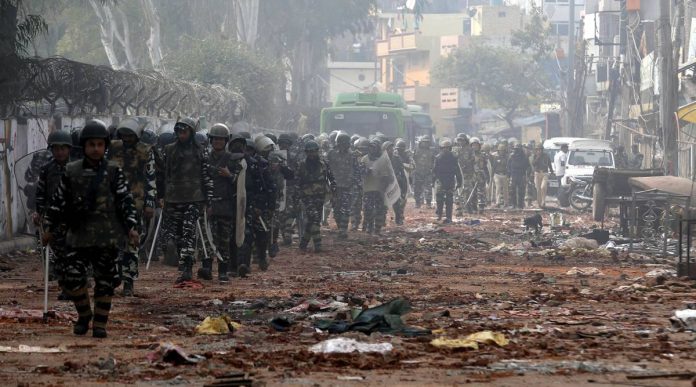
India has had a long history of Hindu-Muslim violence since colonial times. They have already fought thousands of battles over religious matters which have been characterized as “institutionalized communal violence” by political scientists. But what kind of violence broke out during the Delhi 2020 riots? What was the nature and structure of Delhi violence? It was certainly different from the previous incidents of violence. Two years since the horrifying riots that convulsed the national capital, the nature and character of Delhi violence have still not been properly analysed and defined by political scientists.
Delhi violence should be studied from a different political perspective to explore the changing contours of communal violence. It was not simply Hindu-Muslim communal violence but it was violence that had several rounds of political conspiracies. It had many objectives: First, it was violence perpetrated by a separatist group in the national capital against the political sovereignty of our country and to defame the country during the visit of the US President. Second, it was violence that was organized by a Muslim minority group to butcher the Hindu community to uphold political-religious dominance and finally, Delhi violence was planned to retain power in Delhi Assembly. All these objectives manifested in the violent protests that led up to the anti-Hindu Delhi riots in February 2020. That is how Delhi violence has to be studied in a methodological way. The article intends to examine the nature and structure of Delhi violence.
Criticial examination of the nature and the structure of the Delhi Riots 2020
The riot broke out in Northeast Delhi as a part of the anti-CAA protests. In the violence, more than 53 people lost their lives, more than 200 people were left injured and 400 people were displaced. Houses, shops and temples were burnt down and attacked by Muslim mobs. A man named Shahrukh openly threatened common people and police personnel. He was arrested later from the Shamli district of UP. Delhi Police head constable Ratan Lal lost his life while trying to control the protestors.
Section 144 was imposed in several riot-hit areas but prohibitory orders did little to restrain the engulfing violence. Who were the attackers and who provoked the Muslim community?
Attackers were mainly outsiders stationed in schools to execute the violence. Many of them were goons, while others were students purportedly from JNU and Jamia. Former JNU student Umar Khalid was also one of the key accused in the case, who is charged with conspiring to incite violence in the region. Several goons, including Umar Khalid, had been arrested and a judicial proceeding is going on against them. The ‘Urban Naxals’ from academic institutions like JNU and Jamia had prepared the plot to instigate violence against the Hindu community. The Northeast Delhi violence was a clear manifestation of planned genocide against Hindus living in the Muslim-dominated areas.
The Delhi High Court had already declared a well-thought-out conspiracy designed to stoke violence in the national capital. While denying the bail application of one of the accused, namely, Mohammad Ibrahim, Justice Subramanium Prasad strongly said, “The Delhi riots of 2020 were a conspiracy, planned and executed. They evidently did not take place in a spur of the moment.”
Further, the court said in the video footage submitted by the prosecution, “The systematic disconnection and destruction of the CCTV cameras also confirms the existence of a pre-planned and pre-meditated conspiracy to disturb law and order in the city. This is also evident from the fact that innumerable rioters ruthlessly descended with sticks, dandas, bats etc. upon a hopelessly outnumbered cohort of police officials.” In addition, Justice Prasad said, “Individual liberty cannot be used to threaten the fabric of civilised society. Ibrahim was seen on CCTV clips threatening the crowds with a sword.” Ibrahim was accused of killing the head constable Ratan Lal on February 24. Ibrahim had admitted in the court that “he was carrying the sword only to protect himself and his family”.
How the Delhi Riots 2020 signified a new trend in Hindu-Muslim violence
The structure and nature of Delhi violence point towards a new trend in Hindu-Muslim violence. It was the first time that Left-Wing professors from prestigious universities plotted the violence and played an active role in the Hindu genocide. Schools were used by Muslim mobs to target Hindu temples and belongingness. It was a political conspiracy to not only challenge the political sovereignty of India but also to defame the nation in a global society. The open gun culture was another important feature of the violence. The minority community, by taking part in this Hindu genocide, demonstrated their readiness to use violence in order to subjugate the majority Hindu community.
The politically vested interest groups who have miserably failed to defeat prime minister Modi in elections had planned genocide of Hindus in the national capital. They did not even think for a while that India is also their motherland and how can they break the unity and sovereignty her. These attitudes of the separatist groups give birth to the changing contours of communal violence in contemporary India.
(Kamalakanta Roul teaches political science at the University of Delhi. He can be contacted at [email protected])


